The impact of science instructors' Pedagogical Content Knowledge (PCK) on educational practice was studied in this study. Synthesis of a teacher's subject knowledge and pedagogical skill is described as PCK. The study's goal was to see if there was a link between Ghanaian science instructors' PCK and classroom practices. This research employed a descriptive survey approach. Eighty (80) teachers were randomly recruited and data was collected using a standardized questionnaire. Simple percentages and charts were used to organize and illustrate the data. It was revealed that subject matter understanding varies depending on a teacher's level of education. Experienced teachers, on the other hand, demonstrated greater pedagogical expertise and were better able to improve academic achievement than inexperienced teachers. The formal education of a teacher was a strong predictor of their knowledge and ability in the classroom. According to the findings of this study, teachers' pedagogical and subject-matter knowledge are crucial for effective science instruction and student comprehension.
Educators are well aware that teaching is a difficult process that requires the integration of a variety of specialized knowledge. Pedagogical Content Knowledge (PCK) has been a hot topic of discussion in recent decades when it comes to teaching quality. In recent years, improving the quality of teaching professionals has been critical in order to improve student learning outcomes. Finding and retaining experienced instructors, on the other hand, has become a concern in most emerging countries. Evidence from research 1 and literature resulting from reform initiatives 2 has shown that science instructors' subject area knowledge has changed in value. Teachers' pedagogical and subject-matter expertise are unquestionably important for effective science instruction and student comprehension 3. 4 created the term "pedagogical content knowledge" (PCK) to define a teacher's subject knowledge combined with pedagogical experience.
PCK refers to teachers' combined content and pedagogical knowledge, with subjects adapted to students' abilities and interests 5. PCK has been labeled as content/topic knowledge (CK), pedagogical knowledge (PK), and student knowledge (SK) in various studies 6. PCK aids the tutor in clearing up student misconceptions about the content being studied.
1.1. Content Knowledge (CK)Content knowledge refers to a teacher's basic understanding of a subject and a specific area of content. 4 defines conceptual knowledge as "knowledge of concepts, theories, ideas, organizational frameworks, knowledge of evidence and proof, as well as established procedures and approaches to creating such knowledge." Because knowledge and the nature of inquiry vary widely between domains, teachers should comprehend the deeper knowledge basics of the disciplines in which they teach. In the context of science, this would comprise scientific facts and ideas, the scientific process, and evidence-based reasoning. The cost of not having a broad basis of content knowledge can be exorbitant; students, for example, may be given incorrect information and develop preconceptions about the subject 7. Content knowledge refers to a teacher's basic understanding of a subject and a specific area of content. 4 defines conceptual knowledge as "knowledge of concepts, theories, ideas, organizational frameworks, knowledge of evidence and proof, as well as established procedures and approaches to creating such knowledge." Because knowledge and the nature of inquiry vary widely between domains, teachers should comprehend the deeper knowledge basics of the disciplines in which they teach. In the context of science, this would comprise scientific facts and ideas, the scientific process, and evidence-based reasoning. The cost of not having a broad basis of content knowledge can be exorbitant; students, for example, may be given incorrect information and develop preconceptions about the subject 7. For years, several researchers have focused on the concept that teachers' content expertise influences students' accomplishment. The obstacles in the teaching-learning process, according to 8, are related to a lack of instructor knowledge. Teachers' content expertise, they believe, is a prerequisite for effective teaching 9. Furthermore, the content knowledge of teachers has a significant impact on student achievement and influences the learning and teaching process. The material competence of a teacher can assist them in taking more initiative in the classroom. It also drew the attention of more teachers to the significance of continuing their education.
Content knowledge is one of the most significant prerequisites for teacher certification in Ghana. To teach at a basic or senior high school, the Ministry of Education (MoE) and Ghana Education Service (GES) both demand a minimum of a diploma and a bachelor's degree from a recognized institution. In addition to an academic requirement, teachers must have current teacher's licenses. To keep teachers' material knowledge up to date, several in-service professional development programs are organized. However, numerous researches have discovered that a variety of factors, including topic understanding and pedagogical abilities, can influence the effectiveness of science teaching and learning 10. Teachers may have additional possibilities to learn outside of the classroom because education stimulates their knowledge of material and pedagogy.
1.2. Pedagogical Knowledge (PK)Pedagogical knowledge refers to a teacher's comprehensive understanding of the processes, practices, and strategies of teaching and learning (PK). They address a wide range of issues, such as educational aims, values, and ambitions. Generic knowledge includes things like understanding how students learn, general classroom management abilities, lesson planning, and student evaluation. Knowledge of classroom procedures or methods, the nature of the intended audience, and strategies for testing student comprehension are all part of it. A teacher with considerable pedagogical expertise understands how students build healthy learning habits and attitudes as well as how they construct knowledge and abilities 9. As a result, pedagogical knowledge involves a grasp of cognitive, social, and developmental learning theories, as well as how they apply to classroom pupils.
Pedagogical knowledge, according to 4, is "knowledge, theory, and notion about the act of training and the way of learning," and "figures the teacher's tactics in turning in a topic outside the classroom." The learning approach encompasses all actions connected to generating materials, classroom management, learning habits, problem-solving, methodology, strategy, and assessment 11. The success of those activities determines the development of students' learning outcomes.
12 sought to measure the pedagogical expertise of seasoned and inexperienced ESL (English as a Second Language) instructors. He discovered that the two groups share educational knowledge in common. Instructors with more experience, on the other hand, had a better grasp of pedagogy, particularly in detecting students' attitudes and behaviours 12. It signifies that instructors' years of experience in the classroom have helped them strengthen their pedagogical understanding. According to the Gatbonton study, instructors' pedagogical knowledge may also be expanded by the instruction they acquired during their undergraduate studies. 11 study on pre-service math and technology educators in Australia is supported by this. Pre-service instructors' pedagogical understanding was found to have been enhanced by coursework, mentoring, and fieldwork during their college years 11. More experience and training opportunities, Hudson continued, would be required to increase teacher quality. The topic expertise of instructors is improved through teacher education. As a result of this training, teachers are encouraged to improve the quality of teacher education. In addition, greater chances for professional growth exist for experienced teachers. Teachers who have been in the classroom for a long time are familiar with a wide range of scenarios that can happen during the learning process. As a result, they can come up with learning strategies for a wide range of scenarios. Furthermore, more experienced teachers are more likely to be able to deal with a wide range of student personalities. As a result, they may have a better grasp of student learning issues than novice teachers.
Researchers rank different areas of teacher expertise differently, but they all agree that preparing pupils to study a subject is crucial when teaching them. It is possible to state that the teacher's subject knowledge influences the children's learning. At PCK, students only respond to instructions if they are confident in their understanding and communicate with the teacher. As a result, teachers will be able to "catch" their students' mistakes and errors. In this way, teachers will be able to swiftly correct their misunderstandings and faults. As a result, teachers must be well-versed in the subject they are instructing. Teachers' perceptions of subject knowledge are influenced, in general, by their understanding of instructional material. Experienced and skilled professors can help students make learning more meaningful 13. Training and education are pointless without a deep comprehension of the subject. Any good training should involve a PCK. The PCK covers both conceptual and procedural knowledge, as well as the stages required to move from ignorance to mastery. As a result, teachers must know how to effectively instruct kids. Teacher expertise is widely recognized as a predictor of instructional quality and classroom behaviour 14. Given the importance of pedagogical content knowledge in education 4, this research will investigate the pedagogical content knowledge of science instructors in Ghana and its impact on educational practice.
In this study, the descriptive survey method was applied. A descriptive research study 15 aims to determine the nature of a situation as it exists at the time of the investigation. 16 also pointed out that the descriptive survey method allows the researcher to get feedback from a representative sample of the target group in order to infer the general public's perception. As a result, the descriptive survey method was chosen for this investigation. Ghana, a West African country with a population of roughly 31 million people, hosted the study 17. Teachers from both senior high and junior high schools were interviewed. Because reaching a big number of people in a short length of time is quicker and less expensive, the researcher used an online survey to reach out to the respondents.
2.1. Sample Size and Sampling TechniqueThe sample for the study was chosen using a simple random sampling approach. A total of 80 SHS and JHS teachers were randomly sampled to make up the sample size. Simple random sampling, according to 18 allows researchers to assure that all participants (teachers) have an equal probability of being chosen for the study.
2.2. Research InstrumentsA structured questionnaire was developed and utilised to collect data as the study instrument. The questionnaire consisted of closed-ended questions for the teachers to complete. According to 18, closed-ended questions are simple to compile and write, and they do not discriminate based on how articulate the replies are. "Strongly agree" (SA), "Agree" (A), "Disagree" (D), and "Strongly Disagree" (SD) were the four Likert-type scales. The Likert scale is one of the most extensively used techniques to measure attitudes, according to 19. The questionnaire was face validated whiles the test-retest method was used to ascertain its reliability which yielded a co-efficient of 0.87. A reliability co-efficient of 0.80 and 0.90 inclusive is considered appropriate 20.
2.3. Data Collection Analysis ProcedureThe researcher used Google forms to design the questionnaire. Confidentiality statement was included in the questionnaire explaining the purpose of the study to the respondents, and assuring them of anonymity and confidentiality of their responses. The questionnaire was then administered via social media platforms to obtain a pool of responses from the target group. The researcher therefore used a simple random sampling technique to select 80 completed questionnaires from the pool for the study. This procedure resulted in a return rate of 100% since there was a pool of responses to sample from. The data was collated and in frequency distribution tables using simple percentages, and charts for discussion.
Eighty teachers from JHS and SHS were sampled for the study using an online survey technique.
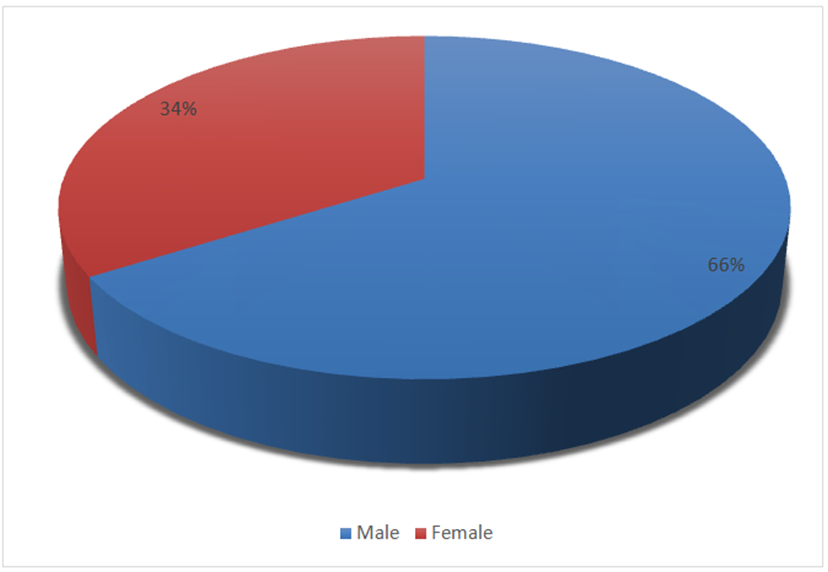
The distribution according to gender of respondents has been presented in Figure 1.
Majority of the respondents of the survey, (52) representing 66% were males, whiles (28) 34% were females.


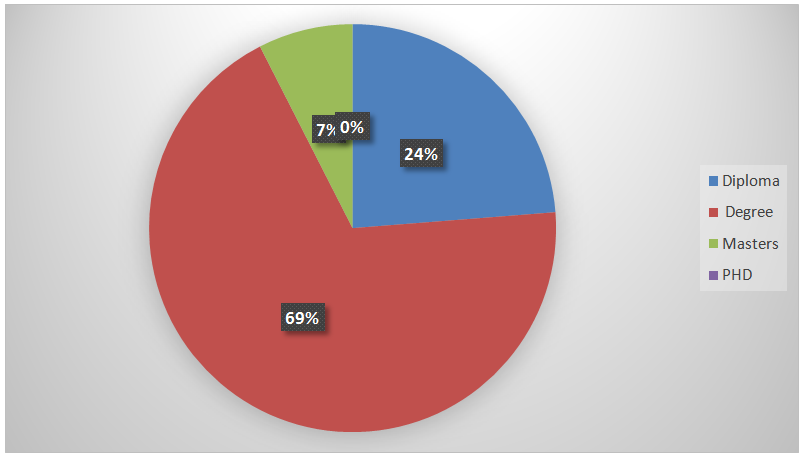
It is evident form the data gathered that 19 respondents representing 24% of the sample size were diploma holders. Majority of the respondent, 55, representing 69% were degree holders whilst 6 respondents representing 7% were having their master’s degree. None of the respondents were PHD holders during the survey.
According to Table 1, all of the teachers believed that qualified teachers will know how to best communicate content for students' understanding, and none of the respondents disagreed. Again, 95 percent of respondents agreed that a teacher's productivity in the classroom is determined by the level of training he or she receives, while just 5% disagreed. Again, all of the teachers in this survey believed that teachers who are completely prepared and credentialed are more successful with students than teachers who are not. 96.2 percent of the instructors polled believed that a teacher's formal education is a crucial predictor of their knowledge and competence in the classroom, while the remainder 3.8 disagreed. Furthermore, all of the survey participants felt that a teacher's subject content understanding is dependent on their level of qualification.
All of the participants in this survey disagree that the teacher possesses all of the knowledge and information that the learners do not. In addition, 96.2 percent of the participants believed that experienced teachers are more capable of boosting academic performance than inexperienced teachers, while only 3.8 percent disagreed.
Furthermore, 98.7% of the respondents believed that the more experience a teacher has, the easier it is for him or her to teach, whereas 1.3 percent disagreed. Again, 95% of respondents believed that the teaching process aids in the recollection or unfolding of knowledge, whereas 5% disagreed. Finally, all of the participants agree that a teacher must be knowledgeable in his or her subject, be able to regulate his or her learners throughout lesson delivery and be able to evaluate and supervise students' ongoing work.
The results of this study revealed that a teacher's qualifications have a considerable impact on students' academic achievement. This backs up findings of 21 which posited that a teacher's formal qualification is a significant predictor of their knowledge and ability in the classroom; it is useful in determining how well-equipped teachers are for the subjects they must teach in schools. Qualified teachers are typically strong and well prepared to handle large, average, or few students in a classroom, since they have been shown to be more successful with students than teachers who have not gone through this training. In a similar study, 22 also suggested not exclusively that academic qualification of teachers has positive correlations with teaching and student performance.
Only qualified teachers know how best to handle students, draw out their intellectual resources, and accomplish improved student performance with the kind of population utilised. As a result, teacher qualification is a significant indicator of their knowledge and competency. This confirms previous research by 23 which found that teacher experience and student academic performance are positively correlated, with students taught by more experienced teachers achieving at a higher level because their teachers have mastered the content and acquired classroom management skills/expertise to deal with various types of classroom problems. The researchers are equally not oblivious of the fact that not only mastering of the subject area result in effective teaching, but this should be accompanied by effective communication 22.
Teaching, as a multifaceted entity, entails a number of interconnected factors aimed at transferring knowledge and skills to students. Teacher content knowledge, teaching skills, teacher attitude, and teacher attendance are all elements of teacher expertise. Successful teaching requires the ability to respond to students as individuals. Individual duties contribute to the development of trust in the teacher-student interaction. One of the most important aspects of a good school is a competent teaching staff. Competent teaching requires good teachers who are masters of their subjects and who use meaningful praise (stimulus-response systems) to keep students engaged in the learning process.
The impact of science instructors' pedagogical content knowledge on their instructional practice is investigated in this study. It was discovered that in-depth subject knowledge and pedagogical experience are both essential components of good instruction. It was also observed that highly trained teachers especially at masters and PhD levels are very few and non-existence in some regards.
| [1] | Dare, E. A., Ellis, J. A., & Roehrig, G. H. (2018). Understanding science teachers’ implementations of integrated STEM curricular units through a phenomenological multiple case study. International Journal of STEM Education, 5(1), 1-19. | ||
| In article | View Article PubMed | ||
| [2] | Chai, C. S., Jong, M., Yin, H. B., Chen, M., & Zhou, W. (2019). Validating and modelling teachers’ technological pedagogical content knowledge for integrative science, technology, engineering and mathematics education. Journal of Educational Technology & Society, 22(3), 61-73. | ||
| In article | |||
| [3] | Rutt, A., & Mumba, F. (2019). Developing preservice teachers’ understanding of and pedagogical content knowledge for history of science–Integrated science instruction. Science & Education, 28(9), 1153-1179. | ||
| In article | View Article | ||
| [4] | Shulman, L. (1986). Those who understand: Knowledge growth in teaching. Educational Researcher, 15(2), 4-14. | ||
| In article | View Article | ||
| [5] | Elas, N., Majid, F., & Narasuman, S. (2019). Development of technological pedagogical content knowledge (TPACK) for english teachers: The validity and reliability. International Journal of Emerging Technologies in Learning (IJET), 14(20), 18-33. | ||
| In article | View Article | ||
| [6] | Liu, S. H., & Lee, G. G. (2013). Using a concept map knowledge management system to enhance the learning of biology. Computers & Education, 68, 105-116. | ||
| In article | View Article | ||
| [7] | Doyle, J., Sonnert, G., & Sadler, P. (2020). How professional development program features impact the knowledge of science teachers. Professional Development in Education, 46(2), 195-210. | ||
| In article | View Article | ||
| [8] | Lawrence, J. E., & Tar, U. A. (2018). Factors that influence teachers’ adoption and integration of ICT in teaching/learning process. Educational Media International, 55(1), 79-105. | ||
| In article | View Article | ||
| [9] | Lee, Y., Capraro, R. M., & Capraro, M. M. (2018). Mathematics teachers’ subject matter knowledge and pedagogical content knowledge in problem posing. International Electronic Journal of Mathematics Education, 13(2), 75-90. | ||
| In article | View Article | ||
| [10] | Quansah, R. E., Sakyi-Hagan, N. A., & Essiam, C. (2019). Challenges affecting the teaching and learning of integrated science in rural junior high schools in Ghana. Science Education International, 30(4), 329-333. | ||
| In article | View Article | ||
| [11] | Hudson, P. (2007). Examining mentors' practices for enhancing preservice teachers' pedagogical development in mathematics and science. Mentoring & Tutoring, 15(2), 201-217. | ||
| In article | View Article | ||
| [12] | Gatbonton, E. (2008). Looking beyond teachers' classroom behaviour: Novice and experienced ESL teachers' pedagogical knowledge. Language Teaching Research, 12(2), 161-182. | ||
| In article | View Article | ||
| [13] | Olsen, B. (2015). Teaching what they learn, learning what they live: How teachers' personal histories shape their professional development. Routledge. | ||
| In article | View Article | ||
| [14] | Barendsen, E., & Henze, I. (2019). Relating teacher PCK and teacher practice using classroom observation. Research in Science Education, 49(5), 1141-1175. | ||
| In article | View Article | ||
| [15] | Clandinin, D. J., & Connely, F. M. (2000), Introduction to research in education (2nd ed.). Rinchart and Winston Inc. | ||
| In article | |||
| [16] | Polit, D. F., & Beck, C. T. (2010). Generalization in quantitative and qualitative research: Myths and strategies. International Journal of Nursing Studies, 47(11), 1451-1458. | ||
| In article | View Article PubMed | ||
| [17] | Ghana. Statistical Service. (2022). 2021 Population and housing census: Summary report of final results. Ghana Statistical Service. | ||
| In article | |||
| [18] | Cohen, L., Manion, L., & Morrison, K. (2008). The methodology of educational research. Athens: Metaichmio. | ||
| In article | |||
| [19] | Taherdoost, H. (2019). What is the best response scale for survey and questionnaire design; review of different lengths of rating scale/attitude scale/Likert scale. Hamed Taherdoost, 1-10. | ||
| In article | |||
| [20] | De Villiers, J. (1991). Why questions. Papers in the acquisition of WH, 155-173. | ||
| In article | |||
| [21] | Habibi, B., Hartinah, S., Umam, R., Syazali, M., Lestari, F., Abdurrahman, A., & Jauhariyah, D. (2019). Factor determinants of teacher professionalism as development of student learning education at school of SMK PGRI in Tgal City, Indonesia. Journal of Gifted Education and Creativity, 6(2), 123-132. | ||
| In article | |||
| [22] | Darling-Hammond, L., & Youngs, P. (2002). Defining “highly qualified teachers”: What does “scientifically-based research” actually tell us?. Educational researcher, 31(9), 13-25. | ||
| In article | View Article | ||
| [23] | Harris, D. N., & Sass, T. R. (2011). Teacher training, teacher quality and student achievement. Journal of Public Economics, 95(7-8), 798-812. | ||
| In article | View Article | ||
Published with license by Science and Education Publishing, Copyright © 2022 Collins Owusu-Fordjour, Charles Kwesi Koomson, Stephen Annan Twumasi, Michael Afari Baidoo, Prosper Deo-Donne Lumor, Napthali Mensah and Elizabeth Konadu
 This work is licensed under a Creative Commons Attribution 4.0 International License. To view a copy of this license, visit
http://creativecommons.org/licenses/by/4.0/
This work is licensed under a Creative Commons Attribution 4.0 International License. To view a copy of this license, visit
http://creativecommons.org/licenses/by/4.0/
| [1] | Dare, E. A., Ellis, J. A., & Roehrig, G. H. (2018). Understanding science teachers’ implementations of integrated STEM curricular units through a phenomenological multiple case study. International Journal of STEM Education, 5(1), 1-19. | ||
| In article | View Article PubMed | ||
| [2] | Chai, C. S., Jong, M., Yin, H. B., Chen, M., & Zhou, W. (2019). Validating and modelling teachers’ technological pedagogical content knowledge for integrative science, technology, engineering and mathematics education. Journal of Educational Technology & Society, 22(3), 61-73. | ||
| In article | |||
| [3] | Rutt, A., & Mumba, F. (2019). Developing preservice teachers’ understanding of and pedagogical content knowledge for history of science–Integrated science instruction. Science & Education, 28(9), 1153-1179. | ||
| In article | View Article | ||
| [4] | Shulman, L. (1986). Those who understand: Knowledge growth in teaching. Educational Researcher, 15(2), 4-14. | ||
| In article | View Article | ||
| [5] | Elas, N., Majid, F., & Narasuman, S. (2019). Development of technological pedagogical content knowledge (TPACK) for english teachers: The validity and reliability. International Journal of Emerging Technologies in Learning (IJET), 14(20), 18-33. | ||
| In article | View Article | ||
| [6] | Liu, S. H., & Lee, G. G. (2013). Using a concept map knowledge management system to enhance the learning of biology. Computers & Education, 68, 105-116. | ||
| In article | View Article | ||
| [7] | Doyle, J., Sonnert, G., & Sadler, P. (2020). How professional development program features impact the knowledge of science teachers. Professional Development in Education, 46(2), 195-210. | ||
| In article | View Article | ||
| [8] | Lawrence, J. E., & Tar, U. A. (2018). Factors that influence teachers’ adoption and integration of ICT in teaching/learning process. Educational Media International, 55(1), 79-105. | ||
| In article | View Article | ||
| [9] | Lee, Y., Capraro, R. M., & Capraro, M. M. (2018). Mathematics teachers’ subject matter knowledge and pedagogical content knowledge in problem posing. International Electronic Journal of Mathematics Education, 13(2), 75-90. | ||
| In article | View Article | ||
| [10] | Quansah, R. E., Sakyi-Hagan, N. A., & Essiam, C. (2019). Challenges affecting the teaching and learning of integrated science in rural junior high schools in Ghana. Science Education International, 30(4), 329-333. | ||
| In article | View Article | ||
| [11] | Hudson, P. (2007). Examining mentors' practices for enhancing preservice teachers' pedagogical development in mathematics and science. Mentoring & Tutoring, 15(2), 201-217. | ||
| In article | View Article | ||
| [12] | Gatbonton, E. (2008). Looking beyond teachers' classroom behaviour: Novice and experienced ESL teachers' pedagogical knowledge. Language Teaching Research, 12(2), 161-182. | ||
| In article | View Article | ||
| [13] | Olsen, B. (2015). Teaching what they learn, learning what they live: How teachers' personal histories shape their professional development. Routledge. | ||
| In article | View Article | ||
| [14] | Barendsen, E., & Henze, I. (2019). Relating teacher PCK and teacher practice using classroom observation. Research in Science Education, 49(5), 1141-1175. | ||
| In article | View Article | ||
| [15] | Clandinin, D. J., & Connely, F. M. (2000), Introduction to research in education (2nd ed.). Rinchart and Winston Inc. | ||
| In article | |||
| [16] | Polit, D. F., & Beck, C. T. (2010). Generalization in quantitative and qualitative research: Myths and strategies. International Journal of Nursing Studies, 47(11), 1451-1458. | ||
| In article | View Article PubMed | ||
| [17] | Ghana. Statistical Service. (2022). 2021 Population and housing census: Summary report of final results. Ghana Statistical Service. | ||
| In article | |||
| [18] | Cohen, L., Manion, L., & Morrison, K. (2008). The methodology of educational research. Athens: Metaichmio. | ||
| In article | |||
| [19] | Taherdoost, H. (2019). What is the best response scale for survey and questionnaire design; review of different lengths of rating scale/attitude scale/Likert scale. Hamed Taherdoost, 1-10. | ||
| In article | |||
| [20] | De Villiers, J. (1991). Why questions. Papers in the acquisition of WH, 155-173. | ||
| In article | |||
| [21] | Habibi, B., Hartinah, S., Umam, R., Syazali, M., Lestari, F., Abdurrahman, A., & Jauhariyah, D. (2019). Factor determinants of teacher professionalism as development of student learning education at school of SMK PGRI in Tgal City, Indonesia. Journal of Gifted Education and Creativity, 6(2), 123-132. | ||
| In article | |||
| [22] | Darling-Hammond, L., & Youngs, P. (2002). Defining “highly qualified teachers”: What does “scientifically-based research” actually tell us?. Educational researcher, 31(9), 13-25. | ||
| In article | View Article | ||
| [23] | Harris, D. N., & Sass, T. R. (2011). Teacher training, teacher quality and student achievement. Journal of Public Economics, 95(7-8), 798-812. | ||
| In article | View Article | ||