Traditionally, practice exercises, activities, and assessments were organized in blocks in many textbooks and learning materials. That is, each practice exercise contains only its assigned topic. This type of practice was referred to as block practice. In contrast, interleave practice involves alternating assignments, activities, and assessments. This research aimed to investigate the effect of interleaved practice incorporated into a learning module on the problem-solving fluency of students officially enrolled in Mathematics in the Modern World (MMW) at St. Michael's College, Iligan City. To further investigate the effectiveness of interleave practice in enhancing students' problem-solving fluency, the study adopted a quasi-experimental pretest-posttest control design. Two intact sections composed of 54 participants were used: one experimental group (n = 28) was exposed to an interleaved practice-learning module, whereas the control group (n = 26) was exposed to a traditional (block practice) learning module. To analyze the result of the data, the researcher utilizes mean, standard deviation, and analysis of covariance (ANCOVA). The data analysis resulted in interleave practice significantly increased students' Problem-Solving Fluency test scores compared to conventional practice. It is recommended that interleave practice be incorporated into assignments, activities, and evaluations. A large scale of the responder is studied, including other institutions, to maximize the intervention's effectiveness.
When it comes to mathematics education, the premise that mathematics is about understanding rather than memorization is the driving force behind the focus on problem solving. As opposed to remembering and applying a set of procedures, the process of problem solving allows students to develop an understanding and articulate the processes utilized to arrive at solutions. To help student in enhancing their problem-solving skills, requires consistency in doing practice problems.
Many researchers have investigated the arrangement of practice problems in mathematics and on other field. This practice arrangement referred to particular types: blocked practice and interleaved practice. The conventional approach is block practice, wherein learning contents are introduced and practiced successively. In contrast, interleave practice is the mixing up or alternating practice problems. Several accounts contributed to the significant result of alleviating learning when integrating interleave practice. Such accounts were shuffling of practice problems in counting principles 1, acquisition of subtraction strategies 2, 3, improving long-term retention of learned content 4, and several classroom experiments found positive effects on mathematics learning 5, 6, 7, 8
Interleaving, in particular, has not yet been fully established to see if it is effective for undertakings that need significant problem-solving. This question is relevant to a wide range of situations where interleaving may be implemented. With these, the main aim of this study is to determine the significant impact of interleave practice on students’ problem-solving fluency. Specifically, the study intends to answer the following:
1. What is the pretest and posttest profile of the respondents in terms of the level of problem-solving fluency (PSF) as they are exposed to:
1.1. conventional block practice
1.2. interleave practice
2. How does the level of problem-solving fluency of the students compare as influence by the conventional block practice and interleave practice?
This study is grounded on the theories of the Discriminative-contrast hypothesis by Birnhau et al. 9 and the Sequential Attention Theory by Carvalho and Goldstone 10. Discriminative-contrast hypothesis emphasizes that blocked practice makes it easier to detect the similarities between different subjects and interleave practice makes it easier to notice the differences between different topics. With this in mind, it is possible that interleaving is beneficial because it juxtaposes distinct categories, highlighting disparities between them and facilitating discrimination learning. Studying things from the same category (block study) makes the similarities between temporally surrounding items more salient, increasing the probability of being utilized for categorization. In general, block practice makes processing similarities within a category easier, whereas interleaving makes it easier to process differences between categories.
Furthermore, Sequential attention theory emphasizes that sequencing of learning impacts learning because it creates demands on what information is attended to and encoded in the student's memory. This is why interleaved study leads to a more significant encoding of differences across categories. In contrast, blocked practice leads to a better encoding of similarities among items in the same category 11.
The study used a quasi-experimental design utilizing a pretest-posttest control group to determine the impact of interleave practice on students’ problem-solving fluency. This involves the experimental (n=26) and control (n=28) groups, composed of students from two intact sections and officially enrolled in Mathematics in the Modern World (MMW) course at St. Michael’s College, Iligan City.
The entire duration of the experiment, the researcher used the subject MMW with topics on Fibonacci and Patterns, Inductive and Deductive Reasoning and Problem Solving Strategies.
The research used a self-made questionnaire validated by experts teaching mathematics and pilot-tested to measure consistency with Cronbach alpha α=0.721 an acceptable reliability leaving eight open-ended questions in the Problem-solving fluency test rated using the scale of Duque and Tan 12.
The researchers took the delivery of the lesson. The entire experiment has two process. First, the distribution of the learning module wherein students are encouraged to do self-paced learning. Second stage is for student to pass the formative assessment with passing rate of 60%, which is above the institutions’ passing score in every formative test. The researcher decided to leverage the passing rate since the students in these sections are coming from College of Education and College of Criminology that have retention policy.
The first week of the class were used to pre-test of Problem-Solving Fluency (PSF) test to determine students’ level of problem-solving fluency. Right after the pretest, the first learning module were distributed to both experimental and control group. The learning module differs in each group. The experimental group learning module was integrated with interleave practice assessment, assignment, and exercises, while the control group learning module was the conventional block arrangement of assessment, assignment, and exercises. Table 1 shows a sample arrangement of assignment, activities, and exercises of the two learning modules.
Students were given two weeks to study, were encouraged for consultation, were required to submit weekly assignments and activities, and were given time for feedback prior to scheduling for formative assessment. The formative assessment served as a basis for advancement to the next learning module. The student who did not meet the 60% passing rate was referred for consultations, and another round of formative tests was scheduled. After everyone had completed the learning modules, a post-test was given.
Following that, descriptive analysis of the data were conducted using the mean and standard deviation to measure the level of problem-solving fluency of the student. Simultaneously, analysis of covariance was used to determine the significant difference between the experimental and control groups' post-test scores, with the pretest score as a covariate. This statistical tool is more appropriate for this analysis since it conforms to the necessary statistical assumptions such as variables are continuous with two categories for independent variable, independence of observations, no significant outliers, normality of the residual, linearity, homogeneity of variances, homoscedasticity, and homogeneity of regression slopes,
Table 2 shows the analysis result on the mean scores and standard deviation of students’ problem-solving fluency test. The result illustrated a beginner description of the pretest score for both groups as demonstrated by mean scores from 6.73 to 7.61. This indicates that their problem-solving fluency is comparable between groups.
In the posttest, the score revealed an increased score in both groups for the problem-solving fluency test. Remarkably, the experimental group showed a noticeable increase in the score compared to the control group. This can be an indicator that interleaved practice help in improving the problem-solving fluency of the students to exemplary with a score difference of 27.43. Furthermore, the table shows an increase of 24.77 scores in control, which describe as proficient. Though there is an increase in the problem-solving fluency score of the control group in the posttest, this may be because the control group has been exposed to different problem-solving strategies. Moreover, it can be observed that participants in the control group have a standard deviation of 3.46, quite the same as the standard deviation of the experimental group of 2.35. This explains that both groups have the almost same level of variation in test scores before the treatment. It is noticeable in the posttest the big difference in the standard deviation between the control group and experimental group. The score of the control group varies in amount ±5.05, while the experimental group test score varies by amount ±3.74. This implies that the level of problem-solving fluency in both groups varied explicitly.
Overall, both the control and experimental groups received scores categorized as beginner-level problem-solving fluency before the experiment's onset. This means that students were unable to establish problem-solving techniques prior to the experiment, as demonstrated by their pretest score. Although both groups improved on their posttest, students in the experimental group improved more than those in the control group, indicating that students' exposure to interleaved practice enhanced their problem-solving fluency.


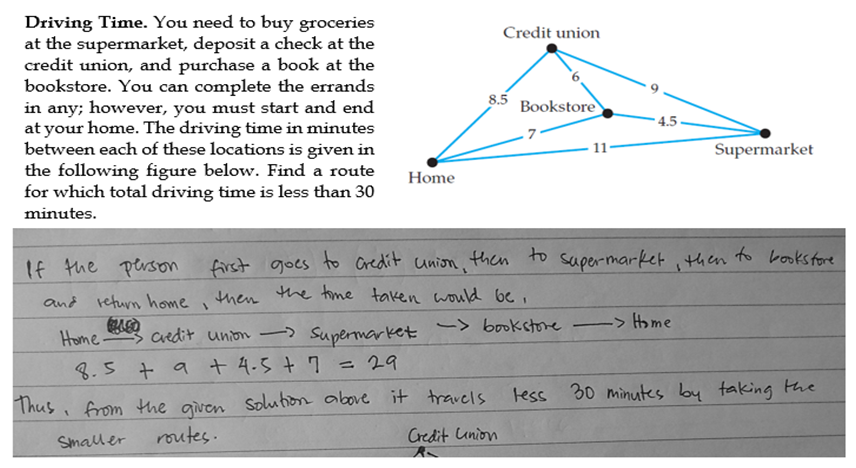
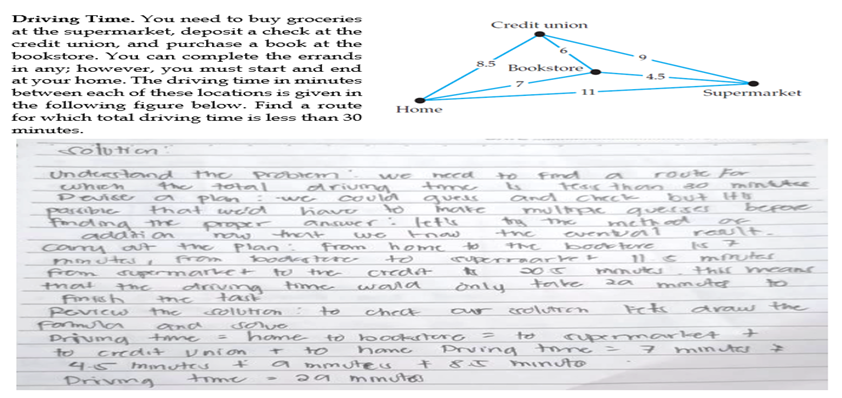
Figure 1 and Figure 2 shows the content analysis of student’s response on Problem: Driving Time of both control and experimental group. This particular item were designed for student to assess their strategies in problem solving.
Figure 1 depicts the student's direct response to what they perceived to be the correct answer to the problem. This demonstrates that the student has not applied any problem-solving strategies discussed throughout the session. On the other hand, Figure 2 illustrates a solution that follows Polya's 4-Step Problem Solving. This suggests that students participating in the experiment may retain Polya's four-step problem-solving process since it is frequently referenced in activities and assessments.
Interleaved practice exposes students to various mental functions, including retrieval and discrimination 13. Since each practice problem was arranged in a different type of problem, students may evaluate the characteristics of each problem and choose a suitable solution. In other words, each solution differs from the previous solution, and thus students were discriminating and retrieving. Because the interleaving of different types of problems hinders the student from reliably implying that every problem needs the very same approach as the preceding one, they must then select a suitable approach based on the nature of the problem, just as they do when taking the exam or completing a real-world task 14.
The present findings strengthen the notion that the benefits of interleaving activities during learning go much beyond the capacity of students to categorize perception category examples; these benefits may even include specific problem-solving abilities.
Moreover, an analysis of covariance (ANCOVA) was used to determine if the treatment had a significant effect on the participants' problem-solving fluency. Table 3 summarizes the results of the analysis of covariance for the participants' problem-solving fluency. After controlling for students' pre-test results, the table illustrates that there was indeed a significant difference in post-test scores among groups F(1,51) =7.126, p=.010, rejecting the null hypothesis.
The results indicate that the experimental group exposed to interleaved practice performed better than the control group. However, the control group showed an increase in their posttest score, as shown in the previous table. This increase is not significant compared to the mean increase for the experimental group participants. This indicates that interleave practice contributes to the increase of the test score implying that students could appropriately apply strategies in problem solving. Since the idea of interleaving requires repetition of practice exercises combing old and present topics, this contributed to the mastery level of learning. Through this learning process, students were able to retain mathematics concepts that enhances their problem-solving skills.
Accordingly, from the result on the study of 15 discovered that interleaving could improve students' memory and problem-solving skills. Using interleave practice in learning module basically help students to retrieve, retain and recall mathematical concepts.
Numerous theoretical conclusions may account for the interleaving benefits. Specifically, the use of interleaved problem types in homework assignments, as opposed to conventional block assignments, resulted in significant results in problem-solving fluency when presented with challenging problems. Interleaved practice also benefits college students' ability to solve mathematical problems 1. Students engaged in blocked practice had trouble distinguishing between different sorts of problems and determining when to utilize which formula. Thus, similar challenging problem, the interleaved practice appears to aid students in differentiating between the several problem types they are learning to solve.
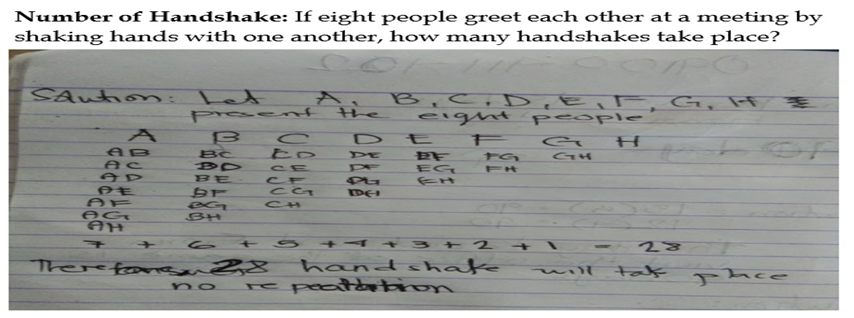
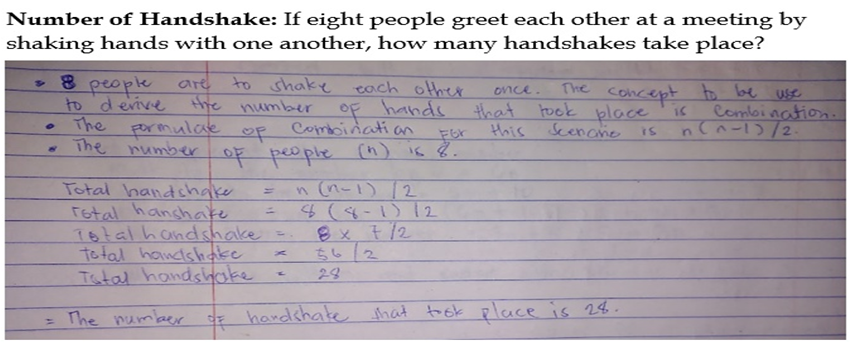
Figure 3 and Figure 4 shows the content analysis of student’s response on Problem Handshake of both control and experimental group.
Figure 3 shows a student's solution to Problem: Handshake during Posttest under the control group. They were observed that student responses showed representation as a solution. On the other hand, a student in the experimental group showed a solution with understanding the problem's required formula. Although both answers were correct, the solution exhibited by the student in the experimental group demonstrates applying knowledge of strategy learned beforehand.

Based on the study findings, interleaved practice positively influenced the students’ problem-solving fluency. On this basis, the teachers may adapt this teaching strategy to improve the mathematics problem-solving skills of their students. The mathematics teacher may redefine their instructional materials, integrating interleave practice in their activities, assignments, and assessments. Because interleave practice is effective at the grade level and the high school and tertiary levels, school presidents and department heads may be willing to support the inclusion of interleaving practice in the curriculum. Similar research might be undertaken on a bigger scale with diverse populations at other educational institutions to generalize the findings.
The researchers are grateful for the scholarship grant from the Department of Science and Technology – Science Education Institute (DOST-SEI).
| [1] | Rohrer, D., & Taylor, K. (2007). The shuffling of mathematics problems improves learning. Instructional Science, 35(6), 481-498. | ||
| In article | View Article | ||
| [2] | Carvalho, P.F., & Goldstone, R.L. (2015). The benefits of interleaved and blocked study: Different tasks benefits from difference schedules of study. Psychonomic Bulletin & Review, 22(1), 281-288. | ||
| In article | View Article PubMed | ||
| [3] | Nemeth, L., Werker, K., Arend., J. & Lipowsky, F. (2021). Fostering the acquisition of subtraction strategies with interleave practice: An intervention study with German third graders. Learning and Instruction. 71. | ||
| In article | View Article | ||
| [4] | Dunlosky, J., Rawson, K.A., Marsh, E.., Nathan, M.J., & Willingham, D.T. (2013). Improving students' learning with eefective learning techniques: Promising directions from cognitive and education psychology. Psychological Science in the Public Interest, 14(1), 4-58 | ||
| In article | View Article PubMed | ||
| [5] | Rau, M. A., Aleven, V., & Rummel, N. (2013). Interleaved practice in multi-dimensional learning tasks: Which dimension should we interleave? Learning and Instruction, 23, 98-114. | ||
| In article | View Article | ||
| [6] | Rohrer, D., Dedrick, R.F., & Burgess, K. (2014). The benefit of interleaved mathematics practice is not limited to superficially similar kinds of problems. Psychonomic Bulleting & Review, 21(5), 1323-1330. | ||
| In article | View Article PubMed | ||
| [7] | Rohrer, D., Dedrick, R.F., & Stershic, S. (2015). Interleaved practice improves mathematics learning. Journal of Educational Psychology, 107(3), 900-908. | ||
| In article | View Article | ||
| [8] | Rohrer, D., Dedrick, R. F., Hartwig, M. K., & Cheung, C.-N. (2019). A randomized controlled trial of interleaved mathematics practice. Journal of Educational Psychology, 112(1), 40-52. | ||
| In article | View Article | ||
| [9] | Birnbau., M. S., Kornell, N., Bjork, E. L., & Bjork, R. A. (2013). Why interleaving enhances inductive learning: The roles of discrimination and retreival. Memory & Cognition, 41(3), 392-402. | ||
| In article | View Article PubMed | ||
| [10] | Carvalho, P. F., & Goldstone, R. L. (2017). The sequence of study changes what information is attended to, encoded, and remembered during category learning. Journal of Experimental Psychology: Learning, Memory, and Cognition, 43(11), 1699-1719. | ||
| In article | View Article PubMed | ||
| [11] | Carvalho, P. F., & Goldstone, R. L. (2019). When Does Interleaving Practice Improve Learning? The Cambridge Handbook of Cognition and Education, 411-436. | ||
| In article | View Article PubMed | ||
| [12] | Duque Jr, C.A., Tan, D. A. (2013). Students’ Mathematics Attitudes And Metacognitive. (3), 1-25. | ||
| In article | |||
| [13] | Hughes, C. A., & Lee, J. Y. (2019). Effective approaches for scheduling and formatting practice: distributed, cumulative, and interleaved practice. Teaching Exceptional Children, 51(6), 411-423. | ||
| In article | View Article | ||
| [14] | Rohrer, D., Dedrick, R. F., Hartwig, M. K., & Cheung, C.-N. (2020). A randomized controlled trial of interleaved mathematics practice. Journal of Educational Psychology, 112(1), 40-52. | ||
| In article | View Article | ||
| [15] | Samani, J., Pan, S.C. (2021). Interleaved practice enhances memory and problem-solving ability in undergraduate physics. npj Sci. Learn. 6, 32. | ||
| In article | View Article PubMed | ||
Published with license by Science and Education Publishing, Copyright © 2022 Edsel P. Baba and Laila S. Lomibao
 This work is licensed under a Creative Commons Attribution 4.0 International License. To view a copy of this license, visit
http://creativecommons.org/licenses/by/4.0/
This work is licensed under a Creative Commons Attribution 4.0 International License. To view a copy of this license, visit
http://creativecommons.org/licenses/by/4.0/
| [1] | Rohrer, D., & Taylor, K. (2007). The shuffling of mathematics problems improves learning. Instructional Science, 35(6), 481-498. | ||
| In article | View Article | ||
| [2] | Carvalho, P.F., & Goldstone, R.L. (2015). The benefits of interleaved and blocked study: Different tasks benefits from difference schedules of study. Psychonomic Bulletin & Review, 22(1), 281-288. | ||
| In article | View Article PubMed | ||
| [3] | Nemeth, L., Werker, K., Arend., J. & Lipowsky, F. (2021). Fostering the acquisition of subtraction strategies with interleave practice: An intervention study with German third graders. Learning and Instruction. 71. | ||
| In article | View Article | ||
| [4] | Dunlosky, J., Rawson, K.A., Marsh, E.., Nathan, M.J., & Willingham, D.T. (2013). Improving students' learning with eefective learning techniques: Promising directions from cognitive and education psychology. Psychological Science in the Public Interest, 14(1), 4-58 | ||
| In article | View Article PubMed | ||
| [5] | Rau, M. A., Aleven, V., & Rummel, N. (2013). Interleaved practice in multi-dimensional learning tasks: Which dimension should we interleave? Learning and Instruction, 23, 98-114. | ||
| In article | View Article | ||
| [6] | Rohrer, D., Dedrick, R.F., & Burgess, K. (2014). The benefit of interleaved mathematics practice is not limited to superficially similar kinds of problems. Psychonomic Bulleting & Review, 21(5), 1323-1330. | ||
| In article | View Article PubMed | ||
| [7] | Rohrer, D., Dedrick, R.F., & Stershic, S. (2015). Interleaved practice improves mathematics learning. Journal of Educational Psychology, 107(3), 900-908. | ||
| In article | View Article | ||
| [8] | Rohrer, D., Dedrick, R. F., Hartwig, M. K., & Cheung, C.-N. (2019). A randomized controlled trial of interleaved mathematics practice. Journal of Educational Psychology, 112(1), 40-52. | ||
| In article | View Article | ||
| [9] | Birnbau., M. S., Kornell, N., Bjork, E. L., & Bjork, R. A. (2013). Why interleaving enhances inductive learning: The roles of discrimination and retreival. Memory & Cognition, 41(3), 392-402. | ||
| In article | View Article PubMed | ||
| [10] | Carvalho, P. F., & Goldstone, R. L. (2017). The sequence of study changes what information is attended to, encoded, and remembered during category learning. Journal of Experimental Psychology: Learning, Memory, and Cognition, 43(11), 1699-1719. | ||
| In article | View Article PubMed | ||
| [11] | Carvalho, P. F., & Goldstone, R. L. (2019). When Does Interleaving Practice Improve Learning? The Cambridge Handbook of Cognition and Education, 411-436. | ||
| In article | View Article PubMed | ||
| [12] | Duque Jr, C.A., Tan, D. A. (2013). Students’ Mathematics Attitudes And Metacognitive. (3), 1-25. | ||
| In article | |||
| [13] | Hughes, C. A., & Lee, J. Y. (2019). Effective approaches for scheduling and formatting practice: distributed, cumulative, and interleaved practice. Teaching Exceptional Children, 51(6), 411-423. | ||
| In article | View Article | ||
| [14] | Rohrer, D., Dedrick, R. F., Hartwig, M. K., & Cheung, C.-N. (2020). A randomized controlled trial of interleaved mathematics practice. Journal of Educational Psychology, 112(1), 40-52. | ||
| In article | View Article | ||
| [15] | Samani, J., Pan, S.C. (2021). Interleaved practice enhances memory and problem-solving ability in undergraduate physics. npj Sci. Learn. 6, 32. | ||
| In article | View Article PubMed | ||