This study aims to assess the quality of physico-chemical and microbiological water from the faucet to Agboville to identify the main factors of contamination. Samples were collected at the inlet and outlet of the treatment plant as well as in different points of the distribution network, and then analyzed according to the standard methods of the AFNOR. On the chemical level, the results indicate a quality that is generally in line with the WHO guideline values (2017) for the parameters studied, with the exception of nitrite and the index of permanganate, whose concentrations exceed the recommended threshold values. Higher grades in ammonium, nitrites and nitrates have been identified in some neighborhoods, including the station and the police. From a microbiological point of view, the water at the exit of the station has a good quality (12.49 % of the samples), while 33.32 % of the samples of the network are considered to be of poor-quality and 54.19 % of very poor quality. The statistical analysis reveals strong negative correlations between the bacterial loads and concentrations of residual chlorine, suggesting that the low chlorine content and order of distance from the treatment plant, are determining factors in the microbial degradation.
Access to quality drinking water is a major public health issue, particularly in developing countries where the infrastructure for processing and distribution maybe weak 1, 2. Indeed, in many African cities, the dilapidated state of infrastructure, the frequent interruptions of the distribution, the connections and illicit lack of maintenance of facilities promote the risk of deterioration of the water quality between the treatment plant and the point of use. In Côte d'Ivoire, the department of Agboville was facing a deficit of drinking water production 3, 4, 5, 6. To compensate for this shortage of supply of drinking water to populations of Agboville and surrounding communities, the Ministry of Infrastructure, Economic (MIE) through the National Office of Drinking Water (ONEP) and a grant from the World Bank (IDA), has initiated the Project of Building of the Drinking Water supply in Urban areas (PREMU). This project is based on the strengthening of the capacity of production of drinking water to the city of Agboville and its surrounding communities from the catchment of the river Agnéby 7. The work of the PREMU were launched in January 2018. Among the achievements, there is the construction of a wastewater pumping of 500 m3par time. The station pumps the raw water, which follows a line up to a drinking water production plant capable of providing 500 m3 of water per hour. Despite efforts to improve the water supply for urban populations, the risk of contamination may persist throughout the distribution chain. This is because of the increasing pressure on water resources and distribution systems by the strong demographic growth, marked by a population from 95 093 inhabitants in 2014 to 135 082 inhabitants by 2021 8, and the rapid urbanization. These contaminations can be chemical, linked in particular to the presence of nitrates, heavy metals or pesticide residues, but also microbiological, resulting from infiltration of fecal or poor conditions of hygiene facilities 6, 9, 10. This study aims to analyze jointly the chemical contamination and microbiological analysis of water distribution network of Agboville, in order to identify the potential risks to the health of consumers.
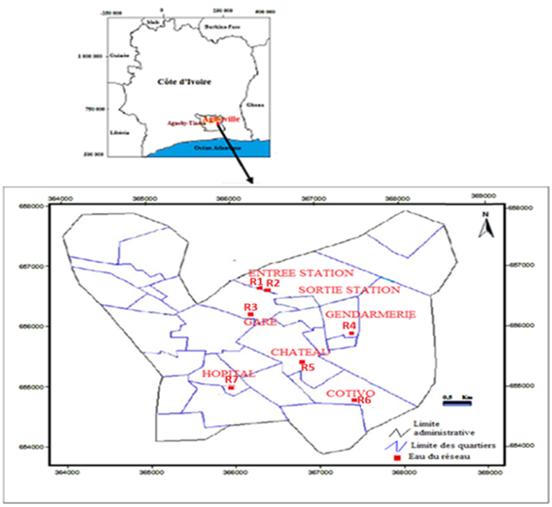
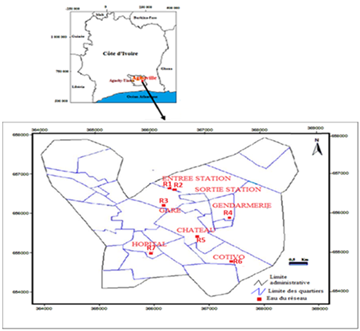
The city of Agboville is located in the South-eastern Côte d'Ivoire between latitudes 552 664 m and 663 305 m North and longitudes 500 000 m and 389 325 m to the West (Figure 1). It covers an area of 12 000 km2 and its total population in 2021 is estimated to be 135 082 inhabitants. 8. It has 18572 households. The climate is typically equatorial, with two rainy seasons (April-July and September - October) and two dry seasons (August -September and December - March) year. The annual rainfall exceeds 1,500 mm per year. The temperature is relatively constant, with an annual average of 27°C. The hydrographic network of Agboville is composed primarily of the river Agnéby or Agbô (Figure 1). Its basin has an area of 8,900 km2 and has a length of 200 km 5. These important tributaries are Seguié and Asseubié. The sub basin of the Agneby to Agboville covers an area of 4 693 km with an area of 328 km and extends over a length of about 120 km and a width of 80 meters. It is picked up by the Water supply Company of Côte d'Ivoire (SODECI) for the supply of drinking water to the population of the city of Agboville 4.
2.2. Sampling and Analysis of WatersThe raw water samples (R1) from the station to lifting and have not under gone any treatment, treated water (R2) output of the station, drinking water production has undergone the necessary treatments and fit for consumption, and water distribution network from the treatment plant through the pipes to the faucet of consumers have been collected. The waters of the network have been chosen taking into account the availability of water in the network of the household and a good spatial distribution. Five (05) water faucet named R3, R4, R5,56 and A7 have been retained in the households of the respective neighborhoods STATION, GENDARMERIE, CASTLE, COTIVO and HOSPITAL. The positions of these points have been referenced with a GPS (Figure 1). Four (04) samples were carried out at the level of each point. The treated water and the distribution were taken directly to the faucet, and the raw water was collected in the course of water directly to the mine. All these samples were collected in polyethylene bottles of 500 mL previously washed and labeled for the chemical analyses and in bottles borosilicate glass 500 mL sterile microbiological testing. They were then stored away from light in coolers containing packs refrigerants (4°C) and then, transported to the laboratory for the different analyses. On the ground, the pH, temperature, conductivity, dissolved oxygen and total dissolved solids (TDS) were measured using a multi-parameter HANNA Hi 9829). The turbidity was measured with a meter HANNA Hi 98703). The residual chlorine was determined by the colorimetric method with a colorimeter LOVIBOND Check it, Direct MD 200 (SODIMEL, France). In the laboratory, the analysis of iron, sulphate, ammonium, nitrites, nitrates, and the absorbance 254 nm and 410 nm has been performed with absorption spectrophotometer molecular DR 6000 HACH (SODIMEL, France). Alkalinity and hardness were measured, respectively, by the methods of volumetric or titrimetric. Index of permanganate (IP) or the oxydability in the KMnO4 in an acidic environment meets the French Standard ISO 8467 1993. The total coliforms and fecal Escherichia coli and fecal streptococci were enumerated by the method of membrane filtration (ISO 9308-1: 2014).
The tests non-parametric Kruskal-Wallis and Mann-Whitney were used to compare the raw water and the treated water. These tests were used at a level of significance of p of 95 % (p <0.05). The test of correlation of Person has been used to show the link between chlorine germs and bacterial. On the basis of the criteria defined by the WHO, the classes of microbiological quality of water wells have been defined 11.
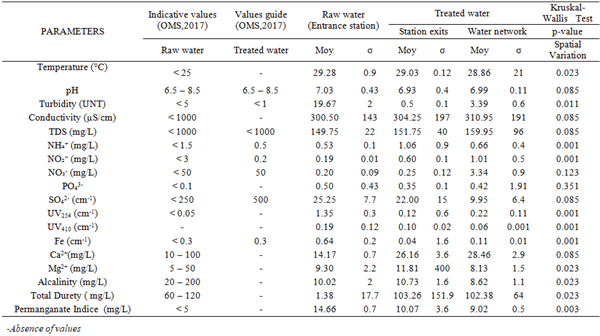
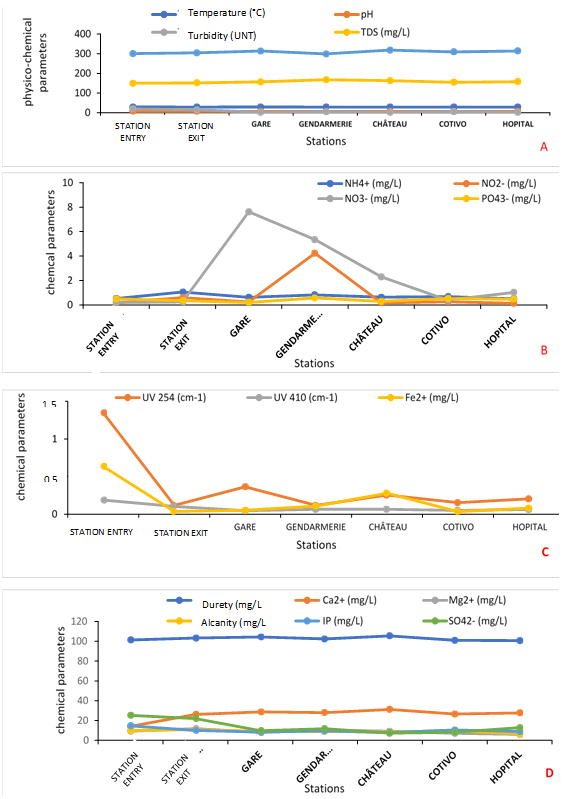
Table 1 presents the results of the physico-chemical analysis of the raw water at the entrance of the sewage treatment plant, treated water at the outlet of the treatment plant and water distribution network of the city of Agboville. Overall, the mean values of the tested parameters comply with the values recommended by the WHO for the raw water and treated water. However, as regards the water at the entrance of the station, only the average values of the temperature of 29.28 ±0.9 °C, turbidity of 19.67 ± 2 UNT and the index of permanganate of 14.66 ± 07 mg/L and do not follow the guideline values of WHO to 25°C for the temperature, 5 UNT for turbidity. For the treated water output of the station, the mean value of nitrite (to 0.6 ± 0.1 mg/L) and the index of permanganate (10.07± 3.6) do not comply with the WHO guideline values of 0.2 mg/L for nitrite and 5 mg/L for the index of permanganate. As for the water in the distribution network, the high values of nitrites (1.01±0.5 mg/L) and the index of permanganate (9.02 ±3.6 mg/L) are observed as in the water at the exit of the station. Also, ammonium (0.66 ± 0.5 mg/L) recorded values slightly higher than that of the WHO of 0.5 mg/L.
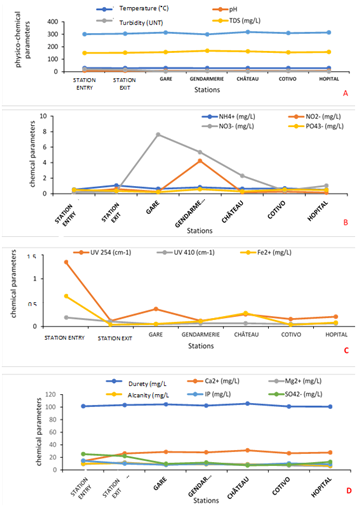
According to the Kruskal-Wallis test statistic (Table 1), significant difference (p<0.05) exists between the values of turbidity, ammonium, nitrates, nitrites, UV254, UV410, the iron and the index permanganate in the water at the entrance of the station, at the exit of the station and those of the distribution network. The Mann-Whitney test shows that the values of turbidity, UV254, UV410, and the index of permanganate are significantly higher in the waters at the exit of the station (19.67 UNT (Figure 2A) ; 1.35 cm-1 ; 0.19 cm-1 (Figure 2C); 14.66 mg/L (Figure 2D) that the treated water. In contrast, concentrations of ammonium, nitrites and nitrates are higher levels of the waters of the network of the station, the train station (0.25 mg/L and 0.63 mg/L ; 7.63 mg/L) (Figure 2 (B) and the gendarmerie (0.63 mg/L ; 0.25 mg/L ; 5.35 mg/L).
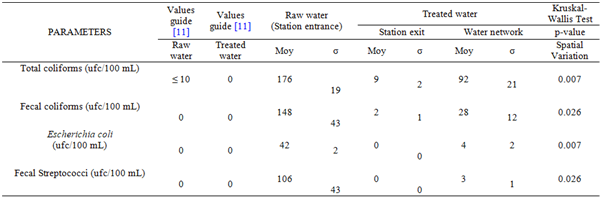
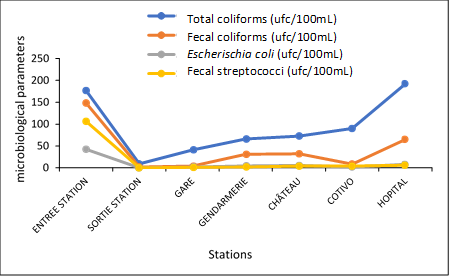
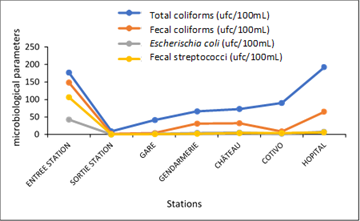
3.2. Microbiological characteristics of the Water at the Inlet and Outlet of the Treatment Plant and the Distribution Network of the City of AgbovilleTable 2 shows the bacterial load of the water at the inlet and outlet of the treatment plant and the distribution network of the city of Agboville. The water gross at the entrance of the station contains medium-sized loads of total coliform bacteria (176±19 cfu/100mL) and fecal (148±43 cfu/100 ml), Escherichia coli (42±2 cfu/100mL) and fecal streptococci (106 ± 43 cfu/100mL) higher than the values recommended by the WHO to 10 cfu/100mL for total coliforms and 0 cfu/100mL for other germs. For the treated water, at the exit of the station, with only 9±2 cfu/100mL total coliforms and 2±1 cfu/100mL fecal are present. On the network, the expenses of 92±21 cfu/100mL of total coliforms, 28±12 cfu/100mL for fecal coliforms,4 ± 2 cfu/100mL for Escherichia coli and 3±1 cfu/100mL for fecal streptococci are observed. Tests of Kruskal-Wallis and Mann-Whitney indicate that the heavy load of all bacteria is recorded in the waters at the entrance of the station.
Regarding the treated water (Figure 3), the expenses of bacteria cancel each other out at the exit of the station. They grow from the station to the train station up to the hospital. As and when away from the treatment plant, the bacterial load increases.
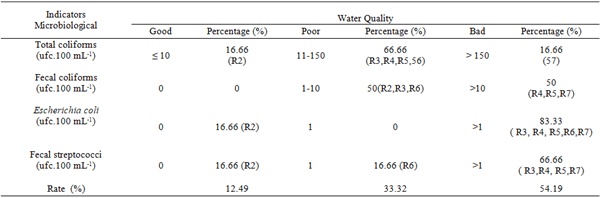
Table 3 shows the classes of the microbiological quality of waters of the network. The results show that 12.49 % of the treated water are of good quality and represents only the water at the exit from the treatment plant. However, 33.32 % of the waters of poor quality and 54.19 % of the water of very poor quality for the waters of the distribution network.
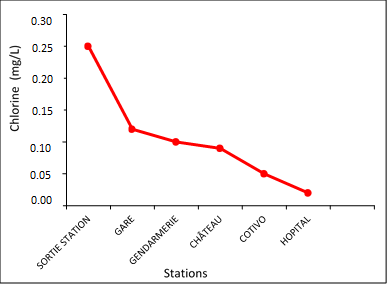
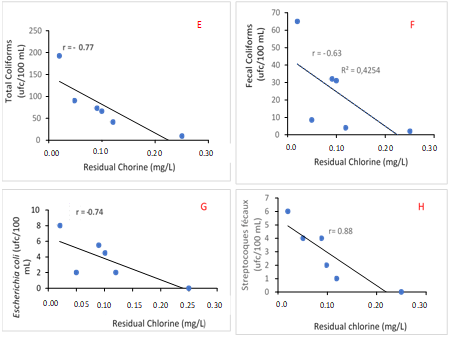
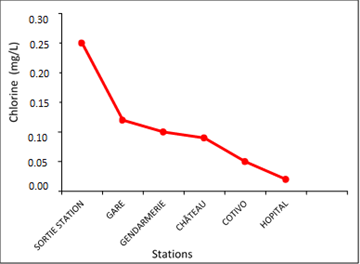
3.3. Influence of Residual chlorine on the Microbiological parameters of the Water Network of the City of AgbovilleFigure 4 presents the distribution space of the chlorine in the treated water. The levels of chlorine decrease of the output (0.25 mg/L) of the station until the station hospital (0.02 mg/L). A significant negative correlation exists between total coliforms (r = - 0.77), fecal coliforms (r =-0.63), Escherichia coli (r =-0.74), fecal streptococci (r =-0.88) and the doses of chlorine residual (Figure 5). This indicates that the bacterial loads of the waters of the network decreases with the distance of the waters of the network to the treatment plant.
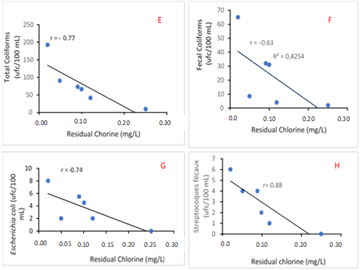
The measurement of physico-chemical parameters and microbiological allowed us to appreciate the quality of the water network of the city of Agboville. In chemistry, the waters at the exit of the station and distribution network are of a good quality compared to the WHO guideline values (2017) for the parameters studied. However, the average values of nitrites and the index of permanganate does not conform to the guidelines of the WHO (2017) for the water at the exit of the station (to 0.6 ± 0.1 mg/L; 10.07± 3.6) and those of the distribution network (1.01±0.5 mg/L; 9.02 ±3.6 mg/L). Also, the values of ammonium (0.66 ± 0.5 mg/L) remained non-compliant in the waters of the network. The consumption of these waters containing high concentrations of nitrites could present a health risk related to methemoglobinemia, or blue baby syndrome 4, 11. In fact, the nitrites are directly ingested via contaminated drinking water 10. In the blood, nitrite reacts with hemoglobin (Hb) within red blood cells. Normal hemoglobin contains iron from ferrous (Fe2⁺), which binds to the oxygen. Under the effect of the nitrites, this iron is oxidized to ferric iron (Fe3⁺). This converts hemoglobin to meta hemoglobin (Mehb) unable to fix or carry oxygen, in contrast to normal hemoglobin. In addition, its presence also prevents the oxygen to release easily from the hemoglobin remaining, exacerbating tissue hypoxia (lack of oxygen in the tissues). Moreover, the high values of the index of permanganate-treated water indicate the strong presence of the organic matter in these waters. However, the organic compounds are very reactive towards chlorine regardless of the mineralization in the middle 12. This reaction can lead to the formation of organ halogen compounds with risks of long-term toxicity (effects of mutagens and/or carcinogens), which cannot be eliminated by simple disinfection 13. Microbiologically, the quality classes indicate that the waters at the exit of the station, have a good (12.49 %). However, 33.32 % of the waters of poor quality and 54.19 % of the water of very poor quality for the waters of the distribution network. These results indicate a deterioration of the microbiological quality of waters of the network Abgoville in accordance with the guidelines of the WHO (2017). The presence of these bacteria is due to the low values of the residual chlorine in the water distribution network 14. In effect, a value of 0.25 mg/L at the exit of the station, it reduces to 0.02 mg/L station of the hospital. A when for a good disinfection with chlorine, the recommended value is in the range 0.2-5 guideline values of WHO (2017). The strong negative correlations significant existing between total coliforms (r = - 0.77), fecal coliforms (r =-0.63), Escherichia coli (r =-0.74), fecal streptococci (r =-0.88) and the doses of chlorine residual justify this assertion. It reflects the increase of bacterial load with the reduction of residual chlorine 15. The repartition the spatial distribution of the dose of chlorine residual and germs studied reveals that the sprouts will grow from the station to the train station which is the nearest station to the treatment plant to the one in the hospital, the station later. As and when away from the treatment plant, the bacterial load increases. The dose of chlorine residual and the distance from the treatment plant, and the faucets in the household could be the main factors of deterioration of the quality of microbiological water 16.
The combined analysis of chemical contamination and microbiological water network of Agboville reveals major health risks. In spite of a chemical quality on the whole satisfactory, excessive concentrations of nitrates, nitrites, and an index of potassium permanganate to non-compliance problem. More alarming is microbiological contamination, persistent, marked by the presence of fecal germs. The strong negative correlation between the bacterial load and the residual chlorine suggests a lack of disinfection. These failures are likely the result of inadequate protection of sources, infiltration of wastewater treatment is inadequate and dysfunctional infrastructure. To ensure safe drinking water compliance and protect the health of the inhabitants, a mobilization urgent and coordinated health authorities, the network management and local communities is essential.
The authors state that they have no known competing financial interests or personal relationships that could have appeared to influence the work reported in this article.
The data presented in this study can be provided upon request from the corresponding author.
| [1] | WHO, UNICEF., Progrès en matière d’alimentation en eau et d’assainissement : rapport 2017. ISBN 978-92-4-251289-2 (Classification NLM: WA 670), 116 p., (2017). Progrès en matière d’alimentation en eau et d’assainissement : Mise à jour 2015 et évaluation des OMD. | ||
| In article | |||
| [2] | WHO, UNICEF., Progrès en matière d’alimentation en eau et d’assainissement : rapport 2014. ISBN 978 92 4 250724 9 (Classification NLM: WA 670), 80 p., (2014). pseau.org/outils/ouvrages/oms_progres_en_matiere_d_alimentation_en_eau_et_d_assainissement_rapport_2014.pdf. | ||
| In article | |||
| [3] | D.L. Gone, J.L. Seidelb, C. Batiot, B. Kamagate, R. Ligban, J. Bero, Using fluorescence spectroscopy EEM to evaluate the efficiency of organicmatterremoval during coagulation-flocculation of a tropical surface water (Agboreservoir)., (2009) 693–699. | ||
| In article | View Article PubMed | ||
| [4] | A.N.B. Kouadio, K.M. YEO, A. Kouadio, D.L. GONE, Spatial and temporal variations of nitrates in traditionalurbanshallowwell water of Sub-SaharanAfrica : the case study of Agboville, Ivory Coast., (2020) 476–485. | ||
| In article | |||
| [5] | A.N.B. Kouadio, K.M. YEO, K.N. ABOUA, D.L. GONE, Demande en chlore et paramètres déterminant la consommation du chlore des eaux de puits traditionnels d’Agboville (Côte d’Ivoire)., (2017) 23–33. | ||
| In article | |||
| [6] | L.P.M.-S. Kouakou, A. Kouyate, A. Sanou, A.E. Koffi, M.A. Tigori, N. Meite, K.J.-P. Bohoussou, B. Dibi, Evaluation of the Physico-chemical Quality of Drinking Water in the City of Daloa (Mid-West of Côte d’Ivoire) - Effects on Human Health, J. Health Environ. Res. 8 (2022) 186–196. | ||
| In article | |||
| [7] | ONEP, Renforcement de l’alimentation en eau potable dans le centre urbain d’Agboville, Rapport final N° 5929‑CI, World Bank Document, 170 p., (2017). | ||
| In article | |||
| [8] | INS, Résultats globaux par Sous-Préfecture du recensement général de la population et de l’habitat de Côte d’Ivoire., Institut National de la Statistique, Secrétariat Technique Permanent, 2021. | ||
| In article | |||
| [9] | AFNOR, Qualité de l’eau. Recueil de normes françaises, (1997). | ||
| In article | |||
| [10] | A. Sanou, N. Méité, A. Kouyaté, E. Irankunda, A.N. Kouamé, A.E. Koffi, K.J.-P. Bohoussou, L.P.M.-S. Kouakou, Assessing Levels and Health Risks of Fluoride and Heavy Metal Contamination in Drinking Water, J. Geosci. Environ. Prot. 10 (2022) 15–34. | ||
| In article | View Article | ||
| [11] | WHO, Directives de qualité pour l’eau de boisson: 4éd. Intégrant le premier additif [Guidelines for drinking-water quality: 4th ed.incorporating first addendum]., (2017). iris.who.int/bitstream/handle/10665/258887/9789242549959-fre.pdf;sequence=1. | ||
| In article | |||
| [12] | S. Achour, S. Guergazi, N. Guesbaya, N. Seghairi, L. Youcef, Incidence des procédés de chloration, de floculation et d’adsorption sur l’évolution de composés organiques et minéraux des eaux naturelles, (2002) 108–128. | ||
| In article | |||
| [13] | Y. Dong, W. Peng, Y. Liu, Z. Wang, Photochemical origin of reactive radicals and halogenated organic substances in naturalwaters: A review, J. Hazard. Mater. 401 (2021) 123884. | ||
| In article | View Article PubMed | ||
| [14] | F.H. Koffi, Etude diagnostique de l’état des canalisations d’AEP pour une meilleure gestion de la qualité de l’eau potable à Abidjan: cas de la commune d’Abobo., (2016). | ||
| In article | |||
| [15] | A. Murray, D. Lantagne, Accuracy, precision, usability and cost of free chlorine residual testing methods, J. Water Health (2015) 79–90. | ||
| In article | View Article PubMed | ||
| [16] | L. Tampo, M. Ayah, T. Kodom, I. Tchakala, P. Boguido, L. Bawa, B. Djaneye, Impact de la demande en chlore et de la chloration sur la désinfection des eaux de puits des quartiers de Lomé : cas des quartiers de Démakpoé et d’Agbalépédogan (Togo), J. Appl. Biosci. (2014) 6272–6281. | ||
| In article | View Article | ||
Published with license by Science and Education Publishing, Copyright © 2025 Elogne Guessan Zoro, Aya Nelly Berthe Kouadio, Namory Méité, SeinyRoger N’Dri, Mariame Coulibaly, Drissa Bamba and DrohLaciné Goné
 This work is licensed under a Creative Commons Attribution 4.0 International License. To view a copy of this license, visit
http://creativecommons.org/licenses/by/4.0/
This work is licensed under a Creative Commons Attribution 4.0 International License. To view a copy of this license, visit
http://creativecommons.org/licenses/by/4.0/
| [1] | WHO, UNICEF., Progrès en matière d’alimentation en eau et d’assainissement : rapport 2017. ISBN 978-92-4-251289-2 (Classification NLM: WA 670), 116 p., (2017). Progrès en matière d’alimentation en eau et d’assainissement : Mise à jour 2015 et évaluation des OMD. | ||
| In article | |||
| [2] | WHO, UNICEF., Progrès en matière d’alimentation en eau et d’assainissement : rapport 2014. ISBN 978 92 4 250724 9 (Classification NLM: WA 670), 80 p., (2014). pseau.org/outils/ouvrages/oms_progres_en_matiere_d_alimentation_en_eau_et_d_assainissement_rapport_2014.pdf. | ||
| In article | |||
| [3] | D.L. Gone, J.L. Seidelb, C. Batiot, B. Kamagate, R. Ligban, J. Bero, Using fluorescence spectroscopy EEM to evaluate the efficiency of organicmatterremoval during coagulation-flocculation of a tropical surface water (Agboreservoir)., (2009) 693–699. | ||
| In article | View Article PubMed | ||
| [4] | A.N.B. Kouadio, K.M. YEO, A. Kouadio, D.L. GONE, Spatial and temporal variations of nitrates in traditionalurbanshallowwell water of Sub-SaharanAfrica : the case study of Agboville, Ivory Coast., (2020) 476–485. | ||
| In article | |||
| [5] | A.N.B. Kouadio, K.M. YEO, K.N. ABOUA, D.L. GONE, Demande en chlore et paramètres déterminant la consommation du chlore des eaux de puits traditionnels d’Agboville (Côte d’Ivoire)., (2017) 23–33. | ||
| In article | |||
| [6] | L.P.M.-S. Kouakou, A. Kouyate, A. Sanou, A.E. Koffi, M.A. Tigori, N. Meite, K.J.-P. Bohoussou, B. Dibi, Evaluation of the Physico-chemical Quality of Drinking Water in the City of Daloa (Mid-West of Côte d’Ivoire) - Effects on Human Health, J. Health Environ. Res. 8 (2022) 186–196. | ||
| In article | |||
| [7] | ONEP, Renforcement de l’alimentation en eau potable dans le centre urbain d’Agboville, Rapport final N° 5929‑CI, World Bank Document, 170 p., (2017). | ||
| In article | |||
| [8] | INS, Résultats globaux par Sous-Préfecture du recensement général de la population et de l’habitat de Côte d’Ivoire., Institut National de la Statistique, Secrétariat Technique Permanent, 2021. | ||
| In article | |||
| [9] | AFNOR, Qualité de l’eau. Recueil de normes françaises, (1997). | ||
| In article | |||
| [10] | A. Sanou, N. Méité, A. Kouyaté, E. Irankunda, A.N. Kouamé, A.E. Koffi, K.J.-P. Bohoussou, L.P.M.-S. Kouakou, Assessing Levels and Health Risks of Fluoride and Heavy Metal Contamination in Drinking Water, J. Geosci. Environ. Prot. 10 (2022) 15–34. | ||
| In article | View Article | ||
| [11] | WHO, Directives de qualité pour l’eau de boisson: 4éd. Intégrant le premier additif [Guidelines for drinking-water quality: 4th ed.incorporating first addendum]., (2017). iris.who.int/bitstream/handle/10665/258887/9789242549959-fre.pdf;sequence=1. | ||
| In article | |||
| [12] | S. Achour, S. Guergazi, N. Guesbaya, N. Seghairi, L. Youcef, Incidence des procédés de chloration, de floculation et d’adsorption sur l’évolution de composés organiques et minéraux des eaux naturelles, (2002) 108–128. | ||
| In article | |||
| [13] | Y. Dong, W. Peng, Y. Liu, Z. Wang, Photochemical origin of reactive radicals and halogenated organic substances in naturalwaters: A review, J. Hazard. Mater. 401 (2021) 123884. | ||
| In article | View Article PubMed | ||
| [14] | F.H. Koffi, Etude diagnostique de l’état des canalisations d’AEP pour une meilleure gestion de la qualité de l’eau potable à Abidjan: cas de la commune d’Abobo., (2016). | ||
| In article | |||
| [15] | A. Murray, D. Lantagne, Accuracy, precision, usability and cost of free chlorine residual testing methods, J. Water Health (2015) 79–90. | ||
| In article | View Article PubMed | ||
| [16] | L. Tampo, M. Ayah, T. Kodom, I. Tchakala, P. Boguido, L. Bawa, B. Djaneye, Impact de la demande en chlore et de la chloration sur la désinfection des eaux de puits des quartiers de Lomé : cas des quartiers de Démakpoé et d’Agbalépédogan (Togo), J. Appl. Biosci. (2014) 6272–6281. | ||
| In article | View Article | ||