Objective: To develop a contextual assessment method based on the Mini-Clinical Evaluation Exercise (Mini-CEX) for evaluating the clinical competency of newly hired nurses and validate its effectiveness in enhancing clinical skills, teaching quality, and patient satisfaction. Methods: A non-concurrent controlled trial was conducted from July 2024 to July 2025. The control group (n=43, 2024 cohort) received routine theoretical and operational assessments, while the intervention group (n=50, 2025 cohort) underwent the Mini-CEX-based contextual assessment. The protocol was developed using the Delphi expert consultation method. Clinical instructors received unified frame-of-reference training. Outcomes included clinical performance scores, clinical competency, and humanistic care competency evaluated via bedside contextual assessments. Results: The intervention group demonstrated significantly higher scores in: Clinical performance (90.5±6.2 vs. 79.3±8.1, P<0.01) Clinical competency (231.31±16.58 vs. 202.31±13.26, P<0.01) Humanistic care competency (230.21±22.38 vs. 205.21±23.26, P<0.01). Conclusion: The Mini-CEX-based contextual assessment objectively evaluates clinical competency in newly hired nurses, effectively enhances clinical and humanistic care literacy, and ensures assessment homogeneity through frame-of-reference training. This method provides a reference for standardized training evaluation.
With the deepening implementation of the Healthy China 2030 strategy and the explicit "Three Enhancements and One Improvement" goals outlined in the National Nursing Development Plan (2021-2025)—enhancing nurse competency, service quality, care efficiency, and patient experience—cultivating a high-caliber nursing workforce has become a core driver of innovative healthcare productivity 1, 2. As a critical component of talent development, standardized training for newly hired nurses faces three persistent evaluation bottlenecks:
1. Overemphasis on theoretical/technical metrics while neglecting core competencies like clinical decision-making, nurse-patient communication, and humanistic care 3, 4;
2. Fragmented assessment criteria lacking homogeneous tools, hindering scientific quantification of training outcomes 5, 6;
3. Scenario-disconnected traditional assessments fostering examination-oriented training, failing to meet the progressive clinical competency requirements of the Standardized Training Guidelines for New Nurses 7, 8.
To address these challenges, this study innovatively developed a contextual competency evaluation framework based on the Mini-Clinical Evaluation Exercise (Mini-CEX). Through Delphi expert consensus, we established a structured assessment protocol and implemented frame-of-reference training to standardize instructional criteria. This system enables multidimensional quantification of nursing procedures, emergency response, and humanistic care practices in authentic clinical settings. A controlled trial validates this model’s efficacy in elevating clinical competence and humanistic literacy, offering a scalable solution for standardized nursing training.
Using convenience sampling, newly hired nurses at a Grade A tertiary hospital (July 2024–July 2025) were sequentially assigned to control or intervention groups based on employment date.
Inclusion Criteria:
Bachelor's degree or higher in nursing (with diploma);
Passed the National Nurse Licensure Examination (or registered), provided informed consent, and committed to completing training.
Exclusion Criteria:
Participants with ≥2 weeks of cumulative leave or other factors preventing full training engagement.
No significant baseline differences existed between groups (P > 0.05).
2.2. MethodsBoth groups received equivalent instructional resources and faculty preparation:
(1). Faculty: All clinical instructors held registered nurse qualifications with ≥3 years' experience.
(2). Preparation:
Designed case-based teaching modules aligned with clinical objectives;
Developed multimedia resources (e.g., PowerPoint demonstrations);
Curated discipline-specific learning materials.
The control group received the hospital's standard induction training:
Didactic Lectures: Clinical instructors delivered theoretical knowledge and technical skills via traditional lectures, aligned with departmental requirements.
Clinical Practice Supervision: Nurses completed rotation-specific tasks across departments under real-time preceptor guidance.
Case-Based Discussions: Regular case analysis sessions facilitated clinical reasoning development with instructor feedback.
Fixed Rotation Schedule: Uniform duration per department with standardized task assignments.
Centered on enhancing clinical competency, this study established a specialized task force (nursing administrators, clinical preceptors, quality control experts) from Jiaozuo Second People's Hospital to develop a tripartite Mini-CEX contextual assessment framework:
Contextual Assessment → Structured Feedback → Competency Progression
The protocol was developed through a three-phase process:
(1) Assessment Framework Development
A Delphi expert consensus method was employed to establish evaluation dimensions. After screening 28 high-quality studies from PubMed, CNKI, and other databases (keywords: Mini-CEX, new nurse training, clinical competency evaluation), we extracted 7 core competency domains. Eight clinical nursing experts (associate chief nurses or higher, ≥10 years teaching experience) completed two consultation rounds. The expert authority coefficient (C<sub>r</sub>=0.92; C<sub>a</sub>=0.90, C<sub>s</sub>=0.94) confirmed a 7-dimension, 23-item assessment scale. Each dimension includes 3-4 contextualized items, with total scores converted to percentage (passing threshold: ≥85%).
(2) Frame-of-Reference Training Standardization
To ensure assessment homogeneity, all clinical preceptors completed frame-of-reference training:
Theoretical Module (4 hours): Standardized interpretation of Mini-CEX evaluation criteria
Practical Module: Standardized patient (SP) simulations in training wards to unify scoring benchmarks (e.g., Humanistic Care dimension:
"Proactively inquires about pain" = 3 points
"Fails to respond to requests" = 1 point
Certification: Preceptors required inter-rater reliability ≥0.85 (Cohen's k) before participation
(3) Contextual Assessment Workflow
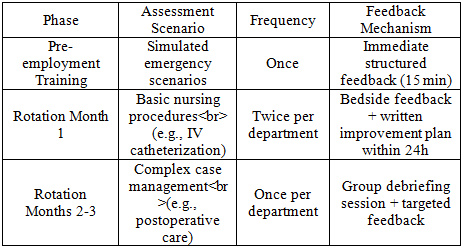
The Mini-CEX assessment protocol was embedded into routine rotations, as outlined in Table 2:
Upon completion of standardized training, all participants underwent evaluations comprising:
Professional Knowledge (100-point scale; passing ≥ 75)
Nursing Case Analysis (10-point scale; passing ≥ 7, competence ≥ 9)
Technical Skills (10-point scale; passing ≥ 7, competence ≥ 9)
Adapted from Lin et al.'s 27-item instrument (2017) and cross-culturally validated by Yang et al. (2019). The scale encompasses four dimensions:
Integrated Nursing Ability (10 items)
Humanistic Care Delivery (6 items)
Professional Development (7 items)
Stress Management (4 items)
Using a 10-point Likert scale (1=strongly disagree; 10=strongly agree), total scores range 27-270 (higher scores indicate greater competency). The Chinese version demonstrated Cronbach's α=0.909 and validity=0.92.
Developed by Nkongho (1990) and cross-culturally adapted by Ma (2006). This 37-item instrument employs a 7-point Likert scale (1=strongly disagree; 7=strongly agree), with reverse-scored items. Total scores range 37-259. The Chinese version shows Cronbach's α=0.86 and split-half reliability=0.82.
2.4. Statistical AnalysisData were dual-entered into Excel and analyzed using SPSS 25.0:Normally distributed continuous data: Mean ± standard deviation; Non-normal continuous data: Median (interquartile range); Categorical data: Frequency (%)
Group comparisons:Independent t-test (normal distribution); Mann-Whitney U test (non-normal distribution); Chi-square test (categorical variables); All tests were two-tailed with statistical significance set at a =0.05 (P<0.05).
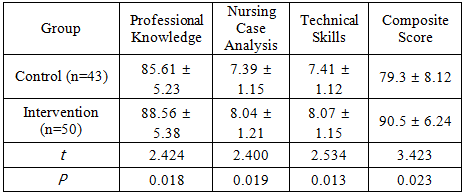
The intervention group demonstrated significantly higher scores in professional knowledge, nursing case analysis, and technical skills compared to the control group (P<0.05), as detailed in Table 3.
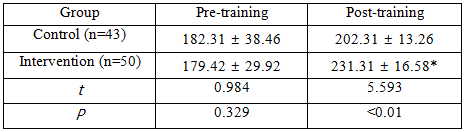
Before training, no significant difference existed between groups (P>0.05). Post-training, both groups showed improved scores, with the intervention group demonstrating significantly higher clinical practice completion ability than controls (P<0.01), as shown in Table 4.
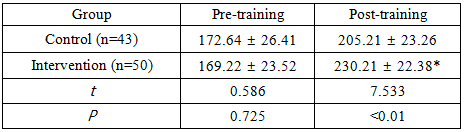
Before training, no significant difference existed in humanistic care ability between groups (P>0.05). Post-training, both groups showed improved scores, with the intervention group demonstrating significantly higher humanistic care ability than controls (P<0.01), as detailed in Table 5.
The intervention group demonstrated superior scores in professional knowledge, case analysis, and technical skills (P<0.05), validating Mini-CEX's efficacy in promoting clinical competency. This aligns with the "assessment-driven learning" mechanism 9: structured feedback (delivered within 15-min post-assessment) enables immediate correction of errors (e.g., standardizing wristband verification during IV catheterization). Multidimensional evaluation (e.g., "organizational efficiency" dimension) shifts nurses from task executors to holistic planners, addressing the National Nursing Development Plan's mandate to "enhance care efficiency."
4.2. Homogenized Evaluation Advances Clinical CompetencyThe intervention group achieved 231.31±16.58 in clinical competency (+14.3% vs controls), attributed to:Frame-of-reference training (k≥0.85 inter-rater reliability) eliminating assessment bias 10. Progressive scenario design: Basic skills (Month 1) → complex case management (Months 2-3)"Stress management" showed greatest improvement (+37.2% baseline), confirming Mini-CEX's efficacy in simulating clinical pressures-a core element neglected in traditional training.
4.3. Internalization of Humanistic Care CompetencyIntervention group scored 230.21±22.38 in humanistic care (+12.2% vs controls), with 29.0% growth rate exceeding technical skills (15.7%). This stems from:Behavioral translation: Abstract concepts (e.g., empathy) operationalized as observable actions (e.g., "proactively inquires about comfort"). Narrative-enhanced feedback: Patient stories during debriefings catalyzed role transition from technician to holistic caregiver 11.
4.4. Closed-Loop System for Nursing Talent DevelopmentMini-CEX evolved from an assessment tool to a data-driven talent ecosystem:Identified training gaps (e.g., lowest scores in communication) → targeted workshops Addressed National Nursing Development Plan's call for "clinical demand-oriented evaluation" 12.
This study established and validated a Mini-CEX-based contextual assessment for newly hired nurses, featuring:7-dimension, 23-item scale (Delphi-validated)
Frame-of-reference training + progressive assessment (pre-employment → basic → complex cases) Significant improvements in clinical competency and humanistic care addressed three bottlenecks: skill-humanism imbalance, scenario disconnect, and fragmented standards.
Limitations:Single-center trial (Grade A tertiary hospital); Long-term retention unmeasured (e.g., 1-year competency sustainability).
Future Directions:
j Multicenter validation in primary care settings
k AI-powered scoring (e.g., NLP analysis of nurse-patient communication)
l Integration with electronic portfolios for"assessment-certification-promotion"
This methodology empowers clinical readiness through contextual assessment and structured feedback-driven competency internalization, accelerating innovative nursing productivity development.
This work was supported by the Henan Provincial Medical Education Research Project (Grant No. WJLX2024180).
| [1] | Ministry of Education of the People's Republic of China. Opinions on accelerating the construction of high-level undergraduate education and comprehensively improving talent training capabilities [J]. Gaz State Counc People's Repub China, 2019(3): 34-41. (Chinese). | ||
| In article | |||
| [2] | National Health Commission of the People's Republic of China. Notice on issuing the National Nursing Development Plan (2021-2025) [J]. Gaz State Counc People's Repub China, 2022(23): 57-63. (Chinese). | ||
| In article | |||
| [3] | Reebals C, Wood T, Markaki A. Transition to Practice for New Nurse Graduates: Barriers and Mitigating Strategies [J]. West J Nurs Res, 2022, 44(4): 416-29. | ||
| In article | View Article PubMed | ||
| [4] | Miller CM, Meyer K, Riemann LA, et al. Transition Into Practice: Outcomes of a Nurse Residency Program [J]. J Contin Educ Nurs, 2023, 54(1): 32-9. | ||
| In article | View Article PubMed | ||
| [5] | Kleib M, Arnaert A, Sugars R, et al. Mentors' and supervisors' perspectives regarding newly qualified nurses' practice in digitally enabled workplaces: A qualitative study [J]. Int J Nurs Stud, 2025, 162: 104968. | ||
| In article | View Article PubMed | ||
| [6] | Afaneh T, Villamor MY, Opinion F, et al. Exploring the gap between school of nursing theoretical foundations and clinical practice [J]. J Prof Nurs, 2023, 49: 158-64. | ||
| In article | View Article PubMed | ||
| [7] | TANG XZ. Effect analysis of scenario simulation training on improving the competence of newly hired nurses in oncology specialty [J]. Chin J Cancer Prev Treat, 2019, 26(Suppl 1): 295-6. (Chinese). | ||
| In article | |||
| [8] | NING YJ, XU GH, FENG YJ, et al. Construction of an evaluation index system for clinical practice ability of newly hired nurses [J]. J Nurs, 2023, 30(17): 11-5. (Chinese). | ||
| In article | |||
| [9] | Hansen W, Zuma SM. Guidelines to support newly qualified professional nurses for effective clinical practice [J]. Curationis, 2024, 47(1): e1-e8. | ||
| In article | View Article PubMed | ||
| [10] | Walters G, Hoffart N, Kring D, et al. Work Readiness of Newly Licensed RNs [J]. J Nurs Adm, 2022, 52(9): 469-73. | ||
| In article | View Article PubMed | ||
| [11] | YANG LP, DUAN PB, HAN SX. Research status and hotspots of narrative nursing based on Web of Science database [J]. J Clin Med Pract, 2022, 26(13): 119-24. (Chinese). | ||
| In article | |||
| [12] | LIU F, WANG YQ, WEN XL, et al. Evaluation of the effect of systematic mentorship training based on Watson's caring theory on cultivating humanistic care quality of new nurses [J]. Chin Nurs Manag, 2021, 21(1): 85-91. (Chinese). | ||
| In article | |||
Published with license by Science and Education Publishing, Copyright © 2025 Tong Li, Qi Feng, Yuxuan Ma, Bing Yang and Fang Huang
 This work is licensed under a Creative Commons Attribution 4.0 International License. To view a copy of this license, visit
http://creativecommons.org/licenses/by/4.0/
This work is licensed under a Creative Commons Attribution 4.0 International License. To view a copy of this license, visit
http://creativecommons.org/licenses/by/4.0/
| [1] | Ministry of Education of the People's Republic of China. Opinions on accelerating the construction of high-level undergraduate education and comprehensively improving talent training capabilities [J]. Gaz State Counc People's Repub China, 2019(3): 34-41. (Chinese). | ||
| In article | |||
| [2] | National Health Commission of the People's Republic of China. Notice on issuing the National Nursing Development Plan (2021-2025) [J]. Gaz State Counc People's Repub China, 2022(23): 57-63. (Chinese). | ||
| In article | |||
| [3] | Reebals C, Wood T, Markaki A. Transition to Practice for New Nurse Graduates: Barriers and Mitigating Strategies [J]. West J Nurs Res, 2022, 44(4): 416-29. | ||
| In article | View Article PubMed | ||
| [4] | Miller CM, Meyer K, Riemann LA, et al. Transition Into Practice: Outcomes of a Nurse Residency Program [J]. J Contin Educ Nurs, 2023, 54(1): 32-9. | ||
| In article | View Article PubMed | ||
| [5] | Kleib M, Arnaert A, Sugars R, et al. Mentors' and supervisors' perspectives regarding newly qualified nurses' practice in digitally enabled workplaces: A qualitative study [J]. Int J Nurs Stud, 2025, 162: 104968. | ||
| In article | View Article PubMed | ||
| [6] | Afaneh T, Villamor MY, Opinion F, et al. Exploring the gap between school of nursing theoretical foundations and clinical practice [J]. J Prof Nurs, 2023, 49: 158-64. | ||
| In article | View Article PubMed | ||
| [7] | TANG XZ. Effect analysis of scenario simulation training on improving the competence of newly hired nurses in oncology specialty [J]. Chin J Cancer Prev Treat, 2019, 26(Suppl 1): 295-6. (Chinese). | ||
| In article | |||
| [8] | NING YJ, XU GH, FENG YJ, et al. Construction of an evaluation index system for clinical practice ability of newly hired nurses [J]. J Nurs, 2023, 30(17): 11-5. (Chinese). | ||
| In article | |||
| [9] | Hansen W, Zuma SM. Guidelines to support newly qualified professional nurses for effective clinical practice [J]. Curationis, 2024, 47(1): e1-e8. | ||
| In article | View Article PubMed | ||
| [10] | Walters G, Hoffart N, Kring D, et al. Work Readiness of Newly Licensed RNs [J]. J Nurs Adm, 2022, 52(9): 469-73. | ||
| In article | View Article PubMed | ||
| [11] | YANG LP, DUAN PB, HAN SX. Research status and hotspots of narrative nursing based on Web of Science database [J]. J Clin Med Pract, 2022, 26(13): 119-24. (Chinese). | ||
| In article | |||
| [12] | LIU F, WANG YQ, WEN XL, et al. Evaluation of the effect of systematic mentorship training based on Watson's caring theory on cultivating humanistic care quality of new nurses [J]. Chin Nurs Manag, 2021, 21(1): 85-91. (Chinese). | ||
| In article | |||