This study investigates the impact of nurse leadership styles on nursing staff performance in both rural healthcare divisions and the Qatif Health Network under the Eastern Health Cluster in Saudi Arabia. A cross-sectional design was used, employing the Multifactor Leadership Questionnaire (MLQ-5X) to measure transformational, transactional, and laissez-faire leadership styles. Data from 380 nurses were analyzed using descriptive statistics, Pearson correlations, and multiple regression analyses. Results revealed that transformational and transactional leadership styles had strong positive correlations with job satisfaction, while laissez-faire leadership showed no significant effect. No statistically significant difference was found between rural and urban settings, suggesting that effective leadership practices transcend environmental differences. The findings underscore the importance of developing transformational and transactional leadership skills to improve nurse satisfaction, retention, and performance, aligning with Saudi Arabia’s Vision 2030 goals for healthcare excellence.
The healthcare sector plays a crucial role in maintaining public health, with nursing being a fundamental component in delivering effective patient care and ensuring positive health outcomes 1. Nurse leadership is particularly instrumental in shaping the work environment and enhancing professional performance among nursing staff. Research indicates that leadership styles fostering positive interactions between managers and employees can significantly improve nurses’ job satisfaction, organizational commitment, and workplace innovation 2.
Rural areas are often characterized by low population density and limited infrastructure, while urban areas feature concentrated populations and advanced development. These environmental contrasts create significant differences in the quality of life among healthcare practitioners working in rural versus urban settings 3. In this context, leadership plays a critical role in overcoming challenges unique to these diverse environments.
Among various leadership styles, boundary-spanning leadership which connects internal and external resources to support nursing teams has been shown to promote innovative work behaviors 4. Additionally, supportive leadership has been linked to reduced job burnout, increased workplace trust, and enhanced job satisfaction 4. Transformational and positive leadership styles are associated with higher performance and organizational commitment, whereas authoritarian or ineffective leadership can lead to negative outcomes such as increased turnover and reduced productivity 5.
However, despite these findings, further research is needed to explore the impact of leadership styles on nurse behavior and performance, particularly in rural healthcare settings. Studies focusing on rural divisions in Saudi Arabia’s Eastern Province have highlighted gaps in understanding how cultural values, leadership practices, and systemic challenges such as limited resources affect staff performance and retention 6. Furthermore, there is a lack of comparative research on how these leadership dynamics may differ in more urbanized and resource-equipped settings such as the Qatif Health Network. By including both rural healthcare networks and the Qatif Health Network in this research, a more comprehensive perspective can be developed on the contextual factors that influence leadership effectiveness, enabling the formulation of tailored strategies to enhance nursing performance and healthcare delivery.
The challenges in rural healthcare environments, including extended working hours and a lack of established organizational systems, often result in poor coworker relationships and increased work pressure. These issues can negatively affect work efficiency, collaboration, and innovation. In these settings, boundary-spanning leadership is crucial as it facilitates coordinated efforts among nursing teams despite structural and resource-related constraints 4.
In contrast, the Qatif Health Network represents a more urbanized and resource-rich environment within the Eastern Health Cluster provides a setting for examining the impact of nurse leadership styles in a different context. The differences in infrastructure, resource availability, and organizational complexity between rural healthcare networks and the Qatif Health Network offer a unique opportunity to investigate how contextual factors shape leadership effectiveness and nursing outcomes. A comparative analysis of these two settings will offer valuable insights into leadership dynamics, helping to develop region-specific strategies that improve nurse performance, job satisfaction, and overall healthcare service quality.
Research Questions
The primary research questions guiding this study are:
Which leadership styles are most commonly adopted by nurse managers in rural divisions and the Qatif Health Network under the Eastern Health Cluster?
What is the relationship between nursing leadership styles and nursing job satisfaction in rural healthcare divisions and the Qatif Health Network?
How do nursing managers’ leadership styles impact staff collaboration and communication in rural healthcare divisions and the Qatif Health Network?
What is the influence of different leadership styles on workplace dynamics and organizational culture in rural healthcare divisions and the Qatif Health Network?
What is the relationship between nursing leadership styles, nurse retention, and career development in rural healthcare divisions and the Qatif Health Network?
Research Aim and Objectives
Aim: To assess the impact of nurse leadership styles on the performance of rural nursing staff compared to those at the Qatif Health Network in the Eastern Region of Saudi Arabia.
Objectives:
Identifying the leadership styles employed by nurse managers in both rural divisions and the Qatif Health Network, all under the umbrella of the Eastern Healthcare Cluster (EHC).
Assessing the impact of these leadership styles on staff performance and job satisfaction in both the Qatif Health Network and rural divisions.
Exploring staff perceptions of leadership effectiveness in both the central and rural divisions.
Investigating the challenges faced by nurse leaders in rural areas in comparison to those in Central.
Examining the influence of cultural and regional factors on leadership effectiveness in both central and rural divisions.
Recommending strategies for improving nurse leadership practices in both rural areas and the Qatif Health Network.
Significance of Study
This research holds significance for enhancing nursing leadership in both rural healthcare divisions and the Qatif Health Network, aligning with Saudi Arabia’s Vision 2030 healthcare transformation goals. Effective leadership is essential to reducing staff turnover, promoting nurse well-being, and improving the quality of patient care across varied healthcare environments. By shedding light on the influence of leadership styles on nursing staff performance and satisfaction within both rural and urbanized healthcare settings, this study contributes to the development of context-sensitive leadership strategies. These findings can inform targeted interventions that improve workforce stability, foster innovation, and ensure consistent healthcare delivery. The comparative approach further strengthens the study’s relevance by highlighting best practices and challenges unique to each setting, thus supporting the national goal of an efficient, equitable, and high-performing healthcare system.
Literature Review
Leadership is an essential management function within healthcare organizations, crucial for channeling resources efficiently and achieving organizational goals. The role of nursing leadership extends beyond managerial tasks, playing a pivotal role in promoting health equity, enhancing patient outcomes, and fostering a positive work environment 7. Effective leadership within nursing significantly influences staff attitudes and behaviors 8 and has a direct impact on patient outcomes, nurse satisfaction, and retention, making it a cornerstone for organizational success 9.
Characteristics of Nursing Leadership
Nursing leadership characteristics are vital for fostering innovation among nurses. Boundary-spanning leaders, who promote innovative work behaviors, are crucial in enhancing nurses' well-being and work performance 10. As the healthcare environment evolves, there is a growing need to reassess leadership models in nursing to ensure that they effectively support staff, enhance job performance, and improve the quality of care 11.
Ethical Leadership in Nursing
Ethical leadership has been shown to reduce professional burnout 12, emotional exhaustion 13, and improve nurses' emotional stability, well-being, and psychological empowerment 14. Ethical leadership fosters a positive organizational culture, builds trust, and enhances nurses' organizational identity 15. This leadership style is integral to creating a supportive, empathetic work environment, which is essential for improving nurse retention and job satisfaction.
Nursing Retention and Leadership Styles
Numerous studies have explored the relationship between nursing leadership and retention, highlighting factors such as job dissatisfaction, intention to leave, and cultural influences 16, 17, 18, 19, 20. However, there is a gap in research focusing on how leadership styles specifically affect organizational commitment and retention rates 21. Transformational and participative leadership styles have been found to reduce turnover intention, while autocratic and laissez-faire styles are linked to higher turnover rates 22. These findings underscore the importance of leadership styles in shaping the work environment and influencing nurse retention.
Leadership Styles and Their Impact on Nursing
Studies have demonstrated that transformational leadership is associated with positive staff outcomes, including job satisfaction, professional growth, and improved organizational culture 2, 23, 24, 25. In contrast, passive and destructive leadership styles correlate with negative outcomes such as burnout, job stress, and higher turnover intentions. Transformational leadership, which emphasizes inspiration, motivation, and engagement, is especially effective in healthcare settings, as it drives enthusiasm and fosters creativity among nursing teams 26, 27, 28.
Rural Healthcare Leadership
Rural healthcare settings face unique challenges, such as limited resources, staff shortages, and geographical isolation, which impact the quality and accessibility of care 29, 30. In Saudi Arabia, rural areas often struggle to provide essential healthcare services, particularly to aging populations with chronic health conditions 31. Nursing leadership in these settings plays a crucial role in maintaining care standards despite these challenges. Studies show that strong, supportive leadership is essential for addressing issues such as job dissatisfaction, turnover intention, and limited professional development opportunities in rural healthcare environments 32.
Leadership Theory
Great Man Theory (1840s)
Great man theories suggest that leadership ability is innate, believing that exceptional leaders are born, not developed. These theories often depict leaders as heroic, legendary figures, destined to assume leadership roles when necessary. The term "great man" was used historically because leadership, particularly in military contexts, was primarily considered a male trait 8.
Contingency Theory (1960s)
Contingency leadership theories emphasize that the effectiveness of a leadership style depends on specific environmental factors. This theory posits that there is no universal leadership style suitable for all situations. Instead, success is influenced by variables such as the leader’s style, follower characteristics, and the context 33, 34.
The Evolution of Leadership: Transactional and Transformational Theories (1990s) and Contemporary Approaches (2000s)
It was recognized that focusing exclusively on one aspect of leadership does not capture the full complexity of the concept, leading to a shift towards more holistic leadership theories that consider a range of factors and interactions 22.
With the increasing complexity and challenges of the modern world, there was a growing demand for leadership theories capable of addressing rapid change, technological innovations, and globalization 35, 36, 37, 38. This led to the emergence of a new leadership era, which moved away from traditional theories that defined leadership as a one-directional, top-down process, creating a clear distinction between leaders and followers. The focus shifted to the intricate interactions between leaders, followers, the environment, and the overall system, highlighting the latent leadership abilities of followers 39. The increasing complexity of leadership challenges led to the popularity of both transformational and transactional leadership theories 40. Transformational leadership is a leadership theory where leaders motivate, inspire, and encourage their followers to achieve higher levels of performance and personal growth 41. This theory is particularly useful when an organization needs revitalization, is undergoing major changes, or requires a new strategic direction. It is especially important in today’s rapidly evolving technological sectors, where innovation and flexibility can determine an organization’s success or failure. Prominent examples of transformational leaders include Jeff Bezos, Steve Jobs, and Bill Gates 39. Transactional leadership, on the other hand, motivates employees through authority and formal power to ensure task completion 41. In transactional leadership, leaders reward followers for their efforts and impose penalties on those who fail to meet goals, with fairness and equity being key factors in the exchange 42. Transactional leadership is most effective in organizations that have a clear structure and established goals, where it helps maintain order and preserve the current system. Managers who emphasize supervision, adherence to processes, and employee performance are typical examples of transactional leaders 39.
While the literature provides substantial insight into various leadership theories and their application in healthcare settings, there remains limited comparative research on how these leadership styles play out in rural versus urban environments particularly within the Eastern Health Cluster of Saudi Arabia. This study aims to fill that gap by analyzing leadership effectiveness and its influence on nursing outcomes in both the Qatif Health Network and rural healthcare settings.
This study adopted a cross-sectional survey design to investigate the impact of nurse leadership styles on nursing performance in rural healthcare settings and the Qatif Health Network, both under the Eastern Health Cluster (EHC) in Saudi Arabia. IRB approval was obtained from the Qatif Health Network, Eastern Health Cluster.
The Multifactor Leadership Questionnaire (MLQ-5X Short Form) 43 was used to assess transformational, transactional, and laissez-faire leadership styles, while nursing performance was evaluated through a modified questionnaire developed from previously validated tools. The modified performance questionnaire focused on job satisfaction, teamwork, and clinical competence. The collected data were analyzed using descriptive statistics, correlation analysis, and multiple regression analysis to determine the relationship between leadership styles and nursing performance.
To minimize bias, this study accounted for confounders like nurse demographics, hospital size, and rurality level using multiple regression analysis. Stratified and subgroup analyses were conducted to identify variations across experience levels and hospital types. Control variables such as age, years of experience, education level, job position, and workplace setting were included in the analysis, while sensitivity tests were conducted to ensure the robustness of the results.
The sample size for this study was determined using a prevalence-based approach. With a conservative estimate of 50% prevalence (maximizing variability), a 95% confidence level, and a 5% margin of error, the required size was approximately 385 participants. This sample size ensured reliable assessment of leadership styles across a diverse rural healthcare population. To achieve representative sampling, stratified random sampling was utilized, ensuring the inclusion of nurses and nurse managers from various healthcare facilities within the Eastern Health Cluster (EHC), specifically located in the rural areas of the Eastern region. This approach accounted for differences in hospital size and leadership roles, ensuring broad and comprehensive representation.
Inclusion Criteria
Saudi and non-Saudi Nurses
Male and female nurses working in rural divisions and the Qatif Health Network within the Eastern Health Cluster (EHC).
Staff nurses, head nurses, charge nurses, nurse managers, nurse supervisors, nurse directors, executive directors, or any other managerial roles.
At least one year of experience in their current role.
Exclusion Criteria
Nurses are assigned to non-nursing roles.
• Nurses with less than one year of experience in their current role.
• nurses are not working in rural divisions or Qatif networks within the Eastern Health Cluster (EHC).
• Other healthcare providers are not part of the study’s focus.
Data collection was conducted using a structured survey distributed via online platforms, including WhatsApp, official emails, and other social media channels used by the Eastern Health Cluster (EHC) to ensure easy access for participants.
Ethical approval was obtained from the Institutional Review Board (IRB), and all participants provided informed consent, ensuring the confidentiality and anonymity of their responses.
Data analysis involved the use of descriptive statistics to summarize leadership styles and nursing performance. Correlation and regression analyses (using SPSS) were conducted to assess the relationship between leadership styles and nursing performance outcomes. The study also incorporated prevalence data to ensure the sample size was large enough to detect meaningful relationships, especially in rural healthcare settings where leadership and performance dynamics might have differed.
1. Demographic and Professional Characteristics of the Sample
The demographic and professional profile of the 380 nursing staff participants who completed the survey is summarized in Table 1.
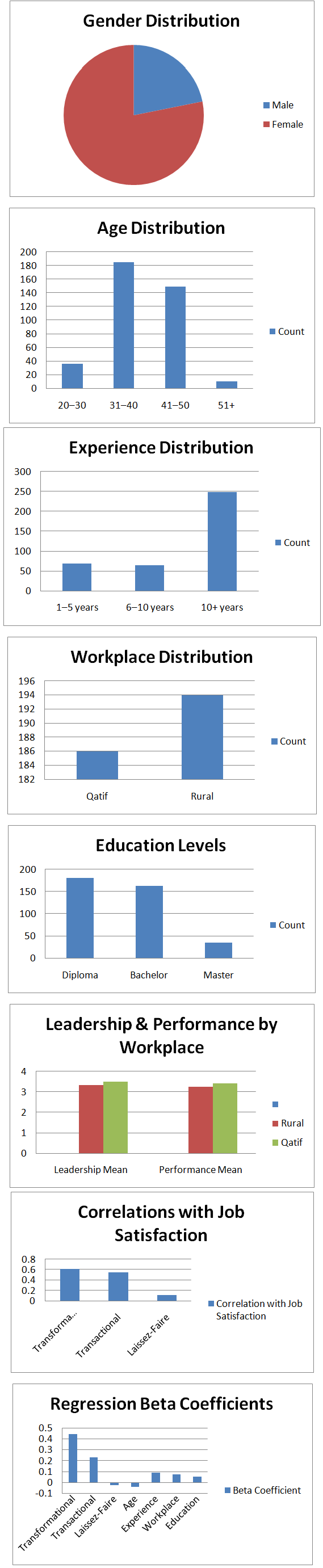
The majority of participants were female (78.2%) and in the middle stages of their careers (31-40 years, 48.7%; 41-50 years, 39.2%). Most had more than ten years of experience (65.3%). The sample was almost evenly split between Qatif Health Network (48.9%) and Rural Healthcare Division (51.1%). Most participants were Saudi nationals (82.4%). Regarding education, the majority held a Diploma (47.6%), followed by a bachelor’s degree (42.9%), and a smaller proportion held a Master’s degree (9.5%).
2. Comparison of Leadership and Performance by Workplace Location
An independent samples t-test was conducted to examine whether perceptions of nurse leadership and self-reported nursing performance differed between Qatif Health Network and Rural Healthcare Division.
Although mean scores for both leadership and performance were higher in the Qatif Health Network, the differences were not statistically significant (p > 0.05).
3. Correlation between Leadership Styles and Job Satisfaction
Pearson correlation analysis was conducted to examine relationships between transformational, transactional, and laissez-faire leadership styles and job satisfaction.
Transformational and transactional leadership showed strong positive correlations with job satisfaction, while laissez-faire leadership had a weak but significant positive correlation. Inter-correlations among leadership styles were also significant.
4. Impact of Leadership Styles on Job Satisfaction: Controlling for Demographics and Workplace
A multiple linear regression was conducted to assess the predictive effect of leadership styles on job satisfaction, controlling for age group, years of experience, workplace location, and education. The assumptions of linearity, independence of errors (Durbin-Watson = 2.050), and homoscedasticity were met. VIF values ranged from 1.067 to 2.315, indicating no multicollinearity concerns.
Model Summary: F(7, 372) = 37.132, p < 0.001, R² = 0.411, Adjusted R² = 0.400
Transformational leadership had the strongest positive effect on job satisfaction (β = 0.442, p < 0.001), followed by transactional leadership (β = 0.232, p < 0.001). Laissez-faire leadership was not a significant predictor (β = -0.025, p = 0.557). Years of experience and workplace location approached significance (p = 0.066 and 0.073, respectively), while age group and education level were not significant.

The study reflects on how the lead nurse position assumes importance within modeling the role of nurse leaders in the Eastern Health Cluster of Saudi Arabia. Employee job satisfaction was viewed by most participants as relating to both transformational as well as transactional leadership 44, contrary to the laissez-faire approach. It was noted in this study that transformational leadership had the greatest overall enhancement in job satisfaction and was positively correlated with it 25, 45, 46. One possibility of this study is to develop leaders who inspire, motivate, and engage their team members. The present findings replicate those of other studies linking developmental leadership styles to possible outcomes, including professional growth and a supportive organizational atmosphere 2, 26, 47. While transformational and transactional leadership were both positively related to job satisfaction, laissez-faire leadership was not related to job satisfaction, confirming its ineffectiveness 22.
The statistical assessment of the urban Qatif Health Network and rural sections in terms of the measured dimensions of leadership perception and performance did not yield statistically significant data, although mean scores were slightly higher for the Qatif Network. This finding is of particular interest, as the literature review raised concern regarding extraneous parameters related to each rural setting, such as resource limitations or relative isolation due to geographical barriers, which may impinge on leadership and performance 29, 32, 48. The absence of a statistically significant difference suggests that the effects of leadership styles, such as transformational and transactional leadership, may transcend environmental and contextual barriers, strongly motivating job satisfaction in both conditions 3.
These findings offer important implications for hospital administrators and policymakers in Saudi Arabia. Nurse managers should further develop their transformational and transactional leadership skills throughout all departments to enhance nurses' job satisfaction, retention, and performance 49. This could be achieved through leadership development programs or mentorship initiatives. Previous studies confirm that leadership style directly influences staff retention, with effective leaders decreasing turnover intention 21, 22, 50, 51. This approach is essential to building a motivated and stable nursing workforce that supports Saudi Arabia’s Vision 2030 healthcare ambitions.
While the results of the Eastern Health Cluster study have meaningful and relevant implications for the existing body of literature, the identified constraints warrant further exploration. The presented results apply more specifically to the Eastern Health Cluster and cannot be generalized to the rest of Saudi Arabia 29, 32. Therefore, a larger pan-regional study would be beneficial. Another limitation is that the study suffers from self-perception biases. This opens the door for future research that might assist in developing mixed-method studies to build richer qualitative datasets on perceptions of leadership, thereby addressing gaps in the literature concerning rural Saudi settings 6. Other intervening variables may exist between leadership and job satisfaction. Throughout the intervention process, variables such as organizational culture and environment should be considered regarding resource distribution and communication quality—especially concerning differences experienced in healthcare delivery between rural and urban contexts.
This study has several potential limitations. Firstly, it focuses exclusively on the Qatif Health Network and Rural Health Networks that are part of the Eastern Health Cluster in Saudi Arabia, which may limit the applicability of the results to other regions or healthcare environments. Additionally, self-reported survey data may be influenced by response bias. Lastly, while the sample size is adequate for statistical analysis, it may not fully reflect the wide range of experiences within rural nursing contexts.
The study concludes that nurse leadership styles, particularly transformational and transactional leadership, are significantly and positively correlated with job satisfaction among nursing staff in both rural divisions and the Qatif Health Network within the Eastern Health Cluster of Saudi Arabia. The transformational leadership and transactional leadership had a strong positive effect on job satisfaction. Specifically, transformational leadership had the strongest positive effect on job satisfaction (β = 0.442, p < 0.001), followed by transactional leadership (β = 0.232, p < 0.001). Conversely, laissez-faire leadership was not a significant predictor of job satisfaction, confirming its ineffectiveness. A finding of particular interest was the absence of a statistically significant difference in the perception of leadership and self-reported nursing performance between the urban Qatif Health Network and the rural divisions. This suggests that the positive impact of effective leadership styles, such as transformational and transactional, may transcend environmental and contextual barriers like resource limitations or geographical isolation that are often present in rural settings. In summary, the study replicates findings from other research linking developmental leadership styles to positive outcomes and underscores the importance of effective nurse leadership in fostering a supportive organizational atmosphere, which is essential for staff retention and overall performance.
The following strategies are recommended for hospital administrators and policymakers in the Eastern Health Cluster to improve nurse leadership practices and enhance nursing outcomes:
Develop Transformational and Transactional Skills: Nurse managers across all departments, in both urban and rural settings, should be encouraged to further develop their transformational and transactional leadership skills.
Implement Leadership Development Programs: This development could be achieved through dedicated leadership development programs or mentorship initiatives. The goal is to develop leaders who can inspire, motivate, and engage their teams, which is essential for enhancing job satisfaction, retention, and performance.
Focus on Workforce Stability: Investing in effective leadership is essential to building a motivated and stable nursing workforce, which directly supports Saudi Arabia's Vision 2030 healthcare ambitions. Previous studies confirm that effective leaders are crucial for decreasing turnover intention.
Future Research Considerations: While the results provide valuable insights for the Eastern Health Cluster, a larger pan-regional study is recommended to allow for broader generalization across Saudi Arabia. Future research should also consider mixed-method studies to incorporate richer qualitative data on perceptions of leadership and could investigate other intervening variables like organizational culture, environment, resource distribution, and communication quality.
| [1] | Al Asmri, M., Almalki, M. J., Fitzgerald, G., & Clark, M. (2020). The public health care system and primary care services in Saudi Arabia: A system in transition. Eastern Mediterranean Health Journal, 26(4), 468-476. | ||
| In article | View Article PubMed | ||
| [2] | Hult, M., Terkamo-Moisio, A., Kaakinen, P., Karki, S., Nurmeksela, A., Palonen, M., Peltonen, L. M., & Häggman-Laitila, A. (2023). Relationships between nursing leadership and organizational, staff and patient outcomes: A systematic review of reviews. Journal of Nursing Management, 31(6), 1359-1370. | ||
| In article | |||
| [3] | Allhaiby, N. M., Al-Turki, H. A., Al-Otaibi, H. M., & Saeed, A. A. (2021). Healthcare practitioners’ quality of life in rural and urban areas. Journal of Rural Health, 38(4), 679-685. | ||
| In article | |||
| [4] | Fick-Cooper, L., Williams, A., Moffatt, S., & Baker, E. (2019). Boundary spacing leadership: Promising practices for public health. Journal of Public Health Management & Practice, 25(3), 288-290. | ||
| In article | View Article PubMed | ||
| [5] | Al-Rjoub, S., Alsharawneh, A., Alhawajreh, M. J., & Othman, E. H. (2024). Exploring the impact of transformational and transactional style of leadership on nursing care performance and patient outcomes. Journal of Healthcare Leadership, 16, 557-568. | ||
| In article | View Article PubMed | ||
| [6] | Brady Germain, P., & Cummings, G. G. (2010). The influence of nursing leadership on nurse retention: A systematic review. Journal of Nursing Management, 18(8), 920-931. | ||
| In article | View Article PubMed | ||
| [7] | Wakefield, A. (2021). Leadership in nursing practice: Building effective teams and improving patient outcomes. Journal of Nursing Management, 29(5), 1023-1031. | ||
| In article | |||
| [8] | Ololube, N. P., Dudafa, U. J., Uriah, O. A., & Agbor, C. N. (2013). Education for development: Impediments to the globalization of higher education in Nigeria. International Journal of Educational Foundations and Management, 1(2), 109-130. | ||
| In article | |||
| [9] | García-Sierra, R., Fernández-Castro, J., & Martínez-Zaragoza, F. (2018). Work engagement and occupational stress in nursing professionals: A cross-sectional study. Journal of Advanced Nursing, 74(1), 148-158. | ||
| In article | |||
| [10] | Lei, H., Ha, A. S., & Yeung, S. S. (2021). The influence of leadership and job resources on work engagement: A study among Chinese nurses. Nursing Open, 8(4), 1932-1940. | ||
| In article | |||
| [11] | Teo, T. S. (2023). Revisiting leadership frameworks in contemporary nursing: Implications for management and practice. International Journal of Nursing Practice, 29(1), e13075. | ||
| In article | |||
| [12] | McKenna, J., & Jeske, D. (2021). Ethical leadership and decision authority effects nurses’ engagement, exhaustion, and turnover intention. Journal of Advanced Nursing, 77, 198-206. | ||
| In article | View Article PubMed | ||
| [13] | Franczukowska, A., & Wysokiński, M. (2021). Ethical leadership and burnout among healthcare professionals: The mediating role of psychological safety. BMC Nursing, 20, 124. | ||
| In article | |||
| [14] | Sahraei Beiranvand, S., & Keshavarz, Z. (2021). Ethical leadership, psychological empowerment, and job satisfaction among Iranian nurses. Nursing Ethics, 28(6), 911-922. | ||
| In article | |||
| [15] | Esmaelzadeh, F., Abbaszadeh, A., & Borhani, F. (2017). Moral distress among Iranian nurses: A systematic review. Iranian Journal of Nursing and Midwifery Research, 22(3), 167-173. | ||
| In article | |||
| [16] | Abed, F., & Elguindy, H. (2014). The relationship between organizational commitment and anticipated turnover among staff nurses in university hospitals. Egyptian Journal of Health Care, 5, 237-251. | ||
| In article | |||
| [17] | AbuAlRub, R. F., & Alghamdi, M. G. (2012). The impact of leadership styles on nurses’ satisfaction and intention to stay among Saudi nurses. Journal of Nursing Management, 20(5), 668-678. | ||
| In article | View Article PubMed | ||
| [18] | Ahmed, R. M., Abdelwahabb, E. A., & Elguindy, H. (2017). Staff nurses’ intention to leave nursing profession and their organizational commitment in selected hospitals at Beni-Sueif city. Egyptian Nursing Journal, 14, 17-24. | ||
| In article | View Article | ||
| [19] | Alammar, K., Alamrani, M., Alqahtani, S., & Ahmad, M. (2016). Organizational commitment and nurses' characteristics as predictors of job involvement. Nursing Leadership, 29(4), 59-69. | ||
| In article | View Article PubMed | ||
| [20] | Dadgar, H., Barahouei, F., Mohammadi, M., Ebrahimi, M., & Ganjali, A. (2013). The relationship between organizational culture, job satisfaction, organizational commitment, and intention to stay among healthcare personnel. World Applied Sciences Journal, 21, 1220-1228. | ||
| In article | |||
| [21] | Al-Yami, M., Galdas, P., & Watson, R. (2018). Leadership style and organisational commitment among nursing staff in Saudi Arabia. Journal of Nursing Management, 26(7), 849-856. | ||
| In article | View Article PubMed | ||
| [22] | Magbity, J. B., Ofei, A. M. A., & Wilson, D. (2020). Leadership styles of nurse managers and turnover intention. Hospital Topics, 98(2), 45-50. | ||
| In article | View Article PubMed | ||
| [23] | Aboshaiqah, A. E., Hamdan-Mansour, A. M., Sherrod, D. R., Alkhaibary, A., & Alkhaibary, S. (2014). Nurses’ perception of managers’ leadership styles and its associated outcomes. American Journal of Nursing Research, 2(4), 57-62. | ||
| In article | |||
| [24] | Al-Theeb, S. A. (2020). Leadership style and employee motivation in Saudi Arabia. Journal of Education and Psychology, 8, 1578. | ||
| In article | |||
| [25] | Albagawi, B. (2019). Leadership styles of nurse managers and job satisfaction of staff nurses: A correlational design study. European Scientific Journal, 15(3), 254-275. | ||
| In article | View Article | ||
| [26] | Harb, A., Althunian, Z., Silva, J., Alayed, A., Aljarudi, S., & Barshaid, A. (2022). Nurses’ perceptions of nursing leadership styles in the Eastern Healthcare Cluster in Saudi Arabia. American Journal of Nursing Research, 10(1), 13-22. | ||
| In article | View Article | ||
| [27] | Cummings, G. G., et al. (2018). Leadership styles and outcome patterns for the nursing workforce and work environment: A systematic review. International Journal of Nursing Studies, 47(3), 363-385. | ||
| In article | View Article PubMed | ||
| [28] | El-Demerdash, S. M., & Aldeeb, G. A. (2016). Head nurses’ transformational leadership, collaboration, and its relation to staff nurses’ work engagement. International Journal of Nursing Didactics, 6(7), 30-39. | ||
| In article | View Article | ||
| [29] | Houghton, C., Murphy, K., Meehan, B., & Casey, D. (2023). Challenges in rural healthcare delivery in Saudi Arabia. Rural and Remote Health, 23(2), 12345. | ||
| In article | |||
| [30] | Albliteeh, M. (2015). Choosing to become a nurse in Saudi Arabia and the lived experience of new graduates: A mixed methods study. University of Nottingham, United Kingdom. | ||
| In article | |||
| [31] | Alkhamis, A. A., & Miraj, S. S. (2021). Challenges of healthcare delivery in rural Saudi Arabia: A narrative review. Journal of Health Informatics in Developing Countries, 15(1), 1-9. | ||
| In article | |||
| [32] | Rose, L., Austin, L., & McCarthy, G. (2023). Study on rural healthcare nurse retention. Journal of Rural Nursing, 39(1), 12-23. | ||
| In article | |||
| [33] | Charry, K. (2012). Leadership theories - 8 major leadership theories. Retrieved March 23, 2014, from https:// psychology.about.com / od/leadership/a/leadershiptheories.htm. | ||
| In article | |||
| [34] | House, R. J., & Mitchell, T. R. (1975). Path-Goal Theory of Leadership. Washington University, Department of Psychology. | ||
| In article | |||
| [35] | Avolio, B. J., & Gardner, W. L. (2005). Authentic leadership development: Getting to the root of positive forms of leadership. Leadership Quarterly, 16(3), 315-338. | ||
| In article | View Article | ||
| [36] | Bass, B. M., & Avolio, B. J. (1994). Improving organizational effectiveness through transformational leadership. Sage Publications. | ||
| In article | |||
| [37] | Burns, J. M. (1978). Leadership. Harper and Row. | ||
| In article | |||
| [38] | Day, D., Fleenor, J., Atwater, L., Sturm, R., & McKee, R. (2014). Advances in leader and leadership development: A review of 25 years of research and theory. Leadership Quarterly, 25(1), 63-82. | ||
| In article | View Article | ||
| [39] | Benmira, S., & Agboola, M. (2021). Evolution of leadership theory. BMJ Leader, 5(1). | ||
| In article | View Article | ||
| [40] | Bass, B. M. (1990). From transactional to transformational leadership: Learning to share the vision. Organizational Dynamics, 18(3), 19-31. | ||
| In article | View Article | ||
| [41] | Flynn, S. I. (2019). Transformational and transactional leadership. Great Neck Publishing. | ||
| In article | |||
| [42] | Hollander, E. P., & Offermann, L. R. (1990). Power and leadership in organizations: Relationships in transition. American Psychologist, 45(2), 179-189. | ||
| In article | View Article | ||
| [43] | Avolio, B. J., & Bass, B. M. (2004). Multifactor Leadership Questionnaire (MLQ-5X) Manual and Sampler Set. Mind Garden, Inc. | ||
| In article | |||
| [44] | Alfaouri, L., Mat, N. H. N., & Padlee, S. F. (2021). HRM practices, organizational commitment, and employee satisfaction. Turkish Online Journal of Quality Inquiry, 12(6), 178. | ||
| In article | |||
| [45] | Albohaiteem, A., & Baig, L. A. (2016). Effect of leadership styles on job satisfaction among critical care nurses in Aseer, Saudi Arabia. Journal of the College of Physicians and Surgeons Pakistan, 26(5), 66-70. | ||
| In article | |||
| [46] | Alshahrani, F. M., & Baig, L. A. (2016). Effect of leadership styles on job satisfaction among critical care nurses in Aseer, Saudi Arabia. Journal of the College of Physicians and Surgeons Pakistan, 26(5), 66-70. | ||
| In article | |||
| [47] | Boamah, S. A., Laschinger, H. K. S., Wong, C., & Clarke, S. (2018). Effect of transformational leadership on job satisfaction and patient safety outcomes. Nursing Outlook, 66(2), 180-189. | ||
| In article | View Article PubMed | ||
| [48] | Choi, Y., Yoon, D. J., & Kim, D. (2020). Leader behavioral integrity and employee in-role performance: The roles of coworker support and job autonomy. International Journal of Environmental Research and Public Health, 17(12), 4303. | ||
| In article | View Article PubMed | ||
| [49] | Duarte, A. P., Ribeiro, N., Semedo, A. S., & Gomes, D. R. (2021). Authentic leadership and improved individual performance: Affective commitment and individual creativity’s sequential mediation. Frontiers in Psychology, 12, 675749. | ||
| In article | View Article PubMed | ||
| [50] | Garg, A. K., & Ramjee, D. (2013). The relationship between leadership styles and employee commitment at a parastatal company in South Africa. International Business & Economics Research Journal, 12(11), 1411-1436. | ||
| In article | View Article | ||
| [51] | Keskes, I. (2014). Relationship between leadership styles and dimensions of employee organizational commitment: A critical review and discussion of future directions. Intangible Capital, 10(1), 26-51. | ||
| In article | View Article | ||
Published with license by Science and Education Publishing, Copyright © 2025 Fatimah Alyousef, Zainab Alswaid, Eman Alshikh, Sameerah Alkhabbaz, Amal Almalali, Amal Mohamed, Reem Almoslem and Ebtihal Alfardan
 This work is licensed under a Creative Commons Attribution 4.0 International License. To view a copy of this license, visit
http://creativecommons.org/licenses/by/4.0/
This work is licensed under a Creative Commons Attribution 4.0 International License. To view a copy of this license, visit
http://creativecommons.org/licenses/by/4.0/
| [1] | Al Asmri, M., Almalki, M. J., Fitzgerald, G., & Clark, M. (2020). The public health care system and primary care services in Saudi Arabia: A system in transition. Eastern Mediterranean Health Journal, 26(4), 468-476. | ||
| In article | View Article PubMed | ||
| [2] | Hult, M., Terkamo-Moisio, A., Kaakinen, P., Karki, S., Nurmeksela, A., Palonen, M., Peltonen, L. M., & Häggman-Laitila, A. (2023). Relationships between nursing leadership and organizational, staff and patient outcomes: A systematic review of reviews. Journal of Nursing Management, 31(6), 1359-1370. | ||
| In article | |||
| [3] | Allhaiby, N. M., Al-Turki, H. A., Al-Otaibi, H. M., & Saeed, A. A. (2021). Healthcare practitioners’ quality of life in rural and urban areas. Journal of Rural Health, 38(4), 679-685. | ||
| In article | |||
| [4] | Fick-Cooper, L., Williams, A., Moffatt, S., & Baker, E. (2019). Boundary spacing leadership: Promising practices for public health. Journal of Public Health Management & Practice, 25(3), 288-290. | ||
| In article | View Article PubMed | ||
| [5] | Al-Rjoub, S., Alsharawneh, A., Alhawajreh, M. J., & Othman, E. H. (2024). Exploring the impact of transformational and transactional style of leadership on nursing care performance and patient outcomes. Journal of Healthcare Leadership, 16, 557-568. | ||
| In article | View Article PubMed | ||
| [6] | Brady Germain, P., & Cummings, G. G. (2010). The influence of nursing leadership on nurse retention: A systematic review. Journal of Nursing Management, 18(8), 920-931. | ||
| In article | View Article PubMed | ||
| [7] | Wakefield, A. (2021). Leadership in nursing practice: Building effective teams and improving patient outcomes. Journal of Nursing Management, 29(5), 1023-1031. | ||
| In article | |||
| [8] | Ololube, N. P., Dudafa, U. J., Uriah, O. A., & Agbor, C. N. (2013). Education for development: Impediments to the globalization of higher education in Nigeria. International Journal of Educational Foundations and Management, 1(2), 109-130. | ||
| In article | |||
| [9] | García-Sierra, R., Fernández-Castro, J., & Martínez-Zaragoza, F. (2018). Work engagement and occupational stress in nursing professionals: A cross-sectional study. Journal of Advanced Nursing, 74(1), 148-158. | ||
| In article | |||
| [10] | Lei, H., Ha, A. S., & Yeung, S. S. (2021). The influence of leadership and job resources on work engagement: A study among Chinese nurses. Nursing Open, 8(4), 1932-1940. | ||
| In article | |||
| [11] | Teo, T. S. (2023). Revisiting leadership frameworks in contemporary nursing: Implications for management and practice. International Journal of Nursing Practice, 29(1), e13075. | ||
| In article | |||
| [12] | McKenna, J., & Jeske, D. (2021). Ethical leadership and decision authority effects nurses’ engagement, exhaustion, and turnover intention. Journal of Advanced Nursing, 77, 198-206. | ||
| In article | View Article PubMed | ||
| [13] | Franczukowska, A., & Wysokiński, M. (2021). Ethical leadership and burnout among healthcare professionals: The mediating role of psychological safety. BMC Nursing, 20, 124. | ||
| In article | |||
| [14] | Sahraei Beiranvand, S., & Keshavarz, Z. (2021). Ethical leadership, psychological empowerment, and job satisfaction among Iranian nurses. Nursing Ethics, 28(6), 911-922. | ||
| In article | |||
| [15] | Esmaelzadeh, F., Abbaszadeh, A., & Borhani, F. (2017). Moral distress among Iranian nurses: A systematic review. Iranian Journal of Nursing and Midwifery Research, 22(3), 167-173. | ||
| In article | |||
| [16] | Abed, F., & Elguindy, H. (2014). The relationship between organizational commitment and anticipated turnover among staff nurses in university hospitals. Egyptian Journal of Health Care, 5, 237-251. | ||
| In article | |||
| [17] | AbuAlRub, R. F., & Alghamdi, M. G. (2012). The impact of leadership styles on nurses’ satisfaction and intention to stay among Saudi nurses. Journal of Nursing Management, 20(5), 668-678. | ||
| In article | View Article PubMed | ||
| [18] | Ahmed, R. M., Abdelwahabb, E. A., & Elguindy, H. (2017). Staff nurses’ intention to leave nursing profession and their organizational commitment in selected hospitals at Beni-Sueif city. Egyptian Nursing Journal, 14, 17-24. | ||
| In article | View Article | ||
| [19] | Alammar, K., Alamrani, M., Alqahtani, S., & Ahmad, M. (2016). Organizational commitment and nurses' characteristics as predictors of job involvement. Nursing Leadership, 29(4), 59-69. | ||
| In article | View Article PubMed | ||
| [20] | Dadgar, H., Barahouei, F., Mohammadi, M., Ebrahimi, M., & Ganjali, A. (2013). The relationship between organizational culture, job satisfaction, organizational commitment, and intention to stay among healthcare personnel. World Applied Sciences Journal, 21, 1220-1228. | ||
| In article | |||
| [21] | Al-Yami, M., Galdas, P., & Watson, R. (2018). Leadership style and organisational commitment among nursing staff in Saudi Arabia. Journal of Nursing Management, 26(7), 849-856. | ||
| In article | View Article PubMed | ||
| [22] | Magbity, J. B., Ofei, A. M. A., & Wilson, D. (2020). Leadership styles of nurse managers and turnover intention. Hospital Topics, 98(2), 45-50. | ||
| In article | View Article PubMed | ||
| [23] | Aboshaiqah, A. E., Hamdan-Mansour, A. M., Sherrod, D. R., Alkhaibary, A., & Alkhaibary, S. (2014). Nurses’ perception of managers’ leadership styles and its associated outcomes. American Journal of Nursing Research, 2(4), 57-62. | ||
| In article | |||
| [24] | Al-Theeb, S. A. (2020). Leadership style and employee motivation in Saudi Arabia. Journal of Education and Psychology, 8, 1578. | ||
| In article | |||
| [25] | Albagawi, B. (2019). Leadership styles of nurse managers and job satisfaction of staff nurses: A correlational design study. European Scientific Journal, 15(3), 254-275. | ||
| In article | View Article | ||
| [26] | Harb, A., Althunian, Z., Silva, J., Alayed, A., Aljarudi, S., & Barshaid, A. (2022). Nurses’ perceptions of nursing leadership styles in the Eastern Healthcare Cluster in Saudi Arabia. American Journal of Nursing Research, 10(1), 13-22. | ||
| In article | View Article | ||
| [27] | Cummings, G. G., et al. (2018). Leadership styles and outcome patterns for the nursing workforce and work environment: A systematic review. International Journal of Nursing Studies, 47(3), 363-385. | ||
| In article | View Article PubMed | ||
| [28] | El-Demerdash, S. M., & Aldeeb, G. A. (2016). Head nurses’ transformational leadership, collaboration, and its relation to staff nurses’ work engagement. International Journal of Nursing Didactics, 6(7), 30-39. | ||
| In article | View Article | ||
| [29] | Houghton, C., Murphy, K., Meehan, B., & Casey, D. (2023). Challenges in rural healthcare delivery in Saudi Arabia. Rural and Remote Health, 23(2), 12345. | ||
| In article | |||
| [30] | Albliteeh, M. (2015). Choosing to become a nurse in Saudi Arabia and the lived experience of new graduates: A mixed methods study. University of Nottingham, United Kingdom. | ||
| In article | |||
| [31] | Alkhamis, A. A., & Miraj, S. S. (2021). Challenges of healthcare delivery in rural Saudi Arabia: A narrative review. Journal of Health Informatics in Developing Countries, 15(1), 1-9. | ||
| In article | |||
| [32] | Rose, L., Austin, L., & McCarthy, G. (2023). Study on rural healthcare nurse retention. Journal of Rural Nursing, 39(1), 12-23. | ||
| In article | |||
| [33] | Charry, K. (2012). Leadership theories - 8 major leadership theories. Retrieved March 23, 2014, from https:// psychology.about.com / od/leadership/a/leadershiptheories.htm. | ||
| In article | |||
| [34] | House, R. J., & Mitchell, T. R. (1975). Path-Goal Theory of Leadership. Washington University, Department of Psychology. | ||
| In article | |||
| [35] | Avolio, B. J., & Gardner, W. L. (2005). Authentic leadership development: Getting to the root of positive forms of leadership. Leadership Quarterly, 16(3), 315-338. | ||
| In article | View Article | ||
| [36] | Bass, B. M., & Avolio, B. J. (1994). Improving organizational effectiveness through transformational leadership. Sage Publications. | ||
| In article | |||
| [37] | Burns, J. M. (1978). Leadership. Harper and Row. | ||
| In article | |||
| [38] | Day, D., Fleenor, J., Atwater, L., Sturm, R., & McKee, R. (2014). Advances in leader and leadership development: A review of 25 years of research and theory. Leadership Quarterly, 25(1), 63-82. | ||
| In article | View Article | ||
| [39] | Benmira, S., & Agboola, M. (2021). Evolution of leadership theory. BMJ Leader, 5(1). | ||
| In article | View Article | ||
| [40] | Bass, B. M. (1990). From transactional to transformational leadership: Learning to share the vision. Organizational Dynamics, 18(3), 19-31. | ||
| In article | View Article | ||
| [41] | Flynn, S. I. (2019). Transformational and transactional leadership. Great Neck Publishing. | ||
| In article | |||
| [42] | Hollander, E. P., & Offermann, L. R. (1990). Power and leadership in organizations: Relationships in transition. American Psychologist, 45(2), 179-189. | ||
| In article | View Article | ||
| [43] | Avolio, B. J., & Bass, B. M. (2004). Multifactor Leadership Questionnaire (MLQ-5X) Manual and Sampler Set. Mind Garden, Inc. | ||
| In article | |||
| [44] | Alfaouri, L., Mat, N. H. N., & Padlee, S. F. (2021). HRM practices, organizational commitment, and employee satisfaction. Turkish Online Journal of Quality Inquiry, 12(6), 178. | ||
| In article | |||
| [45] | Albohaiteem, A., & Baig, L. A. (2016). Effect of leadership styles on job satisfaction among critical care nurses in Aseer, Saudi Arabia. Journal of the College of Physicians and Surgeons Pakistan, 26(5), 66-70. | ||
| In article | |||
| [46] | Alshahrani, F. M., & Baig, L. A. (2016). Effect of leadership styles on job satisfaction among critical care nurses in Aseer, Saudi Arabia. Journal of the College of Physicians and Surgeons Pakistan, 26(5), 66-70. | ||
| In article | |||
| [47] | Boamah, S. A., Laschinger, H. K. S., Wong, C., & Clarke, S. (2018). Effect of transformational leadership on job satisfaction and patient safety outcomes. Nursing Outlook, 66(2), 180-189. | ||
| In article | View Article PubMed | ||
| [48] | Choi, Y., Yoon, D. J., & Kim, D. (2020). Leader behavioral integrity and employee in-role performance: The roles of coworker support and job autonomy. International Journal of Environmental Research and Public Health, 17(12), 4303. | ||
| In article | View Article PubMed | ||
| [49] | Duarte, A. P., Ribeiro, N., Semedo, A. S., & Gomes, D. R. (2021). Authentic leadership and improved individual performance: Affective commitment and individual creativity’s sequential mediation. Frontiers in Psychology, 12, 675749. | ||
| In article | View Article PubMed | ||
| [50] | Garg, A. K., & Ramjee, D. (2013). The relationship between leadership styles and employee commitment at a parastatal company in South Africa. International Business & Economics Research Journal, 12(11), 1411-1436. | ||
| In article | View Article | ||
| [51] | Keskes, I. (2014). Relationship between leadership styles and dimensions of employee organizational commitment: A critical review and discussion of future directions. Intangible Capital, 10(1), 26-51. | ||
| In article | View Article | ||