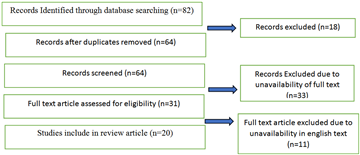
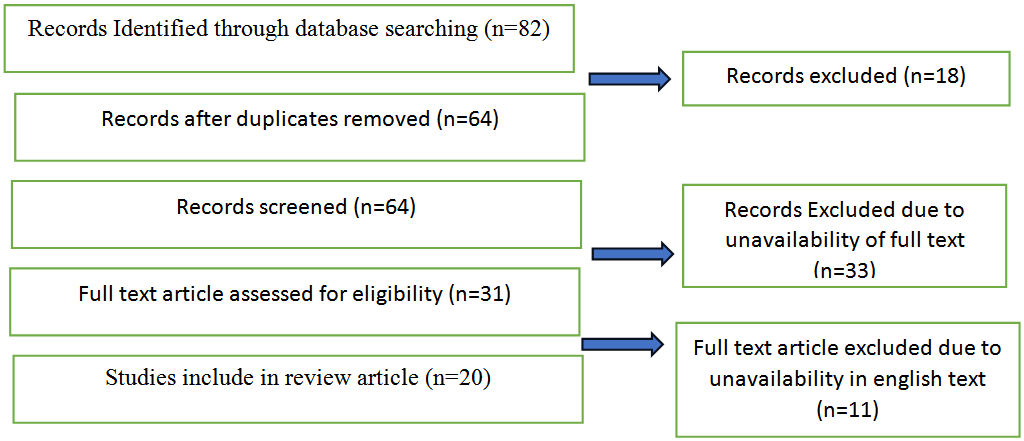
Introduction Adolescence is a critical phase where lifestyle habits, including video game usage, influence long-term health and behavior. Video games, spanning diverse genres, offer both cognitive benefits and potential risks, such as increased aggression or improved social behavior. This review examines the impact of video gaming on adolescents, focusing on areas like eating habits, anxiety, cognitive functioning, and aggression. It aims to uncover patterns and contradictions in research findings, offering insights to guide parents, educators, and policymakers in managing gaming-related behaviors. Materials and Methods A systematic search was conducted across databases like MEDLINE, PUBMED, Scopus, Science Direct, and Google Scholar using search terms such as “Adolescents,” “Video Game,” “Impact,” “Behavior,” and “Randomized Control Trial.” Studies published between 2014-2024, involving adolescents, and available in full-text English were included. Duplicates, non-adolescent studies, and those before 2014 were excluded. Result A total of 82 article were reviewed in which only 20 article met the inclusion criteria. The result help in finding inference between the behaviour modification of adolescents Conclusion The findings reveal that interactive interventions, such as Move games and serious games, positively influence health behaviors, dietary choices, and psychological outcomes among adolescents. Tailored approaches based on demographic factors like age and sex enhance intervention effectiveness, though some programs show limited impact, indicating the need for refinement. Engagement, adherence, and individual characteristics play crucial roles in outcomes, highlighting the complexity of influencing behavior. While many interventions promote healthier habits, further research is required to optimize strategies and assess the long-term sustainability of these behavioral changes.
Adolescence represents a critical phase characterized by a multitude of physical, physiological and psychological transformations 1. It is important to note that during this period, lifestyle, including healthy and unhealthy habits and behaviors, has a significant impact on the health of adults 1 2."Video games" are a popular way for teenagers to engage in recreational activities, fulfilling their "need to play" requirement. 3. Video games, described as an electronic interactive games, have main objective of the players entertainment by immersing them in virtual environments, two-dimensional or three-dimensional, with specific rules and conditions 4. These games cover a wide range of genres, from racing/driving, fighting, adventure, action, platforming, puzzle, role-playing, simulation, strategy, sports, shooting, to active video games, to implicit and explicit video games learn video games 5. The video game industry is important worldwide, with products that work on mobile phones, computers and video game devices showing positive benefits on basic brain processes such as perception, attention, memory and decision. 6. Recent estimates have shown that one in three young people under the age of 18 worldwide use the Internet and that 75% of young people play digital video games every day in developed countries. 7 8 Ask any parent what they think of their child's video games and you will almost certainly hear concerns about the hours spent playing.in a virtual world and the possibility of negative effects on cognition, mental health and behavior. One element that contributes to these concerns is the growth of video games over the past 20 years. This popularity has raised concern among some scientists who have discovered the possible negative effects of this recreational activity. Studies that have surveyed members of the general public 9 10 as well as scientists 11 12 suggest that opinions about the effects of gambling on youth vary greatly depending on demographics and experiences personal with the game. Some researchers conclude that the game has social 13 and cognitive benefits 14, while others argue that this medium contributes to mass shootings 15 16 and that it has lasting and strong effects on aggressive behavior, in general 17. Recently, a series of open letters published by academics warned the public and policy makers about the positive and negative effects of time spent in the game, its addictive potential 18, its cognitive benefits 19 20 and its aggressive effects 21 are overrated. Video games are a double-edged sword, which has its advantages and disadvantages. Video games can act as "teachers" depending on the purpose of the game 22. Video games have many effects depending on the genre of the game. For example, an animated online game can improve physical fitness 23 24 25 26, while social video games can improve social behavior 27 28 29. The most interesting results show that play playing video games can modify cognition and the brain 30 31 32 33. Previous studies have shown that playing video games can benefit cognition. Cross-sectional and longitudinal studies have shown that video game experience is associated with better cognitive functions, especially in terms of viewing pleasure and short-term memory 34, reaction time 35 and memory of work 36. In addition, several randomized controlled studies show positive effects of video game interventions recognition 35 36. Recent meta-analytic research has also supported the high-quality effects of video games on cognition 37 38. This study was conducted to examine the effect of video games on adolescent behavior. The research was done in databases such as PUBMED, Google Scholar, CINAHAL with the search terms VIDEO GAME, Behavior, Effectiveness, Adolescents, Randomized controlled trial, Sexual behavior, Eating behavior, Aggressive behavior.
The Objectives of this literature review is to critically assess and integrate existing studies on the impact of video games on many areas of teenage behavior, with a particular emphasis on eating habits, stress and anxiety levels, cognitive functioning, aggression, and healthy behaviors. This review seeks to uncover similarities and contradictions in findings, investigate the underlying mechanisms that influence these behaviours, and assess the implications for adolescent development and well-being. The review examines many studies to provide a thorough picture of how video game engagement can impact behavioral outcomes in teenagers, alerting parents, educators, and policymakers about potential hazards and benefits.
This review seeks to uncover similarities and contradictions in findings, investigate the underlying mechanisms that influence these behaviors, and assess the implications for adolescent development and well-being. The review examines many studies to provide a thorough picture of how video game engagement can impact behavioral outcomes in teenagers, alerting parents, educators, and policymakers about potential hazards and benefits.
Electronic Database like MEDLINE, PUBMED, Scopus, Science Direct, Google Scholar Since 20 were searched using a combination of search term such as “Adolescents” OR “Video Game” OR “Impact” OR ”Behavior” OR “Randomized Control Trial”. Articles were checked for eligibility based on the inclusion criteria, and the full-text of eligible articles was examined.
All studies which had full text version available
All studies available in English text
Studies available from the year 2014-2024.
Studies done with adolescents.
Same studies that were found on different electronic databases.
Studies done before the year 2014 were excluded
Studies conducted on different age groups.
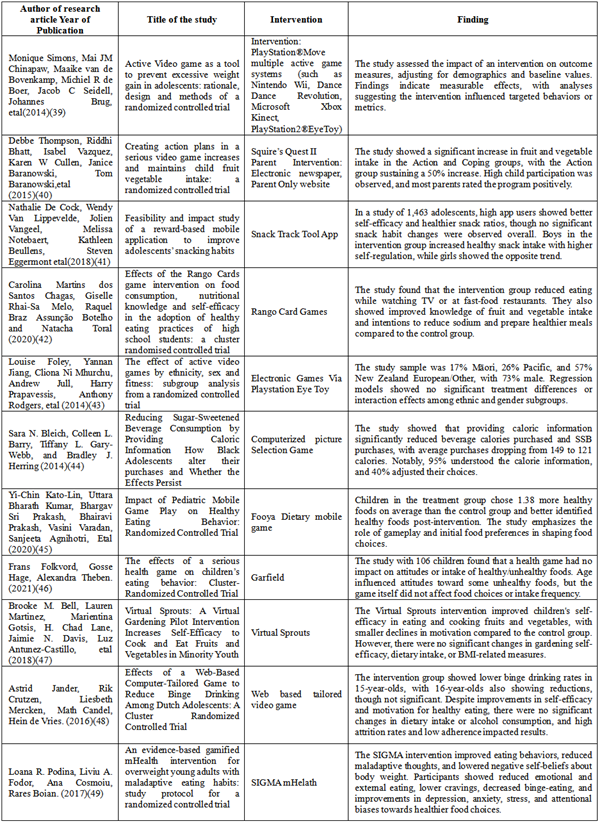
Video game interventions aimed at improving eating habits show promising, though varied, results. Studies demonstrate that active video games, such as PlayStation Move, contribute to weight management by increasing physical activity among adolescents (Simons et al., 2014). Similarly, Thompson et al. (2015) reported a 50% increase in fruit and vegetable intake in children engaged with the game Squire’s Quest II, which incorporates a parental involvement component to reinforce healthy choices. Another study using the Snack Track Tool App showed that high engagement with the app correlated with healthier snack choices and better self-regulation, particularly among boys, while girls showed mixed results (De Cock et al., 2018).
These findings highlight the role of tailored, demographic-sensitive interventions. For instance, family involvement and age-specific approaches appear critical in sustaining healthy changes in adolescents' eating behaviors.
Key Takeaway: Intervention games can encourage healthier eating among adolescents, though demographic factors like age, engagement, and family involvement influence effectiveness.
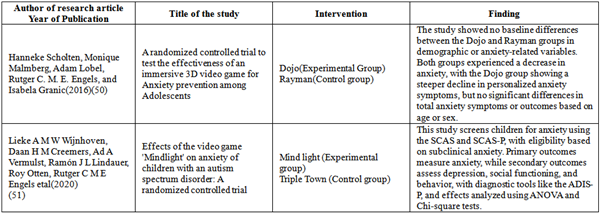
Therapeutic video games show potential for reducing anxiety and stress among adolescents. For example, the game Dojo, designed for anxiety prevention, was associated with significant reductions in personalized anxiety symptoms compared to a control group playing Rayman, although overall anxiety levels showed similar declines in both groups (Scholten et al., 2016). Similarly, Mindlight, another therapeutic game, showed effectiveness in reducing anxiety in children with Autism Spectrum Disorder, suggesting that games designed for mental health can positively influence stress-related symptoms in adolescents (Wijnhoven et al., 2020).
The impact of these games, however, varies with the game design and the population using them. Therapeutic games with specific mental health goals may be more effective in managing anxiety than standard video games.
Key Insight: Video games designed for therapeutic purposes can reduce anxiety and stress symptoms, emphasizing the importance of game intent in mental health interventions.
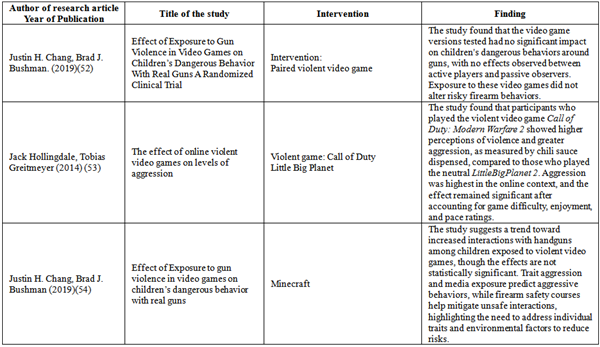
6.3. Effect of Video Game on Aggressive BehaviourResearch on the relationship between violent video games and aggression among adolescents presents complex findings. For instance, Hollingdale and Greitemeyer (2014) reported that violent games like Call of Duty increased aggressive responses compared to neutral games. Conversely, studies involving realistic scenarios, such as handling firearms after playing violent video games, showed no significant impact on dangerous behavior among children (Chang & Bushman, 2019). These mixed findings suggest that while violent video games may heighten aggression in controlled settings, the effects on real-world risky behaviors remain inconclusive.
Individual traits, such as baseline aggression levels, and the context in which games are played may play roles in mediating these effects, indicating that aggression-related outcomes of video games are influenced by personal and environmental factors.
Key Insight: While violent video games may increase aggression in specific contexts, their real-world impact on risky behavior is inconclusive and likely influenced by individual traits and gaming environments.
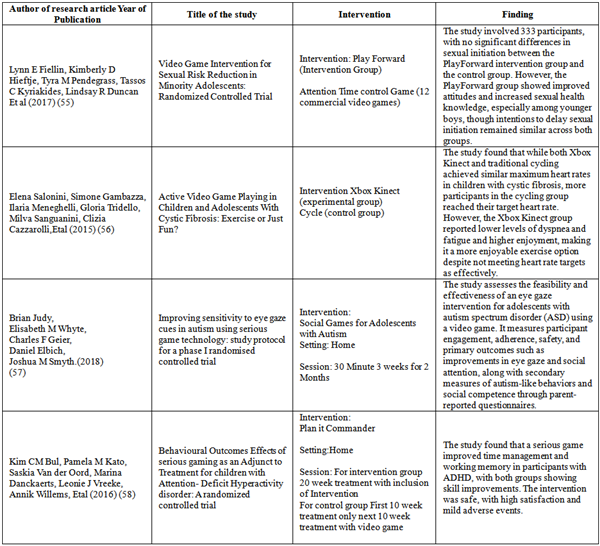
6.4. Effect of video Game on Healthy BehaviourHealth-focused games demonstrate potential for promoting various positive behaviors in adolescents. The game PlayForward, for example, improved sexual health knowledge and attitudes among participants, particularly younger boys, although it did not influence behavior change in delaying sexual initiation (Fiellin et al., 2017). Another study found that active video gaming using Xbox Kinect increased physical activity enjoyment levels for young cystic fibrosis patients, despite not consistently reaching target heart rates (Salonini et al., 2015). In virtual gardening interventions, participants reported improved self-efficacy in cooking and eating fruits and vegetables, showcasing the potential for virtual environments to support healthy behaviors (Bell et al., 2018).
These studies suggest that video games promoting health can positively influence adolescents' health knowledge, engagement in physical activity, and dietary self-efficacy. Enjoyable game experiences appear essential for maintaining engagement and promoting behavior change.
Key Insight: Health-oriented video games can effectively encourage positive health behaviors, with high engagement and enjoyment levels being crucial for sustained impact.
This review demonstrates that video games impact adolescent behavior across multiple domains, with effects influenced by game type, demographic factors, and individual engagement levels. Health-oriented games show promise in promoting positive behaviors, particularly in areas like diet, physical activity, and mental health, especially when they incorporate enjoyable and engaging elements tailored to the target age group. Therapeutic games such as Mindlight and Dojo are particularly effective in managing anxiety, providing evidence that games designed with specific mental health objectives can serve as useful tools in adolescent intervention.
In contrast, violent games present mixed results on aggression and risky behaviors, with some studies showing increased aggressive tendencies in controlled environments but limited evidence of long-term real-world impact. This complexity suggests that individual differences—such as personality traits and previous exposure to aggression—play a crucial role in shaping outcomes, emphasizing that the broader context and gaming environment are pivotal in determining effects.
Future interventions should prioritize demographic sensitivity, as age, gender, and cultural background influence how adolescents respond to gaming. Additionally, longitudinal studies are needed to assess the sustainability of these behaviors over time, particularly for health-promoting games, to understand if positive changes endure without continuous intervention.
Ultimately, this review underscores the potential of video games as impactful tools for behavior change in adolescents, particularly when combined with family involvement and tailored to individual needs. Policymakers, educators, and mental health professionals should consider these insights when designing or recommending video game-based interventions to maximize positive outcomes and mitigate risks associated with gaming.
Altogether in this review significant potential of targeted interventions in promoting healthier behaviors, particularly among children and adolescents. The use of interactive tools, such as video games and apps, demonstrates a notable increase in engagement and positive behavioral outcomes, with high participation rates indicating that incorporating enjoyable elements can enhance adherence and effectiveness. Moreover, the varying levels of parental involvement highlight the importance of including parents in these programs to reinforce healthy behaviors at home. Initial dietary preferences, self-efficacy, and social factors are crucial in shaping intervention success, suggesting that tailoring strategies to account for these characteristics can lead to more effective outcomes. While many studies reported immediate positive changes, concerns about the long-term sustainability of these behaviors emerge, indicating a need for continuous support and periodic assessments. Clear, comprehensible messaging regarding caloric content can influence purchasing behavior, empowering young audiences to make informed dietary choices. Additionally, interventions addressing emotional eating and maladaptive thoughts related to eating have shown promise, indicating that psychological support integrated with nutritional education can enhance effectiveness. Given the diverse demographics of participants, it is essential for interventions to be culturally sensitive and adaptable to various ethnic backgrounds and societal norms, improving engagement across different population segments. In conclusion, these studies emphasize the importance of employing interactive methods to foster healthy behaviors, highlighting the need for tailored interventions that include parental involvement and psychological support. While immediate improvements in behaviors were noted, further research is warranted to assess the long-term sustainability of these changes, guiding policymakers, educators, and health professionals in designing effective health promotion programs that aim for lasting impacts on public health.
Future research should focus on several key areas based on these findings. Longitudinal studies are needed to assess the long-term sustainability of behavior changes resulting from interventions, particularly those involving interactive elements like video games. Additionally, exploring the impact of demographic factors on intervention effectiveness can provide insights into cultural and socioeconomic influences. Investigating parental involvement's role in reinforcing healthy habits would also be beneficial. Mixed methods approaches could enrich understanding by combining quantitative and qualitative data on participant experiences. Furthermore, integrating psychological support into nutritional education programs may help address emotional eating. Lastly, more comprehensive studies on the effects of violent video games should consider individual traits such as aggression to clarify their influence on behavior. These directions can enhance strategies for promoting healthier lifestyles among youth.
This task was completed as part of the author's postgraduate program in Nursing (Paediatric Nursing) at the All India Institute of Medical Sciences in Bhopal. I am grateful to the Institute, Nursing College, Faculty of Nursing College, AIIMS, Bhopal, my research Guide (Dr. Mamta Verma), and Co-Guide (Mr. Kumarasamy A.P.) for their amazing assistance and direction during the completion of this work. I'd also like to thank my peers, family, and friends, as well as everyone else who aided me, whether deliberately or unknowingly.
| [1] | F. B. Ortega, J. R. Ruiz, M. J. Castillo, and M. Sjöström, "Physical fitness in childhood and adolescence: a powerful marker of health," International Journal of Obesity (London), vol. 32, no. 1, pp. 1-11, Jan. 2008. | ||
| In article | View Article PubMed | ||
| [2] | W. Chen, A. Hammond-Bennett, A. Hypnar, and S. Mason, "Health-related physical fitness and physical activity in elementary school students," BMC Public Health, vol. 18, article 195, 2018. | ||
| In article | View Article PubMed | ||
| [3] | S. Mihara and S. Higuchi, "Cross-sectional and longitudinal epidemiological studies of Internet gaming disorder: A systematic review of the literature," Psychiatry and Clinical Neurosciences, vol. 71, no. 7, pp. 425-444, Jul. 2017. | ||
| In article | View Article PubMed | ||
| [4] | M. Quwaider, A. Alabed, and R. Duwairi, "The impact of video games on the players' behaviors: a survey," Procedia Computer Science, vol. 151, pp. 575-582, May 2019. | ||
| In article | View Article | ||
| [5] | J. H. Lee, N. Karlova, R. I. Clarke, K. Thornton, and A. Perti, "Facet analysis of video game genres," Proceedings of iConference 2014, Berlin, Germany, Mar. 4-7, 2014. Available: [Google Scholar]. [Accessed: Oct. 8, 2024]. | ||
| In article | |||
| [6] | A. Eichenbaum, D. Bavelier, and C. S. Green, "Video games: Play that can do serious good," American Journal of Play, vol. 7, no. 1, pp. 50-72, Fall 2014. | ||
| In article | |||
| [7] | UNICEF, The State of the World’s Children 2017: Children in a digital world, New York, NY: United Nations Children's Fund, 2017. Available: https:// www.unicef.org/ media/48581/ file/SOWC_2017_ENG.pdf. [Accessed: Oct. 8, 2024]. | ||
| In article | |||
| [8] | J. Byrne and P. Burton, "Children as Internet users: how can evidence better inform policy debate?" Journal of Cyber Policy, vol. 2, pp. 39-52, 2017. | ||
| In article | View Article | ||
| [9] | A. K. Przybylski, "Who believes electronic games cause real world aggression?" Cyberpsychology, Behavior, and Social Networking, vol. 17, pp. 228-234, 2014. | ||
| In article | View Article PubMed | ||
| [10] | J. D. Ivory and S. Kalyanaraman, "Video games make people violent—well, maybe not that game: effects of content and person abstraction on perceptions of violent video games' effects and support of censorship," Communication Reports, vol. 22, pp. 1-12, 2009. | ||
| In article | View Article | ||
| [11] | T. Quandt, J. Van Looy, J. Vogelgesang, M. Elson, J. D. Ivory, M. Consalvo, and F. Mäyrä, "Digital games research: a survey study on an emerging field and its prevalent debates," Journal of Communication, vol. 65, pp. 975-996, 2015. | ||
| In article | View Article | ||
| [12] | C. J. Ferguson, "Clinicians’ attitudes toward video games vary as a function of age, gender, and negative beliefs about youth: a sociology of media research approach," Computers in Human Behavior, vol. 52, pp. 379-386, 2015. | ||
| In article | View Article | ||
| [13] | A. Lenhart, "Teens, technology and friendships," Pew Research Center: Internet, Science & Tech, Aug. 6, 2015. Available: http://www.pewinternet.org/2015/08/06/teens-technology-and-friendships/. [Accessed: Feb. 23, 2016]. | ||
| In article | |||
| [14] | K. L. Powers, P. J. Brooks, N. J. Aldrich, M. A. Palladino, and L. Alfieri, "Effects of video-game play on information processing: a meta-analytic investigation," Psychonomic Bulletin & Review, vol. 20, pp. 1055-1079, 2013. | ||
| In article | View Article PubMed | ||
| [15] | N. L. Carnagey, C. A. Anderson, and B. J. Bushman, "The effect of video game violence on physiological desensitization to real-life violence," Journal of Experimental Social Psychology, vol. 43, pp. 489-496, 2007. | ||
| In article | View Article | ||
| [16] | A. Copenhaver, "Violent video game legislation as pseudo-agenda," Criminal Justice Studies, vol. 28, pp. 170-185, 2015. | ||
| In article | View Article | ||
| [17] | L. Sax, Boys adrift: the five factors driving the growing epidemic of unmotivated boys and underachieving young men, New York, NY: Basic Books, 2016. Available: [Google Scholar]. [Accessed: Oct. 8, 2024]. | ||
| In article | |||
| [18] | E. Aarseth, et al., "Scholars' open debate paper on the World Health Organization ICD-11 Gaming Disorder proposal," Journal of Behavioral Addictions, vol. 6, pp. 267-270, 2016. | ||
| In article | |||
| [19] | J. C. Allaire, L. Bäckman, D. A. Balota, D. Bavelier, R. A. Bjork, and G. H. Bower, "A consensus on the brain training industry from the scientific community," Max Planck Institute for Human Development, Stanford Center on Longevity, Oct. 15, 2014. Available: http://longevity3.stanford.edu/blog/2014/10/15/the-consensus-on-the-brain-training-industry-from-the-scientificcommunity-2/. [Accessed: Jan. 15, 2015]. | ||
| In article | |||
| [20] | D. J. Simons, W. R. Boot, N. Charness, S. E. Gathercole, C. F. Chabris, D. Z. Hambrick, and E. A. Stine-Morrow, "Do ‘brain-training’ programs work?" Psychological Science in the Public Interest, vol. 17, pp. 103-186, 2016. | ||
| In article | View Article PubMed | ||
| [21] | Consortium of Scholars, "Scholars' open statement to the APA Task Force on Violent Media," Open Science Framework, 2013. Available: https://osf.io/zyjw4/. [Accessed: Oct. 8, 2024]. | ||
| In article | |||
| [22] | D. A. Gentile and J. R. Gentile, "Violent video games as exemplary teachers: A conceptual analysis," Journal of Youth and Adolescence, vol. 37, pp. 127-141, 2008. | ||
| In article | View Article | ||
| [23] | J. McDougall and M. J. Duncan, "Children, video games, and physical activity: An exploratory study," International Journal of Disability, Human Development, vol. 7, pp. 89-94, 2008. | ||
| In article | View Article | ||
| [24] | C. Ni Mhurchu, R. Maddison, Y. Jiang, A. Jull, H. Prapavessis, and A. Rodgers, "Couch potatoes to jumping beans: A pilot study of the effect of active video games on physical activity in children," International Journal of Behavioral Nutrition and Physical Activity, vol. 5, p. 8, 2008. | ||
| In article | View Article PubMed | ||
| [25] | E. C.-S. Murphy, L. Carson, W. Neal, C. Baylis, D. Donley, and R. Yeater, "Effects of an exercise intervention using Dance Dance Revolution on endothelial function and other risk factors in overweight children," International Journal of Pediatric Obesity, vol. 4, pp. 205-214, 2009. | ||
| In article | View Article PubMed | ||
| [26] | R. Maddison, L. Foley, C. Ni Mhurchu, Y. Jiang, A. Jull, H. Prapavessis, M. Hohepa, and A. Rodgers, "Effects of active video games on body composition: A randomized controlled trial," American Journal of Clinical Nutrition, vol. 94, pp. 156-163, 2011. | ||
| In article | View Article PubMed | ||
| [27] | H. Cole and M. D. Griffiths, "Social interactions in massively multiplayer online role-playing gamers," Cyberpsychology & Behavior, vol. 10, pp. 575-583, 2007. | ||
| In article | View Article PubMed | ||
| [28] | D. A. Gentile, C. A. Anderson, S. Yukawa, N. Ihori, M. Saleem, L. K. Ming, A. Shibuya, A. K. Liau, A. Khoo, B. J. Bushman, et al., "The effects of prosocial video games on prosocial behaviors: International evidence from correlational, longitudinal, and experimental studies," Personality and Social Psychology Bulletin, vol. 35, pp. 752-763, 2009. | ||
| In article | View Article PubMed | ||
| [29] | T. Greitemeyer and S. Osswald, "Effects of prosocial video games on prosocial behavior," Journal of Personality and Social Psychology, vol. 98, pp. 211-221, 2010. | ||
| In article | View Article PubMed | ||
| [30] | I. Spence and J. Feng, "Video games and spatial cognition," Review of General Psychology, vol. 14, pp. 92-104, 2010. | ||
| In article | View Article | ||
| [31] | P. Wouters, C. van Nimwegen, H. van Oostendorp, and E. D. van der Spek, "A meta-analysis of the cognitive and motivational effects of serious games," Journal of Educational Psychology, vol. 105, pp. 249-265, 2013. | ||
| In article | View Article | ||
| [32] | P. Toril, J. M. Reales, and S. Ballesteros, "Video game training enhances cognition of older adults: A meta-analytic study," Psychology and Aging, vol. 29, pp. 706-716, 2014. | ||
| In article | View Article PubMed | ||
| [33] | T. A. Shams, G. Foussias, J. A. Zawadzki, V. S. Marshe, I. Siddiqui, D. J. Müller, and A. H. C. Wong, "The effects of video games on cognition and brain structure: Potential implications for neuropsychiatric disorders," Current Psychiatry Reports, vol. 17, p. 71, 2015. | ||
| In article | View Article PubMed | ||
| [34] | I. L. Wilms, A. Petersen, and S. Vangkilde, "Intensive video gaming improves encoding speed to visual short-term memory in young male adults," Acta Psychologica, vol. 142, pp. 108-118, 2013. | ||
| In article | View Article PubMed | ||
| [35] | L. Steenbergen, R. Sellaro, A.-K. Stock, C. Beste, and L. S. Colzato, "Action video gaming and cognitive control: Playing first person shooter games is associated with improved action cascading but not inhibition," PLOS ONE, vol. 10, e0144364, 2015. | ||
| In article | View Article PubMed | ||
| [36] | M. Moisala, V. Salmela, L. Hietajärvi, S. Carlson, V. Vuontela, K. Lonka, K. Hakkarainen, K. Salmela-Aro, and K. Alho, "Gaming is related to enhanced working memory performance and task-related cortical activity," Brain Research, vol. 1655, pp. 204-215, 2017. | ||
| In article | View Article PubMed | ||
| [37] | R. Nouchi, Y. Taki, H. Takeuchi, H. Hashizume, Y. Akitsuki, Y. Shigemune, A. Sekiguchi, Y. Kotozaki, T. Tsukiura, Y. Yomogida, et al., "Brain training game improves executive functions and processing speed in the elderly: A randomized controlled trial," PLOS ONE, vol. 7, e29676, 2012. | ||
| In article | View Article PubMed | ||
| [38] | R. Nouchi, Y. Taki, H. Takeuchi, H. Hashizume, T. Nozawa, T. Kambara, A. Sekiguchi, C. M. Miyauchi, Y. Kotozaki, H. Nouchi, et al., "Brain training game boosts executive functions, working memory and processing speed in young adults: A randomized controlled trial," PLOS ONE, vol. 8, e55518, 2013. | ||
| In article | View Article PubMed | ||
| [39] | M. Simons, M. J. M. Chinapaw, M. van de Bovenkamp, M. R. de Boer, J. C. Seidell, J. Brug, and E. de Vet, "Active video games as a tool to prevent excessive weight gain in adolescents: Rationale, design and methods of a randomized controlled trial," BMC Public Health, vol. 14, pp. 275, March 2014. | ||
| In article | View Article PubMed | ||
| [40] | D. Thompson, R. Bhatt, I. Vazquez, K. W. Cullen, J. Baranowski, T. Baranowski, and Y. Liu, "Creating action plans in a serious video game increases and maintains child fruit-vegetable intake: A randomized controlled trial," International Journal of Behavioral Nutrition and Physical Activity, vol. 12, article 39, April 2015. | ||
| In article | View Article PubMed | ||
| [41] | N. De Cock, W. Van Lippevelde, J. Vangeel, M. Notebaert, K. Beullens, S. Eggermont, B. Deforche, L. Maes, L. Goossens, S. Verbeken, E. Moens, L. Vervoort, C. Braet, L. Huybregts, P. Kolsteren, J. Van Camp, and C. Lachat, "Feasibility and impact study of a reward-based mobile application to improve adolescents' snacking habits," Public Health Nutrition, vol. 21, no. 12, pp. 2329–2344, July 2018. | ||
| In article | View Article PubMed | ||
| [42] | C. M. D. S. Chagas, G. R. S. Melo, R. B. A. Botelho, and N. Toral, "Effects of the Rango Cards game intervention on food consumption, nutritional knowledge and self-efficacy in the adoption of healthy eating practices of high school students: A cluster randomised controlled trial," Public Health Nutrition, vol. 23, no. 13, pp. 2424–2433, September 2020. | ||
| In article | View Article PubMed | ||
| [43] | L. Foley, Y. Jiang, C. Ni Mhurchu, A. Jull, H. Prapavessis, A. Rodgers, and R. Maddison, "The effect of active video games by ethnicity, sex and fitness: Subgroup analysis from a randomised controlled trial," International Journal of Behavioral Nutrition and Physical Activity, vol. 11, no. 1, article 46, April 2014. | ||
| In article | View Article PubMed | ||
| [44] | S. N. Bleich, C. L. Barry, T. L. Gary-Webb, and B. J. Herring, "Reducing sugar-sweetened beverage consumption by providing caloric information: How Black adolescents alter their purchases and whether the effects persist," American Journal of Public Health, vol. 104, no. 12, pp. 2417–2424, December 2014. | ||
| In article | View Article PubMed | ||
| [45] | Y.-C. Kato-Lin, U. B. Kumar, B. S. Prakash, B. Prakash, V. Varadan, S. Agnihotri, N. Subramanyam, P. Krishnatray, and R. Padman, "Impact of pediatric mobile game play on healthy eating behavior: Randomized controlled trial," JMIR mHealth and uHealth, vol. 8, no. 11, article e15717, November 2020. | ||
| In article | View Article PubMed | ||
| [46] | F. Folkvord, G. Haga, and A. Theben, "The effect of a serious health game on children’s eating behavior: Cluster-randomized controlled trial," JMIR Serious Games, vol. 9, no. 3, article e23050, July 2021. | ||
| In article | View Article PubMed | ||
| [47] | B. M. Bell, L. Martinez, M. Gotsis, H. C. Lane, J. N. Davis, L. Antunez-Castillo, and D. Spruijt-Metz, "Virtual Sprouts: A virtual gardening pilot intervention increases self-efficacy to cook and eat fruits and vegetables in minority youth," Games for Health Journal, vol. 7, no. 2, pp. 127–135, April 2018. | ||
| In article | View Article PubMed | ||
| [48] | A. Jander, R. Crutzen, L. Mercken, M. Candel, and H. de Vries, "Effects of a web-based computer-tailored game to reduce binge drinking among Dutch adolescents: A cluster randomized controlled trial," Journal of Medical Internet Research, vol. 18, no. 2, article e29, February 2016. | ||
| In article | View Article PubMed | ||
| [49] | I. R. Podina, L. A. Fodor, A. Cosmoiu, and R. Boian, "An evidence-based gamified mHealth intervention for overweight young adults with maladaptive eating habits: Study protocol for a randomized controlled trial," Trials, vol. 18, no. 1, article 592, November 2017. | ||
| In article | View Article PubMed | ||
| [50] | H. Scholten, M. Malmberg, A. Lobel, R. C. M. E. Engels, and I. Granic, "A randomized controlled trial to test the effectiveness of an immersive 3D video game for anxiety prevention among adolescents," PLoS One, vol. 11, no. 1, article e0147763, January 2016. | ||
| In article | View Article PubMed | ||
| [51] | L. A. M. W. Wijnhoven, D. H. M. Creemers, A. D. Vermulst, R. J. L. Lindauer, R. Otten, R. C. M. E. Engels, and I. Granic, "Effects of the video game 'Mindlight' on anxiety of children with an autism spectrum disorder: A randomized controlled trial," Journal of Behavioral Therapy and Experimental Psychiatry, vol. 68, article 101548, September 2020. | ||
| In article | View Article PubMed | ||
| [52] | Justin H. Chang, Brad J. Bushman, "Effect of Exposure to Gun Violence in Video Games on Children’s Dangerous Behavior With Real Guns: A Randomized Clinical Trial," JAMA Network Open, vol. 2, no. 5, article e194319, May 2019. Available: PubMed Central, PMCID: PMC6547242. [Online]. | ||
| In article | View Article PubMed | ||
| [53] | Jack Hollingdale, Tobias Greitemeyer, "The Effect of Online Violent Video Games on Levels of Aggression," PLoS One, vol. 9, no. 11, article e111790, November 2014. Available: PubMed Central, PMCID: PMC4229070. [Online]. | ||
| In article | View Article PubMed | ||
| [54] | Justin H. Chang, Brad J. Bushman, "Effect of Exposure to Gun Violence in Video Games on Children’s Dangerous Behavior With Real Guns: A Randomized Clinical Trial," JAMA Network Open, vol. 2, no. 5, article e194319, May 2019. Available: PubMed Central, PMCID: PMC6547242. [Online]. | ||
| In article | View Article PubMed | ||
| [55] | Lynn E. Fiellin, Kimberly D. Hieftje, Tyra M. Pendergrass, Tassos C. Kyriakides, Lindsay R. Duncan, James D. Dziura, Benjamin G. Sawyer, Linda Mayes, Cindy A. Crusto, Brian W. Forsyth, David A. Fiellin, "Video Game Intervention for Sexual Risk Reduction in Minority Adolescents: Randomized Controlled Trial," Journal of Medical Internet Research, vol. 19, no. 9, article e314, September 2017. Available: PubMed Central, PMCID: PMC5625130. [Online]. | ||
| In article | View Article PubMed | ||
| [56] | Elena Salonini, Simone Gambazza, Ilaria Meneghelli, Gloria Tridello, Milva Sanguanini, Clizia Cazzarolli, Alessandra Zanini, Baroukh M. Assael, "Active Video Game Playing in Children and Adolescents With Cystic Fibrosis: Exercise or Just Fun?," Respiratory Care, vol. 60, no. 8, pp. 1172-1179, August 2015. [Online]. | ||
| In article | View Article PubMed | ||
| [57] | K. Suzanne Scherf, Jason W. Griffin, Brian Judy, Elisabeth M. Whyte, Charles F. Geier, Daniel Elbich, Joshua M. Smyth, "Improving sensitivity to eye gaze cues in autism using serious game technology: study protocol for a phase I randomised controlled trial," BMJ Open, vol. 8, no. 9, article e023682, October 2018. Available: PubMed Central, PMCID: PMC6173230. [Online]. | ||
| In article | View Article PubMed | ||
| [58] | Kim C. M. Bul, Pamela M. Kato, Saskia Van der Oord, Marina Danckaerts, Leonie J. Vreeke, Annik Willems, Helga J. J. van Oers, Ria Van Den Heuvel, Derk Birnie, Thérèse A. M. J. Van Amelsvoort, Ingmar H. A. Franken, Athanasios Maras, "Behavioral Outcome Effects of Serious Gaming as an Adjunct to Treatment for Children With Attention-Deficit/Hyperactivity Disorder: A Randomized Controlled Trial," Journal of Medical Internet Research, vol. 18, no. 2, article e26, February 2016. Available: PubMed Central, PMCID: PMC4773597. | ||
| In article | View Article PubMed | ||
Published with license by Science and Education Publishing, Copyright © 2024 Abhinav Katara, Dr. Mamta Verma and Mr. Kumarasamy AP
 This work is licensed under a Creative Commons Attribution 4.0 International License. To view a copy of this license, visit
https://creativecommons.org/licenses/by/4.0/
This work is licensed under a Creative Commons Attribution 4.0 International License. To view a copy of this license, visit
https://creativecommons.org/licenses/by/4.0/
| [1] | F. B. Ortega, J. R. Ruiz, M. J. Castillo, and M. Sjöström, "Physical fitness in childhood and adolescence: a powerful marker of health," International Journal of Obesity (London), vol. 32, no. 1, pp. 1-11, Jan. 2008. | ||
| In article | View Article PubMed | ||
| [2] | W. Chen, A. Hammond-Bennett, A. Hypnar, and S. Mason, "Health-related physical fitness and physical activity in elementary school students," BMC Public Health, vol. 18, article 195, 2018. | ||
| In article | View Article PubMed | ||
| [3] | S. Mihara and S. Higuchi, "Cross-sectional and longitudinal epidemiological studies of Internet gaming disorder: A systematic review of the literature," Psychiatry and Clinical Neurosciences, vol. 71, no. 7, pp. 425-444, Jul. 2017. | ||
| In article | View Article PubMed | ||
| [4] | M. Quwaider, A. Alabed, and R. Duwairi, "The impact of video games on the players' behaviors: a survey," Procedia Computer Science, vol. 151, pp. 575-582, May 2019. | ||
| In article | View Article | ||
| [5] | J. H. Lee, N. Karlova, R. I. Clarke, K. Thornton, and A. Perti, "Facet analysis of video game genres," Proceedings of iConference 2014, Berlin, Germany, Mar. 4-7, 2014. Available: [Google Scholar]. [Accessed: Oct. 8, 2024]. | ||
| In article | |||
| [6] | A. Eichenbaum, D. Bavelier, and C. S. Green, "Video games: Play that can do serious good," American Journal of Play, vol. 7, no. 1, pp. 50-72, Fall 2014. | ||
| In article | |||
| [7] | UNICEF, The State of the World’s Children 2017: Children in a digital world, New York, NY: United Nations Children's Fund, 2017. Available: https:// www.unicef.org/ media/48581/ file/SOWC_2017_ENG.pdf. [Accessed: Oct. 8, 2024]. | ||
| In article | |||
| [8] | J. Byrne and P. Burton, "Children as Internet users: how can evidence better inform policy debate?" Journal of Cyber Policy, vol. 2, pp. 39-52, 2017. | ||
| In article | View Article | ||
| [9] | A. K. Przybylski, "Who believes electronic games cause real world aggression?" Cyberpsychology, Behavior, and Social Networking, vol. 17, pp. 228-234, 2014. | ||
| In article | View Article PubMed | ||
| [10] | J. D. Ivory and S. Kalyanaraman, "Video games make people violent—well, maybe not that game: effects of content and person abstraction on perceptions of violent video games' effects and support of censorship," Communication Reports, vol. 22, pp. 1-12, 2009. | ||
| In article | View Article | ||
| [11] | T. Quandt, J. Van Looy, J. Vogelgesang, M. Elson, J. D. Ivory, M. Consalvo, and F. Mäyrä, "Digital games research: a survey study on an emerging field and its prevalent debates," Journal of Communication, vol. 65, pp. 975-996, 2015. | ||
| In article | View Article | ||
| [12] | C. J. Ferguson, "Clinicians’ attitudes toward video games vary as a function of age, gender, and negative beliefs about youth: a sociology of media research approach," Computers in Human Behavior, vol. 52, pp. 379-386, 2015. | ||
| In article | View Article | ||
| [13] | A. Lenhart, "Teens, technology and friendships," Pew Research Center: Internet, Science & Tech, Aug. 6, 2015. Available: http://www.pewinternet.org/2015/08/06/teens-technology-and-friendships/. [Accessed: Feb. 23, 2016]. | ||
| In article | |||
| [14] | K. L. Powers, P. J. Brooks, N. J. Aldrich, M. A. Palladino, and L. Alfieri, "Effects of video-game play on information processing: a meta-analytic investigation," Psychonomic Bulletin & Review, vol. 20, pp. 1055-1079, 2013. | ||
| In article | View Article PubMed | ||
| [15] | N. L. Carnagey, C. A. Anderson, and B. J. Bushman, "The effect of video game violence on physiological desensitization to real-life violence," Journal of Experimental Social Psychology, vol. 43, pp. 489-496, 2007. | ||
| In article | View Article | ||
| [16] | A. Copenhaver, "Violent video game legislation as pseudo-agenda," Criminal Justice Studies, vol. 28, pp. 170-185, 2015. | ||
| In article | View Article | ||
| [17] | L. Sax, Boys adrift: the five factors driving the growing epidemic of unmotivated boys and underachieving young men, New York, NY: Basic Books, 2016. Available: [Google Scholar]. [Accessed: Oct. 8, 2024]. | ||
| In article | |||
| [18] | E. Aarseth, et al., "Scholars' open debate paper on the World Health Organization ICD-11 Gaming Disorder proposal," Journal of Behavioral Addictions, vol. 6, pp. 267-270, 2016. | ||
| In article | |||
| [19] | J. C. Allaire, L. Bäckman, D. A. Balota, D. Bavelier, R. A. Bjork, and G. H. Bower, "A consensus on the brain training industry from the scientific community," Max Planck Institute for Human Development, Stanford Center on Longevity, Oct. 15, 2014. Available: http://longevity3.stanford.edu/blog/2014/10/15/the-consensus-on-the-brain-training-industry-from-the-scientificcommunity-2/. [Accessed: Jan. 15, 2015]. | ||
| In article | |||
| [20] | D. J. Simons, W. R. Boot, N. Charness, S. E. Gathercole, C. F. Chabris, D. Z. Hambrick, and E. A. Stine-Morrow, "Do ‘brain-training’ programs work?" Psychological Science in the Public Interest, vol. 17, pp. 103-186, 2016. | ||
| In article | View Article PubMed | ||
| [21] | Consortium of Scholars, "Scholars' open statement to the APA Task Force on Violent Media," Open Science Framework, 2013. Available: https://osf.io/zyjw4/. [Accessed: Oct. 8, 2024]. | ||
| In article | |||
| [22] | D. A. Gentile and J. R. Gentile, "Violent video games as exemplary teachers: A conceptual analysis," Journal of Youth and Adolescence, vol. 37, pp. 127-141, 2008. | ||
| In article | View Article | ||
| [23] | J. McDougall and M. J. Duncan, "Children, video games, and physical activity: An exploratory study," International Journal of Disability, Human Development, vol. 7, pp. 89-94, 2008. | ||
| In article | View Article | ||
| [24] | C. Ni Mhurchu, R. Maddison, Y. Jiang, A. Jull, H. Prapavessis, and A. Rodgers, "Couch potatoes to jumping beans: A pilot study of the effect of active video games on physical activity in children," International Journal of Behavioral Nutrition and Physical Activity, vol. 5, p. 8, 2008. | ||
| In article | View Article PubMed | ||
| [25] | E. C.-S. Murphy, L. Carson, W. Neal, C. Baylis, D. Donley, and R. Yeater, "Effects of an exercise intervention using Dance Dance Revolution on endothelial function and other risk factors in overweight children," International Journal of Pediatric Obesity, vol. 4, pp. 205-214, 2009. | ||
| In article | View Article PubMed | ||
| [26] | R. Maddison, L. Foley, C. Ni Mhurchu, Y. Jiang, A. Jull, H. Prapavessis, M. Hohepa, and A. Rodgers, "Effects of active video games on body composition: A randomized controlled trial," American Journal of Clinical Nutrition, vol. 94, pp. 156-163, 2011. | ||
| In article | View Article PubMed | ||
| [27] | H. Cole and M. D. Griffiths, "Social interactions in massively multiplayer online role-playing gamers," Cyberpsychology & Behavior, vol. 10, pp. 575-583, 2007. | ||
| In article | View Article PubMed | ||
| [28] | D. A. Gentile, C. A. Anderson, S. Yukawa, N. Ihori, M. Saleem, L. K. Ming, A. Shibuya, A. K. Liau, A. Khoo, B. J. Bushman, et al., "The effects of prosocial video games on prosocial behaviors: International evidence from correlational, longitudinal, and experimental studies," Personality and Social Psychology Bulletin, vol. 35, pp. 752-763, 2009. | ||
| In article | View Article PubMed | ||
| [29] | T. Greitemeyer and S. Osswald, "Effects of prosocial video games on prosocial behavior," Journal of Personality and Social Psychology, vol. 98, pp. 211-221, 2010. | ||
| In article | View Article PubMed | ||
| [30] | I. Spence and J. Feng, "Video games and spatial cognition," Review of General Psychology, vol. 14, pp. 92-104, 2010. | ||
| In article | View Article | ||
| [31] | P. Wouters, C. van Nimwegen, H. van Oostendorp, and E. D. van der Spek, "A meta-analysis of the cognitive and motivational effects of serious games," Journal of Educational Psychology, vol. 105, pp. 249-265, 2013. | ||
| In article | View Article | ||
| [32] | P. Toril, J. M. Reales, and S. Ballesteros, "Video game training enhances cognition of older adults: A meta-analytic study," Psychology and Aging, vol. 29, pp. 706-716, 2014. | ||
| In article | View Article PubMed | ||
| [33] | T. A. Shams, G. Foussias, J. A. Zawadzki, V. S. Marshe, I. Siddiqui, D. J. Müller, and A. H. C. Wong, "The effects of video games on cognition and brain structure: Potential implications for neuropsychiatric disorders," Current Psychiatry Reports, vol. 17, p. 71, 2015. | ||
| In article | View Article PubMed | ||
| [34] | I. L. Wilms, A. Petersen, and S. Vangkilde, "Intensive video gaming improves encoding speed to visual short-term memory in young male adults," Acta Psychologica, vol. 142, pp. 108-118, 2013. | ||
| In article | View Article PubMed | ||
| [35] | L. Steenbergen, R. Sellaro, A.-K. Stock, C. Beste, and L. S. Colzato, "Action video gaming and cognitive control: Playing first person shooter games is associated with improved action cascading but not inhibition," PLOS ONE, vol. 10, e0144364, 2015. | ||
| In article | View Article PubMed | ||
| [36] | M. Moisala, V. Salmela, L. Hietajärvi, S. Carlson, V. Vuontela, K. Lonka, K. Hakkarainen, K. Salmela-Aro, and K. Alho, "Gaming is related to enhanced working memory performance and task-related cortical activity," Brain Research, vol. 1655, pp. 204-215, 2017. | ||
| In article | View Article PubMed | ||
| [37] | R. Nouchi, Y. Taki, H. Takeuchi, H. Hashizume, Y. Akitsuki, Y. Shigemune, A. Sekiguchi, Y. Kotozaki, T. Tsukiura, Y. Yomogida, et al., "Brain training game improves executive functions and processing speed in the elderly: A randomized controlled trial," PLOS ONE, vol. 7, e29676, 2012. | ||
| In article | View Article PubMed | ||
| [38] | R. Nouchi, Y. Taki, H. Takeuchi, H. Hashizume, T. Nozawa, T. Kambara, A. Sekiguchi, C. M. Miyauchi, Y. Kotozaki, H. Nouchi, et al., "Brain training game boosts executive functions, working memory and processing speed in young adults: A randomized controlled trial," PLOS ONE, vol. 8, e55518, 2013. | ||
| In article | View Article PubMed | ||
| [39] | M. Simons, M. J. M. Chinapaw, M. van de Bovenkamp, M. R. de Boer, J. C. Seidell, J. Brug, and E. de Vet, "Active video games as a tool to prevent excessive weight gain in adolescents: Rationale, design and methods of a randomized controlled trial," BMC Public Health, vol. 14, pp. 275, March 2014. | ||
| In article | View Article PubMed | ||
| [40] | D. Thompson, R. Bhatt, I. Vazquez, K. W. Cullen, J. Baranowski, T. Baranowski, and Y. Liu, "Creating action plans in a serious video game increases and maintains child fruit-vegetable intake: A randomized controlled trial," International Journal of Behavioral Nutrition and Physical Activity, vol. 12, article 39, April 2015. | ||
| In article | View Article PubMed | ||
| [41] | N. De Cock, W. Van Lippevelde, J. Vangeel, M. Notebaert, K. Beullens, S. Eggermont, B. Deforche, L. Maes, L. Goossens, S. Verbeken, E. Moens, L. Vervoort, C. Braet, L. Huybregts, P. Kolsteren, J. Van Camp, and C. Lachat, "Feasibility and impact study of a reward-based mobile application to improve adolescents' snacking habits," Public Health Nutrition, vol. 21, no. 12, pp. 2329–2344, July 2018. | ||
| In article | View Article PubMed | ||
| [42] | C. M. D. S. Chagas, G. R. S. Melo, R. B. A. Botelho, and N. Toral, "Effects of the Rango Cards game intervention on food consumption, nutritional knowledge and self-efficacy in the adoption of healthy eating practices of high school students: A cluster randomised controlled trial," Public Health Nutrition, vol. 23, no. 13, pp. 2424–2433, September 2020. | ||
| In article | View Article PubMed | ||
| [43] | L. Foley, Y. Jiang, C. Ni Mhurchu, A. Jull, H. Prapavessis, A. Rodgers, and R. Maddison, "The effect of active video games by ethnicity, sex and fitness: Subgroup analysis from a randomised controlled trial," International Journal of Behavioral Nutrition and Physical Activity, vol. 11, no. 1, article 46, April 2014. | ||
| In article | View Article PubMed | ||
| [44] | S. N. Bleich, C. L. Barry, T. L. Gary-Webb, and B. J. Herring, "Reducing sugar-sweetened beverage consumption by providing caloric information: How Black adolescents alter their purchases and whether the effects persist," American Journal of Public Health, vol. 104, no. 12, pp. 2417–2424, December 2014. | ||
| In article | View Article PubMed | ||
| [45] | Y.-C. Kato-Lin, U. B. Kumar, B. S. Prakash, B. Prakash, V. Varadan, S. Agnihotri, N. Subramanyam, P. Krishnatray, and R. Padman, "Impact of pediatric mobile game play on healthy eating behavior: Randomized controlled trial," JMIR mHealth and uHealth, vol. 8, no. 11, article e15717, November 2020. | ||
| In article | View Article PubMed | ||
| [46] | F. Folkvord, G. Haga, and A. Theben, "The effect of a serious health game on children’s eating behavior: Cluster-randomized controlled trial," JMIR Serious Games, vol. 9, no. 3, article e23050, July 2021. | ||
| In article | View Article PubMed | ||
| [47] | B. M. Bell, L. Martinez, M. Gotsis, H. C. Lane, J. N. Davis, L. Antunez-Castillo, and D. Spruijt-Metz, "Virtual Sprouts: A virtual gardening pilot intervention increases self-efficacy to cook and eat fruits and vegetables in minority youth," Games for Health Journal, vol. 7, no. 2, pp. 127–135, April 2018. | ||
| In article | View Article PubMed | ||
| [48] | A. Jander, R. Crutzen, L. Mercken, M. Candel, and H. de Vries, "Effects of a web-based computer-tailored game to reduce binge drinking among Dutch adolescents: A cluster randomized controlled trial," Journal of Medical Internet Research, vol. 18, no. 2, article e29, February 2016. | ||
| In article | View Article PubMed | ||
| [49] | I. R. Podina, L. A. Fodor, A. Cosmoiu, and R. Boian, "An evidence-based gamified mHealth intervention for overweight young adults with maladaptive eating habits: Study protocol for a randomized controlled trial," Trials, vol. 18, no. 1, article 592, November 2017. | ||
| In article | View Article PubMed | ||
| [50] | H. Scholten, M. Malmberg, A. Lobel, R. C. M. E. Engels, and I. Granic, "A randomized controlled trial to test the effectiveness of an immersive 3D video game for anxiety prevention among adolescents," PLoS One, vol. 11, no. 1, article e0147763, January 2016. | ||
| In article | View Article PubMed | ||
| [51] | L. A. M. W. Wijnhoven, D. H. M. Creemers, A. D. Vermulst, R. J. L. Lindauer, R. Otten, R. C. M. E. Engels, and I. Granic, "Effects of the video game 'Mindlight' on anxiety of children with an autism spectrum disorder: A randomized controlled trial," Journal of Behavioral Therapy and Experimental Psychiatry, vol. 68, article 101548, September 2020. | ||
| In article | View Article PubMed | ||
| [52] | Justin H. Chang, Brad J. Bushman, "Effect of Exposure to Gun Violence in Video Games on Children’s Dangerous Behavior With Real Guns: A Randomized Clinical Trial," JAMA Network Open, vol. 2, no. 5, article e194319, May 2019. Available: PubMed Central, PMCID: PMC6547242. [Online]. | ||
| In article | View Article PubMed | ||
| [53] | Jack Hollingdale, Tobias Greitemeyer, "The Effect of Online Violent Video Games on Levels of Aggression," PLoS One, vol. 9, no. 11, article e111790, November 2014. Available: PubMed Central, PMCID: PMC4229070. [Online]. | ||
| In article | View Article PubMed | ||
| [54] | Justin H. Chang, Brad J. Bushman, "Effect of Exposure to Gun Violence in Video Games on Children’s Dangerous Behavior With Real Guns: A Randomized Clinical Trial," JAMA Network Open, vol. 2, no. 5, article e194319, May 2019. Available: PubMed Central, PMCID: PMC6547242. [Online]. | ||
| In article | View Article PubMed | ||
| [55] | Lynn E. Fiellin, Kimberly D. Hieftje, Tyra M. Pendergrass, Tassos C. Kyriakides, Lindsay R. Duncan, James D. Dziura, Benjamin G. Sawyer, Linda Mayes, Cindy A. Crusto, Brian W. Forsyth, David A. Fiellin, "Video Game Intervention for Sexual Risk Reduction in Minority Adolescents: Randomized Controlled Trial," Journal of Medical Internet Research, vol. 19, no. 9, article e314, September 2017. Available: PubMed Central, PMCID: PMC5625130. [Online]. | ||
| In article | View Article PubMed | ||
| [56] | Elena Salonini, Simone Gambazza, Ilaria Meneghelli, Gloria Tridello, Milva Sanguanini, Clizia Cazzarolli, Alessandra Zanini, Baroukh M. Assael, "Active Video Game Playing in Children and Adolescents With Cystic Fibrosis: Exercise or Just Fun?," Respiratory Care, vol. 60, no. 8, pp. 1172-1179, August 2015. [Online]. | ||
| In article | View Article PubMed | ||
| [57] | K. Suzanne Scherf, Jason W. Griffin, Brian Judy, Elisabeth M. Whyte, Charles F. Geier, Daniel Elbich, Joshua M. Smyth, "Improving sensitivity to eye gaze cues in autism using serious game technology: study protocol for a phase I randomised controlled trial," BMJ Open, vol. 8, no. 9, article e023682, October 2018. Available: PubMed Central, PMCID: PMC6173230. [Online]. | ||
| In article | View Article PubMed | ||
| [58] | Kim C. M. Bul, Pamela M. Kato, Saskia Van der Oord, Marina Danckaerts, Leonie J. Vreeke, Annik Willems, Helga J. J. van Oers, Ria Van Den Heuvel, Derk Birnie, Thérèse A. M. J. Van Amelsvoort, Ingmar H. A. Franken, Athanasios Maras, "Behavioral Outcome Effects of Serious Gaming as an Adjunct to Treatment for Children With Attention-Deficit/Hyperactivity Disorder: A Randomized Controlled Trial," Journal of Medical Internet Research, vol. 18, no. 2, article e26, February 2016. Available: PubMed Central, PMCID: PMC4773597. | ||
| In article | View Article PubMed | ||