Green nanotechnology provides sustainable alternatives for synthesizing functional materials with biomedical potential. This study reports the green synthesis of titanium dioxide (TiO₂) and silver (Ag) nanoparticles using aqueous extracts of Rosmarinus officinalis (rosemary, RO) and Syzygium aromaticum (clove, CL) as natural reducing and stabilizing agents. UV–Vis spectroscopy confirmed nanoparticle formation, with TiO₂ showing its characteristic absorption band and Ag/TiO₂ composites exhibiting a bathochromic shift indicative of Ag–TiO₂ interactions. Scanning electron microscopy revealed predominantly spherical nanoparticles, averaging ~165 nm for TiO₂ and ~96 nm for Ag deposits, while energy-dispersive spectroscopy verified elemental composition. Antibacterial assays demonstrated markedly enhanced activity of Ag/TiO₂ nanocomposites compared to TiO₂ alone, with effective inhibition against Pseudomonas aeruginosa, Staphylococcus aureus, and Escherichia coli, although lower efficacy was observed against Enterococcus faecalis. Interestingly, TiO₂ nanoparticles synthesized with CL extracts exhibited selective antibacterial effects, while RO-based coatings appeared to reduce antimicrobial performance. The combined bioactivity of plant-derived phytochemicals and Ag/TiO₂ nanostructures highlights a synergistic approach for developing biocompatible, eco-friendly antibacterial agents. These results suggest that RO- and CL-mediated Ag/TiO₂ nanocomposites hold promise as adjunctive materials in restorative dentistry, particularly for pulpotomy applications where antibacterial efficacy is essential.
Nanotechnology has emerged as a transformative field, enabling the development of novel materials with enhanced physical, chemical, and biological properties. Among various nanomaterials, titanium dioxide (TiO₂) and silver (Ag) nanoparticles (NPs) have attracted significant attention due to their unique photocatalytic, antimicrobial, and optical properties. 1, 2 These features make them particularly useful in environmental, biomedical, and industrial applications. However, conventional synthesis methods often involve hazardous chemicals, high energy inputs, and environmentally damaging procedures, which pose significant limitations in terms of sustainability and biocompatibility. 3
In response to these concerns, green synthesis approaches have gained increasing interest as eco-friendly, cost-effective, and sustainable alternatives. These methods utilize biological systems such as plant extracts, microorganisms, and enzymes as reducing and stabilizing agents to synthesize nanoparticles under mild conditions. Plant-mediated synthesis, in particular, offers numerous advantages due to the abundance of bioactive phytochemicals that can facilitate the reduction of metal ions and control NP morphology. 4
Dentistry has evolved significantly from the use of rudimentary materials to the development of advanced biomaterials designed for targeted therapeutic outcomes. Over time, the focus has shifted toward enhancing biocompatibility, mechanical performance, and preventive capabilities. This progression reflects the growing demand for restorative materials that not only repair but also protect oral tissues. In this context, the incorporation of functional nanoparticles into dental treatments marks a pivotal advancement in modern dental care. 5
In restorative dentistry, the clinical performance of materials is fundamentally dependent on a combination of their biocompatibility and their mechanical, physical, and chemical characteristics. 6 TiO₂ and Ag NPs have been extensively integrated into various endodontic materials due to their potent antimicrobial efficacy. TiO2 nanoparticles are non-toxic and non-allergic to dental cells and can be used in orthodontic and endodontic dental materials. It has also been discussed that their addition to conventional dental materials can enhance mechanical properties. 7 The dental field has also found promising uses for Ag NPs in the elimination of plaque and tartar, as well as the elimination of bacterial and fungal infections in the mouth. The incorporation of AgNPs into dental materials has been shown to significantly enhance patients’ oral health, leading to their widespread use. 8 The adoption of such nanotechnological advancements holds the potential to improve therapeutic outcomes and substantially lower the incidence of common oral pathologies, thereby supporting the evolution of more efficient and preventive dental care models.
Rosemary (Rosmarinus officinalis) (RO) and clove (Syzygiumaromaticum) (CL) are well-known medicinal plants with long-standing use in traditional oral care due to their potent therapeutic properties. RO exhibits strong antioxidant, anti-inflammatory, and antimicrobial effects, largely attributed to its bioactive compounds such as rosmarinic acid and carnosic acid. 9 CL, rich in eugenol, possesses powerful analgesic, antibacterial, and antiseptic properties, making it particularly effective in managing dental pain and infections. 10 These natural properties have made both extracts valuable in the formulation of mouthwashes, toothpaste, and topical dental treatments. When used as reducing and stabilizing agents in the green synthesis of nanoparticles, particularly Ag and TiO₂, RO and CL not only facilitate eco-friendly nanoparticle production but also enhance the resulting materials with their intrinsic bioactivity. This synergy offers promising applications in dentistry, including antimicrobial coatings, endodontic sealers, and pulp therapy agents, where both the nanoparticle functionality and phytochemical benefits can contribute to improved clinical outcomes.
This study focuses on the green synthesis of TiO₂ and Ag nanoparticles using extracts from RO and CL as natural reducing and capping agents. The aim is to demonstrate a green, sustainable route for producing functional nanomaterials and to evaluate the synergistic effects of plant-based synthesis of TiO₂ and Ag NPs for their potential use in pulpotomies. The study emphasizes their safety for radicular pulp, biocompatibility, and enhanced antibacterial performance, contributing to the growing body of research on green nanotechnology and its applications in combating microbial resistance.
Plant aqueous extract
Plant materials of Rosmarinus officinalis (rosemary, RO) and Syzygium aromaticum (clove, CL) were washed with distilled water to remove dust, debris, and surface impurities. Following washing, the materials were dried in a hot air oven at 60°C until complete desiccation was achieved. Subsequently, 20 grams of each dried sample were weighed, crushed, and subjected to maceration in 200 mL of distilled water for a period of 24 hours at ambient temperature to facilitate the extraction. Upon completion of the maceration process, the mixtures were heated to a boil for 10 minutes to enhance the release of bioactive constituents, after which they were allowed to rest undisturbed for an additional 5 minutes. The extracts were then cooled to room temperature and filtered using Whatman No. 1 filter paper to remove any remaining plant residues. The resulting filtrates were collected and stored at 4 °C.
TiO2 nanoparticle synthesis
The synthesis of TiO₂ nanoparticles was carried out following a previously reported method, with slight modifications. 11 Briefly, 20 mL of the plant extract, either RO, CL, or RO/CL was added to 90 mL of a titanium dioxide (TiO₂), 5 mM. The mixture was kept at room temperature under constant stirring for 24 hours to allow TiO₂ nanocomposite formation. After the reaction was complete, the synthesized nanoparticles were separated by centrifugation at 4500 rpm for 30 minutes. The resulting pellets were carefully collected, washed with distilled water to remove any unreacted constituents, and subsequently dried. The purified nanoparticles were then stored in airtight containers for further characterization and application.
Ag/TiO2nanoparticlesynthesis
The synthesis of Ag/TiO₂ nanoparticles was carried out via green reduction following a previously reported method, with slight modifications. 12 Briefly, 30 mL of the prepared plant extract, either RO, CL, or RO/CL was added to an aqueous solution of silver nitrate (AgNO₃) at a concentration of 10 mM. The resulting mixture was stirred gently and allowed to react at room temperature for approximately 72 hours to ensure complete reduction and stabilization of silver nanoparticles. Following that, 20 mL of the Ag-containing solution was introduced into 90 mL of a TiO₂ solution, 5 mM. The mixture was maintained at room temperature for an additional 24 hours under constant stirring to facilitate the formation of Ag/TiO₂ nanocomposites. After the reaction was complete, the synthesized nanoparticles were separated by centrifugation at 4500 rpm for 30 minutes. The resulting pellets were carefully collected, washed with distilled water to remove any unreacted constituents, and subsequently dried. The purified nanoparticles were then stored in airtight containers for further characterization and application.
Nanoparticle characterization
Ultraviolet–visible (UV–Vis) spectroscopic analysis was performed using a Thermo Scientific™ Genesys 50 spectrophotometer. The absorbance spectra of the synthesized nanoparticles were recorded over a wavelength range of 300 to 1100 nm to monitor the optical properties and confirm the formation of nanoparticles.
The morphology of the samples was evaluated using Scanning Electron Microscopy (SEM) using a Hitachi SU3500, 5 mm working distance, 10 keV electron beam energy, 30 spot size. The EDS was carried out in an oxford con software Aztec, 10 mm working distance, 15 keV electron beam energy, and 60 spot size. The samples were suspended in water and added to a silicon wafer for the analysis after the water was allowed to evaporate. The nanoparticles size was measured using ImageJ software.
Antibacterial assays
The antimicrobial activity of the Ag/TiO2 nanoparticles reinforced with rosemary and clove extract was tested against Pseudomona aeruginosa ATCC27853 (PA), Staphylococcus aureus ATCC25923 (SA), Escherichia coli ATCC95922 (EC), and a clinically isolated Enterococcus faecalis (EF) strain. Muller-Hinton Agar was used for bacteria culture and to observe the zone of inhibition. The bacterial inoculum was 108 CFU, obtained by using the 0.5 McFarland standard value. Approximately 45 µL of a 30 mg/mL solution of the different nanoparticles was added to 2 mm well made in the medium previously. The plates were incubated at 37 °C for 24 h and subsequently, the inhibition zone was measured as the indicator of the antibacterial activity.
The TiO2and Ag/TiO2nanoparticles where synthesized by a green reduction where the precursor material uses the
polyphenols, flavonoids and terpenoids of the CL and the
RO. The plants extract act as reducing agents to facilitate
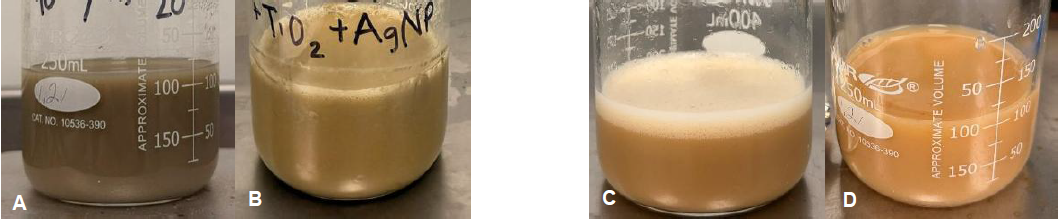
The TiO2and the AgNO3 reduction and as capping agents to stabilize the resulting nanoparticles. 14, 15 During the green synthesis reduction of the nanoparticles, the reactions containing TiO₂ nanoparticles appeared paler than the original extract but showed no significant color change. However, Ag/TiO2 reactions consistently developed yellow tones over 72 hours, (Figure 1) this behavior aligns to Ag NPs synthesis tendencies.
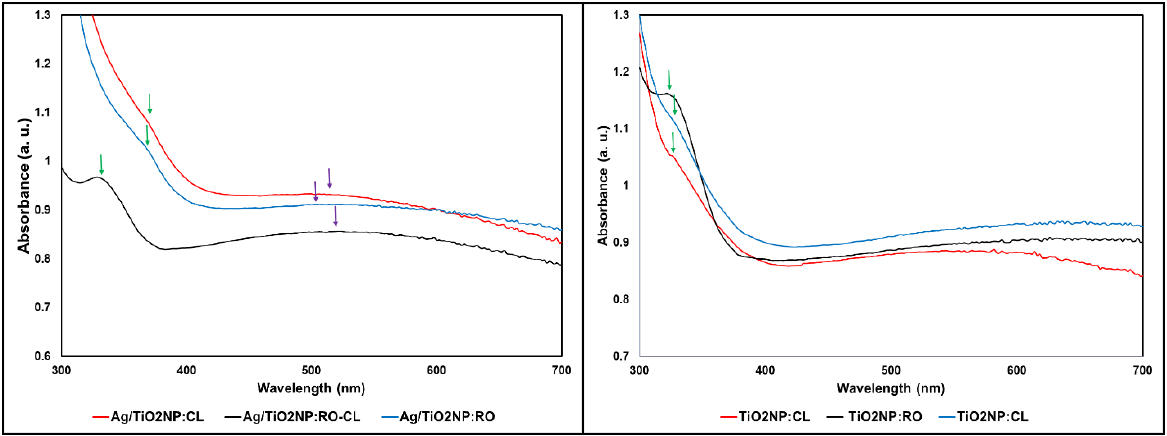
The nanoparticles were evaluated with UV-vis (Figure 2), the Ag/TiO2NP exhibited a band between 330 and 380 nm marked with the green arrows, which are consistent with TiO2 nanoparticles 13 and a wide one between 500 and 530 nm marked with the purple arrows that represent the metal cluster of Ag nanoparticles, typically Ag nanoparticles show a bands close to 420 nm, however, the bathochromic displacement (from 420 to 520 nm) can be attributed to the size, distribution, and chemical interaction of the Ag nanoparticles deposited on the TiO2 ones. 16 On the other hand, the TiO2 nanoparticles exhibited the typical band in 320 nm.


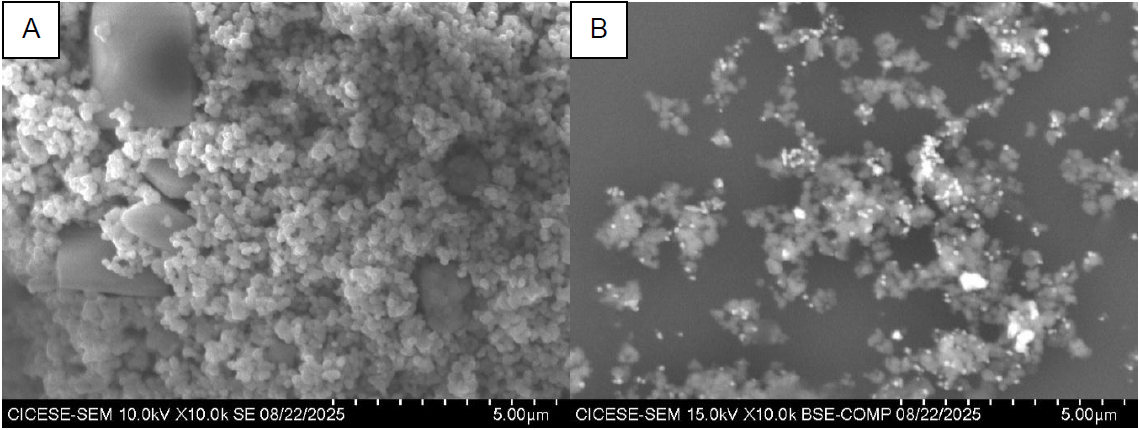
The TiO2 and Ag/TiO2 nanoparticles where also evaluated using SEM and the TiO2 nanoparticles images depicted a semispherical shape and a wide diameter size distribution of approximately 164 nm (Figure 3) along with some unreacted microparticles. The Ag/TiO₂ nanoparticles displayed a similar morphology, with an average TiO₂ diameter of 167 nm. Distinct Ag deposits with an average diameter of 96 nm were visible, appearing brighter due to higher electron density and ability to interact with the electron beam. The Ag nanoparticles seem to be dispersed over the material but not coating the TiO2 nanoparticles. There’s a tendency for the materials to form aggregates which can be attributed to the Van der Waals forces existing between the nanoparticles. 17 The EDS elemental analysis showed a proportion on 41.9% of Ti, 34.2% of O, and 2.9% of Si for the TiO2 nanoparticles, and 29.9% of Ag, 27.0% of Ti,26.5% of O, and 4.8% Si. This confirms the silver on the material with similar presence to the titanium ones, however, oxygen also appeared abundant, likely due to the SEM support material, which also contributed to the silicon signal.
Antibacterial assay
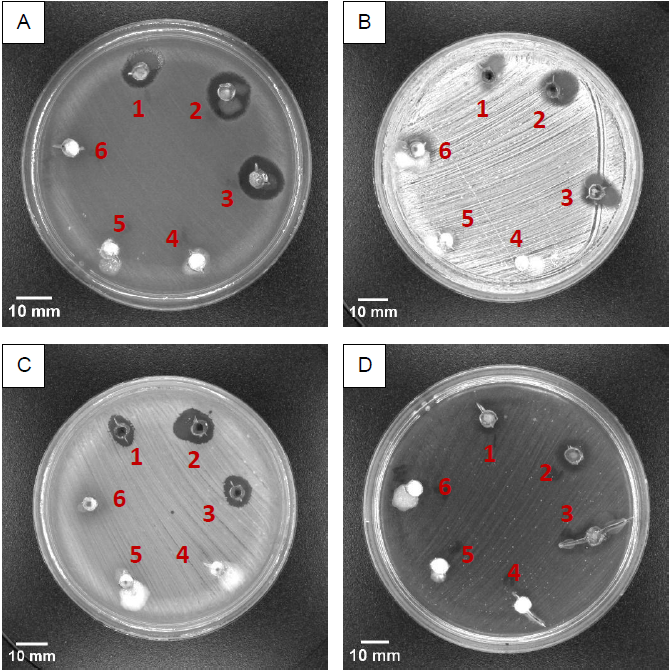
The antibacterial assay showed a higher activity in the Ag/TiO2 nanoparticles in comparison to TiO2 nanoparticles in all extract combination with inhibition zones between 10 and 14 mm (Figure 4 and Table 1). However, the TiO2 nanoparticles present activity solely on the ones with CL specially against SA (gram-positive) and EC (gram-negative), with an inhibition zone of up to 10 mm, this confirms that the plant extract contributes to the antibacterial properties of the nanoparticles. This could lead us to believe that the rosemary coating can obstruct TiO2 nanoparticles antibacterial effect. The increased antimicrobial activity of modified CL TiO2 can be explained by several mechanisms. First, the plant extract has the ability to adhere to the cell wall and increase the permeabilization of the membrane. 18 On top of that, CL has been reported to have remarkable antibacterial capacity that can enhance the TiO2 antibacterial properties. 19
On the other hand, Ag/TiO2nanoparticles exhibited inhibition zones in all the bacteria evaluated, however EF was the least effective, depicted as a smaller inhibition zone 10-11 mm, this is consistent with reports because Ag nanoparticles release Ag ions, positively charged, and can interact with the negatively charged bacteria cell walls, produce reactive oxygen species (ROS), inhibiting protein synthesis and interfering with DNA replication, 20 and combined with TiO2 the mixture of metal-semiconductor called Schottky barrier effect. This can lead to an increase in biocide action through affecting the electrostatic based reactions with the membrane’s lipids and stimulating catalytic oxidation process, consequently, pores appear on the outer membrane and eventually cytoplasm leaks out and the cell cracks. 21 and improves as the surface increases. 22

This work demonstrates the successful green synthesis of TiO₂ and Ag/TiO₂ nanoparticles using aqueous extracts of Rosmarinus officinalis (RO) and Syzygium aromaticum (CL) through green reduction method. Structural and morphological characterization by UV-vis spectroscopy and SEM confirmed the formation of nanoparticles, with TiO₂ nanoparticles averaging 164 nm and Ag nanoparticles 96 nm in diameter. The incorporation of Ag into TiO₂ was evidenced by a bathochromic shift in UV–Vis spectra and resulted in enhanced antibacterial properties. Antimicrobial testing against clinically relevant pathogens, including Pseudomonas aeruginosa, Staphylococcus aureus, Escherichia coli, and Enterococcus faecalis, revealed superior bactericidal efficacy of Ag/TiO₂ nanocomposites compared to TiO₂ alone. These findings are of particular importance in dentistry, where the control of microbial contamination remains a central challenge in procedures such as pulpotomies. Overall, this study provides a sustainable pathway for producing functional nanomaterials with direct translational relevance. The demonstrated antibacterial performance positions Ag/TiO₂ nanoparticles as strong candidates for incorporation into next-generation endodontic biomaterials, underscoring their potential role in enhancing infection control and advancing clinical dental practice.
The authors would like to acknowledge Dra. Gabriela Guzman del LNMA-CICESE for her outstanding SEM services.
| [1] | Verma V, Al-Dossari M, Singh J, Rawat M, Kordy MGM, Shaban M.,“A Review on Green Synthesis of TiO2 NPs: Photocatalysis and Antimicrobial Applications”,Polymers, 14(7).1444. 2022. | ||
| In article | View Article PubMed | ||
| [2] | Asif, M.; Yasmin, R.; Asif, R.; Ambreen, A.; Mustafa, M.; Umbreen, S., “Green Synthesis of Silver Nanoparticles (AgNPs), Structural Characterization, and their Antibacterial Potential”,Dose-Response, 20 (2). 15593258221088709. 2022 | ||
| In article | View Article PubMed | ||
| [3] | Odaudu, O. R.; Akinsiku, A. A., “Toxicity and Cytotoxicity Effects of Selected Nanoparticles: A Review”,IOP Conference Series: Earth and Environmental Science, 1054 (1), 012007. 2022. | ||
| In article | View Article | ||
| [4] | Khan, M. R.; Urmi, M. A.; Kamaraj, C.; Malafaia, G.; Ragavendran, C.; Rahman, M. M., “Green synthesis of silver nanoparticles with its bioactivity, toxicity and environmental applications: A comprehensive literature review”, Environmental Nanotechnology, Monitoring & Management, 20. 100872. 2023. | ||
| In article | View Article | ||
| [5] | Gronwald, B.; Kozłowska, L.; Kijak, K.; Lietz-Kijak, D.; Skomro, P.; Gronwald, K.; Gronwald, H. “Nanoparticles in Dentistry—Current Literature Review”,Coatings, 13(1). 102. 2023. | ||
| In article | View Article | ||
| [6] | Yazdanian, M.; Rostamzadeh, P.; Rahbar, M.; Alam, M.; Abbasi, K.; Tahmasebi, E.; Tebyaniyan, H.; Ranjbar, R.; Seifalian, A.; Yazdanian, A., “The Potential Application of Green-Synthesized Metal Nanoparticles in Dentistry: A Comprehensive Review”, 2022(1). 2311910. 2022. | ||
| In article | View Article PubMed | ||
| [7] | Mansoor, A.; Khan, M. T.; Mehmood, M.; Khurshid, Z.; Ali, M. I.; Jamal, A., “Synthesis and Characterization of Titanium Oxide Nanoparticles with a Novel Biogenic Process for Dental Application”,Nanomaterials, 12(7). 1078. 2022. | ||
| In article | View Article PubMed | ||
| [8] | Yassaei, S.; Nasr, A.; Zandi, H.; Motallaei, M. N., “Comparison of antibacterial effects of orthodontic composites containing different nanoparticles on Streptococcus mutans at different times”,Dental Press Journal of Orthodontics,25 (2). 52-60. 2020. | ||
| In article | View Article PubMed | ||
| [9] | Veenstra, J. P.; Johnson, J. J., “Rosemary (Salvia rosmarinus): Health-promoting benefits and food preservative properties”, International Journal of Nutrition Sciences, 6 (4). 1-10. 2021. | ||
| In article | View Article PubMed | ||
| [10] | Tomas, A.; Maroyi, A.; Cheikhyoussef, N.; Hussein, A. A.; Cheikhyoussef, A., Chapter 37 - Health-promoting activities of clove (Syzygiumaromaticum) extracts, In Clove (Syzygiumaromaticum),Chemistry, Functionality and Applications, Elsevier, Saudi Arabia. 2022, 619-637. | ||
| In article | View Article | ||
| [11] | Rajput, P.; Dasgupta, S.; Chakraborty, M.; Nandwani, S.; Hajoori, M., “Green synthesis of titanium dioxide nanoparticles (TiO2NPs) using leaf extract of datura innoxia”, International Journal of Pharmacy and Biological Sciences,8(3).1086-1092. 2018. | ||
| In article | |||
| [12] | Muñoz-Carrillo, M. G.; Garcidueñas-Piña, C.; Valerio-García, R. C.; Carrazco-Rosales, J. L.; Morales-Domínguez, J. F., “Green Synthesis of Silver Nanoparticles from the Opuntia ficus-indica Fruit and Its Activity against Treated Wastewater Microorganisms”, Journal of Nanomaterials, 2020 (1). 6908290. 2020. | ||
| In article | View Article | ||
| [13] | Leong, K.; Gan, B.; Ibrahim, S.; Pichiah, S., “Synthesis of surface plasmon resonance (SPR) triggered Ag/TiO2 photocatalyst for degradation of endocrine disturbing compound”, Applied Surface Science, 319. 128-135. 2014. | ||
| In article | View Article | ||
| [14] | Wasim A.; Rony Mia.; Sultan U.; Mohammed A.; Jian ., “Simultaneous synthesis and application of TiO2 nanoparticles using mulberry leaves for functionalization of organic cotton fabric”,Journal of Cleaner Production, 440. 140939. 2024. | ||
| In article | View Article | ||
| [15] | Shuaixuan Ying, Zhenru Guan, Polycarp C. Ofoegbu, Preston Clubb, Cyren Rico, Feng He, Jie Hong, “Green synthesis of nanoparticles: Current developments and limitations”,Environmental Technology & Innovation,26.102336. 2022. | ||
| In article | View Article | ||
| [16] | Hammad, A.; Anzai, A.; Zhu, X.; Yamamoto, A.; Ootsuki, D.; Yoshida, T.; El-Shazly, A.; Elkady, M.; Yoshida, H., “Photodeposition Conditions of Silver Cocatalyst on Titanium Oxide Photocatalyst Directing Product Selectivity in Photocatalytic Reduction of Carbon Dioxide with Water”, Catalysis Letters, 150. 1-8.2020. | ||
| In article | View Article | ||
| [17] | Leong, K. H.; Gan, B. L.; Ibrahim, S.; Saravanan, P., “Synthesis of surface plasmon resonance (SPR) triggered Ag/TiO2 photocatalyst for degradation of endocrine disturbing compounds”,Applied Surface Science, 319. 128-135. 2014. | ||
| In article | View Article | ||
| [18] | Serov DA, Gritsaeva AV, Yanbaev FM, Simakin AV, Gudkov SV. “Review of Antimicrobial Properties of Titanium Dioxide Nanoparticles”, International Journal of Molecular Sciences, 25(19). 10519. 2024. | ||
| In article | View Article PubMed | ||
| [19] | Jun Li, Changzhu Li, Ce Shi, Javad Aliakbarlu, Haiying Cui, Lin Lin, “Antibacterial mechanisms of clove essential oil against Staphylococcus aureus and its application in pork”, International Journal of Food Microbiology, 380.109864. 2022. | ||
| In article | View Article PubMed | ||
| [20] | Helmlinger, J.; Sengstock, C.; Groß-Heitfeld, C.; Mayer, C.; Schildhauer, T. A.; Köller, M.; Epple, M., “Silver nanoparticles with different size and shape: equal cytotoxicity, but different antibacterial effects”, RSC Advances, 6 (22). 18490-18501.2016. | ||
| In article | View Article | ||
| [21] | Weng, S., Zhao, X., Liu, G. “Synthesis, characterization, antibacterial activity in dark and in vitro cytocompatibility of Ag-incorporated TiO2 microspheres with high specific surface area”, Journal of Materials Science: Materials in Medicine, 29 (50). 2018. | ||
| In article | View Article PubMed | ||
| [22] | Nguyen, V. T.; Vu, V. T.; Nguyen, T. H.; Nguyen, T. A.; Tran, V. K.; Nguyen-Tri, P., “Antibacterial Activity of TiO2- and ZnO-Decorated with Silver Nanoparticles” Journal of Composites Science, 3(2). 61. 2019. | ||
| In article | View Article | ||
Published with license by Science and Education Publishing, Copyright © 2025 Rebecca Álvarez Arceo, Esteban Hernández Guevara, Judith Lerma Sevilla, Adolfo Neftalí García-Barrón and Fernanda Araiza-Verduzco
 This work is licensed under a Creative Commons Attribution 4.0 International License. To view a copy of this license, visit
http://creativecommons.org/licenses/by/4.0/
This work is licensed under a Creative Commons Attribution 4.0 International License. To view a copy of this license, visit
http://creativecommons.org/licenses/by/4.0/
| [1] | Verma V, Al-Dossari M, Singh J, Rawat M, Kordy MGM, Shaban M.,“A Review on Green Synthesis of TiO2 NPs: Photocatalysis and Antimicrobial Applications”,Polymers, 14(7).1444. 2022. | ||
| In article | View Article PubMed | ||
| [2] | Asif, M.; Yasmin, R.; Asif, R.; Ambreen, A.; Mustafa, M.; Umbreen, S., “Green Synthesis of Silver Nanoparticles (AgNPs), Structural Characterization, and their Antibacterial Potential”,Dose-Response, 20 (2). 15593258221088709. 2022 | ||
| In article | View Article PubMed | ||
| [3] | Odaudu, O. R.; Akinsiku, A. A., “Toxicity and Cytotoxicity Effects of Selected Nanoparticles: A Review”,IOP Conference Series: Earth and Environmental Science, 1054 (1), 012007. 2022. | ||
| In article | View Article | ||
| [4] | Khan, M. R.; Urmi, M. A.; Kamaraj, C.; Malafaia, G.; Ragavendran, C.; Rahman, M. M., “Green synthesis of silver nanoparticles with its bioactivity, toxicity and environmental applications: A comprehensive literature review”, Environmental Nanotechnology, Monitoring & Management, 20. 100872. 2023. | ||
| In article | View Article | ||
| [5] | Gronwald, B.; Kozłowska, L.; Kijak, K.; Lietz-Kijak, D.; Skomro, P.; Gronwald, K.; Gronwald, H. “Nanoparticles in Dentistry—Current Literature Review”,Coatings, 13(1). 102. 2023. | ||
| In article | View Article | ||
| [6] | Yazdanian, M.; Rostamzadeh, P.; Rahbar, M.; Alam, M.; Abbasi, K.; Tahmasebi, E.; Tebyaniyan, H.; Ranjbar, R.; Seifalian, A.; Yazdanian, A., “The Potential Application of Green-Synthesized Metal Nanoparticles in Dentistry: A Comprehensive Review”, 2022(1). 2311910. 2022. | ||
| In article | View Article PubMed | ||
| [7] | Mansoor, A.; Khan, M. T.; Mehmood, M.; Khurshid, Z.; Ali, M. I.; Jamal, A., “Synthesis and Characterization of Titanium Oxide Nanoparticles with a Novel Biogenic Process for Dental Application”,Nanomaterials, 12(7). 1078. 2022. | ||
| In article | View Article PubMed | ||
| [8] | Yassaei, S.; Nasr, A.; Zandi, H.; Motallaei, M. N., “Comparison of antibacterial effects of orthodontic composites containing different nanoparticles on Streptococcus mutans at different times”,Dental Press Journal of Orthodontics,25 (2). 52-60. 2020. | ||
| In article | View Article PubMed | ||
| [9] | Veenstra, J. P.; Johnson, J. J., “Rosemary (Salvia rosmarinus): Health-promoting benefits and food preservative properties”, International Journal of Nutrition Sciences, 6 (4). 1-10. 2021. | ||
| In article | View Article PubMed | ||
| [10] | Tomas, A.; Maroyi, A.; Cheikhyoussef, N.; Hussein, A. A.; Cheikhyoussef, A., Chapter 37 - Health-promoting activities of clove (Syzygiumaromaticum) extracts, In Clove (Syzygiumaromaticum),Chemistry, Functionality and Applications, Elsevier, Saudi Arabia. 2022, 619-637. | ||
| In article | View Article | ||
| [11] | Rajput, P.; Dasgupta, S.; Chakraborty, M.; Nandwani, S.; Hajoori, M., “Green synthesis of titanium dioxide nanoparticles (TiO2NPs) using leaf extract of datura innoxia”, International Journal of Pharmacy and Biological Sciences,8(3).1086-1092. 2018. | ||
| In article | |||
| [12] | Muñoz-Carrillo, M. G.; Garcidueñas-Piña, C.; Valerio-García, R. C.; Carrazco-Rosales, J. L.; Morales-Domínguez, J. F., “Green Synthesis of Silver Nanoparticles from the Opuntia ficus-indica Fruit and Its Activity against Treated Wastewater Microorganisms”, Journal of Nanomaterials, 2020 (1). 6908290. 2020. | ||
| In article | View Article | ||
| [13] | Leong, K.; Gan, B.; Ibrahim, S.; Pichiah, S., “Synthesis of surface plasmon resonance (SPR) triggered Ag/TiO2 photocatalyst for degradation of endocrine disturbing compound”, Applied Surface Science, 319. 128-135. 2014. | ||
| In article | View Article | ||
| [14] | Wasim A.; Rony Mia.; Sultan U.; Mohammed A.; Jian ., “Simultaneous synthesis and application of TiO2 nanoparticles using mulberry leaves for functionalization of organic cotton fabric”,Journal of Cleaner Production, 440. 140939. 2024. | ||
| In article | View Article | ||
| [15] | Shuaixuan Ying, Zhenru Guan, Polycarp C. Ofoegbu, Preston Clubb, Cyren Rico, Feng He, Jie Hong, “Green synthesis of nanoparticles: Current developments and limitations”,Environmental Technology & Innovation,26.102336. 2022. | ||
| In article | View Article | ||
| [16] | Hammad, A.; Anzai, A.; Zhu, X.; Yamamoto, A.; Ootsuki, D.; Yoshida, T.; El-Shazly, A.; Elkady, M.; Yoshida, H., “Photodeposition Conditions of Silver Cocatalyst on Titanium Oxide Photocatalyst Directing Product Selectivity in Photocatalytic Reduction of Carbon Dioxide with Water”, Catalysis Letters, 150. 1-8.2020. | ||
| In article | View Article | ||
| [17] | Leong, K. H.; Gan, B. L.; Ibrahim, S.; Saravanan, P., “Synthesis of surface plasmon resonance (SPR) triggered Ag/TiO2 photocatalyst for degradation of endocrine disturbing compounds”,Applied Surface Science, 319. 128-135. 2014. | ||
| In article | View Article | ||
| [18] | Serov DA, Gritsaeva AV, Yanbaev FM, Simakin AV, Gudkov SV. “Review of Antimicrobial Properties of Titanium Dioxide Nanoparticles”, International Journal of Molecular Sciences, 25(19). 10519. 2024. | ||
| In article | View Article PubMed | ||
| [19] | Jun Li, Changzhu Li, Ce Shi, Javad Aliakbarlu, Haiying Cui, Lin Lin, “Antibacterial mechanisms of clove essential oil against Staphylococcus aureus and its application in pork”, International Journal of Food Microbiology, 380.109864. 2022. | ||
| In article | View Article PubMed | ||
| [20] | Helmlinger, J.; Sengstock, C.; Groß-Heitfeld, C.; Mayer, C.; Schildhauer, T. A.; Köller, M.; Epple, M., “Silver nanoparticles with different size and shape: equal cytotoxicity, but different antibacterial effects”, RSC Advances, 6 (22). 18490-18501.2016. | ||
| In article | View Article | ||
| [21] | Weng, S., Zhao, X., Liu, G. “Synthesis, characterization, antibacterial activity in dark and in vitro cytocompatibility of Ag-incorporated TiO2 microspheres with high specific surface area”, Journal of Materials Science: Materials in Medicine, 29 (50). 2018. | ||
| In article | View Article PubMed | ||
| [22] | Nguyen, V. T.; Vu, V. T.; Nguyen, T. H.; Nguyen, T. A.; Tran, V. K.; Nguyen-Tri, P., “Antibacterial Activity of TiO2- and ZnO-Decorated with Silver Nanoparticles” Journal of Composites Science, 3(2). 61. 2019. | ||
| In article | View Article | ||