Introduction. The danger of thrombosis for humans has become widely known since the mid-nineteenth century, and the list of diseases whose pathogenesis involves the formation of blood clots includes most of the known nosological forms today. The purpose of the work was to study the frequency of occurrence and allelic load of mutations in thrombophilia genes in patients with chronic myeloproliferative diseases. Materials and methods. 50 patients with chronic myelopolyferative diseases (CMPD), age less than 50 years and episodes of thrombosis were examined in the inpatient conditions of the Russian National Research Medical Center for Hematology. Conclusions: The high frequency of mutations of thrombophilia genes in patients with CMРD indicates the possible participation of genes of a hereditary nature in the development of thrombosis and the outcome of the underlying disease.
According to modern literature data, carriers of thrombophilia genes have an increased risk of developing thrombosis in the cardiovascular system, which in turn is the third leading cause of death 1, 2. More than a third of cases occur in people over 60 years of age and about 1% in people over 80 years of age. The incidence rate for persons under 40 years of age is 1 case per 10,000 population and continues to increase 3, 4.
The concept of thrombophilia is usually used to describe inherited and/or acquired conditions associated with an increased susceptibility to thrombosis. Hereditary thrombophilia refers to genetic disorders of specific hemostatic proteins. These disorders are associated only with laboratory factors that assess the severity of bleeding disorders and are not generally associated with diseases such as cancer, inflammatory conditions, and obesity, which are associated with thrombosis through multiple mechanisms.
The most well-known genetic determinants of hereditary thrombophilias are the prothrombin gene variant F2 (G20210A), the factor F5 Leiden variant (G1691A), as well as congenital deficiencies of proteins C (PC), S (PS) and antithrombin (AT). Acquired thrombophilias include antiphospholipid syndrome (APS), paroxysmal nocturnal hemoglobinuria (PNH), myeloproliferative neoplasms (MPN), and the presence of a JAK2 gene mutation in the absence of an MPN phenotype. Deficiency of anticoagulants and surplus of coagulating factors can also be acquired 5, 6.
The purpose of the work was to study the frequency of occurrence and allelic load of mutations in thrombophilia genes in patients with chronic myeloproliferative diseases.
In the inpatient conditions of the Russian National Research Medical Center for Hematology, 50 patients with chronic myelopolyferative diseases (CMPD), age less than 50 years and episodes of thrombosis during this hospitalization were examined. All examined were from 18 to 50 years old, 21 men and 29 women (M:F ratio –1:1.2).
The following patient characteristics were recorded as recorded data: gender, age at the time of diagnosis of thrombosis, the presence of thrombosis-specific symptoms, as well as all laboratory parameters confirming CMPD. Exclusion criteria from the study were pregnancy, endocrine diseases, other malignant neoplasms, pulmonary and heart failure in patients.
The basis of the study was genetic tests carried out using real-time polymerase chain reaction (RT-PCR) to study mutations C677T (Ala22Val) of the MTHFR gene, A66G (ILe22Met) of the MTRR gene, A2756G (Asp919Gly) of the MTR gene, G (455)A of the FGB gene , G20210A of the F2 gene, G1691A (Arg506Gln) of the F5 gene, G10976A (Arg353Gln) of the F7 gene. The choice of these genetic variants was determined by data from foreign literature sources, where it was noted that they are most often found in patients with thrombophilias 2, 5, 6, 7. However, a study of mutations of these genes among patients with CMPD with a history of thrombosis has not been previously conducted. The data obtained from this study may have a potential prognosis for the development of the disease and serve as an additional tool for doctors to diagnose these pathologies.
Nosological groups of patients with CMPD included: Polycythemia vera (PV) – 20 patients (40%); Essential thrombocythemia (ET) – 21 patients (42%); Myelofibrosis (MF) – 9 patients (18%).
Among thrombotic complications in patients with IP, thrombotic episodes characteristic of arterial vessels predominated: acute cerebrovascular accidents and microstrokes were suffered by 5 (10%) patients, myocardial infarction was diagnosed in 9 (18%) patients, thrombosis was observed much less frequently in patients with IP deep veins – 2 (4%) cases and retinal vein thrombosis – 5 (10%) cases. Manifestations of thrombophilia in patients with ET were represented mainly by venous forms of thrombosis (deep vein thrombosis) - in 75% of cases, and arterial thrombosis (myocardial infarction) was observed in 25% of subjects. In patients with MF, acute microdisturbances of cerebral circulation (ACVA) were observed in 22% of cases, deep vein thrombosis in 55.5%, and myocardial infarction in 22.5%.
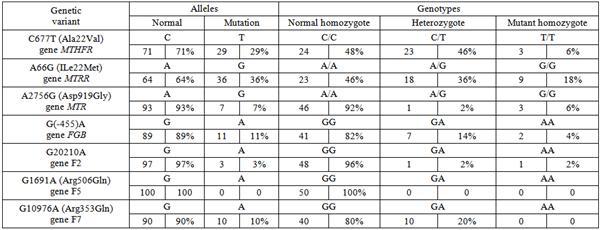
All patients underwent a molecular genetic study to identify markers of thrombophilia. The results obtained are presented in Table 1.
The section of the DNA coding sequence of the MTHFR gene, in which the base of cytosine (C) can be replaced with thymine (T), is located at position 677. With nucleotide substitution, the biochemical properties of the enzyme also change, in which the amino acid alanine is replaced with valine in the folate binding site, which causes a genetic predisposition to hyperhomocysteinemia, ischemic lesions of various organs, hypertension, atherosclerosis, thrombosis, various forms of cancer, etc. 3, 7, 8. In the studied sample of CMPD patients with clinical signs of thrombosis in history, the frequency of occurrence of the normal C allele at position 677 of the MTHFR gene was 71%, while the mutant T allele was 29%. The frequency of the normal homozygous genotype in this sample of patients was 48% of cases. The heterozygous genotype occurred in 46%, and the frequency of the mutant homozygous genotype reached 6% (Val/Val mutation).
The MTRR gene encodes the cytoplasmic enzyme methionine synthase reductase (MSR), which plays an important role in protein synthesis and is involved in a large number of biochemical processes associated with the transfer of the methyl group. It has been established that the frequency of occurrence of this gene in the European population is 54% 9. Analysis of the MTRR gene mutation (A66G) in the examined patients showed that the frequency of the normal A allele was 64%, and the mutant G allele was 36%. Normal homozygote was found in 46% of the examined samples, mutant homozygote G/G - in 18%. Heterozygous carriage of the mutant allele in genotype A/G was confirmed in 36% of cases.
Analysis of the results of a study of the Asp919Gly polymorphism in the MTR gene revealed a normal allele A in 64% of cases, and the occurrence of the mutant allele was 36%. Since this gene encodes the cytoplasmic enzyme methionine synthase (alternatively 5-methyltetrahydrofolate-homocysteine S-methyltransferase) and catalyzes the remethylation of homocysteine to form methionine, in which cobalamin (a precursor of vitamin B12) acts as a cofactor, this gene may act as a predictive criterion for the development of future thrombotic episodes. In our study, the frequency of the normal homozygous genotype in the patients examined was 92%, heterozygous carriage - 2%, while the mutational homozygous genotype was found in 6% of cases.
The FGB gene encodes the amino acid sequence of the fibrinogen beta chain and occupies one of the leading positions in the regulation of hemostasis processes. Fibrin is formed from fibrinogen, the main component of a thrombotic clot. The -455 G->A polymorphism of the FGB gene is associated with the replacement of the nucleotide guanine (G) with adenine (A) in the promoter region of the gene. Option A is accompanied by increased gene expression, which leads to an increase in fibrinogen in the blood and increases the likelihood of blood clots. The frequency of polymorphism of this gene in the European population reaches 5-10%. Carriers of variant A have a greater risk of cardiovascular diseases, including coronary heart disease, myocardial infarction, and stroke 3. Among the examined patients with CMPD, the frequency of occurrence of the normal G allele at position 455 is 89%, and the mutational variant of the A allele is 11%. The mutant homozygous genotype was detected in 4% of cases, and heterozygous carriage of G(455)A FGB was found in 14% of samples. The frequency of normal homozygotes was 82% of cases.
It is known that blood clotting disorders in hereditary thrombophilia are in most cases caused by changes in the genes of blood coagulation factors II and V, caused by genetic markers F2 G20210A, F5 G1691A; they play a major role in the development of thrombophilia and associated diseases 4, 6. According to studies by Gerhardt et al. (2000), in patients with a history of venous thromboembolism, the prevalence of factor V Leiden was 43.7% 4. However, it is believed that the high prevalence of a potentially harmful mutation in the general population may be the result of evolutionary selection. Polymorphisms ARG506GLN of the F5 gene (Leiden) and G20210A of the F2- gene as predictors of thrombotic complications in patients with chronic myeloproliferative diseases (in the Uzbek population) who have episodes of thrombosis, attracted our attention because in the group we studied, not a single case of gene mutation was found F5, and when analyzing the F2 gene, a normal allele was identified in 97% of cases, and a mutation allele was identified in only 3%. The mutational homozygous genotype (AA) of the F2 gene was found in only 2% and in 2% of cases heterozygous carriage was detected, which absolutely does not correspond to the world literature data describing the mutational status of these thrombophilia genes.
Next, we analyzed the results of a study of the Arg353Gln polymorphism in the F7 gene. The F7 gene encodes coagulation factor VII (proconvertin), a protein synthesized in the liver that regulates blood clotting, acting as an activator of coagulation factors X (F10) and IX (F9) in the presence of vitamin K 1. According to the literature, the occurrence of this mutation in the European population is 10% 1, 3. The marker is associated with a reduced likelihood of myocardial infarction, even in the presence of angiographically documented severe coronary atherosclerosis. Heterozygotes (carriers of one allele A and one G, genotype A/G) have a risk of myocardial infarction that is 2 times lower than carriers of two alleles G (genotype G/G) 10. In our study, the frequency of the normal G allele was detected in 90%, and the mutation allele A in 10%. A homozygous mutation of this gene was not detected, but heterozygous carriage (GA) at position G10976A of the F7 gene occurred in 20% of cases. The normal homozygous genotype was identified in 80% of the subjects.
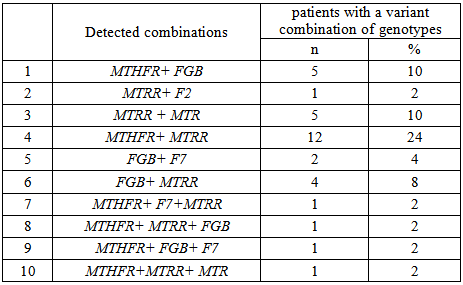
Due to the fact that the thrombophilic status can be caused by the influence of several polymorphic genes, it was advisable to find out the presence of a combination of allelic variants of the studied genes in the examined patients (Table 2). The results showed that a combination of allelic variants in 2 genes was noted in 29 patients with CMPD, which accounted for 58% of cases. A combination of 3 genes was simultaneously observed in 8% of cases.
Most often, the following genes were involved in the studied combinations of allelic variants: MTRR – 50% of cases, MTHFR – in 42% of patients, FGB in 26% of patients and MTR – in 12% of patients. The data obtained indicate that the development of thrombophilic status in patients with CMPD is due to the influence of allelic variants of a number of genes. In connection with the above, testing to identify the hereditary determinant of the risk of developing thrombosis in patients with CPMD should be carried out on the basis of a panel that includes, among other things, the MTRR (A66G), MTHFR (C677T) and FGB (G-455) A polymorphisms.
The results of our study showed that only 6 (12%) patients out of 50 did not have any changes in the studied thrombophilia genes, while 88% of patients had one or another variant of carrying the mutation, which indicates a high probability of involvement of a hereditary genetic factor in the development and course of episodes of thrombosis in patients with CMPD. Since all patients in the study sample had a history of thrombosis, the results obtained indicate that genetic mutations and carriage of heterozygous alleles can affect the course and outcome of the underlying disease, and therefore, to assess the risk of thrombosis in patients with CMPD, it is advisable to test for the presence of a genetic predisposition and the development of this pathology.
Research transparency. - The study had no sponsorship. The authors are solely responsible for submitting the final version of the manuscript for publication.
Declaration of financial and other relationships. - All authors participated in the conception and design of the study and in writing the manuscript. The final version of the manuscript was approved by all authors. The authors received no royalties for the study.
| [1] | Ramzi M., N. Cohan, M. Yavarian, M.R. Jahromi // Coagulation factor VII gene polymorphisms and cardiovascular diseases in Iranian population / J. Indian College of Cardiology. 2013. Vol. 3, No 1. P. 6-8. | ||
| In article | View Article | ||
| [2] | Melikyan A.L., A.G. Turkina, K.M. Abdulkadyrov [et al.] /Clinical recommendations for the diagnosis and treatment of Ph-negative myeloproliferative diseases (polycythemia vera, essential thrombocythemia, primary myelofibrosis) // Hematology and transfusiology. - 2014. - T. 59, No. 4. -S. 31-56. | ||
| In article | |||
| [3] | Martiskainen M., Pohjasvaara T., Mikkelsson J. Fibrinogen gene promoter -455 A allele as a risk factor for lacunar stroke // Stroke.- 2020.- V. 34, N 4.- P. 886-891. | ||
| In article | View Article PubMed | ||
| [4] | Rosendaal F.R., Siscovick D.S., Schwartz S.M. A common prothrombin variant (20210 G to A) increases the risk of myocardial infarction in young women // Blood.- 2017.- V. 90, N 5.- P. 1747-1750. | ||
| In article | View Article PubMed | ||
| [5] | Friptu Valentin, Mitriuc Diana, Popusoi Olga HEREDITARY THROMBOPHILIA AND ADVERSE PREGNANCY OUTCOMES // The Moldovan Medical Journal. 2021. №3. URL: https://cyberleninka.ru/article/n/hereditary-thrombophilia-and-adverse-pregnancy-outcomes. | ||
| In article | View Article | ||
| [6] | Abdulbary A.M. Ahmed, Azova M. Madina ASSOCIATION OF VEGFA, FACTOR V AND PROTHROMBIN GENE POLYMORPHISMS WITH EARLY PREGNANCY LOSS // Scientific results of biomedical research. 2021. | ||
| In article | |||
| [7] | Duangnapasatit D., E. Rattarittamrong, T. Rattanathammethee/ Clinical Manifestations and Risk Factors for Complications of Philadelphia Chromosome-Negative Myeloproliferative Neoplasms //Asian Pac J Cancer Prev. - 2015. - Vol. 16(12). - P. 5013-5018. | ||
| In article | View Article PubMed | ||
| [8] | Butt C., Zheng H., Randell E. e.a. Combined carrier status of prothrombin 20210A and factor XIII-A Leu34 alleles as a strong risk factor for myocardial infarction: evidence of a gene-gene interaction // Blood.- 2021.- V.102, N 4.- P. 1558-1559. | ||
| In article | |||
| [9] | Mahmoodi , , , , , , , . Venous thromboembolism and predictive value of screening asymptomatic relatives of patients with hereditary deficiencies of protein S, protein C or antithrombin J Thromb Haemost. 2018 Jun; 8(6): 1193-200. | ||
| In article | View Article PubMed | ||
| [10] | Andreenko E.Yu., L.M. Samokhodskaya, A.V. Balatsky, P.I. Makarevich, S.A. Boytsov //Prognostic significance of carriage of allelic variants of genes that control the hemostasis system, and their combination with traditional risk factors in the early development of coronary heart disease/Cardiovascular therapy and prevention. 2011. T. 10, No. 8. P. 32-39. | ||
| In article | |||
Published with license by Science and Education Publishing, Copyright © 2023 I.V. Berger, A.D. Makhmudova, A.A. Kayumov and M.O. Omonov
 This work is licensed under a Creative Commons Attribution 4.0 International License. To view a copy of this license, visit
https://creativecommons.org/licenses/by/4.0/
This work is licensed under a Creative Commons Attribution 4.0 International License. To view a copy of this license, visit
https://creativecommons.org/licenses/by/4.0/
| [1] | Ramzi M., N. Cohan, M. Yavarian, M.R. Jahromi // Coagulation factor VII gene polymorphisms and cardiovascular diseases in Iranian population / J. Indian College of Cardiology. 2013. Vol. 3, No 1. P. 6-8. | ||
| In article | View Article | ||
| [2] | Melikyan A.L., A.G. Turkina, K.M. Abdulkadyrov [et al.] /Clinical recommendations for the diagnosis and treatment of Ph-negative myeloproliferative diseases (polycythemia vera, essential thrombocythemia, primary myelofibrosis) // Hematology and transfusiology. - 2014. - T. 59, No. 4. -S. 31-56. | ||
| In article | |||
| [3] | Martiskainen M., Pohjasvaara T., Mikkelsson J. Fibrinogen gene promoter -455 A allele as a risk factor for lacunar stroke // Stroke.- 2020.- V. 34, N 4.- P. 886-891. | ||
| In article | View Article PubMed | ||
| [4] | Rosendaal F.R., Siscovick D.S., Schwartz S.M. A common prothrombin variant (20210 G to A) increases the risk of myocardial infarction in young women // Blood.- 2017.- V. 90, N 5.- P. 1747-1750. | ||
| In article | View Article PubMed | ||
| [5] | Friptu Valentin, Mitriuc Diana, Popusoi Olga HEREDITARY THROMBOPHILIA AND ADVERSE PREGNANCY OUTCOMES // The Moldovan Medical Journal. 2021. №3. URL: https://cyberleninka.ru/article/n/hereditary-thrombophilia-and-adverse-pregnancy-outcomes. | ||
| In article | View Article | ||
| [6] | Abdulbary A.M. Ahmed, Azova M. Madina ASSOCIATION OF VEGFA, FACTOR V AND PROTHROMBIN GENE POLYMORPHISMS WITH EARLY PREGNANCY LOSS // Scientific results of biomedical research. 2021. | ||
| In article | |||
| [7] | Duangnapasatit D., E. Rattarittamrong, T. Rattanathammethee/ Clinical Manifestations and Risk Factors for Complications of Philadelphia Chromosome-Negative Myeloproliferative Neoplasms //Asian Pac J Cancer Prev. - 2015. - Vol. 16(12). - P. 5013-5018. | ||
| In article | View Article PubMed | ||
| [8] | Butt C., Zheng H., Randell E. e.a. Combined carrier status of prothrombin 20210A and factor XIII-A Leu34 alleles as a strong risk factor for myocardial infarction: evidence of a gene-gene interaction // Blood.- 2021.- V.102, N 4.- P. 1558-1559. | ||
| In article | |||
| [9] | Mahmoodi , , , , , , , . Venous thromboembolism and predictive value of screening asymptomatic relatives of patients with hereditary deficiencies of protein S, protein C or antithrombin J Thromb Haemost. 2018 Jun; 8(6): 1193-200. | ||
| In article | View Article PubMed | ||
| [10] | Andreenko E.Yu., L.M. Samokhodskaya, A.V. Balatsky, P.I. Makarevich, S.A. Boytsov //Prognostic significance of carriage of allelic variants of genes that control the hemostasis system, and their combination with traditional risk factors in the early development of coronary heart disease/Cardiovascular therapy and prevention. 2011. T. 10, No. 8. P. 32-39. | ||
| In article | |||