This study explores the relationship between thermal conductivity and the California Bearing Ratio (CBR) index of lateritic gravel, an essential road construction material in tropical regions. The main objective is to assess how the thermal properties of this material, sourced from the Cana Atchia quarry in Benin, influence its mechanical performance with a view to optimizing the durability of road infrastructure. The methodology adopted consisted of conducting thermal conductivity and CBR tests on samples of lateritic gravel compacted at different rates: 90%, 95%, 97%, and 100% of the OPM dry density. For each compaction rate, the CBR was measured on test specimens that had undergone a thermal test and on unheated control specimens. This study showed that increasing the compaction rate leads to an increase in thermal conductivity. For each of the target compaction rates, the CBR values of the specimens subjected to thermal testing were consistently lower than those of the unheated specimens, demonstrating that heat has a negative impact on the bearing capacity of a lateritic gravel pavement layer. The test also showed that above 95% compactness, the CBR begins to fall as thermal conductivity increases. This phenomenon sheds light on the degradation of the mechanical properties of lateritic gravels under high temperatures.
Lateritic gravel is a natural material rich in iron and aluminum oxides, found mainly in tropical and subtropical regions. Due to its local availability and favorable mechanical characteristics, it is commonly used as a base material for road construction, particularly in areas where alternative materials are scarce or expensive 1. The performance of lateritic gravel as a construction material depends on several properties, the most important of which are the California Bearing Ratio (CBR), water content, and temperature 2. Previous studies conducted by Azizi & Boukhechba 3, et Boukelia et al. 4 have shown that parameters such as the conductivity and diffusivity of silty soil increase until they reach a maximum value around the Proctor optimum. This study also concluded that an increase in temperature causes a slight increase in thermal parameters. This interdependence of mechanical and thermal properties is fundamental to understanding the behavior of lateritic gravels under real conditions. Indeed, water content and temperature not only affect thermal properties, as demonstrated by Boukélia et al. 4, but they also play a decisive role in the mechanical strength of the material. It is therefore essential to examine how these common factors influence both the bearing capacity and heat transfer within the material.
According to Black and Lister 5, the CBR, an indicator of a soil's bearing capacity, is crucial for determining a material's resistance under load, while thermal conductivity measures its ability to transfer heat. The relationship between these two properties is particularly relevant in the case of lateritic gravel, where factors such as density, water content, and mineralogical composition strongly influence CBR and thermal conductivity values 6. Furthermore, in tropical environments, the thermal management of pavement materials becomes crucial due to high temperatures and their impact on infrastructure durability 7.
Several previous studies have shown that the thermal conductivity of road construction materials depends on mineral composition and water content. For example, Farouki 8 demonstrated that thermal conductivity generally increases with water content due to the better heat transfer of water compared to air. Similarly, studies on materials similar to lateritic gravel indicate that density and compaction improve CBR and thermal conductivity, suggesting an interaction between these properties under varying moisture and compaction conditions 9.
The importance of the relationship between thermal conductivity and CBR has not been sufficiently explored in the literature, although several studies have established indirect links between density, compaction, and the thermal performance of materials 10, 11 proposed an innovative approach to assess the impact of compaction rate and thermal conductivity on the shear strength of lateritic materials, suggesting that optimizing these two parameters could offer better mechanical performance, particularly for materials used in hot and humid regions. However, most existing research has focused on conventional mechanical properties (compressive strength, tensile strength) without considering the impact of thermal conductivity.
This study therefore aims to explore the relationship between thermal conductivity and the CBR index of lateritic gravel. Thermal conductivity measurements will be carried out at several compaction rates to determine the CBR index by combining the thermal test and the CBR test.
The results could help optimize the use of this material in transportation infrastructure in tropical regions, taking into account its thermal and mechanical performance.
The material studied in this study comes from the Cana Atchia quarry, specifically in the commune of Zogbodomey, Zou department, Republic of Benin. These characteristic 12, listed in Table 1 below, clearly show that it is a road construction material.
The equipment used to conduct this study is classified into three categories, namely:
○ Modified Proctor test equipment in accordance with standard NF P 94-093 16;
○ Thermal conductivity testing equipment as presented by Houanou et al. 12;
○ CBR (California Bearing Ratio) testing equipment in accordance with standard NF P 94-078 17.
2.2. MethodIn order to achieve the expected result, the methodological approach used is divided into three phases, namely:
○ Modified Proctor test method in accordance with standard NF P 94-093 16; Equation 3 is established in order to determine the number of blows based on the compaction rate.
The scientific origin of the logarithmic relationship in compaction dates back to the work of G.P. Boutwell in 18.
𝛾𝑑=𝑎 𝑙𝑜𝑔𝑛 +𝑏 (1)
where a=0.2864 and b=1.7654 n represents the number of blows
Given that compactness is given by equation 2:
 | (2) |
Equation 3 is established by substituting (1) and (2):
 | (3) |
With  taken from Houanou et al. 13.
This gives:
 (4)
(4)
Let  (5)
(5)
From equation 5, we determined the number of blows based on the compaction rate (see Table 2).
The modified Proctor test is performed according to these different numbers of blows relative to compactness.
v Thermal conductivity test method as presented by Houanou et al. 12;
v CBR (California Bearing Ratio) test method in accordance with standard NF P 94-078 17.
The results of the thermal conductivity tests are recorded in Table 3, Table 4, Table 5, and Table 6 below.
The correction factor Cλ and the linear power Q supplied to the medium are constants with values of 0.1 and 120 watts/m, respectively 12.
Based on conductivity tests carried out on Cana Atchia lateritic gravel according to the CBR, we have produced Table 7 and the following bar chart.
Analysis of this table shows that the CBR values measured on specimens not subjected to thermal conductivity testing are higher than those measured in conjunction with thermal conductivity testing.
This table also shows an increase in CBR evaluated on unheated specimens as the compaction rate increases. On the other hand, the CBR measured in conjunction with thermal conductivity increases from 12 to 39 when the compaction rate changes from 90% to 95%. It can be seen in this area that thermal conductivity increased from 0.168 to 0.232. From 95% to 100% compactness, thermal conductivity increased from 0.232 to 0.286, while the CBR in this area decreased from 39 to 22. The increase in thermal conductivity as a function of compactness is due to the reduction of voids within the material 19.
We can, therefore, already say that thermal conductivity has an effect on CBR, even if it is increasing. However, beyond this threshold, CBR decreases despite a continuous increase in thermal conductivity, suggesting a critical point where excessive heat degrades the mechanical properties of the material.
This phenomenon can be explained by heat exchange between the atmosphere and the pavement. Sunlight raises the surface temperature, gradually transferring this heat to the deeper layers, which alters the properties of the materials. This can lead to expansion, loss of cohesion in granular materials, and, as a result, a reduction in stiffness and bearing capacity, as indicated by a decrease in CBR.
These effects are particularly concerning in tropical areas, where prolonged exposure to sunlight accelerates pavement degradation. Excess heat reduces the mechanical performance of materials and accelerates their long-term aging.
To remedy this, it is essential to incorporate thermal factors into pavement design. Solutions such as adding stabilizing additives, optimizing materials, or using reflective coatings can limit the negative impacts of high thermal conductivity, thereby improving the durability of road infrastructure.
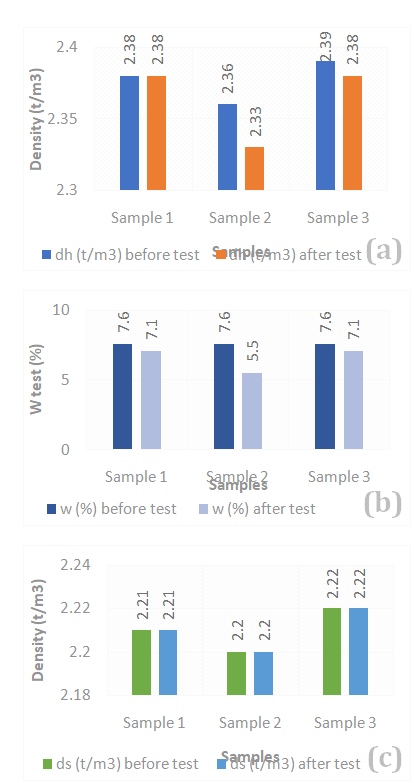
Figure 4 (a) shows the wet density values measured before and after the thermal conductivity test. Figure 4 (b) shows the water content values before and after the thermal conductivity test. Finally, Figure 4 (c) shows the dry density values observed before and after the thermal conductivity test.
Analysis of Figure 4 shows that, unlike dry density, which remains stable before and after the thermal conductivity test, wet density and water content have fallen. This change indicates that a material compacted at its optimum water content undergoes a reduction in its wet densities and optimum water content over time under the effect of heat. This phenomenon is due to the evaporation of water contained in the material, leading to a change in its physical properties, particularly in terms of water retention capacity and compactness.

The study of the thermal conductivity of lateritic gravel as a function of the California Bearing Ratio (CBR) is of paramount importance in the field of civil engineering, particularly for the design and optimization of the cross-section of pavements in tropical regions. Lateritic gravel, a material widely used in these regions for its mechanical qualities and local availability, has varied characteristics that require a thorough understanding of its thermal and mechanical behavior. The thermal conductivity of lateritic gravel depends heavily on its physical and mechanical properties, such as density, moisture content, particle size distribution, and compaction rate, which also influence the CBR. Soil with a high CBR, indicating good mechanical strength, tends to have a dense and well-bonded structure, which improves thermal conductivity by facilitating heat transfer. However, at a given compaction rate above 95%, thermal conductivity begins to cause the CBR in lateritic soil to drop, thereby reducing its bearing capacity. By linking CBR and thermal conductivity, it becomes possible to develop predictive models to quickly assess the performance of lateritic soils under various climatic conditions.
“The authors declare no conflicts of interest.”
| [1] | H. B. Bodjona, O.-D. E. Samah, et A. K. Houanou, "Study of the Variation in Service Temperature on the RN°1 Roadway in the Central Region (Togo)," Journal of Scientific and Engineering Research, 9(1) 10. 2022. | ||
| In article | View Article | ||
| [2] | Issiakou, M. S. "Caractérisation et valorisation des matériaux latéritiques utilisés en construction routière au Niger," PhD Thesis, Université de Bordeaux. 2016. https://theses.hal.science/tel-01511599/. | ||
| In article | |||
| [3] | Azizi, F.et Boukhechba, G. "Influence de la température et de l’humidité sur les propriétés thermo-physique des matériaux locaux à base d’argile", PhD Thesis. Université Ahmed Draya-Adrar. 2016. | ||
| In article | |||
| [4] | Boukelia, A, Eslami, H, Rosin-Paumier, S, et Masrouri, F. "Effect of temperature and initial state on variation of thermal parameters of fine compacted soils," European Journal of Environmental and Civil Engineering. 23(9) 1125‑1138. sept. 2019. | ||
| In article | View Article | ||
| [5] | Black, W. P. M. et Lister, N. W. "The Engineering Properties of Soils and Rocks ," Butterworth-Heinemann, Oxford. 1979. | ||
| In article | |||
| [6] | Afolayan, J. O, Ajayi, S. O, et Akinmusuru, J. O. "Influence of Compaction Characteristics on Lateritic Soil Subgrade using California Bearing Ratio," Nigerian Journal of Technological Development. 9(2) 36‑42. 2012. | ||
| In article | |||
| [7] | Jones, S, Tedla, E, Zephaniah, S, Appiah-Opoku, S, Tefe, M. et Walsh, J. "Rural transport health and safety in Sub-Saharan Africa," AFCAP GEN M. 127. 2014. https:// www. research4cap.org/wp-content/uploads/ral/Jones-etal-Africa-2014-Transport+Health+Safety-AFCAPgen127m-v140711.pdf. | ||
| In article | |||
| [8] | Farouki, O. T, "Thermal Properties of Soils. Series on Rock and Soil Mechanics," Trans Tech Publications, Clausthal. Germany. 1981. | ||
| In article | View Article PubMed | ||
| [9] | Obasi, S. O. et Agunwamba, J. C., "Effect of Soil Type and Moisture Content on Thermal Conductivity and California Bearing Ratio," Journal of Civil and Environmental Engineering, 5(4) 20‑30. 2015. | ||
| In article | |||
| [10] | M. Sissoko, Vers une innovation au service des utilisateurs dans les pays en voie de développement. 2020. | ||
| In article | |||
| [11] | Wilson Ayebale Alex Bawa, An investigation into the correlation between California bearing ratio and thermal conductivity of soil. Thesis. 2019. http:// dissertations.mak.ac.ug/ handle/ 20.500.12281/7010. | ||
| In article | |||
| [12] | Houanou, K. A, Adjagboni, C. E, Dossou, K. S, et Vianou, A, "Design of a Device for Measuring the Thermal Conductivity of Granular Materials Using the Thermal Probe Method," Open Journal of Applied Sciences. 15(6) juin 2025. | ||
| In article | View Article | ||
| [13] | Houanou, K. A, Dossou, K. S, P’kla, A, Prodjinonto, V, Adjagboni, C. E. et Olodo, E. "Technical Parameters of the Cana-Atchia Lateritic Aggregate for Its Use in Road Engineering in Southern Benin," Current Journal of Applied Science and Technology. 21‑33. 2022. | ||
| In article | View Article | ||
| [14] | CEBTP, "Guide pratique de dimensionnement des chaussées pour les pays tropicaux," 2ème Edition. in La documentation française. PARIS. 154. 1984. | ||
| In article | |||
| [15] | CEBTP, "Revue du guide pratique de dimensionnement des chaussées pour les pays tropicaux," 2019. | ||
| In article | |||
| [16] | NF P94-093, "Sols : reconnaissance et essais, détermination des références de compactage d’un matériau : essai Proctor normal-essai Proctor Modifié," 20. 1999. | ||
| In article | |||
| [17] | NF P94-078, "Sols: reconnaissance et essais-Indice CBR après immersion, Indice CBR immédiat. Indice Portant Immédiat-Mesure sur échantilllon compacté dans le moule CBR," AFNOR. 1997. | ||
| In article | |||
| [18] | G. Boutwell, "Effects of variation of fill construction on the material properties and the subsequent fill performance," Independent study Rep », School of Civ. Engrg. Georgia Institute of Technology, Atlanta, Ga. 1961. | ||
| In article | |||
| [19] | Dondi, M, Mazzanti, F, Principi, P, Raimondo, M. et Zanarini, G. "Thermal Conductivity of Clay Bricks," J. Mater. Civ. Eng., 16(1) 8‑14. févr. 2004. | ||
| In article | View Article | ||
Published with license by Science and Education Publishing, Copyright © 2026 Kocouvi Agapi HOUANOU, Constant Euloge ADJAGBONI, Kpomagbé Serge DOSSOU and Antoine VIANOU
 This work is licensed under a Creative Commons Attribution 4.0 International License. To view a copy of this license, visit
http://creativecommons.org/licenses/by/4.0/
This work is licensed under a Creative Commons Attribution 4.0 International License. To view a copy of this license, visit
http://creativecommons.org/licenses/by/4.0/
| [1] | H. B. Bodjona, O.-D. E. Samah, et A. K. Houanou, "Study of the Variation in Service Temperature on the RN°1 Roadway in the Central Region (Togo)," Journal of Scientific and Engineering Research, 9(1) 10. 2022. | ||
| In article | View Article | ||
| [2] | Issiakou, M. S. "Caractérisation et valorisation des matériaux latéritiques utilisés en construction routière au Niger," PhD Thesis, Université de Bordeaux. 2016. https://theses.hal.science/tel-01511599/. | ||
| In article | |||
| [3] | Azizi, F.et Boukhechba, G. "Influence de la température et de l’humidité sur les propriétés thermo-physique des matériaux locaux à base d’argile", PhD Thesis. Université Ahmed Draya-Adrar. 2016. | ||
| In article | |||
| [4] | Boukelia, A, Eslami, H, Rosin-Paumier, S, et Masrouri, F. "Effect of temperature and initial state on variation of thermal parameters of fine compacted soils," European Journal of Environmental and Civil Engineering. 23(9) 1125‑1138. sept. 2019. | ||
| In article | View Article | ||
| [5] | Black, W. P. M. et Lister, N. W. "The Engineering Properties of Soils and Rocks ," Butterworth-Heinemann, Oxford. 1979. | ||
| In article | |||
| [6] | Afolayan, J. O, Ajayi, S. O, et Akinmusuru, J. O. "Influence of Compaction Characteristics on Lateritic Soil Subgrade using California Bearing Ratio," Nigerian Journal of Technological Development. 9(2) 36‑42. 2012. | ||
| In article | |||
| [7] | Jones, S, Tedla, E, Zephaniah, S, Appiah-Opoku, S, Tefe, M. et Walsh, J. "Rural transport health and safety in Sub-Saharan Africa," AFCAP GEN M. 127. 2014. https:// www. research4cap.org/wp-content/uploads/ral/Jones-etal-Africa-2014-Transport+Health+Safety-AFCAPgen127m-v140711.pdf. | ||
| In article | |||
| [8] | Farouki, O. T, "Thermal Properties of Soils. Series on Rock and Soil Mechanics," Trans Tech Publications, Clausthal. Germany. 1981. | ||
| In article | View Article PubMed | ||
| [9] | Obasi, S. O. et Agunwamba, J. C., "Effect of Soil Type and Moisture Content on Thermal Conductivity and California Bearing Ratio," Journal of Civil and Environmental Engineering, 5(4) 20‑30. 2015. | ||
| In article | |||
| [10] | M. Sissoko, Vers une innovation au service des utilisateurs dans les pays en voie de développement. 2020. | ||
| In article | |||
| [11] | Wilson Ayebale Alex Bawa, An investigation into the correlation between California bearing ratio and thermal conductivity of soil. Thesis. 2019. http:// dissertations.mak.ac.ug/ handle/ 20.500.12281/7010. | ||
| In article | |||
| [12] | Houanou, K. A, Adjagboni, C. E, Dossou, K. S, et Vianou, A, "Design of a Device for Measuring the Thermal Conductivity of Granular Materials Using the Thermal Probe Method," Open Journal of Applied Sciences. 15(6) juin 2025. | ||
| In article | View Article | ||
| [13] | Houanou, K. A, Dossou, K. S, P’kla, A, Prodjinonto, V, Adjagboni, C. E. et Olodo, E. "Technical Parameters of the Cana-Atchia Lateritic Aggregate for Its Use in Road Engineering in Southern Benin," Current Journal of Applied Science and Technology. 21‑33. 2022. | ||
| In article | View Article | ||
| [14] | CEBTP, "Guide pratique de dimensionnement des chaussées pour les pays tropicaux," 2ème Edition. in La documentation française. PARIS. 154. 1984. | ||
| In article | |||
| [15] | CEBTP, "Revue du guide pratique de dimensionnement des chaussées pour les pays tropicaux," 2019. | ||
| In article | |||
| [16] | NF P94-093, "Sols : reconnaissance et essais, détermination des références de compactage d’un matériau : essai Proctor normal-essai Proctor Modifié," 20. 1999. | ||
| In article | |||
| [17] | NF P94-078, "Sols: reconnaissance et essais-Indice CBR après immersion, Indice CBR immédiat. Indice Portant Immédiat-Mesure sur échantilllon compacté dans le moule CBR," AFNOR. 1997. | ||
| In article | |||
| [18] | G. Boutwell, "Effects of variation of fill construction on the material properties and the subsequent fill performance," Independent study Rep », School of Civ. Engrg. Georgia Institute of Technology, Atlanta, Ga. 1961. | ||
| In article | |||
| [19] | Dondi, M, Mazzanti, F, Principi, P, Raimondo, M. et Zanarini, G. "Thermal Conductivity of Clay Bricks," J. Mater. Civ. Eng., 16(1) 8‑14. févr. 2004. | ||
| In article | View Article | ||