HIV prevalence among adults in Chad is estimated at 1.2%, with serodiscordant couples representing a key population in efforts to control the national HIV epidemic. This study assessed the relationship between plasma and genital HIV-1 RNA loads and their impact on sexual transmission, alongside the prevalence and transmission dynamics of sexually transmitted infections (STIs), including hepatitis B virus (HBV), hepatitis C virus (HCV), and syphilis within these couples. HIV-1 RNA was extracted from genital secretions using the QIAamp Viral RNA Mini Kit and quantified on the MIC platform, while plasma viral loads were measured using the automated GeneXpert system. Rapid diagnostic tests were used for HBV surface antigen, HCV antibodies, and syphilis antibodies screening. Among HIV-positive partners, 68.4% had undetectable plasma viral loads (<40 copies/mL), 15.8% had low-level viremia (41–600 copies/mL), and 15.8% had high viral replication (>1000 copies/mL). Viral RNA was undetectable in genital secretions in 84.2% of cases; the remainder exhibited low-level shedding (median 308.5 copies/mL). A strong positive correlation was observed between plasma and genital viral loads (r = 0.894, p = 0.001). Co-infections were identified in 2.6% (HCV), 15.8% (HBV), and 11.8% (syphilis), with transmission rates of 0%, 50%, and 100%, respectively. These findings show that while HBV and syphilis transmit efficiently between partners, effective antiretroviral therapy suppresses HIV replication in plasma and genital secretions, preventing HIV transmission within serodiscordant couples. Continued monitoring and management of co-infections remain essential to support prevention efforts in this population.
Sexual health among serodiscordant couples, defined as a spousal or cohabiting heterosexual partnership between an HIV seropositive individual and an HIV seronegative individual, poses a significant public health challenge, particularly in Chad. In sub-Saharan Africa, the region most affected by HIV, the average adult prevalence is approximately 4.3% 1. In Chad, this prevalence is estimated at 0.9% 2, although this national average conceals substantial regional disparities and complex epidemiological dynamics. These challenges are further compounded by issues such as treatment failures, co-infections with hepatitis B virus (HBV) and hepatitis C virus (HCV), and the resurgence of syphilis 3, 4, 5.
Plasma viral load reflects the quantity of HIV in the blood and is a primary determinant of transmission risk. However, viral load in genital secretions, particularly seminal fluid, plays an equally critical role in this context. Even when plasma viral load is suppressed to undetectable levels through antiretroviral therapy, HIV may persist in seminal fluid, although the risk of transmission is substantially reduced. Therefore, monitoring viral load in seminal fluid enables a more refined risk assessment, particularly among serodiscordant couples 6, 7. Thus, dual monitoring of plasma and genital secretions enhances prevention strategies and further reduces the risk of sexual HIV transmission.
Co-infections, notably with hepatitis viruses, exacerbate the health status of people living with HIV by weakening the immune system and increasing viral virulence 8, 9. Specifically, individuals co-infected with HIV and HCV exhibit higher viral loads, thereby elevating the risk of HIV transmission to their HIV-negative partners 10. Furthermore, the increasing prevalence of syphilis in many regions facilitates HIV transmission by causing lesions on the genital mucosa 11, 12. These co-infections raise an essential issue regarding whether HIV is sexually transmitted within serodiscordant couples to the same extent as other STIs.
To address this question, it is necessary to thoroughly investigate the relationship between plasma viral load and viral load in genital secretions, while also examining the transmission dynamics of other sexually transmitted infections among serodiscordant couples.
Study population
The study population comprised HIV-1 serodiscordant couples who were under clinical follow-up at the Laboratoire de Référence National pour le VIH et les Hépatites and at theLaboratoire de l’Hopitald’Instruction des Arméesin N’Djamena.
Study Design and Period
The study employed a descriptive cross-sectional design over the period from October 2022 to October 2024. HIV-1 serodiscordant couples attending the Laboratoire de Référence National pour le VIH et les Hépatitesand the HopitalMilitaired’Instructionin N’Djamena who provided informed consent were included.
Biological analyses wereperformed at the Laboratoire de l’Hopital d’Instruction des Armées in N’Djamena, in collaboration with the Laboratoire National de Biosécurité et d’Epidémies (LaBiEp)inN’Djamena and the Laboratoire de Biochimie et d’Immunologie Appliquées de l’Université Pr Joseph Ki-Zerbo in Burkina Faso. All couples were sexually active for at least one year.
Sampling
An exhaustive sampling approach was used, targeting serodiscordant couples who had been sexually active for at least one year. "Sexually active" was defined as having engaged in penile-vaginal penetrative sex with a primary partner over the preceding year. Data were collected using a pre-established survey form containing targeted information.
Specimen Collection
The detection of HIV-1 RNA was performed in HIV-infected patients after one year of follow-up, following a standardized protocol involving various types of biological specimens.
Blood Collection and Handling
For each HIV-positive partner, 5 mL of venous blood was collected into EDTA tubes by peripheral venipuncture. After centrifugation at 3000 rpm for 10 minutes, the plasma obtained was used for viral load quantification using the GeneXpert® technology.
Collection of Genital Secretions
Vaginal samples were collected following a standardized protocol that included the insertion of a sterile speculum, thorough washing with 10 mL of sterile physiological saline (0.9%), and systematic swabbing. A four-day sexual abstinence period was observed prior to each sampling, in accordance with the established protocol for all participants. All samples were processed under standardized conditions to ensure analytical quality.
Measurement of plasma Viral Load (VL)
Analyses were conducted using a fully automated method based on the GeneXpert® system (Cepheid, Maurens-Scopont, France). The GeneXpert® system integrates all analytical steps within a single cartridge: RNA extraction and purification, reverse transcription to cDNA, and real-time PCR quantification. Following the manufacturer’s protocol, 1 mL of plasma was loaded into the Xpert HIV-1 VL test cartridge before being inserted into the instrument. The assay’s quantification range spans a broad dynamic interval (40 to 10,000,000 copies/mL), ensuring precise viral load detection. This standardized method offers optimal reproducibility while minimizing contamination riskas described in the previous paper 13.
Measurement of Viral Load in genital secretions
Viral RNA was extracted directly from genital secretion samples (semen and vaginal lavage) using the QIAamp kit, following a manual protocol involving a series of steps including lysis, column binding, washes, and final elution. The purified RNA was then accurately quantified by fluorometry (Qubit™ Flex) to determine its concentration prior to amplification.Viral RNA quantification was performed by real-time RT-PCR on the MIC platform. After preparing a reaction mix and loading the samples into a microplate, amplification was carried out according to a specific thermocycling program including reverse transcription, enzyme activation, denaturation, and hybridization steps, enabling detection with a sensitivity of 40 copies/mL.
Antiretroviral treatment regimens and adherence monitoring
All HIV-positive participants were treated with a dolutegravir-based antiretroviral therapy (ART) regimen, consistent with WHO and national Chadian guidelines for first-line treatment. Adherence to ART was monitored using a multi-faceted approach. This included self-pill counts reinforced by bi-weekly telephone reminders from study staff. Additionally, adherence was formally assessed during monthly clinical appointments using the validated 8-item Morisky Medication Adherence Scale (MMAS).
Serological Detection of Hepatitis B
The HBsAg Rapid Test Cassette is a qualitative, solid phase, two-site sandwich immunoassay for the detection of HBsAg in whole blood, serum or plasma. The membrane is pre-coated with anti-HBsAg antibodies on the test line region of the test. During testing, the serum specimen reacts with the particle coated with anti-HBsAg antibodies to form a complex. The complex migrates upward on the membrane chromatographically by capillary action to react with anti-HBsAg antibodies on the membrane and generate a colored line. The presence of this colored line in the test region indicates a positive result, while its absence indicates a negative result. To serve as a procedural control, a colored line will always appear in the control line region indicating that proper volume of specimen has been added and membrane wicking has occurred.
Serological Detection of Hepatitis C
The HCV Rapid Test Cassette is a qualitative, membrane-based immunoassay for the detection of antibody to HCV in whole blood, serum or plasma. The membrane is pre-coated with recombinant HCV antigen on the test line region of the test. During testing, the serum specimen reacts with recombinant HCV antigen conjugated colloid gold. The mixture migrates upward on the membrane chromatographically by capillary action to react with recombinant HCV antigen on the membrane and generate a colored line. Presence of this colored line indicates a positive result, while its absence indicates a negative result. To serve as a procedural control, a colored line will always appear at the control line region indicating that proper volume of specimen has been added and membrane wicking has occurred.
Serological Detection of Syphilis
The Syphilis Rapid Test Cassette is a qualitative membrane-based immunoassay for the detection of Treponema pallidum antibodies (IgG and IgM) in whole blood, serum, or plasma. In this test procedure, the recombinant syphilis antigen is immobilized in the test line region of the test. Once the sample has been added to the sample well of the cassette, it reacts with the syphilis antigen-coated particles in the test. This mixture migrates chromatographically across the length of the test and interacts with the immobilized syphilis antigen.
The dual antigen test format can detect both IgG and IgM in samples. If the sample contains TP antibodies, a colored line will appear in the test line region, indicating a positive result. If the specimen does not contain TP antibodies, a colored line will not appear in this region, indicating a negative result. To serve as a procedural control, a colored line will always appear in the control line region, indicating that the appropriate volume of sample has been added and that its absorption by the membrane has occurred.
Study Parameters
The study parameters included sociodemographic data (age, sex, marital status, and education level) and biological data, such as plasma and genital viral loads, CD4 counts of HIV-positive partners, detection of HBsAg, anti-HCV antibodies, and syphilis markers have been collected.
Data Collection and Processing
Data were collected using a pre-established and pretested survey form. Data entry was performed using Microsoft Word 2016 and Microsoft Excel 2016, and statistical analysis was conducted using SPSS version 22.0. The Chi-square test with a 95% confidence interval was used to evaluate the correlation between plasma viral load and viral load in genital secretions.
Ethical Considerations
The study received approval from the Ministry of Public Health through the Psychosocial Support Center, an entity under the supervision of the Sectoral Program for the Fight against AIDS and Sexually Transmitted Infections (PSLSH/IST), and the l’HopitalMilitaired’Instruction de N’Djamena. All participants provided written informed consent after the study objectives, procedures, and guarantees of strict data anonymization and secure storage were explained. Enhanced confidentiality protections were implemented to address HIV-related stigma. All data were anonymized using unique codes and securely stored in locked cabinets for paper records and a password-protected database with access restricted to the principal investigators.
Baseline Characteristics of Study Participants
A total of 38 serodiscordant couples were included in the study. Among them, 44.74% had HIV-negative female partners, while 55.26% had HIV-negative male partners (Table 1). The mean age of HIV-negative women was 33 ± 2.21 years, and HIV-negative men had a mean age of 40.63 ± 1.73 years. The duration of living with an HIV-positive partner averaged 8.6 years for women and 14.46 years for men. The couples reported an average sexual frequency of 3.24 acts per week.
Viral Load among HIV-Positive Partners
The majority of HIV-positive partners (68.42%) had an undetectable plasma viral load (<40 copies/mL). Low-level viremia (41–600 copies/mL) was observed in 15.79%, and 15.79% had high viral replication (>1000 copies/mL) (Table 2).
Regarding genital secretions, 84.21% showed undetectable or very low viral load (<40 copies/mL), while 15.79% had detectable viral loads with a median of 308.5 copies/mL.No cases exceeded 1000 copies/mL in genital secretions (Table 3).
Correlation Analysis between Plasma and Genital Viral Loads
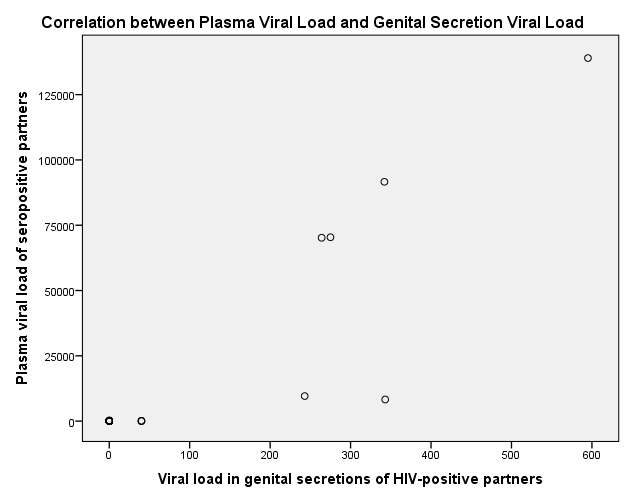
Our results demonstrated a strong and statistically significant positive correlation between plasma and genital viral loads (correlation coefficient r = 0.894, p = 0.001). This robust association indicates that an increase in plasma viral load is consistently accompanied by a proportional increase in viral load within genital secretions.
A strong positive correlation was observed between plasma and genital viral loads (r = 0.894, p = 0.001), indicating that increases in plasma viral load are proportionally reflected in genital secretions (Figure 1).

Adherence to antiretroviral therapy was good in 35 (92.10%) HIV-positive partners, compared with 3 (7.90%) who had poor adherence. A strong correlation was observed between viral load and adherence to antiretroviral therapy (p < 0.001) Table 4.
Viral Markers (Hepatitis B and C) Among Serodiscordant Couples
The study revealed a hepatitis C prevalence of 2.6% among HIV-positive partners. Regarding hepatitis B, detection of hepatitis B surface antigen (HBsAg) identified six positive cases in total, with a distribution of 5.3% (2 cases) among seronegative partners and 10.5% (4 cases) among seropositive partners.
Bacterial Marker (Syphilis) Among Serodiscordant Couples
The prevalence of syphilis was identical among seronegative and seropositive partners, each at 7.9%.
Serological analyses revealed a hepatitis C antibody prevalence of 2.6% among HIV-positive partners. Hepatitis B surface antigen (HBsAg) positivity was found in 10.5% of HIV-positive partners and 5.3% of HIV-negative partners. Syphilis prevalence was similar in both groups at 7.9% (Table 5).
After 12 months of treatment, HIV-positive partners showed significant immunological recovery. Median CD4 counts increased from 320 to 480 cells/mm³ (p < 0.001), accompanied by a 23.6% reduction in severe immunosuppression (CD4 < 200 cells/mm³) and a near tripling in the proportion with preserved immunity (CD4 ≥ 500 cells/mm³) (Table 6).
This study highlights key epidemiological and virological characteristics of HIV serodiscordant couples in our setting. The average age of HIV-negative partners, 33 years for women and 48 years for men, aligns with global epidemiological data identifying individuals aged 15 to 45 as the most affected demographic by HIV 14.
This age distribution highlights the critical role of demographic factors in HIV transmission dynamics. However, despite frequent sexual activity reported by participants (3.67 acts per week) and consistent absence of barrier protection, remarkably, no HIV transmission was observed during the study period.
This apparent contradiction can be largely explained by effective viral suppression among HIV-positive partners under antiretroviral therapy (ART) 15. Our findings confirm that an undetectable plasma viral load, as found in over two-thirds (68.42%) of participants, translates into a negligible risk of HIV transmission, consistent with the U=U (Undetectable = Untransmittable) paradigm 16. This principle, supported by pivotal studies demonstrating zero transmissions in serodiscordant couples with viral suppression 17, remains a cornerstone in HIV prevention efforts worldwide. Additionally, the long-term stability of relationships in our cohort (average duration 9 years) likely facilitates adherence to ART and reinforces the protective effect of viral suppression 18.
Consistent with this, high adherence to ART was observed in 92.10% of HIV-positive partners and was strongly associated with plasma viral suppression (p < 0.001). Beyond plasma viral load, our study also assessed viral shedding in genital secretions, an important but less frequently monitored factor. While a minority of participants (15.79%) exhibited moderate genital viral loads, none exceeded levels generally associated with significant transmission risk (>1000 copies/mL). The observed median genital viral load of 308.5 copies/mL indicates low-level, possibly intermittent shedding. Coupled with effective plasma viral suppression, this likely contributed to the absence of observed HIV transmissions. The persistence of viral RNA in the genital tract, observed in a minority of patients, suggests compartmentalization within anatomical sanctuaries (such as the testes or female genital tract) that escape ARV molecules 19. In fact, local genital inflammation, often due to asymptomatic viral or bacterial sexually transmitted infections (STIs), could recruit CD4+ lymphocytes to the site, creating a sanctuary for localized viral replication 20. The detection of viral RNA in genital secretions despite plasma suppression, observed in a minority of participants, can be explained by several biological mechanisms. As noted, anatomical compartmentalization, where the genital tract (e.g. seminal vesicles, testes, cervicovaginal tissue) acts as a pharmacologically privileged sanctuary site, may allow for persistent, low-level viral replication independent of systemic control 19. Furthermore, subclinical genital inflammation, often triggered by co-infections with other sexually transmitted pathogens or dysbiosis of the genital microbiome, can recruit activated CD4+ T-cells to the mucosal site, creating a favourable microenvironment for localized viral replication 20. Finally, the intermittent nature of genital shedding may reflect stochastic bursts of viral production from long-lived reservoir cells within the genital-associated lymphoid tissue. These factors underscore that while plasma viral load is a robust correlate of genital shedding and transmission risk, the genital compartment possesses its own unique dynamics that warrant consideration.
These results align with recent evidence indicating that transmission risk diminishes substantially below 200 copies/mL in genital secretions 21. Nevertheless, limitations including sample size and follow-up duration necessitate cautious interpretation, indicating the need for ongoing monitoring of genital viral loads, especially in the context of genital co-infections or inconsistent treatment adherence.
In the context of risk-reduction strategies, our cohort notably did not employ additional protective measures such as condom use, yet still experienced no transmissions. This finding emphasizes the critical importance of ART adherence and viral suppression, while also signaling the potential risks that could arise if suppression falters. Accordingly, couples exhibiting detectable genital viral shedding should be counselled on supplementary preventive approaches to minimize transmission risk.
Our data further establish a strong and statistically significant correlation between plasma viral load and genital viral shedding (p = 0.001), reinforcing the biological plausibility that systemic viral replication directly influences genital viral excretion and, by extension, transmission potential 22, 23.
Beyond HIV, the study sheds light on the prevalence of other sexually transmitted infections (STIs) within serodiscordant couples. Hepatitis C virus (HCV) infection was rare among participants, whereas hepatitis B virus (HBV) infection was notably twice as prevalent in HIV-positive partners compared to their HIV-negative counterparts. This difference may reflect either increased susceptibility linked to immunosuppression or shared transmission risks. However, the lack of molecular typing limits conclusions regarding direct intra-couple transmission. Meanwhile, the equal prevalence of syphilis across both groups points to complex transmission dynamics, possibly involving within-couple transmission, common external sources, or broader epidemiological trends in the population. Given the cross-sectional design, these hypotheses call for further investigation through longitudinal studies.
The findings of this study carry important policy implications for the national HIV response in Chad. The demonstrated prevention efficacy of ART reinforces the critical need to ensure universal, uninterrupted access to dolutegravir-based regimens and routine plasma viral load monitoring for all people living with HIV, including those in serodiscordant relationships. To further reduce transmission risks, public health strategies should promote the U=U (Undetectable = Untransmittable) message to combat stigma and encourage treatment adherence. Importantly, the considerable prevalence of HBV and syphilis co-infections highlights an opportunity for integrated service delivery. We recommend embedding routine screening and management of these sexually transmitted infections within existing HIV care platforms, as well as within antenatal and reproductive health services, which are key contact points for couples. Such an integrated approach would provide more comprehensive care and enhance the overall impact of prevention efforts.
The findings of this study confirm that maintaining an undetectable plasma viral load is essential for preventing HIV transmission within serodiscordant couples. However, the detection of viral RNA in genital secretions, even at low levels, and the prevalence of co-infections such as hepatitis B and syphilis highlight the need for comprehensive clinical monitoring beyond plasma viral load alone. Integrated management of co-infections and regular assessment of genital viral shedding are important to sustain the protective effect and ensure effective long-term prevention. Further research into host genetic factors, including CCR5Δ32 variants, is necessary to improve understanding of serodiscordance and to develop optimized, personalized prevention strategies.Finally, to definitively establish transmission risks and dynamics, future studies should employ a longitudinal design to monitor serodiscordant couples over time, ideally incorporating phylogenetic analyses of viral strains to confirm the source of any new infections.
| [1] | ONUSIDA. Rapport ONUSIDA sur l’épidémie mondiale de sida 2013 RAPPORT. 2013. | ||
| In article | |||
| [2] | UNAIDS. Country factsheets HIV and AIDS Estimates CHAD. 2024. | ||
| In article | |||
| [3] | Bessimbaye N, Moussa AM, Mbanga D, Tidjani A, Mahamat SO, Ngawara MN, et al. Séroprévalence de l’Ag HBs et de l’anticorps Anti VHC chez les personnes infectées par le VIH1 à N’Djamena, TCD. Bulletin de La Societe de Pathologie Exotique 2014; 107: 327–31. | ||
| In article | View Article PubMed | ||
| [4] | Clausen LN, Lundbo LF, Benfield T. Hepatitis C virus infection in the human immunodeficiency virus infected patient. World J Gastroenterol 2014; 20: 12132–43. | ||
| In article | View Article PubMed | ||
| [5] | Ali HM, Ahmat SI, Chatté A, Mahamat DD, François T, Chinka FB, et al. Virological Failure among HIV Patients on the Antiretroviral Therapy (ART) in N&#8217;Djamena (Chad). Adv Infect Dis 2024; 14: 659–69. | ||
| In article | View Article | ||
| [6] | Barry MJ, Nicholson WK, Silverstein M, Chelmow D, Coker TR, Davis EM, et al. Preexposure Prophylaxis to Prevent Acquisition of HIV: US Preventive Services Task Force Recommendation Statement. JAMA 2023; 330: 736–45. | ||
| In article | View Article PubMed | ||
| [7] | Broyles LN, Luo R, Boeras D, Vojnov L. The risk of sexual transmission of HIV in individuals with low-level HIV viraemia: a systematic review. The Lancet 2023; 402: 464–71. | ||
| In article | View Article PubMed | ||
| [8] | Oshun PO, Salu OB, Omilabu SA. Prevalence and risk factors for hepatitis C virus infection among HIV positive patients at the Lagos University Teaching Hospital, Nigeria. African Journal of Clinical and Experimental Microbiology 2023; 24: 274–81. | ||
| In article | View Article | ||
| [9] | Rupasinghe D, Choi JY, Kumarasamy N, Pujari S, Sun LP, Merati TP, et al. Viral hepatitis and the cascade of care among people living with HIV in the Asia-Pacific. HIV Med 2022; 23: 959–68. | ||
| In article | View Article PubMed | ||
| [10] | Chen M, Wong WW, Law MG, Kiertiburanakul S, Yunihastuti E, Merati TP, et al. Hepatitis B and C co-infection in HIV patients from the TREAT Asia HIV observational database: Analysis of risk factors and survival. PLoS One 2016; 11. | ||
| In article | View Article PubMed | ||
| [11] | Choudhri Y, Miller J, Sandhu J, Leon A, Aho J. La syphilis infectieuse et la syphilis congénitale au Canada, de 2010 à 2015. Relevé Des Maladies Transmissibles Au Canada 2018; 44: 47–53. | ||
| In article | View Article | ||
| [12] | Who. Implementing the global health sector strategies on HIV, viral hepatitis and sexually transmitted infections, 2022–2030. 2024. | ||
| In article | |||
| [13] | Ahmat SI, Ali HM, Hien YE, Chatte A, Doungous DM, Tabsoba F, et al. HIV-1 Serodiscordant Couples in Ndjamena (Chad): Analysis of Behavioral Patterns, Viral Load and Antiretroviral Therapy Adherence. Adv Infect Dis 2025; 15: 268–77. | ||
| In article | View Article | ||
| [14] | UNAIDS. Fact sheet 2024 - Latest global and regional HIV statistics on the status of the AIDS epidemic. 2024. | ||
| In article | |||
| [15] | Djakpa Y, Sawadogo N. Prévention du VIH au sein des couples sérodifférents : postures et difficultés à Lomé (Togo). Afrique et Perspectives Internationales 2022. | ||
| In article | View Article PubMed | ||
| [16] | WHO. The role of HIV viral suppression in Improuving individual health and reducing transmission: polcy brief. 2023. | ||
| In article | |||
| [17] | Cohen MS, Gamble T, Mccauley M. Prevention of HIV Transmission and the HPTN 052 Study 2019; 24. | ||
| In article | View Article PubMed | ||
| [18] | Gutin SA, Ruark A, Darbes LA, Neilands TB, Mkandawire J, Conroy AA. Supportive couple relationships buffer against the harms of HIV stigma on HIV treatment adherence. BMC Public Health 2023; 23. | ||
| In article | View Article PubMed | ||
| [19] | Margolis DM, Archin NM, Cohen MS, Eron JJ, Ferrari G, Garcia JV, et al. Curing HIV: Seeking to Target and Clear Persistent Infection. Cell 2020; 181: 189–206. | ||
| In article | View Article PubMed | ||
| [20] | Johnson LF, Lewis DA. The effect of genital tract infections on HIV-1 shedding in the genital tract: A systematic review and meta-analysis. Sex Transm Dis 2008; 35: 946–59. | ||
| In article | View Article PubMed | ||
| [21] | Rodger AJ, Cambiano V, Phillips AN, Robledano C, Redondo EG, Estrada VP, et al. Risk of HIV transmission through condomless sex in serodifferent gay couples with the HIV-positive partner taking suppressive antiretroviral therapy (PARTNER): final results of a multicentre, prospective, observational study. The Lancet 2019; 393: 2428–38. | ||
| In article | View Article PubMed | ||
| [22] | Baeten JM, Kahle E, Lingappa JR, Coombs RW, Delany-Moretlwe S, Nakku-Joloba E, et al. Genital HIV-1 RNA Predicts Risk of Heterosexual HIV-1 Transmission. 2011. | ||
| In article | View Article PubMed | ||
| [23] | Vettore MV, Schechter M, Melo MF, Boechat LJ, Barroso PF. Genital HIV-1 viral load is correlated with blood plasma HIV-1 viral load in Brazilian women and is reduced by antiretroviral therapy. Journal of Infection 2006; 52: 290–3. | ||
| In article | View Article PubMed | ||
Published with license by Science and Education Publishing, Copyright © 2025 Seïd Idriss Ahmat, Yéri Esther Hien, Hassan Mahamat Ali, Rokiatou Henry S., Edwige R. Somé Tiodjio, Adawaye Chatte, Djamal Hachim, Ahmat Mahamat Ahmat, Tapsoba François, Seïdé Hamid Moussa, Aly Savadogo and Traore Yves
 This work is licensed under a Creative Commons Attribution 4.0 International License. To view a copy of this license, visit
http://creativecommons.org/licenses/by/4.0/
This work is licensed under a Creative Commons Attribution 4.0 International License. To view a copy of this license, visit
http://creativecommons.org/licenses/by/4.0/
| [1] | ONUSIDA. Rapport ONUSIDA sur l’épidémie mondiale de sida 2013 RAPPORT. 2013. | ||
| In article | |||
| [2] | UNAIDS. Country factsheets HIV and AIDS Estimates CHAD. 2024. | ||
| In article | |||
| [3] | Bessimbaye N, Moussa AM, Mbanga D, Tidjani A, Mahamat SO, Ngawara MN, et al. Séroprévalence de l’Ag HBs et de l’anticorps Anti VHC chez les personnes infectées par le VIH1 à N’Djamena, TCD. Bulletin de La Societe de Pathologie Exotique 2014; 107: 327–31. | ||
| In article | View Article PubMed | ||
| [4] | Clausen LN, Lundbo LF, Benfield T. Hepatitis C virus infection in the human immunodeficiency virus infected patient. World J Gastroenterol 2014; 20: 12132–43. | ||
| In article | View Article PubMed | ||
| [5] | Ali HM, Ahmat SI, Chatté A, Mahamat DD, François T, Chinka FB, et al. Virological Failure among HIV Patients on the Antiretroviral Therapy (ART) in N&#8217;Djamena (Chad). Adv Infect Dis 2024; 14: 659–69. | ||
| In article | View Article | ||
| [6] | Barry MJ, Nicholson WK, Silverstein M, Chelmow D, Coker TR, Davis EM, et al. Preexposure Prophylaxis to Prevent Acquisition of HIV: US Preventive Services Task Force Recommendation Statement. JAMA 2023; 330: 736–45. | ||
| In article | View Article PubMed | ||
| [7] | Broyles LN, Luo R, Boeras D, Vojnov L. The risk of sexual transmission of HIV in individuals with low-level HIV viraemia: a systematic review. The Lancet 2023; 402: 464–71. | ||
| In article | View Article PubMed | ||
| [8] | Oshun PO, Salu OB, Omilabu SA. Prevalence and risk factors for hepatitis C virus infection among HIV positive patients at the Lagos University Teaching Hospital, Nigeria. African Journal of Clinical and Experimental Microbiology 2023; 24: 274–81. | ||
| In article | View Article | ||
| [9] | Rupasinghe D, Choi JY, Kumarasamy N, Pujari S, Sun LP, Merati TP, et al. Viral hepatitis and the cascade of care among people living with HIV in the Asia-Pacific. HIV Med 2022; 23: 959–68. | ||
| In article | View Article PubMed | ||
| [10] | Chen M, Wong WW, Law MG, Kiertiburanakul S, Yunihastuti E, Merati TP, et al. Hepatitis B and C co-infection in HIV patients from the TREAT Asia HIV observational database: Analysis of risk factors and survival. PLoS One 2016; 11. | ||
| In article | View Article PubMed | ||
| [11] | Choudhri Y, Miller J, Sandhu J, Leon A, Aho J. La syphilis infectieuse et la syphilis congénitale au Canada, de 2010 à 2015. Relevé Des Maladies Transmissibles Au Canada 2018; 44: 47–53. | ||
| In article | View Article | ||
| [12] | Who. Implementing the global health sector strategies on HIV, viral hepatitis and sexually transmitted infections, 2022–2030. 2024. | ||
| In article | |||
| [13] | Ahmat SI, Ali HM, Hien YE, Chatte A, Doungous DM, Tabsoba F, et al. HIV-1 Serodiscordant Couples in Ndjamena (Chad): Analysis of Behavioral Patterns, Viral Load and Antiretroviral Therapy Adherence. Adv Infect Dis 2025; 15: 268–77. | ||
| In article | View Article | ||
| [14] | UNAIDS. Fact sheet 2024 - Latest global and regional HIV statistics on the status of the AIDS epidemic. 2024. | ||
| In article | |||
| [15] | Djakpa Y, Sawadogo N. Prévention du VIH au sein des couples sérodifférents : postures et difficultés à Lomé (Togo). Afrique et Perspectives Internationales 2022. | ||
| In article | View Article PubMed | ||
| [16] | WHO. The role of HIV viral suppression in Improuving individual health and reducing transmission: polcy brief. 2023. | ||
| In article | |||
| [17] | Cohen MS, Gamble T, Mccauley M. Prevention of HIV Transmission and the HPTN 052 Study 2019; 24. | ||
| In article | View Article PubMed | ||
| [18] | Gutin SA, Ruark A, Darbes LA, Neilands TB, Mkandawire J, Conroy AA. Supportive couple relationships buffer against the harms of HIV stigma on HIV treatment adherence. BMC Public Health 2023; 23. | ||
| In article | View Article PubMed | ||
| [19] | Margolis DM, Archin NM, Cohen MS, Eron JJ, Ferrari G, Garcia JV, et al. Curing HIV: Seeking to Target and Clear Persistent Infection. Cell 2020; 181: 189–206. | ||
| In article | View Article PubMed | ||
| [20] | Johnson LF, Lewis DA. The effect of genital tract infections on HIV-1 shedding in the genital tract: A systematic review and meta-analysis. Sex Transm Dis 2008; 35: 946–59. | ||
| In article | View Article PubMed | ||
| [21] | Rodger AJ, Cambiano V, Phillips AN, Robledano C, Redondo EG, Estrada VP, et al. Risk of HIV transmission through condomless sex in serodifferent gay couples with the HIV-positive partner taking suppressive antiretroviral therapy (PARTNER): final results of a multicentre, prospective, observational study. The Lancet 2019; 393: 2428–38. | ||
| In article | View Article PubMed | ||
| [22] | Baeten JM, Kahle E, Lingappa JR, Coombs RW, Delany-Moretlwe S, Nakku-Joloba E, et al. Genital HIV-1 RNA Predicts Risk of Heterosexual HIV-1 Transmission. 2011. | ||
| In article | View Article PubMed | ||
| [23] | Vettore MV, Schechter M, Melo MF, Boechat LJ, Barroso PF. Genital HIV-1 viral load is correlated with blood plasma HIV-1 viral load in Brazilian women and is reduced by antiretroviral therapy. Journal of Infection 2006; 52: 290–3. | ||
| In article | View Article PubMed | ||