Bacillus anthracis, the causative agent of anthrax, is a Gram-positive bacterium that poses serious concerns for public health and biodefense and capable of forming resilient spores enables prolonged environmental survival, and it can infect hosts through cutaneous, inhalational, gastrointestinal or injection routes. The pathogenicity of bacteria is primarily attributed to its poly-D-glutamic acid capsule and a tripartite exotoxin complex consisting of protective antigen, edema factor and lethal factor, which collectively facilitate immune evasion and systemic spread. While herbivores are particularly vulnerable, all warm-blooded animals, including humans, are susceptible to infection. Natural outbreaks are frequently associated with contaminated soil, making geographic and ecological surveillance essential in endemic regions. Vaccination, particularly with protective antigen (PA)-based vaccines, is the most effective preventive strategy, although challenges in vaccine tolerance and accessibility remain. Recent advances in molecular epidemiology and genomic sequencing have enhanced the tracking of outbreak sources and strain variation. Prompt administration of antimicrobial therapy and monoclonal antibody use are critical for successful treatment. Additionally, proper carcass disposal, environmental decontamination, and active surveillance are crucial for breaking the transmission cycle and managing outbreaks. Understanding the molecular pathogenesis, host susceptibility and immunological responses is essential for advancing diagnostics, therapeutics and control measures.
Many zoonotic diseases including brucellosis, anthrax, rabies, leptospirosis, plague, echinococcosis, mycetoma, leishmaniasis, taeniasis/cysticercosis, and schistosomiasis are frequently neglected, particularly in low-resource settings 1, 2, 3, 4. The majority of these neglected diseases predominantly affect impoverished communities, largely due to inadequate sanitation, poor environmental hygiene and insufficient access to healthcare services. Among them, anthrax stands out as a highly contagious and potentially fatal bacterial zoonosis. It primarily affects herbivorous ungulates and is caused by Bacillus anthracis, an aerobic, Gram-positive, spore-forming, rod-shaped bacterium 1, 4. All warm-blooded animals, including humans, can be infected, although herbivores are the primary hosts 5. Humans are typically incidental hosts, acquiring the infection through contact with infected animals, contaminated animal products or ingestion of undercooked contaminated meat. While transmission occurs between animals and from animals to humans, there is no documented evidence of human-to-human transmission. The endospores of B. anthracis are highly resistant to environmental stressors, such as desiccation, heat, ultraviolet radiation, gamma irradiation, and many common disinfectants 6. These spores can remain viable in dry soil for decades but can be effectively destroyed by boiling at 100°C for 10 minutes.
Anthrax is classified into four clinical forms based on the route of exposure: cutaneous, gastrointestinal, inhalational, and injectional the latter being associated with the use of contaminated injectable drugs 7. In humans, the disease is typically contracted through direct or indirect exposure to infected animals or animal-derived materials. Anthrax infection is believed to initiate when Bacillus anthracis endospores enter the host and are phagocytosed by macrophages, within which they germinate into vegetative bacilli 8. In cases of experimental inhalational anthrax, alveolar macrophages play a pivotal role not only in facilitating spore germination but also in transporting the resulting bacilli to regional lymph nodes, enabling systemic dissemination 9.
Spore germination is a complex process involving the detection of chemical germinant, the activation of germination operons, changes in membrane permeability, and the activation of enzymes responsible for degrading the spore’s outer layers 10, 11. The virulence of Bacillus anthracis is largely attributed to two plasmids: pXO1 and pXO2. The pXO1 plasmid (184.5 kb) encodes the anthrax toxin components: protective antigen (pagA), lethal factor (lef), and edema factor (cya) 12. The pXO2 plasmid contains genes responsible for synthesizing a poly-D-glutamic acid capsule, which helps the bacterium evade host immune defenses.
The aim of this paper is to provide a detailed overview of the biology and pathophysiology of Bacillus anthracis, the agent responsible for anthrax. with emphasis on its structural features, elucidate its infection mechanisms and virulence determinants. Additionally, it highlights the range of susceptible hosts and discusses current approaches for diagnosis, prevention, and control. By consolidating available scientific insights, this paper seeks to inform the development of more effective strategies to mitigate the impact of anthrax in both animal and human populations.
The cytoplasmic membrane represents a fundamental structural and functional component of the bacterial cell, serving as the principal boundary essential for cellular viability. It is composed of a phospholipid bilayer interspersed with integral and peripheral membrane proteins, which collectively regulate the bidirectional movement of molecules and facilitate signal transduction processes critical for cellular adaptation and survival. In Bacillus anthracis, the phospholipid composition of the cytoplasmic membrane demonstrates distinct fatty acid profiles in comparison to related species such as Bacillus thuringiensis and Bacillus cereus, suggesting species-specific variations in membrane architecture and function 13. Earlier studies suggested that B. anthracis lacked membrane-associated polysaccharides such as lipoteichoic acids (LTAs), which are characteristically present in the membranes of other Gram-positive bacteria. Although glycerol phosphate polymers have not been isolated from B. anthracis 14, membrane proteins (MPs) have been recognized as critical components due to their functional roles. Consequently, these proteins are considered promising targets for the development of vaccines and novel therapeutics. Proteomic analyses have facilitated the identification of several novel MPs expressed during spore germination and the early stages of vegetative growth, which are crucial phases in the establishment of infection 15, 16.
The peptidoglycan (PG) layer of Bacillus anthracis is targeted by β-lactam antibiotics such as penicillin G and amoxicillin. However, these antibiotics are not specific to B. anthracis, and both intrinsic and inducible resistance to β-lactams have been reported in clinical isolates 17, 18. Direct studies on the B. anthracis membrane remain limited, aside from investigations on lysine modifications of phospholipids, with comparative analyses often relying on the model Gram-positive bacterium Bacillus subtilis, which has a low GC content genome 19. Recent investigations have elucidated the involvement of specific membrane lipids and proteins in the regulation of virulence determinants. Notably, the expression of toxin and capsule biosynthesis genes is transcriptionally upregulated in response to bicarbonate and carbon dioxide, which act as host-associated environmental cues 20, 21. An ATP-binding cassette (ABC) transporter responsible for bicarbonate uptake has been characterized in B. anthracis, comprising transmembrane permease components essential for bicarbonate metabolism 22. Deletion of the genes encoding this transporter results in the abrogation of bicarbonate-induced toxin gene expression and leads to complete attenuation of virulence in murine infection models.
The mutant strain lacking the bicarbonate transporter is avirulent in a murine infection model, indicating that bicarbonate transport is essential for B. anthracis virulence. A transposon mutagenesis approach has been employed to identify regulators of toxin gene expression. Additionally, many bacteria and archaea, including B. anthracis, assemble S-layers (surface layers) as their outermost envelope structure 23. These S-layers form crystalline, porous lattices with unit dimensions ranging from 3 to 100 nm and pore sizes between 2 and 10 nm, serving as protective barriers with selective permeability 24.
Following germination, B. anthracis emerges as a single vegetative cell, which rapidly elongates and undergoes division to form chains of 4 to 16 cells during the mid-logarithmic phase of growth 25. As the bacterium transitions into the stationary phase, the average chain length decreases to 2–4 cells, eventually leading to predominantly short chains or individual cells 25. Prolonged chain formation has been shown to hinder host cell invasion and provides partial protection against phagocytosis by macrophages 26.
2.2. Pathophysiology of Anthrax Infection in AnimalNon-human primates (NHPs), including rhesus macaques, cynomolgus macaques, and African green monkeys, are widely considered the most relevant animal models for investigating inhalational anthrax. Their high susceptibility to infection with toxigenic strains of Bacillus anthracis, particularly via the respiratory route, makes them predictive of disease progression and pathology in humans. In contrast, murine models exhibit comparable susceptibility to both toxigenic and nontoxigenic encapsulated strains, indicating that in mice, the poly-γ-D-glutamic acid capsule is the primary virulence determinant, and disease pathogenesis is largely independent of anthrax toxin 27.
Despite the utility of established animal models, they do not always accurately replicate human responses to medical countermeasures. For instance, rabbits exhibit limited responsiveness to vaccine formulations that rely on Toll-like receptor agonists as adjuvants, thereby restricting their applicability in evaluating such immunomodulatory strategies 28. If the rabbit inhalational anthrax computational model becomes sufficiently robust to accurately simulate key host–pathogen interactions and disease outcomes, it could be re-parameterized for human application, thereby enhancing our understanding of anthrax pathogenesis in humans. It is important to note that the outcome of inhalational anthrax is strongly influenced by the anatomical site and quantity of spore deposition in the lungs, both of which are species-specific parameters that must be accounted for in comparative pathogenesis studies 29.
Developing host-specific computational models of inhalational anthrax necessitates precise characterization of spore deposition patterns within the respiratory tract. The lung comprises two anatomically and immunologically distinct regions: the lower alveolar region and the upper conducting airways (including the trachea and bronchi). The alveolar macrophages are the primary immune cells responsible for encountering and internalizing inhaled B. anthracis spores in the alveolar region, thereby initiating a cascade of host–pathogen interactions. These interactions ultimately determine the infection outcome either leading to spore clearance and host survival or spore germination and bacterial proliferation resulting in disease 30, 31.
The susceptibility of a mouse strain to lethal toxin (LT) does not necessarily correlate with its overall susceptibility to Bacillus anthracis infection 32. The attenuated B. anthracis Sterne strain is frequently employed in murine models due to its practical advantages, i.e., it expresses major virulence factors (LT, edema toxin [ET], and protective antigen [PA]) while lacking the pXO2 plasmid required for capsule synthesis, thereby allowing studies under Biosafety Level 2 (BSL-2) containment conditions 33. The Sterne strain expresses the major virulence factors—lethal toxin (LT), edema toxin (ET), and protective antigen (PA). In contrast, research involving fully virulent strains, such as the Ames strain, which also produces LT, ET, and PA, must be conducted under Biosafety Level 3 (BSL-3) containment due to the heightened pathogenic risk.
Murine anthrax models have employed a range of exposure routes, including subcutaneous, intraperitoneal, intranasal and intratracheal administration 34, though immune responses and disease outcomes can vary depending on the route and strain used. In addition to mice, Hartley guinea pigs (Cavia porcellus) have been extensively utilized in anthrax vaccine studies over the past four decades, but with limited predictive success 35. Post-vaccination survival following challenge with virulent strains (e.g., Ames strain) is inconsistent, and immunogenicity data derived from guinea pigs often fail to translate effectively to other animal models or to humans 35, 36. Inhaled spores may also deposit within the tracheobronchial region, where they interact with the mucociliary escalator; a defense mechanism comprising ciliated epithelial cells that facilitate the clearance of inhaled particles via coordinated upward movement of mucus. A defining feature of inhalational anthrax in guinea pigs is the early detection of B. anthracis within the tracheobronchial lymph nodes (TBLNs), preceding its appearance in the bloodstream or distal tissues. The primary clearance mechanism in this region involves ciliated epithelial cells, which facilitate the upward movement of inhaled particles via the mucociliary escalator, expelling them from the respiratory tract 37.
2.3. Pathophysiology of Anthrax Infection in HumanSporulation in Bacillus anthracis occurs within the mother cell in response to adverse environmental conditions. The mature spore consists of a central protoplast containing dipicolinic acid, surrounded by a peptidoglycan-rich cortex embedded with cortex-lytic enzymes, and an outermost exosporium layer. The exosporium is structurally complex and contains at least 21 identified proteins, including an arginase enzyme and minor amounts of protective antigen 38. Spore germination is initiated by specific environmental cues, notably purine nucleosides such as inosine, which act through germinant receptors located in the spore membrane. Upon germination, the vegetative cells synthesize a poly-γ-D-glutamic acid capsule and express a tripartite exotoxin consisting of protective antigen (PA), lethal factor (LF), and edema factor (EF) 38. These virulence factors are critical for immune evasion and pathogenesis. The host macrophage engulfs the spores and reacts by recognizing pathogen associated molecular patterns with its toll-like receptors and NOD-like receptors and the defense by the organism to macrophage signaling is complex but, germinating spores may release toxins intracellularly which modify macrophage functions 39. Vegetative bacilli also release lethal toxin; the toxin enters macrophages and inhibits further spore phagocytosis 40. Multiple studies have explored the molecular mechanisms involved in Bacillus anthracis spore phagocytosis, germination, and their subsequent escape from host immune cells to promote systemic infection. Notably, macrophages that internalize a larger number of spores are more likely to harbor a subset that survive, germinate, and develop into vegetative bacilli 41.
2.4. Mode of Infection and Susceptible Host of Bacillus anthracisBacillus anthracis infects hosts through exposure to its spores, which are the dormant and highly resilient form of the bacterium. The spores can enter the body through four primary routes: cutaneous (via skin abrasions), inhalational (via respiratory tract), gastrointestinal (via ingestion of contaminated meat), and injection (through contaminated needles, primarily among intravenous drug users) 42, 43. Upon entry, the spores are phagocytosed by macrophages and dendritic cells then carry them to regional lymph nodes, where they germinate into vegetative bacilli 37, 44. Shortly after germination, B. anthracis initiates the production of its principal virulence factors: protective antigen (PA), edema factor (EF), and lethal factor (LF), which together form edema and lethal toxins, which play pivotal roles in immune suppression, disruption of cellular signaling, and induction of systemic disease 45. The resulting impairment of host defenses facilitates bacterial dissemination and contributes to the extensive tissue damage and lethality associated with anthrax infections 46, 31.
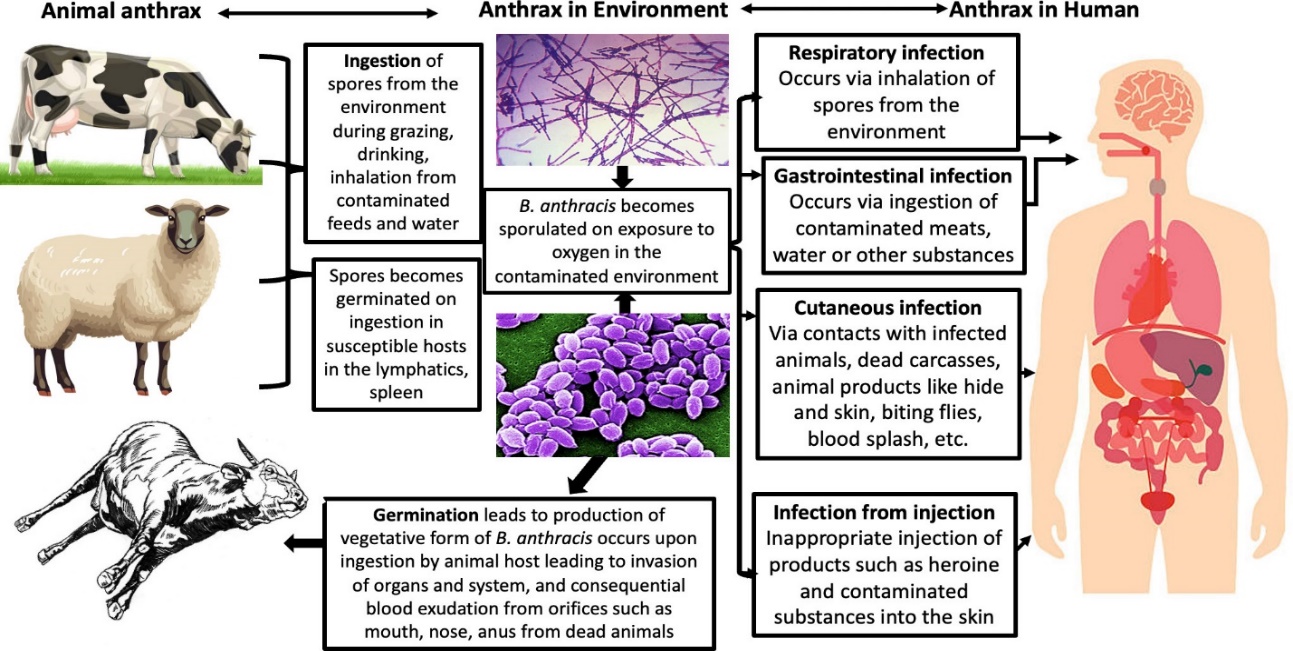
Anthrax primarily affects herbivorous mammals, including cattle, sheep, goats, horses, and antelopes, which serve as natural hosts due to their high likelihood of ingesting or inhaling spores from contaminated soil or vegetation 47. Nevertheless, all warm-blooded animals, including humans, are potentially susceptible to infection, although the degree of vulnerability varies among species 48, 49. The degree of host susceptibility appears to be species-specific and may involve factors such as immune system differences or variation in cellular receptors. For instance, mice demonstrate a high sensitivity to anthrax toxins but exhibit relative resistance to spore-mediated infection, whereas pigs, though more resistant to the toxins, can succumb to low doses of spores 49, 50. Non-human primates, especially macaques, serve as accurate models for human inhalational anthrax due to their high susceptibility to aerosolized spores 27.Additionally, co-infections and immunosuppressive conditions may exacerbate host susceptibility. Secondary infections can alter immune dynamics, impairing the host’s ability to mount effective responses and thereby increasing disease severity 51, 52. The detailed mechanism of transmission of anthrax in different host species is shown in Figure 1.
Anthrax primarily affects herbivorous animals, although all mammalian species exhibit some degree of susceptibility to Bacillus anthracis 48, 49. The variability in susceptibility among species is not fully understood but is believed to involve differences in host-specific physiological or immunological factors. For example, rats exhibit a high sensitivity to anthrax toxins yet show remarkable resistance to spore-mediated infection, suggesting that early immune containment or barriers to spore germination may play a critical role in resistance 44.Conversely, pigs, while more resistant to anthrax toxins, can succumb to relatively small spore doses, indicating complex host-pathogen dynamics 48, 50. In natural ecosystems, both animal and human hosts frequently harbor co-infections with a range of micro- and macro-parasites. These concurrent infections may interact synergistically or antagonistically, influencing pathogen transmission dynamics, virulence, and clinical outcomes. Such interactions can occur through direct competition for host resources or indirectly via modulation of the host’s immune responses 51. Co-infections have been shown to dysregulate immune function, increasing host vulnerability to secondary infections 54, 52 and are associated with higher pathogen loads, prolonged disease course, and more severe pathological manifestations 54.
2.6. Immunization and Host Response to VaccinationThe currently licensed anthrax vaccine consists of protective antigen (PA) adsorbed onto aluminum hydroxide as an adjuvant 17. A series of multiple immunizations is required over an 18-month period, followed by annual booster doses in order to achieve and maintain adequate protective immunity 55. However, this vaccination schedule can induce undesirable local reactogenicity in some recipients 56. Numerous efforts have been made to improve both the safety profile and immunogenicity of the anthrax vaccine. These include reformulating PA with different adjuvants 57, employing recombinant or mutant forms of PA 58, expressing PA via attenuated Salmonella vectors 59, and developing attenuated Bacillus anthracis strains deficient in one or more toxin components 20.
Vaccination continues to be the most affordable and effective method for decreasing vulnerability to anthrax infection and to accelerate the development of protective immunity following exposure to Bacillus anthracis 60. Protective immunity is primarily mediated by neutralizing antibodies directed against the bacterial protective antigen (PA), which decrease pathogenicity by blocking anthrax toxin binding to host cells, inhibiting spore germination, and enhancing macrophage-mediated phagocytosis and killing of spores 57. The currently licensed human anthrax vaccine adsorbed (AVA) requires a series of six vaccinations over an 18-month period, followed by annual booster doses, to induce and maintain protective IgG anti-protective antigen (PA) antibody titers. This immunization schedule can cause undesirable side effects in some vaccine recipients. In the 1930s, Sterne developed live attenuated Bacillus anthracis strains (“live-spore vaccines”), which remain widely used worldwide for the immunization of domesticated animals 56.
A contraindication to vaccination includes a history of hypersensitivity reactions to the vaccine. Severe injection-site or systemic reactions have been reported with the licensed AVA. In cases where vaccination of previously sensitized individuals is necessary, pretreatment with antihistamines and nonsteroidal anti-inflammatory drugs may be beneficial, although this approach has not been formally evaluated.Similar to AVA, protection conferred by recombinant PA (rPA)-based vaccines is primarily antibody-mediated 9. Titers of toxin-neutralizing antibodies, which represent the most reliable correlate of protection against lethal anthrax challenge 61, can be induced to comparable levels by rPA vaccines and AVA 62, 63. Furthermore, the rPA molecule can be truncated 64 or modified 65, 66, 67 without compromising its ability to elicit a protective humoral immune response.
2.7. Infected Host Treatment and Management of Bacillus anthracisThe treatment of Bacillus anthracis infection depends on the clinical form of anthrax and the stage of disease at the time of diagnosis. Prompt initiation of appropriate antimicrobial therapy is crucial for improving survival, especially in cases of inhalational exposure anthrax, which is defined by swift progression and elevated mortality rates 68, 69. The first-line treatment includes high-dose intravenous antibiotics such as ciprofloxacin or doxycycline, often combined with one or more additional agents like rifampin, clindamycin, or vancomycin depending on disease severity and susceptibility profiles 70. For uncomplicated cutaneous anthrax, oral antibiotics such as ciprofloxacin, doxycycline, or amoxicillin for 7–10 days are usually effective 43. Anthrax toxins contribute substantially to pathogenesis; therefore, monoclonal antibody therapies targeting protective antigen (e.g., raxibacumab and obiltoxaximab) have been developed and are recommended alongside antibiotics for systemic disease 68, 71. Individuals exposed to B. anthracis spores but not yet symptomatic receive 60 days of oral antibiotic prophylaxis with ciprofloxacin or doxycycline, combined with a 3-dose vaccine series when indicated, to prevent disease development 69. Challenges in the clinical management of anthrax include delayed diagnosis, potential antimicrobial resistance, and complications arising from toxin-mediated tissue damage. These factors underscore the necessity for early recognition, rapid initiation of therapy, and a multidisciplinary approach to patient care 43, 70
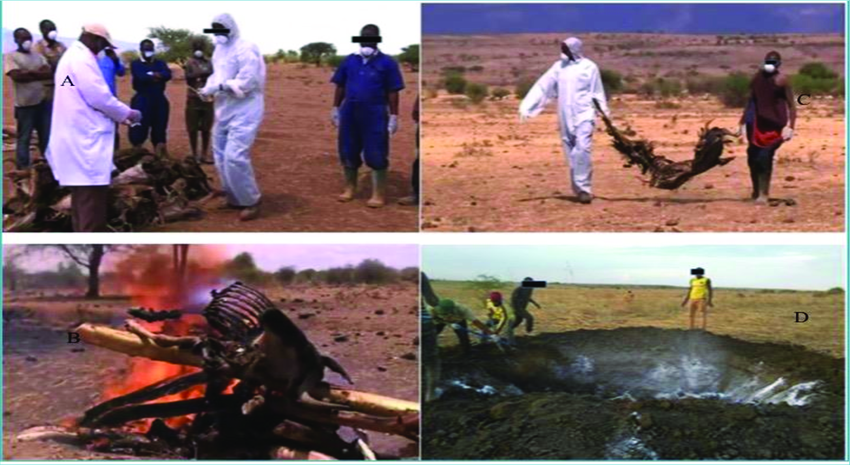
2.8. Managemental Aspects of Bacillus anthracis InfectionPost-mortem examinations of animals suspected to have died from anthrax are widely discouraged and often prohibited to prevent environmental contamination and further spread of the disease 72. The three primary carcass disposal methods employed are deep burial, incineration or rendering, and a combination of incineration and burial 72.The methods for safe disposal of animal carcasses during an outbreak are as shown in Figure 2.
Rendering is a sterilization process applied to raw materials derived from infected animals, enabling their safe economic reuse through deep sterilization techniques. In contrast, burial as a standalone method is considered inadequate as a long-term disposal method due to the potential persistence of resilient Bacillus anthracis spores in the soil. Incineration, including the thorough burning of soil beneath carcasses, is strongly recommended to sterilize residual exudates and spores; however, its effectiveness depends on the proper execution and may still fall short of complete spore eradication under suboptimal conditions 17.
Disinfection and decontamination are essential strategies for preventing the transmission of anthrax by eliminating Bacillus anthracis spores from contaminated surfaces, thereby interrupting the infection cycle. However, a significant challenge lies in accurately identifying all areas of contamination, particularly in endemic regions where old burial sites may serve as long-term reservoirs of viable spores. In contrast, such control interventions tend to be more effective in non-enzootic areas, where the absence of established spore reservoirs and the implementation of proactive containment practices help prevent the formation of new contaminated zones 72.
Various chemical agents are effective for disinfecting surfaces and decontaminating soils, including high-pressure hot water, steam, hydrogen peroxide, formaldehyde, glutaraldehyde, peracetic acid, and chlorine-based solutions. Formaldehyde at concentrations of 5–10% is notably effective for soil decontamination. It is advisable to test these agents on a small scale prior to extensive application to confirm efficacy and safety 72.
Anthrax remains a major threat to both public and veterinary health, particularly in endemic regions and resource-limited settings. The disease caused by B. anthracis can manifest in various clinical forms depending on the route of exposure. The high environmental persistence of spores, coupled with potent toxins encoded by virulence plasmids (pXO1 and pXO2), makes the pathogen exceptionally resilient and dangerous. Understanding the complex interplay between host susceptibility, spore germination, toxin activity, and immune response is essential for effective disease control. While current vaccines for both humans and animals have demonstrated efficacy, challenges related to accessibility, adverse effects, and rigid immunization schedules limit their widespread application. Furthermore, carcass management and environmental decontamination are critical in breaking the transmission cycle,these measures are often difficult to implement effectively in endemic regions.
Based on the above conclusion, the following recommendations were forwarded:
√ Enhance active surveillance in endemic areas, particularly among livestock and wildlife, to enable early detection and rapid response to outbreaks.
√ Expand vaccination programs for at-risk livestock and occupationally exposed humans, utilizing proven PA-based vaccines, and invest in research for improved, more accessible vaccines.
√ Implement strict protocols for carcass disposal, decontamination, and movement control during outbreaks to prevent environmental contamination and further transmission.
√ Educate farmers, veterinarians, and at-risk communities about anthrax transmission, prevention, and the importance of reporting suspicious animal deaths.
√ Encourage collaboration between veterinary, medical, and environmental sectors (One Health approach) to ensure coordinated and effective anthrax control and prevention.
Contribution of Authors
All the authors contributed during the preparation of the manuscript. Dr. Mahendra Pal contributed to conceptualization and drafting the original manuscript, Tesfaye Rebuma contributed to the editing of the draft, Alemayehu Bekele contributed to writing the review and editing, Milad Badri contributed to visualization and drafting the manuscript. Dr. Ravindra Zende conducted a detailed review of literature and drafted the manuscript and ensured comprehensive coverage of the topic. Dr. Aishwarya Nair contributed to the sections of the manuscript, edited the language and clarity of the manuscript.
The authors declare that they have no known competing financial interests or personal relationships that could have appeared to influence the work reported in this paper.
No financial support was received from any organization.
| [1] | Pal, M., "Anthrax: A neglected bacterial zoonosis of major public health concern", Acta Scientific Microbiology, 1(5), 78–79. 2018. | ||
| In article | |||
| [2] | Pal, M. and Dave, P., "Mycetoma: An infectious neglected tropical devastating disease", CPQ Microbiology, 3, 1–9. 2019. | ||
| In article | |||
| [3] | Pal, M., "Schistosomiasis: A neglected tropical parasitic disease of public health concern", International Journal of Parasitological and Epidemiological Sciences, 1, 23–24. 2020. | ||
| In article | View Article | ||
| [4] | Pal, M., Dhanze, H., Regassa, M., Rebuma, T. and Tafesse, W., "An overview of anthrax: a neglected zoonosis of the tropical region", Journal of Bacteriology and Mycology: Open Access, 12(1), 13–17. 2024. | ||
| In article | View Article | ||
| [5] | Pal, M., "Zoonoses. 2nd Edition", Satyam Publishers, Jaipur, India. 2007. | ||
| In article | |||
| [6] | Kamal, S. M., Rashid, A. M., Bakar, M. A. and Ahad, M. A., "Anthrax: an update", Asian Pacific Journal of Tropical Biomedicine, 1(6), 496–501. 2011. | ||
| In article | View Article PubMed | ||
| [7] | Sweeney, D.A., Hicks, C.W., Cui, X., Li, Y. and Eichacker, P.Q., "Anthrax infection", American Journal of Respiratory and Critical Care Medicine, 184(12), 1333-1341. 2011. | ||
| In article | View Article PubMed | ||
| [8] | Frazier, A. A., Franks, T. J. and Galvin, J. R., "Inhalational anthrax", Journal of Thoracic Imaging, 21(4), 252–258. 2006. | ||
| In article | View Article PubMed | ||
| [9] | Williamson, E.D., Hodgson, I., Walker, N.J., Topping, A.W., Duchars, M.G., Mott, J.M., Estep, J., Lebutt, C., Flick-Smith, H.C., Jones, H.E. and Li, H., "Immunogenicity of recombinant protective antigen and efficacy against aerosol challenge with anthrax", Infection and Immunity, 73(9), 5978–5987. 2005. | ||
| In article | View Article PubMed | ||
| [10] | Moir, A., Corfe, B. M. and Behravan, J., "Spore germination", Cellular and Molecular Life Sciences, 59(3), 403–409. 2002. | ||
| In article | View Article PubMed | ||
| [11] | Weiner, M.A., Read, T.D. and Hanna, P.C., "Identification and characterization of the gerH operon of Bacillus anthracis endospores: a differential role for purine nucleosides in germination", Journal of Bacteriology, 185(4), 1462-1464. 2003. | ||
| In article | View Article PubMed | ||
| [12] | Goel, A. K., "Anthrax: A disease of biowarfare and public health importance", World Journal of Clinical Cases, 3(1), 20. 2015. | ||
| In article | View Article PubMed | ||
| [13] | Kaneda, T., "Fatty acids in the genus Bacillus I. Iso-and anteiso-fatty acids as characteristic constituents of lipids in 10 species", Journal of Bacteriology, 93(3), 894–903. 1967. | ||
| In article | View Article PubMed | ||
| [14] | Molnár, J. and Prágai, B., "Attempts to detect the presence of teichoic acid in Bacillus anthracis", Acta Microbiologica Academiae Scientiarum Hungaricae, 18(2), 105–108. 1971. | ||
| In article | |||
| [15] | Huang, C. M., Elmets, C. A., De-chu, C. T., Li, F. and Yusuf, N., "Proteomics reveals that proteins expressed during the early stage of Bacillus anthracis infection are potential targets for the development of vaccines and drugs", Genomics, Proteomics and Bioinformatics, 2(3), 143–151. 2004. | ||
| In article | View Article PubMed | ||
| [16] | Chen, Y., Barat, B., Ray, W. K., Helm, R. F., Melville, S. B. and Popham, D. L., "Membrane proteomes and ion transporters in Bacillus anthracis and Bacillus subtilis dormant and germinating spores", Journal of Bacteriology, 201(6), e00662-18. 2019. | ||
| In article | View Article | ||
| [17] | Turnbull, P.C., Sirianni, N.M., LeBron, C.I., Samaan, M.N., Sutton, F.N., Reyes, A.E. and Peruski Jr, L.F., "MICs of selected antibiotics for Bacillus anthracis, Bacillus cereus, Bacillus thuringiensis, and Bacillusmycoides from a range of clinical and environmental sources as determined by the Etest", Journal of Clinical Microbiology, 42(8), 3626-3634. 2004. | ||
| In article | View Article PubMed | ||
| [18] | Weber, D.J. and Rutala, W.A., "Bacillus species", Infection Control and Hospital Epidemiology, 9(8), 368-373. 1988. | ||
| In article | View Article PubMed | ||
| [19] | Fouet, A. and Mesnage, S., "Bacillus anthracis cell envelope components", Anthrax, 87–113. 2002. | ||
| In article | View Article PubMed | ||
| [20] | Pezard, C., Weber, M., Sirard, J. C., Berche, P. and Mock, M., "Protective immunity induced by Bacillus anthracis toxin-deficient strains", Infection and Immunity, 63(4), 1369–1372. 1995. | ||
| In article | View Article PubMed | ||
| [21] | Fouet, A. and Mock, M., "Regulatory networks for virulence and persistence of Bacillus anthracis", Current Opinion in Microbiology, 9(2), 160–166. 2006. | ||
| In article | View Article PubMed | ||
| [22] | Wilson, A.C., Hoch, J.A. and Perego, M., "Two small c-type cytochromes affect virulence gene expression in Bacillus anthracis", Molecular Microbiology, 72(1),109–123. 2009. | ||
| In article | View Article PubMed | ||
| [23] | Fagan, R. P. and Fairweather, N. F., "Biogenesis and functions of bacterial S-layers", Nature Reviews Microbiology, 12(3), 211–222. 2014. | ||
| In article | View Article PubMed | ||
| [24] | Pum, D., Toca-Herrera, J. L. and Sleytr, U. B., "S-layer protein self-assembly", International Journal of Molecular Sciences, 14(2), 2484–2501. 2013. | ||
| In article | View Article PubMed | ||
| [25] | Anderson, J., Williams, P. T., Katos, A. M., Krasna, M., Burrows, W. and Hilmas, C. J., "Botulinum toxin",Handbook of Toxicology of Chemical Warfare Agents, 407–432. 2009. | ||
| In article | View Article PubMed | ||
| [26] | Wang, Y.T., Oh, S.Y., Hendrickx, A.P., Lunderberg, J.M. and Schneewind, O., "Bacillus cereus G9241 S-layer assembly contributes to the pathogenesis of anthrax-like disease in mice", Journal of Bacteriology, 195(3), 596-605. 2013. | ||
| In article | View Article PubMed | ||
| [27] | Twenhafel, N.A., Leffel, E. and Pitt, M.L.M., "Pathology of inhalational anthrax infection in the African green monkey", Veterinary Pathology, 44(5), 716-721. 2010. | ||
| In article | View Article PubMed | ||
| [28] | Rankin, R., Pontarollo, R., Ioannou, X., Krieg, A. M., Hecker, R., Babiuk, L. A. and van Drunen Littel-van den Hurk, S., "CpG motif identification for veterinary and laboratory species demonstrates that sequence recognition is highly conserved", Antisense and Nucleic Acid Drug Development, 11(5), 333–340. 2001. | ||
| In article | View Article PubMed | ||
| [29] | Jarabek, A. M., Asgharian, B. and Miller, F. J., "Dosimetric adjustments for interspecies extrapolation of inhaled poorly soluble particles (PSP)", Inhalation Toxicology, 17(7–8), 317–334. 2005. | ||
| In article | View Article PubMed | ||
| [30] | Tournier, J.N., Paccani, S.R., Quesnel-Hellmann, A. and Baldari, C.T., "Anthrax toxins: a weapon to systematically dismantle the host immune defenses", Molecular Aspects of Medicine, 30(6), 456-466. 2009. | ||
| In article | View Article PubMed | ||
| [31] | Frankel, A. E., Bianchine, P. J. and McClain, D., "Pathogenesis and treatment of anthrax", Current Opinion in Investigational Drugs, 10(2), 132–136. 2009. | ||
| In article | |||
| [32] | Terra, J.K., Cote, C.K., France, B., Jenkins, A.L., Bozue, J.A., Welkos, S.L., LeVine, S.M. and Bradley, K.A., "Cutting edge: resistance to Bacillus anthracis infection mediated by a lethal toxin sensitive allele of Nalp1b/Nlrp1b", Journal of Immunology, 184(1), 17-20. 2010. | ||
| In article | View Article PubMed | ||
| [33] | Duong, S., Chiaraviglio, L. and Kirby, J. E., "Histopathology in a murine model of anthrax", International Journal of Experimental Pathology, 87(2), 131–137. 2006. | ||
| In article | View Article PubMed | ||
| [34] | Lyons, C. R., Lovchik, J., Hutt, J., Lipscomb, M. F., Wang, E., Heninger, S., Berliba, L. and Garrison, K., "Murine model of pulmonary anthrax: kinetics of dissemination, histopathology, and mouse strain susceptibility", Infection and Immunity, 72(8), 4801–4809. 2004. | ||
| In article | View Article PubMed | ||
| [35] | Fellows, P. F., Linscott, M. K., Ivins, B. E., Pitt, M. L. M., Rossi, C. A., Gibbs, P. H. and Friedlander, A. M., "Efficacy of a human anthrax vaccine in guinea pigs, rabbits, and rhesus macaques against challenge by Bacillus anthracis isolates of diverse geographical origin", Vaccine, 19(23–24), 3241–3247. 2001. | ||
| In article | View Article PubMed | ||
| [36] | Little, S. F., Ivins, B. E., Fellows, P. F. and Friedlander, A. M., "Passive protection by polyclonal antibodies against Bacillus anthracis infection in guinea pigs", Infection and Immunity, 65(12), 5171–5175. 1997. | ||
| In article | View Article PubMed | ||
| [37] | Ross, J.M., "The pathogenesis of anthrax following the administration of spores by the respiratory route", Journal of Pathology and Bacteriology, 73(2), 485–494. 1957. | ||
| In article | View Article | ||
| [38] | Steichen, C.T., Kearney, J.F. and Turnbough Jr, C.L., "Non‐uniform assembly of the Bacillus anthracis exosporium and a bottle cap model for spore germination and outgrowth", Molecular Microbiology, 64(2), 359-367. 2007. | ||
| In article | View Article PubMed | ||
| [39] | Banks, D. J., Barnajian, M., Maldonado‐Arocho, F. J., Sanchez, A. M. and Bradley, K. A., "Anthrax toxin receptor 2 mediates Bacillus anthracis killing of macrophages following spore challenge", Cellular Microbiology, 7(8), 1173–1185. 2005. | ||
| In article | View Article PubMed | ||
| [40] | Rubin, R., Strayer, D.S. and Rubin, E. eds., Rubin's pathology: clinicopathologic foundations of medicine. Lippincott Williams and Wilkins. 2008. | ||
| In article | |||
| [41] | Ruthel, G., Ribot, W.J., Bavari, S. and Hoover, T.A., "Time-lapse confocal imaging of development of Bacillus anthracis in macrophages", Journal of Infectious Diseases, 189(7), 1313-1316. 2004. | ||
| In article | View Article PubMed | ||
| [42] | Carlson, C.J., Getz, W.M., Kausrud, K.L., Cizauskas, C.A., Blackburn, J.K., Bustos Carrillo, F.A. and Stenseth, N.C., "Spores and soil from six sides: interdisciplinarity and the environmental biology of anthrax (Bacillus anthracis)", Biological Reviews, 93(4), 1813-1831. 2018. | ||
| In article | View Article PubMed | ||
| [43] | WHO, "Anthrax", World Health Organization. Available at: https://www.who.int/news-room/fact-sheets/detail/anthrax [Accessed 10 July 2025]. | ||
| In article | |||
| [44] | Liu, S., Moayeri, M. and Leppla, S. H., "Anthrax lethal and edema toxins in anthrax pathogenesis", Trends in Microbiology, 22(6), 317–325. 2014. | ||
| In article | View Article PubMed | ||
| [45] | Moyer, R. W. and Leppla, S. H., "Anthrax toxin protective antigen: structure, function, and mechanism of action", Biochemical Pharmacology, 68(3), 509–514. 2004. | ||
| In article | |||
| [46] | Hanna, P. C. and Ireland, J. A. W., "Bacillus anthracis toxins: cellular and molecular mechanisms of action", Cellular and Molecular Life Sciences, 56(6–7), 397–405. 1999. | ||
| In article | |||
| [47] | Turnbull, P.C.B. ed., Anthrax in humans and animals.World Health Organization. 2008. | ||
| In article | |||
| [48] | Jones, W. I., Darlow, H. M. and Green, H. H., "Susceptibility of different animal species to anthrax infection", Veterinary Record, 80(5), 145–152. 1967. | ||
| In article | |||
| [49] | Welkos, S.L., Keener, T.J. and Gibbs, P.H., "Differences in susceptibility of inbred mice to Bacillus anthracis", Infection and Immunity, 51(3), pp.795–800. 1986. | ||
| In article | View Article PubMed | ||
| [50] | Petney, T. N. and Andrews, R. H., "Multiparasite communities in animals and humans: frequency, structure and pathogenic significance", International Journal for Parasitology, 28(3), 377–393. 1998. | ||
| In article | View Article PubMed | ||
| [51] | Lello, J., Boag, B., Fenton, A., Stevenson, I. R. and Hudson, P. J., "Competition and mutualism among the gut helminths of a mammalian host", Nature, 428(6985), 840–844. 2004. | ||
| In article | View Article PubMed | ||
| [52] | Pathak, A. K., Pelensky, C., Boag, B. and Cattadori, I. M., "Immuno-epidemiology of chronic bacterial and helminth co-infections: observations from the field and evidence from the laboratory", International Journal for Parasitology, 42(7), 647–655. 2012. | ||
| In article | View Article PubMed | ||
| [53] | Ogunleye, S.C., Olorunshola, M.M., Fasina, K.A., Aborode, A.T., Akinsulie, O.C., Amoo, A., and Chinyere, E.C., "Anthrax outbreak: exploring its biological agents and public health implications", Frontiers in Tropical Diseases, 4, 1297896. 2024. | ||
| In article | View Article | ||
| [54] | Chen, C. C., Louie, S., McCormick, B., Walker, W. A. and Shi, H. N., "Concurrent infection with an intestinal helminth parasite impairs host resistance to enteric Citrobacter rodentium and enhances Citrobacter-induced colitis in mice", Infection and Immunity, 73(9), 5468–5481. 2005. | ||
| In article | View Article PubMed | ||
| [55] | Ivins, B., Fellows, P., Pitt, L., Estep, J., Farchaus, J., Friedlander, A. and Gibbs, P., "Experimental anthrax vaccines: efficacy of adjuvants combined with protective antigen against an aerosol Bacillus anthracis spore challenge in guinea pigs", Vaccine, 13(18), 1779–1784. 1995. | ||
| In article | View Article PubMed | ||
| [56] | Brachman, P. S., Gold, H., Plotkin, S. A., Fekety, F. R., Werrin, M. and Ingraham, N. R., "Field evaluation of a human anthrax vaccine", American Journal of Public Health and the Nation’s Health, 52(4), 632–645. 1962. | ||
| In article | View Article PubMed | ||
| [57] | Ivins, B. E., Welkos, S. L., Little, S. F., Crumrine, M. H. and Nelson, G. O., "Immunization against anthrax with Bacillus anthracis protective antigen combined with adjuvants", Infection and Immunity, 60(2), 662–668. 1992. | ||
| In article | View Article PubMed | ||
| [58] | Singh, Y., Klimpel, K.R., Arora, N., Sharma, M. and Leppla, S.H., "The chymotrypsin-sensitive site, FFD315, in anthrax toxin protective antigen is required for translocation of lethal factor", Journal of Biological Chemistry, 269(46), 29039-29046. 1994. | ||
| In article | View Article PubMed | ||
| [59] | Coulson, N. M., Fulop, M. and Titball, R. W., "Bacillus anthracis protective antigen, expressed in Salmonella typhimurium SL 3261, affords protection against anthrax spore challenge", Vaccine, 12(15), 1395–1401. 1994. | ||
| In article | View Article PubMed | ||
| [60] | Plotkin, S. L. and Plotkin, S. A., "A short history of vaccination", Vaccines, 5, 1–16. 2004. | ||
| In article | View Article | ||
| [61] | Weiss, S., Kobiler, D., Levy, H., Marcus, H., Pass, A., Rothschild, N. and Altboum, Z., "Immunological correlates for protection against intranasal challenge of Bacillus anthracis spores conferred by a protective antigen-based vaccine in rabbits", Infection and Immunity, 74(1), 394-398. 2006. | ||
| In article | View Article PubMed | ||
| [62] | Campbell, J. D., Clement, K. H., Wasserman, S. A., Donegan, S., Chrisley, L. and Kotloff, K. L., "Safety, reactogenicity, and immunogenicity of a recombinant protective antigen anthrax vaccine given to healthy adults", Human Vaccines, 3(5), 205–211. 2007. | ||
| In article | View Article PubMed | ||
| [63] | Gorse, G. J., Keitel, W., Keyserling, H., Taylor, D. N., Lock, M., Alves, K., Kenner, J., Deans, L. and Gurwith, M., "Immunogenicity and tolerance of ascending doses of a recombinant protective antigen (rPA102) anthrax vaccine: a randomized, double-blinded, controlled, multicenter trial", Vaccine, 24(33–34), 5950–5959. 2006. | ||
| In article | View Article PubMed | ||
| [64] | Hepler, R. W., Kelly, R., McNeely, T. B., Fan, H., Losada, M. C., George, H. A., Woods, A., Cope, L. D., Bansal, A., Cook, J. C. and Zang, G., "A recombinant 63-kDa form of Bacillus anthracis protective antigen produced in the yeast Saccharomyces cerevisiae provides protection in rabbit and primate inhalational challenge models of anthrax infection", Vaccine, 24(10), 1501–1514. 2006. | ||
| In article | View Article PubMed | ||
| [65] | Ramirez, D. M., Leppla, S. H., Schneerson, R. and Shiloach, J., "Production, recovery and immunogenicity of the protective antigen from a recombinant strain of Bacillus anthracis", Journal of Industrial Microbiology and Biotechnology, 28(4), 232–238. 2002. | ||
| In article | View Article PubMed | ||
| [66] | Ribot, W.J., Panchal, R.G., Brittingham, K.C., Ruthel, G., Kenny, T.A., Lane, D., Curry, B., Hoover, T.A., Friedlander, A.M. and Bavari, S., "Anthrax lethal toxin impairs innate immune functions of alveolar macrophages and facilitates Bacillus anthracis survival", Infection and Immunity, 74(9), 5029-5034. 2006. | ||
| In article | View Article PubMed | ||
| [67] | Rhie, G.E., Park, Y.M., Han, J.S., Yu, J.Y., Seong, W.K. and Oh, H.B., "Efficacy of non-toxic deletion mutants of protective antigen from Bacillus anthracis", FEMS Immunology and Medical Microbiology, 45(2), 341-347. 2005. | ||
| In article | View Article PubMed | ||
| [68] | Borio, L., Inglesby, T.and Peters, C., "Clinical management of anthrax", Clinical Infectious Diseases, 66(10), 1625–1632. 2018. | ||
| In article | |||
| [69] | CDC, "Anthrax Treatment", Centers for Disease Control and Prevention. Available at: https:// www.cdc.gov/ anthrax/ clinical/treatment.html. [Accessed 10 July 2025]. 2022. | ||
| In article | |||
| [70] | Inglesby, T. V., Henderson, D. A., Bartlett, J. G., Ascher, M. S., Eitzen, E., Friedlander, A. M., Hauer, J., McDade, J., Osterholm, M. T., Tolle, O. T., Parker, G., Perl, T. M., Russell, P. K. and Tonat, K., "Anthrax as a biological weapon: medical and public health management. Working group on civilian biodefence", Journal of the American Medical Association, 281(18), 1735–1745. 1999. | ||
| In article | View Article PubMed | ||
| [71] | FDA, "Raxibacumab and Obiltoxaximab: FDA-approved treatments for inhalational anthrax", U.S. Food and Drug Administration. 2023. | ||
| In article | |||
| [72] | WHO, Guidelines for the surveillance and control of anthrax in humans and animals, No. WHO/EMC/ZDI/98.6. World Health Organization. 1998. | ||
| In article | |||
| [73] | Mwakapeje, E., "Use of a One Health Approach for understanding the epidemiology and management of anthrax outbreaks in the human-livestock-wildlife and environmental health interface areas of Northern Tanzania", PhD Thesis, 10.13140/ G.2.2.23918.15683. | ||
| In article | |||
Published with license by Science and Education Publishing, Copyright © 2025 Mahendra Pal, Tesfaye Rebuma, Alemayehu Bekele, Milad Badri, Ravindra Zende and Aishwarya Nair
 This work is licensed under a Creative Commons Attribution 4.0 International License. To view a copy of this license, visit
http://creativecommons.org/licenses/by/4.0/
This work is licensed under a Creative Commons Attribution 4.0 International License. To view a copy of this license, visit
http://creativecommons.org/licenses/by/4.0/
| [1] | Pal, M., "Anthrax: A neglected bacterial zoonosis of major public health concern", Acta Scientific Microbiology, 1(5), 78–79. 2018. | ||
| In article | |||
| [2] | Pal, M. and Dave, P., "Mycetoma: An infectious neglected tropical devastating disease", CPQ Microbiology, 3, 1–9. 2019. | ||
| In article | |||
| [3] | Pal, M., "Schistosomiasis: A neglected tropical parasitic disease of public health concern", International Journal of Parasitological and Epidemiological Sciences, 1, 23–24. 2020. | ||
| In article | View Article | ||
| [4] | Pal, M., Dhanze, H., Regassa, M., Rebuma, T. and Tafesse, W., "An overview of anthrax: a neglected zoonosis of the tropical region", Journal of Bacteriology and Mycology: Open Access, 12(1), 13–17. 2024. | ||
| In article | View Article | ||
| [5] | Pal, M., "Zoonoses. 2nd Edition", Satyam Publishers, Jaipur, India. 2007. | ||
| In article | |||
| [6] | Kamal, S. M., Rashid, A. M., Bakar, M. A. and Ahad, M. A., "Anthrax: an update", Asian Pacific Journal of Tropical Biomedicine, 1(6), 496–501. 2011. | ||
| In article | View Article PubMed | ||
| [7] | Sweeney, D.A., Hicks, C.W., Cui, X., Li, Y. and Eichacker, P.Q., "Anthrax infection", American Journal of Respiratory and Critical Care Medicine, 184(12), 1333-1341. 2011. | ||
| In article | View Article PubMed | ||
| [8] | Frazier, A. A., Franks, T. J. and Galvin, J. R., "Inhalational anthrax", Journal of Thoracic Imaging, 21(4), 252–258. 2006. | ||
| In article | View Article PubMed | ||
| [9] | Williamson, E.D., Hodgson, I., Walker, N.J., Topping, A.W., Duchars, M.G., Mott, J.M., Estep, J., Lebutt, C., Flick-Smith, H.C., Jones, H.E. and Li, H., "Immunogenicity of recombinant protective antigen and efficacy against aerosol challenge with anthrax", Infection and Immunity, 73(9), 5978–5987. 2005. | ||
| In article | View Article PubMed | ||
| [10] | Moir, A., Corfe, B. M. and Behravan, J., "Spore germination", Cellular and Molecular Life Sciences, 59(3), 403–409. 2002. | ||
| In article | View Article PubMed | ||
| [11] | Weiner, M.A., Read, T.D. and Hanna, P.C., "Identification and characterization of the gerH operon of Bacillus anthracis endospores: a differential role for purine nucleosides in germination", Journal of Bacteriology, 185(4), 1462-1464. 2003. | ||
| In article | View Article PubMed | ||
| [12] | Goel, A. K., "Anthrax: A disease of biowarfare and public health importance", World Journal of Clinical Cases, 3(1), 20. 2015. | ||
| In article | View Article PubMed | ||
| [13] | Kaneda, T., "Fatty acids in the genus Bacillus I. Iso-and anteiso-fatty acids as characteristic constituents of lipids in 10 species", Journal of Bacteriology, 93(3), 894–903. 1967. | ||
| In article | View Article PubMed | ||
| [14] | Molnár, J. and Prágai, B., "Attempts to detect the presence of teichoic acid in Bacillus anthracis", Acta Microbiologica Academiae Scientiarum Hungaricae, 18(2), 105–108. 1971. | ||
| In article | |||
| [15] | Huang, C. M., Elmets, C. A., De-chu, C. T., Li, F. and Yusuf, N., "Proteomics reveals that proteins expressed during the early stage of Bacillus anthracis infection are potential targets for the development of vaccines and drugs", Genomics, Proteomics and Bioinformatics, 2(3), 143–151. 2004. | ||
| In article | View Article PubMed | ||
| [16] | Chen, Y., Barat, B., Ray, W. K., Helm, R. F., Melville, S. B. and Popham, D. L., "Membrane proteomes and ion transporters in Bacillus anthracis and Bacillus subtilis dormant and germinating spores", Journal of Bacteriology, 201(6), e00662-18. 2019. | ||
| In article | View Article | ||
| [17] | Turnbull, P.C., Sirianni, N.M., LeBron, C.I., Samaan, M.N., Sutton, F.N., Reyes, A.E. and Peruski Jr, L.F., "MICs of selected antibiotics for Bacillus anthracis, Bacillus cereus, Bacillus thuringiensis, and Bacillusmycoides from a range of clinical and environmental sources as determined by the Etest", Journal of Clinical Microbiology, 42(8), 3626-3634. 2004. | ||
| In article | View Article PubMed | ||
| [18] | Weber, D.J. and Rutala, W.A., "Bacillus species", Infection Control and Hospital Epidemiology, 9(8), 368-373. 1988. | ||
| In article | View Article PubMed | ||
| [19] | Fouet, A. and Mesnage, S., "Bacillus anthracis cell envelope components", Anthrax, 87–113. 2002. | ||
| In article | View Article PubMed | ||
| [20] | Pezard, C., Weber, M., Sirard, J. C., Berche, P. and Mock, M., "Protective immunity induced by Bacillus anthracis toxin-deficient strains", Infection and Immunity, 63(4), 1369–1372. 1995. | ||
| In article | View Article PubMed | ||
| [21] | Fouet, A. and Mock, M., "Regulatory networks for virulence and persistence of Bacillus anthracis", Current Opinion in Microbiology, 9(2), 160–166. 2006. | ||
| In article | View Article PubMed | ||
| [22] | Wilson, A.C., Hoch, J.A. and Perego, M., "Two small c-type cytochromes affect virulence gene expression in Bacillus anthracis", Molecular Microbiology, 72(1),109–123. 2009. | ||
| In article | View Article PubMed | ||
| [23] | Fagan, R. P. and Fairweather, N. F., "Biogenesis and functions of bacterial S-layers", Nature Reviews Microbiology, 12(3), 211–222. 2014. | ||
| In article | View Article PubMed | ||
| [24] | Pum, D., Toca-Herrera, J. L. and Sleytr, U. B., "S-layer protein self-assembly", International Journal of Molecular Sciences, 14(2), 2484–2501. 2013. | ||
| In article | View Article PubMed | ||
| [25] | Anderson, J., Williams, P. T., Katos, A. M., Krasna, M., Burrows, W. and Hilmas, C. J., "Botulinum toxin",Handbook of Toxicology of Chemical Warfare Agents, 407–432. 2009. | ||
| In article | View Article PubMed | ||
| [26] | Wang, Y.T., Oh, S.Y., Hendrickx, A.P., Lunderberg, J.M. and Schneewind, O., "Bacillus cereus G9241 S-layer assembly contributes to the pathogenesis of anthrax-like disease in mice", Journal of Bacteriology, 195(3), 596-605. 2013. | ||
| In article | View Article PubMed | ||
| [27] | Twenhafel, N.A., Leffel, E. and Pitt, M.L.M., "Pathology of inhalational anthrax infection in the African green monkey", Veterinary Pathology, 44(5), 716-721. 2010. | ||
| In article | View Article PubMed | ||
| [28] | Rankin, R., Pontarollo, R., Ioannou, X., Krieg, A. M., Hecker, R., Babiuk, L. A. and van Drunen Littel-van den Hurk, S., "CpG motif identification for veterinary and laboratory species demonstrates that sequence recognition is highly conserved", Antisense and Nucleic Acid Drug Development, 11(5), 333–340. 2001. | ||
| In article | View Article PubMed | ||
| [29] | Jarabek, A. M., Asgharian, B. and Miller, F. J., "Dosimetric adjustments for interspecies extrapolation of inhaled poorly soluble particles (PSP)", Inhalation Toxicology, 17(7–8), 317–334. 2005. | ||
| In article | View Article PubMed | ||
| [30] | Tournier, J.N., Paccani, S.R., Quesnel-Hellmann, A. and Baldari, C.T., "Anthrax toxins: a weapon to systematically dismantle the host immune defenses", Molecular Aspects of Medicine, 30(6), 456-466. 2009. | ||
| In article | View Article PubMed | ||
| [31] | Frankel, A. E., Bianchine, P. J. and McClain, D., "Pathogenesis and treatment of anthrax", Current Opinion in Investigational Drugs, 10(2), 132–136. 2009. | ||
| In article | |||
| [32] | Terra, J.K., Cote, C.K., France, B., Jenkins, A.L., Bozue, J.A., Welkos, S.L., LeVine, S.M. and Bradley, K.A., "Cutting edge: resistance to Bacillus anthracis infection mediated by a lethal toxin sensitive allele of Nalp1b/Nlrp1b", Journal of Immunology, 184(1), 17-20. 2010. | ||
| In article | View Article PubMed | ||
| [33] | Duong, S., Chiaraviglio, L. and Kirby, J. E., "Histopathology in a murine model of anthrax", International Journal of Experimental Pathology, 87(2), 131–137. 2006. | ||
| In article | View Article PubMed | ||
| [34] | Lyons, C. R., Lovchik, J., Hutt, J., Lipscomb, M. F., Wang, E., Heninger, S., Berliba, L. and Garrison, K., "Murine model of pulmonary anthrax: kinetics of dissemination, histopathology, and mouse strain susceptibility", Infection and Immunity, 72(8), 4801–4809. 2004. | ||
| In article | View Article PubMed | ||
| [35] | Fellows, P. F., Linscott, M. K., Ivins, B. E., Pitt, M. L. M., Rossi, C. A., Gibbs, P. H. and Friedlander, A. M., "Efficacy of a human anthrax vaccine in guinea pigs, rabbits, and rhesus macaques against challenge by Bacillus anthracis isolates of diverse geographical origin", Vaccine, 19(23–24), 3241–3247. 2001. | ||
| In article | View Article PubMed | ||
| [36] | Little, S. F., Ivins, B. E., Fellows, P. F. and Friedlander, A. M., "Passive protection by polyclonal antibodies against Bacillus anthracis infection in guinea pigs", Infection and Immunity, 65(12), 5171–5175. 1997. | ||
| In article | View Article PubMed | ||
| [37] | Ross, J.M., "The pathogenesis of anthrax following the administration of spores by the respiratory route", Journal of Pathology and Bacteriology, 73(2), 485–494. 1957. | ||
| In article | View Article | ||
| [38] | Steichen, C.T., Kearney, J.F. and Turnbough Jr, C.L., "Non‐uniform assembly of the Bacillus anthracis exosporium and a bottle cap model for spore germination and outgrowth", Molecular Microbiology, 64(2), 359-367. 2007. | ||
| In article | View Article PubMed | ||
| [39] | Banks, D. J., Barnajian, M., Maldonado‐Arocho, F. J., Sanchez, A. M. and Bradley, K. A., "Anthrax toxin receptor 2 mediates Bacillus anthracis killing of macrophages following spore challenge", Cellular Microbiology, 7(8), 1173–1185. 2005. | ||
| In article | View Article PubMed | ||
| [40] | Rubin, R., Strayer, D.S. and Rubin, E. eds., Rubin's pathology: clinicopathologic foundations of medicine. Lippincott Williams and Wilkins. 2008. | ||
| In article | |||
| [41] | Ruthel, G., Ribot, W.J., Bavari, S. and Hoover, T.A., "Time-lapse confocal imaging of development of Bacillus anthracis in macrophages", Journal of Infectious Diseases, 189(7), 1313-1316. 2004. | ||
| In article | View Article PubMed | ||
| [42] | Carlson, C.J., Getz, W.M., Kausrud, K.L., Cizauskas, C.A., Blackburn, J.K., Bustos Carrillo, F.A. and Stenseth, N.C., "Spores and soil from six sides: interdisciplinarity and the environmental biology of anthrax (Bacillus anthracis)", Biological Reviews, 93(4), 1813-1831. 2018. | ||
| In article | View Article PubMed | ||
| [43] | WHO, "Anthrax", World Health Organization. Available at: https://www.who.int/news-room/fact-sheets/detail/anthrax [Accessed 10 July 2025]. | ||
| In article | |||
| [44] | Liu, S., Moayeri, M. and Leppla, S. H., "Anthrax lethal and edema toxins in anthrax pathogenesis", Trends in Microbiology, 22(6), 317–325. 2014. | ||
| In article | View Article PubMed | ||
| [45] | Moyer, R. W. and Leppla, S. H., "Anthrax toxin protective antigen: structure, function, and mechanism of action", Biochemical Pharmacology, 68(3), 509–514. 2004. | ||
| In article | |||
| [46] | Hanna, P. C. and Ireland, J. A. W., "Bacillus anthracis toxins: cellular and molecular mechanisms of action", Cellular and Molecular Life Sciences, 56(6–7), 397–405. 1999. | ||
| In article | |||
| [47] | Turnbull, P.C.B. ed., Anthrax in humans and animals.World Health Organization. 2008. | ||
| In article | |||
| [48] | Jones, W. I., Darlow, H. M. and Green, H. H., "Susceptibility of different animal species to anthrax infection", Veterinary Record, 80(5), 145–152. 1967. | ||
| In article | |||
| [49] | Welkos, S.L., Keener, T.J. and Gibbs, P.H., "Differences in susceptibility of inbred mice to Bacillus anthracis", Infection and Immunity, 51(3), pp.795–800. 1986. | ||
| In article | View Article PubMed | ||
| [50] | Petney, T. N. and Andrews, R. H., "Multiparasite communities in animals and humans: frequency, structure and pathogenic significance", International Journal for Parasitology, 28(3), 377–393. 1998. | ||
| In article | View Article PubMed | ||
| [51] | Lello, J., Boag, B., Fenton, A., Stevenson, I. R. and Hudson, P. J., "Competition and mutualism among the gut helminths of a mammalian host", Nature, 428(6985), 840–844. 2004. | ||
| In article | View Article PubMed | ||
| [52] | Pathak, A. K., Pelensky, C., Boag, B. and Cattadori, I. M., "Immuno-epidemiology of chronic bacterial and helminth co-infections: observations from the field and evidence from the laboratory", International Journal for Parasitology, 42(7), 647–655. 2012. | ||
| In article | View Article PubMed | ||
| [53] | Ogunleye, S.C., Olorunshola, M.M., Fasina, K.A., Aborode, A.T., Akinsulie, O.C., Amoo, A., and Chinyere, E.C., "Anthrax outbreak: exploring its biological agents and public health implications", Frontiers in Tropical Diseases, 4, 1297896. 2024. | ||
| In article | View Article | ||
| [54] | Chen, C. C., Louie, S., McCormick, B., Walker, W. A. and Shi, H. N., "Concurrent infection with an intestinal helminth parasite impairs host resistance to enteric Citrobacter rodentium and enhances Citrobacter-induced colitis in mice", Infection and Immunity, 73(9), 5468–5481. 2005. | ||
| In article | View Article PubMed | ||
| [55] | Ivins, B., Fellows, P., Pitt, L., Estep, J., Farchaus, J., Friedlander, A. and Gibbs, P., "Experimental anthrax vaccines: efficacy of adjuvants combined with protective antigen against an aerosol Bacillus anthracis spore challenge in guinea pigs", Vaccine, 13(18), 1779–1784. 1995. | ||
| In article | View Article PubMed | ||
| [56] | Brachman, P. S., Gold, H., Plotkin, S. A., Fekety, F. R., Werrin, M. and Ingraham, N. R., "Field evaluation of a human anthrax vaccine", American Journal of Public Health and the Nation’s Health, 52(4), 632–645. 1962. | ||
| In article | View Article PubMed | ||
| [57] | Ivins, B. E., Welkos, S. L., Little, S. F., Crumrine, M. H. and Nelson, G. O., "Immunization against anthrax with Bacillus anthracis protective antigen combined with adjuvants", Infection and Immunity, 60(2), 662–668. 1992. | ||
| In article | View Article PubMed | ||
| [58] | Singh, Y., Klimpel, K.R., Arora, N., Sharma, M. and Leppla, S.H., "The chymotrypsin-sensitive site, FFD315, in anthrax toxin protective antigen is required for translocation of lethal factor", Journal of Biological Chemistry, 269(46), 29039-29046. 1994. | ||
| In article | View Article PubMed | ||
| [59] | Coulson, N. M., Fulop, M. and Titball, R. W., "Bacillus anthracis protective antigen, expressed in Salmonella typhimurium SL 3261, affords protection against anthrax spore challenge", Vaccine, 12(15), 1395–1401. 1994. | ||
| In article | View Article PubMed | ||
| [60] | Plotkin, S. L. and Plotkin, S. A., "A short history of vaccination", Vaccines, 5, 1–16. 2004. | ||
| In article | View Article | ||
| [61] | Weiss, S., Kobiler, D., Levy, H., Marcus, H., Pass, A., Rothschild, N. and Altboum, Z., "Immunological correlates for protection against intranasal challenge of Bacillus anthracis spores conferred by a protective antigen-based vaccine in rabbits", Infection and Immunity, 74(1), 394-398. 2006. | ||
| In article | View Article PubMed | ||
| [62] | Campbell, J. D., Clement, K. H., Wasserman, S. A., Donegan, S., Chrisley, L. and Kotloff, K. L., "Safety, reactogenicity, and immunogenicity of a recombinant protective antigen anthrax vaccine given to healthy adults", Human Vaccines, 3(5), 205–211. 2007. | ||
| In article | View Article PubMed | ||
| [63] | Gorse, G. J., Keitel, W., Keyserling, H., Taylor, D. N., Lock, M., Alves, K., Kenner, J., Deans, L. and Gurwith, M., "Immunogenicity and tolerance of ascending doses of a recombinant protective antigen (rPA102) anthrax vaccine: a randomized, double-blinded, controlled, multicenter trial", Vaccine, 24(33–34), 5950–5959. 2006. | ||
| In article | View Article PubMed | ||
| [64] | Hepler, R. W., Kelly, R., McNeely, T. B., Fan, H., Losada, M. C., George, H. A., Woods, A., Cope, L. D., Bansal, A., Cook, J. C. and Zang, G., "A recombinant 63-kDa form of Bacillus anthracis protective antigen produced in the yeast Saccharomyces cerevisiae provides protection in rabbit and primate inhalational challenge models of anthrax infection", Vaccine, 24(10), 1501–1514. 2006. | ||
| In article | View Article PubMed | ||
| [65] | Ramirez, D. M., Leppla, S. H., Schneerson, R. and Shiloach, J., "Production, recovery and immunogenicity of the protective antigen from a recombinant strain of Bacillus anthracis", Journal of Industrial Microbiology and Biotechnology, 28(4), 232–238. 2002. | ||
| In article | View Article PubMed | ||
| [66] | Ribot, W.J., Panchal, R.G., Brittingham, K.C., Ruthel, G., Kenny, T.A., Lane, D., Curry, B., Hoover, T.A., Friedlander, A.M. and Bavari, S., "Anthrax lethal toxin impairs innate immune functions of alveolar macrophages and facilitates Bacillus anthracis survival", Infection and Immunity, 74(9), 5029-5034. 2006. | ||
| In article | View Article PubMed | ||
| [67] | Rhie, G.E., Park, Y.M., Han, J.S., Yu, J.Y., Seong, W.K. and Oh, H.B., "Efficacy of non-toxic deletion mutants of protective antigen from Bacillus anthracis", FEMS Immunology and Medical Microbiology, 45(2), 341-347. 2005. | ||
| In article | View Article PubMed | ||
| [68] | Borio, L., Inglesby, T.and Peters, C., "Clinical management of anthrax", Clinical Infectious Diseases, 66(10), 1625–1632. 2018. | ||
| In article | |||
| [69] | CDC, "Anthrax Treatment", Centers for Disease Control and Prevention. Available at: https:// www.cdc.gov/ anthrax/ clinical/treatment.html. [Accessed 10 July 2025]. 2022. | ||
| In article | |||
| [70] | Inglesby, T. V., Henderson, D. A., Bartlett, J. G., Ascher, M. S., Eitzen, E., Friedlander, A. M., Hauer, J., McDade, J., Osterholm, M. T., Tolle, O. T., Parker, G., Perl, T. M., Russell, P. K. and Tonat, K., "Anthrax as a biological weapon: medical and public health management. Working group on civilian biodefence", Journal of the American Medical Association, 281(18), 1735–1745. 1999. | ||
| In article | View Article PubMed | ||
| [71] | FDA, "Raxibacumab and Obiltoxaximab: FDA-approved treatments for inhalational anthrax", U.S. Food and Drug Administration. 2023. | ||
| In article | |||
| [72] | WHO, Guidelines for the surveillance and control of anthrax in humans and animals, No. WHO/EMC/ZDI/98.6. World Health Organization. 1998. | ||
| In article | |||
| [73] | Mwakapeje, E., "Use of a One Health Approach for understanding the epidemiology and management of anthrax outbreaks in the human-livestock-wildlife and environmental health interface areas of Northern Tanzania", PhD Thesis, 10.13140/ G.2.2.23918.15683. | ||
| In article | |||