Introduction: The intestinal microbiota (IM) comprises microorganisms such as bacteria, viruses, and fungi that protect and live in symbiosis with the host. This article describes the cultivable bacterial population and their interactions, analyzing the variables of IM establishment in infants from birth (D0) to 3 months at the Bingerville Pediatric Hospital. Method: A 4-month longitudinal and prospective cohort study was conducted to perform a conventional bacteriological analysis and antibiotic susceptibility testing, searching for resistance markers from stool samples preserved at -80°C. Results: 52 infants were recruited for the initial sampling at D0, and 31 samples were collected at M3. At D0, only bifidobacteria were identified. At M3, bifidobacteria represented 44% of the isolated microorganisms, followed by E. faecalis, S. aureus, E. coli, Streptococcus sp, and yeasts. Conclusion: Bifidobacteria, E. faecalis, Streptococcus sp, E. coli, S. aureus, and yeasts constitute the intestinal microbiota of infants up to 3 months. Increasing the sample size and utilizing high-throughput sequencing or metagenomic methods are recommended for a better understanding of the intestinal microbiota.
Pr+eviously referred to as intestinal flora, the Intestinal Microbiota (MI) represents a microbial ecosystem comprising approximately 100,000 billion bacteria residing or transiting in the digestive tract, weighing up to 2 kg, surpassing even the mass of our brain 1, 2, 3. The predominant constituents of the MI are mainly bacteria, although archaea, viruses, and fungi are also found within it 4. Anaerobic bacteria resist traditional culture approaches. However, through sequencing techniques, these non-cultivable microorganisms can be identified more accurately.
Intestinal bacteria play various crucial roles, particularly in the immune system, nutrient digestion, and xenobiotic metabolism. Furthermore, they play a role in qualitative changes observed in allergic children, such as a decrease in Bifidobacteria genera 5.
These microorganisms substantially colonize the intestinal microbiota from birth. This intensive colonization occurs at the time of delivery, influenced by exposure to maternal-origin microorganisms, with significantly increased contact during vaginal delivery compared to cesarean section 6; This phase of gradual establishment of the intestinal microbiota in children represents a period of vulnerability. The as-yet-uncolonized intestinal ecological niches render the immature gut susceptible to various pathogens. Disrupted or insufficiently present bacteria no longer effectively fulfill their functions. Thus, the gut can be affected by dysbiosis, often induced by factors such as inappropriate or unbalanced diet, infection, medication, stress, etc 7; The manifestations of this phenomenon include conditions such as autoimmune diseases, allergies, infectious pathologies, and transit dysfunctions. 8
The acquisition of the intestinal microbiota in children requires particular vigilance to minimize, or even completely eliminate, the risks of intestinal dysbiosis that can lead to serious pathologies.
This document aims to describe the cultivable bacterial population found in the stool of infants aged 0 to 3 months at the Mother and Child Hospital of Bingerville and to examine their specific interactions among major variables (mode of delivery, feeding mode, environment, and antibiotic administration), which are likely to modulate intestinal composition.
This was a longitudinal and prospective cohort study conducted over a period of 4 months; from May 23rd to September 23rd, newborns aged 0 to 3 months from the obstetrics-gynecology department of the Mother and Child Hospital were included in this study. Bacteriological analyses were conducted at the Clinical Bacteriology Laboratory of the Pasteur Institute of Côte d'Ivoire, on the Cocody site, from November 2023 to December 2023.
2.2. MethodologyAll infants from day 0 to day 3 of age, regardless of gender, born alive at the Mother and Child Hospital of Bingerville, whose parents agreed to participate in the study.
This involved successive exhaustive recruitment from birth. These newborns were followed over a period of 3 months with samples taken on the day of birth (J0) and at the 3rd month (M3).
Stool samples were collected using stool collection containers, at both J0 and M3, from the diapers of the participants. These samples were transported to the laboratory in triple packaging (insulated bag), then aliquoted and stored at -80°C in the biobank for analysis.
The study aimed to perform conventional bacteriological analysis with a minimum of antibiograms to search for resistance markers from stool samples previously stored at -80°C in the biobank. These samples were thawed at -20°C and then brought to room temperature before analysis. The analysis was conducted following the principles of bacteriological culture on selective culture media, adapted to the target microorganisms (Bifidobacteria, Escherichia coli, Staphylococcus aureus, Enterococcus faecalis, Streptococcus sp, yeasts).
Data were collected using EPI Info™ (CDC) version 7.2.4.0 to establish the database, and then exported to Excel. Statistical analyses were conducted using XLSTAT version 2018. Qualitative data were presented in terms of frequency. Contingency tables were established to assess the relationship between two qualitative characteristics. The Chi-square test was used to evaluate the possibility of a relationship between these two qualitative variables when the theoretical frequencies were greater than 5, and Fisher's exact test was used otherwise, i.e., when at least one theoretical frequency was strictly less than 5. The test was conducted between the isolated microorganisms and each of the socio-demographic and clinical characteristics of the children at J0 and M3. Boxplots were used to describe the variations of Gram-positive and Gram-negative bacteria.
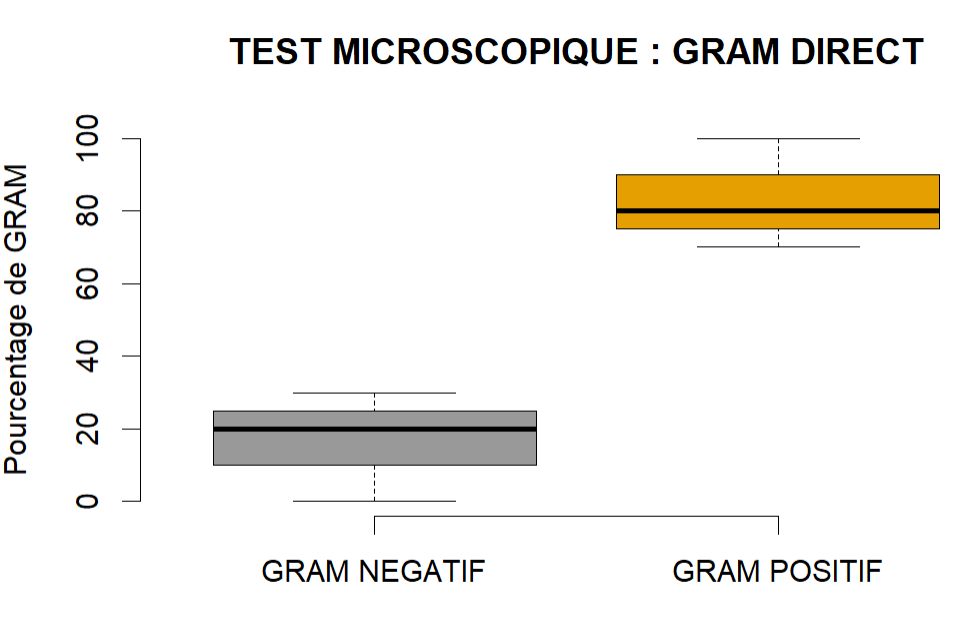
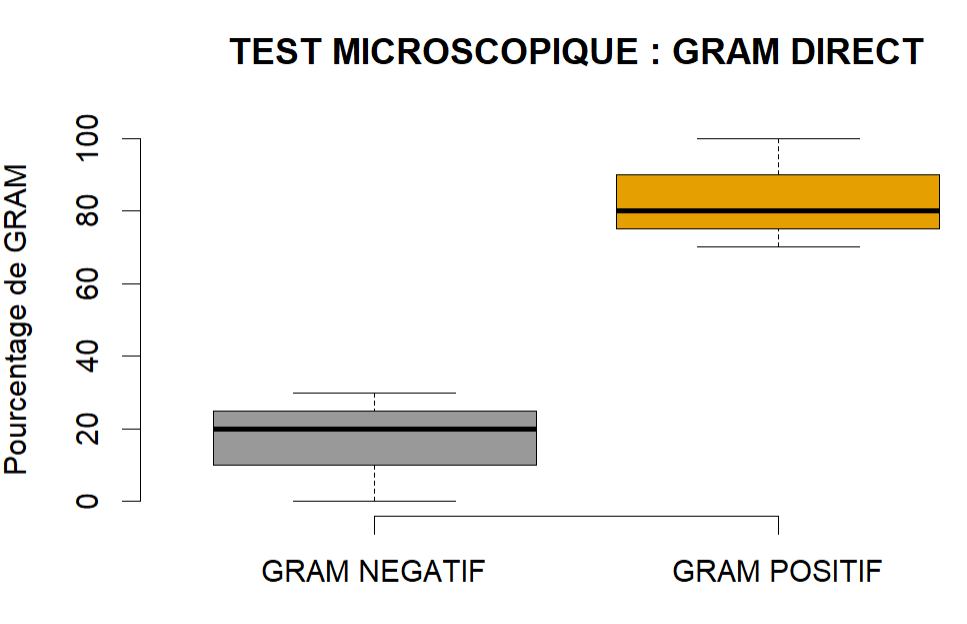
We recruited a total of 52 infants for the first sampling at J0, and for the second sampling at M3, we obtained 31 stool samples. The general results of bacteriology were presented in Table 1 and Table 2. Among the various scrutinized microorganisms, only bifidobacteria were identified at J0, while other cultures turned out negative. The distribution of isolated bacteria according to their Gram staining is presented in Figure 1 and Figure 2. Socio-demographic and clinical characteristics were detailed in Table 3 and Table 4.
3.1. Bacteriological Results of Infants' Stool Samples at J0Out of a total of 52 samples taken, 40% of the isolated microorganisms consisted mainly of bifidobacteria. Other cultures conducted revealed negative results. (See Table 1).
Out of a total of 31 samples taken, 44% of the isolated microorganisms were bifidobacteria, followed by 33% of E. faecalis and 9% of S. aureus. Other isolated microorganisms included yeasts, Streptococcus sp, and E. coli, representing 7%, 4%, and 2%, respectively. Only one negative culture was obtained for this second sampling phase (see Table 2).
The balance of intestinal flora: percentages of Gram-positive and Gram-negative Bacilli were evaluated during the first and second sampling.
The box plots (Figure 1 and Figure 2) representing samples at J0 and M3 show a favorable balance of intestinal flora in newborns, with a predominance of Gram-positive bacteria representing between 70% and 100% of the observed population. In contrast, Gram-negative bacteria were present at a rate ranging from 0% to 30%, indicating that all infants participating in this study have a balanced intestinal flora regardless of living conditions or diet (see box plots in Figure 1 and Figure 2).
Table 3 and Table 4 show that the P-value is less than 0.05, indicating that bacterial density is statistically significant.


Within the group of 52 infants at J0 of life, only bifidobacteria were observed, with an absence of positive culture for other searched microorganisms. Regarding gestational age, 41% of bifidobacteria were isolated in term infants, while this figure rose to 33% in premature infants. Among infants recruited at J0, 40% of bifidobacteria were isolated, with 32% for cesarean-born and 56% for those born vaginally. Regarding feeding type, 50% of mixed-fed infants had bifidobacteria, while this figure was 29% for those exclusively breastfed and 27% for those exclusively formula-fed. Among infants whose mothers reported taking antibiotic therapy about a month before delivery, 43% had bifidobacteria, compared to 35% for those whose mothers did not take antibiotics a month before delivery. Overall, in all evaluated characteristics, the P-value is greater than 0.05, suggesting that the studied variables (gestational age, mode of delivery, feeding mode, antibiotic intake) are independent of the isolated microorganisms.
3.4. Clinical characteristics of infants at M3 of lifeAmong the group of 31 infants at this age, all were born at term and two isolates were most represented: 24 samples of bifidobacteria, accounting for 39% of the isolates, and 18 samples of E. faecalis, representing 30% of the isolates. Regarding the mode of delivery, 44% of bifidobacteria isolates and 31% of E. faecalis isolates were found in infants born by cesarean section, while among those born vaginally, the percentages were 44% for bifidobacteria and 44% for E. faecalis.
Regarding the environment, among infants living in houses with two to three rooms with one adult, 50% of E. faecalis isolates and 50% of S. aureus isolates were found, while among those living in a one-room house with seven other people, 50% of bifidobacteria and 50% of E. faecalis were isolated.
Bifidobacteria, E. faecalis, Streptococcus sp, and yeasts were found at 50%, 30%, 10%, and 10%, respectively, in infants living in a two-room house with 4, 5, and 17 other people. Among those living in three-room houses with 3 to 8 other people, all searched microorganisms were isolated, with percentages of 41% for bifidobacteria, 34% for E. faecalis, 3% for E. coli, 9% for S. aureus, 3% for Streptococcus sp, and 9% for yeasts.
Among infants living in houses with four or five rooms with 3, 5, 9, and 23 people, both bifidobacteria and E. faecalis were isolated. Bifidobacteria were isolated at 50% in four-room houses and 67% in five-room houses, while E. faecalis was isolated at 33% in five-room houses.
In all scrutinized characteristics, the P-value is greater than 0.05, indicating independence between the studied variables and the identified microorganisms.
At the age of three months, two newborns were identified as carriers of a strain of Escherichia coli producing extended-spectrum beta-lactamase (ESBL) with cross-resistance to fluoroquinolones, as well as a strain of multidrug-resistant Staphylococcus aureus, characterized by its resistance to at least two families of beta-lactams (Methicillin-resistant/SARM) and to all aminoglycosides (kanamycin, tobramycin, gentamicin/KTG). It is relevant to note that both infants were born by cesarean section and were fed mixed feeding. Additionally, the mothers had a history of illnesses and had received antibiotic therapy approximately one month before sampling.
Various factors play a role in the initial configuration of the intestinal flora, including gestational age, mode of delivery (with a distinction between significant colonization by bacteria from the maternal flora and colonization by environmental bacteria), as well as the birth environment and the use of antibiotics. This article specifically addresses the results obtained by associating these factors with the identified microorganisms.
The initial colonization of the gastrointestinal tract begins as soon as the fetal membranes rupture and extends over several months. The establishment of a balance in the intestinal flora generally occurs between the second and third year of life, depending on both diet and the timing and manner in which dietary diversification is introduced. In this study, during direct Gram examination, we observed that for the first two samples, 70 to 100% of the bacteria were Gram-positive. Gram-positive bacilli were predominant, representing over 70%, followed by Gram-positive cocci, which were present at about 30%. Non-parametric comparison analysis revealed a P value less than 0.05, indicating a significant correlation between the obtained values. Indeed, the percentages of Gram-positive bacteria were proportional to the percentages of Gram-negative bacteria. This result suggests that the composition of the intestinal flora in these children is balanced. This observation could be explained by the fact that the children were still very young (around three months old) and that breast milk was the main source of nutrition, regardless of feeding tààçype.
All the statistical analyzes carried out except the distribution of bacteria according to the bacterial density at D0 and M3 of life, indicate that the establishment of intestinal flora is not influenced by the mode of delivery, feeding type, place of residence, or even antibiotic intake, as in all these cases, the p-value is greater than 0.05. These results could be explained by the fact that the p-value should not be interpreted in isolation but rather contextualized, bearing in mind that statistical significance differs from clinical significance 9, 10.
Our conclusions are in line with those of N. Fontaine and colleagues in 2008 regarding the impact of delivery mode and feeding type on the establishment of the intestinal microbiota. However, our results differ regarding the effect of antibiotic intake. Their study also revealed that intestinal colonization is not influenced by delivery mode, feeding type, or length of hospital stay, but it is affected by antibiotic administration 10. Our results notably diverge from those reported in the literature, as several previous studies have consistently highlighted the potential influence of the factors examined, such as the mode of delivery 11, the feeding method 11, the environment 11, 12 and taking antibiotic therapy 10 truly influence the composition of the intestinal flora 13, 14, 15.
The resistance profiles observed in bacteria isolated at three months of age in two newborns (Escherichia: ESBL with cross-resistance to fluoroquinolones; and multidrug-resistant Staphylococcus aureus, resistant to at least two families of beta-lactams: MRSA and to all aminoglycosides (kanamycin, tobramycin, genàotamicin/KTG)) could be explained by the following factors:
- The cesarean birth of both infants may potentially be associated with increased exposure to multidrug-resistant bacteria. During a cesarean section, the infant is not exposed to bacteria present in the mother's vaginal canal, which can influence the initial colonization of their intestinal microbiota. Consequently, the baby could be more vulnerable to colonization by multidrug-resistant bacteria from environmental or hospital sources. However, it is important to note that other factors, such as the use of prophylactic antibiotics during the cesarean section or the length of hospital stay, may also contribute to this increased susceptibility.
- One of the mothers received antibiotic treatment less than a month before the second sampling, suggesting a possible transmission of resistance from mothers to infants. Antibiotics taken by the mother can disrupt her intestinal microbiota, thereby favoring the selection of resistant bacteria. These resistant bacteria can be transmitted to the infant during delivery, skin-to-skin contact, or breastfeeding, leading to colonization by multidrug-resistant bacteria in the infant. This direct transmission of antibiotic resistance from mother to infant underscores the importance of monitoring and judiciously managing the use of antibiotics during pregnancy and childbirth.
- One of the mothers had a history of diseases such as ulcers, a family history of diabetes, and tobacco consumption. These factors could also have influenced bacterial resistance in the infants. Chronic illnesses and behaviors like tobacco consumption can affect the composition of the intestinal microbiota, thereby promoting colonization by resistant bacteria in both the mother and potentially the infant. Additionally, studies suggest that certain diseases, such as diabetes, may be associated with immune system alterations, which could make individuals more vulnerable to bacterial infections and antibiotic resistance. Therefore, these factors should also be considered when evaluating the transmission of bacterial resistance from mother to infants.
Following this investigation, it is established that bifidobacteria, E. faecalis, Streptococcus sp, E. coli, S. aureus, as well as yeasts, are among the facultative anaerobic microorganisms constituting the intestinal microbiota of infants up to the age of three months. However, an analysis of factors such as gestational age, mode of delivery, feeding mode, environment, and types of facultative anaerobic microorganisms isolated in newborns at the Bingerville Mother and Child Hospital reveals no significant relationship. However, it is crucial to consider the individual clinical contexts of each child, as the interpretation of statistical tests and P values must be contextualized. Factors such as preexisting health conditions, family medical history, and other individual variables can influence the composition of the intestinal microbiota and its response to various environmental and medical factors. Therefore, a personalized approach is necessary to fully understand the impact of these factors on the health of newborns.
In such studies, it is beneficial to increase the sample size and utilize high-throughput sequencing methods or metagenomics to obtain more precise results and better understand the overall composition of the intestinal microbiota. These approaches allow for a more in-depth and comprehensive analysis of the intestinal microbiota by identifying a greater variety of microorganisms and providing more detailed information on their diversity and function. This also enables the identification of potential associations between the composition of the intestinal microbiota and the factors under study with greater reliability.
| [1] | Meriem Bendriss. Implantation du microbiote du nouveau-né: connaissances et rôles des sagesfemmes. Pédiatrie. 2018. dumas-01945133. | ||
| In article | |||
| [2] | Landman C, Quévrain E. Le microbiote intestinal : description, rôle et implication physiopathologique. Rev Médecine Interne. Juin 2016; 37(6): 418‑23. | ||
| In article | View Article PubMed | ||
| [3] | Remillieux M. Le microbiote intestinal: l'univers à l'intérieur de nous. Elsevier. Avril 2021 https:// reader.elsevier.com/ reader/ sd/pii/ S0001407919311756 20230125134120. | ||
| In article | |||
| [4] | Gaouzi Z. Rôle du laboratoire dans l’étude du microbiote intestinal chez le nouveau-né prématuré. 2022. Université Mohammed V - RABAT Faculté de Médecine et de Pharmacie - RABAT. http://ao.um5.ac.ma/xmlui/handle/123456789/19948. | ||
| In article | |||
| [5] | Lecerf JM, DELZENNE N. Microbiote intestinal et santé humaine. Elsevier Health Sciences; 2021. 263 p. | ||
| In article | |||
| [6] | Hernandez J. La colonisation de l’intestin par les micro-organismes ne se fait pas avant l’accouchement. Futura. Mai 2021. https://www.futura-sciences.com/sante/actualites/biologie-colonisation-intestin-micro-organismes-ne-fait-pas-avant-accouchement-53822/. | ||
| In article | |||
| [7] | Biard N. Le microbiote intestinal, les probiotiques et leur place dans les pathologies digestives basses du nourrisson. Université de Lorraine; 2016. p. non renseigné. https://hal.univ-lorraine.fr/hal-01734070. | ||
| In article | |||
| [8] | Motya Y. Le microbiote intestinal humain. Thesis 122. 2018. Université Mohammed V - RABAT Faculté de Médecine et de Pharmacie - RABAT http:// ao.um5.ac.ma/ xmlui/ handle/ 123456789/16991. | ||
| In article | |||
| [9] | Ladner J, Ben Abdelaziz A, Pédagogie-Recherche-Publication en Sciences de la Santé(RPP2S) RM. Comment calculer et interpréter la valeur de «p» dans une étude épidémiologique. Tunis Médicale. Mars 2021; 99(3): 313‑7. | ||
| In article | |||
| [10] | Buxeraud J. Impact des antibiotiques sur le microbiote intestinal. Actual Pharm. 1 juin 2021; 60(607, Supplement): S18‑9. | ||
| In article | View Article | ||
| [11] | Lecerf JM, DELZENNE N. Microbiote intestinal et santé humaine. Elsevier Health Sciences; 2021. 263 p. | ||
| In article | |||
| [12] | Comtet-Marre S, Mosoni P, Peyret P. Effets des polluants environnementaux et alimentaires sur le microbiote intestinal. Cah Nutr Diététique. 1 oct 2020; 55(5): 255‑62. | ||
| In article | View Article | ||
| [13] | Masson E. EM. Mise en place de la flore intestinale du nouveau-né. Elsevier Masson SAS Gastroenterol Clin Biol 2007; 31: 533-542. | ||
| In article | View Article PubMed | ||
| [14] | Patin C. Exploration du dialogue entre le microbiote intestinal et l’hôte chez les enfants nés grands-prématurés à un mois de vie via des méthodes méta-omiques. Bactériologie. Université Paris-Saclay, 2023. Français. NNT: 2023UPASQ045. | ||
| In article | |||
| [15] | Fontaine N. Etude du microbiote intestinal résident chez des prématurés et influence de la stomie sur la flore intestinale et la translocation bactérienne [PhD Thesis]. Amiens; 2008. https://www.theses.fr/2008AMIED010. | ||
| In article | |||
Published with license by Science and Education Publishing, Copyright © 2024 Grace Kemsol Miedjim, Gbonon Mbengue Valérie, Kouamé Clarisse, Akaffou Adja Evelyne, Ndôh Ngrabé Nodje-Assal, Assohoun Egomli Stanislas, Marcelle Money Ettien, Franck Djéda Gnahoré, Kouakou Diely Anita Christelle, Anné J.Claude, Kangah Tatiana, Ouattara Mohamed Baguy, Koffi Stéphane and Dosso Mireille
 This work is licensed under a Creative Commons Attribution 4.0 International License. To view a copy of this license, visit
https://creativecommons.org/licenses/by/4.0/
This work is licensed under a Creative Commons Attribution 4.0 International License. To view a copy of this license, visit
https://creativecommons.org/licenses/by/4.0/
| [1] | Meriem Bendriss. Implantation du microbiote du nouveau-né: connaissances et rôles des sagesfemmes. Pédiatrie. 2018. dumas-01945133. | ||
| In article | |||
| [2] | Landman C, Quévrain E. Le microbiote intestinal : description, rôle et implication physiopathologique. Rev Médecine Interne. Juin 2016; 37(6): 418‑23. | ||
| In article | View Article PubMed | ||
| [3] | Remillieux M. Le microbiote intestinal: l'univers à l'intérieur de nous. Elsevier. Avril 2021 https:// reader.elsevier.com/ reader/ sd/pii/ S0001407919311756 20230125134120. | ||
| In article | |||
| [4] | Gaouzi Z. Rôle du laboratoire dans l’étude du microbiote intestinal chez le nouveau-né prématuré. 2022. Université Mohammed V - RABAT Faculté de Médecine et de Pharmacie - RABAT. http://ao.um5.ac.ma/xmlui/handle/123456789/19948. | ||
| In article | |||
| [5] | Lecerf JM, DELZENNE N. Microbiote intestinal et santé humaine. Elsevier Health Sciences; 2021. 263 p. | ||
| In article | |||
| [6] | Hernandez J. La colonisation de l’intestin par les micro-organismes ne se fait pas avant l’accouchement. Futura. Mai 2021. https://www.futura-sciences.com/sante/actualites/biologie-colonisation-intestin-micro-organismes-ne-fait-pas-avant-accouchement-53822/. | ||
| In article | |||
| [7] | Biard N. Le microbiote intestinal, les probiotiques et leur place dans les pathologies digestives basses du nourrisson. Université de Lorraine; 2016. p. non renseigné. https://hal.univ-lorraine.fr/hal-01734070. | ||
| In article | |||
| [8] | Motya Y. Le microbiote intestinal humain. Thesis 122. 2018. Université Mohammed V - RABAT Faculté de Médecine et de Pharmacie - RABAT http:// ao.um5.ac.ma/ xmlui/ handle/ 123456789/16991. | ||
| In article | |||
| [9] | Ladner J, Ben Abdelaziz A, Pédagogie-Recherche-Publication en Sciences de la Santé(RPP2S) RM. Comment calculer et interpréter la valeur de «p» dans une étude épidémiologique. Tunis Médicale. Mars 2021; 99(3): 313‑7. | ||
| In article | |||
| [10] | Buxeraud J. Impact des antibiotiques sur le microbiote intestinal. Actual Pharm. 1 juin 2021; 60(607, Supplement): S18‑9. | ||
| In article | View Article | ||
| [11] | Lecerf JM, DELZENNE N. Microbiote intestinal et santé humaine. Elsevier Health Sciences; 2021. 263 p. | ||
| In article | |||
| [12] | Comtet-Marre S, Mosoni P, Peyret P. Effets des polluants environnementaux et alimentaires sur le microbiote intestinal. Cah Nutr Diététique. 1 oct 2020; 55(5): 255‑62. | ||
| In article | View Article | ||
| [13] | Masson E. EM. Mise en place de la flore intestinale du nouveau-né. Elsevier Masson SAS Gastroenterol Clin Biol 2007; 31: 533-542. | ||
| In article | View Article PubMed | ||
| [14] | Patin C. Exploration du dialogue entre le microbiote intestinal et l’hôte chez les enfants nés grands-prématurés à un mois de vie via des méthodes méta-omiques. Bactériologie. Université Paris-Saclay, 2023. Français. NNT: 2023UPASQ045. | ||
| In article | |||
| [15] | Fontaine N. Etude du microbiote intestinal résident chez des prématurés et influence de la stomie sur la flore intestinale et la translocation bactérienne [PhD Thesis]. Amiens; 2008. https://www.theses.fr/2008AMIED010. | ||
| In article | |||