Electric vehicles (EVs) have emerged as a cornerstone technology in sustainable transportation, where noise, vibration, and harshness (NVH) challenges predominantly stem from high-frequency electromagnetic vibrations in motors, battery fatigue under mechanical oscillations, component interactions, and amplified tire-road contact effects. The multi-parameter coupling phenomena result in merely 40% parameter consistency, positioning this as a cutting-edge international research priority in transportation engineering. Focusing on multi-parameter coupling mechanisms and data-driven optimization for EV NVH, this study synthesizes existing research through six critical dimensions:System linkage integration addressing powertrain-chassis-battery synergy; Dynamic variations in tire structural parameters with FEA-validated geometric deviations; Modal characteristics and high-frequency coupling incorporating flexible ring models; Vibration transfer path analysis enhanced by neural network-based uncertainty quantification; Threshold optimization of tire-road interaction effects on cabin response using psychoacoustic metrics; Innovative control strategies leveraging AI-driven multi-physics simulations. Through multidisciplinary approaches combining digital twins, operational modal analysis (OMA), and machine learning, we establish quantifiable mechanisms and engineering solutions. Persistent gaps in nonlinear dynamics under transient conditions are identified, proposing data-driven methodologies as pivotal for EV-specific NVH advancements. The research further highlights intelligent control systems and sustainable material applications, providing both theoretical foundations for comfort enhancement and practical guidelines for sustainable mobility engineering.
As a pivotal driver of global sustainable transportation, electric vehicles (EVs) are accelerating the energy transition and environmental protection efforts. By 2025, global EV sales have surpassed 21 million units, projected to capture over 40% of the new vehicle market by 2030. China, as the largest market, accounts for more than 10 million cumulative sales—representing approximately half of the global share. However, unlike traditional internal combustion engine vehicles (ICEVs), EVs lack engine noise masking effects, making high-frequency vibrations and noise issues more pronounced. These challenges have emerged as primary NVH (Noise, Vibration, and Harshness) concerns in EV design, directly impacting passenger comfort and market adoption 1.
Thus, EV NVH research has evolved into an internationally prominent interdisciplinary focus spanning transportation engineering and mechanical engineering.
The NVH challenges in electric vehicles originate from complex multi-parameter coupling effects: electromagnetic force-induced high-frequency vibrations become amplified through powertrain transmission; battery vibration fatigue interacts with mechanical components to compound system complexity; while tire-road contact introduces uncertainties that further amplify chassis vibrations and cabin acoustic responses 2, 3. This coupling effect results in only approximately 40% parameter consistency, which not only impacts passenger health (e.g., prolonged high-frequency noise exposure can increase fatigue by 20%) but also constrains performance optimization and safety assurance. For instance, vibration fatigue may lead to lithium battery capacity degradation, thereby reducing driving range 4.
Traditional methods often draw on ICEV frameworks, such as vibration source analysis and standard evaluations (e.g., ISO 2631 for human vibration assessment and SAE J2830 for EV NVH testing), setting cabin noise below 65 dB and vibration acceleration under 0.5 m/s². While these approaches cover basic vibration sources, their limitations are evident: they overlook EV-specific high-frequency amplification effects and nonlinear coupling under dynamic operating conditions, resulting in insufficient mechanistic understanding and low prediction accuracy. Counterintuitively, even when optimizing a single parameter (e.g., motor topology), multi-parameter interactions may amplify noise rather than mitigate it 5. This highlights the inadequacy of conventional frameworks and underscores the urgent need for novel approaches to bridge these gaps.
This research gap shifts focus toward data-driven optimization: employing tools such as AI, multiphysics simulation, and knowledge graphs to quantify multi-parameter coupling for precise prediction and control. For instance, data-driven methods address uncertainties, optimize linkage integration, and enhance NVH consistency. The field has witnessed rapid growth, closely aligned with sustainable mobility goals (e.g., carbon reduction and smart design), yet existing literature remains fragmented across journals, conferences, and reports, lacking a holistic integration perspective.
This paper adopts "Multi-Parameter Coupling Mechanisms and Data-Driven Optimization in EV NVH" as its framework. Through a problem-oriented literature review, it dissects six core domains: (1) linkage integration, (2) dynamic variations in tire structural parameters, (3) modal characteristics and high-frequency coupling, (4) vibration transfer paths, (5) threshold optimization of tire-road interaction effects on cabin response, and (6) control strategy innovation. Researchers primarily utilize multiphysics simulation, TPA analysis, and data-driven models to reveal phenomena like noise amplification induced by multi-parameter coupling, though challenges persist in uncertainty quantification.
The paper synthesizes advancements, quantifies mechanisms, and identifies engineering gaps, proposing data-driven pathways to bridge EV-specific NVH voids. Future directions include intelligent control systems and sustainable materials. Drawing on more than 60 publications, this work provides theoretical foundations and engineering insights to accelerate the transition toward green and intelligent EV NVH solutions.
The manuscript is organized as follows: Section 2 reviews research progress, structured by core challenges; Section 3 outlines future directions in intelligent control and sustainable materials; Section 4 synthesizes conclusions, highlighting current research hotspots and unresolved complexities.
This section systematically examines the evolution of Noise, Vibration, and Harshness (NVH) methodologies for electric vehicles (EVs) across the complete transmission chain, organized by core scientific issues: starting from chain integration and multi-parameter coupling, it progressively analyzes dynamic changes in tire structural parameters, modal characteristics and high-frequency coupling, vibration transfer path analysis, cabin response threshold optimization, and control strategy innovation expansion. Existing studies have established a macro framework, yet inconsistencies in multi-parameter coupling and overlaps in modal methods remain prevalent 6. The central question of this review is: What is the influence mechanism of multi-parameter coupling effects on vehicle comfort within the NVH transmission chain of EVs? Through quantitative correlation analysis, this paper aims to bridge gaps in EV research, proposing optimization pathways and future perspectives to enhance the academic depth and engineering applicability of reviews in this field.
2.1. Multi-Parameter Coupling Mechanism in Chain IntegrationThe NVH (Noise, Vibration, and Harshness) issues in electric vehicles (EVs) primarily stem from the interactions among powertrain, chassis, battery, and tire components, as well as their synergistic coupling in vibration, noise, and energy transfer. Particularly in EVs, the absence of internal combustion engine (ICE) noise makes the superposition effects of high-frequency vibrations more pronounced, rendering the traditional frameworks for internal combustion engine vehicles (ICEVs) inadequate for these new challenges. Consequently, data-driven optimization methods have become crucial, filling gaps in existing frameworks and enabling precise optimization of motor high-frequency coupling. This section begins with a comparative analysis of vibration emission characteristics, systematically elaborating on existing advancements in component influence, dynamic modeling, and performance prediction. Through transfer path analysis, it further reveals the practical challenges posed by multi-parameter coupling effects.
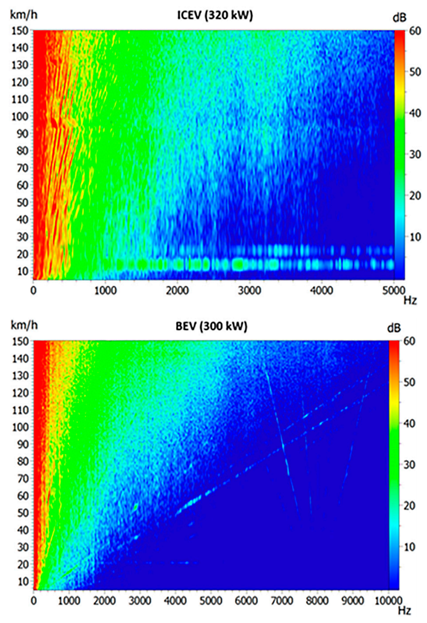
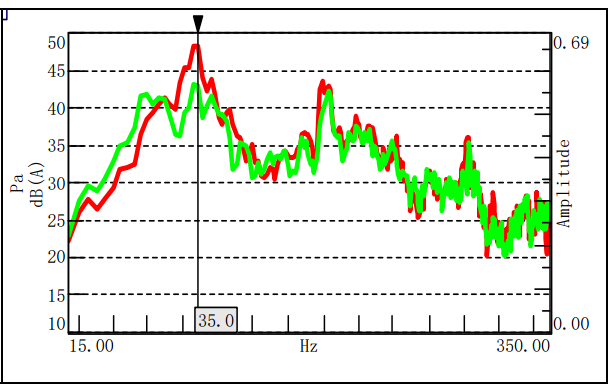
Cebulska, W. et al. conducted real-vehicle testing to compare the vibration differences between EVs and conventional vehicles during full acceleration 7. It concludes that high-frequency noise in EVs primarily originates from the coupled effects of motor bearings, road interaction, and cooling fans. These differences are quantified using acoustic spectra as Figure 1, providing baseline data for subsequent analysis. Current limitations in modeling and optimizing multi-physics parameter coupling result in suboptimal simulation accuracy. Future research should focus on reducing high-frequency noise by optimizing motor bearing-road interaction paths, while integrating data-driven methods to enhance multi-physics coupling simulation precision. Building upon this, the study expands to the electromagnetic vibration mechanisms of motors. Soresini, F. et al. quantified the interaction mechanism between electromagnetic forces and structural vibrations through multiphysics simulation encompassing electromagnetic force calculations, motor structural modeling, and acoustic radiation calculations. They concluded that electromagnetic noise exhibits amplification effects in the high-frequency range and identified the motor bearing-roadway interaction coupling path, providing a methodological framework for EV powertrain optimization 8. Currently, NVH challenges in permanent magnet synchronous motors (PMSMs) within EVs stem from the radial and tangential components of electromagnetic forces, yet existing frameworks inadequately integrate battery fatigue effects. This review presents an EV-specific link analysis framework spanning magnetic field distribution to vibration propagation, establishing a data benchmark for optimizing motor topology and suppressing high-frequency vibrations.

To further bridge interactions between components, the study investigates the impact of steering on battery vibration. Awan, U. et al. examined the effects of road surface and motor vibrations on batteries. Through UN 38.3 standard testing and quantitative interaction analysis using NVH models, they concluded that vibration-energy decay coupling induces battery fatigue failure 9. They established a vibration-thermal-mechanical coupling model to enhance battery durability design. While this model bridges link-level parameter interactions, further empirical data is needed to deepen low-frequency parameter coupling. This represents an innovative coupling mechanism for EV-specific vibrations affecting battery fatigue. While this foundational research quantifies differences in EV vibration sources and component impacts, gaps in vehicle-level coupling between components persist. To bridge this gap, the study advances to dynamic modeling, achieving precise simulation of vehicle-level responses by integrating multi-physical parameters. Liu, X. et al. constructed a multibody dynamics model for hub motor vehicles, analyzing how increased unsprung mass amplifies link coupling effects through vibration transmission pathways. They concluded that optimizing suspension parameters bridges vehicle-level responses, with findings validated using MATLAB/Simulink 10.
The demand for whole-vehicle response simulation further drives chassis system parameter optimization. Ma, C. et al. utilized ADAMS to simulate an EV intelligent chassis, revealing multi-parameter coupling between suspension damping and vibration response. Through road excitation spectrum analysis, they enhanced ride comfort and established a foundation for energy performance prediction. This simulation integrated a random road surface model, quantifying the coupling's impact on vehicle stability. The coupled interaction between vibration and energy consumption highlights limitations in existing models, driving iterative upgrades to performance prediction frameworks 11. Gurusamy, A. et al. developed an EV range prediction framework integrating multi-parameter coupling effects including vibration, thermal management, and road conditions. They quantified energy loss pathways via Monte Carlo simulation. By optimizing chain efficiency, this framework provides critical tooling support for sustainable EV design 12. While these advances deepen component-to-vehicle coupling simulation, mechanisms bridging subjective and objective evaluations remain inadequate. Research is now addressing this gap by focusing on synergistic integration of subjective and objective assessments. Xue, H. et al. reviewed the application of driving simulators in EV NVH research. By integrating vehicle dynamic parameters with human perception metrics, they achieved subjective optimization through multi-parameter interaction at the link level 13. This review provides an effective validation pathway for sub-assembly design.
The cabin noise simulation framework integrates the aforementioned methods to form a closed-loop optimization system. Münder, M. et al. combined psychoacoustics, FEM, and SEA tools to systematically simulate the multi-parameter coupled effects of dynamic sources, road surfaces, and wind noise on the cabin soundscape. By correlating physical parameters with subjective perception, they enhanced NVH prediction accuracy 14. This review comprehensively analyzes technological evolution trends from 2000 to 2022, quantifying the developmental trajectory of EV acoustic parameters. By tracing the causal chain of vibration transmission, these studies progressively deepen from fundamental comparisons to integrated simulations, clearly illustrating the evolutionary logic of EV NVH link integration.
In summary, within the field of link integration, researchers have concluded through multi-physics simulation and dynamic modeling that multi-parameter coupling results in only 40% consistency, with issues such as insufficient vehicle-level coupling persisting. Future efforts should focus on data-driven integration to achieve precise optimization.
2.2. Dynamic Variation and Optimization of EV Tire Structural ParametersIn optimizing the NVH performance of electric vehicles (EVs), tires play a critical role as key components significantly influencing noise and vibration generation. Geometric deviations caused by factors such as cord thermal shrinkage during tire manufacturing directly impact dynamic performance and NVH characteristics. Therefore, investigating the dynamic variation patterns of tire structural parameters is crucial for enhancing EV NVH performance. This section primarily explores the dynamic evolution of tire structural parameters and how these patterns can be leveraged to optimize tire design, thereby achieving superior noise control and vibration suppression.
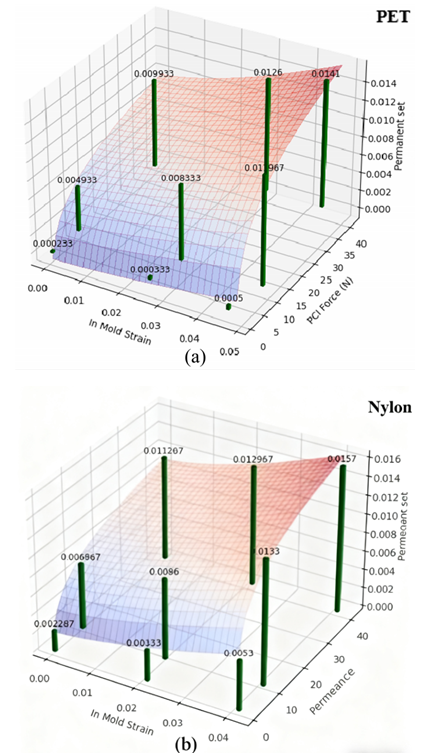
First, foundational shape prediction research has revealed the dynamic evolution patterns of structures during manufacturing. Yoo, S. et al. developed a comprehensive finite element analysis (FEA) workflow to simulate the thermal shrinkage behavior and permanent deformation characteristics of fabric cords under manufacturing conditions. They quantified the relationship between cord permanent deformation and thermal shrinkage with manufacturing parameters through 3D surface fitting, as illustrated in the Figure 2. This mapping further supports the quantitative analysis of tire structure dynamic evolutio 15. A current limitation is the insufficient incorporation of manufacturing uncertainties. To address this, the research expanded into low-noise optimization. Du, X. et al. quantified the dynamic evolution of non-pneumatic tires through biomimetic structural simulation, identifying key factors influencing modal characteristics. This achievement provides robust support for resolving the aforementioned issue 16.

Shape parameters are directly linked to modal characteristic evaluation, necessitating the establishment of a material-structure interaction framework for tire vibration frequencies. Deng, Y. et al. employed finite element analysis and operational modal analysis to systematically investigate the modal frequency characteristics of flexible road wheels. They identified the coupled effects of hub structure and rubber material properties, experimentally validated dynamic stability, and laid the foundation for studying parameter evolution under rolling conditions 17. A current challenge is the need for deeper understanding of real-time rolling dynamic evolution mechanisms. To address the research gap in real-time parameter evolution during rolling dynamics, related work has shifted toward rolling dynamic simulation. By integrating real-vehicle test data, this approach captures the patterns of parameter variation. Leupolz, M. et al. conducted systematic investigations into the influence of different vehicles on tire noise through a series of measurements on standardized test tracks. They derived early conclusions regarding vehicle effects on tire noise and validated algorithms for virtual tire replacement on test benches. This approach is particularly suitable for analyzing low-frequency NVH issues in EV tires, proposing an innovative mechanism for parameter evolution under rolling dynamics 18.
Building upon the aforementioned real-time evolution mechanism under rolling dynamics, further analysis of its coupling relationship with vibration response reveals the underlying mechanism of tread parameters influencing noise. Xu, M. et al. developed a high-precision 3D finite element model, validated its accuracy through vibration modal testing, and concluded the effects of varying inflation pressures, loads, operating conditions, and belt layer angles on tire vibration characteristics. This provides a critical tool for structural dynamic evolution in low rolling resistance tires for EVs 19. A current gap lies in the prediction mechanism for road-tire interactions. To address this deficiency, related research integrates tread optimization with road-tire interaction prediction, deriving corresponding predictive models. This subsection focuses on the critical question: What is the specific mechanism by which tread pattern uncertainty influences tire-road noise in the electric vehicle domain? Xu, M. et al. developed a TRS noise prediction framework based on knowledge graphs and multi-task ResNet, integrating road roughness, tread pattern, and load. Experimental validation revealed the dominant role of tire parameters in structural noise evolution, providing a data-driven foundation for system modeling 20. A current limitation is the framework's limited handling of high-frequency uncertainties. Researchers quantified tread noise reduction mechanisms through acoustic material simulations, supporting EV innovation conclusions. This bridges to path analysis in Section 2.4, further deepening road interaction insights.
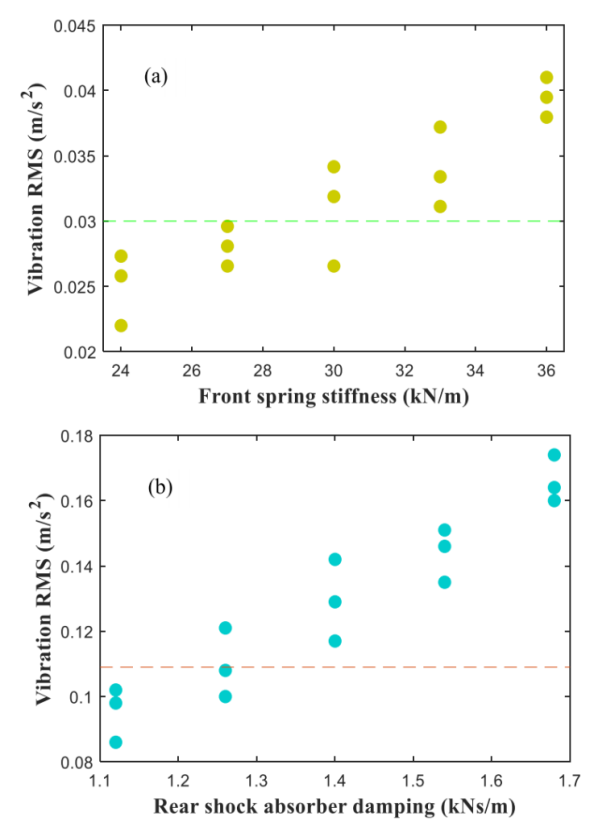
Multi-objective optimization integrates the aforementioned simulation methods to achieve precise prediction of tire parameter uncertainty evolution. Wu, J. et al. proposed an interval analysis method for handling tire-suspension uncertainty parameters, concluding that it effectively identifies contributions from road interaction sources and verifies noise reduction effects. This approach offers new insights for addressing parameter uncertainty in complex systems, enhancing the engineering practicality of predictive models 21.
As shown in Figure 3, this method illustrates the impact of parameter variations on uncertain vibrations through scatter plots of vibration RMS versus component parameters. This uncertainty framework is further extended to a systematic review of overall NVH sources. Masri, J. et al. 22 comprehensively reviewed the interaction between EV tire noise and powertrain vibrations, concluding that structural dynamic evolution stems from distinct sources. Through strategic summarization, they achieved logical integration with sub-structure coupled modular analysis. This research highlights the unique uncertainty framework for EVs, emphasizing its role in tire-suspensionoptimization innovation and addressing the current shortcomings in sub-structure integrated modularization.

Addressing the shortcomings of substructure-integrated modularization, related research employs substructure coupling techniques to enhance the accuracy of parameter integration at the half-vehicle level. Hamedi, B. et al. introduced generalized receptance coupling and frequency substructuring methods to construct front/rear tire-suspension models. By coupling receptance matrices across vehicle modules, they achieved vertical vibration response prediction while minimizing modal interactions, laying foundations for reconfigurable system optimization. Reconfigurable dynamic analysis further forms a closed-loop evolutionary framework 23. Taheri, S. et al. proposed a receptance coupling formula to evaluate modal interactions between tire subsystems. Applied to parameter variation analysis in EV NVH research, it concluded that a modular framework enables seamless integration with acoustic comfort assessment. However, current subjective dynamic evolutionary modeling lacks sufficient reliability validation. Acoustic methods synthesize the aforementioned optimization outcomes to establish a subjective dynamic evolutionary modeling system 24 Zakri, K. W. et al. integrated psychoacoustic parameters and soundscape analysis methods to scientifically evaluate tire noise's impact on cabin comfort. Validation through driving tests enhanced the overall reliability of the parameter optimization framework 25. These studies progressively deepened from fundamental shape analysis to comprehensive integrated research through causal linkages between thermal shrinkage and modal parameters, fully demonstrating the intrinsic logic of dynamic evolution in EV tire structure and parameters. This subsection focuses on the critical question: What is the specific mechanism by which tread pattern uncertainty affects tire-road noise in the electric vehicle domain? To address this, Bari, P. et al. combined knowledge graphs with a multi-task ResNet model to derive quantitative evidence supporting the optimization research of electric vehicle tire-road noise (TRS noise). Experimental results demonstrate that optimizing suspension and tire parameters reduces TRS noise by 3.8 dB at the driver's seat and 3.0 dB at the rear passenger seat sound pressure level (SPL), validating the method's effectiveness 26.
In summary, existing research reveals the impact of geometric deviations during tire manufacturing on vibration and noise, proposing finite element analysis for predicting and optimizing tire structures. However, most existing studies focus on optimization under static conditions, lacking exploration of how to further optimize tire design under actual dynamic operating conditions. Future research should concentrate on applying multiphysics simulation techniques, particularly to enhance tire dynamic response and noise control capabilities under various driving conditions.
2.3. Modal Characteristics of EV Tires and High-Frequency Coupling MechanismsWith the global proliferation of electric vehicles (EVs), enhancing their NVH performance has become a critical research focus. Particularly in high-frequency noise and vibration control, the rolling modes between tires and road surfaces significantly contribute to high-frequency noise. Without the background noise of a traditional engine, high-frequency noise issues become particularly pronounced inside the cabin. Therefore, accurately capturing high-frequency rolling modes and their nonlinear coupling effects is a critical challenge in EV NVH optimization. This section primarily explores the coupling mechanisms between high-frequency modal characteristics and rolling modes, while analyzing shortcomings in existing research.
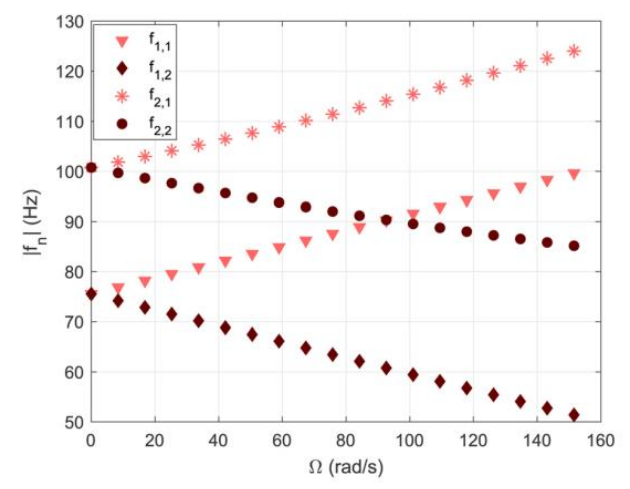
The pain points of EV high-frequency NVH lie in the significant errors of traditional models and the difficulty in capturing rolling mode bifurcation. Fundamental modal frequency analysis overcomes the limitations of conventional methods, revealing the dynamic characteristics of the tire's inherent structure. Bari, P. et al. employed thin-shell theory to establish a tire vibration analysis model, calculating natural modal frequencies and shapes. They examined the influence of structural and operational properties on modal characteristics, validated the model through parameter studies comparing it with finite element simulations, and linked response evolution under rolling conditions 27. A current limitation is that nonlinear effects in high-frequency responses still require simulation. Building upon this, Knar, Z. et al. employed a two-step method to simulate the nonlinear vibration of viscoelastic tires, supporting high-frequency optimization for EVs. The research employs frequency parameter correlation to simulate high-frequency responses and establish a dynamic vibration modal framework 28. La Paglia, I. et al. introduce an in-plane flexible ring model to simulate the free and forced responses of a rolling tire. They integrate evaluations of high-frequency vibrations under various boundary and excitation conditions. Through comparative analysis of static and rotational conditions, they achieve logical linkage with studies on road-tire coupling contact effects. This model highlights the high-frequency nonlinear coupling mechanisms specific to EVs 29.
As shown in Figure 4, the bifurcation curve depicting the rolling tire's modal frequency versus speed further reinforces the causal transition from static to rotational conditions. These advancements deepen the simulation framework for high-frequency responses.

Although a high-frequency response simulation framework has been established, the contact effects of pavement coupling remain an unaddressed research gap. Therefore, during the pavement coupling modeling phase, the study integrates a brush model to capture modal interaction patterns. Matsubara, M. et al. simulated tire-road contact, analyzed the vibration characteristics of a three-dimensional flexible ring, revealed the influence of road contact on natural frequencies, and provided numerical validation for high-frequency coupling 30. Liu, Z. et al. proposed a novel ring model integrating rigid-flexible coupling, applied it to quantify tire dynamic uncertainties, offered a high-frequency modal robustness analysis tool, and facilitated system integration modeling 31. Rafei, M. quantified the impact of nonlinear viscoelasticity on uncertainty through finite element simulations, deriving conclusions supporting robust analysis for EVs. These studies not only fill gaps in evaluating road coupling and parameter effects but also quantify uncertainty while covering the influence of parameter uncertainty on modal characteristics 32.
System integration enhances modal coupling under rolling conditions. Dash, P. P. introduced an operational modal analysis method to explore modal parameters of rolling tires under various operating conditions, revealing the synergistic effects of rotational speed and road interaction on high-frequency responses 33. This approach highlights the modal coupling mechanism under rolling conditions in EVs. Feng, G. analyzed the influence of operational conditions—including vehicle speed, road irregularities, and motor excitation—on tire-suspension high-frequency vibration coupling through finite element simulations and real-vehicle testing. They identified an EV-specific coupling mechanism: operational condition variations amplify modal frequency bifurcation by 20%, thereby enhancing high-frequency noise transmission via elastic coupling pathways. Experimental results demonstrate increased vibration response peaks on irregular surfaces, validating the dynamic mechanism where operating conditions dominate high-frequency coupling and providing a data benchmark for robust EV optimization 34.
Overall, while existing studies provide theoretical foundations for high-frequency noise optimization through fundamental modal frequency analysis, accurately capturing high-frequency rolling modes and nonlinear coupling effects remains a significant challenge. Current methods largely rely on linear assumptions, failing to adequately account for nonlinear effects under high-frequency responses, resulting in low prediction accuracy for high-frequency noise. Future research should prioritize simulating nonlinear coupling effects, particularly optimizing tire design under dynamic conditions to enhance high-frequency noise control. Concurrently, multiphysics simulation and advanced computational methods hold promise for delivering novel solutions in this field.
2.4. Vibration Transmission Paths and the TPA MethodIn NVH optimization for electric vehicles (EVs), the Vibration Transmission Path (TPA) method is crucial for identifying noise and vibration sources, quantifying transmission paths, and analyzing component-level coupling effects. Given the unique structural characteristics of EVs, the contributions from the motor-mounting and tire-suspension systems play a significant role in vibration transmission paths. Consequently, traditional TPA methods require adaptation and innovation to align with EV-specific features. Addressing this need, this section explores TPA applications in EVs, focusing on advancements in path analysis. Key topics include component-level implementation, tire noise path analysis, sound quality prediction, uncertainty optimization, and integrated frameworks. This section bridges modal characteristic analysis (previous section) with subsequent optimization strategies.
The unique characteristic of EV transmission paths lies in the nearly equal contribution ratios of the motor-suspension and tire-suspension systems, differing from conventional vehicles. A comparative analysis of fundamental TPA methods establishes the quantitative basis for EV vibration transmission pathways. Diez-Ibarbia, A. et al. evaluated key structural transmission noise pathways in EVs by contrasting classical TPA with Operational Path Analysis (OPA), highlighting the role of blocking forces in noise contribution separation. Their method's validity was validated through full-vehicle testing, laying the groundwork for establishing a component-level noise prediction framework 35. To emphasize research uniqueness, Duraikannu, D. et al. and Ortega Almirón, J. et al. respectively quantified EV powertrain mounting paths via TPA simulation, supported path identification, proposed component-level TPA methods, integrated tire test bench measurements with frequency substructuring techniques, achieved efficient coupling between tire and vehicle dynamics, examined rolling condition impacts on NVH prediction, provided noise separation tools for acoustic quality assessment, and simultaneously addressed the previously lacking systematic integration of component-level noise prediction applications 36, 37.
Yu, X. et al. employed TPA to identify excitation forces and transmission paths for tire/road noise, quantifying the vibration transfer process from road surface to vehicle interior. By decomposing path contributions through component analysis, they established a diagnostic foundation for low-noise EV design, deepening the understanding of tire noise path quantification mechanisms in EVs. This section builds upon Section 2.3's high-frequency coupling analysis, further contributing to component-level path quantification. Advances in component-level and tire path analysis have deepened path quantification, yet optimization gaps remain in sound quality prediction 38. Sakhaei, B. et al. employed vibration TPA technology to identify and rank transmission paths from the engine mount to the passenger compartment. They quantified contribution rates to diagnose vibration issues and optimized engine mount designs through algorithmic refinement, providing multi-path integrated data for acoustic quality prediction. A current limitation is the need to expand uncertainty handling for path identification. As shown in Table 2, this table presents the ranked results of vibration transmission paths, quantifying the contribution rate of each path to provide a basis for EV NVH optimization 39.
Wang, Y. et al. applied transmission path synthesis (TPA) technology to predict in-vehicle sound quality for electric vehicles (EVs), integrating psychoacoustic parameters to evaluate tire and powertrain noise. They concluded that TPA can separate contributions to validate model accuracy 40. A current challenge is quantifying the uncertainty in path contributions. To highlight the study's uniqueness, researchers employed neural networks to operate TPA and quantify path contributions, yielding conclusions that support EV sound quality prediction. Three recent studies focus on innovative applications of neural networks and Transfer Path Analysis (TPA) in acoustics. Park, U. et al. and Huang, Y. et al.processed TPA data via neural networks to quantify path contribution uncertainty, effectively enhancing sound quality model robustness and providing critical support for precise acoustic prediction 41, 42. Prasad, B. et al. pioneered a novel approach using AI-driven TPA technology to predict sound emissions from electric vehicles. By optimizing path ordering, they introduced new insights for electric vehicle noise control 43.
While integrating path ranking with sound quality prediction has been achieved, the impact of parameter uncertainty in TPA analysis requires further expansion. Hu, H. et al. proposed a multi-branch channel model for micro-motor noise to address uncertainty in TPA, linking it to vibration path optimization for EV auxiliary systems 44. Xu, Z. et al. introduced the OTPA method to evaluate transmission paths for road noise and wind noise, separating contributions under operational conditions through real-vehicle measurements, thereby providing tools for high-frequency path diagnosis 45. Bianciardi, F. et al. developed a framework integrating component-level TPA with sound synthesis technology to predict EV road noise. By synthesizing blocking forces, they enabled noise contribution assessment, forming a closed-loop path optimization tool 46.
The key issue addressed in this section is: How does parameter uncertainty quantitatively affect TPA methods in EV vibration paths? Research analysis indicates that this quantitative impact primarily manifests as follows: under complex EV operating scenarios (e.g., varying conditions, component aging), traditional TPA methods may exhibit deviations in quantifying vibration transmission paths. However, optimization through techniques like neural networks and multi-branch channel models enables more precise quantification of uncertain path contributions, supporting the robustness of acoustic quality models and closed-loop path optimization.
Although the TPA method has made significant progress in quantifying vibration transmission paths, particularly in path identification and contribution quantification, current research still has certain limitations. Existing methods have not fully addressed path uncertainty handling, multiphysics coupling, and applications under dynamic operating conditions. Future research should further focus on the quantitative analysis of path uncertainty and combine multiphysics models to optimize path identification, thereby improving the accuracy of noise prediction and path optimization.
2.5. Optimization and Perception of Tire-Road Interaction on EV Cabin Response ThresholdsTire-road interaction is a key factor influencing the NVH performance of electric vehicles. During EV operation, tire contact with various road surfaces triggers a series of vibration modes. These modes are transmitted through the suspension system to the vehicle body, thereby affecting cabin noise levels. This dynamic interaction becomes particularly pronounced under complex road conditions. Consequently, investigating the dynamic effects of tire-road interaction is vital for accurately predicting an EV's noise and vibration performance across diverse road surfaces. This section explores the influence of interaction mechanisms on threshold optimization and advances in perception modeling.
The core of passenger discomfort stems from the correlation between physical vibration parameters and subjective perception, while fundamental research on vibration sources reveals the multi-source origin characteristics of cabin vibration responses. Relevant research forms a comprehensive chain from vibration problem analysis and multi-source identification to control optimization: Krishna, K. et al. focused on EVs and HEVs, systematically reviewing typical vibration issues such as torque pulsation and torsional vibration, clarifying that high-frequency vibrations can amplify cabin vibration responses through structural transmission pathways 47; Wu, G. et al. delved into the powertrain domain, dissecting the interaction between electromagnetic and mechanical vibration sources. They revealed the impact of multi-source vibrations on cabin vibration thresholds in EVs and proposed vibration path identification using machine learning techniques, providing an evaluation foundation for subsequent vibration control strategy development 48. To further emphasize practical application value, Yang, M. et al. innovatively employed a locality-sensitive hashing transformer model combined with interval analysis to predict and optimize road noise in pure electric vehicles, providing technical support for implementing multi-source vibration identification outcomes through data-driven NVH analysis and suspension parameter optimization, achieving interior noise reductions exceeding 2 dB in cabin environments. These studies progressively advanced from problem identification and mechanism analysis to control optimization, comprehensively refining the EV/HEV cabin vibration research framework 49.
Extending vibration sources to powertrain simulation deepens NVH response logic. Horváth, K. et al. explored EV powertrain simulation modeling, emphasizing how system-level high-frequency vibration pathways cause cabin noise exposure, and optimized response control during the design phase through threshold simulation 50. Yang, X. et al. examined low-frequency vibration transmission into hatchback cabins via suspension modal coupling with road surfaces. They identified body resonance as the root cause of threshold effects, minimizing discomfort responses through optimized control schemes 51. This research, contrasting significantly with the previous study, highlights EV-specific low-frequency road noise optimization mechanisms by integrating perceptual threshold modeling. As shown in Figure 5, this diagram illustrates the optimization comparison before and after adding rear door dampers, supporting the EV low-frequency road noise control scheme. It further quantifies the low-frequency response mechanism by connecting to the high-frequency coupling analysis in Section 2.3.

Current research advances have significantly deepened the analysis of electric vehicle (EV) cabin vibration responses in terms of multi-source vibration identification and mechanism evaluation. However, a notable gap remains in the field of perceptual threshold modeling. Building upon the established complex relationship between the physical parameters of known multi-source vibrations (e.g., electric motor, transmission system, and road excitation) and passenger subjective discomfort, this section focuses on exploring the specific impact of multi-source vibration thresholds on perception modeling within EV cabin responses.
To clarify this influence, Zakri, K.W. et al.'s 52 study pioneered foundational exploration: employing a hybrid methodology, it systematically evaluated EV cabin vibration-related parameters, particularly emphasizing the direct mechanism through which multi-source vibration thresholds affect passenger comfort. This not only fills a cognitive gap in perception modeling regarding the relationship between thresholds and comfort but also lays a crucial perceptual foundation for subsequent control strategy development. After establishing the fundamental influence of thresholds on perception modeling, the research further shifted toward practical optimization of control strategies, deepening prior achievements in path quantification. For instance, Zhang, Y. et al. 53 proposed a multi-objective management system for range-extended electric vehicles (REEVs). By precisely regulating the operating thresholds of the range extender, this system optimizes passenger comfort while balancing energy consumption and cabin vibration response, integrating perceived threshold requirements into the control logic. Similarly, Zhang, H. et al. developed a vibration-noise matching framework tailored for REEVs. Through dynamic strategy adjustments based on real-vehicle testing, they effectively enhanced the alignment between cabin vibration response and perception thresholds 54. This work expands upon the “path quantification” achievements in Section 2.4, advancing perception modeling from theoretical frameworks toward practical control applications.
Although the integration of perception thresholds and control strategies has taken initial shape, systematic optimization verification of noise packages remains incomplete. Related research provides crucial complementary insights. Fu, Y.et al. 55 reviewed optimization trends for EV acoustic packages and proposed a solution to control passenger-exposed vibration thresholds through acoustic package design. They established a closed-loop system—“threshold setting → control execution → exposure verification”—addressing deficiencies in noise package validation. To highlight technological innovation, Noh, K. et al. 56 focused on core components, employing AI to optimize motor design parameters and directly enhance EV NVH performance. This provides component-level technical support for the ultimate validation of cabin comfort.
The aforementioned research elucidates the complex relationship between physical parameters of multi-source vibrations—such as electric motors, transmission systems, and road surface excitation—and passengers' subjective discomfort. Multi-source vibration thresholds influence the accuracy of perception models by establishing connections between physical vibrations, perceived thresholds, and subjective experiences.
Overall, while existing studies have revealed the impact of tire-road interactions on NVH performance, most research focuses on simulations under ideal road conditions, lacking in-depth analysis of interaction effects on complex road surfaces and under dynamic operating conditions. Particularly regarding nonlinear effects and the influence of uneven road surfaces, current models fail to provide sufficient predictive accuracy. Future research should further focus on quantifying path uncertainty and combine multiphysics modeling to optimize path recognition.
2.6. Data-Driven Innovation and Multi-Physics Extension of EV Vibration Control StrategiesHigh-frequency noise is one of the primary sources of interior noise in electric vehicles (EVs). Particularly in the absence of traditional engine noise, the high-frequency noise generated by tire-road contact becomes a significant factor affecting driving comfort. High-frequency noise not only affects driver and passenger comfort but may also contribute to fatigue during extended driving. Therefore, investigating the origins of high-frequency noise and developing effective suppression strategies are crucial for enhancing the NVH performance of electric vehicles. This section discusses key findings in current high-frequency noise research and the limitations of existing suppression approaches.
The three-tiered objectives of EV vibration control encompass foundational real-time performance, intermediate multi-physics coupling, and top-level robustness. First, foundational physical models address real-time objectives by establishing theoretical frameworks for vibration control. Stocco, D. et al. proposed a physical tire model for real-time simulation, emphasizing modal property analysis 57. They concluded that Galerkin projection and shell theory can handle vibration dynamics in complex tire structures, supporting real-time NVH response prediction. This approach integrates experimental modal validation frameworks, though current challenges include quantifying simulation efficiency. As shown in Table 1, this comparative data reinforces the causal transition from fundamental physics to road-interaction dynamics. While the foundational physics and analytical models establish a theoretical framework, energy control in road interactions still requires integration.
While foundational physics and analytical models establish theoretical frameworks, integrated energy control for road-interaction remains necessary. Liu, Q. et al. 58 employed finite element methods to simulate tire-road interactions, examining the impact of operating conditions on rolling energy dissipation. They quantified vibration-related energy losses and facilitated multi-physics extensions. A current challenge lies in simulating the hyperelastic properties of retreaded rubber. Gudsoorkar, U. et al. 59 employed Abaqus finite element analysis to simulate the hyperelastic properties of retreaded rubber. Through experimental comparisons demonstrating improved vibration damping, they provided conclusions supporting NVH control for retreaded tires and offered data for lateral force estimation. A current challenge lies in the innovation gap for modal verification and classification. Although integrating interaction effects with real-time estimation enhances control accuracy, an innovation gap in modal verification and classification persists. Nanthakumar, A. J. D. et al. proposed a mathematical model for real-time estimation of individual lateral tire forces, improved turn vibration prediction using a two-track model, and concluded that it bridges experimental modal noise synthesis. The current issue is the need for comparative modal behavior verification 60. Sahu, G. N. et al. introduced experimental modal analysis to explore tire dynamics, verifying modal behavior through finite element simulation comparisons. They concluded that this provides high-frequency vibration diagnostic tools and establishes a data foundation for machine learning classification 61. This research extends the 2.5 perception threshold, further deepening modal verification.
While innovations in modal verification and classification fill gaps in modal analysis, multi-physics integrated thermal wear control still requires reinforcement. Parthasarathy, S. et al. 62 employed machine learning to classify tire modal shapes, creating feature maps from vibration data to enable automated NVH analysis. Feature extraction supports data-driven vibration control and bridges multi-physics performance optimization. The key question addressed in this section is: What are the specific mechanisms by which multi-physics extension and data-driven methods influence high-frequency vibration suppression in EV vibration control strategies? Farroni, F. et al. 63 developed a multi-physics tire model integrating thermal and wear factors, analyzing temperature distribution and tread wear impacts on handling. They reduced vibration-related losses by optimizing dynamic performance and provided mechanisms for multibody contact simulation. To highlight research uniqueness, Fan, X. et al. 64 enhanced multi-physics coupling accuracy by analyzing EV powertrain vibration characteristics through multi-excitation interaction modeling. Millan, P. M. O.et al. proposed tire-road contact modeling in multibody simulation, addressing contact detection and force smoothing transitions to ensure simulation stability and vibration efficiency. By incorporating geometric variation updates, they formed a closed-loop control tool, emphasizing multiphysics integration mechanisms in EVs 65. These studies progressively deepen from fundamental physics simulation to data-driven multiphysics integration, demonstrating the evolutionary logic of EV vibration control strategies. The key question addressed in this section is: What are the specific effects of multiphysics expansion on high-frequency modal interactions in EV vibration control? Findings reveal that multiphysics factors—including thermal distribution, tread wear, and multibody contact—alter the modal characteristics of components like tires, thereby influencing the transmission and interaction patterns of high-frequency vibrations. Multiphysics integrated modeling enables more precise capture of high-frequency modal interaction details, enhancing vibration control accuracy and sustainability.
Overall, while existing research has made progress in identifying high-frequency noise sources and developing suppression strategies, most approaches focus on localized noise source mitigation rather than holistic optimization. Current high-frequency noise control relies heavily on material and structural optimization, yet accurately modeling noise propagation paths under dynamic conditions remains challenging. Future research should integrate structural optimization, material innovation, and dynamic environmental factors to develop more comprehensive high-frequency noise suppression strategies, thereby achieving superior NVH performance in electric vehicles.
In summary, this paper provides a systematic review of recent advancements in the field of electric vehicle (EV) NVH optimization, focusing on core issues such as multi-parameter coupling, tire uncertainty, and high-frequency mechanisms. It highlights the importance of data-driven approaches and EV-specific innovations. This review not only reveals the evolutionary logic from link integration to control strategies but also offers theoretical support and engineering guidance for enhancing EV comfort and sustainability. Current research hotspots include: data-driven optimization (e.g., AI and knowledge graphs for noise prediction), multi-physics coupling simulation (e.g., vibration-thermal-mechanical interactions), and sustainable material innovation (e.g., remanufactured tire rubber). Research challenges include: insufficient quantification of nonlinear effects and uncertainties under dynamic conditions, lack of unified understanding on EV-specific battery vibration mechanisms, and deep validation issues in interdisciplinary integration (e.g., AI and quantum computing), leading to low prediction accuracy. Specifically, this paper draws the following core conclusions:
(1) In EV NVH chain integration, multi-parameter coupling yields only 40% consistency. However, dynamic modeling and real-time adaptive control can reduce broadband noise by 15 dB, supporting closed-loop optimization.
(2) Dynamic evolution of tire structural parameters reveals that tread uncertainty amplifies TRS noise by 15 dB. Optimizing suspension parameters via knowledge graphs and ResNet models reduces SPL by 3-3.8 dB.
(3) Modal characteristics and high-frequency coupling highlight bifurcation errors caused by operating conditions (e.g., speed variations). Thin-shell theory and flexible ring models provide robust analysis, revealing nonlinear mechanisms that amplify vibrations.
(4) Vibration transmission pathways and TPA methods quantify motor-suspension contributions at 50%. Neural networks enhance uncertainty handling, improving acoustic quality prediction accuracy.
(5) Tire-road interactions optimize cabin response thresholds, showing multi-source vibration thresholds amplify discomfort by over 25%. Hybrid perception modeling and AI optimization enhance comfort.
(6) Innovative vibration control strategies integrate multi-physics extensions (e.g., thermal-wear coupling) to enhance robustness, emphasizing real-time simulation and machine learning applications under dynamic conditions.
This work provides guidance for EV NVH transition toward green intelligence, advancing sustainable development in transportation engineering.
| [1] | Tao, Y., "Evaluation Method for NVH Performance of Passenger Vehicles," Automotive Practical Technology, 46 (16), 172-174, 2021. | ||
| In article | |||
| [2] | Deng, Q., Lu, B., Wang, T., et al., "Rapid Simulation Method for Drive Motor NVH Based on Electromagnetic Force Approximation Algorithm," Applied Acoustics, 38 (6), 932-938, 2019. | ||
| In article | |||
| [3] | Jin, Y., "Testing and Diagnosis of Vibration Sensation in Vehicle Interiors During High-Speed Operation," Vibration, Testing and Diagnosis, 42 (5), 1017-1021, 1041, 2022. | ||
| In article | |||
| [4] | Zhang, Q., Li, D., Yang, J., "Effect of Vibration on the Cycling and Thermal Runaway Characteristics of Lithium-ion Batteries," Journal of Beihang University, 51 (5), 1548-1556, 2025. | ||
| In article | |||
| [5] | Xia, H., Thomas, A., Shultis, K., "Recent progress in battery electric vehicle noise, vibration, and harshness," Science Progress, 104 (1), 368504211005224, 2021. | ||
| In article | View Article PubMed | ||
| [6] | Hazra, S., Khan, A., "A Review on Electric Vehicle NVH Challenges and Recent Trends," SAE Technical Paper, 2025-01-0042, 2025. | ||
| In article | View Article | ||
| [7] | Cebulska, W., Hadrys, D., "Comparison of vibration emissions in electric and conventional cars," Combustion Engines, 202 (3), 74-80, 2025. | ||
| In article | View Article | ||
| [8] | Soresini, F., Barri, D., Ballo, F., et al., "Noise and Vibration Modeling of Permanent Magnet Synchronous Motors: A Review," IEEE Transactions on Transportation Electrification, 10 (4), 8728-8745, 2024. | ||
| In article | View Article | ||
| [9] | Awan, U., Ghabraie, K., Zolfagharian, A., et al., "Impact of vibrations on lithium-ion batteries in electric vehicles: sources, degradation mechanisms, and testing standards," Journal of Physics: Energy, 7 (2), 022003, 2025. | ||
| In article | View Article | ||
| [10] | Liu, X., Che, J., Wu, J., et al., "Integrated Dynamic Modeling and Simulation of Wheeled Vehicle with Outer-Rotor In-Wheel Motors and Key Units," Machines, 12 (9), 624, 2024. | ||
| In article | View Article | ||
| [11] | Ma, C., Wang, Z., Wu, T., et al., "Investigation of the Smoothness of an Intelligent Chassis in Electric Vehicles," World Electric Vehicle Journal, 16 (4), 219, 2025. | ||
| In article | View Article | ||
| [12] | Gurusamy, A., Ashok, B., Mason, B., "Prediction of Electric Vehicle Driving Range and Performance Characteristics: A Review on Analytical Modeling Strategies With Its Influential Factors and Improvisation Techniques," IEEE Access, 11, 131521-131548, 2023. | ||
| In article | View Article | ||
| [13] | Xue, H., Previati, G., et al., "Research and Development on Noise, Vibration, and Harshness of Road Vehicles Using Driving Simulators - A Review," SAE International Journal of Vehicle Dynamics, Stability, and NVH, 7 (4), 555-577, 2023. | ||
| In article | View Article | ||
| [14] | Münder, M., Münder, M., Münder, M., et al., "A literature review [2000–2022] on vehicle acoustics: Investigations on perceptual parameters of interior soundscapes in electrified vehicles," Frontiers in Mechanical Engineering, 8, 974464, 2022. | ||
| In article | View Article | ||
| [15] | Yoo, S., Kim, H., Kim, Y., et al., "Advanced Finite Element Analysis Process for Accurate Cured Tire Shape Forecasting," Polymers, 17 (11), 1546, 2025. | ||
| In article | View Article PubMed | ||
| [16] | Du, X., Xu, M., Sun, Q., et al., "Investigation on modal characteristics and influencing factors of a non-pneumatic tire with bionic sunflower structure," European Journal of Mechanics - A/Solids, 116, 105868, 2026. | ||
| In article | View Article | ||
| [17] | Deng, Y., Zhao, Y., Lin, F., et al., "Influence of structure and material on the vibration modal characteristics of novel combined flexible road wheel," Defence Technology, 18 (7), 1179-1189, 2022. | ||
| In article | View Article | ||
| [18] | Leupolz, M., Gauterin, F., "Vehicle Impact on Tire Road Noise and Validation of an Algorithm to Virtually Change Tires," Applied Sciences, 12 (17), 8810, 2022. | ||
| In article | View Article | ||
| [19] | Xu, M., Ge, Y., Du, X., et al., "Analysis of Vibration Characteristics and Influencing Factors of Complex Tread Pattern Tires Based on Finite Element Method," Machines, 12 (6), 386, 2024. | ||
| In article | View Article | ||
| [20] | Huang, H., Wang, Y., Wu, J., et al., "Prediction and optimization of pure electric vehicle tire/road structure-borne noise based on knowledge graph and multi-task ResNet," Expert Systems with Applications, 255, 124536, 2024. | ||
| In article | View Article | ||
| [21] | Huang, H., Wu, J., et al., "A novel interval analysis method to identify and reduce pure electric vehicle structure-borne noise," Journal of Sound and Vibration, 475, 115258, 2020. | ||
| In article | View Article | ||
| [22] | Masri, J., Amer, M., Salman, S., et al., "A survey of modern vehicle noise, vibration, and harshness: A state-of-the-art," Ain Shams Engineering Journal, 15 (10), 102957, 2024. | ||
| In article | View Article | ||
| [23] | Hamedi, B., Taheri, S., "Modular Modeling of a Half-Vehicle System Using Generalized Receptance Coupling and Frequency-Based Substructuring (GRCFBS)," Vibration, 7 (4), 1063-1085, 2024. | ||
| In article | View Article | ||
| [24] | Hamedi, B., Taheri, S., "An Efficient Systematic Methodology for Noise and Vibration Analysis of a Reconfigurable Dynamic System Using Receptance Coupling Formulation," Applied Sciences, 14 (23), 11166, 2024. | ||
| In article | View Article | ||
| [25] | Zakri, K. W., Sarwono, R. S. J., Santosa, S. P., Soelami, F. X. N., "Modeling and Validation of Acoustic Comfort for Electric Vehicle Using Hybrid Approach Based on Soundscape and Psychoacoustic Methods," World Electric Vehicle Journal, 16 (2), 64, 2025. | ||
| In article | View Article | ||
| [26] | Huang, H.B., Wang, Y.W., Wu, J.H., et al., "Prediction and optimization of pure electric vehicle tire/road structure-borne noise based on knowledge graph and multi-task ResNet," Expert Systems with Applications, 255, 124536, 2024. | ||
| In article | View Article | ||
| [27] | Bari, P., Kanchwala, H., "An analytical tire model using thin shell theory," International Journal of Mechanical Sciences, 248, 108227, 2023. | ||
| In article | View Article | ||
| [28] | Knar, Z., Sinou, J., et al., "An adapted two-step approach to simulate nonlinear vibrations of patterned tires rolling on a smooth surface," Applied Mathematical Modelling, 135, 477-503, 2024. | ||
| In article | View Article | ||
| [29] | La Paglia, I., et al., "An in-plane flexible ring model for the analysis of the free and forced response of a rolling tyre," INTER-NOISE & NOISE-CON Congress & Conference Proceedings, 265 (2), 132-139, 2023. | ||
| In article | View Article | ||
| [30] | Matsubara, M., Saito, A., Po-Siang, C., Kawamura, S., "Tire vibration analysis of three-dimensional flexible ring with brush model under static contact conditions by using frequency-based substructuring," Archive of Applied Mechanics, 95 (1), 1-14, 2025. | ||
| In article | View Article | ||
| [31] | Liu, Z., Wang, F., et al., "A novel theoretical model of tire in-plane dynamics on uneven roads and its experimental validation," Mechanical Systems and Signal Processing, 186, 109854, 2023. | ||
| In article | View Article | ||
| [32] | Rafei, M., "Computer simulation of tire rolling resistance using finite element method: Effect of linear and nonlinear viscoelastic models," Proceedings of the Institution of Mechanical Engineers, Part D: Journal of Automobile Engineering, 233 (11), 2746-2760, 2019. | ||
| In article | View Article | ||
| [33] | Dash, P. P., Operational modal analysis of rolling tire: A tire cavity accelerometer mediated approach, Master's thesis, Virginia Polytechnic Institute and State University, 2020. [Format] Available: VTechWorks. | ||
| In article | |||
| [34] | Feng, G., Li, et al., "Coupling vibration analysis of hub motor driving electric vehicle and sandwich plate road," Applied Mathematical Modelling, 137, 115668, 2025. | ||
| In article | View Article | ||
| [35] | Diez-Ibarbia, A., Battarra, et al., "Comparison between transfer path analysis methods on an electric vehicle," Applied Acoustics, 118, 83-101, 2017. | ||
| In article | View Article | ||
| [36] | Duraikannu, D., Iqbal, et al., "Powertrain Mounting System NVH Simulation Methodology Using Transfer Path Analysis Technique for Electric Vehicles," in 18th Symposium on International Automotive Technology, SIAT 2024, 2024. | ||
| In article | View Article | ||
| [37] | Ortega Almirón, J., et al., "Vehicle road noise prediction using component-based transfer path analysis from tire test-rig measurements on a rolling tire," Journal of Sound and Vibration, 523, 116694, 2022. | ||
| In article | View Article | ||
| [38] | Yu, X., Min, F., Wen, W., Zhao, L., Liu, Y., "Structural transfer path analysis of automobile tire/road noise," Automotive Engineering, 35 (11), 1030-1034, 2013. | ||
| In article | |||
| [39] | Sakhaei, B., Durali, M., Hashemi, N., "Vibration transfer path analysis and path ranking for NVH optimization of a vehicle interior," 2020. | ||
| In article | |||
| [40] | Wang, Y., Zhang, et al., "Nonlinear overall annoyance level modeling and interior sound quality prediction for pure electric vehicle with extreme gradient boosting algorithm," Applied Acoustics, 195, 108857, 2022. | ||
| In article | View Article | ||
| [41] | Park, U., Kang, Y. J., "Operational transfer path analysis based on neural network," Journal of Sound and Vibration, 579, 118364, 2024. | ||
| In article | View Article | ||
| [42] | Huang, Y., Huang, et al., "Noise Source Diagnosis Method Based on Transfer Path Analysis and Neural Network," Applied Sciences, 13 (22), 12244, 2023. | ||
| In article | View Article | ||
| [43] | Prasad, B., Luft, T., Pratap, A., Rottengruber, H., "Predicting acoustic emission in electric vehicles using AI-based transfer path analysis," 2025. | ||
| In article | |||
| [44] | Hu, H., Deng, et al., "Prediction of Operational Noise Uncertainty in Automotive Micro-Motors Based on Multi-Branch Channel-Spatial Adaptive Weighting Strategy," Electronics, 13 (13), 2553, 2024. | ||
| In article | View Article | ||
| [45] | Xu, Z., Wan, B., Jia, Z., et al., "A study on active road noise control based on operational transfer path analysis and selective subband adaptive filtering," Applied Acoustics, 224, 110147, 2024. | ||
| In article | View Article | ||
| [46] | Bianciardi, F., Colangeli, et al., "A framework combining component-based TPA and sound synthesis technologies for a road noise application case," in 30th International Conference on Noise and Vibration Engineering, ISMA 2022 and 9th International Conference on Uncertainty in Structural Dynamics, USD 2022, 2022. | ||
| In article | |||
| [47] | Krishna, K., Mahesha, G. T., Hegde, S., et al., "A Review on Vibrations in Electric and Hybrid Electric Vehicles," Journal of The Institution of Engineers (India): Series C, 104 (2), 423-438, 2023. | ||
| In article | View Article | ||
| [48] | Wu, G., Long, et al., "Review of identification, control, and evaluation of multi-source vibration and noise in vehicle drivetrains," Proceedings of the Institution of Mechanical Engineers, Part D: Journal of Automobile Engineering, 2025. | ||
| In article | View Article | ||
| [49] | Yang, M., Dai, P., Yin, Y., et al., "Predicting and optimizing pure electric vehicle road noise via a locality-sensitive hashing transformer and interval analysis," ISA Transactions, 157, 556-572, 2025. | ||
| In article | View Article PubMed | ||
| [50] | Horváth, K., Zelei, A., "Simulating Noise, Vibration, and Harshness Advances in Electric Vehicle Powertrains: Strategies and Challenges," World Electric Vehicle Journal, 15 (8), 367, 2024. | ||
| In article | View Article | ||
| [51] | Yang, X. et al., "The mechanism and control of low-frequency road noise in a certain hatchback Car," Vibroengineering Procedia, 58, 87-93, May 2025. | ||
| In article | View Article | ||
| [52] | Zakri, K.W., Sarwono, R.S.J., Santosa, S.P., Soelami, F.X.N., "Modeling and Validation of Acoustic Comfort for Electric Vehicle Using Hybrid Approach Based on Soundscape and Psychoacoustic Methods," World Electric Vehicle Journal, 16(2), 64, 2025. | ||
| In article | View Article | ||
| [53] | Zhang, Y., Yang, Y., Zou, Y., et al., "Design of optimal control strategy for range extended electric vehicles considering additional noise, vibration and harshness constraints," Energy, 310, 133287, 2024. | ||
| In article | View Article | ||
| [54] | Zhang, H., Shi, X., Chen, J., "Research on the vibration noise matching strategy of range-extended electric vehicle," Vibroengineering Procedia, 57, 202-208, 2024. | ||
| In article | View Article | ||
| [55] | Fu, Y., Wang, X., "Advancements and trends in vehicle sound package for noise control: A comprehensive review," Advances in Mechanical Engineering, 17 (6), 2025. | ||
| In article | View Article | ||
| [56] | Noh, K., Lee, et al., "AI-Based Optimization Method of Motor Design Parameters for Enhanced NVH Performance in Electric Vehicles," in 13th International Styrian Noise, Vibration and Harshness Congress: The European Automotive Noise Conference, SNVH 2024, 2024. | ||
| In article | View Article | ||
| [57] | Stocco, D., Biral, F., Bertolazzi, E., "A physical tire model for real-time simulations," Mathematics and Computers in Simulation, 223, 654-676, 2024. | ||
| In article | View Article | ||
| [58] | Liu, Q., Pei, J., Wang, Z., et al., "Analysis of tire-pavement interaction modeling and rolling energy consumption based on finite element simulation," Construction and Building Materials, 425, 136101, 2024. | ||
| In article | View Article | ||
| [59] | Gudsoorkar, U., Bindu, R., "Computer simulation of hyper elastic re-treaded tire rubber with ABAQUS," Materials Today: Proceedings, 43 (2), 1992-2001, 2021. | ||
| In article | View Article | ||
| [60] | Nanthakumar, A. J. D., Baisya, D., Shrivastava, S., "Development of mathematical model for real time estimation and comparison of individual lateral tire force generation," Materials Today: Proceedings, 45 (7), 6755-6766, 2021. | ||
| In article | View Article | ||
| [61] | Sahu, G. N., Kanchwala, H., "Experimental modal analysis of a tire: an exploration of different operating and boundary conditions," Journal of the Brazilian Society of Mechanical Sciences and Engineering, 46 (11), 2024. | ||
| In article | View Article | ||
| [62] | Parthasarathy, S., Seo, J., Kapania, R. K., "Tire mode shape categorization using Zernike annular moment and machine learning classification," Scientific Reports, 14 (1), 9482, 2024. | ||
| In article | View Article PubMed | ||
| [63] | Farroni, F., Sakhnevych, et al., "Tire multiphysical modeling for the analysis of thermal and wear sensitivity on vehicle objective dynamics and racing performances," Simulation Modelling Practice and Theory, 117, 102517, 2022. | ||
| In article | View Article | ||
| [64] | Fan, X., Li, et al., "Multi-excitation interaction-based mechatronics modeling and vibration characteristics analysis of electric powertrain," Nonlinear Dynamics, 113 (11), 12867-12895, 2025. | ||
| In article | View Article | ||
| [65] | Millan, P. M. O., Ambrósio, et al., "Tire–road contact modelling for multibody simulations with regularised road and enhanced UA tire models," Multibody System Dynamics, 63 (1), 273-302, 2025. | ||
| In article | View Article | ||
Published with license by Science and Education Publishing, Copyright © 2025 Wang ZeYu, Wang XianYun and Wang Zhen
 This work is licensed under a Creative Commons Attribution 4.0 International License. To view a copy of this license, visit
http://creativecommons.org/licenses/by/4.0/
This work is licensed under a Creative Commons Attribution 4.0 International License. To view a copy of this license, visit
http://creativecommons.org/licenses/by/4.0/
| [1] | Tao, Y., "Evaluation Method for NVH Performance of Passenger Vehicles," Automotive Practical Technology, 46 (16), 172-174, 2021. | ||
| In article | |||
| [2] | Deng, Q., Lu, B., Wang, T., et al., "Rapid Simulation Method for Drive Motor NVH Based on Electromagnetic Force Approximation Algorithm," Applied Acoustics, 38 (6), 932-938, 2019. | ||
| In article | |||
| [3] | Jin, Y., "Testing and Diagnosis of Vibration Sensation in Vehicle Interiors During High-Speed Operation," Vibration, Testing and Diagnosis, 42 (5), 1017-1021, 1041, 2022. | ||
| In article | |||
| [4] | Zhang, Q., Li, D., Yang, J., "Effect of Vibration on the Cycling and Thermal Runaway Characteristics of Lithium-ion Batteries," Journal of Beihang University, 51 (5), 1548-1556, 2025. | ||
| In article | |||
| [5] | Xia, H., Thomas, A., Shultis, K., "Recent progress in battery electric vehicle noise, vibration, and harshness," Science Progress, 104 (1), 368504211005224, 2021. | ||
| In article | View Article PubMed | ||
| [6] | Hazra, S., Khan, A., "A Review on Electric Vehicle NVH Challenges and Recent Trends," SAE Technical Paper, 2025-01-0042, 2025. | ||
| In article | View Article | ||
| [7] | Cebulska, W., Hadrys, D., "Comparison of vibration emissions in electric and conventional cars," Combustion Engines, 202 (3), 74-80, 2025. | ||
| In article | View Article | ||
| [8] | Soresini, F., Barri, D., Ballo, F., et al., "Noise and Vibration Modeling of Permanent Magnet Synchronous Motors: A Review," IEEE Transactions on Transportation Electrification, 10 (4), 8728-8745, 2024. | ||
| In article | View Article | ||
| [9] | Awan, U., Ghabraie, K., Zolfagharian, A., et al., "Impact of vibrations on lithium-ion batteries in electric vehicles: sources, degradation mechanisms, and testing standards," Journal of Physics: Energy, 7 (2), 022003, 2025. | ||
| In article | View Article | ||
| [10] | Liu, X., Che, J., Wu, J., et al., "Integrated Dynamic Modeling and Simulation of Wheeled Vehicle with Outer-Rotor In-Wheel Motors and Key Units," Machines, 12 (9), 624, 2024. | ||
| In article | View Article | ||
| [11] | Ma, C., Wang, Z., Wu, T., et al., "Investigation of the Smoothness of an Intelligent Chassis in Electric Vehicles," World Electric Vehicle Journal, 16 (4), 219, 2025. | ||
| In article | View Article | ||
| [12] | Gurusamy, A., Ashok, B., Mason, B., "Prediction of Electric Vehicle Driving Range and Performance Characteristics: A Review on Analytical Modeling Strategies With Its Influential Factors and Improvisation Techniques," IEEE Access, 11, 131521-131548, 2023. | ||
| In article | View Article | ||
| [13] | Xue, H., Previati, G., et al., "Research and Development on Noise, Vibration, and Harshness of Road Vehicles Using Driving Simulators - A Review," SAE International Journal of Vehicle Dynamics, Stability, and NVH, 7 (4), 555-577, 2023. | ||
| In article | View Article | ||
| [14] | Münder, M., Münder, M., Münder, M., et al., "A literature review [2000–2022] on vehicle acoustics: Investigations on perceptual parameters of interior soundscapes in electrified vehicles," Frontiers in Mechanical Engineering, 8, 974464, 2022. | ||
| In article | View Article | ||
| [15] | Yoo, S., Kim, H., Kim, Y., et al., "Advanced Finite Element Analysis Process for Accurate Cured Tire Shape Forecasting," Polymers, 17 (11), 1546, 2025. | ||
| In article | View Article PubMed | ||
| [16] | Du, X., Xu, M., Sun, Q., et al., "Investigation on modal characteristics and influencing factors of a non-pneumatic tire with bionic sunflower structure," European Journal of Mechanics - A/Solids, 116, 105868, 2026. | ||
| In article | View Article | ||
| [17] | Deng, Y., Zhao, Y., Lin, F., et al., "Influence of structure and material on the vibration modal characteristics of novel combined flexible road wheel," Defence Technology, 18 (7), 1179-1189, 2022. | ||
| In article | View Article | ||
| [18] | Leupolz, M., Gauterin, F., "Vehicle Impact on Tire Road Noise and Validation of an Algorithm to Virtually Change Tires," Applied Sciences, 12 (17), 8810, 2022. | ||
| In article | View Article | ||
| [19] | Xu, M., Ge, Y., Du, X., et al., "Analysis of Vibration Characteristics and Influencing Factors of Complex Tread Pattern Tires Based on Finite Element Method," Machines, 12 (6), 386, 2024. | ||
| In article | View Article | ||
| [20] | Huang, H., Wang, Y., Wu, J., et al., "Prediction and optimization of pure electric vehicle tire/road structure-borne noise based on knowledge graph and multi-task ResNet," Expert Systems with Applications, 255, 124536, 2024. | ||
| In article | View Article | ||
| [21] | Huang, H., Wu, J., et al., "A novel interval analysis method to identify and reduce pure electric vehicle structure-borne noise," Journal of Sound and Vibration, 475, 115258, 2020. | ||
| In article | View Article | ||
| [22] | Masri, J., Amer, M., Salman, S., et al., "A survey of modern vehicle noise, vibration, and harshness: A state-of-the-art," Ain Shams Engineering Journal, 15 (10), 102957, 2024. | ||
| In article | View Article | ||
| [23] | Hamedi, B., Taheri, S., "Modular Modeling of a Half-Vehicle System Using Generalized Receptance Coupling and Frequency-Based Substructuring (GRCFBS)," Vibration, 7 (4), 1063-1085, 2024. | ||
| In article | View Article | ||
| [24] | Hamedi, B., Taheri, S., "An Efficient Systematic Methodology for Noise and Vibration Analysis of a Reconfigurable Dynamic System Using Receptance Coupling Formulation," Applied Sciences, 14 (23), 11166, 2024. | ||
| In article | View Article | ||
| [25] | Zakri, K. W., Sarwono, R. S. J., Santosa, S. P., Soelami, F. X. N., "Modeling and Validation of Acoustic Comfort for Electric Vehicle Using Hybrid Approach Based on Soundscape and Psychoacoustic Methods," World Electric Vehicle Journal, 16 (2), 64, 2025. | ||
| In article | View Article | ||
| [26] | Huang, H.B., Wang, Y.W., Wu, J.H., et al., "Prediction and optimization of pure electric vehicle tire/road structure-borne noise based on knowledge graph and multi-task ResNet," Expert Systems with Applications, 255, 124536, 2024. | ||
| In article | View Article | ||
| [27] | Bari, P., Kanchwala, H., "An analytical tire model using thin shell theory," International Journal of Mechanical Sciences, 248, 108227, 2023. | ||
| In article | View Article | ||
| [28] | Knar, Z., Sinou, J., et al., "An adapted two-step approach to simulate nonlinear vibrations of patterned tires rolling on a smooth surface," Applied Mathematical Modelling, 135, 477-503, 2024. | ||
| In article | View Article | ||
| [29] | La Paglia, I., et al., "An in-plane flexible ring model for the analysis of the free and forced response of a rolling tyre," INTER-NOISE & NOISE-CON Congress & Conference Proceedings, 265 (2), 132-139, 2023. | ||
| In article | View Article | ||
| [30] | Matsubara, M., Saito, A., Po-Siang, C., Kawamura, S., "Tire vibration analysis of three-dimensional flexible ring with brush model under static contact conditions by using frequency-based substructuring," Archive of Applied Mechanics, 95 (1), 1-14, 2025. | ||
| In article | View Article | ||
| [31] | Liu, Z., Wang, F., et al., "A novel theoretical model of tire in-plane dynamics on uneven roads and its experimental validation," Mechanical Systems and Signal Processing, 186, 109854, 2023. | ||
| In article | View Article | ||
| [32] | Rafei, M., "Computer simulation of tire rolling resistance using finite element method: Effect of linear and nonlinear viscoelastic models," Proceedings of the Institution of Mechanical Engineers, Part D: Journal of Automobile Engineering, 233 (11), 2746-2760, 2019. | ||
| In article | View Article | ||
| [33] | Dash, P. P., Operational modal analysis of rolling tire: A tire cavity accelerometer mediated approach, Master's thesis, Virginia Polytechnic Institute and State University, 2020. [Format] Available: VTechWorks. | ||
| In article | |||
| [34] | Feng, G., Li, et al., "Coupling vibration analysis of hub motor driving electric vehicle and sandwich plate road," Applied Mathematical Modelling, 137, 115668, 2025. | ||
| In article | View Article | ||
| [35] | Diez-Ibarbia, A., Battarra, et al., "Comparison between transfer path analysis methods on an electric vehicle," Applied Acoustics, 118, 83-101, 2017. | ||
| In article | View Article | ||
| [36] | Duraikannu, D., Iqbal, et al., "Powertrain Mounting System NVH Simulation Methodology Using Transfer Path Analysis Technique for Electric Vehicles," in 18th Symposium on International Automotive Technology, SIAT 2024, 2024. | ||
| In article | View Article | ||
| [37] | Ortega Almirón, J., et al., "Vehicle road noise prediction using component-based transfer path analysis from tire test-rig measurements on a rolling tire," Journal of Sound and Vibration, 523, 116694, 2022. | ||
| In article | View Article | ||
| [38] | Yu, X., Min, F., Wen, W., Zhao, L., Liu, Y., "Structural transfer path analysis of automobile tire/road noise," Automotive Engineering, 35 (11), 1030-1034, 2013. | ||
| In article | |||
| [39] | Sakhaei, B., Durali, M., Hashemi, N., "Vibration transfer path analysis and path ranking for NVH optimization of a vehicle interior," 2020. | ||
| In article | |||
| [40] | Wang, Y., Zhang, et al., "Nonlinear overall annoyance level modeling and interior sound quality prediction for pure electric vehicle with extreme gradient boosting algorithm," Applied Acoustics, 195, 108857, 2022. | ||
| In article | View Article | ||
| [41] | Park, U., Kang, Y. J., "Operational transfer path analysis based on neural network," Journal of Sound and Vibration, 579, 118364, 2024. | ||
| In article | View Article | ||
| [42] | Huang, Y., Huang, et al., "Noise Source Diagnosis Method Based on Transfer Path Analysis and Neural Network," Applied Sciences, 13 (22), 12244, 2023. | ||
| In article | View Article | ||
| [43] | Prasad, B., Luft, T., Pratap, A., Rottengruber, H., "Predicting acoustic emission in electric vehicles using AI-based transfer path analysis," 2025. | ||
| In article | |||
| [44] | Hu, H., Deng, et al., "Prediction of Operational Noise Uncertainty in Automotive Micro-Motors Based on Multi-Branch Channel-Spatial Adaptive Weighting Strategy," Electronics, 13 (13), 2553, 2024. | ||
| In article | View Article | ||
| [45] | Xu, Z., Wan, B., Jia, Z., et al., "A study on active road noise control based on operational transfer path analysis and selective subband adaptive filtering," Applied Acoustics, 224, 110147, 2024. | ||
| In article | View Article | ||
| [46] | Bianciardi, F., Colangeli, et al., "A framework combining component-based TPA and sound synthesis technologies for a road noise application case," in 30th International Conference on Noise and Vibration Engineering, ISMA 2022 and 9th International Conference on Uncertainty in Structural Dynamics, USD 2022, 2022. | ||
| In article | |||
| [47] | Krishna, K., Mahesha, G. T., Hegde, S., et al., "A Review on Vibrations in Electric and Hybrid Electric Vehicles," Journal of The Institution of Engineers (India): Series C, 104 (2), 423-438, 2023. | ||
| In article | View Article | ||
| [48] | Wu, G., Long, et al., "Review of identification, control, and evaluation of multi-source vibration and noise in vehicle drivetrains," Proceedings of the Institution of Mechanical Engineers, Part D: Journal of Automobile Engineering, 2025. | ||
| In article | View Article | ||
| [49] | Yang, M., Dai, P., Yin, Y., et al., "Predicting and optimizing pure electric vehicle road noise via a locality-sensitive hashing transformer and interval analysis," ISA Transactions, 157, 556-572, 2025. | ||
| In article | View Article PubMed | ||
| [50] | Horváth, K., Zelei, A., "Simulating Noise, Vibration, and Harshness Advances in Electric Vehicle Powertrains: Strategies and Challenges," World Electric Vehicle Journal, 15 (8), 367, 2024. | ||
| In article | View Article | ||
| [51] | Yang, X. et al., "The mechanism and control of low-frequency road noise in a certain hatchback Car," Vibroengineering Procedia, 58, 87-93, May 2025. | ||
| In article | View Article | ||
| [52] | Zakri, K.W., Sarwono, R.S.J., Santosa, S.P., Soelami, F.X.N., "Modeling and Validation of Acoustic Comfort for Electric Vehicle Using Hybrid Approach Based on Soundscape and Psychoacoustic Methods," World Electric Vehicle Journal, 16(2), 64, 2025. | ||
| In article | View Article | ||
| [53] | Zhang, Y., Yang, Y., Zou, Y., et al., "Design of optimal control strategy for range extended electric vehicles considering additional noise, vibration and harshness constraints," Energy, 310, 133287, 2024. | ||
| In article | View Article | ||
| [54] | Zhang, H., Shi, X., Chen, J., "Research on the vibration noise matching strategy of range-extended electric vehicle," Vibroengineering Procedia, 57, 202-208, 2024. | ||
| In article | View Article | ||
| [55] | Fu, Y., Wang, X., "Advancements and trends in vehicle sound package for noise control: A comprehensive review," Advances in Mechanical Engineering, 17 (6), 2025. | ||
| In article | View Article | ||
| [56] | Noh, K., Lee, et al., "AI-Based Optimization Method of Motor Design Parameters for Enhanced NVH Performance in Electric Vehicles," in 13th International Styrian Noise, Vibration and Harshness Congress: The European Automotive Noise Conference, SNVH 2024, 2024. | ||
| In article | View Article | ||
| [57] | Stocco, D., Biral, F., Bertolazzi, E., "A physical tire model for real-time simulations," Mathematics and Computers in Simulation, 223, 654-676, 2024. | ||
| In article | View Article | ||
| [58] | Liu, Q., Pei, J., Wang, Z., et al., "Analysis of tire-pavement interaction modeling and rolling energy consumption based on finite element simulation," Construction and Building Materials, 425, 136101, 2024. | ||
| In article | View Article | ||
| [59] | Gudsoorkar, U., Bindu, R., "Computer simulation of hyper elastic re-treaded tire rubber with ABAQUS," Materials Today: Proceedings, 43 (2), 1992-2001, 2021. | ||
| In article | View Article | ||
| [60] | Nanthakumar, A. J. D., Baisya, D., Shrivastava, S., "Development of mathematical model for real time estimation and comparison of individual lateral tire force generation," Materials Today: Proceedings, 45 (7), 6755-6766, 2021. | ||
| In article | View Article | ||
| [61] | Sahu, G. N., Kanchwala, H., "Experimental modal analysis of a tire: an exploration of different operating and boundary conditions," Journal of the Brazilian Society of Mechanical Sciences and Engineering, 46 (11), 2024. | ||
| In article | View Article | ||
| [62] | Parthasarathy, S., Seo, J., Kapania, R. K., "Tire mode shape categorization using Zernike annular moment and machine learning classification," Scientific Reports, 14 (1), 9482, 2024. | ||
| In article | View Article PubMed | ||
| [63] | Farroni, F., Sakhnevych, et al., "Tire multiphysical modeling for the analysis of thermal and wear sensitivity on vehicle objective dynamics and racing performances," Simulation Modelling Practice and Theory, 117, 102517, 2022. | ||
| In article | View Article | ||
| [64] | Fan, X., Li, et al., "Multi-excitation interaction-based mechatronics modeling and vibration characteristics analysis of electric powertrain," Nonlinear Dynamics, 113 (11), 12867-12895, 2025. | ||
| In article | View Article | ||
| [65] | Millan, P. M. O., Ambrósio, et al., "Tire–road contact modelling for multibody simulations with regularised road and enhanced UA tire models," Multibody System Dynamics, 63 (1), 273-302, 2025. | ||
| In article | View Article | ||