Most of the existing concurrent tolerancing methods can only be used to solve optimal tolerance allocation problems under the conditions of given manufacturing processes and economical process tolerance ranges, which are difficult to get the global optimization solutions of process and design tolerances, as well as the most economical processing routes. With the aim to address these shortcomings, an optimization mathematical model was developed in this paper, in which we consider the selection of alternative manufacturing processes by introducing a manufacturing process selection coefficient into the existing concurrent tolerancing model. The recommended model simultaneously allocates the design and process tolerances with alternative machining process selection by minimizing the total cost including the production cost and the expected quality loss, and taking the product function requirements, the economic machining tolerance range for each alternative process operation, and alternative manufacturing process selection as constraints. In order to accurately solve this discrete integrated optimization model, the MATLAB R2016b is adopted as a nonlinear programming technique to achieve the optimization solution of concurrent tolerancing allocation and manufacturing process selection. The numerical example of a gear assembly proves that the proposed model can not only select manufacturing processes but also realize concurrent optimization allocation of tolerances.
Tolerance is very important geometric information transmitted in various stages of product design, production and verification, which has a great impact on performance quality and production cost of a product. A product feature (dimensional or geometrical feature) with loose tolerances means low production cost, but the variation of product quality characteristics is large, which will bring about greater quality loss. On the other hand, the feature with tight tolerances indicates little variation in product quality characteristics, but will lead to higher production cost. Tolerances have become the link to achieve the best trade-off between product quality and production cost 1. Traditionally, tolerance allocation consists of two serial independent phases: product tolerance allocation and process tolerance allocation. Instead of this serial tolerance allocation mode, concurrent tolerancing allocation joints these two relatively independent phases together, thus shortening product development cycles, improving design efficiency, and reducing production costs. In the early days, Ye and Salustri 2 developed a non-linear optimization model with the objective function of minimizing the summation of production cost and quality loss for simultaneously allocating the process tolerances and design tolerances. For the sake of quality improvement and cost reduction, Jeang 3 combined tolerance design and parameter design into one equation to simultaneously obtain the optimized values of process tolerance, process mean, and design tolerance; Jeang et al. 4 further extended this work for simultaneously determining the optimal process mean and process tolerance based on manufacturing cost and asymmetric mass loss function. After deriving the multivariate quality loss function for interrelated critical characteristics, Peng et al. 5 proposed a new concurrent tolerancing allocation model for mechanical assemblies with interrelated dimensional chains based on minimizing the sum of expected quality loss and production cost. But this study mainly focuses on the concurrent optimal allocation of dimensional tolerances, without considering geometric tolerances. Then, Peng HP and Peng ZQ 6 conducted an extended study on the model to realize concurrent tolerancing allocation including geometrical tolerances and dimensional tolerances. Janakiraman and Saravanan 7 adopted the design of experiments approach to systematically investigate the machining process parameters that affect product quality, and established a mathematical model to simultaneously achieve the optimal allocation of tolerances and the determination of procedure parameters with the aim of minimizing the total machining cost and quality loss function. In order to get better product assemblability and lower production cost, Lu et al. 8 investigated the key technologies for concurrent tolerance design with non-cooperative game theory, taking the perspective of the actual processing and assembling processes of product. Peng 9 introduced the present worth of expected quality loss to capture the quality loss caused by product degradation over time, and developed a new tolerance optimization model based on the minimization of the sum of the present worth of expected quality loss and production cost to achieve the parallel tolerancing allocation of products with correlated characteristics. Then, Balamurugan et al. 10 extended Peng's model to implement the concurrent optimization allocation of geometrical tolerances and dimensional tolerances based on maximizing the summation of weight process geometrical and dimensional tolerances and minimizing the present worth of expected quality loss using evolutionary optimization techniques.
For manufactured parts with multiple machining processes (MMPs), various machines, machining tools, process plans, scheduling plans, etc. are employed to transform the raw materials or semi‐finished products into final products, in which process planning and scheduling are two crucial functions that are usually executed sequentially. The integration of process planning and scheduling is crucial for optimal utilization of manufacturing resources, and various optimization algorithms are also adopted to solve this kind of integrated optimization problems 11, 12, 13, 14. And machining operation sequencing has always been an important research direction in computer-aided process planning; an optimal process sequence could greatly improve production efficiency and reduce production cost 15. Utilizing the extended spline model, Yeo et al. 16 proposed an approach for determining optimal process tolerances and generating optimal process sequence based on the minimum production cost criterion. Robles and Roy 17 investigated a model for optimal tolerance allocation and process sequence selection by taking the minimization of manufacturing cost and the quality loss as objective function, and taking design tolerance constraint, process machining capacity constraint, and process sequence selection constraint as constraint conditions. Geetha et al. 18 suggested a method for concurrent tolerance allocation and scheduling that simultaneously considered the total tolerance cost and total machine idle time cost, and the genetic algorithm (GA) was introduced to allocate the part tolerances and determine the optimal production sequence. Mohapatra et al. 19 constructed a multi-objective optimization model for integrating process planning and scheduling. In order to obtain the optimal and robust solution, an improved controlled elitist non-dominated sorting genetic algorithm was employed to solve this integration problem. Deja and Siemiatkowski 20 presented an extended feature classification for the needs of the rational process plan selection, and developed a feature-based reasoning method for generating machining sequences and allocating machine alternatives.
The machining processes selection and the optimal tolerance allocation are two important factors affecting product cost in MMPs; In this connection, developing more efficient approaches to solve the machining processes selection problem and tolerance allocation problem has become another important research direction in CAPP. Ming and Mak 21 constructed a model for optimal tolerances allocation and manufacturing operations selection, in which Hopfield neural network and genetic algorithm are used to solve the manufacturing operations selection problem and the tolerance optimization problem of each manufacturing operation, respectively. Singh et al. 22 formulated the optimal tolerance allocation problem involving alternative machining processes selection and utilized genetic algorithm to solve the complex tolerancing problem. Compared with Singh et al.’s approach mentioned above, the new algorithm developed by Kumar et al. 23 is more cost-effective in solving the optimal tolerance synthesis problem involving alternative machining processes selection. Sivakumar et al. 24 proposed a multi-objective tolerance optimization method with the optimization objectives of minimizing tolerance stack-up, manufacturing cost and quality loss, and the Multi-Objective Particle Swarm Optimization and the Elitist Non-dominated Sorting Genetic Algorithm are adopted to solve this optimal problem to achieve alternative manufacturing process selection and concurrent tolerance allocation. Geetha et al. 25 also constructed a multi-objective optimization model by concurrently optimizing machining parameters: total machining time, the machine idle time cost and manufacturing cost; and the genetic algorithm was employed solve this model to achieve optimal tolerance synthesis with process and machine selection.
In the process of product concurrent tolerancing allocation, there often exist various feasible process plans, machining sequences, and specific machining methods for the workpieces, how to select the economical and reasonable process plans, machining sequences, and specific machining methods to obtain the optimization process and design tolerances is of great significance for ensuring the product functional requirements and reducing the product production costs. Nevertheless, most of the existing concurrent tolerancing allocation methods are: the designer determines the manufacturing processes and process routes for each process of the part in advance, and then solves the established concurrent tolerance optimization model, so as to achieve concurrent allocation of process tolerances and design tolerances. But these methods based on pre-determined manufacturing processes and process routes do not take into account the impact of the diversity of manufacturing processes and process routes in product design and manufacturing on the results of concurrent tolerance optimization allocation, which can easily lead to the problems such as suboptimal tolerance results and insufficient economical process routes for parts. To overcome these shortcomings, the focus of this research is to extend traditional concurrent tolerancing allocation model and develop an integrated optimization model for concurrent tolerancing allocation and alternative machining process selection, aiming to overcome the shortcomings of previous concurrent tolerancing allocation model that can only perform tolerance optimization allocation under pre-determined manufacturing processes and process routes.
The selection of manufacturing processes is to choose a reasonable machining process for each feature surface of the parts with quality requirements. The commonly used processing methods for mechanical parts include turning, milling, planing, drilling, grinding, etc. In general, the turning operation can process part feature surfaces including internal and external cylindrical surfaces, conical surfaces, internal and external threads, forming rotary surfaces and end surfaces, etc.; the milling can process various planes (including horizontal, vertical and inclined planes), forming surfaces, spiral surfaces, various grooves, etc.; while the grinding can process internal and external cylindrical surfaces, conical surfaces, planes, forming surfaces, etc.
In general, different workpiece materials, workpiece shapes and sizes, machining precision and surface quality need to adopt different manufacturing processes. In concurrent tolerancing allocation, we consider the selection of manufacturing processes by introducing an alternative manufacturing process selection coefficient into concurrent tolerancing allocation model.
2.2. Production CostIn general, a tighter tolerance usually incurs higher production cost; while a looser tolerance will reduce production cost of the machined part. The relationship between cost and tolerance is generally formulated as the cost-tolerance model, and the acquisition of high quality empirical cost-tolerance data is a necessary prerequisite for establishing a reliable and practical cost-tolerance model. Many studies focused on mathematical modeling of production cost-tolerance relations based on empirical cost-tolerance data from all frequently used production processes. Several commonly-used cost-tolerance models include: the Reciprocal Model, the Reciprocal Squared Model, the Reciprocal Powers Model, the Exponential Model, the Combined Reciprocal Powers and Exponential Model, the Reciprocal Powers and Exponential Hybrid Model, etc.
The total production cost is the sum of the machining costs of the various machining processes of all relevant parts; it can be expressed as follows:
 | (1) |
where C(Tij) denotes the production cost of machining the i th part feature dimension to tolerance Tij in the j th machining process; p is the number of part feature dimensions; q is the number of machining processes of the ith part dimension.
Each machining operation of a part may have multiple different manufacturing processes, and different manufacturing processes correspond to different production equipment, machining time, etc., which will cause changes in production costs. Here, we recommend a manufacturing process selection coefficient μijk to consider the impact of different manufacturing processes, Eq. (1) can be written as:
 | (2) |
where C(Tijk) represents the production cost of obtaining required process tolerance Tijk by selecting the kth manufacturing process in the jth process of the ith part dimension; r is the number of alternative machining processes in the jth machining process of the ith part dimension; μijk is the manufacturing process selection coefficient, if the kth manufacturing process is selected in the jth machining process of the ith part dimension, then μijk is 1, otherwise it is 0.
In this study, we adopted the Combined Reciprocal Powers and Exponential Function proposed by Dong et al. 26 as the cost-tolerance model, i.e.
 | (3) |
where the model parameters a0, a1, a2, a3, and a4 can be determined according to the empirical data.
Dong et al. also introduced several specific cost-tolerance models on the basis of in-depth research on the empirical cost-tolerance data of typical machining processes such as surface milling, turning, rotary surface grinding, hole machining and casting. According to the research of Dong et al. 26, several typical cost-tolerance models are listed as follows:
For surface milling:
 | (4) |
For turning:
 | (5) |
For rotary surface grinding
 | (6) |
The functional requirements of a product are guaranteed by its critical quality characteristics. Assuming that the uth product characteristic parameter zu (u=1, 2, …, n) is the function of p part design dimensions, we have:
 | (7) |
where yi ( ) is the ith part dimension.
By extending Taguchi’s quality loss function, Lee and Tang 27 proposed a general format for evaluating the quality loss of the product with multiple quality characteristics as follows:
where Auv is the quality loss coefficient, the calculation method of which has been mentioned in many studies 9, 10, 27; zu is the uth product quality characteristic with its target value mu; zv is the vth quality characteristic with its target value mv.. And the expected quality loss for batch products can be written as:
where is  is the variance of product characteristic parameter zu;
  is the covariance between characteristic parameters zu and zv, for u, v=1, 2, …, n, u≠v.
  and
and  represent the biases between the mean values of characteristic parameters zu and zv and their target values, respectively.
In the condition of mass production, it can be assumed that the variations of part design dimensions are in accord with normal distribution centered on its mean value. According to statistical theory, the variance of the variations in assembly characteristic parameter zu can be expressed as:
 | (10) |
 | (11) |
where  is the variance of the variations in the part design dimension yi.
According to the 6σ tolerance analysis method, approximately 99.73% of the variations in part design dimension are distributed within interval [−3σ, +3σ] centered on its mean value 6, and we have:
 | (12) |
where Ti is the bilateral tolerance of part design dimension yi.
In the machining process, the part dimension yi is expressed as the equation of relevant process dimensions, that is:
where xij ( ) is the jth process dimension of yi, and q is the number of machining processes of yi.
Suppose the variations of process dimensions are normally distributed, according to statistical theory, the variance of the design dimension yi variations is similarly expressed as:
where  is the variance of the variations in the process dimension xij.
Similar to Eq.(12), we can also have:
 | (15) |
where Tij is the bilateral tolerance of process dimension xij.
By substituting Eqs. (12) and (15) into Eq.(14), the function relation formula between design tolerance and process tolerances can be obtained as follows:
 | (16) |
Substituting Eq. (15) into Eq. (14), we have:
 | (17) |
Substituting Eq. (17) into Eqs. (10) and (11), one has:
 | (18) |
 | (19) |
And substituting Eqs. (18) and (19) into Eq. (9), the expected quality loss expressed as the function of process tolerances Tij can be represented as:
 | (20) |
If there exist r alternative manufacturing processes in the jth machining process of the ith part dimension, we introduce a binary variable μijk for selecting the manufacturing process. Thus, Eq. (20) will be written as:
2.4. Model FormulationThe concurrent allocation of process and design tolerances involved in the selection of manufacturing processes usually affects both production cost and product quality. Based on the idea of combining the concurrent tolerancing allocation with alternative manufacturing process selection, an integrated optimization mathematical model is established in this section with the objective function of minimizing the sum of the production cost and the expected quality loss, and the constraints of assembly function requirement, economic machining accuracy range, and manufacturing process selection.
Substituting Eqs. (2) and (21) into Eq.(22), we get:
 | (23) |
Subject to the following constraints:
(1) The assembly function requirement constraint with the RSS criterion:
 | (24) |
where  is the assembly functional tolerance of the product.
(2) The economical process tolerance range for each manufacturing process:
 | (25) |
where  and
and  are respectively the lower and upper bounds of economical process tolerance Tijk when the kth manufacturing process is selected in the jth machining process of the ith part dimension.
(3) Manufacturing process selection constraint
The purpose of this constraint is to ensure that only one of the most economical and reasonable manufacturing processes is ultimately selected for each process.
 | (26) |
where  ;
;
 |
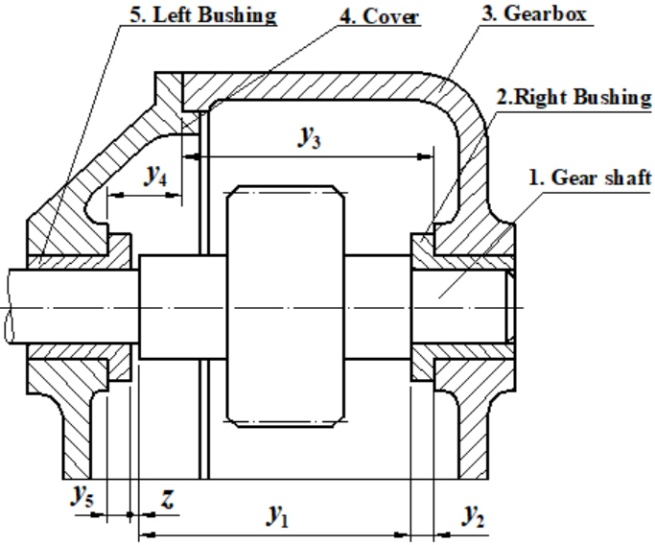
In this section, an example of gear shaft assembly is used to verify the recommended model. The assembly shown in Figure 1 is composed of gear shaft 1, right bushing 2, gearbox 3, cover 4, left bushing 5, etc. The variation of horizontal gap z (assembly characteristic parameter) between the left shoulder of the gear shaft and the right end face of the left bushing needs to be controlled to guarantee the performance of this assembly. Suppose the nominal design dimensions have already been assigned according to the functional requirements of the product, they are: y1=140mm, y2=15mm, y3=125mm, y4=45mm, y5=15mm, respectively. The assembly characteristic parameter is  , (unit: mm). Assume that when the assembly gap z deviates from its design target will lead to product failure and cause a loss of $100.


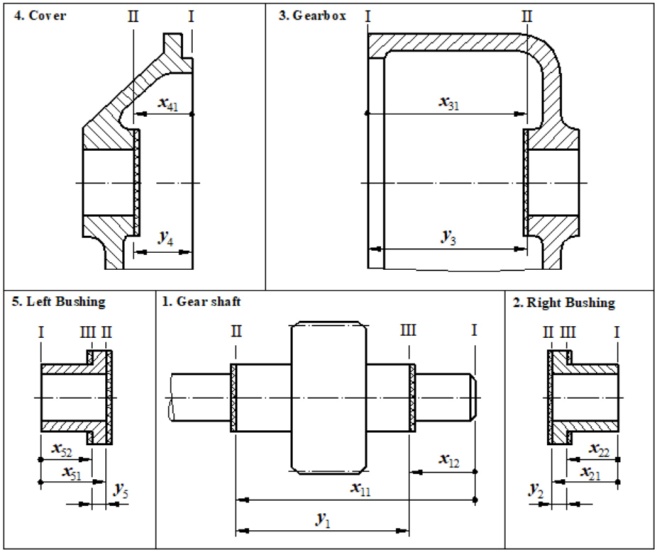
According to the manufacturing processes of parts as shown in Figure 2, the surface features to be machined are all planes, and there are 6-9 alternative manufacturing processes (rough milling, half finish milling, finish milling, rough turning, semi-extractive turning, finish turning, rough grinding, semi-finished grinding, fine grinding) for each process. The two processes of gear shaft 1 are involved in the machining of end surfaces, and the manufacturing processes of which can be turning and grinding; The left end face of right bushing 2 (left bushing 5) is a round plane, and the manufacturing processes used will be milling, turning, and grinding, while its left end face is a toroidal plane, and the manufacturing processes commonly used are turning and grinding; the manufacturing processes for gearbox 3 and cover 4 include milling, turning and grinding. The manufacturing processes of relevant parts and the economical process tolerance ranges are listed in Table 1.
3.2. Objective FunctionAs mentioned above, the objective of this optimization issue is to minimize the total assembly cost. The total assembly cost consists of the production cost and the expected quality loss, in which the production cost is the sum of processing cost of each machining operation for all process dimensions; the expected quality loss can be calculated by using Eq. (21). In this example, the functional requirement of this assembly is guaranteed by a single critical quality characteristic z, the Eq. (21) can be simplified as:
 | (27) |
Assuming that the tolerance interval of assembly characteristic parameter z is located in [-Tz, Tz], and the quality loss due to product failure is Q0, then the quality loss coefficient A11 can be calculated as:
 | (28) |
The two rotational surfaces specified by process dimensions X11 and X12 (the corresponding process tolerances T11 and T12, respectively) can be machined by using turning and surface grinding, the production cost associated with the process dimensions X11 and X12 can be modeled by turning and rotary surface grinding model, which can be respectively represented as follows.
 |
 |
The two rotational surfaces specified by X21 and X22 (the corresponding process tolerances T21 and T22, respectively) can be machined by using the face milling, turning and surface grinding, so the production cost related to process dimensions X21 and X22 can be modeled by using the face milling, turning, and rotary surface grinding model, which will be respectively expressed as follows.
 |
 |
Both flat surfaces specified by process dimensions X31 and X41 (the corresponding process tolerances T31 and T41, respectively) can be machined by using the face milling, turning, and surface grinding, so the production cost associated with process dimensions X31 and X41 can be represented as:
 |
 |
The dimensions of part 2 and part 5 are exactly the same, similar to the process dimensions X21 and X22; we get the production cost associated with process dimensions X51 and X52.
 |
 |
The sum of processing costs of all machining operations constitutes the production cost of the assembly, which can be expressed as:
 |
As shown in Figure 1, the assembly characteristic function of the gear shaft assembly is defined by:
 |
The variance of the variations in assembly characteristic parameter can be obtained from Eq. (10) as follows.
 |
From Eq. (12), we have:
 |
 |
 |
 |
 |
According to the given machining processes of parts, five machining equations can be obtained as follows:
 |
 |
 |
 |
 |
Under stable processing condition, combining Eqs. (14) and (15), we get:
 |
 |
 |
 |
 |
Then we obtain the following relationships:
 |
 |
 |
 |
 |
From Eqs. (27) and (28), the expected loss is expressed as:
 |
And then, the objective function of this optimization problem is formulated as:
 |
It should be noted that in this example we only consider the production cost of the process dimensions involved in assembly functional requirements; and ignore the production cost of other process dimensions, as we adopted the most economical process tolerances for these process dimensions. The same considerations also apply to the expected quality loss.
3.3. Constraint ConditionsSubject to the following constrains:
(1) Assembly function requirement constraint
 |
where Tz is the bilateral tolerance of assembly characteristic size z,  ,
, ,
,  ,
,  ,
,  ,
,  ,
,  ,
,  .
.
(2) Economical process tolerance range constraints
The economical process tolerance ranges are listed in the last column of Table 1.
(3) Manufacturing process selection constraints
 |
 |
 |
 |
 |
 |
 |
 |
where  ,
,
The optimization model developed in this example is a complicated discrete nonlinear optimization model. The programming software MATLAB R2016b was adopted to solve this model.
When Tz is assumed to be 0.08, 0.18, 0.25, and 0.32, respectively, the optimized process tolerances and selected machining processes are listed in Table 2.
The optimized total cost and part design tolerances are listed in Table 3.
By analyzing and comparing the optimization results when Tz is 0.08, 0.18, 0.25, and 0.32, respectively, it can be seen that along with the increase of product assembly function tolerance, the total product cost decreases, and most of the process tolerances and design tolerances increase; In the meanwhile, the manufacturing processes have also changed, showing a trend towards decreasing the economical machining precision.
Most previous studies on concurrent tolerancing allocation have focused on minimizing production cost, quality loss or a combination of both, and paid little attention to the selection of manufacturing processes. In this study, the manufacturing process selection coefficient was introduced into the concurrent tolerance optimization model, and the manufacturing process selection was taken as one of the constraints of the model, so as to achieve the optimization of design and process tolerances while determine the machining processes for parts. The suggested model is validated by an example of gear shaft assembly.
In order to cover more possible applications, further research will involve the integrated optimization of concurrent tolerancing allocation and manufacturing process selection for products with multiple interrelated dimension chains and non-normally distributed process dimensions. Another direction of future research will be directed to the integrated optimization simultaneously including dimensional and geometrical tolerances, even involving material conditions related to both.
The authors would like to acknowledge the financial support of the National Natural Science Foundation of China (Grant No. 52075222).
| [1] | Hallmann M, Schleich B, Wartzack S. From tolerance allocation to tolerance-cost optimization: a comprehensive literature review. Int J Adv Manuf Technol, 2020, 107: 4859-4912. | ||
| In article | View Article | ||
| [2] | Ye B, Salustri F A. Simultaneous tolerance synthesis for manufacturing and quality. Res Eng Des, 2003, 14: 98-106. | ||
| In article | View Article | ||
| [3] | Jeang A. Combined parameter and tolerance design optimization with quality and cost. Int J Prod Res, 2001, 39 (5): 923-952. | ||
| In article | View Article | ||
| [4] | Jeang A, Chung C-P, Hsieh C-K. Simultaneous process mean and process tolerance determination with asymmetrical loss function. Int J Adv Manuf Tech, 2007, 31: 694-704. | ||
| In article | View Article | ||
| [5] | Peng H P, JiangX Q, Liu X J. Concurrent optimal allocation of design and process tolerances for mechanical assemblies with interrelated dimension chains. Int J Prod Res, 2008, 46 (24): 6963-6979. | ||
| In article | View Article | ||
| [6] | Peng H P, Peng Z Q. Concurrent design and process tolerances determination in consideration of geometrical tolerances. Proc IMechE Part C: J Mechanical Engineering Science, 2019, 233 (19-20): 6727-6740. | ||
| In article | View Article | ||
| [7] | Janakiraman V, Saravanan R. Concurrent optimization of machining process parameters and tolerance allocation. Int J Adv Manuf Technol, 2010, 51: 357-369. | ||
| In article | View Article | ||
| [8] | Lu C, Zhao W H, Yu S J. Concurrent tolerance design for manufacture and assembly with a game theoretic approach. Int J Adv Manuf Technol, 2012, 62: 303-316. | ||
| In article | View Article | ||
| [9] | Peng H P. Concurrent tolerancing for design and manufacturing based on the present worth of quality loss. Int J Adv Manuf Technol, 2012, 59: 929-937. | ||
| In article | View Article | ||
| [10] | Balamurugan C, Saravanan A, Babu P D, Jagan S, Narasimman S R. Concurrent optimal allocation of geometric and process tolerances based on the present worth of quality loss using evolutionary optimisation techniques. Res Eng Design, 2017, 28: 185-202. | ||
| In article | View Article | ||
| [11] | Petrović M, Vuković N, Mitić M, Miljković Z. Integration of process planning and scheduling using chaotic particle swarm optimization algorithm. Expert Syst Appl, 2016, 64: 569-588. | ||
| In article | View Article | ||
| [12] | Yu M R, Yang B, Chen Y. Dynamic integration of process planning and scheduling using a discrete particle swarm optimization algorithm. Adv Prod Eng Manag, 2018, 13 (3): 279-296. | ||
| In article | View Article | ||
| [13] | Li X, Gao L, Wang W, Wang C,Wen L. Particle swarm optimization hybridized with genetic algorithm for uncertain integrated process planning and scheduling with interval processing time. Comput Ind Eng, 2019, 135: 1036-1046. | ||
| In article | View Article | ||
| [14] | Demir H I, Erden C. Dynamic integrated process planning, scheduling and due-date assignment using ant colony optimization. Comput Ind Eng, 2020, 149: 106799-106806. | ||
| In article | View Article | ||
| [15] | Ding L, Yue Y, Ahmet K, Jackson M, Parkin R. Global optimization of a feature-based process sequence using GA and ANN techniques. Int J Prod Res, 2005, 43 (15): 3247-3272. | ||
| In article | View Article | ||
| [16] | Yeo S H, Ngoi B K A, Chen H. Process sequence optimization based on a new cost-tolerance model. J Intell Manuf, 1998, 9: 29-37. | ||
| In article | View Article | ||
| [17] | Robles N, Roy U. Optimal tolerance allocation and process-sequence selection incorporating manufacturing capacities and quality issues. J Manuf Syst, 2004, 23 (2): 127-133. | ||
| In article | View Article | ||
| [18] | Geetha K, Ravindran D, Kumar M S, Islam M N. Concurrent tolerance allocation and scheduling for complex assemblies. Robot Cim-Int Manuf, 2015, 35: 84-95. | ||
| In article | View Article | ||
| [19] | Mohapatra P, Nayak A, Kumar S K, Tiwari M K. Multi-objective process planning and scheduling using controlled elitist non-dominated sorting genetic algorithm. Int J Prod Res, 2015, 53 (6): 1712-1735. | ||
| In article | View Article | ||
| [20] | Deja M, Siemiatkowski M S. Machining process sequencing and machine assignment in generative feature-based CAPP for mill-turn parts. J Manuf Syst, 2018, 48: 49-62. | ||
| In article | View Article | ||
| [21] | Ming X, Mak K. Intelligent approaches to tolerance allocation and manufacturing operations selection in process planning. J Mater Process Tech, 2001, 117: 75-83. | ||
| In article | View Article | ||
| [22] | Singh P K, Jain P K, Jain S C. A genetic algorithm-based solution to optimal tolerance synthesis of mechanical assemblies with alternative manufacturing processes: focus on complex tolerancing problems. Int J Prod Res, 2004, 42 (24): 5185-5215. | ||
| In article | View Article | ||
| [23] | Kumar M S, Kannan S M, Jayabalan V. A new algorithm for optimum tolerance allocation of complex assemblies with alternative processes selection. Int J Adv Manuf Technol, 2009,40: 819-836. | ||
| In article | View Article | ||
| [24] | Sivakumar K, Balamurugan C, Ramabalan S. Concurrent multi-objective tolerance allocation of mechanical assemblies considering alternative manufacturing process selection. Int J Adv Manuf Technol, 2011, 53: 711-732. | ||
| In article | View Article | ||
| [25] | Geetha K, Ravindran D, Kumar M S, Islam M N. Multi-objective optimization for optimum tolerance synthesis with process and machine selection using a genetic algorithm. Int J Adv Manuf Technol, 2013, 67: 2439-2457. | ||
| In article | View Article | ||
| [26] | Dong Z, Hu W, Xue D. New production cost-tolerance models for tolerance synthesis. J Eng Indus, 1994, 116: 199-206. | ||
| In article | View Article | ||
| [27] | Lee C L, Tang G R. Tolerance design for products with correlated characteristics. Mech Mach Theory, 2000, 35(12): 1675-1687. | ||
| In article | View Article | ||
Published with license by Science and Education Publishing, Copyright © 2025 Heping Peng, Zhuoqun Peng and Qianpeng Han
 This work is licensed under a Creative Commons Attribution 4.0 International License. To view a copy of this license, visit
http://creativecommons.org/licenses/by/4.0/
This work is licensed under a Creative Commons Attribution 4.0 International License. To view a copy of this license, visit
http://creativecommons.org/licenses/by/4.0/
| [1] | Hallmann M, Schleich B, Wartzack S. From tolerance allocation to tolerance-cost optimization: a comprehensive literature review. Int J Adv Manuf Technol, 2020, 107: 4859-4912. | ||
| In article | View Article | ||
| [2] | Ye B, Salustri F A. Simultaneous tolerance synthesis for manufacturing and quality. Res Eng Des, 2003, 14: 98-106. | ||
| In article | View Article | ||
| [3] | Jeang A. Combined parameter and tolerance design optimization with quality and cost. Int J Prod Res, 2001, 39 (5): 923-952. | ||
| In article | View Article | ||
| [4] | Jeang A, Chung C-P, Hsieh C-K. Simultaneous process mean and process tolerance determination with asymmetrical loss function. Int J Adv Manuf Tech, 2007, 31: 694-704. | ||
| In article | View Article | ||
| [5] | Peng H P, JiangX Q, Liu X J. Concurrent optimal allocation of design and process tolerances for mechanical assemblies with interrelated dimension chains. Int J Prod Res, 2008, 46 (24): 6963-6979. | ||
| In article | View Article | ||
| [6] | Peng H P, Peng Z Q. Concurrent design and process tolerances determination in consideration of geometrical tolerances. Proc IMechE Part C: J Mechanical Engineering Science, 2019, 233 (19-20): 6727-6740. | ||
| In article | View Article | ||
| [7] | Janakiraman V, Saravanan R. Concurrent optimization of machining process parameters and tolerance allocation. Int J Adv Manuf Technol, 2010, 51: 357-369. | ||
| In article | View Article | ||
| [8] | Lu C, Zhao W H, Yu S J. Concurrent tolerance design for manufacture and assembly with a game theoretic approach. Int J Adv Manuf Technol, 2012, 62: 303-316. | ||
| In article | View Article | ||
| [9] | Peng H P. Concurrent tolerancing for design and manufacturing based on the present worth of quality loss. Int J Adv Manuf Technol, 2012, 59: 929-937. | ||
| In article | View Article | ||
| [10] | Balamurugan C, Saravanan A, Babu P D, Jagan S, Narasimman S R. Concurrent optimal allocation of geometric and process tolerances based on the present worth of quality loss using evolutionary optimisation techniques. Res Eng Design, 2017, 28: 185-202. | ||
| In article | View Article | ||
| [11] | Petrović M, Vuković N, Mitić M, Miljković Z. Integration of process planning and scheduling using chaotic particle swarm optimization algorithm. Expert Syst Appl, 2016, 64: 569-588. | ||
| In article | View Article | ||
| [12] | Yu M R, Yang B, Chen Y. Dynamic integration of process planning and scheduling using a discrete particle swarm optimization algorithm. Adv Prod Eng Manag, 2018, 13 (3): 279-296. | ||
| In article | View Article | ||
| [13] | Li X, Gao L, Wang W, Wang C,Wen L. Particle swarm optimization hybridized with genetic algorithm for uncertain integrated process planning and scheduling with interval processing time. Comput Ind Eng, 2019, 135: 1036-1046. | ||
| In article | View Article | ||
| [14] | Demir H I, Erden C. Dynamic integrated process planning, scheduling and due-date assignment using ant colony optimization. Comput Ind Eng, 2020, 149: 106799-106806. | ||
| In article | View Article | ||
| [15] | Ding L, Yue Y, Ahmet K, Jackson M, Parkin R. Global optimization of a feature-based process sequence using GA and ANN techniques. Int J Prod Res, 2005, 43 (15): 3247-3272. | ||
| In article | View Article | ||
| [16] | Yeo S H, Ngoi B K A, Chen H. Process sequence optimization based on a new cost-tolerance model. J Intell Manuf, 1998, 9: 29-37. | ||
| In article | View Article | ||
| [17] | Robles N, Roy U. Optimal tolerance allocation and process-sequence selection incorporating manufacturing capacities and quality issues. J Manuf Syst, 2004, 23 (2): 127-133. | ||
| In article | View Article | ||
| [18] | Geetha K, Ravindran D, Kumar M S, Islam M N. Concurrent tolerance allocation and scheduling for complex assemblies. Robot Cim-Int Manuf, 2015, 35: 84-95. | ||
| In article | View Article | ||
| [19] | Mohapatra P, Nayak A, Kumar S K, Tiwari M K. Multi-objective process planning and scheduling using controlled elitist non-dominated sorting genetic algorithm. Int J Prod Res, 2015, 53 (6): 1712-1735. | ||
| In article | View Article | ||
| [20] | Deja M, Siemiatkowski M S. Machining process sequencing and machine assignment in generative feature-based CAPP for mill-turn parts. J Manuf Syst, 2018, 48: 49-62. | ||
| In article | View Article | ||
| [21] | Ming X, Mak K. Intelligent approaches to tolerance allocation and manufacturing operations selection in process planning. J Mater Process Tech, 2001, 117: 75-83. | ||
| In article | View Article | ||
| [22] | Singh P K, Jain P K, Jain S C. A genetic algorithm-based solution to optimal tolerance synthesis of mechanical assemblies with alternative manufacturing processes: focus on complex tolerancing problems. Int J Prod Res, 2004, 42 (24): 5185-5215. | ||
| In article | View Article | ||
| [23] | Kumar M S, Kannan S M, Jayabalan V. A new algorithm for optimum tolerance allocation of complex assemblies with alternative processes selection. Int J Adv Manuf Technol, 2009,40: 819-836. | ||
| In article | View Article | ||
| [24] | Sivakumar K, Balamurugan C, Ramabalan S. Concurrent multi-objective tolerance allocation of mechanical assemblies considering alternative manufacturing process selection. Int J Adv Manuf Technol, 2011, 53: 711-732. | ||
| In article | View Article | ||
| [25] | Geetha K, Ravindran D, Kumar M S, Islam M N. Multi-objective optimization for optimum tolerance synthesis with process and machine selection using a genetic algorithm. Int J Adv Manuf Technol, 2013, 67: 2439-2457. | ||
| In article | View Article | ||
| [26] | Dong Z, Hu W, Xue D. New production cost-tolerance models for tolerance synthesis. J Eng Indus, 1994, 116: 199-206. | ||
| In article | View Article | ||
| [27] | Lee C L, Tang G R. Tolerance design for products with correlated characteristics. Mech Mach Theory, 2000, 35(12): 1675-1687. | ||
| In article | View Article | ||