A 41-year-old man presented to our hospital with abdominal pain, and a CT scan revealed findings of adhesive ileus and an incidental gas-containing gallstone. Because gas-containing gallstones are uncommon, we presented a literature hypothesis of their pathogenesis.
Gallstones are hardened deposits of cholesterol, bilirubin, and bile in the gallbladder or bile ducts. Although often asymptomatic, they can cause pain, nausea, vomiting, and complications such as cholangitis or pancreatitis, especially after fatty meals. They form when bile components precipitate out, sometimes trapping gas. Unlike gas from emphysematous cholecystitis, gas in gallstones is usually not harmful. 1, 2, 3, 4 This report showed gas in gallstones 8 years after laparotomy.
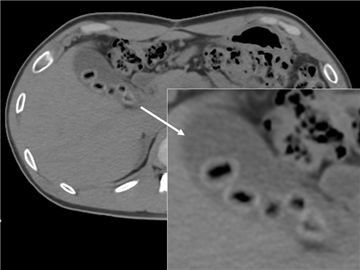
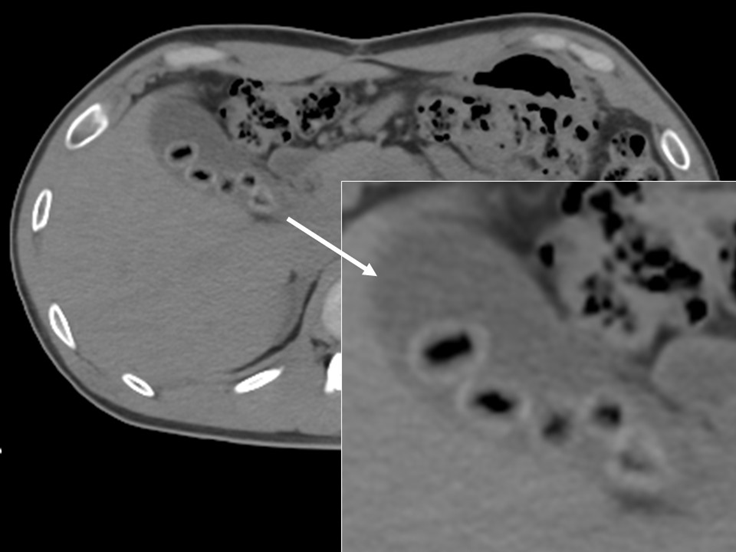
A 41-year-old man, who had undergone an enterotomy for small intestinal injury due to a traffic accident 8 years earlier, became aware of abdominal pain in the morning, which gradually worsened, and in the afternoon he started vomiting with oral intake. He came to our hospital alone. At the time of admission, his consciousness was clear, blood pressure was 128/93 mmHg, respiratory rate was 15 breaths/min, SpO2 was 98%, and pulse was 72 beats/min. Ultrasound showed dilatation of the small bowel and back and forth movement of bowel fluid. Contrast-enhanced CT of the abdomen showed dilatation of the small bowel and formation of a fluid surface, but the mechanism of obstruction was unclear. Secondary findings included a large number of internal low-density gallstones with air and CT values (Figure 1). The patient was hospitalized for conservative management of postoperative adhesive bowel obstruction. The patient's symptoms improved with conservative treatment and he was discharged on day 7.
Several gallstones were found in the gallbladder with low absorption area in the center and oval-shaped high absorption area in the surrounding area. The CT value of the low-absorption area within the gallstones was ROI -32768, the same CT value as the surrounding air, and was determined to be gas.
In the present study, a 41-year-old man presented to our hospital with abdominal pain and a CT scan revealed findings of a rare incidental gas-containing gallstone in addition to adhesive ileus.
Huerta et al performed an institutional review of all patients with gaseous gallstones in the gallbladder over a 16-year period. 2 They identified 5 patients with gaseous gallstones in 1,252 consecutive cholecystectomies; 4 of these had cholecystitis and 1 was an incidental finding.They also reviewed the 30 manuscripts documenting 54 unique patients with gas-containing biliary stones. None of them had subsequent pathology related to gas in the stones other than that caused by the gallstones (i.e., biliary colic and cholecystitis). They concluded that gaseous gallstones are uncommon. Gas-containing gallstones should not be interpreted as free gas within the gallbladder or within an abscess, similar to our asymptomatic case. 2, 4
Regarding the gas composition and mechanisms of formation of gas-containing gallstones, the gas was less than 10% carbon dioxide and less than most component was nitrogen was postulated to be the most common gas within this stone. 2, 5 The gas may form during gallstone development when fissures fill with bile, fluid, or gas.2 It may be produced by the stone itself or enter from the intestine.2 Some gas gets trapped inside stones due to internal fissures or negative pressure during formation. 2
Interestingly, the present case did not have gallstones when he underwent abdominal computed tomography for evaluation of trauma. Little et al. reported that among 73 patients who did not have gallstones on abdominal ultrasound, 12 of 47 who underwent major abdominal surgery had gallstones within 14-36 months after surgery, compared with 0 of 26 who did not undergo such surgery. 6 Major abdominal surgery may accelerate the development of gallstones in some patients. It has been suggested that laparotomy may affect bile secretion and promote gallstone formation.
We reported a case of a 41-year-old man who presented with adhesive ileus, during the evaluation of which an incidental gas-containing gallstone was identified on the CT. Owing to the rarity of such findings, we conducted a literature review and discussed potential pathophysiological mechanisms contributing to the formation of gas-containing gallstones.
This work was supported in part by a Grant-in-Aid for Special Research in Subsidies for ordinary expenses of private schools from The Promotion and Mutual Aid Corporation for Private Schools of Japan.
We do not have conflict of interest to declare.
YY wrote the manuscript with support from RT, CM, NT, & KN.
| [1] | Jones MW, Weir CB, Ghassemzadeh S. Gallstones (Cholelithiasis). StarPearls Last Update: August 17, 2024. | ||
| In article | |||
| [2] | Huerta S, Kakati R, Lanier H. Gas-Containing Biliary Calculi: Case Series and a Systematic Review. Am Surg. 2023 Jun; 89(6): 2656-2664. | ||
| In article | View Article PubMed | ||
| [3] | Marshall-Webb M, Fosh B. Gas-containing gallstones: a radiological finding. ANZ J Surg. 2017 Dec; 87(12): E323-E324. | ||
| In article | View Article PubMed | ||
| [4] | Sitaridis K, Domi I, Nathanailidou M, Chatzigiannis G, Boulas KA, Sourtse G, Hatzigeorgiadis A. Air in gallbladder: Emphysematous cholecystitis or else? Clin Case Rep. 2023 Mar 27; 11(3): e6391. | ||
| In article | View Article PubMed | ||
| [5] | Kommerell, B., and Wolpers, C. Gashaltige Gallensteine. Fortschr Rontgenstr. 1938; 58, 156-174. | ||
| In article | |||
| [6] | Little JM, Avramovic J. Gallstone formation after major abdominal surgery. Lancet. 1991 May 11; 337(8750): 1135-7. | ||
| In article | |||
Published with license by Science and Education Publishing, Copyright © 2025 Youichi Yanagawa, Raiki Tokutsu, Chihiro Maekawa, Noriko Tanaka and Kousuke Natsume
 This work is licensed under a Creative Commons Attribution 4.0 International License. To view a copy of this license, visit
http://creativecommons.org/licenses/by/4.0/
This work is licensed under a Creative Commons Attribution 4.0 International License. To view a copy of this license, visit
http://creativecommons.org/licenses/by/4.0/
| [1] | Jones MW, Weir CB, Ghassemzadeh S. Gallstones (Cholelithiasis). StarPearls Last Update: August 17, 2024. | ||
| In article | |||
| [2] | Huerta S, Kakati R, Lanier H. Gas-Containing Biliary Calculi: Case Series and a Systematic Review. Am Surg. 2023 Jun; 89(6): 2656-2664. | ||
| In article | View Article PubMed | ||
| [3] | Marshall-Webb M, Fosh B. Gas-containing gallstones: a radiological finding. ANZ J Surg. 2017 Dec; 87(12): E323-E324. | ||
| In article | View Article PubMed | ||
| [4] | Sitaridis K, Domi I, Nathanailidou M, Chatzigiannis G, Boulas KA, Sourtse G, Hatzigeorgiadis A. Air in gallbladder: Emphysematous cholecystitis or else? Clin Case Rep. 2023 Mar 27; 11(3): e6391. | ||
| In article | View Article PubMed | ||
| [5] | Kommerell, B., and Wolpers, C. Gashaltige Gallensteine. Fortschr Rontgenstr. 1938; 58, 156-174. | ||
| In article | |||
| [6] | Little JM, Avramovic J. Gallstone formation after major abdominal surgery. Lancet. 1991 May 11; 337(8750): 1135-7. | ||
| In article | |||