Cutaneous larva migrans (CLM) is parasitic skin infestation caused by hookworm larvae. This case report describes a 4‑year‑old boy and compares albendazole versus mebendazole treatment.
Cutaneous larva migrans (CLM) is a parasitic skin infection predominantly caused by the larvae of animal hookworms, particularly Ancylostoma braziliense, and is most commonly encountered in tropical and subtropical regions 1.
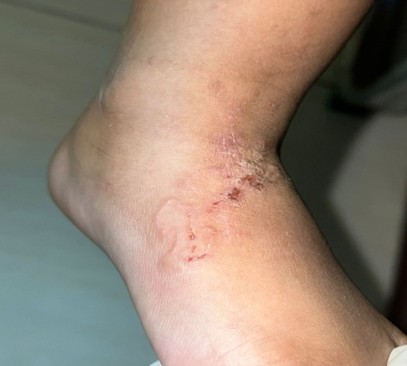
It manifests as a pruritic, serpiginous (snake-like) skin lesion due to larval migration in the epidermis. This case describes CLM in a 4-year-old boy from Jazan.
A 4-year-old boy from a rural area in Saudi Arabia presented with a highly itchy skin lesion on his left foot. The lesion was initially misdiagnosed as a fungal infection. Over time, it expanded into a serpiginous, erythematous track, becoming intensely pruritic. The child’s family lived in poor socioeconomic conditions, and he frequently walked barefoot in an area with many domestic and stray dogs, a known risk factor for CLM due to soil contamination with hookworm larvae. The lesion is shown below in Figure 1.
The diagnosis was made clinically based on the characteristic serpiginous lesion and the patient’s history of barefoot exposure in a high-risk environment. Laboratory tests were not detailed in this case, but CLM diagnosis typically relies on clinical presentation rather than invasive tests, as biopsies rarely detect the larvae which located 1–2 cm ahead of the lesion.
Due to the unavailability of albendazole in the primary care setting, the patient was referred to dermatology. The child was treated with oral albendazole 400 mg daily for 7 days and antihistamines to manage pruritus, and the symptoms resolved completely within a week.
The clinical management of CLM relies heavily on accurate diagnosis and effective pharmacological intervention. Among the available anthelmintic agents, albendazole and mebendazole are frequently employed. This discussion aims to compare the efficacy and utility of albendazole and mebendazole in the treatment of CLM, while also examining the diagnostic approaches utilized in clinical practice.
The diagnosis of CLM is primarily clinical, based on the recognition of characteristic skin lesions and relevant exposure history. Patients typically present with erythematous, serpiginous, and pruritic cutaneous eruptions, often localized to the lower extremities, as observed in the prospective study by Caumes et al 2. The lesions are usually linear or serpentine, with a papular tip, and are associated with intense itching. A history of walking barefoot or exposure to contaminated soil is a significant epidemiological clue 3.
Laboratory investigations, including total and differential blood counts, peripheral blood smear, and chest X-ray, are generally non-specific and are primarily used to rule out systemic involvement or alternative diagnoses. Eosinophilia may be present in rare cases, particularly if there is systemic migration of larvae 4. However, as demonstrated in the presented case, routine investigations often yield normal results, and the diagnosis remains clinical 5. Biopsy may be considered in atypical cases or when the diagnosis is uncertain, but it is not routinely required 6. Differential diagnoses include bacterial and fungal infections, as well as other parasitic diseases, necessitating careful clinical evaluation.
3.1. Albendazole Versus Mebendazole: Comparative Efficacy and ConsiderationsAlbendazole is a broad-spectrum anthelmintic that has demonstrated high efficacy in the treatment of CLM. In the case reported by Neupane et al 5. a regimen of albendazole 400 mg once daily for seven days resulted in significant regression of the lesion and resolution of pruritus. This outcome is consistent with previous studies, which have shown that albendazole is effective in eradicating the larvae and alleviating symptoms 7. Albendazole acts by inhibiting microtubule synthesis in the parasite, leading to impaired glucose uptake and eventual death of the larvae.
The advantages of albendazole include its high bioavailability, favorable safety profile, and the convenience of once-daily dosing. Moreover, albendazole is effective against a broad range of helminths, making it a versatile option in regions where polyparasitism is common.
Mebendazole is another benzimidazole derivative with anthelmintic properties, commonly used in the management of various helminthic infections, including CLM. Like albendazole, mebendazole disrupts microtubule formation in the parasite. However, its efficacy in CLM is generally considered to be lower compared to albendazole, particularly due to its poor absorption from the gastrointestinal tract, which may limit its effectiveness against tissue-migrating larvae 3.
Mebendazole is typically administered at a dose of 100 mg twice daily for three days, but longer courses may be required in some cases. While it is generally well-tolerated, the need for multiple daily doses and potentially prolonged treatment duration may affect patient compliance. Furthermore, some studies have reported suboptimal cure rates with mebendazole, especially in cases of extensive or persistent CLM 7.
When comparing albendazole and mebendazole, several factors favor the use of albendazole as the first-line agent for CLM. Albendazole’s superior tissue penetration, higher cure rates, and shorter treatment duration contribute to its preference in clinical practice 7. In contrast, mebendazole may be considered in settings where albendazole is unavailable or contraindicated, but clinicians should be aware of its limitations.
The case presented by Neupane et al. 5 further supports the efficacy of albendazole, as the patient experienced complete resolution of symptoms and regression of the lesion within a week of therapy. This rapid response underscores the clinical utility of albendazole in the management of CLM.
In summary, the diagnosis of cutaneous larva migrans is predominantly clinical, relying on the recognition of characteristic skin lesions and relevant exposure history. Laboratory investigations are generally non-contributory, and biopsy is reserved for atypical cases. In terms of pharmacological management, albendazole demonstrates superior efficacy, tissue penetration, and patient compliance compared to mebendazole, making it the preferred agent for CLM. The case report by Neupane et al. 5 exemplifies the successful use of albendazole, highlighting its role as the treatment of choice. Clinicians should remain vigilant for CLM in patients with compatible clinical presentations and exposure histories, and initiate prompt therapy to ensure rapid resolution of symptoms.
The authors wish to express their gratitude to the Eastern Health Cluster, Dammam Health Network, for their continuous support in patient care and clinical documentation. Special appreciation is extended to the dermatology consultants for their contributions to the management of this case
| [1] | Heukelbach, J., and Feldmeier, H., “Epidemiological and clinical characteristics of hookworm-related cutaneous larva migrans,” The Lancet Infectious Diseases, 8(5), 302–309, 2008. | ||
| In article | View Article PubMed | ||
| [2] | Caumes, E., Carrière, J., Guermonprez, G., et al., “Dermatoses associated with travel to tropical countries: a prospective study of the diagnosis and management of 269 patients presenting to a tropical disease unit,” Clinical Infectious Diseases, 20(3), 542–548, 1995. | ||
| In article | View Article PubMed | ||
| [3] | Jelinek, T., Maiwald, H., Nothdurft, H. D., et al., “Cutaneous larva migrans in travelers: synopsis of histories, symptoms, and treatment of 98 patients,” Clinical Infectious Diseases, 19(6), 1062–1066, 1994. | ||
| In article | View Article PubMed | ||
| [4] | Schaub, N. A., Perruchoud, A. P., and Buechner, S. A., “Cutaneous larva migrans associated with Löffler’s syndrome,” Dermatology, 205(2), 207–209, 2002. | ||
| In article | View Article PubMed | ||
| [5] | Neupane, S. K., Shah, S., Neupane, P. K., and Jaishi, P. P., “Cutaneous larva migrans: A case report successfully treated with albendazole,” Annals of Medicine and Surgery, Article 104904, 2022. | ||
| In article | View Article | ||
| [6] | Hochedez, P., and Caumes, E., “Hookworm-related cutaneous larva migrans,” Journal of Travel Medicine, 14(5), 326–333, 2007. | ||
| In article | View Article PubMed | ||
| [7] | Rizzitelli, G., Scarabelli, G., and Veraldi, S., “Albendazole: a new therapeutic regimen in cutaneous larva migrans,” International Journal of Dermatology, 36(9), 700–703, 1997. | ||
| In article | View Article PubMed | ||
Published with license by Science and Education Publishing, Copyright © 2025 Esraa Alabdulaal, Eman Albahhar, Horeia Alfaraj and Zainab Albahhar
 This work is licensed under a Creative Commons Attribution 4.0 International License. To view a copy of this license, visit
http://creativecommons.org/licenses/by/4.0/
This work is licensed under a Creative Commons Attribution 4.0 International License. To view a copy of this license, visit
http://creativecommons.org/licenses/by/4.0/
| [1] | Heukelbach, J., and Feldmeier, H., “Epidemiological and clinical characteristics of hookworm-related cutaneous larva migrans,” The Lancet Infectious Diseases, 8(5), 302–309, 2008. | ||
| In article | View Article PubMed | ||
| [2] | Caumes, E., Carrière, J., Guermonprez, G., et al., “Dermatoses associated with travel to tropical countries: a prospective study of the diagnosis and management of 269 patients presenting to a tropical disease unit,” Clinical Infectious Diseases, 20(3), 542–548, 1995. | ||
| In article | View Article PubMed | ||
| [3] | Jelinek, T., Maiwald, H., Nothdurft, H. D., et al., “Cutaneous larva migrans in travelers: synopsis of histories, symptoms, and treatment of 98 patients,” Clinical Infectious Diseases, 19(6), 1062–1066, 1994. | ||
| In article | View Article PubMed | ||
| [4] | Schaub, N. A., Perruchoud, A. P., and Buechner, S. A., “Cutaneous larva migrans associated with Löffler’s syndrome,” Dermatology, 205(2), 207–209, 2002. | ||
| In article | View Article PubMed | ||
| [5] | Neupane, S. K., Shah, S., Neupane, P. K., and Jaishi, P. P., “Cutaneous larva migrans: A case report successfully treated with albendazole,” Annals of Medicine and Surgery, Article 104904, 2022. | ||
| In article | View Article | ||
| [6] | Hochedez, P., and Caumes, E., “Hookworm-related cutaneous larva migrans,” Journal of Travel Medicine, 14(5), 326–333, 2007. | ||
| In article | View Article PubMed | ||
| [7] | Rizzitelli, G., Scarabelli, G., and Veraldi, S., “Albendazole: a new therapeutic regimen in cutaneous larva migrans,” International Journal of Dermatology, 36(9), 700–703, 1997. | ||
| In article | View Article PubMed | ||