The aim of the study is to analyze the understanding of rainfed rice growers of climate variability in the Tiassalé department, identify the climatic risks to which rainfed rice is exposed, characterize the degree of vulnerability of rice crops, soils, and rice growers to climate variability, identify the means available to rice growers to cope with new climate variations in their area and propose new adaptation strategies to reinforce those already available. The study involved a random sample of 200 rainfed rice farmers in 20 localities in the Tiassalé department in southern Ivory Coast. The results of the study indicate that the rice growers are fully aware of the variability of the climate in their localities. This variability is reflected in the scarcity of rain, the shortening of rainy seasons, the lengthening of dry seasons, the frequency of pockets of drought during rainy seasons, and the rise in air temperature. The direct consequence of this is a fall in yields and therefore in rice growers' incomes, leading to a gradual abandonment of rice growing in favor of other, more profitable activities. This can threaten local and even national self-sufficiency in rice. Faced with the new climate conditions, rice growers have adopted various adaptation strategies, such as changing sowing and harvesting dates and diversifying their sources of crop income (food crops, industrial crops, trade, livestock, etc.). However, despite the endogenous strategies adopted, rice growers are still unable to cope effectively with the effects of climate variability on their activity. Scientific research is therefore needed to provide rainfed rice growers in the Tiassalé department with new strategies to help reduce their vulnerability and thus increase their ability to adapt to climate variability in their region
The global climate is constantly changing, mainly due to an increase in the greenhouse effect in recent years. 42% of historical greenhouse gas emissions occurred in the period 1990-2019 alone 1. This is leading to extreme weather events such as heatwaves, droughts and floods, with enormous social, economic and ecological consequences.
Global warming is expected to reach at least +2 °C by the end of the century. Extreme temperatures are set to increase between now and 2100, and projected scenarios suggest an increase of up to +4°C 1. On a continental scale, Africa has experienced a rise in temperature of between 0.6°C and 0.7°C. At regional level, West Africa has experienced a temperature rise of between 0.2°C and 0.8°C 2.
West Africa is one of the most vulnerable regions in the world to climate change. The alarming frequency of extreme droughts, floods, heat waves and their impacts over the last 30 years demonstrates the seriousness of the situation 3.
Ivory Coast, located in West Africa, is not immune to this phenomenon. Its climate is highly variable 4, 5, 6, 7, 8, 9. Various authors have highlighted the existence of climate variability, with rainfall deficits ranging from 11 to 28% 6, 9, 10, 11. This is reflected in a downward trend in rainfall, rising temperatures, dry soils, shorter rainy seasons, strong winds during the rainy seasons, disruption of the seasons and therefore of the cropping calendars, all of which threaten to increase rice growers' incomes and local food security. Rainfed rice occupies 85% of sown land, contributing 90% to national production. It is the most widespread in the country, with 693,297 hectares sown in 2023, compared to 30,213 hectares for irrigated rice 12. It is highly dependent on rainfall, and is therefore considerably affected by climate variability. Rice is the fourth most important food crop in Ivory Coast, and with its culinary and economic advantages, coupled with rapid urbanisation over a long period, it has become the main staple for almost all the population. In 2022, annual rice consumption was 84kg per capita. Despite producing 1.3 million tonnes of rice, Ivory Coast has had to rely on imports to meet 50% of its population's consumption needs for more than three decades. Imports rose from 756,681 tonnes of milled rice in 2008 to 1,281,287 tonnes in 2016 and 1,562,897 tonnes of milled rice in 2022. These imports come from Thailand (37%), Vietnam (24%) and India (22%) 12. The estimated cost is more than 103 billion CFA francs. Yields on rice farms are often very low, mainly due to the low capacity of rice growers to adapt to climate variability. Rainfall variability and difficulties in identifying the right start and end dates for the seasons are among the main factors reducing yields in rainfed rice farming. Errors in assessing the conditions required for sowing often lead to water stress in rice plants, which can prevent germination or the emergence of seedlings, and sometimes to abortion of seedlings. This often forces rice growers to resow. It is in this context that this study was initiated, with the aim of helping to reduce the vulnerability of rainfed rice growers in the Tiassalé department to the effects of climate variability, by proposing measures to increase their capacity to adapt to the new climate conditions in their region.
Specifically, the aim will be to analyze the understanding that rice-growing stakeholders in Tiassalé department have of climate variability, to characterize the climatic risks of rainfed rice, to analyze the vulnerability of rice-growers in the Tiassalé district to climate variability and, finally, to suggest strategies for coping with the effects of climate variability in their area.
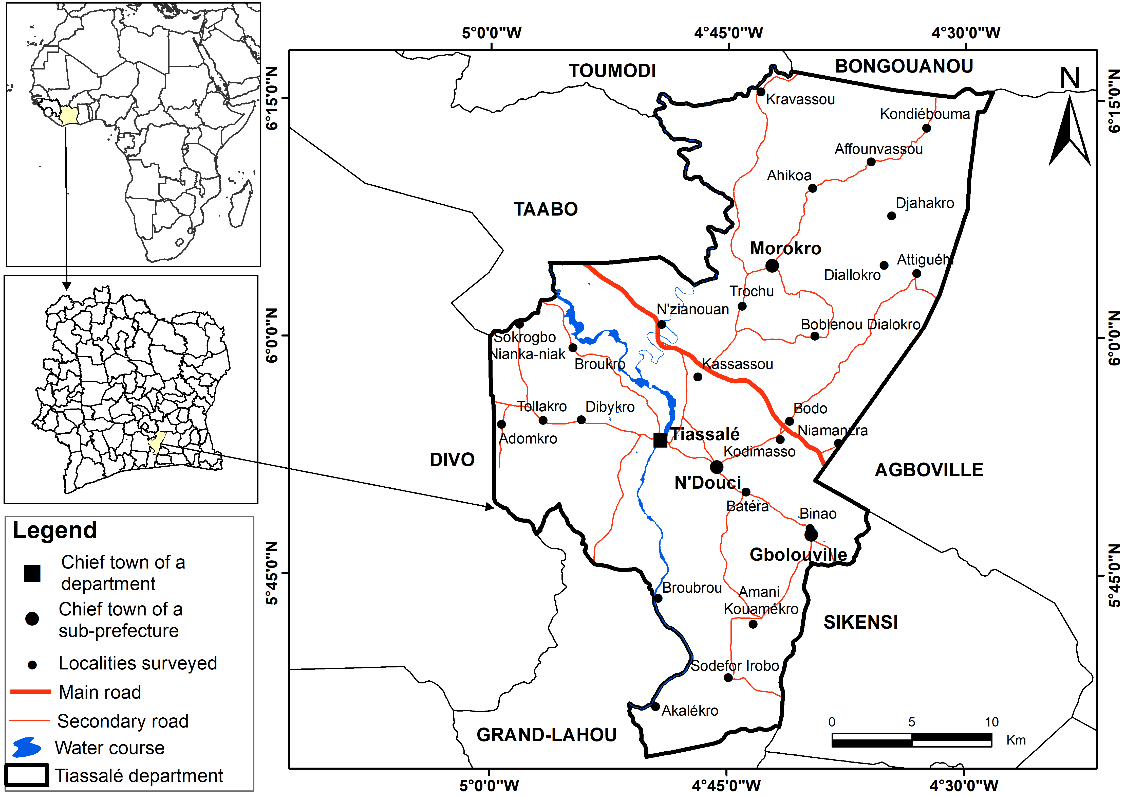
Tiassalé department is located in the south of Ivory Coast in the Agnéby-Tiassa region between latitudes 5°32 and 6°24 north and longitudes 4°29 and 5°14 west. It is bordered to the north by the departments of Toumodi and Bongouanou, to the south by the departments of Grand-Lahou and Sikensi, to the east by the department of Agboville and to the west by the department of Divo (Figure 1). It comprises fifty-five villages and covers an area of 2,490.81 km². It has an estimated population of 278,954 13, spread across four sub-prefectures: Tiassalé, N'douci, Morokro and Gbolouville. The town of Tiassalé is the departmental capital. The rainfall pattern in Tiassalé department is of the transitional equatorial type. This climate, also known as the ‘attiéen climate’, is characterized by two alternating rainy and dry seasons, with a long rainy season from March to July, a short dry season in August, a short rainy season from September to November and a long dry season from December to February. The climate is generally favorable for farming. The department of Tiassalé has a generally flat topography, consisting mainly of plains, flat-bottomed valleys, hill chains and poorly drained valleys creating lowlands where rainfed lowland rice is grown. It is made up of ferrallitic soils, hydromorphic mineral soils, and soils that are not very advanced.
The vegetation is pre-forest and transitional, consisting of dense forest in the south of the department and wooded savannah in the north. The area is also characterized by a very dense hydrographic network comprising the Bandama river and its tributary, the N'zi. Hydrogeologically, the Tiassalé department is home to alterite and fissure aquifers. The geology of the area is made up of meta-sedimentary, volcanic and plutonic rocks.
The main economic activities in Tiassalé are agriculture (coffee, cocoa, pineapple, rubber, oil palm, rice, cassava, plantain, yams, etc.), industry (sawmills, SCB, BABACI, SIAPA, BATIA, etc.), fishing and livestock farming 14.
As data, we used audio recordings from interviews with resource persons and survey forms from rice farmers.
Documentary research data were also obtained from Rice Sector Development Agency (ADERIZ) and National Agency for Rural Development Support (ANADER).
Three (3) software packages were used to process the data:
- ArcGis 10.5: GIS software. It was used to create the thematic maps.
- Sphinx Plus²: used to create the survey questionnaire, analyze the survey forms and analyze the results.
- Excell: used to generate diagrams.
3.2. MethodologyData collection began with a pre-survey, which consisted of conducting a preliminary survey on March 3, 2018 on a restricted sample of 15 rice farmers in the locality of Tiassalékro (town center of the Tiassalé sub-prefecture) in order to validate our research hypotheses and also to specify the scope of the questionnaire and precode the responses.
To understand farmers' perceptions of climate variability in the Tiassalé department, two approaches were adopted: a quantitative study and a qualitative study. The qualitative study was first carried out using an interview guide consisting of around ten open-ended questions through interviews with resource persons, namely the chairmen of the Tiassalé Food Producers' Cooperative (ECPVT) and Tiassalé rice growers' cooperative (CODERIZ) now Simplified Cooperative Society of Tiassalé Rice Producers (SCOOPSRIT), the Regional Delegate of ADERIZ of the Agnéby-Tiassa region, the ANADER Zone Commander for the Tiassalé department and the Head of the ANADER technical support service for rice growers in the Tiassalé department.
Three focus groups were also carried out: the first on March 9, 2018 with 12 rice growers aged over 50 from the ECPVT cooperative; the second on June 9, 2021 with 15 rice growers aged between 35 and 45 from the ECPVT cooperative at their headquarters in Tiassalé; and the third on August 22, 2024 in the center of Ndouci with a group of 11 rice growers.
The quantitative study was carried out by means of a questionnaire in the form of forms sent directly to the rice growers. The questionnaire consisted of 85 single-choice, multiple-choice, and short open-ended questions. The surveys were carried out over three periods: March 2018, June 2021 and August 2024. Our sample was based on a sampling frame of 1,200 rainfed rice farmers from the ANADER and ADERIZ censuses in the Tiassalé department. Application of the formula in equation 1, taken from the work of 15, enabled us to estimate the size of the sample of rice farmers to be surveyed at 200 persons.
 |
With:
n = minimum sample size;
Zα/2 = 1.96 which corresponds to the 95% confidence level;
 : desired margin of error of 5%;
p: proportion of the population aged 35 or over.
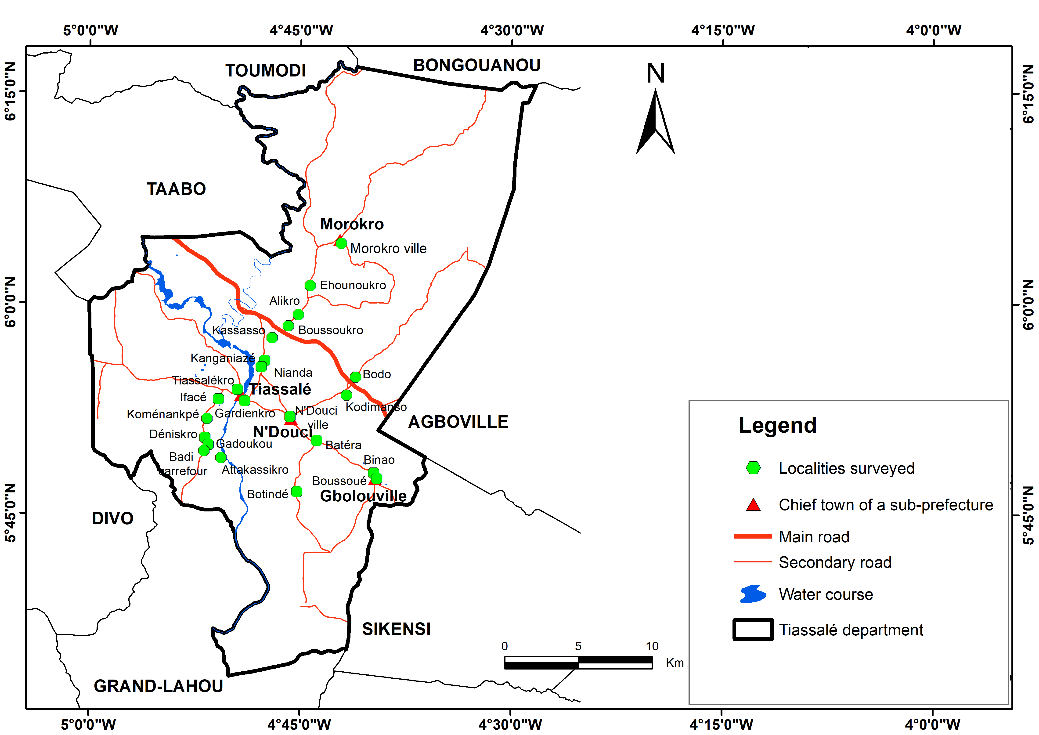
The 200 rainfed rice farmers in the Tiassalé department were selected using a methodology combining both purposive and random sampling, respecting the age criterion of over 35 years and the criteria of seniority in the area and in rainfed rice production, which are respectively at least ten years of seniority in the area and at least five years of seniority in rainfed rice cultivation. The survey was conducted individually and the questionnaire was semi-open-ended with a few open-ended questions. The choice of localities was based on interviews with the heads of rice-growing structures in the department, i.e. the presidents of cooperatives and Aderiz. The survey was carried out in the 20 localities (Figure 2).

The responses were processed in several stages. The tool used throughout the survey process was Sphinx Plus² software, which was used to design the questionnaire, analyze the survey forms, and analyze and disseminate the results. Each variable was described by flat sorting through the percentage of responses for each modality. The statistical processing of the results was completed for greater precision using Excell software, which was used to produce the various diagrams.
Climate varies over time from one season to the next, from one year to the next, from one decade to the next, from one hundred years to thousands of years.
For the purposes of operational climate monitoring, the OMM recommends the adoption of a rolling 30 years period updated every 10 years 16. Indicators of the existence of variability in the Tiassalé district were determined by rainfed rice growers in the district over a period of 30 years in the past and 10 years in the present. The questions focused on the increase in air temperature, the start and end periods of the rainy and dry seasons, the lengths of the rainy and dry seasons, and the amount and intensity of rain during the rainy seasons, the existence of pockets of drought during the rainy seasons, the occurrence of heavy rain accompanied by violent winds, and the frequency of flooding and soil erosion during the rainy seasons, both in the past (30 years ago) and currently (over the last 10 years).
Climate risk assessment is the approach recommended by the ‘Groupe d’Experts Intergouvernemental sur l’Evolution du Climat’ (GIEC) to decision-making in the context of climate change 17, 18.
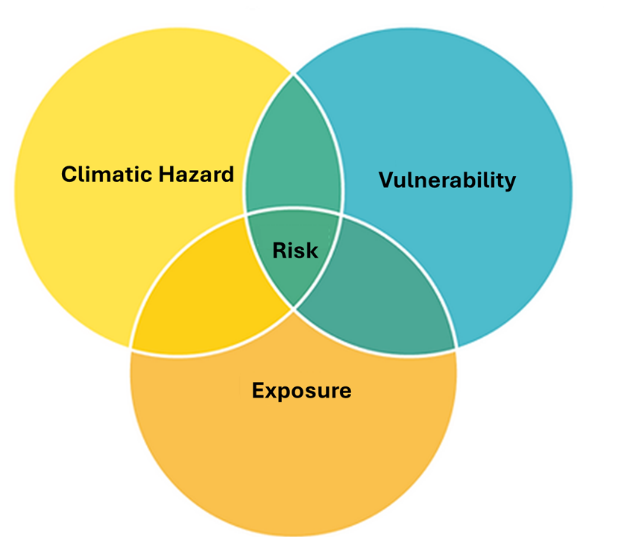
In its sixth report 19, the GIEC identified a number of climate risks that could have a negative impact on agriculture, including rising temperatures and drying out of the soil, which could adversely affect the development of plants; episodes of intense precipitation, such as heavy rains, which could destroy entire harvests if they occur at the wrong time, and which could also generate a risk of flooding that could devastate arable land; the development of certain diseases affecting plants or the proliferation of harmful insects caused by changes in climatic conditions; the shortening of agricultural seasons, making it difficult for crops to complete their development cycle; etc. In its summary report of the 6th Assessment Report (AR6), the GIEC defines risk as the product of hazard, vulnerability and exposure (Figure 3).

Climate risks were determined on the basis of the survey results. The probabilities of occurrence were determined on the basis of the proportions of respondents' answers. A risk matrix was drawn up not only to prioritize actions by identifying risks requiring immediate attention, but also to facilitate the optimal allocation of resources. By providing a clear representation of the risks, ranked by probability and impact, it enables decision-makers to better understand the issues and make informed choices. The probability of occurrence of each risk is expressed in the GEC reports 20, 21 using the standard terminology shown in Table 1. Background colors and values have been assigned to the different probabilities of occurrence in order to characterize them according to the classification resulting from the GIEC and the work of 22 (Table 2 and Table 3).
The impacts of identified climatic hazards on rainfed rice production in Tiassalé department were determined from the results of qualitative and quantitative surveys of rainfed rice producers and resource persons interviewed in Tiassalé department. The people interviewed only mentioned negative impacts. For this reason, we will only deal with the negative consequences in our study. These are the impacts of climate variability on soils, rice plants and the rice growers themselves. The socio-economic impacts focused on rice growers' satisfaction with the selling prices of their products, the extent to which their needs were covered by the income from their farming activities and the way in which they managed to survive.
These results were combined with information obtained from documentary research on rainfed rice growing in Tiassalé department. By cross-referencing the level of severity of the negative consequence of the climate risk (Table 4) with the probability of occurrence of the climate risk, we obtain the degree of impact matrix. Each level of severity of the negative impact, which may be minor, moderate, major or severe, is associated with a colored background (Table 5).
Thus, a climate risk that is very unlikely to occur and is likely to have minor negative consequences will have a low level of negative impact, whereas a climate risk that is very likely to occur and is likely to have major negative consequences will have a high level of negative impact.

Adaptation to climate change is a process by which communities and ecosystems adjust to changes and associated effects, in order to limit the negative consequences. Depending on the availability of means of responding to climate risks indicated by rice growers and resource persons during the surveys, and the level of severity of the negative consequences of these risks (derived from documentary research and survey results), adaptive capacity may be non-existent, low, medium or high. A background color and values inspired by the classifications of 22 and 21 were associated with each level of adaptive capacity (Table 6). Adaptive capacity is said to be high when the rice growers' response to climate risk is between 67% and 90%. It will be said to be medium if the proportion of adaptive responses is between 33% and 66%, and low if it is between 1% and 32%.
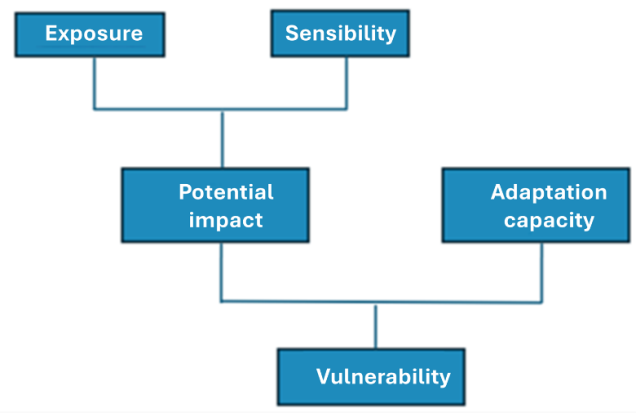
According to the GIEC Fourth Assessment Report (AR4), vulnerability is the degree to which a system is susceptible to, or unable to cope with, adverse effects of climate change, including climate variability and extremes 20. According to Adelphi and Eurac, it is made up of four key elements: exposure, sensitivity, potential impact and adaptive capacity (Figure 4) 23, 24.
The vulnerability matrix is thus obtained by cross-referencing the potential impacts of the risks with the capacity of rice growers to adapt. The results of the work by Cobon et al have enabled us to assign colored backgrounds corresponding to the different levels of vulnerability, which can be low, moderate or high (Table 7).
Vulnerability is said to be low when the potential impacts are low and the ability to adapt is low, moderate or high, or when the potential impacts are moderate but the ability of rice growers to adapt is high. Vulnerability is said to be high when the potential impacts of climatic risks are high or extreme and rice growers' capacity to adapt is low or moderate.
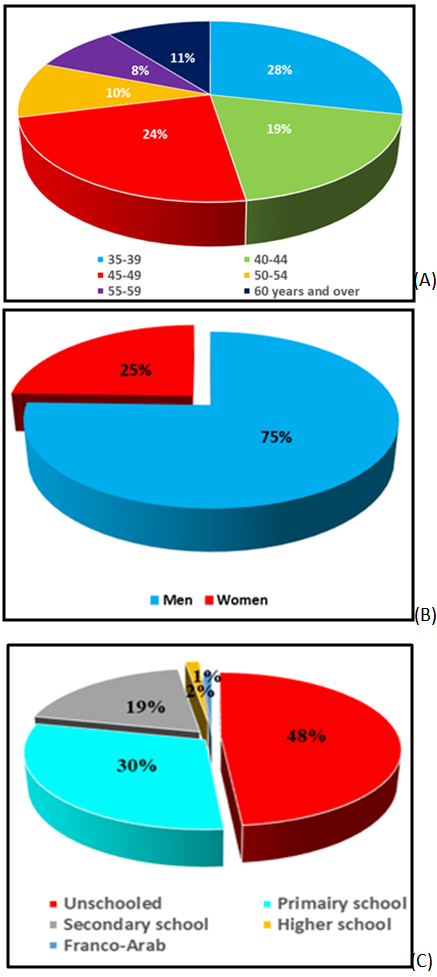
Of the 200 rice farmers surveyed, 75% were men and 25% women (Figure 5a) and most were aged between 35 and 39 (Figure 5b). Most of the rice farmers surveyed were married (82%) with dependent children (90%). On average, there were between 3 and 5 dependent children per rice-farming family surveyed (42% of respondents). 14.5% of respondents had between 6 and 10 dependent children.
Just over half of the rice growers surveyed had attended school (52%) and 30% had not gone beyond primary school (Figure 5c). 51% of the rice farmers surveyed had between 10 and 24 years’ experience of growing rainfed rice. 22% had been growing rice for between 10 and 14 years. 43% of respondents had fields of 1 hectare, while 31% had rice fields of 0.5 hectare. One in two respondents has lived in the Tiassalé department for more than 35 years. 25.5% have lived there between 35 and 40 years, and 23.5% have lived there for more than 40 years.

In the past, more than 80% of rice growers said that they had observed two dry seasons and two rainy seasons, compared with 69% at present. 5% of respondents mentioned the existence of only two seasons in the past, i.e. a rainy season and a dry season, compared with 11.5% at present. Around 10% of respondents thought that there were currently three seasons, including two rainy seasons and one dry season, both in the past and at present. 7% of respondents said that they found it increasingly difficult to distinguish the seasons during the year.
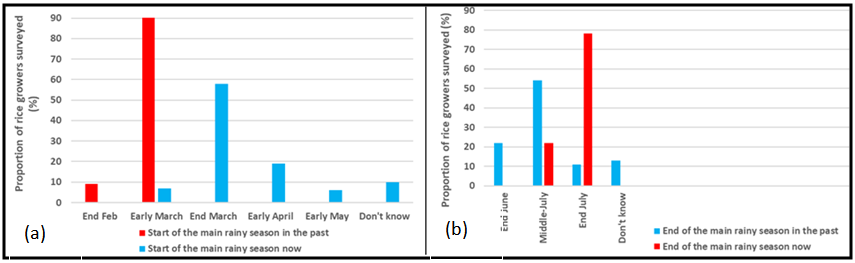
With regard to the start and end of the rainy season, 91% of rice growers felt that the main rainy season used to start at the beginning of March and 9% at the end of February. At present, 58% of those surveyed said that it began towards the end of March, 19% at the beginning of April and 6% thought that the main rainy season began at the beginning of May. 10% said they could no longer determine the start of the main rainy season (Figure 6b).
In the past, 22% of rice growers said that the main rainy season ended in mid-July and 78% at the end of July. Currently, 22% of rice growers think that the main rainy season ends early at the end of June, 54% in mid-July and 11% at the end of July. 13% of respondents are no longer able to determine when the main rainy season ends (Figure 6b).
In the past, the short rainy season started at the beginning of September according to 88% of respondents and mid-September according to 12%. Currently, 71% of the rice growers surveyed maintain that the short rainy season starts at the end of September, while 14% think that it starts at the beginning of October. 9% could no longer determine when the short rainy season begins.
In the past, the short rainy season ended at the end of November according to 84% of respondents, and at the beginning of December according to 16%. Today, 54% of respondents say that it ends earlier, in mid-November, while 28% say it ends at the end of November. In addition, 14% of rice growers say that they are currently unable to determine the exact end of the short rainy season.


The rice growers surveyed were almost unanimous in stating that there was a downward trend in rainfall, reflected in a shortening of the rainy seasons observed by just over 81% of them, and a decline in the frequency of rainfall during the rainy seasons identified by 78% of respondents, although there have been exceptional years with rainfall surpluses. They also noted that there have been more frequent breaks in the rainfall in recent years, resulting in a drop in the number of rainy days.
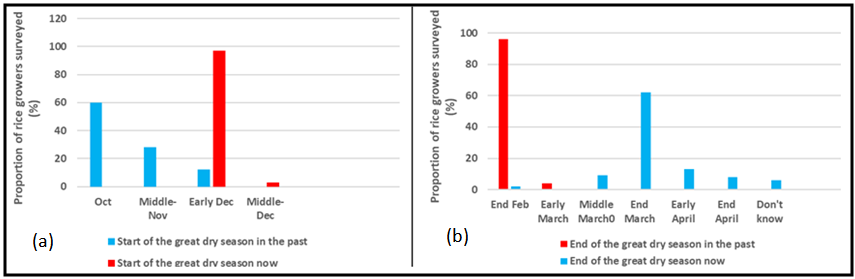
With regard to past dry seasons, 97% of the rice growers surveyed estimated that the main dry season began at the beginning of December and ended at the end of February, according to 96% of them. Today, 60% of farmers say that it begins in mid-November, 28% in early December and 12% in mid-December (Figure 7a). The end of the long dry season started at the end of February according to 96% of rice growers. Currently, for 62% of those surveyed, it ends at the end of March, 13% in mid-April and 8% at the end of April (Figure 7b).
The short dry season began at the end of July for 43% of respondents, and at the beginning of August for 57% in the past. It ended at the end of August for 76% of rice growers and mid-September for 24% of them.
Currently, 12% of rice growers put the start of the short dry season at the end of May, 13% at the end of June and 62% at the end of July. It ends at the end of August according to 57% of those surveyed, at the end of September for 43% of them and at the beginning of October for 3%. 7% of rice growers say they can no longer determine the end of the short dry
With regard to the length of the dry seasons, 69% of the rice growers surveyed felt that the dry seasons had become much longer than in the past. 79% of respondents felt that it was much hotter during the day during the dry seasons than in the past.
4.2. Climate risksThe various percentages obtained after sorting out the survey results highlighted 10 main climatic risks for rainfed rice cultivation in Tiassalé district.
There is an extremely high probability of temperature rises, as well as late onset and early cessation of rains. Rainfed rice farming is highly exposed to the risk of shorter rainy seasons. It is also exposed to the increase and lengthening of pockets of drought during rainy episodes, as well as to the irregularity of rainfall during rainy seasons (Table 8).
4.3. Impacts of Climate Variability on Rainfed Rice ProductionThe level of severity of the impact of climatic risks on the rainfed rice production system in Tiassalé department varied from low to high, with a preponderance of high severity.
The impacts mentioned by the rice growers surveyed were recorded in Table 9.
The results of the documentary research 25, 26 and the results of the surveys show that the increase in temperature and the late start and early cessation of the rains during the
agricultural season have a very severe impact on rice plants, soils and rice growers, causing, among other things, an increase in rice diseases, proliferation of new, tougher weed species, rapid evapotranspiration from the soil, dry soil, difficulty for rice farmers to plough the soil, slower growth of rice plants, reduced tillering, lower rainfed rice production and lower income for rice farmers (Table 10).
Shorter rainy seasons and more frequent and longer dry spells during the rainy seasons have a moderate impact on soils but a high impact on rice plants (Table 10).
Violent winds and the frequency of flooding and soil erosion have a low impact on rice plants, soils and rice growers (Table 10).
According to 27, the ability to adapt depends on the economy (access to markets, risk insurance, availability of and access to agricultural credit, cost of agricultural products, income, savings, etc.), physical capital (agricultural equipment, road network, motorised pumps, etc.), human capital (agricultural training and supervision, availability of labour, etc.), natural capital (availability of arable land, vegetation cover, watercourses, reservoirs, etc.), and economic capital (agricultural inputs, production capacity, etc.). ), human capital (agricultural training and supervision, availability of labour, etc.), natural capital (availability of arable land, plant cover, watercourses, reservoirs, etc.) and social capital (actions by the State, cooperatives, NGOs, etc.).
The adaptive capacity of rainfed rice farmers in Tiassalé district was determined on the one hand from the results of interviews with resource persons and on the other hand from the results of individual interviews with rainfed rice farmers in Tiassalé district. The proportions of responses given by rice growers are shown in Table 11. The results obtained enabled us to draw up a matrix of the adaptive capacity of rice growers in Tiassalé district in the face of the effects of climate variability. The rice growers surveyed have predominantly low and non-existent adaptive capacities (Table 12). They adapt moderately to water stress and deficit, to irregular and poorly distributed rainfall, to seed rot in the event of heavy rain at sowing time, and to paddy rot in the event of sudden heavy rain after harvest. The means they employ are still very inadequate. Rainfed rice growers are powerless because they have no adaptive response to the drop in soil moisture, the effects of the early cessation of rains and the occurrence of dry sequences on rice growth (delayed flowering; sterility of spikelets; reduction in the number of spikelets, incomplete grain filling, reduced tillering, etc.).
The level of vulnerability of rainfed rice growers in Tiassalé department varies from low to high.
Rice plants, soils and farmers are highly vulnerable to rising temperatures and the late start and early cessation of rain during the agricultural season. The impact of these risks on these three resources is high, while the capacity of rice growers to adapt to these impacts is generally low to moderate (Table 13).
Rice plants, soils and rice growers are also moderately vulnerable to the occurrence of heavy rains and strong winds, as they have a moderate capacity to adapt to the negative consequences of these risks (which are also moderate), as well as a low vulnerability to the frequency of flooding and soil erosion (Table 13).
4.7. Proposed Adaptive measuresDespite the adaptive methods used by rainfed rice growers in the Tiassalé department to cope with the effects of climate variability on their activity, their efforts are still inadequate given the scale of the situation.
We therefore propose, at the end of our study, strategies that they could adopt in addition to those they are already using to enable them to cope better with the negative consequences of climatic risks (Table 14).
Rainfed rice growers and resource persons from research and rice grower support structures in Tiassalé Department have a good knowledge of climate variability and clearly perceive it. These results are in line with those of 5, 28, 29 on local knowledge of climate variability. The respondents in our study identified climate variability in terms of the decrease and irregularity of rainfall during the rainy seasons, the late start of the main rainy season, the early cessation of rainfall, the higher frequency of pockets of dry spells during the rainy seasons, the shorter length of the rainy seasons, the longer duration of the main dry season, the higher air temperature, and the frequency of strong winds during rainy episodes. These results are confirmed by the work of 10 on the characterisation of rainfall constraints in rainfed rice cultivation in central-western Ivory Coast, and 30 on the study of the perception of farmers in marshy areas in South Kivu in DR Congo with regard to climatic uncertainties. The same criteria for characterising the existence of climate variability were also mentioned by cocoa farmers during the work of 29 on the study of the vulnerability and climate change of cocoa farmers in Daloa department in Ivory Coast. Respondents also said that the rains start late and stop early. They also indicated the presence of more and more dry sequences during rainy periods. These observations were made in the results of work by 31 in their analysis of the perception of climate change in the rural communes of Boussouma and Zitenga located in the Centre-North and Plateau-Central regions of Burkina Faso. Rice growers spoke of a drop in rainfall, which has led to a sometimes considerable drop in the amount of water in the soil. This makes the soil hard and therefore difficult to plough. In their work, 32 mentioned the existence of a major water deficit and very high evapotranspiration due to relatively high temperatures in Tiassalé department. This drop in rainfall hampers the development of rice plants and reduces production. The results of the surveys showed a reduction in the number of rainy days and several breaks in rainfall during the agricultural season, which corresponds to the main rainy season. In their work, 9, 33, 34 indicated a reduction in the number of rainy days in West Africa. This drop in the number of rainy days causing water stress for rainfed rice cultivation was also observed from the late 1970s in the N'zi (Bandama) watershed by 35. This is in line with the results of our study. 36 reported on the frequency of rainfall breaks of 8 to 14 days in the Sudanian and Sahelian zones of West Africa, which include our study area.
The surveys also revealed a shift in the main rainy season from February to June in the past, 30 years ago, to March to June at present, i.e. a one-month reduction in the main rainy season, which is the agricultural season for rainfed rice cultivation in Tiassalé department. 28, 37, 29 have also noted this shift in season.
Rice farmers said that there are more and more late starts and early stops to the rains during the agricultural seasons. This is in line with the findings of 38 on the impact of climate variability on agricultural calendars in the Vavoua sub-prefecture of Ivory Coast.
As 39 also pointed out in their work on adaptation to climate variability and change in smallholder farming communities, it is becoming increasingly difficult for rice growers to identify the beginning and end of agricultural seasons. It is therefore becoming increasingly difficult for rice farmers to match their agricultural calendar to the current climate conditions in their area, which makes them very vulnerable. The disruption to rice growers' agricultural calendar is increasingly leading to planting losses and lower crop yields. Rice growers are sometimes obliged to resow, incurring additional expenditure on seeds, plant protection products and labour, all of which contribute to their impoverishment. 40 states that early sowings can suffer from dry sequences at emergence as well as during the critical phase (flowering).
The degradation of the plant cover exposes crops and soil to strong winds, especially during heavy rains. It has also led to the proliferation of new weed species that are very difficult to weed, according to rice growers and confirmed by the work of 29. Weeding is only effective through the use of selective and non-selective herbicides, the costs of which are beyond the reach of all rice growers. Weeds compete with rice for water, nutrients, sunlight and space, resulting in poor rice growth and yield losses 25.
Rice growers also reported an increase in rice diseases, particularly blast and yellow mottle, and in the number of predators, particularly birds. These are the worst fears of rice growers, as the damage they cause is enormous, including the decimation of rice fields and crop losses. These observations were also made 28, 29, 30.
Faced with all these constraints, rice growers and the institutions in charge of developing rice growing in the Tiassalé department have developed coping strategies. The institutions provide technical support from ANADER (indication of sowing and harvesting dates, guidance on the choice of seeds, training in soil preparation and field maintenance techniques) and support from ADERIZ (provision of fertilisers, herbicides, seeds, processors, hudimeters, paddy-drying tarpaulins and also putting producers and consumers in touch with each other to facilitate the sale of products). As for the rice growers, they have opted for means of adaptation, including late sowing, the use of short-cycle rice varieties, the surveillance of their fields by children to protect them from birds, the use of herbicides to combat weeds, the diversification of their sources of income (trade; growing food, market and cash crops; livestock, etc.), and ritual invocations of the ancestors to bring back the rain when there is no rain. These rituals were also the subject of research by 5.
However, the methods used by both institutions and rice growers in the Tiassalé department are still inadequate in the face of the scale of the situation, making them very vulnerable to the consequences of climate variability on their activity, mainly due to their isolation (because they refuse to join cooperatives), their lack of training and information, and their difficulties in acquiring good quality seed, plant protection products, arable land and agricultural equipment. Almost all rice growers are considering abandoning rainfed rice cultivation if the weather conditions and their working conditions do not improve.
It is therefore essential to provide decision-support tools by proposing new adaptation strategies to the main players in rainfed rice production in the Tiassalé department, with the aim of considerably reducing their vulnerability to the effects of climate variability. These include promoting agroforestry to create a microclimate in rice fields, with the aim of protecting both the rice plants and the soil from heavy rains and strong winds; developing new rice varieties that are tolerant or resistant to hydric and thermal stress, and to rice diseases such as blast and yellow mottle, through scientific research and dissemination; setting up and distributing weather forecast bulletins; teaching rice growers to read and write and to use weather forecasts to plan their activities; stepping up training for rice growers in soil preparation techniques and the choice of sowing, harvesting and seed periods; providing rice growers with agricultural equipment, plant protection products and seeds. This should make a major contribution to improving the working and living conditions of rice growers and increasing rainfed rice production in Tiassalé department.
At the end of our study, we would like to thank ADERIZ, ANADER and the presidents of the ECPVT and SCOOPSRIT cooperatives for the data made available to us.
Our study focused on analysing farmers' perceptions of climate variability in the Tiassalé district. This analysis revealed that rainfed rice growers and resource persons in the rice-growing sector in Tiassalé district are fully aware of the existence of climate variability in their region. They perceive it through the rise in temperatures, the fall and irregularity of rainfall during the rainy seasons, the late start and early end of the main rainy season, the greater frequency of pockets of dry spells during the rainy seasons, the shorter length of the rainy seasons and the longer duration of the main dry season, and the existence of heavy rains accompanied by violent winds. These climatic hazards have negative repercussions on rice production, water resources, soils, vegetation, elements of the cropping system and rice growers' incomes. The consequences mentioned by the respondents are difficulties in ploughing the soil, a reduction in the area under rice, difficulties in determining sowing and harvesting dates, instability in the date of soil preparation, water stress and deficit, the proliferation of new species of tougher weeds in the rice fields, an increase in rice diseases, an increase in attacks by predators, a drop in soil fertility and in the availability of farmland, and a fall in yields and producers' incomes.
To cope with these negative impacts, rainfed rice growers in the Tiassalé department have adopted several strategies, such as late sowing using short-cycle rice varieties, shifting sowing from the plateau to the lower slopes, particularly the rice-growing lowlands, and using organic manure to rehabilitate degraded land in order to increase crop yields. Unfortunately, however, not all rice growers are able to afford these strategies. Faced with this situation, rice growers see irrigation as the key remedy for improving their production and increasing their income.
However, despite the endogenous adaptation capacities developed by rice growers, they are often hampered by their isolation, their lack of training and information, and by the fact that some of them are unable to access quality seeds, plant protection products and equipment. This increases their vulnerability to the effects of climate variability.
As a result, rice growers are increasingly considering the option of giving up rice growing if they feel that current climatic conditions persist or worsen in their area.
Therefore, it is essential to strengthen the adaptive capacities of rainfed rice growers in the Tiassalé department. The contribution of scientific research could make it possible to establish new cropping calendars in the Tiassalé district, in order to align the rainfed rice growing cycle as closely as possible with current climatic conditions in Tiassalé department.
Scientific research should also be encouraged to develop new rice varieties that are more resistant to water and heat stress and to rice diseases; an early warning system should be set up for dry periods during the rainy seasons; disseminate weather reports and train rice growers to use them for their farming activities, encourage rice growers to join cooperatives, initiate and develop a literacy and training programme for rice growers, particularly on farming techniques and the judicious use of plant protection products and fertilisers; strengthen the technical supervision of rice growers; provide equipment and agricultural inputs; develop a large number of low-lying rice fields; promote access to agricultural loans for rice growers; introduce index insurance for rice growers; and promote the diversification of resources. This should effectively reduce the vulnerability of rainfed rice growers in the Tiassalé department to the effects of climate variability and help kincrease their income.
| [1] | GIEC, 2023: Changements climatiques 2023: Rapport de synthèse. GIEC, 184 p. | ||
| In article | |||
| [2] | Cra, 2011. Centre Régional Agrhymet. Le sahel face aux changements climatiques, enjeux pour le développement. Bulletin Mensuel N° spécial, Niamey Niger, 43 p. | ||
| In article | |||
| [3] | Niasse, Madiodio, Afouda, Abel et Amani, Abou (ed.) 2004. Réduire la vulnérabilité de l’Afrique de l’Ouest aux impacts du climat sur les ressources en eau, les zones humides et la désertification: Eléments de stratégie régionale de préparation et d’adaptation. UICN, Gland, Suisse et Cambridge, Royaume-Uni. xviii + 71pp. | ||
| In article | |||
| [4] | Amani Michel Kouassi, Jean-Muller Kouao et Koffi Eugène Kouakou, « Caractérisation intra-annuelle de la variabilité climatique en Côte d’Ivoire », Bulletin de l’association de géographes français [En ligne], 99-2 | 2022, mis en ligne le 11 juillet 2022, consulté le 26 juillet 2024. | ||
| In article | View Article | ||
| [5] | Brou Y T., Akindès F., Bigot S., 2005: La variabilité climatique en Côte d'Ivoire: entre perceptions sociales et réponses agricoles, in Cahiers Agricultures., 14(6), pp533-540. | ||
| In article | |||
| [6] | Dékoula, S. C., Kouamé, B., N’goran, K.E., Yao, G. F., Ehounou, J.N., et Soro, N, (2018). Impact de la variabilité pluviométrique sur la saison culturale dans la zone de production cotonnière en Côte d’Ivoire. European scientific journal, Vol. 14, N°12, 2018, 143-159 | ||
| In article | View Article | ||
| [7] | Goula, B. T. A., Savane, I., Konan, B., Fadika, V., & Kouadio, G. B. 2006. Impact de la variabilité climatique sur les ressources hydriques des bassins de N’Zo et N’Zi en Côte d’Ivoire (Afrique tropicale humide). VertigO - la revue électronique en sciences de l’environnement, 7 (1), 1 - 12. | ||
| In article | View Article | ||
| [8] | Kouassi, Amani Michel. Kouao, Jean-Muller. Kouakou, Koffi Eugène. (2022). Caractérisation intra-annuelle de la variabilité climatique en Côte d’Ivoire. Bulletin de l'Association de géographes français, 99. | ||
| In article | View Article | ||
| [9] | Paturel J. E., Servat E., Kouamé B. et Boyer J.F, Manifestation de la sécheresse en Afrique de l’Ouest non sahélienne, cas de la Côte d’Ivoire, du Togo et du Benin. Bulletin sécheresse, vol.6, n°1, 1995, 95-102 | ||
| In article | |||
| [10] | Amani K. (2013). Caractérisation des contraintes pluviométriques en riziculture pluviale au Centre-Ouest de la Cote d’Ivoire. Mémoire de DEA, Université Nangui Abrogoua de Côte d’Ivoire, 59p. | ||
| In article | |||
| [11] | Saley, M. B., Tanoh, R., Kouamé, K. F., Oga, M. S., Kouadio, B. H., Djagoua, E. V., Oularé, S., Youan, T. M., Affian, K., Jourda, J. P., Savané, I. et Biemi, J. (2009). Variabilité spatio-temporelle de la pluviométrie et son impact sur les ressources en eaux souterraines: cas du district d’Abidjan (sud de la Côte d’Ivoire), 18 p. | ||
| In article | |||
| [12] | ADERIZ. Tableau de bord de la filière riz 2012-2018. Document de travail ADERIZ (fichier Excel) base de données l'étude. 2020, 52p. | ||
| In article | |||
| [13] | RGPH. (2021). Recensement Générale de la population et de l’Habitat 2021, Résultats Globaux, 8p. | ||
| In article | |||
| [14] | ANADER (2003), Monographie agricole du département de Tiassalé; 120 p. | ||
| In article | |||
| [15] | Anderson D. R, Sweeney D. J, Williams T. A. (2006): Statistiques pour l’économie et la gestion, Nouveaux Horizons, de Boeck, Paris, Bruxelles, 1è édition, 4ème tirage. | ||
| In article | |||
| [16] | Organisation météorologique mondiale, 2017. Directives de l’OMM sur l’élaboration d’un ensemble défini de produits nationaux de surveillance du climat (OMM-N° 1204). Genève. | ||
| In article | |||
| [17] | GIEC. (2014a): Changements climatiques 2014: Incidences, adaptation et vulnérabilité Résumés, foire aux questions et encarts thématiques. Contribution du Groupe de travail II au cinquième Rapport d’évaluation du Groupe d’experts intergouvernemental sur l’évolution du climat. Genève (Suisse), 201 p. | ||
| In article | |||
| [18] | GIEC. (2014b): Changements climatiques 2014: Rapport de synthèse. Contribution des Groupes de travail I, II et III au cinquième Rapport d’évaluation du Groupe d’experts intergouvernemental sur l’évolution du climat. Genève, Suisse, 161 p. | ||
| In article | |||
| [19] | GIEC, 2021: Changement climatique 2021: Les fondements scientifiques physiques. Contribution du Groupe de travail I au sixième rapport d'évaluation du Groupe d'experts intergouvernemental sur l'évolution du climat [Masson-Delmotte, V., P. Zhai, A. Pirani, SL Connors, C. | ||
| In article | |||
| [20] | GIEC 2007b: AR4 WG2 Appendix I Glossary (Glossaire de l’AR4, groupe de travail 2, annexe I). pp. 869-883. Consulté le 07.01.2025 sur: http://www.ipcc.ch/pdf/glossary/ar4-wg2.pdf. | ||
| In article | |||
| [21] | GIEC, 2007: Bilan 2007 des changements climatiques. Contribution des Groupes de travail I, II et III au quatrième Rapport d’évaluation du Groupe d’experts intergouvernemental sur l’évolution du climat [Équipe de rédaction principale, Pachauri, R.K. et Reisinger, A. (publié sous la direction de~)]. GIEC, Genève, Suisse, …, 103 pages. | ||
| In article | |||
| [22] | Cobon D.H., Stone G.S., Carter J.O., Scanlan J.C., Toombs N.R., Zhang X., Willcocks J. and McKeon G.M. (2009): The climate change risk management matrix for the grazing industry of northern Australia. The Rangeland Journal, 31(1), pp. 31-49. Consulté le mardi 07 janvier 2025 à 22h35mn | ||
| In article | View Article | ||
| [23] | GIZ et EURAC (2017): Guide de référence sur la vulnérabilité. Concept et lignes directrices pour la conduite d’analyses de vulnérabilité standardisées. 180 p. | ||
| In article | |||
| [24] | GIZ et EURAC, 2017. Guide complémentaire sur la vulnérabilité : le concept de risque. Deutsche Gesellschaft für Internationale Zusammenarbeit (GIZ), Bonn. 119 p. | ||
| In article | |||
| [25] | Chaudhary R.C., Nanda J.S., Tran D.V. (2003). Guide d'identification des contraintes de terrain à la production de riz. Commission internationale du riz. Organisation Des Nations Unies Pour L'alimentation et l’Agriculture. Rome, 2003. | ||
| In article | |||
| [26] | D. A. KOUASSI, Y. C. BROU, P.-M. K. KOUAKOU, E.-O. TIENEBO. (2020). Identification des risques climatiques en riziculture pluviale dans le centre de la cote d’ivoire. Agronomie Africaine 32 (1): 1 - 14 | ||
| In article | |||
| [27] | Manfre, C. et Rubin, D. (2013): Intégrer le genre en recherche forestière: Guide pour les scientifiques et les administrateurs de programme du CIFOR. CIFOR, Bogor, Indonésie. Center for International Forestry Research. 116 p. | ||
| In article | |||
| [28] | Beavogui, M. 2012. Impacts du changement climatique sur la culture du riz pluvial en haute guinée et proposition de stratégies d’adaptation. Mémoire de Master. Centre Regional Agrhymet. Niger. 95 p. | ||
| In article | |||
| [29] | Kanga B. I., 2020. Vulnérabilité a la variabilité et au changement climatique et stratégies d'adaptation des producteurs de cacao du département de Daloa en Côte d'ivoire. Mémoire de Master. Centre Régional Agrhymet. Niger. 122 p. | ||
| In article | |||
| [30] | Arsène Mushagalusa Balasha, Jean-Hélène Kitsali Katungo, Benjamin Murhula Balasha, Lebon Hwali Masheka, Aloïse Bitagirwa Ndele, Volonté Cirhuza , Jean -Baptiste Assumani Buhendwa, Innocent Akilimali, Nicanor Cubaka et Benoît Bismwa, «Perception et stratégies d’adaptation aux incertitudes climatiques par les exploitants agricoles des zones marécageuses au Sud-Kivu », VertigO - la revue électronique en sciences de l'environnement [En ligne], 21-1 | Mai 2021, mis en ligne le 17 mai 2021, consulté le 30 mars 2025. | ||
| In article | View Article | ||
| [31] | Halimatou Aboubacar Toure, Roger Zerbo. Perceptions du changement climatique et adaptation aux risques naturels au Centre-Nord et au Plateau-Central du Burkina Faso. Espaces Africains (Revue des Sciences Sociales), 2022, 1 (2), pp.93-108. hal-04065875. | ||
| In article | |||
| [32] | Rosine Marie N’Guessan FOSSOU, Aristide DOUAGUI, Auguste Kouamé KOUASSI, Williams Guehi ABA et Lanciné Droh GONE. Variabilité de la pluviométrie et son incidence sur les ressources en eau souterraines: cas du département de Tiassalé, Côte d’Ivoire. Rev. Ivoir. Sci. Technol., 39 (2022) 128 - 146 128 ISSN 1813-3290, http://www.revist.ci | ||
| In article | |||
| [33] | Paturel J. E., Servat E., Delat M. O. H. et Lubes-niel H. (1998). Analyse de séries pluviométriques de longue durée en Afrique de l'Ouest et Centrale non sahélienne dans un contexte de variabilité climatique. Hydrological Sciences-Journal-des Sciences Hydrologiques, 43(6) December 1998, pp 937-946. | ||
| In article | View Article | ||
| [34] | Servat, E., Paturel, J-E, Brou, K., Travaglio, M., Ouedraogo M. & Boyer J-F. (1998). Identification, caractéristique et conséquences d’une variabilité hydrologique en Afrique de l’Ouest et centrale. ORSTOM programme FRIEND AOC, 323-337 | ||
| In article | |||
| [35] | Amani Michel Kouassi, Koffi Fernand Kouamé, Yao Blaise Koffi, Kouakou Bernard Djè, Jean Emmanuel Paturel et Sekouba Oularé, « Analyse de la variabilité climatique et de ses influences sur les régimes pluviométriques saisonniers en Afrique de l’Ouest: cas du bassin versant du N’zi (Bandama) en Côte d’Ivoire », Cybergeo: European Journal of Geography [En ligne], Environnement, Nature, Paysage, document 513, mis en ligne le 07 décembre 2010, consulté le 7 février 2025. | ||
| In article | View Article | ||
| [36] | Salack S., Muller B., Gaye A. T., Hourdin F. et Cisse N., Analyse multi-échelles des pauses pluviométriques au Niger et au Sénégal. Sécheresse Vol. 23, 2012, 3-1. | ||
| In article | |||
| [37] | OUEDRAOGO Mathieu, DEMBELE Youssouf, & SOME Leopold, 2010. Perceptions et stratégies d’adaptation aux changements des précipitations: cas des paysans du Burkina Faso. Science et changements planétaires / Sécheresse 21 (2), p. 87-96 | ||
| In article | View Article | ||
| [38] | Giscard A.A., Christophe N.K. & Rodolphe A.A.R..(2022). Impact de la Variabilité Climatique sur les Calendriers Agricoles dans la Sous-prefecture de Vavoua (Centre-Ouest Ivoirien). European Scientific Journal, ESJ, 18 (27), 255. | ||
| In article | View Article | ||
| [39] | Sarr, B., S. Atta, M. Ly, S. Salack, T. Ourback, S. Subsol et D.A. Geoges, 2015, Adapting to climate variability and change in smalholder farmin communities: A case study from Burkina Faso, Chad and Niger (CVADAPT), Journal of Agricultural Extension and Rural Development, vol. 7, 1, pp. 16-27 | ||
| In article | View Article | ||
| [40] | Ndong, J.B. (2003). Caractérisation de la saison des pluies dans le Centre Ouest du Sénégal. Publication de l'Association Internationale de Climatologie, 15: 326-332. | ||
| In article | |||
Published with license by Science and Education Publishing, Copyright © 2025 Gonan N’Guessan Brigitte-Milène ZIKÉ, Mahaman Bachir SALEY and Hermann Vami N’Guessan Bi
 This work is licensed under a Creative Commons Attribution 4.0 International License. To view a copy of this license, visit
http://creativecommons.org/licenses/by/4.0/
This work is licensed under a Creative Commons Attribution 4.0 International License. To view a copy of this license, visit
http://creativecommons.org/licenses/by/4.0/
| [1] | GIEC, 2023: Changements climatiques 2023: Rapport de synthèse. GIEC, 184 p. | ||
| In article | |||
| [2] | Cra, 2011. Centre Régional Agrhymet. Le sahel face aux changements climatiques, enjeux pour le développement. Bulletin Mensuel N° spécial, Niamey Niger, 43 p. | ||
| In article | |||
| [3] | Niasse, Madiodio, Afouda, Abel et Amani, Abou (ed.) 2004. Réduire la vulnérabilité de l’Afrique de l’Ouest aux impacts du climat sur les ressources en eau, les zones humides et la désertification: Eléments de stratégie régionale de préparation et d’adaptation. UICN, Gland, Suisse et Cambridge, Royaume-Uni. xviii + 71pp. | ||
| In article | |||
| [4] | Amani Michel Kouassi, Jean-Muller Kouao et Koffi Eugène Kouakou, « Caractérisation intra-annuelle de la variabilité climatique en Côte d’Ivoire », Bulletin de l’association de géographes français [En ligne], 99-2 | 2022, mis en ligne le 11 juillet 2022, consulté le 26 juillet 2024. | ||
| In article | View Article | ||
| [5] | Brou Y T., Akindès F., Bigot S., 2005: La variabilité climatique en Côte d'Ivoire: entre perceptions sociales et réponses agricoles, in Cahiers Agricultures., 14(6), pp533-540. | ||
| In article | |||
| [6] | Dékoula, S. C., Kouamé, B., N’goran, K.E., Yao, G. F., Ehounou, J.N., et Soro, N, (2018). Impact de la variabilité pluviométrique sur la saison culturale dans la zone de production cotonnière en Côte d’Ivoire. European scientific journal, Vol. 14, N°12, 2018, 143-159 | ||
| In article | View Article | ||
| [7] | Goula, B. T. A., Savane, I., Konan, B., Fadika, V., & Kouadio, G. B. 2006. Impact de la variabilité climatique sur les ressources hydriques des bassins de N’Zo et N’Zi en Côte d’Ivoire (Afrique tropicale humide). VertigO - la revue électronique en sciences de l’environnement, 7 (1), 1 - 12. | ||
| In article | View Article | ||
| [8] | Kouassi, Amani Michel. Kouao, Jean-Muller. Kouakou, Koffi Eugène. (2022). Caractérisation intra-annuelle de la variabilité climatique en Côte d’Ivoire. Bulletin de l'Association de géographes français, 99. | ||
| In article | View Article | ||
| [9] | Paturel J. E., Servat E., Kouamé B. et Boyer J.F, Manifestation de la sécheresse en Afrique de l’Ouest non sahélienne, cas de la Côte d’Ivoire, du Togo et du Benin. Bulletin sécheresse, vol.6, n°1, 1995, 95-102 | ||
| In article | |||
| [10] | Amani K. (2013). Caractérisation des contraintes pluviométriques en riziculture pluviale au Centre-Ouest de la Cote d’Ivoire. Mémoire de DEA, Université Nangui Abrogoua de Côte d’Ivoire, 59p. | ||
| In article | |||
| [11] | Saley, M. B., Tanoh, R., Kouamé, K. F., Oga, M. S., Kouadio, B. H., Djagoua, E. V., Oularé, S., Youan, T. M., Affian, K., Jourda, J. P., Savané, I. et Biemi, J. (2009). Variabilité spatio-temporelle de la pluviométrie et son impact sur les ressources en eaux souterraines: cas du district d’Abidjan (sud de la Côte d’Ivoire), 18 p. | ||
| In article | |||
| [12] | ADERIZ. Tableau de bord de la filière riz 2012-2018. Document de travail ADERIZ (fichier Excel) base de données l'étude. 2020, 52p. | ||
| In article | |||
| [13] | RGPH. (2021). Recensement Générale de la population et de l’Habitat 2021, Résultats Globaux, 8p. | ||
| In article | |||
| [14] | ANADER (2003), Monographie agricole du département de Tiassalé; 120 p. | ||
| In article | |||
| [15] | Anderson D. R, Sweeney D. J, Williams T. A. (2006): Statistiques pour l’économie et la gestion, Nouveaux Horizons, de Boeck, Paris, Bruxelles, 1è édition, 4ème tirage. | ||
| In article | |||
| [16] | Organisation météorologique mondiale, 2017. Directives de l’OMM sur l’élaboration d’un ensemble défini de produits nationaux de surveillance du climat (OMM-N° 1204). Genève. | ||
| In article | |||
| [17] | GIEC. (2014a): Changements climatiques 2014: Incidences, adaptation et vulnérabilité Résumés, foire aux questions et encarts thématiques. Contribution du Groupe de travail II au cinquième Rapport d’évaluation du Groupe d’experts intergouvernemental sur l’évolution du climat. Genève (Suisse), 201 p. | ||
| In article | |||
| [18] | GIEC. (2014b): Changements climatiques 2014: Rapport de synthèse. Contribution des Groupes de travail I, II et III au cinquième Rapport d’évaluation du Groupe d’experts intergouvernemental sur l’évolution du climat. Genève, Suisse, 161 p. | ||
| In article | |||
| [19] | GIEC, 2021: Changement climatique 2021: Les fondements scientifiques physiques. Contribution du Groupe de travail I au sixième rapport d'évaluation du Groupe d'experts intergouvernemental sur l'évolution du climat [Masson-Delmotte, V., P. Zhai, A. Pirani, SL Connors, C. | ||
| In article | |||
| [20] | GIEC 2007b: AR4 WG2 Appendix I Glossary (Glossaire de l’AR4, groupe de travail 2, annexe I). pp. 869-883. Consulté le 07.01.2025 sur: http://www.ipcc.ch/pdf/glossary/ar4-wg2.pdf. | ||
| In article | |||
| [21] | GIEC, 2007: Bilan 2007 des changements climatiques. Contribution des Groupes de travail I, II et III au quatrième Rapport d’évaluation du Groupe d’experts intergouvernemental sur l’évolution du climat [Équipe de rédaction principale, Pachauri, R.K. et Reisinger, A. (publié sous la direction de~)]. GIEC, Genève, Suisse, …, 103 pages. | ||
| In article | |||
| [22] | Cobon D.H., Stone G.S., Carter J.O., Scanlan J.C., Toombs N.R., Zhang X., Willcocks J. and McKeon G.M. (2009): The climate change risk management matrix for the grazing industry of northern Australia. The Rangeland Journal, 31(1), pp. 31-49. Consulté le mardi 07 janvier 2025 à 22h35mn | ||
| In article | View Article | ||
| [23] | GIZ et EURAC (2017): Guide de référence sur la vulnérabilité. Concept et lignes directrices pour la conduite d’analyses de vulnérabilité standardisées. 180 p. | ||
| In article | |||
| [24] | GIZ et EURAC, 2017. Guide complémentaire sur la vulnérabilité : le concept de risque. Deutsche Gesellschaft für Internationale Zusammenarbeit (GIZ), Bonn. 119 p. | ||
| In article | |||
| [25] | Chaudhary R.C., Nanda J.S., Tran D.V. (2003). Guide d'identification des contraintes de terrain à la production de riz. Commission internationale du riz. Organisation Des Nations Unies Pour L'alimentation et l’Agriculture. Rome, 2003. | ||
| In article | |||
| [26] | D. A. KOUASSI, Y. C. BROU, P.-M. K. KOUAKOU, E.-O. TIENEBO. (2020). Identification des risques climatiques en riziculture pluviale dans le centre de la cote d’ivoire. Agronomie Africaine 32 (1): 1 - 14 | ||
| In article | |||
| [27] | Manfre, C. et Rubin, D. (2013): Intégrer le genre en recherche forestière: Guide pour les scientifiques et les administrateurs de programme du CIFOR. CIFOR, Bogor, Indonésie. Center for International Forestry Research. 116 p. | ||
| In article | |||
| [28] | Beavogui, M. 2012. Impacts du changement climatique sur la culture du riz pluvial en haute guinée et proposition de stratégies d’adaptation. Mémoire de Master. Centre Regional Agrhymet. Niger. 95 p. | ||
| In article | |||
| [29] | Kanga B. I., 2020. Vulnérabilité a la variabilité et au changement climatique et stratégies d'adaptation des producteurs de cacao du département de Daloa en Côte d'ivoire. Mémoire de Master. Centre Régional Agrhymet. Niger. 122 p. | ||
| In article | |||
| [30] | Arsène Mushagalusa Balasha, Jean-Hélène Kitsali Katungo, Benjamin Murhula Balasha, Lebon Hwali Masheka, Aloïse Bitagirwa Ndele, Volonté Cirhuza , Jean -Baptiste Assumani Buhendwa, Innocent Akilimali, Nicanor Cubaka et Benoît Bismwa, «Perception et stratégies d’adaptation aux incertitudes climatiques par les exploitants agricoles des zones marécageuses au Sud-Kivu », VertigO - la revue électronique en sciences de l'environnement [En ligne], 21-1 | Mai 2021, mis en ligne le 17 mai 2021, consulté le 30 mars 2025. | ||
| In article | View Article | ||
| [31] | Halimatou Aboubacar Toure, Roger Zerbo. Perceptions du changement climatique et adaptation aux risques naturels au Centre-Nord et au Plateau-Central du Burkina Faso. Espaces Africains (Revue des Sciences Sociales), 2022, 1 (2), pp.93-108. hal-04065875. | ||
| In article | |||
| [32] | Rosine Marie N’Guessan FOSSOU, Aristide DOUAGUI, Auguste Kouamé KOUASSI, Williams Guehi ABA et Lanciné Droh GONE. Variabilité de la pluviométrie et son incidence sur les ressources en eau souterraines: cas du département de Tiassalé, Côte d’Ivoire. Rev. Ivoir. Sci. Technol., 39 (2022) 128 - 146 128 ISSN 1813-3290, http://www.revist.ci | ||
| In article | |||
| [33] | Paturel J. E., Servat E., Delat M. O. H. et Lubes-niel H. (1998). Analyse de séries pluviométriques de longue durée en Afrique de l'Ouest et Centrale non sahélienne dans un contexte de variabilité climatique. Hydrological Sciences-Journal-des Sciences Hydrologiques, 43(6) December 1998, pp 937-946. | ||
| In article | View Article | ||
| [34] | Servat, E., Paturel, J-E, Brou, K., Travaglio, M., Ouedraogo M. & Boyer J-F. (1998). Identification, caractéristique et conséquences d’une variabilité hydrologique en Afrique de l’Ouest et centrale. ORSTOM programme FRIEND AOC, 323-337 | ||
| In article | |||
| [35] | Amani Michel Kouassi, Koffi Fernand Kouamé, Yao Blaise Koffi, Kouakou Bernard Djè, Jean Emmanuel Paturel et Sekouba Oularé, « Analyse de la variabilité climatique et de ses influences sur les régimes pluviométriques saisonniers en Afrique de l’Ouest: cas du bassin versant du N’zi (Bandama) en Côte d’Ivoire », Cybergeo: European Journal of Geography [En ligne], Environnement, Nature, Paysage, document 513, mis en ligne le 07 décembre 2010, consulté le 7 février 2025. | ||
| In article | View Article | ||
| [36] | Salack S., Muller B., Gaye A. T., Hourdin F. et Cisse N., Analyse multi-échelles des pauses pluviométriques au Niger et au Sénégal. Sécheresse Vol. 23, 2012, 3-1. | ||
| In article | |||
| [37] | OUEDRAOGO Mathieu, DEMBELE Youssouf, & SOME Leopold, 2010. Perceptions et stratégies d’adaptation aux changements des précipitations: cas des paysans du Burkina Faso. Science et changements planétaires / Sécheresse 21 (2), p. 87-96 | ||
| In article | View Article | ||
| [38] | Giscard A.A., Christophe N.K. & Rodolphe A.A.R..(2022). Impact de la Variabilité Climatique sur les Calendriers Agricoles dans la Sous-prefecture de Vavoua (Centre-Ouest Ivoirien). European Scientific Journal, ESJ, 18 (27), 255. | ||
| In article | View Article | ||
| [39] | Sarr, B., S. Atta, M. Ly, S. Salack, T. Ourback, S. Subsol et D.A. Geoges, 2015, Adapting to climate variability and change in smalholder farmin communities: A case study from Burkina Faso, Chad and Niger (CVADAPT), Journal of Agricultural Extension and Rural Development, vol. 7, 1, pp. 16-27 | ||
| In article | View Article | ||
| [40] | Ndong, J.B. (2003). Caractérisation de la saison des pluies dans le Centre Ouest du Sénégal. Publication de l'Association Internationale de Climatologie, 15: 326-332. | ||
| In article | |||