A comprehensive numerical investigation of ocean wave power characteristics based on the JONSWAP spectrum was carried out using MATLAB simulations. The study evaluates spectral moments, characteristic wave periods, and depth-dependent energy transmission for different peak enhancement factor (γ) under both deep and finite water conditions. In addition to irregular sea states represented by the JONSWAP spectrum, regular (monochromatic) wave components were also analyzed to compare their power propagation behavior. Both spectral integration and the approximate formula were implemented to estimate the wave power across a wide range of depths. The computed results demonstrate that increasing γ leads to a narrower and more energetic spectrum, significantly affecting mean wave periods and power potential. Furthermore, the wave celerity modification coefficient (Ch). The outcomes reveal a strong correlation between spectral shape, wave regularity, and power transmission, providing valuable insights for accurate assessment of wave energy resources and design optimization of wave energy converters.
Wave energy has emerged as a promising source of renewable power due to its high energy density and predictable nature. Accurate estimation of available wave power and understanding its variation with sea state and depth are crucial for designing efficient wave energy converters (WECs). In practical ocean environments, waves may occur as either regular (periodic) or irregular (random) forms 1, 2, 3, 4, 5, and their behavior differs significantly in deep and finite waters. Therefore, it is essential to analyze both wave types to obtain reliable assessments of energy potential and propagation characteristics. From wave-to-wire (W2W), some different types of WECs, such as the oscillating water column (OWC), point absorber, Salter’s duck, flap type, overtopping under different regular and irregular waves are employed to extract the electrical power 6, 7, 8, 9, 10 11, 12, 13, 14.
The spectral representation of ocean waves provides a quantitative framework for describing irregular wave fields 15, 16, 17, 18, 19. Among various parametric spectra, the JONSWAP (Joint North Sea Wave Project) spectrum is widely used for developing sea states because of its adaptability through the peak enhancement factor ( ), which controls the sharpness of the spectral peak 20, 21, 22. In contrast, regular waves with a single frequency allow analytical comparison and validation of the spectral results under idealized conditions.
Previous studies 23, 24, 25 26, 27, 28, 29 have investigated spectral moments and their relationship with wave energy transport. However, limited attention has been given to the combined analysis of regular and irregular waves under finite-depth conditions using both spectral integration and empirical approaches. In this study, a MATLAB-based numerical framework is developed to compute spectral characteristics, wavelength dispersion, and the modification coefficient ( ) for both deep and finite water regimes 30, 31, 32 33, 34, 35. The objective is to clarify the influence of wave regularity and spectral shape on energy propagation and to provide accurate, depth-dependent predictions applicable to coastal engineering and marine renewable energy systems.
In this study, both the approximate formula of wave power and the spectrally integrated power were evaluated to understand the energy potential across a range of sea states. The analysis included detailed computation of the modification coefficient  , which accounts for depth-dependent effects on wave propagation and energy transport. The differences between two approached were systematically examined based on water depth, highlighting how shallow and deep-water conditions influence wave energy extraction. Additionally, the impact of wavelength variations on the relative discrepancy between these two approaches was analyzed, providing insights into how wave dispersion and finite-depth effects alter the available power and propagation characteristics. This comparison enables a more accurate assessment of WEC performance under realistic ocean conditions.
The JONSWAP spectrum is one of the most widely adopted empirical models for describing the energy distribution of ocean waves as a function of frequency. Developed in the 1970 based on extensive field measurements in the North Sea, it represents a refinement of the Pierson–Moskowitz (PM) spectrum by introducing a peak enhancement factor ( ), which better captures the spectral shape of a growing sea where the waves are not yet fully developed. The general expression for the JONSWAP spectrum is given by 2, 3:
 | (1) |
In equation (1),  is the spectral energy density,
  is the gravitational acceleration,
  is the angular frequency, and
  is the peak frequency. The parameter
  is a dimensionless scaling factor that determines the overall energy level of the JONSWAP spectrum. It essentially controls the magnitude of the spectral density and is adjusted so that the integrated area under the spectrum corresponds to the desired significant wave height (
The parameter , known as the peak enhancement factor, controls the sharpness and height of the spectral peakin the JONSWAP spectrum. It modifies the distribution of energy around the peak frequency, thereby influencing the spectral shape and concentration of wave energy. Its value is not constant but depends on the sea state and the significant wave height
 . The parameter
  defines the spectral width and is asymmetrical about
 , given by:
 | (2) |
The exponential and Gaussian terms jointly define the spectral shape, with the Gaussian term enhancing the energy near the peak frequency. Physically, a higher  value (typically between 2 and 7) corresponds to a sharper and narrower spectral peak, indicating a fetch-limited sea where the energy is more concentrated around the dominant frequency. When
 , the JONSWAP spectrum reduces to the Pierson–Moskowitz spectrum, describing a fully developed sea under steady wind conditions. For
  , the sea is in a developing (fetch-limited) state.
To analyze wave characteristics more accurately, spectral moments were defined. The nth spectral moment is given by:
 | (3) |
which can be obtained by substituting  , and 4 to calculate the corresponding spectral moments, respectively.
Spectral moments provide key information about energy, The peak period  zero-crossing period (
 ), mean wave period
  , and spectral bandwidth parameter
  can be computed as:
 | (4) |

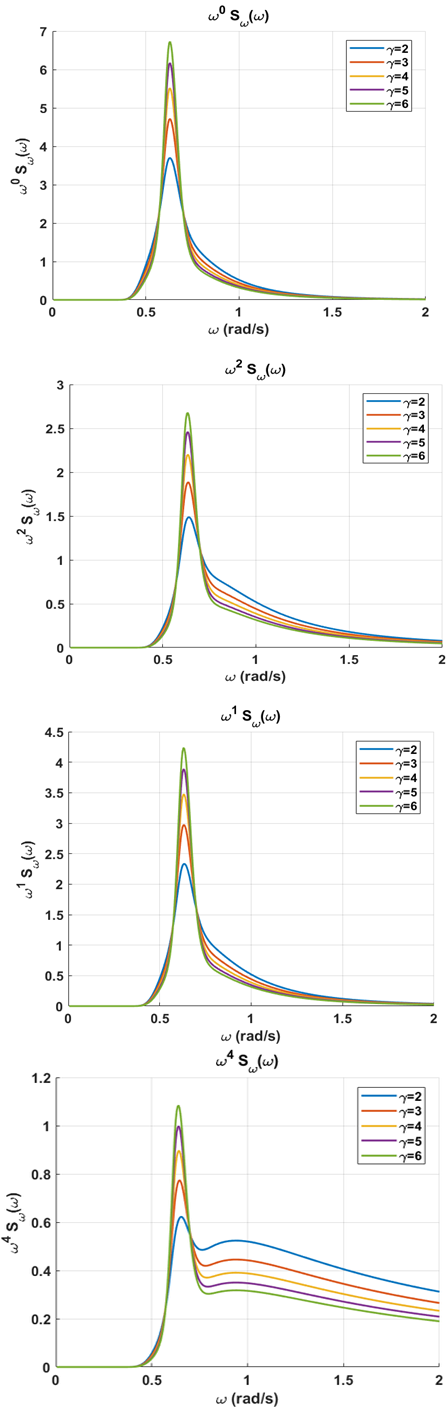
The analysis of the four weighted spectral power is shown in Figure 1 under different factor  . It provides a comprehensive understanding of how wave energy is distributed across frequencies. Table 1 presented the values of
  and periods (
 , ..,
, .., ) for different
  Spectral bandwidth parameter
  is also given in this table. It is shown as average bandwidth (not narrow and not wide band).
The zero-order spectrum represents the total energy of the sea state, directly relating to the significant wave height, with its area under the curve indicating overall energy density. The first-order spectrum shows how this energy is distributed across frequencies and is closely linked to the mean wave period, with higher  values concentrating energy at lower frequencies and producing longer, more regular waves. The second-order spectrum emphasizes wave acceleration and steepness, with energy peaking at mid-frequencies and further heightened as
  increases, highlighting dominant wave components. Finally, the fourth-order spectrum captures high-frequency contributions, corresponding to rapid surface oscillations and shorter waves, which diminish with increasing
  , reflecting a transition toward smoother, more organized sea conditions.
The analysis of wave parameters in Table 1 shows that the peak period increases with  as energy becomes more concentrated at lower frequencies, indicating longer, dominant waves, while the zero-crossing period slightly increases, reflecting reduced high-frequency content and smoother wave passages. The mean wave period also shows a moderate increase with
  , providing a measure of overall wave rhythm and regularity. At the same time, the spectral width decreases with
  , illustrating a transition from a broad, irregular sea toward a narrow-banded, more organized state.
Overall, the evolution of these four spectra with increasing  illustrates the transformation of the sea state from a broad, irregular, multi-frequency system toward a more organized, narrow-banded state dominated.
In wave power analysis, a fundamental step is the comparison between spectral integration and the approximation method. The spectral method computes wave power by integrating the energy spectrum  with the depth-dependent group velocity correction
 | (5) |
 is known as the wave celerity modification coefficient:
 | (6) |
where  are wave numbers at finite depth and deep water, respectively. The wavenumber
  in equation (6) is obtained from the dispersion relation in equation (7):
 | (7) |
In deep water ,
,  whereas in finite water
 ,
,  This reduction results in shorter wavelengths, which directly influence the extractable wave power by modifying both the phase and group velocities. In shallow waters, the shorter wavelengths concentrate wave energy, often reducing the power that can be extracted from longer waves.
The spectral integration method accurately captures these depth-dependent effects and the full frequency distribution, providing a realistic estimate of extractable wave power. Its primary advantage lies in revealing the contributions of individual frequency components, thereby allowing a detailed assessment of how different waves contribute to the total energy available for conversion.
Approximation method uses a single effective wave period .. and significant wave height , computing wave power as 4:
 | (8) |
where energy wave period  defined as:
 | (9) |
The percentage relative error between the spectral and approximate formulas is found by
 | (10) |

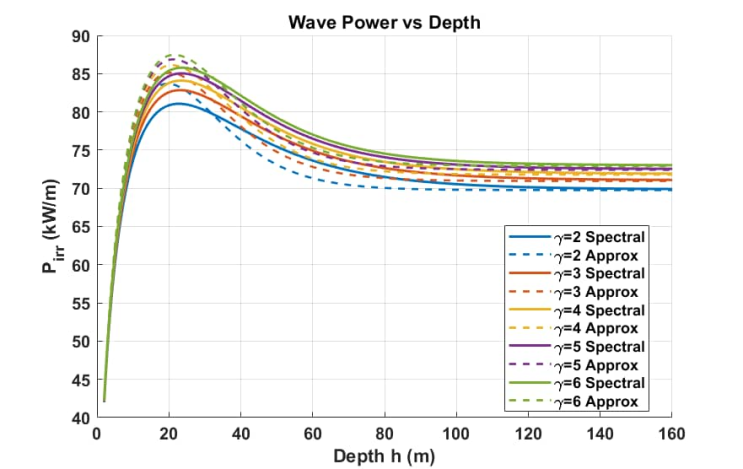
Figure 2 illustrates how the extractable wave power varies with water depth for different sea states characterized by peak enhancement factor . The plot compares two approaches; the spectral integration, which accounts for the full frequency-dependent spectrum weighted by the wave celerity modification coefficient
  , and the approximation, which estimates power using bulk parameters such as significant wave height and effective wave period.
In finite water, depth markedly modulates wave energy flux, particularly attenuating low-frequency contributions to the total power. The approximate method reproduces the overall trend but slightly overestimates energy in very shallow regions due to its simplified representation of depth effects. As depth increases toward intermediate and deep waters, the approximate and full spectral methods converge, as the depth correction factor approaches unity and depth-dependent influences diminish. higher γ values, corresponding to narrower and more sharply peaked spectra, concentrate energy near the spectral peak, further reducing the sensitivity to depth and yielding near-identical predictions. These findings underscore the necessity of incorporating depth-dependent modifications in wave power assessment and validate the approximation as an efficient preliminary tool, while confirming the superior accuracy of full spectral.
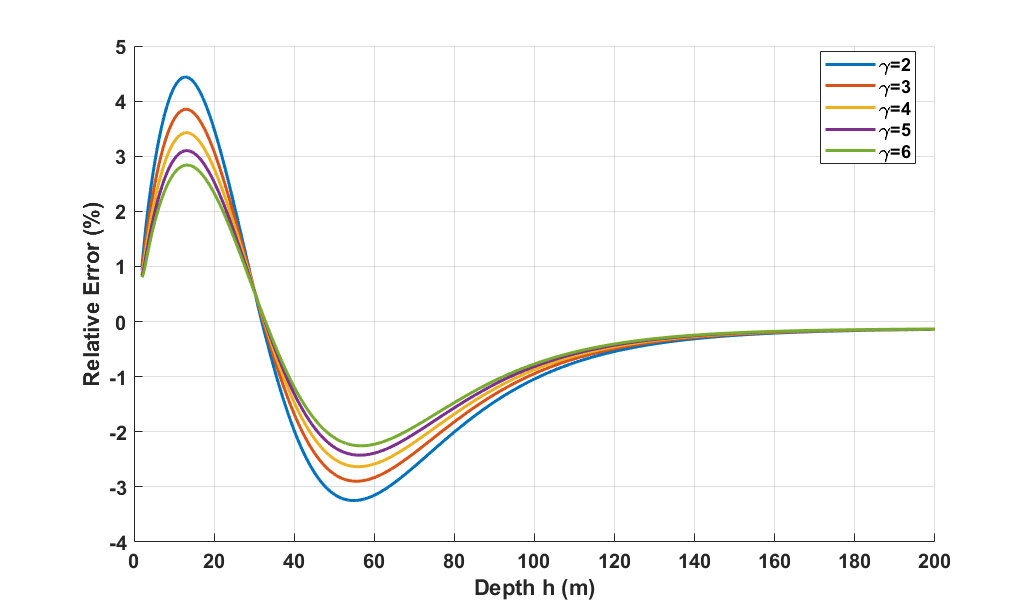
The relative error between the approximation method and the exact spectral wave power can also be represented graphically using the following formula:

As shown in Figure 3 and summarized in Table 2, the difference between the approximate method and the full spectral integration of wave power is evident across a range of water depths and JONSWAP  values. Positive values indicate overestimation by approximation method, while negative values indicate underestimation. The error is generally more pronounced in shallow and intermediate depths due to finite-depth effects on wave dispersion and group velocity, which approximates less accurately. As depth increases toward deep-water conditions, the error diminishes and approaches zero, reflecting the method’s convergence with exact calculations.
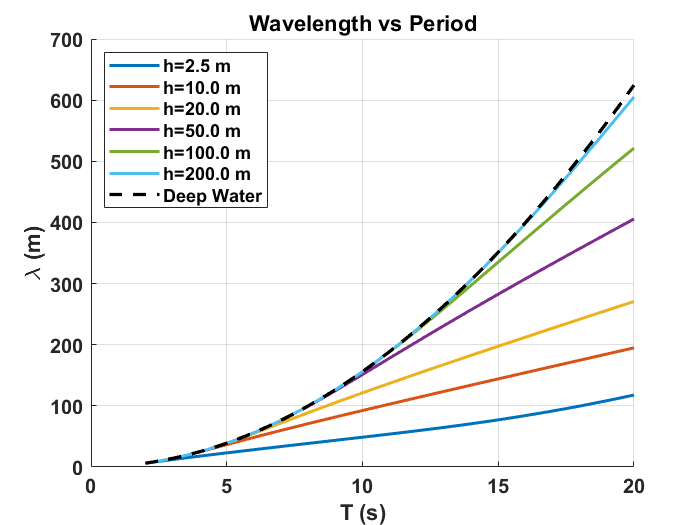
Building on the preceding discussion and based on Equation (9), the wavelength ( ) as a function of wave period (
 ) is plotted for key water depths.
Numerical analysis in Figure 4 shows that increasing depth moves the wavelength toward the deep-water value. For longer periods, the depth effect is less pronounced because  becomes larger. This is crucial for designing wave energy extraction systems in shallow coastal areas, as the spacing between turbines or converters must be proportional to the actual wavelength to avoid wave interference and performance loss.
Furthermore, the wavelength depends on wave type (regular vs. irregular) and spectral shape. In irregular waves, energy is dispersed across a wider frequency range, reducing the mean wavelength compared to regular waves. Hence, accurate numerical analysis is essential for determining optimal installation locations. Overall, calculating the actual wavelength and analyzing the effect of depth and frequency is a fundamental tool for the optimal design of turbines and coastal structures, directly impacting energy efficiency.

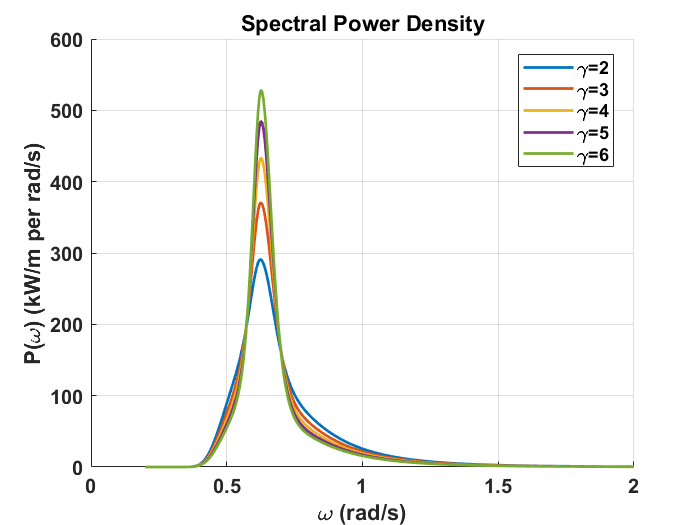
The spectral wave power plot  ) illustrates the distribution of wave energy flux as a function of angular frequency
  , providing a frequency-resolved view of the energy contained in the sea state. Each point on the curve represents the contribution of a narrow frequency band to the total wave power, enabling identification of the frequencies that dominate energy transfer.

Key observations from the Figure 5 indicate that low-frequency components (long waves) generally carry the largest fraction of total power because their energy is concentrated at low , corresponding to long wavelengths and large group velocities. Mid-frequency components (dominant waves) correspond to the spectral peak, representing the most energetic waves that are critical for effective energy conversion and optimal WEC design. High-frequency components (short waves) contribute less to total power, especially in narrow-banded seas with elevated peak enhancement factor
  , as their energy content is lower and their influence diminishes with increasing
 .
.
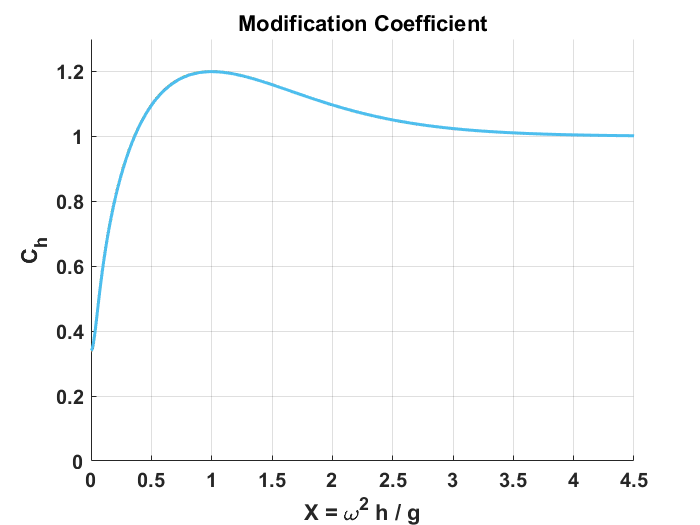
As previously mentioned, the wave celerity modification coefficient plays a crucial role in calculating wave power, particularly in finite and shallow water conditions 10. This coefficient represents the ratio between the actual group velocity at depth (
 ) and the deep-water group velocity, directly influencing the amount of extractable wave energy. Its mathematical formulation was expressed by equation (8).
According to Figure 6 in shallow water  because the group velocity decreases, leading to slower energy propagation. This reduction is more significant for short waves and shallower depths, resulting in a noticeable decline in wave power, whereas for long waves or deep-water conditions,
  1) and depth effects become negligible 24.
Numerical analysis of ) as a function of the dimensionless parameter
  shows a substantial reduction in wave power under high-frequency and shallow-water conditions. This decrease must be considered in the design of wave energy systems, such as turbines and converters, since neglecting it can lead to overestimations or underestimation.
In this study, the wave power was performed using the JONSWAP spectral model and the computation of spectral moments. The analysis demonstrated that spectral moments form the foundation for describing the statistical and dynamic behavior of ocean waves and for determining representative wave periods such as  ,
,  , and
, and  . The comparison between the exact spectral integration and approximation indicated that both approaches yield consistent results in intermediate and deep-water conditions, while notable discrepancies emerge in shallow waters due to depth-dependent dispersion effects. The results further showed that wave energy is mainly concentrated near the spectral peak, emphasizing that the design of WECs should align their operational frequency with this dominant energy band to maximize conversion efficiency.
Moreover, the evaluation of the depth modification coefficient  and wavelength
  confirmed the crucial role of water depth in energy transmission and wave propagation. As depth decreases, the group velocity and energy transport rate diminish, leading to reduced available power, particularly at higher frequencies. In contrast, deeper waters allow the wavelength and group velocity to approach their asymptotic deep-water values. These findings underscore the importance of incorporating depth corrections and wavelength variations into wave power assessments, ensuring accurate estimation of energy potential and improved placement strategies for WEC systems in coastal and offshore environments.
| [1] | Rasool S., Muttaqi K. M., Sutanto D., and Iqbal S., Modeling ocean waves and investigation of ocean wave spectra for wave-to-wire system, Journal of Engineering Research, vol. 12, no. 1, p. 51, 2021. | ||
| In article | View Article | ||
| [2] | Guo Q. and Xu Z., Simulation of deep-water waves based on JONSWAP spectrum and realization by MATLAB, Geoinformatics, vol. 2011, pp. 1–5, Jun. 2011. | ||
| In article | View Article | ||
| [3] | Guo B. and Ringwood J. V., A review of wave energy technology from a research and commercial perspective, IET Renewable Power Generation, vol. 15, no. 10, pp. 3065–3090, Oct. 2021. | ||
| In article | View Article | ||
| [4] | Sheng W. and Li H., A method for energy and resource assessment of waves in finite water depths, Energies, vol. 10, no. 8, p. 1188, 2017. | ||
| In article | View Article | ||
| [5] | Lee U. J., W. Jeong M., and Cho H. Y., Estimation and analysis of JONSWAP spectrum parameter using observed data around Korean coast, J. Mar. Sci. Eng., vol. 10, no. 5, p. 578, May 2022. | ||
| In article | View Article | ||
| [6] | Cannata G., Simone M., Gallerano F., Numerical Investigation into the Performance of an OWC Device under Regular and Irregular Waves, J. Mar. Sci. Eng. 2023, 11, 735. | ||
| In article | View Article | ||
| [7] | Cao D., Zeng H., He J., Liang H., Yang Z., Ramaya Ancha V., Chen H., A numerical investigation of irregular wave overtopping on a 2D fixed overtopping wave energy converter, Ships and offshore structures, 2024. | ||
| In article | View Article | ||
| [8] | Fan, G., Wu, W., Wang, H., Cao, F., Wu, Y., & Blaabjerg, F., A novel wave energy converter with an extended operational range for a wide range of wave conditions. Ocean Engineering, 2026, 343, 123478. | ||
| In article | View Article | ||
| [9] | Yang, I., Terziev, M., Tezdogan, T., & Incecik, A., Numerical investigation of a point absorber wave energy converter integrated with vertical wall and latching control for enhanced power extraction. Marine Energy Research, 1(1), 10004, 2024. | ||
| In article | View Article | ||
| [10] | Ulm, N., Huang, Z., & Cross, P., Experimental study of a fixed OWC-type wave energy converter in irregular wave conditions. Scientific Reports, 15, 9420, 2025. | ||
| In article | View Article PubMed | ||
| [11] | Ren, C., Tan, J., Zhang, L., & Li, C., Study on the influence of PTO control strategies on extreme loads of wave energy converters. Journal of Marine Science and Engineering, 13(5), 994, 2025. | ||
| In article | View Article | ||
| [12] | Abbasi A., Ghassemi H., Investigation of a novel hybrid-absorber wave energy converter combining linear (Raft-type) and point (Wavestar) absorbers for improved power extraction, Journal of Cleaner Production, 538, 2026, 147284. | ||
| In article | View Article | ||
| [13] | Neisi A., Ghafari H.R., Ghassemi H., Moan T. , He G., Power extraction and dynamic response of hybrid semi-submersible yaw-drive flap combination (SYFC), Renewable Energy 218, 2023, 119315. | ||
| In article | View Article | ||
| [14] | Jafarzadeh Khatibani M., Ghassemi H., Ghiasi M., Numerical study on coupled heave-pitch motions of multi-body Salter’s duck-WEC with a floating platform in regular and irregular waves, Energy Conversion and Management 329, 2025, 119639. | ||
| In article | View Article | ||
| [15] | Abroug I., Abcha N., Dutykh D., Jarno,A. and Marin, F., Experimental and numerical study of the propagation of focused wave groups in the nearshore zone, Physics Letters A, vol. 384, no. 6, p. 126-144, 2020. | ||
| In article | View Article | ||
| [16] | Folley M. and Whittaker T., Analysis of the nearshore wave energy resource, Renewable Energy, vol. 34, no. 7, pp. 1709–1715, Jul. 2009. | ||
| In article | View Article | ||
| [17] | Reikard G. and Robertson B., Simulating and forecasting ocean wave energy in Western Canada, Ocean Engineering, vol. 103, pp. 223–236, 2015. | ||
| In article | View Article | ||
| [18] | Li, Y., & Smith, J., On the formation of coastal rogue waves in water of variable depth: Wave transformation and variation in wave celerity. Cambridge Prisms: Coastal Futures, 2023. | ||
| In article | View Article PubMed | ||
| [19] | Simarro, G., Influence of bed variations on linear wave propagation beyond the mild slope condition. Journal of Marine Science and Engineering, 12(9), 1652, 2024. | ||
| In article | View Article | ||
| [20] | Wilson P. and Clark R., Dispersion Relations in Shallow Water Waves, Geoscience and Remote Sensing, vol. 57, no. 10, pp. 7890-7899, October 2018. | ||
| In article | |||
| [21] | Cruz J. (Ed.), Ocean Wave Energy: Current Status and Future Perspectives, Springer, 2008. | ||
| In article | View Article | ||
| [22] | Hasselmann K., et al., Directional wave spectra observed during JONSWAP 1973, Journal of Physical Oceanography, vol. 10, no. 8, pp. 1264–1280, 1980. | ||
| In article | View Article | ||
| [23] | Mazzaretto O. M., et al., A global evaluation of the JONSWAP spectra suitability on coastal regions worldwide, Coastal Engineering, 2022. | ||
| In article | View Article | ||
| [24] | Ryabkova M., et al., A review of wave spectrum models as applied to the ocean, Journal of Geophysical Research: Oceans, 2019. | ||
| In article | View Article | ||
| [25] | Lee T. and Kim D., A study on the effects of wave spectra on wave energy conversions, Renewable Energy, vol. 145, pp. 1231–1245, 2020. | ||
| In article | |||
| [26] | Cahill B. and Lewis T., Wave period ratios and the calculation of wave power, Marine Energy Technology Symposium (METS), 2014. | ||
| In article | |||
| [27] | Williams H., JONSWAP waves for realistic ocean wave modelling, Ocean Engineering Letters, 2021. | ||
| In article | |||
| [28] | Goda T., Random Seas and Design of Maritime Structures, 3rd ed., World Scientific, 2010. | ||
| In article | View Article | ||
| [29] | Young R. and Holthuijsen P., Spectral wave energy analysis under shallow water conditions, Coastal Engineering, vol. 56, no. 9, pp. 850–861, 2009. | ||
| In article | |||
| [30] | Cavaleri L., Wave modelling — the state of the art, Progress in Oceanography, vol. 75, no. 4, pp. 603–674, 2007. | ||
| In article | View Article | ||
| [31] | M. Benoit, Spectral energy balance and wave propagation in shallow water, Coastal Engineering Journal, 2013. | ||
| In article | |||
| [32] | Wolf J., The impact of spectral shape on wave energy flux, Renewable Energy, vol. 39, pp. 356–367, 2012. | ||
| In article | |||
| [33] | Li Y. and Haynes, R., Numerical assessment of JONSWAP parameters for energy prediction, Ocean Engineering, vol. 157, pp. 111–122, 2018. | ||
| In article | |||
| [34] | Ardhuin F., et al., Observations of swell dissipation across oceans, Geophysical Research Letters, vol. 36, 2009. | ||
| In article | View Article | ||
| [35] | Guedes Soares C., and Rego A., Effect of the JONSWAP peak enhancement on wave kinematics, Applied Ocean Research, vol. 22, pp. 123–135, 2000. | ||
| In article | |||
Published with license by Science and Education Publishing, Copyright © 2026 Mehrshad Seraj, Hassan Ghassemi and Jabbar Firouzi
 This work is licensed under a Creative Commons Attribution 4.0 International License. To view a copy of this license, visit
http://creativecommons.org/licenses/by/4.0/
This work is licensed under a Creative Commons Attribution 4.0 International License. To view a copy of this license, visit
http://creativecommons.org/licenses/by/4.0/
| [1] | Rasool S., Muttaqi K. M., Sutanto D., and Iqbal S., Modeling ocean waves and investigation of ocean wave spectra for wave-to-wire system, Journal of Engineering Research, vol. 12, no. 1, p. 51, 2021. | ||
| In article | View Article | ||
| [2] | Guo Q. and Xu Z., Simulation of deep-water waves based on JONSWAP spectrum and realization by MATLAB, Geoinformatics, vol. 2011, pp. 1–5, Jun. 2011. | ||
| In article | View Article | ||
| [3] | Guo B. and Ringwood J. V., A review of wave energy technology from a research and commercial perspective, IET Renewable Power Generation, vol. 15, no. 10, pp. 3065–3090, Oct. 2021. | ||
| In article | View Article | ||
| [4] | Sheng W. and Li H., A method for energy and resource assessment of waves in finite water depths, Energies, vol. 10, no. 8, p. 1188, 2017. | ||
| In article | View Article | ||
| [5] | Lee U. J., W. Jeong M., and Cho H. Y., Estimation and analysis of JONSWAP spectrum parameter using observed data around Korean coast, J. Mar. Sci. Eng., vol. 10, no. 5, p. 578, May 2022. | ||
| In article | View Article | ||
| [6] | Cannata G., Simone M., Gallerano F., Numerical Investigation into the Performance of an OWC Device under Regular and Irregular Waves, J. Mar. Sci. Eng. 2023, 11, 735. | ||
| In article | View Article | ||
| [7] | Cao D., Zeng H., He J., Liang H., Yang Z., Ramaya Ancha V., Chen H., A numerical investigation of irregular wave overtopping on a 2D fixed overtopping wave energy converter, Ships and offshore structures, 2024. | ||
| In article | View Article | ||
| [8] | Fan, G., Wu, W., Wang, H., Cao, F., Wu, Y., & Blaabjerg, F., A novel wave energy converter with an extended operational range for a wide range of wave conditions. Ocean Engineering, 2026, 343, 123478. | ||
| In article | View Article | ||
| [9] | Yang, I., Terziev, M., Tezdogan, T., & Incecik, A., Numerical investigation of a point absorber wave energy converter integrated with vertical wall and latching control for enhanced power extraction. Marine Energy Research, 1(1), 10004, 2024. | ||
| In article | View Article | ||
| [10] | Ulm, N., Huang, Z., & Cross, P., Experimental study of a fixed OWC-type wave energy converter in irregular wave conditions. Scientific Reports, 15, 9420, 2025. | ||
| In article | View Article PubMed | ||
| [11] | Ren, C., Tan, J., Zhang, L., & Li, C., Study on the influence of PTO control strategies on extreme loads of wave energy converters. Journal of Marine Science and Engineering, 13(5), 994, 2025. | ||
| In article | View Article | ||
| [12] | Abbasi A., Ghassemi H., Investigation of a novel hybrid-absorber wave energy converter combining linear (Raft-type) and point (Wavestar) absorbers for improved power extraction, Journal of Cleaner Production, 538, 2026, 147284. | ||
| In article | View Article | ||
| [13] | Neisi A., Ghafari H.R., Ghassemi H., Moan T. , He G., Power extraction and dynamic response of hybrid semi-submersible yaw-drive flap combination (SYFC), Renewable Energy 218, 2023, 119315. | ||
| In article | View Article | ||
| [14] | Jafarzadeh Khatibani M., Ghassemi H., Ghiasi M., Numerical study on coupled heave-pitch motions of multi-body Salter’s duck-WEC with a floating platform in regular and irregular waves, Energy Conversion and Management 329, 2025, 119639. | ||
| In article | View Article | ||
| [15] | Abroug I., Abcha N., Dutykh D., Jarno,A. and Marin, F., Experimental and numerical study of the propagation of focused wave groups in the nearshore zone, Physics Letters A, vol. 384, no. 6, p. 126-144, 2020. | ||
| In article | View Article | ||
| [16] | Folley M. and Whittaker T., Analysis of the nearshore wave energy resource, Renewable Energy, vol. 34, no. 7, pp. 1709–1715, Jul. 2009. | ||
| In article | View Article | ||
| [17] | Reikard G. and Robertson B., Simulating and forecasting ocean wave energy in Western Canada, Ocean Engineering, vol. 103, pp. 223–236, 2015. | ||
| In article | View Article | ||
| [18] | Li, Y., & Smith, J., On the formation of coastal rogue waves in water of variable depth: Wave transformation and variation in wave celerity. Cambridge Prisms: Coastal Futures, 2023. | ||
| In article | View Article PubMed | ||
| [19] | Simarro, G., Influence of bed variations on linear wave propagation beyond the mild slope condition. Journal of Marine Science and Engineering, 12(9), 1652, 2024. | ||
| In article | View Article | ||
| [20] | Wilson P. and Clark R., Dispersion Relations in Shallow Water Waves, Geoscience and Remote Sensing, vol. 57, no. 10, pp. 7890-7899, October 2018. | ||
| In article | |||
| [21] | Cruz J. (Ed.), Ocean Wave Energy: Current Status and Future Perspectives, Springer, 2008. | ||
| In article | View Article | ||
| [22] | Hasselmann K., et al., Directional wave spectra observed during JONSWAP 1973, Journal of Physical Oceanography, vol. 10, no. 8, pp. 1264–1280, 1980. | ||
| In article | View Article | ||
| [23] | Mazzaretto O. M., et al., A global evaluation of the JONSWAP spectra suitability on coastal regions worldwide, Coastal Engineering, 2022. | ||
| In article | View Article | ||
| [24] | Ryabkova M., et al., A review of wave spectrum models as applied to the ocean, Journal of Geophysical Research: Oceans, 2019. | ||
| In article | View Article | ||
| [25] | Lee T. and Kim D., A study on the effects of wave spectra on wave energy conversions, Renewable Energy, vol. 145, pp. 1231–1245, 2020. | ||
| In article | |||
| [26] | Cahill B. and Lewis T., Wave period ratios and the calculation of wave power, Marine Energy Technology Symposium (METS), 2014. | ||
| In article | |||
| [27] | Williams H., JONSWAP waves for realistic ocean wave modelling, Ocean Engineering Letters, 2021. | ||
| In article | |||
| [28] | Goda T., Random Seas and Design of Maritime Structures, 3rd ed., World Scientific, 2010. | ||
| In article | View Article | ||
| [29] | Young R. and Holthuijsen P., Spectral wave energy analysis under shallow water conditions, Coastal Engineering, vol. 56, no. 9, pp. 850–861, 2009. | ||
| In article | |||
| [30] | Cavaleri L., Wave modelling — the state of the art, Progress in Oceanography, vol. 75, no. 4, pp. 603–674, 2007. | ||
| In article | View Article | ||
| [31] | M. Benoit, Spectral energy balance and wave propagation in shallow water, Coastal Engineering Journal, 2013. | ||
| In article | |||
| [32] | Wolf J., The impact of spectral shape on wave energy flux, Renewable Energy, vol. 39, pp. 356–367, 2012. | ||
| In article | |||
| [33] | Li Y. and Haynes, R., Numerical assessment of JONSWAP parameters for energy prediction, Ocean Engineering, vol. 157, pp. 111–122, 2018. | ||
| In article | |||
| [34] | Ardhuin F., et al., Observations of swell dissipation across oceans, Geophysical Research Letters, vol. 36, 2009. | ||
| In article | View Article | ||
| [35] | Guedes Soares C., and Rego A., Effect of the JONSWAP peak enhancement on wave kinematics, Applied Ocean Research, vol. 22, pp. 123–135, 2000. | ||
| In article | |||