Emerging infectious diseases increasingly emerged from animal reservoirs affecting human populations, frequently originating from wild or domestic animals. The complex interactions between humans, livestock and wildlife significantly influence the transmission dynamics of various infectious diseases, particularly in regions like Ethiopia with diverse ecosystems and extensive livestock populations. Human and animal movements often blur the boundaries between agricultural lands and natural wildlife habitats, leading to both direct and indirect interactions between domestic and wild animal species. These interactions can serve as pathways for the transmission of infectious agents across. Therefore, this paper aims to review disease transmission at the human-domestic wildlife interface in Ethiopia to give evidence-based recommendations for the control and prevention of diseases. Current understanding of the transmission mechanisms and the main source remains incomplete. However, the overlap of habitats due to human encroachment, grazing practices, microbial evolution, vectors, and the movement of animals contribute to pathogen transmission and multi-host diseases. To address these challenges, the principal method for preventing or controlling transmission at the interface involves minimizing contact between livestock and wild animals through land use regulations and fencing, surveillance of vectors and wild reservoirs, regular collection and analysis of epidemiological data, early warning systems for animal diseases, and targeted vaccination programs to mitigate the spread of infectious diseases. The review examines passive management strategies, such as the 'soft edge' approach where livestock and wildlife coexist and share resources within managed interfaces. It recommends strengthening veterinary services, increasing community awareness, and implementing wildlife management strategies to reduce disease transmission.
Emerging infectious diseases (EIDs) have repeatedly emerged from wild or domestic animal reservoirs in human populations in recent decades. These pathogens are considered emerging due to their rising occurrence in host populations within the past twenty years or their potential to do so imminently. 'Emergence' further includes the re-emergence of known diseases after a decline 1. More than 60% of emerging disease pathogens worldwide are zoonotic, with 75% of these emerging zoonoses having a wildlife origin 2. Although both wildlife and domesticated animals serve as reservoirs for EIDs, it is the anthropogenic influence on ecological systems that largely determines the risk level at the human-animal interface in zoonotic compliant emergence 3.
Understanding the dynamics of multi-species pathogens is crucial for public health, as many emerging human diseases are zoonotic 4, 5. The interactions between humans, livestock, and wildlife play a pivotal role in disease transmission dynamics, particularly in regions like Ethiopia, where these interactions are intricate and significant 6. Ethiopia's large and diverse livestock population and rich wildlife biodiversity create complex systems where zoonotic diseases can be transmitted between animals and humans. With its considerable livestock sector playing a key role in the economy and supporting rural livelihoods 7, Ethiopia exemplifies the complex interplay between humans, livestock and wildlife. The coexistence of wildlife with human and livestock populations adds more complexity to disease transmission dynamics, especially considering the high occurrence of zoonotic diseases that can spread between animals and humans 2.
Wildlife's increasing role in disease transmission at the wildlife-livestock interface has raised concerns within the scientific community. Changes in land use, habitat encroachment, and intensive livestock production contribute to heightened disease transmission risk at this interface 8. There have been several reports of infections that affect both livestock and wildlife in different parts of the world, including Ethiopia. Classical diseases such as anthrax and tuberculosis, as well as more recent issues with influenza, rabies, foot and mouth disease, African horse sickness, African and classical swine fever, and trypanosomiasis, are notable examples 4, 9. Mycobacterium bovis in wild boars, badgers, and deer, and brucellosis in diverse wildlife species are a few examples of transmission of diseases from livestock to wildlife. Bovine tuberculosis poses a major public health risk due to its zoonotic potential, disrupts ecological balance through wildlife transmission, and has economic impacts at both national and international levels 10. Consequently, prioritizing diseases emerging at the interface between livestock and wildlife is imperative for animal health authorities 11.
Although Ethiopia encounters major challenges in controlling disease spread at the human-livestock-wildlife interface, opportunities for intervention exist. Enhancing surveillance systems, deploying vaccination efforts, adopting sustainable land management strategies, and raising awareness of disease risks can all help reduce disease transmission spread. Despite progress in understanding disease dynamics in Ethiopia, specific disease transmission pathways, understanding the impact of environmental factors, and assessing the efficacy of interventions are limited. Therefore, the objective of this paper is to review the disease transmission between human- livestock and wildlife interfaces and to highlight the key wildlife-derived transmission mechanisms for zoonosis.
Interface diseases are crucial regarding issues of public health, . Wildlife is the source of a large number of zoonotic diseases. Approximately 60% of the 1,400 known human infectious diseases are derived from animal sources. Moreover, an estimated 75% of newly emerging infectious diseases globally are of zoonotic origin 12. The alternatives for control are limited and frequently have effects on the welfare of wildlife, even when wildlife reservoirs have been recognized and disease control is desired due to dangers to human health 13. Ebola hemorrhagic fever is an illness resulting from an unidentified pathogen that can infect humans, livestock or other species, influenced by ecological, environmental or demographic factors. These diseases are growing as disease interface patterns change and significantly impact public health 14.
2.2. The Livestock-Wildlife- InterfaceLivestock as a distinct category emerged only after humans began domesticating wild species, creating three novel interaction zones: human–domestic animal, wildlife–domestic animal, and a combined human–domestic–wildlife interface. Wildlife-livestock interfaces are the physical spaces in which wild and livestock species overlap in range and potentially interact, forming a continuum of direct and Indirect contact between free-ranging wildlife and domestic livestock 15. Indirect contact can occur through exposure to infected materials (such as aerosols or any excretion product such as feces, urine, saliva, or ocular or nasal discharge) or environmental reservoirs (such as soil, water, or forage) and via vectors 16. Thus, the wildlife–livestock interface is defined as a dynamic network of epidemiological and ecological connections between wildlife, livestock and the physical space in which they overlap and potentially interact 17. This interface is complex and changes along with natural landscapes and is vulnerable to human intervention 18.
The interface also influences the risk distribution of shared pathogens, as seen in the strong association between anthrax suitability and the elephant-livestock interface 19. The interactions among wildlife, livestock, and human populations at their interface are influenced by factors such as biodiversity, livestock management practices, and the connectivity between surrounding communities 20. From bio diverse and continuous forest ecosystems, transitions occur through forest loss, shifting toward human-modified environments composed of agricultural, pastoral, and urban mosaics. These changes have led to degraded land, fragmented ecosystems, and streamlined trophic and host community structures, land degradation, and simplified host communities, with an increasing presence of peri-domestic and managed wildlife 21.
2.3. Characteristics of Wildlife-Livestock InterfacesWildlife-livestock interfaces are geographical areas where the home ranges of different species cross and where there is a chance of interaction. Evidence of wildlife-livestock interfaces can be seen at the landscape level using aerial or remote sensing technologies. A land-use barrier, such as a fence, restricts the movement of large species and the usage of an area 22. Interfaces between wildlife and livestock are frequently poorly defined by environmental factors 23. The range of the wildlife-livestock interface, or the area where different species interact, cannot be precisely delineated by a resource gradient or physical borders alone. A preliminary conceptual model of the wildlife-livestock interface, grounded on environmental features like rivers or fences, is essential; however, it requires validation or refutation through empirical data on species interactions 24.
The concept of wildlife-livestock interfaces is multifaceted and represents different meanings for various professionals. Anthropologists may consider the non-material cultural and symbolic values of wild animals, while epidemiologists will define the interface according to the opportunities it provides for pathogen transmission between wildlife and livestock 25; range land managers will consider how it influences competition between wild and domestic herbivores and legal scholars may focus on boundary delineation and access rights 26.
Behavioral Ecology
Numerous areas of ecology and epidemiology depend on the quantification of variables to identify interactions or contacts between individuals in multi-host and multi-pathogen systems. Early methods for measuring animal contact rates relied on direct observation of individuals 27. However, more recent developments ("Collecting Data to Assess the Interactions Between Livestock and Wildlife") have made it possible to accurately and frequently record animal locations without putting study animals at risk of harm 6. The home range of one or a small number of individuals can be used to infer the group home range for social animals, such as most ungulates, including all domestic species 28.
Molecular Approaches and Genetics
Recent developments in population genetics and the geographic distribution and history of species have shed light on the links between wild and domesticated species, as well as on patterns of migration and the evolution and phylogenetic relatedness of populations 29. Naturally, gene transfer between species rarely happens unless the wild and domestic species are genetically similar, as in the case of domestic pigs and wild boar 30. The phylogeographic field is concentrated at a broad spatiotemporal scale, creating knowledge about the connection at the species/subspecies level of previous historical events taking place during the quaternary geological period 31.
2.4. Epidemiology of Some Wildlife-related Infectious DiseasePathogens often lack host specificity, and cross-species transmission has introduced the concept of an interface (Table 1); however, the exact mechanisms of transmission are rarely understood 16. Viral diseases originating from wild animals are widely considered significant threats to public health, and the transmission of such viral pathogens from wildlife to other domestic animals and humans is exacerbated by the difficulty of detecting pathogens in wild populations 32. The spillover of viral pathogens from wildlife to domestic animals and humans at the edges of protected areas, particularly in remote communities, is frequently under-reported and undetected. High-risk human activities, such as domesticating animals, encroaching on wildlife habitats and hunting, promote spillover events, leading to the emergence of viral diseases worldwide and threatening wildlife populations. 33.
The swift rise in population has resulted in the development of areas dominated by humans and a rise in land use for building, farming, and other purposes. This shift in land use has precipitated numerous diseases affecting both wildlife and livestock. The primary source of income for numerous communities is the sale of livestock and animal-derived products, while select ranching systems also generate supplementary income through wildlife harvesting and ecotourism-related activities 48. Changed agricultural practices have altered habitats, pushing wildlife closer to human settlements and facilitating the transmission of pathogens to new hosts. Increased overlap between livestock and wildlife habitats due to land use changes raises the risk of mutual pathogen exchange 49.
Increased competition for grazing and water resources intensifies pressure on land and contributes to conflicts between pastoralists and wildlife 50. Most pastoralists face significant economic hardship and limited access to formal veterinary services. Consequently, they often rely on ethno-veterinary practices rooted in traditional knowledge and understanding of cattle diseases, to manage and control livestock health issues 49. During grazing, livestock herbivores are constantly at risk of contracting diseases from other livestock species and within their species. The host range for previously restricted parasites has expanded due to infection transmission facilitated by shared habitats between cattle and wild populations. The interactions at the point of contact between herbivorous hosts and environmental feces dictate the transmission of parasites to grazing herbivores 51. It is becoming more challenging to assess the current condition of wildlife illnesses in continents like Europe due to the dynamics of both wildlife and diseases due to the changes in livestock and wildlife management 37. Animals in the wild now share habitats with livestock due to the growth of grazing land. Animals prefer to graze early in the morning and late in the afternoon in tropical areas because of the high average temperature, which causes them to concentrate in shaded regions like wallowing grounds. The nasopharynx and fecal excretions serve as key routes of pathogen shedding, facilitating the transmission of infectious diseases to both livestock and wildlife populations 52.
The wildlife-livestock interface has facilitated the transmission of infections to new hosts, serving as a breeding ground for disease intermingling. Due to their adaptive characteristics, numerous harmful microorganisms have since undergone mutation, resulting in strains that impact a large population of animals and can infect a variety of hosts. The rapid mutation rate of RNA viruses positions them as the primary agents in the emergence and re-emergence of diseases 53.
One of the main causes of the introduction of diseases is the movement of domestic or wild animals. The stress associated with overcrowding and fear during animal transport, often exacerbated by substandard conditions, significantly increases their vulnerability to infectious diseases 53. Wildlife trade is one of the key issues in a potential transfer of infectious pathogens across species, even though it primarily affects species other than ungulates 54.
Arthropods such as ticks and flies significantly enhance the bidirectional transmission of infectious pathogens at the wildlife-livestock interface. More than any other arthropod vector, ticks transmit a wide range of harmful microbes, including viruses, rickettsiae, spirochetes, and protozoa, making them a principal source of diseases affecting both livestock and wildlife. This interaction has increased both, the prevalence and geographic distribution of well-known vector-borne diseases over the last decade 55.
2.6. The Impacts of Wildlife on LivestockInteractions with wildlife can significantly impact cattle production, leading to morbidity and mortality due to infectious diseases. Additionally, decreased food security, the burden of zoonotic diseases, and predator-prey interactions can exacerbate economic hardship. Wildlife hosts frequently remain asymptomatic yet can significantly impact livestock health; for example, warthogs serve as reservoirs for African Swine Fever Virus (ASFV), while wild waterfowl are key carriers of highly pathogenic avian influenza 43, wild birds for Newcastle Disease virus, and African buffalo for Foot-and-Mouth Disease Virus (FMDV) 34, 44, 56. In such cases, a large population of farmed pigs allows the virus to spread, mutate, and potentially jump to humans. As the disease spreads between farms, direct or indirect encounters between such reservoirs and vulnerable animal populations can trigger sporadic outbreaks that may escalate into epidemics 57. Regional spread of the disease may result from continued wildlife transmission or, more frequently, from manmade sources such as the migration of diseased cattle or contaminated fomites 58.
2.7. The Impacts of Livestock on WildlifeLivestock farming greatly affects wildlife through changes in land use and habitat intrusion 59. This results in loss of habitat, food sources and water, which diminishes the diversity and number of animal species. A reduction in biodiversity may impair the "dilution effect," which could result in higher disease prevalence if vulnerable species become dominant. For instance, overgrazing reduces vegetation diversity and habitat space, which limits resources for wildlife. 60.
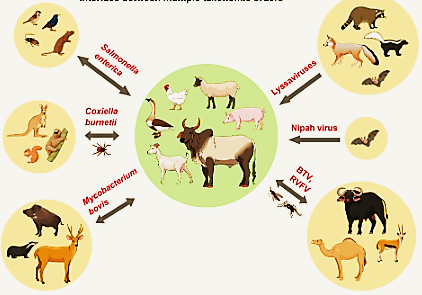
Numerous infectious diseases of the livestock can affect wildlife populations as well, resulting in significant mortality and losses (Figure 1). For example, ASFV (African Swine Fever Virus) can spread among domestic pigs and some wild pig species. When genotype II of ASFV was introduced into the Caucasus in 2007, it spread slowly but steadily through European wild boar populations. So far, about 12 European Union countries have reported ASF cases in wild boar, with over 30,000 cases recorded in the last five years alone 61. The virus has also spread across Asia, affecting native pig species (Sus barbatus) and posing a serious threat to several highly endangered pig species in the region 62.

Another disease that has spread from livestock to wildlife is bovine tuberculosis, which was first detected in a single African buffalo in Kruger National Park in 1990 (Syncerus caffer) 63. After analyzing the disease, it was concluded that Mycobacterium bovis likely entered the park around 1963 through contact with infected cattle. Since then, the disease has spread among the park's large buffalo population and has been found in at least 23 other mammal species, including large predators 64. These disease spillovers are particularly concerning when they affect species already vulnerable or endangered. For example, recent cases of bovine tuberculosis have been found in endangered African wild dogs (Lycaon pictus) 65, and rabies outbreaks have been reported among Ethiopian wolf (Canis simensis) populations, both of which are species already at risk of extinction 32.
2.8. Prevention and Control Strategies to Reduce Disease in Wildlife–Livestock InteractionsThe importance of establishing comprehensive surveillance systems that encompass livestock, wildlife, and human elements has been emphasized. Strong surveillance at wildlife and the livestock-wildlife interface is essential for early identification of EIDs or pathogen spillover events between livestock and wild animals. The current surveillance systems are passive, disease-specific, and largely intended to support campaigns to eradicate illnesses like brucellosis, TB, and pseudo-rabies. Thus, implementing epidemiological surveillance should be based on both ecological monitoring (surveillance of vectors and wild reservoirs) and epidemiological monitoring (regular collection and analysis of epidemiological data and early warning systems for animal diseases) 66. Disease reporting frequencies vary; some conditions need immediate notification, while others are reported periodically, often annually. Using graphs is recommended to help visualize trends, and combining animal disease data with human health records is crucial for a comprehensive understanding studies. An instance of an active surveillance program supports industry, human, and wildlife risk management methods and advances understanding of the ecology and epidemiology of illness 67.
To maintain minimal interaction between the populations, it is necessary to rigorously manage both the wildlife population and the cattle. A prolific herd of cattle can be chosen to help with this, and feeding livestock in stalls can help stop the spread of diseases brought in by wild animals 56. Farms should keep productive animals while eliminating underperforming ones. To reduce issues linked to interfaces, a proper land-use policy should be ensured. To reduce the likelihood of wildlife leaving their habitat, protected areas should incorporate habitat development measures for wildlife, such as building water bodies. Other methods to alter habitats include changing the distribution or density of hosts or reducing contact with disease agents 68.
Globally, wildlife culling has been a widely to limit the transmission of diseases and mitigate the impact of large predators on domestic livestock 56. However, in developed economies, implementation has become more challenging because of declining biodiversity and rising public concern over related ethical issues. Consequently, the preferred solution now is to relocate or translocate problematic animals. A thorough analysis of host-pathogen interactions within ecological systems is essential to fully comprehend their complexities prior to implementing wildlife culling measures. The advantages and disadvantages of such a disease management approach, pathogen transmission pattern, host contact pattern, regulatory processes, seasonality, spatial structure, and environmental sources of infection should be thoroughly analyzed before wildlife culling 69.
The translocation of problematic wildlife to reduce their presence in certain areas is also utilized as a management tool, particularly to mitigate human-wildlife conflict involving large predators of high conservation value 56. To prevent disease spread, restricting wild animal translocations, including farm-bred wildlife, is crucial, necessitating closer collaboration between animal health and wildlife management authorities. Some wildlife species are considered nuisances for agricultural operations and are subject to pest control measures due to their heightened risk to biosecurity 70. Moreover, the movement of domestic animals poses risks, potentially introducing new diseases or vectors into different regions (for instance, the introduction of rabbit hemorrhagic disease from China into Germany) 71.
Wildlife vaccination has occasionally been utilized to lower the risk of disease transfer to domestic livestock, with vaccine being administered orally 72. This approach, however, is exceptional and typically targets the most significant diseases, particularly those causing substantial economic losses, where wildlife reservoirs play a crucial role. For example, in Europe, wildlife vaccination has been used to fight diseases like fox rabies 73, classical swine fever, and possibly bovine TB 53. However, there are concerns within the scientific community about vaccinating rabbits against Myxomatosis and hemorrhagic disease 71. Unlike culling, oral vaccination has several benefits, such as painless delivery that addresses animal welfare issues and preventing behavioral disruptions like greater dispersal or immigration. While treatment of diseases in wildlife is uncommon, vaccination can be an effective intervention in certain situations. However, developing safe and effective vaccine delivery systems suited to the specific challenges of wild animal populations is necessary 74. Using insecticides and acaricides to control arthropod vectors offers an alternative approach for eliminating vector-borne animal diseases 74. Continued research and innovation are crucial for creating and refining effective vaccination strategies for wildlife populations.
The emergence and spread of diseases are driven by complex interactions among hosts, pathogens, and the environment 5. One of the primary approaches to reducing disease risk at the wildlife–livestock boundary is the adoption of farm-level interventions that limit opportunities for contact between the two groups. These procedures frequently separate populations according to their health status, allowing for zoning or compartmentalization, which is regularly used to protect global trade from specific production areas 75. While fences are useful tools for preventing wildlife-livestock contact, their efficacy needs to be guaranteed by establishing a routine maintenance and observation program and adapting the design of the fence to the specific animal species in concern 76.
The present review delineates that the livestock-wildlife interaction plays a crucial role in how several zoonotic diseases are transmitted in Ethiopia. Cattle and wildlife populations tend to have significant detrimental effects on one another at those interfaces. While productivity loss and rising socioeconomic costs are the main effects on livestock, these interactions also raising the danger of new diseases, such as zoonosis. Some of these interactions and their effects on animal production can be minimized by biosecurity controls used in the livestock industry. Long-term solutions for decreasing wildlife-livestock interactions and their underlying causes, such as human migration because of war and climate change because of the burning of fossil fuels, are essential. The negative consequences, such as biodiversity loss and wildlife population decline due to habitat degradation and resource depletion, are often irreversible, particularly for wildlife. Therefore, the creation of strategies to lessen pathogen transmission between wildlife and both domestic animals and humans, better understanding of the risks and effects of infections, particularly at the interface between livestock and wildlife but also at the interface with people, and implementation of the One Health approach has been recommended.
The authors affirm that they have no known conflicts of interest, whether financial or personal, that could have potentially influenced the work reported herein paper.
The research detailed in the article did not involve the use of any data.
All the authors contributed during the preparation of the manuscript. Dr. Mahendra Pal conceptualized the topic and contributed to the final editing of the draft, Firaol Tariku contributed to drafting the original manuscript, Tegegn Dilbato contributed to editing the review, Visualization and Conceptualization, Tesfaye Rebuma contributed to Writing the review and editing along with Visualization. Dr. Ravindra Zende conducted a detailed review of literature and drafted the manuscript and ensured comprehensive coverage of the topic. Dr. Aishwarya Nair contributed to the sections, edited the language and clarity of the manuscript.
No financial support was received from any organization.
| [1] | Tomczuk K., Grzybek M., Szczepaniak K., Studzińska M., Demkowska-Kutrzepa M., Roczeń-Karczmarz M., Klockiewicz M., Analysis of intrinsic and extrinsic factors influencing the dynamics of bovine Eimeria spp. from central–eastern Poland, Veterinary Parasitology, 2015; 214, (1): 22-28. | ||
| In article | View Article PubMed | ||
| [2] | Tomori O., Oluwayelu, D. O., Domestic animals as potential reservoirs of zoonotic viral diseases, Annual Review of Animal Biosciences. 2023; 11(1): 33-55. | ||
| In article | View Article PubMed | ||
| [3] | Hassell J. M., Begon M., Ward M. J., Fèvre E. M., Urbanization and Disease Emergence: Dynamics at the Wildlife–Livestock–Human Interface. Trends in Ecology & Evolution. 2017; 32 (1): 55-67. | ||
| In article | View Article PubMed | ||
| [4] | Daszak P., Cunningham A. A., Hyatt A. D., Anthropogenic environmental change and the emergence of infectious diseases in wildlife, Acta Tropica. 2001; 78 (2): 103-116. | ||
| In article | View Article PubMed | ||
| [5] | Pal M., Tariku F., Upadhyay D., Zende R., Current innovations in the diagnosis and immunization of emerging and re-Emerging zoonoses, American Journal of Epidemiology and Infectious Diseases. 2024; 12 (2): 23-28. | ||
| In article | View Article | ||
| [6] | De Garine-Wichatitsky, M., Miguel, E., Kock, R., Valls-Fox, H., Caron, A. The ecology of pathogens transmission at the wildlife-livestock interface: beyond disease ecology, towards socio-ecological system health. In Diseases at the Wildlife-Livestock Interface: Research and Perspectives in a Changing World. 2021; pp. 91-119. Cham: Springer International Publishing. | ||
| In article | View Article | ||
| [7] | CSA: Agricultural sample survey 2020/21, Report on livestock and livestock characteristics. Statistical Bulletin 589. Vol. II. Addis Ababa, Ethiopia, 2021, vol. II. | ||
| In article | |||
| [8] | Wittemyer G., Elsen P., Bean W. T., Burton A. C., Brashares J. S., Accelerated human population growth at protected area edges, Science. 2008; 321 (5885): 123-126. | ||
| In article | View Article PubMed | ||
| [9] | Epstein J. H., Field H. E., Luby S., Pulliam J. R., Daszak P., Nipah virus: impact, origins, and causes of emergence, Current Infectious Disease Reports. 2006; 8 (1): 59-65. | ||
| In article | View Article PubMed | ||
| [10] | Pal, M., Regassa, M., Gizachewu, M., Shifara, K., Zende, R., Nair, A., Sgroi, G. Battling bovine tuberculosis: Modern approaches to diagnosis and control. American Journal of Infectious Diseases and Microbiology, 2025; 13 (1): 5-14. | ||
| In article | View Article | ||
| [11] | Siembieda J. L., Kock R. A., McCracken T. A., Newman S. H., The role of wildlife in transboundary animal diseases, Animal Health Research Reviews. 2011; 12 (1): 95-111. | ||
| In article | View Article PubMed | ||
| [12] | Shaheen, M. N. The concept of one health applied to the problem of zoonotic diseases. Reviews in medical virology, 2022; 32(4): e2326. | ||
| In article | View Article PubMed | ||
| [13] | Cleaveland S., Laurenson K., Mlengeya T., Impacts of wildlife infections on human and livestock health with special reference to Tanzania: implications for protected area management, Conservation and development interventions at the wildlife/livestock interface: implications for wildlife, livestock and human health, IUCN, Gland, Switzerland. 2005; 147-151. | ||
| In article | |||
| [14] | Peterson A. T., Bauer J. T., Mills J. N., Ecologic and geographic distribution of filovirus disease, Emerging Infectious Diseases. 2004; 10 (1): 40. | ||
| In article | View Article PubMed | ||
| [15] | Huyvaert K. P., Russell R. E., Patyk K. A., Craft M. E., Cross P. C., Garner M. G., Walsh D. P., Challenges and opportunities developing mathematical models of shared pathogens of domestic and wild animals, Veterinary Sciences. 2018; 5 (4): 92. | ||
| In article | View Article PubMed | ||
| [16] | Kock R. A., What is this infamous “wildlife/livestock disease interface?” A review of current knowledge for the African continent, Conservation and development interventions at the wildlife/livestock interface: implications for wildlife, livestock and human health. 2005; 30: 1-13. | ||
| In article | |||
| [17] | Jori F., Martínez-López B., Vicente J., Novel approaches to assess disease dynamics at the wildlife livestock interface, Frontiers in Veterinary Science. 2019; 6: 409. | ||
| In article | View Article PubMed | ||
| [18] | Barroso, P., Gortázar, C. (2024). The wildlife–livestock interface: a general perspective. Animal Frontiers. 2024; 14 (1): 3-4. | ||
| In article | View Article PubMed | ||
| [19] | Walsh M. G., Mor S. M., Hossain S., The elephant–livestock interface modulates anthrax suitability in India, Proceedings of the Royal Society B. 2019; 286 (1898): 20190179. | ||
| In article | View Article PubMed | ||
| [20] | Jones B. A., Grace D., Kock R., Alonso S., Rushton J., Said M. Y., Pfeiffer D. U., Zoonosis emergence linked to agricultural intensification and environmental change, Proceedings of the National Academy of Sciences. 2013; 110 (21): 8399-8404. | ||
| In article | View Article PubMed | ||
| [21] | Abrahão J. S., Guedes M. I., Trindade G. S., Fonseca F. G., Campos R. K., Mota B. F., Kroon E. G., One more piece in the VACV ecological puzzle: could peridomestic rodents be the link between wildlife and bovine vaccinia outbreaks in Brazil?, PloS One. 2009; 4 (10): e7428. | ||
| In article | View Article PubMed | ||
| [22] | Kock R., Kock M., de Garine-Wichatitsky M., Chardonnet P., Caron A., Livestock and buffalo (Syncerus caffer) interfaces in Africa: ecology of disease transmission and implications for conservation and development, Ecology, Evolution and Behaviour of Wild Cattle Implication for Conservation. Cambridge University Press, Cambridge, UK. 2014; 431-445. | ||
| In article | View Article | ||
| [23] | Cravino, A., Perelló, A., Brazeiro, A. Livestock–wildlife interactions: key aspects for reconnecting animal production and wildlife conservation. Animal Frontiers, 2024; 14(1): 13-19. | ||
| In article | View Article PubMed | ||
| [24] | Van Schalkwyk O. L., Knobel D. L., De Clercq E. M, De Pus C., Hendrickx G., Van den Bossche P., Description of Events Where African Buffaloes (Syncerus caffer) Strayed from the Endemic Foot‐and‐Mouth Disease Zone in South Africa, 1998–2008, Transboundary and Emerging Diseases. 2016; 63 (3): 333-347. | ||
| In article | View Article PubMed | ||
| [25] | Bengis R. G., Kock R. A., Fischer J., Infectious animal diseases: the wildlife/livestock interface, Revue scientifique et technique (International Office of Epizootics). 2002; 21(1): 53-65. | ||
| In article | View Article PubMed | ||
| [26] | Andersson J. A., Cumming D.H., Defining the edge: boundary formation and TFCAs in Southern Africa, In Transfrontier Conservation Areas. 2017; 25 (61): 9781315147376. | ||
| In article | View Article | ||
| [27] | Richomme C., Gauthier D., and Fromont E., Contact rates and exposure to inter-species disease transmission in mountain ungulates, Epidemiology and Infection. 2006; 134 (1): 21-30. | ||
| In article | View Article PubMed | ||
| [28] | Cornélis D., Benhamou S., Janeau G., Morellet N., Ouedraogo M., De Visscher M.N., Spatiotemporal dynamics of forage and water resources shape space use of West African savanna buffaloes, Journal of Mammalogy. 2011; 92 (6): 1287-1297. | ||
| In article | View Article | ||
| [29] | Nayak, S. S., Rajawat, D., Jain, K., Sharma, A., Gondro, C., Tarafdar, A., Panigrahi, M. (2024). A comprehensive review of livestock development: insights into domestication, phylogenetics, diversity, and genomic advances. Mammalian Genome. 2024; 35 (4): 577-599. | ||
| In article | View Article PubMed | ||
| [30] | Goedbloed D. J., Megens H. J., Van Hooft P., Herrero‐Medrano J. M., Lutz W., Alexandri P., and Prins H. T., Genome‐wide single nucleotide polymorphism analysis reveals recent genetic introgression from domestic pigs into Northwest European wild boar populations, Molecular Ecology. 2013; 22 (3): 856-866. | ||
| In article | View Article PubMed | ||
| [31] | Avise J. C., Hamrick J. L., Conservation genetics: case histories from nature, Journal of Applied Ecology. 1997; 34 (3): 829. | ||
| In article | View Article | ||
| [32] | Johnson C. K., Hitchens P. L., Pandit P. S., Rushmore J., Evans T., Smiley Y., Cristine C. W., Doyle M. M., Global shifts in mammalian population trends reveal key predictors of virus spillover risk, Proceedings of the Royal Society B. 2020; 287 (1924): 20192736. | ||
| In article | View Article PubMed | ||
| [33] | Wolfe N. D., Daszak P., Kilpatrick A. M., and Burke D. S., Bushmeat, hunting, deforestation, and prediction of zoonotic disease emergence, Emerging Infectious Diseases. 2005; 11, (12): 1822. | ||
| In article | View Article PubMed | ||
| [34] | Jori F., Etter E., Transmission of foot and mouth disease at the wildlife/livestock interface of the Kruger National Park, South Africa: Can the risk be mitigated?, Preventive Veterinary Medicine. 2016; 126 :19-29. | ||
| In article | View Article PubMed | ||
| [35] | Britch S. C., Binepal Y. S., Ruder M. G., Kariithi H. M., Linthicum K. J., Anyamba A., Small J. L., Tucker C. J., Ateya L. O., Oriko A. A., Gacheru S., Rift Valley fever risk map model and seroprevalence in selected wild ungulates and camels from Kenya, PLoS One. 2013; 8 (6): e66626. | ||
| In article | View Article PubMed | ||
| [36] | Olive M., Goodman S. M., Reynes J. M., The role of wild mammals in the maintenance of Rift Valley fever virus, Journal of Wildlife diseases. 2012; 48(2): 241-266. | ||
| In article | View Article PubMed | ||
| [37] | Gortázar C., Ferroglio E., Höfle U., Frölich K., Vicente J., Diseases shared between wildlife and livestock: a European perspective, European Journal of Wildlife Research. 2007; 53: 241-256. | ||
| In article | View Article | ||
| [38] | Atuman J. Y., Ibrahim S., Abubakar A. I., Kudi C. A., Seroprevalence of bovine tuberculosis and brucellosis in Agropastoralist livestock herds and wildlife in Yankari game reserve: Public health implications, Sokoto Journal of Veterinary Sciences. 2018; 16 (2): 83-90. | ||
| In article | View Article | ||
| [39] | Palmer M. V., Mycobacterium bovis: characteristics of wildlife reservoir hosts, Transboundary and Emerging Diseases. 2013; 60: 1-13. | ||
| In article | View Article PubMed | ||
| [40] | Hugh-Jones M., De Vos V., Anthrax and Wildlife, Transboundary Emerging Disease. 2002; 21 (2): 359-83. | ||
| In article | View Article PubMed | ||
| [41] | Olsen S. C., Brucellosis in the United States: role and significance of wildlife reservoirs, Vaccine. 2010; 28: 73-76. | ||
| In article | View Article PubMed | ||
| [42] | Spickler A. R., Roth J. A., Galyon J., and Lofstedt J., Emerging and Exotic Diseases of Animals, Institute for International Cooperation in Animal Biologics, Iowa State University, College of Veterinary Medicine, Ames, IA, 2010. | ||
| In article | |||
| [43] | Globig A., Baumer A., Revilla-Fernández S., Beer M., Wodak E., Fink M., Stärk K. D., Ducks as sentinels for avian influenza in wild birds, Emerging Infectious Diseases. 2009; 15(10): 1633-1636. | ||
| In article | View Article PubMed | ||
| [44] | Ayala A. J., Yabsley M. J., Hernandez S. M., A review of pathogen transmission at the backyard chicken–wild bird interface, Frontiers in Veterinary Science. 2020; 7-20: 539925. | ||
| In article | View Article PubMed | ||
| [45] | Lindsay D. S., Dubey J. P., Toxoplasmosis in wild and domestic animals, Toxoplasma gondii, (Third Edition). 2020; pp. 293-320. | ||
| In article | View Article | ||
| [46] | Mbaya A. W., Ahmed T., and Igbokwe I. O., Current survey of trypanosomiasis among livestock and wildlife in the arid region of Northeastern, Nigeria, Bulletin of Animal Health and Production in Africa. 2013; 61(3): 323-330. | ||
| In article | |||
| [47] | WHO: Consultation on public health and animal Transmissible spongiform Encephalopathies, Epidemiology, risk and research requirements. 1999. | ||
| In article | |||
| [48] | Wambwa, E. Diseases of importance at the wildlife/livestock interface in Kenya. In S. A. Osofsky (Ed.), Conservation and development interventions at the wildlife/livestock interface: Implications for wildlife, livestock and human health, IUCN. 2005; pp. 21–25. | ||
| In article | |||
| [49] | Farnsworth M. L., Wolfe L. L., Hobbs N. T., Burnham K. P., Williams E. S., Theobald D.M., Miller M. W., Human land use influences chronic wasting disease prevalence in mule deer, Ecological Applications. 2005; 15(1): 119-126. | ||
| In article | View Article | ||
| [50] | Kock R., Kebkiba B., Heinonen R., Bedane B., Wildlife and pastoral society shifting paradigms in disease control, Annals of the New York Academy of Sciences. 2002; 969 (1): 24-33. | ||
| In article | View Article PubMed | ||
| [51] | Smith L. A., Marion G., Swain D. L., White P. C., Hutchings M. R., Inter-and intra-specific exposure to parasites and pathogens via the faecal–oral route: a consequence of behavior in a patchy environment, Epidemiology and Infection. 2009; 137 (5): 630-643. | ||
| In article | View Article PubMed | ||
| [52] | Ayele W. Y., Neill S. D., Zinsstag J., Weiss M. G.,Pavlik I., Bovine tuberculosis: an old disease but a new threat to Africa, International Journal of Tuberculosis and Lung Disease. 2004; 8 (8): 924-937. | ||
| In article | |||
| [53] | Martin C., Pastoret P. P., Brochier B., Humblet M. F., Saegerman C., A survey of the transmission of infectious diseases/infections between wild and domestic ungulates in Europe, Veterinary Research. 2011; 42: 1-16. | ||
| In article | View Article PubMed | ||
| [54] | Gómez A., and Aguirre A. A., Infectious diseases and the illegal wildlife trade, Annals of the New York Academy of Sciences. 2008; 1149(1): 16-19. | ||
| In article | View Article PubMed | ||
| [55] | De La Rocque S., Rioux J.A., and Slingenbergh J., Climate change: effects on animal disease systems and implications for surveillance and control, Revue Scientifique et Technique (International Office of Epizootics). (2008) 27(2), 339-54. | ||
| In article | View Article | ||
| [56] | Jori F., Hernandez-Jover M., Magouras I., Dürr S., and Brookes V. J., Wildlife–livestock interactions in animal production systems: what are the biosecurity and health implications? Animal Frontiers. 2021; 11(5): 8-19. | ||
| In article | View Article PubMed | ||
| [57] | Tomori, O., Oluwayelu, D. O. Domestic animals as potential reservoirs of zoonotic viral diseases. Annual Review of Animal Biosciences, 2023, 11(1): 33-55. | ||
| In article | View Article PubMed | ||
| [58] | Dixon L. K., Stahl K., Jori F., Vial L., Pfeiffer D. U., African swine fever epidemiology and control, Annual Review of Animal Biosciences. 2020; 8(1): 221-246. | ||
| In article | View Article PubMed | ||
| [59] | Gordon I.J., Livestock production increasingly influences wildlife across the globe, Animal. 2018; 12(2): s372-s382. | ||
| In article | View Article PubMed | ||
| [60] | Boone R. B., Burn Silver S. B., Thornton P. K., Worden J. S., Galvin K. A., Quantifying declines in livestock due to land subdivision, Rangeland Ecology and Management. 2005; 58(5): 523-532. | ||
| In article | View Article | ||
| [61] | Viltrop, A., Boinas, F., Depner, K., Jori, F., Kolbasov, D., Laddomada, A., Ståhl, K., Chenais. E., African swine fever epidemiology, surveillance and control. In Understanding and combatting African swine fever. A European perspective. Wageningen Academic Publishers, Wageningen, the Netherlands. 2021; pp. 229–261. | ||
| In article | View Article | ||
| [62] | Luskin, M.S., Meijaard, E., Surya, S., Sheherazade, C.W., Linkie, M., African Swine Fever threatens Southeast Asia’s 11 endemic wild pig species, Conservation Letters. 2020: e12784. | ||
| In article | View Article | ||
| [63] | Buss, P. E., Miller, M. A. (2023). Ecosystem and Multiple Species Effects of Tuberculosis in Kruger National Park. In Fowler's Zoo and Wild Animal Medicine Current Therapy, 2023; 10 pp. 181-186. WB Saunders. | ||
| In article | View Article | ||
| [64] | Hlokwe, T.M., De Klerk-Lorist, L.M., Michel, A.L., Wildlife on the move: a hidden tuberculosis threat to conservation areas and game farms through introduction of untested animals. Journal of Wildlife Disease. 2016; 52 (4): 837-843. | ||
| In article | View Article PubMed | ||
| [65] | Higgitt, R.L., van Schalkwyk, O.L., de Klerk-Lorist, L.M., Buss, P.E., Caldwell, P., Rossouw, L., Manamela, T., Hausler, G.A., Hewlett, J., Mitchell, E.P., van Helden, P.D., Mycobacterium bovis infection in african wild dogs, kruger national park, south Africa, Emerging Infectious Diseases, 2019; 25(7): 1425. | ||
| In article | View Article PubMed | ||
| [66] | Dufour A., Moutou F., Hattenberger A. M., Rodhain F., Global change: impact, management, risk approach and health measures--the case of Europe, Revue Scientifique et Technique (International Office of Epizootics). 2008 27: (2), 529-550. | ||
| In article | View Article | ||
| [67] | Hansbro P. M., Warner S., Tracey J. P., Arzey K. E., Selleck P., O’Riley K., Hurt A. C., Surveillance and analysis of avian influenza viruses, Australia, Emerging Infectious Diseases. 2010; 16(12): 1896. | ||
| In article | View Article PubMed | ||
| [68] | Wobeser G., Disease management strategies for wildlife. Revue Scientifique et Technique (International Office of Epizootics). 2002; 21(1): 159-178. | ||
| In article | View Article PubMed | ||
| [69] | Miguel E., Grosbois V., Caron A., Pople D., Roche B., Donnelly C. A., A systemic approach to assess the potential and risks of wildlife culling for infectious disease control, Communications Biology. 2020; 3 (1): 353. | ||
| In article | View Article PubMed | ||
| [70] | Pearson H. E., Toribio J. A., Lapidge S. J., Hernández-Jover M., Evaluating the risk of pathogen transmission from wild animals to domestic pigs in Australia, Preventive Veterinary Medicine. 2016; 123: 39-51. | ||
| In article | View Article PubMed | ||
| [71] | Angulo E., and Cooke B., First synthesize new viruses then regulate their release? The case of the wild rabbit, Molecular Ecology. 2002; 11 (12): 2703-2709 | ||
| In article | View Article PubMed | ||
| [72] | Jori, F., Hernandez-Jover, M., Magouras, I., Dürr, S., Brookes, V. J. (2021). Wildlife–livestock interactions in animal production systems: what are the biosecurity and health implications?. Animal frontiers, 2021; 11 (5): 8-19. | ||
| In article | View Article PubMed | ||
| [73] | Artois, M., The role of wildlife in the control of domestic animal diseases, OIE Communication Régionale Europe, 2012; pp. 8. | ||
| In article | |||
| [74] | Wilson A. L., Courtenay O., Kelly-Hope L. A., Scott T. W., Takken W., Torr S. J., Lindsay S. W., The importance of vector control for the control and elimination of vector-borne diseases, PLoS Neglected Tropical Diseases. 2020; 14 (1): e0007831. | ||
| In article | View Article PubMed | ||
| [75] | Mysterud A., and Rolandsen C. M., Fencing for wildlife disease control, Journal of Applied Ecology. 2019; 56 (3): 519-525. | ||
| In article | View Article | ||
| [76] | Gortazar C., Diez-Delgado I., Barasona J. A., Vicente J., De La Fuente J., Boadella M., The wild side of disease control at the wildlife-livestock-human interface: a review, Frontiers in Veterinary Science. 2015; 1: 27. | ||
| In article | View Article PubMed | ||
Published with license by Science and Education Publishing, Copyright © 2025 Mahendra Pal, Firaol Tariku Geleto, Tegegn Dilbato Dinbiso, Tesfaye Rebuma Abdeta, Ravindra Zende and Aishwarya Nair
 This work is licensed under a Creative Commons Attribution 4.0 International License. To view a copy of this license, visit
http://creativecommons.org/licenses/by/4.0/
This work is licensed under a Creative Commons Attribution 4.0 International License. To view a copy of this license, visit
http://creativecommons.org/licenses/by/4.0/
| [1] | Tomczuk K., Grzybek M., Szczepaniak K., Studzińska M., Demkowska-Kutrzepa M., Roczeń-Karczmarz M., Klockiewicz M., Analysis of intrinsic and extrinsic factors influencing the dynamics of bovine Eimeria spp. from central–eastern Poland, Veterinary Parasitology, 2015; 214, (1): 22-28. | ||
| In article | View Article PubMed | ||
| [2] | Tomori O., Oluwayelu, D. O., Domestic animals as potential reservoirs of zoonotic viral diseases, Annual Review of Animal Biosciences. 2023; 11(1): 33-55. | ||
| In article | View Article PubMed | ||
| [3] | Hassell J. M., Begon M., Ward M. J., Fèvre E. M., Urbanization and Disease Emergence: Dynamics at the Wildlife–Livestock–Human Interface. Trends in Ecology & Evolution. 2017; 32 (1): 55-67. | ||
| In article | View Article PubMed | ||
| [4] | Daszak P., Cunningham A. A., Hyatt A. D., Anthropogenic environmental change and the emergence of infectious diseases in wildlife, Acta Tropica. 2001; 78 (2): 103-116. | ||
| In article | View Article PubMed | ||
| [5] | Pal M., Tariku F., Upadhyay D., Zende R., Current innovations in the diagnosis and immunization of emerging and re-Emerging zoonoses, American Journal of Epidemiology and Infectious Diseases. 2024; 12 (2): 23-28. | ||
| In article | View Article | ||
| [6] | De Garine-Wichatitsky, M., Miguel, E., Kock, R., Valls-Fox, H., Caron, A. The ecology of pathogens transmission at the wildlife-livestock interface: beyond disease ecology, towards socio-ecological system health. In Diseases at the Wildlife-Livestock Interface: Research and Perspectives in a Changing World. 2021; pp. 91-119. Cham: Springer International Publishing. | ||
| In article | View Article | ||
| [7] | CSA: Agricultural sample survey 2020/21, Report on livestock and livestock characteristics. Statistical Bulletin 589. Vol. II. Addis Ababa, Ethiopia, 2021, vol. II. | ||
| In article | |||
| [8] | Wittemyer G., Elsen P., Bean W. T., Burton A. C., Brashares J. S., Accelerated human population growth at protected area edges, Science. 2008; 321 (5885): 123-126. | ||
| In article | View Article PubMed | ||
| [9] | Epstein J. H., Field H. E., Luby S., Pulliam J. R., Daszak P., Nipah virus: impact, origins, and causes of emergence, Current Infectious Disease Reports. 2006; 8 (1): 59-65. | ||
| In article | View Article PubMed | ||
| [10] | Pal, M., Regassa, M., Gizachewu, M., Shifara, K., Zende, R., Nair, A., Sgroi, G. Battling bovine tuberculosis: Modern approaches to diagnosis and control. American Journal of Infectious Diseases and Microbiology, 2025; 13 (1): 5-14. | ||
| In article | View Article | ||
| [11] | Siembieda J. L., Kock R. A., McCracken T. A., Newman S. H., The role of wildlife in transboundary animal diseases, Animal Health Research Reviews. 2011; 12 (1): 95-111. | ||
| In article | View Article PubMed | ||
| [12] | Shaheen, M. N. The concept of one health applied to the problem of zoonotic diseases. Reviews in medical virology, 2022; 32(4): e2326. | ||
| In article | View Article PubMed | ||
| [13] | Cleaveland S., Laurenson K., Mlengeya T., Impacts of wildlife infections on human and livestock health with special reference to Tanzania: implications for protected area management, Conservation and development interventions at the wildlife/livestock interface: implications for wildlife, livestock and human health, IUCN, Gland, Switzerland. 2005; 147-151. | ||
| In article | |||
| [14] | Peterson A. T., Bauer J. T., Mills J. N., Ecologic and geographic distribution of filovirus disease, Emerging Infectious Diseases. 2004; 10 (1): 40. | ||
| In article | View Article PubMed | ||
| [15] | Huyvaert K. P., Russell R. E., Patyk K. A., Craft M. E., Cross P. C., Garner M. G., Walsh D. P., Challenges and opportunities developing mathematical models of shared pathogens of domestic and wild animals, Veterinary Sciences. 2018; 5 (4): 92. | ||
| In article | View Article PubMed | ||
| [16] | Kock R. A., What is this infamous “wildlife/livestock disease interface?” A review of current knowledge for the African continent, Conservation and development interventions at the wildlife/livestock interface: implications for wildlife, livestock and human health. 2005; 30: 1-13. | ||
| In article | |||
| [17] | Jori F., Martínez-López B., Vicente J., Novel approaches to assess disease dynamics at the wildlife livestock interface, Frontiers in Veterinary Science. 2019; 6: 409. | ||
| In article | View Article PubMed | ||
| [18] | Barroso, P., Gortázar, C. (2024). The wildlife–livestock interface: a general perspective. Animal Frontiers. 2024; 14 (1): 3-4. | ||
| In article | View Article PubMed | ||
| [19] | Walsh M. G., Mor S. M., Hossain S., The elephant–livestock interface modulates anthrax suitability in India, Proceedings of the Royal Society B. 2019; 286 (1898): 20190179. | ||
| In article | View Article PubMed | ||
| [20] | Jones B. A., Grace D., Kock R., Alonso S., Rushton J., Said M. Y., Pfeiffer D. U., Zoonosis emergence linked to agricultural intensification and environmental change, Proceedings of the National Academy of Sciences. 2013; 110 (21): 8399-8404. | ||
| In article | View Article PubMed | ||
| [21] | Abrahão J. S., Guedes M. I., Trindade G. S., Fonseca F. G., Campos R. K., Mota B. F., Kroon E. G., One more piece in the VACV ecological puzzle: could peridomestic rodents be the link between wildlife and bovine vaccinia outbreaks in Brazil?, PloS One. 2009; 4 (10): e7428. | ||
| In article | View Article PubMed | ||
| [22] | Kock R., Kock M., de Garine-Wichatitsky M., Chardonnet P., Caron A., Livestock and buffalo (Syncerus caffer) interfaces in Africa: ecology of disease transmission and implications for conservation and development, Ecology, Evolution and Behaviour of Wild Cattle Implication for Conservation. Cambridge University Press, Cambridge, UK. 2014; 431-445. | ||
| In article | View Article | ||
| [23] | Cravino, A., Perelló, A., Brazeiro, A. Livestock–wildlife interactions: key aspects for reconnecting animal production and wildlife conservation. Animal Frontiers, 2024; 14(1): 13-19. | ||
| In article | View Article PubMed | ||
| [24] | Van Schalkwyk O. L., Knobel D. L., De Clercq E. M, De Pus C., Hendrickx G., Van den Bossche P., Description of Events Where African Buffaloes (Syncerus caffer) Strayed from the Endemic Foot‐and‐Mouth Disease Zone in South Africa, 1998–2008, Transboundary and Emerging Diseases. 2016; 63 (3): 333-347. | ||
| In article | View Article PubMed | ||
| [25] | Bengis R. G., Kock R. A., Fischer J., Infectious animal diseases: the wildlife/livestock interface, Revue scientifique et technique (International Office of Epizootics). 2002; 21(1): 53-65. | ||
| In article | View Article PubMed | ||
| [26] | Andersson J. A., Cumming D.H., Defining the edge: boundary formation and TFCAs in Southern Africa, In Transfrontier Conservation Areas. 2017; 25 (61): 9781315147376. | ||
| In article | View Article | ||
| [27] | Richomme C., Gauthier D., and Fromont E., Contact rates and exposure to inter-species disease transmission in mountain ungulates, Epidemiology and Infection. 2006; 134 (1): 21-30. | ||
| In article | View Article PubMed | ||
| [28] | Cornélis D., Benhamou S., Janeau G., Morellet N., Ouedraogo M., De Visscher M.N., Spatiotemporal dynamics of forage and water resources shape space use of West African savanna buffaloes, Journal of Mammalogy. 2011; 92 (6): 1287-1297. | ||
| In article | View Article | ||
| [29] | Nayak, S. S., Rajawat, D., Jain, K., Sharma, A., Gondro, C., Tarafdar, A., Panigrahi, M. (2024). A comprehensive review of livestock development: insights into domestication, phylogenetics, diversity, and genomic advances. Mammalian Genome. 2024; 35 (4): 577-599. | ||
| In article | View Article PubMed | ||
| [30] | Goedbloed D. J., Megens H. J., Van Hooft P., Herrero‐Medrano J. M., Lutz W., Alexandri P., and Prins H. T., Genome‐wide single nucleotide polymorphism analysis reveals recent genetic introgression from domestic pigs into Northwest European wild boar populations, Molecular Ecology. 2013; 22 (3): 856-866. | ||
| In article | View Article PubMed | ||
| [31] | Avise J. C., Hamrick J. L., Conservation genetics: case histories from nature, Journal of Applied Ecology. 1997; 34 (3): 829. | ||
| In article | View Article | ||
| [32] | Johnson C. K., Hitchens P. L., Pandit P. S., Rushmore J., Evans T., Smiley Y., Cristine C. W., Doyle M. M., Global shifts in mammalian population trends reveal key predictors of virus spillover risk, Proceedings of the Royal Society B. 2020; 287 (1924): 20192736. | ||
| In article | View Article PubMed | ||
| [33] | Wolfe N. D., Daszak P., Kilpatrick A. M., and Burke D. S., Bushmeat, hunting, deforestation, and prediction of zoonotic disease emergence, Emerging Infectious Diseases. 2005; 11, (12): 1822. | ||
| In article | View Article PubMed | ||
| [34] | Jori F., Etter E., Transmission of foot and mouth disease at the wildlife/livestock interface of the Kruger National Park, South Africa: Can the risk be mitigated?, Preventive Veterinary Medicine. 2016; 126 :19-29. | ||
| In article | View Article PubMed | ||
| [35] | Britch S. C., Binepal Y. S., Ruder M. G., Kariithi H. M., Linthicum K. J., Anyamba A., Small J. L., Tucker C. J., Ateya L. O., Oriko A. A., Gacheru S., Rift Valley fever risk map model and seroprevalence in selected wild ungulates and camels from Kenya, PLoS One. 2013; 8 (6): e66626. | ||
| In article | View Article PubMed | ||
| [36] | Olive M., Goodman S. M., Reynes J. M., The role of wild mammals in the maintenance of Rift Valley fever virus, Journal of Wildlife diseases. 2012; 48(2): 241-266. | ||
| In article | View Article PubMed | ||
| [37] | Gortázar C., Ferroglio E., Höfle U., Frölich K., Vicente J., Diseases shared between wildlife and livestock: a European perspective, European Journal of Wildlife Research. 2007; 53: 241-256. | ||
| In article | View Article | ||
| [38] | Atuman J. Y., Ibrahim S., Abubakar A. I., Kudi C. A., Seroprevalence of bovine tuberculosis and brucellosis in Agropastoralist livestock herds and wildlife in Yankari game reserve: Public health implications, Sokoto Journal of Veterinary Sciences. 2018; 16 (2): 83-90. | ||
| In article | View Article | ||
| [39] | Palmer M. V., Mycobacterium bovis: characteristics of wildlife reservoir hosts, Transboundary and Emerging Diseases. 2013; 60: 1-13. | ||
| In article | View Article PubMed | ||
| [40] | Hugh-Jones M., De Vos V., Anthrax and Wildlife, Transboundary Emerging Disease. 2002; 21 (2): 359-83. | ||
| In article | View Article PubMed | ||
| [41] | Olsen S. C., Brucellosis in the United States: role and significance of wildlife reservoirs, Vaccine. 2010; 28: 73-76. | ||
| In article | View Article PubMed | ||
| [42] | Spickler A. R., Roth J. A., Galyon J., and Lofstedt J., Emerging and Exotic Diseases of Animals, Institute for International Cooperation in Animal Biologics, Iowa State University, College of Veterinary Medicine, Ames, IA, 2010. | ||
| In article | |||
| [43] | Globig A., Baumer A., Revilla-Fernández S., Beer M., Wodak E., Fink M., Stärk K. D., Ducks as sentinels for avian influenza in wild birds, Emerging Infectious Diseases. 2009; 15(10): 1633-1636. | ||
| In article | View Article PubMed | ||
| [44] | Ayala A. J., Yabsley M. J., Hernandez S. M., A review of pathogen transmission at the backyard chicken–wild bird interface, Frontiers in Veterinary Science. 2020; 7-20: 539925. | ||
| In article | View Article PubMed | ||
| [45] | Lindsay D. S., Dubey J. P., Toxoplasmosis in wild and domestic animals, Toxoplasma gondii, (Third Edition). 2020; pp. 293-320. | ||
| In article | View Article | ||
| [46] | Mbaya A. W., Ahmed T., and Igbokwe I. O., Current survey of trypanosomiasis among livestock and wildlife in the arid region of Northeastern, Nigeria, Bulletin of Animal Health and Production in Africa. 2013; 61(3): 323-330. | ||
| In article | |||
| [47] | WHO: Consultation on public health and animal Transmissible spongiform Encephalopathies, Epidemiology, risk and research requirements. 1999. | ||
| In article | |||
| [48] | Wambwa, E. Diseases of importance at the wildlife/livestock interface in Kenya. In S. A. Osofsky (Ed.), Conservation and development interventions at the wildlife/livestock interface: Implications for wildlife, livestock and human health, IUCN. 2005; pp. 21–25. | ||
| In article | |||
| [49] | Farnsworth M. L., Wolfe L. L., Hobbs N. T., Burnham K. P., Williams E. S., Theobald D.M., Miller M. W., Human land use influences chronic wasting disease prevalence in mule deer, Ecological Applications. 2005; 15(1): 119-126. | ||
| In article | View Article | ||
| [50] | Kock R., Kebkiba B., Heinonen R., Bedane B., Wildlife and pastoral society shifting paradigms in disease control, Annals of the New York Academy of Sciences. 2002; 969 (1): 24-33. | ||
| In article | View Article PubMed | ||
| [51] | Smith L. A., Marion G., Swain D. L., White P. C., Hutchings M. R., Inter-and intra-specific exposure to parasites and pathogens via the faecal–oral route: a consequence of behavior in a patchy environment, Epidemiology and Infection. 2009; 137 (5): 630-643. | ||
| In article | View Article PubMed | ||
| [52] | Ayele W. Y., Neill S. D., Zinsstag J., Weiss M. G.,Pavlik I., Bovine tuberculosis: an old disease but a new threat to Africa, International Journal of Tuberculosis and Lung Disease. 2004; 8 (8): 924-937. | ||
| In article | |||
| [53] | Martin C., Pastoret P. P., Brochier B., Humblet M. F., Saegerman C., A survey of the transmission of infectious diseases/infections between wild and domestic ungulates in Europe, Veterinary Research. 2011; 42: 1-16. | ||
| In article | View Article PubMed | ||
| [54] | Gómez A., and Aguirre A. A., Infectious diseases and the illegal wildlife trade, Annals of the New York Academy of Sciences. 2008; 1149(1): 16-19. | ||
| In article | View Article PubMed | ||
| [55] | De La Rocque S., Rioux J.A., and Slingenbergh J., Climate change: effects on animal disease systems and implications for surveillance and control, Revue Scientifique et Technique (International Office of Epizootics). (2008) 27(2), 339-54. | ||
| In article | View Article | ||
| [56] | Jori F., Hernandez-Jover M., Magouras I., Dürr S., and Brookes V. J., Wildlife–livestock interactions in animal production systems: what are the biosecurity and health implications? Animal Frontiers. 2021; 11(5): 8-19. | ||
| In article | View Article PubMed | ||
| [57] | Tomori, O., Oluwayelu, D. O. Domestic animals as potential reservoirs of zoonotic viral diseases. Annual Review of Animal Biosciences, 2023, 11(1): 33-55. | ||
| In article | View Article PubMed | ||
| [58] | Dixon L. K., Stahl K., Jori F., Vial L., Pfeiffer D. U., African swine fever epidemiology and control, Annual Review of Animal Biosciences. 2020; 8(1): 221-246. | ||
| In article | View Article PubMed | ||
| [59] | Gordon I.J., Livestock production increasingly influences wildlife across the globe, Animal. 2018; 12(2): s372-s382. | ||
| In article | View Article PubMed | ||
| [60] | Boone R. B., Burn Silver S. B., Thornton P. K., Worden J. S., Galvin K. A., Quantifying declines in livestock due to land subdivision, Rangeland Ecology and Management. 2005; 58(5): 523-532. | ||
| In article | View Article | ||
| [61] | Viltrop, A., Boinas, F., Depner, K., Jori, F., Kolbasov, D., Laddomada, A., Ståhl, K., Chenais. E., African swine fever epidemiology, surveillance and control. In Understanding and combatting African swine fever. A European perspective. Wageningen Academic Publishers, Wageningen, the Netherlands. 2021; pp. 229–261. | ||
| In article | View Article | ||
| [62] | Luskin, M.S., Meijaard, E., Surya, S., Sheherazade, C.W., Linkie, M., African Swine Fever threatens Southeast Asia’s 11 endemic wild pig species, Conservation Letters. 2020: e12784. | ||
| In article | View Article | ||
| [63] | Buss, P. E., Miller, M. A. (2023). Ecosystem and Multiple Species Effects of Tuberculosis in Kruger National Park. In Fowler's Zoo and Wild Animal Medicine Current Therapy, 2023; 10 pp. 181-186. WB Saunders. | ||
| In article | View Article | ||
| [64] | Hlokwe, T.M., De Klerk-Lorist, L.M., Michel, A.L., Wildlife on the move: a hidden tuberculosis threat to conservation areas and game farms through introduction of untested animals. Journal of Wildlife Disease. 2016; 52 (4): 837-843. | ||
| In article | View Article PubMed | ||
| [65] | Higgitt, R.L., van Schalkwyk, O.L., de Klerk-Lorist, L.M., Buss, P.E., Caldwell, P., Rossouw, L., Manamela, T., Hausler, G.A., Hewlett, J., Mitchell, E.P., van Helden, P.D., Mycobacterium bovis infection in african wild dogs, kruger national park, south Africa, Emerging Infectious Diseases, 2019; 25(7): 1425. | ||
| In article | View Article PubMed | ||
| [66] | Dufour A., Moutou F., Hattenberger A. M., Rodhain F., Global change: impact, management, risk approach and health measures--the case of Europe, Revue Scientifique et Technique (International Office of Epizootics). 2008 27: (2), 529-550. | ||
| In article | View Article | ||
| [67] | Hansbro P. M., Warner S., Tracey J. P., Arzey K. E., Selleck P., O’Riley K., Hurt A. C., Surveillance and analysis of avian influenza viruses, Australia, Emerging Infectious Diseases. 2010; 16(12): 1896. | ||
| In article | View Article PubMed | ||
| [68] | Wobeser G., Disease management strategies for wildlife. Revue Scientifique et Technique (International Office of Epizootics). 2002; 21(1): 159-178. | ||
| In article | View Article PubMed | ||
| [69] | Miguel E., Grosbois V., Caron A., Pople D., Roche B., Donnelly C. A., A systemic approach to assess the potential and risks of wildlife culling for infectious disease control, Communications Biology. 2020; 3 (1): 353. | ||
| In article | View Article PubMed | ||
| [70] | Pearson H. E., Toribio J. A., Lapidge S. J., Hernández-Jover M., Evaluating the risk of pathogen transmission from wild animals to domestic pigs in Australia, Preventive Veterinary Medicine. 2016; 123: 39-51. | ||
| In article | View Article PubMed | ||
| [71] | Angulo E., and Cooke B., First synthesize new viruses then regulate their release? The case of the wild rabbit, Molecular Ecology. 2002; 11 (12): 2703-2709 | ||
| In article | View Article PubMed | ||
| [72] | Jori, F., Hernandez-Jover, M., Magouras, I., Dürr, S., Brookes, V. J. (2021). Wildlife–livestock interactions in animal production systems: what are the biosecurity and health implications?. Animal frontiers, 2021; 11 (5): 8-19. | ||
| In article | View Article PubMed | ||
| [73] | Artois, M., The role of wildlife in the control of domestic animal diseases, OIE Communication Régionale Europe, 2012; pp. 8. | ||
| In article | |||
| [74] | Wilson A. L., Courtenay O., Kelly-Hope L. A., Scott T. W., Takken W., Torr S. J., Lindsay S. W., The importance of vector control for the control and elimination of vector-borne diseases, PLoS Neglected Tropical Diseases. 2020; 14 (1): e0007831. | ||
| In article | View Article PubMed | ||
| [75] | Mysterud A., and Rolandsen C. M., Fencing for wildlife disease control, Journal of Applied Ecology. 2019; 56 (3): 519-525. | ||
| In article | View Article | ||
| [76] | Gortazar C., Diez-Delgado I., Barasona J. A., Vicente J., De La Fuente J., Boadella M., The wild side of disease control at the wildlife-livestock-human interface: a review, Frontiers in Veterinary Science. 2015; 1: 27. | ||
| In article | View Article PubMed | ||