This paper presents the design and implementation of a single-axis solar tracking robot (STR) aimed at maximizing solar energy harvesting efficiency and exploring its use in off-grid electric vehicle (EV) charging systems. Unlike fixed solar panels that suffer performance losses due to the sun’s movement, the STR autonomously aligns a photovoltaic panel using light-dependent resistors (LDRs) and a servo motor, while its mobility system repositions the entire unit in search of optimal sunlight. The robot was built using cost-effective components such as Arduino Uno, L298N motor driver, and DC motors, and simulated in Proteus before hardware implementation. Field testing demonstrated an efficiency gain of up to 26% compared to static panels. The results suggest that the STR provides a viable, scalable solution for renewable-powered EV charging in remote or underdeveloped areas.
The growing global emphasis on sustainable energy development has established solar photovoltaic (PV) technology as a vital contributor to clean electricity generation. However, the efficiency of PV panels depends heavily on their orientation relative to the sun. Fixed solar installations are inherently limited in their ability to maintain optimal alignment with the sun throughout the day, leading to considerable losses in energy capture-particularly during morning and evening hours 1.
To overcome this limitation, solar tracking systems have been developed to dynamically adjust the orientation of PV modules. These systems reduce the angle of incidence between sunlight and panel surface, thereby maximizing irradiance absorption. Studies have shown that single-axis trackers can increase energy yield by approximately 25%, while dual-axis trackers may improve output by up to 35% compared to fixed-tilt panels 2. Consequently, solar tracking is increasingly adopted in both residential and commercial PV systems to enhance efficiency and return on investment.
Despite these benefits, conventional solar tracking systems remain stationary in location and do not address challenges posed by uneven terrain, intermittent shading, or dynamically changing sunlight availability. In such contexts, integrating robotic mobility into solar trackers offers a novel solution, enabling systems to not only orient themselves toward the sun but also reposition physically to better-lit areas.
This paper introduces the design and implementation of a low-cost, mobile, single-axis Solar Tracking Robot (STR) that leverages light-dependent resistors (LDRs) for solar detection, a servo motor for azimuthal tracking, and a mobile base powered by DC motors. The entire system is controlled via an Arduino microcontroller. The STR is designed to enhance energy harvesting under varying environmental conditions and is evaluated for potential use in off-grid applications, particularly autonomous electric vehicle (EV) charging infrastructure in remote or underdeveloped regions.
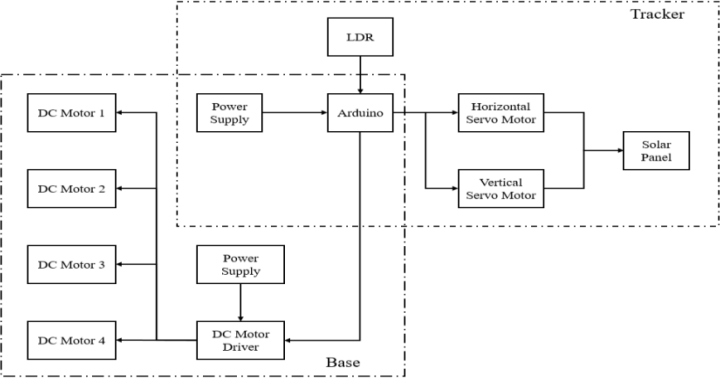
The Solar Tracking Robot (STR) integrates two core subsystems: a solar tracking mechanism and a mobile navigation system, coordinated by an Arduino Uno microcontroller. Figure 1 shows the System block diagram of the STR.


A. Tracking Mechanism
The STR employs a single-axis horizontal (azimuthal) tracking system using two light-dependent resistors (LDRs), mounted on either side of the panel and separated by an opaque barrier. These sensors detect differential light intensity, which the Arduino processes to adjust a servo motor accordingly. When one LDR receives more light than the other, the panel rotates until equilibrium is achieved. This method ensures that the solar panel remains perpendicular to sunlight, maximizing irradiance capture 3, 4.
B. Mobility Mechanism
The STR’s mobility base addresses light obstructions due to shading or environmental factors. Two additional LDRs are positioned at the front and rear of the base. If the detected light intensity falls below a preset threshold, the system triggers a pair of DC motors via an L298N H-bridge driver to move the robot to a better-lit location. This enables adaptive relocation without reliance on external positioning systems 5.
C. Control Architecture
The system logic is governed by an Arduino-based dual- loop architecture:
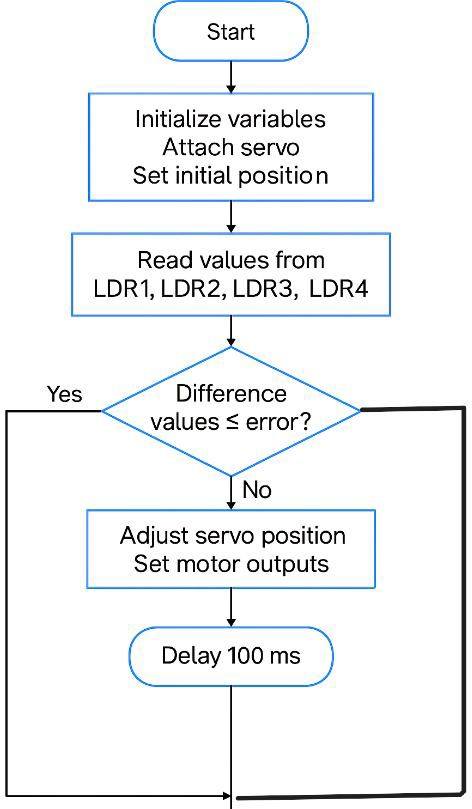
• Panel Tracking Loop: Continuously compares left/right LDR values and adjusts servo position to balance light exposure.
• Mobility Loop: Assesses front/rear light intensity and activates motion if lighting is inadequate.
This architecture supports fully autonomous operation using low-power components, suitable for energy- constrained outdoor deployments 6. Figure 2 shows the system flowchart.
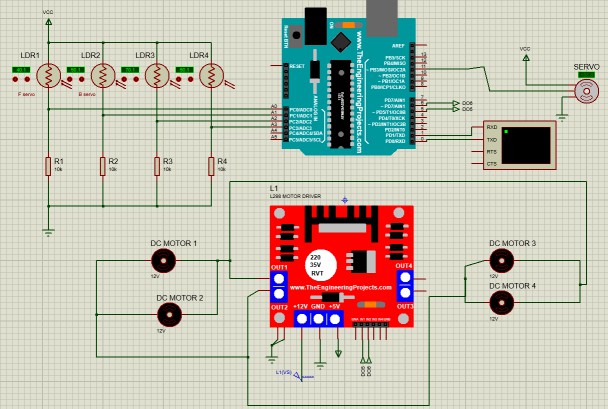
The Solar Tracking Robot (STR) was designed with an emphasis on low-cost prototyping, portability, and efficient energy harvesting. The hardware design integrates sensing, control, and actuation modules in a compact and autonomous robotic platform. The entire system was first modeled and simulated using Proteus Design Suite, enabling verification of signal behavior and logic flow before hardware implementation. Figure 3 shows the Electrical wiring diagram by Proteus.

A. System Components
The STR hardware is composed of the following core components:
• Arduino Uno R3: Serves as the central microcontroller, selected for its affordability, open-source ecosystem, and compatibility with analog and PWM inputs/outputs. It processes real- time sensor data and governs actuator control loops.
• Light Dependent Resistors (LDRs): Four LDRs are utilized in the system:
™ Two (left and right) for solar panel tracking
™ Two (front and rear) for environmental illumination assessment to trigger mobility
Each LDR is configured in a voltage divider circuit and interfaced to analog pins (A0–A3) on the Arduino.
• SG90 Micro Servo Motor: Employed to adjust the solar panel along a single horizontal axis (azimuth). It receives PWM control signals via digital pin D11, allowing fine-grained angular adjustments between 0° and 180°.
• DC Gear Motors (12V): Two brushed DC motors drive the robot’s wheels for forward and backward motion. These are controlled by direction and speed via the motor driver.
• L298N Dual H-Bridge Driver Module: This module provides motor control logic and current amplification. It enables bidirectional rotation and speed modulation of the DC motors based on control signals from digital pins D5–D8.
• Photovoltaic Panel: A 6V-12V solar panel serves as the energy-harvesting unit and performance evaluation load during testing phases.
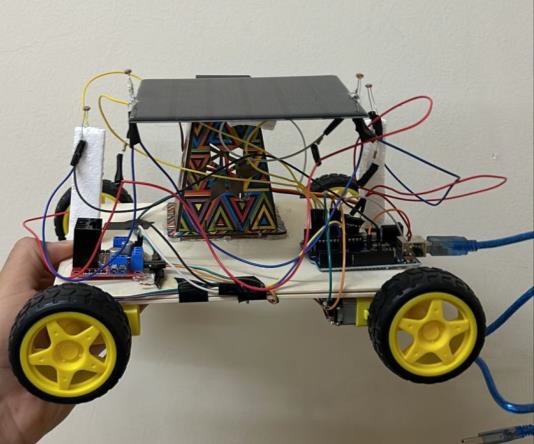
• 12V Lead-Acid or Li-ion Battery: Provides energy for both control and actuation subsystems. A voltage regulator (AMS1117) ensures safe 5V logic-level supply to the Arduino and sensors. Figure 4 shows the full view of STR with visible solar panel, sensors, and chassis

B. Electrical Configuration and Integration
The sensors, motor driver, and servo motor are electrically integrated with the Arduino as follows:
• LDRs: A0-A3 (analog inputs via voltage divider)
• Servo Motor: D11 (PWM signal)
• L298N IN1-IN4: D5-D8 (motor direction control)
• ENA/ENB: tied to PWM-capable pins for speed regulation
• Power Bus: 12V line for motors, 5V regulator output for logic components
Proper isolation is maintained between the logic and motor power domains to avoid voltage spikes and ensure system stability.
C. Embedded Control Logic
The firmware is written in C++ and uploaded via Arduino IDE. It comprises two tightly integrated control loops:
1. Tracking Control Loop:
™ Continuously samples the left/right LDR voltage.
™ Calculating differential intensity.
™ If the difference exceeds a pre-calibrated threshold (error margin), the servo adjusts the solar panel toward the more illuminated side.
™ This loop allows real-time adjustment every 100–200 ms for smooth and accurate solar tracking.
2. Mobility Control Loop:
™ Monitors light intensity from front and rear LDRs.
™ If ambient light drops below a defined global threshold, and the panel has remained unbalanced for a predefined duration, the robot initiates locomotion.
™ Movement direction is determined by comparing front/rear light levels.
™ The robot moves incrementally, reassessing after each repositioning step.
This control structure ensures efficient use of power and fast adaptation to changing sunlight conditions without redundant motion.
D. Safety Mechanisms and Power Optimization
To prevent over-rotation or mechanical stress:
• Servo limits are constrained programmatically (e.g., 30° to 150°).
• Timeouts are implemented to halt DC motors after a fixed travel time if no improvement in light is detected.
Sleep modes and loop delay cycles are optimized to reduce power consumption during idle states, improving system runtime on battery supply.
The Solar Tracking Robot (STR) was evaluated through both simulation and experimental validation to assess its effectiveness in real-world solar tracking and energy harvesting. Tests focused on tracking accuracy, energy yield, light responsiveness, and system stability under varying environmental conditions.
A. Experimental Setup
The prototype was deployed in an open outdoor environment with direct sunlight. Power output was measured using a digital multimeter connected to the solar panel's terminals under two conditions:
1. Fixed panel (non-tracking)
2. STR in active tracking mode
Light intensity was simultaneously monitored through the LDR voltage readings to evaluate sensor response and control precision. Observations were logged from 8:00 AM to 6:00 PM across multiple days.
B. Tracking Performance
The STR consistently aligned the panel within ±10° of optimal azimuth orientation throughout daylight hours. The servo responded to changing light conditions within 200 ms, providing near-continuous alignment. The robot effectively maintained perpendicular incidence with sunlight during peak solar angles (10:00 AM - 2:00 PM).
C. Energy Output Comparison
Table 1 presents the comparative power output of the STR vs. a fixed panel over a 10-hour cycle.
On average, the STR increased solar energy output by 18%-26%, with the highest gain observed during non- peak hours when tracking is most advantageous.
D. Sensor Reliability and Motion Precision
All LDRs demonstrated stable analog outputs across a range of light levels. The robot's motion logic activated only under prolonged low-light conditions, confirming the robustness of its dual-LDR threshold algorithm. No erratic movement or unnecessary repositioning was observed.
E. Limitations
• The system performed best under direct sunlight; overcast or highly diffused light conditions reduced tracking accuracy.
• Mobility was tested on smooth ground; terrain adaptability is yet to be evaluated.
• Battery runtime was limited to 3-5 hours under heavy motor use without solar charging integration. This can be improved by using extra battery.
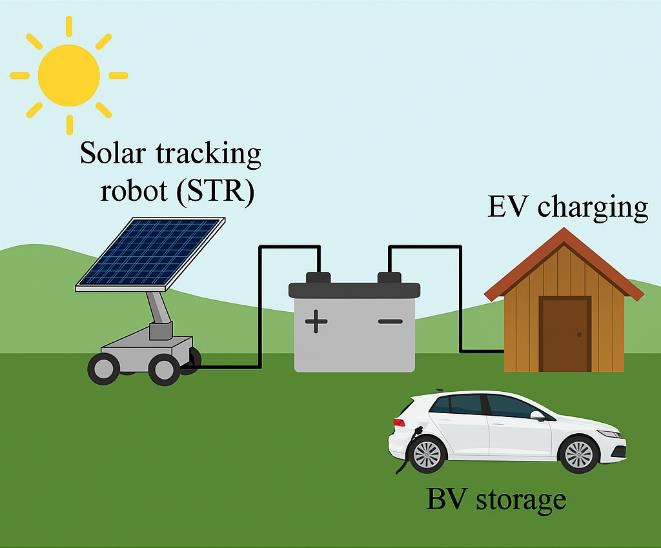
The accelerating adoption of electric vehicles (EVs) worldwide has driven a parallel demand for sustainable and autonomous charging infrastructure. Traditional EV charging stations often depend on grid connectivity, which is limited or non-existent in rural, remote, or emergency- deployment areas. The Solar Tracking Robot (STR), with its autonomous solar alignment and self-repositioning capabilities, offers a compelling off-grid charging solution that is both efficient and mobile. Figure 5 shows the Conceptual STR deployment for rural off-grid electric vehicle charging.

F. Off-Grid Charging Potential
In remote regions, the absence of reliable electricity severely hampers the deployment of fixed EV charging infrastructure. Mobile STR units can serve as standalone solar power stations that dynamically align with the sun to maximize energy harvesting and charge small EVs such as scooters, bikes, or light utility vehicles. These units can operate individually or as part of a decentralized microgrid 9.
G. Practical Use Cases
1. Rural Mobility Support – In developing regions, STRs can be deployed in rural transport systems to charge community-owned electric vehicles during daylight hours.
2. Disaster Relief and Emergency Response – In post-disaster areas where grid access is unavailable, mobile solar trackers can provide energy for electric medical carts, emergency communications, or transport 10.
3. Agricultural Fields – STRs can support electric carts or tools on farms by charging them where they are used, minimizing downtime and grid dependency 11, 12.
H. System Adaptability
The current STR prototype supports solar panels in the 6-12V range and can be enhanced by integrating:
• High-wattage PV panels (100W and above)
• MPPT charge controllers to optimize power output
• Battery packs with DC output regulation for compatibility with standard EV connectors (USB- C, Type 1/2)
By modifying the payload and control algorithms, STRs can be scaled to serve a range of EV power requirements.
I. Advantages of Stationary Charging Platforms
• Enhanced Energy Capture: Sun-tracking improves irradiance absorption by up to 26%, reducing charge time 2.
• Mobility: The system can autonomously relocate to optimal sunlit locations, avoiding obstructions or shaded regions 9.
• Rapid Deployment: STRs can be installed or relocated within minutes, unlike fixed solar chargers which often require permitting and infrastructure 10.
• Grid Independence: Especially suitable for off- grid or emergency EV charging scenarios, increasing resilience in energy-insecure regions 11.
This paper presented the design, development, and evaluation of a low-cost, single-axis Solar Tracking Robot (STR) capable of autonomous sun alignment and mobility for enhanced photovoltaic energy harvesting. By integrating light-dependent resistor (LDR) sensors, servo motor actuation, and a mobile platform driven by DC motors, the STR dynamically maintains optimal panel orientation and can reposition itself in search of better solar irradiance. Experimental results demonstrated that the STR achieved a solar energy yield increase of up to 26%.
compared to fixed-panel systems. It also proved responsive to environmental light changes and operated reliably in an off-grid configuration using Arduino-based control logic. These outcomes highlight the STR's potential to support decentralized and mobile energy systems, especially in applications such as off-grid electric vehicle (EV) charging.
| [1] | Rao, CSVP., Pandian, A., Reddy, CR., Bajaj, M., Massoud, J., Shouran, M., “Unified power quality conditioner-based solar EV charging station using the GBDT-JS technique”, Frontiers in Energy Research, 12, (2024). | ||
| In article | View Article | ||
| [2] | White, A., “How Efficient Are Tracking Solar Panels,” Alt Energy Mag, (2022). | ||
| In article | |||
| [3] | Alsadi, S., Alsadi, B., “Design and implementation of a solar tracking system using Arduino,” International Journal of Engineering Research and Applications, 7, 17-22, (2017). | ||
| In article | |||
| [4] | Toledo, J., Leiva, D., Rodríguez, P., “Low- cost photovoltaic tracking system using LDRs and Arduino,” Proc. IEEE ANDESCON, 1-4. (2018). | ||
| In article | |||
| [5] | Al-Turki, Y. A., Qamber, M., “A mobile solar tracking robot design using LDR sensors and Arduino,” International Journal of Innovative Technology and Exploring Engineering (IJITEE), 8, 12, 154-159, (2019). | ||
| In article | |||
| [6] | Khan, M. M., et al., “Energy-efficient embedded systems for solar tracking applications: A review,” Renewable and Sustainable Energy Reviews, 111, 344-360, (2019). | ||
| In article | View Article | ||
| [7] | Kacira, N., et al., “Determining optimum tilt angles and orientations of photovoltaic panels in Sanliurfa, Turkey,” Renewable Energy, 29, 8, 1265–1275, (2004). | ||
| In article | View Article | ||
| [8] | Zahid, M., et al., “Design and implementation of low-cost dual axis solar tracker using Arduino,” in Proc. Int. Conf. on Electrical Engineering and Computer Science (EECSI), 1-6. (2019). | ||
| In article | |||
| [9] | Solaflect Energy, “An Off-Grid Solar Tracker Powers This EV Charging Station,” Electrek, (2024). | ||
| In article | |||
| [10] | Beam Global, “EV ARC Sustainable EV Charging in Minutes Not Months,” | ||
| In article | |||
| [11] | Hackaday, “Off-Grid EV Charging for Mobile Applications,” (2023). | ||
| In article | |||
| [12] | Gogoi, D., Bharatee, A., Ray, PK., “Implementation of battery storage system in a solar PV-based EV charging station”, Electric Power Systems Research, 229 (2024). | ||
| In article | View Article | ||
Published with license by Science and Education Publishing, Copyright © 2025 Ali Alzahrani, Mouiad Nahhas, Abdulaziz Alogla, Khalid Almghrabi, Nawaf Albishri and Ahmed M. Nahhas
 This work is licensed under a Creative Commons Attribution 4.0 International License. To view a copy of this license, visit
http://creativecommons.org/licenses/by/4.0/
This work is licensed under a Creative Commons Attribution 4.0 International License. To view a copy of this license, visit
http://creativecommons.org/licenses/by/4.0/
| [1] | Rao, CSVP., Pandian, A., Reddy, CR., Bajaj, M., Massoud, J., Shouran, M., “Unified power quality conditioner-based solar EV charging station using the GBDT-JS technique”, Frontiers in Energy Research, 12, (2024). | ||
| In article | View Article | ||
| [2] | White, A., “How Efficient Are Tracking Solar Panels,” Alt Energy Mag, (2022). | ||
| In article | |||
| [3] | Alsadi, S., Alsadi, B., “Design and implementation of a solar tracking system using Arduino,” International Journal of Engineering Research and Applications, 7, 17-22, (2017). | ||
| In article | |||
| [4] | Toledo, J., Leiva, D., Rodríguez, P., “Low- cost photovoltaic tracking system using LDRs and Arduino,” Proc. IEEE ANDESCON, 1-4. (2018). | ||
| In article | |||
| [5] | Al-Turki, Y. A., Qamber, M., “A mobile solar tracking robot design using LDR sensors and Arduino,” International Journal of Innovative Technology and Exploring Engineering (IJITEE), 8, 12, 154-159, (2019). | ||
| In article | |||
| [6] | Khan, M. M., et al., “Energy-efficient embedded systems for solar tracking applications: A review,” Renewable and Sustainable Energy Reviews, 111, 344-360, (2019). | ||
| In article | View Article | ||
| [7] | Kacira, N., et al., “Determining optimum tilt angles and orientations of photovoltaic panels in Sanliurfa, Turkey,” Renewable Energy, 29, 8, 1265–1275, (2004). | ||
| In article | View Article | ||
| [8] | Zahid, M., et al., “Design and implementation of low-cost dual axis solar tracker using Arduino,” in Proc. Int. Conf. on Electrical Engineering and Computer Science (EECSI), 1-6. (2019). | ||
| In article | |||
| [9] | Solaflect Energy, “An Off-Grid Solar Tracker Powers This EV Charging Station,” Electrek, (2024). | ||
| In article | |||
| [10] | Beam Global, “EV ARC Sustainable EV Charging in Minutes Not Months,” | ||
| In article | |||
| [11] | Hackaday, “Off-Grid EV Charging for Mobile Applications,” (2023). | ||
| In article | |||
| [12] | Gogoi, D., Bharatee, A., Ray, PK., “Implementation of battery storage system in a solar PV-based EV charging station”, Electric Power Systems Research, 229 (2024). | ||
| In article | View Article | ||