This paper explores the impact of mutual coupling on the performance of MIMO systems, particularly in 5G microstrip antennas. Through simulations, we investigate the coupling effect in a proposed Microstrip Patch Antenna (MPA) design. A single-element MPA and a 4-element antenna array are designed to analyze mutual coupling and improve isolation by introducing slots, thereby increasing the data rate. The slotted single microstrip antenna achieves a 175% bandwidth improvement, covering 27.6 GHz to 29.7 GHz at a center frequency of 28 GHz. The results show that the 4-element slotted microstrip MIMO antenna system reduces mutual coupling to -16.675 dB, outperforming the not slotted design (-14.4 dB). This work aims to design a single-band 4-element MIMO microstrip antenna for 5G systems, enhancing bandwidth, reducing mutual coupling, and achieving high data rates, polarization, bandwidth (>1 GHz), and realized gain at 28 GHz.
Antennas are crucial elements in RF systems, enabling signal transmission and reception through the air. Without proper design, signals cannot be transmitted or detected. Microstrip patch antennas (MPAs) have gained significant attention since their introduction in the 1950s, although they didn't receive serious consideration until the 1970s 1. MPAs utilize printed circuit technology for radiating elements and consist of conductive strips and patches on a dielectric substrate with a ground layer 2. The advent of 5G communication has further emphasized the importance of MPAs in multiple input multiple output (MIMO) systems, a core component of 5G that improves capacity and data transmission rates 3. MIMO technology, first proposed by Marconi in 1980, has broad applications in mobile communication and can significantly increase system channel capacity and wireless link transmission quality 4. Recent advancements in MIMO antenna design, such as using slots in microstrip antenna rectangular patches and wideband neutralization lines for mutual coupling reduction, have shown promising results 5. As the demand for high-speed wireless communication continues to grow, compact and efficient MIMO antenna designs are essential for next-generation devices. This imperative drives the exploration of novel antenna configurations capable of supporting the stringent bandwidth and isolation requirements of 5G systems 6. This paper investigates a novel approach to enhance the performance of microstrip patch antennas for 5G multiple-input multiple-output systems, specifically focusing on increasing bandwidth and mitigating mutual coupling through the strategic integration of slots within the antenna structure 7.
Designing a MIMO antenna system with minimal mutual coupling poses a significant challenge in wireless devices, particularly when trying to accommodate multiple antennas within a limited area to meet 5G requirements of configuration and characteristics 8, 9, 10, 11, 12. This section outlines the methodologies employed to design and simulate four distinct antenna models: a single microstrip antenna, a slotted single microstrip antenna, a 4-element microstrip MIMO antenna system without slots, and a 4-element microstrip MIMO antenna system with slots. The primary objective is to evaluate the mutual coupling values by comparing the performance of slotted and not slotted patch designs. This comparative analysis will elucidate the efficacy of slot integration in mitigating detrimental inter-element interactions within multi-antenna configurations, thereby validating their role in enhancing overall system performance and spectral efficiency. To achieve this, the CST Microwave Studio software is utilized for designing and simulating the proposed antenna models, following a structured approach that includes:
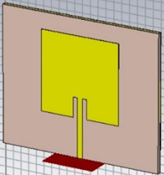
2.1. Design of Single Microstrip AntennaThe design process for a microstrip antenna begins with selecting the operating frequency and determining the suitable substrate. The operating frequency, in this case, 28 GHz, which falls within the wireless band region, must be carefully chosen to ensure the antenna functions within the desired frequency band. The next step involves selecting an appropriate substrate, whose height and dielectric properties significantly impact the antenna's electromagnetic characteristics. For this design, FR-4 is chosen as the dielectric material. Notably, high dielectric substrates enable antenna size reduction due to the inverse relationship between antenna dimensions and dielectric constant 13, 14, 15, 16. Figure 1 illustrates the design of the not slotted single-element microstrip antenna, while Table 1 provides a comprehensive list of its characteristics.

The integration of slots into the microstrip patch antenna design serves as a primary method for enhancing bandwidth and achieving multiband operation, which is critical for meeting the diverse requirements of 5G 15. This technique effectively alters the current distribution on the patch, leading to resonant frequency shifts and the creation of additional resonant modes, thereby broadening the operational bandwidth 17, 18. Specifically, the incorporation of U-shaped or asymmetrical slots can significantly improve the impedance bandwidth and polarization purity, overcoming the narrow bandwidth limitation inherent in conventional microstrip antennas 19, 20. These slots effectively increase the electrical length of the current path, leading to lower resonant frequencies and enabling wider impedance matching 21.
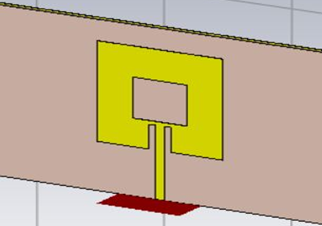
To optimize the microstrip patch antenna for 5G communication systems, a rectangular slot of 9.9 × 9.7 mm is incorporated into the patch. The outer dimensions of the slot are approximately equal to those of the 28 GHz patch antenna designed on the same substrate. Figure 2 illustrates the design of the slotted single-element antenna.

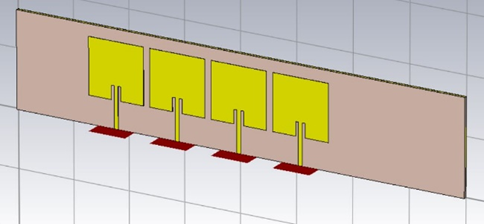
The design of a 4-element microstrip MIMO antenna system without slots is crucial for establishing a baseline for mutual coupling and overall performance comparison against the slotted designs, thereby highlighting the benefits of slot integration. This non-slotted configuration allows for a direct assessment of inherent mutual coupling levels and isolation characteristics that are solely dependent on antenna spacing and substrate properties, providing a clear reference point for the enhancements achieved through slotting techniques 22, 23. Such antenna arrays often face challenges in achieving high gain and wide bandwidth, which are essential for millimeter-wave 5G applications, without resorting to more complex feeding networks or additional parasitic elements 24. The inherent limitations of conventional non-slotted microstrip arrays, such as narrow bandwidth and elevated mutual coupling, underscore the necessity for innovative design modifications to meet the stringent demands of 5G communication 25. To enhance the data rate and system capacity of 5G communication systems, a 4-element MIMO microstrip antenna system is designed. Specifically, a 4-element MIMO microstrip antenna without slots is developed, as shown in Figure 3, which demonstrates a mutual coupling of -14.4 dB.

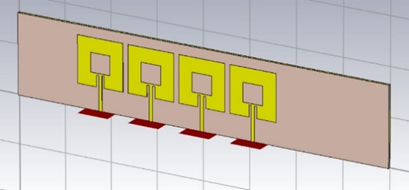
The fourth and final design is a 4-element microstrip MIMO antenna system with slots as illustrated in Figure 4, replicating the single-element antenna design four times to enhance data throughput. The introduction of slots optimizes the antenna's electromagnetic properties, yielding improved bandwidth and minimized mutual coupling between elements.
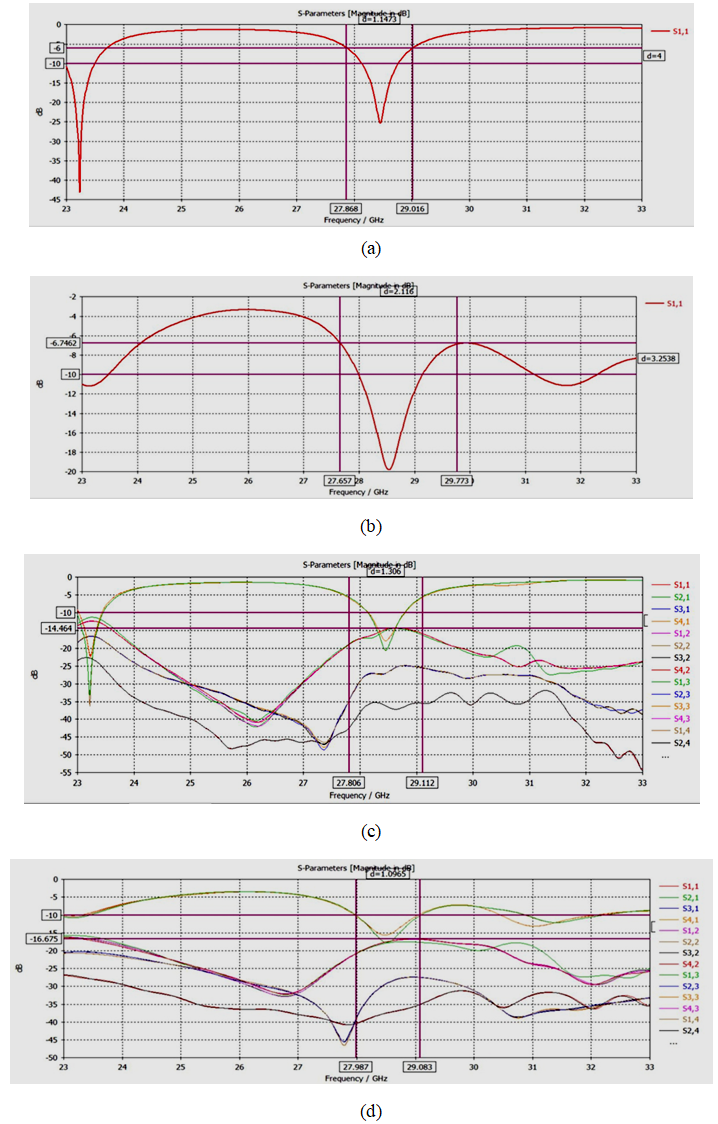
In general, the most commonly referenced parameter for antennas is S11, which represents the reflection coefficient or return loss. It signifies the amount of power reflected from the antenna. For instance, if S11 = 0 dB, all power is reflected, and none is radiated. If S11 = -10 dB, it means 10% of the power is reflected, while the rest is delivered to the antenna, either being absorbed or radiated 26, 27, 28, 29, 30. The simulated return loss results are presented in Figure 5, highlighting the performance of four different antenna designs: a single microstrip antenna with a bandwidth of 27.868-29.016 GHz (Figure a), a slotted single microstrip antenna with a bandwidth of 27.657-29.773 GHz (Figure b) represents more than 175% ((29.7 – 27.6)/(29 - 27.8)) × 100) improvement in bandwidth has been achieved., a 4-element microstrip MIMO antenna system without slots exhibiting a mutual coupling of -14.464 dB (Figure c), and a 4-element microstrip MIMO antenna system with slots showing a mutual coupling of -16.675 dB (Figure d) which is more better.

In conclusion, this paper demonstrates the effectiveness of slot-based patch antenna design in enhancing bandwidth and reducing mutual coupling in MIMO systems for 5G applications. By introducing slots in the microstrip patch antenna, we achieved a significant 175% improvement in bandwidth, covering a frequency range of 27.6 GHz to 29.7 GHz at a center frequency of 28 GHz. Furthermore, the 4-element slotted microstrip MIMO antenna system exhibited reduced mutual coupling of -16.675 dB, outperforming the not slotted design. These results highlight the potential of slot-based patch antenna design in achieving high-performance 5G communication systems with enhanced bandwidth, reduced mutual coupling, and improved data rates. The proposed antenna design can be a promising solution for future 5G applications, enabling high-speed data transmission and reliable communication.
| [1] | D.M. Pozar, Microstrip antennas. Proceedings of the IEEE. Volume 80, Page(s):79 – 91, Issue 1, Jan. 1992. | ||
| In article | View Article | ||
| [2] | D. G. Fang, Antenna theory and microstrip antennas, 1 edition. CRC Press/Taylor &Franci, p. 311, 2009 52. | ||
| In article | |||
| [3] | M. Abdullah, A. Altaf, M.R. Anjuml, Future smartphone: MIMO antenna system for 5G mobile terminals, IEEE Access 9 (2021) 91593–91603. | ||
| In article | View Article | ||
| [4] | R.V. Durga, A. Mclauchlin, Performance analysis of MIMO system capacity with various receiver architectures, Int. J. Grid Distrib. Comput. 13 (2) (2021). | ||
| In article | |||
| [5] | Liu, L., Cheung, S. W., & Yuk, T. I. (2013). Compact MIMO Antenna for Portable Devices in UWB Applications. IEEE Transactions on Antennas and Propagation, 61(8), 4257–4264. | ||
| In article | View Article | ||
| [6] | Fernandez, R., Ra’id, F., Andre, H., Baharuddin, B., & Firdaus, F. (2021). The use of edge cut on microstrip antenna patch with the modified partial ground plane for bandwidth enhancement. IOP Conference Series Materials Science and Engineering, 1041(1), 12017. | ||
| In article | View Article | ||
| [7] | Xiang, K., & Chen, F. (2020). A method for increasing the bandwidth of slot and patch antennas using grid‐slotted patch. International Journal of RF and Microwave Computer-Aided Engineering, 31(2). | ||
| In article | View Article | ||
| [8] | N. I. M. Elamin, T. A. Rahman and A. Y. Abdulrahman, "New Adjustable Slot Meander Patch Antenna for 4G Handheld Devices," in IEEE Antennas and Wireless Propagation Letters, vol. 12, pp. 1077-1080, 2013, keywords: {Antenna measurements;Broadband antennas; Wideband;Slot antennas; Microwave antennas; LTE antenna; LTE-FDD frequency bands; LTE-TDD frequency bands; slot meander patch} | ||
| In article | View Article | ||
| [9] | Raj, T., Mishra, R., Kumar, P., & Kapoor, A. (2023). Advances in MIMO Antenna Design for 5G: A Comprehensive Review [Review of Advances in MIMO Antenna Design for 5G: A Comprehensive Review]. Sensors, 23(14), 6329. Multidisciplinary Digital Publishing Institute. | ||
| In article | View Article PubMed | ||
| [10] | Rana, Md. S., Hossain, S., Rana, S. B., & Rahman, Md. M. (2022). Microstrip patch antennas for various applications: a review [Review of Microstrip patch antennas for various applications: a review]. Indonesian Journal of Electrical Engineering and Computer Science, 29 (3), 1511. Institute of Advanced Engineering and Science (IAES). | ||
| In article | View Article | ||
| [11] | Abdelgwad, A. H., & Ali, M. (2020). CAPACITY AND EFFICIENCY IMPROVEMENT OF MIMO ANTENNA SYSTEMS FOR 5G HANDHELD TERMINALS. Progress In Electromagnetics Research C, 104, 269. | ||
| In article | View Article | ||
| [12] | Chu-Anh, T., Kim-Thi, P., Nguyen-Manh, H., & Tran, H. H. (2023). A conformal multi-port MIMO patch antenna for 5G wireless devices. PLoS ONE, 18(12). | ||
| In article | View Article PubMed | ||
| [13] | Tiwari, R., Bagwari, A., & Kushwah, V. S. (2020). Parameter Improvement of Micro strip Patch Antennas Using Various Techniques: A Review [Review of Parameter Improvement of Micro strip Patch Antennas Using Various Techniques: A Review]. Materials Today Proceedings, 29, 492. Elsevier BV. | ||
| In article | View Article | ||
| [14] | Tiwari, R., Sharma, R., & Dubey, R. (2020). Microstrip Patch Antenna Array Design Anaylsis for 5G Communication Applications. SMART MOVES JOURNAL IJOSCIENCE, 6(5), 1. | ||
| In article | View Article | ||
| [15] | Mazen, K., Emran, A. A., Shalaby, A., & Yahya, A. (2021). Design of Multi-band Microstrip Patch Antennas for Mid-band 5G Wireless Communication. International Journal of Advanced Computer Science and Applications, 12(5). | ||
| In article | View Article | ||
| [16] | Padmasree, R., Dharmapuri, Y. G., Priyanka, K., & Yogesh, V. (2024). Exploring Performance Metrics of a Microstrip Antenna for 6G Millimeter-Wave Communication. Research Square (Research Square). | ||
| In article | View Article | ||
| [17] | Ermiş, S., & Demirci, M. (2023). Improving the Performance of Patch Antenna by Applying Bandwidth Enhancement Techniques for 5G Applications. Tehnički Glasnik, 17(3), 305. | ||
| In article | View Article | ||
| [18] | Noor, S. K., Jusoh, M., Sabapathy, T., Rambe, A. H., Vettikalladi, H., Albishi, A. M., & Himdi, M. (2023). A Patch Antenna with Enhanced Gain and Bandwidth for Sub-6 GHz and Sub-7 GHz 5G Wireless Applications. Electronics, 12(12), 2555. | ||
| In article | View Article | ||
| [19] | Xu, K. (2022). Broadband Microstrip Antenna Overview. Highlights in Science Engineering and Technology, 27, 621. | ||
| In article | View Article | ||
| [20] | El-Sayed, M., AboSree, M. F., & AbdElazem, M. H. (2021). Compact wide band antenna for millimetric communications. IOP Conference Series Materials Science and Engineering, 1051(1), 12032. | ||
| In article | View Article | ||
| [21] | Gatti, R. V., Rossi, R., & Dionigi, M. (2020). Single-Layer Line-Fed Broadband Microstrip Patch Antenna on Thin Substrates. Electronics, 10(1), 37. | ||
| In article | View Article | ||
| [22] | Hakeem, M. J., & Nahas, M. M. (2021). Improving the Performance of a Microstrip Antenna by Adding a Slot into Different Patch Designs. Engineering Technology & Applied Science Research, 11(4), 7469. | ||
| In article | View Article | ||
| [23] | Prasad, B. S. H., & Prasad, M. V. S. (2020). DESIGN AND ANALYSIS OF COMPACT PERIODIC SLOT MULTIBAND ANTENNA WITH DEFECTED GROUND STRUCTURE FOR WIRELESS APPLICATIONS. Progress In Electromagnetics Research M, 93, 77. | ||
| In article | View Article | ||
| [24] | Juneja, S., & Sharma, R. (2021). Study of techniques to improve performance of patch antennas for 5G applications at millimeter wave (mmW) frequencies. IOP Conference Series Materials Science and Engineering, 1022(1), 12033. | ||
| In article | View Article | ||
| [25] | Gupta, A. K., Patnaik, A. K., Suresh, S., Chowdary, P. S. R., & Krishna, M. V. (2020). DGS-Based T-Shaped Patch Antenna for 5G Communication Applications. In Lecture notes in electrical engineering (p. 11). Springer Science+Business Media. | ||
| In article | View Article | ||
| [26] | Kothari, Nikita & Saraf, Aman & Rawat, Manoj. (2016). Design of Meander Slotted Patch antenna for Wireless Application - A Review. International Journal of Engineering Trends and Technology. 37. 225-232. 10.14445/22315381/IJETT-V37P239. | ||
| In article | View Article | ||
| [27] | Gohari, A., Ahmad, A. B., Rahim, R. B. A., Elamin, N. I. M., Gismalla, M. S. M., Oluwatosin, O. O., ... & Lawal, A. (2023). Drones for road accident management: A systematic review. IEEE Access, 11, 109247-109256. | ||
| In article | View Article | ||
| [28] | Deshmukh, A. A., Rane, A., Surendran, S., Bhasin, Y., & Chavali, V. A. P. (2023). Wideband and Compact Regular Shape Microstrip Antennas Employing Rectangular Slots Cut Bow-tie Shape Ground Plane. Progress In Electromagnetics Research B, 100, 155. | ||
| In article | View Article | ||
| [29] | Nguyen, L. N. (2020). Mutual Coupling Reduction in Microstrip Antennas using Defected Ground Structure. REV Journal on Electronics and Communications, 10. | ||
| In article | View Article | ||
| [30] | Nassrin Ibrahim Mohamed Elamin. Miniature 4-Element MIMO Antenna System Designed From Transparent Glass Substrate and Aluminum Foil Radiator. American Journal of Electrical and Electronic Engineering. 2021; 9(1): 1-6. | ||
| In article | |||
Published with license by Science and Education Publishing, Copyright © 2025 Nassrin Ibrahim Mohamed Elamin and Mohammed Gronfula
 This work is licensed under a Creative Commons Attribution 4.0 International License. To view a copy of this license, visit
http://creativecommons.org/licenses/by/4.0/
This work is licensed under a Creative Commons Attribution 4.0 International License. To view a copy of this license, visit
http://creativecommons.org/licenses/by/4.0/
| [1] | D.M. Pozar, Microstrip antennas. Proceedings of the IEEE. Volume 80, Page(s):79 – 91, Issue 1, Jan. 1992. | ||
| In article | View Article | ||
| [2] | D. G. Fang, Antenna theory and microstrip antennas, 1 edition. CRC Press/Taylor &Franci, p. 311, 2009 52. | ||
| In article | |||
| [3] | M. Abdullah, A. Altaf, M.R. Anjuml, Future smartphone: MIMO antenna system for 5G mobile terminals, IEEE Access 9 (2021) 91593–91603. | ||
| In article | View Article | ||
| [4] | R.V. Durga, A. Mclauchlin, Performance analysis of MIMO system capacity with various receiver architectures, Int. J. Grid Distrib. Comput. 13 (2) (2021). | ||
| In article | |||
| [5] | Liu, L., Cheung, S. W., & Yuk, T. I. (2013). Compact MIMO Antenna for Portable Devices in UWB Applications. IEEE Transactions on Antennas and Propagation, 61(8), 4257–4264. | ||
| In article | View Article | ||
| [6] | Fernandez, R., Ra’id, F., Andre, H., Baharuddin, B., & Firdaus, F. (2021). The use of edge cut on microstrip antenna patch with the modified partial ground plane for bandwidth enhancement. IOP Conference Series Materials Science and Engineering, 1041(1), 12017. | ||
| In article | View Article | ||
| [7] | Xiang, K., & Chen, F. (2020). A method for increasing the bandwidth of slot and patch antennas using grid‐slotted patch. International Journal of RF and Microwave Computer-Aided Engineering, 31(2). | ||
| In article | View Article | ||
| [8] | N. I. M. Elamin, T. A. Rahman and A. Y. Abdulrahman, "New Adjustable Slot Meander Patch Antenna for 4G Handheld Devices," in IEEE Antennas and Wireless Propagation Letters, vol. 12, pp. 1077-1080, 2013, keywords: {Antenna measurements;Broadband antennas; Wideband;Slot antennas; Microwave antennas; LTE antenna; LTE-FDD frequency bands; LTE-TDD frequency bands; slot meander patch} | ||
| In article | View Article | ||
| [9] | Raj, T., Mishra, R., Kumar, P., & Kapoor, A. (2023). Advances in MIMO Antenna Design for 5G: A Comprehensive Review [Review of Advances in MIMO Antenna Design for 5G: A Comprehensive Review]. Sensors, 23(14), 6329. Multidisciplinary Digital Publishing Institute. | ||
| In article | View Article PubMed | ||
| [10] | Rana, Md. S., Hossain, S., Rana, S. B., & Rahman, Md. M. (2022). Microstrip patch antennas for various applications: a review [Review of Microstrip patch antennas for various applications: a review]. Indonesian Journal of Electrical Engineering and Computer Science, 29 (3), 1511. Institute of Advanced Engineering and Science (IAES). | ||
| In article | View Article | ||
| [11] | Abdelgwad, A. H., & Ali, M. (2020). CAPACITY AND EFFICIENCY IMPROVEMENT OF MIMO ANTENNA SYSTEMS FOR 5G HANDHELD TERMINALS. Progress In Electromagnetics Research C, 104, 269. | ||
| In article | View Article | ||
| [12] | Chu-Anh, T., Kim-Thi, P., Nguyen-Manh, H., & Tran, H. H. (2023). A conformal multi-port MIMO patch antenna for 5G wireless devices. PLoS ONE, 18(12). | ||
| In article | View Article PubMed | ||
| [13] | Tiwari, R., Bagwari, A., & Kushwah, V. S. (2020). Parameter Improvement of Micro strip Patch Antennas Using Various Techniques: A Review [Review of Parameter Improvement of Micro strip Patch Antennas Using Various Techniques: A Review]. Materials Today Proceedings, 29, 492. Elsevier BV. | ||
| In article | View Article | ||
| [14] | Tiwari, R., Sharma, R., & Dubey, R. (2020). Microstrip Patch Antenna Array Design Anaylsis for 5G Communication Applications. SMART MOVES JOURNAL IJOSCIENCE, 6(5), 1. | ||
| In article | View Article | ||
| [15] | Mazen, K., Emran, A. A., Shalaby, A., & Yahya, A. (2021). Design of Multi-band Microstrip Patch Antennas for Mid-band 5G Wireless Communication. International Journal of Advanced Computer Science and Applications, 12(5). | ||
| In article | View Article | ||
| [16] | Padmasree, R., Dharmapuri, Y. G., Priyanka, K., & Yogesh, V. (2024). Exploring Performance Metrics of a Microstrip Antenna for 6G Millimeter-Wave Communication. Research Square (Research Square). | ||
| In article | View Article | ||
| [17] | Ermiş, S., & Demirci, M. (2023). Improving the Performance of Patch Antenna by Applying Bandwidth Enhancement Techniques for 5G Applications. Tehnički Glasnik, 17(3), 305. | ||
| In article | View Article | ||
| [18] | Noor, S. K., Jusoh, M., Sabapathy, T., Rambe, A. H., Vettikalladi, H., Albishi, A. M., & Himdi, M. (2023). A Patch Antenna with Enhanced Gain and Bandwidth for Sub-6 GHz and Sub-7 GHz 5G Wireless Applications. Electronics, 12(12), 2555. | ||
| In article | View Article | ||
| [19] | Xu, K. (2022). Broadband Microstrip Antenna Overview. Highlights in Science Engineering and Technology, 27, 621. | ||
| In article | View Article | ||
| [20] | El-Sayed, M., AboSree, M. F., & AbdElazem, M. H. (2021). Compact wide band antenna for millimetric communications. IOP Conference Series Materials Science and Engineering, 1051(1), 12032. | ||
| In article | View Article | ||
| [21] | Gatti, R. V., Rossi, R., & Dionigi, M. (2020). Single-Layer Line-Fed Broadband Microstrip Patch Antenna on Thin Substrates. Electronics, 10(1), 37. | ||
| In article | View Article | ||
| [22] | Hakeem, M. J., & Nahas, M. M. (2021). Improving the Performance of a Microstrip Antenna by Adding a Slot into Different Patch Designs. Engineering Technology & Applied Science Research, 11(4), 7469. | ||
| In article | View Article | ||
| [23] | Prasad, B. S. H., & Prasad, M. V. S. (2020). DESIGN AND ANALYSIS OF COMPACT PERIODIC SLOT MULTIBAND ANTENNA WITH DEFECTED GROUND STRUCTURE FOR WIRELESS APPLICATIONS. Progress In Electromagnetics Research M, 93, 77. | ||
| In article | View Article | ||
| [24] | Juneja, S., & Sharma, R. (2021). Study of techniques to improve performance of patch antennas for 5G applications at millimeter wave (mmW) frequencies. IOP Conference Series Materials Science and Engineering, 1022(1), 12033. | ||
| In article | View Article | ||
| [25] | Gupta, A. K., Patnaik, A. K., Suresh, S., Chowdary, P. S. R., & Krishna, M. V. (2020). DGS-Based T-Shaped Patch Antenna for 5G Communication Applications. In Lecture notes in electrical engineering (p. 11). Springer Science+Business Media. | ||
| In article | View Article | ||
| [26] | Kothari, Nikita & Saraf, Aman & Rawat, Manoj. (2016). Design of Meander Slotted Patch antenna for Wireless Application - A Review. International Journal of Engineering Trends and Technology. 37. 225-232. 10.14445/22315381/IJETT-V37P239. | ||
| In article | View Article | ||
| [27] | Gohari, A., Ahmad, A. B., Rahim, R. B. A., Elamin, N. I. M., Gismalla, M. S. M., Oluwatosin, O. O., ... & Lawal, A. (2023). Drones for road accident management: A systematic review. IEEE Access, 11, 109247-109256. | ||
| In article | View Article | ||
| [28] | Deshmukh, A. A., Rane, A., Surendran, S., Bhasin, Y., & Chavali, V. A. P. (2023). Wideband and Compact Regular Shape Microstrip Antennas Employing Rectangular Slots Cut Bow-tie Shape Ground Plane. Progress In Electromagnetics Research B, 100, 155. | ||
| In article | View Article | ||
| [29] | Nguyen, L. N. (2020). Mutual Coupling Reduction in Microstrip Antennas using Defected Ground Structure. REV Journal on Electronics and Communications, 10. | ||
| In article | View Article | ||
| [30] | Nassrin Ibrahim Mohamed Elamin. Miniature 4-Element MIMO Antenna System Designed From Transparent Glass Substrate and Aluminum Foil Radiator. American Journal of Electrical and Electronic Engineering. 2021; 9(1): 1-6. | ||
| In article | |||