Background: Coffee is one of the most consumed beverages to beat boredom and improve alertness. Though many studies have proved its cognitive effect, this study helps to understand the need for coffee intake and its different benefits and ill effects among faculty of medical school where teaching is a prime focus. Methodology: A cross-sectional questionnaire-based study was conducted among 30 faculty in a Caribbean Medical school. A questionnaire comprising five categories was developed to assess various aspects of coffee consumption. A mixed method study where quantitative and qualitative data were collected by closed and open-ended questionnaire. Sum, mean and average used for statistical analysis. Result: Faculty members at middle age consumed more coffee than younger faculty. The faculty members believed coffee consumption enhanced their alertness and cognition. There was difference in alertness scale before and after coffee consumption among the participants. The most frequent adverse effects were anxiety and palpitation. Few participants stopped coffee consumption to avoid these adverse effects. Participants noted that these adverse effects were exacerbated when consuming coffee with coke, cola and when dehydrated. Conclusion: Anxiety or loss of motivation will significantly affect the quality of teaching in a medical school. Though the faculty believed that coffee enhanced their performance many of them had subsequent adverse effects which could possibly hinder their performance. The faculty should be trained to adjust the level of coffee consumption to have low adverse effects and maintain an optimal performance in a medical school.
Coffee, one of the most widely consumed beverages globally, is known for its stimulating effects due to its primary active ingredient, caffeine 1. In professional and academic settings, coffee is often consumed to enhance performance, increase alertness, and counteract fatigue 2. However, the effects of coffee consumption can vary widely among individuals, influenced by factors such as frequency of consumption, dosage, and personal tolerance levels. This study aims to investigate the impact of coffee consumption on the performance and alertness of faculty at a Caribbean medical school, while also examining the associated adverse effects and strategies used to mitigate them.
Previous research has established that caffeine can improve cognitive functions, mood, and physical performance, making it a popular choice among professionals, including those in academic environments 3. Despite its benefits, excessive caffeine intake can lead to adverse effects such as anxiety, insomnia, and gastrointestinal disturbances, which may affect an individual's overall well-being and productivity 4. Understanding the balance between these benefits and drawbacks is crucial for optimizing coffee consumption habits among faculty members, who often face demanding workloads and long hours.
Caffeine acts as an adenosine receptor blocker affecting the release of various neurotransmitters like dopamine, acetylcholine, norepinephrine and serotonin 5. Thus caffeine can have a multitude of actions on an individual. Thus, additionally the study explores the relationship between years of experience and coffee consumption patterns, providing insights into how these habits evolve over time.
This investigation not only contributes to the existing body of knowledge on caffeine consumption in professional settings but also offers practical implications for improving workplace productivity and health. By identifying common patterns and individual differences in coffee consumption and its effects, the study aims to inform better consumption practices and promote a healthier, more productive academic environment.
This study employed a cross-sectional questionnaire-based approach to investigate the impact of coffee consumption on alertness, performance, and adverse effects among faculty members in a Caribbean medical school.
Study Participants
The study was conducted after obtaining approval from the Institutional Review Board (IRB). A total of 30 faculty members from the medical school were recruited as participants. Inclusion criteria comprised university faculty members aged between 25 and 80 years, of both genders, who provided informed consent. Exclusion criteria included individuals who were not university faculty members, those with health conditions such as caffeine sensitivity, cardiovascular disorders (e.g., Atrial fibrillation, Atrial flutter), individuals taking medications (e.g., contraceptives, antidepressants), substance abusers, pregnant and breastfeeding individuals.
A questionnaire comprising five categories was developed to assess various aspects of coffee consumption. These categories included:
i. Frequency and amount of coffee consumption
ii. Effects of coffee on performance
iii. Effects of coffee on attention and alertness
iv. Side effects of coffee consumption
v. Other reasons for coffee consumption in a working atmosphere
The questionnaire consisted of both closed-ended and open-ended questions, providing insight into participants' perceptions and experiences.
Data Collection
The questionnaire, accompanied by a consent form, was distributed to all eligible faculty members. The questionnaire was structured into four sections as closed and open-ended questions:
1. First section gathered data on participants' teaching experience and their coffee consumption habits.
2. Performance Enhancement: Participants were asked to report their perceptions regarding the impact of coffee intake on performance, including the duration and onset of action of performance enhancement.
3. Alertness and Attention Enhancement: This section assessed participants' perceptions of the effects of coffee consumption on alertness and attention.
4. Adverse Effects: Participants provided feedback on various adverse effects they associated with coffee consumption.
Data Analysis
Descriptive analysis involved the calculation of sum, mean, and average. the frequency distribution of participants based on their coffee consumption habits, including the number of cups consumed per day and the frequency of consumption. To compare the enhancement of alertness and attention before and after coffee consumption, a student's t-test was conducted. Qualitative analysis was performed for open-ended questions to identify common themes and patterns in participants' responses.
A total of 30 faculty members participated in the survey, representing a diverse range of ages and experiences within the academic community. The age of participants spanned from 20 to 80 years, with a mean age of 50 years. Notably, the majority of participants fell within the age brackets of thirties and forties.
The survey comprised 30 faculty members, with a balanced gender distribution, including 14 male and 16 female respondents.
Table 2 presents the relationship between participants' teaching experience and their coffee consumption habits. Among the 30 participants, the majority reported consuming coffee daily (1-3 times per day) or regularly (1-3 times per week). Participants with 0-5 years of teaching experience accounted for approximately 30% of the group and consumed coffee occasionally (less than once a week). Notably, coffee consumption increased with teaching experience. Participants with 6-10 years of experience demonstrated regular coffee consumption, typically 1-3 times per week. Those with 11-20 years of experience reported the highest coffee intake, with a daily consumption of 1-3 times per day. Interestingly, participants with over 20 years of experience exhibited a decline in coffee consumption, reverting to occasional intake less than once a week.
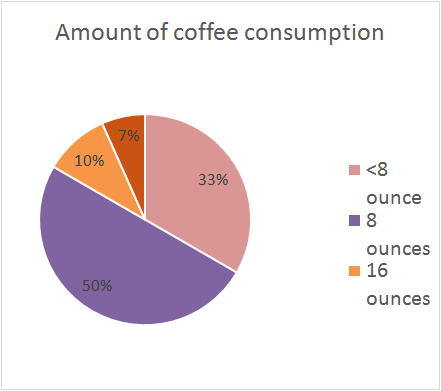
Figure 1 illustrated the distribution of coffee consumption among faculty members. Approximately 33% of the participants reported consuming less than one cup of coffee and 50% consumed exactly one cup of coffee that is 8 ounces. Just 10% consumed three cups or more, and around 7% consumed more than 3 cups of coffee per day. Notably, the majority of the participants consumed one cup of coffee regularly.
Table 3 provides details about the faculty response regarding perceived effects of coffee on performance, enhancement, including frequency of consumption, onset of action and perceived enhancements on a 10-point scale. Among the participants 73.3% consume coffee exclusively for performance enhancements, while 76.6% consumed for alternes and attention enhancement. Additionally, 43.3% of participants believed they had performance enhancement within 15-30 minutes of coffee consumption, whereas 23.3% felt the effect within 15 minutes.
On the 10-point scale rating, before consuming coffee, most of participants (21 out of 30) reported an alertness score of <5, indicating low alertness. Only 8 participants rated their alertness in the 5-7 range, and just 1 participant reported a high alertness level of 8-10.
After coffee consumption, there was a notable improvement in alertness levels. The number of participants with an alertness score of <5 dropped significantly from 21 to 2, while those in the 5-7 range increased markedly to 21 participants. Furthermore, 8 participants reported a high alertness score of 8-10 post-coffee consumption.
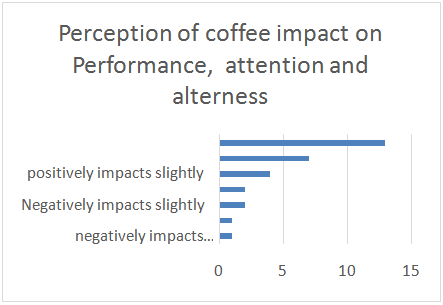
Figure 2 depicts the impact of coffee on participant’s alertness and attention. A large portion of participants around 80% had a positive impact, while 13.3% of participants had a negative impact showing that coffee consumption had a positive effect on improving alertness and attention.
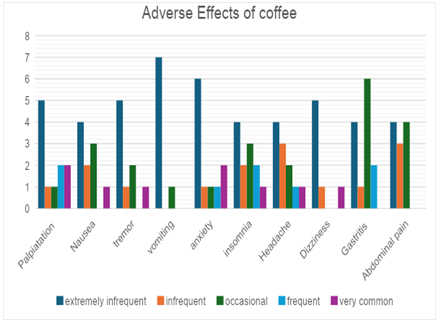
Figure 3 highlights the adverse effects of coffee consumption reported by participants. Anxiety, insomnia, headache, palpitation, gastritis were the common adverse effects. Extremely infrequent and infrequent adverse effects were vomiting, abdominal pain, dizziness and tremor.
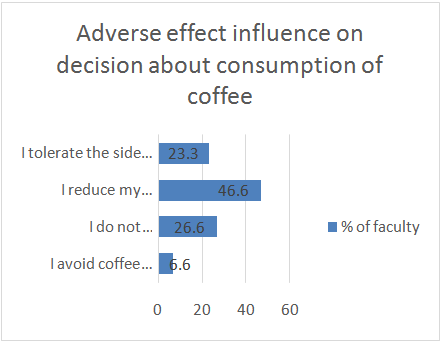
Participants noted that these adverse effects were exacerbated when consuming coffee with coke, cola and when they were dehydrated. Additionally, one participant reported experiencing more gastritis when consuming coffee with whitener. The adverse effect was more produced when taken in an empty stomach, and few participants quoted that when they take more than two cups or more they experience more adverse effects. The open ended question about “How does the occurrence of side effects influence your decision to consume coffee?” 30% of the participants stated that they reduce the consumption of coffee, 13.3% tolerated the adverse effects and 6.7% avoided coffee due to the adverse effects. Conversely, 23.3% didn’t experience any adverse effects. Figure 4 depicts the participants strategies to reduce adverse effects associated with coffee consumption.
Participants were asked an open-ended question on how they managed to reduce the adverse effects of coffee. Different strategies were reported. The participants answered that to avoid gastritis they avoided consuming coffee on empty stomachs and avoided taking whitener and milk products that aggravated the adverse effects. To prevent insomnia, participants refrained from consuming coffee before bedtime or in late evenings. If they experience palpitation, participants opted to avoid coffee for a period of one to two weeks.
When questioned about the variation in coffee effects on participants performance based on factors such as time of the day, dosage or presence of food. While some participants felt that coffee overstimulated and diminished their performance.
For instance, one participant mentioned “Yes, during brunch, I have coffee, which keeps me energetic because I tend to feel low after two hours of classes”.
And another participant reported “yes, I feel it helps the most when I am exhausted mostly afternoon at 3.00pm”
Opinions varied regarding the impact of activity levels on coffee consumption.
One participant responded that “When I'm tired, I feel more of a boost in performance, than if I'm well rested and consuming coffee. There is no difference in performance when consuming coffee when well rested.”
Few participants felt that the presence of food affected the effects of coffee. Many felt that consuming coffee reduces appetite and increases wakefulness. One participant mentioned that coffee helps them stay awake to work during night hours.
The open-ended responses also revealed varied perceptions regarding the effect of coffee on teaching performance. While many participants reported feeling more energetic and alert after coffee consumption, some highlighted negative effects. One participant mentioned, "Sometimes anxiety and palpitations interfere with my ability to answer students' queries." Another shared, "Gastric pain lowers my voice, making it difficult for students to understand me." Additionally, one participant mentioned experiencing dizziness during sessions, which occasionally led to unscheduled breaks, particularly during small group teaching sessions.
These responses underscore the complexity of the relationship between coffee consumption and its effects on performance, influenced by various factors such as timing, dosage, and dietary habits. Understanding these nuances can inform individuals' coffee consumption choices and optimize its benefits while minimizing adverse effects.


Coffee is commonly used for its positive effects by teachers across the globe. Coffee is widely consumed depending on the roasting process as cinnamon, light, medium, full city, dark, French and Italian 6. The amount of caffeine in each cup of coffee varies widely depending on the extraction condition, grinding level, roasting condition and volume of the cup. A study by Crozier et al should how different caffeine content varies in coffee prepared by starbucks to around six-fold increase in caffeine content in Patisserie Francoise 7. A faculty should be aware of the amount of caffeine in the coffee that they consume commonly. The information about various brand and the amount of caffeine can be easily obtained from caffeine informer 8.
Patterns of Coffee Consumption
The study highlights varied patterns of coffee consumption among faculty members. 8oz of coffee commonly used in faculty lounge contained around 120mg of caffeine. Interestingly, coffee consumption appeared to correlate with the years of experience. Participants with 11-20 years of experience exhibited the highest frequency of daily coffee consumption (1-3 times), whereas those with >20 years of experience reported very low frequency of coffee consumption. Middle aged faculty had common coffee consumption when compared to young and old age groups. This pattern is common due to monotonous work load taken by middle aged faculty members over the years. When compared to younger faculty who are in the process of learning and exploring their role as teachers. Although caffeine produces a small but significant increase in psychomotor performance 9, the senior level faculty general avoids caffeine due to its ill-effect. This suggests that coffee consumption habits may develop or change over the course of one's career 10.
Impact on Performance and Alertness
Caffeine takes 45 minutes to be completely absorbed to reach 99% bioavailability without significant first pass effect 11. 73.3% of the respondents consumed coffee exclusively for performance enhancement, with 63.3% reporting an enhancement in performance within 15-30 minutes of consumption. This finding aligns with existing research that shows caffeine can improve alertness and cognitive performance within a short time frame 12. Caffeine with a low plasma protein affinity of around 10-30%, crosses the CNS barrier effectively in both animal models and humans to improve performance and cognition 13.
In terms of alertness, 76.6% of faculty reported consuming coffee for enhanced attention and alertness, with a higher proportion perceiving the effect within 15-30 minutes of consumption. This suggests that while many participants felt more alert after drinking coffee, this perception might not be universally experienced or might not be strong enough to be statistically confirmed 14, 15.
Adverse Effects
The half-life of caffeine is not affected by age 16 or gender but it can be shorter in pregnancy and smokers 17. The adverse effects of coffee consumption reported by participants included anxiety, insomnia, headache, palpitations, and gastritis. These effects were more pronounced when coffee was consumed with other substances like cola or on an empty stomach. These findings are supported by studies highlighting caffeine's potential to cause anxiety and disrupt sleep when consumed in high doses or at inappropriate times 2, 18. Participants also reported that adverse effects were more frequent when consuming more than two cups of coffee. Strategies to mitigate these effects included avoiding coffee on an empty stomach, refraining from late-evening consumption to prevent insomnia, and temporarily abstaining from coffee if palpitations occurred.
The adverse effects influenced participants' decisions regarding coffee consumption. About 46.6% of participants reported reducing their coffee intake due to side effects, 23.3% tolerated the adverse effects and continued consumption, while 6.6% avoided coffee due to side effects. Conversely, 26.6% did not experience any adverse effects, indicating a diverse range of tolerance levels among individuals. Previous research similarly shows that caffeine tolerance varies widely among individuals, which influences both its perceived benefits and negative impacts 1, 15.
Influence of Timing, Dosage, and Food
Participants noted that the timing of coffee consumption, the dosage, and the presence of food influenced the effects of coffee on their performance. Some felt that coffee was more effective when consumed during periods of fatigue, such as in the afternoon or after several hours of classes 19. Others mentioned that coffee reduced their appetite and helped them stay awake during night hours, which was beneficial for their work.
Limitations of the study where the sample size is relatively small and may not be representative of the broader faculty population. Much of the data in the study is based on self-reported measures, which can introduce bias. Participants might not accurately recall or report their caffeine consumption and its effects, leading to potential inaccuracies 3. The study does not seem to control for other factors that could influence performance and alertness, such as sleep quality, overall diet, physical activity, or use of other stimulants or medications 20.
The study underscores the complex relationship between coffee consumption and its effects on performance, alertness, and adverse effects among faculty. While coffee is widely used for its perceived benefits in enhancing performance and alertness, the adverse effects and individual differences in tolerance play a significant role in shaping consumption habits. Understanding these nuances can help individuals optimize their coffee consumption to maximize benefits while minimizing negative outcomes. Further research with larger sample sizes and more controlled settings could provide deeper insights into these dynamics.
| [1] | Hewlett P, Smith A. Effects of repeated doses of caffeine on performance and alertness: new data and secondary analyses. Hum Psychopharmacol. 2007 Aug; 22(6): 339-50. | ||
| In article | View Article PubMed | ||
| [2] | Callaghan F, Muurlink O, Reid N. Effects of caffeine on sleep quality and daytime functioning. Risk Manag Healthc Policy. 2018 Dec 7; 11: 263-271. | ||
| In article | View Article PubMed | ||
| [3] | Smith AP. Caffeine at work. Hum Psychopharmacol. 2005 Aug; 20(6): 441-5. | ||
| In article | View Article PubMed | ||
| [4] | Hughes JR, Higgins ST, Bickel WK, Hunt WK, Fenwick JW, Gulliver SB, Mireault GC. Caffeine self-administration, withdrawal, and adverse effects among coffee drinkers. Archives of general psychiatry. 1991 Jul 1; 48(7): 611-7. | ||
| In article | View Article PubMed | ||
| [5] | Daly JW, Shi D, Nikodijević O, Jacobson KA. The role of adenosine receptors in the central action of caffeine. InCaffeine and Behavior: Current Views & Research Trends 2020 Mar 5 (pp. 1-16). CRC Press. | ||
| In article | |||
| [6] | Severini C, Derossi A, Ricci I, Fiore AG, Caporizzi R. How much caffeine in coffee cup? Effects of processing operations, extraction methods and variables. The question of caffeine. 2017 Jun 21: 45-85. | ||
| In article | View Article | ||
| [7] | Crozier TW, Stalmach A, Lean ME, Crozier A. Espresso coffees, caffeine and chlorogenic acid intake: potential health implications. Food & function. 2012; 3(1) 30-3. | ||
| In article | View Article PubMed | ||
| [8] | Caffeine Informer. Available from: https:// www. caffeineinformer.com/ (accessed on 29th Sept 2024). | ||
| In article | |||
| [9] | Rees K, Allen D, Lader M. The influences of age and caffeine on psychomotor and cognitive function. Psychopharmacology. 1999 Jul; 145: 181-8. | ||
| In article | View Article PubMed | ||
| [10] | Muang KS. The Effects of Coffee Consumption on Self-reported Job Performance in Yangon, Myanmar. Webster University Thailand. 2020 Feb. https:// www.academia.edu/ 42246918/ The_effects_of_cof. | ||
| In article | |||
| [11] | Alsabri SG, Mari WO, Younes S, Elsadawi MA, Oroszi TL. Kinetic and dynamic description of caffeine. Journal of Caffeine and Adenosine Research. 2018 Mar 1; 8(1): 3-9. | ||
| In article | View Article | ||
| [12] | PenetarDH, McCann U, Thorne D, Schelling A, Galinski C, Sing H, Thomas M, Belenky G. Effects of caffeine on cognitive performance mood and alertness in sleep-deprived humans. Food components to enhance performance. 1994: 407-31. | ||
| In article | |||
| [13] | Institute of Medicine (US) Committee on Military Nutrition Research. Caffeine for the sustainment of mental task performance: formulations for military operations. Washington (DC): National Academies Press; 2002 Jan 7. | ||
| In article | |||
| [14] | Nehlig A. Is caffeine a cognitive enhancer?. Journal of Alzheimer's Disease. 2010 Apr 14; 20(s1): S85-94. | ||
| In article | View Article PubMed | ||
| [15] | Cappelletti, S., Piacentino, D., Sani, G., & Aromatario, M. (2015). "Caffeine: Cognitive and physical performance enhancer or psychoactive drug": Erratum. Current Neuropharmacology, 13(4), 554. | ||
| In article | View Article PubMed | ||
| [16] | Committee on Military Nutrition Research. Caffeine for the sustainment of mental task performance: formulations for military operations. National Academies Press; 2002 Jan 7. | ||
| In article | |||
| [17] | Mandel HG. Update on caffeine consumption, disposition and action. Food Chem Toxicol. 2002; 40: 1231–1234. | ||
| In article | View Article PubMed | ||
| [18] | James JE, Keane MA. Caffeine, sleep and wakefulness: implications of new understanding about withdrawal reversal. Hum Psychopharmacol. 2007 Dec; 22(8): 549-58. | ||
| In article | View Article PubMed | ||
| [19] | Yeomans MR, Ripley T, Davies LH, Rusted JM, Rogers PJ. Effects of caffeine on performance and mood depend on the level of caffeine abstinence. Psychopharmacology (Berl). 2002 Nov; 164(3): 241-9. | ||
| In article | View Article PubMed | ||
| [20] | Haskell-Ramsay CF, Jackson PA, Forster JS, Dodd FL, Bowerbank SL, Kennedy DO. The Acute Effects of Caffeinated Black Coffee on Cognition and Mood in Healthy Young and Older Adults. Nutrients. 2018 Sep 30; 10(10): 1386. | ||
| In article | View Article PubMed | ||
Published with license by Science and Education Publishing, Copyright © 2025 Oluwabusola Osimosu, Shree Lakshmi devi Singaravelu, Vinayak Joshua, Uche Amaefuna-Obasi, Fiyinfoluwa Ogunfile, George Odiase and Solomon Akiode
 This work is licensed under a Creative Commons Attribution 4.0 International License. To view a copy of this license, visit
http://creativecommons.org/licenses/by/4.0/
This work is licensed under a Creative Commons Attribution 4.0 International License. To view a copy of this license, visit
http://creativecommons.org/licenses/by/4.0/
| [1] | Hewlett P, Smith A. Effects of repeated doses of caffeine on performance and alertness: new data and secondary analyses. Hum Psychopharmacol. 2007 Aug; 22(6): 339-50. | ||
| In article | View Article PubMed | ||
| [2] | Callaghan F, Muurlink O, Reid N. Effects of caffeine on sleep quality and daytime functioning. Risk Manag Healthc Policy. 2018 Dec 7; 11: 263-271. | ||
| In article | View Article PubMed | ||
| [3] | Smith AP. Caffeine at work. Hum Psychopharmacol. 2005 Aug; 20(6): 441-5. | ||
| In article | View Article PubMed | ||
| [4] | Hughes JR, Higgins ST, Bickel WK, Hunt WK, Fenwick JW, Gulliver SB, Mireault GC. Caffeine self-administration, withdrawal, and adverse effects among coffee drinkers. Archives of general psychiatry. 1991 Jul 1; 48(7): 611-7. | ||
| In article | View Article PubMed | ||
| [5] | Daly JW, Shi D, Nikodijević O, Jacobson KA. The role of adenosine receptors in the central action of caffeine. InCaffeine and Behavior: Current Views & Research Trends 2020 Mar 5 (pp. 1-16). CRC Press. | ||
| In article | |||
| [6] | Severini C, Derossi A, Ricci I, Fiore AG, Caporizzi R. How much caffeine in coffee cup? Effects of processing operations, extraction methods and variables. The question of caffeine. 2017 Jun 21: 45-85. | ||
| In article | View Article | ||
| [7] | Crozier TW, Stalmach A, Lean ME, Crozier A. Espresso coffees, caffeine and chlorogenic acid intake: potential health implications. Food & function. 2012; 3(1) 30-3. | ||
| In article | View Article PubMed | ||
| [8] | Caffeine Informer. Available from: https:// www. caffeineinformer.com/ (accessed on 29th Sept 2024). | ||
| In article | |||
| [9] | Rees K, Allen D, Lader M. The influences of age and caffeine on psychomotor and cognitive function. Psychopharmacology. 1999 Jul; 145: 181-8. | ||
| In article | View Article PubMed | ||
| [10] | Muang KS. The Effects of Coffee Consumption on Self-reported Job Performance in Yangon, Myanmar. Webster University Thailand. 2020 Feb. https:// www.academia.edu/ 42246918/ The_effects_of_cof. | ||
| In article | |||
| [11] | Alsabri SG, Mari WO, Younes S, Elsadawi MA, Oroszi TL. Kinetic and dynamic description of caffeine. Journal of Caffeine and Adenosine Research. 2018 Mar 1; 8(1): 3-9. | ||
| In article | View Article | ||
| [12] | PenetarDH, McCann U, Thorne D, Schelling A, Galinski C, Sing H, Thomas M, Belenky G. Effects of caffeine on cognitive performance mood and alertness in sleep-deprived humans. Food components to enhance performance. 1994: 407-31. | ||
| In article | |||
| [13] | Institute of Medicine (US) Committee on Military Nutrition Research. Caffeine for the sustainment of mental task performance: formulations for military operations. Washington (DC): National Academies Press; 2002 Jan 7. | ||
| In article | |||
| [14] | Nehlig A. Is caffeine a cognitive enhancer?. Journal of Alzheimer's Disease. 2010 Apr 14; 20(s1): S85-94. | ||
| In article | View Article PubMed | ||
| [15] | Cappelletti, S., Piacentino, D., Sani, G., & Aromatario, M. (2015). "Caffeine: Cognitive and physical performance enhancer or psychoactive drug": Erratum. Current Neuropharmacology, 13(4), 554. | ||
| In article | View Article PubMed | ||
| [16] | Committee on Military Nutrition Research. Caffeine for the sustainment of mental task performance: formulations for military operations. National Academies Press; 2002 Jan 7. | ||
| In article | |||
| [17] | Mandel HG. Update on caffeine consumption, disposition and action. Food Chem Toxicol. 2002; 40: 1231–1234. | ||
| In article | View Article PubMed | ||
| [18] | James JE, Keane MA. Caffeine, sleep and wakefulness: implications of new understanding about withdrawal reversal. Hum Psychopharmacol. 2007 Dec; 22(8): 549-58. | ||
| In article | View Article PubMed | ||
| [19] | Yeomans MR, Ripley T, Davies LH, Rusted JM, Rogers PJ. Effects of caffeine on performance and mood depend on the level of caffeine abstinence. Psychopharmacology (Berl). 2002 Nov; 164(3): 241-9. | ||
| In article | View Article PubMed | ||
| [20] | Haskell-Ramsay CF, Jackson PA, Forster JS, Dodd FL, Bowerbank SL, Kennedy DO. The Acute Effects of Caffeinated Black Coffee on Cognition and Mood in Healthy Young and Older Adults. Nutrients. 2018 Sep 30; 10(10): 1386. | ||
| In article | View Article PubMed | ||