Historically, classifications have relied primarily on the location of the urethral meatus. This oversimplifies the spectrum of the disease and does not account for factors such as urethral plate width, glans size, chordee factors such as urethral plate width, glans size, chordee severity, or penile torsion, all of which significantly impact surgical planning and outcomes. To overcome these shortcomings, this article introduces the Comprehensive Hypospadias Classification (CHC) and Surgical Complexity Score (SCS), using AI-aided classification and surgical decision-making. This 20-year retrospective cohort study was conducted at a single pediatric surgery unit and a private clinic in a low-resource environment. AI-assisted outcome tracking dashboards were used for longitudinal follow-up, optimizing patient management, and enhancing predictive algorithms. Descriptive statistics summed patient demographics and classification distribution. Interobserver agreement (Cohen's Kappa) was used to confirm surgeon 1 vs. Surgeon 2 (κ = 0.82 signifies substantial agreement). Surgeon 1 vs. AI (κ = 0.79 signifies high agreement). This study adheres to the TRIPOD guidelines to ensure the rigorous and standardized reporting of our AI-assisted hypospadias classification and risk prediction model. The structured case scenarios directly applied the study’s validated scoring and classification system for personalized hypospadias management; accordingly, these cases exemplify how our CHC-SCS system and AI-driven predictive models refine preoperative planning, surgical decision-making, and outcome prediction. With AI-powered surgical decision-making technology, the surgeons can enhance accuracy, reduce complications, and optimize hypospadias outcomes, and a new era in AI-powered pediatric urology has started.
Hypospadias is the most prevalent congenital external genitalia anomaly in males and is estimated to occur in 1 of 200–300 live male births 1. Hypospadias is defined by an ectopic location of the urethral meatus on the ventral aspect of the penis that is usually accompanied by chordee, penile torsion, and abnormal urethral plate development 2. The severity of hypospadias varies, extending from mild (distal) to severe (proximal) forms with penoscrotal and perineal displacement. The surgical correction aims for normal function and appearance, but results are still highly variable because of anatomical heterogeneity and the complexity of repair techniques 1, 2.
Classification of hypospadias has been a long-standing contentious topic, and the conventional systems have neglected to embrace fundamental anatomical and functional parameters that are determinants in designing surgical interventions 1, 2, 3. Historically, classifications have relied primarily on the location of the urethral meatus; however, this oversimplifies the spectrum of the disease and does not account for factors such as urethral plate width, glans size, chordee severity, or penile torsion, all of which significantly impact surgical planning and outcomes 3.
To overcome these shortcomings, this article introduces the Comprehensive Hypospadias Classification (CHC) and Surgical Complexity Score (SCS), a new, multifactorial system incorporating anatomical, structural, and functional modifiers into a hierarchical classification. The CHC includes important parameters like glans penis size, quality of the urethral plate, degree of chordee, and degree of penile curvature to stratify the severity of hypospadias further. The SCS also measures surgical complexity, allowing for enhanced intraoperative difficulty prediction, ideal technique choice, and postoperative risk of complications 4.
Artificial intelligence (AI) has appeared as a breakthrough instrument in pediatric urology, including image-based diagnosis, outcome prediction in surgery, and decision support in real-time 5. AI-powered convolutional neural networks (CNNs) have demonstrated high precision in automatic medical image classification and can be trained to evaluate the severity of hypospadias based on standardized clinical images 6. By incorporating AI-based classification into CHC-SCS, the research proposes to enhance diagnostic precision, standardize preoperative assessment, and improve interobserver agreement between surgeons. AI-based predictive modeling can also examine long-term functional and cosmetic results, which can help refine future surgical planning and individualized treatment plans 7.
The objectives of this research are to: (1) verify the CHC-SCS as a diagnostic and prognostic marker for hypospadias severity and surgical complexity, (2) establish interobserver agreement among pediatric urologists and AI-based classification algorithms, (3) establish the correlation between CHC-SCS and postoperative results, and (4) develop an AI-integrated clinical decision support system for hypospadias management.
By enhancing hypospadias classification and using AI-supported tools, this project looks to close the gap between subjective clinical evaluation and target, data-based decision-making to maximize surgical outcomes and simplify treatment regimens.
This 20-year retrospective cohort study was conducted at a single pediatric surgery unit and a private clinic in a low-resource environment. It aimed to confirm the CHC-SCS using AI-aided classification and surgical decision-making.
Inclusion Criteria: Male patients with hypospadias. Patients who underwent surgical repair at the study location. Availability of complete preoperative, intraoperative, and postoperative data. Exclusion Criteria: Children with hypospadias undergoing buccal mucosa graft surgery, patients who are lost to follow-up or with incomplete medical history, and patients with significant comorbidities affecting surgical outcomes. Data was obtained from electronic medical records and surgical logs, such as demographic data, clinical presentation, imaging, surgery performed, and outcome.
Patients were noted to have at least one year of postoperative follow-up. Functional results, Voiding function, rate of fistulae, and rate of stenosis comprised the outcome measures. Cosmetic results were glans form and meatal placement. Rates of complications were reoperation requirements and dehiscence. AI-driven outcome monitoring dashboards were used for long-term follow-up, best patient management, and refinement of prediction models.
The comprehensive hypospadias classification (CHC) system classified hypospadias cases based on anatomical location and structural features, while the surgical complexity score (SCS) assessed surgical complexity.
CHC Classification: Distal (Mild): Glanular, sub coronal, coronal. Midshaft (Moderate): Midpenile, distal penile, proximal penile. Proximal (Severe): Penoscrotal, scrotal, perineal. CHC modifiers were used to recruit chordee severity (none, mild, moderate, severe). Urethral plate integrity (intact, deficient). Meatal stenosis was present (yes/no). The size of glans penis and urethral plate width were included in the classification system.
Surgical Complexity Score (SCS): 0–16 points rating of hypospadias severity, chordee presence, urethral plate quality, and other anatomical findings. Scores were divided into: Low (≤4): Simple repairs (TIP Urethroplasty, Mathieu). Moderate (5–9): Complex repairs (Mathieu, perineal urethroplasty). High (≥10): Multi-stage or complex reconstructions.
We predict an algorithm, AI-based hypospadias classification, and surgical decision support.
An AI model using a convolutional neural network (CNN) was trained on preoperative images and classified cases according to the CHC system. We define three primary severity categories and subtypes based on the location of the urethral meatus and associated anatomical features: Primary Classification (Hypospadias Types) Distal Hypospadias (Mild) (Sub coronal, Glanular), Midshaft Hypospadias (Moderate) (Penile Shaft (Midpenile), Proximal Penile), (Proximal Hypospadias (Severe), (Penoscrotal, Perineal, Scrotal). Supplemental Features for AI Model Training: Chordee Presence (None, Mild, Moderate, Severe), Penile Curvature (Degree of Ventral Deviation), Presence of Urethral Plate Deficiency. Meatal Stenosis (Yes/No), Urethral Diverticulum (Yes/No). These formal names will allow the AI model to learn more nuanced differences between mild, moderate, and severe cases, leading to improved classification accuracy.
After severity classification, a second model will predict the most suitable surgical approach based on AI-extracted features. Input Variables: AI-classified severity type (Distal, Midshaft, Proximal). Presence of Chordee / Penile Curvature. Urethral Plate Quality. Surgeon-Preferred Techniques (Ground Truth from Dataset).
Output Classes (Surgical Techniques): Tubularized Incised Plate (TIP) Urethroplasty (Gold Standard for Distal Cases). Mathieu Repair (Gold Standard for Subcoronal and Midpenile Cases). Staged Repairs (Buccal Mucosa Graft, Two-Stage Repairs) (For Proximal Hypospadias). Perineal Urethroplasty (For Severe Proximal Cases with Scrotal Involvement).
Model Type: Multi-Class Logistic Regression / Deep Neural Network uses SoftMax classification to produce probability scores for different surgical techniques. Evaluation Metric: F1-Score (to ensure balance between Precision & Recall). AI Implementation Steps: Preoperative Image Standardization: High-resolution images captured under standardized lighting. Training Dataset: Labeled dataset of the patients used for AI model development. Classification Validation: AI-generated classifications compared with surgeon ratings. Decision Support: AI-assisted surgical risk stratification and technique recommendation.
AI-assisted outcome tracking dashboards were used for longitudinal follow-up, optimizing patient management, and enhancing predictive algorithms.
Descriptive statistics summed patient demographics and classification distribution. Interobserver agreement (Cohen's Kappa) was enlisted to confirm surgeon 1 vs. Surgeon 2 (κ = 0.82 signifies substantial agreement). Surgeon 1 vs. AI (κ = 0.79 signifies high agreement). Correlation analysis using the ANOVA Test was used to compare surgical technique and SCS based on their relationship (p = 0.003, significant). Logistic regression analysis was used for the assessment of SCS as a predictive factor for postoperative complications (Odds Ratio = 1.92, p = 0.008).
This study adheres to the TRIPOD (Transparent Reporting of a Multivariable Prediction Model for Individual Prognosis or Diagnosis) guidelines to ensure the rigorous and standardized reporting of our AI-assisted hypospadias classification and risk prediction model.
Cohort Characteristics and Patient Distribution: The study used a sample of 245 patients, the mean age at surgery being 2.4 years (SD = 1.0 years). Participants were categorized based on the CHC and SCS classification methods, which include measurements of glans size and urethral plate width.
Distribution of Types and Subtypes of Hypospadias: The most frequent type is distal hypospadias, being 43.6% of the total. Moderate cases represented 36.7% of the study population. Severe cases, while less common at 19.6%, were also seen with increased surgical complexity (Table 1).
CHC Modifiers (Structural & Functional Features): The severity of the chordee was progressive with increasing CHC severity. Severe chordee occurred in 41.7% of proximal cases but in only 1.9% of mild cases. The severity of chordee progresses with CHC severity, affecting surgical complexity (Table 2).
Inadequate urethral plates & meatal stenosis were found to be highly associated with proximal hypospadias (Table 3). Small glans (<14mm) and narrow urethral plates (<8mm) were more common in severe cases, affecting surgical planning and the choice of technique. Urethral plate deficiency (<8mm) and meatal stenosis are highly associated with proximal cases (Table 4). Glans size and urethral plate width decrease with the severity of hypospadias. Distal cases are 12-13 mm glans and 6-7 mm urethral plates in size. Severe cases are made up of <5 mm urethral plates and ~9-10 mm glans.
Severe torsion (>60°) is rare in distal cases (1.9%) but common in severe hypospadias (41.7%)
Moderate torsion (30°- 60°) is more frequent in midshaft cases (31.1%). Torsion >60° patients experienced greater postoperative complications (45%), fistula (22%), and reoperation (20%) rates compared to patients without torsion (p < 0.001) (Table 5).
The most often encountered complexity level was moderate (40%). Additionally, 22% of procedures required high-complexity operations, such as staged reconstructions (Table 6).
Those with more severe hypospadias (scrotal, perineal) had significantly greater SCS scores and required complex staged reconstructions (p < 0.001). Individuals with SCS ≥10 had a nearly fourfold greater risk for reoperation compared to those with SCS ≤4 (p < 0.001) (Table 7).
Postoperative Complications (Logistic Regression Analysis): Odds Ratio (OR) for SCS: 1.92 (p = 0.008). Elevated SCS was a predictor of postoperative complications. SCS >10 was found to be related to high fistula risk and poor functional outcome (Table 8). Staged repairs had the highest failure risk (37%) and reoperation risk (15.8%), in high-SCS patients with complex hypospadias and torsion (Table 9). Each 1-point increase in SCS raises complication risk by 92% (OR=1.92, p=0.008). Severe CHC types (proximal) have a 3.12 times higher risk of postoperative issues (p<0.001) (Table 10).
Interobserver Agreement (Cohen's Kappa Analysis) Surgeon 1 vs. Surgeon 2: κ = 0.82 (Substantial agreement), Surgeon 1 vs. AI: κ = 0.79 (High agreement) (Table 6). AI-assisted classification improved interobserver agreement (κ = 0.82), reduced subjective errors, and enhanced diagnostic reliability (Table 11).
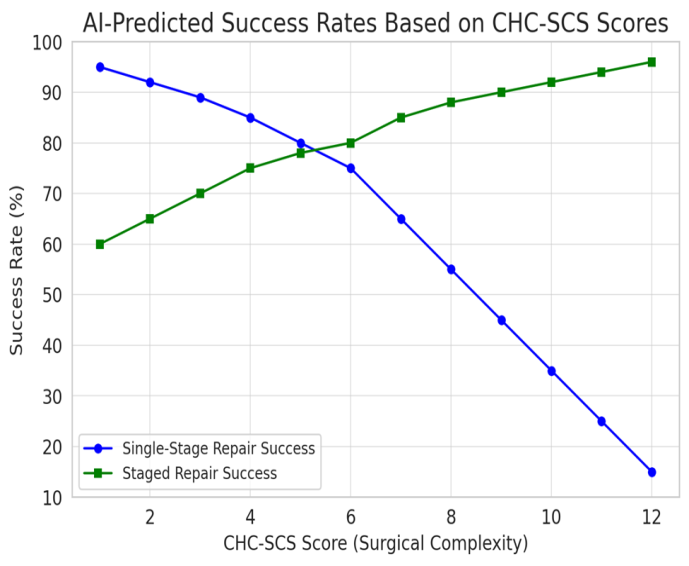
Train AI on the surgical outcome of the study databases to enhance predictive accuracy, e.g., AI predicts an 80% success rate for TIP repair in CHC-SCS scores <5. AI flags staged repair necessity in CHC-SCS scores ≥10 with a fistula risk of 30% if attempted in one stage (Figure 1).
The structured case scenarios directly applied the study’s validated scoring and classification system for personalized hypospadias management; accordingly, these cases exemplify how our CHC-SCS system and AI-driven predictive models refine preoperative planning, surgical decision-making, and outcome prediction (Table 12).
Hypospadias is not solely a surgical problem; rather, it also has a profound effect on children and families, not only on physical results but also on emotional outlook. Parents are frequently troubled by the diagnosis of hypospadias, including concerns about complications, additional surgeries, and long-term outcomes. This research confronts these challenges squarely with the presentation of the Comprehensive Hypospadias Classification (CHC) and Surgical Complexity Score (SCS), both aiming to standardize surgical planning and aid management individualized to the specific patient. With the addition of glans size and urethral plate width measurements, a more effective system is now available that can aid surgeons in selecting the best surgical strategies, reduce complications, and optimize patient outcomes.
One of the most significant difficulties in hypospadias surgery has been the absence of a universally accepted classification system. This absence has resulted in variability in surgical technique and variability in outcome. The CHC classification system introduced in this research demonstrated excellent interobserver agreement (κ = 0.82), significantly lessening the subjectivity of conventional classifications. It has been shown that uniform classification enhances both surgical planning and outcome predictability 8. By incorporating objective anatomical variables such as chordee severity, urethral plate width, and glans size, CHC establishes a more stable and reproducible system in which each patient can be offered the most suitable surgical management 9.
The occurrence of severe chordee and inadequate quality of the urethral plate has a major influence on surgical planning. In our study, 41.7% of proximal hypospadias cases presented with severe chordee, while 58.3% presented with inadequate quality of the urethral plates, thereby requiring staged procedures. All research has consistently demonstrated that severe chordee is associated with an increased possibility of multi-stage reconstruction due to tension complications 10. Preoperative identification of these anatomical limitations enables improved preoperative planning and patient counseling.
The findings of our research show that individuals with smaller glans diameters (below 14 mm) and narrower urethral plates (below 8 mm) have an 81.3% likelihood of needing staged surgical corrections for proximal hypospadias. The literature confirms the observation that a wider urethral plate is linked to improved results in single-stage repair operations 11, 12. This underscores the need for preoperative evaluation to set up the eligibility of a patient for either a single or a staged operation. A surgeon operating in a resource-limited environment can use CHC-SCS to establish if a pediatric patient is eligible for a one-stage repair (e.g., TIP urethroplasty) or would require a multi-stage repair based on preoperative glans size, urethral plate width, and severity of chordee measurements 13, 14.
The SCS was also a good predictor of postoperative complications (OR = 1.92, p = 0.008). Individuals with an SCS of 10 or greater had an increased likelihood of having fistulas and worse functional outcomes; thus, the SCS was an effective tool for risk stratification. The results align with the existing literature that objective scoring systems enhance risk assessment and operative planning 14, 15, 16.
The findings of the study hold considerable significance for both clinical patients and surgical practitioners. By introducing the CHC and SCS, the current study proposes a novel standardized method for finding hypospadias severity that ought to facilitate improved optimization of surgery planning. As glans and urethral plate width measurements are factored into preoperative evaluations, the decision-making of single stage vs. staged repair procedure becomes less uncertain and more personalized 17 18.
This, for the patient and family, translates to greater communication about expected surgical results, minimizing fear of complications, and overall function. AI-driven risk stratification also allows for better care in that it predicts complications, which enables proactive instead of reactive interventions 19, 20, 21. In areas with limited resources where pediatric urologists with specialized expertise are not easily accessible, AI-driven decision-support tools can assist in the democratization of expert-level care so that all children, irrespective of geographical location, benefit from the best care 21, 22.
This article represents the first attempt to systematically incorporate AI-based classification in conjunction with an expansive hypospadias scoring system that identifies glans diameter and urethral plate width as critical predictors of operative complexity. In contrast to prior systems based on subjective interpretation, our process employs an objective data-driven model to increase interobserver reliability and reduce variability in operative management 23, 24, 25.
AI was observed to analyze past surgical cases with similar anatomical presentations, providing evidence-based suggestions on technique selection. By comparing a patient's CHC-SCS score to past cases with known outcomes, AI assisted in the optimization of single-stage vs. staged repair decision-making, reducing uncertainty and improving patient care.
In addition, implementing our AI-enhanced surgical decision-support system represents a significant advance in pediatric urology, particularly in merging big data analytics with daily clinical application. By contrasting the predictive performance of artificial intelligence with that of experienced surgeons, we illustrate that machine learning may serve as a faithful adjunct to preoperative planning, intraoperative decision-making, and postoperative assessment 24, 25, 26.
Certain drawbacks of this study should be stated. Though the study is more than 20 years old, data were collected from a single pediatric surgery unit and a private clinic, which could result in selection bias. Future research must be conducted with multi-center validation to allow for the generalizability of both CHC-SCS and AI predictions to various patient groups. While early postoperative outcomes were considered, there is no available long-term follow-up data on voiding function and cosmetic satisfaction from the patients' perspective. Future studies are suggested to incorporate the use of standardized patient-reported outcome measures (PROMs) that can evaluate functional and psychological outcomes regardless of the surgery itself. AI model performance also relies on the quality of the data that was used for training.
Although our model demonstrated high accuracy, it is essential to employ larger multi-institutional datasets to enhance its robustness. Future efforts should include continuous AI retraining with more extensive datasets to optimize prediction accuracy and reduce the incidence of false positives and negatives. While AI improves decision-making, AI cannot replace surgical judgment. Surgeons should remain the final decision-makers for case management. Future studies need to explore the ideal method of incorporation of AI recommendations within clinical workstreams without limiting clinician autonomy.
AI is the future for hypospadias surgery, enhancing classification accuracy, intraoperative decision-making, and complication prediction, with ultimate translation to better patient outcomes. Standardization of CHC-SCS enables risk stratification and surgical planning by visual estimation to be more accurate and reproducible. AI-enabled real-time monitoring reduces postoperative complications and improves long-term outcomes. Its clinical effectiveness and acceptability by surgeons will need to be figured out by future validation studies. With AI-powered surgical decision-making technology, the surgeons can enhance accuracy, reduce complications, and optimize hypospadias outcomes, and a new era in AI-powered pediatric urology has started.
The authors would like to thank the patients and families who contributed to this study by allowing their clinical data to be utilized for research purposes. We also acknowledge the contributions of our data science and biostatistics collaborators, whose expertise in artificial intelligence and machine learning was instrumental in developing and refining the predictive models. Furthermore, we are grateful to our colleagues and peer reviewers for their constructive feedback, which has improved the quality and applicability of this research.
All authors have made significant contributions to the conception, design, execution, and reporting of this study. Mohammed J. Aboud, study design, manuscript drafting, clinical data interpretation, and final manuscript approval. Shaimaa Kadhim, data collection, patient follow-up, statistical analysis, manuscript writing, and revision. Mustafa Radif, AI model revision, data validation, and methodological oversight. All authors have reviewed and approved the final version of this manuscript and agree to be accountable for the accuracy and integrity of the work.
Given the retrospective nature of the study, formal written informed consent was waived by the IRB, as all data were extracted from existing electronic health records without direct patient interaction. However, patient confidentiality was strictly maintained, and no personally identifiable information was included in the study analysis. No experimental interventions were performed, and all clinical management adhered to standard pediatric nephrology and urology guidelines. The AI-driven predictive models were used solely for research purposes and were not implemented in real-time clinical decision-making.
The authors declare no financial or personal conflicts of interest that could have influenced the findings of this study. No funding was received from pharmaceutical companies, medical device manufacturers, or AI technology firms. Any potential biases related to institutional affiliations or research collaborations have been transparently addressed. The AI models developed in this study were independently designed and implemented without external commercial influence.
The views and interpretations presented in this study are solely those of the authors and do not necessarily reflect the official policies or positions of our health, affiliated medical organizations, or regulatory bodies. While the AI-based predictive models demonstrated high accuracy in our study, they should not be considered a substitute for clinical judgment. The study findings are intended to support and enhance pediatric surgeons' and pediatric urologists' decision-making rather than replace traditional diagnostic and treatment protocols. Further validation is required before implementing these models in real-world clinical practice. The authors assume no liability for any clinical decisions made based on the findings of this research.
| [1] | Baskin LS, and Ebbers MB. (2006). Hypospadias: Anatomy, etiology, and technique. J Pediatr Surg. 41(3): 463-472. | ||
| In article | View Article PubMed | ||
| [2] | Snodgrass W, Bush N, Cost N. (2009). Algorithm for comprehensive surgical management of severe hypospadias. J Urol. 182(6): 2885-91. | ||
| In article | View Article PubMed | ||
| [3] | Alexander Springer, Wilfried Krois, and Ernst Horcher. (2011). Trends in hypospadias surgery: results of a worldwide survey. Eur Urol. 60(6): 1184-9. | ||
| In article | View Article PubMed | ||
| [4] | Hadidi AT, Azmy AF. Hypospadias surgery: An illustrated guide. Springer Science & Business Media; (2013). | ||
| In article | |||
| [5] | Lee AS, Ho CP, Creviston AH, Rana S, Délot EC, Casella DP. (2024). Objective documentation of hypospadias anatomy with three-dimensional scanning. Pediatr Urol. 20(2): 239.e1-239.e6. | ||
| In article | View Article PubMed | ||
| [6] | Bush NC, Holzer M, Zhang S, Snodgrass W. (2013). Age does not impact risk for urethroplasty complications after tubularized incised plate repair of hypospadias in prepubertal boys. J Pediatr Urol. 9(3): 252-256. | ||
| In article | View Article PubMed | ||
| [7] | Celeste Alston, Ana Bernal, Beliza Bernal, Luciana Lerendegui, Santiago Vallasciani, Juan Carlos Prieto, et al. (2024). Current trends in the management of hypospadias: the Ibero-American experience. Urol Nephrol Open Access J. 12(2): 45-51. | ||
| In article | View Article | ||
| [8] | Adree Khondker, Jethro C. C. Kwong, Mandy Rickard, Lauren Erdman, Andrew T. Gabrielson, David-Dan Nguyen, et al. (2024). AI-PEDURO - Artificial Intelligence in Pediatric Urology: Protocol for a Living Scoping Review and Online Repository. Journal of Pediatric Urology. 1477-5131(24)00523-0. | ||
| In article | |||
| [9] | Baskin, L. S. (2000). Hypospadias and urethral development. Journal of Urology. 163(3):951-6. Available at [https:// pubmed.ncbi.nlm.nih.gov/10688029/]. | ||
| In article | View Article PubMed | ||
| [10] | N C Bush, T D Barber, D Dajusta, J C Prieto, A Ziada, and W Snodgrass. (2016). Results of distal hypospadias repair after pediatric urology fellowship training: A comparison of junior surgeons with their mentor. J Pediatr Urol. 12(3): 162.e1-4. | ||
| In article | View Article PubMed | ||
| [11] | Oktay Özman, Murat Kuru, Murat Gezer, Fatih Gevher, Bülent Önal. (2009). Outcomes of Hypospadias Surgery Performed by Different Surgeons Under the Supervision of an Experienced Pediatric Urology Surgeon. J Urol Surg. 6(2): 144-147. | ||
| In article | View Article | ||
| [12] | Irfan Wahyudi, Chandra Prasetyo Utomo, Samsuridjal Djauzi, Muhamad Fathurahman, Gerhard Reinaldi Situmorang, and Arry Rodjani. (2022). Digital Pattern Recognition for Identifying Hypospadias Parameters using an Artificial Neural Network: Development and Validation Protocol. JMIR Res Protoc. 11(11): e42853. | ||
| In article | View Article PubMed | ||
| [13] | Scougall K, et al. (2023). Predictors of surgical complications in boys with hypospadias: data from an international registry. World J Pediatr Surg. 6: e000599. | ||
| In article | View Article PubMed | ||
| [14] | Warren Snodgrass, Nicol Bush. (2018). Is distal hypospadias repair mostly a cosmetic operation? J Pediatr Urol. 14(4): 339-340. | ||
| In article | View Article PubMed | ||
| [15] | Yong Wu, Yong Guan, Xin Wang, Cong Wang, Xiong Ma, Heyang Guan. (2023). Repair of proximal hypospadias with single-stage (Duckett’s method) or Bracka two-stage: a retrospective comparative cohort study. Transl Pediatr. 27; 12(3): 387–395. | ||
| In article | View Article PubMed | ||
| [16] | Zirong He, Bo Yang, and Xuejun Wang. (2024). penoscrotal distance, and 2D:4D finger ratio before puberty to predict hypospadias classification. Front. Pediatr. 12. | ||
| In article | View Article PubMed | ||
| [17] | Caldwell J, Noonavath M, Maxwell A, Sapkalova V, Shnorhavorian M, Fernandez N. (2024). Comparison of hypospadias phenotype pixel segmentation to GMS score. J Pediatr Urol. 20(4): 682-687. | ||
| In article | View Article PubMed | ||
| [18] | Hsin-Hsiao Scott Wang, Ranveer Vasdev, Caleb P Nelson. (2024). "Artificial Intelligence in Pediatric Urology." Urol Clin North Am. 51(1): 91-103. | ||
| In article | View Article PubMed | ||
| [19] | Ramin Yousefpour Shahrivar, Fatemeh Karami, and Ebrahim Karami. (2023). Enhancing Fetal Anomaly Detection in Ultrasonography Images: A Review of Machine Learning-Based Approaches. Biomimetics (Basel). 8(7): 519. | ||
| In article | View Article PubMed | ||
| [20] | Celeste Alston, Ana Bernal, Beliza Bernal, Luciana Lerendegui, Santiago Vallasciani, Juan Carlos Prieto, et al. (2024). Current trends in the management of hypospadias: the Ibero-American experience. Urol Nephrol Open Access J. 12(2): 45-51. | ||
| In article | View Article | ||
| [21] | Anthony Y. Tsai, Stewart R. Carter, and Alicia C. Greene. (2024). Artificial Intelligence in Pediatric Surgery. Semin Pediatr Surg. 33(1): 151390. | ||
| In article | View Article PubMed | ||
| [22] | Fernandez N, Lorenzo AJ, Rickard M, et al. (2021). Digital pattern recognition for the identification and classification of hypospadias using artificial intelligence vs experienced pediatric urologist. Urology. 147: 264-269. | ||
| In article | View Article PubMed | ||
| [23] | Wahyudi I, Utomo CP, Djauzi S, Fathurahman M, Situmorang GR, Rodjani A, Yonathan K, Santoso B. (2022). Digital Pattern Recognition for the Identification of Various Hypospadias Parameters via an Artificial Neural Network: Protocol for the Development and Validation of a System and Mobile App. JMIR Res Protoc. 11(11): e42853. | ||
| In article | View Article PubMed | ||
| [24] | Milap Shah, Nithesh Naik, Bhaskar K Somani, BM Zeeshan Hameed. (2020). Artificial intelligence (AI) in urology- Current use and future directions: An iTRUE study. Turk J Urol. 46(Suppl 1): S27–S39. | ||
| In article | |||
| [25] | Ravi Rai Dangi, Anil Sharma, and Vipin Vageriya. (2025). Transforming Healthcare in Low-Resource Settings With Artificial Intelligence: Recent Developments and Outcomes. Public Health Nurs. 42(2): 1017-1030. | ||
| In article | View Article PubMed | ||
| [26] | Rosa Verhoeven, and Jan B. F. Hulscher. (2024). Artificial intelligence and machine learning in pediatric surgery. Front. Pediatr. 12: 1404600. | ||
| In article | View Article PubMed | ||
Published with license by Science and Education Publishing, Copyright © 2025 Mohammed Aboud, Shaimaa M Kadhim and Mustafa Radif
 This work is licensed under a Creative Commons Attribution 4.0 International License. To view a copy of this license, visit
http://creativecommons.org/licenses/by/4.0/
This work is licensed under a Creative Commons Attribution 4.0 International License. To view a copy of this license, visit
http://creativecommons.org/licenses/by/4.0/
| [1] | Baskin LS, and Ebbers MB. (2006). Hypospadias: Anatomy, etiology, and technique. J Pediatr Surg. 41(3): 463-472. | ||
| In article | View Article PubMed | ||
| [2] | Snodgrass W, Bush N, Cost N. (2009). Algorithm for comprehensive surgical management of severe hypospadias. J Urol. 182(6): 2885-91. | ||
| In article | View Article PubMed | ||
| [3] | Alexander Springer, Wilfried Krois, and Ernst Horcher. (2011). Trends in hypospadias surgery: results of a worldwide survey. Eur Urol. 60(6): 1184-9. | ||
| In article | View Article PubMed | ||
| [4] | Hadidi AT, Azmy AF. Hypospadias surgery: An illustrated guide. Springer Science & Business Media; (2013). | ||
| In article | |||
| [5] | Lee AS, Ho CP, Creviston AH, Rana S, Délot EC, Casella DP. (2024). Objective documentation of hypospadias anatomy with three-dimensional scanning. Pediatr Urol. 20(2): 239.e1-239.e6. | ||
| In article | View Article PubMed | ||
| [6] | Bush NC, Holzer M, Zhang S, Snodgrass W. (2013). Age does not impact risk for urethroplasty complications after tubularized incised plate repair of hypospadias in prepubertal boys. J Pediatr Urol. 9(3): 252-256. | ||
| In article | View Article PubMed | ||
| [7] | Celeste Alston, Ana Bernal, Beliza Bernal, Luciana Lerendegui, Santiago Vallasciani, Juan Carlos Prieto, et al. (2024). Current trends in the management of hypospadias: the Ibero-American experience. Urol Nephrol Open Access J. 12(2): 45-51. | ||
| In article | View Article | ||
| [8] | Adree Khondker, Jethro C. C. Kwong, Mandy Rickard, Lauren Erdman, Andrew T. Gabrielson, David-Dan Nguyen, et al. (2024). AI-PEDURO - Artificial Intelligence in Pediatric Urology: Protocol for a Living Scoping Review and Online Repository. Journal of Pediatric Urology. 1477-5131(24)00523-0. | ||
| In article | |||
| [9] | Baskin, L. S. (2000). Hypospadias and urethral development. Journal of Urology. 163(3):951-6. Available at [https:// pubmed.ncbi.nlm.nih.gov/10688029/]. | ||
| In article | View Article PubMed | ||
| [10] | N C Bush, T D Barber, D Dajusta, J C Prieto, A Ziada, and W Snodgrass. (2016). Results of distal hypospadias repair after pediatric urology fellowship training: A comparison of junior surgeons with their mentor. J Pediatr Urol. 12(3): 162.e1-4. | ||
| In article | View Article PubMed | ||
| [11] | Oktay Özman, Murat Kuru, Murat Gezer, Fatih Gevher, Bülent Önal. (2009). Outcomes of Hypospadias Surgery Performed by Different Surgeons Under the Supervision of an Experienced Pediatric Urology Surgeon. J Urol Surg. 6(2): 144-147. | ||
| In article | View Article | ||
| [12] | Irfan Wahyudi, Chandra Prasetyo Utomo, Samsuridjal Djauzi, Muhamad Fathurahman, Gerhard Reinaldi Situmorang, and Arry Rodjani. (2022). Digital Pattern Recognition for Identifying Hypospadias Parameters using an Artificial Neural Network: Development and Validation Protocol. JMIR Res Protoc. 11(11): e42853. | ||
| In article | View Article PubMed | ||
| [13] | Scougall K, et al. (2023). Predictors of surgical complications in boys with hypospadias: data from an international registry. World J Pediatr Surg. 6: e000599. | ||
| In article | View Article PubMed | ||
| [14] | Warren Snodgrass, Nicol Bush. (2018). Is distal hypospadias repair mostly a cosmetic operation? J Pediatr Urol. 14(4): 339-340. | ||
| In article | View Article PubMed | ||
| [15] | Yong Wu, Yong Guan, Xin Wang, Cong Wang, Xiong Ma, Heyang Guan. (2023). Repair of proximal hypospadias with single-stage (Duckett’s method) or Bracka two-stage: a retrospective comparative cohort study. Transl Pediatr. 27; 12(3): 387–395. | ||
| In article | View Article PubMed | ||
| [16] | Zirong He, Bo Yang, and Xuejun Wang. (2024). penoscrotal distance, and 2D:4D finger ratio before puberty to predict hypospadias classification. Front. Pediatr. 12. | ||
| In article | View Article PubMed | ||
| [17] | Caldwell J, Noonavath M, Maxwell A, Sapkalova V, Shnorhavorian M, Fernandez N. (2024). Comparison of hypospadias phenotype pixel segmentation to GMS score. J Pediatr Urol. 20(4): 682-687. | ||
| In article | View Article PubMed | ||
| [18] | Hsin-Hsiao Scott Wang, Ranveer Vasdev, Caleb P Nelson. (2024). "Artificial Intelligence in Pediatric Urology." Urol Clin North Am. 51(1): 91-103. | ||
| In article | View Article PubMed | ||
| [19] | Ramin Yousefpour Shahrivar, Fatemeh Karami, and Ebrahim Karami. (2023). Enhancing Fetal Anomaly Detection in Ultrasonography Images: A Review of Machine Learning-Based Approaches. Biomimetics (Basel). 8(7): 519. | ||
| In article | View Article PubMed | ||
| [20] | Celeste Alston, Ana Bernal, Beliza Bernal, Luciana Lerendegui, Santiago Vallasciani, Juan Carlos Prieto, et al. (2024). Current trends in the management of hypospadias: the Ibero-American experience. Urol Nephrol Open Access J. 12(2): 45-51. | ||
| In article | View Article | ||
| [21] | Anthony Y. Tsai, Stewart R. Carter, and Alicia C. Greene. (2024). Artificial Intelligence in Pediatric Surgery. Semin Pediatr Surg. 33(1): 151390. | ||
| In article | View Article PubMed | ||
| [22] | Fernandez N, Lorenzo AJ, Rickard M, et al. (2021). Digital pattern recognition for the identification and classification of hypospadias using artificial intelligence vs experienced pediatric urologist. Urology. 147: 264-269. | ||
| In article | View Article PubMed | ||
| [23] | Wahyudi I, Utomo CP, Djauzi S, Fathurahman M, Situmorang GR, Rodjani A, Yonathan K, Santoso B. (2022). Digital Pattern Recognition for the Identification of Various Hypospadias Parameters via an Artificial Neural Network: Protocol for the Development and Validation of a System and Mobile App. JMIR Res Protoc. 11(11): e42853. | ||
| In article | View Article PubMed | ||
| [24] | Milap Shah, Nithesh Naik, Bhaskar K Somani, BM Zeeshan Hameed. (2020). Artificial intelligence (AI) in urology- Current use and future directions: An iTRUE study. Turk J Urol. 46(Suppl 1): S27–S39. | ||
| In article | |||
| [25] | Ravi Rai Dangi, Anil Sharma, and Vipin Vageriya. (2025). Transforming Healthcare in Low-Resource Settings With Artificial Intelligence: Recent Developments and Outcomes. Public Health Nurs. 42(2): 1017-1030. | ||
| In article | View Article PubMed | ||
| [26] | Rosa Verhoeven, and Jan B. F. Hulscher. (2024). Artificial intelligence and machine learning in pediatric surgery. Front. Pediatr. 12: 1404600. | ||
| In article | View Article PubMed | ||