This research examines sustainable construction methods in the 3rd District of Cagayan by combining deconstruction processes with reuse and recycling to manage increasing amounts of construction and demolition waste. The swift expansion of urban areas combined with insufficient infrastructure systems has led to heightened waste management challenges requiring local implementation of sustainable solutions. The research team implemented mixed-methods research to examine present construction waste techniques and to discover sustainable materials and methods while considering their environmental, economic and social effects. Construction contractors exhibited advanced understanding of sustainable building practices but generally chose material reuse as their primary strategy. The deconstruction process revealed potential but suffered from a shortage of skilled workers and adequate training programs while recycling operations faced obstacles due to poor infrastructure and insufficient economic incentives. Survey results revealed that respondents placed greatest importance on environmental advantages like diminished greenhouse gas emissions and better resource management while economic and social benefits achieved recognition but failed to be seen as essential. Three major barriers exist in the current system due to inconsistent regulatory enforcement together with insufficient government incentives and lack of community participation. Findings indicate construction industry support for sustainability exists at the local level but broader acceptance needs coordinated policy frameworks alongside infrastructure development and economic instruments together with community engagement. Local government entities and construction firms alongside other stakeholders use this framework and set of strategies to create sustainable building practices that meet local development targets while complying with international environmental standards.
The construction sector significantly contributes to global waste, accounting for over 30% of total waste generated worldwide. The traditional linear construction model, which emphasizes resource extraction, consumption, and disposal, exacerbates environmental degradation. Sustainable strategies, such as deconstruction, reuse, and recycling, offer viable pathways toward achieving a circular economy. These approaches reduce dependency on landfills, mitigate greenhouse gas emissions, and improve resource efficiency 1. Notably, incorporating waste management considerations during the design and construction phases, rather than treating them as afterthoughts, enhances the feasibility of material reuse and recovery. However, the global implementation of these strategies remains inconsistent due to numerous barriers. These include regulatory gaps, limited market demand for recycled materials, and the absence of standardized guidelines for deconstruction processes. In developing regions, economic constraints hinder the adoption of advanced recycling technologies, while industrialized nations often face challenges related to inadequate economic incentives and market frameworks, limiting the integration of circular practices into the construction mainstream 2.
In Finland, the construction sector has made strides in embracing circular economy principles, yet challenges persist. The high costs and logistical complexities of transporting and processing reusable materials continue to impede the comprehensive execution of deconstruction strategies. Additionally, Finnish construction firms often cite regulatory obstacles and insufficient incentives as significant barriers. To address these challenges, Finland has launched pilot projects to improve material recovery rates and has actively developed regulatory frameworks to foster sustainable construction practices 3, 4.
The Cagayan 3rd District in the Philippines faces unique challenges in advancing sustainable construction. Rapid urbanization and insufficient infrastructure for waste segregation and recycling have resulted in inefficiencies in material reuse. Although national policies such as the Ecological Solid Waste Management Act promote waste reduction at the source, their implementation within the construction sector remains limited 5. Local governments in the region have initiated pilot projects to recycle construction waste, but these efforts are hindered by funding shortages and a lack of technical expertise.
Construction waste management in the Cagayan 3rd District is further complicated by localized challenges. The region’s rapid development has outpaced its capacity to manage construction and demolition waste, leading to illegal dumping and environmental degradation 6. Rural construction projects frequently rely on conventional methods, with limited emphasis on deconstruction and material reuse. The absence of centralized facilities for sorting and recycling construction waste contributes to low recovery rates for reusable materials 7, 8, 9. Furthermore, awareness of sustainable construction practices among key stakeholders, such as contractors and local government officials, remains insufficient. Small and medium-sized enterprises (SMEs), which dominate the construction industry in the region, often lack the resources and expertise to adopt advanced recycling technologies. Regulatory gaps specific to construction waste management further obstruct efforts to reduce waste systematically.
Despite global advocacy for circular economy principles, there is a critical lack of empirical data on the effectiveness and adoption of deconstruction, reuse, and recycling strategies at the local level. In rapidly urbanizing regions like Cagayan 3rd District, localized research is essential to address specific economic, logistical, and technical constraints that hinder the implementation of sustainable practices. Existing frameworks often fail to account for these regional nuances, resulting in ineffective execution of sustainability initiatives.
This study aimed to develop and evaluate sustainable construction practices focusing on deconstruction, reuse and recycling strategies in the 3rd district of Cagayan. By addressing knowledge gaps and highlighting localized barriers, the study seeks to inform the prevailing construction and demolition waste management in the 3rd District of Cagayan, identify feasible materials and methods for deconstruction, reuse and recycling methods in the 3rd district of Cagayan, propose strategies and frameworks for the implementation of sustainable construction practices in the local industry, and evaluate the environmental, economic and social impacts of adopting sustainable construction practices in the 3rd district of Cagayan. Findings will be disseminated through academic journals, industry conferences, and local government forums to ensure broad accessibility and practical application. Ultimately, the study aspires to foster collaboration and encourage the adoption of sustainable construction practices in alignment with both regional priorities and global environmental objectives.
1.2. Statement of the ProblemThe Cagayan 3rd District struggles to maintain environmental sustainability while pursuing construction development like many developing regions do. The predominant approach in modern construction practices tends to favor new construction projects while neglecting deconstruction and recycling methods, which generates substantial waste and exhausts natural resources. The situation produces environmental damage which manifests as growing landfill loads along with habitat destruction and rising carbon emissions. The spread of sustainable construction methods faces obstacles due to insufficient public knowledge and a lack of proper material processing infrastructure alongside weak regulatory systems. The problem intensifies because robust incentive programs and capacity-building initiatives remain absent. The construction sector in Cagayan 3rd District fails to realize economic advantages from recycling materials and contributes to environmental harm which obstructs sustainable development progress in the area. This study examines the current sustainable construction practices in the region and identifies major obstacles while offering practical solutions to overcome them. In addition, the study will determine the cost of deconstruction, reuse, and recycling, as well as the value that is gained from these construction practices.
1.3. Objective of the StudyThe study aims to develop and evaluate sustainable construction practices focusing on deconstruction, reuse and recycling strategies in the 3rd district of Cagayan.
Specifically, it aims:
1. To determine the prevailing construction and demolition waste practices in the 3rd District of Cagayan.
2.To identify feasible materials and methods for deconstruction, reuse and recycling methods in the 3rd district of Cagayan
3.To determine the environmental, economic and social impacts of adopting sustainable construction practices in the 3rd district of Cagayan.
4.To propose strategies and frameworks for the implementation of sustainable construction practices in the local industry.
This study utilized a mixed-methods research design. Mixed-methods research employs both quantitative and qualitative techniques which together deliver a complete understanding of research issues by merging statistical data with rich participant perspectives. The mixed-methods research design will enable the researcher to collect and analyze quantitative information about construction practices along with material reuse and recycling in the 3rd district of Cagayan and to investigate stakeholder viewpoints through interviews and focus group discussions. The analysis of numerical data will reveal patterns about material deconstruction and recycling while qualitative data collection helps understand stakeholders' sustainable construction challenges and strategies. The research combines two study methods to develop sustainable construction techniques which enhance deconstruction and recycling systems and boost local industry sustainability by enhancing resource efficiency.
2.2. Locale of the StudyThe study will be conducted in the 3rd District of Cagayan.
2.3. Data Gathering ProcedureThe researcher will initiate the research process by writing a formal letter to the university dean to request permission for the study. The research process begins with a step that demonstrates the necessity of following ethical guidelines. The researcher needs to present the study to the local Research Ethics Committee (REC) for ethical compliance review after obtaining initial approval.
The researcher plans to submit the survey and interview guide tool for review by three subject matter experts after receiving ethical clearance. The external review process will deliver crucial feedback for enhancing research instruments while supporting their validity. After the researcher receives REC approval the next step involves acquiring official authorization from the study location. The researcher collected consent forms signed by participants during this stage to verify their understanding and voluntary participation. The researcher collected data after securing all required approvals and consents. The researcher used internet platforms along with phone calls to distribute surveys which enable flexible access for all participants.
The survey maintains short length and requires participants to spend between 10 and 30 minutes to complete it, enabling efficient participation. Participants who are prepared will receive information about the survey and start answering it. The researcher organized and synthesized the survey findings using the collected digital data after completion to ensure effective data management practices. The research strategy includes both a survey and qualitative data collection through an interview guide tool administered to selected participants. The interviewer used open-ended questions during consistent and clear interviews to obtain detailed information about sustainable construction practices and strategies for deconstruction, reuse, and recycling. The researchers recorded and transcribed all interviews to enable comprehensive data analysis.
During the data collection phase, the researcher implemented the highest security measures to preserve participant privacy and confidentiality. The researcher provided participants with assurance that collected data were dealt with utmost confidentiality.
2.4. Analysis of the Data/ Statistical TreatmentData interpretation involved the use of statistical tools. The study utilized mean and standard deviation to describe construction and demolition waste management practices in the 3rd District of Cagayan while evaluating the viability of deconstruction materials and methods together with reuse and recycling strategies and reviewing their environmental and economic impacts along with social benefits of sustainable construction practices. The average response score calculation using the mean allows us to understand participant perceptions regarding current waste management practices and the extent of application in deconstruction and recycling methods. Standard deviation analysis determines the range of participants' responses which shows if their perspectives remain consistent or exhibit significant differences among categories.
The thematic analysis will examine qualitative interview data to identify patterns and themes which will establish strategic frameworks and implementation models for sustainable construction practices in the local industry. The qualitative method aims to extract fundamental concepts and structures which stakeholders can use to build sustainable construction systems. The study utilizes mixed-methods techniques to create actionable recommendations for advancing sustainable construction practices in the 3rd District of Cagayan.
The Relative Importance Index (RII) will be calculated using the Following equation.
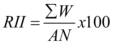 |
where:
W= weighting given to each factor by respondents, ranging from 1 to 5;
A= highest weight (i.e., 5 in this case); and
N= the total number of respondents or participants who provided their opinions or ratings for the factors.
RII is a statistical method that will be used to determine the relative importance the ranking of relative importance of Respondents Perceptions on: (1) Prevailing Construction and Deconstruction Waste Management, (2) Feasible Materials and Methods for Deconstruction, Reuse and Recycling, and (3) Environmental, Economic, and Social Impacts of Adopting Sustainable Construction Practices.
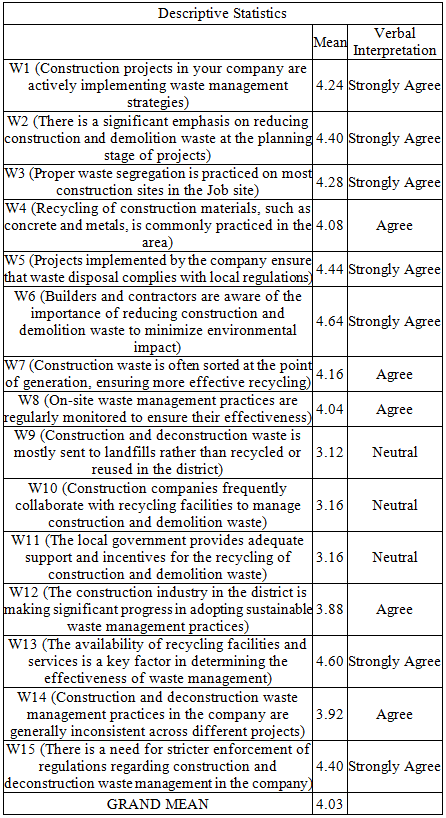
The current construction and demolition waste management methods for the 3rd District of Cagayan are presented in Table 1. The survey results revealed that most participants responded positively to the existing construction and demolition waste management practices. Strong agreement ratings emerged for multiple waste management practices including W1 through W15 which showed mean scores from 4.21 to 5 indicating Strongly Agree status and W6 recorded the highest mean value.
The survey data revealed that W1, W2, W3, W5, W6, W13, and W15 exceeded the 4.40 benchmark indicating that participants broadly supported active construction and demolition waste management strategies. The elevated mean score of W6 at 4.64 shows stakeholders possess significant environmental awareness which indicates their deep environmental understanding. According to the study found that contractors with a good understanding of environmental concerns can successfully manage waste reduction initiatives 10. Research shows organizations with comprehensive waste disposal policies achieve better compliance with local regulations 11.
Respondents showed agreement on W4 (“recycling of construction materials”), W7 (“construction waste is often sorted at the point of generation for more effective recycling”), W8 (“on-site waste management practices are regularly monitored for effectiveness”), W12 (“significant progress in adopting sustainable waste management practices”), and W14 (“construction and deconstruction waste management practices are generally inconsistent”), with mean scores between 3.41 and 4.20 which indicate agreement.
The mean values of Statements W4, W7, W8, W12, and W14 between 4.04 to 4.16 demonstrate general agreement yet highlights the need for progress. The current state shows waste segregation and monitoring practices along with sustainability efforts have been implemented but lack full optimization and consistent application. The practical obstacles of time limitations and worker awareness issues hinder the regular practice of waste management on construction sites according to 12. Reference 13 showed that effective site monitoring together with real-time waste segregation greatly enhances recycling efficiency.
The survey results showed neutral responses for statements W9 ("waste is mostly sent to landfills rather than recycled or reused"), W10 ("collaboration with recycling facilities to manage construction and demolition waste"), and W11 ("support and incentives for the recycling of construction and demolition waste") as mean values fell between 2.61 to 3.40 and W9 recorded the lowest mean score. The neutral evaluations assigned to W9, W10 and W11 (between 3.12 and 3.16) reveal shortcomings in government incentives and inadequate collaboration with recycling facilities while pointing out the excessive dependence on landfills instead of recycling materials. Research from 14 shows that insufficient collaboration between public and private entities leads to poor recycling outcomes at urban construction locations. According to 15, construction companies require government financial assistance or regulatory mandates to adopt expensive recycling programs.
The evaluators of statement W13 (M = 4.60) confirmed that recycling facilities need to exist for effective waste management. The data from W15 (M = 4.40) indicates that current voluntary actions are inadequate and stricter regulatory enforcement is necessary. Reference 16 concluded that physical infrastructure components like accessible recycling centers play a pivotal role in determining the adoption levels of waste reuse initiatives. Reference 17 suggested that waste management practices require stricter enforcement protocols to achieve consistent application.
Research results with the grand mean of 4.03 which is high, demonstrate favorable attitudes towards sustainable practices in construction waste management with a focus on raising awareness, adhering to regulations and strategic planning. The main obstacles to implementing waste reuse programs include operational inconsistencies alongside insufficient governmental support and inadequate recycling infrastructure. The future success of waste management requires enhanced institutional backing and incentives for private-public partnerships.
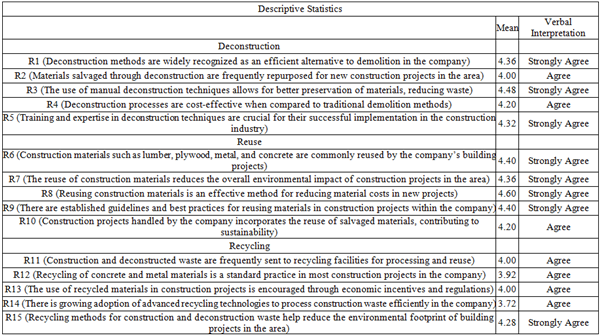
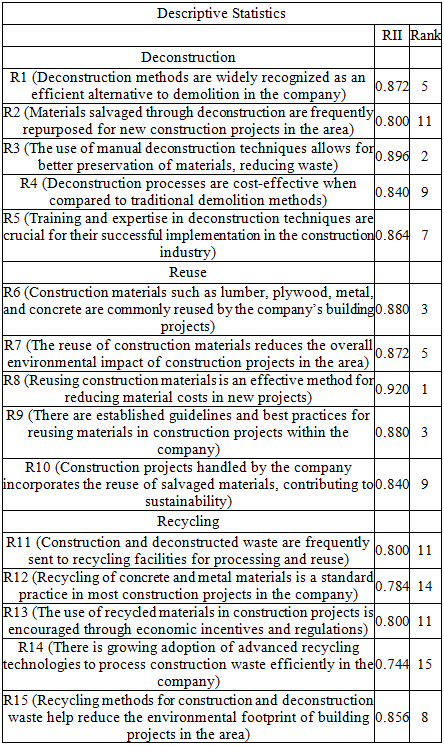
Table 2 displays the effective approaches utilized in deconstruction, reuse and recycling tasks by participants from their respective agencies. The research findings demonstrate that respondents possessed favorable views about the practicality of materials and methods used for deconstruction, reuse and recycling in construction activities.
Participants expressed strong support for various statements about deconstruction activities with particular emphasis on R3 that manual deconstruction techniques preserve materials better and reduce waste (mean = 4.48), R1 which outlined deconstruction methods as an efficient demolition alternative (mean = 4.36), and R5 which stressed the significance of training and expertise for effective implementation of deconstruction techniques (mean = 4.32). Participants agreed with R2’s statement that “salvaged materials are frequently repurposed for new construction projects” at a mean of 4.00 as well as R4’s claim “deconstruction processes are cost-effective than traditional demolition methods” with a mean score of 4.20.
Findings from Table 2 show that experts agree deconstruction offers superior sustainability and efficiency compared to demolition from both economic and environmental perspectives. The broad implementation of these practices remains constrained due to missing standardization efforts or training opportunities. Reference 18 show how deconstruction practices are increasingly recognized as both financial and environmental win-win solutions in the industry. Furthermore, 19 state that developing skills plays a crucial role in executing effective deconstruction processes. In addition to that, 20 observed that manual deconstruction helps preserve valuable materials which leads to decreased landfill use and supports circular economy principles.
The reuse activity statements received high mean scores which were mostly interpreted as Strongly Agree though R10 received a mean score of 4.20 and was interpreted as Agree. Respondents expressed strong agreement with both the fact that construction materials are reused (mean = 4.40) and the establishment of guidelines for material reuse (mean = 4.40), in addition to reuse practices that reduce environmental impact (mean = 4.36) and lower material costs (mean = 4.60).
Surveyed participants showed outstanding material reuse methods which align with existing policies while showing strong environmental awareness. Both financial savings and environmental sustainability goals drive these specific actions. The research conducted by 21 shows that utilizing material reuse methods leads to major cost reductions and lower carbon emissions. The research conducted by 22 demonstrates that effective guidelines are essential for integrating reuse practices into construction projects successfully. The research conducted by 23. Building reuse practices enhance sustainability performance across all stages of a building's life. Building reuse practices enhance sustainability performance over the whole lifespan of a structure from its construction phase through to its eventual demolition.
The study participants demonstrated uniform agreement about the statements related to recycling activities. Respondents showed strong support exclusively for R15 which indicates that recycling methods decrease environmental impact with an average score of 4.28. The survey results confirmed participant consensus on several recycling activities such as sending waste to recycling facilities with a mean score of 4.00 (R11), recycling concrete and metals with a mean score of 3.92 (R12), incentivizing recycled materials through policies with a mean score of 4.00 (R13), and adopting advanced recycling technologies with a mean score of 4.28 (R14).
The company currently practices recycling but has not achieved complete optimization or technological advancement in this area. The adoption of innovative recycling methods progresses at a slower pace despite economic benefits and environmental goals. The research conducted by 24 highlighted the requirement for sophisticated recycling systems to enhance material recovery. Reference 25 demonstrated that construction recycling rates increase when regulatory support combines with financial incentives. Reference 26 discovered that investing in recycling technology leads to improved sustainability performance throughout construction sites.
The survey participants show strong commitment to sustainable construction practices especially in reuse which is the most mature and deconstruction which has high potential. Recycling requires additional technological development and better incentive systems despite its current use. Companies should Expand deconstruction training programs (R5), institutionalize reuse guidelines (R10) and Promote advanced recycling technology investments (R14) to boost their performance.
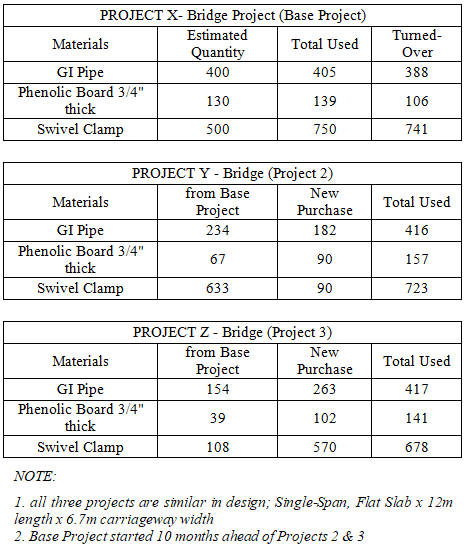
Some projects were site surveyed to gather information on the reuse, recycle and recover activities of a construction firm which is under Category AAA for General Engineering according to PCAB Categorization. The construction firm had a project on a bridge approach which is located in a town in Cagayan Province. The project have had purchased distinct materials for the said project. These materials are reusable materials which means that after the project these materials can be reused for another project.
Tables below show the three different projects which are adjacent to each other. The base project has the same scope as the other two projects mentioned. As seen in the tables below, GI Pipes, Phenolic Board ¾”, and swivel clamps are the three materials which were considered reused materials. The GI Pipes were fully reused, all surplus from the base project was consumed across Projects 2 and 3 indicating an excellent material efficiency. Likewise, the Phenolic Board 3/4" were fully reused, again, complete utilizations showcase proper storage and reuse planning. Lastly, Swivel Clamps were fully reused, all clamps transferred to and used up in Projects 2 & 3 this demonstrates a great resource rotation.
The "Turned Over" materials from the “Base Project” were efficiently redistributed and used entirely in the projects y and z bridge projects. This represents a 0% waste rate from recovered inventory. Minimal new purchases were necessary—only those needed to supplement shortfalls, this cut costs and optimized resources. Starting the Base Project 10 months ahead enabled time for careful recovery, assessment, and allocation of excess materials for future use. This foresight led to synchronized deployment in simultaneous builds (Projects 2 & 3).
Regarding the other salvaged or recovered materials in the previous projects or in the demolition process, the site engineer says the salvaged metal scrap is sold to junkshops to buy materials and other products for machinery maintenance. Any remaining funds would be divided and given to workers to purchase food or other commodities. In appreciation, the workers state that it is a wonderful idea and will go a long way to assist them with food and other expenses for their families. The willingness to support and give to one another creates a harmonious environment and encourages everyone to do their part.
As for crushed cement, workers explained these are being used for embankments and that they were being used as protection materials during the construction. The materials used would not only increase the stability of the project under construction but would also help with eco-friendliness as a means of upcycling or recycling waste products. Therefore, the project would benefit both the workers and their families as well as the environment. Some of the unused crushed cement was also being used as backfill, or sub-base, for the temporary roads being constructed during the building’s development.
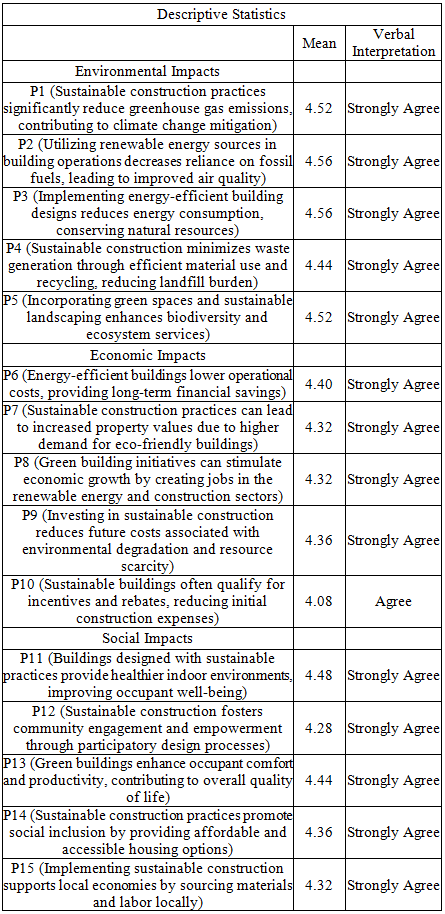
3.3. Environmental, Economic and Social Impacts of Adopting Sustainable Construction PracticesThe Environmental impact domain showed all five items received scores ranging from 4.44 to 4.56 which demonstrates universal strong agreement. P1–P3 (Means: The response data from P1–P3 (Means: 4.52–4.56) shows respondents strongly agree that sustainable practices reduce greenhouse gas emissions and also lead to better air quality and energy conservation. Research by 26 identifies energy-efficient designs and renewable energy as crucial approaches to counter climate change. While P4 (Mean: The average response of 4.44 demonstrates that stakeholders highly prioritize waste reduction through effective material utilization and recycling which corresponds with circular economy principles in construction 21. Finally, for P5 (Mean: According to P5 (Mean: 4.52), green spaces hold recognition for their essential function in supporting biodiversity and ecosystem health which contributes to urban sustainability 27. Stakeholders emphasize the importance of sustainable construction benefits which focus on energy efficiency, air quality improvements, and ecological preservation.
The Economic Impact domain reveals Mean scores from 4.08 to 4.40 which demonstrates uniform agreement yet displays less intensity than environmental impacts. P6 (Mean: The rating of 4.40 represents the consensus that buildings designed for energy efficiency deliver sustained cost savings according to life-cycle cost analysis 28. P7–P9 (Means: Survey results from P7-P9 show that stakeholders recognize property value growth, job creation opportunities, and cost avoidance benefits from green building projects which supports 12 research findings in 2021, that green projects boost economic resilience. P10 (Mean: The mean score of 4.08 for P10 shows weaker agreement regarding access to incentives/rebates which indicates either restricted access or insufficient awareness—a common problem in developing regions as per 29. The data indicates that stakeholders recognize economic benefits yet immediate financial aid such as rebates remain less apparent and harder to access than long-term economic savings and growth advantages.
The Social Impact domain results show consistently high scores (4.28–4.48), demonstrating strong consensus on sustainable construction's social benefits. P11 (Mean: The top-rated social item identified in P11 (with a mean score of 4.48) demonstrates how healthier indoor environments contribute to better well-being and fewer respiratory problems according to 30. P12–P15 (Means: The data (4.28–4.44) proves that items about community engagement and social inclusion together with local economic support and comfort received substantial support. These aspects correspond with social sustainability dimensions that recent studies have identified 31. Participants understand that green building extends beyond environmental concerns to support social welfare and strengthen both community cohesion and local development.
The environmental domain garners widespread agreement concerning its environmental advantages. The economic domain agrees about long-term value but clarification of incentives is required. The social domain receives robust backing that focuses on improving health conditions and achieving social fairness. Stakeholders see sustainable construction as a multi-dimensional solution that responds to climate concerns while managing costs and community needs.
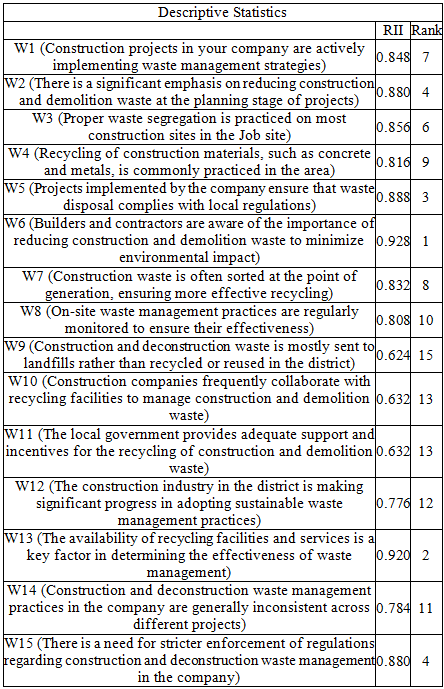
The most important item for the respondents was W6 (“awareness of the importance of reducing construction and demolition waste”, RII = 0.928), indicating that awareness of environmental impact was the top priority. Next was W13 (“availability of recycling facilities and services for waste management”, RII = 0.920). Other highly rated items included W5 (“ensure that waste disposal complies with local regulations”, RII = 0.888) at rank 3, and W2 (“emphasis on reducing construction and demolition waste at the planning stage”) and W15 (“enforcement of regulations regarding construction and deconstruction waste management”), both at rank 4 with an RII of 0.880.
Mid-ranked items with RII values ranging from 0.816 to 0.856, such as W1 (Rank 7), W3 (Rank 6), W4 (Rank 9), and W7 (Rank 8) showed that practices like implementing waste management strategies, proper waste segregation, recycling of construction materials, and sorting of construction waste were also seen important.
The items rated as less important W9, W10, and W11, with RII values ranging from 0.624 to 0.632. This suggested that waste not recycled or reused, collaboration with recycling facilities, and government support and incentives for recycling waste, were not yet visible to respondents. Overall, the rankings demonstrated that awareness and emphasis of waste reduction, availability of recycling facilities, and compliance and enforcement of regulations, were considered the most important for managing construction and deconstruction waste effectively.
The results revealed that the most important item was under reuse of construction materials, specifically R8 (reduced material cost, RII = 0.920 and rank 1). This was followed by an item under deconstruction which is R3 (“manual deconstruction techniques to preserve materials”, RII = 0.896).
Notably, items related to reuse of construction materials were rated with high importance, while items related to deconstruction were rated less important, though their RII values were greater than or equal to 0.8. This suggests that deconstruction practices were perceived as less important than the benefits of reusing construction materials. Meanwhile, the potential impacts of recycling materials were still highly rated, with RII values ranging from 0.744 to 0.800, but perceived to be the least important among the three by the respondents.
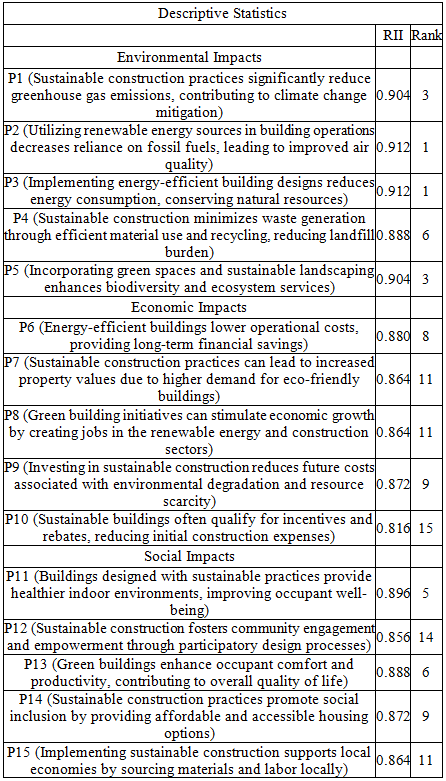
Table 7 reveals that respondents strongly agree environmental benefits through energy efficiency and renewables are the primary impacts resulting from sustainable construction. The growing worldwide focus on climate mitigation efforts and better air quality standards supports this observation. According to 32, adopting renewable energy sources leads to better air quality and decreases reliance on fossil fuels. Research by 33 maintains that energy-efficient building design stands out as one of the top methods for cutting greenhouse gas emissions. Reference 34 found that construction projects using materials more efficiently decrease the amount of waste that ends up in landfills.
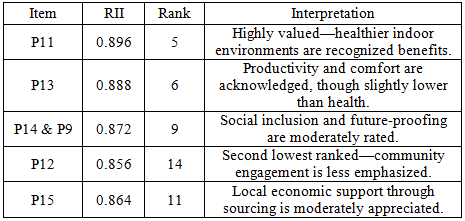
The research showed environmental impacts took precedence because they achieved the top RII scores among all evaluated categories. Social impacts received lower ratings in comparison to environmental impacts but were still deemed important because their RII values surpassed 0.850. The results showed P11 which focused on “healthier indoor environments to improve well-being” with an RII of 0.896 and ranked fifth while P13 aimed at “enhancing comfort and productivity” achieved an RII of 0.888 and ranked sixth P14 which worked to “promote social inclusion” received an RII of 0.872 and ranked ninth P12 targeted “community engagement empowerment through participatory design processes” and got an RII of 0.856 ranking fourteenth and finally P15 focused on “local sourcing of materials and labor” with an RII of 0.864 secured the eleventh position.
The economic impacts category was evaluated as the least important section which included P6 (“lower operational costs for long-term financial savings”, RII = 0.880) as the top-ranking element with rank 8 and P10 (“incentives and rebates to reduce initial construction expenses”, RII = 0.816) as the bottom-ranking element with rank 15 as illustrated in Table 8.
Survey participants understand sustainable construction brings long-term economic advantages yet they do not see short-term financial incentives (P10) as important. The data shows doubt regarding initial investment expenses or the existence of governmental financial support. According to 28 energy-efficient buildings achieve significant operational cost reductions. Reference 35 identify job creation within green industries as a significant yet commonly overlooked advantage. Reference 29 identifies that many developers fail to recognize available financial incentives which results in P10’s low ranking.
Sustainable construction demonstrates a strong connection to health and well-being (P11). Community participation and inclusion (P12) demonstrated in Table 9 shows less emphasis which indicates stakeholders prioritize technical aspects over participatory approaches in sustainability. Reference 30 demonstrate how sustainable buildings substantially improve health outcomes through enhanced air quality and lighting. Research from 36 indicates that developing construction markets frequently ignore social advantages through community participation. The research by 37 demonstrates how inclusive and locally sourced projects contribute to sustained resilience improvements.
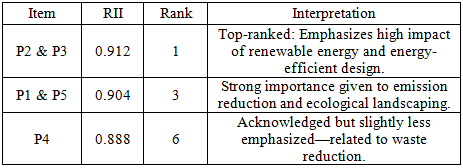
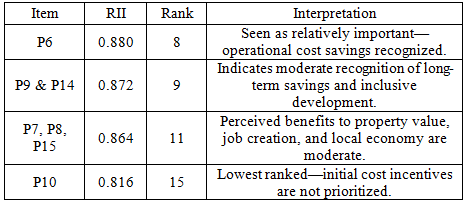
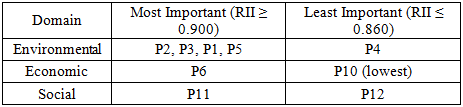
Table 10 shows the summary of least important and most important factors in the Environmental, Economic and Social Domain. The dominant factor driving perceived value in sustainable construction is its environmental benefits. Financial incentives (P10) receive less acknowledgement despite the recognition of economic gains. Although health-related social impacts (P11) stand out prominently the need for increased focus on community participation (P12) remains critical. The table demonstrates that ranking positions P2 and P3 lead the list (RII = 0.912), showing energy efficiency and renewable energy as the top strategies for mitigating environmental impacts. Both P1 and P5 demonstrated strong agreement with initiatives to cut greenhouse gas emissions while improving green spaces and biodiversity. Stakeholders show strong environmental awareness which aligns with international climate objectives established in the Paris Agreement. Sustainable design continues to prioritize energy consumption and carbon emissions as central concerns 32, 33. Waste minimization takes a secondary position because metrics for energy and carbon emissions provide more straightforward quantification and receive stronger emphasis in policy and media discussions.
The economic impact reveals statements P7–P9, P14, and P15 as Moderately Important with their RII values ranging from 0.864 to 0.872. The operational cost savings associated with energy-efficient buildings represent clear and convincing financial benefits. Higher property value, job creation and environmental cost savings have recognition but remain secondary priorities potentially because of perceived unpredictability or delayed economic benefits. The statement P10 - RII = 0.816 stands as the least important finding because initial incentives and rebates received the lowest ranking among survey participants which suggests either insufficient awareness of these programs 29 or skepticism about their financial adequacy or accessibility and demonstrates a preference for long-term economic gains over short-term cost relief tools.
Stakeholders highly value healthy indoor environments especially since P11 – RII = 0.896 showed this being the most important social impact factor according to respondents which leads to better productivity and improved mental health and quality of life 30. The ranking of P13 and P14 factors shows RII scores between 0.872 and 0.888 which indicates stakeholders recognize comfort alongside affordability and inclusivity but place less emphasis on them compared to health benefits. The least important factor is P12 (RII = 0.856): P15 (RII = 0.864) shows minimal attention to local labor and material sources because supply chain limitations and developer cost preferences override local options. The findings show that although individual wellness receives prioritization, community participation and economic inclusion remain undervalued aspects of social sustainability that present an opportunity for developing more comprehensive planning systems.
The main forces pushing sustainable construction stem from environmental factors through the use of renewable energy and efficient design solutions. Operational cost savings demonstrate clear economic benefits which are widely acknowledged yet financial incentives remain underutilized due to insufficient awareness and adoption. Social considerations show uneven distribution where priority goes to individual health while community involvement and local economic empowerment remain underemphasized revealing the social dimension of sustainability lacks completeness.
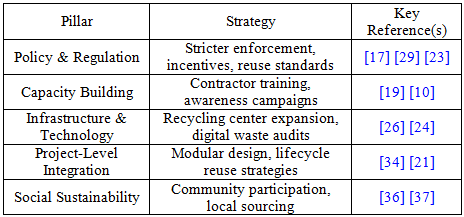
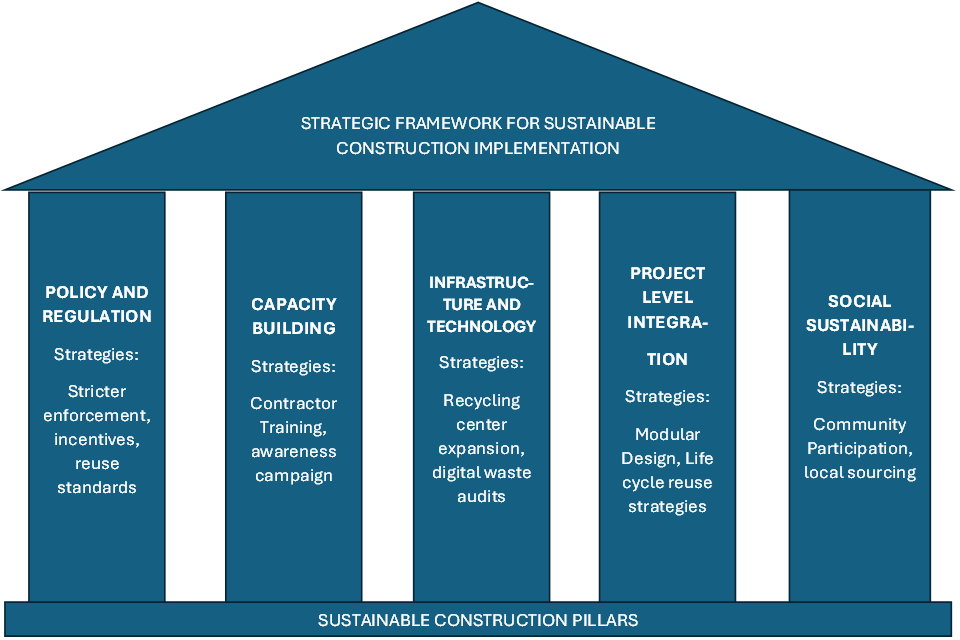
Five pillars comprise the Strategic Framework for Sustainable Construction Implementation detailed in Figure 1. and described further Table 11 which includes Policy and Regulatory Strategies, Capacity Building and Training, Infrastructure and Technology Development, Project-Level Strategic Implementation and Social Inclusion and Community Engagement. The construction industry's sustainability is strengthened through activities that support and develop the framework's five (5) pillars. The study responses together with published literature provide justifications that strengthen these activities.
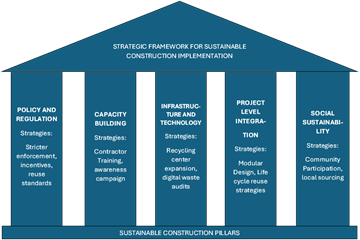
The suggested strategies and frameworks target both the highest and lowest RII components and address the identified survey gaps. Through its creation of links between policy implementation strategies, practical approaches, human engagement, and infrastructure development this comprehensive framework can lead the local construction industry to fully embrace sustainable methods which will achieve a balance between economic sustainability, social fairness, and environmental goals.
The first pillar consists of policy and regulatory strategies. The different strategies will be integrated into this framework to enable the construction sector to achieve environmentally sustainable building practices. One of the approaches includes strengthening the current enforcement of existing waste management regulations. The goal will be achieved through monitoring construction project compliance requirements alongside fines for landfill overuse and the acknowledgment of recycling programs. The substantial RII support for W15 (0.880) and W5 (0.888) demonstrates stakeholder agreement on the need for enhanced regulatory enforcement 17. This action receives validation from the demonstrated support. Another possible action involves creating local incentive programs that reward environmentally responsible activities. This activity provides rebates or tax credits to projects that receive environmental certification for building projects. The development of incentive programs serves to promote the acquisition of recycling equipment. The justification for this stance comes from the fact that P10 achieved the lowest rating among economic criteria with an RII of 0.816 which shows minimal knowledge or availability concerning incentives according to 29. The standardization and certification process for deconstruction and reuse criteria has reached completion. The adoption of local policy guides and certification systems for reuse and deconstruction will help achieve this objective by promoting these practices as alternatives to destruction. According to 18 together with 22 provide an explanation for this phenomenon through the strong agreement on reuse (R8 = 0.920) and deconstruction (R3 = 0.896) which shows readiness but lacks formal institutional structure.
The capacity development and training aspect functions as the second foundational pillar. This pillar will be achieved by completing the actions listed below. Begin by training workers and contractors to adopt environmentally responsible practices. The way to accomplish this objective involves setting up training programs that focus on deconstruction and material recovery techniques with segregation methods plus creating partnerships with TESDA and local technical institutions. The importance of training practice is shown in R5 where RII equals 0.864 while 19 and 20 support this outcome and provide support for this assertion. Experts suggest implementing activities to enhance stakeholders' understanding of sustainability practices. Corporations need to run campaigns that educate people about the long-term expenses of sustainable buildings as well as their reuse benefits and health effects. The target audience should include government officials along with property purchasers and developers. According to 10 The research conducted by 10 shows awareness as the primary factor affecting adoption with details presented in W6 (RII = 0.928).
The third pillar concentrates on creating advancements in both technology and infrastructure. The improvement of this will be achieved through all the following actions. Investments in modern recycling technology for concrete, metals and composites during local facility expansion and modernization provide a way to advance recycling efforts. The activity should set up collaborations between public entities and private enterprises to extend existing operations. W13 (RII = 0.920) shows that having essential amenities is critical support for this contention. According to 24 and 26. The recycling RII of R14 was 0.744 in 2024 showing its underdevelopment. The establishment of waste auditing and material tracking systems remains a necessary action. The management of materials from consumption through end-of-life alongside documentation requirements for permits necessitates the application of digital technologies. The Monitoring activity labeled W8 = 4.04 which focuses on material tracking systems is currently operational but still requires optimization as indicated by 13.
At the project level strategic planning implementation constitutes Pillar 4. The Integrated Waste Reduction in Project Planning implementation will allow us to achieve this objective. This activity will stimulate modular construction and prefabrication techniques while requiring waste reduction plans submission prior to issuing building licenses. According to 34 waste reduction during planning received high stakeholder priority in documents W2 (RII = 0.880) and P4 (RII = 0.888). Activities regarding design for reuse and adaptability require proper oversight. The design for adaptability will encourage flexible layouts that extend building lifespans while supporting construction methods that allow for material reuse after building disassembly. According to 21, reuse demonstrates maturity but requires formalization. The domain of Reuse (R6–R9) demonstrates this justification because it possesses the highest overall RII values.
Social inclusion and interaction with the community stand as the final pillar which holds equal importance within the framework. To achieve this goal the specified tasks will be executed. The initial step demands emphasis on participatory planning and design. The implementation of this approach is essential to engage communities in sustainable project discussions and to align design objectives with local social and economic needs. According to 36. The importance of this concept is detailed in P12 from 36 which had a low priority ranking (RII = 0.856) yet its implementation leads to improved societal sustainability. Support local economies through the purchase of regional products and services. This activity demands that both public and private projects utilize local materials and labor as a priority. This method will enable local investors to establish supply chains that foster sustainable sourcing within their communities. The study by 37 demonstrates through P15 (RII = 0.864) that this approach is backed by evidence; however, local economic empowerment remains underutilized.The adoption of this all-encompassing framework delivers multiple advantages that affect environmental sustainability and economic development while also impacting social well-being. Through rigorous waste management regulation enforcement alongside recycling incentives and modern facility expansion we will substantially lower landfill waste and environmental harm. The implementation of deconstruction and reuse strategies together with lifecycle reuse planning during project development leads to a reduction in virgin material use and lowers the construction industry's carbon emissions. Enhanced systems for tracking materials and auditing waste improve transparency and accountability which results in better resource management efficiency.
The framework contributes to building a construction sector that combines sustainability with resilience from an economic standpoint. Incentive programs that promote green building practices together with support for acquiring recycling technology drive innovation and investment in sustainable technologies. The Cagayan 3rd District sees strengthened local economies and job creation through the local sourcing of materials and labor which leads to economic growth. Designing buildings with reuse and flexibility in mind extends their operational life while lowering future demolition and rebuilding expenses.
The framework improves community involvement and advances social equality. The use of participatory design and planning processes guarantees construction projects meet local requirements and priorities by creating shared ownership and responsibility. Training contractors and workers in sustainable practices enhances their job prospects and builds a workforce that is both proficient and flexible. Awareness campaigns on sustainable building practices strengthen stakeholder decision-making which supports a sustainable and equitable future for the Cagayan 3rd District. This framework's integrated approach demonstrates how environmental protection works alongside economic viability and social equity as mutually reinforcing components of sustainable development.
The research finds that stakeholders in Cagayan’s 3rd District show high awareness of sustainable construction practices with contractors and construction professionals leading the understanding yet a significant gap exists between this awareness and the actual implementation of these practices. Participants in the study expressed robust backing for environmental principles including waste reduction, material reuse, and energy efficiency methods. There is currently a lack of district-wide implementation of this conceptual understanding into consistent large-scale practices. Systemic and operational barriers lead to inconsistent implementation of sustainable practices including deconstruction, reuse, and recycling.
A major obstacle exists because sustainable construction practices show varied implementation across different projects and organizations. Although reuse methods and basic waste segregation practices are starting to appear among some companies these practices lack both standardization and broad enforcement. The practical application of circular construction principles faces significant limitations due to insufficient infrastructure including few advanced recycling facilities and missing centralized material recovery systems. The construction sector's reluctance to pursue long-term sustainability goals remains unaddressed because of inadequate governmental backing and missing economic incentives that would drive the industry past short-term cost-saving measures.
The construction industry still needs to fully integrate community participation and local economic empowerment which are essential aspects of social sustainability into its local practices. The construction industry has acknowledged the social advantages of green buildings through healthier indoor spaces and better occupant health yet it fails to focus sufficiently on participatory design, inclusive planning processes and local green job creation. Sustainable construction in the district continues to prioritize environmental aspects but fails to properly incorporate both economic and social factors which are essential for complete sustainability.
The community demonstrates its commitment to solving urgent ecological problems through its strong emphasis on environmental benefits such as energy efficiency and waste reduction. The study shows that more comprehensive planning needs to merge environmental targets with economic growth and social inclusion. The growth of sustainable construction practices in the 3rd District of Cagayan depends on creating favorable policy conditions and investing in infrastructure together with technical education alongside establishing community engagement platforms and public-private partnerships. The district can move from separate sustainability projects to an integrated and durable sustainable development system in construction by solving these complex barriers.
The subsequent recommendations emerge from the study findings.
1.Strengthen Policy and Regulatory Frameworks: Strengthen enforcement of current waste management rules while creating financial rewards for sustainable methods and setting standard guidelines for material reuse during deconstruction processes.
2.Enhance Capacity Building and Training: Offer thorough professional development to construction workers while running awareness campaigns about sustainable construction advantages to all involved parties.
3.Develop Infrastructure and Technology: Allocate resources to build advanced recycling facilities and establish digital platforms to monitor materials and review waste management practices.
4.Integrate Sustainable Practices at the Project Level: Building permits should involve waste minimization plans and construction designs must adopt modular and flexible approaches.
5.Promote Social Inclusion and Community Engagement: Planning projects should involve community input while prioritizing local materials and workforce to foster economic and social advancement.
The Cagayan 3rd District will resolve current obstacles and promote an industry that thrives through sustainability and economic fairness by applying these recommendations. Future investigations should evaluate the economic efficiency of various sustainable practices while addressing local community requirements to develop precise interventions.
| [1] | Bertino, G., Kisser, J., Zeilinger, J., Langergraber, G., Fischer, T., & Österreicher, D. (2021). Fundamentals of building deconstruction as a circular economy strategy for the reuse of construction materials. Applied sciences, 11(3), 939. | ||
| In article | View Article | ||
| [2] | Akinade, O., Oyedele, L., Oyedele, A., Davila Delgado, J. M., Bilal, M., Akanbi, L., ... & Owolabi, H. (2020). Design for deconstruction using a circular economy approach: Barriers and strategies for improvement. Production Planning & Control, 31(10), 829-840. | ||
| In article | View Article | ||
| [3] | Munaro, M. R., Tavares, S. F., & Bragança, L. (2022). The ecodesign methodologies to achieve buildings’ deconstruction: a review and framework. Sustainable Production and Consumption, 30, 566-583. | ||
| In article | View Article | ||
| [4] | Bertin, I., Saadé, M., Le Roy, R., Jaeger, J. M., & Feraille, A. (2022). Environmental impacts of Design for Reuse practices in the building sector. Journal of Cleaner Production, 349, 131228. | ||
| In article | View Article | ||
| [5] | Chen, Q., Feng, H., & de Soto, B. G. (2022). Revamping construction supply chain processes with circular economy strategies: A systematic literature review. Journal of cleaner production, 335, 130240. | ||
| In article | View Article | ||
| [6] | Allam, A. S., & Nik-Bakht, M. (2023). From demolition to deconstruction of the built environment: A synthesis of the literature. Journal of Building Engineering, 64, 105679. | ||
| In article | View Article | ||
| [7] | Pittri, H., Agyekum, K., Ayebeng Botchway, E., Opoku, A., & Bimpli, I. (2024). Design for deconstruction (DfD) implementation among design professionals: empirical evidence from Ghana. International Journal of Construction Management, 24(13), 1387-1397. | ||
| In article | View Article | ||
| [8] | Pittri, H., Godawatte, G. A. G. R., Agyekum, K., Botchway, E. A., Dompey, A. M. A., Oduro, S., & Asamoah, E. (2024). Examining the barriers to implementing design for deconstruction in the construction industry of a developing country. Construction Innovation. | ||
| In article | View Article | ||
| [9] | Pittri, H., Agyekum, K., Botchway, E. A., Alencastro, J., Oladinrin, O. T., & Dompey, A. M. A. (2024). Drivers for design for deconstruction (DfD) implementation among design professionals. Smart and Sustainable Built Environment, 13(5), 1134-1154. | ||
| In article | View Article | ||
| [10] | Chen, Z., Wang, X., & Li, Y. (2021). Contractor awareness and the adoption of sustainable waste practices in construction projects. Resources, Conservation and Recycling, 168, 105276. | ||
| In article | |||
| [11] | Amoah, C., & Pretorius, L. (2022). Enforcement mechanisms and their impact on construction waste reduction practices. Journal of Cleaner Production, 350, 131478. | ||
| In article | |||
| [12] | Zhao, X., & Le, T. T. (2019). Construction site practices and their effects on waste minimization. Sustainable Cities and Society, 47, 101476. | ||
| In article | |||
| [13] | Nguyen, T. H., Doan, T. N., & Bui, L. (2020). On-site waste segregation and its role in sustainable construction. Journal of Environmental Management, 262, 110318. | ||
| In article | |||
| [14] | Rahman, M. A., Karim, A., & Yeasmin, R. (2023). Assessing public-private cooperation in construction waste recycling: Evidence from urban centers. Built Environment Project and Asset Management, 13(2), 204–221. | ||
| In article | |||
| [15] | Singh, V., & Tan, R. (2024). Barriers to effective C&D waste management in developing countries: Policy gaps and industry inertia. International Journal of Construction Management. | ||
| In article | |||
| [16] | Li, T., Zhang, H., & Sun, Y. (2020). Infrastructure availability and construction waste recycling: A city-level analysis. Waste Management, 102, 872–882. | ||
| In article | |||
| [17] | Ahmed, K., & Yusuf, N. (2021). Regulatory effectiveness in construction waste management: A stakeholder perspective. Sustainability, 13(6), 3124. | ||
| In article | |||
| [18] | Chileshe, N., Rameezdeen, R., & Hosseini, M. R. (2020). Deconstruction in construction: Trends, barriers, and strategies for sustainable practice. Resources, Conservation and Recycling, 158, 104784. | ||
| In article | |||
| [19] | Leising, E., Quist, J., & Bocken, N. M. P. (2021). Building capabilities for circular construction through deconstruction. Sustainable Production and Consumption, 27, 1032–1044. | ||
| In article | |||
| [20] | Pombo, O., Rivela, B., & Neila, J. (2022). Sustainable deconstruction strategies: From policy to practice. Journal of Building Engineering, 45, 103595. | ||
| In article | |||
| [21] | Akbarnezhad, A., & Xiao, J. (2019). Reusing construction materials: Environmental and economic performance assessment. Journal of Cleaner Production, 218, 273–287. | ||
| In article | |||
| [22] | Lippiatt, B. C., & Speight, D. (2021). Guidelines for effective material reuse in sustainable construction. Building and Environment, 193, 107601. | ||
| In article | |||
| [23] | Pitt, M., Tucker, M., Riley, M., & Longden, J. (2023). Integrating reuse into sustainable construction project frameworks. Construction Management and Economics, 41(5), 415–429. | ||
| In article | |||
| [24] | Gálvez-Martos, J. L., Styles, D., Schoenberger, H., & Zeschmar-Lahl, B. (2019). Construction and demolition waste best management practice in the EU. Waste Management, 89, 486–498. | ||
| In article | |||
| [25] | Xie, T., Liu, G., & Lin, H. (2022). Regulatory and economic incentives in enhancing C&D waste recycling. Sustainable Cities and Society, 80, 103752. | ||
| In article | |||
| [26] | Li, S., Zhang, B., & Sun, J. (2024). Accelerating the adoption of recycling technologies in construction. Journal of Environmental Management, 347, 119063. 3 | ||
| In article | View Article PubMed | ||
| [27] | Kabirifar, K., Mojtahedi, M., Wang, C., & Tam, V. W. (2020). Construction and demolition waste management contributing factors coupled with reduce, reuse, and recycle strategies for effective waste management: A review. Journal of cleaner production, 263, 121265. | ||
| In article | View Article | ||
| [28] | Darko, A., & Chan, A. P. C. (2019). Strategies for promoting green building technologies adoption in developing countries. Buildings, 9(9), 195. | ||
| In article | |||
| [29] | Opoku, A. (2020). Awareness and use of green building incentives in construction projects. Sustainable Development, 28(5), 1242–1252. | ||
| In article | |||
| [30] | Cheshmehzangi, A., Dawodu, A., & Huang, H. (2021). Sustainable building design for health and wellbeing. Building and Environment, 200, 107977. | ||
| In article | |||
| [31] | Goubran, S., Cucuzzella, C. (2019) Infrastructure as a Deeply Integrated Sustainable Urban Project. Journal of Sustainability Research. J Sustain Res. 2019;1:e190005. | ||
| In article | |||
| [32] | Zuo, J., & Zhao, Z. Y. (2019). Green building research–current status and future agenda: A review. Renewable and Sustainable Energy Reviews, 75, 767–778. | ||
| In article | |||
| [33] | Lu, Y., Wu, Y., & Chang, R. (2020). Green building and carbon emissions reduction: A life-cycle assessment approach. Journal of Cleaner Production, 273, 122880. | ||
| In article | |||
| [34] | Azhar, S., Carlton, W. A., Olsen, D., & Ahmad, I. (2021). Sustainable construction: A guide to material efficiency and waste reduction. Journal of Construction Engineering and Management, 147(4), 04021015. | ||
| In article | |||
| [35] | Wuni, I. Y., Shen, G. Q., & Osei-Kyei, R. (2021). The economic implications of sustainable construction practices. Built Environment Project and Asset Management, 11(3), 386–402. | ||
| In article | |||
| [36] | Agyekum, K., Chan, A. P. C., & Adabre, M. A. (2022). Social sustainability of green buildings: A review of the state-of-the-art. Sustainable Cities and Society, 76, 103430. | ||
| In article | |||
| [37] | Alwan, Z., & Jones, P. (2019). The importance of local supply chains in sustainable construction. International Journal of Sustainable Building Technology and Urban Development, 10(2), 77–88. | ||
| In article | |||
Published with license by Science and Education Publishing, Copyright © 2026 Jefrey M. Buguina
 This work is licensed under a Creative Commons Attribution 4.0 International License. To view a copy of this license, visit
http://creativecommons.org/licenses/by/4.0/
This work is licensed under a Creative Commons Attribution 4.0 International License. To view a copy of this license, visit
http://creativecommons.org/licenses/by/4.0/
| [1] | Bertino, G., Kisser, J., Zeilinger, J., Langergraber, G., Fischer, T., & Österreicher, D. (2021). Fundamentals of building deconstruction as a circular economy strategy for the reuse of construction materials. Applied sciences, 11(3), 939. | ||
| In article | View Article | ||
| [2] | Akinade, O., Oyedele, L., Oyedele, A., Davila Delgado, J. M., Bilal, M., Akanbi, L., ... & Owolabi, H. (2020). Design for deconstruction using a circular economy approach: Barriers and strategies for improvement. Production Planning & Control, 31(10), 829-840. | ||
| In article | View Article | ||
| [3] | Munaro, M. R., Tavares, S. F., & Bragança, L. (2022). The ecodesign methodologies to achieve buildings’ deconstruction: a review and framework. Sustainable Production and Consumption, 30, 566-583. | ||
| In article | View Article | ||
| [4] | Bertin, I., Saadé, M., Le Roy, R., Jaeger, J. M., & Feraille, A. (2022). Environmental impacts of Design for Reuse practices in the building sector. Journal of Cleaner Production, 349, 131228. | ||
| In article | View Article | ||
| [5] | Chen, Q., Feng, H., & de Soto, B. G. (2022). Revamping construction supply chain processes with circular economy strategies: A systematic literature review. Journal of cleaner production, 335, 130240. | ||
| In article | View Article | ||
| [6] | Allam, A. S., & Nik-Bakht, M. (2023). From demolition to deconstruction of the built environment: A synthesis of the literature. Journal of Building Engineering, 64, 105679. | ||
| In article | View Article | ||
| [7] | Pittri, H., Agyekum, K., Ayebeng Botchway, E., Opoku, A., & Bimpli, I. (2024). Design for deconstruction (DfD) implementation among design professionals: empirical evidence from Ghana. International Journal of Construction Management, 24(13), 1387-1397. | ||
| In article | View Article | ||
| [8] | Pittri, H., Godawatte, G. A. G. R., Agyekum, K., Botchway, E. A., Dompey, A. M. A., Oduro, S., & Asamoah, E. (2024). Examining the barriers to implementing design for deconstruction in the construction industry of a developing country. Construction Innovation. | ||
| In article | View Article | ||
| [9] | Pittri, H., Agyekum, K., Botchway, E. A., Alencastro, J., Oladinrin, O. T., & Dompey, A. M. A. (2024). Drivers for design for deconstruction (DfD) implementation among design professionals. Smart and Sustainable Built Environment, 13(5), 1134-1154. | ||
| In article | View Article | ||
| [10] | Chen, Z., Wang, X., & Li, Y. (2021). Contractor awareness and the adoption of sustainable waste practices in construction projects. Resources, Conservation and Recycling, 168, 105276. | ||
| In article | |||
| [11] | Amoah, C., & Pretorius, L. (2022). Enforcement mechanisms and their impact on construction waste reduction practices. Journal of Cleaner Production, 350, 131478. | ||
| In article | |||
| [12] | Zhao, X., & Le, T. T. (2019). Construction site practices and their effects on waste minimization. Sustainable Cities and Society, 47, 101476. | ||
| In article | |||
| [13] | Nguyen, T. H., Doan, T. N., & Bui, L. (2020). On-site waste segregation and its role in sustainable construction. Journal of Environmental Management, 262, 110318. | ||
| In article | |||
| [14] | Rahman, M. A., Karim, A., & Yeasmin, R. (2023). Assessing public-private cooperation in construction waste recycling: Evidence from urban centers. Built Environment Project and Asset Management, 13(2), 204–221. | ||
| In article | |||
| [15] | Singh, V., & Tan, R. (2024). Barriers to effective C&D waste management in developing countries: Policy gaps and industry inertia. International Journal of Construction Management. | ||
| In article | |||
| [16] | Li, T., Zhang, H., & Sun, Y. (2020). Infrastructure availability and construction waste recycling: A city-level analysis. Waste Management, 102, 872–882. | ||
| In article | |||
| [17] | Ahmed, K., & Yusuf, N. (2021). Regulatory effectiveness in construction waste management: A stakeholder perspective. Sustainability, 13(6), 3124. | ||
| In article | |||
| [18] | Chileshe, N., Rameezdeen, R., & Hosseini, M. R. (2020). Deconstruction in construction: Trends, barriers, and strategies for sustainable practice. Resources, Conservation and Recycling, 158, 104784. | ||
| In article | |||
| [19] | Leising, E., Quist, J., & Bocken, N. M. P. (2021). Building capabilities for circular construction through deconstruction. Sustainable Production and Consumption, 27, 1032–1044. | ||
| In article | |||
| [20] | Pombo, O., Rivela, B., & Neila, J. (2022). Sustainable deconstruction strategies: From policy to practice. Journal of Building Engineering, 45, 103595. | ||
| In article | |||
| [21] | Akbarnezhad, A., & Xiao, J. (2019). Reusing construction materials: Environmental and economic performance assessment. Journal of Cleaner Production, 218, 273–287. | ||
| In article | |||
| [22] | Lippiatt, B. C., & Speight, D. (2021). Guidelines for effective material reuse in sustainable construction. Building and Environment, 193, 107601. | ||
| In article | |||
| [23] | Pitt, M., Tucker, M., Riley, M., & Longden, J. (2023). Integrating reuse into sustainable construction project frameworks. Construction Management and Economics, 41(5), 415–429. | ||
| In article | |||
| [24] | Gálvez-Martos, J. L., Styles, D., Schoenberger, H., & Zeschmar-Lahl, B. (2019). Construction and demolition waste best management practice in the EU. Waste Management, 89, 486–498. | ||
| In article | |||
| [25] | Xie, T., Liu, G., & Lin, H. (2022). Regulatory and economic incentives in enhancing C&D waste recycling. Sustainable Cities and Society, 80, 103752. | ||
| In article | |||
| [26] | Li, S., Zhang, B., & Sun, J. (2024). Accelerating the adoption of recycling technologies in construction. Journal of Environmental Management, 347, 119063. 3 | ||
| In article | View Article PubMed | ||
| [27] | Kabirifar, K., Mojtahedi, M., Wang, C., & Tam, V. W. (2020). Construction and demolition waste management contributing factors coupled with reduce, reuse, and recycle strategies for effective waste management: A review. Journal of cleaner production, 263, 121265. | ||
| In article | View Article | ||
| [28] | Darko, A., & Chan, A. P. C. (2019). Strategies for promoting green building technologies adoption in developing countries. Buildings, 9(9), 195. | ||
| In article | |||
| [29] | Opoku, A. (2020). Awareness and use of green building incentives in construction projects. Sustainable Development, 28(5), 1242–1252. | ||
| In article | |||
| [30] | Cheshmehzangi, A., Dawodu, A., & Huang, H. (2021). Sustainable building design for health and wellbeing. Building and Environment, 200, 107977. | ||
| In article | |||
| [31] | Goubran, S., Cucuzzella, C. (2019) Infrastructure as a Deeply Integrated Sustainable Urban Project. Journal of Sustainability Research. J Sustain Res. 2019;1:e190005. | ||
| In article | |||
| [32] | Zuo, J., & Zhao, Z. Y. (2019). Green building research–current status and future agenda: A review. Renewable and Sustainable Energy Reviews, 75, 767–778. | ||
| In article | |||
| [33] | Lu, Y., Wu, Y., & Chang, R. (2020). Green building and carbon emissions reduction: A life-cycle assessment approach. Journal of Cleaner Production, 273, 122880. | ||
| In article | |||
| [34] | Azhar, S., Carlton, W. A., Olsen, D., & Ahmad, I. (2021). Sustainable construction: A guide to material efficiency and waste reduction. Journal of Construction Engineering and Management, 147(4), 04021015. | ||
| In article | |||
| [35] | Wuni, I. Y., Shen, G. Q., & Osei-Kyei, R. (2021). The economic implications of sustainable construction practices. Built Environment Project and Asset Management, 11(3), 386–402. | ||
| In article | |||
| [36] | Agyekum, K., Chan, A. P. C., & Adabre, M. A. (2022). Social sustainability of green buildings: A review of the state-of-the-art. Sustainable Cities and Society, 76, 103430. | ||
| In article | |||
| [37] | Alwan, Z., & Jones, P. (2019). The importance of local supply chains in sustainable construction. International Journal of Sustainable Building Technology and Urban Development, 10(2), 77–88. | ||
| In article | |||