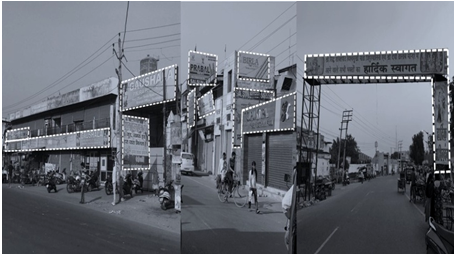
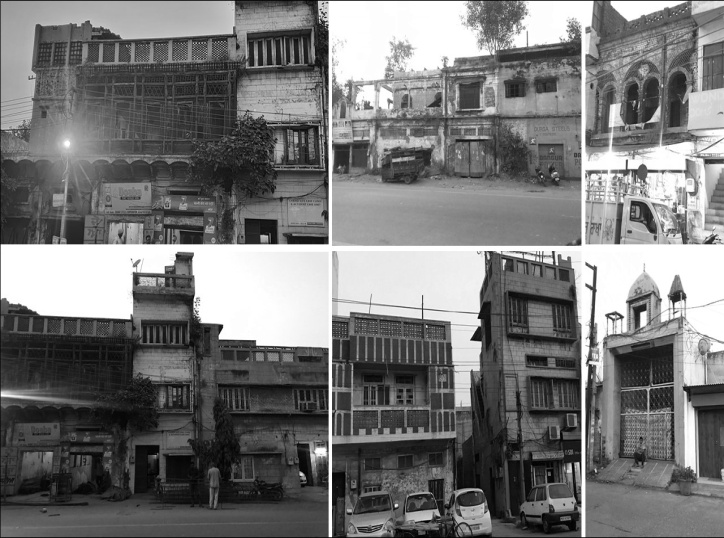
India is one of the oldest civilizations globally, with a kaleidoscopic variety and rich cultural heritage. However, there is a diverse change in India's cultural and historical centers with the increasing demographics. Several approaches and schemes have been introduced and applied to reinforce historical cities' cultural identity within recent decades. There is not solely ought to conserve the heritage buildings but also outdoor activity and quality. Streetscape is an on-the-spot panorama of the city that individuals grasp and creates the city's public image and identity. The isolated area between the heritage buildings desires public attention instead of no man's land. A medium-sized city like Jalandhar, Punjab, is enriched with cultural and historical monuments, but these are ignored. The 200-year-old Devi Talab Mandir, Jalandhar, Punjab, receives thousands of tourist footfalls annually and can revitalize its Street. Through this vision, the paper adopts streetscape revitalization as an urban facet to bolster and embrace the cultural identity, placemaking and the heritage character of the historic city of Jalandhar, Punjab. This paper discusses numerous urban guidelines that may be adopted to enhance the Streetscape outside the Devi Talab Mandir and provide a sensible framework that produces redesign principles that reflect and support community character revitalization.
This India is the land of many cultural livings. "Unity through diversity" is India's main attraction to many foreign countries. Every city has its own culture, identity, and heritage. The historic sites inside the cities are liable for promoting the economic, cultural, and social interaction areas. However, due to urban sprawl and tremendous growth, there is a diverse change in the city's cultural and historical centers. Even in medium-sized cities like Jalandhar, full of culture and heritage, its conservation and enhancement are ignored due to other issues. Many approaches and visions have been introduced and enforced in recent decades to revive the city's cultural identity. These revitalization strategies focus mainly on the unattended streets between the heritage buildings. Streetscape is an immediate vista of the city that people grasp and creates the city's public image and identity 1. A well-designed street will receive more visitors, enhance the economy, and create a suitable environment for working and living. India's rich cultural heritage employs about 9% of its workforce.
There is abundant scope to enhance the city's economy by revitalizing the heritage streets, as streets and their sidewalks are the main public spaces and the city's most vital organs. As an element of the city, the Street is the most influencing cultural identity 2. Streetscape redesign helps to upgrade the local economy through local art, skills, resources, and knowledge. This paper sees the heritage street outside the 200 years old Devi Talab Mandir, Jalandhar, Punjab, as an opportunity to revitalize and enhance the city's overall character by following the urban guidelines. For this, the research surveys the selected stretch at different time intervals from September to October.
Further, it discusses the best possible solutions that can be applied to the selected site. The research's scope is limited to the stretch outside the Devi Talab Mandir, Jalandhar, Punjab. Answering the main question in this paper- how revitalizing heritage streets will enhance the city's overall character will help design a better streetscape. This will help in increasing the socioeconomic profile of the city.
The present research strategy is based on a single case study, i.e., the stretch outside the Devi Talab Mandir, Jalandhar, Punjab. The city was selected because of two reasons. First, India's Government envisioned transforming Jalandhar into a smart city by promoting its economy, sustainability, and sports factors more and focusing less on its heritage development 3. Second, the Devi Talab Mandir is 200 years old and receives a massive footfall of tourists yearly 4. Its streets have the potential to be revitalized and help improve the city's imageability.
To understand the street and its surroundings, existing problems and obstacles, roles and responsibilities of locals and the vendors, the research conducts an on-site observation and in-depth, open-ended interviews with shopkeepers that provide descriptive data. The research was conducted between September and October based on various parameters. Activity mapping was done at different intervals to study the area and obtain the project's physical, functional, and organizational decisions. Shopkeepers, street vendors, and visitors' perceptions about the Street are recorded and presented in the research as pie charts. Further, this research reviews various research papers and urban guidelines to enlist street elements. The major street elements discussed in this research area are physical elements that include road-pedestrian walkway condition, safety, landscape, Streetscape, urban utilities, public amenities, universal accessibility, and the spiritual elements that include sensory, connectivity, vitality, aura, and magnet city. These elements are extracted from [1,5,6,7,8,9,10,11,12].
"Streetscape is a view or a scene of streets; the visual elements of a street, including the road, adjoining buildings, sidewalks, street furniture, trees, and open spaces, combine to form the street character" 13. Like an individual, it is believed that a city or urban place needs an identity to be recognized as different from other cities. As an element of the city, the Street is the most influencing cultural identity 2. Streets are an essential urban element; people experience the city while walking through the streets. Hence, the streets contribute to enhancing the city's image.
3.2. Streets as a Core of Cultural IdentityCulture has been called "the way of life for an entire society" 1. Cultural revitalization is affirming and promoting people's individual and collective cultural identity. It is vital to remember the culture for generations. Without it, many ethnicities will be diminished from our knowledge. Cultural revitalization strategies help reveal and enhance the underlying identity, the unique meaning, value, and character of a community's physical and social form. This identity is reflected through the community's character or sense of place. Kevin Lynch, in his seminal work, found the five elements of the image of the city, i.e., landmark, path, nodes, district, and edge. He admitted that the path is an essential element that recognizes the other four elements 14. Thus streets, their names, and their character have become a core of cultural identity. An enhanced streetscape identity improves the built environment's quality, ensuring shared public spaces are accessible, appealing, and welcoming to everyone. Heritage can improve the quality of life by understanding of the past and us.
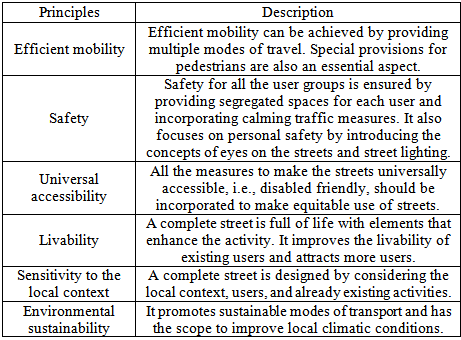
3.3. Principles of Street DesignA street designed to cater to all the users' needs and activities through equitable allocation of road space is known as a complete street. For designing a complete street, following principles must be considered (Table 1).
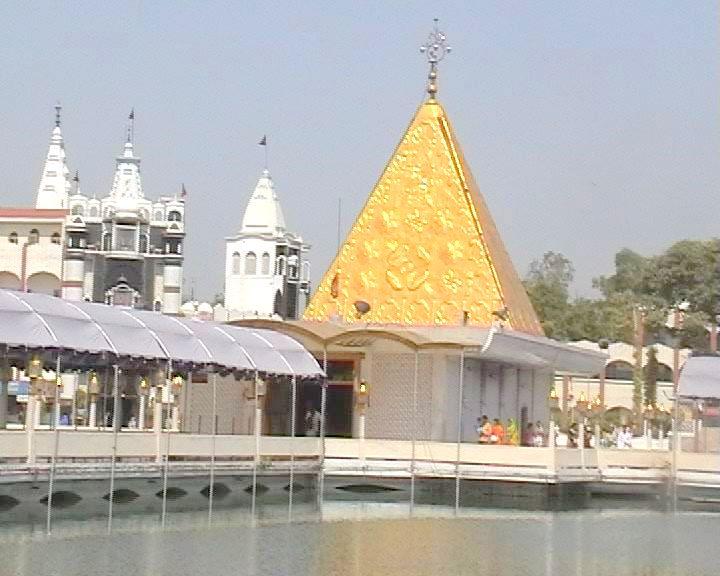
Jalandhar is situated at a north latitude of 30 19’ and east longitude of 75 36’48” with a general elevation of 780m above mean sea level. It is a non-resident Indian state that has religious and historic districts. It has the highest per capita medical facility in Asia. It enjoys the privilege of Intra, a bound tourist destination. Jalandhar district boasts many religious and historical monuments. Numerous economic drivers for the city will play an essential role in the upcoming years; one is Devi Talab Temple 15. Devi Talab Temple is situated in the heart of Jalandhar city. It is an old temple of the goddess Kali and is believed to be more than 200 years old. The temple is one of the 51 Shakti Pithas in India (Figure 1). The temple hosts one of the national festivals, i.e., Harballabh Sangeet Samelan, every year in December that celebrates Hindustani Classical music. On average, 10 lakh tourists visit the temple annually 15. Despite having utmost importance, the Street outside the Devi Talab temple faces various issues. It can get revitalized and transform the city's overall image, enhance the cultural identity, and restores the historical memoir. This research selects the stretch outside the Devi Talab temple.
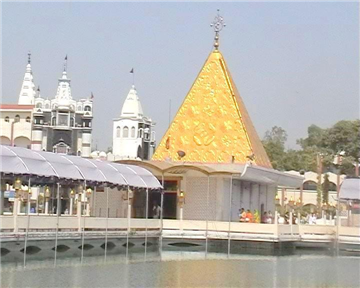
The land use along the stretch outside the Devi Talab Temple, the street precinct, is dominated by commercial activities followed by institutional buildings. The street precinct serves various uses like commercial, public, and semi-public spaces. The commercial activities along this Street are divided into two basic types. The first is the temporary shops solely settled here due to the temple. The street vendors sell the temple's necessities and items like jewellery and toys that attract the Mandir's tourists. The other type is the permanent shops like restaurants, hotels, hardware and garments shops.
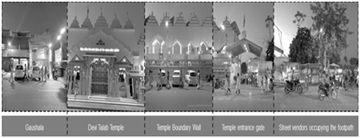
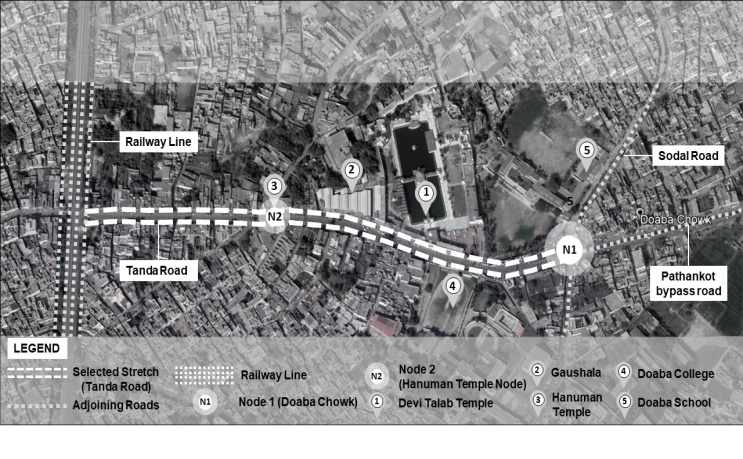
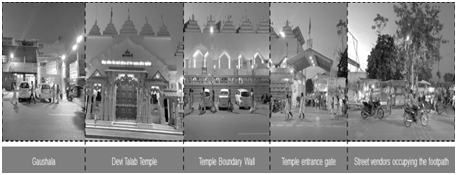
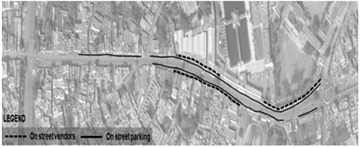
4.2. Character of the StreetThe stretch outside the Devi Talab Temple is also known as Tanda Road. It is one of the main roads in the city core that connects various important places. The selected stretch is 810 meters long with a varying width between 15-20 meters (Figure 2). The road connects to various small roads of varying widths and is enclosed with precise building alignment on both sides. Street vendors sell jewellery, fruits, toys, fast food, and temple-related items at the Street's entry. Further along the Street, religious buildings like Devi Talab temple and Hanuman temple also act as important tourist zone. Apart from the street itself is a commercial activity connecting to a Mai Hiran gate commercial zone. It is one of Jalandhar's most essential and prominent fabrics and accessories markets. Commercial buildings dominate the precinct. The buildings' character displays two building typologies, i.e., buildings with traditional character and contemporary buildings. Today in Punjab, various structures can be seen that are designed on the principles of Sikh architectural style. Inspired by the predominant architectural styles, the Devi Talab temple has similar features to Sikh architecture. The temple's planning is similar to the Golden Temple, with the temple at the centre surrounded by a water body. The motifs in the Devi Talab temple resemble Sikh and Hindu architecture (Figure 3).
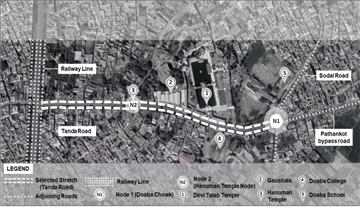
Streets should be designed so that they put people and places first before the movement of vehicles. Streets should be designed for better mobility, safety, and livability that improves the overall image of the Street. Certain street elements help all users to move safely, smoothly, and conveniently. Some physical elements that have been considered while studying the site are listed. Physical elements include road-pedestrian walkway condition, safety, landscape, Streetscape, urban utilities, public amenities, and universal accessibility. Based on the detailed survey, mapping, and observations, the site's following analysis has been prepared under the urban design dimensions.
5.1. Physical Elements of Urban StreetThe road pedestrian walkway includes the condition of pedestrians, footpaths, carriageway, and parking.
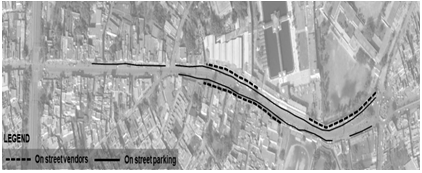
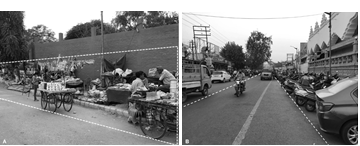
Present Scenario: Different Street vendors occupy the pedestrian area and offer pedestrian congestion. The right of way of street vendors is not defined, which results in an unpleasant image of the Street. The pedestrian area can be seen near the temple area occupied by street vendors, as shown in Figure 3, highlighting the need for pedestrianization in the Street. Irregular parking has been seen along the entire stretch resulting in traffic congestion on the road, as shown in Figure 4B. No dedicated space has been allotted for parking on the Street. The vehicles are parked in small fragmented unmarked pockets. The area near the Devi Talab temple experiences the maximum traffic because of the encroachment of vehicles, pedestrians, and street vendors, making the Street unsafe for the user.
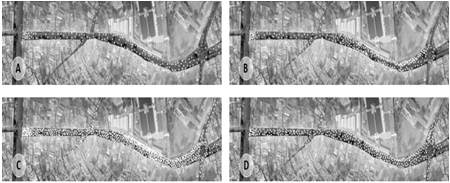
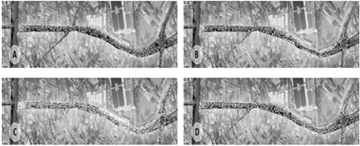
Traffic analysis has been done on both regular and event days at different time intervals in a day, i.e., in the morning and evening. The traffic represented vehicular, pedestrian, and street vendors, as shown in Figure 5.
Urban Design Intervention: The major congestion problem between vehicles, pedestrians, and street vendors can be avoided by providing proper space for each activity. Pedestrianization can be encouraged by proposing a good footpath on the road's edges, where people can meet, walk, sit, and eat (Figure 4). The footpath should be free from obstructions with a minimum clear walking zone of 2.5 meters, in which a maximum of 2250 people per hour can travel in both directions 6. The footpath should be well-lit, shaded, and 150 mm high from the road, separated by the curbstone. The footpath's surface should be rigid, anti-skid, and visible with a gentle slope of 1:50 towards the Street stormwater to avoid water accumulation. To get a clear walking space on the footpath, street vendors should be provided with a good area at their existing places. The row of the street vendors should be uniform throughout, and hierarchy in material, texture, and structure should be maintained to get a visually appealing environment. Well-planned spaces for Street vending provide citizens with a secure area for shopping. Strategic planning can be done for the placement of street vendors. While going towards the temple from Doaba Chowk, street vendors selling temple-related items can be placed, and at the exit point of the temple, street vendors selling toys, food items, and jewellery can be placed that can attract visitors. An area of at least 4m2, including a spillover of 1.8m2, should be provided for each vendor 8. Basic supporting amenities like water taps, electrical points, trash bins, and public toilets should be proposed to prevent the filth around the vending areas. Currently, perpendicular parking is practiced on the Street. The concept of parallel parking can be introduced on the Street as it provides efficient car parking and occupies minimum road space (Figure 5). At present, the maximum parking on the road is for Mandir. The parking for the temple can be planned inside it, and for others, on-street parking can be proposed. For On-Street parking, a maximum of 22m long parking bay can be created 7, which is well marked and provided with permeable grass pavers, signages and shade. There should be a 0.5m buffer from the footpath for the safety of pedestrians (Figure 6). Informal public transport like autos and rickshaw should be parked near the commercial activity zones with maximum 7 autos in one parking zone 7.
Safety elements should be incorporated into the design to make streets safe, clean, attractive, and comfortable for people to walk and drive. Safety elements include pedestrian crossings, calming traffic measures, speed breakers, central medians, and signages.
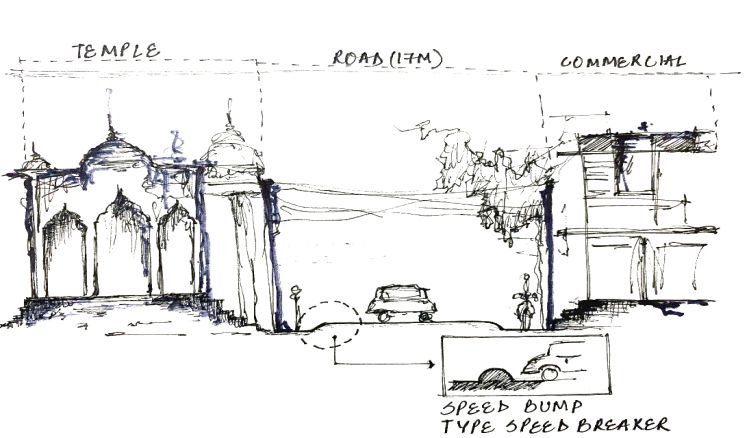
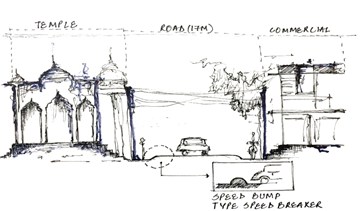
Present Scenario: On the selected stretch, the encroachment of pedestrians, vendors, and different types of vehicles in the same area results in congestion that makes the street unsafe. The Street is a single-lane road with two-way traffic and varying widths. It has a speed bump-type speed breaker constructed at a certain distance. It is not continued from one edge to the other edge of the street, allowing vehicles to move from the leftover space at a higher speed making the street unsafe. The speed breakers are not highlighted using lights or visible at night. The cat eyes installed on the road are not in working condition. The beggars occupy the road edge space. Electric poles, advertisement boards, and trees are on the road that blocks the vision and making the street unsafe. The absence of pedestrian crossings and signages also results in poor safety of the Street. Based on a survey, 70% of people found the street unsafe, while the remaining 30% found it safe.
Urban Design Intervention: To make the streets safe, various traffic calming measures can be incorporated into the design. Traffic can be streamlined by providing a central median of 1.5m width that will separate the Street into two halves and direct the traffic flow 6. The median height should be 0.15m at the refuge island and 0.9m at other locations. Trees can be planted in the median to enhance the Street's aesthetic. Table-type pedestrian crossings with a height of 0.15m and a vehicle ramp of 1:8 to 1:10 slope can be proposed for pedestrians' safety and to lower the speed of the vehicles 8. Along with commercial activity, the site has a school and college. Railing or bollards of a maximum height of 0.7m can be provided to ensure the safety of the students and pedestrians. A necessary warning and an informatory sign should be placed along the stretch. Bump-type speed breakers that continue from edge to edge of the road should be provided (Figure 7). All the pedestrian crossings, bollards, railings, and speed breakers should be painted with reflective paints and provided with cat eyes to maintain visibility during the day and night. Proper marking of different types of lines on the carriageway should be done. Night shelters can be proposed for the beggars that occupy the road space.
The landscape is one of the essential elements that define the Street's character and helps provide a comfortable environment to the user. The landscape of the Street includes a plantation, street furniture, street lights, and advertisements.
Present Scenario: There are 21 trees on the entire selected stretch; some block the shops and the Street views. Due to the absence of trees on the stretch, walking on the street during the summer is difficult, promoting an unhealthy pedestrian experience. Street furniture is also an essential element that caters to the safety and comfort of road users, especially pedestrians. However, there is only one bench for seating, which is provided at the Street entrance. As the street offers high commercial activity and pedestrian flow, a lack of street furniture is observed on the site. Streetlights offer a sense of security for all road users. On the stretch, the street lights are placed only on one side of the road. The height of street lights is 10m, and the distance between the two light poles is 20m. The road is not lit at night due to the lack of street lights.
Advertisement on the streets has become a necessity in today's marketing generation. Advertising affects the aesthetics and safety of the Street to a great extent. Many advertisement boards on the Tanda Road buildings exhibited a complete absence of regularity control or defined pattern. Large hoardings, as compared to the size of the building, are seen on the site. Many buildings have multiple advertisement boards. Advertisement through graffiti has also been observed on the site. There is a significant gateway structure advertising the Devi Talab temple at the stretch entrance. Some advertisement boards are very brightly lit, which causes glare. Advertisement boards with moving and changing figures and running lines also offer distraction in vehicular flow. The irregular, oversized, and over-numbered placement of the advertisement boards destroyed the building's elevation feature, obstructing views and defacing the beauty of the Streetscape.
Urban Design Intervention: Trees encourage pedestrian activity, provide shade, and add a point to the aesthetics of the Street. So local indigenous, deciduous, and evergreen trees should be planted on the frontage zone of the footpath and in the parking belts. As the street is commercial, medium-sized trees with medium-density foliage are appropriate. It is mandatory to have tree pits of 1.8mx1.8m for the tree's proper growth 8. Street lights should be considered while planting trees so they should not get hidden due to the tree canopy. Two types of streetlights can be provided. First, on the pedestrians' footpath with a height of 3-6m and spacing of 9-16m. Second, in the central median for the road with a height of 8-10m and spacing of 25-27m 6. Light-emitting diodes and solar lights can be proposed because of their energy efficiency. At present, existing trees occupy the space in the carriageway. These should be preserved by highlighting them with chevron road markings, cat eyes, and reflective posts visible at night.
The frontage edge of the footpath should be filled with street furniture at regular intervals. The furniture should be well-designed and properly placed so that it is easy to maintain. Street furniture should encourage seating and discourage lying down. Unsympathetic elements like projections of boards, advertisement boards on compound walls, and street corners should be treated to make the streets visually appealing. The advertisement boards should be designed not to hide the shop's elevation feature and, at the same time, advertise for it. A hierarchy in the design of advertisement boards should be maintained in size, colour, texture, and shape. Boards can be 9x6m with a height of 3.5- 18m 17.
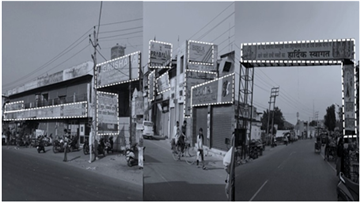
Streetscape refers to the way someone perceives the image of the Street. As urban spaces, streets are experienced by the users as linear three-dimensional spaces. Users move along the Street; they will experience spaces formed by building facades, a row of trees, sidewalks, street furniture, trees, and open spaces 18. The streetscape includes the facade, material, and identity of the street.
Present scenario: Despite the heritage building Devi Talab temple's presence, the street does not show the heritage character. The absence of fundamental design principles like balance, harmony, and emphasizes is noticed on the site. Various unsympathetic elements are present on the street that have altered the original fabric of the building. The buildings do not show harmony in height, texture, and materials. Even the right of way of the street vendors is not defined. Due to the abovementioned problems, the street's identity is lost, and the Street fails to give an enhanced user experience. Various traditional buildings on the site serve the purpose of mixed-use buildings today. The ground floor of these traditional buildings is used as shops. Various design elements like Jaalis, Chajjas, Wooden screens, Arches, Brackets, and horizontal and vertical bands are seen on the site. However, these structures are neither maintained nor given importance. In addition to this, the Devi Talab temple shows elements of Sikh architecture like arches, floral carvings, multifoil arches, bands, and Jaalis. Despite such beautiful architecture, the Street shows a lost character and identity.
Urban Design Intervention: To revive the Street's lost identity, essential elements of principles of design should be followed. A regular arrangement of alternated or repeated elements like jaalis, bands, arches, color, and texture can be proposed. Emphasis can be given to the Devi Talab temple on the street by designing the facade of the neighboring buildings in contrast to it using the same design elements like bands, arches, texture, color, and jaalis. The buildings with modern façade need to be pulled down and adopt the style of architecture in the street precinct in harmony with the traditional buildings. The existing traditional structures should be maintained as it is. The government should assist local artisans in setting up their shops and workshops on the Street, which would attract many tourists. Thus, reviving the tangible and intangible heritage transforms the Street into a cultural tourist heritage precinct. The city's cultural activities can be organized on the streets, attracting tourists and locals, thus diversifying the streets.
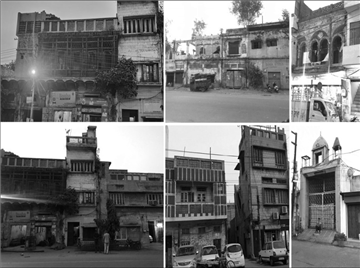
Streets are not just movement corridors for vehicles and people, but they also carry infrastructural utilities. Utilities are the most crucial components of the street and require proper design, placement, and maintenance. Streets carry many utilities like stormwater management, garbage disposal, and electrical service 19.
Present Scenario: The street slopes on both sides towards the edge. Generally, the stormwater is collected at the edges of the road by an inlet placed at regular intervals and then discharged to stormwater drainage. However, water is collected by the pipes along the road and then discharged into the drain. Open catch pits are provided. Very few catch pits collect the stormwater; thus, waterlogging occurs in the neighboring streets 20. Manholes and other obstructive utilities like transformers are located on the carriageway on the slight offset from the road's edge, interrupting vehicular and pedestrian movement. The space under the transformers is used as a collection area for garbage. An overhead system of electrical lines on the site is improperly maintained, breaking the Street's visual connectivity. One of the major problems observed on the site was the garbage disposal. Garbage bins in the right place help to keep the streets clean. Clean streets not only provide hygiene but also encourage interaction activity between people. However, garbage humps can be seen on the road in small pockets due to the complete absence of garbage bins. The survey found that 60% of people needed dustbins, while the remaining were fine with the situation 21.
Urban Design Intervention: Stormwater management should be incorporated into the street design. Open catch pits for the stormwater should be avoided, and permeable pavers and bioswales can be introduced on the Street. Proper maintenance of the manhole is needed. The covers of the manholes and the catch pits can be painted and crafted using waste materials like tiles and stones. Overhead electric lines should be appropriately maintained. Dustbins should be placed on the Street at regular intervals; 2-3 small dustbins are preferred rather than one big dustbin for easy maintenance. Two garbage containers within 500m are preferred 7. Different colored dustbins can be provided for biodegradable and non-biodegradable waste.
Present Scenario: Public amenities and services are the fundamental needs of the people. The primary need for public toilets and drinking water facilities was observed on the site. There is only one water dispenser along the entire stretch located at the stretch entrance.
Urban Design Interventions: Accessing sanitation is a fundamental aspect of community development. Considering this, the government has already proposed a toilet on the site under construction. The toilet is proposed in between the footpath, which will hinder pedestrian access. A better place for a toilet can be found at the start of the stretch or near the temple. Drinking water facilities should be proposed at regular intervals 22.
Universal design is the design of products and the environment to be usable by all people to the greatest extent possible without needing adaptation or specialized design. There are seven principles of universal design. These are equitable use, flexibility in use, simple and intuitive use, perceptible information, tolerance of error, low physical effort, size, and space for approach and use 6. While designing a universal design, these principles must be taken into consideration.
The sidewalks designed on the Street should be universally accessible. The surface of the footpath should be leveled, and guiding blocks for the visually impaired can be introduced. Wherever bollards are provided, a 0.9m gap should be left for wheelchair users 16. All the gratings should be covered and have a maximum gap of 12mm. The tactile paving concept should be introduced for visually impaired people that gives them guidance in the pedestrian area. Kerb ramps should be introduced with a maximum slope of 1:10 and 900mm width for accessibility between the footpath and streets. The public toilets designed should be universally accessible. Handrails should be provided in the toilets and wherever necessary.
Streets are the lifelines of any city. To know the culture and heritage of any city, the streets are the best place to walk all day long. The paper analyses the crucial relations between cultural identity and streetscape redesign in developing cities like Jalandhar. While revitalizing the streetscapes, various design elements are taken into consideration. Based on detailed site analysis, the following are the best practices that may be applicable on the stretch outside the Devi Talab temple.
a). All the urban guidelines for revitalizing the streetscapes and regenerating their lost cultural identity should be followed.
b). All the existing heritage structures should be preserved and maintained.
c). Hierarchy in facade, material, and building elements should be maintained throughout the stretch. The design elements like Chajjas, Jaalis, bands, arches, color, and texture can be used to design the entire stretch's facades.
d). Establish a clear sense of arrival through a distinct landscape, built and open spaces, and unique features.
e). Organize signage, street furniture, and lighting to give people a clear direction and orientation. Create a safe, secure, and enjoyable street.
f). Create a suitable furniture module that creates interest and comfort for the public realm. Innovative furniture modules that are multifunction, occupy less space, and provide the user with clearer walking space can be proposed.
g). Jane Jacob coins keeping "Eyes on the Street" in her book The Death and Life of the Great American Cities. This term aims to organize various activities along the Street to create a safe and interactive environment. Creating space for street vendors, hawkers, street cafes, and utility booths along the Street helps create a safe and secure environment.
h). A good parking area should be proposed for all users, like street vendors, shopkeepers, and visitors. Permeable pavement can be installed in the parking lots to recharge the groundwater and reduce the pollutants in stormwater runoff in rivers and drains.
i). The proper pedestrian area should be designed to be free of any obstruction and universally accessible.
j). Establish the landscape design with a proper and clear tone, easy to maintain and appropriate for the locals. Trees with attractive foliage, colors and flowers are preferred. Ornamental species of plants with contrasting foliage and scent should be preferred for the prominent areas.
k). Community participation and public art are essential to consider while designing the Streetscape. Public art creates a sense of bringing out the community's unique character. It can play a dual role of utility and aesthetics. Carefully designed public art can have a significant impact on the behavioral pattern of people.
l). Environmentally friendly toilets should be designed every 500-800m.
m). Different types of dustbins should be placed on the streets for different types of waste. Proper labels are not put on the bins because people cannot recognize the purpose of the dustbins. A better solution is that dustbins can be transparent and opaque, or some stickers can be applied to them to understand the people clearly.
This paper discussed numerous urban guidelines that may be adopted to enhance the Streetscape outside the Devi Talab Mandir and provide a sensible framework that produces redesign principles that reflect and support community character revitalization. The research contributes to a better understanding of the revitalization strategies of historic streetscapes. The literature analyzed provides us with the best practices applied to the streets to enhance their cultural identity. The selected stretch transforms its historic structure to accommodate the commercial activities into contemporary buildings and loses its character. Despite having a great heritage, the stretch has lost its identity. As streets are one of the essential elements for forming a good image of the city, the selected stretch is envisioned as an opportunity to improve the city's overall imageability and enhance its cultural identity. Hence, proactive steps should be considered while designing the Streetscape. The existing activities and public participation should be core elements while designing the Street. To regenerate the original character and cultural significance, appropriate conservation regulations and measures to improve the Street's quality should be followed.
| [1] | E. Embaby, Mohga, Promoting Cultural Identity along Streetscape Redesign ‘Case studies in Cairo and Luxor Cities, Egypt, IJERT - Int. J. Engginering Res. Technol., 4(5), 1248–1261, 2015, [Online]. Available: https:// www.ijert.org/ research/ promoting-cultural-identity-along-streetscape-redesign-case-studies-in-cairo-and-luxor-cities-egypt-IJERTV4IS051101.pdf. | ||
| In article | |||
| [2] | J. Jacobs, The Death and Life of Great American Cities. New York, 1961. | ||
| In article | |||
| [3] | Government of Punjab, World class professionals required for smart city projects of Amritsar, Ludhiana and Jalandhar under Smart Cities Mission (SCM) of govt. of India, 2013. [Online]. Available: https:// pmidc.punjab.gov.in/ wp-content/ uploads/ 2017/06/Detailed_Scope_of_Work_ToR_for_CEO_for_ASCL_LSCL_JSCL24122016.pdf. | ||
| In article | |||
| [4] | Government of India, Final report of tourism survey for the state of Punjab, 2010. [Online]. Available: https:/ /tourism.gov.in/ sites/default/2020-04/Punjab.pdf. | ||
| In article | |||
| [5] | S. Said and Z. Samadi, The Evolution of Historic Streetscape in Adapting Modern Demand in Achieving the Quality of Life, Procedia - Social Behavioural Science, 234, 488–497, 2016. | ||
| In article | View Article | ||
| [6] | Pune Municipal Corporation, Urban Street Design Guidelines, Pune, 2016. [Online]. Available: http://itdp.in/wp-content/uploads/2016/07/Urban-street-design-guidelines.pdf. | ||
| In article | |||
| [7] | ITDC, Institute for Transportation and Development Policy, Complete Street Planning Manual, 2020. [Online]. Available: https://chennaicorporation.gov.in/images/Complete_Street_Planning Guidelines.pdf. | ||
| In article | |||
| [8] | DUAC, Delhi Urban Art Commission, Street Design Guidelines, Delhi, 2020. [Online]. Available: https://duac.org.in/Upload/City Level Studies/Transport studies/653962684171893.pdf. | ||
| In article | |||
| [9] | R. M. Yunus, Z. Samadi, and D. Omar, Making of ‘Great Heritage Street, Procedia - Social Behavioural Science, 168, 365–372, 2015. | ||
| In article | View Article | ||
| [10] | R. H. Charlotte Marceau, Dr Annabel Bradbury, Halcrow, and B. Hamilton-Baillie, Designs for life: Learning from Best Practice Streetscape Design, in Proceedings Of The European Transport Conference, 2007 Held 17-19 October 2007, Leiden, The Netherlands, 2007, 1–23, [Online]. Available: https:// trid.trb.org/ view/855423. | ||
| In article | |||
| [11] | The Mumbai Metropolitan Region – Heritage Conservation Society, Design Handbook of Heritage Streetscape Guidelines for Street Furniture and Signage. 2002, [Online]. Available: http://mmrhcs.org.in/images/documents/projects/Guidelines-for-street-furniture-and-signage. pdf. | ||
| In article | |||
| [12] | F. B. Saroinsong and R. H. E. Sendouw, Streetscape Enhancement for Supporting City Tourism Development, Int. J. Psychosoc. Rehabil., 24(3), 871–887, 2020. | ||
| In article | View Article | ||
| [13] | T. Edirisinghe and D. C. Hewawasam, An Investigation of the Relationship of Streetscape Visual Enclosure and the Pedestrian Movement in Selected Case Studies in Colombo, Journal of Engineering and Architecture, 8(1), 11–30, 2020. | ||
| In article | View Article | ||
| [14] | K. Lynch, A Theory of Good City Form. 1981. | ||
| In article | |||
| [15] | Jalandhar Development Authority, Jalandhar Master Plan, 2013. [Online]. Available: https:// www.jda.gov.in/ sites/ default/ files/documents/Report-Master-Plan-Jalandhar.pdf. | ||
| In article | |||
| [16] | B. I. R. Harsritanto, Indriastjario, and Wijayanti, Universal design characteristic on themed streets, IOP Conf. Ser. Earth Environ. Sci., 99(1), 2018. | ||
| In article | View Article | ||
| [17] | B. Mcllroy and P. H. Carter, Main Street Urban Design Guidelines Cambridge, Ontario, 2013. [Online]. Available: https://www.cambridge.ca/en/build-invest-grow/resources/Main-Street-Urban-Design-Guidelines.pdf. | ||
| In article | |||
| [18] | R. Garg, A. P.ankaj, T. R. Warsi, M. Arif Kamal, User Experience and Expectations of Streetscape: A Planning Framework for Urban Streets in India. Civil Engineering and Architecture, 11(3), 1480-1486, 2023. | ||
| In article | View Article | ||
| [19] | M. Arif Kamal, V. Vasanth and M. Afzal Khan, Urban Regeneration of Public Spaces and Pedestrian Streets in Commercial Area: Case of Chandni Chowk at Old Delhi, India, American Journal of Civil Engineering and Architecture. 12(3), 44-50, 2024. | ||
| In article | View Article | ||
| [20] | M. Arif Kamal, F. Ali, S. Maheshwari, Emerging Developments in Solid Waste Management for Urban Areas in India: Present Scenario, Obstacles and Prospects, Architecture Engineering and Science, 5(2), 72-86, 2024. | ||
| In article | View Article | ||
| [21] | N. S. Chomal, A. Mahalik,, R. Agrawal, S. Suhane, M. Arif Kamal, Assessment of Integrated Waste Management System for Sustainable Development: The Case of Goa, India. Architecture Engineering and Science, 5(4), 186-192, 2025. | ||
| In article | |||
| [22] | T. Bokhad, R. Surwade, A. Bangre, M. Arif Kamal, Understanding the Transformation of Cities into Smart Cities: A Sustainable Urban Environment Perspective. Architecture Engineering and Science, 5(4), 177-185, 2024. | ||
| In article | |||
Published with license by Science and Education Publishing, Copyright © 2025 Manmeet Singh, Naveen Chomal, Rupesh Surwade, Abhishek Bangre and Mohammad Arif Kamal
 This work is licensed under a Creative Commons Attribution 4.0 International License. To view a copy of this license, visit
http://creativecommons.org/licenses/by/4.0/
This work is licensed under a Creative Commons Attribution 4.0 International License. To view a copy of this license, visit
http://creativecommons.org/licenses/by/4.0/
| [1] | E. Embaby, Mohga, Promoting Cultural Identity along Streetscape Redesign ‘Case studies in Cairo and Luxor Cities, Egypt, IJERT - Int. J. Engginering Res. Technol., 4(5), 1248–1261, 2015, [Online]. Available: https:// www.ijert.org/ research/ promoting-cultural-identity-along-streetscape-redesign-case-studies-in-cairo-and-luxor-cities-egypt-IJERTV4IS051101.pdf. | ||
| In article | |||
| [2] | J. Jacobs, The Death and Life of Great American Cities. New York, 1961. | ||
| In article | |||
| [3] | Government of Punjab, World class professionals required for smart city projects of Amritsar, Ludhiana and Jalandhar under Smart Cities Mission (SCM) of govt. of India, 2013. [Online]. Available: https:// pmidc.punjab.gov.in/ wp-content/ uploads/ 2017/06/Detailed_Scope_of_Work_ToR_for_CEO_for_ASCL_LSCL_JSCL24122016.pdf. | ||
| In article | |||
| [4] | Government of India, Final report of tourism survey for the state of Punjab, 2010. [Online]. Available: https:/ /tourism.gov.in/ sites/default/2020-04/Punjab.pdf. | ||
| In article | |||
| [5] | S. Said and Z. Samadi, The Evolution of Historic Streetscape in Adapting Modern Demand in Achieving the Quality of Life, Procedia - Social Behavioural Science, 234, 488–497, 2016. | ||
| In article | View Article | ||
| [6] | Pune Municipal Corporation, Urban Street Design Guidelines, Pune, 2016. [Online]. Available: http://itdp.in/wp-content/uploads/2016/07/Urban-street-design-guidelines.pdf. | ||
| In article | |||
| [7] | ITDC, Institute for Transportation and Development Policy, Complete Street Planning Manual, 2020. [Online]. Available: https://chennaicorporation.gov.in/images/Complete_Street_Planning Guidelines.pdf. | ||
| In article | |||
| [8] | DUAC, Delhi Urban Art Commission, Street Design Guidelines, Delhi, 2020. [Online]. Available: https://duac.org.in/Upload/City Level Studies/Transport studies/653962684171893.pdf. | ||
| In article | |||
| [9] | R. M. Yunus, Z. Samadi, and D. Omar, Making of ‘Great Heritage Street, Procedia - Social Behavioural Science, 168, 365–372, 2015. | ||
| In article | View Article | ||
| [10] | R. H. Charlotte Marceau, Dr Annabel Bradbury, Halcrow, and B. Hamilton-Baillie, Designs for life: Learning from Best Practice Streetscape Design, in Proceedings Of The European Transport Conference, 2007 Held 17-19 October 2007, Leiden, The Netherlands, 2007, 1–23, [Online]. Available: https:// trid.trb.org/ view/855423. | ||
| In article | |||
| [11] | The Mumbai Metropolitan Region – Heritage Conservation Society, Design Handbook of Heritage Streetscape Guidelines for Street Furniture and Signage. 2002, [Online]. Available: http://mmrhcs.org.in/images/documents/projects/Guidelines-for-street-furniture-and-signage. pdf. | ||
| In article | |||
| [12] | F. B. Saroinsong and R. H. E. Sendouw, Streetscape Enhancement for Supporting City Tourism Development, Int. J. Psychosoc. Rehabil., 24(3), 871–887, 2020. | ||
| In article | View Article | ||
| [13] | T. Edirisinghe and D. C. Hewawasam, An Investigation of the Relationship of Streetscape Visual Enclosure and the Pedestrian Movement in Selected Case Studies in Colombo, Journal of Engineering and Architecture, 8(1), 11–30, 2020. | ||
| In article | View Article | ||
| [14] | K. Lynch, A Theory of Good City Form. 1981. | ||
| In article | |||
| [15] | Jalandhar Development Authority, Jalandhar Master Plan, 2013. [Online]. Available: https:// www.jda.gov.in/ sites/ default/ files/documents/Report-Master-Plan-Jalandhar.pdf. | ||
| In article | |||
| [16] | B. I. R. Harsritanto, Indriastjario, and Wijayanti, Universal design characteristic on themed streets, IOP Conf. Ser. Earth Environ. Sci., 99(1), 2018. | ||
| In article | View Article | ||
| [17] | B. Mcllroy and P. H. Carter, Main Street Urban Design Guidelines Cambridge, Ontario, 2013. [Online]. Available: https://www.cambridge.ca/en/build-invest-grow/resources/Main-Street-Urban-Design-Guidelines.pdf. | ||
| In article | |||
| [18] | R. Garg, A. P.ankaj, T. R. Warsi, M. Arif Kamal, User Experience and Expectations of Streetscape: A Planning Framework for Urban Streets in India. Civil Engineering and Architecture, 11(3), 1480-1486, 2023. | ||
| In article | View Article | ||
| [19] | M. Arif Kamal, V. Vasanth and M. Afzal Khan, Urban Regeneration of Public Spaces and Pedestrian Streets in Commercial Area: Case of Chandni Chowk at Old Delhi, India, American Journal of Civil Engineering and Architecture. 12(3), 44-50, 2024. | ||
| In article | View Article | ||
| [20] | M. Arif Kamal, F. Ali, S. Maheshwari, Emerging Developments in Solid Waste Management for Urban Areas in India: Present Scenario, Obstacles and Prospects, Architecture Engineering and Science, 5(2), 72-86, 2024. | ||
| In article | View Article | ||
| [21] | N. S. Chomal, A. Mahalik,, R. Agrawal, S. Suhane, M. Arif Kamal, Assessment of Integrated Waste Management System for Sustainable Development: The Case of Goa, India. Architecture Engineering and Science, 5(4), 186-192, 2025. | ||
| In article | |||
| [22] | T. Bokhad, R. Surwade, A. Bangre, M. Arif Kamal, Understanding the Transformation of Cities into Smart Cities: A Sustainable Urban Environment Perspective. Architecture Engineering and Science, 5(4), 177-185, 2024. | ||
| In article | |||