Vision 2030's transformative drive in Saudi Arabia has ignited a construction boom. However, this sector also holds the unfortunate distinction of boasting the highest workplace injury rates. This study delves into the critical link between health and safety (H&S) practices and construction productivity within the Kingdom. It aims to illuminate the significant impact of robust H&S protocols on project productivity, ultimately promoting their adoption across the industry. By employing a mixed-methods approach, 36 key H&S factors are identified and categorised. A comprehensive questionnaire survey, distributed across diverse construction sites throughout Saudi Arabia, garnered insights from 108 industry professionals. Total Importance Index Impact (T.I.I.I.) analysis was then utilised to extract the most impactful factors influencing productivity. The findings unequivocally demonstrate the vital role of H&S in construction success. Companies can unlock significant productivity gains by prioritising improved working conditions and implementing effective H&S management programs. This research offers a compelling case for prioritising worker well-being as a cornerstone for a thriving construction sector within Saudi Arabia.
One of the world's most dangerous industries is construction, with thousands of fatalities and accidents occurring every year due to neglecting health and safety issues. Construction safety in both developed and underdeveloped countries has been assessed. Safety is typically measured in the construction industry using lagging indicators such as fatalities, recordable injuries, lost time, and safety incidents. The construction industry was evaluated among five high–risk sectors 1. Computer vision techniques have been used to extract safety-related information from site photographs and videos as a robust and automated way of field observation. They are viewed as effective alternatives to the current time-consuming and unreliable manual observational practices 2. Continuous inspection of risky conditions and action is required for construction safety and health to eliminate potential dangers as soon as possible. Workplace factors such as heavy workloads, extreme heat or cold, chemical odours, noise, inadequate lighting, vibration, and dust can affect employees' performance directly and indirectly. These circumstances make workers less focused on their work, which leads to low productivity, high costs, poor quality, and physical and mental stress 3. The importance of occupational safety and health (O.S.H.) in raising health awareness and enhancing motivation and dedication at the individual level is highlighted by research into the relationship between cost savings and occupational safety and health programs. It was discovered that each construction project is different due to its size, materials, budget for the location, weather, and human resources 4.
Low productivity in the construction sector is still a big problem in many countries. As a result, to increase construction productivity rates, it is essential to understand the factors affecting labour productivity 5. To prevent unfavourable outcomes, contractors, subcontractors, owners, consultants, and all other project stakeholders are encouraged to analyse all productivity-influencing factors under their control 6. The most important factors that affect labour productivity are bad weather, slow payment, poor working conditions, and a lack of skilled workers 7. The safety and health management system should be regularly reviewed and improved to enhance the organisation's overall performance in terms of safety and health 8. However, it is uncommon to find information on how construction workers use personal protective equipment (P.P.E.) like hand gloves, hard hats, dungarees, safety boots, earplugs, safety harnesses with lanyards and face shields. This study investigated the factors that affect building construction workers' use of personal protective equipment (P.P.E.) in Kampala, Uganda 9. Workers deal with various problems, such as not getting paid on time for work completed, living in appalling conditions, paying for their healthcare, and being unable to plan. Most contractors blame employees for being untrained for project failure 10.
The high accident rate in the construction industry is primarily due to issues with health and safety. Recent studies have shown that implementing the building information modelling (BIM) methodology can make construction sites and building maintenance facilities more pleasant workplaces 11. Protecting people's minds and bodies from disease brought on by improper handling of materials, procedures, and processes at work can be characterised as health. Health and safety are frequently used in tandem to maintain employees' physical and mental well-being at work 12. With fatalities and significant workers' compensation lawsuits ranking third in the last five years (accounting for 16% of fatalities and 11% of serious claims), the construction industry is regarded as a relatively high-risk sector. Consequently, it has a detrimental impact on employees' physical, mental, and social well-being. It also raises production costs and lowers competitiveness 13. On the other hand, because of the high cost of personal protective equipment (P.P.E.), safety training, and operations, the construction industry in developed countries does not concentrate on O.S.H. [14, 15] 14, 15. Even though many small businesses dominate the industry, little is known about their occupational safety and health (O.S.H.) requirements, practices, or limits 16. A skilled worker must have received professional training, have at least two years of experience, be knowledgeable about construction materials, tools, and techniques, and be in good physical shape 17. The psychological and physical well-being of construction workers and those whose health is impacted by construction activities are addressed by construction site health and safety. Governments, project stakeholders, employers, and workers are all worried. Therefore, maintaining health and safety standards requires sound management oversight and is a financial and humanitarian responsibility 18. Industrial practitioners face a critical challenge in this regard: identifying and analysing the variables that affect worker productivity. These factors and their connections to worker productivity have been the subject of numerous studies in the academic literature 19. Occupational safety is a crucial element of production efficiency in this industry because construction sites have a high risk of harm. The injured workers were unable to work and missed workdays. The social and economic efficiency of the construction industry is impacted by financial costs 20.
The effect of health and safety on labour productivity in Saudi Arabian construction firms is still not satisfactory. The study aims to identify the health and safety aspects that influence Saudi Arabian employees' productivity.
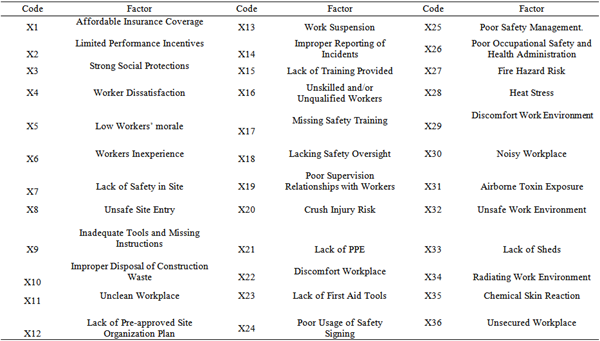
The study's methodology encompasses three pivotal steps to achieve its objectives, starting with identifying factors influencing workers' health, performance, and productivity. A questionnaire was developed to evaluate the impact of the workplace environment on workers' health, safety, and productivity. Subsequently, data were collected from construction professionals, followed by an analysis that led to calculating a total importance index for each identified factor. Utilising both primary and secondary data, the research adopts a literature review approach to pinpoint health and safety factors affecting construction worker productivity in Saudi Arabia. By examining sources [11-47] 11, the study identifies critical areas for improvement within the Saudi Arabian construction sector to boost worker productivity, as detailed in Table 1 below.

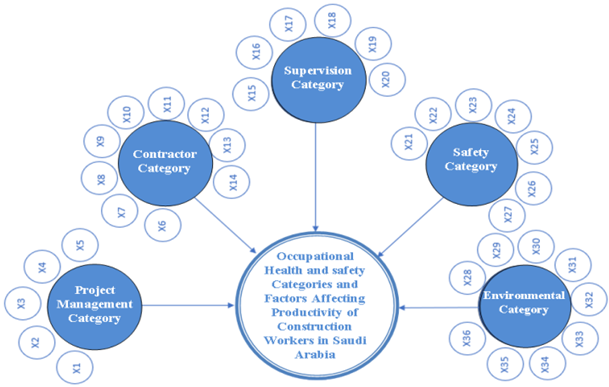
Figure 1 illustrates the strategic categorization of occupational health and safety (OHS) factors within the construction industry into five key groups: Project Management, Contractor, Supervision, Safety, and Environmental. This classification is particularly applied to the context of construction workers in Saudi Arabia, aiming to streamline the management and understanding of the multifaceted elements influencing worker safety and project outcomes. By organizing these factors into distinct categories, it facilitates the identification of their origins, comprehends their impacts, and aids in crafting precise interventions to reduce risks. Furthermore, this categorization is in harmony with established theoretical frameworks in OHS research, such as the Protection Motivation Theory (PMT) and the Theory of Planned Behavior (TPB), offering insights into the psychological and behavioral dimensions of workplace safety 48.
2.1. Questionnaire StructureThe questionnaire should be simple to design, can be sent to all respondents, take less time to complete, and be more accurate in the outcome. It should avoid asking long questions to avoid wasting the participants' time and avoid confusing questions that are readily misinterpreted, resulting in a poor response rate. Closed questions were the best choice for this case 49. Four questions for each factor were posed to the respondents. The first dealt with the Frequency with which this factor occurred, and the second one with the severity with which this factor affected the workers' health.
2.2. Sampling SizeThe questionnaire was distributed to a large number of experts in the construction industry. In Saudi Arabia, a huge number of construction projects are conducted throughout the Kingdom. For an 86% confidence level, the sample size can be computed using equations derived by 22 and 23. The sample size-based standard formula is indicated in Equation (1).
Sample Size= (Z^2×p(1-p))/(1+((Z^2×p(1-p))/(e^2 N)) ) (1)
Where N refers to the size of the population, z refers to the Z-score, e refers to the error's margin, and p refers to the standard deviation. Considering the number of engineering consultants is 8500, the number of project management consultants is 600, and the confidence level is 90% (i.e., Z-score is 1.65), then the accepted sample is 73 participants; however, in this paper, the collected sample was 108 participants in the field of construction. Six interviews were conducted with construction professionals among the 108 respondents to benefit from their advice and writing recommendations. Their answers to the questionnaire were used to classify the more influential factors.
2.3. Data AnalysisThis paper proposes a way to deal with a complete ranking of delay using a statistical technique called the Important Index (I.I.), which is based on the degree of severity and degree of Frequency. It is carried out based on the responses. The factors have been analysed to rank the cause of changes in the timeline based on the importance index. For each case, the important index was calculated as a function of both frequency and severity index as follows:
Important Index (I.I) of health, performance, or productivity Impact % = [F.I% x S.I%]/100 (2)
Where, F.I is Frequency Index, and S.I is Severity Index
Frequency Index (F.I): A formula is used to rank causes of delay based on frequency of occurrence as identified by the participants 24, 25.
Frequency Index (F.I) (%) = ∑ a (n/N)*100/5 (3)
Severity Index (S.I): A formula is used to rank causes of delay based on severity as indicated by the participants.
Severity Index (S.I) (%) = ∑ a (n/N)*100/5 (4)
Where a is the constant expressing weighting given to each response (ranges from 1 for very low to 5 for very high), n is the Frequency of the response, and N is the Total number of responses 26.
The Frequency, F.I. and severity indices for health, S.H.I., performance, S.P.I., and productivity, S.PR.I, impact factors. Total Importance Index of overall health, performance, and productivity Impact as the average of the function of importance indices for health, performance, and productivity Impact as:
T.I.I.I = [I.I.H.I + I.I.P.I + I.I.PR.I]/3 (5)
Where: T.I.I.I is the total importance index impact, I.I.H.I is the importance index of health impact, I.I.P.I is the importance index of performance impact, and I.I.PR.I is the importance index of productivity impact.
Using the Statistical Package for the Social Sciences (SPSS V25) program, the alpha coefficients for the Frequency of occurrence factor, the severity impact of health, the severity impact of performance, and the severity impact of productivity for all 36 factors were 0.905, 0.905, and 0.919, respectively. These values are more than 0.7 from the specified limit value, demonstrating the strength of the data's internal consistency 27 and 28.
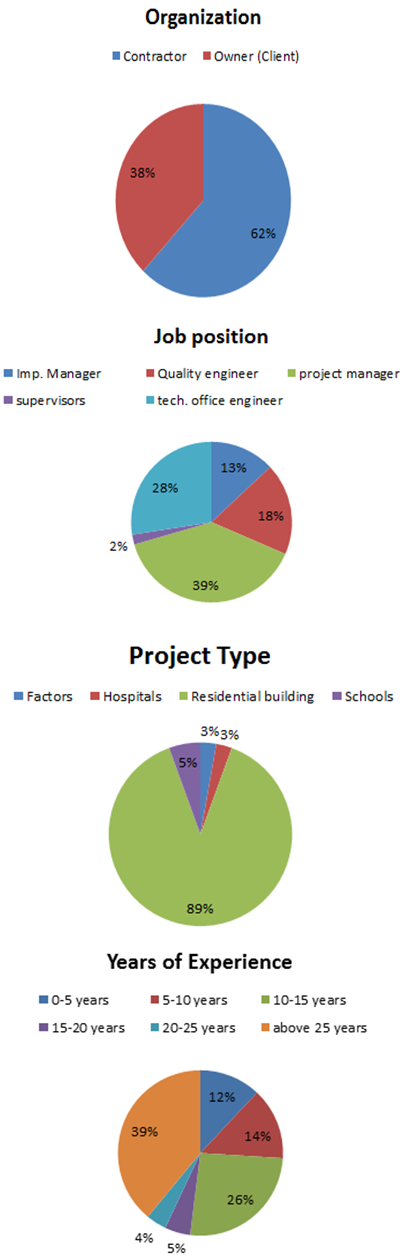
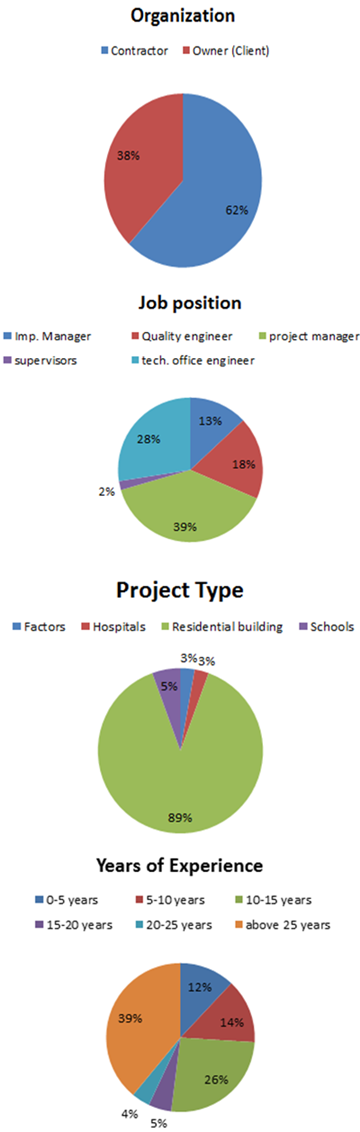
The results of the study, based on a sample of 108 respondents, provide a comprehensive overview of the demographics and experience levels within the construction industry are all represented in Figure 2. 62% of respondents are contractors, and 38% are owners, indicating a contractor-dominated sector with a trend towards flexible staffing and specialised skills. The job position breakdown shows a significant presence of project managers (39%) and technical office engineers (27.5%), highlighting the importance of project oversight and technical planning. Experience levels among respondents are skewed towards those with over 30 years (39%), indicating a mature workforce but with a gap in mid-level experience that could pose challenges for knowledge transfer. There is also a steady influx of new professionals, with 12% having less than five years of experience, ensuring some level of generational diversity within the industry.
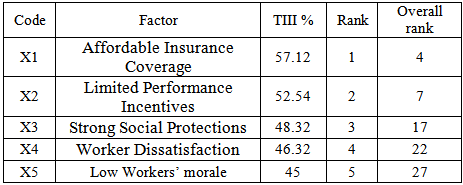
Factors related to Occupational Health and Safety that impact workers' productivity are included in Table 2's list of the most effective project management variables. It was found that the factor " Affordable Insurance Coverage " was ranked as the most significant factor impacting worker productivity, with a Total Importance Index (T.I.I.I.) of 57.12%, underscores the critical role of health insurance in ensuring worker well-being and productivity. This finding aligns with the research presented in 50, which discusses the Affordable Care Act's impact on health outcomes and productivity. The factor "Limited Performance Incentives," with a T.I.I.I of 52.54% highlights the importance of monetary and non-monetary incentives in motivating workers and improving productivity. A study on the effect of monetary incentives on worker performance and the impact of non-monetary benefits towards employee performance 5 corroborates this. "Strong Social Protections," with a T.I.I.I of 48.32% reflects the necessity of a supportive social framework for worker productivity. This includes access to healthcare, job security, and a safe working environment 51.
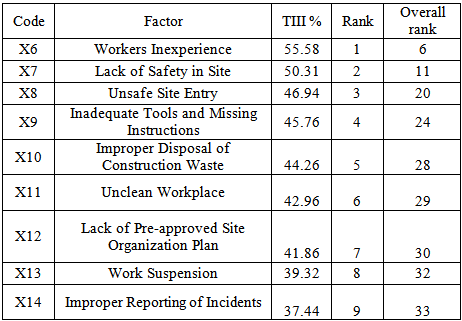
The factor " Workers Inexperience " was found to be the most critical factor in this category, with a rank of 6th of the 36 factors with T.I.I.I of 55.58%. This result is consistent with 52's result, which found that there are fewer fatalities among young people than among older people in the workplace. This indicates that even though they have a lower chance of dying, they have a very high chance of developing permanent impairment. Table 3 shows the factors related to the contractor category, which consists of each factor's ranking as well as its overall ranking among the 36 factors.
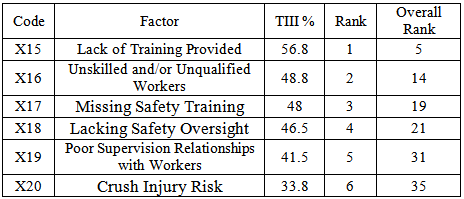
3.4. Supervision CategoryThe survey's findings indicated that the fifth-ranked factor among the 36 factors " lack of training provided " with a T.I.I.I of 56.8% was the most significant one. Studies consistently show inadequate training can lead to inefficiencies, increased accident rates, and lower productivity 53. This result also aligns with findings from authors like 54, who argue that robust training programs are essential for enhancing skill levels and ensuring quality workmanship. " Unskilled and/or Unqualified Workers " and " Missing Safety Training " with a T.I.I.I of 48.8% and 48.8%, respectively. Literature suggests that the presence of unskilled workers is often a direct consequence of insufficient training and recruitment strategies 55. Safety training is highlighted as a pivotal area where gaps can lead to serious safety breaches and accidents on-site 56. Table 4 lists the supervisory factors ranking.
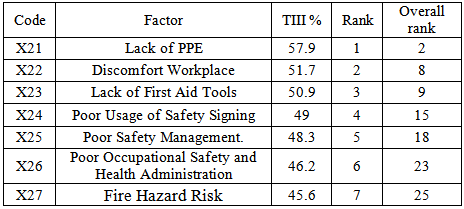
Table 5 lists three safety-related factors that are most prevalent in this study. The factor " Lack of P.P.E. "has a T.I.I.I, of 57.9%, and is ranked first in this category and second among the 36 factors, was discovered to be the cause. That is followed by " Discomfort Workplace " and " Lack of First Aid Tools " with a T.I.I.I of 51.7% and 50.9%, respectively. The prominence of "Lack of P.P.E." as a leading factor reflects widespread issues in the enforcement and adherence to safety protocols, a concern echoed by researchers like 57, who highlight the direct correlation between P.P.E. usage and the reduction of workplace injuries. Similarly, the significance of "Discomfort Workplace" points to environmental and ergonomic factors that can significantly impact worker health and productivity, a topic extensively discussed in the works of 58. Lastly, the "Lack of First Aid Tools" indicates a gap in emergency preparedness, which is crucial for immediate response to accidents, potentially saving lives and reducing the severity of injuries.
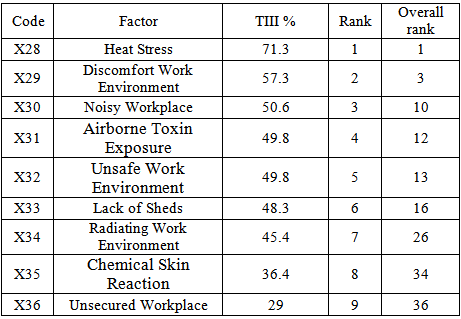
3.6. Environmental CategoryThe factors related to the environmental category are listed in Table 6, including their (T.I.I.), rankings among the group, and overall ranking. " Heat Stress " ranked first in its group and among the 36 factors, with a T.I.I.I of 71.3%. Similarly, 59 highlights that exposure to excessive heat can lead to heat exhaustion, heatstroke, and diminished mental alertness, thereby increasing the risk of accidents on construction sites. That is followed by " Discomfort Work Environment " and Noisy Workplace " with a T.I.I.I of 57.3% and 50.6%, respectively. According to 60, poor ergonomic conditions can lead to musculoskeletal disorders, significantly affecting worker comfort and long-term health. Noise pollution, as discussed by 61, poses a risk to hearing and contributes to stress and decreased concentration, further compromising safety and efficiency.
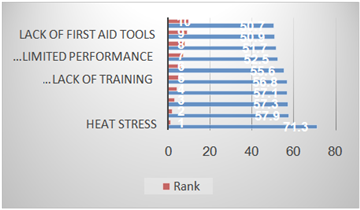
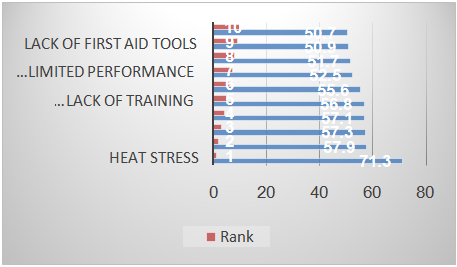
Table 7 and Figure 3 list the top ten factors that impact workers' productivity most. Starting with " Heat Stress ", which was ranked first, and continuing through exposure to " Lack of Training Provided ", ranked fifth with a T.I.I.I of 56.8%. Noticeably, two factors among the top ten most effective factors are related to the Safety Category, which should draw attention to such an issue. However, the intense heat significantly reduces working hours and productivity, necessitating adaptive measures such as modified work schedules and enhanced hydration practices to mitigate its effects 59. "Lack of P.P.E." significantly impacts workers' productivity, consistent with the literature emphasising the critical role of safety measures in construction 62. Proper P.P.E. usage is essential for preventing injuries and ensuring worker well-being.
Occupational health and safety (O.H.S.) practices profoundly impact productivity within the construction industry in Saudi Arabia. The transformative drive of Vision 2030 has significantly increased construction activities. However, it has also highlighted the need for improved O.H.S. protocols to ensure the well-being and efficiency of the workforce. This research has identified 36 key O.H.S. factors and determined their influence on productivity. The study's results indicated that factors such as "Heat Stress," "Lack of P.P.E.," and "Discomfort Work Environment" are among the most critical issues affecting worker productivity.
In conclusion, the research presents a compelling case for prioritising worker well-being as a cornerstone for a thriving construction sector within Saudi Arabia. Several recommendations are suggested to be implemented as the construction industry in Saudi Arabia can significantly improve occupational health and safety practices, leading to enhanced productivity and contributing to the successful realisation of Vision 2030 objectives. as follows:
• Implementation of Comprehensive Safety Training Programs: Construction companies in Saudi Arabia must develop and implement comprehensive safety training programs. These programs should be mandatory for all employees, regardless of their position or experience level.
• Adoption of Advanced Safety Monitoring Technologies: The integration of advanced technologies such as wearable devices, drones, and artificial intelligence (A.I.) for real-time monitoring can significantly enhance the safety of construction sites.
• Strengthening of Regulatory Compliance and Enforcement: The Saudi government should strengthen the enforcement of existing O.H.S. regulations and consider introducing more stringent standards to ensure higher safety levels in the construction industry.
• Promotion of a Safety-First Culture: Construction companies should work towards fostering a safety-first culture where safety is integrated into every aspect of the work process.
• Enhancement of Worker Welfare and Support Systems: Improving the overall welfare of construction workers, including their physical and mental health, can positively impact productivity.
| [1] | Eyiah, A.K., Kheni, N. A., and Quartey, P., D. (2019) "An Assessment of Occupational Health and Safety Regulations in Ghana: A Study of the Construction Industry" J. of building construction and planning research, 07(02), 11-31 | ||
| In article | View Article | ||
| [2] | J. Seo, S. Han, S. Lee, and H. Kim, (2015 ) “Computer vision techniques for construction safety and health monitoring,” Adv. Eng. Informatics, vol. vol. 29, no. 2, pp. 239–251, 2015. | ||
| In article | View Article | ||
| [3] | Kahya, E. (2007) "The effects of job characteristics and working conditions on job performance" Inter. J. of Industrial Ergonomics, 37(6), 515-523. | ||
| In article | View Article | ||
| [4] | Budawara, N. and Alkass, S. (2009) "Key performance indicators to measure design performance in construction" In Proceeding, Annual Conference – Canadian Sociaety for Civil Engineering (Vol. 3, Issue April) | ||
| In article | |||
| [5] | Ghoddosi, P. and Hosseini, M. R. (2012) "A survey of the factors affecting the productivity of construction projects" Tech. and Economic Development of Economy, 18(1), 99-116. | ||
| In article | View Article | ||
| [6] | M. Gunduz and A. Abu-Hijleh, “Assessment of human productivity drivers for construction labor through importance rating and risk mapping,” Sustain., vol. 12, no. 20, pp. | ||
| In article | View Article | ||
| [7] | M. T. Shafiq and M. Afzal, (2020) “Potential of virtual design construction technologies to improve job-site safety in gulf corporation council,” Sustain., vol. 12, no. 9. | ||
| In article | View Article | ||
| [8] | HSA, (2006) “Workplace Safety and Health Management: Practical guidelines on the implementation and maintenance of an occupational safety, health and welfare management system,” Heal. Saf. Auth., pp. 1–56. | ||
| In article | |||
| [9] | https:// www.hsa.ie/ eng/ Publications_ and_Forms/ Publications/ Safety_and_Health_Management/ Workplace_Safety_and_Health_Management.pdf. | ||
| In article | |||
| [10] | J. Izudi, V. Ninsiima, and J. B. Alege, (2017) “Use of Personal Protective Equipment among Building Construction Workers in Kampala, Uganda,” J. Environ. Public Health, vol. 2017, no. November 2015, 2017. | ||
| In article | View Article PubMed | ||
| [11] | K. Imriyas, S. P. Low, A. L. Teo, and S. L. Chan, “Premium-Rating Model for Workers’ Compensation Insurance in Construction,” J. Constr. Eng. Manag., vol. 134, no. 8, pp. 601 617, 2008. | ||
| In article | View Article | ||
| [12] | C. Ajila and A. Abiola, “Influence of Rewards on Workers Performance in an Organization,” J. Soc. Sci., vol. 8, no. 1, pp. 7–12, 2004. | ||
| In article | View Article | ||
| [13] | Y. A. Istomina and J. V. Ivanchina, “Labor and Family Responsibilities: Updated Approaches in Law,” vol. 498, pp. 129–134, 2020. | ||
| In article | View Article | ||
| [14] | K. Chandrasekar, “Workplace environment and its impact on organisational performance in public sector organisations,” Int. J. Enterp. Comput. Bus. Syst., vol. 1, no. 1, pp. 1–19, 2011 . | ||
| In article | |||
| [15] | Othman, M. Kamil, R. Y. Sunindijo, M. Alnsour, and A. F. Kineber, “Critical success factors influencing construction safety program implementation in developing countries,” J. Phys. Conf. Ser., vol. 1529, no. 4, 2020. | ||
| In article | View Article | ||
| [16] | P. B. Setiadi, R. Ursula, R. Rismawati, and M. Setini, “Labour Productivity, Work Experience, Age and Education: The Case of Lurik Weaving Industry in Klaten, Indonesia,” Webology, vol. 17, no. 2, pp. 487–502, 2020. | ||
| In article | View Article | ||
| [17] | K. A. Shamsuddin, A. K. Ismail, C. ani M. Norzaimi, and M. R. bin Ibrahim, “(PDF) Investigation the Safety, Health and Environment (SHE) Protection in Construction Area,” Int. Res. J. Eng. Technol. , vol. 2, no. 6, pp. 624–636, 2015, [Online]. Available: https:// www.researchgate.net/ publication/ 282747785_Investigation_the_Safety_Health_and _ Environment _SHE_Protection_in_Construction_Area. | ||
| In article | |||
| [18] | M. O. Sanni-anibire, A. S. Mahmoud, M. A. Hassanain, and B. A. Salami, “A risk assessment approach for enhancing construction safety performance,” Saf. Sci., vol. 121, no. August 2019, pp. 15–29, 2020. | ||
| In article | View Article | ||
| [19] | R. Almamlook, M. Bzizi, M. Al-Kbisbeh, T. Ali, and E. Almajiri, “Factors Affecting Labor Productivity in the Construction Industry,” Am. J. Environ. Sci. Eng., vol. 4, no. 2, p. 24, 2020. | ||
| In article | View Article | ||
| [20] | C. Town and J. Thomas, “HYPERION SOLAR DEVELOPMENT 3 AND ASSOCIATED INFRASTRUCTURE NEAR KATHU , NORTHERN CAPE PROVINCE,” vol. 27, no. May, 2019. | ||
| In article | |||
| [21] | Charehzehi and A. Ahankoob, “Enhancement Of Safety Performance At Construction Site,” Int. J. Adv. Eng. Technol., vol. 5, no. 1, pp. 303–312, 2012. | ||
| In article | |||
| [22] | L. D. Nguyen, S. O. Ogunlana, and D. T. X. Lan, “A study on project success factors in large construction projects in Vietnam,” Eng. Constr. Archit. Manag., vol. 11, no. 6, pp. 404–413, 2004. | ||
| In article | View Article | ||
| [23] | Y. Chinniah, “Analysis and prevention of serious and fatal accidents related to moving parts of machinery,” Saf. Sci., vol. 75, pp. 163–173, 2015. | ||
| In article | View Article | ||
| [24] | H. M. Al-Tabtabai, “Analyzing construction site accidents in Kuwait,” Kuwait J. Sci. Eng., vol. 29, no. 2, pp. 213–238, 2002. | ||
| In article | |||
| [25] | B. M. Varghese et al., “Heat-related injuries in Australian workplaces: Perspectives from health and safety representatives,” Saf. Sci., vol. 126, no. October 2019, p. 104651, 2020. | ||
| In article | View Article | ||
| [26] | L. Bikitsha and C. Amoah, “Assessment of challenges and risk factors influencing the operation of emerging contractors in the Gauteng Province, South Africa,” Int. J. Constr. Manag., vol. 0, no. 0, pp. 1–10, 2020. | ||
| In article | |||
| [27] | M. N. Maliha, Y. I. Abu Aisheh, B. A. Tayeh, and A. Almalki, “Safety barriers identification, classification, and ways to improve safety performance in the architecture, engineering, and construction (Aec) industry: Review study,” Sustain., vol. 13, no. 6, 2021. | ||
| In article | View Article | ||
| [28] | T. Assegaai and H. Schneider, “Factors Associated With Workplace and Interpersonal Trust in the Supervisory System of a Community Health Worker Programme in a Rural South African District,” Int. J. Heal. Policy Manag., no. x, pp. 1–8, 2021. | ||
| In article | View Article PubMed | ||
| [29] | M. A. Smita Bhole, “Safety Problems and Injuries on Construction Site: A Review,” Int. J. Eng. Tech., vol. 2, no. 4, [Online]. Available: http://www.ijetjournal.org . | ||
| In article | |||
| [30] | M. Gul and M. F. Ak, Assessment of occupational risks from human health and environmental perspectives: a new integrated approach and its application using fuzzy BWM and fuzzy MAIRCA, vol. 34, no. 8. Springer Berlin Heidelberg, 2020. | ||
| In article | View Article | ||
| [31] | R. M. Choudhry and D. Fang, “Why operatives engage in unsafe work behavior: Investigating factors on construction sites,” Saf. Sci., vol. 46, no. 4, pp. 566–584, 2008. | ||
| In article | View Article | ||
| [32] | S. Shaikh and S. H. Panhwar, “An assessment of health & safety measures at construction sites: A case study of Qasimabad & Latifabad , Hyderabad,” no. May, pp. 5–8, 2020. | ||
| In article | |||
| [33] | C. M. Tam, S. X. Zeng, and Z. M. Deng, “Identifying elements of poor construction safety management in China,” Saf. Sci., vol. 42, no. 7, pp. 569–586, 2004. | ||
| In article | View Article | ||
| [34] | W. Simukonda, P. Manu, A. M. Mahamadu, and K. Dziekonski, “Occupational safety and health management in developing countries: a study of construction companies in Malawi,” Int. J. Occup. Saf. Ergon., vol. 26, no. 2, pp. 303–318, 2020. | ||
| In article | View Article PubMed | ||
| [35] | S. Durdyev, S. Mohamed, M. L. Lay, and S. Ismail, “Key factors affecting construction safety performance in developing countries: Evidence from Cambodia,” Constr. Econ. Build., vol. 17, no. 4, pp. 48–65, 2017. | ||
| In article | View Article | ||
| [36] | T. M. Abokhashabah, B. Jamoussi, A. Summan, and E. Abdelfattah, “A review of occupational exposure to heat stress, its health effects and controls among construction industry workers, A case of Jeddah, KSA,” Int. J. Biosci., no. October, 2020. | ||
| In article | |||
| [37] | M. Taha, S. Rafay, and A. Bukhari, “Analysis of Key Factors Affecting Labor Productivity in General Construction Projects in Pakistan Analysis of Key Factors Affecting Labor Productivity in General Construction Projects in Pakistan,” no. February 2019, 2021. | ||
| In article | |||
| [38] | M. D. Fernández, S. Quintana, N. Chavarría, and J. A. Ballesteros, “Noise exposure of workers of the construction sector,” Appl. Acoust., vol. 70, no. 5, pp. 753–760, 2009. | ||
| In article | View Article | ||
| [39] | S. Chi and S. Han, “Analyses of systems theory for construction accident prevention with specific reference to OSHA accident reports,” Int. J. Proj. Manag., vol. 31, no. 7, pp. 1027 1041, 2013. | ||
| In article | View Article | ||
| [40] | B. Shao, Z. Hu, Q. Liu, S. Chen, and W. He, “Fatal accident patterns of building construction activities in China,” Saf. Sci., vol. 111, no. July, pp. 253–263. | ||
| In article | View Article | ||
| [41] | Ahmad, M. A. Balkhyour, T. M. Abokhashabah, I. M. Ismail, and M. Rehan, “Workplace Safety and Health Conditions and Facilities in Small Industries in Jeddah, Saudi Arabia,” J. Saf. Stud., vol. 3, no. 1, p. 37, 2017. | ||
| In article | View Article | ||
| [42] | T. H. E. P. S, “Environmental Hazards 2 (2000) 3}9”. | ||
| In article | View Article | ||
| [43] | B. D. Lushniak, “Occupational skin diseases,” Prim. Care - Clin. Off. Pract., vol. 27, no. 4, pp. 895–915, 2000. | ||
| In article | View Article PubMed | ||
| [44] | 62. Z. Wang, S. Zaman, S. F. Rasool, Q. U. Zaman, and A. Amin, “Exploring the relationships between a toxic workplace environment, workplace stress, and project success with the moderating effect of organizational support: Empirical evidence from Pakistan,” Risk Manag. Healthc. Policy, vol. 13, pp. 1055–1067, 2020. | ||
| In article | View Article PubMed | ||
| [45] | Al-Shahri, M, .Assaf, S. A., Bubshait, A. A., Atiyah, S., & (2001) "The management of construction company overhead costs" International Journal of Project Management, 19(5), 295-303. | ||
| In article | View Article | ||
| [46] | Migas, P., Semp-pls, M.A., Setyaningsih, Y., Denny, H.M., & Komunitas, J.K. (2019). Work Safety Performance of a Contractor in an Oil and Gas Company using Sem-pls Analysis Kinerja Keselamatan Kerja Perusahaan Kontraktor. | ||
| In article | |||
| [47] | Brown G. and Edmunds, S. (2011) "Doing pedagogical research in engineering" Engineering Centre for Excellenve in Teaching an Learning, 235. | ||
| In article | |||
| [48] | Karim M. El-Dash, Mohamed Shawky Abdel Monem, Rasha Laith Mohammed Salih (2022) "An intensive review on health and safely factors affecting construction projects' productivity" J. of Al Azhar University, Engineering Sector, Vol. 17 No. 22, 133-145. | ||
| In article | View Article | ||
| [49] | S. Ahmed, H. Islam, I. Hoque, and M. Hossain, (2020) “Reality check against skilled worker parameters and parameters failure effect on the construction industry for Bangladesh,” Int. J. Constr. Manag., vol. 20, no. 5, pp. 480–489. | ||
| In article | View Article | ||
| [50] | Koh, T. Y., & Rowlinson, S. (2012). Relational approach in managing construction project safety: A social capital perspective. Accident Analysis & Prevention, 48, 134-144. | ||
| In article | View Article PubMed | ||
| [51] | Liu, J., Meng, F., & Fellows, R. (2015). An exploratory study of understanding project risk management from the perspective of national culture. International Journal of Project Management, 33(3), 564-575. | ||
| In article | View Article | ||
| [52] | Okorie, V. N., & Aigbavboa, C. O. (2016). The economic and social impacts of site accidents on the small and medium sized construction companies in Nigeria. | ||
| In article | |||
| [53] | Leung, M. Y., Chan, I. Y. S., & Yu, J. (2012). Preventing construction worker injury incidents through the management of personal stress and organizational stressors. Accident Analysis & Prevention, 48, 156-166. | ||
| In article | View Article PubMed | ||
| [54] | Kjellstrom, T., Briggs, D., Freyberg, C., Lemke, B., Otto, M., & Hyatt, O. (2016). Heat, human performance, and occupational health: a key issue for the assessment of global climate change impacts. Annual review of public health, 37, 97-112. | ||
| In article | View Article PubMed | ||
| [55] | Jensen, K. L., Toftum, J., & Friis-Hansen, P. (2009). A Bayesian Network approach to the evaluation of building design and its consequences for employee performance and operational costs. Building and Environment, 44(3), 456-462. | ||
| In article | View Article | ||
| [56] | Arezes, P. M., & Miguel, A. S. (2002). Hearing protectors acceptability in noisy environments. Annals of Occupational Hygiene, 46(6), 531-536. | ||
| In article | |||
| [57] | Budaiwi, I. M., Abdou, A. A., & Al-Homoud, M. S. (2013, March). Envelope retrofit and air-conditioning operational strategies for reduced energy consumption in mosques in hot climates. In Building Simulation (Vol. 6, pp. 33-50). Tsinghua Press. | ||
| In article | View Article | ||
| [58] | Al-Bahar, J. F., & Crandall, K. C. (1990). Systematic risk management approach for construction projects. Journal of construction engineering and management, 116(3), 533-546. | ||
| In article | View Article | ||
| [59] | Al-Bouwarthan, M., Quinn, M. M., Kriebel, D., & Wegman, D. H. (2019). Assessment of heat stress exposure among construction workers in the hot desert climate of Saudi Arabia. Annals of work exposures and health, 63(5), 505-520. | ||
| In article | View Article PubMed | ||
| [60] | Lingard, H., & Turner, M. (2017). Construction workers’ health: Occupational and environmental issues. In Valuing people in construction (pp. 23-40). Routledge. | ||
| In article | View Article | ||
| [61] | Jung, M., Lim, S., & Chi, S. (2020). Impact of work environment and occupational stress on safety behavior of individual construction workers. International journal of environmental research and public health, 17(22), 8304. | ||
| In article | View Article PubMed | ||
| [62] | Sehsah, R., El-Gilany, A. H., & Ibrahim, A. M. (2020). Personal protective equipment (PPE) use and its relation to accidents among construction workers. La Medicina del lavoro, 111(4), 285. | ||
| In article | |||
Published with license by Science and Education Publishing, Copyright © 2024 Ahmad Baghdadi
 This work is licensed under a Creative Commons Attribution 4.0 International License. To view a copy of this license, visit
https://creativecommons.org/licenses/by/4.0/
This work is licensed under a Creative Commons Attribution 4.0 International License. To view a copy of this license, visit
https://creativecommons.org/licenses/by/4.0/
| [1] | Eyiah, A.K., Kheni, N. A., and Quartey, P., D. (2019) "An Assessment of Occupational Health and Safety Regulations in Ghana: A Study of the Construction Industry" J. of building construction and planning research, 07(02), 11-31 | ||
| In article | View Article | ||
| [2] | J. Seo, S. Han, S. Lee, and H. Kim, (2015 ) “Computer vision techniques for construction safety and health monitoring,” Adv. Eng. Informatics, vol. vol. 29, no. 2, pp. 239–251, 2015. | ||
| In article | View Article | ||
| [3] | Kahya, E. (2007) "The effects of job characteristics and working conditions on job performance" Inter. J. of Industrial Ergonomics, 37(6), 515-523. | ||
| In article | View Article | ||
| [4] | Budawara, N. and Alkass, S. (2009) "Key performance indicators to measure design performance in construction" In Proceeding, Annual Conference – Canadian Sociaety for Civil Engineering (Vol. 3, Issue April) | ||
| In article | |||
| [5] | Ghoddosi, P. and Hosseini, M. R. (2012) "A survey of the factors affecting the productivity of construction projects" Tech. and Economic Development of Economy, 18(1), 99-116. | ||
| In article | View Article | ||
| [6] | M. Gunduz and A. Abu-Hijleh, “Assessment of human productivity drivers for construction labor through importance rating and risk mapping,” Sustain., vol. 12, no. 20, pp. | ||
| In article | View Article | ||
| [7] | M. T. Shafiq and M. Afzal, (2020) “Potential of virtual design construction technologies to improve job-site safety in gulf corporation council,” Sustain., vol. 12, no. 9. | ||
| In article | View Article | ||
| [8] | HSA, (2006) “Workplace Safety and Health Management: Practical guidelines on the implementation and maintenance of an occupational safety, health and welfare management system,” Heal. Saf. Auth., pp. 1–56. | ||
| In article | |||
| [9] | https:// www.hsa.ie/ eng/ Publications_ and_Forms/ Publications/ Safety_and_Health_Management/ Workplace_Safety_and_Health_Management.pdf. | ||
| In article | |||
| [10] | J. Izudi, V. Ninsiima, and J. B. Alege, (2017) “Use of Personal Protective Equipment among Building Construction Workers in Kampala, Uganda,” J. Environ. Public Health, vol. 2017, no. November 2015, 2017. | ||
| In article | View Article PubMed | ||
| [11] | K. Imriyas, S. P. Low, A. L. Teo, and S. L. Chan, “Premium-Rating Model for Workers’ Compensation Insurance in Construction,” J. Constr. Eng. Manag., vol. 134, no. 8, pp. 601 617, 2008. | ||
| In article | View Article | ||
| [12] | C. Ajila and A. Abiola, “Influence of Rewards on Workers Performance in an Organization,” J. Soc. Sci., vol. 8, no. 1, pp. 7–12, 2004. | ||
| In article | View Article | ||
| [13] | Y. A. Istomina and J. V. Ivanchina, “Labor and Family Responsibilities: Updated Approaches in Law,” vol. 498, pp. 129–134, 2020. | ||
| In article | View Article | ||
| [14] | K. Chandrasekar, “Workplace environment and its impact on organisational performance in public sector organisations,” Int. J. Enterp. Comput. Bus. Syst., vol. 1, no. 1, pp. 1–19, 2011 . | ||
| In article | |||
| [15] | Othman, M. Kamil, R. Y. Sunindijo, M. Alnsour, and A. F. Kineber, “Critical success factors influencing construction safety program implementation in developing countries,” J. Phys. Conf. Ser., vol. 1529, no. 4, 2020. | ||
| In article | View Article | ||
| [16] | P. B. Setiadi, R. Ursula, R. Rismawati, and M. Setini, “Labour Productivity, Work Experience, Age and Education: The Case of Lurik Weaving Industry in Klaten, Indonesia,” Webology, vol. 17, no. 2, pp. 487–502, 2020. | ||
| In article | View Article | ||
| [17] | K. A. Shamsuddin, A. K. Ismail, C. ani M. Norzaimi, and M. R. bin Ibrahim, “(PDF) Investigation the Safety, Health and Environment (SHE) Protection in Construction Area,” Int. Res. J. Eng. Technol. , vol. 2, no. 6, pp. 624–636, 2015, [Online]. Available: https:// www.researchgate.net/ publication/ 282747785_Investigation_the_Safety_Health_and _ Environment _SHE_Protection_in_Construction_Area. | ||
| In article | |||
| [18] | M. O. Sanni-anibire, A. S. Mahmoud, M. A. Hassanain, and B. A. Salami, “A risk assessment approach for enhancing construction safety performance,” Saf. Sci., vol. 121, no. August 2019, pp. 15–29, 2020. | ||
| In article | View Article | ||
| [19] | R. Almamlook, M. Bzizi, M. Al-Kbisbeh, T. Ali, and E. Almajiri, “Factors Affecting Labor Productivity in the Construction Industry,” Am. J. Environ. Sci. Eng., vol. 4, no. 2, p. 24, 2020. | ||
| In article | View Article | ||
| [20] | C. Town and J. Thomas, “HYPERION SOLAR DEVELOPMENT 3 AND ASSOCIATED INFRASTRUCTURE NEAR KATHU , NORTHERN CAPE PROVINCE,” vol. 27, no. May, 2019. | ||
| In article | |||
| [21] | Charehzehi and A. Ahankoob, “Enhancement Of Safety Performance At Construction Site,” Int. J. Adv. Eng. Technol., vol. 5, no. 1, pp. 303–312, 2012. | ||
| In article | |||
| [22] | L. D. Nguyen, S. O. Ogunlana, and D. T. X. Lan, “A study on project success factors in large construction projects in Vietnam,” Eng. Constr. Archit. Manag., vol. 11, no. 6, pp. 404–413, 2004. | ||
| In article | View Article | ||
| [23] | Y. Chinniah, “Analysis and prevention of serious and fatal accidents related to moving parts of machinery,” Saf. Sci., vol. 75, pp. 163–173, 2015. | ||
| In article | View Article | ||
| [24] | H. M. Al-Tabtabai, “Analyzing construction site accidents in Kuwait,” Kuwait J. Sci. Eng., vol. 29, no. 2, pp. 213–238, 2002. | ||
| In article | |||
| [25] | B. M. Varghese et al., “Heat-related injuries in Australian workplaces: Perspectives from health and safety representatives,” Saf. Sci., vol. 126, no. October 2019, p. 104651, 2020. | ||
| In article | View Article | ||
| [26] | L. Bikitsha and C. Amoah, “Assessment of challenges and risk factors influencing the operation of emerging contractors in the Gauteng Province, South Africa,” Int. J. Constr. Manag., vol. 0, no. 0, pp. 1–10, 2020. | ||
| In article | |||
| [27] | M. N. Maliha, Y. I. Abu Aisheh, B. A. Tayeh, and A. Almalki, “Safety barriers identification, classification, and ways to improve safety performance in the architecture, engineering, and construction (Aec) industry: Review study,” Sustain., vol. 13, no. 6, 2021. | ||
| In article | View Article | ||
| [28] | T. Assegaai and H. Schneider, “Factors Associated With Workplace and Interpersonal Trust in the Supervisory System of a Community Health Worker Programme in a Rural South African District,” Int. J. Heal. Policy Manag., no. x, pp. 1–8, 2021. | ||
| In article | View Article PubMed | ||
| [29] | M. A. Smita Bhole, “Safety Problems and Injuries on Construction Site: A Review,” Int. J. Eng. Tech., vol. 2, no. 4, [Online]. Available: http://www.ijetjournal.org . | ||
| In article | |||
| [30] | M. Gul and M. F. Ak, Assessment of occupational risks from human health and environmental perspectives: a new integrated approach and its application using fuzzy BWM and fuzzy MAIRCA, vol. 34, no. 8. Springer Berlin Heidelberg, 2020. | ||
| In article | View Article | ||
| [31] | R. M. Choudhry and D. Fang, “Why operatives engage in unsafe work behavior: Investigating factors on construction sites,” Saf. Sci., vol. 46, no. 4, pp. 566–584, 2008. | ||
| In article | View Article | ||
| [32] | S. Shaikh and S. H. Panhwar, “An assessment of health & safety measures at construction sites: A case study of Qasimabad & Latifabad , Hyderabad,” no. May, pp. 5–8, 2020. | ||
| In article | |||
| [33] | C. M. Tam, S. X. Zeng, and Z. M. Deng, “Identifying elements of poor construction safety management in China,” Saf. Sci., vol. 42, no. 7, pp. 569–586, 2004. | ||
| In article | View Article | ||
| [34] | W. Simukonda, P. Manu, A. M. Mahamadu, and K. Dziekonski, “Occupational safety and health management in developing countries: a study of construction companies in Malawi,” Int. J. Occup. Saf. Ergon., vol. 26, no. 2, pp. 303–318, 2020. | ||
| In article | View Article PubMed | ||
| [35] | S. Durdyev, S. Mohamed, M. L. Lay, and S. Ismail, “Key factors affecting construction safety performance in developing countries: Evidence from Cambodia,” Constr. Econ. Build., vol. 17, no. 4, pp. 48–65, 2017. | ||
| In article | View Article | ||
| [36] | T. M. Abokhashabah, B. Jamoussi, A. Summan, and E. Abdelfattah, “A review of occupational exposure to heat stress, its health effects and controls among construction industry workers, A case of Jeddah, KSA,” Int. J. Biosci., no. October, 2020. | ||
| In article | |||
| [37] | M. Taha, S. Rafay, and A. Bukhari, “Analysis of Key Factors Affecting Labor Productivity in General Construction Projects in Pakistan Analysis of Key Factors Affecting Labor Productivity in General Construction Projects in Pakistan,” no. February 2019, 2021. | ||
| In article | |||
| [38] | M. D. Fernández, S. Quintana, N. Chavarría, and J. A. Ballesteros, “Noise exposure of workers of the construction sector,” Appl. Acoust., vol. 70, no. 5, pp. 753–760, 2009. | ||
| In article | View Article | ||
| [39] | S. Chi and S. Han, “Analyses of systems theory for construction accident prevention with specific reference to OSHA accident reports,” Int. J. Proj. Manag., vol. 31, no. 7, pp. 1027 1041, 2013. | ||
| In article | View Article | ||
| [40] | B. Shao, Z. Hu, Q. Liu, S. Chen, and W. He, “Fatal accident patterns of building construction activities in China,” Saf. Sci., vol. 111, no. July, pp. 253–263. | ||
| In article | View Article | ||
| [41] | Ahmad, M. A. Balkhyour, T. M. Abokhashabah, I. M. Ismail, and M. Rehan, “Workplace Safety and Health Conditions and Facilities in Small Industries in Jeddah, Saudi Arabia,” J. Saf. Stud., vol. 3, no. 1, p. 37, 2017. | ||
| In article | View Article | ||
| [42] | T. H. E. P. S, “Environmental Hazards 2 (2000) 3}9”. | ||
| In article | View Article | ||
| [43] | B. D. Lushniak, “Occupational skin diseases,” Prim. Care - Clin. Off. Pract., vol. 27, no. 4, pp. 895–915, 2000. | ||
| In article | View Article PubMed | ||
| [44] | 62. Z. Wang, S. Zaman, S. F. Rasool, Q. U. Zaman, and A. Amin, “Exploring the relationships between a toxic workplace environment, workplace stress, and project success with the moderating effect of organizational support: Empirical evidence from Pakistan,” Risk Manag. Healthc. Policy, vol. 13, pp. 1055–1067, 2020. | ||
| In article | View Article PubMed | ||
| [45] | Al-Shahri, M, .Assaf, S. A., Bubshait, A. A., Atiyah, S., & (2001) "The management of construction company overhead costs" International Journal of Project Management, 19(5), 295-303. | ||
| In article | View Article | ||
| [46] | Migas, P., Semp-pls, M.A., Setyaningsih, Y., Denny, H.M., & Komunitas, J.K. (2019). Work Safety Performance of a Contractor in an Oil and Gas Company using Sem-pls Analysis Kinerja Keselamatan Kerja Perusahaan Kontraktor. | ||
| In article | |||
| [47] | Brown G. and Edmunds, S. (2011) "Doing pedagogical research in engineering" Engineering Centre for Excellenve in Teaching an Learning, 235. | ||
| In article | |||
| [48] | Karim M. El-Dash, Mohamed Shawky Abdel Monem, Rasha Laith Mohammed Salih (2022) "An intensive review on health and safely factors affecting construction projects' productivity" J. of Al Azhar University, Engineering Sector, Vol. 17 No. 22, 133-145. | ||
| In article | View Article | ||
| [49] | S. Ahmed, H. Islam, I. Hoque, and M. Hossain, (2020) “Reality check against skilled worker parameters and parameters failure effect on the construction industry for Bangladesh,” Int. J. Constr. Manag., vol. 20, no. 5, pp. 480–489. | ||
| In article | View Article | ||
| [50] | Koh, T. Y., & Rowlinson, S. (2012). Relational approach in managing construction project safety: A social capital perspective. Accident Analysis & Prevention, 48, 134-144. | ||
| In article | View Article PubMed | ||
| [51] | Liu, J., Meng, F., & Fellows, R. (2015). An exploratory study of understanding project risk management from the perspective of national culture. International Journal of Project Management, 33(3), 564-575. | ||
| In article | View Article | ||
| [52] | Okorie, V. N., & Aigbavboa, C. O. (2016). The economic and social impacts of site accidents on the small and medium sized construction companies in Nigeria. | ||
| In article | |||
| [53] | Leung, M. Y., Chan, I. Y. S., & Yu, J. (2012). Preventing construction worker injury incidents through the management of personal stress and organizational stressors. Accident Analysis & Prevention, 48, 156-166. | ||
| In article | View Article PubMed | ||
| [54] | Kjellstrom, T., Briggs, D., Freyberg, C., Lemke, B., Otto, M., & Hyatt, O. (2016). Heat, human performance, and occupational health: a key issue for the assessment of global climate change impacts. Annual review of public health, 37, 97-112. | ||
| In article | View Article PubMed | ||
| [55] | Jensen, K. L., Toftum, J., & Friis-Hansen, P. (2009). A Bayesian Network approach to the evaluation of building design and its consequences for employee performance and operational costs. Building and Environment, 44(3), 456-462. | ||
| In article | View Article | ||
| [56] | Arezes, P. M., & Miguel, A. S. (2002). Hearing protectors acceptability in noisy environments. Annals of Occupational Hygiene, 46(6), 531-536. | ||
| In article | |||
| [57] | Budaiwi, I. M., Abdou, A. A., & Al-Homoud, M. S. (2013, March). Envelope retrofit and air-conditioning operational strategies for reduced energy consumption in mosques in hot climates. In Building Simulation (Vol. 6, pp. 33-50). Tsinghua Press. | ||
| In article | View Article | ||
| [58] | Al-Bahar, J. F., & Crandall, K. C. (1990). Systematic risk management approach for construction projects. Journal of construction engineering and management, 116(3), 533-546. | ||
| In article | View Article | ||
| [59] | Al-Bouwarthan, M., Quinn, M. M., Kriebel, D., & Wegman, D. H. (2019). Assessment of heat stress exposure among construction workers in the hot desert climate of Saudi Arabia. Annals of work exposures and health, 63(5), 505-520. | ||
| In article | View Article PubMed | ||
| [60] | Lingard, H., & Turner, M. (2017). Construction workers’ health: Occupational and environmental issues. In Valuing people in construction (pp. 23-40). Routledge. | ||
| In article | View Article | ||
| [61] | Jung, M., Lim, S., & Chi, S. (2020). Impact of work environment and occupational stress on safety behavior of individual construction workers. International journal of environmental research and public health, 17(22), 8304. | ||
| In article | View Article PubMed | ||
| [62] | Sehsah, R., El-Gilany, A. H., & Ibrahim, A. M. (2020). Personal protective equipment (PPE) use and its relation to accidents among construction workers. La Medicina del lavoro, 111(4), 285. | ||
| In article | |||