Domestic violence is a pervasive and complex public health problem impacting more than 10 million people per year in the United States . Even though the social, emotional, and psychological impacts of domestic violence are felt universally, certain demographics are uniquely vulnerable to its impacts. Specifically, African American college-age women attending Historically Black Colleges and Universities (HBCUs) are disproportionately affected by domestic violence. Institutions of higher learning, national programs, and federally funded organizations have developed interventions to address violence on college campuses. However, cultural barriers and preconceived stigmas reduce the effectiveness of standard domestic violence prevention programs. This article analyzed needs assessment data, domestic violence impact reports, gaps in the literature, and current violence prevention strategies for HBCU campuses to examine the problems and identify solutions. The mixed-methods analysis results provided thematic patterns of intersectionality, treatment barriers, and violence prevention strategies for the development of a domestic violence prevention program designed explicitly for HBCU communities as a theoretical solution. The culturally specific domestic violence prevention program structure, objectives, learning outcomes, and implementation description are provided. Although preliminary findings indicate that the proposed domestic violence prevention program will increase awareness, utilization of support services, and potentially reduce reported incidents of violence among target populations, further quantitative studies are suggested as implications for future research and research limitations.
Violence and abuse can take physical, emotional, or even psychological forms. The survivors and perpetrators of abuse can also be impacted in a variety of ways. However, domestic violence not only profoundly affects individuals engaged in conflict but also society as a whole. Domestic violence is defined as a pattern of abusive interpersonal behavior used to gain control and power over another 2, 3. It has a rippling effect that shifts personal and professional relationships beyond the confines of the initial engagement. It is estimated that domestic violence impacts almost 10 million people per year in the United States 1. This results in roughly $8.3 billion annually and a lifetime economic cost burden of nearly $3.6 trillion in lost productivity, criminal justice, medical services, and other costs associated with domestic violence 4, 5.
Although domestic violence affects every person and community, there are specific demographics that are more vulnerable to its impact. Young adults and college students between the ages of 18 and 24 experience higher rates of domestic violence compared to their high school counterparts and older adults 3, 6, 7. Furthermore, African American women experience violence at a rate 2.5 times higher than their white counterparts 8. Young African American women attending college are at a higher risk of being impacted by domestic violence. Individuals in this ethnic and gender group also attend historically black colleges and universities at a high rate. In 2022, it was estimated that 289,000, roughly 64%, of the student population at Historically Black Colleges and Universities (HBCUs) were women 9. The overarching social implications and access to the most prominent target population stations HBCUs perfectly for researching solutions to address domestic violence prevention.
In matters of sex-based or gender-based violence on college campuses, prevention efforts and training are often key to providing the knowledge necessary for persons who have experienced misconduct in finding a sound resolution to their alleged matters. While prolonged studies reflecting the outcomes of domestic violence prevention programs at HBCUs are limited, they are relevant to the estimated population of students attending HBCUs. Title IX refers to the federal civil rights act prohibiting sex-based discrimination in an educational setting 10. However, students attending HBCUs may be reluctant to engage in their campus’s domestic violence prevention programs or with the Title IX office. Though still infrequent, there is emerging work on domestic violence prevention efforts at HBCUs. These programs are working to implement culturally specific domestic violence prevention strategies at HBCUs. This article will provide the literature to support this concept and outline the structure for providing domestic violence prevention programs at HBCUs. It will also describe the significance of domestic violence prevention, the implementation of a proposed program, research limitations, and implications for future research on the topic. While highlighting some of the existing programs, the literature review for this article will discuss the prevailing lack of long-term, peer-reviewed assessments of current DV programs on HBCU campuses. Furthermore, advocating for the development of culturally affirming environments, systemic investments into domestic violence programming through multi-year Federal and State Funding initiatives, coupled with peer-reviewed research on HBCU campuses.
Domestic violence constitutes a critical public health issue that impacts almost 10 million people per year in the United States, affecting individuals across all demographics and, notably, is preventable 1. Mental and physical health issues, substance use, traumatic brain injury, and gastrointestinal disorders are associated with domestic violence 3, 7. As many as one in four women and one in nine men are victims of domestic violence 1. To be clear, these behaviors include physical violence (like slapping or hitting), sexual violence (coercion or assault), emotional abuse (manipulation and intimidation), and stalking 3.
Domestic violence can occur between a parent and child, siblings, or even roommates (Moorer, 2024). Intimate partner violence (IPV) is a specific type of domestic violence that refers to physical, verbal, emotional, and sexual abuse, as well as stalking, between current or former intimate partners (e.g., boyfriend, girlfriend, spouse) 11. IPV can happen to anyone. Research indicates that young adult college students, particularly those between the ages of 18 and 24, experience higher rates of domestic violence compared to their high school counterparts and older adults ages 25+ 3, 6, 7. Young adults attending college are being affected at increased rates, making this demographic vulnerable; however, this also breeds grounds for emphasis on African American college students who are already navigating vulnerability through an intersectional lens of race and age, to name a few. African American college students, who, despite being a racial minority, represent a large portion of the aforementioned domestic violence occurrences, along with increasing rates of domestic violence on college campuses. A study showed 68.4% of students attending historically Black colleges and universities (HBCUs) also reported experiencing domestic violence victimization, while 68.0% admitted to perpetration. Furthermore, 61.3% of these students reported co-experience of both victimization and perpetration in the past 12 months (An et al., 2024). Out of 88,975 college students, researchers found that Black students reported experiencing more emotional domestic violence than white students and reported higher rates of physical intimate partner violence than non-black students 12. This not only makes black college students vulnerable to domestic violence but also increases their chances of failing and performing poorly academically. This demographic trend emphasizes the increasing necessity for effective and culturally responsive domestic violence prevention programs on college campuses throughout America. Domestic violence can be prevented effectively through improving the existing research regarding effective strategies and outcomes for campus-based domestic violence prevention programs in America.
2.1. Ineffective Prevention ProgrammingTo address gaps in the existing literature, an examination of the effectiveness of current campus-based domestic violence programs will be thoroughly reviewed. From 2010 to 2020, another scoping review evaluated 25 peer-reviewed articles that revealed many domestic violence programs that addressed various risk factors by utilizing bystander interventions and strategies focused on raising awareness, while 44% of the studies evaluated actual behavioral outcomes, such as bystander actions or decreases in domestic violence on college campuses (An et al., 2024). Additionally, marginalized communities such as students attending Historically Black Colleges and Universities (HBCUs) and LatinX individuals had very limited representation within this study, with many participants in this study being white. This is truly unfortunate, given that out of 88,975 college students, Black students reported experiencing more emotional and physical domestic violence than their white counterparts, as found by the National College Health Assessment (NCHA) database 12. This revelation comes after evaluating the findings and realizing the immediate need for diverse demographic representation and increased cultural responsiveness on college campuses. Increasing awareness remains the center of focus for many domestic violence prevention methods; however, there is a pressing need to shift focus towards fostering tangible behavioral change. Programs must move beyond mere awareness-raising and emphasize skill-building and impact evaluation, increasing diversification and behavioral modification, especially for HBCUs and students of color attending PWIs. A meta-analysis conducted on the impact of campus domestic violence prevention programs, along with the measured outcomes related to psychological and physical violence, solidifies the need to shift focus towards exploring tangible behavioral change 13. Most interventions did not significantly affect changing attitudes or behaviors, even though there were encouraging advancements in domestic violence-related awareness or knowledge. Once again, on-campus domestic violence programs have to shift their focus from mere awareness initiatives to employing culturally relevant behavioral interventions, as this has the potential to decrease harmful domestic violence-related behaviors and attitudes significantly.
2.2. Lack of Institutional CommitmentDomestic violence prevention efforts have primarily centered around raising awareness. In order to show awareness efforts are effective, there lies the next crucial step: evaluating the institutions' ability to decrease domestic violence prevalence or occurrences on HBCU campuses successfully. Beginning in 2023, the Office on Violence Against Women launched a Campus Program special initiative grant called Strengthening Culturally Specific Campus Approaches to Address Domestic Violence, Dating Violence, Sexual Assault, and Stalking 14, 15. This initiative allocated more than $14 million in funding to 31 minority-serving institutions for the fiscal years spanning Fall 2023 to Fall 2024 to enhance institutional response to domestic violence, dating violence, sexual assault, and stalking on campuses 14, 15. While over half of these institutions were HBCU’s there is still little evidence that the implementation of these programs decreased the prevalence/ and or occurrence of domestic violence on HBCU campuses 16. This lack of development can easily be redirected to a past study that pointed out similar issues with a lack of institutional program implementation and noted that compliance with federal mandates, such as the 2013 SaVE Act, had been limited 13, 17. With only 25% of campuses offering domestic violence-specific programming and only 11% in full compliance, institutional commitment and real behavioral change on college campuses beyond just awareness remains weak and stagnant 13, 17. Due to there still being very little existing research and significant gaps in scientific literature focusing on the effectiveness of domestic violence prevention programming on HBCU campuses, despite the aforementioned dispersed funding to at least 20 HBCU institutions since 2023, it is clear there seems to be stagnancy in regards to institutional commitment to effectively addressing domestic violence as a public health issue that moves beyond mere awareness.
2.3. Skills-Based InterventionOne exception is the Skills for Healthy Adult Relationships (SHARe) program, a comprehensive, skills-based group intervention evaluated by Webermann et al. (2022) 3. Through an eight-session (12-hour) college-based group intervention, proven positive outcomes were demonstrated through significantly lower levels of negative communication at post-assessment relative to controls, and increased confidence in participants in managing conflicts than wait-list controls, which supports this study's hypothesis 1 3. Also, participants reported less psychological aggression in the 3-month follow-up (CTS-2) than controls. Controls were 1.5 times more likely to engage in such behavior, which supports this study’s hypothesis 3 3. Although positive communication did not improve significantly, possibly due to a ceiling effect, the (SHARe) DV prevention program demonstrates the value of intensive, skill-building approaches over brief awareness-focused interventions 3.
2.4. Theoretical FrameworksCreating effective on-campus domestic violence prevention programs starts with implementing culturally relevant frameworks into skill-building methods and curricula. Black Feminist Thought, Intersectionality, and Social-Emotional Learning (SEL) can tackle systemic and identity-based risk factors by encouraging effective, healthy relationship skill-building. To fully understand the multiple overlapping oppressions black people face, which span across gender and race, intersectionality is employed as a critical social theory 18. Prioritizing black women’s lived experience is the foundation of Black Feminist Thought, further employing the intersectional framework, which in turn acts as a guide to understanding these culturally relevant concepts. However, the intentional exclusion and marginalization of the black woman's perspective is deployed through traditional feminism, which prioritizes and only considers the American white woman's perspective 19. The dismantling of the intersecting racist and sexist social structures lies within the employment of these culturally evidence-based frameworks, which seek to acknowledge the uniqueness that lies within living and experiencing life as an African American. Social Emotional Learning (SEL) is an educational framework that broadly encapsulates and emphasizes social emotional awareness to focus on regulating emotions better, communicating effectively, and using informed decision-making in every aspect of life 20. Domestic violence prevention strategies and curricula should integrate culturally relevant theoretical frameworks and an ecological model, which is encouraged to guide on-campus interventions to navigate multiple system levels (individual, relational, community, societal) to organize data. Utilizing Intersectionality by employing the Black Feminist Thought can be used to ensure the curriculum incorporates strategized methods for dismantling cultural norms, for instance, the Strong Black Woman stereotype, a stigma unique to black women that mentally and emotionally can serve as a barrier to healthy help-seeking habits in black women. This is an example of how culturally relevant methods better inform DV prevention program curriculum and instruction for African American women. The dismantling of the intersecting racist and sexist social structures lies within the employment of these culturally evidence-based frameworks, which seek to acknowledge the uniqueness that lies within living and experiencing life as an African American. Social Emotional Learning (SEL) is an educational framework that broadly encapsulates and emphasizes social emotional awareness to focus on regulating emotions better, communicating effectively, and using informed decision-making in every aspect of life 20.
2.5. Challenges Unique to HBCUsThere are many challenges when it comes to overcoming domestic violence. However, African American and historically black college communities have unique challenges that require specific attention. One of the substantial challenges black students face is protecting their families' reputations. Many traditional black homes strive to uphold the strong black family image. African Americans are taught to preserve the image portrayed to the outside world. Common African American sayings, such as keep family business private, discourage students from seeking help. Many African American families feel the need to constantly portray the image of the strong black family. This can lead to developing a culture of silence when it comes to mental health and struggles, such as domestic violence or abuse. Additionally, there is a common fear in this culture regarding airing out their families' dirty laundry, the constant pressure to not show weakness, and the belief that family and cultural unity affect the way black people seek help 21.
In African American households, topics such as mental health and domestic violence are seen as weaknesses. These issues are often managed through spiritual or religious interventions instead of mental health services. Historically, African American families use religion to help solve mental health problems because it is seen as a way to turn to faith to heal them 22. Therefore, seeking domestic violence prevention or therapeutic services is looked down upon in this community. This contradiction of viewing mental health care as not in alignment with the values of a strong black family is ultimately detrimental to each family member. The individual and the family usually hide mental illnesses overall in the black community because they are associated with embarrassment and shame. 23. On HBCU campuses, this skewed way of thinking may influence students to avoid using the counseling services provided because they fear being seen as weak by their peers.
HBCUs, in comparison to Predominantly White Institutions (PWIs), do not have as many resources and services available to support their students regarding domestic violence or sexual abuse (OVW, n.d.; 24. Statistics show that 54% of HBCU students have had mental health needs that were not met (UNCF, 2025). This is a much higher rate than last year, when it was only 41% 25. This could be due to a lack of concern or funding for resources and counseling. Regardless of the rationale, funding resources for mental health services on HBCU campuses are vital to the health of the students and the community. Research suggests securing funding for mental health counseling improves retention and the overall academic performance of a university. After reviewing a 2022 study, the report stated that out of all the students surveyed, 63.2% said that being in counseling has helped them stay enrolled in school 26. Economists think that an institution that helps at least 500 students a year will result in about 30 students remaining enrolled in school, bringing in over $1.2 million in tuition over two years 26. There are already a lot of problems and stressors to cope with as a student on campus. Providing that type of support on an HBCU campus not only helps the mental health of their students but also benefits the graduation and attendance rate overall.
Many discussions about domestic violence are often focused on the victim and how the situation occurred, with little consideration given to the male consent culture or accountability. Many other topics surround domestic violence that have less to do with the victim and what they experienced and more to do with the cultural norms that enable this type of abuse and the male entitlement that has become normalized over the years. In a study from 2023, out of 300 cisgender black men ranging from 18 to 25 years old, participants with higher levels of anxiety and aggressive confrontational styles tend to agree more with the intimate partner violence beliefs compared to the black men who identify more with collectivist values 27. Prioritizing accountability and reshaping the consent and gender norms at these universities can begin to prevent the situation from escalating. Instead of concentrating on the victim, the focus should be on changing the system.
According to research, many Black males now use toxic masculinity as a crutch to hide the insecurity and hardship they experience, particularly in HBCUs. Toxic masculinity refers to the culturalized normalization of harmful and poisonous ideas of masculine traits of dominance, aggression, and emotional repression 28. These norms are linked to mental health conditions. There is a study that linked self-reliance with experiencing higher depressive symptoms 29. This could negatively affect not only African American males' mental health, but also any individual who has associated emotional repression with strength. However, this can cause internalized trauma, which leads to it affecting future relationships. Because of the systematic issues such as racism, economic inequality, and a lack of involvement in their communities, black men often feel pressure from their community. These challenges tend to limit their possibilities and expose them to other pressing issues like violence. Black men are therefore more likely to embrace the hypermasculine norms, which can very quickly become toxic.
Due to the generational trauma and mistrust of support systems, black students are often at risk of domestic abuse. However, they hesitate to seek help because of deeply embedded cultural silence and fear of being judged 23. Many African American kids are exposed to cultural generational trauma very early through racism and segregation. Essentially, the entire black population in America is living with chronic PTSD 30. Experiencing and being aware of such trauma can affect how they perceive the power dynamics in their lives and can also affect their reaction to abuse.
Due to the long history of police brutality against African Americans, students may also be hesitant to involve law enforcement out of fear that the police could escalate the situation and make it worse. Both personal experiences and generational trauma shape this fear and cause individuals to remain silent and continue to take the abuse because of the deep-rooted distrust in the system.
In the black community, there is a lot of judgment and silence around sexual assault and domestic violence. It is not taken seriously, and when it is, the focus is mainly on supporting the survivors and dealing with the trauma that follows. Social media, structural effects of oppression, power, dominance, silence, and minimization are considered significant contributors to student victimization and perpetration 31. On the other hand, it would be more beneficial to educate students on recognizing the signs of domestic violence and how to leave those relationships. Academic institutions can lessen personal safety and university policy disparity by prioritizing confidentiality, protection, and general student support. This will give students the space to address issues related to domestic violence, stalking, and sexual harassment. When schools lack the necessary resources to provide students with this space, it jeopardizes their safety and security 32. This can discourage interested students out of fear of judgment from their peers, leading the vulnerable students to avoid these resources.
Beyond the plateau of a check box approach of simplicity focusing on awareness, colleges and universities must implement meaningful domestic violence prevention programs to include behavioral skill-building with measurable outcomes. Efforts must prioritize diverse student populations by incorporating culturally driven data and theories to ensure relevance and equity. This comes as a necessity given the complexity of IPV when incorporating gender, race, age, and even bidirectional dynamics that include individuals potentially occupying both survivor and perpetrator roles. Additionally, longitudinal studies and higher-quality, controlled evaluations are necessary to establish evidence-based practices. Most importantly, expanding research initiatives can enhance institutional accountability and transform domestic violence awareness into positive behavioral and cultural change for students across all college campuses.
A mixed-methods approach was used to collect and analyze data for the development of a domestic violence prevention program specifically for HBCUs. A needs assessment evaluation combining literature reviews and the current impact of domestic violence report data on HBCU campuses. The assessment data were used to identify specific research problems and theoretical solutions. One of the potential solutions identified from the findings was the creation and implementation of a domestic violence prevention program designed explicitly for HBCU communities. There appears to be a variety of domestic violence prevention initiatives, coalitions, and programs available 33, 34, 35. However, African Americans are less likely to enroll in these services 36, 37. Research suggests cultural stigma may discourage this population from seeking and utilizing prevention services 38, 37. Creating preventative programs tailored explicitly to challenging African American stigmas regarding domestic violence will reduce the number of incidents in this community. Following the needs assessment, a comprehensive literature review was conducted to analyze current domestic violence prevention programs, standards of practice, protocol, learning objectives, and evaluation methods. The theoretical framework and research findings were used to develop program learning outcomes, structure, and implementation policies. Special focus was given to implementing outreach and engagement activities specifically addressing the African American HBCUs community.
A mixed-methods approach was used to collect and analyze data on domestic violence prevention approaches at HBCUs. A needs assessment evaluation combining literature, prevalence reports of domestic violence on HBCU campuses, and preventive programming data was collected. Themes in the data were analyzed to clarify specific research problems and theoretical solutions. One potential solution identified from the findings was the creation and implementation of a domestic violence prevention program designed explicitly for HBCU communities.
4.1. Needs Assessment FindingsThe literature review included 40 research articles, over 25 prevention programs, and 4 current state and local domestic violence prevention laws. Research data suggest that domestic violence roughly impacts almost 10 million Americans annually 1. Young adults and college students between the ages of 18 and 24, specifically African American women, experience higher rates of domestic violence 3, 6, 8, 39. Members of this ethnic and gender group also attend historically black colleges and universities at a high rate 9. African American college students are experiencing high rates of intimate partner violence on college campuses. A recent study highlighted that at historically Black colleges and universities (HBCUs), a staggering 68.4% of students reported experiencing intimate partner violence (IPV) victimization, while 68.0% admitted to IPV perpetration. Furthermore, 61.3% of these students reported co-experience of both victimization and perpetration in the past 12 months (An et al., 2024). Public data also indicated that the Office on Violence Against Women allocated more than $14 million in funding to 31 minority-serving institutions, with over half being HBCUs, to create and implement institutional domestic violence prevention programming 14, 15. However, there is a lack of data and quantitative evidence that these programs were successful in decreasing the occurrences or prevalence of domestic violence on HBCU campuses, which also underscores a lack of institutional commitment and a need for the implementation of culturally relevant curriculum. Needs assessment findings also suggested that African Americans have unique barriers to seeking domestic violence treatment. Cultural beliefs and practices among African Americans were identified as a significant barrier to seeking domestic violence treatment. Research suggests that generational trauma and institutional racism have created a mistrust of support systems. Simultaneously, a culture of judgment and silence around sexual assault and domestic violence further discourages admitting that an incident occurred or seeking support. Other cultural factors, like male entitlement and toxic masculinity norms of dominance and emotional repression, contribute to miscommunications regarding consent, enabling an abuse culture. Research findings also indicated that HBCUs, in comparison to predominantly white schools, have far fewer funding resources, which alters their ability to provide domestic violence prevention services. According to data from 2019, the top eight Ivy League PWIs collectively received nearly 5.5 billion dollars, while the combined total of all 99 HBCUs earned 45 million dollars from the largest foundations in the country 40
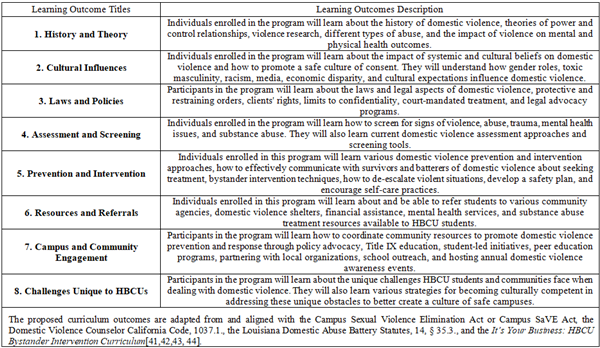
4.2. Training Objectives and Engagement Strategy ThemesFederal, state, and local organizations offer standards of learning objectives for domestic violence prevention training. Common learning objective themes identified from research sources include 1. exploring the history of domestic violence, 2. understanding theories of power and control relationships, 3. becoming familiar with violence research, 4. differentiating types of abuse, 5. reconnoitering the impact of violence on mental and physical health outcomes, 6. studying laws and legal aspects of domestic violence, 7. screening for signs of violence, 8. learning prevention and intervention approaches, and 9. identifying available treatment resources.
Regarding barriers to treatment, research findings suggested that culturally specific, trauma-informed engagement strategies will increase African American students' utilization of domestic violence prevention. Increased engagement and overcoming cultural barriers to treatment themes included 1. incorporating familiar cultural bases content, 2. understanding intersectional identities, 3. providing peer-to-peer training, 4. involving influential groups (e.g., Greek organizations, student government), 5. utilizing social media to share information, 6. acknowledging the impact of historical inequalities on the distrust of support networks, 7. collaborating with community stakeholders, and 8. customizing curricula intervention and prevention strategies specific to the targeted population.
4.3. Interpretive Analysis and SynthesisThe thematic analysis of the needs assessment and literature review of domestic violence prevention programs identified several recurring patterns. The themes display that the intersectionality between gender, age, and culture impacts the prevalence of domestic violence and barriers to providing prevention services. While African American college-aged women are particularly vulnerable to the impact of domestic violence, cultural barriers deter many from seeking treatment. The research findings display how the complexity of this pervasive problem is also the solution. Specific characteristics that created barriers to treatment can also be used to create culturally specific domestic violence prevention curricula. Combined findings from multiple studies in the systematic review provided standards of practice, protocol, learning objectives, and evaluation methods for a domestic violence prevention program designed explicitly for HBCU communities. Domestic violence prevention programs that are specifically designed for this target population will increase awareness, decrease incidents of partner violence, and create safer campus communities.
The theoretical framework and research findings were used to develop program learning outcomes, structure, and implementation policies specifically addressing domestic violence prevention in the HBCU community.
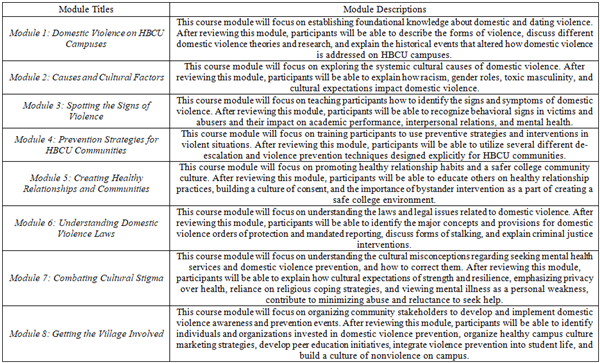
The proposed program and curriculum are designed to provide comprehensive training in domestic violence prevention and intervention for the HBCU community. Program content aligns with the national and state 40-hour training criteria for batterer intervention and domestic violence advocacy programs. The program is divided into eight-week modular courses that review the research, theories, and practical application of domestic violence prevention strategies for this population. Individuals enrolled in the program will explore the causes of violence, recognize the signs and symptoms of abuse, learn the dynamics of power and control, and become knowledgeable in screening and support strategies for victims. Special focus will be placed on violence prevention and interventions for African American college students on an HBCU campus. Topics that affect domestic violence universally will also be covered, including gender roles, community resources, and mandated reporting policies. Course modules can be adapted for undergraduate students, faculty, staff, or campus leaders. Course content can be taught either online or in person. Upon completion of the course, students will receive a Violence Prevention and Awareness Specialist Certificate.
5.1. Program ObjectivesThe program's primary objective is to reduce the prevalence of domestic violence incidents on HBCU campuses. The program educates students, faculty, and staff about violence prevention and intervention strategies to reach this goal. The program's secondary objective is to create a safer college community culture where survivors and perpetrators of domestic violence are supported in seeking rehabilitative services. This objective will be achieved through the promotion of seeking safety domestic violence awareness campaigns, healthy relationship programming, and enhanced rehabilitative services offered through the program.
5.2. Program StructureThe Domestic Violence Prevention for HBCU Community Program is an eight-module course training designed to educate the HBCU community on domestic violence prevention and intervention and promote a safe campus culture. Each module is aligned with national and state domestic violence training competencies and covers various topics to help prepare the learner to implement the strategies taught. The target audience is HBCU faculty, staff, students, and campus leaders positioned to implement the cultural changes suggested in this curriculum program. Modular activities and core structures can be adapted to suit the needs of the individual campus organization.
Handling of matters of sex-based or gender-based misconduct prevention efforts and the training of the entire campus should be implemented multiple times throughout the academic year. At a minimum, training should be offered at the beginning and end of each semester. Training that informs the students, staff, and administrators about the key personnel on campuses and how to contact them when such matters occur is critical to ensuring sound resolutions of misconduct allegations. Establishing a visible office where students are comfortable engaging with trained staff and peer-mentors is essential.
Research suggests that the development of a culturally specific domestic violence prevention program would be effective in reducing the prevalence of violence on HBCU campuses and creating a safer overall culture. However, the development of such programs is rare, and there is limited evidence-based research to support their efficacy. This is also the case in this study. The limited amount of research is simultaneously one of the reasons for exploring the topic and a challenge to developing a new model. To address this limitation, future research should focus on continuing to create and explore various ways to reduce the prevalence of violence on HBCU campuses.
Another limitation of the study is that no quantitative experimental data can currently be provided. Testing and evaluating effectiveness in meeting set objectives are essential in the program and curriculum development. Creating experimental pilot studies and analyzing comparative data can determine if the program effectively educates participants and encourages positive behavioral changes in domestic violence prevention. Future research studies on this topic should collect real-world data from program participants to evaluate changes in attitude regarding seeking prevention services, behavioral changes in bystander interventions, and the reduction of violence incidents on HBCU campuses.
The proposed program and curriculum are designed specifically for African American students attending HBCUs. The program's specific nature limits its generalizability. The study's lack of diversity means it can only be applied in particular settings. Additional research could modify this culturally specific program design for other ethnic groups, organizations, or target populations. The collected data would be analyzed to determine if other factors can be adapted to improve the program's utilization for different populations and settings.
Domestic violence is a public health issue that affects not only the individual but the community as well. With roughly 10 million adults experiencing domestic violence annually, it is easy to generalize solutions for every population 1. However, domestic violence disproportionately affects people of different ethnic backgrounds, socioeconomic statuses, genders, and ages. African American students, particularly women, at Historically Black Colleges and Universities HBCUs experience some of the highest rates of domestic violence and related fatalities 12. Existing research suggests that systemic barriers, cultural norms, mistrust, and reliance on religious practices for support create unique challenges for African American students to access violence prevention services.
Several HBCUs and organizations recognize the severity of the issue and are actively working to address domestic violence on their campuses. Furthermore, the Office on Violence Against Women (OVW) at the US Department of Justice provides financial support for HBCUs to develop culturally relevant prevention and response strategies. This article offered another option for creating and implementing a culturally specific domestic violence prevention program on HBCUs. The program combines best practices to enhance the implementation of culturally specific domestic violence prevention initiatives on HBCUs. Furthermore, each module is aligned with national and state domestic violence training competencies and covers various topics to help prepare the learner to implement the strategies taught.
College staff, Title IX specialists, and domestic violence experts attested that well-funded, culturally specific training and consistent engagement efforts would enhance participation in domestic violence prevention programming among African Americans. Research also supports that when programs are built around well-attuned needs of the community they serve, and trust is earned through consistent engagement, many of the challenges African American students have accessing violence prevention services are addressed. However useful these programs are, their development is rare, and limited evidence-based research is available to support their efficacy. Future research should focus on producing quantitative experimental data on how the program effectively educates participants and encourages positive behavioral changes in domestic violence prevention in real-world settings. With the continued development of culturally specific prevention strategies, education, accessible resources, and research efforts, a safer campus culture of respect and compassion can be achieved.
| [1] | Huecker, M. R., King, K. C., Jordan, G. A., & Smock, W. (2023). Domestic Violence. StatPearls Publishing. https:// pubmed. ncbi.nlm.nih.gov/ 29763066/. | ||
| In article | |||
| [2] | U.S. Department of Justice. Office on Violence Against Women. (2025). What Is Domestic Violence? https:// www.justice.gov/ ovw/domestic-violence. | ||
| In article | |||
| [3] | Webermann, A. R., Murphy, C. M., Singh, R., & Schacht, R. L. (2022). Preventing relationship abuse among college students: A controlled trial of the Skills for Healthy Adult Relationships (SHARe) program. Journal of Interpersonal Violence, 37(3/4), NP1860–NP1885. | ||
| In article | View Article PubMed | ||
| [4] | Center For Domestic Peace (2025). Economic Impact of Domestic Violence. https://centerfordomesticpeace.org/economic-impact-of-domestic-violence/. | ||
| In article | |||
| [5] | Peterson, C., Kearns, M.C., McIntosh, W. L., Estefan, L.F., Nicolaidis, C., McCollister, K.E., Gordon, A., & Florence, C. (2018). Lifetime Economic Burden of Intimate Partner Violence Among U.S. Adults. American Journal of Preventive Medicine. 55(4):433–444. | ||
| In article | View Article PubMed | ||
| [6] | Desmarais, S. L., Reeves, K. A., Nicholls, T. L., Telford, R. P., & Fiebert, M. S. (2012). Prevalence of physical violence in intimate relationships, part 1: Rates of male and female victimization. Partner Abuse, 3(2), 140–169. | ||
| In article | View Article | ||
| [7] | An, S., Welch-Brewer, C., & Tadese, H. (2024). Scoping review of intimate partner violence prevention programs for undergraduate college students. Trauma, Violence, & Abuse, 25(4), 3099–3114. | ||
| In article | View Article PubMed | ||
| [8] | Georgia Coalition Against Domestic Violence. (2019). African American/Black Women and Intimate Partner Violence Facts. https://gcadv.org › AA-Factsheet_ Final_DEC19 https:// gcadv.org/wp-content/uploads/AA-Factsheet_Final_DEC19.pdf. | ||
| In article | |||
| [9] | National Center for Education Statistics (NCES). (2025). Historically Black Colleges and Universities Fast Facts. https://nces.ed.gov › fastfacts › display https:// nces.ed.gov/ fastfacts/display.asp?id=667. | ||
| In article | |||
| [10] | U.S. Department of Education, Office for Civil Rights. (2025). Sex discrimination: Overview of the law. https://www.ed.gov/laws-and-policy/ civil-rights-laws/ sex-discrimination /sex-discrimination-2. | ||
| In article | |||
| [11] | U.S. Department of Veterans Affairs. Women Veterans Health Care. (2025). Intimate Partner Violence. https:// www.womenshealth. va.gov/topics/intimate-partner-violence.asp. | ||
| In article | |||
| [12] | Whitfield, D. L., Coulter, R. W., Langenderfer-Magruder, L., & Jacobson, D. (2021). Experiences of intimate partner violence among lesbian, gay, bisexual, and transgender college students: The intersection of gender, race, and sexual orientation. Journal of Interpersonal Violence, 36(11–12), NP6040–NP6064. | ||
| In article | View Article PubMed | ||
| [13] | Kettrey, H. H., Thompson, M. P., Marx, R. A., et al. (2024). Effects of campus intimate partner violence prevention programs on psychological and physical violence outcomes: A systematic review and meta-analysis. Journal of Experimental Criminology, 20, 1015–1041. | ||
| In article | View Article | ||
| [14] | Office on Violence Against Women (OVW). United States Department of Justice. (2025). Campus Program. https:// www.justice.gov/ovw/campus-program#:~: text=In% 202024% 2C% 20the% 20Campus% 20Program% 20special% 20initiative,HSI%20flyer%20%C2%B7%20Download%20the%20TCU%20flyer. | ||
| In article | |||
| [15] | U.S. Department of Justice, Office on Violence Against Women. (n.d.). Strengthening culturally specific campus approaches to address domestic violence, dating violence, sexual assault, and stalking initiative. Campus Program. Retrieved July 25, 2025, from https://www.justice.gov/ovw/campus-program. | ||
| In article | |||
| [16] | Moylan, C. A., Javorka, M., Bybee, D., Stotzer, R. L., & Carlson, M. (2019). Campus-level variation in the prevalence of student experiences of sexual assault and intimate partner violence. Journal of the Society for Social Work and Research, 10(3), 397–421. | ||
| In article | View Article | ||
| [17] | Griffin, V. W., Pelletier, D., Griffin, O. H., III, & Sloan, J. J., III. (2017). Campus violence elimination act: SaVing lives or SaVing face? American Journal of Criminal Justice, 42, 401–425. | ||
| In article | View Article | ||
| [18] | Collins, P. H., da Silva, E. C. G., Ergun, E., Furseth, I., Bond, K. D., & Martínez-Palacios, J. (2021). Intersectionality as Critical Social Theory: Intersectionality as Critical Social Theory, Patricia Hill Collins, Duke University Press, 2019. Contemporary Political Theory, 20(3), 690–725. | ||
| In article | View Article PubMed | ||
| [19] | Rankin, Y. (2024). Moving from theory to application: Black Feminist thought as an intersectional framework for design: IX Magazine issue XXXI.5 September - October 2024. ACM Interactions. https://interactions.acm.org/archive/view/september-october-2024/moving-from-theory-to-application-black-feminist-thought-as-an-intersectional-framework-for-design#R5. | ||
| In article | View Article | ||
| [20] | Souza, J. (2025). What is social and emotional learning?Child Mind Institute. https://childmind.org/article/what-is-social-and-emotional-learning/. | ||
| In article | |||
| [21] | BentGoodley, T. B., Zonicle, A. E., RomeroChandler, S., & St. Vil, N. M. (2025). Intimate partner violence, mental health, and intimate partner homicide: Perceptions of Black communities. Social Work Research, 49(2), 93–105. | ||
| In article | View Article | ||
| [22] | Lukachko, A., Hatzenbuehler, M. L., & Keyes, K. M. (2022). Religiosity and stigmatization related to mental illness among African Americans and Black immigrants. Journal of Racial and Ethnic Health Disparities, 9(6), 2483–2493. | ||
| In article | |||
| [23] | Williams, M. T. (2011). Mental health in the African American community: From stigma to solutions. Psychology Today. https://www.psychologytoday.com/us/blog/culturally-speaking/ 201108/ mental-health-in-the-african-american-community. | ||
| In article | View Article PubMed | ||
| [24] | Holliday, R. B., & Hill, A. E. (2018). Resource disparities and student support services at historically Black colleges and universities. Journal of College Student Development, 59(3), 340–355. | ||
| In article | |||
| [25] | Healthy Minds Network & United Negro College Fund Institute for Capacity Building. (2025). Community, Culture, and Care: A Cross-Institutional Analysis of Mental Health Among HBCU and PBI Students. [Report based on the Healthy Minds Study survey administered during 2022–2024]. | ||
| In article | |||
| [26] | U.S. Department of Education. (2022). Counseling services and student retention: A review of campus mental health return on investment. National Center for Biotechnology Information. https://www.ncbi.nlm.nih.gov/books/NBK567366/. | ||
| In article | |||
| [27] | W. Montague Cobb–NMA Health Institute. (2023). Afrocentric cultural norms, mental health functioning, and the perception of intimate partner violence among young Black men [Qualitative/quantitative study summary]. Journal of Racial and Ethnic Health Disparities. Advance online publication. | ||
| In article | |||
| [28] | Fiveable. (2024). Toxic Masculinity – Intro to African American Studies. https://library.fiveable.me/key-terms/introduction-african-american-studies/toxic-masculinity. | ||
| In article | |||
| [29] | Goodwill, J. R., Johnson, N. C., & Watkins, D. C. (2020). Adherence to masculine norms and depressive symptoms in young Black men. Social Work, 65(3), 235–244. | ||
| In article | View Article PubMed | ||
| [30] | DeGruy, J. (2005). Post-traumatic slave syndrome: America's legacy of enduring injury and healing. Uptone Press. | ||
| In article | |||
| [31] | Murray, A. L., & Osei-Tutu, E. (2023). “A man’s gotta do what a man’s gotta do”: An exploration of Black American men’s conceptualizations of masculinity, manhood, and gender roles. Journal of Interpersonal Violence, 38(13–14), 10055–10082. | ||
| In article | |||
| [32] | National Women’s Law Center. (2020). Title IX protections. https://nwlc.org/issue/title-ix/. | ||
| In article | |||
| [33] | Centers for Disease Control and Prevention (CDC). (n.d.) Domestic Violence Prevention Enhancements and Leadership Through Alliances (DELTA) Program. https:// www.cdc.gov/ intimate-partner-violence/programs/index.html. | ||
| In article | |||
| [34] | Louisiana Domestic Violence Prevention Commission. (2020). 2020 Annual Report https:// gov.louisiana.gov/ assets/docs/ 2020DVPCReport.pdf. | ||
| In article | |||
| [35] | U.S. Department of Justice. (2024). 2024 Biennial Report to Congress on the Effectiveness of Grant Programs Under the Violence Against Women Act. https:// www.justice.gov/ ovw/media/ 1385821/dl?inline=. | ||
| In article | |||
| [36] | Gutowski, E.R., Freitag, S., Zhang, S., Thompson, M.P., & Kaslow, N.J. (2022). Intimate Partner Violence, Legal Systems, and Barriers for African American Women. Journal of Interpersonal Violence. 38(1-2):NP1279-NP1298. | ||
| In article | View Article PubMed | ||
| [37] | Hulley, J., Bailey, L., Kirkman, G., Gibbs, G. R., Gomersall, T., Latif, A., & Jones, A. (2022). Intimate Partner Violence and Barriers to Help-Seeking Among Black, Asian, Minority Ethnic and Immigrant Women: A Qualitative Metasynthesis of Global Research. Trauma, Violence, & Abuse, 24(2), 1001–1015. | ||
| In article | View Article PubMed | ||
| [38] | Hampton, R., Oliver, W., & Magarian, L. (2003). Domestic Violence in the African American Community: An Analysis of Social and Structural Factors. Violence Against Women. 9. 533–557. 10.1177/1077801202250450. | ||
| In article | View Article | ||
| [39] | Smith, S. G., Chen, J., Basile, K. C., Gilbert, L. K., Merrick, M. T., Patel, N., Walling, M., & Jain, A. (2017). The National Intimate Partner and Sexual Violence Survey (NISVS): 2010–2012 state report. National Center for Injury Prevention and Control, Centers for Disease Control and Prevention. https:// www.cdc.gov/ violenceprevention/ pdf/nisvs-statereportbook.pdf. | ||
| In article | |||
| [40] | Mandler, C. (2023). HBCUs receive 178 times less foundation funding than Ivy League schools, study finds. CBS News. https://www.cbsnews.com/news/hbcus-receive-178-times-less-funding-than-ivy-league-schools-study-finds/. | ||
| In article | |||
| [41] | Black Women’s Blueprint. (2018). It’s Your Business: HBCU Bystander Intervention Curriculum. https:// www. changingourcampus. org/ documents/Its-Your-Business-HBCU-Curriculum-2018-7-31.pdf/. | ||
| In article | |||
| [42] | Campus Sexual Violence Elimination Act or Campus SaVE Act. H.R.2016 — 112th Congress. (2016). https:// www.congress.gov /bill/ 112th-congress/house-bill/2016. | ||
| In article | |||
| [43] | Domestic Violence Counselor-Victim Privilege. California Code, Evidence Code - EVID § 1037.1. (2006). https://leginfo.legislature.ca.gov/. | ||
| In article | |||
| [44] | Louisiana Revised Statutes. 14, § 35.3. Domestic abuse battery. (1990). https://www.legis.la.gov/legis/Law.aspx?d=206153. | ||
| In article | |||
Published with license by Science and Education Publishing, Copyright © 2025 Sean I. Gibbs, Jalyn Holden, Deja Harper and Sojourner A. Gibbs
 This work is licensed under a Creative Commons Attribution 4.0 International License. To view a copy of this license, visit
http://creativecommons.org/licenses/by/4.0/
This work is licensed under a Creative Commons Attribution 4.0 International License. To view a copy of this license, visit
http://creativecommons.org/licenses/by/4.0/
| [1] | Huecker, M. R., King, K. C., Jordan, G. A., & Smock, W. (2023). Domestic Violence. StatPearls Publishing. https:// pubmed. ncbi.nlm.nih.gov/ 29763066/. | ||
| In article | |||
| [2] | U.S. Department of Justice. Office on Violence Against Women. (2025). What Is Domestic Violence? https:// www.justice.gov/ ovw/domestic-violence. | ||
| In article | |||
| [3] | Webermann, A. R., Murphy, C. M., Singh, R., & Schacht, R. L. (2022). Preventing relationship abuse among college students: A controlled trial of the Skills for Healthy Adult Relationships (SHARe) program. Journal of Interpersonal Violence, 37(3/4), NP1860–NP1885. | ||
| In article | View Article PubMed | ||
| [4] | Center For Domestic Peace (2025). Economic Impact of Domestic Violence. https://centerfordomesticpeace.org/economic-impact-of-domestic-violence/. | ||
| In article | |||
| [5] | Peterson, C., Kearns, M.C., McIntosh, W. L., Estefan, L.F., Nicolaidis, C., McCollister, K.E., Gordon, A., & Florence, C. (2018). Lifetime Economic Burden of Intimate Partner Violence Among U.S. Adults. American Journal of Preventive Medicine. 55(4):433–444. | ||
| In article | View Article PubMed | ||
| [6] | Desmarais, S. L., Reeves, K. A., Nicholls, T. L., Telford, R. P., & Fiebert, M. S. (2012). Prevalence of physical violence in intimate relationships, part 1: Rates of male and female victimization. Partner Abuse, 3(2), 140–169. | ||
| In article | View Article | ||
| [7] | An, S., Welch-Brewer, C., & Tadese, H. (2024). Scoping review of intimate partner violence prevention programs for undergraduate college students. Trauma, Violence, & Abuse, 25(4), 3099–3114. | ||
| In article | View Article PubMed | ||
| [8] | Georgia Coalition Against Domestic Violence. (2019). African American/Black Women and Intimate Partner Violence Facts. https://gcadv.org › AA-Factsheet_ Final_DEC19 https:// gcadv.org/wp-content/uploads/AA-Factsheet_Final_DEC19.pdf. | ||
| In article | |||
| [9] | National Center for Education Statistics (NCES). (2025). Historically Black Colleges and Universities Fast Facts. https://nces.ed.gov › fastfacts › display https:// nces.ed.gov/ fastfacts/display.asp?id=667. | ||
| In article | |||
| [10] | U.S. Department of Education, Office for Civil Rights. (2025). Sex discrimination: Overview of the law. https://www.ed.gov/laws-and-policy/ civil-rights-laws/ sex-discrimination /sex-discrimination-2. | ||
| In article | |||
| [11] | U.S. Department of Veterans Affairs. Women Veterans Health Care. (2025). Intimate Partner Violence. https:// www.womenshealth. va.gov/topics/intimate-partner-violence.asp. | ||
| In article | |||
| [12] | Whitfield, D. L., Coulter, R. W., Langenderfer-Magruder, L., & Jacobson, D. (2021). Experiences of intimate partner violence among lesbian, gay, bisexual, and transgender college students: The intersection of gender, race, and sexual orientation. Journal of Interpersonal Violence, 36(11–12), NP6040–NP6064. | ||
| In article | View Article PubMed | ||
| [13] | Kettrey, H. H., Thompson, M. P., Marx, R. A., et al. (2024). Effects of campus intimate partner violence prevention programs on psychological and physical violence outcomes: A systematic review and meta-analysis. Journal of Experimental Criminology, 20, 1015–1041. | ||
| In article | View Article | ||
| [14] | Office on Violence Against Women (OVW). United States Department of Justice. (2025). Campus Program. https:// www.justice.gov/ovw/campus-program#:~: text=In% 202024% 2C% 20the% 20Campus% 20Program% 20special% 20initiative,HSI%20flyer%20%C2%B7%20Download%20the%20TCU%20flyer. | ||
| In article | |||
| [15] | U.S. Department of Justice, Office on Violence Against Women. (n.d.). Strengthening culturally specific campus approaches to address domestic violence, dating violence, sexual assault, and stalking initiative. Campus Program. Retrieved July 25, 2025, from https://www.justice.gov/ovw/campus-program. | ||
| In article | |||
| [16] | Moylan, C. A., Javorka, M., Bybee, D., Stotzer, R. L., & Carlson, M. (2019). Campus-level variation in the prevalence of student experiences of sexual assault and intimate partner violence. Journal of the Society for Social Work and Research, 10(3), 397–421. | ||
| In article | View Article | ||
| [17] | Griffin, V. W., Pelletier, D., Griffin, O. H., III, & Sloan, J. J., III. (2017). Campus violence elimination act: SaVing lives or SaVing face? American Journal of Criminal Justice, 42, 401–425. | ||
| In article | View Article | ||
| [18] | Collins, P. H., da Silva, E. C. G., Ergun, E., Furseth, I., Bond, K. D., & Martínez-Palacios, J. (2021). Intersectionality as Critical Social Theory: Intersectionality as Critical Social Theory, Patricia Hill Collins, Duke University Press, 2019. Contemporary Political Theory, 20(3), 690–725. | ||
| In article | View Article PubMed | ||
| [19] | Rankin, Y. (2024). Moving from theory to application: Black Feminist thought as an intersectional framework for design: IX Magazine issue XXXI.5 September - October 2024. ACM Interactions. https://interactions.acm.org/archive/view/september-october-2024/moving-from-theory-to-application-black-feminist-thought-as-an-intersectional-framework-for-design#R5. | ||
| In article | View Article | ||
| [20] | Souza, J. (2025). What is social and emotional learning?Child Mind Institute. https://childmind.org/article/what-is-social-and-emotional-learning/. | ||
| In article | |||
| [21] | BentGoodley, T. B., Zonicle, A. E., RomeroChandler, S., & St. Vil, N. M. (2025). Intimate partner violence, mental health, and intimate partner homicide: Perceptions of Black communities. Social Work Research, 49(2), 93–105. | ||
| In article | View Article | ||
| [22] | Lukachko, A., Hatzenbuehler, M. L., & Keyes, K. M. (2022). Religiosity and stigmatization related to mental illness among African Americans and Black immigrants. Journal of Racial and Ethnic Health Disparities, 9(6), 2483–2493. | ||
| In article | |||
| [23] | Williams, M. T. (2011). Mental health in the African American community: From stigma to solutions. Psychology Today. https://www.psychologytoday.com/us/blog/culturally-speaking/ 201108/ mental-health-in-the-african-american-community. | ||
| In article | View Article PubMed | ||
| [24] | Holliday, R. B., & Hill, A. E. (2018). Resource disparities and student support services at historically Black colleges and universities. Journal of College Student Development, 59(3), 340–355. | ||
| In article | |||
| [25] | Healthy Minds Network & United Negro College Fund Institute for Capacity Building. (2025). Community, Culture, and Care: A Cross-Institutional Analysis of Mental Health Among HBCU and PBI Students. [Report based on the Healthy Minds Study survey administered during 2022–2024]. | ||
| In article | |||
| [26] | U.S. Department of Education. (2022). Counseling services and student retention: A review of campus mental health return on investment. National Center for Biotechnology Information. https://www.ncbi.nlm.nih.gov/books/NBK567366/. | ||
| In article | |||
| [27] | W. Montague Cobb–NMA Health Institute. (2023). Afrocentric cultural norms, mental health functioning, and the perception of intimate partner violence among young Black men [Qualitative/quantitative study summary]. Journal of Racial and Ethnic Health Disparities. Advance online publication. | ||
| In article | |||
| [28] | Fiveable. (2024). Toxic Masculinity – Intro to African American Studies. https://library.fiveable.me/key-terms/introduction-african-american-studies/toxic-masculinity. | ||
| In article | |||
| [29] | Goodwill, J. R., Johnson, N. C., & Watkins, D. C. (2020). Adherence to masculine norms and depressive symptoms in young Black men. Social Work, 65(3), 235–244. | ||
| In article | View Article PubMed | ||
| [30] | DeGruy, J. (2005). Post-traumatic slave syndrome: America's legacy of enduring injury and healing. Uptone Press. | ||
| In article | |||
| [31] | Murray, A. L., & Osei-Tutu, E. (2023). “A man’s gotta do what a man’s gotta do”: An exploration of Black American men’s conceptualizations of masculinity, manhood, and gender roles. Journal of Interpersonal Violence, 38(13–14), 10055–10082. | ||
| In article | |||
| [32] | National Women’s Law Center. (2020). Title IX protections. https://nwlc.org/issue/title-ix/. | ||
| In article | |||
| [33] | Centers for Disease Control and Prevention (CDC). (n.d.) Domestic Violence Prevention Enhancements and Leadership Through Alliances (DELTA) Program. https:// www.cdc.gov/ intimate-partner-violence/programs/index.html. | ||
| In article | |||
| [34] | Louisiana Domestic Violence Prevention Commission. (2020). 2020 Annual Report https:// gov.louisiana.gov/ assets/docs/ 2020DVPCReport.pdf. | ||
| In article | |||
| [35] | U.S. Department of Justice. (2024). 2024 Biennial Report to Congress on the Effectiveness of Grant Programs Under the Violence Against Women Act. https:// www.justice.gov/ ovw/media/ 1385821/dl?inline=. | ||
| In article | |||
| [36] | Gutowski, E.R., Freitag, S., Zhang, S., Thompson, M.P., & Kaslow, N.J. (2022). Intimate Partner Violence, Legal Systems, and Barriers for African American Women. Journal of Interpersonal Violence. 38(1-2):NP1279-NP1298. | ||
| In article | View Article PubMed | ||
| [37] | Hulley, J., Bailey, L., Kirkman, G., Gibbs, G. R., Gomersall, T., Latif, A., & Jones, A. (2022). Intimate Partner Violence and Barriers to Help-Seeking Among Black, Asian, Minority Ethnic and Immigrant Women: A Qualitative Metasynthesis of Global Research. Trauma, Violence, & Abuse, 24(2), 1001–1015. | ||
| In article | View Article PubMed | ||
| [38] | Hampton, R., Oliver, W., & Magarian, L. (2003). Domestic Violence in the African American Community: An Analysis of Social and Structural Factors. Violence Against Women. 9. 533–557. 10.1177/1077801202250450. | ||
| In article | View Article | ||
| [39] | Smith, S. G., Chen, J., Basile, K. C., Gilbert, L. K., Merrick, M. T., Patel, N., Walling, M., & Jain, A. (2017). The National Intimate Partner and Sexual Violence Survey (NISVS): 2010–2012 state report. National Center for Injury Prevention and Control, Centers for Disease Control and Prevention. https:// www.cdc.gov/ violenceprevention/ pdf/nisvs-statereportbook.pdf. | ||
| In article | |||
| [40] | Mandler, C. (2023). HBCUs receive 178 times less foundation funding than Ivy League schools, study finds. CBS News. https://www.cbsnews.com/news/hbcus-receive-178-times-less-funding-than-ivy-league-schools-study-finds/. | ||
| In article | |||
| [41] | Black Women’s Blueprint. (2018). It’s Your Business: HBCU Bystander Intervention Curriculum. https:// www. changingourcampus. org/ documents/Its-Your-Business-HBCU-Curriculum-2018-7-31.pdf/. | ||
| In article | |||
| [42] | Campus Sexual Violence Elimination Act or Campus SaVE Act. H.R.2016 — 112th Congress. (2016). https:// www.congress.gov /bill/ 112th-congress/house-bill/2016. | ||
| In article | |||
| [43] | Domestic Violence Counselor-Victim Privilege. California Code, Evidence Code - EVID § 1037.1. (2006). https://leginfo.legislature.ca.gov/. | ||
| In article | |||
| [44] | Louisiana Revised Statutes. 14, § 35.3. Domestic abuse battery. (1990). https://www.legis.la.gov/legis/Law.aspx?d=206153. | ||
| In article | |||