Poly(vinyl chloride) (PVC) nanoplastics (< 1,000 nm) are widely used in exposure and fate studies, yet the original sourcing and pre-treatment of starting materials, which govern additive profiles, particle properties, and leachates are inconsistently reported. Our primary objective was to evaluate how PVC-nanoplastics studies report feed-stock provenance and the implications for reproducibility and environmental relevance. We conducted a systematized narrative review (PubMed, database inception to 20 July 2025) of primary studies that purchased or produced PVC particles with at least one dimension < 1000 nm and used them in exposure, characterization, fate, or calibration experiments. Data extraction captured six provenance descriptors (supplier, catalogue/lot, molecular-weight/inherent-viscosity, additive profile, cleaning/aging, pre-processing), synthesis routes, morphology, and a six-item characterization completeness score. Thirty-four studies met the inclusion criteria. Across these studies, starting materials comprised virgin scientific-grade resin (41.2%), commercially purchased PVC nanoparticles (20.6%), post-consumer waste (14.7%), virgin commercial powder (11.8%), and external reference materials (11.8%). Only 1 of 34 studies (2.9%) reported a catalogue number, while 13 of 34 (38.2%) described any additive information. The median characterization score was 2 of 6 (range 0–5). Nanoprecipitation and top-down milling were the most common synthesis methods, but reporting of yields and leachate controls was inconsistent. Provenance reporting for PVC nanoplastics is frequently incomplete, particularly for catalogue/lot numbers and additive profiles that critically influence solubility, morphology, surface chemistry, and leachate composition. We propose a PVC-specific reporting extension emphasizing supplier/batch identifiers, additive quantification, weathering/cleaning verification, and leachate controls to enable reproducible, decision-useful research.
Global polymer production surpassed 400 million metric tons in 2022 and continues to rise at a pace that outstrips growth in formal recycling and recovery 1. The mismatch between production and end-of-life management ensures a sustained and expanding flux of secondary micro-and nanoplastics generated through mechanical abrasion, thermal cycling, and photochemical weathering of larger items. Nanoplastics (<1000 nm) occupy a critical but under-resolved portion of this spectrum: their high surface-area-to-volume ratios and colloidal stability increase environmental residence times and mobility across compartments, while their small size allows interactions with biological barriers that are not accessible to larger particles 2. Taken together, these features justify treating the nano-fraction as a distinct exposure class whose occurrence, behavior, and consequences remain insufficiently captured by current monitoring programs and policy instruments 3.
1.1. Why the Nano-fraction MattersAt the nanoscale, particle properties change in ways that cannot be predicted simply by scaling down from microplastic studies. Features such as particle curvature, structural defects, and altered surface chemistry make nanoplastics more reactive at interfaces 4. As a result, their sorption and desorption of chemicals can differ, and biomolecules readily form a corona around particle surfaces, which influences how they behave in complex environments. Inside organisms, nanoplastics are small enough to enter cells through processes like endocytosis and may move across tissues, rather than being limited to bulk ingestion. These differences affect where nanoplastics distribute in the body, which tissues they reach, and the types of cellular responses they trigger. For these reasons, risk frameworks should treat nanoplastics as a distinct class of particles rather than assuming they behave the same as larger microplastics 3.
1.2. Detection and Monitoring LimitsDespite growing interest, environmental surveillance of plastics rarely involves particles under 100 nm3. Practical limitations arise from low refractive-index contrast for common polymers, limited mass sensitivity at small particle sizes, and matrix interference in natural waters, soils, and biological extracts. Research-grade approaches, such as asymmetric-flow field-flow fractionation (AF4) with multi-detector setups, transmission electron microscopy, and single-particle ICP-MS/tracer-friendly mass spectrometry, have advanced characterization of the nano-fraction but remain technically demanding, comparatively expensive, and only partially standardized for environmental applications 4, 5, 6. Direct field evidence of nanoplastics is beginning to emerge using novel sample preparation and imaging strategies, yet occurrence datasets remain sparse relative to microplastics 7. As a result, size distributions and chemical states for nanoplastics are still under-documented at regulatory monitoring scales 3.
1.3. Why Focus on PVC?Within the broad family of commercial polymers, poly (vinyl chloride) (PVC) warrants specific attention on three fronts. First, PVC constitutes a major share of installed polymer stock across infrastructure and consumer products, piping, profiles, flooring, wire and cable insulation, packaging, and selected medical devices, such that even low per-item fragmentation rates translate into substantial environmental inputs over time 8, 9. Second, the chlorine-rich PVC backbone undergoes dehydro-chlorination when subjected to heat, UV radiation, or catalytic impurities, generating HCl and conjugated polyenes that accelerate photo-oxidation, increase surface polarity, and alter interactions with co-contaminants and biota 10. Third, PVC formulations, especially flexible grades used in flooring and cables, are additive-rich: plasticizers and stabilizers are physically blended rather than covalently bound and can migrate under ordinary use, with aging further enhancing release 11. Recent experimental work shows long-term phthalate release from PVC microplastics and photoaging-enhanced leaching and transformation products, linking aging chemistry directly to leachate profiles 12. The conjunction of high production volume, chlorine-driven degradation chemistry, and substantial additive loads elevates the plausibility of both particle-mediated and leachate-mediated hazards and motivates a dedicated assessment of how PVC nanoplastic test materials are generated and reported.
Several studies have demonstrated measurable plasticizer release from PVC micro- and nanoplastics into seawater and freshwater matrices over experimental timescales 12, 13, 14. The magnitude of release is influenced by additive molecular weight, polymer morphology, surface area, and environmental conditions such as temperature and salinity 13. Importantly, laboratory synthesis choices directly influence plasticizer retention. Pre-extraction by Soxhlet or pressurized-liquid extraction, antisolvent precipitation with dialysis, or prolonged washing steps are likely to produce particles with reduced plasticizer burdens relative to the source material 15, 16, 17. In the absence of quantitative additive analysis, these differences remain unreported yet have substantial implications for hazard interpretation.
1.4. Environmental and Biological Fate of PVC NanoplasticsSecondary generation of PVC nanoplastics is driven by progressive embrittlement and surface cracking of larger objects under realistic use and weathering conditions 10, 11, 15. Aging water and wastewater pipes provide a persistent source where hydraulic pressure, temperature fluctuations, and disinfectants contribute to mechanical fatigue and chemical alteration. Indoors, vinyl flooring and related materials shed wear particles and additive-rich dust, contributing to settled particulate loads 11. In the e-waste stream, polymeric cable insulation is subjected to dismantling, shredding, and, where controls are lacking, open burning, all of which promote particle generation and additive volatilization 8. Laboratory weathering protocols often isolate UV, thermal, or mechanical stressors for experimental tractability; field contexts typically combine these drivers, accelerating dehydro-chlorination, oxidation, and size reduction in ways that are challenging to replicate in simplified test systems 15.
1.5. Biological effects: Oxidative Stress, Inflammation, and Endocrine-related EndpointsExposure to nano- and small microplastics is associated with oxidative stress (ROS formation, lipid peroxidation), inflammatory signaling (cytokine induction, immune modulation, tissue-level histopathology), and endocrine-related outcomes (hormone perturbation, reproductive effects, developmental alterations) 18, 19, 20. Much of the mechanistic evidence derives from polystyrene and PVC nanoplastics models: experimental studies demonstrate genotoxicity and cytotoxicity in human lung cells, 21 disruption of intestinal epithelial integrity in advanced in vitro triple culture systems 20, and cytokine release by human monocytes and dendritic cells 22. Additional evidence from aquatic and invertebrate models shows size-dependent toxicity and altered cellular function 23, 24. Multiple syntheses report endocrine-disrupting outcomes across vertebrate models at experimental concentrations, while invertebrate studies document immune shifts after repeated nanoplastic exposure. Where PVC-specific studies exist, they converge on similar endpoints and highlight the potential contribution of additive leachates unique to PVC formulations 11, 12. The relative scarcity of PVC-focused datasets underscores the need for test materials that more faithfully represent environmentally aged PVC and for systematic reporting that allows results to be compared across laboratories and model systems.
1.6. Laboratory Synthesis and the Provenance ProblemExperimental studies commonly prepare PVC nanoplastic test particles by solvent displacement (nanoprecipitation), cryomilling of bulk material, or laser-based fragmentation 25, 26, 27, 28, 29. While these routes offer practical control over nominal size ranges and experimental throughput, they seldom reproduce key attributes of field-aged particles, including oxidation state, additive depletion or redistribution, and irregular, fracture-dominated morphology 15. Reproducibility and interpretability are further constrained by incomplete reporting of feed-stock provenance. Essential descriptors, supplier and catalogue/lot number, molecular weight or inherent viscosity, additive profile, any pre-cleaning or selective extraction steps, and details of artificial aging, are frequently absent or only partially described. A structured quality appraisal of microplastic effect studies highlighted pervasive reporting shortfalls that hinder reproducibility and meta-analysis 30. Because these attributes govern polymer solubility, nanoprecipitation behavior, milling brittleness, yield, surface chemistry, colloidal stability, and the composition of leachates, under-reporting obscures mechanistic links between starting materials, particle properties, and biological outcomes. Transparent provenance and thorough characterization are therefore prerequisites for credible hazard assessment and for data synthesis across studies 15, 30.
This review systematically evaluates how PVC-nanoplastics studies document feed-stock provenance and pre-treatment and examines the consequences of those practices for experimental comparability. Specifically, (i) we quantify reporting across six core descriptors: Plastic typing, supplier, catalogue/ lot, additive profile, cleaning/ aging procedure, and any pre-processing; (ii) map trends in synthesis routes, model systems, and characterization techniques; and (iii) assess whether authors explicitly link feed-stock choice to particle properties and experimental outcomes. By including exposure, calibration, and characterization studies, we aim to capture the full methodological landscape and to identify practical pathways toward more reproducible, environmentally relevant, and decision-useful PVC nanoplastics research.
The review protocol was developed a priori and prospectively registered on the Open Science Framework (.) We followed the PRISMA 2020 statement for systematic reviews and meta-analyses and mapped all items to the PRISMA checklist during drafting of the manuscript.
3.2. Review Design and ObjectiveThis study is a systematized narrative review that catalogues and critically appraises how primary research articles describe the provenance and pre-treatment of starting poly(vinyl chloride) (PVC) used to generate nanoplastics (<1 µm), regardless of the downstream synthesis route or experimental purpose. Articles were considered a “PVC-nanoplastics study” if they (i) purchased or produced PVC particles with at least one dimension < 1 µm and (ii) reported any experimental exposure, characterization, fate, or calibration work involving those particles.
A single-database strategy was used because PubMed/MEDLINE provides the most comprehensive indexing of nanoplastics studies in life-science, toxicology, and environmental health disciplines, ensuring consistency in study design and terminology. PubMed’s controlled vocabulary (MeSH) for polymers and nanoparticle exposure also enables reproducible search retrieval and minimizes redundancy relative to multidisciplinary databases, making it particularly suitable for assessing reporting practices rather than broad bibliometric trends.
A single-database search in PubMed/MEDLINE from 1 Jan 2015 to 20 July 2025 was conducted. No other databases, registries, or grey literature sources were searched. The final PubMed search was completed on 20 July 2025. Complete search results are available in Table S3.
3.4. Search StrategyDatabases: PubMed Complete search results (coverage = 1 Jan 2015 to search date). Final search date- July 20th, 2025.
Core search string (PubMed, Title/Abstract unless MeSH-tagged):
("Polyvinyl Chloride"[MeSH] OR PVC [tiab] OR "poly(vinyl chloride)" [tiab]) AND (nanoplastics* [tiab] OR nanoparticle* [tiab])
No synthesis keywords are included so we capture every route (nanoprecipitation, mechanical frag-mentation, laser ablation, etc.). Complete search results can be found in Supplementary Table S2
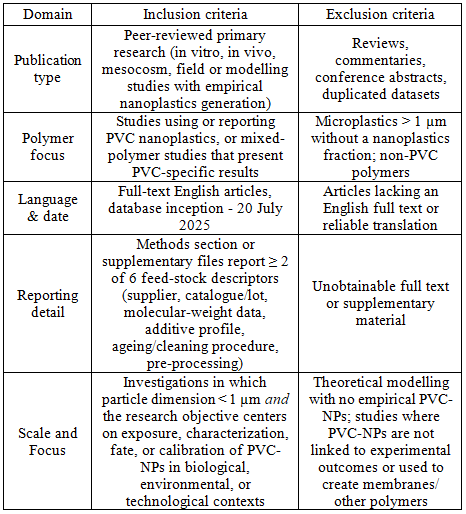
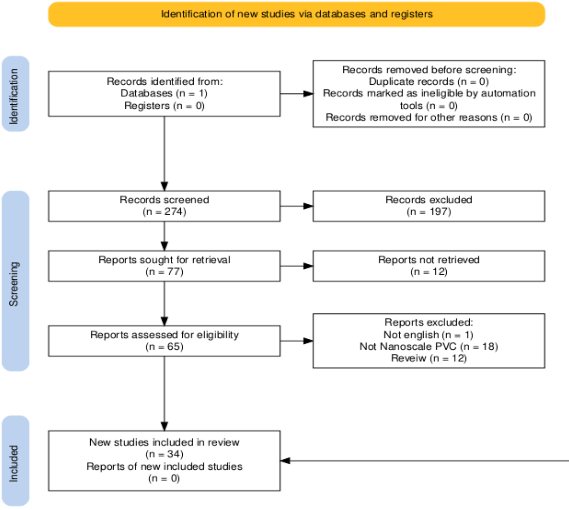
3.5. Selection Process and SynthesisTwo stages were applied: (1) title/abstract screening; (2) full-text review against pre-specified eligibility criteria. Because only PubMed was searched, no de-duplication across databases was required. Selection decisions were mapped based on exclusion criteria which are available in Supplementary Table S1, and exclusion process is shown in Figure 1 PRISMA diagram. 31
A systematized narrative review focused on materials provenance and reporting practices was performed. We did not conduct quantitative meta-analysis. Data were charted into predefined fields, and synthesized results narratively with structured tables and simple frequency plots. A fit-for-purpose reporting checklist was created to summarize coverage of key descriptors; no aggregate risk-of-bias grading or certainty (GRADE) assessment was performed
Data was extracted using a piloted form capturing feed-stock provenance descriptors, synthesis routes, and characterization.
Thirty-four primary studies met the inclusion criteria for PVC nanoplastics and were charted for provenance and reporting practices (full eligibility framework and information sources are detailed in Methods).
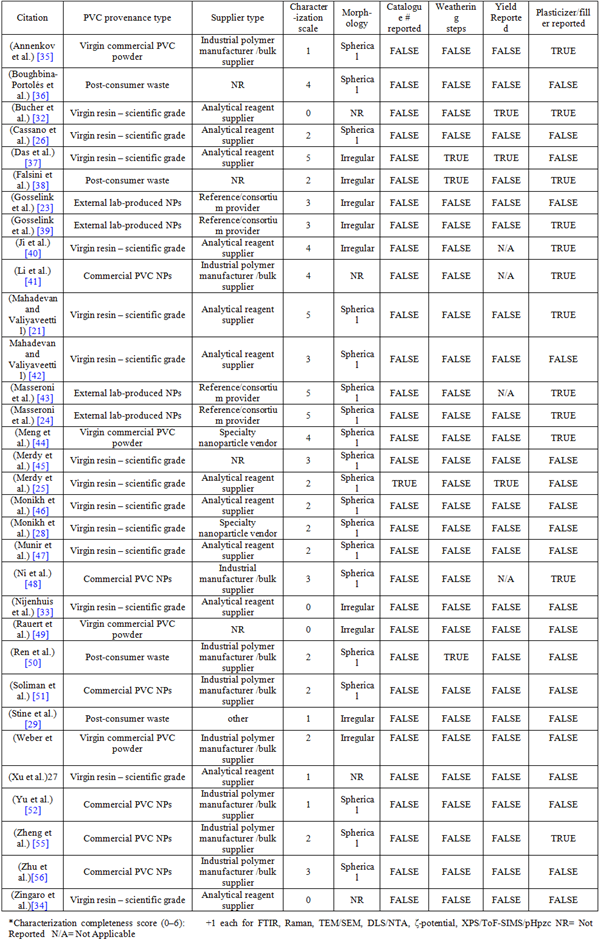
4.2. Study CharacteristicsAcross the 34 studies, the most common feedstock was virgin, scientific-grade PVC resin (14/34; 41.2%), followed by commercially purchased “PVC nanoparticles” (7/34; 20.6%), post-consumer waste (5/34; 14.7%), virgin commercial PVC powder (4/34; 11.8%), and external lab-produced reference materials (4/34; 11.8%). Representative rows are shown in Table 2 (e.g., virgin scientific-grade resin; commercial NPs; post-consumer waste; external reference materials).
Supplier types clustered into analytical reagent vendors (12/34; 35.3%) and industrial/bulk polymer suppliers (11/34; 32.4%), with smaller contributions from consortium/reference providers (4/34; 11.8%) and specialty nanoparticle vendors (2/34; 5.9%). The rest of the papers leave this unreported. Selected examples are highlighted in Table 2.
4.3. Provenance and Materials ReportingExact catalogue/lot numbers were almost nonexistent: 1/34 studies (2.9%) reported a catalogue number (Merdy et al., “Nanoplastic Production Procedure”), while 33/34 did not.
Reporting of pre-treatment/weathering steps was rare (3/34; 8.8%), appearing in studies using either virgin resin or post-consumer sources. Additive/plasticizer/filler information was reported in 13/34 studies and absent in the remainder. Yield reporting (mass recovery or particle yield) applied to 30 studies (N/A in 4 where “commercial NPs” were used solely as received); among applicable studies, 3/30 (10.0%) reported yield.
4.4. Particle Morphology and CharacterizationParticles were described as spherical in 20/34 studies (58.8%), irregular in 10/34 (29.4%), and not reported in 4/34 (11.8%). Examples of each category appear in Table 2.
Using a predefined six-item list, we created a characterization completeness score. (+1 for each group included in study.)
1. Fourier Transform Infrared Spectroscopy,
2. Raman Spectroscopy,
3. Transmission Electron Microscopy/Scanning Electron Microscopy,
4. Dynamic Light Scattering/ Nanoparticle Tracking Analysis,
5. Zeta Potential
6. X-ray Photoelectron Spectroscopy/Time-of-Flight Secondary Ion Mass Spectrometry/Point of Zero Charge
Selected studies scored a median of 2.0/6 (IQR 2.0; range 0–5). Several exemplars reached 5/6 (e.g. Mahadevan & Valiyaveettil; Masseroni et al.), 21, 24 but multiple papers scored 0/6 (e.g., Bucher et al.; Nijenhuis et al.; Zingaro et al.) 32, 33, 34. Of the 34 studies reviewed, 29 (85.3%) failed to report ≥ half of the six provenance descriptors.
4.5. Method LinesAcross 34 method lines, nanoprecipitation accounted for 11 entries (33%), top-down milling for 10 (30%), and commercial ‘as-received’ particles for 8 (24%); two lines reported only post-processing steps and two were other/NA. Common modifiers included SDS stabilization, size- selection (sieving /ultracentrifugation /filtration), and occasional functionalization (iodination, Au-doping, dye).
Poly(vinyl chloride) (PVC) differs fundamentally from many other commodity polymers used in nanoplastic studies, such as polyethylene (PE), polypropylene (PP), and polystyrene (PS), in that it is almost never encountered in a pure, additive-free form. Commercial PVC formulations incorporate substantial proportions of plasticizers, stabilizers, fillers, and pigments essential to achieving the desired mechanical, thermal, and optical properties. Flexible PVC grades frequently contain high loadings of plasticizers, often phthalate esters such as di(2-ethylhexyl) phthalate (DEHP) or high-molecular-weight alternatives (e.g., DiNP, DiDP, DINCH), at concentrations that may exceed 30–40% by mass. Rigid grades typically incorporate mineral fillers (e.g., calcium carbonate) and pigments (e.g., titanium dioxide), while all grades require heat stabilizers due to the inherent thermal instability of the PVC backbone. Stabilizers may include organotin compounds, Ca/Zn systems, or, in legacy materials, lead or cadmium-based salts. These additives are generally not covalently bound to the polymer matrix and are therefore susceptible to migration, leaching, volatilization, or transformation under environmental and experimental conditions.
This chemical complexity imparts a series of unique considerations for nanoplastic studies. Additives influence not only the environmental behavior of PVC particles, through alterations in density, surface chemistry, hydro-phobicity, and brittleness, but also their toxicological profile via additive-derived leachates. Moreover, common laboratory synthesis routes, particularly nanoprecipitation and mechanical milling, differentially alter additive content. As a result, experimental outcomes in PVC nanoplastic studies cannot be interpreted solely on the basis of particle size, shape, and polymer identity; they must also be contextualized by additive profile.
5.2. Route-dependent Modification of Additive ProfilesNanoprecipitation protocols dissolve the bulk polymer, often co-extracting plasticizers, and other additives into the solvent phase, followed by precipitation in an antisolvent. Depending on solvent selection, pre-extraction treatments, and post-processing steps such as dialysis or centrifugation, the resulting particles may be substantially depleted of low-molecular-weight additives compared to the parent material. This depletion can alter surface charge, hydrophobicity, and mechanical integrity, with downstream effects on colloidal stability and interaction with test organisms.
By contrast, top-down mechanical milling, particularly cryogenic milling or grinding, tends to preserve the additive composition of the parent article, including fillers and pigments. However, mechanical stress can induce chain scission, surface oxidation, and increased surface area, all of which can accelerate additive release during exposure.
5.3. Plasticizers: Mobility and Toxicological SignificancePlasticizers, especially ortho-phthalates, are among the most consequential additives in PVC. They readily migrate from the polymer matrix into contacting media, and their leaching has been documented extensively from PVC medical devices and consumer products. For nanoplastic research, the mobility of plasticizers creates a persistent risk of confounding: observed biological effects may reflect additive exposure rather than, or in addition to, particle-mediated mechanisms.
5.4. Heat Stabilizers: Persistence and LeachabilityPVC’s susceptibility to dehydrochlorination during processing and use necessitates the inclusion of heat stabilizers. Organotin compounds remain in use in rigid PVC products such as pressure pipes; Ca/Zn stabilizer systems have largely replaced cadmium salts; and legacy materials may still contain lead-based stabilizers. Several stabilizer types possess intrinsic toxicity; organotins for example, are known endocrine disruptors in aquatic species. Stabilizers may leach as intact complexes or as degradation products under experimental conditions. In the context of nanoplastic studies, this means that particle dispersions derived from rigid PVC sources may introduce metals or organometallic species into exposure media, potentially confounding particle-specific effects. Analytical verification of stabilizer content in both particles and leachates is therefore essential.
5.5. Fillers and Pigments: Mechanical and Analytical ImplicationsMineral fillers such as calcium carbonate modify fracture mechanics and influence particle morphology during milling, typically promoting angular fragmentation. Fillers also affect particle density, with implications for separation, sedimentation, and bioavailability in aquatic systems. Pigments such as titanium dioxide impart additional analytical complexity by contributing strong scattering and characteristic IR/Raman signals that can overlap with PVC’s spectral features. For studies employing vibrational spectroscopy for polymer iden-tification, accounting for these signals is critical to avoid misclassification or overestimation of PVC purity.
5.6. Weathering chemistry and Leachate FormationPVC degradation under environmental stressors is chemically distinct from that of polyolefins and styrenics. Thermal and photolytic processes initiate dehydro-chlorination, forming conjugated polyenes and releasing hydrogen chloride gas. These emissions can acidify exposure media, alter ionic strength, and act as stressors. Aging and cleaning steps, whether deliberate (e.g., UV-thermal cycles) or incidental to synthesis, could modify particle surfaces and leachate chemistry. Experimental designs should incorporate filtered-leachate controls and targeted analyses of inorganic and organic acids to distinguish between particle-mediated and leachate-mediated effects.
5.7. Integrating Additive Context into InterpretationThe present review identified three predominant material sources in the literature: nano-precipitated particles, mechanically milled particles, and commercially obtained nanoparticles. When interpreted through the lens of additive chemistry, these categories exhibit distinct expected profiles: nano-precipitated particles are depleted in mobile additives; milled particles retain the additive composition of the source article; and commercial nanoparticles remain of unknown formulation without supplier and batch disclosure. Recognizing these differences is critical to understanding variability in reported bioeffects and to ensuring that comparisons across studies are valid.
5.8. Implications of Catalogue NumberFailure to supply the exact product catalogue number for a Sigma-Aldrich PVC powder makes it impossible for readers to know which resin grade was used. Sigma sells several “plain” PVC powders that look identical in a lab notebook but differ by an order of magnitude in molecular weight (M w ≈ 40 k to 230 k Da), inherent viscosity, and residual stabilizer package. Those attributes govern how readily the polymer dissolves (or fails to dissolve) in a relevant solvent, the chain entanglement that drives nanoprecipitation, and the brittleness that controls particle-size reduction during cryo-milling. Two studies that both list “PVC powder purchased from Sigma” can therefore yield nanoplastics with diameters that differ by hundreds of nanometers, surface chemistries that diverge in chlorine-to-oxygen ratio, or additive leachates that swing from undetectable to toxicologically relevant, all before any downstream ageing or toxicology assay is performed.
Omitting the catalogue number also blocks access to the batch-specific Certificate of Analysis and Certificate of Composition that Millipore-Sigma provides. Those documents list heavy-metal stabilizers, trace phthalates, K-value and, for Selectophore grades. Without them, reviewers cannot judge whether a reported “additive-free” exposure was truly additive-free or whether the apparent biological effect might instead be driven by residual barium, organic tin, or plasticizer. In short, the product number is the only simple handle that connects a Methods section to the hidden material properties that determine solubility kinetics, nanoparticle yield, colloidal stability, and toxicological outcome; leaving it out undermines both reproducibility and the mechanistic claims a study can credibly make. Of course, all these challenges can be rectified by rigorous testing of the experimental material, but these are prohibitively expensive and complex. Recommendations for PVC-specific reporting
To address the reproducibility and relevance gaps identified, we recommend a PVC-specific extension to existing microplastic reporting frameworks:
1. Provenance and identification – Supplier and catalog/lot number; resin grade
2. Additive quantification – Plasticizer identity and mass fraction; stabilizer type and concentration; filler/pigment identity and loading.
3. Weathering and cleaning – Detailed conditions for any pre-treatments; verification of chemical changes (FTIR, XPS, ion chromatography).
4. Synthesis route – Solvent systems, concentrations, process parameters, yields, and recovery efficiency.
5. Exposure verification – Measured particle concentration (mass and number), ζ-potential in exposure medium, additive concentrations in the medium over time.
6. Leachate controls – Filtered leachate and additive-spiked controls to decouple particle and chemical effects.
7. Data transparency – Deposition of raw spectra, micrographs, and code to enable independent verification.
5.9. Future DirectionsPriority research needs include inter-laboratory comparisons using reference PVC materials that differ systematically in additive package or weathering history, as well as coordinated efforts to co-report particle and leachate effects using orthogonal analytical techniques. Only through such integrative approaches can PVC nanoplastic hazard data be rendered both reproducible and environmentally relevant.
5.10. Broader Implications for Regulatory Monitoring and Cross-Polymer ComparabilityThe underreporting of PVC feedstock provenance has consequences that extend beyond this polymer system. Incomplete documentation of supplier origin, additive formulation, and pre-processing obscures inter-laboratory comparability and undermines the development of standardized toxicity thresholds across polymer classes. Transparent provenance reporting would enable alignment with emerging quality-assurance frameworks that emphasize traceable material characterization, such as the OECD Working Party on Manufactured Nanomaterials (WPMN) Test Guidelines for plastic waste assessment. By establishing consistent descriptors across PVC, PE, PP, PS, and other commonly studied nanoplastics, researchers can generate datasets that are not only reproducible but also interoperable within regulatory risk-assessment models. Ultimately, improving cross-polymer comparability strengthens the interpretability of nanoplastics research for environmental monitoring and policy formulation.
This review highlights pervasive gaps in provenance reporting within PVC nanoplastics research and underscores their implications for reproducibility, comparability, and environmental interpretation. Despite increasing experimental sophistication, only a small fraction of studies report essential descriptors such as supplier, catalogue number, additive profile, or pre-treatment method, leaving the majority of published data partially unverifiable. Because these parameters directly influence surface chemistry, solubility, and leachate composition, their omission weakens mechanistic inferences and complicates cross-study synthesis. The proposed PVC-specific reporting checklist offers a practical framework for improving transparency and aligning with emerging quality assurance initiatives in micro- and nanoplastics research. Adoption of standardized provenance reporting will not only strengthen data integrity but also support the integration of PVC nanoplastic evidence into regulatory risk assessment and environmental monitoring frameworks such as those developed by OECD and NIST.
This review focused on studies indexed in PubMed, which means that some relevant records from other databases may not have been captured. Screening and data extraction were performed by a single reviewer following predefined criteria. While this streamlined approach ensures consistency, future reviews could expand coverage to further strengthen reproducibility.
Supplementary Tables used for calculation can be found in the OSF files or requested from the corresponding author.
Open Science Framework (https:// doi.org/ 10.17605/OSF.IO/CQYXT.)
8.2. Competing InterestsThe authors declare that they have no competing interests.
8.3. FundingThis work was supported by the Center for Agriculture, Family and Sciences at Fort Valley State University through graduate research assistantship support and by the U.S. Department of Agriculture, National Institute of Food and Agriculture under grant USDA-NIFA 336176
8.4. Authors' ContributionsJared D. Mimbs: Conceptualization, Methodology, Data curation, Formal analysis, Writing – original draft, Visualization.
Greg Hunlen: Validation, Writing – Review
Bipul K. Biswas: Conceptualization, Supervision, Project administration, Writing – review & editing, Funding acquisition.
Financial support was provided by the USDA-NIFA project GEOX 5226 (PI: Dr. B. K. Biswas).
| [1] | Plastics Europe (2023). Plastics Europe launches Plastics – The Fast Facts 2023. https://plasticseurope.org/media/plastics-europe-launches-the-plastics-the-fast-facts-2023/. | ||
| In article | |||
| [2] | Hartmann, N. B., Hüffer, T., Thompson, R. C., et al. (2019). Are we speaking the same language? Recommendations for a definition and categorization framework for plastic debris. Environmental Science & Technology, 53(3), 1039–1047. | ||
| In article | View Article PubMed | ||
| [3] | Cunningham, B. E., Sharpe, E. E., Brander, S. M., et al. (2023). Critical gaps in nanoplastics research and their connection to risk assessment. Frontiers in Toxicology, 5, 1154538. | ||
| In article | View Article PubMed | ||
| [4] | Mitrano, D. M., Wiedmer, T., Nowack, B., et al. (2021). Placing nanoplastics in the context of global plastic pollution. Nature Nanotechnology, 16(5), 491–500. | ||
| In article | View Article PubMed | ||
| [5] | Barber, A., Klaine, S. J., Steinberg, S. M., et al. (2020). Coupling single-particle ICP-MS with field-flow fractionation for characterizing metal nanoparticles contained in nanoplastic colloids. Environmental Science: Nano, 7(2), 514–524. | ||
| In article | View Article | ||
| [6] | Correia, M., Sousa, J., Mendes, R., et al. (2018). Challenges in determining the size distribution of nanoparticles in consumer products by asymmetric flow field-flow fractionation coupled to ICP-MS. Separations, 5(4), 56. | ||
| In article | View Article | ||
| [7] | Pradel, A., Ferrari, B., Rossi, G., et al. (2023). The environmental fate of nanoplastics: What we know and what we need to know about aggregation. NanoImpact, 29, 100453. | ||
| In article | View Article PubMed | ||
| [8] | Kudzin, M. H., Nowacka, J., Piekut, J., et al. (2023). Risks associated with the presence of polyvinyl chloride in the environment and methods for its disposal and utilization. Materials, 17(1), 173. | ||
| In article | View Article PubMed | ||
| [9] | Bottausci, S., Ungureanu-Comanita, E.-D., Gavrilescu, M., et al. (2021). Environmental impacts quantification of PVC production. Environmental Engineering and Management Journal, 20(10), 1693–1702. | ||
| In article | View Article | ||
| [10] | Pok, Š., Kralj Cigić, I., Strlič, M., Rijavec, T. (2025). Poly(vinyl chloride) degradation: Identification of acidic degradation products, their emission rates, and implications for heritage collections. NPJ Heritage Science, 13(1), 382. | ||
| In article | View Article | ||
| [11] | Wiesinger, R., Hahladakis, J., Bridgen, P., et al. (2024). Legacy and emerging plasticizers and stabilizers in PVC floorings and implications for recycling. Environmental Science & Technology, 58, 1894–1907. | ||
| In article | View Article PubMed | ||
| [12] | Henkel, C., Ritter, S., Koch, M., et al. (2024). Photoaging enhances the leaching of di(2-ethylhexyl) phthalate and transformation products from polyvinyl chloride microplastics into aquatic environments. Communications Chemistry, 7(1), 218. | ||
| In article | View Article PubMed | ||
| [13] | Yan, Y., Huang, Y., Zhang, Y., et al. (2021). Dibutyl phthalate release from polyvinyl chloride microplastics: Influence of plastic properties and environmental factors. Water Research, 204, 117597. | ||
| In article | View Article PubMed | ||
| [14] | Marcilla, A., García, S., Beltrán, M. (2004). Study of the migration of PVC plasticizers. Journal of Analytical and Applied Pyrolysis, 71(2), 457–463. | ||
| In article | View Article | ||
| [15] | Alimi, O. S., Farner B., Mitrano, D. M., et al. (2022). Weathering pathways and protocols for environmentally relevant microplastics and nanoplastics: What are we missing? Journal of Hazardous Materials, 423, 126955. | ||
| In article | View Article PubMed | ||
| [16] | Cuthbertson, A. A., et al. (2024). Characterization of polymer properties and identification of additives in commercially available research plastics. Green Chemistry, 26(12), 7067–7090. | ||
| In article | View Article | ||
| [17] | Chen, W., et al. (2022). Defining the chemical additives driving in vitro toxicities of plastics. Environmental Science & Technology, 56(20), 14627–14639. | ||
| In article | View Article PubMed | ||
| [18] | Jahedi, F., Nguyen, T. M., Thomas, K. V., et al. (2025). Micro- and nanoplastic toxicity in humans: Exposure pathways, cellular effects, and mitigation strategies. Toxicology Reports, 14, 102043. | ||
| In article | View Article PubMed | ||
| [19] | Brachner, A., Kreutz, R., Hildebrandt, L., et al. (2020). Assessment of human health risks posed by nano- and microplastics is currently not feasible. International Journal of Environmental Research and Public Health, 17(23), 8832. | ||
| In article | View Article PubMed | ||
| [20] | Busch, J., Ehlers, S. M., Kramer, N., et al. (2021). Investigations of acute effects of polystyrene and polyvinyl chloride micro- and nanoplastics in an advanced in vitro triple culture model of the intestine. Environmental Research, 193, 110536. | ||
| In article | View Article PubMed | ||
| [21] | Mahadevan, G., Valiyaveettil, S. (2021). Comparison of genotoxicity and cytotoxicity of polyvinyl chloride and poly(methyl methacrylate) nanoparticles on human lung cells. Chemical Research in Toxicology, 34(6), 1468–1480. | ||
| In article | View Article PubMed | ||
| [22] | Weber, A., Wirth, M., Fischer, S., et al. (2022). Nanoplastics affect the inflammatory cytokine release by primary human monocytes and dendritic cells. Environment International, 163, 107173. | ||
| In article | View Article PubMed | ||
| [23] | Gosselink, I. F., et al. (2024). Assessing toxicity of amorphous nanoplastics in airway- and lung epithelial cells using air–liquid interface models. Chemosphere, 368, 143702. | ||
| In article | View Article PubMed | ||
| [24] | Masseroni, A., et al. (2024). Sublethal effects induced by different plastic nano-sized particles in Daphnia magna at environmentally relevant concentrations. Environmental Pollution, 343, 123107. | ||
| In article | View Article PubMed | ||
| [25] | Merdy, P., et al. (2023). Nanoplastic production procedure for scientific purposes: PP, PVC, PE-LD, PE-HD, and PS. Heliyon, 9(8), e18387. | ||
| In article | View Article PubMed | ||
| [26] | Cassano, F., et al. (2023). Investigating the cellular uptake of model nanoplastics by single-cell ICP-MS. Nanomaterials, 13(3), 594. | ||
| In article | View Article PubMed | ||
| [27] | Xu, Y., et al. (2022). Identification and quantification of nanoplastics in surface and ground water by pyrolysis GC-MS. Environmental Science & Technology, 56(8), 4988–4997. | ||
| In article | View Article PubMed | ||
| [28] | Monikh, F. A., et al. (2022). Chemical composition and particle size influence the toxicity of nanoscale plastic debris and their co-occurring benzo(α)pyrene in Daphnia magna and Danio rerio. NanoImpact, 25, 100382. | ||
| In article | View Article PubMed | ||
| [29] | Stine, J. S., et al. (2023). A novel approach for identifying nanoplastics by assessing deformation behavior with scanning electron microscopy. Micromachines, 14(10), 1903. | ||
| In article | View Article PubMed | ||
| [30] | de Ruijter, V. N., Redondo-Hasselerharm, P. E., Gouin, T., Koelmans, A. (2020). Quality criteria for microplastic effect studies in the context of risk assessment: A critical review. Environmental Science & Technology, 54(19), 11692–11705. | ||
| In article | View Article PubMed | ||
| [31] | Haddaway, N. R., Page, M. J., Pritchard, C., et al. (2022). PRISMA2020: An R package and Shiny app for producing PRISMA 2020-compliant flow diagrams with interactivity for open synthesis. Campbell Systematic Reviews, 18, e1230. | ||
| In article | View Article PubMed | ||
| [32] | Bucher, C., Gehrig, S., Seifert, S., et al. (2025). Total organic carbon (TOC): A simple tool for assessing micro(nano)plastics and nanocellulose recovery during size-based fractionation. Analytical and Bioanalytical Chemistry, 417(14), 2983–2996. | ||
| In article | View Article PubMed | ||
| [33] | Nijenhuis, W., Koelmans, A. A., Redondo-Hasselerharm, P. E., et al. (2025). Improved multivariate quantification of plastic particles in human blood using non-targeted pyrolysis GC-MS. Journal of Hazardous Materials, 489, 137584. | ||
| In article | View Article PubMed | ||
| [34] | Zingaro, A., et al. (2023). Morphological and lipid metabolism alterations in macrophages exposed to model environmental nanoplastics traced by high-resolution synchrotron techniques. Frontiers in Immunology, 14, 1247747. | ||
| In article | View Article PubMed | ||
| [35] | Annenkov, V., Popova, E., Voronina, A., et al. (2023). Uptake and effects of nanoplastics on the dinoflagellate Gymnodinium corollarium. Environmental Toxicology and Chemistry, 42(5), 1124–1133. | ||
| In article | View Article PubMed | ||
| [36] | Boughbina-Portolés, A., Pujol, M., Martínez, E., et al. (2024). Assessing the size transformation of nanoplastics in natural water matrices. Science of the Total Environment, 953, 176225. | ||
| In article | View Article PubMed | ||
| [37] | Das, M., et al. (2025). Development and characterization of reference environmentally relevant micro-nano-plastics for risk assessment studies. NanoImpact, 38, 100567. | ||
| In article | View Article PubMed | ||
| [38] | Falsini, S., et al. (2022). Plastic is in the air: Impact of micro-nanoplastics from airborne pollution on Tillandsia usneoides as a possible green sensor. Journal of Hazardous Materials, 437, 129314. | ||
| In article | View Article PubMed | ||
| [39] | Gosselink, I. F., et al. (2025). Size- and polymer-dependent toxicity of amorphous environmentally relevant micro- and nanoplastics in human bronchial epithelial cells. Microplastics and Nanoplastics, 5(1), 19. | ||
| In article | View Article PubMed | ||
| [40] | Ji, Y., et al. (2024). Realistic nanoplastics induced pulmonary damage via the crosstalk of ferritinophagy and mitochondrial dysfunction. ACS Nano, 18(26), 16790–16807. | ||
| In article | View Article PubMed | ||
| [41] | Li, M., Li, S., Chen, X., et al. (2022). Polyvinyl chloride nanoparticles affect cell membrane integrity by disturbing the properties of the multicomponent lipid bilayer in Arabidopsis thaliana. Molecules, 27(18), 5906. | ||
| In article | View Article PubMed | ||
| [42] | Mahadevan, G., Valiyaveettil, S. (2021). Understanding the interactions of poly(methyl methacrylate) and poly(vinyl chloride) nanoparticles with BHK-21 cell lines. Scientific Reports, 11, 2089. | ||
| In article | View Article PubMed | ||
| [43] | Masseroni, A., et al. (2024). Ecological fitness impairments induced by chronic exposure to polyvinyl chloride nanospheres in Daphnia magna. Heliyon, 10, e40065. | ||
| In article | View Article PubMed | ||
| [44] | Meng, L., Wang, T., Fang, J., et al. (2023). Understanding the aggregation, consumption, distribution, and accumulation of nanoparticles of polyvinyl chloride and polymethyl methacrylate in Ruditapes philippinarum. Science of the Total Environment, 871, 161955. | ||
| In article | View Article PubMed | ||
| [45] | Merdy, P., et al. (2024). Fluorescent labeling as a tool for identifying and quantifying nanoplastics. RSC Advances, 14(50), 37610–37617. | ||
| In article | View Article PubMed | ||
| [46] | Monikh, F. A., et al. (2024). Analytical methods for quantifying PS and PVC nanoplastic attachment to activated sludge bacteria and their impact on community structure. NanoImpact, 35, 100514. | ||
| In article | View Article PubMed | ||
| [47] | Munir, M., et al. (2023). Iodine-131 radiolabeled polyvinylchloride: A potential radiotracer for micro- and nanoplastics bioaccumulation and biodistribution study in organisms. Marine Pollution Bulletin, 188, 114627. | ||
| In article | View Article PubMed | ||
| [48] | Ni, Z., Yu, X., Zhang, Y., et al. (2024). Polyvinyl chloride nanoplastics transport inhibited in natural sandy soil by iron-modified biochar. Environmental Monitoring and Assessment, 196(9), 830. | ||
| In article | View Article PubMed | ||
| [49] | Rauert, C., Wesch, C., von der Esch, E., et al. (2025). Assessing the efficacy of pyrolysis-GC-MS for nanoplastic and microplastic analysis in human blood. Environmental Science & Technology, 59(4), 1984–1994. | ||
| In article | View Article PubMed | ||
| [50] | Ren, X., Li, F., Zhao, J., et al. (2023). Elucidating the characteristics of leachates released from microplastics under different aging conditions: Perspectives of dissolved organic carbon fingerprints and nanoplastics. Water Research, 233, 119786. | ||
| In article | View Article PubMed | ||
| [51] | Soliman, A. M., Salem, M., El-Masry, M., et al. (2025). Impact of polyvinyl chloride nanoplastics on the biochemical status of Oreochromis niloticus under a predicted global warming scenario. Scientific Reports, 15(1), 3671. | ||
| In article | View Article PubMed | ||
| [52] | Yu, Y., Li, J. (2024). Biochar-derived dissolved and particulate matter effects on the phytotoxicity of polyvinyl chloride nanoplastics. Science of the Total Environment, 906, 167258. | ||
| In article | View Article PubMed | ||
| [53] | Yu, Y., Zhao, F., Li, J., et al. (2024). Feasibility assessment of biochar amendment for mitigating phytotoxicity of polyvinyl chloride micro/nano-plastics: A study based on lettuce pot experiments. Environmental Pollution, 362, 124964. | ||
| In article | View Article PubMed | ||
| [54] | Zhang, W., Chen, G., Xu, L., et al. (2020). Direct observation of the release of nanoplastics from commercially recycled plastics with correlative Raman imaging and scanning electron microscopy. ACS Nano, 14(7), 7920–7926. | ||
| In article | View Article PubMed | ||
| [55] | Zheng, P., Li, M., Zhou, Q., et al. (2024). Mechanism involved in polyvinyl chloride nanoplastics–induced anaerobic granular sludge disintegration: Microbial interaction energy, EPS molecular structure, and metabolism functions. Environmental Science & Technology, 58(26), 11542–11553. | ||
| In article | View Article PubMed | ||
| [56] | Zhu, J., He, Y., et al. (2024). Accumulation of nanoplastics by wheat seedling roots: Both passive and energy-consuming processes. Journal of Hazardous Materials, 480, 136052. | ||
| In article | View Article PubMed | ||
Published with license by Science and Education Publishing, Copyright © 2025 Jared D. Mimbs, Greg Hunlen and Bipul K. Biswas
 This work is licensed under a Creative Commons Attribution 4.0 International License. To view a copy of this license, visit
http://creativecommons.org/licenses/by/4.0/
This work is licensed under a Creative Commons Attribution 4.0 International License. To view a copy of this license, visit
http://creativecommons.org/licenses/by/4.0/
| [1] | Plastics Europe (2023). Plastics Europe launches Plastics – The Fast Facts 2023. https://plasticseurope.org/media/plastics-europe-launches-the-plastics-the-fast-facts-2023/. | ||
| In article | |||
| [2] | Hartmann, N. B., Hüffer, T., Thompson, R. C., et al. (2019). Are we speaking the same language? Recommendations for a definition and categorization framework for plastic debris. Environmental Science & Technology, 53(3), 1039–1047. | ||
| In article | View Article PubMed | ||
| [3] | Cunningham, B. E., Sharpe, E. E., Brander, S. M., et al. (2023). Critical gaps in nanoplastics research and their connection to risk assessment. Frontiers in Toxicology, 5, 1154538. | ||
| In article | View Article PubMed | ||
| [4] | Mitrano, D. M., Wiedmer, T., Nowack, B., et al. (2021). Placing nanoplastics in the context of global plastic pollution. Nature Nanotechnology, 16(5), 491–500. | ||
| In article | View Article PubMed | ||
| [5] | Barber, A., Klaine, S. J., Steinberg, S. M., et al. (2020). Coupling single-particle ICP-MS with field-flow fractionation for characterizing metal nanoparticles contained in nanoplastic colloids. Environmental Science: Nano, 7(2), 514–524. | ||
| In article | View Article | ||
| [6] | Correia, M., Sousa, J., Mendes, R., et al. (2018). Challenges in determining the size distribution of nanoparticles in consumer products by asymmetric flow field-flow fractionation coupled to ICP-MS. Separations, 5(4), 56. | ||
| In article | View Article | ||
| [7] | Pradel, A., Ferrari, B., Rossi, G., et al. (2023). The environmental fate of nanoplastics: What we know and what we need to know about aggregation. NanoImpact, 29, 100453. | ||
| In article | View Article PubMed | ||
| [8] | Kudzin, M. H., Nowacka, J., Piekut, J., et al. (2023). Risks associated with the presence of polyvinyl chloride in the environment and methods for its disposal and utilization. Materials, 17(1), 173. | ||
| In article | View Article PubMed | ||
| [9] | Bottausci, S., Ungureanu-Comanita, E.-D., Gavrilescu, M., et al. (2021). Environmental impacts quantification of PVC production. Environmental Engineering and Management Journal, 20(10), 1693–1702. | ||
| In article | View Article | ||
| [10] | Pok, Š., Kralj Cigić, I., Strlič, M., Rijavec, T. (2025). Poly(vinyl chloride) degradation: Identification of acidic degradation products, their emission rates, and implications for heritage collections. NPJ Heritage Science, 13(1), 382. | ||
| In article | View Article | ||
| [11] | Wiesinger, R., Hahladakis, J., Bridgen, P., et al. (2024). Legacy and emerging plasticizers and stabilizers in PVC floorings and implications for recycling. Environmental Science & Technology, 58, 1894–1907. | ||
| In article | View Article PubMed | ||
| [12] | Henkel, C., Ritter, S., Koch, M., et al. (2024). Photoaging enhances the leaching of di(2-ethylhexyl) phthalate and transformation products from polyvinyl chloride microplastics into aquatic environments. Communications Chemistry, 7(1), 218. | ||
| In article | View Article PubMed | ||
| [13] | Yan, Y., Huang, Y., Zhang, Y., et al. (2021). Dibutyl phthalate release from polyvinyl chloride microplastics: Influence of plastic properties and environmental factors. Water Research, 204, 117597. | ||
| In article | View Article PubMed | ||
| [14] | Marcilla, A., García, S., Beltrán, M. (2004). Study of the migration of PVC plasticizers. Journal of Analytical and Applied Pyrolysis, 71(2), 457–463. | ||
| In article | View Article | ||
| [15] | Alimi, O. S., Farner B., Mitrano, D. M., et al. (2022). Weathering pathways and protocols for environmentally relevant microplastics and nanoplastics: What are we missing? Journal of Hazardous Materials, 423, 126955. | ||
| In article | View Article PubMed | ||
| [16] | Cuthbertson, A. A., et al. (2024). Characterization of polymer properties and identification of additives in commercially available research plastics. Green Chemistry, 26(12), 7067–7090. | ||
| In article | View Article | ||
| [17] | Chen, W., et al. (2022). Defining the chemical additives driving in vitro toxicities of plastics. Environmental Science & Technology, 56(20), 14627–14639. | ||
| In article | View Article PubMed | ||
| [18] | Jahedi, F., Nguyen, T. M., Thomas, K. V., et al. (2025). Micro- and nanoplastic toxicity in humans: Exposure pathways, cellular effects, and mitigation strategies. Toxicology Reports, 14, 102043. | ||
| In article | View Article PubMed | ||
| [19] | Brachner, A., Kreutz, R., Hildebrandt, L., et al. (2020). Assessment of human health risks posed by nano- and microplastics is currently not feasible. International Journal of Environmental Research and Public Health, 17(23), 8832. | ||
| In article | View Article PubMed | ||
| [20] | Busch, J., Ehlers, S. M., Kramer, N., et al. (2021). Investigations of acute effects of polystyrene and polyvinyl chloride micro- and nanoplastics in an advanced in vitro triple culture model of the intestine. Environmental Research, 193, 110536. | ||
| In article | View Article PubMed | ||
| [21] | Mahadevan, G., Valiyaveettil, S. (2021). Comparison of genotoxicity and cytotoxicity of polyvinyl chloride and poly(methyl methacrylate) nanoparticles on human lung cells. Chemical Research in Toxicology, 34(6), 1468–1480. | ||
| In article | View Article PubMed | ||
| [22] | Weber, A., Wirth, M., Fischer, S., et al. (2022). Nanoplastics affect the inflammatory cytokine release by primary human monocytes and dendritic cells. Environment International, 163, 107173. | ||
| In article | View Article PubMed | ||
| [23] | Gosselink, I. F., et al. (2024). Assessing toxicity of amorphous nanoplastics in airway- and lung epithelial cells using air–liquid interface models. Chemosphere, 368, 143702. | ||
| In article | View Article PubMed | ||
| [24] | Masseroni, A., et al. (2024). Sublethal effects induced by different plastic nano-sized particles in Daphnia magna at environmentally relevant concentrations. Environmental Pollution, 343, 123107. | ||
| In article | View Article PubMed | ||
| [25] | Merdy, P., et al. (2023). Nanoplastic production procedure for scientific purposes: PP, PVC, PE-LD, PE-HD, and PS. Heliyon, 9(8), e18387. | ||
| In article | View Article PubMed | ||
| [26] | Cassano, F., et al. (2023). Investigating the cellular uptake of model nanoplastics by single-cell ICP-MS. Nanomaterials, 13(3), 594. | ||
| In article | View Article PubMed | ||
| [27] | Xu, Y., et al. (2022). Identification and quantification of nanoplastics in surface and ground water by pyrolysis GC-MS. Environmental Science & Technology, 56(8), 4988–4997. | ||
| In article | View Article PubMed | ||
| [28] | Monikh, F. A., et al. (2022). Chemical composition and particle size influence the toxicity of nanoscale plastic debris and their co-occurring benzo(α)pyrene in Daphnia magna and Danio rerio. NanoImpact, 25, 100382. | ||
| In article | View Article PubMed | ||
| [29] | Stine, J. S., et al. (2023). A novel approach for identifying nanoplastics by assessing deformation behavior with scanning electron microscopy. Micromachines, 14(10), 1903. | ||
| In article | View Article PubMed | ||
| [30] | de Ruijter, V. N., Redondo-Hasselerharm, P. E., Gouin, T., Koelmans, A. (2020). Quality criteria for microplastic effect studies in the context of risk assessment: A critical review. Environmental Science & Technology, 54(19), 11692–11705. | ||
| In article | View Article PubMed | ||
| [31] | Haddaway, N. R., Page, M. J., Pritchard, C., et al. (2022). PRISMA2020: An R package and Shiny app for producing PRISMA 2020-compliant flow diagrams with interactivity for open synthesis. Campbell Systematic Reviews, 18, e1230. | ||
| In article | View Article PubMed | ||
| [32] | Bucher, C., Gehrig, S., Seifert, S., et al. (2025). Total organic carbon (TOC): A simple tool for assessing micro(nano)plastics and nanocellulose recovery during size-based fractionation. Analytical and Bioanalytical Chemistry, 417(14), 2983–2996. | ||
| In article | View Article PubMed | ||
| [33] | Nijenhuis, W., Koelmans, A. A., Redondo-Hasselerharm, P. E., et al. (2025). Improved multivariate quantification of plastic particles in human blood using non-targeted pyrolysis GC-MS. Journal of Hazardous Materials, 489, 137584. | ||
| In article | View Article PubMed | ||
| [34] | Zingaro, A., et al. (2023). Morphological and lipid metabolism alterations in macrophages exposed to model environmental nanoplastics traced by high-resolution synchrotron techniques. Frontiers in Immunology, 14, 1247747. | ||
| In article | View Article PubMed | ||
| [35] | Annenkov, V., Popova, E., Voronina, A., et al. (2023). Uptake and effects of nanoplastics on the dinoflagellate Gymnodinium corollarium. Environmental Toxicology and Chemistry, 42(5), 1124–1133. | ||
| In article | View Article PubMed | ||
| [36] | Boughbina-Portolés, A., Pujol, M., Martínez, E., et al. (2024). Assessing the size transformation of nanoplastics in natural water matrices. Science of the Total Environment, 953, 176225. | ||
| In article | View Article PubMed | ||
| [37] | Das, M., et al. (2025). Development and characterization of reference environmentally relevant micro-nano-plastics for risk assessment studies. NanoImpact, 38, 100567. | ||
| In article | View Article PubMed | ||
| [38] | Falsini, S., et al. (2022). Plastic is in the air: Impact of micro-nanoplastics from airborne pollution on Tillandsia usneoides as a possible green sensor. Journal of Hazardous Materials, 437, 129314. | ||
| In article | View Article PubMed | ||
| [39] | Gosselink, I. F., et al. (2025). Size- and polymer-dependent toxicity of amorphous environmentally relevant micro- and nanoplastics in human bronchial epithelial cells. Microplastics and Nanoplastics, 5(1), 19. | ||
| In article | View Article PubMed | ||
| [40] | Ji, Y., et al. (2024). Realistic nanoplastics induced pulmonary damage via the crosstalk of ferritinophagy and mitochondrial dysfunction. ACS Nano, 18(26), 16790–16807. | ||
| In article | View Article PubMed | ||
| [41] | Li, M., Li, S., Chen, X., et al. (2022). Polyvinyl chloride nanoparticles affect cell membrane integrity by disturbing the properties of the multicomponent lipid bilayer in Arabidopsis thaliana. Molecules, 27(18), 5906. | ||
| In article | View Article PubMed | ||
| [42] | Mahadevan, G., Valiyaveettil, S. (2021). Understanding the interactions of poly(methyl methacrylate) and poly(vinyl chloride) nanoparticles with BHK-21 cell lines. Scientific Reports, 11, 2089. | ||
| In article | View Article PubMed | ||
| [43] | Masseroni, A., et al. (2024). Ecological fitness impairments induced by chronic exposure to polyvinyl chloride nanospheres in Daphnia magna. Heliyon, 10, e40065. | ||
| In article | View Article PubMed | ||
| [44] | Meng, L., Wang, T., Fang, J., et al. (2023). Understanding the aggregation, consumption, distribution, and accumulation of nanoparticles of polyvinyl chloride and polymethyl methacrylate in Ruditapes philippinarum. Science of the Total Environment, 871, 161955. | ||
| In article | View Article PubMed | ||
| [45] | Merdy, P., et al. (2024). Fluorescent labeling as a tool for identifying and quantifying nanoplastics. RSC Advances, 14(50), 37610–37617. | ||
| In article | View Article PubMed | ||
| [46] | Monikh, F. A., et al. (2024). Analytical methods for quantifying PS and PVC nanoplastic attachment to activated sludge bacteria and their impact on community structure. NanoImpact, 35, 100514. | ||
| In article | View Article PubMed | ||
| [47] | Munir, M., et al. (2023). Iodine-131 radiolabeled polyvinylchloride: A potential radiotracer for micro- and nanoplastics bioaccumulation and biodistribution study in organisms. Marine Pollution Bulletin, 188, 114627. | ||
| In article | View Article PubMed | ||
| [48] | Ni, Z., Yu, X., Zhang, Y., et al. (2024). Polyvinyl chloride nanoplastics transport inhibited in natural sandy soil by iron-modified biochar. Environmental Monitoring and Assessment, 196(9), 830. | ||
| In article | View Article PubMed | ||
| [49] | Rauert, C., Wesch, C., von der Esch, E., et al. (2025). Assessing the efficacy of pyrolysis-GC-MS for nanoplastic and microplastic analysis in human blood. Environmental Science & Technology, 59(4), 1984–1994. | ||
| In article | View Article PubMed | ||
| [50] | Ren, X., Li, F., Zhao, J., et al. (2023). Elucidating the characteristics of leachates released from microplastics under different aging conditions: Perspectives of dissolved organic carbon fingerprints and nanoplastics. Water Research, 233, 119786. | ||
| In article | View Article PubMed | ||
| [51] | Soliman, A. M., Salem, M., El-Masry, M., et al. (2025). Impact of polyvinyl chloride nanoplastics on the biochemical status of Oreochromis niloticus under a predicted global warming scenario. Scientific Reports, 15(1), 3671. | ||
| In article | View Article PubMed | ||
| [52] | Yu, Y., Li, J. (2024). Biochar-derived dissolved and particulate matter effects on the phytotoxicity of polyvinyl chloride nanoplastics. Science of the Total Environment, 906, 167258. | ||
| In article | View Article PubMed | ||
| [53] | Yu, Y., Zhao, F., Li, J., et al. (2024). Feasibility assessment of biochar amendment for mitigating phytotoxicity of polyvinyl chloride micro/nano-plastics: A study based on lettuce pot experiments. Environmental Pollution, 362, 124964. | ||
| In article | View Article PubMed | ||
| [54] | Zhang, W., Chen, G., Xu, L., et al. (2020). Direct observation of the release of nanoplastics from commercially recycled plastics with correlative Raman imaging and scanning electron microscopy. ACS Nano, 14(7), 7920–7926. | ||
| In article | View Article PubMed | ||
| [55] | Zheng, P., Li, M., Zhou, Q., et al. (2024). Mechanism involved in polyvinyl chloride nanoplastics–induced anaerobic granular sludge disintegration: Microbial interaction energy, EPS molecular structure, and metabolism functions. Environmental Science & Technology, 58(26), 11542–11553. | ||
| In article | View Article PubMed | ||
| [56] | Zhu, J., He, Y., et al. (2024). Accumulation of nanoplastics by wheat seedling roots: Both passive and energy-consuming processes. Journal of Hazardous Materials, 480, 136052. | ||
| In article | View Article PubMed | ||