In Sub-Saharan Africa, rural communities depend heavily on forests for their livelihoods, yet natural forests are under increasing pressure from socioeconomic factors. While large-scale plantations are proposed as a solution, their impacts are controversial, often creating land disputes and unequal benefit sharing. This highlights the need for an in-depth understanding of how local communities interact with forest resources to ensure sustainable management. This study aimed to analyze how sociodemographic and sociocultural characteristics influence wood use patterns in a co-managed Reserve like Lama Forest Reserve in Benin, where access to forest resources is limited. We hypothesized that these characteristics significantly affect wood use. Using a structured questionnaire with 208 respondents and a Bayesian logistic regression model, we found that gender and village membership are the primary factors influencing wood use. Men were less likely to use firewood but more likely to use construction and craft wood, reflecting distinct gender roles. Village of residence significantly influenced firewood and commercial wood use, suggesting that local contexts like resource accessibility play a crucial role. In contrast, age, education level, and sociocultural group did not have a significant influence on any type of wood use. These results underscore that a one-size-fits-all approach to forest management is ineffective. Future research should use qualitative methods to explore the specific reasons for these local variations and analyze the economic value chains of wood. It should also investigate the effects of formal and informal regulations on wood use and further examine gender-specific roles to propose equitable and effective conservation strategies.
Forests play a crucial role in the livelihoods of rural communities, particularly in sub-Saharan Africa, by providing a variety of goods and ecosystem services, such as timber and non-timber forest products 1. However, these ecosystems are under pressure. The degradation of natural forests, often linked to socioeconomic factors like population growth and poverty 2, endanger these vital resources. This situation makes it urgent to find solutions for the sustainable management of forest resources.
In the face of a growing demand for forest products 3, large-scale tree plantations are often presented as a solution for socioeconomic development in rural areas 4. They can potentially reduce pressure on natural forests by providing wood for industry 5 and domestic uses.
However, socioeconomic impacts of these plantations are controversial. While they can provide benefits such as job creation, infrastructure development, or income generation 4, 6, they also pose major challenges. Studies reveal problems such as community displacement, unequal benefit sharing, and a lack of land compensation 6, 7. Illegal logging is also a serious threat 8, highlighting the complexity of their management.
To maximize benefits and mitigate negative impacts, it is crucial to involve local communities. Participatory approaches and community forest management are increasingly recognized as key drivers for ecosystem sustainability and community empowerment 7, 9. These models allow local populations to be directly involved in resource management, decision-making, and income sharing, thereby contributing to improved livelihoods 7.
Nevertheless, even these approaches face challenges, including unequal participation, a lack of institutional support, and contested land rights for rural and indigenous communities 7, 9. Therefore, it is necessary to conduct an in-depth analysis of how the socioeconomic and cultural characteristics of populations influence their interaction with these resources. The use of wood by local populations is a critical factor in the pressure exerted on forests 2. While it is known that the characteristics of local populations affect this use 10, there is a lack of understanding of specific local-level dynamics.
This study aims to fill this gap by analyzing how local populations use wood and what socioeconomic and sociocultural factors influence these practices. The main objective is to better understand wood use patterns to propose more adapted and sustainable management strategies. To do so, we test the following hypothesis: Wood use patterns are significantly influenced by the sociodemographic and sociocultural characteristics of local people.
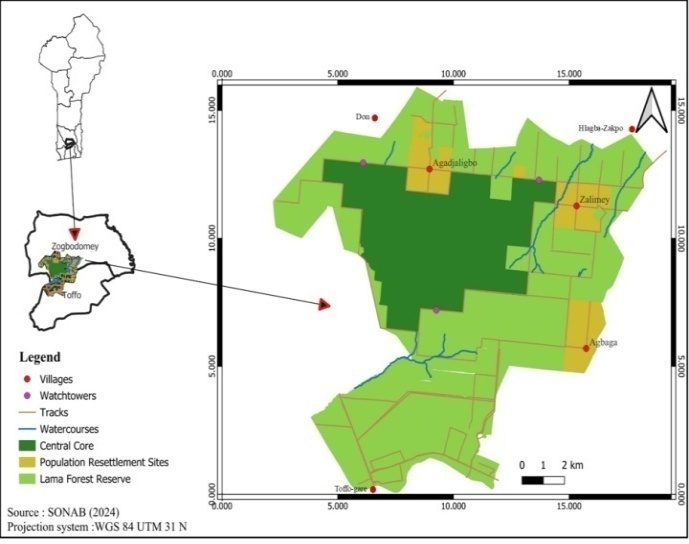
The study was carried out in the Lama Forest Reserve (Benin), which is co-managed by Société Nationale du Bois (SONAB) and local population. Located in Southern Benin (Figure 1), the Lama Forest Reserve (LFR), covering 16.250 hectares, is a multi-use protected area. The area is divided into three zones: a strictly protected central natural forest, Tectona grandis and Gmelina arborea plantations, and resettlement and agricultural zones. It has been legally protected as a Forest Reserve since 1946, which means that entry is prohibited and access to resources is limited for local populations. Villages are located within or near the forest 11, 12. Holli, Fon and Aizo socio-cultural groups mainly inhabit the forest.
A preliminary survey was conducted with 30 randomly selected respondents (over 18 years old) from three villages inside and three representative villages around the LFR 11, 13, 14. The objective of this initial phase was to estimate the proportion (p) of respondents able to identify patterns of wood use in the LFR. Based on the estimated proportion of positive responses (p = 0.90), the required sample size (n) was calculated (Eq.1) using the following Dagnelie formula 15.
 | (1) |
Where U1-α∕2 (α = 0.05) = 1.96, d: the margin error=5 %.
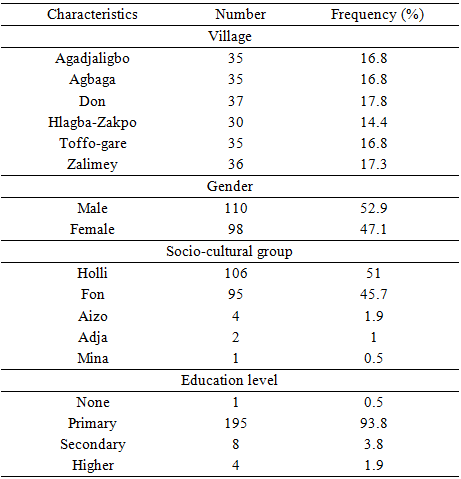
A total of 208 representative people (over 18 years old) 16 were randomly selected in the villages of Agadjaligbo (Agad) 17, Agbaga (Agb) 18, Zalimey (Zal) 17, Don (Don), Hlagba-Zakpo (Hlz), and Toffo-gare (Tg).
Authorization to conduct the survey was obtained from Société Nationale du Bois (SONAB). Verbal consent was obtained from the respondents prior to each survey being carried out 19. A structured questionnaire was used, and data were collected through a survey using face-to-face interviews in local languages 20. The survey collected socio-cultural and socio-demographic data on the respondents, such as age, gender, education level, village of residence and socio-cultural group, as well as information on the different uses of wood, such as for firewood, construction, commercial purposes and crafts.
Age was recorded as a continuous variable. Education level was collected as an ordinal variable, categorized as None (0), Primary (1), Secondary (2), and Higher (3). Both village of residence and socio-cultural group were included as nominal variables. Finally, gender (Female=0, Male=1) and wood uses data (No=0, Yes=1) were collected as binary variables.
Statistical analysis was performed using Rstudio (version 2025.05.1+ 513) 21. Both descriptive and inferential methods were used. Descriptive statistics, such as frequencies, was calculated and graphically visualized using the dplyr, scales and ggplot2 packages 21, 22.
Bayesian logistic regression 21, 23, 24, 25, 26, 27, 28 was performed with dplyr and rstanarm packages to analyze whether wood use patterns are significantly influenced by respondents’ sociodemographic and sociocultural characteristics.
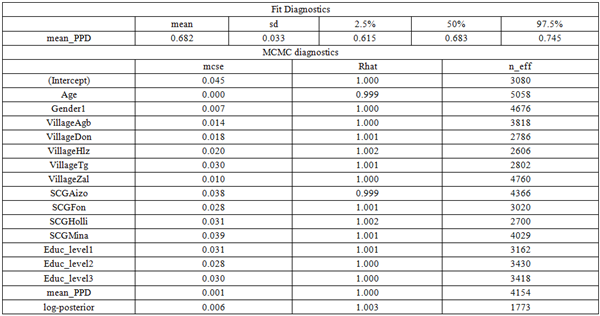
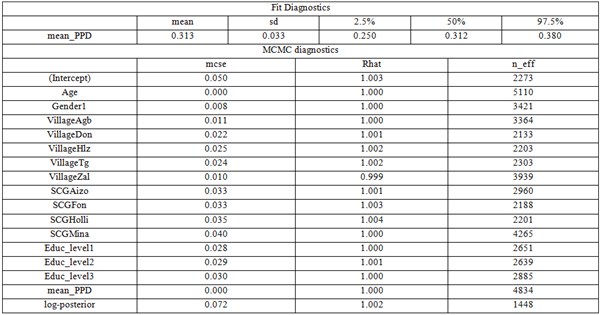
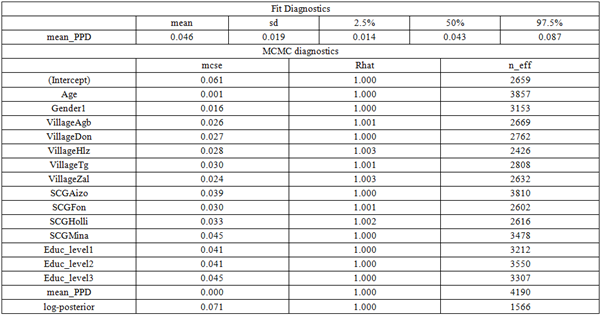
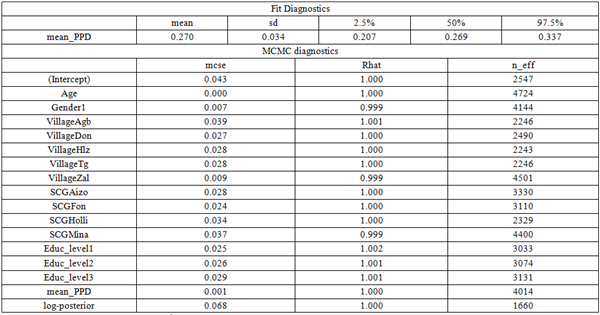
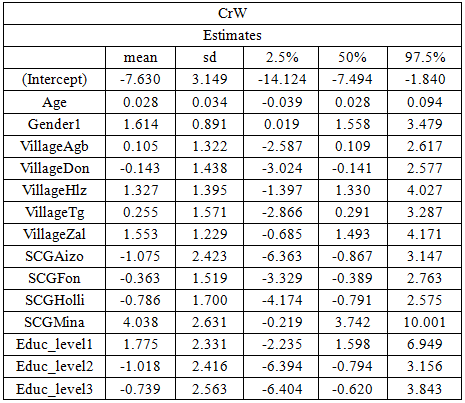
The interpretation of Bayesian model summary was straightforward and focused on the 95% credibility intervals, which were the 2.5% and 97.5% columns. An effect was considered significant if its credibility interval did not contain zero. The MCMC diagnostics were very good. The Rhat was close to 1.0 for all parameters, confirming that the model had converged well and the results were reliable. The n_eff was high (greater than 1000 for most parameters), indicating that the Markov chain sample size was adequate and the estimates were precise for firewood use patterns (Table 2), construction wood use patterns (Table 3), craft wood use patterns (Table 4), and commercial wood use patterns (Table 5).
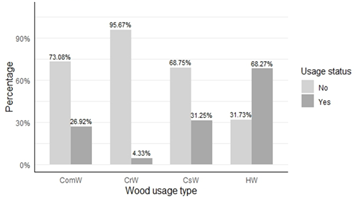
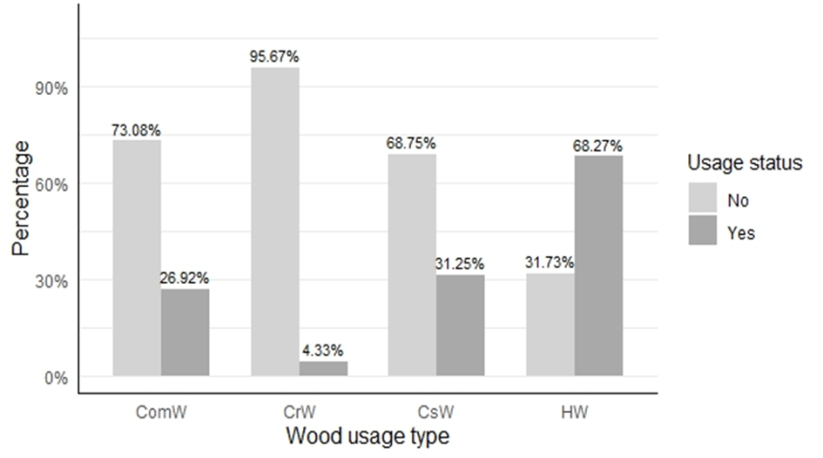
The findings show that respondents used wood in several forms: 68.27% for firewood (HW), 31.25% for construction wood (CsW), 26.92% for commercial wood (ComW), and 4.33% for craft wood (CrW) (Figure 2).
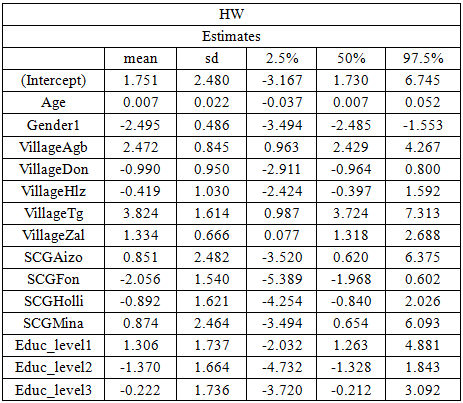
The coefficient for Men (Gender 1) was -2.485, and its credibility interval was [-3.494, -1.553]. Therefore, the effect was highly significant. The negative coefficient indicated that men were less likely to use firewood compared to women (Table 6).
Village membership had a significant influence, but it varied between villages. For Agbaga (Agb), the coefficient was 2.429, with an interval of [0.963, 4.267]. The coefficient was 3.724, with an interval of [0.987, 7.313] for Toffo-gare (Tg). This had a very significant and positive effect. The coefficient was 1.318, with an interval of [0.077, 2.688] for Zalimey (Zal). Thus, residents of Agbaga, Toffo-gare, and Zalimey were more likely to use firewood (Table 6).
The credibility interval for age was [-0.037, 0.052] and indicated that age did not have a significant influence on firewood use. Similarly, education levels did not have significant influence. All intervals for the various sociocultural groups also indicated they did not have a significant influence on firewood use (Table 6).
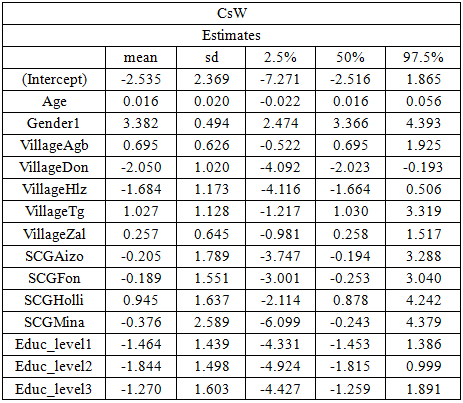
The coefficient for Men (Gender 1) was 3.366, and its credibility interval was [2.474, 4.393]. Since this interval was entirely positive, the effect was highly significant. The positive coefficient indicated that men were significantly more likely to use construction wood compared to women (Table 7).
Village membership had a significant influence, but only for one village. The coefficient was -2.023, and the interval was [-4.092, -0.193] for Don. This indicated a significant and negative effect: residents of Don were less likely to use construction wood. (Table 7).
The credibility interval for age was [-0.022, 0.056]. Therefore, age did not have a significant influence on construction wood use. None of the credibility intervals for the different education levels were significant, indicating that education level did not have a significant influence. Similarly, none of the intervals for the sociocultural groups were significant (Table 7).
The coefficient for Men (Gender1) was 1.558, and its credibility interval was [0.019, 3.479]. Given that this interval was entirely positive, the effect was significant, indicating that men were more likely to use craft wood compared to women (Table 8).
Age, village membership, sociocultural group, and education level did not have a significant influence on craft wood use (Table 8).
The coefficient for Men (Gender1) was -1.721, and its credibility interval was [-2.717, -0.850]. Therefore, men were less likely to use commercial wood than women (Table 9).
Village membership had a strong influence, but it varied between villages. The coefficient was -4.484, with an interval of [-9.282, -2.194]. This effect was significant and negative, meaning that residents of Agbaga (Agb) were less likely to use commercial wood. The coefficient was 1.677, with an interval of [0.567, 2.874], for Zalimey. Therefore, the inhabitants are more likely to use commercial wood (Table 9).
Age, education level, and sociocultural group did not have a significant influence on commercial wood use (Table 9).
Our study aimed to test whether wood use patterns in the LFR were influenced by the sociodemographic and sociocultural characteristics of residents, in accordance with our initial hypothesis. Our results, derived from a robust Bayesian model, confirm this hypothesis as 29, but with nuances, by highlighting specific variables and important distinctions depending on the type of wood use.
4.1. Factors Influencing the Use of Firewood, Construction, Craft, and Commercial Wood in the Lama Forest ReserveThe results reveal that gender and village membership are crucial factors in firewood use. Men are significantly less likely to use firewood than women. This finding is particularly relevant because it contrasts with some studies that minimize the influence of gender in contexts of resource scarcity 30. The higher probability of firewood use among women can be explained by their traditional role in domestic and culinary activities, where wood is often the main energy source 31. This observation highlights the need to integrate gender perspectives into forest management plans.
Furthermore, the significantly greater use of firewood observed in Agbaga, Toffo-Gare, and Zalimey compared to the other three villages indicates the critical influence of geographic proximity. 32. Local variations in resource accessibility or cultural cooking habits could explain these differences. This result supports the idea that a generic approach is insufficient and that it's crucial to acknowledge the diversity of local contexts 33.
In contrast to village membership and gender, our results indicate that age and education level do not have a significant influence on firewood use. This finding partly contradicts some literature suggesting that older individuals are more likely to use firewood 34, 35 or that education can reduce wood dependency 36. However, our result may be explained by the predominance of local geographical and behavioral factors 32, which may outweigh the influence of traditionally studied sociodemographic variables.
An analysis of wood use for construction, crafts, and commercial purposes reveals distinct dynamics. For construction and craft wood, men are significantly more likely to use it than women. These uses are often associated with construction, production, and income-generating activities, areas where men are typically more involved 36.
Conversely, the use of commercial wood, including charcoal, is less common among men, suggesting that women may play a more significant role in the informal or local value chains for this type of product. This observation once again highlights the complexity and nuances of forest exploitation based on product type.
Village membership plays a crucial role, but in varying ways. Construction wood is more likely to be used in some villages than in others. These local variations can be attributed to factors such as proximity, resource availability and accessibility, or the specifics of local economies.
Consistent with firewood results, age and education level have no significant influence on other forms of wood use. Furthermore, sociocultural groups do not appear to have an impact on any of the analyzed uses. While some studies suggest that age and education influence the perceived value of forest products 36, our data indicate that these variables are not significant predictors of wood use.
In the Lama Forest Reserve (LFR) plantations, the main exploited species (teak and gmelina), mainly provide timber and leaves. This contrasts with indigenous fruit species used for a wide array of purposes, including food, medicine, crafts, spiritual practices, as well as fuelwood, fodder, and rural construction material 37. Nevertheless, a few fruit species are cultivated in resettlement and agricultural areas. Furthermore, the LFR’s management system promotes sustainable exploitation by prioritizing the controlled harvesting of fast-growing exotic species while conserving slow-growing native species. This model stands in contrast to other protected areas in Benin, such as certain community forests, where local populations may exploit woody resources without ecological restoration measures, often leading to unsustainable exploitation 38.
4.2. Implications of Findings and Future Research PerspectivesTo expand upon the results of this study, future research should focus on the specific factors that explain the variations in wood use. This would involve conducting qualitative studies, particularly through interviews and focus groups on villages like Agbaga, Toffo-gare, and Zalimey. Such research would assess the impact of forest resource accessibility, the presence of local markets, as well as the influence of cultural habits and culinary practices on wood consumption.
It's crucial to better understand the economic value of wood for households. Future studies could quantify the monetary value of timber forest products to better assess the communities' economic dependency. It would also be relevant to analyze the wood value chains, from harvesting to sale. By distinguishing between self-consumption and commercial uses, we could identify commercial circuits and opportunities to develop sustainable value chains.
For more effective management, it's important to evaluate the impact of existing policies. Research should investigate the effects of formal and informal regulations on wood use practices. This would help determine whether access restrictions lead to illegal exploitation or, conversely, promote sustainable management. Furthermore, an in-depth analysis of gender roles is necessary. This would involve studying how men and women share in the exploitation and processing of different types of wood to identify decision-making points and the benefits for each gender.
In conclusion, wood use patterns are indeed influenced by certain sociodemographic characteristics, particularly gender and location. However, the influence of these variables is specific to the type of wood used. These findings underscore the need to develop forest management policies that are not uniform, but that consider local dynamics and the differentiated roles of gender within communities. Sustainable management can only be effective if it adapts to the complex and diverse realities that shape a community's relationship with the forest. It is imperative to move beyond generalizations and consider local specifics and gender roles to develop effective and equitable conservation policies. To be relevant, participatory management must therefore recognize and integrate these complex dynamics to ensure the sustainability of forest resources and the well-being of communities.
The authors thank the ITTO Fellowship Program (ITTO Ref. Number: 055/24A) for financial support for this research, the SONAB managers for authorizations to collect data, the local populations, the local field assistant and the students who provided technical support for the work.
The authors declare no competing interests.
| [1] | Abdeta, D., Ayana, A.N. and Bekele, Y, “Willingness to pay for forest conservation: Evidence from a contingent valuation, survey analysis in Southwest Ethiopia”, Global Ecology and Conservation, 46. e02551. October 2023. | ||
| In article | View Article | ||
| [2] | Kefa, C.A., Lung, M., Espira, A. and Gregory, A.J, “Quantifying the rate of subsistence wood harvesting from a tropical rainforest in Kenya”, Oryx, 52 (2). 369-373. April 2018. | ||
| In article | View Article | ||
| [3] | Phimmavong, S., Maraseni, T.N., Keenan, R.J. and Cockfield, G, “Financial returns from collaborative investment models of Eucalyptus agroforestry plantations in Lao PDR”, Land Use Policy, 87. 104060. September 2019. | ||
| In article | View Article | ||
| [4] | Kainyande, A., Hintz, K.S., Kyamagero, S., Auch, E. and Giessen, L, “Reviewing the ambiguity in the socio-economic outcomes of large-scale tree plantation investments: reconciling decades of contrasting evidence from sub-Saharan Africa”, International Forestry Review, 26 (4). 470-489. December 2024. | ||
| In article | View Article | ||
| [5] | Pirard, R., Dal Secco, L. and Warman, R, “Do timber plantations contribute to forest conservation?”, Environmental Science & Policy, 57. 122-130. March 2016. | ||
| In article | View Article | ||
| [6] | Barney, K, “Commercial timber plantations and community livelihoods: Insights from comparative case studies in southern Laos”, Forest Policy and Economics, 158. 103099. January 2024. | ||
| In article | View Article | ||
| [7] | Muluneh, A. and Sime, G, “Participatory Forest management for sustainable rural livelihoods and forest ecosystem services: The case of Deneba Forest Managing Cooperative in Ethiopia”, Journal for Nature Conservation, 78. 126580. March 2024. | ||
| In article | View Article | ||
| [8] | Lee, J.H., Kubo, Y., Fujiwara, T., Septiana, R.M., Riyanto, S. and Iwasa, Y, “Profit Sharing as a Management Strategy for a State-owned Teak Plantation at High Risk for Illegal Logging”, Ecological Economics, 149. 140-148. July 2018. | ||
| In article | View Article | ||
| [9] | Gabay, M. and Alam, M, “Community forestry and its mitigation potential in the Anthropocene: The importance of land tenure governance and the threat of privatization”, Forest Policy and Economics, 79. 26-35. June 2017. | ||
| In article | View Article | ||
| [10] | Al-Subaiee, F.S, “Socio-economic factors affecting the conservation of natural woodlands in Central Riyadh Area-Saudi Arabia”, Saudi Journal of Biological Sciences, 23 (3). 319-326. | ||
| In article | View Article PubMed | ||
| [11] | ONAB, Plan Directeur d’Aménagement et de Gestion du Noyau Central de la Forêt Classée de la Lama, 2011, 1-97. | ||
| In article | |||
| [12] | Agbahoungba, S., Assogbadjo, A.E., Chadare, F.J., Idohou, R., Salako, V.K., Agoyi, E.E. and Glèlè Kakaï, R.L, “Ecological diversity and conservation of wild edible fruit trees species in the Lama Forest Reserve in Benin”, Bois et Forêts des Tropiques, 329 (3). 53-65. July 2017. | ||
| In article | View Article | ||
| [13] | INSAE, Cahier des villages et quartiers de ville du département du Zou (RGPH-4, 2013), 2016a, 1-37. | ||
| In article | |||
| [14] | INSAE, Cahier des villages et quartiers de ville du département de l’Atlantique (RGPH-4, 2013), 2016b, 1-40. | ||
| In article | |||
| [15] | Dagnelie, P, Statistiques théoriques et appliquées, Tome 1, Bruxelles : De Boeck et Larcier, 1998, 1-508. | ||
| In article | |||
| [16] | Masud, M.M., Shahabudin, S.M., Baskaran, A. and Akhtar, R, “Co-management approach to sustainable management of marine protected areas: The case of Malaysia”, Marine Policy, 138. 105010. April 2022. | ||
| In article | View Article | ||
| [17] | Folahan, S.O.N., Dissou, E.F., Akouehou, G.S., Tente, B.A.H. and Boko, M, “Ecologie et structure des groupements végétaux des écosystèmes de la Lama au Sud-Bénin”, International Journal of Biological and Chemical Sciences, 12 (1). 322-340. February 2018. | ||
| In article | View Article | ||
| [18] | Nitiema, B., Hien, S., Traore, L., Boussim, I.J. and Guissou, K.M.L, “Caractérisation des services écosystémiques du Chantier d’Aménagement Forestier de Tiogo au Burkina Faso”, International Journal of Biological and Chemical Sciences, 18 (3). 904-916. June 2024. | ||
| In article | View Article | ||
| [19] | Gouwakinnou, G.N., Biaou, S., Vodouhe, F.G., Tovihessi, M.S., Awessou, B.K. and Biaou, H.S.S, “Local perceptions and factors determining ecosystem services identification around two forest reserves in Northern Benin”, Journal of Ethnobiology and Ethnomedicine, 15 (61). December 2019. | ||
| In article | View Article PubMed | ||
| [20] | Yetein, M.H., Houessou, L.G., Lougbégnon, T.O., Gbodja, G.T., Sèmèvo, D.F. and Oumorou, Madjidou, “Perceptions of ecosystem services provided by the landscapes of the coastal lagoon at the 1017 Ramsar site in Benin (West Africa)”, Environmental Challenges, 19. 101122. June 2025. | ||
| In article | View Article | ||
| [21] | Posit team, RStudio: Integrated Development Environment for R. Posit Software, PBC, Boston, MA, 2025. | ||
| In article | |||
| [22] | Ying, T.H., Kibria, A., SMG. and Nath, T.K., “Modeling city dwellers’ perceptions on the ecosystem services supplied by urban green spaces in Malaysia: A logistic regression analysis”. Environmental Development, 55. 101198. July 2025. | ||
| In article | View Article | ||
| [23] | Stroud, T.W.F, “Bayesian analysis of binary survey data”, The Canadian Journal of Statistics, 22 (1). 33-45. March 1994. | ||
| In article | View Article | ||
| [24] | Gelman, A., Jakulin, A., Pittau, M.G. and Su, Y.-S, “A weakly informative default prior distribution for logistic and other regression models”, Annals of Applied Statistics, 2 (4). 1360-1383. December 2008. | ||
| In article | View Article | ||
| [25] | Greco, T., Landoni, G., Biondi-Zoccai, G., D’Ascenzo, F. and Zangrillo, A, “A Bayesian network meta-analysis for binary outcome: how to do it”, Statistical Methods in Medical Research, 25 (5). 1757-1773. August 2013. | ||
| In article | View Article PubMed | ||
| [26] | Rainey, C, “Dealing with Separation in Logistic Regression Models”, Political Analysis, 24 (3). 339-355. August 2016. | ||
| In article | View Article | ||
| [27] | Negrín-Hernández, M.-A., Martel-Escobar, M. and Vázquez-Polo, F.-J, “Bayesian Meta-Analysis for Binary Data and Prior Distribution on Models”, International Journal of Environmental Research and Public Health, 18 (2). 1-18. January 2021. | ||
| In article | View Article PubMed | ||
| [28] | Clark, R.G., Blanchard, W., Hui, F.K.C., Tian, R. and Woods, H, “Dealing with complete separation and quasi-complete separation in logistic regression for linguistic data”, Research Methods in Applied Linguistics, 2. 100044. January 2023. | ||
| In article | View Article | ||
| [29] | Akpovo, A.H., et Fandohan, A.B, “Usages, distribution des connaissances traditionnelles et valeur économique de Ricinodendron heudelotii au Bénin”, Revue Marocaine des Sciences Agronomiques et Vétérinaires, 9(2). 274-285. Juin 2021. | ||
| In article | |||
| [30] | da Silva, M.M.S., Feitosa, I.S., Cruz, R.S., de Sá, V.A., de Medeiros, P.M. and da Silva, R.R.V, “Use of firewood for artisanal ceramic production in a context of forest scarcity in Northeastern Brazil”, Ethnobiology and Conservation, 12 (23). 1-14. November 2023. | ||
| In article | View Article | ||
| [31] | Semenya, K. and Machete, F, “Factors that influence firewood use among electrified Bapedi households of Senwabarwana Villages, South Africa”, African Journal of Science, Technology, Innovation and Development, 11 (6). 719-729. April 2019. | ||
| In article | View Article | ||
| [32] | Romanach, L. and Frederiks, E, “Understanding the Key Determinants of Residential Firewood Consumption in Australia: A Nationwide Household Survey”, Energies, 14 (20). 6777. October 2021. | ||
| In article | View Article | ||
| [33] | Dawson, N., Carvalho, W.D., Bezerra, J.S., Todeschini, F., Tabarelli, M. and Mustin, K, “Protected areas and the neglected contribution of Indigenous Peoples and local communities: Struggles for environmental justice in the Caatinga dry forest”, People and Nature, 5 (6). 1739-1755. November 2021. | ||
| In article | View Article | ||
| [34] | Nzabona, A., Tuyiragize, R., Assiimwe, J.B., Kakuba, C. and Kisaakye, P, “Urban Household Energy Use: Analyzing Correlates of Charcoal and Firewood Consumption in Kampala City, Uganda”, Journal of Environmental and Public Health, 2021 (1). 1-8. April 2021. | ||
| In article | View Article PubMed | ||
| [35] | Florkowski, W.J. and Neupane, S, “Cooking fuel frequency use in urban Uganda: addressing household air pollution”, Environmental Science and Pollution Research, 30. 120722-120734. November 2023. | ||
| In article | View Article PubMed | ||
| [36] | Kariuki, D.W, “Socio-Economic Determinants of Household Continued Use of Solid Biofuels (Fuelwood and Charcoal) for Cooking Purposes in Sub-Saharan Africa- Kenya’s Situation”, East African Journal of Environment and Natural Resources, 3 (1). 49-68. March 2021. | ||
| In article | View Article | ||
| [37] | Agbo, I.R., Missihoun, A.A., Vihotogbe, R., Assogbadjo, E.A., Ahanhanzo, C., et Agbangla, C, “Impacts des usages traditionnels sur la vulnérabilité de Detarium microcarpum, Guill. & Perr. (Caesalpiniaceae) dans le district phytogéographique Zou au Bénin (en Afrique de l’Ouest)”, International Journal of Biological and Chemical Sciences, 11 (2). 730–742. July 2017. | ||
| In article | View Article | ||
| [38] | Hadonou-Yovo, A.G., Houessou, L.G., Lougbegnon, T.O., Adebi, Y., Sinasson, G.K.S., Semevo, D.F., Lange, U., et Boko, M, “ Diversité et formes d’utilisation des espèces ligneuses de la Réserve de biosphère du Mono (Bénin)”, VertigO - la revue électronique en sciences de l'environnement, 19(2), Octobre 2019, mis en ligne le 05 octobre 2019, consulté le 23 octobre 2025. | ||
| In article | View Article | ||
Published with license by Science and Education Publishing, Copyright © 2025 Rodéric Roland Singbénou Sagbo and Sedjro Gilles Armel Nago
 This work is licensed under a Creative Commons Attribution 4.0 International License. To view a copy of this license, visit
http://creativecommons.org/licenses/by/4.0/
This work is licensed under a Creative Commons Attribution 4.0 International License. To view a copy of this license, visit
http://creativecommons.org/licenses/by/4.0/
| [1] | Abdeta, D., Ayana, A.N. and Bekele, Y, “Willingness to pay for forest conservation: Evidence from a contingent valuation, survey analysis in Southwest Ethiopia”, Global Ecology and Conservation, 46. e02551. October 2023. | ||
| In article | View Article | ||
| [2] | Kefa, C.A., Lung, M., Espira, A. and Gregory, A.J, “Quantifying the rate of subsistence wood harvesting from a tropical rainforest in Kenya”, Oryx, 52 (2). 369-373. April 2018. | ||
| In article | View Article | ||
| [3] | Phimmavong, S., Maraseni, T.N., Keenan, R.J. and Cockfield, G, “Financial returns from collaborative investment models of Eucalyptus agroforestry plantations in Lao PDR”, Land Use Policy, 87. 104060. September 2019. | ||
| In article | View Article | ||
| [4] | Kainyande, A., Hintz, K.S., Kyamagero, S., Auch, E. and Giessen, L, “Reviewing the ambiguity in the socio-economic outcomes of large-scale tree plantation investments: reconciling decades of contrasting evidence from sub-Saharan Africa”, International Forestry Review, 26 (4). 470-489. December 2024. | ||
| In article | View Article | ||
| [5] | Pirard, R., Dal Secco, L. and Warman, R, “Do timber plantations contribute to forest conservation?”, Environmental Science & Policy, 57. 122-130. March 2016. | ||
| In article | View Article | ||
| [6] | Barney, K, “Commercial timber plantations and community livelihoods: Insights from comparative case studies in southern Laos”, Forest Policy and Economics, 158. 103099. January 2024. | ||
| In article | View Article | ||
| [7] | Muluneh, A. and Sime, G, “Participatory Forest management for sustainable rural livelihoods and forest ecosystem services: The case of Deneba Forest Managing Cooperative in Ethiopia”, Journal for Nature Conservation, 78. 126580. March 2024. | ||
| In article | View Article | ||
| [8] | Lee, J.H., Kubo, Y., Fujiwara, T., Septiana, R.M., Riyanto, S. and Iwasa, Y, “Profit Sharing as a Management Strategy for a State-owned Teak Plantation at High Risk for Illegal Logging”, Ecological Economics, 149. 140-148. July 2018. | ||
| In article | View Article | ||
| [9] | Gabay, M. and Alam, M, “Community forestry and its mitigation potential in the Anthropocene: The importance of land tenure governance and the threat of privatization”, Forest Policy and Economics, 79. 26-35. June 2017. | ||
| In article | View Article | ||
| [10] | Al-Subaiee, F.S, “Socio-economic factors affecting the conservation of natural woodlands in Central Riyadh Area-Saudi Arabia”, Saudi Journal of Biological Sciences, 23 (3). 319-326. | ||
| In article | View Article PubMed | ||
| [11] | ONAB, Plan Directeur d’Aménagement et de Gestion du Noyau Central de la Forêt Classée de la Lama, 2011, 1-97. | ||
| In article | |||
| [12] | Agbahoungba, S., Assogbadjo, A.E., Chadare, F.J., Idohou, R., Salako, V.K., Agoyi, E.E. and Glèlè Kakaï, R.L, “Ecological diversity and conservation of wild edible fruit trees species in the Lama Forest Reserve in Benin”, Bois et Forêts des Tropiques, 329 (3). 53-65. July 2017. | ||
| In article | View Article | ||
| [13] | INSAE, Cahier des villages et quartiers de ville du département du Zou (RGPH-4, 2013), 2016a, 1-37. | ||
| In article | |||
| [14] | INSAE, Cahier des villages et quartiers de ville du département de l’Atlantique (RGPH-4, 2013), 2016b, 1-40. | ||
| In article | |||
| [15] | Dagnelie, P, Statistiques théoriques et appliquées, Tome 1, Bruxelles : De Boeck et Larcier, 1998, 1-508. | ||
| In article | |||
| [16] | Masud, M.M., Shahabudin, S.M., Baskaran, A. and Akhtar, R, “Co-management approach to sustainable management of marine protected areas: The case of Malaysia”, Marine Policy, 138. 105010. April 2022. | ||
| In article | View Article | ||
| [17] | Folahan, S.O.N., Dissou, E.F., Akouehou, G.S., Tente, B.A.H. and Boko, M, “Ecologie et structure des groupements végétaux des écosystèmes de la Lama au Sud-Bénin”, International Journal of Biological and Chemical Sciences, 12 (1). 322-340. February 2018. | ||
| In article | View Article | ||
| [18] | Nitiema, B., Hien, S., Traore, L., Boussim, I.J. and Guissou, K.M.L, “Caractérisation des services écosystémiques du Chantier d’Aménagement Forestier de Tiogo au Burkina Faso”, International Journal of Biological and Chemical Sciences, 18 (3). 904-916. June 2024. | ||
| In article | View Article | ||
| [19] | Gouwakinnou, G.N., Biaou, S., Vodouhe, F.G., Tovihessi, M.S., Awessou, B.K. and Biaou, H.S.S, “Local perceptions and factors determining ecosystem services identification around two forest reserves in Northern Benin”, Journal of Ethnobiology and Ethnomedicine, 15 (61). December 2019. | ||
| In article | View Article PubMed | ||
| [20] | Yetein, M.H., Houessou, L.G., Lougbégnon, T.O., Gbodja, G.T., Sèmèvo, D.F. and Oumorou, Madjidou, “Perceptions of ecosystem services provided by the landscapes of the coastal lagoon at the 1017 Ramsar site in Benin (West Africa)”, Environmental Challenges, 19. 101122. June 2025. | ||
| In article | View Article | ||
| [21] | Posit team, RStudio: Integrated Development Environment for R. Posit Software, PBC, Boston, MA, 2025. | ||
| In article | |||
| [22] | Ying, T.H., Kibria, A., SMG. and Nath, T.K., “Modeling city dwellers’ perceptions on the ecosystem services supplied by urban green spaces in Malaysia: A logistic regression analysis”. Environmental Development, 55. 101198. July 2025. | ||
| In article | View Article | ||
| [23] | Stroud, T.W.F, “Bayesian analysis of binary survey data”, The Canadian Journal of Statistics, 22 (1). 33-45. March 1994. | ||
| In article | View Article | ||
| [24] | Gelman, A., Jakulin, A., Pittau, M.G. and Su, Y.-S, “A weakly informative default prior distribution for logistic and other regression models”, Annals of Applied Statistics, 2 (4). 1360-1383. December 2008. | ||
| In article | View Article | ||
| [25] | Greco, T., Landoni, G., Biondi-Zoccai, G., D’Ascenzo, F. and Zangrillo, A, “A Bayesian network meta-analysis for binary outcome: how to do it”, Statistical Methods in Medical Research, 25 (5). 1757-1773. August 2013. | ||
| In article | View Article PubMed | ||
| [26] | Rainey, C, “Dealing with Separation in Logistic Regression Models”, Political Analysis, 24 (3). 339-355. August 2016. | ||
| In article | View Article | ||
| [27] | Negrín-Hernández, M.-A., Martel-Escobar, M. and Vázquez-Polo, F.-J, “Bayesian Meta-Analysis for Binary Data and Prior Distribution on Models”, International Journal of Environmental Research and Public Health, 18 (2). 1-18. January 2021. | ||
| In article | View Article PubMed | ||
| [28] | Clark, R.G., Blanchard, W., Hui, F.K.C., Tian, R. and Woods, H, “Dealing with complete separation and quasi-complete separation in logistic regression for linguistic data”, Research Methods in Applied Linguistics, 2. 100044. January 2023. | ||
| In article | View Article | ||
| [29] | Akpovo, A.H., et Fandohan, A.B, “Usages, distribution des connaissances traditionnelles et valeur économique de Ricinodendron heudelotii au Bénin”, Revue Marocaine des Sciences Agronomiques et Vétérinaires, 9(2). 274-285. Juin 2021. | ||
| In article | |||
| [30] | da Silva, M.M.S., Feitosa, I.S., Cruz, R.S., de Sá, V.A., de Medeiros, P.M. and da Silva, R.R.V, “Use of firewood for artisanal ceramic production in a context of forest scarcity in Northeastern Brazil”, Ethnobiology and Conservation, 12 (23). 1-14. November 2023. | ||
| In article | View Article | ||
| [31] | Semenya, K. and Machete, F, “Factors that influence firewood use among electrified Bapedi households of Senwabarwana Villages, South Africa”, African Journal of Science, Technology, Innovation and Development, 11 (6). 719-729. April 2019. | ||
| In article | View Article | ||
| [32] | Romanach, L. and Frederiks, E, “Understanding the Key Determinants of Residential Firewood Consumption in Australia: A Nationwide Household Survey”, Energies, 14 (20). 6777. October 2021. | ||
| In article | View Article | ||
| [33] | Dawson, N., Carvalho, W.D., Bezerra, J.S., Todeschini, F., Tabarelli, M. and Mustin, K, “Protected areas and the neglected contribution of Indigenous Peoples and local communities: Struggles for environmental justice in the Caatinga dry forest”, People and Nature, 5 (6). 1739-1755. November 2021. | ||
| In article | View Article | ||
| [34] | Nzabona, A., Tuyiragize, R., Assiimwe, J.B., Kakuba, C. and Kisaakye, P, “Urban Household Energy Use: Analyzing Correlates of Charcoal and Firewood Consumption in Kampala City, Uganda”, Journal of Environmental and Public Health, 2021 (1). 1-8. April 2021. | ||
| In article | View Article PubMed | ||
| [35] | Florkowski, W.J. and Neupane, S, “Cooking fuel frequency use in urban Uganda: addressing household air pollution”, Environmental Science and Pollution Research, 30. 120722-120734. November 2023. | ||
| In article | View Article PubMed | ||
| [36] | Kariuki, D.W, “Socio-Economic Determinants of Household Continued Use of Solid Biofuels (Fuelwood and Charcoal) for Cooking Purposes in Sub-Saharan Africa- Kenya’s Situation”, East African Journal of Environment and Natural Resources, 3 (1). 49-68. March 2021. | ||
| In article | View Article | ||
| [37] | Agbo, I.R., Missihoun, A.A., Vihotogbe, R., Assogbadjo, E.A., Ahanhanzo, C., et Agbangla, C, “Impacts des usages traditionnels sur la vulnérabilité de Detarium microcarpum, Guill. & Perr. (Caesalpiniaceae) dans le district phytogéographique Zou au Bénin (en Afrique de l’Ouest)”, International Journal of Biological and Chemical Sciences, 11 (2). 730–742. July 2017. | ||
| In article | View Article | ||
| [38] | Hadonou-Yovo, A.G., Houessou, L.G., Lougbegnon, T.O., Adebi, Y., Sinasson, G.K.S., Semevo, D.F., Lange, U., et Boko, M, “ Diversité et formes d’utilisation des espèces ligneuses de la Réserve de biosphère du Mono (Bénin)”, VertigO - la revue électronique en sciences de l'environnement, 19(2), Octobre 2019, mis en ligne le 05 octobre 2019, consulté le 23 octobre 2025. | ||
| In article | View Article | ||