The Mining Environmental Impact Assessment Methodology (MEIAM) is developed to allow predicting environmental and human health impacts on mining projects. It combines both the chronic and the accidental sources of impacts, and that at all phases of the life cycle of the project, including the prospection and the after closure of the mine. The method is designed to address all environmental problems: groundwater, surface water, soil, air, fauna and flora. A case study to test the feasibility of MEIAM and to compare its outputs to the usual approach has been carried out for the Afema gold mine located in Côte d’Ivoire. The case study was restricted to the groundwater. The results of this implementation were compared with those obtained by using the matrices method in the EIA study of this mining project. The two methods led to different conclusions. Unlike the EIA study, MEIAM identifies and evaluates many pollution scenarios. In the EIA study the potential groundwater pollution scenario involving soils leaching and, working face (open pit borders) were not considered. In addition, the exploration phase was not considered in the EIA study. The present work concluded that the impact of groundwater pollution is high at the operation and the closure phases, while previous study indicated an average impact (for the few considered scenarios). For these high impacts, some measures have been proposed to protect groundwater resources. MEIAM better assesses the impact of pollution by considering the intrinsic parameters (geology, climate, initial state of the environmental component) of the mine site, the nature of the potential pollutants and feedbacks. It may therefore be of considerable value in mining projects.
Environmental Impact Assessment (EIA) is the procedure of the identification and evaluation of impacts on the environmental of planned activities, policies or programs 1, 2, 3, 4. EIA is mandatory before approval of infrastructure projects with significant impacts on the environment 4, 5. However, the concept of EIA varies from place to place and changes over time 5. These authors show that there is no univocal and unanimously accepted definition of EIA and that therefore there can be no homogeneity of methods around the world. Nevertheless, they recognize as 1, 6, 7, 8 that the overall context in which integrates the EIA is fundamentally similar from one place to another and consequently that the various procedures are largely similar. A generic model of the EIA process includes distinct stages, namely screening, scoping, impact prediction and evaluation, mitigation, reporting, decision-making, and post-project monitoring and evaluation (EIA follow-up) 1, 2, 6, 7, 8. Screening involves conducting a preliminary but sufficient analysis of the proposed project to know its components 5, aiming to determine if this project requires an EIA to performed. Guidelines for whether an EIA is required are country specific depending on the laws or norms in operation. Legislation often specifies the criteria for screening and full EIA. Development banks also screen projects presented for financing to decide whether an EIA is required using their set criteria 3. For example, European EIA guidelines apply to a wide range of defined public and private projects; some of them are still mandatory (e.g., long-distance railway lines or facilities for the disposal of hazardous wastes), whereas others are at the discretion of the member states based on a case-by-case examination or on thresholds set by the member state 8.
Scoping involves prioritization of the key issues involved in the studied project because the objective of the EIA is not to study all the environmental impacts of all the projects 3. Scoping is used to identify the key issues of concern at an early stage in the planning process. This identification is used to determine the scope of the study, the level of details and the terms of reference to be addressed in the EIA Report 3. It is therefore intended to focus as effectively as possible on the detailed examination that will follow 5. The last phase of scoping consists in characterizing the environment through the identification and description of the various elements of the environment, namely the biophysical and human environment, which can be affected by the implementation of the project 3, 5.
Impact prediction consists of characterizing the impact of the activities or anticipated environmental effects on the various components of the environment. Prediction should be based on the available environmental baseline for the project area. Such predictions are described in quantitative or qualitative terms 3. It is a question of estimating the apprehended magnitude of the modifications that the elements of the environment will undergo following the realization of the project 3, 5.
Impact assessment is the core of the procedure 3, 8. It is decisive for decision-making 5 and consists in assessing the significance of impacts.
Mitigation consists of recommending of measures to minimize unavoidable impacts, as well as compensation measures for residual impacts. This step requires feedback to the project under study.
The final steps of the EIA procedure are the drafting of an EIA report which should contain the program of monitoring activities and proposed actions throughout the project's operational life until its final stage. Public participation is strongly encouraged at all stages of the process 3.
The EIA procedure relies on different tools at all stages of the procedure. For the scoping stage, checklists, matrices, networks, consultations with local stakeholders 9, map overlays, geographic information systems, expert systems, and professional judgement 10 are usually used to ensure that all potential impacts are detected 8. For impact assessment, methods for predicting the characteristics of impacts include, inter alia, professional judgement, quantitative mathematical models, experiments, physical models 3, and case studies as analogues or point of reference 8, 10. Therefore, EIA practitioners are free to choose among available methods or models and their own expertise to estimate project environmental impacts 3. The environmental impacts are often separated in two major classes according to the frequency of occurrence, the chronic events, such as waste production and discharge in normal function, and the accidental events, like leakage in degraded operation conditions. At present, these two types of events are evaluated with different tools and leading to different indicators. Accidental events are evaluated using standard risk analysis methods 4, 11 and chronic events that could be described as impacts are also evaluated with other methods 12, 13. Estimating the global impact into environment is thus not easy as the indicators used are not homogeneous. So, several authors 4, 11, 14 have suggested the integration of the risk analysis (RA) methods in EIA procedure. Although 14 established a methodological framework for RA integration in EIA procedure, they did not carry out a case study. The methodology of case study research was limited to reviewing Environmental Impact Statements (EISs) and supporting materials. Reviewing EIS is an established method of identifying strength and weaknesses of the EIA practice, which is based on the principle “what is done is documented” 14. Their proposal of integrating RA into EIA may be considered as a framework for consistent treatment of human health impacts of high-risk and high-profile projects including chemical and nuclear power plants, dams and reservoirs, waste treatment and disposal facilities. 4 also proposed the implementation of RA in EIAs and carried out a case study on a project to build a flood protection structure in Slovakia. These authors limited their analysis to the environmental impacts of accidental events.
In the present work, we propose to consider both chronic and accidental events in a single procedure. The objective is to achieve a harmonized method for assessing chronic and accidental events. The Mining Environmental Impact Assessment Methodology (MEIAM) is a method of evaluation using easily accessible and exploitable parameters of the study area using techniques such as the multi-criteria analysis to carry out a comparative study that can enable all stakeholders (mining companies, authorities, environmental protection agencies or academic groups), to have an easy but exhaustive tool for performing and criticizing an ordinary EIA.
To do this, taking inspiration from the risk analysis approach, we have developed a method integrating the evaluation of the impacts generated by chronic events and accidental events.
A case study applying this method is presented, the future gold mine of Afema, located in the South-East of Côte d’Ivoire (West Africa).
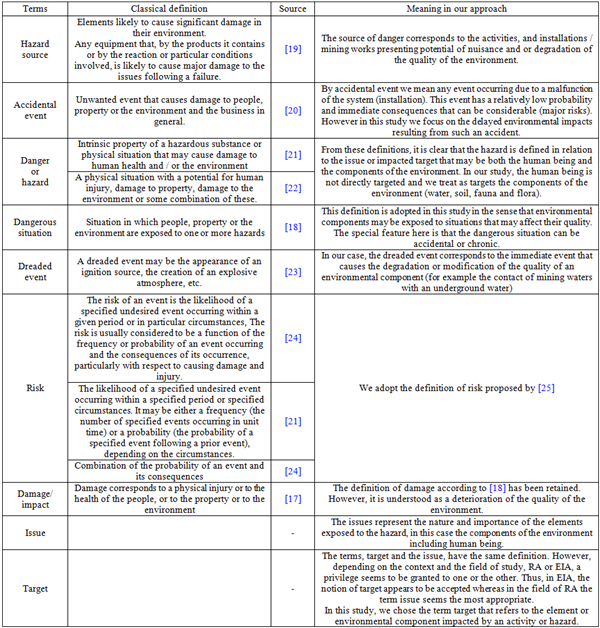
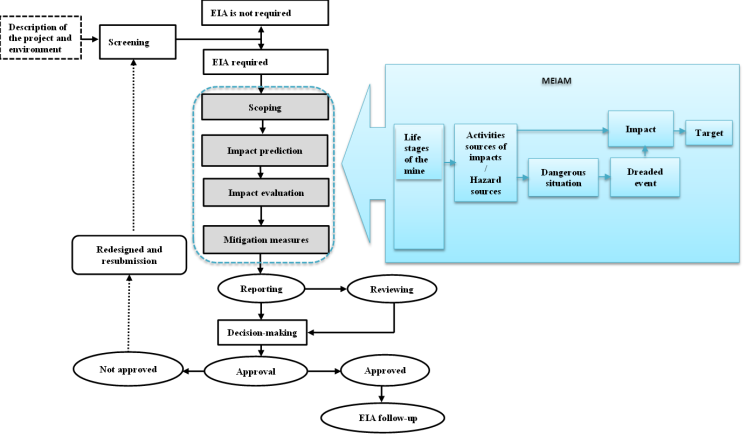
Since this method is based on the risk analysis approach, it seems necessary to clarify the terms of the risk analysis used (by misuse of language) and the meaning given to them in this new approach (Table 1). The proposed method can be used at the scoping, impact prediction, impact assessment, and mitigation measures stages of the EIA procedure (Figure 1).
2.2. Description of MEIAMThis method starts with the analysis of the system studied (mining) to determine the potential sources of impacts or potential sources of hazard (Table 1) to which the environment (in the broad sense) is exposed, followed by the estimation of the level or significance of the impact based on the impacted component. The analysis takes into account all phases of a mine's life including the long-term future of the mine site. Mining is accompanied by the construction of mineral processing facilities and waste rock and tailings disposal structures that can cause pollution as they evolve over time and according to many internal and external parameters.
The basic assumption is that any situation likely to alter the quality of the environment should be considered a dreaded phenomenon and thus, should be included in the analysis. Following the structure of classical methods of risk analysis 15, 16, 17, 18, MEIAM comprises 4 steps: 1- System definition; 2- identification of dangers and dangerous situations for environment; 3- impact (damage) evaluation and 4- impact reduction measures. These parts are detailed in the following paragraphs.
The estimation of the impact involves identifying the sources of the impacts and the different mechanisms that govern its appearance. This step involves a thorough review of each phase of the mine to determine the dangerous situations and the undesired event that may be associated.
The sources of these events can be the activities directly carried out in the context of mining operations, mining works, but also the storage of products of all kinds which constitute potential sources of pollution.
This identification phase therefore requires precise knowledge of the mining site, the methods of exploitation and the chemicals used. It also implies knowledge of the surrounding environment. Therefore, from the perspective of environmental impact assessment, groundwater and surface water, soil, and air are the environmental compartments to protect, and biodiversity, the end point target. However, for the case study presented here, we will limit our analysis to the groundwater.
In mining context, water pollution is usually considered as the consequence of all the activities that contribute to mineral (useful substance) extraction. These activities cover clearing and stripping operations of the mineralized zones as well as the use of chemicals for concentrating the ore. However, according to feedbacks (lessons learned from similar cases) 26, the environmental impacts derived from the presence on a mining site tailings ponds and waste rock cannot be neglected. In general, we can distinguish several sources:
- Works of exploitation, recognition, - access to the deposit from the surface and underground;
- Ore processing and purification facilities;
- Deposits of wastes resulting from research and mining or processing of ore;
- Storage of hydrocarbons (fuels, lubricants, and other maintenance products);
Water pollution depends both on the exploitation conditions and the natural predisposition of the mining area. It may result from various scenarios as described in section below.
Thus, dangerous situations for groundwater pollution correspond to the leaching of mining waste stored on the surface, leaching of land contaminated by atmospheric deposition, leakage and/or breakage of tailings ponds, leaching of working face (borders of the pits) and the accidental spill of chemical products (hydrocarbons, lubricants, etc.).
This step concerns the estimation and the evaluation of the level or the significance of the environmental impact. The first step requires linking each potential source with the event generated for each stage of the mining cycle and then to estimating the level of the impact. The determination of the significance of the impact results from the knowledge of its probability of occurrence and the severity of its consequences. The estimation of the risk level is based on the crossing of the predictable severity of the event (here the pollution) with its probability of occurrence 10. Therefore, this estimation requires a thorough knowledge of the environment and its characteristics in order to better characterize the probability of occurrence and the severity of the pollution. In practice, risk estimation can be done in several ways depending on the nature of the event being analyzed, knowledge or availability of data 17, 27. A distinction is made between quantitative and qualitative risk estimation.
- Quantitative estimation: quantitative risk estimation is based on the estimation of the probabilities of the event from statistical studies. These studies are based on long series of actual data or obtained experimentally in the laboratory. The quantitative estimation thus consists in a calculation of the probabilities of occurrence (in the mathematical sense) for each feared phenomenon.
- Qualitative estimation: the probabilistic approach finds its limits when the data are in insufficient quantities (difficult experimental measurements, few statistical data, etc.). The calculation of probabilities is then based on hypotheses that can be too simplistic, and thus, lead to results that can be criticized or inoperable 15. The qualitative estimation of risks is in these conditions privileged. It is based both on the judgment of experts and on the limited information available 26.
In this study we adopt the same approach to evaluate the impact, that is, the assessment of the probability of occurrence and the severity of the consequences.
Given the very partial nature of the information available, the complexity of the mechanisms and the heterogeneous nature of the natural environment, the qualitative assessment was favored in this study. For this, during the work, the term predisposition will be used instead of the probability of occurrence.
The predisposition corresponds to the chance that the danger becomes an event. It depends on several favorable or unfavorable factors. These factors may be climatic, geomorphological, geological, geotechnical, or hydrogeological. For example, the chances of an acid mine drainage (AMD) development and therefore of polluting the water is low in regions where the climate is such that it almost never rains.
The severity of the phenomenon corresponds to the extent of the consequences or nuisances that may result from the dreaded phenomenon. Severity is estimated from the factors characterizing the consequences of the dreaded phenomenon.
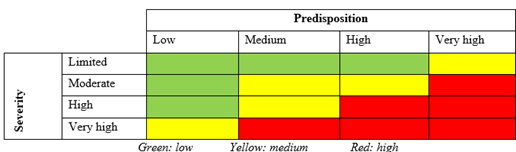
Therefore, the determination of the level of the impact results from the crossing of the factors expressing the severity of a given dreaded phenomenon with those characterizing the predisposition. To do this, classes of severity and predisposition must be defined for each dreaded phenomenon.
Finally, the evaluation of the impact is done by comparing the impact levels for each danger with the predefined acceptable impact criteria.
From the identified sources (section 2.1.2), several scenarios of pollution can occur. For this phase we have been inspired by numerous bibliographical works, including 26, 28, 29.
○ Polution by leaching of tailings
Groundwater pollution may result from leaching of tailings, particularly residues from treatment. Indeed, it is common in mining to observe large quantities of processing residues stored on the surface. However, due to rain, a water table can develop there. It follows that the deposition behaves like a permeable porous aquifer which can give rise to an AMD. As a result, the infiltration water, which has become very acidic at the end of this phenomenon, is loaded with dissolved metallic elements and suspended matter and reaches groundwater.
○ Accidental pollution
Changes in the chemical characteristics of groundwater in the mining area may also be related to unforeseeable phenomena such as accidental spills of chemicals (hydrocarbons, ore processing products) and breakage of retention structures. These situations, when they occur, can release large quantities of pollutants that reach groundwater through the infiltration mechanism.
○ Pollution by leaching of the working faces (cavities fronts)
The mining works, open pit or underground, lead to the opening of the geological formations in place. Thus, these mineralized formations can undergo leaching by the infiltration waters, which become charged with elements which have become soluble in the presence of oxygen. This process leads to an increase in concentrations of toxic or undesirable elements that modify the quality of the groundwater.
○ Pollution by leaching of soils contaminated by falling dust
During mining operations, dust deposits contaminate the surrounding soil, mainly in metallic elements. As in the case of accidental spills of pollutants, leaching of these soils through infiltration can lead to pollution of groundwater.
Predisposition results from the combination of the natural predisposition of the environment (intrinsic vulnerability) and the probability of dangerous situations.
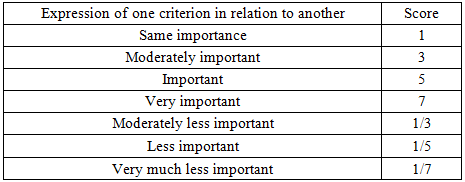
The evaluation of natural predisposition may involve several favorable or unfavorable factors. It is therefore necessary to weigh these factors. This is done using the multicriteria analysis technique according to the Analytical Hierarchy Process (AHP) developed by 30. Indeed, according 31, 32, contrary to the weighting technique based on the arbitrary choice of weights, 30 proposed a simple method whose framework is consolidated by mathematical calculations which generate weight coefficients (weight). First, the factors that make it possible to evaluate the predisposition of a given phenomenon are compared two by two according to Table 2. When two factors have the same importance in the manifestation of a given phenomenon, score 1 is affected. Moreover, for factors considered less important than others, the inverses of the scores given to important factors are affected. Thus, a matrix called a comparison matrix or judgment matrix is obtained (Table S1).
For the dreaded phenomenon, groundwater pollution for example, the factors or criteria considered to evaluate the predisposition of an area to pollution are:
- the permeability of geological formations;
- the physicochemical quality of the water;
- the groundwater recharge;
- the type of soil;
- the intrinsic mobility of pollutants.
Details on these factors are given in the application example section.
In Table S1, it is estimated that the permeability of geological formation is 5 times greater than the current physicochemical quality of these waters when evaluating the susceptibility to groundwater pollution in an area. Thus we have: permeability vs water quality = 5 and water quality vs permeability = 1/5 . In this way, the calculations of the eigenvectors (V) and the weight (W) become easy. They are made from the matrix (M) generated by the pairwise comparison of the factors (Table S1). The first step consists in summing the elements of each column of the M matrix (Table S2). Then, each element of the M matrix is divided by the sum of the corresponding column. This step leads to a second matrix called standardized matrix (Table S3). Eigenvectors are obtained by summing each row of the standardized matrix and priorities or weights (W) are obtained by dividing each eigenvector by the total sum of all the criteria (Table S3).
Once priorities are obtained, the next step is to check the consistency of the judgment on the factors through the calculation of the Consistency Index (CI). A perfect consistent decision should always lead to CI=0, but 33 argued that small values of inconsistency may be tolerated. The inconsistencies are tolerable if
 | (1) |
CI: Consistency Index
RI: Random Index
For a given number of criteria, the RI values are presented in table S4.
The Consistency Index is obtained according to the following steps:
- Multiply each column of the comparison matrix by the corresponding W. This makes it possible to obtain a new matrix;
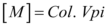 | (2) |
Col: considered column;
Vpi: Eigenvector corresponding to the considered column;
- Sum the elements of each row of this matrix:
 | (3) |
- Divide each row total by the Vp of the criterion corresponding to that row:
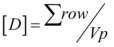 | (4) |
- Determine the mean (λ max) of the results obtained in the previous step:
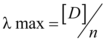 | (5) |
- Determine the Consistency Index CI:
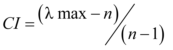 | (6) |
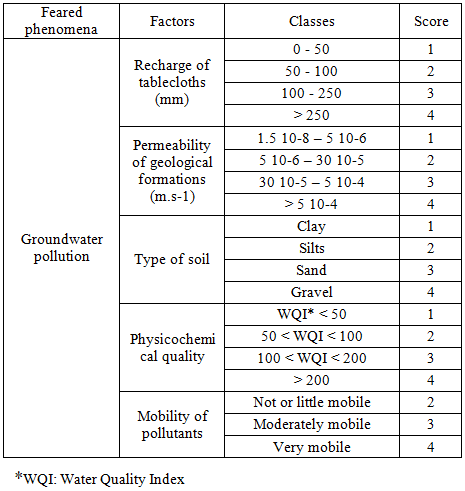
Finally, the predisposition factors are evaluated on a scale of 1 to 4. For each factor, when the conditions of the terrain lend themselves well to the realization of the dreaded phenomenon (groundwater pollution), score 4 is granted. Otherwise, score 1 is assigned. Intermediate scores of 2 and 3 are assigned according to expert judgement based on field conditions. Indeed, the data collected during the field and/or bibliographic studies are grouped by classes. Then the assignment of the scores depends on whether the class is favorable to the phenomenon (Table 3).
Moreover, since the dreaded phenomenon (pollution) is initiated by a situation which is described here as a dangerous situation, this situation is also evaluated on another scale from 1 to 4. This evaluation is made qualitatively by taking into account the state of the terrain, the methods of exploitation and feedbacks. For example, where tailings are exposed to the surface without vegetation cover or other protection and in an area of high rainfall, there is a good chance that the waste will be leached. In the end, the predisposition to pollution is obtained by combining the intrinsic vulnerability factor scores and those of the dangerous situations as shown in equation (7).
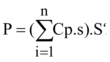 | (7) |
Where P is predisposition to pollution, Cp is weighting coefficient or weight of each factor obtained by multicriteria analysis; s is score for each factor, and S, the score corresponding to the dangerous situation.
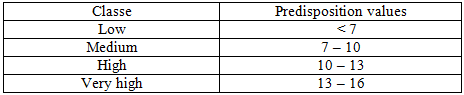
Thus, the final predisposition scores range from 1 (less likely) to 16 (most likely). When the dangerous situation score is 1 (i.e. no chance of this happening), whereas all factors are favorable (score 4 for each of them), the final predisposition value is 4 (i.e. 1 × 4). Therefore, by reclassifying the predisposition values into four classes, it was assumed that the value 4 is the minimum predisposition value and 16 the maximum value (Table 4).
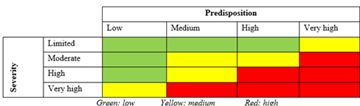
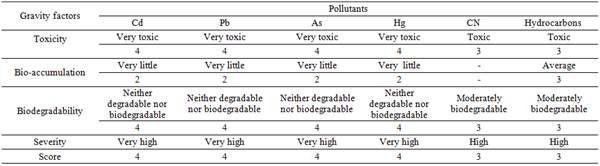
The severity of the pollution phenomenon depends on the nature of the pollutant, its concentration in the contaminated water, and the exposure of the targets (human, living organisms) to this contaminated water. However, given the predictive nature of the impact assessment and the difficulty of simulating expected concentrations, severity is estimated by considering the three most relevant parameters that characterize a given pollutant: toxicity, biodegradability and bioaccumulation of the pollutant 35. For a given substance when scores for different severity criteria are different, the highest score is used to estimate severity. This choice can be explained by the fact that we estimate that roughly the criteria toxicity, biodegradability and bioaccumulation are equally important for judging the severity of a pollutant. In addition, the guideline values for water quality limits and references proposed by 36 are used to estimate the level of toxicity or the nuisance to the environment and to human health. Indeed, the more toxic an element is, less the limit value permitted for drinking water is high. The scores range from 1 to 4 as shown in Table 5.
The impact estimation is obtained by combining the levels of severity with those of the predisposition to pollution as indicated in Figure 2. These impact classes are defined based on the bibliography 15, 26.
Once the impact for all phases of mine’s life is known, the next step is to propose measures to fight against the appearance of these impacts.
The reduction of the impact includes all the actions or measures to be implemented to reduce, on the one hand, the chance that the pollution will occur and, on the other hand, the severity of the pollution. These measures relate in particular to impacts deemed to be high. The aim is to propose remedial measures and good practices to avoid or limit the occurrence of a dangerous situation and/or to limit its consequences.
2.3. Application to the Afema Gold MineTo illustrate the method, an application case has been carried out on a gold mine in Côte d'Ivoire.
The mining project is located in the department of Aboisso in the South-East of the Côte d’Ivoire, about 130 km from Abidjan. The study area corresponds to the area (850 km2) of the 2 watersheds of the Ehania and Noé rivers. This delimitation takes into account the potential influence zone of the mining activities on the natural environment 37. Several secondary watercourses draining the area are added to the rivers Ehania and Noé (Figure S1). The climate is sub-equatorial, always wet and locally called “climat Attiéen” 37. Rainfall is abundant with an annual average of more than 1600 mm of rain. Four seasons stand out and are distributed as follows: a large rainy season from April to July; a small dry season from August to September; a small rainy season from October to November and a large dry season from December to March. From a geological point of view, the formations encountered are grouped into two main sets: metavulcanites and metasediments 38. The contact area of these assemblies represents the mineralized area (shear zone) oriented NE-SW. The lithology consists essentially of metaarenites, meta-graywackes, metaargilites (usually graphite). These formations are in some places affected by volcanic intrusions of metabasalts, metadolerites, metarhyolites and métadacites. Metagabbros and diorites are also identified in the study area (Figure S2). The mineralized zone is essentially localized in metaarenites. The study area is covered in its southwestern part by a thin sedimentary layer consisting of sand, clay and sandstone 39. The mineral resources identified amount to more than 9 million tons of gold ores with a grade of 2.4 g/t Au 40. It is a former mine operated from 1992 to 1998. Only the oxidized ores had been exploited by the Société des Mines d’Afema (SOMIAF) company. The opencast mining method was retained for this new exploitation of the Afema deposits. The works of 38 and 40 in this area showed the mineralogical composition of these deposits. Microscopic studies indicated that mineralization is associated with sulphides. Pyrite (FeS2) and Arsenopyte (FeAsS) are the most abundant sulphides with respectively 91% and 6%. Rutile (TiO2) has also been identified as abundant minerals. These minerals are accompanied by chalcopyrite (CuFeS2), sphalerite (ZnS), tetrahedrite [(Cu, Fe, Ag, Zn)12Sb4S13], tennantite [(Cu, Ag, Zn, Fe) 12As4S13], Gold (Au) and the pyrrhotite (Fe1-x S) identified in traces.
This section presents the applications following the four steps of the MEIAM methodology shown in the previous sections. However, it is important to note that in this case study we focused on water pollution phenomenon because in the context of mining, water is the main vector of pollution. As a result, the study will not address all the impacts potentially generated by all accidental events in a mining facility.
The system under studied concerns the future gold mine of Afema. Its location and geographic borders are already presented in section 2.2.1 and in Figure S1. Description of the different phases of a mine will not be discussed here; we refer the reader to the abundant literature available on this subject 28, 41. In addition, potential sources of water pollution are those presented in section 2.2.2, above (i.e. Works of exploitation, recognition, access to the deposit from the surface and underground; Ore processing and purification facilities; Deposits of wastes resulting from research and mining or processing of ore; Storage of hydrocarbons (fuels, lubricants, and other maintenance products).
We will focus in the following paragraphs about how predisposition and severity were estimated.
• Estimation of the predisposition
Although water pollution is dependent on the presence of pollution sources on site, the natural predisposition of the site also plays an important role. This predisposition is characterized by several factors which make it possible to estimate the probability that the pollution reaches groundwater. For groundwater pollution, the main predisposition qualification factors are:
- the permeability of the geological formations
The permeability of geological formations plays an important role in the infiltration process. The higher the permeability of formations, the greater is the infiltration of surface water. Thus, pollutants are more likely to reach groundwater through infiltration. This factor was estimated from the permeability induced by the fractures. Fracture-induced permeability was estimated from the structural mapping of the study area established by 37. Determination of the induced permeability was possible thanks to the method proposed by 42 in the field of hydrogeology of fractured media. For details on permeability calculation, readers are referred to 31, 32, 42, 43.
- the physico-chemical quality of water
The current chemical conditions of water are an essential parameter for assessing the potential pollution of this resource. It was assumed that at the current concentration of a given parameter in the water is added a certain amount of this element in case of contamination. This leads to an increase in concentration, the degree of which depends on the level of contamination. In addition, the acid or alkaline state of the resource provides information on the physicochemical processes of the environment. The water quality was evaluated using the Water Quality Index (WQI). More information about WQI calculus principles can be found in 44. The WQI makes it possible to estimate the quality of the water based on of the influence of several parameters (pH, concentration of metals, etc.). The calculation is based on the suitability of given water for human consumption. WQI < 50 indicates excellent quality; 50 < WQI < 100 is good quality; 100 < WQI < 200 poor water; 200 < WQI < 300 is very poor water and WQI > 300 is water unsuitable for drinking. For this purpose, groundwater sampling was conducted from 8 to 12 February 2016. 14 sampling points were selected. These samples consist of 8 boreholes and 6 wells, as there are very few drill holes in the study area. World Health Organization (WHO) Standards for waters were adopted.
- the recharge of the groundwater
The recharge is the total amount of water actually infiltrated into the water table. It is closely bound to the effective infiltration and depends of rainfall and its losses by runoff and evapotranspiration. The recharge was estimated from the hydrological equation (8):
 | (8) |
Where, P is total rainfall per year (mm), ETR is the annual real evapotranspiration (mm), R is the total runoff per year (mm) and I is effective infiltration or effective recharge of the aquifer.
- the type of soil
Soils are the result of alteration of rocks under the influence of climate and vegetation. They constitute the first "curtain" for the protection of groundwater. Clay soils play a buffer role. Indeed, they tend to immobilize the pollutants more than sandy soils. The type of soil makes it possible to appreciate more or less the speed of migration of the pollutants.
- the mobility of pollutants
Another important criterion for judging the ability of a pollutant to be found in groundwater is its mobility. However, the mobility of a pollutant depends on several parameters including the pH of the medium, speciation, organic matter content and clay content. For this study, it is rather the intrinsic mobility of pollutants that has been estimated without considering the degree of oxidation. Several works, notably those of 45, 46, 47, 48 have made it possible to estimate qualitatively the mobility of metals.
Finally, the data collected through the bibliography and feedback (existence of historical pollution) allowed estimating the dangerous situations. Estimation of predisposition was made for each life stage of the mine and for each pollution scenario.
• Estimation of the severity
Concerning the second component of the risk, namely severity, it was estimated based on the potential for disturbance of water by heavy metals, since in the context of mining, metallic pollution is the most worrying. In this study, focus was made on cadmium (Cd), lead (Pb), mercury (Hg), total cyanide (CN), arsenic (As), and hydrocarbons. There were two main reasons for these choices. The first reason is that Cd, Pb, CN and As are all toxic elements not only for the environment but also for human health. Cd, Pb together with mercury (Hg) forms the three most toxic heavy metals. The toxicity of CN and As is also known, in particular, according to CLP regulation 1272/2008 on the classification and labeling of dangerous products. The second reason is that they are pollutants most often found in the mining environment, particularly in gold mining as is the case in Afema 38.
The severity of the pollution is estimated from the toxicity of the pollutant, its accumulating capacity in the biological organs and its (bio) degradability. These criteria were estimated qualitatively from the bibliographic works [45,48,49,50,51,52,53,54,55]. A fourth criterion, the accessibility of the polluted water, which characterizes the “probability of meeting” between the polluted water and the target (human), could have been considered. However, in this study, exposure is total because people use groundwater for domestic use (drinking, cooking food, etc.).
The toxicity of the heavy metals involved in this study is known and has been the subject of several studies 45, 48. In the case of lead, it presents real dangers to human health and to the environment. It can damage human nervous systems (especially in children) and cause reproductive problems 45. Cadmium is a heavy metal with known carcinogenic properties and is the cause of Itai-Itai disease 53. For mercury, it is the metal for which the highest concentration accepted by 36 for drinking water is the lowest among the metals studied.
For these reasons, score 4 was assigned to these pollutants to assess their toxicity. Furthermore, from a toxicological point of view, diesel is known to be capable of causing cancer. It is toxic to aquatic organisms and can cause long-term adverse effects 54. As a result, score 3 was assigned to diesel fuel, which characterizes hydrocarbon-type pollutants (including lubricants) in this study.
With regard to (bio)-degradation, the inorganic nature of heavy metals gives them no biodegradation properties. Therefore, Cd, Pb, Hg, and As are not biodegradable and the score 4 was assigned to each of them. CN, on the other hand, is biodegradable particularly by solar radiation. As a result, score 3 was assigned to CN.
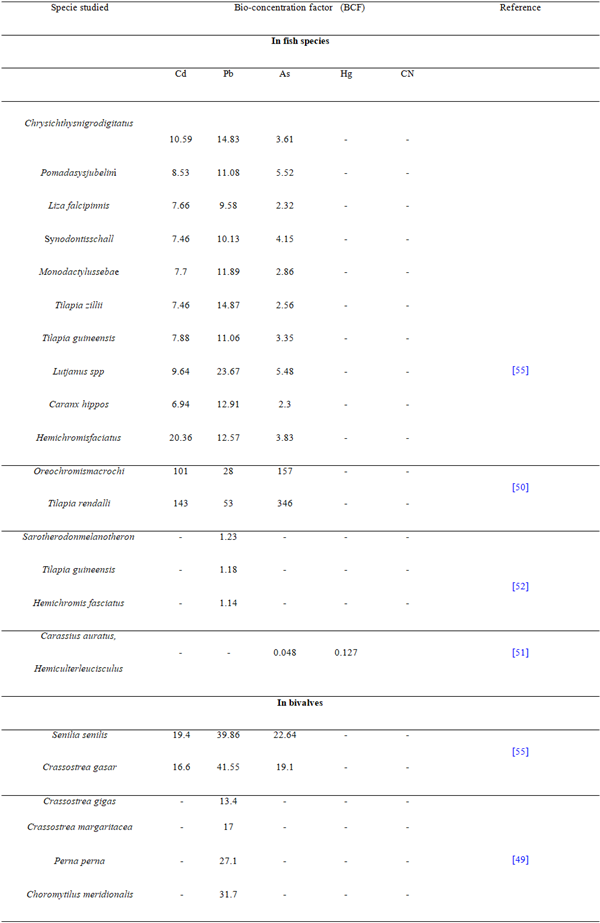
As for bioaccumulation, the results of various authors 49, 50, 51, 52, 55 under mining and/or industrial pollution conditions have been analyzed (Table S5). The analysis of these results shows that the bioaccumulation of Cd, Pb, and As varies, on the one hand, depending on the species concerned and on the other hand, depending on the habitat. Thus, bivalves those are more benthic than fish have higher BCF. Anyway, whether fish or bivalves, BCF is far below 500 which is the lower limit of the adopted classification (Table 5). Therefore, we assumed that the metals studied are very low bioaccumulative and score 1 was assigned to the bioaccumulation factor.
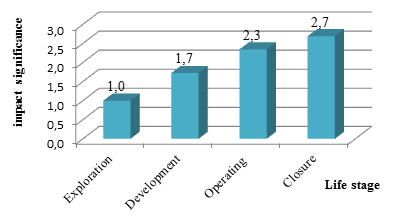
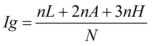
Finally, the level of impact is obtained by combining the predisposition and the gravity classes. The overall Impact (Ig) is also calculated for each phase of the mine in order to achieve a comparison. Equation (9) shows the calculation of Ig. It is in fact an arbitrary assignment of a coefficient to each impact class (low, medium and high) obtained within the same phase. Thus, coefficients 1, 2 and 3 are assigned respectively to low, medium and high impact. Then in each phase, the total number of:
- low impact nL is multiplied by 1;
- medium impact nA, by 2 and;
- high impact nH, by 3.
The sum of these results is divided by the total number of impact (nL + nA + nH) designated by N.
 | (9) |
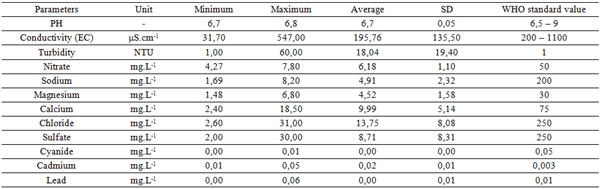
The various results on Water Quality Index, permeability induced by fractures, groundwater recharge, and soil type are presented here. The results of the physicochemical analysis of the groundwater samples are shown in Table S3. These results revealed that the groundwater of Afema is of good quality with respect to physical parameters (pH, EC). From the ionic point of view (major ions) the values obtained also remain below the respective standard values proposed by 36. Some metals/metalloid such as Hg, Cr and As were not detected in the studied waters whereas the detection limit of the measuring instruments is 0,001 mg.L-1.
However, Cd levels are all of these waters because the values obtained are all above the WHO standards. These values range from 0.014 to 0.052 mg.L-1. The same applies to Pb with values obtained in well samples greater than the value of the guide (Table S6).
In short, although mining activity developed in the region (1992-1998), groundwater is not contaminated by either CN or Hg. High levels of Cd may be due to the use of phosphate fertilizers in the region as high values have also been obtained in surface waters. Most of fertilizers used are from natural phosphate rocks sometimes containing Cd.
The physicochemical data for groundwater allowed calculation of the WQI. The results showed that more than half (57%) of the waters studied have a WQI higher than 100 (Table 6). These waters are therefore for the most part of poor quality.
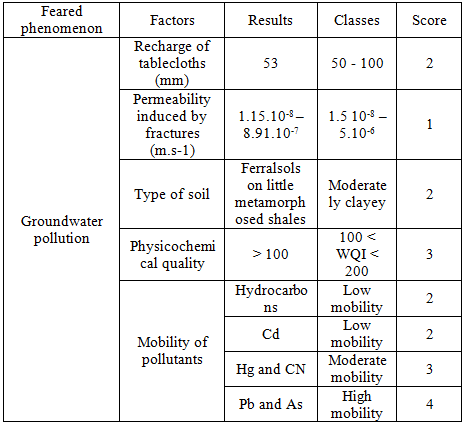
Table 6 summarizes the results of all predisposition factors. Concerning permeability induced by fractures, the values obtained oscillate between 1.15 10-8 and 8.91 10-7 m.s-1. For the recharge of the groundwater, 53 mm per year of rain contribute to the groundwater recharge. The types of soils encountered in the entire Afema mining area are essentially desaturated ferralsols developed on schist. In addition, saprolite layer which is relatively clayey is large and reaches 30 m in depth. For all these factors, the corresponding score is shown on the right.
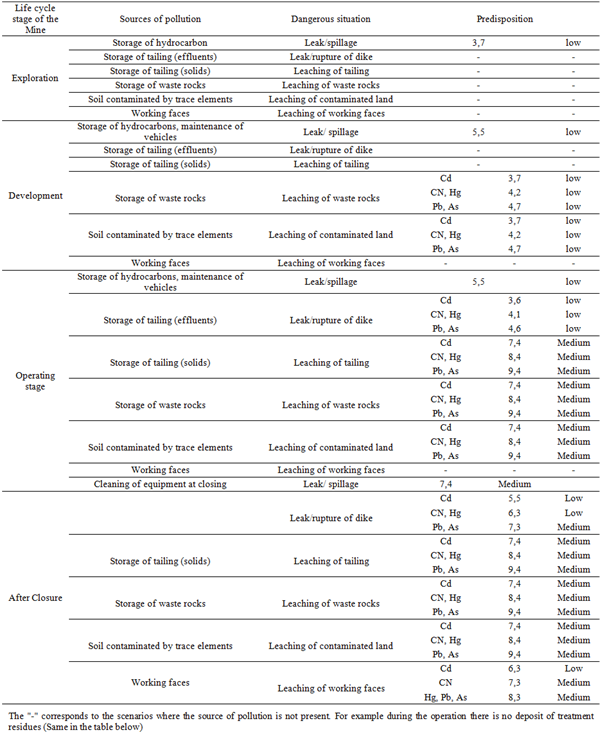
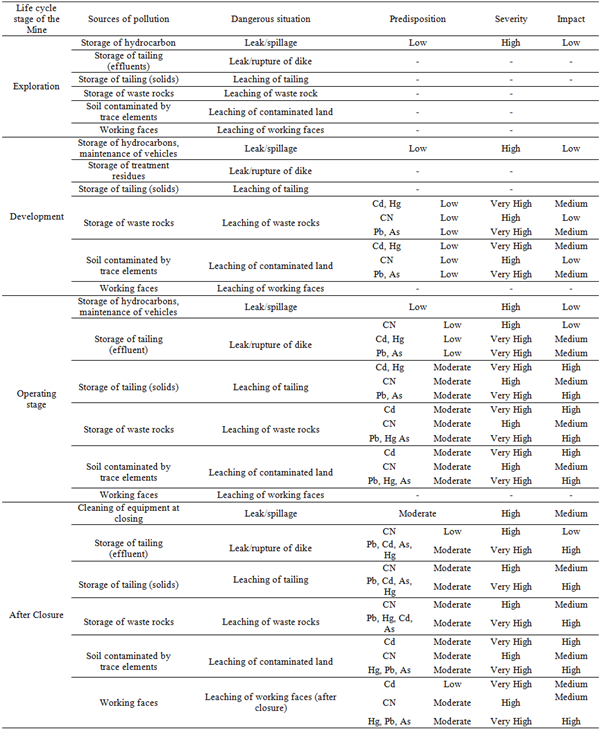
The results on the estimation of the severity and predisposition to groundwater pollution are shown in Tables S7 and S8, respectively. The impact levels resulting from the combination of both estimations are shown in Table S9. Accordingly, during exploration, groundwater pollution can occur in the event of an accidental spill of hydrocarbons. The impact of this pollution scenario is estimated to be low because, although the severity of pollution involving hydrocarbons is high, the likelihood of such an accident occurring is low. The other sources of pollution (deposits of processing residues, waste rocks, etc.) are not present during this phase; there is therefore no impact associated with these scenarios.
At the development and construction of the mine stage, the impact levels are low to medium for all pollution scenarios. Dangerous situations such as leaching of waste rock and contaminated soil are somewhat less likely due to the low intensity of the works. At this stage only the circulation of machinery can contribute to soil contamination. However, this contamination is limited due to the low traffic at this stage and especially the relatively short length (2 years on average).
In contrast, during the operation phase, these dangerous situations are very likely since large quantities of waste rocks are generally put in heaps and they may still contain appreciable proportions of metals. Thus, the impact of pollution by leaching and seepage from mining waste (exposed to air and water) was evaluated at the highest. The same applies to the pollution which may result from the leaching of land contaminated by metallic trace elements.
During operation, the traffic becomes intense due to loading and unloading operations, to which may be added dust removal (from the processing plant). In addition, the blasting creates dust which can fly and deposit trace elements (metallic) which will then be driven by seepage into groundwater. As regards pollution by treatment residues, the level of impact is low (for CN) to average (for metals) because the rupture of the retention structures that can initiate this phenomenon is a more or less rare event (less than 1 accident/2years) according to ARIA database 56.
As in the operation phase, in the post-mining phase (after closure) the level of groundwater pollution impact varies from medium to high for almost all scenarios. In the case of pollution by hydrocarbons and other processing products, during the dismantling of the retention and purging structures of the equipment, contaminant products may be discharged and then be infiltrated into the groundwater. However, this impact is medium because of the fact that petroleum products are not intrinsically mobile enough. On the other hand, the impacts of pollution from waste rocks and land contaminated by trace elements deposits are high because the likelihood of leaching is high due to the precipitation abundance in the area.
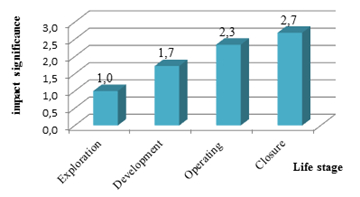
Figure 3 shows that the operating and closure phases are the riskiest. The level of groundwater pollution impact during the operating and closure phases is almost three times higher than that of the exploration phase. These results can be explained by the abundance of pollution sources compared to the exploration and development phases.
The example of the Afema gold mine illustrates the method developed. Although only groundwater pollution is discussed, this example allowed unfolding the whole process. The method developed here is applicable to all environmental issues (surface water, air, fauna, and flora). The study reveals significant impacts during operation and post-closure phase. These results are in agreement with those obtained by 37 on the intrinsic vulnerability to water pollution in the entire Afema area. The latter showed that the Afema mining area was characterized by high vulnerability. In addition, similar results were obtained from groundwater in the Hiré mining area (Central-West Côte d’Ivoire) 57. In their study, the authors showed that groundwater around the mine was polluted with metals such as As, Cd, Hg, Cr and Pb. These results contrast with the conclusions of 58 in the former mining area of Kettara (Morocco), where, despite the presence of metals (Fe, S, Cu, Pb, Zn, Cd, Ni, Cr, Co, As, Se) in the Acid Mine Drainage (AMD), groundwater did not show significant pollution levels. They indicated that the low pollution by these metals is probably related to the low ion circulation under the local dry climate with low annual rainfall that prevents metal ion circulation, highlighting the importance of the local conditions in the final impact.
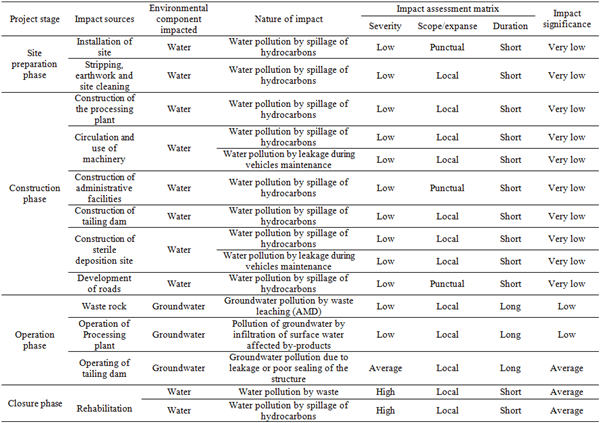
Based on the matrices method (classical method used in Côte d’Ivoire), the groundwater pollution risk was performed by 41. The results dealt with water/groundwater are presented in Table S7. Sometimes no precision was given on the type of water (surface water or groundwater). This case and those where groundwater was mentioned are given in Table S10. Four phases were identified namely site preparation phase, site construction phase, operation phase, and closure phase. The main sources of water pollution are construction works (site, administrative facilities, tailing dam, processing plant, etc.) during which, as well as during the maintenance of vehicles, hydrocarbons can spill accidentally. The resulting potential impacts are all estimated to be very low during site preparation and construction of the mine. During operation phase, potential sources of impacts are waste rocks, processing plant, and tailing dam. The potential pollution of groundwater is low, low and medium for the three sources respectively. After the operation phase (closure), rehabilitation works can lead to water pollution. This pollution can especially come from either heaps (waste rocks) or by oil spill with a medium impact for each case.
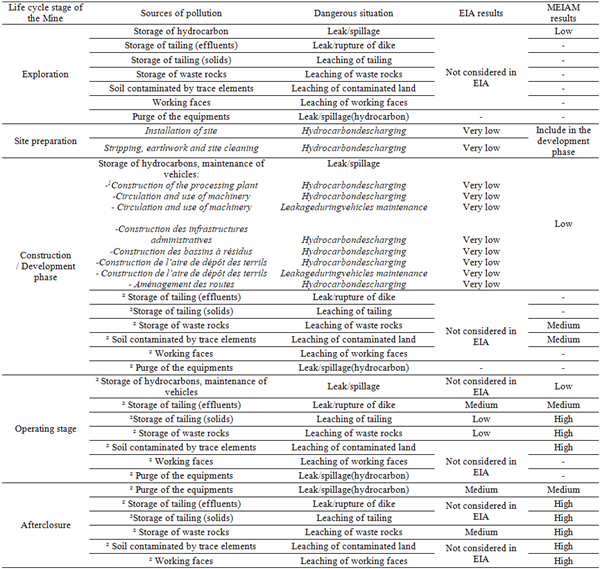
Comparing our results with those obtained by 41, we note some differences (Table S11). First, the exploration phase has been considered as out of the scope of the EIA procedure (evaluate the impact of the incoming project), while in MEIAM, all the phases of the mine are considered. In addition, in EIA study, the site preparation was taken as an independent phase while in MEIAM it was included in the development (or construction) phase. As another difference between the two studies, many groundwater pollution scenarios like tailing leaching, contaminated soils leaching, leaching of the cavities fronts (mining works) are missing in the EIA study. At the operation phase, the scenario pollution involving hydrocarbons spillage is absent in the EIA study even if the resulting impact is low in present study. In addition, in the present study, the impact of groundwater pollution due to potential leaching of the contaminated soil is high while this scenario is not accounted in the EIA. The same applies to the groundwater pollution which may result from the leaching of land contaminated by metallic trace elements and from the leaching of the mining cavities at the closure phase. However, the impact of the pollution related to the potential tailing dam rupture (called leakage or poor sealing of the dam structure in the EIA) is medium in both studies. At the end of activities (closure) this impact is high in our study (because sometimes no structure monitoring is done) while it is not considered in the EIA.
In sum, the results of these two studies are different in two respects. First many groundwater pollution scenarios are not addressed by the EIA and then when this is done the results are different except in one case. This comparative analysis shows that the impact levels in present study are overestimated in relation to the results of the EIA. This difference is explained by the evaluation methods. Indeed, in the EIA study intensity, scope and duration are the criteria for assessing the importance of the pollution, while MEIAM takes account of the intrinsic vulnerability (geological and climatic parameters) of the site and the dangerous nature of the pollutants. In this work all the pollutants considered are potentially dangerous. As a result, the level of severity was high. This high level of severity probably influenced the results. Nevertheless, it seems clear that an overestimation (while remaining within the limit of the reasonable) of the level of impact is better than an underestimation. For in case of overestimation, the preventive measures taken allow to be protected from pollution in relation to the underestimation. Thus, we can conclude that the results obtained in the present study are satisfactory. MEIAM provided a more global vision of potential groundwater pollution in the Afema area.
However, the method presents some aspects that merit discussion. The first point of discussion concerns the choice of predisposition parameters. The permeability of geological formations, groundwater recharge, physico-chemical of water, soil type and pollutant mobility are the factors that make it possible to assess the predisposition of a site to undergo pollution (groundwater). These factors are not exclusive and other factors such as land cover (presence of vegetation or not) could have been taken into account. However, considering that mining is accompanied by clearing, this factor is no longer relevant. The discussion then turns to the factor weighting technique. Indeed, the comparison by pair of factors, although it has been submitted to a panel of experts, the results may nevertheless be somewhat subjective. Consequently, the different weights obtained may be overestimated or, on the contrary, underestimated. Moreover, the qualitative assessment based on the bibliography may have certain limitations insofar some studies may be specific and correspond only to particular cases. As regards the mobility of pollutants, for example, when the parameters are chemically stable in cationic form (Cd, Ni, Pb, Cr (III), etc.), their solubility increases when the pH decreases. On the other hand, for stable parameters in anionic form (Cr (VI), Cr2O72-, AsO43-, etc.), their solubility increases with pH. As a result, the fixation of the elements depends strongly on the pH of the medium and other parameters such as the level of organic matter.
Another point of discussion concerns the evaluation of accidental situations (rupture of dam, accidental spill, etc.) and chronic (leaching of mining deposits) in the same way (same rating scale: 1 to 4). Indeed, given the impressive amount of sludge that can be released after a dike break, the level of dangerousness in this situation is unlikely to be comparable to leaching of contaminated tailings or soils. However, in the present state of the method it is difficult to make this distinction. Failure to take this distinction into account is also reinforced by the idea that accidental situations do not happen every day. According to data collected from the ARIA database of the Bureau d’Analyse des Risques et Pollutions Industriels 56, in 24 years, only 11 accidents involving ruptures and leaks of mining effluents (metal ores non-ferrous) have been identified. This shows the relatively low frequency (less than 1 accident/2 years) of this type of accident compared to the number of active or closed mines around the world. It is assumed that the low level of presumed dangerousness of chronic situations could be offset by the low frequency of accidental situations. Especially since the cumulative effect of chronic events plays an important role.
In this study we proposed a comprehensive method for assessing the environmental impacts of the mining industry, including both chronic and accidental events. The Mining Environmental Impact Assessment Methodology (MEIAM) presented is based on the methodological framework of the risk analysis methods. It assesses the environmental impact of mining activity considering all the mine life phases. The case study of the Afema gold mine (Côte d’Ivoire) showed the advantages of this method. Unlike the method of the matrices used in the EIA study of this mine, MEIAM identifies and evaluates many pollution scenarios. In addition, it better assesses the impact of pollution by considering the intrinsic parameters (geology, climate, initial state of the environmental component) of the mine site, the nature of the potential pollutants and feedbacks. The case study showed that the exploitation and closure phases are the most worrying because the impact of groundwater pollution is high. Furthermore, it indicated that the sources of pollution leading to high risks include tailings deposits (both solids and effluents), land previously contaminated by dust fallout and the front of cavities. These high levels of impact can be explained by the high precipitation which implies a high probability of leaching of mining waste in the area. In order to reduce these pollution impacts, the following measures have been proposed: (1) containment of all potentially reactive wastes under inert materials, (2) compaction of the heap surfaces to ensure good circulation of storm water to the collection and treatment systems that would initially be in place, (3) revegetation of tailings piles, and the establishment of storm water collection and treatment systems, (4) periodic monitoring of water quality through the installation of piezometers in the vicinity of tailings ponds and tailings stocks, (5) the limitation as far as possible of the residence time of water in mining work (pit).
Last, although the proposed method has led to encouraging results in the case study, it is possible to improve the approach, particularly by strengthening the relevance of dangerous situation estimation and distinguishing between chronic situations and accidental situations in the assessment. Work is underway to further improving the approach by geographical tagging the data to allow using GIS software that would allow specialization of impacts.
The authors thank Jerome Tixier and Guillaume Junqua for their good advice on the subject. The authors express their gratitude to the Laboratory of Water Sciences and Environmental Engineering at the University of Felix Houphouet-Boigny, Abidjan, Cote d’Ivoire and the Laboratory of Industrial and Environmental Engineering of the IMT Mines Ales, France for their support.
| [1] | Jha-Thakur, U., Khosravi, F. Beyond 25 years of EIA in India: Retrospection and way forward. Environ. Impact Assess. Rev., 87, 106533. March 2021. | ||
| In article | View Article | ||
| [2] | Rathi, A.K.A. The need for a robust review system to improve the quality of environmental impact statements: An Indian case study analysis. Environ. Prot. Res., 1, 39–49. 2021. | ||
| In article | View Article | ||
| [3] | Ogola, P.F.A., Environmental Impact Assessment General Procedures, Short Course II on Surface Exploration for Geothermal Resources, Organized by UNU-GTP and KenGen. Lake Naivasha, Kenya, 2007, 42p. | ||
| In article | |||
| [4] | Zeleňáková M., Zvijáková L. Risk analysis within environmental impact assessment of proposed construction activity. Environmental Impact Assessment Review, 62. 76-89. Oct. 2016. | ||
| In article | View Article | ||
| [5] | Leduc G.A, Raymond M. L’évaluation des impacts environnementaux: un outil d’aide à la décision. Éditions Multi Mondes. Sainte-Foy (Quebec). 2000. 403p. | ||
| In article | |||
| [6] | Reith, C. Risk-based Assessment Approach to Geo-Environmental Assessments Compared to the Significant Approach; EIA quality mark article; Institute of Environmental Management and Assessment: Lincoln, UK, 2014. | ||
| In article | |||
| [7] | Nicol, S., Evans, M., Chades, I., Whitten, S., Wolfe, N., Rough, T. Developing a Risk-based Approach to Environmental Compliance and Monitoring; CSIRO: Brisbane, Australia, 2014. | ||
| In article | |||
| [8] | Larrey-Lassalle P., Catel L., Roux P., Rosenbaum R.K., Lopez-Ferber M., Junqua G., Loiseau E. An innovative implementation of LCA within the EIA procedure: Lessons learned from two Wastewater Treatment Plant case studies. Environmental Impact Assessment Review 63, 95–106. 2017. | ||
| In article | View Article | ||
| [9] | Bernauer, W., Hostetler, G., Greene, E., Tester, F., Harris, R., and Tanguay, L. Undermining Assessment: EIA follow-up, stake-holder advisory groups, and extractive industries in Nunaut, Canada. Impact Assessment and Project Appraisal, 41(2): 87-101. Nov. 2022. | ||
| In article | View Article | ||
| [10] | Fuentes-Bargues, J.L., Bastante-Ceca J., Ferrer-Gisbert, P.S, and González-Cruz, C. Study of Major-Accident Risk Assessment Techniques in the Environmental Impact Assessment Process. Sustainability. 12. 1-16. Jul. 2020. | ||
| In article | View Article | ||
| [11] | Rathi, A.K.A., Integration of the Standalone ‘Risk Assessment’ Section in Project Level Environmental Impact Assessment Reports for Value Addition: An Indian Case Analysis. Sustainability. 15: 1-17. Jan. 2023. | ||
| In article | View Article | ||
| [12] | Kuma J.S., Younger P.L., Bowell R.J. Expanding the hydrogeological base in mining EIA studies A focus on Ghana. Environmental Impact Assessment Review. 22: 273–287. 2002. | ||
| In article | View Article | ||
| [13] | Ghose M.K, Generation and Quantification of Hazardous Dusts from Coal Mining in the Indian Context. Environ Monit Assess 130: 35–45. 2007. | ||
| In article | View Article PubMed | ||
| [14] | Demidova, O., Cherp, A.,. Risk assessment for improved treatment of health considerations in EIA. Environ. Impact Assess. Rev. 25, 411–429, May 2005. | ||
| In article | View Article | ||
| [15] | Favaro M., Monteau M. Bilan des méthodes d’analyse à priori des risques, 2ème partie: Principales méthodes de la sécurité des systèmes. Cahier de notes documentaires n°139. 1990. | ||
| In article | |||
| [16] | Gardes L. Méthodologie d'analyse des dysfonctionnements des systèmes pour une meilleure maitrise des risques industriels dans les PME: application au secteur du traitement de surface. Thèse de doctorat, Ecole Nationale Supérieure des Mines de Saint-Etienne, 222p. 2001. | ||
| In article | |||
| [17] | Aissani L. Integration of spatio-temporal parameters and accident risks into the Life Cycle Analysis: Application to the hydrogen energy sector and to the petroleum sector. Doctoral thesis, Ecole Nationale Supérieure des Mines, Saint-Etienne, 354p. 2008. | ||
| In article | |||
| [18] | ISO/IEC Guide 51, Safety aspects - Guidelines for their inclusion in standards. 24p. 2014. | ||
| In article | |||
| [19] | INERIS, Glossaire grand public. 2015. | ||
| In article | |||
| [20] | INERIS, Glossaire grand public. 2004. | ||
| In article | |||
| [21] | Directive n° 2012/18/UE du 04/07/12 concernant la maîtrise des dangers liés aux accidents majeurs impliquant des substances dangereuses, modifiant puis abrogeant la directive 96/82/CE du Conseil. 2012. | ||
| In article | |||
| [22] | Jones D.A. Nomenclature for Hazard and risk assessment in the process industries. Institution of Chemical Engineers. 1992. | ||
| In article | |||
| [23] | Fages F. Étude des dangers: Analyser les risques Environnement – Sécurité, Métier, techniques de l’ingénieur. 2014. | ||
| In article | View Article | ||
| [24] | Wells G. Hazard identification and risk assessment. 1996. | ||
| In article | |||
| [25] | ISO. FD ISO/IEC Guide 73. Risk management –Vocabulary – Guidelines for use in standards. 27p. 2002. | ||
| In article | |||
| [26] | Artignan D., Baranger P., Billaud P., Lansiart M., Mazenc B. L’élaboration des plans de prévention des risques miniers, guide méthodologique, volet technique relatif à l’évaluation de l’aléa « pollution des sols et des eaux » Rapport final, BRGM/RP-55143-FR 109p. 2008. | ||
| In article | |||
| [27] | Fairman R., Mead C.D., Williams W.P.. Environmental risk assessment: approaches, experiences and information sources, sixth ed. European Environment Agency Copenhagen. 1998. | ||
| In article | |||
| [28] | MINEO, User Need Document. Part 2, Potential environmental and social impact of mining, 28p. 2000. | ||
| In article | |||
| [29] | Chair in eco-consulting, The mining industry and sustainable development, working paper, Université du Québec à Chicoutimi, 71p. 2012. | ||
| In article | |||
| [30] | Saaty T.L. Fundamentals of Decision Making and Priority Theory with the Analytic Hierarchy Process. vol. VI. 2000. | ||
| In article | View Article | ||
| [31] | Youan Ta M., Yao K.A.F., Baka D., De Lasm Z.O., Lasm T., Adja M.G., Kouakou S., Onetie Z.O., Jourda J.P.R., Biemi J. Cartographie des zones potentielles à l’implantation des forages à gros débits en milieu fissuré par analyse multicritère: cas du département d’Oumé (centre-ouest de la cote d’ivoire). Larhyss Journal. 23, 155-181. Sept. 2015. | ||
| In article | |||
| [32] | Youan Ta M, Lasm T., Jourda J.P.R., Saley M.B., Adja M.G., Kan K., Biémi J. Cartographie des eaux souterraines en milieu fissuré par analyse multicritère: cas de Bondoukou (Côte d’Ivoire). Revue internationale de géomatique. 21 (1), 43-71. 2011. | ||
| In article | View Article | ||
| [33] | El Morjani Z. Conception d’un système d’information à référence spatiale pour la gestion environnementale ; application à la sélection de sites potentiels de stockage de déchets ménagers et industriels en région semi-aride (Souss, Maroc). Thèse de doctorat, Univ. Genève. Terre et Environnement. Vol. 42, 300 p. | ||
| In article | |||
| [34] | Saaty T.L. The analytic hierarchy process. McGraw Hill, New York City. 1980. | ||
| In article | View Article | ||
| [35] | Amharref M., Bernoussi A.S. "Vulnérabilité et risque de pollution des eaux souterraines". In JSIRAUF, Hanoi, 11p. | ||
| In article | |||
| [36] | WHO (World Health Organization), Guidelines for Drinking-water Quality, fourth Edition, 518p. 2011. | ||
| In article | |||
| [37] | Yao K.A.F., Salze D., Lasm T., Yao B.K., Belcourt O., Miguel L., Ahoussi K.E., Youan Ta M. Mapping of the vulnerability to pollution of aquifers in a mining area: Afema gold mine case (South-eastern Côte d'Ivoire). International Journal of Innovation and Applied Studies. 17 (2), 682-697. Juil. 2016. | ||
| In article | |||
| [38] | Assié K.E. Lode gold mineralization in the Paleoproterozoic (Birimian) volcano-sedimentary sequence of Afema gold district, southeastern Côte d'Ivoire. Dissertation, Technical University of Clausthal, 198p. 2008. | ||
| In article | |||
| [39] | Delor, C., Diaby, Y. Simeon, Y. Tastet, J-P. Vidal, M., Chiron J-V., et Dommanget A. Notice explicative de la Carte Géologique de la Côte d’Ivoire à 1/200 000, Feuille Grand-Bassam, Mémoire de la Direction de la Géologie de Côte d’Ivoire, Abidjan no. 4, 30p. 1992. | ||
| In article | |||
| [40] | Rockstone Gold. Étude d’impact environnemental et social du projet aurifère d’Afema, Aboisso (Côte d’Ivoire) 360p. 2013. | ||
| In article | |||
| [41] | Durucan S., Korre A., Munoz-Melendez G. Mining life cycle modelling: a cradle-to-gate approach to environmental management in the minerals industry. Journal of Cleaner Production 14:1057-1070. 2006. | ||
| In article | View Article | ||
| [42] | Francis F.O. Contribution à l'étude du mouvement d'eau à travers les milieux fissurés. Géomorphologie et Géologie du Brésil. Thèse Doct. Ing., Univ. Grenoble I, 108p. 1970. | ||
| In article | |||
| [43] | Jourda, J.P., Saley, M.B., Kouamé, K.J., Kouadio, B.H, Biemi J. et Razack, M. Gestion et protection des ressources en eaux | ||
| In article | |||
| [44] | Souterraines: contribution d'un SIG à la réalisation de la carte de vulnérabilité à la pollution des aquifères fissures de Korhogo (Nord de la Côte d'Ivoire) selon la méthode DRASTIC”, in Conférence Francophone SIG, Paris, 21p., 2005. | ||
| In article | |||
| [45] | Ramakrishnaiah C.R., Sadashivaiah C., Ranganna G. ˮAssessment of Water Quality Index for the Groundwater in Tumkur Taluk, Karnataka State, Indiaˮ. E-Journal of Chemistry 6(2): 523-530. 2009. | ||
| In article | View Article | ||
| [46] | ATSDR (Agency for Toxic Substances and Disease Registry). Toxicological profile for Arsenic, U. S. department of health and human services, Public health service, Agency for Toxic Substances and Disease Registry, 559p. 2007. | ||
| In article | |||
| [47] | Basta N.T., Gradwohl R., Snethen K.L., Schroder J.L. Chemical Immobilization of Lead, Zinc, and Cadmium in Smelter-Contaminated Soils Using Biosolids and Rock Phosphate. Journal of Environmental Quality. 30(4): 1222-1230. 1997. | ||
| In article | View Article PubMed | ||
| [48] | Autier, V. and White D. Examination of cadmium sorption characteristics for a boreal soil near Fairbanks, Alaska. Journal of Hazardous Materials. 106 (2-3): 149-155. 2004. | ||
| In article | View Article PubMed | ||
| [49] | Goix S. Origine et impact des pollutions liées aux activités minières sur l'environnement et la santé, cas de Oruro (Bolivie). Thèse de doctorat, Université Paul Sabatier - Toulouse III, 319p. 2012. | ||
| In article | |||
| [50] | Watling, H.R. Accumulation of seven metals by Crasostrea gigas, Crassostrea margaritacea, Perna perna and Choromytilus meridionalis. Bull Environ Contam Toxicol, 30:317-322. 1983. | ||
| In article | View Article PubMed | ||
| [51] | Manda B.K., Colinet G., André L., Manda A.C. Marquet J.P., Micha J.C. Évaluation de la contamination de la chaîne trophique par les éléments traces (Cu, Co, Zn, Pb, Cd, U, V et As) dans le bassin de la Lufira supérieure (Katanga/RD Congo). Tropicultura 28(4): 246-252. 2010. | ||
| In article | |||
| [52] | Fu, Z., Wu, F., Mo, C., Liu, B., Zhu, J., Deng, H.L., Zhang, Y. Bioaccumulation of antimony, arsenic, and mercury in the vicinities of a large antimony mine, China. Microchemical Journal 97: 12–19. June 2010. | ||
| In article | View Article | ||
| [53] | Youssao A., Soclo H.H., Bonou C., Vianou K., Gbaguidi M., Dovonon L. Evaluation de la contamination de la faune ichthyenne dans le complexe lagunaire Nokoué – chenal de Cotonou par le plomb: cas des espèces Sarotherodon melanotheron, Tilapia guineensis et Hemichromis fasciatus (Bénin). Int. J. Biol. Chem. Sci. 5(2): 595-602. 2011. | ||
| In article | View Article | ||
| [54] | Zhang, Y., Huo, S., Zan, F., Xi, B., Zhang, J., Wu, F. Historical records of multiple heavy metals from dated sediment cores in Lake Chenghai, China. Environ. Earth Sci. Nov. 2014. | ||
| In article | View Article | ||
| [55] | Ekperusi, O.A, and Aigbodion, I.F. Bioremediation of heavy metals and petroleum hydrocarbons in diesel contaminated soil with the earthworm: Eudrilus eugeniae. SpringerPlus. 4: 2-13. Sept. 2015. | ||
| In article | View Article PubMed | ||
| [56] | Ouro-Sama K., Solitoke H.D., Gnandi K., Afiademanyo K.M., Bowessidjaou E.J. Évaluation et risques sanitaires de la bioaccumulation de métaux lourds chez des espèces halieutiques du système lagunaire togolais. Virtigo vol.14 (2). 2014. | ||
| In article | View Article | ||
| [57] | MEDD - Ministère de l’Environnement et du Développement Durable, Direction Générale de la prévention des risques SRT/ BARPI, France – (2016). Résultats de recherche d’accidents sur www.aria.developpement-durable.gouv.fr. | ||
| In article | |||
| [58] | Yapi Y.H.A., Dongui B.K., Trokourey A., Barima Y.S.S., Essis Y., Atheba P. Evaluation de la pollution métallique des eaux souterraines et de surface dans un environnement minier aurifère à Hiré (Côte d’Ivoire). Int. J. Biol. Chem. Sci. 8(3): 1281-1289. 2014. | ||
| In article | View Article | ||
| [59] | El Amari K., Valera P., Hibti M., Pretti S., Marcello A., Essarraj S. Impact of mine tailings on surrounding soils and ground water: Case of Kettara old mine, Morocco. Journal of African Earth Sciences. 100, pp. 437–449. 2014. | ||
| In article | View Article | ||
Published with license by Science and Education Publishing, Copyright © 2025 Kouadio Assemien Francois Yao, Yapi Désiré Sosthène Atto, Koffi Chiayé Larissa, David Salze, Yao Blaise Koffi and Miguel Lopez-Ferber
 This work is licensed under a Creative Commons Attribution 4.0 International License. To view a copy of this license, visit
http://creativecommons.org/licenses/by/4.0/
This work is licensed under a Creative Commons Attribution 4.0 International License. To view a copy of this license, visit
http://creativecommons.org/licenses/by/4.0/
| [1] | Jha-Thakur, U., Khosravi, F. Beyond 25 years of EIA in India: Retrospection and way forward. Environ. Impact Assess. Rev., 87, 106533. March 2021. | ||
| In article | View Article | ||
| [2] | Rathi, A.K.A. The need for a robust review system to improve the quality of environmental impact statements: An Indian case study analysis. Environ. Prot. Res., 1, 39–49. 2021. | ||
| In article | View Article | ||
| [3] | Ogola, P.F.A., Environmental Impact Assessment General Procedures, Short Course II on Surface Exploration for Geothermal Resources, Organized by UNU-GTP and KenGen. Lake Naivasha, Kenya, 2007, 42p. | ||
| In article | |||
| [4] | Zeleňáková M., Zvijáková L. Risk analysis within environmental impact assessment of proposed construction activity. Environmental Impact Assessment Review, 62. 76-89. Oct. 2016. | ||
| In article | View Article | ||
| [5] | Leduc G.A, Raymond M. L’évaluation des impacts environnementaux: un outil d’aide à la décision. Éditions Multi Mondes. Sainte-Foy (Quebec). 2000. 403p. | ||
| In article | |||
| [6] | Reith, C. Risk-based Assessment Approach to Geo-Environmental Assessments Compared to the Significant Approach; EIA quality mark article; Institute of Environmental Management and Assessment: Lincoln, UK, 2014. | ||
| In article | |||
| [7] | Nicol, S., Evans, M., Chades, I., Whitten, S., Wolfe, N., Rough, T. Developing a Risk-based Approach to Environmental Compliance and Monitoring; CSIRO: Brisbane, Australia, 2014. | ||
| In article | |||
| [8] | Larrey-Lassalle P., Catel L., Roux P., Rosenbaum R.K., Lopez-Ferber M., Junqua G., Loiseau E. An innovative implementation of LCA within the EIA procedure: Lessons learned from two Wastewater Treatment Plant case studies. Environmental Impact Assessment Review 63, 95–106. 2017. | ||
| In article | View Article | ||
| [9] | Bernauer, W., Hostetler, G., Greene, E., Tester, F., Harris, R., and Tanguay, L. Undermining Assessment: EIA follow-up, stake-holder advisory groups, and extractive industries in Nunaut, Canada. Impact Assessment and Project Appraisal, 41(2): 87-101. Nov. 2022. | ||
| In article | View Article | ||
| [10] | Fuentes-Bargues, J.L., Bastante-Ceca J., Ferrer-Gisbert, P.S, and González-Cruz, C. Study of Major-Accident Risk Assessment Techniques in the Environmental Impact Assessment Process. Sustainability. 12. 1-16. Jul. 2020. | ||
| In article | View Article | ||
| [11] | Rathi, A.K.A., Integration of the Standalone ‘Risk Assessment’ Section in Project Level Environmental Impact Assessment Reports for Value Addition: An Indian Case Analysis. Sustainability. 15: 1-17. Jan. 2023. | ||
| In article | View Article | ||
| [12] | Kuma J.S., Younger P.L., Bowell R.J. Expanding the hydrogeological base in mining EIA studies A focus on Ghana. Environmental Impact Assessment Review. 22: 273–287. 2002. | ||
| In article | View Article | ||
| [13] | Ghose M.K, Generation and Quantification of Hazardous Dusts from Coal Mining in the Indian Context. Environ Monit Assess 130: 35–45. 2007. | ||
| In article | View Article PubMed | ||
| [14] | Demidova, O., Cherp, A.,. Risk assessment for improved treatment of health considerations in EIA. Environ. Impact Assess. Rev. 25, 411–429, May 2005. | ||
| In article | View Article | ||
| [15] | Favaro M., Monteau M. Bilan des méthodes d’analyse à priori des risques, 2ème partie: Principales méthodes de la sécurité des systèmes. Cahier de notes documentaires n°139. 1990. | ||
| In article | |||
| [16] | Gardes L. Méthodologie d'analyse des dysfonctionnements des systèmes pour une meilleure maitrise des risques industriels dans les PME: application au secteur du traitement de surface. Thèse de doctorat, Ecole Nationale Supérieure des Mines de Saint-Etienne, 222p. 2001. | ||
| In article | |||
| [17] | Aissani L. Integration of spatio-temporal parameters and accident risks into the Life Cycle Analysis: Application to the hydrogen energy sector and to the petroleum sector. Doctoral thesis, Ecole Nationale Supérieure des Mines, Saint-Etienne, 354p. 2008. | ||
| In article | |||
| [18] | ISO/IEC Guide 51, Safety aspects - Guidelines for their inclusion in standards. 24p. 2014. | ||
| In article | |||
| [19] | INERIS, Glossaire grand public. 2015. | ||
| In article | |||
| [20] | INERIS, Glossaire grand public. 2004. | ||
| In article | |||
| [21] | Directive n° 2012/18/UE du 04/07/12 concernant la maîtrise des dangers liés aux accidents majeurs impliquant des substances dangereuses, modifiant puis abrogeant la directive 96/82/CE du Conseil. 2012. | ||
| In article | |||
| [22] | Jones D.A. Nomenclature for Hazard and risk assessment in the process industries. Institution of Chemical Engineers. 1992. | ||
| In article | |||
| [23] | Fages F. Étude des dangers: Analyser les risques Environnement – Sécurité, Métier, techniques de l’ingénieur. 2014. | ||
| In article | View Article | ||
| [24] | Wells G. Hazard identification and risk assessment. 1996. | ||
| In article | |||
| [25] | ISO. FD ISO/IEC Guide 73. Risk management –Vocabulary – Guidelines for use in standards. 27p. 2002. | ||
| In article | |||
| [26] | Artignan D., Baranger P., Billaud P., Lansiart M., Mazenc B. L’élaboration des plans de prévention des risques miniers, guide méthodologique, volet technique relatif à l’évaluation de l’aléa « pollution des sols et des eaux » Rapport final, BRGM/RP-55143-FR 109p. 2008. | ||
| In article | |||
| [27] | Fairman R., Mead C.D., Williams W.P.. Environmental risk assessment: approaches, experiences and information sources, sixth ed. European Environment Agency Copenhagen. 1998. | ||
| In article | |||
| [28] | MINEO, User Need Document. Part 2, Potential environmental and social impact of mining, 28p. 2000. | ||
| In article | |||
| [29] | Chair in eco-consulting, The mining industry and sustainable development, working paper, Université du Québec à Chicoutimi, 71p. 2012. | ||
| In article | |||
| [30] | Saaty T.L. Fundamentals of Decision Making and Priority Theory with the Analytic Hierarchy Process. vol. VI. 2000. | ||
| In article | View Article | ||
| [31] | Youan Ta M., Yao K.A.F., Baka D., De Lasm Z.O., Lasm T., Adja M.G., Kouakou S., Onetie Z.O., Jourda J.P.R., Biemi J. Cartographie des zones potentielles à l’implantation des forages à gros débits en milieu fissuré par analyse multicritère: cas du département d’Oumé (centre-ouest de la cote d’ivoire). Larhyss Journal. 23, 155-181. Sept. 2015. | ||
| In article | |||
| [32] | Youan Ta M, Lasm T., Jourda J.P.R., Saley M.B., Adja M.G., Kan K., Biémi J. Cartographie des eaux souterraines en milieu fissuré par analyse multicritère: cas de Bondoukou (Côte d’Ivoire). Revue internationale de géomatique. 21 (1), 43-71. 2011. | ||
| In article | View Article | ||
| [33] | El Morjani Z. Conception d’un système d’information à référence spatiale pour la gestion environnementale ; application à la sélection de sites potentiels de stockage de déchets ménagers et industriels en région semi-aride (Souss, Maroc). Thèse de doctorat, Univ. Genève. Terre et Environnement. Vol. 42, 300 p. | ||
| In article | |||
| [34] | Saaty T.L. The analytic hierarchy process. McGraw Hill, New York City. 1980. | ||
| In article | View Article | ||
| [35] | Amharref M., Bernoussi A.S. "Vulnérabilité et risque de pollution des eaux souterraines". In JSIRAUF, Hanoi, 11p. | ||
| In article | |||
| [36] | WHO (World Health Organization), Guidelines for Drinking-water Quality, fourth Edition, 518p. 2011. | ||
| In article | |||
| [37] | Yao K.A.F., Salze D., Lasm T., Yao B.K., Belcourt O., Miguel L., Ahoussi K.E., Youan Ta M. Mapping of the vulnerability to pollution of aquifers in a mining area: Afema gold mine case (South-eastern Côte d'Ivoire). International Journal of Innovation and Applied Studies. 17 (2), 682-697. Juil. 2016. | ||
| In article | |||
| [38] | Assié K.E. Lode gold mineralization in the Paleoproterozoic (Birimian) volcano-sedimentary sequence of Afema gold district, southeastern Côte d'Ivoire. Dissertation, Technical University of Clausthal, 198p. 2008. | ||
| In article | |||
| [39] | Delor, C., Diaby, Y. Simeon, Y. Tastet, J-P. Vidal, M., Chiron J-V., et Dommanget A. Notice explicative de la Carte Géologique de la Côte d’Ivoire à 1/200 000, Feuille Grand-Bassam, Mémoire de la Direction de la Géologie de Côte d’Ivoire, Abidjan no. 4, 30p. 1992. | ||
| In article | |||
| [40] | Rockstone Gold. Étude d’impact environnemental et social du projet aurifère d’Afema, Aboisso (Côte d’Ivoire) 360p. 2013. | ||
| In article | |||
| [41] | Durucan S., Korre A., Munoz-Melendez G. Mining life cycle modelling: a cradle-to-gate approach to environmental management in the minerals industry. Journal of Cleaner Production 14:1057-1070. 2006. | ||
| In article | View Article | ||
| [42] | Francis F.O. Contribution à l'étude du mouvement d'eau à travers les milieux fissurés. Géomorphologie et Géologie du Brésil. Thèse Doct. Ing., Univ. Grenoble I, 108p. 1970. | ||
| In article | |||
| [43] | Jourda, J.P., Saley, M.B., Kouamé, K.J., Kouadio, B.H, Biemi J. et Razack, M. Gestion et protection des ressources en eaux | ||
| In article | |||
| [44] | Souterraines: contribution d'un SIG à la réalisation de la carte de vulnérabilité à la pollution des aquifères fissures de Korhogo (Nord de la Côte d'Ivoire) selon la méthode DRASTIC”, in Conférence Francophone SIG, Paris, 21p., 2005. | ||
| In article | |||
| [45] | Ramakrishnaiah C.R., Sadashivaiah C., Ranganna G. ˮAssessment of Water Quality Index for the Groundwater in Tumkur Taluk, Karnataka State, Indiaˮ. E-Journal of Chemistry 6(2): 523-530. 2009. | ||
| In article | View Article | ||
| [46] | ATSDR (Agency for Toxic Substances and Disease Registry). Toxicological profile for Arsenic, U. S. department of health and human services, Public health service, Agency for Toxic Substances and Disease Registry, 559p. 2007. | ||
| In article | |||
| [47] | Basta N.T., Gradwohl R., Snethen K.L., Schroder J.L. Chemical Immobilization of Lead, Zinc, and Cadmium in Smelter-Contaminated Soils Using Biosolids and Rock Phosphate. Journal of Environmental Quality. 30(4): 1222-1230. 1997. | ||
| In article | View Article PubMed | ||
| [48] | Autier, V. and White D. Examination of cadmium sorption characteristics for a boreal soil near Fairbanks, Alaska. Journal of Hazardous Materials. 106 (2-3): 149-155. 2004. | ||
| In article | View Article PubMed | ||
| [49] | Goix S. Origine et impact des pollutions liées aux activités minières sur l'environnement et la santé, cas de Oruro (Bolivie). Thèse de doctorat, Université Paul Sabatier - Toulouse III, 319p. 2012. | ||
| In article | |||
| [50] | Watling, H.R. Accumulation of seven metals by Crasostrea gigas, Crassostrea margaritacea, Perna perna and Choromytilus meridionalis. Bull Environ Contam Toxicol, 30:317-322. 1983. | ||
| In article | View Article PubMed | ||
| [51] | Manda B.K., Colinet G., André L., Manda A.C. Marquet J.P., Micha J.C. Évaluation de la contamination de la chaîne trophique par les éléments traces (Cu, Co, Zn, Pb, Cd, U, V et As) dans le bassin de la Lufira supérieure (Katanga/RD Congo). Tropicultura 28(4): 246-252. 2010. | ||
| In article | |||
| [52] | Fu, Z., Wu, F., Mo, C., Liu, B., Zhu, J., Deng, H.L., Zhang, Y. Bioaccumulation of antimony, arsenic, and mercury in the vicinities of a large antimony mine, China. Microchemical Journal 97: 12–19. June 2010. | ||
| In article | View Article | ||
| [53] | Youssao A., Soclo H.H., Bonou C., Vianou K., Gbaguidi M., Dovonon L. Evaluation de la contamination de la faune ichthyenne dans le complexe lagunaire Nokoué – chenal de Cotonou par le plomb: cas des espèces Sarotherodon melanotheron, Tilapia guineensis et Hemichromis fasciatus (Bénin). Int. J. Biol. Chem. Sci. 5(2): 595-602. 2011. | ||
| In article | View Article | ||
| [54] | Zhang, Y., Huo, S., Zan, F., Xi, B., Zhang, J., Wu, F. Historical records of multiple heavy metals from dated sediment cores in Lake Chenghai, China. Environ. Earth Sci. Nov. 2014. | ||
| In article | View Article | ||
| [55] | Ekperusi, O.A, and Aigbodion, I.F. Bioremediation of heavy metals and petroleum hydrocarbons in diesel contaminated soil with the earthworm: Eudrilus eugeniae. SpringerPlus. 4: 2-13. Sept. 2015. | ||
| In article | View Article PubMed | ||
| [56] | Ouro-Sama K., Solitoke H.D., Gnandi K., Afiademanyo K.M., Bowessidjaou E.J. Évaluation et risques sanitaires de la bioaccumulation de métaux lourds chez des espèces halieutiques du système lagunaire togolais. Virtigo vol.14 (2). 2014. | ||
| In article | View Article | ||
| [57] | MEDD - Ministère de l’Environnement et du Développement Durable, Direction Générale de la prévention des risques SRT/ BARPI, France – (2016). Résultats de recherche d’accidents sur www.aria.developpement-durable.gouv.fr. | ||
| In article | |||
| [58] | Yapi Y.H.A., Dongui B.K., Trokourey A., Barima Y.S.S., Essis Y., Atheba P. Evaluation de la pollution métallique des eaux souterraines et de surface dans un environnement minier aurifère à Hiré (Côte d’Ivoire). Int. J. Biol. Chem. Sci. 8(3): 1281-1289. 2014. | ||
| In article | View Article | ||
| [59] | El Amari K., Valera P., Hibti M., Pretti S., Marcello A., Essarraj S. Impact of mine tailings on surrounding soils and ground water: Case of Kettara old mine, Morocco. Journal of African Earth Sciences. 100, pp. 437–449. 2014. | ||
| In article | View Article | ||