Chemistry students in their college laboratory routinely employ qualitative reactivity patterns to identify functional groups of unknown organic compounds. Qualitative organic analysis is therefore very useful for determining the overall structure. Most of the common functional groups can be easily detected by simple color tests that are rapid, simple and routinely performed by the students. However, the detection of aromatic hydrocarbons and aryl halides is still a challenge as there are not many color tests available. The present work highlights the detection of aromatic hydrocarbons and aryl halides by simple modification of their reaction with chloroform. The method is simple, using chemicals that are easily available in the undergraduate laboratory and follows the principles of green chemistry.
Science students in the undergraduate curriculum routinely perform a number of chemical tests in qualitative organic analysis as a part of their chemistry class. This methodology trains the students in various chemical procedures and techniques and makes them more proficient in the organic laboratory. To be a successful chemist, one must have a strong grasp of the foundations of chemistry, extensive laboratory experience, and knowledge of green chemistry concepts. These courses prepare the students for the challenges that come with a job in research and development. Qualitative organic analysis is a combination of various physical and chemical tests that will be used to determine the functional groups present in an organic compound. 1, 2 Each of these tests should ideally give an easily visible result. In general, colour tests have the most advantage - in terms of simplicity and convenience of usage. There is no need for expensive equipment or chemicals, and the student takes only a few hours. Depending on the test used, a negative colour test result can serve to rule out the presence of a particular functional group. However, certain drawbacks do exist. These tests are often performed either as macroscale 1, 2 or microscale analysis 3 and the process of performing the tests often generates a significant amount of waste which is difficult to dispose of. 4 Furthermore, the improper disposal of chemicals not only comes at a high cost but has negative consequences for the environment. In addition, very often, in many procedures, hazardous chemicals are used.
During the past few years, our department has been focussed on the development of simple spot tests for the easy and rapid identification of various functional groups in our college undergraduate laboratory. 4, 5 These tests have allowed the students to routinely identify various functional groups of organic compounds using the principles of green chemistry - without the use of harsh chemicals, avoiding the production of wanted waste/by-products, while saving time and energy. 6 During the past few decades, the practice of green chemistry has gained much importance in chemical laboratories, including the undergraduate labs. 7, 8 Green chemistry is a cleaner and safer approach to chemistry, reducing and avoiding the risks and hazards generally associated with the use of chemicals. 9, 10, 11 Performing simple coloured spot tests is a green way to organic qualitative analysis. 12
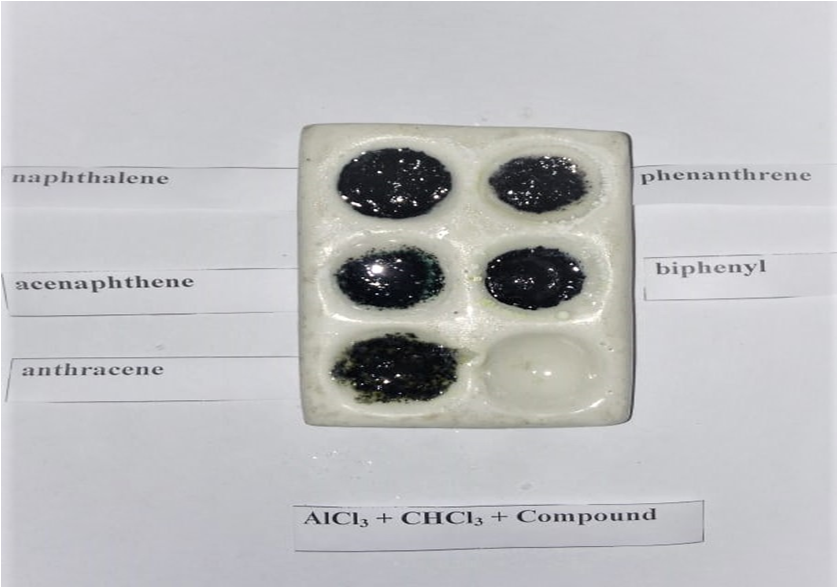
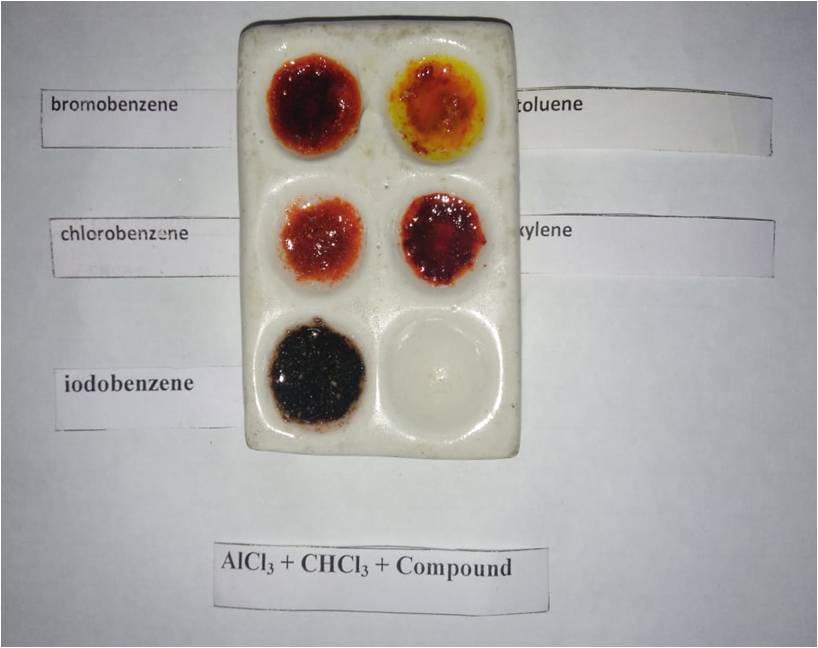
Aromatic hydrocarbons are derivatives of benzene, 13 containing carbon and hydrogen, and relatively unreactive and difficult to identify by simple tests. In the most common test, the aromatic compounds react with chloroform in the presence of anhydrous aluminium chloride to produce coloured triarylmethanes cations, Ar3C+. Generally, the colour depends on the number of rings in the particular aromatic hydrocarbon. Usually, benzene and its derivatives tend to give an orange-red colour; while naphthalene and its derivatives give deep blue-purple colours. 1, 2 It is important to note that the above test requires the use of anhydrous (water free) aluminium chloride and the students must ensure that the test tube and other materials are clean and dry before performing this test.
Conventional Procedure: In a clean, dry pyrex tube, heated AlCl3 horizontally and added 4-5 drops of the given aromatic hydrocarbon and 1 mL of CHCl3. Shake and note the colour change. 1, 2
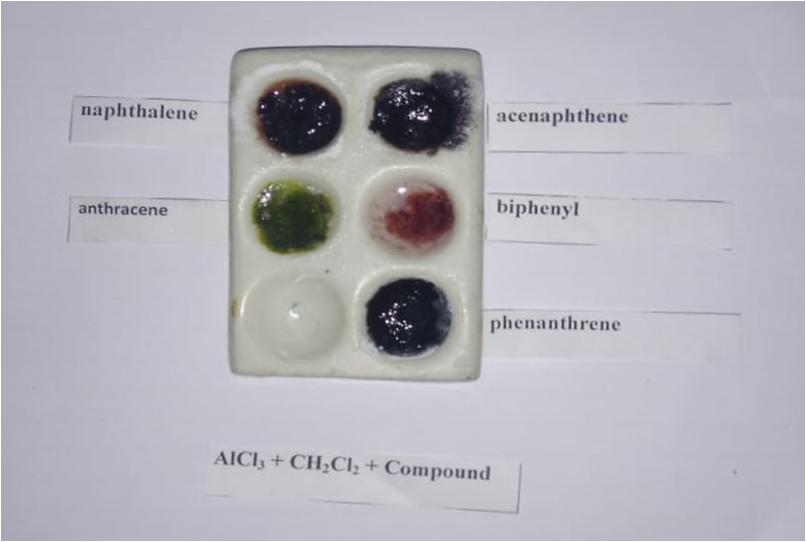
Spot Test: In a clean, dry groove tile, add 40 mg anhydrous AlCl3, 2 drops or 20 mg of the aromatic hydrocarbon and 3-4 drops of chloroform (CHCl3) or dichloromethane (CH2Cl2) and mix well.
In our continuing efforts to develop simple colour based spots for the detection of various functional groups in organic qualitative analysis, a spot test was developed for the detection of aromatic hydrocarbons based upon the conventional method with anhydrous aluminium chloride and chloroform. The test is performed on a groove tile and requires a lesser quantity of the reagents. The test can be performed with either chloroform or dichloromethane (a safer choice in terms of toxicity). Furthermore, the test can be expanded to aryl halides such as chloro- and bromobenzene, where a distinct orange colour is observed.
3.1. Comparison of Analysis
 |


A simple and easy to perform spot test is developed to identify aromatic hydrocarbons and aryl halides using a modified Friedel-Crafts reaction with anhydrous aluminium chloride and chloroform. The test is performed on a groove tile, requires less amount of the reagents and colour change is observed in seconds. In terms of green chemistry, the spot test is safe, saves energy and consumption of chemicals is less. The test will be an easy addition to the undergraduate organic analysis procedure.
We are thankful to Dr Sunita Dhingra, Associate Professor (Retd.), Department of Chemistry, Miranda House for the guidance and support of the present work. We are thankful to the Principal, Miranda House, for the permission and encouragement to pursue the present study. We also thank our undergraduate students and the laboratory staff for their help in the completion of this project.
| [1] | Furniss, B. S., Hannaford, A. J., Rogers, V., Smith, P. W. G. and Tatchell, A. R., Vogel’s Text Book of Practical Organic Chemistry. Longman Group Ltd., London, 1978. | ||
| In article | |||
| [2] | Ahluwalia, V. K., Dhingra, S., Comprehensive Practical Organic Chemistry: Qualitative Analysis. Universities Press Private Limited: Hyderabad, India, 2008. | ||
| In article | |||
| [3] | Finley, K. T. J. Chem. Educ. 2005, 82, 240. | ||
| In article | View Article | ||
| [4] | Dhingra, S., Angrish, C., “Qualitative Organic Analysis: An Efficient, Safer, and Economical Approach to Preliminary Tests and Functional Group Analysis”. Journal of Chemical Education, 2011, 88 (5), 649-651. | ||
| In article | View Article | ||
| [5] | Sonkar, S.M., Sengupta, S. & Singh, S. 2022. Spot Test to Differentiate between D-Glucose and D-Fructose. Journal of Laboratory Chemical Education. 10(1): 1-3. | ||
| In article | |||
| [6] | Feigl, F. Spot Tests in Organic Analysis, 7th ed.; Elsevier Science: Amsterdam, 1966. | ||
| In article | |||
| [7] | Sonkar, S.M., Sengupta, S., Singh, S. & Lumb, A. 2022. Derivatization of Alcohols Using (bmim)HSO4: A Green Approach for the Undergraduate Chemistry Laboratory. World Journal of Chemical Education. 10(2) (2022): 62-64. | ||
| In article | View Article | ||
| [8] | Sonkar, S.M., Singh, S., Sengupta, S. & Himanshu. 2022. Green Method of Derivatization of Alcohols: Microwave Assisted Synthesis of 3,5-Dinitrobenzoates. Hansshodhsudha, Accepted. | ||
| In article | |||
| [9] | Anastas, P.T. and Warner, J.K. Oxford Green Chemistry - Theory and Practice, University Press, 1998. | ||
| In article | |||
| [10] | Green Chemistry: An Introduction, Sujata Sengupta and Sharda M. Sonkar, Prestige Publication, 2019. | ||
| In article | |||
| [11] | An Introductory Text on Green Chemistry, Indu Tucker Sidhwani and R.K. Sharma, Wiley Publications, 2020. | ||
| In article | |||
| [12] | Ratnani, S., Gurjar, S., Kathuria, A., “Functional Group Analysis in Undergraduate Laboratory: Safe, Cost-effective and Micro-scale Alternatives”. Resonance, 2019, 685-689. | ||
| In article | View Article | ||
| [13] | Bruice, P. Y., Organic Chemistry,3rd Edition. Pearson Education, Inc., 2002. | ||
| In article | |||
| [14] | http://myweb.liu.edu/~swatson/downloads/files/Experiment_9.pdf Accessed on 25 February 2022, 8.15 pm | ||
| In article | |||
| [15] | https://people.chem.umass.edu/mcdaniel/CHEM-268/Experiments/Qualitative-Organic-Analysis.pdf. Accessed on 25 February 2022, 8.30 pm. https://www.amherst.edu/system/files/media/0901/Exp10.pdf Accessed on 28 February 2022, 10.19 am. | ||
| In article | |||
| [16] | https://community.wvu.edu/~josbour1/Labs/S2017/Exp%2024%20-%20QOA_2017.pdf. Accessed on 28 February 2022, 10.27 am. | ||
| In article | |||
Published with license by Science and Education Publishing, Copyright © 2022 Sujata Sengupta, Sharda Mahilkar Sonkar, Shivani Singh, Ankita Duggal and Mamta Siwach
 This work is licensed under a Creative Commons Attribution 4.0 International License. To view a copy of this license, visit
http://creativecommons.org/licenses/by/4.0/
This work is licensed under a Creative Commons Attribution 4.0 International License. To view a copy of this license, visit
http://creativecommons.org/licenses/by/4.0/
| [1] | Furniss, B. S., Hannaford, A. J., Rogers, V., Smith, P. W. G. and Tatchell, A. R., Vogel’s Text Book of Practical Organic Chemistry. Longman Group Ltd., London, 1978. | ||
| In article | |||
| [2] | Ahluwalia, V. K., Dhingra, S., Comprehensive Practical Organic Chemistry: Qualitative Analysis. Universities Press Private Limited: Hyderabad, India, 2008. | ||
| In article | |||
| [3] | Finley, K. T. J. Chem. Educ. 2005, 82, 240. | ||
| In article | View Article | ||
| [4] | Dhingra, S., Angrish, C., “Qualitative Organic Analysis: An Efficient, Safer, and Economical Approach to Preliminary Tests and Functional Group Analysis”. Journal of Chemical Education, 2011, 88 (5), 649-651. | ||
| In article | View Article | ||
| [5] | Sonkar, S.M., Sengupta, S. & Singh, S. 2022. Spot Test to Differentiate between D-Glucose and D-Fructose. Journal of Laboratory Chemical Education. 10(1): 1-3. | ||
| In article | |||
| [6] | Feigl, F. Spot Tests in Organic Analysis, 7th ed.; Elsevier Science: Amsterdam, 1966. | ||
| In article | |||
| [7] | Sonkar, S.M., Sengupta, S., Singh, S. & Lumb, A. 2022. Derivatization of Alcohols Using (bmim)HSO4: A Green Approach for the Undergraduate Chemistry Laboratory. World Journal of Chemical Education. 10(2) (2022): 62-64. | ||
| In article | View Article | ||
| [8] | Sonkar, S.M., Singh, S., Sengupta, S. & Himanshu. 2022. Green Method of Derivatization of Alcohols: Microwave Assisted Synthesis of 3,5-Dinitrobenzoates. Hansshodhsudha, Accepted. | ||
| In article | |||
| [9] | Anastas, P.T. and Warner, J.K. Oxford Green Chemistry - Theory and Practice, University Press, 1998. | ||
| In article | |||
| [10] | Green Chemistry: An Introduction, Sujata Sengupta and Sharda M. Sonkar, Prestige Publication, 2019. | ||
| In article | |||
| [11] | An Introductory Text on Green Chemistry, Indu Tucker Sidhwani and R.K. Sharma, Wiley Publications, 2020. | ||
| In article | |||
| [12] | Ratnani, S., Gurjar, S., Kathuria, A., “Functional Group Analysis in Undergraduate Laboratory: Safe, Cost-effective and Micro-scale Alternatives”. Resonance, 2019, 685-689. | ||
| In article | View Article | ||
| [13] | Bruice, P. Y., Organic Chemistry,3rd Edition. Pearson Education, Inc., 2002. | ||
| In article | |||
| [14] | http://myweb.liu.edu/~swatson/downloads/files/Experiment_9.pdf Accessed on 25 February 2022, 8.15 pm | ||
| In article | |||
| [15] | https://people.chem.umass.edu/mcdaniel/CHEM-268/Experiments/Qualitative-Organic-Analysis.pdf. Accessed on 25 February 2022, 8.30 pm. https://www.amherst.edu/system/files/media/0901/Exp10.pdf Accessed on 28 February 2022, 10.19 am. | ||
| In article | |||
| [16] | https://community.wvu.edu/~josbour1/Labs/S2017/Exp%2024%20-%20QOA_2017.pdf. Accessed on 28 February 2022, 10.27 am. | ||
| In article | |||