Granite is the main component of the continental crust that is exposed over ca. 15 % of the continents. It is composed mainly of aluminosilicate minerals, rich in a variety of elements/nutrients. In Egypt, it outcrops along the Red Sea margin, Southern Sinai, Aswan, and southern the Western Desert. Weathered, fractured, and defective granites are easy to mine and inexpensive. Additionally, the granitic slurry and rock dust which result from cutting and polishing during the granitic manufacturing processes are considered waste products causing a problem and additional industrial costs. Reusing this waste product would benefit the manufacturer. On the other hand, the world's popularity as well as the Egyptian continues to increase at an alarming rate. Consequently, the food demand increases substantially. Egypt has a plan, already in action, for desert reclamation, however, these soils are poor in many fundamental nutrients. Additionally, the natural fertilization of the traditionally planted lands in the Nile Valley and the Delta decreases gradually since the establishment of the High Dam. Moreover, the worldwide high inflation rates cause a huge increase in the chemical fertilizers prices. Therefore, there is an urge and demand for affordable, available, and nutrients rich fertilizers. Granite, is traditionally, used as a potassium fertilizer which could enhance soil quality. However, its nature as an insoluble silicate-based mineral has limited the plants' beneficiary from its fertilizer. During this study, we have designed a strategy by which choosing the most suitable granitic rock type, overcoming its solubility issues, and testing its effect on plants. The treated sample is a monzogranite from the Younger granite suite of the Arabian-Nubian Shield at Somr ElQaa area in the northern Eastern Desert. The monzogranite rocks are generally characterized with minimum silica content among the granitic rocks and roughly equal concentrations of potassium and calcium.
Granite is the dominant rock type in continental crusts, which is exposed over ca. 15 % of the continents 1. Unlike other mineral fertilizers which support soil with one or few elements (i.e., phosphate rocks, marble, or limestone), granites are composed mainly of aluminosilicate minerals, rich in a variety of elements/nutrients. The Egyptian granitic rocks, mainly exposed along the Red Sea coast, have Neoproterozoic age (875-535 Ma; 2), affected by successive tectonic events extended from the Cambrian to the Miocene. This prolonged and active history caused these rocks to be intensively weathered and fractured which reduced their economic value for industrial purposes, yet, these granites are easy to mine, crush, mill, and inexpensive. An additional affordable source for these granites, to be used as fertilizers, is the granitic slurry and rock dust that result from cutting and polishing during the granitic manufacturing processes. The granitic slurry is considered a waste product causing a problem and additional industrial costs because it has to be collected, wrapped, transported, and dumped in an environmentally friendly way. An alternative is to recycle this waste product and used it for mineral fertilizer production that could benefit the granite manufacturer, the environment, the agricultural wealth, and the national/international economy.
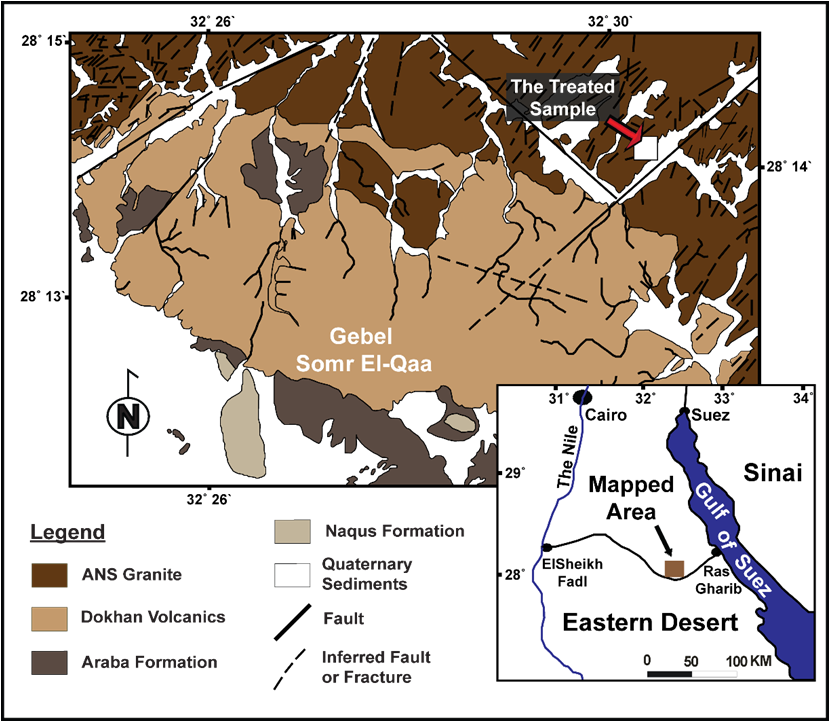
The studied sample is a monzogranite from the Younger granite suite of the Arabian-Nubian Shield (ANS) at Somr ElQaa area in the northern Eastern Desert (Figure 1).
Food demand increases significantly with increasing world popularity. Similarly, on the national level, the Egyptian population grow continuously at an alarming rate. Additionally, the natural fertilization of the traditionally planted soils in the Nile Valley and the Delta decreases gradually since the establishment of the High Dam. Therefore, Egypt has a running plan to reclaim new agricultural land from the desert, unfortunately, many of these soils are poor in several fundamental nutrients. Moreover, the worldwide high inflation rates cause a huge increase in the chemical fertilizers prices. Therefore, there is an increasing need and demand for affordable, abundant, and nutrients rich fertilizers.


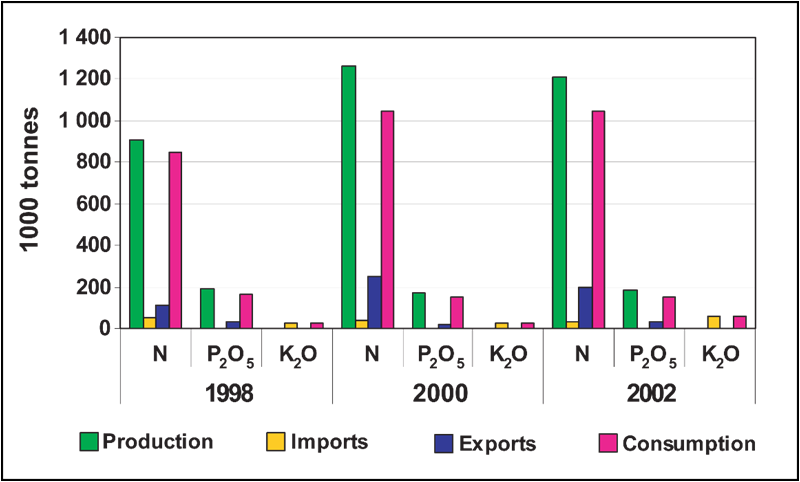
In Egypt, mineral fertilizers along with organic manures are the main nutrient source for plants, especially the N, P and K fertilizers. These mineral fertilizers have traditionally been used in Egypt since 1902. The mineral fertilizers were entirely imported until national production of phosphate fertilizers began in 1936, while, nitrogen fertilizers production started in 1951. No potash fertilizers are produced in Egypt (Figure 2), due to the lack of resources 3. The main types of fertilizers used in Egypt are: (1) as a Nitrogen nutrient; urea (46.5%), ammonium nitrate (33.5%), ammonium sulphate (20.6%), and calcium nitrate (15.5%). (2) as a Phosphate nutrient; single superphosphate (15%), and concentrated superphosphate (37%). (3) as a Potassium nutrient; potassium sulphate (48-50%), and potassium chloride (50-60%) 3.
Granite, is traditionally, used as a potassium fertilizer which could enhance the soil quality (e.g., 5, 6). However, its nature as an insoluble silicate-based mineral has limited the plant's beneficiary from it as a fertilizer 7. Therefore, finding the granitic rock type that is enriched in different nutrients, with low heavy metals and radioactive concentrations is the key, however, we still have to overcome its mineral solubility in media and/or soil issues and test its effectiveness on plants.
The analyzed sample is a monzogranite rock from the Younger granite suite of the ANS at Somr ElQaa area, northern Eastern Desert, Egypt (Figure 1). The monzogranite rock sample was chosen because they are generally characterized with minimum silica content among granitic rocks, with roughly equal concentrations of potassium and calcium.
The Egyptian ANS (ENS) was developed through multistage tectonic activities ended by island arcs and continental fragments accretion into old craton during the Late Neoproterozoic 9, 10, 11, 12, 13. Granites with island-arc affinity are common in the ANS 14, 15, 16. Previous studies proposed the classification of the ENS granitic rocks into two main groups; the older suite with Tonian-Cryogenian age and calc-alkaline composition, and the younger suite with Ediacaran age alkaline affinity 17, 18, 19. However, more recent studies reported a synchronous formation of both calc-alkaline and alkaline granitic rocks 20, 21. After its formation, the ENS was eroded before the end of the Cambrian and buried beneath the Lower Palaeozoic sedimentary succession 22, 23, 24. After a tectonically stable period, Gondwana and Laurasia collided causing the Hercynian tectonic events which caused rock uplift and exposure of the ENS again during the Devonian-Carboniferous 25, 26, 27. Afterwards, the mid-Atlantic opening during the Jurassic-Cretaceous resulted in volcanism, domal structures, and additional exhumation in the ENS 28, 29, 30, 31. Then, during the Oligocene-Miocene, a period of significant uplifts in the ENS formed the flanks of the newly formed Red Sea/Gulf of Suez rift system.
The Younger granites formed in the ENS within two major events; (1) during the Dokhan event which is responsible for the emplacement of most of the ENS Younger granite in the Eastern Desert between 630 Ma and 570 Ma. (2) during the Katherina event which is responsible for the emplacement of most of the ENS Younger granite in the northern Eastern Desert and Sinai between 572 Ma and 500 Ma 32. The analyzed sample was collected from the Younger granite that belongs to the Dokhan event at Gebel Somr ElQaa area, western the Gulf of Suez, in the NED, Egypt (Figure 1). Generally, the Younger granites are characterized by SiO2 concentrations ranges from 80 wt% and 70 wt%, the CaO ranges between 0.1 and 1.6 wt%, the K2O/Na2O ratios > 1, K2O >3.8 wt%, and the FeO*/MgO ratios >4. They are enriched in total REEs and the high field strength elements, while, depleted in Ba, Sr, and have high Rb/Sr and conversely low K/Rb ratios 13.
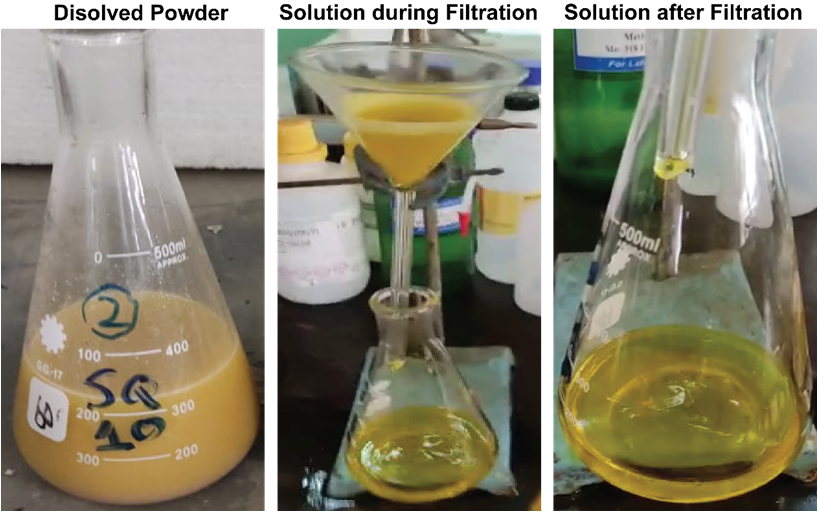
The treated sample was collected from the Younger granite suite at Somr ElQaa area, and analyzed by conventional geological techniques; the boulder-sized sample are crushed using a Jaw crusher to reduce their size to ca. 200-75 mm. Then, a grinding Mill was used to reduce the size to the minimum achievable size. The resulting powder is insoluble because of the bonding of different elements with the silicate group (SiO2). To overcome this issue, the resulting powder was treated with a mixture of concentric acids, these acids break the bond of different elements and dissolve them from the silicate component which did not dissolve. Then, the solution was filtered five times until it becomes entirely clear, while, the silicate group will be removed by this filtration process (Figure 3). The expected now is that the bond between different elements and the silicate group is broken, and all element except the silicate group will pass through the filter paper. To test the validity of this method we have analyzed the treated sample using the attenuated total reflection coupled with Fourier-transform infrared (ATR-FTIR). This technique is used to procure the infrared spectrum of the treated sample, it collects synchronously the high-spectral-resolution data over a widespread range. The resulting spectrum allows us to test whether the represented elements bonded to each other or not. Furthermore, the concentrations of the elements within the granitic powder and the granitic solution were examined using Energy Dispersive X-Ray Spectrometry (EDX).
The studied sample was analyzed using EDX before and after being dissolved in acids to test if our method was efficient to remove the silicates from other elements. The powder (pre-solution) shows, as expected, a high silicate concentration of ca. 58.5% of the sample (Table 1). Then, descending concentrations of aluminium, iron, calcium, magnesium, sodium, and potassium oxides, indicating its suitability as a multinutrient fertilizer (Table 1). However, the main issue here is the insolubility of these elements and oxides in the water due to the insolubility of the silicate components which are connected to all other elements. Therefore, the element concentrations of the dissolved sample were measured using the same technique, EDX. The analyzed concentrations were very promising showing no silicate content after dissolving and filtering the undissolved silicates (Table 2). Taking into account that the detection limit of the EDX measurement is ca. 0.1%. This also is applied to the radioactive element which are absent or lower than our detection limit, documents for the absence of any radioactive hazardous for using these granites as mineral fertilizers.
Here we analyzed another granitic sample after dissolution because all granites are composed of silicate minerals, and the purpose of the dissolving process (removing silica) will be tested anyway. However, using another sample would demonstrate the fact that the granitoid rocks comprise a wide range of mineralogical and element compositions (Table 1 & Table 2). This is indicated here by representing not only different concentrations (from the powder sample) but also other elements. These elements represented in the dissolved granitic sample are chromium, copper, and phosphorus, while, the sodium element is absent. Therefore, further investigation is required to choose the most satisfactory rock that includes the most required nutrients.
Granitoid rocks can be used as multinutrient mineral fertilizer as it is rich in a majority of the required element for plants. However, further research about the most suitable rock type of event mixture of rocks is required. This result became achievable after we could overcome the main problem of using a granitoid rock as fertilizers by removing the insoluble silicate from the main component.
| [1] | Twidale, C.R. 2000. Granite outcrops: their utilisation and conservation. Journal of the Royal Society of Western Australia, 83:115-122. | ||
| In article | |||
| [2] | Stern, R.J., Hedge, C.E., 1985. Geochronologic and isotopic constraints on late Precambrian crustal evolution in the Eastern Desert of Egypt. American Journal of Science 285, 97-127. | ||
| In article | View Article | ||
| [3] | FAO. 2005. Fertilizer use by crop in Egypt. Report of Land and Plant Nutrition Management Service Land and Water Development Division, FOOD AND AGRICULTURE ORGANIZATION OF THE UNITED NATIONS, Rome, 57pp. | ||
| In article | |||
| [4] | Tawfik, H.A, Ghandour, I.M, Maejima, W, Abdel-Hameed, A.T. 2011. Petrography and Geochemistry of the Lower Paleozoic Araba Formation, Northern Eastern Desert, Egypt: Implications for Provenance, Tectonic Setting and Weathering Signature. Journal of Geoscience, Osaka City University, 54, 1-16. | ||
| In article | |||
| [5] | Coroneos, C., Hinsinger, P. Gilkes, R.J. 1995. Granite powder as a source of potassium for plants: a glasshouse bioassay comparing two pasture species. Fertilizer research, 45(2), 143-152. | ||
| In article | View Article | ||
| [6] | Khan, M.A., Rana, H. 2020. Granite Slurry: A Valued By-Product as Fertilizer. International Journal of Research and Innovation in Applied Science (IJRIAS) | Volume V, Issue IV, ISSN 2454-6194. | ||
| In article | |||
| [7] | Bolland, M. D. A., & Baker, M. J. 2000. Powdered granite is not an effective fertilizer for clover and wheat in sandy soils from Western Australia. Nutrient Cycling in Agroecosystems, 56(1), 59-68. | ||
| In article | View Article | ||
| [8] | MALR. 2003. Bulletin of Agriculture Economics, Central Administration of Agriculture Economics, Ministry of Agriculture and Land Reclamation, published data. | ||
| In article | |||
| [9] | Kröner, A. 1979. Pan African Plate Tectonics and Its Repercussions on the Crust of Northeast Africa. Geol. Rundsch. 68, 565-583. | ||
| In article | View Article | ||
| [10] | Meert, J.G. 2003. A Synopsis of Events Related to the Assembly of Eastern Gondwana. Tectonophysics, 362, 1-40. | ||
| In article | View Article | ||
| [11] | Engel, A.E.J.; Dixon, T.H.; Stern, R.J. 1980. Late Precambrian Evolution of Afro-Arabian Crust from Ocean Arc to Craton. Geol. Soc. Am. Bull., 91, 699, 2. | ||
| In article | View Article | ||
| [12] | Johnson, P.R.; Andresen, A.; Collins, A.S.; Fowler, A.R.; Fritz, H.; Ghebreab, W.; Kusky, T.; Stern, R.J. 2011. Late Cryogenian–Ediacaran History of the Arabian–Nubian Shield: A Review of Depositional, Plutonic, Structural, and Tectonic Events in the Closing Stages of the Northern East African Orogen. J. Afr. Earth Sci., 61, 167-232. | ||
| In article | View Article | ||
| [13] | Mansour, S. E. E. (2015). Long-term topographic evolution of the African plate, causes and 456 consequences for surrounding lithospheric plates. | ||
| In article | |||
| [14] | El-Gaby, S.; el-Nady, O.; Khudeir, A. 1984. Tectonic Evolution of the Basement Complex in the Central Eastern Desert of Egypt. Geol. Rundsch., 73, 1019-1036. | ||
| In article | View Article | ||
| [15] | Bentor, Y.K. 1985. The Crustal Evolution of the Arabo-Nubian Massif with Special Reference to the Sinai Peninsula. Precambrian Res., 28, 1-74. | ||
| In article | View Article | ||
| [16] | El Din, G.M.K.; Khudeir, A.A.; Greiling, R.O. 1991. Tectonic Evolution of a Pan-African Gneiss Culmination, Gabal El Sibai Area, Central Eastern Desert, Egypt. Zent Bl Geol Palaeont, I11, 2637-2640. | ||
| In article | |||
| [17] | Hume, W.F. 1935. The Later Plutonic and Minor Intrusive Rocks, Survey of Egypt, Cairo. | ||
| In article | |||
| [18] | Schurmann, H.M.E. 1953. The Precambrian of the Gulf of Suez Area. Int Geol Congr Algiers CR, 19, 115-135. | ||
| In article | |||
| [19] | El Ramly, M.F.; Akaad, M.K. 1960. The Basement Complex in the Central-Eastern Desert of Egypt between Lat. 24°30 and 25° 40 N. Geol. Surv. Egypt Ann., 8. | ||
| In article | |||
| [20] | Ali, B.H.; Wilde, S.A.; Gabr, M.M.A. 2009. Granitoid Evolution in Sinai, Egypt, Based on Precise SHRIMP U–Pb Zircon Geochronology. Gondwana Research, 15, 38-48. | ||
| In article | View Article | ||
| [21] | Moreno, J.A.; Montero, P.; Abu Anbar, M.; Molina, J.F.; Scarrow, J.H.; Talavera, C.; Cambeses, A.; Bea, F. 2012. SHRIMP U–Pb Zircon Dating of the Katerina Ring Complex: Insights into the Temporal Sequence of Ediacaran Calc-Alkaline to Peralkaline Magmatism in Southern Sinai, Egypt. Gondwana Research, 21, 887-900. | ||
| In article | View Article | ||
| [22] | Said, R. 1990. The Geology of Egypt; 2nd ed.; A.A. Balkema, Rotterdam: Netherlands. | ||
| In article | |||
| [23] | Seilacher, A. 1990. Paleozoic Trace Fossils. In Geology of Egypt; A.A. Balkema, Rotterdam: Netherlands, pp. 113-156. | ||
| In article | |||
| [24] | Bosworth, W.; Huchon, P.; McClay, K. 2005. The Red Sea and Gulf of Aden Basins. Journal of African Earth Science. 43, 334-378. | ||
| In article | View Article | ||
| [25] | Stampfii, G.M.; von Raumer, J.F.; Borel, G.D. 2002. Paleozoic Evolution of Pre-Variscan Terranes: From Gondwana to the Variscan Collision. In Variscan-Appalachian dynamics: The building of the late Paleozoic basement; Geological Society of America. | ||
| In article | View Article | ||
| [26] | Craig, J.; Sutcliffe, O.; Lüning, S.; Le Heron, D.; Whittington, R. 2008. Structural Styles and Prospectivity in the Precambrian and Palaeozoic Hydrocarbon Systems of North Africa. In Geology of East Libya; Earth Sci. Soc. of Libya: Tripoli, pp. 51-122. | ||
| In article | |||
| [27] | Dixon, R.J.; Moore, J.K.S.; Bourne, M.; Dunn, E.; Haig, D.B.; Hossack, J.; Roberts, N.; Parsons, T.; Simmons, C.J. 2010. Integrated Petroleum Systems and Play Fairway Analysis in a Complex Palaeozoic Basin: Ghadames-Illizi Basin, North Africa. Geol. Soc. Lond. Pet. Geol. Conf. Ser., 7, 735-760. | ||
| In article | View Article | ||
| [28] | Said, R. 1962. The Geology of Egypt; 1st ed.; Elsevier, Amsterdam: Netherlands. | ||
| In article | |||
| [29] | Klitzsch, E. 1986. Plate Tectonics and Cratonal Geology in Northeast Africa (Egypt, Sudan). Geol. Rundsch., 75, 755-768. | ||
| In article | View Article | ||
| [30] | Hashad, A.H. 1978. Present Status of Geochronological Data on the Egyptian Basement Complex. Precambrian Research, 6, A24-A25. | ||
| In article | View Article | ||
| [31] | Greiling, R.O.; Kriiner, A.; El Ramly, M.F.; Rashwan, A.A. 1988. Structural Relationships between the Southern and Central Parts of the Eastern Desert of Egypt: Details of a Fold and Thrust Belt. In The Pan-African of NE Africa and Adjacent Areas; El Gaby, S., Greiling, R.O., Eds.; Vieweg: Wiesbaden, pp. 121-145. | ||
| In article | |||
| [32] | Hassan, M.A.; Hashad, A.H. 1990. Precambrian of Egypt. In Geology of Egypt; Said, R., Ed.; Balkema Publications, Netherlands, p. 734. | ||
| In article | |||
Published with license by Science and Education Publishing, Copyright © 2021 Sherif Mansour and Amr Elkelish
 This work is licensed under a Creative Commons Attribution 4.0 International License. To view a copy of this license, visit
http://creativecommons.org/licenses/by/4.0/
This work is licensed under a Creative Commons Attribution 4.0 International License. To view a copy of this license, visit
http://creativecommons.org/licenses/by/4.0/
| [1] | Twidale, C.R. 2000. Granite outcrops: their utilisation and conservation. Journal of the Royal Society of Western Australia, 83:115-122. | ||
| In article | |||
| [2] | Stern, R.J., Hedge, C.E., 1985. Geochronologic and isotopic constraints on late Precambrian crustal evolution in the Eastern Desert of Egypt. American Journal of Science 285, 97-127. | ||
| In article | View Article | ||
| [3] | FAO. 2005. Fertilizer use by crop in Egypt. Report of Land and Plant Nutrition Management Service Land and Water Development Division, FOOD AND AGRICULTURE ORGANIZATION OF THE UNITED NATIONS, Rome, 57pp. | ||
| In article | |||
| [4] | Tawfik, H.A, Ghandour, I.M, Maejima, W, Abdel-Hameed, A.T. 2011. Petrography and Geochemistry of the Lower Paleozoic Araba Formation, Northern Eastern Desert, Egypt: Implications for Provenance, Tectonic Setting and Weathering Signature. Journal of Geoscience, Osaka City University, 54, 1-16. | ||
| In article | |||
| [5] | Coroneos, C., Hinsinger, P. Gilkes, R.J. 1995. Granite powder as a source of potassium for plants: a glasshouse bioassay comparing two pasture species. Fertilizer research, 45(2), 143-152. | ||
| In article | View Article | ||
| [6] | Khan, M.A., Rana, H. 2020. Granite Slurry: A Valued By-Product as Fertilizer. International Journal of Research and Innovation in Applied Science (IJRIAS) | Volume V, Issue IV, ISSN 2454-6194. | ||
| In article | |||
| [7] | Bolland, M. D. A., & Baker, M. J. 2000. Powdered granite is not an effective fertilizer for clover and wheat in sandy soils from Western Australia. Nutrient Cycling in Agroecosystems, 56(1), 59-68. | ||
| In article | View Article | ||
| [8] | MALR. 2003. Bulletin of Agriculture Economics, Central Administration of Agriculture Economics, Ministry of Agriculture and Land Reclamation, published data. | ||
| In article | |||
| [9] | Kröner, A. 1979. Pan African Plate Tectonics and Its Repercussions on the Crust of Northeast Africa. Geol. Rundsch. 68, 565-583. | ||
| In article | View Article | ||
| [10] | Meert, J.G. 2003. A Synopsis of Events Related to the Assembly of Eastern Gondwana. Tectonophysics, 362, 1-40. | ||
| In article | View Article | ||
| [11] | Engel, A.E.J.; Dixon, T.H.; Stern, R.J. 1980. Late Precambrian Evolution of Afro-Arabian Crust from Ocean Arc to Craton. Geol. Soc. Am. Bull., 91, 699, 2. | ||
| In article | View Article | ||
| [12] | Johnson, P.R.; Andresen, A.; Collins, A.S.; Fowler, A.R.; Fritz, H.; Ghebreab, W.; Kusky, T.; Stern, R.J. 2011. Late Cryogenian–Ediacaran History of the Arabian–Nubian Shield: A Review of Depositional, Plutonic, Structural, and Tectonic Events in the Closing Stages of the Northern East African Orogen. J. Afr. Earth Sci., 61, 167-232. | ||
| In article | View Article | ||
| [13] | Mansour, S. E. E. (2015). Long-term topographic evolution of the African plate, causes and 456 consequences for surrounding lithospheric plates. | ||
| In article | |||
| [14] | El-Gaby, S.; el-Nady, O.; Khudeir, A. 1984. Tectonic Evolution of the Basement Complex in the Central Eastern Desert of Egypt. Geol. Rundsch., 73, 1019-1036. | ||
| In article | View Article | ||
| [15] | Bentor, Y.K. 1985. The Crustal Evolution of the Arabo-Nubian Massif with Special Reference to the Sinai Peninsula. Precambrian Res., 28, 1-74. | ||
| In article | View Article | ||
| [16] | El Din, G.M.K.; Khudeir, A.A.; Greiling, R.O. 1991. Tectonic Evolution of a Pan-African Gneiss Culmination, Gabal El Sibai Area, Central Eastern Desert, Egypt. Zent Bl Geol Palaeont, I11, 2637-2640. | ||
| In article | |||
| [17] | Hume, W.F. 1935. The Later Plutonic and Minor Intrusive Rocks, Survey of Egypt, Cairo. | ||
| In article | |||
| [18] | Schurmann, H.M.E. 1953. The Precambrian of the Gulf of Suez Area. Int Geol Congr Algiers CR, 19, 115-135. | ||
| In article | |||
| [19] | El Ramly, M.F.; Akaad, M.K. 1960. The Basement Complex in the Central-Eastern Desert of Egypt between Lat. 24°30 and 25° 40 N. Geol. Surv. Egypt Ann., 8. | ||
| In article | |||
| [20] | Ali, B.H.; Wilde, S.A.; Gabr, M.M.A. 2009. Granitoid Evolution in Sinai, Egypt, Based on Precise SHRIMP U–Pb Zircon Geochronology. Gondwana Research, 15, 38-48. | ||
| In article | View Article | ||
| [21] | Moreno, J.A.; Montero, P.; Abu Anbar, M.; Molina, J.F.; Scarrow, J.H.; Talavera, C.; Cambeses, A.; Bea, F. 2012. SHRIMP U–Pb Zircon Dating of the Katerina Ring Complex: Insights into the Temporal Sequence of Ediacaran Calc-Alkaline to Peralkaline Magmatism in Southern Sinai, Egypt. Gondwana Research, 21, 887-900. | ||
| In article | View Article | ||
| [22] | Said, R. 1990. The Geology of Egypt; 2nd ed.; A.A. Balkema, Rotterdam: Netherlands. | ||
| In article | |||
| [23] | Seilacher, A. 1990. Paleozoic Trace Fossils. In Geology of Egypt; A.A. Balkema, Rotterdam: Netherlands, pp. 113-156. | ||
| In article | |||
| [24] | Bosworth, W.; Huchon, P.; McClay, K. 2005. The Red Sea and Gulf of Aden Basins. Journal of African Earth Science. 43, 334-378. | ||
| In article | View Article | ||
| [25] | Stampfii, G.M.; von Raumer, J.F.; Borel, G.D. 2002. Paleozoic Evolution of Pre-Variscan Terranes: From Gondwana to the Variscan Collision. In Variscan-Appalachian dynamics: The building of the late Paleozoic basement; Geological Society of America. | ||
| In article | View Article | ||
| [26] | Craig, J.; Sutcliffe, O.; Lüning, S.; Le Heron, D.; Whittington, R. 2008. Structural Styles and Prospectivity in the Precambrian and Palaeozoic Hydrocarbon Systems of North Africa. In Geology of East Libya; Earth Sci. Soc. of Libya: Tripoli, pp. 51-122. | ||
| In article | |||
| [27] | Dixon, R.J.; Moore, J.K.S.; Bourne, M.; Dunn, E.; Haig, D.B.; Hossack, J.; Roberts, N.; Parsons, T.; Simmons, C.J. 2010. Integrated Petroleum Systems and Play Fairway Analysis in a Complex Palaeozoic Basin: Ghadames-Illizi Basin, North Africa. Geol. Soc. Lond. Pet. Geol. Conf. Ser., 7, 735-760. | ||
| In article | View Article | ||
| [28] | Said, R. 1962. The Geology of Egypt; 1st ed.; Elsevier, Amsterdam: Netherlands. | ||
| In article | |||
| [29] | Klitzsch, E. 1986. Plate Tectonics and Cratonal Geology in Northeast Africa (Egypt, Sudan). Geol. Rundsch., 75, 755-768. | ||
| In article | View Article | ||
| [30] | Hashad, A.H. 1978. Present Status of Geochronological Data on the Egyptian Basement Complex. Precambrian Research, 6, A24-A25. | ||
| In article | View Article | ||
| [31] | Greiling, R.O.; Kriiner, A.; El Ramly, M.F.; Rashwan, A.A. 1988. Structural Relationships between the Southern and Central Parts of the Eastern Desert of Egypt: Details of a Fold and Thrust Belt. In The Pan-African of NE Africa and Adjacent Areas; El Gaby, S., Greiling, R.O., Eds.; Vieweg: Wiesbaden, pp. 121-145. | ||
| In article | |||
| [32] | Hassan, M.A.; Hashad, A.H. 1990. Precambrian of Egypt. In Geology of Egypt; Said, R., Ed.; Balkema Publications, Netherlands, p. 734. | ||
| In article | |||