The intensification of maize (Zea mays L.)–common bean (Phaseolus vulgaris L.) intercropping requires balancing nutrient supply, interspecific competition and returns to fertilizer investment. The individual and interactive effects of NPK fertilizer regime, supplemental urea, and bean density on system productivity and economic performance on a tropical Andosol of the Cameroon Western Highlands were evaluated. Two independent field experiments were conducted on separate fields (C1: April–July; C2: July–October) using a split-split-plot design with three replicates. Five NPK regimes (0; 300 and 600 kg ha−1 of 20-10-10 + 6SO3; and 300 and 600 kg ha−1 of 14-23-14 + 5S + 1B2O3) were combined with 0 or 100 kg ha−1 urea and three cropping systems: sole maize at 55,555 plants ha−1 (S1), and maize at the same density intercropped with bean at 22,222 (S2; two plants hill−1) or 33,333 plants ha−1 (S3; three plants hill−1), while maintaining the same spatial arrangement. Mean combined physical grain yield was 7.384 t ha−1 in C1 and 6.746 t ha−1 in C2; these differences were considered descriptive because the experiments were conducted on separate fields. The NPK × urea × cropping system interaction significantly affected combined physical grain yield in both C1 (P = 0.037) and C2 (P = 0.028). NPK14_600 × U100 × S2 produced the highest yields, reaching 9.476 and 8.295 t ha−1, respectively. Increasing bean density by 50% from S2 to S3 reduced bean yield by 8.5% in C1 and 14.0% in C2 and further reduced maize yield. The productivity optimum, however, did not coincide with the economic optimum. The aggregated economic assessment identified NPK14_300 × U0 × S2 as having the highest benefit-to-cost ratio (BCR = 2.59; fertilizer economic return = 158.85%), compared with a BCR of 1.33 for the highest-yielding strategy, NPK14_600 × U100 × S2. Thus, among the configurations tested, S2 was common to the strategies achieving the highest physical productivity and economic return, whereas fertilizer intensity determined the trade-off between these objectives.
Cereal–legume intercropping is central to smallholder farming systems in sub-Saharan Africa, where increasing food production must be reconciled with declining soil fertility, growing pressure on arable land and high input costs 1 2 3. By combining species with contrasting architectures, phenologies, and resource-acquisition strategies, intercrops can diversify production and improve the spatiotemporal use of light, water and nutrients 4 5. Their performance, however, depends on the balance between complementarity and competition, which is strongly influenced by nutrient availability, relative plant densities, and environmental conditions 4 6 7 8 9. Efficient intensification therefore entails more than increasing fertilizer inputs or plant populations; it requires identifying nutrient supply–plant density combinations that effectively convert available resources into grain yield and economic returns.
Maize (Zea mays L.)–common bean (Phaseolus vulgaris L.) intercropping exemplifies this management challenge in the Central African highlands. Maize contributes substantially to food, livestock feed, and farm income, but its productivity is often constrained by insufficient or imbalanced nutrient supply and environmental variability 2 10 11. Its high demand for N, P, and K makes maize particularly responsive to soil fertility management 12. Common bean is likewise an important source of dietary protein and income for smallholder farmers. In the Western Highlands of Cameroon, its performance is influenced by P availability, water supply, and interactions with the associated cereal 13 14 15 16 17. System productivity therefore depends on meeting the nutrient requirements of two component crops with contrasting resource demands and acquisition strategies.
Relative plant density is a key management lever in this balance. At constant maize density, increasing bean density may increase the potential contribution of the legume to system production, but it also increases total plant population and collective resource demand. Beyond a certain density, greater overlap of above- and below-ground niches may intensify inter- and intraspecific competition and reduce crop performance 8 18 19. Plant density, canopy architecture, and spatial arrangement regulate radiation interception and the partitioning of water and nutrients between component crops 20 21 22 23 24. Bean density and nutrient supply should therefore be considered jointly rather than as independent management factors.
This interaction may be particularly important on the volcanic Andosols of the Western Highlands of Cameroon. Andosols typically have low bulk density, high porosity, and high organic matter contents, but their short-range-order minerals, including allophane and imogolite, together with organo-mineral Al and Fe complexes, confer a strong capacity to sorb phosphate and potentially restrict its availability to crops 25 26 27 28 29. Under these conditions, nutrient balance may be as important as fertilizer rate. NPK 20-10-10 + 6SO3 supplies proportionally more N and less P than NPK 14-23-14 + 5S + 1B2O3, which also supplies B. Phosphorus is involved in energy transfer, root development, and the functioning of N2-fixing symbioses; S contributes to N metabolism and the synthesis of sulfur-containing amino acids; and B supports several growth and reproductive processes 13 30 31 32 33. Because the two formulations differ simultaneously in several nutrients, however, their comparison represents contrasting nutrient regimes rather than tests of the isolated effects of P, S, or B.
Management responses also depend on the environment in which they are expressed. Rainfall distribution, crop phenology, and soil properties can alter nutrient availability and transport and ultimately their conversion into grain yield 14 20 34. Variation in maize and common bean responses to fertilization has also been reported in western Cameroon 17. Applying the same treatment structure in independent field experiments therefore provides an opportunity to assess the consistency of treatment responses across distinct experimental conditions without treating cropping period as an experimental factor.
Biological responses alone are insufficient to determine whether an intensification strategy is relevant to smallholder farmers. Higher fertilizer rates may maximize grain yield while reducing returns per unit of capital invested when the marginal value of additional production fails to offset the additional input cost. This trade-off is particularly important where farmers face limited access to capital, high fertilizer prices, and variable crop prices 35 36 37 38 39. The management combination that maximizes physical production therefore cannot be assumed to maximize economic returns 40 41.
Despite these considerations, the joint effects of NPK fertilizer regime, supplemental urea, and bean density on productivity and economic performance remain poorly documented for maize–common bean intercropping on Andosols in the Western Highlands of Cameroon. It remains unclear whether simultaneously increasing fertilizer intensity and bean density improves overall system performance or shifts the balance toward greater competition, and whether the management combination that maximizes combined physical grain yield also provides the greatest return to fertilizer investment. Resolving this productivity–profitability trade-off is important for designing more resource-efficient intensification strategies.
Therefore, in this work, the individual and interactive effects of two NPK formulations applied at two rates and compared with a no-NPK control, supplemental urea, and three cropping systems on maize–common bean growth, grain yield, and economic performance have been evaluated. Two independent field experiments were conducted on a tropical Andosol in western Cameroon to assess the consistency of treatment responses. Four hypotheses were tested: (i) NPK and supplemental urea increase crop growth and grain yield, with responses depending on nutrient regime; (ii) fertilizer responses depend on cropping system and bean density; (iii) increasing bean density from 22,222 to 33,333 plants ha−1 at constant maize density does not necessarily increase bean yield because greater plant density may intensify competition; and (iv) the management combination that maximizes combined physical grain yield differs from that maximizing the value-to-cost ratio.
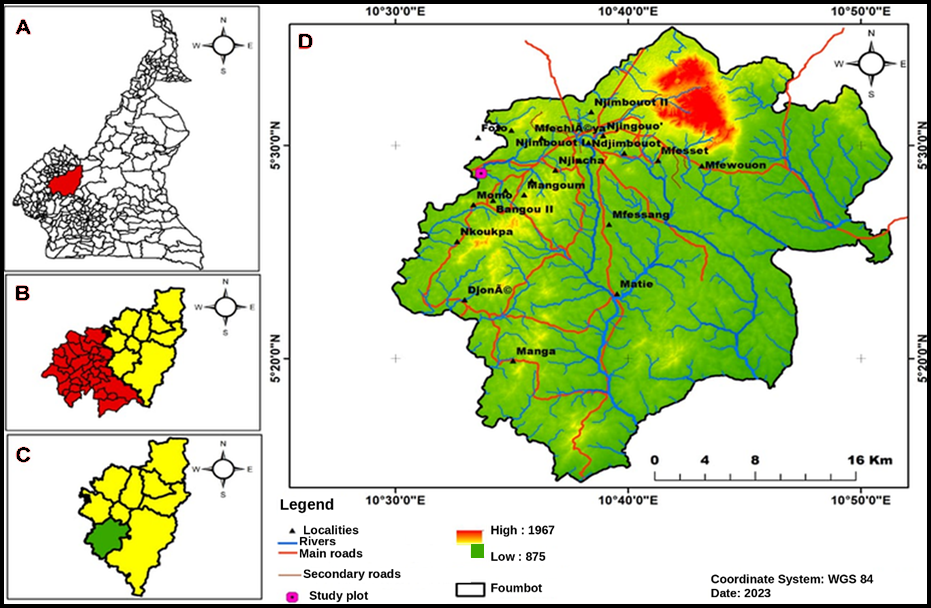
The study was conducted in 2023 at the Mangoum Research Station of the Institute of Agricultural Research for Development (IRAD), Foumbot, in the Western Highlands of Cameroon (05°28′41.2″ N, 010°33′41.2″ E; 1,015 m a.s.l.; Figure 1). Two independent field experiments were established on separate fields using an identical experimental design: C1 from April to July 2023 and C2 from July to October 2023.
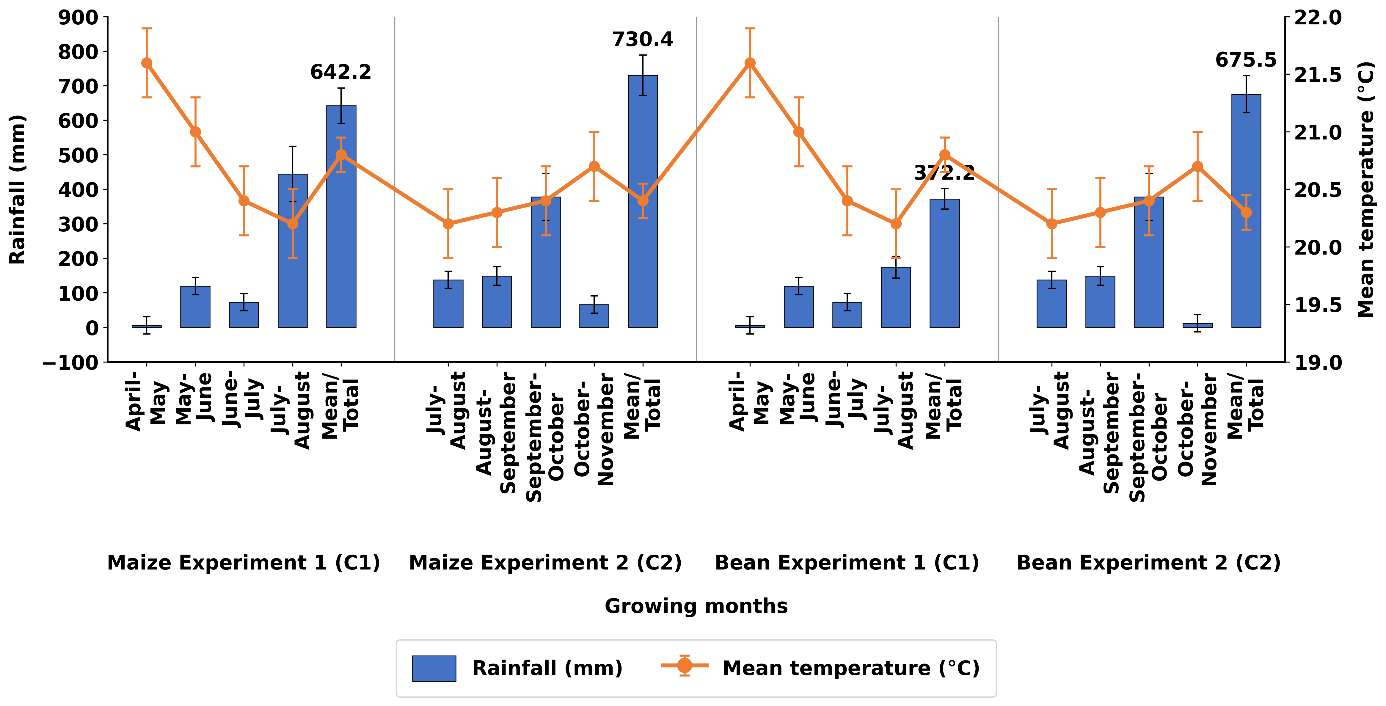
The region has a tropical highland climate characterized by a prolonged rainy season from approximately mid-March to mid-November and a dry season from mid-November to mid-March. Mean annual temperature and rainfall are approximately 21 °C and 1,950 mm, respectively. Meteorological conditions differed markedly between the two experimental periods (Figure 2). Cumulative rainfall over the maize growing cycle was 642.2 mm in C1 and 730.4 mm in C2, whereas rainfall over the shorter common bean cycle was 372.2 and 675.5 mm, respectively. Rainfall distribution also differed substantially, with C2 receiving 378 mm in August alone.
The Western Highlands are underlain by a Precambrian crystalline basement dominated by gneisses and migmatites intruded by granitoids and locally mantled by thick volcanic pyroclastic deposits 42 43. Both experimental fields were situated on Andosols developed from volcanic parent materials. At the regional scale, Andosols and Ferralsols predominate on upland landscape positions, whereas Gleysols occur mainly in poorly drained lowlands 43 44. Agriculture is the dominant land use in the area, with maize, common bean, soybean, tomato, and potato among the major crops. Maize–common bean intercropping is an important component of local smallholder cropping systems, making this volcanic highland environment particularly relevant for evaluating fertilizer × crop-density interactions 17.


Before establishment of each experiment, composite soil samples were collected from the 0–30 cm layer. Soil physicochemical properties were determined following the analytical procedures described by Pauwels et al. 45. Both experimental fields were classified as Andosols according to the World Reference Base for Soil Resources 28. The 0–30 cm soils were slightly acidic (pH-H2O 6.4–6.5), had high organic matter contents (5.84–8.56%), relatively low available P concentrations (8.63–11.07 mg kg−1), and high cation exchange capacity (CEC; 27.33–33.30 cmolc kg−1). Soil texture was sandy clay loam in both experimental fields (Table 1).
The plant material consisted of maize cultivar CHC201 (KASSAI) and common bean cultivar GLP190, both developed by the Institute of Agricultural Research for Development (IRAD) and adapted to the highland conditions of Cameroon. CHC201 is a white-grained maize cultivar with a growth cycle of approximately 90–110 days and a potential grain yield of 4–7 t ha−1. GLP190 is a determinate, bush-type common bean cultivar with large red seeds mottled with white, a growth cycle of approximately 70–90 days, and a potential grain yield of 2–4 t ha−1.
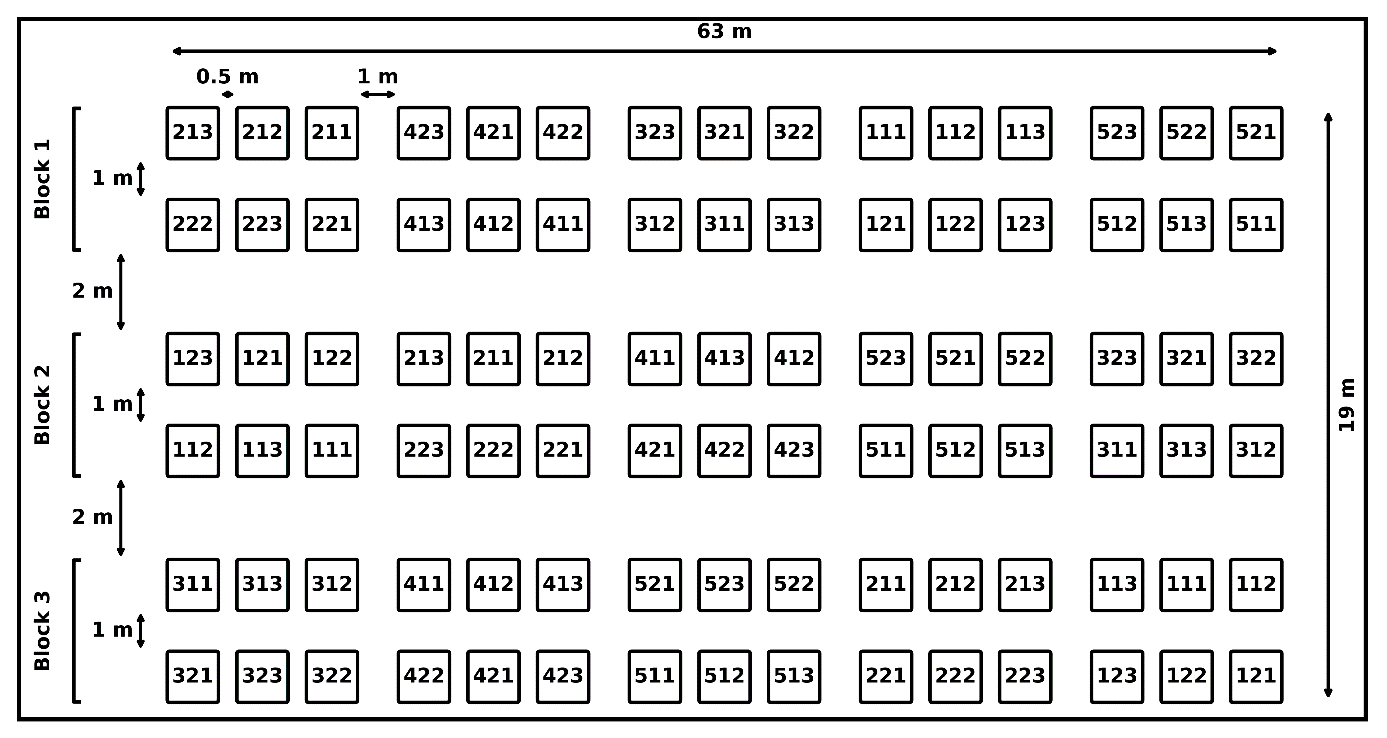
2.4. Experimental Design and TreatmentsEach experiment in the field was conducted using a randomized complete block design with a split-split-plot arrangement and three replicates. NPK fertilizer regime (EM), supplemental urea (U), and cropping system (S) were assigned to the main plots, subplots, and sub-subplots, respectively.
The NPK factor comprised five regimes: NPK0, with no NPK fertilizer; NPK20_300 and NPK20_600, corresponding to 300 and 600 kg ha−1 of NPK 20-10-10 + 6SO3, respectively; and NPK14_300 and NPK14_600, corresponding to 300 and 600 kg ha−1 of NPK 14-23-14 + 5S + 1B2O3, respectively. Supplemental urea (46% N) was applied at two rates: U0 (0 kg ha−1) and U100 (100 kg ha−1). Urea was applied locally to maize five weeks after sowing.
The cropping system factor comprised three treatments: S1, sole maize at 55,555 plants ha−1 (90 × 20 cm, one plant hill−1); S2, maize at 55,555 plants ha−1 intercropped with common bean at a final density of 22,222 plants ha−1; and S3, maize at the same density intercropped with common bean at a final density of 33,333 plants ha−1. Bean spacing was identical in S2 and S3 (45 × 20 cm, between maize rows). Bean density differed only in the number of plants retained per hill after establishment: two plants hill−1 in S2 and three plants hill−1 in S3. Thus, bean density increased by 50% from S2 to S3 without changing crop spacing or spatial arrangement.
The factorial combination of five NPK regimes, two urea rates, and three cropping systems generated 30 treatment combinations per block, giving 90 experimental units per experiment. Each experimental unit covered 7.2 m² (3.6 × 2.0 m). The experimental layout and configurations of S1, S2, and S3 are shown in Figure 3, and the nutrient inputs supplied by the fertilizer regimes are presented in Table 2.

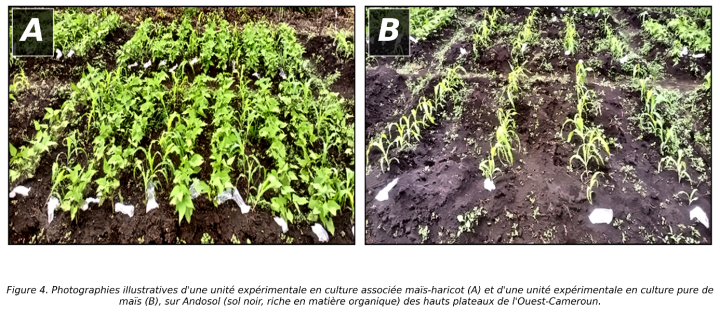
The soil was manually tilled to a depth of 30 cm. NPK fertilizers were band-applied 14 days after sowing (DAS). At the 300 kg ha−1 rate, 200 kg ha−1 was allocated to maize and 100 kg ha−1 to common bean. At the 600 kg ha−1 rate, 500 kg ha−1 was allocated to maize and 100 kg ha−1 to common bean (Figure 4). Urea was applied only to maize five weeks after sowing. Crop protection included applications of lambda-cyhalothrin + acetamiprid against insect pests, including fall armyworm, and a copper-based fungicide against common bean rust.

Plant height and stem diameter were measured at 14-day intervals until 56 days after sowing (DAS); leaf area index (LAI) was additionally determined for maize. Seven maize plants from the inner rows of each experimental unit were tagged and monitored throughout the measurement period. For common bean, measurements were taken on 12 internal plants per experimental unit, excluding border plants.
At maturity, maize grain yield was adjusted to 15% moisture content and common bean grain yield to 10%. For maize, 1000-grain weight, ear length, and ear diameter were measured. For common bean, 1000-grain weight and number of pods per plant were determined.
To quantify the total physical amount of grain harvested from each experimental unit, combined physical grain yield was calculated as:
Ycombined = Ymaize + Ybean
where Ymaize and Ybean are maize and common bean grain yields, respectively. This indicator represents only the physical sum of grain yields of the component crops and was not interpreted as a measure of relative land-use efficiency.
2.7. Economic AssessmentThe economic performance of fertilizer use was assessed using the benefit-to-cost ratio (BCR) and fertilizer economic return (FER), following the FAO approach 35. Incremental production value was defined as the difference in production value relative to the reference treatment. For each cropping system, incremental production value was calculated relative to the unfertilized control (NPK0 × U0) within the same cropping system, thereby separating the economic effect of fertilizer application from that of cropping-system configuration.
BCR and FER were calculated as:
BCR = incremental production value / fertilizer cost
FER (%) = [(incremental production value − fertilizer cost) / fertilizer cost] × 100.
A BCR > 1 indicates that incremental production value exceeds fertilizer cost, whereas BCR ≥ 2 was used as the threshold for economic attractiveness, providing a margin to account for risk 35.
2.8. Statistical AnalysisThe two independent experiments (C1 and C2), conducted on separate fields, were analyzed separately by analysis of variance (ANOVA) according to the split-split-plot design. NPK fertilizer regime (EM), supplemental urea (U), and cropping system (S) were assigned to the main-plot, subplot, and sub-subplot levels, respectively. Main effects and the EM × U, EM × S, U × S, and EM × U × S interactions were tested against the appropriate error terms corresponding to each level of randomization.
When ANOVA indicated a significant effect, means were separated using Duncan’s multiple range test at α = 0.05. Mean yield levels in C1 and C2 were compared descriptively using means, standard deviations, and relative differences, calculated as [(C2 − C1)/C1] × 100. No statistical test of cropping-period effects was performed because C1 and C2 were conducted on separate fields and differed in both edaphic and weather conditions. Consistency of treatment responses between experiments was assessed from the direction and recurrence of the major treatment effects. Statistical analyses were performed using GenStat 9.2.
Productivity levels differed between the two independent experiments (Table 3). Mean combined physical grain yield was 7.384 ± 1.40 t ha−1in C1 and 6.746 ± 1.45 t ha−1 in C2, corresponding to a relative difference of −8.6%. This overall contrast reflected opposite responses of the two component crops: maize grain yield was 13.6% lower in C2 than in C1 (5.259 vs. 6.090 t ha−1), whereas common bean grain yield was 14.9% higher (1.487 vs. 1.294 t ha−1). The 0.193 t ha−1 increase in bean yield only partially offset the 0.831 t ha−1 decrease in maize yield, resulting in lower overall physical grain production in C2.
These contrasts describe productivity under two distinct experimental environments and are not interpreted as an effect of cropping period because C1 and C2 were conducted on separate fields that also differed in edaphic and weather conditions. Nevertheless, the results indicate a shift in the relative contribution of maize and common bean to system productivity. Despite differences in absolute yield levels, several major treatment responses were consistent across the two experiments, particularly the highest-yielding treatment combination and the adverse response to increased bean density.
Values are means ± standard deviation (n = 90 per experiment). Relative differences were calculated as [(C2 − C1)/C1] × 100. C1 and C2 were independent experiments conducted on separate fields from April to July and July to October 2023, respectively. Differences between experiments are presented descriptively and are not interpreted as cropping-period effects because edaphic and weather conditions also differed between fields.
Vegetative growth responded primarily to NPK fertilizer regime and cropping system, with effects generally more pronounced at 56 days after sowing (DAS) (Tables 4 and 5). In maize, NPK fertilization improved most growth traits in both experiments. At 56 DAS, NPK14_600 produced the tallest plants (236.0 and 197.2 cm in C1 and C2, respectively), compared with 181.9 and 140.4 cm under NPK0. The highest leaf area index (LAI) values were recorded under NPK20_600 (6.18 and 5.37), although values were also high under NPK14_600 (6.11 and 5.23). Sole maize (S1) generally had greater stem diameter and LAI than intercropped maize, whereas responses to supplemental urea varied among growth traits. Several interactions involving NPK regime and cropping system were significant, particularly in C2.
Common bean showed a less consistent response to fertilization, and the effect of supplemental urea was limited. NPK regime primarily affected plant height and stem diameter, with the lowest values generally observed under NPK0. Increasing bean density from S2 to S3 reduced stem diameter at 56 DAS in C1 (7.12 vs. 6.67 mm; P = 0.002) and plant height in C2 (66.8 vs. 64.2 cm; P = 0.033). In contrast to maize, the NPK × urea × cropping system interaction was only occasionally significant for common bean growth traits. Overall, maize growth exhibited stronger interactive responses to the management factors than common bean growth.
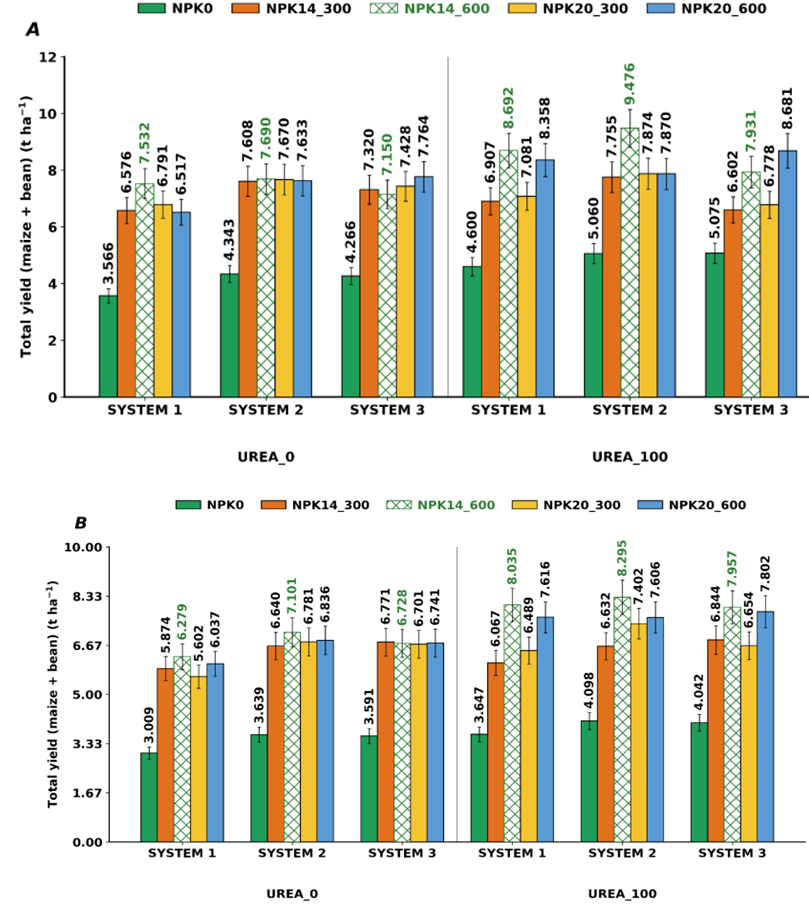
Common bean grain yield was less responsive to fertilizer management than maize grain yield and was primarily associated with bean density within the intercropping systems (Table 6). Supplemental urea had no significant effect on bean grain yield in either experiment (P = 0.863 in C1; P = 0.882 in C2), and the NPK × urea × cropping system interaction was also not significant. An effect of NPK regime on bean grain yield was detected only in C2 (P = 0.001), where NPK14_600 produced 1.660 t ha−1 compared with 1.184 t ha−1 under NPK0.
In contrast, the effect of cropping system was consistent across the two experiments (P = 0.038 in C1; P = 0.009 in C2). Increasing final bean density by 50%, from 22,222 plants ha−1under S2 to 33,333 plants ha−1 under S3, reduced bean grain yield from 1.351 to 1.236 t ha−1 in C1 (−8.5%) and from 1.599 to 1.375 t ha−1 in C2 (−14.0%). In C1, this reduction was accompanied by a decrease in pod number from 6.4 to 4.4 pods plant−1 (−31.3%; P < 0.001), whereas pod number did not differ significantly between S2 and S3 in C2 (P = 0.204). The 1000-grain weight and other yield components were generally less responsive to the treatments.
Thus, increasing bean population by 50% provided no yield advantage; instead, bean grain yield declined in both experiments. The consistent superiority of S2 over S3 indicates that, under the conditions tested, bean density was a more consistent determinant of bean productivity than supplemental urea.
NPK fertilizer regime, supplemental urea, and cropping system strongly affected both maize grain yield and combined physical grain yield in the two experiments (P < 0.001; Table 7). The NPK × urea × cropping system interaction significantly affected combined physical grain yield in both C1 (P = 0.037) and C2 (P = 0.028), indicating that the response to fertilizer management depended on cropping system. NPK14_600 × U100 × S2 was the highest-yielding treatment combination in both experiments, reaching 9.476 t ha−1 in C1 (8.157 t ha−1 maize + 1.319 t ha−1 common bean) and 8.295 t ha−1 in C2 (7.037 + 1.258 t ha−1, respectively) (Figure 5A, B).
At equivalent application rates (300 or 600 kg ha−1), NPK14 and NPK20 did not differ significantly in maize grain yield. At 600 kg ha−1, maize yields under NPK14 and NPK20 were 7.170 and 6.850 t ha−1 in C1 and 6.208 and 6.195 t ha−1 in C2, respectively. Supplemental urea increased mean maize grain yield by 10.4% in C1 and 14.9% in C2 (P < 0.001).
In contrast, increasing the associated crop population progressively reduced maize grain yield (S1 > S2 > S3; P < 0.001). Yield decreased from 6.660 t ha−1 under S1 to 5.540 t ha−1 under S3 in C1 and from 5.891 to 4.784 t ha−1 in C2, corresponding to reductions of 16.8 and 18.8%, respectively. Yield components were generally less responsive to treatments; in particular, 1000-grain weight was not significantly affected by NPK regime. Overall, these results highlight the joint role of fertilizer intensity and cropping-system configuration in determining system productivity.
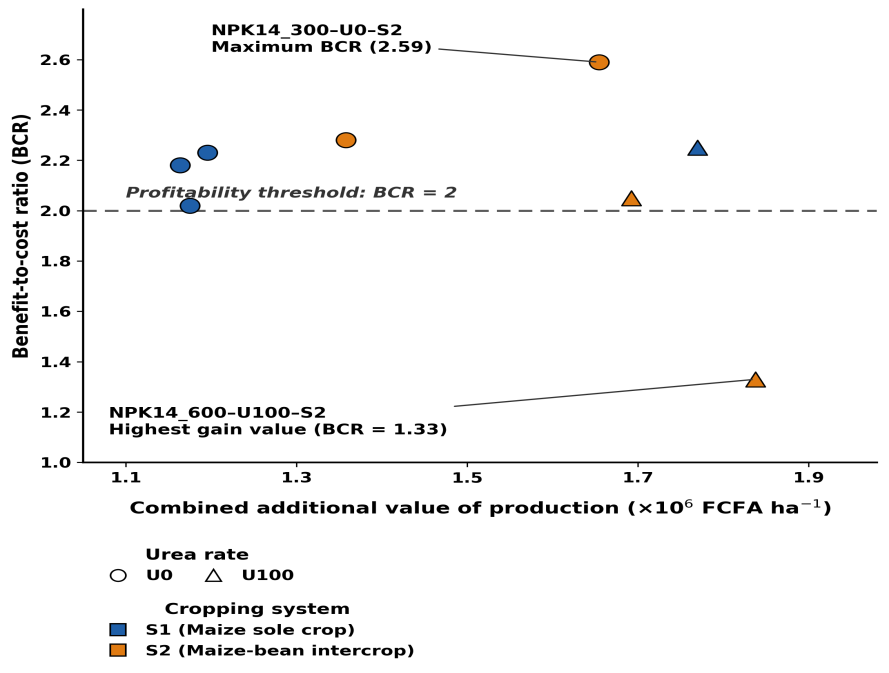
3.5. Economic Profitability of Fertilizer Use and Intensification Trade-offsThe economic analysis revealed a marked divergence between the productivity optimum and the economic optimum (Table 8; Figure 6). Among the strategies evaluated, seven reached the predefined threshold for economic attractiveness (BCR ≥ 2.0). NPK14_300 × U0 × S2 (Code 412) achieved the best economic performance, with the highest VCR of 2.59 (FER = 158.85%), an aggregate incremental production value of 1.654 × 10⁶ FCFA ha−1, and a fertilizer cost of 639,467 FCFA ha−1.
In contrast, NPK14_600 × U100 × S2 (Code 522), the combination that maximized physical productivity in both experiments, generated an aggregate incremental production value of 1.838 × 10⁶ FCFA ha−1 at a fertilizer cost of 1.381 × 10⁶ FCFA ha−1. Its BCR was therefore only 1.33 (FER = 33.07%). Thus, the higher fertilizer expenditure associated with this high-intensity strategy was not matched by a proportional increase in incremental production value, explaining its lower VCR despite its high physical productivity.
Two distinct optima therefore emerged among the evaluated treatments: NPK14_600 × U100 × S2 maximized physical productivity in the agronomic analyses of both experiments, whereas NPK14_300 × U0 × S2 maximized the economic return to fertilizer investment in the aggregated economic assessment. Both strategies relied on S2 (22,222 bean plants ha−1), identifying this cropping-system configuration as their common feature, whereas fertilizer intensity determined the trade-off between maximizing physical production and the economic return to fertilizer investment.


Each point represents a combination of NPK fertilizer regime, urea treatment, and cropping system that reached the BCR ≥ 2 threshold. Colors distinguish sole maize (S1) from maize–common bean intercropping at 22,222 bean plants ha−1 (S2), whereas symbols distinguish the absence of supplemental urea (U0) from the application of 100 kg ha−1 urea (U100). The horizontal dashed line indicates the BCR = 2 threshold used as the criterion for economic attractiveness. S3 is not represented because no combination including 33,333 bean plants ha−1 reached this threshold. Values correspond to the aggregated economic assessment of the two independent experiments. Unfertilized controls are not shown because BCR is undefined when fertilizer cost is zero.
The central finding of this study is that intensification of maize–common bean intercropping on a tropical Andosol was governed by the coordination of nutrient supply and crop density rather than by maximizing either component independently. Three lines of evidence support this conclusion. First, fertilizer inputs strongly increased maize growth and yield, but their benefits depended on cropping-system configuration, as shown by the significant NPK × urea × cropping system interaction for combined physical grain yield in both experiments. Secondly, increasing bean density by 50% beyond S2 failed to increase bean yield and simultaneously strengthened the yield penalty on maize, indicating that greater plant population shifted the system toward competition rather than additional production. Third, the management combination that maximized physical productivity differed markedly from that maximizing economic return to fertilizer investment. Importantly, both optima occurred under the same intermediate bean density (S2), while differing in fertilizer intensity. Together, these results identify crop density as a key determinant of system productivity and fertilizer intensity as a major determinant of the productivity–profitability trade-off.
Absolute productivity differed between the two independent experiments, but the major management responses were remarkably consistent. Combined physical grain yield was 8.6% lower in C2 than in C1, reflecting a 13.6% decrease in maize yield that was only partly offset by a 14.9% increase in bean yield. The relative contribution of the two species to total physical production therefore shifted between experimental environments. Such contrasting component-crop responses illustrate why aggregate intercrop production alone may conceal important changes in species-level performance.
These differences cannot be interpreted as a cropping-period effect because C1 and C2 were conducted on separate fields and differed simultaneously in edaphic and weather conditions. Initial soil texture, organic C, CEC, and exchangeable K differed between fields, while cumulative rainfall during the maize cycle increased from 642.2 mm in C1 to 730.4 mm in C2 and was strongly concentrated in August during C2. The timing of water supply relative to flowering and grain filling strongly influences maize productivity 46 47, and common bean is similarly sensitive to water availability during flowering and pod filling 14. Soil water conditions can also influence N transformations and mobility within the soil profile 48 49. These processes provide plausible explanations for some of the differences between C1 and C2, but they cannot be resolved here because soil water status, drainage, and N losses were not measured.
More important for the objectives of this study is that the direction of the major management responses persisted across these contrasting environments. Fertilization substantially increased productivity, S3 consistently failed to translate its higher bean population into greater bean yield while further reducing maize yield, and NPK14_600 × U100 × S2 produced the highest combined physical grain yield in both experiments. This recurrence does not establish temporal or regional stability, but it indicates that the main treatment responses were not restricted to a single experimental field or growing period. Similar environmental variation in maize–common bean performance has been reported in western Cameroon 17. Multi-year and multi-site testing is nevertheless required to determine whether the response patterns identified here remain robust across the broader range of Andosol environments in the Western Highlands.
4.2. Nutrient Supply and Cropping-system Configuration Jointly Regulate Fertilizer ResponseThe strong response of maize to NPK fertilization confirms nutrient availability as a major determinant of productivity in this system. Fertilization increased plant height, stem diameter, leaf area development, and grain yield, responses consistent with improved nutrient support for canopy development, radiation interception, assimilate production, and reproductive growth. Such responses agree with the central role of balanced N, P, and K supply in closing nutrient-related yield gaps in sub-Saharan African cereal systems 1 [2 11 12.
Supplemental urea further increased mean maize grain yield by 10.4% in C1 and 14.9% in C2, demonstrating that additional N remained effective even in the presence of NPK fertilization. Yet the response to fertilizer cannot be reduced to a simple dose effect. The significant NPK × urea × cropping system interaction for combined physical grain yield in both C1 (P = 0.037) and C2 (P = 0.028) shows that the productivity generated by nutrient inputs depended on the crop configuration in which those nutrients were deployed. In an intercrop, nutrient demand is determined not only by nutrient supply but also by the number, identity, and competitive relationships of plants sharing the same resource pool. Fertilizer rate and crop density should therefore be considered as interacting components of system design rather than independent management decisions. This interpretation is consistent with integrated soil fertility management, which emphasizes that returns to nutrient inputs emerge from interactions among soil fertility, crop demand, environment, and management 1 2 50.
The asymmetry of fertilizer allocation between the component crops is important for interpreting these responses. When total NPK application increased from 300 to 600 kg ha−1, the allocation to bean remained fixed at 100 kg ha−1, whereas that to maize increased from 200 to 500 kg ha−1. Higher fertilizer intensity therefore predominantly increased nutrient supply to maize. The stronger maize response at high rates cannot consequently be interpreted simply as evidence of greater intrinsic responsiveness of maize than bean; the two species were also exposed to different increments in fertilizer supply.
The Andosol context provides an additional basis for interpreting the response to nutrient regimes. Short-range-order minerals and organo-mineral Al and Fe complexes can strongly sorb phosphate in volcanic soils, potentially restricting plant P availability 25 26 27 29. This is relevant given the relatively low available P concentrations measured in both experimental fields. At 600 kg ha−1, NPK14 supplied 138 kg P2O5 ha−1 compared with 60 kg P2O5 ha−1from NPK20, while the formulations also differed in N, K, S, and B. The potential relevance of a P-richer nutrient regime is therefore physiologically plausible because P supports energy metabolism, root development, and processes important to legume growth and symbiotic functioning 13 31 32 33 51 52.
The experiment, however, does not provide evidence for a specific P, S, or B effect. Because the formulations differed simultaneously in several nutrients, NPK14 and NPK20 represent contrasting nutrient regimes rather than factorial tests of individual elements. This distinction is particularly important because NPK14 did not consistently outperform NPK20 at equivalent rates; at 600 kg ha−1, mean maize yields under the two formulations were statistically comparable in both experiments. The significance of NPK14 therefore lies not in demonstrating a universally superior fertilizer formulation, but in its contribution to particular management combinations. Specifically, NPK14_600 × U100 × S2 generated the highest physical productivity in both experiments. The agronomically relevant unit of interpretation is thus the fertilizer–density combination, rather than fertilizer formulation in isolation.
4.3. Increasing Bean Density Intensified Competition Without Improving ProductivityBean density produced one of the clearest and most reproducible responses in the study. Increasing bean population from 22,222 plants ha−1 under S2 to 33,333 plants ha−1 under S3 increased total crop population from approximately 77,777 to 88,888 plants ha−1 because maize density remained fixed at 55,555 plants ha−1. This 50% increase in bean density therefore increased potential demand for radiation, water, and nutrients without reducing the population of the dominant cereal component.
Intercropping benefits arise when differences in resource acquisition between component species generate sufficient complementarity to offset competition 4 6 8. Increasing plant density does not necessarily strengthen this complementarity. Once resource demand exceeds the capacity of spatial or temporal niche differentiation to reduce overlap, additional plants can intensify both interspecific and intraspecific competition 18 19. The progressive reduction in maize yield from S1 to S2 and S3 is consistent with such an increase in competitive pressure.
More compellingly, the additional bean plants in S3 failed to generate additional bean production. Raising bean density from S2 to S3 reduced bean grain yield by 8.5% in C1 and 14.0% in C2. Thus, the response was not merely a decline in individual-plant performance compensated by a larger population; yield per unit area itself declined. In C1, pod number decreased from 6.4 to 4.4 pods plant−1, providing direct evidence of reduced reproductive output at the higher density. Changes in vegetative traits of both crops were also consistent with greater competitive pressure. Although the specific limiting resource cannot be identified from the present measurements, the repeated yield response indicates that, within the tested range, additional bean plants imposed a competitive cost that exceeded any production benefit from increased population.
This result has broader implications for intercrop design. Much of the potential advantage of cereal–legume intercropping depends on how plant density and spatial arrangement regulate access to light and below-ground resources 5 20 21 22 23 24. Here, S2 maintained a meaningful bean contribution while imposing a smaller penalty on maize than S3. The response therefore supports an important distinction between intensifying population and intensifying productivity: adding plants beyond S2 increased biological demand, but not harvestable output.
This finding should not be interpreted as establishing 22,222 bean plants ha−1as a universal optimum. Only two bean densities were compared, maize density was held constant, and spatial arrangement was unchanged. The experiment demonstrates that S2 outperformed S3 under the tested conditions; identifying the density at which complementarity is maximized would require a broader response surface incorporating multiple densities of both species and, ideally, alternative spatial arrangements.
4.4. Maximum Yield and Maximum Return Define Different Intensification PathwaysThe strongest decision-relevant result of this study is the clear separation between the agronomic and economic optima. The most intensive high-performing combination, NPK14_600 × U100 × S2, maximized combined physical grain yield in both experiments, reaching 9.476 t ha−1 in C1 and 8.295 t ha−1 in C2. Yet its aggregated BCR was only 1.33. By contrast, NPK14_300 × U0 × S2 achieved the highest BCR (2.59; FER = 158.85%) despite not maximizing physical yield. More fertilizer therefore generated more grain, but not the greatest return to fertilizer investment.
This divergence illustrates the diminishing economic leverage of input intensification. Moving toward the physical yield maximum required substantially greater fertilizer expenditure, but the incremental production value did not increase proportionally. Consequently, the high-input strategy optimized biological output while the moderate-input strategy optimized capital productivity. This distinction is particularly consequential for smallholder systems, where capital constraints and exposure to fertilizer and crop-price variability can make return per unit invested at least as important as maximum attainable yield 36 37 39.
The absence of supplemental urea from the economically optimal treatment should therefore not be interpreted as evidence that urea was ineffective. U100 significantly increased maize yield in both experiments. Rather, at the prices used in the analysis, its additional yield contribution within the most profitable configuration did not offset its additional cost sufficiently to maximize BCR. This distinction between agronomic response and economic efficiency is fundamental: an input can be biologically effective while being economically suboptimal at the margin. Similar divergence between yield-maximizing and economically optimal fertilizer strategies has been reported in smallholder production systems 38 39 40 41.
A particularly important feature of the two optima is what did not change between them: both occurred under S2. NPK14_600 × U100 × S2 maximized physical production, whereas NPK14_300 × U0 × S2 maximized BCR. Thus, among the configurations tested, crop density defined a common biological platform for both objectives, while fertilizer intensity shifted the system along the productivity–profitability frontier. This distinction provides a more useful framework for management than searching for a single universally “optimal” treatment. Where maximizing grain supply is the primary objective and capital is less limiting, the high-input strategy provides the physical yield maximum observed in this experiment. Where return to fertilizer investment is prioritized, the moderate-input strategy provides substantially greater economic efficiency.
The economic ranking should nevertheless be interpreted within the 2023 price structure used in the analysis. Changes in fertilizer or grain prices could shift the relative attractiveness of treatments, and sensitivity analysis would be required to quantify that risk. Moreover, the experiments were conducted at one location in one year, while processes that could explain treatment responses including soil N and P dynamics, nodulation, biological N2 fixation, root competition, and soil water status were not directly measured. Multi-year, multi-site experiments combining these process measurements with price sensitivity analysis are therefore required to establish the robustness and broader applicability of the identified trade-off.
Overall, the results challenge the assumption that efficient intensification can be achieved by simply increasing fertilizer inputs or legume population. Within the tested management space, higher bean density increased competition rather than production, while higher fertilizer intensity moved the system toward maximum yield at the expense of return on investment. The intermediate bean density, S2, was common to both the physical and economic optima, but the fertilizer regime required to achieve each objective differed sharply. Efficient intensification of maize–common bean intercropping on these tropical Andosols should therefore be framed not as input maximization, but as the joint optimization of crop density, nutrient supply, and the farmer’s production objective.
Efficient intensification of maize–common bean intercropping on tropical Andosols depends on coordinating nutrient supply with crop density rather than maximizing either input independently. Across two independent experiments, the major management responses were consistent: the NPK × urea × cropping system interaction significantly affected combined physical grain yield, while increasing bean density by 50% from 22,222 (S2) to 33,333 plants ha−1 (S3) reduced bean yield by 8.5% in C1 and 14.0% in C2 and further penalized maize. Thus, among the configurations tested, increasing bean population beyond S2 shifted the system toward greater competition rather than greater productivity.
Most importantly, the agronomic and economic optima were clearly decoupled. NPK14_600 × U100 × S2 maximized combined physical grain yield in both experiments (9.476 and 8.295 t ha−1 in C1 and C2, respectively), yet achieved an aggregated BCR of only 1.33. In contrast, NPK14_300 × U0 × S2 maximized the return to fertilizer investment (BCR = 2.59; FER = 158.85%). The same intermediate bean density therefore underpinned both optima, whereas fertilizer intensity determined whether the system moved toward maximum grain production or maximum economic return.
These findings shift the intensification objective from input maximization to management optimization: more plants and more fertilizer do not necessarily generate greater productivity or profitability. Matching fertilizer intensity and intercrop density to farmers’ production objectives and capital constraints provides a more relevant pathway for intensifying maize–common bean systems on the Andosols of the Western Highlands of Cameroon. Multi-year, multi-site validation and price-sensitivity analyses are now needed to assess the robustness and broader applicability of this productivity–profitability frontier.
| [1] | Vanlauwe, B., Coyne, D., Gockowski, J., Hauser, S., Huising, J., Masso, C., Nziguheba, G., Schut, M. and Van Asten, P., "Sustainable intensification and the African smallholder development agenda," International Journal of Agricultural Sustainability, 12 (3), 212-238, 2014. | ||
| In article | |||
| [2] | Vanlauwe, B., Descheemaeker, K., Giller, K.E., Huising, J., Merckx, R., Nziguheba, G. and Zingore, S., "Integrated soil fertility management in Sub-Saharan Africa: unravelling K-meaning," Current Opinion in Environmental Sustainability, 15, 8-15, 2015. | ||
| In article | View Article PubMed | ||
| [3] | FAO, IFAD, UNICEF, WFP and WHO, The State of Food Security and Nutrition in the World 2022. Repurposing food and agricultural policies to make healthy diets more affordable, FAO, Rome, Italy, 2022, 260 p. | ||
| In article | |||
| [4] | Bedoussac, L., Journet, E.P., Hauggaard-Nielsen, H., Naudin, C., Corre-Hellou, G., Prieur, L., Housseker, A. and Justes, E., "Ecological principles underlying the increase of productivity achieved by cereal-grain legume intercrops in organic farming: a review," Agronomy for Sustainable Development, 35 (3), 911-935, 2015. | ||
| In article | View Article | ||
| [5] | Li, C., Hoffland, E., Kuyper, T.W., Yu, Y., Zhang, C., Li, H., Zhang, F. and Werf, W. van der, "Syndromes of production in intercropping: a meta-analysis," Field Crops Research, 291, 108796, 2023. | ||
| In article | View Article | ||
| [6] | Willey, R.W., "Intercropping—its importance and research needs. Part 1. Competition and yield advantages," Field Crop Abstracts, 32 (1), 1-10, 1979. | ||
| In article | |||
| [7] | Hauggaard-Nielsen, H., Jornsgaard, B., Kinane, J. and Jensen, E.S., "Grain legume-cereal intercropping: The qualitative upgrade of competition, resource utilization and yield stability," Field Crops Research, 107 (2), 161-169, 2008. | ||
| In article | |||
| [8] | Brooker, R.W., Karley, A.J., Newton, A.C., Pakeman, R.J. and Schöb, C., "Facilitation and crop intercropping: using habitat modification to improve crop yield," Journal of Ecology, 103 (1), 56-65, 2015. | ||
| In article | |||
| [9] | Bybee-Finley, K.A. and Ryan, M.R., "Advancing intercropping research and practices in temperate agricultural systems," Agronomy, 8 (6), 80, 2018. | ||
| In article | View Article | ||
| [10] | Tittonell, P. and Giller, K.E., "When yield gaps are poverty traps: The paradigm of ecological intensification in African agriculture," Field Crops Research, 143, 76-90, 2013. | ||
| In article | View Article | ||
| [11] | Giller, K.E., Hijbeek, R., Andersson, J.A. and Summers, D.M., "Regenerative agriculture: An agronomic perspective," Outlook on Agriculture, 50 (1), 13-25, 2021. | ||
| In article | View Article PubMed | ||
| [12] | ten Berge, H.F.M., Hijbeek, R., van Loon, M.P., Rurinda, J., Tesfaye, K., Zingore, S., Kihara, J., Vanlauwe, B. and van Ittersum, M.K., "Maize crop nutrient requirements in Sub-Saharan Africa," Field Crops Research, 235, 27-39, 2019. | ||
| In article | |||
| [13] | Broughton, W.J., Hernandez, G., Blair, M., Beebe, S., Gepts, P. and Vanderleyden, J., "Beans (Phaseolus spp.)-model food legumes," Plant and Soil, 252 (1), 55-128, 2003. | ||
| In article | View Article | ||
| [14] | Beebe, S., Rao, I., Mukankusi, C. and Buruchara, R., "Improving common bean productivity under climate change in Sub-Saharan Africa," Frontiers in Physiology, 3, 498, 2012. | ||
| In article | |||
| [15] | Djeugap, J.F., Fontem, D.A. and Tapondjou, L.A., "Assessment of common bean (Phaseolus vulgaris L.) production constraints and cropping practices in the Western Highlands of Cameroon," International Journal of Agricultural Policy and Research, 2 (6), 210-218, 2014. | ||
| In article | |||
| [16] | Tening, A.S., Foba-Tendo, J.N., Yakum-Ntai, Y. and Yerima, B.P.K., "Assessment of soil fertility status in Foumbot Western Highlands of Cameroon," International Journal of Soil Science, 15 (1), 12-22, 2020. | ||
| In article | |||
| [17] | Mfouapon, Y.H., Azinwi Tamfuh, P., Onana, A.A., Jules, A.L., Etienne, M., Evariste, D.M., Cynthia-Rita, N.N., Ismael, F.Y. and Alexis, B., "Interactive effect of organic manures, mineral fertilizers and seasons on agronomic parameters of intercropped maize (Zea mays L.), common beans (Phaseolus vulgaris L.) on Oxisol in the Noun Valley (Cameroon Western Highlands)," African Journal of Agricultural Research, 20 (8), 702-718, 2024. | ||
| In article | View Article | ||
| [18] | Lithourgidis, A.S., Dordas, C.A., Damalas, C.A. and Vlachostergios, D.N., "Annual intercrops: an alternative pathway for sustainable agriculture," Australian Journal of Crop Science, 5 (4), 396-410, 2011. | ||
| In article | |||
| [19] | Maitra, S., Hossain, A., Bregaglio, S. and Pramanick, B., "Intercropping—A low-input agricultural strategy for food and environmental security," Agronomy, 11 (2), 343, 2021. | ||
| In article | View Article | ||
| [20] | Chimonyo, V.G.P., Modi, A.T. and Mabhaudhi, T., "Perspective on intra-specific competition in cereal-legume intercropping systems," Agronomy Journal, 112 (1), 220-234, 2020. | ||
| In article | |||
| [21] | Feng, L., Raza, M.A., Chen, Y., Khalid, M.H.R., Meraj, T.A., Ahsan, F., Fan, Y., Du, J., Wu, X., Song, C., Liu, W.G. and Yang, W., "Narrow-wide row planting pattern improves light interception and seed yield in maize-soybean intercropping systems," Field Crops Research, 270, 108214, 2021. | ||
| In article | View Article | ||
| [22] | Raza, M.A., Cui, L., Khan, I., Din, A.M.U., Chen, G., Ansar, M., Ahmed, M. and Yang, W., "Compact maize canopy maintains symmetry and improves radiation use efficiency in maize-soybean intercropping," Frontiers in Plant Science, 12, 640191, 2021. | ||
| In article | View Article PubMed | ||
| [23] | Zhang, D., Sun, Z., Zhang, Y., Bai, W., Wang, Q., Liu, Z. and Zhang, L., "Maize-soybean strip intercropping increases system productivity by improving light interception and dry matter accumulation," Field Crops Research, 262, 108020, 2021. | ||
| In article | |||
| [24] | Stomph, T.J., Dordas, C., Baranger, A., de Rijk, J., Dong, B., Evers, J.B., Gu, C., Li, L. and Zhang, C., "Designing intercropping systems for multi-functionality: Opportunities and challenges," Frontiers in Plant Science, 14, 1225883, 2023. | ||
| In article | |||
| [25] | Shoji, S., Nanzyo, M. and Dahlgren, R., Volcanic Ash Soils: Genesis, Properties and Utilization, Developments in Soil Science 21, Elsevier, Amsterdam, Netherlands, 1993, 288 p. | ||
| In article | |||
| [26] | Dahlgren, R.A., Saigusa, M. and Ugolini, F.C., "The nature, properties and management of volcanic ash soils," Advances in Agronomy, 82, 113-182, 2004. | ||
| In article | View Article | ||
| [27] | Yerima, B.P.K. and Van Ranst, E., Major Soil Classification Systems: A basis for understanding soil resources for Africa and the Republic of Cameroon, Éditions CLE, Yaoundé, Cameroun, 2005, 392 p. | ||
| In article | |||
| [28] | IUSS Working Group WRB, World Reference Base for Soil Resources. International soil classification system for naming soils and creating legends for soil maps, 4th ed., International Union of Soil Sciences (IUSS), Vienna, Austria, 2022. | ||
| In article | |||
| [29] | Nintije, G., Yerima, B.P.K. and Van Ranst, E., "Phosphate sorption characteristics and availability in tropical Andosols of the Central African Highlands," Geoderma Regional, 32, e00612, 2023. | ||
| In article | |||
| [30] | Nassary, E.K., Frederick, C. and Kalala, A., "Nitrogen fixed by legumes and its economic value in cereal-legume intercropping systems," Journal of Soil Science and Plant Nutrition, 20 (4), 2201-2218, 2020. | ||
| In article | |||
| [31] | Desta, B., Amare, G. and Astatke, A., "Boron and sulfur fertilization improves grain yield, nodulation and economic returns of common bean (Phaseolus vulgaris L.)," Heliyon, 7 (5), e07012, 2021. | ||
| In article | |||
| [32] | Bipfubusa, M., Tening, A.S. and Yerima, B.P.K., "Balanced fertilization including sulfur and boron enhances maize and legume productivity on volcanic soils of Central Africa," Journal of Soil Science and Plant Nutrition, 22 (4), 3105-3118, 2022. | ||
| In article | |||
| [33] | Kihara, J., Bolo, P., Kinyua, M., Rurinda, J. and Zingore, S., "Micronutrient fertilization increases cereal and legume yields in Sub-Saharan Africa: A meta-analysis," Agronomy for Sustainable Development, 43 (2), 28, 2023. | ||
| In article | |||
| [34] | Anyoni, V.P., Chimonyo, V.G.P., Mabhaudhi, T. and Modi, A.T., "Optimizing water and nutrient use efficiency in cereal-legume intercropping under variable rainfall regimes," Agricultural Water Management, 291, 108620, 2024. | ||
| In article | View Article | ||
| [35] | FAO, Financial and Economic Analysis of Fertilizer Use and Agriculture Inputs, Land and Water Development Division, Food and Agriculture Organization of the United Nations, Rome, Italy, 2005, 89 p. | ||
| In article | |||
| [36] | Kaho, F., Yemefack, M., Feujio-Teguefouet, P. and Tchantchaouang, J.C., "Effet combiné des feuilles de Calliandra calothyrsus et des engrais minéraux sur le rendement du maïs et les propriétés d'un sol ferrallitique au Centre Cameroun," Tropicultura, 29 (1), 39-45, 2011. | ||
| In article | |||
| [37] | Sheahan, M. and Barrett, C.B., "Ten striking facts about agricultural input use in Sub-Saharan Africa," Food Policy, 67, 12-25, 2017. | ||
| In article | View Article PubMed | ||
| [38] | Coulibaly, A., Bagayoko, M. and Kouressy, M., "Economic evaluation of mineral fertilizer application in sorghum-cowpea intercropping systems in West Africa," African Journal of Agricultural Research, 12 (14), 1180-1191, 2017. | ||
| In article | |||
| [39] | Worku, M., De Groote, H. and Munyua, B., "Financial profitability and risk analysis of mineral fertilizer application in smallholder maize production systems," Agricultural Economics, 51 (4), 543-558, 2020. | ||
| In article | |||
| [40] | Girma, R., Bedadi, B. and Worku, W., "Economic profitability of mineral fertilizer use in smallholder cereal-legume intercropping systems under nutrient-limited soils," Nutrient Cycling in Agroecosystems, 125 (2), 145-160, 2023. | ||
| In article | |||
| [41] | Rurinda, J., Mapfumo, P., van Wijk, M.T., Mtambanengwe, F., Rufino, M.C., Chikowo, R. and Giller, K.E., "Comparative profitability and risk assessment of mineral fertilizer practices in smallholder farming systems," Agricultural Systems, 204, 103540, 2023. | ||
| In article | View Article | ||
| [42] | Wandji, R., Contribution à l'étude pétrologique et géochimique du volcanisme de la région de Foumbot (Ouest-Cameroun), Thèse de Doctorat de 3ème cycle, Université de Yaoundé, Cameroun, 1985, 185 p. | ||
| In article | |||
| [43] | Kenzong, B., Bitondo, D., Tamfuh, P.A., Kameni, G.S.K., Vounang, J.G., Enang, R.K., Temgoua, E. and Bitom, D., "Assessing and Mapping Land Suitability Units for Maize (Zea mays L) Production Using Integrated DEMATELANP Model and GIS in the Foumbot Agricultural Basin (Cameroon Western Highlands)," Journal of Geoscience and Environment Protection, 10, 57-85, 2022. | ||
| In article | View Article | ||
| [44] | Ngandeu, A.D., Yerima, B.P.K. and Van Ranst, E., "Spatial distribution and pedogenic characterization of toposequence soils in the Noun Plain, Western Highlands of Cameroon," Journal of Soil Science and Environmental Management, 7 (8), 112-125, 2016. | ||
| In article | |||
| [45] | Pauwels, J.M., Van Ranst, E., Verloo, M. and Mvondo Ze, A., Manuel d'analyse de sol et de plante : méthodes de laboratoire et de contrôle de qualité, Publications Agricoles n° 28, AGCD, Bruxelles, Belgique, 1992, 265 p. | ||
| In article | |||
| [46] | Cairns, J.E., Sonder, K., Zaidi, P.H., Verhulst, N., Mahlein, A.K., Choudhary, A.K., Nair, S.K., Babu, R., Thaitamu, D.A. and Prasanna, B.M., "Maize production in a changing climate: impacts, adaptation, and mitigation strategies," Advances in Agronomy, 114, 1-58, 2012. | ||
| In article | View Article | ||
| [47] | Hatfield, J.L. and Dold, C., "Water-use efficiency: advances and challenges in agricultural systems," Agronomy, 9 (3), 103, 2019. | ||
| In article | View Article PubMed | ||
| [48] | Cameron, K.C., Di, H.J. and Moir, J.L., "Nitrogen losses from the soil/plant system: a review," Annals of Applied Biology, 162 (2), 145-173, 2013. | ||
| In article | View Article | ||
| [49] | Quemada, M., Barba, M., Nguyen, B.T. and Gabriel, J.L., "Strategies for improving nitrogen use efficiency in irrigated agricultural systems," Agriculture, Ecosystems & Environment, 174, 1-10, 2013. | ||
| In article | View Article | ||
| [50] | Vanlauwe, B., Bationo, A., Chianu, J., Giller, K.E., Merckx, R., Mokwunye, U., Ohiokpehai, O., Pypers, P., Tabo, R., Shepherd, K.D., Smaling, E.M.A., Woomer, P.L. and Zingore, S., "Integrated soil fertility management: operational definition and consequences for implementation and dissemination," Agronomy Journal, 102 (3), 890-893, 2010. | ||
| In article | |||
| [51] | Fageria, N.K., Baligar, V.C. and Jones, C.A., Growth and Mineral Nutrition of Field Crops, 3rd ed., CRC Press, Boca Raton, FL, USA, 2011, 584 p. | ||
| In article | View Article PubMed | ||
| [52] | Marschner, P., Marschner's Mineral Nutrition of Higher Plants, 3rd ed., Academic Press, San Diego, CA, USA, 2012, 651 p. | ||
| In article | |||
Published with license by Science and Education Publishing, Copyright © 2026 Hassan Yap Mfouapon, Adalbert Onana Adibime, Jean Bosco Onguene, Primus Azinwi Tamfuh, Paulin Nana, Evariste Desire Moundjeu, Georges Simplice Kameni Kouedeu, Cynthia-rita Ngwahimo Ngnokam, Ismael Foukena Yandintoum and Alexis Boukong
 This work is licensed under a Creative Commons Attribution 4.0 International License. To view a copy of this license, visit
http://creativecommons.org/licenses/by/4.0/
| [1] | Vanlauwe, B., Coyne, D., Gockowski, J., Hauser, S., Huising, J., Masso, C., Nziguheba, G., Schut, M. and Van Asten, P., "Sustainable intensification and the African smallholder development agenda," International Journal of Agricultural Sustainability, 12 (3), 212-238, 2014. | ||
| In article | |||
| [2] | Vanlauwe, B., Descheemaeker, K., Giller, K.E., Huising, J., Merckx, R., Nziguheba, G. and Zingore, S., "Integrated soil fertility management in Sub-Saharan Africa: unravelling K-meaning," Current Opinion in Environmental Sustainability, 15, 8-15, 2015. | ||
| In article | View Article PubMed | ||
| [3] | FAO, IFAD, UNICEF, WFP and WHO, The State of Food Security and Nutrition in the World 2022. Repurposing food and agricultural policies to make healthy diets more affordable, FAO, Rome, Italy, 2022, 260 p. | ||
| In article | |||
| [4] | Bedoussac, L., Journet, E.P., Hauggaard-Nielsen, H., Naudin, C., Corre-Hellou, G., Prieur, L., Housseker, A. and Justes, E., "Ecological principles underlying the increase of productivity achieved by cereal-grain legume intercrops in organic farming: a review," Agronomy for Sustainable Development, 35 (3), 911-935, 2015. | ||
| In article | View Article | ||
| [5] | Li, C., Hoffland, E., Kuyper, T.W., Yu, Y., Zhang, C., Li, H., Zhang, F. and Werf, W. van der, "Syndromes of production in intercropping: a meta-analysis," Field Crops Research, 291, 108796, 2023. | ||
| In article | View Article | ||
| [6] | Willey, R.W., "Intercropping—its importance and research needs. Part 1. Competition and yield advantages," Field Crop Abstracts, 32 (1), 1-10, 1979. | ||
| In article | |||
| [7] | Hauggaard-Nielsen, H., Jornsgaard, B., Kinane, J. and Jensen, E.S., "Grain legume-cereal intercropping: The qualitative upgrade of competition, resource utilization and yield stability," Field Crops Research, 107 (2), 161-169, 2008. | ||
| In article | |||
| [8] | Brooker, R.W., Karley, A.J., Newton, A.C., Pakeman, R.J. and Schöb, C., "Facilitation and crop intercropping: using habitat modification to improve crop yield," Journal of Ecology, 103 (1), 56-65, 2015. | ||
| In article | |||
| [9] | Bybee-Finley, K.A. and Ryan, M.R., "Advancing intercropping research and practices in temperate agricultural systems," Agronomy, 8 (6), 80, 2018. | ||
| In article | View Article | ||
| [10] | Tittonell, P. and Giller, K.E., "When yield gaps are poverty traps: The paradigm of ecological intensification in African agriculture," Field Crops Research, 143, 76-90, 2013. | ||
| In article | View Article | ||
| [11] | Giller, K.E., Hijbeek, R., Andersson, J.A. and Summers, D.M., "Regenerative agriculture: An agronomic perspective," Outlook on Agriculture, 50 (1), 13-25, 2021. | ||
| In article | View Article PubMed | ||
| [12] | ten Berge, H.F.M., Hijbeek, R., van Loon, M.P., Rurinda, J., Tesfaye, K., Zingore, S., Kihara, J., Vanlauwe, B. and van Ittersum, M.K., "Maize crop nutrient requirements in Sub-Saharan Africa," Field Crops Research, 235, 27-39, 2019. | ||
| In article | |||
| [13] | Broughton, W.J., Hernandez, G., Blair, M., Beebe, S., Gepts, P. and Vanderleyden, J., "Beans (Phaseolus spp.)-model food legumes," Plant and Soil, 252 (1), 55-128, 2003. | ||
| In article | View Article | ||
| [14] | Beebe, S., Rao, I., Mukankusi, C. and Buruchara, R., "Improving common bean productivity under climate change in Sub-Saharan Africa," Frontiers in Physiology, 3, 498, 2012. | ||
| In article | |||
| [15] | Djeugap, J.F., Fontem, D.A. and Tapondjou, L.A., "Assessment of common bean (Phaseolus vulgaris L.) production constraints and cropping practices in the Western Highlands of Cameroon," International Journal of Agricultural Policy and Research, 2 (6), 210-218, 2014. | ||
| In article | |||
| [16] | Tening, A.S., Foba-Tendo, J.N., Yakum-Ntai, Y. and Yerima, B.P.K., "Assessment of soil fertility status in Foumbot Western Highlands of Cameroon," International Journal of Soil Science, 15 (1), 12-22, 2020. | ||
| In article | |||
| [17] | Mfouapon, Y.H., Azinwi Tamfuh, P., Onana, A.A., Jules, A.L., Etienne, M., Evariste, D.M., Cynthia-Rita, N.N., Ismael, F.Y. and Alexis, B., "Interactive effect of organic manures, mineral fertilizers and seasons on agronomic parameters of intercropped maize (Zea mays L.), common beans (Phaseolus vulgaris L.) on Oxisol in the Noun Valley (Cameroon Western Highlands)," African Journal of Agricultural Research, 20 (8), 702-718, 2024. | ||
| In article | View Article | ||
| [18] | Lithourgidis, A.S., Dordas, C.A., Damalas, C.A. and Vlachostergios, D.N., "Annual intercrops: an alternative pathway for sustainable agriculture," Australian Journal of Crop Science, 5 (4), 396-410, 2011. | ||
| In article | |||
| [19] | Maitra, S., Hossain, A., Bregaglio, S. and Pramanick, B., "Intercropping—A low-input agricultural strategy for food and environmental security," Agronomy, 11 (2), 343, 2021. | ||
| In article | View Article | ||
| [20] | Chimonyo, V.G.P., Modi, A.T. and Mabhaudhi, T., "Perspective on intra-specific competition in cereal-legume intercropping systems," Agronomy Journal, 112 (1), 220-234, 2020. | ||
| In article | |||
| [21] | Feng, L., Raza, M.A., Chen, Y., Khalid, M.H.R., Meraj, T.A., Ahsan, F., Fan, Y., Du, J., Wu, X., Song, C., Liu, W.G. and Yang, W., "Narrow-wide row planting pattern improves light interception and seed yield in maize-soybean intercropping systems," Field Crops Research, 270, 108214, 2021. | ||
| In article | View Article | ||
| [22] | Raza, M.A., Cui, L., Khan, I., Din, A.M.U., Chen, G., Ansar, M., Ahmed, M. and Yang, W., "Compact maize canopy maintains symmetry and improves radiation use efficiency in maize-soybean intercropping," Frontiers in Plant Science, 12, 640191, 2021. | ||
| In article | View Article PubMed | ||
| [23] | Zhang, D., Sun, Z., Zhang, Y., Bai, W., Wang, Q., Liu, Z. and Zhang, L., "Maize-soybean strip intercropping increases system productivity by improving light interception and dry matter accumulation," Field Crops Research, 262, 108020, 2021. | ||
| In article | |||
| [24] | Stomph, T.J., Dordas, C., Baranger, A., de Rijk, J., Dong, B., Evers, J.B., Gu, C., Li, L. and Zhang, C., "Designing intercropping systems for multi-functionality: Opportunities and challenges," Frontiers in Plant Science, 14, 1225883, 2023. | ||
| In article | |||
| [25] | Shoji, S., Nanzyo, M. and Dahlgren, R., Volcanic Ash Soils: Genesis, Properties and Utilization, Developments in Soil Science 21, Elsevier, Amsterdam, Netherlands, 1993, 288 p. | ||
| In article | |||
| [26] | Dahlgren, R.A., Saigusa, M. and Ugolini, F.C., "The nature, properties and management of volcanic ash soils," Advances in Agronomy, 82, 113-182, 2004. | ||
| In article | View Article | ||
| [27] | Yerima, B.P.K. and Van Ranst, E., Major Soil Classification Systems: A basis for understanding soil resources for Africa and the Republic of Cameroon, Éditions CLE, Yaoundé, Cameroun, 2005, 392 p. | ||
| In article | |||
| [28] | IUSS Working Group WRB, World Reference Base for Soil Resources. International soil classification system for naming soils and creating legends for soil maps, 4th ed., International Union of Soil Sciences (IUSS), Vienna, Austria, 2022. | ||
| In article | |||
| [29] | Nintije, G., Yerima, B.P.K. and Van Ranst, E., "Phosphate sorption characteristics and availability in tropical Andosols of the Central African Highlands," Geoderma Regional, 32, e00612, 2023. | ||
| In article | |||
| [30] | Nassary, E.K., Frederick, C. and Kalala, A., "Nitrogen fixed by legumes and its economic value in cereal-legume intercropping systems," Journal of Soil Science and Plant Nutrition, 20 (4), 2201-2218, 2020. | ||
| In article | |||
| [31] | Desta, B., Amare, G. and Astatke, A., "Boron and sulfur fertilization improves grain yield, nodulation and economic returns of common bean (Phaseolus vulgaris L.)," Heliyon, 7 (5), e07012, 2021. | ||
| In article | |||
| [32] | Bipfubusa, M., Tening, A.S. and Yerima, B.P.K., "Balanced fertilization including sulfur and boron enhances maize and legume productivity on volcanic soils of Central Africa," Journal of Soil Science and Plant Nutrition, 22 (4), 3105-3118, 2022. | ||
| In article | |||
| [33] | Kihara, J., Bolo, P., Kinyua, M., Rurinda, J. and Zingore, S., "Micronutrient fertilization increases cereal and legume yields in Sub-Saharan Africa: A meta-analysis," Agronomy for Sustainable Development, 43 (2), 28, 2023. | ||
| In article | |||
| [34] | Anyoni, V.P., Chimonyo, V.G.P., Mabhaudhi, T. and Modi, A.T., "Optimizing water and nutrient use efficiency in cereal-legume intercropping under variable rainfall regimes," Agricultural Water Management, 291, 108620, 2024. | ||
| In article | View Article | ||
| [35] | FAO, Financial and Economic Analysis of Fertilizer Use and Agriculture Inputs, Land and Water Development Division, Food and Agriculture Organization of the United Nations, Rome, Italy, 2005, 89 p. | ||
| In article | |||
| [36] | Kaho, F., Yemefack, M., Feujio-Teguefouet, P. and Tchantchaouang, J.C., "Effet combiné des feuilles de Calliandra calothyrsus et des engrais minéraux sur le rendement du maïs et les propriétés d'un sol ferrallitique au Centre Cameroun," Tropicultura, 29 (1), 39-45, 2011. | ||
| In article | |||
| [37] | Sheahan, M. and Barrett, C.B., "Ten striking facts about agricultural input use in Sub-Saharan Africa," Food Policy, 67, 12-25, 2017. | ||
| In article | View Article PubMed | ||
| [38] | Coulibaly, A., Bagayoko, M. and Kouressy, M., "Economic evaluation of mineral fertilizer application in sorghum-cowpea intercropping systems in West Africa," African Journal of Agricultural Research, 12 (14), 1180-1191, 2017. | ||
| In article | |||
| [39] | Worku, M., De Groote, H. and Munyua, B., "Financial profitability and risk analysis of mineral fertilizer application in smallholder maize production systems," Agricultural Economics, 51 (4), 543-558, 2020. | ||
| In article | |||
| [40] | Girma, R., Bedadi, B. and Worku, W., "Economic profitability of mineral fertilizer use in smallholder cereal-legume intercropping systems under nutrient-limited soils," Nutrient Cycling in Agroecosystems, 125 (2), 145-160, 2023. | ||
| In article | |||
| [41] | Rurinda, J., Mapfumo, P., van Wijk, M.T., Mtambanengwe, F., Rufino, M.C., Chikowo, R. and Giller, K.E., "Comparative profitability and risk assessment of mineral fertilizer practices in smallholder farming systems," Agricultural Systems, 204, 103540, 2023. | ||
| In article | View Article | ||
| [42] | Wandji, R., Contribution à l'étude pétrologique et géochimique du volcanisme de la région de Foumbot (Ouest-Cameroun), Thèse de Doctorat de 3ème cycle, Université de Yaoundé, Cameroun, 1985, 185 p. | ||
| In article | |||
| [43] | Kenzong, B., Bitondo, D., Tamfuh, P.A., Kameni, G.S.K., Vounang, J.G., Enang, R.K., Temgoua, E. and Bitom, D., "Assessing and Mapping Land Suitability Units for Maize (Zea mays L) Production Using Integrated DEMATELANP Model and GIS in the Foumbot Agricultural Basin (Cameroon Western Highlands)," Journal of Geoscience and Environment Protection, 10, 57-85, 2022. | ||
| In article | View Article | ||
| [44] | Ngandeu, A.D., Yerima, B.P.K. and Van Ranst, E., "Spatial distribution and pedogenic characterization of toposequence soils in the Noun Plain, Western Highlands of Cameroon," Journal of Soil Science and Environmental Management, 7 (8), 112-125, 2016. | ||
| In article | |||
| [45] | Pauwels, J.M., Van Ranst, E., Verloo, M. and Mvondo Ze, A., Manuel d'analyse de sol et de plante : méthodes de laboratoire et de contrôle de qualité, Publications Agricoles n° 28, AGCD, Bruxelles, Belgique, 1992, 265 p. | ||
| In article | |||
| [46] | Cairns, J.E., Sonder, K., Zaidi, P.H., Verhulst, N., Mahlein, A.K., Choudhary, A.K., Nair, S.K., Babu, R., Thaitamu, D.A. and Prasanna, B.M., "Maize production in a changing climate: impacts, adaptation, and mitigation strategies," Advances in Agronomy, 114, 1-58, 2012. | ||
| In article | View Article | ||
| [47] | Hatfield, J.L. and Dold, C., "Water-use efficiency: advances and challenges in agricultural systems," Agronomy, 9 (3), 103, 2019. | ||
| In article | View Article PubMed | ||
| [48] | Cameron, K.C., Di, H.J. and Moir, J.L., "Nitrogen losses from the soil/plant system: a review," Annals of Applied Biology, 162 (2), 145-173, 2013. | ||
| In article | View Article | ||
| [49] | Quemada, M., Barba, M., Nguyen, B.T. and Gabriel, J.L., "Strategies for improving nitrogen use efficiency in irrigated agricultural systems," Agriculture, Ecosystems & Environment, 174, 1-10, 2013. | ||
| In article | View Article | ||
| [50] | Vanlauwe, B., Bationo, A., Chianu, J., Giller, K.E., Merckx, R., Mokwunye, U., Ohiokpehai, O., Pypers, P., Tabo, R., Shepherd, K.D., Smaling, E.M.A., Woomer, P.L. and Zingore, S., "Integrated soil fertility management: operational definition and consequences for implementation and dissemination," Agronomy Journal, 102 (3), 890-893, 2010. | ||
| In article | |||
| [51] | Fageria, N.K., Baligar, V.C. and Jones, C.A., Growth and Mineral Nutrition of Field Crops, 3rd ed., CRC Press, Boca Raton, FL, USA, 2011, 584 p. | ||
| In article | View Article PubMed | ||
| [52] | Marschner, P., Marschner's Mineral Nutrition of Higher Plants, 3rd ed., Academic Press, San Diego, CA, USA, 2012, 651 p. | ||
| In article | |||