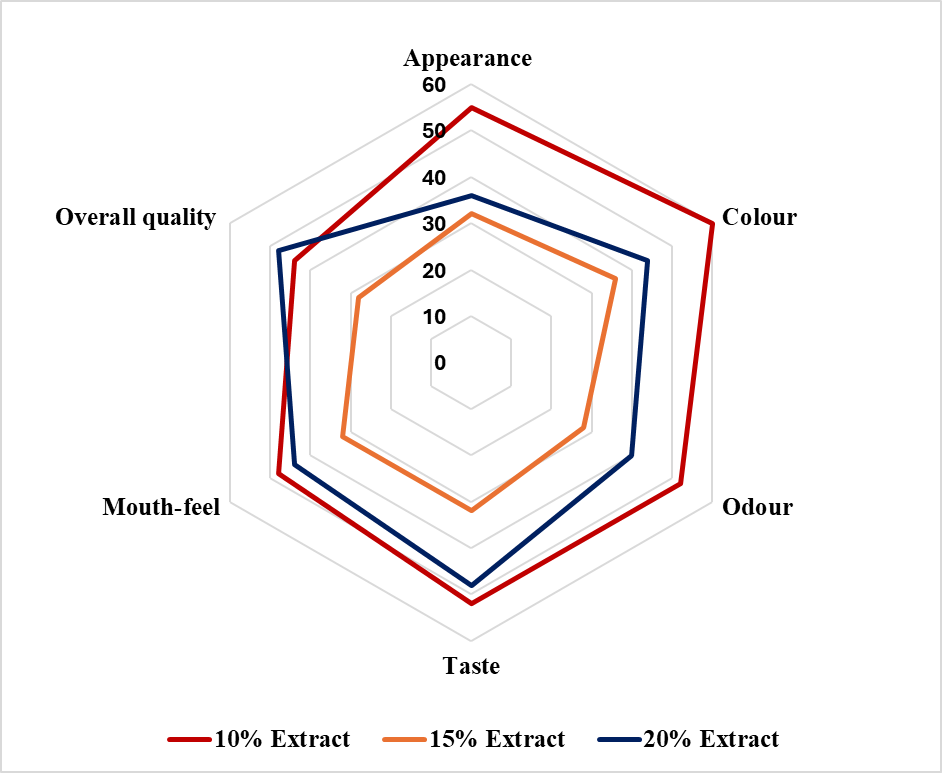
King coconut (Cocos nucifera var. Aurantiaca) water is considered a healthier beverage option, yet the remaining parts of the nut, namely the mesocarp and endocarp, often become king coconut waste (KCW), which decomposes over two to three years. This study aimed to transform KCW into a nutritious ready-to-serve (RTS) beverage to support zero waste management. The KCW was divided into components, and their proportions were calculated. Total antioxidant activity (TAC), total phenol content (TPC), and total flavonoid content (TFC) were assessed using Folin-Ciocalteu method and modified AlCl3 method respectively, while total antioxidant activity was determined using 2,2-Diphenyl-1-picrylhydrazyl (DPPH) Free Radical Scavenging Assay, and Oxygen Radical Absorbance Capacity (ORAC) Assay. The mineral content was determined using Inductively Coupled Plasma Mass Spectrometry (ICP-MS). Quality parameters such as pH, titratable acidity, and colour were measured through established analytical techniques. RTS beverages were formulated with 10%, 15%, and 20% concentrations of king coconut waste extract (KCWE) and evaluated by twenty trained panelists. Anti-inflammatory activity was performed using Arachidonate 5-Lipoxygenase (A5-LOX) inhibition assay. Proximate analysis of king coconut mesocarp extract-based drink was performed using AOAC methods. Data analysis was conducted with SPSS software. Results indicated that KCW consists of 7.82% mesocarp, 7.33% endocarp, 14.34% coir dust, 10.18% fiber, 4.33% perianth, and 16.29% king coconut mesocarp extract (KCME). The final beverage formulation yielded TPC of 880.65±12.8 mg GAE 100 mL-1, TFC of 8.11±0.17 mg QE mL-1, DPPH of 75.42±1.48 μg mL-1, and ORAC of 232.84±67.75 mg TE 100 mL-1. Color values (L*, a*, b*) were 16.57±0.19, 5.91±0.20, and 7.98±0.08, respectively, with pH at 2.94±0.02 and titratable acidity at 18.34±0.12. The RTS beverage, with 10% KCWE achieved significantly higher scores for all sensory attributes, and overall acceptability. Additionally, KCWE-based beverages exhibited 88±0.71% anti-inflammatory activity, reinforcing traditional claims regarding their health benefits. The findings suggest that KCWE is a valuable source of wellness beverages, promoting the zero-waste concept in the king coconut industry.
King coconut (Cocos nucifera var. Aurantiaca), which belongs to the Palmae family, is characterized by two primary varieties: "Aurantiaca," often referred to as "Nawasi Thembili," "Rathran Thembili," or "Bothal Thembili," and "Typica," commonly known as "Ran Thembili" or "Gon Thembili." The Aurantiaca variety is particularly valued for its superior yield of coconut water, improved nutritional profile, and sweeter flavor, factors that significantly contribute to its popularity in the beverage industry 1, 2. The fruit is composed of four distinct anatomical parts: the exocarp (outermost skin), mesocarp (intermediate fibrous layer), endocarp (hard shell), and endosperm, which primarily consists of king coconut water 3. Among these components, the endosperm is the most commercially valuable, representing a significant product in both local and international markets for oral rehydration, and treatment of infantile symptoms, dysentery, and cholera 4. In contrast, the other components including exocarp, mesocarp, and endocarp are typically discarded as waste. Due to their chemical composition, these parts do not decompose easily, leading to environmental concerns, including the creation of potential mosquito breeding sites 5, 6. Although king coconut waste is generally regarded as refuse, it possesses significant levels of bioactive compounds, macro and micronutrients, and various essential minerals, thus demonstrating considerable therapeutic properties 7, 8, 9, 6. Furthermore, immature mesocarp is used in traditional medicine for the treament of wound healing, abdorminal diseases, and as antiimflamatory activities 8. Sri Lanka has 2.20 million palms and mainly concentrated in Kurunegala, Gampaha and Galle districts with 11 million king coconuts exported in 2022 9. Despite the diverse varieties of king coconut available in Sri Lanka and their significant applications, including a substantial amount of waste containing beneficial bioactive nutrients, sustainable practices for utilizing coconut waste have not yet been established. Therefore, the current study aims to transform king coconut waste into a nutritious and therapeutically active health beverage.
1.1. Chemicals and Reagents UsedThe following chemicals and reagents were used in the experiment: 2,2-diphenyl-1-picrylhydrazyl (DPPH), Trolox (6-hydroxy-2,5,7,8-tetramethylchroman-2-carboxylic acid), methanol, quercetin, Folin-Ciocalteu's reagent, gallic acid, and 2,2'-Azobis(2-methylpropionamidine) dihydrochloride (AAPH), all of which were purchased from Sigma-Aldrich Co., Louis, USA. Additionally, AlCl3 was obtained from DUKSAN Pure Chemicals in Ansan City, Kyungkido, Korea, and sodium carbonate was sourced from Sisco Research Laboratories Pvt Ltd. in Maharashtra, India. Analytical grade chemicals and reagents were used throughout the experiment.
Immature king coconut nuts were acquired from the open market and subsequently cleaned to eliminate impurities. The nuts were weighed using a top-loading balance (CEYMA, Model – C-10S, Sri Lanka). Following this, the nuts were systematically separated into their constituent parts: king coconut water, endocarp, mesocarp, and perianth. Finally, the percentages of all waste materials were calculated to assess the composition.
2.2. Sample Preparation and ExtractionThe mesocarp and endocarp of the King coconut were subjected to an extraction process. The resultant extract was separated from the coir by manually squeezing the pulp. This extracted liquid was then reserved for further sedimentation and subjected to blanching by heating it to a temperature of 85°C. Following this process, it was allowed to cool to room temperature (24±2°C) before being stored in a deep freezer at -18 °C for subsequent use in the development of beverages.
2.3. Development of the BeverageThe initial beverage was prepared by mixing 30% mesocarp extract with 60% distilled water, 10% brown sugar, 0.1% citric acid, and 0.02% potassium sorbate. Trained panel members conducted a series of sensory evaluations, and the formulation was refined based on their comments and suggestions. The final formulation for the king coconut mesocarp extract consisted of 88% filtered water, 10% mesocarp extract, 2% brown sugar, 0.15% citric acid, 0.02 g/100 g potassium sorbate, and 100 ppm sucralose as an artificial sweetener.
2.4. Determination of Total Phenolic Content (TPC)The Total Phenolic Contents (TPC) of king coconut mesocarp extract was determined using the Folin-Ciocalteu method 10, based on a modified method. A volume of 20 μL of each sample (at a concentration of 100 μg mL-1) was combined with 110 μL of Folin-Ciocalteu reagent (diluted 1:10 with deionized water). This mixture was then neutralized with 70 μL of a 10% (w/v) sodium carbonate solution. The reaction was allowed to be incubated at room temperature for 30 minutes, after which the absorbance was measured at 765 nm, using distilled water as a blank. To quantify the TPC, a standard curve of gallic acid (y = 0.079x + 0.203, R2=0.986) was utilized, and the results were expressed as gallic acid equivalents per gram of extract (GAE g-1 extract).
2.5. Determination of Total Flavonoid Content (TFC)The Total Flavonoid Content (TFC) of king coconut mesocarp extract and king coconut mesocarp extract-based beverage was determined using a modified AlCl3 method. In this method, each sample (100 μL) was mixed with 100 μL of 2% AlCl3. After incubating for 10 minutes at room temperature, the absorbance of the reaction mixture was measured at 415 nm against a blank (Methanol). A standard curve of quercetin was established (y = 0.045x + 0.028, r² = 0.996) to quantify the TFC, which is expressed as mg quercetin equivalent per gram (mg QE/g extract) of the extract.
2.6. 2,2-Diphenyl-1-picrylhydrazyl (DPPH) Free Radical Scavenging AssayThe DPPH free radical scavenging assay was conducted following the method described by 11. Both the king coconut mesocarp extract and the king coconut mesocarp extract-based beverage were tested within a concentration range of 5–40 μg/mL. A DPPH solution (40 μg/mL, 200 μL) was incubated with 100 μL of each sample at room temperature (25±2 °C) in the dark for 10 minutes. The absorbance was measured against a blank at a wavelength of 517 nm. Trolox was utilized as a positive control. The capacity to scavenge the DPPH radical by 50% (IC50) was determined from the dose-response curves using linear regression, and the % inhibition was calculated using the following equation:
 |
The Oxygen Radical Absorbance Capacity (ORAC) of both king coconut mesocarp extract and beverage was determined. The assay was performed using the method described by 12, with slight modifications. The reaction was carried out in 75 mM phosphate buffer (pH 7.4), with the final reaction mixture being 200 μL. Samples of king coconut mesocarp extract and a king coconut mesocarp extract-based developed drink (10 μL, varying from 1 to 50 μg/mL) were mixed with fluorescein solution (100 μL: 1.6 μg/mL) and pre-incubated for 5 minutes at 37°C. Fifty microliters of AAPH solution was then added immediately, and the decay of fluorescence was monitored for 35 minutes at 1-minute intervals at 37°C (Ex 494 nm, Em 535 nm). The net area under the curve (AUC) corresponding to a sample was calculated by subtracting the AUC corresponding to the blank. ORAC values were expressed as Trolox equivalents by using the standard curve prepared with Trolox (y = 0.349x + 0.845, r² = 0.996). The ORAC values of the extracts were expressed as mg/g Trolox equivalent (TE) of dry extract 12.
2.8. Determination of Mineral ContentThe mineral content was analyzed utilizing inductively coupled plasma atomic emission spectrometry (ICP-AES), in accordance with the methodology outlined by Musa Özcan et al. 13, with modifications implemented as per internal procedures. The concentration levels were quantified using an ICP-AES instrument operating under defined conditions.
2.9. Determination of Anti-inflammatory Properties (Arachidonate 5-Lipoxygenase Inhibition Assay)Arachidonate 5-Lipoxygenase (A5-LOX) inhibition assay was performed according to the method described by 14 with some modifications. The final reaction mixture contained A5-LOX (55 μL) and phosphate buffer (pH 8.0, 100 mM, 110 μL) along with linoleic acid (0.08 mM, 25 µL) and the test sample. The formation of (9Z, 11E)-(13S)-13-hydroperoxyoctadeca-9, 11-dienoate was measured for 10 minutes at 30-second intervals at a wavelength of 234 nm. Dose-response curves were obtained for compounds that exhibited more than 88% inhibition at a concentration of 200 µg/mL. The standard inhibitor used in this assay was baicalein.
2.10. Physicochemical Analysis of BeverageColor, pH, titratable acidity, total soluble solids, total solids and viscosity according to SLS standards 15.
2.11. Proximate Analysis of King Coconut Mesocarp Extract-based DrinkMoisture content, protein content, ash content, crude fiber content, fat content and total carbohydrate content of the RTS drink was measured according to the AOAC methods.
2.12. Data AnalysisAll experimental measurements were performed in quintuplicate and are reported as the average ± standard error. For the non-parametric sensory data, the Friedman test was employed with a 95% confidence interval utilizing SPSS software (version 22) to statistically compare the treatments and evaluate significant differences in sensory perception. Conversely, parametric data were analyzed at a 95% confidence interval using R software (version 4.3.3).
In the present study, king coconut waste (KCW) was systematically separated into its individual components to evaluate the percentage distribution of various parts of KCW. This analysis facilitates a comprehensive understanding of the composition of each waste component. The findings are presented in Table 1.
As indicated in Table 1, the average weight of a tender king coconut was measured at 1,220 ± 26.47 g. Upon separation into individual components, the total weight decreased to 1,196 g. This reduction may be attributed to the loss of certain portions during the separation process.
The results indicated that the composition of King Coconut waste (KCW) consists of mesocarp at 50.31%, followed by endosperm at 37.31%, kernel at 7.52%, and perianth at 4.45%. These findings regarding the average nut weight align with the research conducted by Perera et al. 1, which investigated the fresh weight of various King Coconut varieties available in Sri Lanka. Their study reported that the fresh weight ranged from 1007 grams to 1700 grams, depend upon the specific sizes of the individual varieties. Furthermore, Bindu Naik et al. 16 identified that coconuts contain 25% coconut water. Our findings surpass this previous research, which may be attributed to the specific varietal characteristics and maturity stages of the coconut. Moreover, current results regarding extract weight and other components of KCW are comparable to, or slightly exceed, the findings of the abovementioned study. The current study indicates that only 37.31% of king coconut nuts are effectively utilized as king coconut water, while a noteworthy 62.2% is discarded as waste. However, this discarded material, immature soft mesocarp and endocarp account for 57.83%, which represents 92.97% of the total KCW. This indicates a substantial opportunity for maximizing the use of these resources, as king coconuts have various potential applications in food products, beverages, and even bio-based materials. Therefore, we focused our research efforts on the immature soft mesocarp and endocarp, as these two components collectively represented a significant 92.97% of the total biomass of KCW.
3.2. Determination of Phytochemical Contents and Antioxidant Capacity of King Coconut Mesocarp and EndocarpUpon assessing the waste percentage of individual components, the major parts, namely the mesocarp and endocarp, were analyzed for their specific quality parameters, including Total Flavonoid Content (TFC), Total Phenolic Content (TPC), DPPH, ORAC, and Trolox Equivalent Antioxidant Capacity (TEAC), as illustrated in Table 2.
As demonstrated in Table 2, the results clearly indicated that both components contained significant quantities of the assessed properties. Specifically, the mesocarp exhibited a markedly higher TPC of 338.49 ± 14.71 mg QE/g, along with a notable Trolox Equivalent Antioxidant Capacity. Conversely, the endocarp demonstrated significantly elevated values for TFC, DPPH, and ORAC values. The DPPH values obtained in the current study are consistent with the findings of Leliana et al. 17, who reported that the young coconut mesocarp and endocarp exhibited higher IC50 values compared to synthetic antioxidants. This underscores that both the young coconut mesocarp and endocarp serve as significant sources of natural antioxidants. Further, findings of our study are in agreement with the work of Leliana et al. 17, who reported an increase in total phenolic content (TPC) values to 395.97 ± 4.78 mg GAE g−1 as a result of modifications to the extraction procedure. This represents a significant enhancement compared to previous studies, which documented TPC values as low as 126.7 mg GAE g−1. Current study reported significantly higher flavonoid content in endocarp (6.19±0.15 mg QE/g) compared to the mesocarp. Previous studies conducted by Bindu Naik et al., 16, reported mesocarp contain several flavonoids including catechin, ranscinnamic acid, Chlorogenic acid and gallic acid and elevated total flavonoid contents.
3.3. Determination of Mineral Content of King Coconut WasteMinerals are naturally occurring, inorganic solid substances that are essential for the maintenance of bodily functions 18. This study analyzed extracts obtained from both the mesocarp and endocarp of young king coconut to evaluate their mineral content. As illustrated in Table 3, significant concentrations of major minerals were identified, including Na (2605 mg/kg), Mg (3387 mg/kg), K (10621 mg/kg), Ca (1246 mg/kg), Mn (6.8 mg/kg), Fe (71.8 mg/kg), and Zn (20.9 mg/kg). These minerals are critical for various physiological functions. Notably, the analysis revealed that major heavy metals such as arsenic (As), cadmium (Cd), silver (Ag), and mercury (Hg) were not present in the examined samples. This finding demonstrates that the mesocarp and endocarp of young coconut not only contain favorable minerals but also absent of harmful heavy metals, thus making them a safe option for human consumption. The mineral compositional data of this study aligns with the findings of Appaiah et al. 19, who reported that coconuts contain almost all major minerals distributed throughout the different parts of the nut.
Following a comprehensive analysis of raw materials, their safety, and a series of sensory evaluations of various formulations, the final Ready-to-Serve (RTS) product was developed. This formulation was subsequently evaluated for its phytochemical content and antioxidant activities, with the findings detailed in Table 4.
The final Ready-to-Serve (RTS) product demonstrated significant levels of Total Antioxidant Capacity (TAC) and Total Phenolic Content (TPC), as well as exceptional antioxidant properties, which exceeded those recorded for the raw materials, as detailed in Table 4. Furthermore, our findings indicated considerably higher values for DPPH and TPC when compared to the studies conducted by Nakorn et al. 12. and Oliveira et al. 20., who investigated the functional properties of coconut water.
The proximate analysis of the final RTS drink demonstrates a moisture content of 97.88%, indicating its suitability as a hydrating beverage. The low protein (0.05%) and fat (ND) contents are consistent with similar fruit-based beverages, emphasizing its low-calorie profile. The carbohydrate content (1.98%) and total sugar content (1.91%) are notably lower than commercially available soft drinks, making it a healthier option 21. The viscosity (0.96 cP) ensures a smooth mouthfeel comparable to high-quality ready-to-serve beverages.
3.6. Sensory Evaluation of King Coconut Waste Base Functional Ready to Serve BeverageIn sensory evaluation, colour, aroma, taste, mouth feel, after taste and overall acceptability are considered and Hedonic scale is used for measuring product liking and preference 22.
As demonstrated in Table 6 & Figure 1, all tested sensory attributes such as colour, aroma, taste, mouth feel, after taste and overall acceptability are significantly higher in beverage formulated using 10% of king coconut waste extract.

The utilization of king coconut mesocarp for the treatment of allergies has been documented as a traditional practice since ancient times (personal communication, 2025). Nevertheless, scientific validation of this longstanding claim remains to be established. The present study sought to evaluate the anti-inflammatory activity of an extract derived from king coconut waste. The results indicated an anti-inflammatory activity of 88±0.71% when assessed using the Arachidonate 5-Lipoxygenase method. These findings are consistent with those reported by Roschek et al. 23, who observed a dose-dependent anti-inflammatory effect associated with coconut extracts.
This study successfully developed a ready-to-serve wellness beverage utilizing king coconut waste extract. thereby transforming agricultural waste into a valuable product. The final formulation showcases notable antioxidants and anti-inflammatory properties, featuring a total phenolic content of 880.65 mg GAE/100 mL and a flavonoid content of 8.11 mg QE/100 mL. With its low-calorie profile and smooth texture, this beverage appeals to health-conscious consumers, and sensory evaluations have affirmed its overall acceptability. This research underscores the potential of king coconut extract as a sustainable ingredient in beverage production and promotes innovative zero-waste practices that align with contemporary sustainable development goals. Our study has provided scientific validation for the traditional use of king coconut mesocarp in treating allergies, a practice that has been documented since ancient times. This underscores the value of integrating time-honored practices with modern scientific inquiry.
Appreciation is also extended to the senior scientists, laboratory staff of the Herbal and Food Technology Sections at the Industrial Technology Institute, and the dedicated lecturers of the Department of Plant Sciences, Rajarata University, whose invaluable assistance and encouragement greatly enriched this journey.
| [1] | Perera, S. A. C. N. Dissanayaka, H. D. M. A. C. Herath, H. M. N. B. Meegahakumbura, M. G. M. K and L. Perera (2014). Quantitative Characterization of Nut Yield and Fruit Components in Indigenous Coconut Germplasm in Sri Lanka. International Journal of Biodiversity, 1-5. | ||
| In article | View Article | ||
| [2] | Ekanayake G.K., Perera S.A.C.N., Dassanayake P.N. and Everard J.M.D.T. (2010): Varietal classification of new coconut (Cocos nucifera L.) forms identified from Southern Sri Lanka. Cocos, 19(1): 41-50. | ||
| In article | View Article | ||
| [3] | Prades,A, Dornia,M, Diop, N, Pain, J.P. (2012). Coconut water preservation and processing: A review. Fruits. 67 (3), 157-171. | ||
| In article | View Article | ||
| [4] | Yong, J. W. H., Ge, L., Ng, Y. F., & Tan, S. N. (2009). The Chemical Composition and Biological Properties of Coconut (Cocos nucifera L.) Water. Molecules, 14(12), 5144-5164. | ||
| In article | View Article PubMed | ||
| [5] | Ismail, F. N. M., Akhir, N. Othman, and H. Hara, (2024) Optimization of Extraction Solvents on the Antioxidant Properties of Coconut Waste,” J. Adv. Res. Fluid Mech. Therm. Sci., 117, 1, 109–117. | ||
| In article | View Article | ||
| [6] | Herath, H.M.I.K.1, and Wijebandara, D.M.D.I (2017). Potential Use of King Coconut Husk as a Nutrient Source for Organic Coconut Cultivation. Journal of Food and Agriculture, 10 (1 & 2): 1-7. | ||
| In article | View Article | ||
| [7] | Shayanthavi, S. Kapilan, R. Indira Wickramasinghe, (2024). Comprehensive analysis of physicochemical, nutritional, and antioxidant properties of various forms and varieties of tender coconut (Cocos nucifera L.) water in Northern Sri Lanka, Food Chemistry Advances. | ||
| In article | View Article | ||
| [8] | Kalina, S., & Navaratne, S. B. (2019). Analysis of Antioxidant Activity and Texture Profile of Tender-Young and King Coconut (Cocos nucifera) Mesocarps under Different Treatments and the Possibility to Develop a Food Product. International Journal of Food Science, 1, 7470696. | ||
| In article | View Article PubMed | ||
| [9] | Department of Senses and Statistics 2024. Cost of Production of coconut. Available at https:// www.statistics.gov.lk/ Agriculture/ StaticalInformation/COP_coconut last access 28/5/2025. | ||
| In article | |||
| [10] | Singleton, Vernon L.; Orthofer, Rudolf; Lamuela-Raventós, Rosa M. (1999). Analysis of total phenols and other oxidation substrates and antioxidants by means of folin–ciocalteu reagent. Methods in Enzymology. 299, 152–178. | ||
| In article | View Article | ||
| [11] | Gursoy, C. Sarikurkcu, M. Cengiz, and M. H. Solak,(2009) Antioxidant activities, metal contents, total phenolics and flavonoids of seven Morchella species,” Food Chem. Toxicol., 47, 9, 2381–2388. | ||
| In article | View Article PubMed | ||
| [12] | Nakorn, S.N., Hasaya Dokduang, Nisana Namwat, Poramate Klanrit, Arporn Wangwiwatsin, Bundit Promraksa, Sirinya Sitthirak, Tinnapat Seaban, Watcharin Loilome, (2024). Antioxidant and longevity inducing properties of coconut water on human dermal fibroblasts, Heliyon, 10, (24). | ||
| In article | View Article PubMed | ||
| [13] | Musa Özcan, M. (2008). Determination of the mineral compositions of some selected oil-bearing seeds and kernels using Inductively Coupled Plasma Atomic Emission Spectrometry (ICP-AES) Grasas y Aceites, 57 (2), 211-218. | ||
| In article | View Article | ||
| [14] | Liyanaarachchi, G. D., Samarasekera, J. K. R. R. . Mahanama, K. R. R and K. D. P. Hemalal, (2018)“Tyrosinase, elastase, hyaluronidase, inhibitory and antioxidant activity of Sri Lankan medicinal plants for novel cosmeceuticals,” Ind. Crops Prod., 111, 597–605, 2018. | ||
| In article | View Article | ||
| [15] | Sri Lanka Standard institution (1984). General standards for ready to serve beverages. | ||
| In article | |||
| [16] | Bindu Naik, Vijay Kumar, Arun Kumar Gupta (2023). Valorization of tender coconut mesocarp for the formulation of ready-to-eat dairy-based dessert (Kheer): Utilization of industrial by-product, Journal of Agriculture and Food Research, 12, 100572. | ||
| In article | View Article | ||
| [17] | Leliana, L., Setyaningsih, W., Palma, M., Supriyadi, & Santoso, U. (2022). Antioxidant Activity of Aqueous and Ethanolic Extracts of Coconut (Cocos nucifera) Fruit By-Products. Agronomy, 12(5), 1102. | ||
| In article | View Article | ||
| [18] | Quintaes,K.D & Rosa Wanda Diez-Garcia (2015). Handbook of Mineral Elements in Food.Eds. Miguel de la Guardia and Salvador Garrigues, Wiley Blackwell publishers, United Kingdom 1-21. | ||
| In article | |||
| [19] | Appaiah P, Sunil L, Prasanth Kumar P. K., and A. G. Gopala Krishna (2014). Composition of Coconut Testa, Coconut Kernel and its Oil. J Am Oil Chem Soc. 91:917–924. | ||
| In article | View Article | ||
| [20] | Oliveira,B.S, Monika; Barros Valentim, Iara; Calado de Vasconcelos, Camila; Maria Bazilio Omena, Cristhiane; Jose Henriques Bechara, Etelvino; Gomes da Costa, Joao; de Lima Freitas, Mikael; Euzebio Goulart Sant'Ana, Antonio; Oliveira Fonseca Goulart, Marilia (2013). Cocos nucifera Linn. (Palmae) Husk Fiber Ethanolic Extract: Antioxidant Capacity and Electrochemical Investigation. Combinatorial Chemistry & High Throughput Screening,16 (2), 121-129. | ||
| In article | View Article | ||
| [21] | Monica Gallo, Lydia Ferrara, Daniele Naviglio (2019). An Overview of Natural Beverages, Editor(s): Alexandru Mihai Grumezescu, Alina Maria Holban,Natural Beverages, Academic Press, Pages 1-35, ISBN 9780128166895. | ||
| In article | View Article | ||
| [22] | Lee, J. H., Yang, J. E., & Chung, L. (2012). Sensory characteristic and drivers of liking for functional beverages. Korean journal of food and cookery science, 28(6), 741-751. | ||
| In article | View Article | ||
| [23] | Roschek Jr, B., Fink, R. C., Li, D., McMichael, M., Tower, C. M., Smith, R. D., & Alberte, R. S. (2009). Pro-inflammatory enzymes, cyclooxygenase 1, cyclooxygenase 2, and 5-lipooxygenase, inhibited by stabilized rice bran extracts. Journal of medicinal food, 12(3), 615-623. | ||
| In article | View Article PubMed | ||
Published with license by Science and Education Publishing, Copyright © 2025 P.V. Munasinghe, R.M. Dharmadasa, W.C.P. Egodawatta, G. Liyanaarachchi and Udayani Binduhewa
 This work is licensed under a Creative Commons Attribution 4.0 International License. To view a copy of this license, visit
http://creativecommons.org/licenses/by/4.0/
This work is licensed under a Creative Commons Attribution 4.0 International License. To view a copy of this license, visit
http://creativecommons.org/licenses/by/4.0/
| [1] | Perera, S. A. C. N. Dissanayaka, H. D. M. A. C. Herath, H. M. N. B. Meegahakumbura, M. G. M. K and L. Perera (2014). Quantitative Characterization of Nut Yield and Fruit Components in Indigenous Coconut Germplasm in Sri Lanka. International Journal of Biodiversity, 1-5. | ||
| In article | View Article | ||
| [2] | Ekanayake G.K., Perera S.A.C.N., Dassanayake P.N. and Everard J.M.D.T. (2010): Varietal classification of new coconut (Cocos nucifera L.) forms identified from Southern Sri Lanka. Cocos, 19(1): 41-50. | ||
| In article | View Article | ||
| [3] | Prades,A, Dornia,M, Diop, N, Pain, J.P. (2012). Coconut water preservation and processing: A review. Fruits. 67 (3), 157-171. | ||
| In article | View Article | ||
| [4] | Yong, J. W. H., Ge, L., Ng, Y. F., & Tan, S. N. (2009). The Chemical Composition and Biological Properties of Coconut (Cocos nucifera L.) Water. Molecules, 14(12), 5144-5164. | ||
| In article | View Article PubMed | ||
| [5] | Ismail, F. N. M., Akhir, N. Othman, and H. Hara, (2024) Optimization of Extraction Solvents on the Antioxidant Properties of Coconut Waste,” J. Adv. Res. Fluid Mech. Therm. Sci., 117, 1, 109–117. | ||
| In article | View Article | ||
| [6] | Herath, H.M.I.K.1, and Wijebandara, D.M.D.I (2017). Potential Use of King Coconut Husk as a Nutrient Source for Organic Coconut Cultivation. Journal of Food and Agriculture, 10 (1 & 2): 1-7. | ||
| In article | View Article | ||
| [7] | Shayanthavi, S. Kapilan, R. Indira Wickramasinghe, (2024). Comprehensive analysis of physicochemical, nutritional, and antioxidant properties of various forms and varieties of tender coconut (Cocos nucifera L.) water in Northern Sri Lanka, Food Chemistry Advances. | ||
| In article | View Article | ||
| [8] | Kalina, S., & Navaratne, S. B. (2019). Analysis of Antioxidant Activity and Texture Profile of Tender-Young and King Coconut (Cocos nucifera) Mesocarps under Different Treatments and the Possibility to Develop a Food Product. International Journal of Food Science, 1, 7470696. | ||
| In article | View Article PubMed | ||
| [9] | Department of Senses and Statistics 2024. Cost of Production of coconut. Available at https:// www.statistics.gov.lk/ Agriculture/ StaticalInformation/COP_coconut last access 28/5/2025. | ||
| In article | |||
| [10] | Singleton, Vernon L.; Orthofer, Rudolf; Lamuela-Raventós, Rosa M. (1999). Analysis of total phenols and other oxidation substrates and antioxidants by means of folin–ciocalteu reagent. Methods in Enzymology. 299, 152–178. | ||
| In article | View Article | ||
| [11] | Gursoy, C. Sarikurkcu, M. Cengiz, and M. H. Solak,(2009) Antioxidant activities, metal contents, total phenolics and flavonoids of seven Morchella species,” Food Chem. Toxicol., 47, 9, 2381–2388. | ||
| In article | View Article PubMed | ||
| [12] | Nakorn, S.N., Hasaya Dokduang, Nisana Namwat, Poramate Klanrit, Arporn Wangwiwatsin, Bundit Promraksa, Sirinya Sitthirak, Tinnapat Seaban, Watcharin Loilome, (2024). Antioxidant and longevity inducing properties of coconut water on human dermal fibroblasts, Heliyon, 10, (24). | ||
| In article | View Article PubMed | ||
| [13] | Musa Özcan, M. (2008). Determination of the mineral compositions of some selected oil-bearing seeds and kernels using Inductively Coupled Plasma Atomic Emission Spectrometry (ICP-AES) Grasas y Aceites, 57 (2), 211-218. | ||
| In article | View Article | ||
| [14] | Liyanaarachchi, G. D., Samarasekera, J. K. R. R. . Mahanama, K. R. R and K. D. P. Hemalal, (2018)“Tyrosinase, elastase, hyaluronidase, inhibitory and antioxidant activity of Sri Lankan medicinal plants for novel cosmeceuticals,” Ind. Crops Prod., 111, 597–605, 2018. | ||
| In article | View Article | ||
| [15] | Sri Lanka Standard institution (1984). General standards for ready to serve beverages. | ||
| In article | |||
| [16] | Bindu Naik, Vijay Kumar, Arun Kumar Gupta (2023). Valorization of tender coconut mesocarp for the formulation of ready-to-eat dairy-based dessert (Kheer): Utilization of industrial by-product, Journal of Agriculture and Food Research, 12, 100572. | ||
| In article | View Article | ||
| [17] | Leliana, L., Setyaningsih, W., Palma, M., Supriyadi, & Santoso, U. (2022). Antioxidant Activity of Aqueous and Ethanolic Extracts of Coconut (Cocos nucifera) Fruit By-Products. Agronomy, 12(5), 1102. | ||
| In article | View Article | ||
| [18] | Quintaes,K.D & Rosa Wanda Diez-Garcia (2015). Handbook of Mineral Elements in Food.Eds. Miguel de la Guardia and Salvador Garrigues, Wiley Blackwell publishers, United Kingdom 1-21. | ||
| In article | |||
| [19] | Appaiah P, Sunil L, Prasanth Kumar P. K., and A. G. Gopala Krishna (2014). Composition of Coconut Testa, Coconut Kernel and its Oil. J Am Oil Chem Soc. 91:917–924. | ||
| In article | View Article | ||
| [20] | Oliveira,B.S, Monika; Barros Valentim, Iara; Calado de Vasconcelos, Camila; Maria Bazilio Omena, Cristhiane; Jose Henriques Bechara, Etelvino; Gomes da Costa, Joao; de Lima Freitas, Mikael; Euzebio Goulart Sant'Ana, Antonio; Oliveira Fonseca Goulart, Marilia (2013). Cocos nucifera Linn. (Palmae) Husk Fiber Ethanolic Extract: Antioxidant Capacity and Electrochemical Investigation. Combinatorial Chemistry & High Throughput Screening,16 (2), 121-129. | ||
| In article | View Article | ||
| [21] | Monica Gallo, Lydia Ferrara, Daniele Naviglio (2019). An Overview of Natural Beverages, Editor(s): Alexandru Mihai Grumezescu, Alina Maria Holban,Natural Beverages, Academic Press, Pages 1-35, ISBN 9780128166895. | ||
| In article | View Article | ||
| [22] | Lee, J. H., Yang, J. E., & Chung, L. (2012). Sensory characteristic and drivers of liking for functional beverages. Korean journal of food and cookery science, 28(6), 741-751. | ||
| In article | View Article | ||
| [23] | Roschek Jr, B., Fink, R. C., Li, D., McMichael, M., Tower, C. M., Smith, R. D., & Alberte, R. S. (2009). Pro-inflammatory enzymes, cyclooxygenase 1, cyclooxygenase 2, and 5-lipooxygenase, inhibited by stabilized rice bran extracts. Journal of medicinal food, 12(3), 615-623. | ||
| In article | View Article PubMed | ||