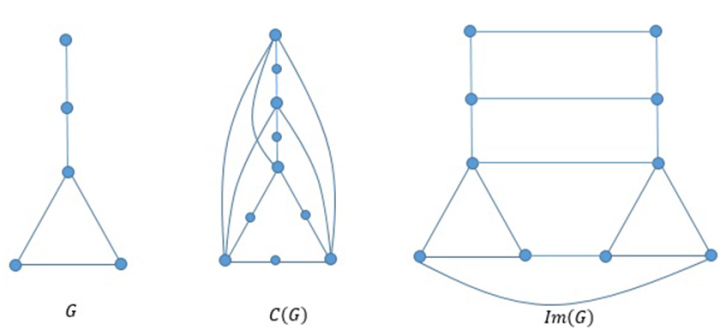
Derived graphs are the graphs obtained by some kind of operation on a given and usually smaller graph. By studying the relations between a graph and its derived graph, one can obtain information on one depending on the information on the other. In this paper, we consider certain popular topological indices of two of the derived graphs, namely the central graph and the image graph.
Several topological graph indices have been defined and studied by many mathematicians and chemists. They are defined as topological graph invariants measuring several physical, chemical, pharmacological, pharmaceutical, biological, etc. properties of graphs which are modelling real life situations. They can be grouped into three classes according to the way they are defined: by vertex degrees, by matrices or by distances. In this paper, we consider degree based topological indices of two derived graphs.
Let  be a simple graph with
  vertices and
  edges where
  and
and  . That is, we do not allow loops or multiple edges within the set of edges. For any vertex
  , we denote the degree of v by
  or
or  .
.
If  and
and  are adjacent vertices of G, and if the edge e connects them, this situation will be denoted by
 . In such a case, the vertices
  and
and  are called adjacent vertices and the edge e is said to be incident with
  and
and  . Adjacency and incidency play a very important role in the spectral graph theory, the sub-area of graph theory dealing with linear algebraic study of graphs. The smallest and biggest vertex degrees in a graph will be denoted by δ and ∆, respectively.
Written with multiplicities, a degree sequence in general is written as
 | .(1) |
Let D be a set of some non-decreasing non-negative integers. We say that a graph G is a realization of the set D if the degree sequence of G is equal to D. Also D is said to be realizable if there is at least one graph having D as its degree sequence.
Definition 1 1 Let  be a realizable degree sequence and its realization be the graph G. The
  of G is defined in terms of the degree sequence as
 | (2) |
The omega value of a graph G is shown to have many nice and practical applications. In 1, 2, some fundamental properties of omega invariant are obtained. It can be used to find the number of fundamental cycles, loops, multiple edges, the size of the largest cycle, etc. amongst all realizations of a given degree sequence.
The subdivision graph  of a graph G is a new graph of order
  and size
  which is obtained by inserting an additional vertex to each edge of G. The vertex set of the subdivision graph
  is
is  where
where  Note that the degree of any new vertex
  is 2, and the edge set of
  is
is 
The central graph  of a graph G is a graph of order
  and size
  which is obtained by subdividing each edge of G exactly once and joining all the non-adjacent vertices of G in
  . The vertex set of the central graph
  is
is  and the edge set of
  is
is
 |
The image graph  of a graph G is a graph of order
  and size
  which is obtained by taking a copy of G exactly once and joining each vertex of G with itself in the copy of G to form an edge.

Two of the most important topological graph indices are called the first an second Zagreb indices denoted by  and
and  , respectively:
 | (3) |
They were first defined in 1972 by Gutman and Trinajstic, 3, and are often referred to due to their uses in Chemistry for QSAR and QSPR studies. In 4, some results on the first Zagreb index together with some other indices are given. For some graph operations, these indices are calculated in 5.
The F-index or forgotten index of a graph G denoted by  or
or  is defined as
 | (4) |
They were first appeared in the study of structure-dependency of total π-electron energy in 1972, 3. Recently, this sum was named as the forgotten index or the F-index by Furtula and Gutman, 7.
The hyper-Zagreb index was defined as a variety of the classical Zagreb indices as
 | (5) |
see e.g. 7.
Inspired by the study of heat formation for heptanes and octanes in 11, Furtula et. al. proposed an index, is called augmented Zagreb index which gives a better prediction power. It is defined by
 | (6) |
The harmonic index was introduced by Zhang 8 who found that it correlates well with  -electron energy of benzenoid hydrocarbons and was defined as
 | (7) |
6 introduced the redefined versions of the some Zagreb indices, i.e. the redefined first, second and third Zagreb indices for a graph G as
 | (8) |
 | (9) |
 | (10) |
9 reformulated the Zagreb indices in terms of the edge degrees instead of the vertex degrees as
 | (11) |
Note that the edge degree of an edge  is equal to
  .
.
Aram and Dehgardi, 10, introduced the concept of reformulated F-index as
 | (12) |
Topological indices of some derived graphs such as subdivision, total, semitotal, line and paraline graphs have already been studied in 12, 13. In this paper, we examine some degree based topological indices of image graph and central graph which are two of the derived graphs, and find relations between these topological indices.
Now we will determine some well-known topological indices of central and image graphs of G in terms of the Zagreb indices, the order and size, and also the omega invariant of the graph G:
Theorem 2 Let G be a graph of order n and  and
and  be the central graph and image graph of G, respectively. Then
(i)  ,
,
(ii)  ,
,
(iii)  ,
,
(iv) 
Proof. We can divide the set of vertices of  into two parts according to their degrees:
1. The vertices  with
with

The total number of these vertices in  is n.
is n.
2. The remaining vertices  of
of  so that
  . These vertices have degree
 and the total number of the vertices lying in this category is m.
Then, using Eq. (3), we have
 |
Also we can divide the incident edges of  into two categories:
1. Corresponding to every pair of adjacent vertices  and
and  in G, there is a pair of incident edges in
  such that
  and the total number of them is 2m.
2. The remaining incident edges of  are
are  such that
  and the total number of incident edges lying in this category is
  .
.
Thus, using Eq. (3), we get
 |
According to the definition of the image graph of G, for all  ,
,  . If we consider the degree sequence D of G and using Eq. (3), we have
 |
We can divide the incident edges of  into two cases:
Case 1. The incident edges of  are
are  such that
  and they also form edges in the copy of G, say
  , so
, so  and the total number of incident edges in this case is
  .
.
Case 2. Each vertex in G is joined to itself in  to form an edge, so the remaining incident edges of are
  such that
  and the total number of these edges is n.
 |
Theorem 3. Let G be a graph as in Theorem 2. Then the third Zagreb index, also called the forgotten index, of  and
and  are
are
i)  ,
,
ii) 
Proof. Using Eq. (4), we have
 |
Since
 |
the result immediately follows by using the process in the proof of Theorem 2.
Theorem 4 Let G be a graph as in Theorem 2. Then the hyper-Zagreb index of  and
and  are
are
(i) 
(ii)
Proof. From Eq. (5), we have
 |
and
 |
and the result follows.
Theorem 5 Let G be a graph as in Theorem 2. The augmented Zagreb index of  is
is
 |
Proof. Using Eq. (6), we obtain
 |
Theorem 6 Let G be a graph as in Theorem 2. The harmonic index of  is
is
 |
Proof. We know that  , i.e.,
 |
Theorem 7 Let G be a graph as in Theorem 2. The redefined versions of Zagreb indices of  and
and  are
are
(i) 
(ii) 
(iii) 
(iv) 

(v)  ,
,
(vi) 

Proof. From Eq. (8), we have,
 |
 |
 |
 |
The others also follow combinatorically.
Theorem 8 Let G be a graph as in Theorem 2. The reformulated Zagreb indices of G are
(i) 
(ii) 
(iii) 
(iv) 

Proof. Using Eq. (11), we have,
 |
For the proof of (ii), similar methods can be applied by using Eq. (12). Similar ways can be employed to prove (iii) and (iv) by means of Eqs. (11) and (12).
 |
and the result immediately follows.
 |
and we have the desired result.
In this paper, we obtained the expressions for topological indices of two derived graphs, central and image graphs and found these expressions in terms of the topological indices of main graph, the size, order and also a recently defined graph invariant called Ω.
| [1] | Delen, S., Cangul, I. N., A New Graph Invariant, Turkish Journal of Analysis and Number Theory, 6 (1), 30-33. 2018. | ||
| In article | View Article | ||
| [2] | Delen, S., Cangul, I. N., Extremal Problems on Components and Loops in Graphs, Acta Mathematica Sinica, English Series, 35 (2), 161-171. 2019. | ||
| In article | View Article | ||
| [3] | Gutman, I., Trinajstic, N., Graph theory and molecular orbitals III. Total π-electron energy of alternant hydrocarbons, Chem. Phys. Lett., 17, 535-538. 1972. | ||
| In article | View Article | ||
| [4] | Das, K. C., Akgunes, N., Togan, M., Yurttas, A., Cangul, I. N., Cevik, A. S., On the first Zagreb index and multiplicative Zagreb coindices of graphs, Analele Stiintifice ale Universitatii Ovidius Constanta, 24 (1), 153- 176. 2016. | ||
| In article | View Article | ||
| [5] | Das, K. C., Yurttas, A., Togan, M., Cangul, I. N., Cevik, A. S., The multiplicative Zagreb indices of graph operations, Journal of Inequalities and Applications, 90. 2013. | ||
| In article | View Article | ||
| [6] | Ranjini, P. S., Lokesha, V., Usha, A., Relation between phenylene and hexagonal squeeze using harmonic index, Int. J. of Graph Theory, 1, 116-21. 2013. | ||
| In article | |||
| [7] | Furtula, B., Gutman, I., A Forgotten Topological Index, J. Math. Chem., 53 (4), 1184-1190. 2015. | ||
| In article | View Article | ||
| [8] | Zhong, L., The harmonic index on graphs, Applied Mathematics Letters, 25, 561-566. 2012. | ||
| In article | View Article | ||
| [9] | Milicevic, A., Nikolic, S., Trinajstic, N., On reformulated Zagreb indices, Mol. Divers., 8, 393-399. 2004. | ||
| In article | View Article PubMed | ||
| [10] | Aram, H., Dehgardi, N., Reformulated F-index of graph operations, Commun. Comb. Optim., 2, 87-98. 2017. | ||
| In article | |||
| [11] | Furtula, B., Graovac, A., Vukicevic, D., Augmented Zagreb Index, Journal of Mathematical Chemistry, 48, 370-380. 2010. | ||
| In article | View Article | ||
| [12] | Liu, J. B., Bahadur, A., Malik, M. A., Siddiqui, H. M. A., Imran, M., Reformulated Zagreb Indices of Some Derived Graphs, Mathematics, 7 (4), 366. 2019. | ||
| In article | View Article | ||
| [13] | Basavanagoud, B., Gutman, I., Gali, C. S., On Second Zagreb Index and Coindex of Some Derived Graphs, Kragujevac J. Sci., 37, 113-121. 2015. | ||
| In article | View Article | ||
Published with license by Science and Education Publishing, Copyright © 2020 Aysun YURTTAS GUNES, Muge TOGAN, Musa DEMIRCI and Ismail Naci CANGUL
 This work is licensed under a Creative Commons Attribution 4.0 International License. To view a copy of this license, visit
http://creativecommons.org/licenses/by/4.0/
This work is licensed under a Creative Commons Attribution 4.0 International License. To view a copy of this license, visit
http://creativecommons.org/licenses/by/4.0/
| [1] | Delen, S., Cangul, I. N., A New Graph Invariant, Turkish Journal of Analysis and Number Theory, 6 (1), 30-33. 2018. | ||
| In article | View Article | ||
| [2] | Delen, S., Cangul, I. N., Extremal Problems on Components and Loops in Graphs, Acta Mathematica Sinica, English Series, 35 (2), 161-171. 2019. | ||
| In article | View Article | ||
| [3] | Gutman, I., Trinajstic, N., Graph theory and molecular orbitals III. Total π-electron energy of alternant hydrocarbons, Chem. Phys. Lett., 17, 535-538. 1972. | ||
| In article | View Article | ||
| [4] | Das, K. C., Akgunes, N., Togan, M., Yurttas, A., Cangul, I. N., Cevik, A. S., On the first Zagreb index and multiplicative Zagreb coindices of graphs, Analele Stiintifice ale Universitatii Ovidius Constanta, 24 (1), 153- 176. 2016. | ||
| In article | View Article | ||
| [5] | Das, K. C., Yurttas, A., Togan, M., Cangul, I. N., Cevik, A. S., The multiplicative Zagreb indices of graph operations, Journal of Inequalities and Applications, 90. 2013. | ||
| In article | View Article | ||
| [6] | Ranjini, P. S., Lokesha, V., Usha, A., Relation between phenylene and hexagonal squeeze using harmonic index, Int. J. of Graph Theory, 1, 116-21. 2013. | ||
| In article | |||
| [7] | Furtula, B., Gutman, I., A Forgotten Topological Index, J. Math. Chem., 53 (4), 1184-1190. 2015. | ||
| In article | View Article | ||
| [8] | Zhong, L., The harmonic index on graphs, Applied Mathematics Letters, 25, 561-566. 2012. | ||
| In article | View Article | ||
| [9] | Milicevic, A., Nikolic, S., Trinajstic, N., On reformulated Zagreb indices, Mol. Divers., 8, 393-399. 2004. | ||
| In article | View Article PubMed | ||
| [10] | Aram, H., Dehgardi, N., Reformulated F-index of graph operations, Commun. Comb. Optim., 2, 87-98. 2017. | ||
| In article | |||
| [11] | Furtula, B., Graovac, A., Vukicevic, D., Augmented Zagreb Index, Journal of Mathematical Chemistry, 48, 370-380. 2010. | ||
| In article | View Article | ||
| [12] | Liu, J. B., Bahadur, A., Malik, M. A., Siddiqui, H. M. A., Imran, M., Reformulated Zagreb Indices of Some Derived Graphs, Mathematics, 7 (4), 366. 2019. | ||
| In article | View Article | ||
| [13] | Basavanagoud, B., Gutman, I., Gali, C. S., On Second Zagreb Index and Coindex of Some Derived Graphs, Kragujevac J. Sci., 37, 113-121. 2015. | ||
| In article | View Article | ||