We present the detailed study of activation energy Ea according to the thickness of the magnetic layer (tCo=0.7,0.8 and 1nm). The study was carried out at room temperature by means of polar magneto-optical Kerr effect magnetometry (PMOKE) using a He–Ne laser (λ=633nm). We found that the activation field μ0Ha, the coercive field μ0HC and the average activation energy Ea are weak for the sample with thickness tCo = 1 nm.
The miniaturization of the devices using ferromagnetic materials made grow the interest for these materials during these last decades for the researchers. Research on these materials is directed either towards the comprehension of very fundamental mechanisms or towards an important prospects for applications such as ultra-high density storage 1, 2. Indeed, the writing of the elementary bits of information is traditionally done by application of an impulsion of magnetic field. Thus the magnetization reversal dynamic plays a fundamental role in the creation of these elementary bits of information. Energy necessary to create a first reversed magnetic field is called activation energy. A perfect control of the parameters controlling the activation energy would make it possible to control the electric current necessary for the creation of the elementary bits of information. Some work has been devoted to the energy of activation 3, 4, 5 but these works did not discuss the effect the thickness of the magnetic layer on energy of activation.
The aim of this paper is to show that the thickness of the magnetic layer can influence the value of the activation energy.
Si(100) substrate is beforehand cleaned by ultrasounds in an acetone bath. After the cleaning, this substrates is thermally oxidized in a furnace at 1200°C during 2 hours. This time is sufficient for the formation of an oxide layer on the silicon surface substrate.

Au/Co/Au films were prepared by electron beam evaporation in an ultrahigh vacuum chamber, with a base pressure about of  and approximately
  during deposition on SiO2, at room temperature.
A first 25 nm thick Au film is deposited on the substrate at a deposition rate of  , as calibrated with a quartz microbalance, followed by annealing at
  during
  to reduce the surface roughness.
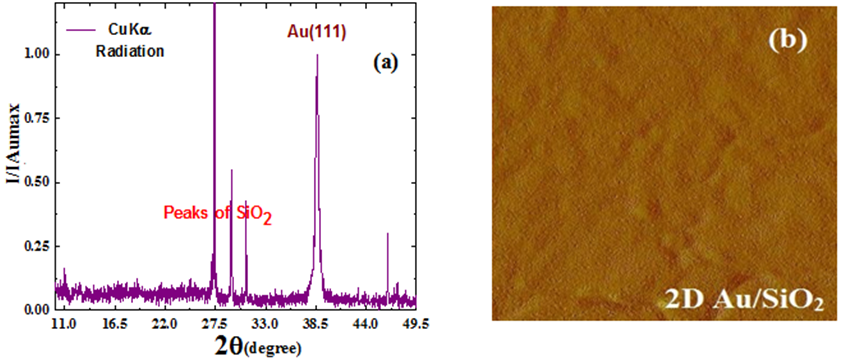
The Au film is (111) textured, as shown by X-ray diffraction (Figure 1(a)). Figure 1(b) shows the 2D AFM image of the Au buffer layer after annealing. The surface roughness (root mean square: rms) was measured to be about 0.2 nm. Using the surface corrugation obtained from 2D AFM, we estimate a lateral grain size of 40-60 nm. Cobalt layers with thicknesses ( ) equal to 1,0.8 and 0.7nm are then deposited on the Au/SiO2 at a deposition rate of 0.2nm/min. Finally, a second Au layer with a thickness about of 5nm is deposited on top of the cobalt layers.
The (111) texture of the Au buffer layer suggests, in each case, a possible epitaxial growth of the cobalt layer with the Hexagonal Close-Packed (0001) structure 6, 7, 8.
2.2. Magnetic investigationsMagnetic hysteresis loops, at a field sweep rate of  , were recorded at room temperature (RT) by polar magneto-optical Kerr effect magnetometry (PMOKE) using a He–Ne laser (
 ). On the hysteresis loops we measured the coercive fields
  and the nucleation fields
  . Table 1 shows magnetic quasi statistic parameters deduced from the hysteresis loops of the three samples.
The energy needed to reverse magnetization can be expressed in the following way 3, 4:
 | (1) |
where  is an activation energy at zero field i.e. thermal energy required to initiate the magnetization reversal in the absence of the field,
  is the saturation magnetization and
  is the Barkhausen volume (the magnetization volume that reverses during a single activation event). In this context, the time
  so that a sample is demagnetized, under the applied field
  , should follow the Arrhenius-Néel law:
 | (2) |
We recorded the reduced magnetization reversal curves  in time. From magnetization reversal curves
  vs
vs  we deduced
  vs
vs  . The fit of
  vs
vs  by using equation (2) allowed us to determine
  and
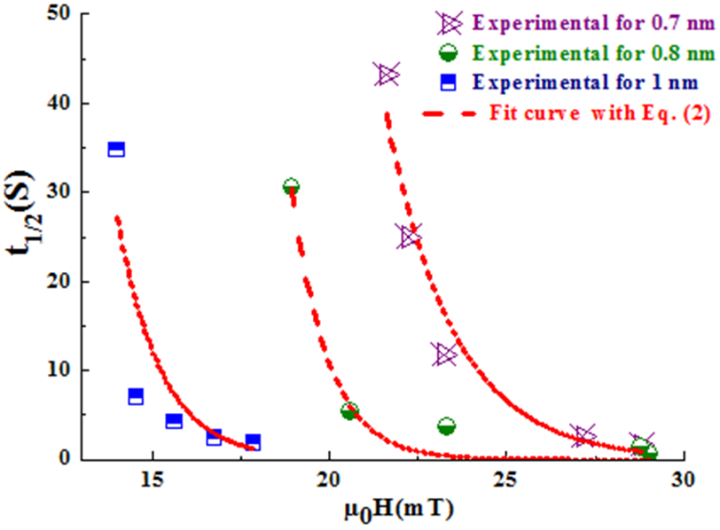
and  . On Figure 2 are represented
  vs
vs  and their fitting.
The experimental dots of Figure 2 show that  evolves under the Arrhenius law. The adjustments of these experimental dots by Eq. (2) gives the values of
  ,
,  and
and  .
.
On Figure 2, we notice in the three cases that there is an agreement between the adjustment curve and the experimental dots. In Table 2 are summarized the values of  ,
,  and
and  . For the three samples
  is
is  , what mean that this parameter does not vary too much according to the thickness of the magnetic layer. The value of
  is the same magnitude order we found on (Pt/Co)3 multilayers 5.

The values of  , in Table 2, are in general weak compared to that we found on our (Pt/Co)3 multilayers 5.
  in magnetic layer having 0.8 nm thickness is twice higher than those of the magnetic layers having thicknesses
  = 1 nm and 0.7 nm. The highest value of the activation energy found in this sample (
 nm) let’s think that this sample would have more defects than the two others. This sample has also the highest value of
  . If we emit the assumption that the magnetization saturation
  is almost of the same magnitude order for the three samples 6 then the greatest value of
  would be in the magnetic layer of 0.8 nm thickness. This lets think that reversed initial volumes would be larger than those of the two other samples. Thus, magnetization reversal in this sample would be done by a mode different from that of the two other samples. In the samples of thickness
  = 1 nm and 0.7 nm, the weakness of the values of activation energy
  lets think about the magnetization reversal dynamics dominated by the magnetic domain wall motion. These deductions are in agreement with our previous works 5 where we showed that the activation volume and the activation energy are highs when magnetization reverse mainly by several nucleate centers due to the inhomogeneities.
Knowing  and
and  for each sample, it is possible to estimate these times of demagnetization in zero field but under the temperature effect only at 300 K. In fact, Eq. (2) at zero field become:
 | (3) |
We found respectively  =
=  ,
,  and
and  for
for  0.7 nm, 0.8 nm and 1 nm.
 for
for  where
where  is the activation field that cancels the energy barrier. Under these conditions the activation energy is given by:
 | (4) |
By taking into account the values of  found, in Table 2, Eq. (4) gives respectively
  = 10.93 mT,
  = 13.03 mT and
  = 7.43 mT for the samples with
  0.7 nm, 0.8 nm and 1 nm. In the three cases the value of
  is lower than that of
  what shows clearly that the magnetization reversal is well initiated before the sample is demagnetized. The lowest value of
  is found for the sample
  with = 1 nm. The lowest values of
  and
and  found for this sample shows that the reversal of its magnetization would not require enough of electrical energy.
We studied ultrathin cobalt films with thickness  0.7, 0.8 and 1 nm. We extracted for these three samples the average activation energy
  in zero field.
  does not vary linearly according to the thickness of the magnetic layer. We found that the activation field
  , the coercive field
  and the average activation energy
  are weak for the sample with thickness
  = 1 nm. This result shown that with this thickness one can reverse magnetization with a low electrical energy.
This work is the result of a collaboration between the LMOP laboratory (Tunisia) and the University of Kara, Togo. We acknowledge the help of LMOP in Tunisia and that of «équipe Micro et Nano-Magnétisme de l’Institut Néel à Grenoble, France».
| [1] | J. Pommier, P. Meyer, G. Pénissard, J. Ferré, P. Bruno, and D. Renard, Magnetization reversal in ultrathin ferromagnetic films with perpendicular anisotropy: Domain observations Phys. Rev. Lett. 65, 2054, 1990. | ||
| In article | View Article PubMed | ||
| [2] | J. X. Shen, R. D. Kirby, Z. S. Shan, D. J. Sellmyer, and Tl Suzuki, Observation of unequal activation volumes of wall-motion and nucleation processes in Co/Pd multilayers, J. Appl. Phys. 73, 6418, 1993. | ||
| In article | View Article | ||
| [3] | P. Bruno, G. Bayreuther, P. Beauvillain, C. Chappert, G. Lugert, D. Renard, J.P. Renard, J. Seiden, Hysteresis properties of ultrathin ferromagnetic films, J. Appl. Phys. 68 (1990) 5759. | ||
| In article | View Article | ||
| [4] | M. Czapkiewicz, T. Stobiecki, S. van Dijken, Thermally activated magnetization reversal in exchange-biased [Pt∕Co]3/Pt/IrMn multilayers, Phys. Rev. B 77 (2008) 024416. | ||
| In article | View Article | ||
| [5] | R. Belhi, A. Adanlété Adjanoh, J. Vogel, Influence of Pt thickness on magnetization reversal processes in (Pt/Co)3 multilayers with perpendicular anisotropy, J. Magn. Magn. Mater. 324 (2012) 1869-1877. | ||
| In article | View Article | ||
| [6] | C. Chappert, D. Renard, P. Beauvillain, J.P. Renard, J. Seiden, Ferromagnetism of very thin films of nickel and cobalt, J. Magn. Magn. Mater. 54 (1986) 795. | ||
| In article | View Article | ||
| [7] | C. H. Lee, H. He, F. Lamelas, W. Vavra, C. Uher and R. Clarke, Epitaxial Co-Au Superlattices, Phys. Rev. Lett. 62 (1989) 653. | ||
| In article | View Article PubMed | ||
| [8] | M. Ohtake, M. Futamoto, F. Kirino, N. Fujita, N. Inaba, Epitaxial growth of hcp/fcc Co bilayer films on Al2O3(0001) substrates J. Appl. Phys. 103 (2008) 07B522. | ||
| In article | |||
| [9] | A. Adanlété Adjanoh, R. Belhi, J. Vogel, O. Fruchart, M. Ayadi, K. Abdelmoula, Magnetization reversal dynamics in Au/Co/Au(111) ultrathin films: Effect of roughness of the buffer layer, J. Magn. Magn. Mater. 322 (2010) 2498. | ||
| In article | View Article | ||
Published with license by Science and Education Publishing, Copyright © 2018 A. Adanlété Adjanoh and R. Belhi
 This work is licensed under a Creative Commons Attribution 4.0 International License. To view a copy of this license, visit
http://creativecommons.org/licenses/by/4.0/
This work is licensed under a Creative Commons Attribution 4.0 International License. To view a copy of this license, visit
http://creativecommons.org/licenses/by/4.0/
| [1] | J. Pommier, P. Meyer, G. Pénissard, J. Ferré, P. Bruno, and D. Renard, Magnetization reversal in ultrathin ferromagnetic films with perpendicular anisotropy: Domain observations Phys. Rev. Lett. 65, 2054, 1990. | ||
| In article | View Article PubMed | ||
| [2] | J. X. Shen, R. D. Kirby, Z. S. Shan, D. J. Sellmyer, and Tl Suzuki, Observation of unequal activation volumes of wall-motion and nucleation processes in Co/Pd multilayers, J. Appl. Phys. 73, 6418, 1993. | ||
| In article | View Article | ||
| [3] | P. Bruno, G. Bayreuther, P. Beauvillain, C. Chappert, G. Lugert, D. Renard, J.P. Renard, J. Seiden, Hysteresis properties of ultrathin ferromagnetic films, J. Appl. Phys. 68 (1990) 5759. | ||
| In article | View Article | ||
| [4] | M. Czapkiewicz, T. Stobiecki, S. van Dijken, Thermally activated magnetization reversal in exchange-biased [Pt∕Co]3/Pt/IrMn multilayers, Phys. Rev. B 77 (2008) 024416. | ||
| In article | View Article | ||
| [5] | R. Belhi, A. Adanlété Adjanoh, J. Vogel, Influence of Pt thickness on magnetization reversal processes in (Pt/Co)3 multilayers with perpendicular anisotropy, J. Magn. Magn. Mater. 324 (2012) 1869-1877. | ||
| In article | View Article | ||
| [6] | C. Chappert, D. Renard, P. Beauvillain, J.P. Renard, J. Seiden, Ferromagnetism of very thin films of nickel and cobalt, J. Magn. Magn. Mater. 54 (1986) 795. | ||
| In article | View Article | ||
| [7] | C. H. Lee, H. He, F. Lamelas, W. Vavra, C. Uher and R. Clarke, Epitaxial Co-Au Superlattices, Phys. Rev. Lett. 62 (1989) 653. | ||
| In article | View Article PubMed | ||
| [8] | M. Ohtake, M. Futamoto, F. Kirino, N. Fujita, N. Inaba, Epitaxial growth of hcp/fcc Co bilayer films on Al2O3(0001) substrates J. Appl. Phys. 103 (2008) 07B522. | ||
| In article | |||
| [9] | A. Adanlété Adjanoh, R. Belhi, J. Vogel, O. Fruchart, M. Ayadi, K. Abdelmoula, Magnetization reversal dynamics in Au/Co/Au(111) ultrathin films: Effect of roughness of the buffer layer, J. Magn. Magn. Mater. 322 (2010) 2498. | ||
| In article | View Article | ||


: XRD spectra of a 25 nm thick Au layers deposited on SiO2 substrate. (b): 2D AFM image of a 25 nm thick Au buffer layer deposited on SiO2 substrate)


, for the three samples)