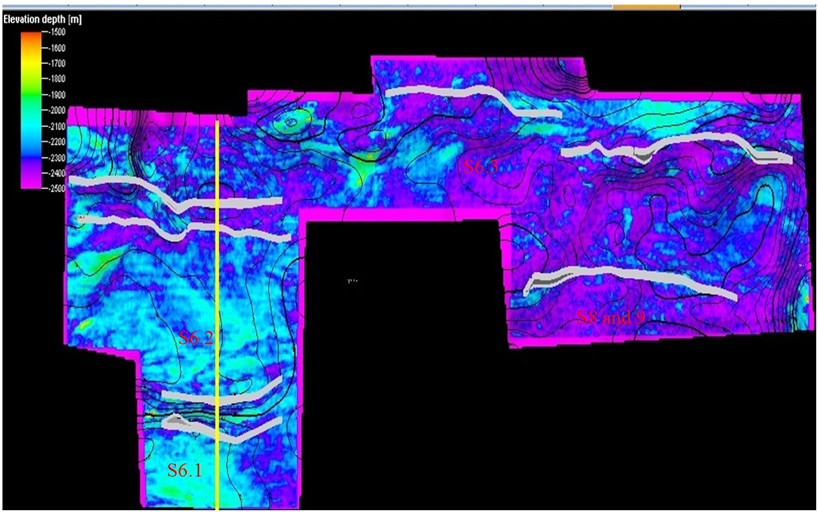
The N-Field area of the Rio Del Rey Basin was interpreted on 3D seismic data, in order to provide an updated new prospects map of the area. The objective of creating the maps is to evaluate infill opportunities in N-Field. Three main horizons were picked in detail for this seismic interpretation, one in each target reservoir group (S6.1, S6.2 and S6.3) as well as two deeper horizons to ascertain the sedimentary architecture of the basin. The reservoirs and deeper sands show lateral variations in seismic response which are related to changes in reservoir properties but also to possible presence of hydrocarbons. Sedimentary features such as channels and pinch-outs can be seen on seismic, which likely act as stratigraphic traps to the east. All major faults were picked, as well as approximately five smaller, less well-defined faults and interpreted as straight normal faults, along many faults; the throw is variable, often decreasing to no visible throw at one or both ends The evaluation of the petrophysical characteristics revealed that the reservoirs are of good quality with average net to gross, porosities, water saturation and hydrocarbon saturation ranging from 0.774 to 0.980, 0.220-0.339, 0.133-0.367 and 0.633-0.867, respectively. Variation in the petrophysical parameters and the uncertainty in the reservoir structure of the three reservoirs were considered in calculating range of values of gross rock volume from generated prospects map.
The N-Field is an offshore field located within the Rio Del Rey Basin. The three wells of interest pseudo-named A3, A6 and A5 due to Cameroon’s National Hydrocarbon Corporation (SNH) confidential ity agreement were drilled; the locations of the wells were suggested from preliminary 3D seismic studies carried out in this field which has an area coverage of 560 km2. The wells penetrated the Paleocene-Eocene Agbada Formation where sequences of thick clastic material of Agbada Formation were deposited in a deltaic fluvio-marine environment. The basin is just like the Niger Delta Basin is often characterized by complex structural deformation and faulting which could lead to high uncertainties in the reservoir properties 1. These high uncertainties greatly affect the exploration and development of fields within the basin such as ‘N-Field. Improper interpretation of reservoir properties heterogeneity in the field has led to poor performance of reservoir during hydrocarbon production. Nonlinearity, natural heterogeneity and uncertainty of reservoir parameters make problems related to hydrocarbon characterization difficult 2. Thus, it is problematic to clearly quantify spatial relationships of variable properties of reservoir. In resolving this problem, well logs and seismic data can be used to generate useful petrophysical parameters, maps and seismic attributes
This research aims to add value to the geology of the field with special interest in generating prospects map considering range of reservoir properties and structural uncertainty. This was achieved by interpreting the 3D seismic data to define the reservoir geometry, Well log derived information are useful for formation evaluation and apt at estimating hydrocarbon (oil & gas) quantities in a reservoir 3. The evaluation of reservoir rocks in terms of their porosity, water saturation and permeability determinations, enhances the ability to estimate hydrocarbon reserves and reservoir bed thickness, and to distinguish between gas, oil and water bearing strata, by observing their electrical resistivity and relative permeability value 4 evaluating the petrophysical parameters of the reservoirs and determining the lateral extent of the hydrocarbon-bearing zone using the delineated fluid contacts; this helped to estimate the gross rock volume (GRV).
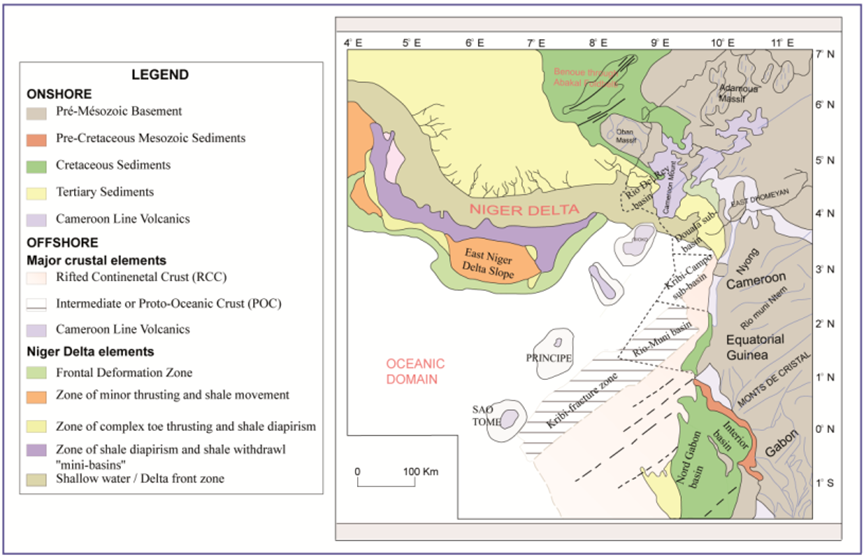
The Rio Del Rey (RDR) Basin of offshore Cameroon is located in the South-western portion of Cameroon, in the Southwest Region and is centered in the waters of the Gulf of Guinea. It is bordered to the west and northwest by the Niger Delta and the Calabar Flank respectively and to the South by the Rio Muni Basin (Equatorial Guinea). The RDR Basin comprises the easternmost portion of the Niger delta complex 5. To the North it is bordered by the Rumpi Hills and to the east by the Cameroon Volcanic line (CVL) which separates it from the Douala/Kribi-Campos Basin. The area is located between latitude 8.40 & 9.00 E and longitude 4.00and 4.80N, west of the SSW-NNE CVL (Figure 1). The offshore segment of the Rio Del Rey basin is 7000km2 and is the main petroleum producing basin in Cameroon with about 90% of the country's production while the Douala/Kribi Campo basin produces the rest 6.
Within the Rio Del Ray Basin is N-Field which is located in the western offshore depo belt of the Rio del Rey Basin, where sequences of thick clastic material of Agbada Formation were deposited in a deltaic fluvio-marine environment. The precise location of the field is classified.

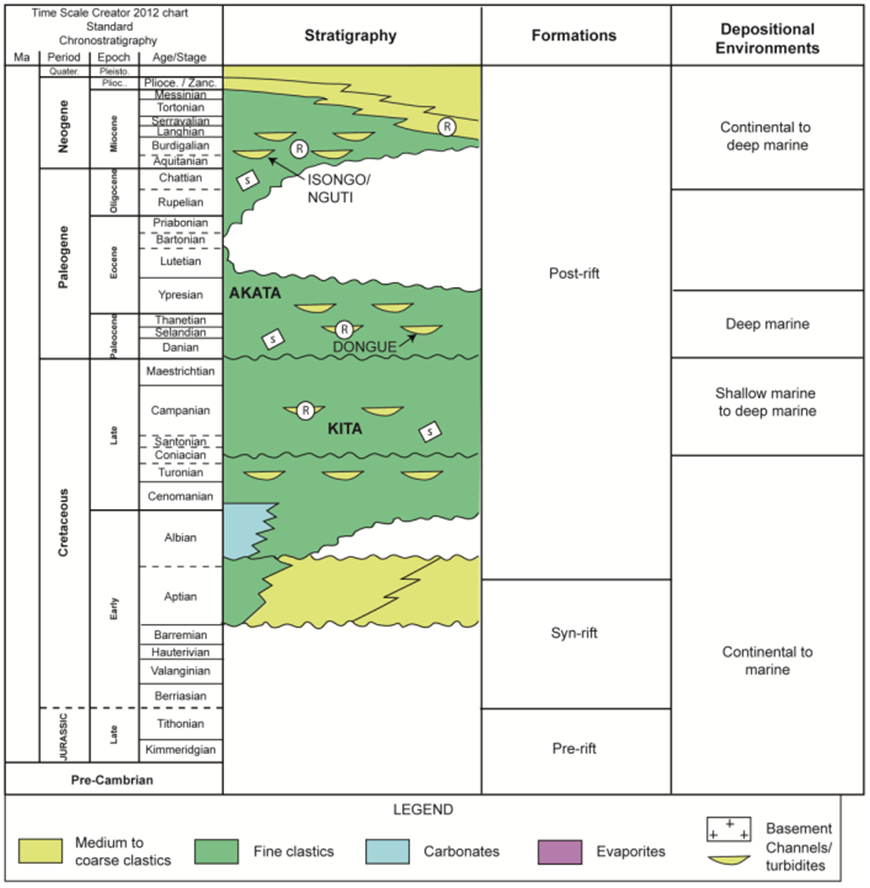
The clastic sediments of the Niger Delta reach a maximum of 12km of thickness in the core area (Nigeria side), and the stratigraphy is divided into 3 diachronous units from Eocene to Recent age that form a major regressive cycle 1, 7, 8:
Benin Formation. (Uppermost unit): continental/fluviatile and backswamp deposits up to 2500 m thick. Oldest continental sands are probably Oligocene.
Agbada Formation. (Middle Unit): paralic, coastal, fluvio-marine and marine sediments organised into coarsening upwards overlaps cycles. The age range from Eocene to Pleistocene and the maximum thickness can be more than 3000 m.
Akata Formation. (Lowermost Unit): comprises up to 7000 m of marine pro-delta clays. Shales are overpressured and have deformed in response to delta progradation. These shales facilitate regional decollement for updip extension and downdip compression. Deepwater turbidites sands also exist within this formation. The ages range from Paleocene to Holocene.
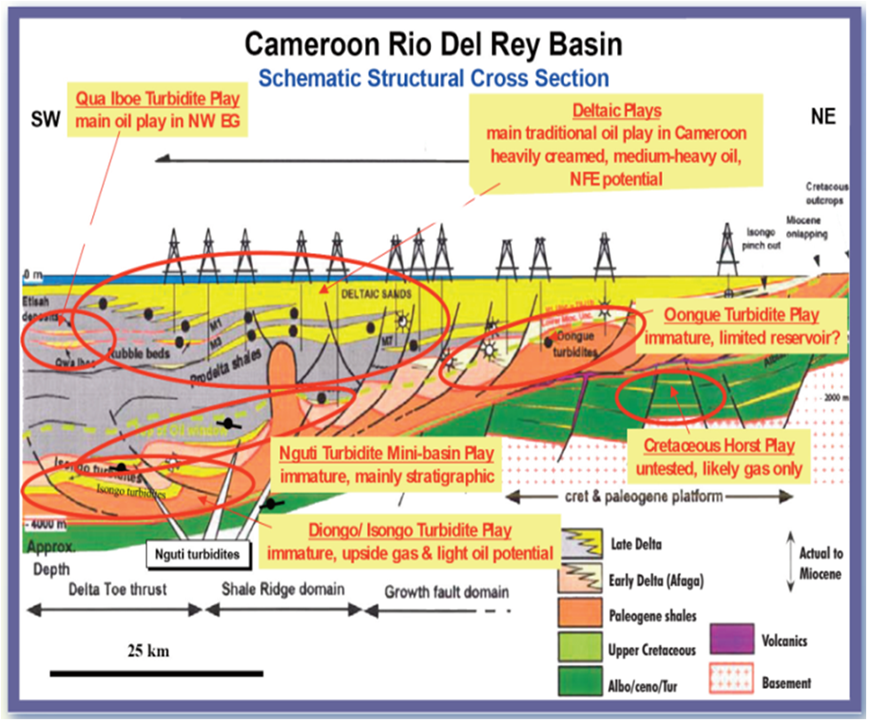
The Rio del Rey Basin, which is the eastern termination of the Niger Delta, has a lithostratigraphy very similar to the lithostratigraphy identified in Nigeria. Some namings are even common (AKATA shales, QWA IBOE, etc).
The sedimentologic column recognised by wells covers the interval Paleocene to Present time. It corresponds to a think fluvio-deltaic regressive mega sequence composed by sands and shales in which are defined from bottom to top the following diachronous formations. 9:
The Akata Formation. That corresponds to Paleocene and Eocene marine shales in which are intercalated ONGUE turbidites, proven in the N-E part of the Basin.
The Isongo turbiditic Formation, age of which is Lower Miocene to base Upper Miocene.
The Afaga Formation, overlying the Isongo turbidites. This argillaceous sandy deltaic formation located in the Northern part of the Rio del Rey Basin is contemporaneous of the bathyal shales in which are developed the NGUTI and DIONGO turbidites located to the south in the shale ridge domain. This formation is dated Middle to Upper Miocene.
The Agbada Formation, which is a thick alternance of deltaic sands and shales. This formation also called <<Alternances deltaiques>>, represent the main play in the Rio del Rey Basin and contain the quasi total oil production of Cameroon. Age of this formation is Upper Miocene to Pliocene.
The sandy Benin Formation, usually fresh water bearing. This formation is dated Pliocene to Pleistocene.

The RDR Basin is one of the Equatorial Atlantic marginal basins of the Gulf of Guinea of the Atlantic Ocean formed by the separation of the South American block from the African continent block 10. The RDR Basin has a geologic history that can be divided into three (3) stages of basin development: Pre-rift stage (late Proterozoic to Late Jurassic, with the deposition of about 600 m2 of continental clastic rocks of Carboniferous to Jurassic age 11; Sync-rift stage (Late Jurassic to EarlyCretaceous, with the deposition of thick sequences of fuvial and lacustrine rocks); and Post-rift stage (Late Cretaceous to Holocene, which is made up of younger rocks and deposited as transgressive units consisting of shelf clastic and carbonate rocks followed by progradational units along the continental margins and as open-ocean water units 12. The RDR Basin is made up of four structural provinces showing different features 13 (Figure 3). These include the Cretaceous onshore province, the growth fault province in the north, the shale ridge province in the southwest, and the Delta Toe-thrust in the south central area.
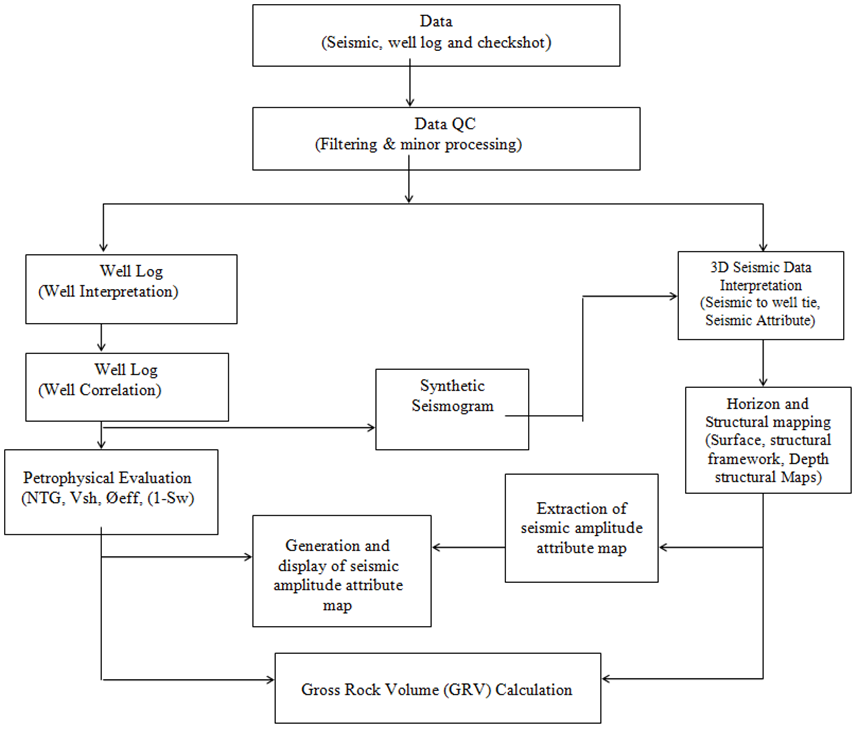
This study integrated 3D which covers an area of 560km seismic reflection and wireline log data from three wells (A3, A5 and A6) with other supporting information such as checkshot survey data. Well logs which record different physical borehole parameters against depth were interpreted and subjected to various petrophysical analyses and also employed to carry out litho-stratigraphic correlation across the wells in order to establish the distribution and behaviour of the lithological units of interest across different well locations. Various measured log parameters such as gamma radiation, natural spontaneous electrical potential, resistivity, density, neutron, sonic among others were employed to identify porous and permeable litho-units which are saturated with hydrocarbon and possess right qualities that distinct them as hydrocarbon reservoirs. In addition, other derivative reservoir parameters such as, reservoir thickness, Net-To-Gross (NTG), volume of shale (Vsh) in the clastic reservoirs, effective porosity (Øeff), hydrocarbon saturation (1 - Sw) and electrofacies distribution were derived from the well-log data to estimate the hydrocarbon potential of N-Field. The 3D seismic reflection data comprising of in-lines and cross-line seismic sections were also carefully analyzed in terms of horizon mapping, structural interpretation and attribute extraction and analyzed to generate horizon surfaces, structural frameworks, depth structural maps as well as define the areal extents and invariably the Gross Rock Volume (GRV) of the identified reservoir units. Structural mapping involved identifying discontinuous and abruptly terminated reflection events which usually continue across the fault planes either thrown upward or downward depending on the nature of fault, whether normal or reverse dip slip fault. Synthetic seismograms were generated for wells to link logs (in depth domain) to time domain seismic data and to observe the seismic character of sands within the area. The synthetic seismograms were created by using the extracted Wavelet at well locations. Well to seismic ties were performed by establishing correlation between the seismic and synthetic seismograms by adjusting T-D functions through stretch and squeeze. Three key horizons S6.1, S6.2 and S6.3 namely Upper, Mid and Lower Agbada respectively were mapped throughout the 3D post stack migrated seismic data across the different in- and cross-line sections at every 10th in and cross-line seismic record using the 3D auto track tool provided by Petrel interpretation software and interpolated to obtain continuous horizon surfaces for surface seismic attribute scanning of various seismic attributes. To gain all possible information from seismic data amplitude extraction process was performed. Maximum amplitudes were extracted, calibrated to well data and used as a main attribute. According to well calibration negative amplitudes can be related to high mud/siltstone ratio while positive amplitudes are high sand ratio. Extraction window was adjusted according to the thickness of particular stratigraphic intervals, which in most case were around 20 ms. Time structure maps were generated from the derived horizon surface maps by inserting the fault polygons of delineated major faults and subsequently converted to depth structure map using the layer cake velocity model with the aid of sonic calibrated check-shot data 14. The resultant depth structure map was used to generate the gross volume of the reservoir rock (GRV). In order to map in detail the vertical changes in sand distribution and seismic geomorphology some additional deeper horizon of the S8 and S9 Levels were selected and picked with reference to these three interpreted Horizons.
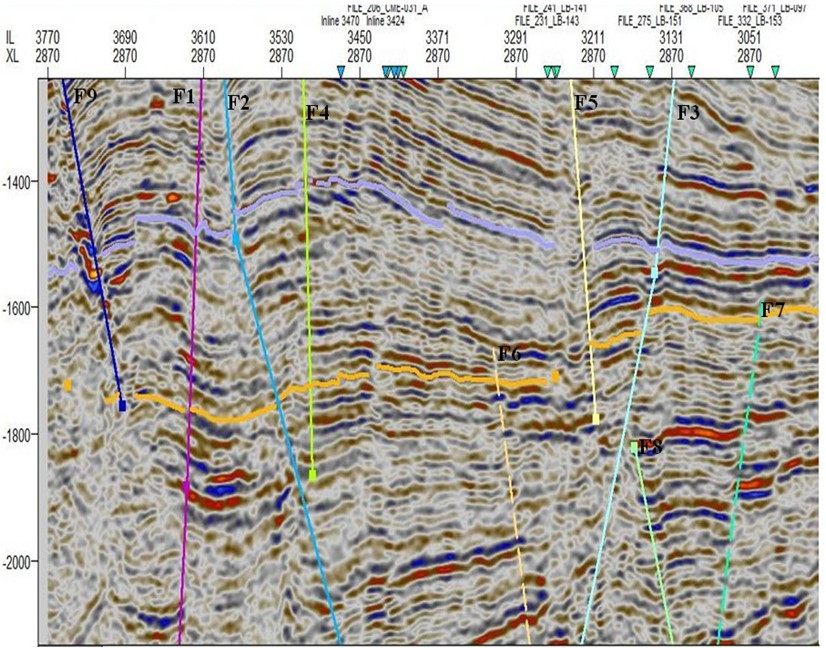
The field is structurally controlled by sets of synthetic faults (F2, F5, F6, F8 and F9.) which trend northwest (NW) southeast (SE) and dip southwest. There also exist some antithetic faults as shown in Figure 5. Structural analysis framework of the study area also reveals NW–SE, which prompted the use of crossline 2870 where the structures were mostly visible, thus seismic section in this field were run perpendicular to the fault in the crossline direction trending of the faults (Figure 5). These structures correspond to the general depositional trend in the correlation panels of the shale/sand units of the Agbada and Akata Formations (Figure 7). The geometry and differential loading of Akata shale probably caused the development of hanging-wall rollover anticlines observed in the N-Field; this could serve as hydrocarbon traps.
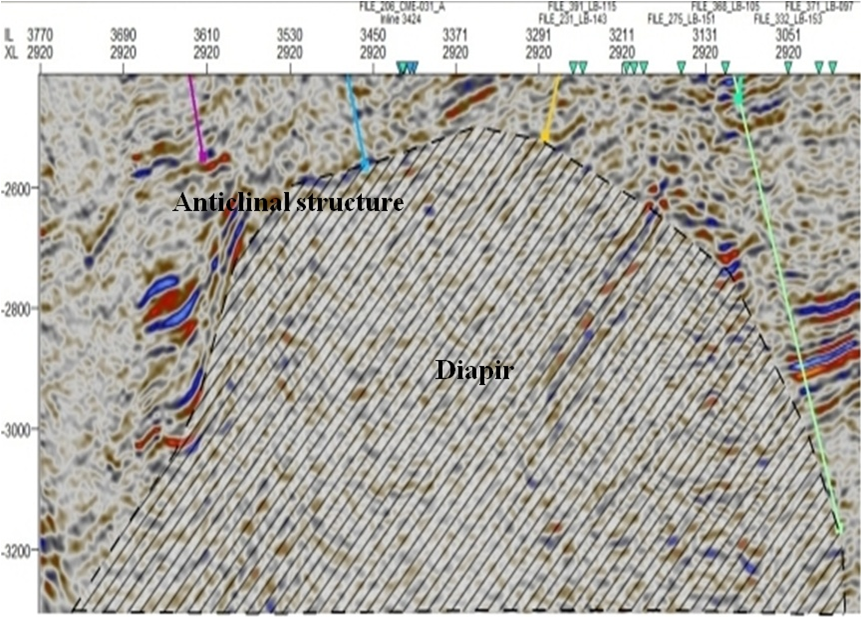
The noisy character of the seismic data, specifically closer to the shale diapir (Figure 6), does not allow for detailed fault interpretation. Further away from the diapir, the faults are reasonably well imaged. Imaging below these target zones is very poor, so no detailed fault interpretation and review was performed on this level.


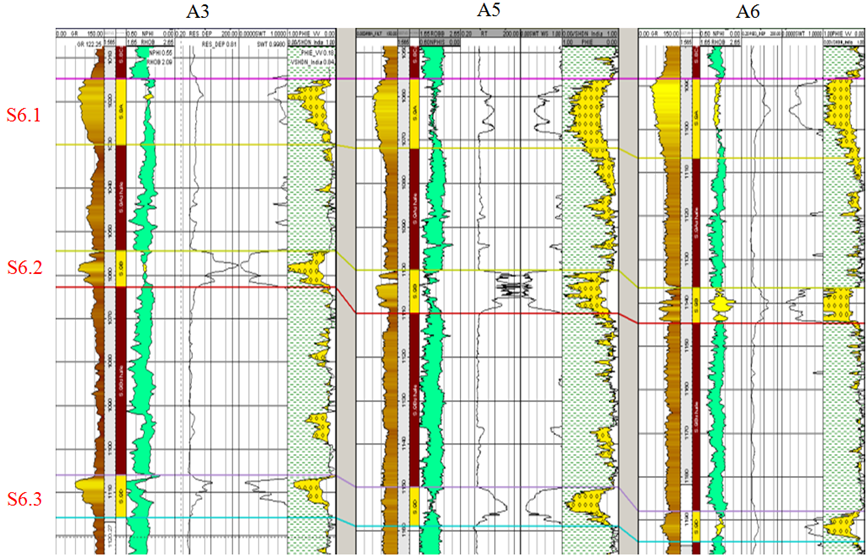
The correlated well locations in Figure 7, show the sand units S6.1, S6.2 and S6.3. Gamma ray was used to trace similarities of log responses for sand bodies encountered in wells A3, A6 and A5 as indicated in the insert map (Figure 7). The delineated reservoir sands exhibit strong degree of correlation and similarity in structures and thickness distribution. Generally, the sands were observed to thicken basinward, which is a typical thickening pattern in the Rio Del Rey Basin and characteristic of transition environment, here, transition from paralic Agbada to continental Benin Formation 15. It was also observed that shale layers increased in thickness with depth, while the sand bodies decreases in thickness with depth.
4.2. Petrophysical EvaluationElectrofacies analysis indicate that sand gross thickness varies from 1870 to 1885 m., 1925–1940 m. and 1950–1959 m., for horizons S6.1, S6.2 and S6.3 respectively (Table 1), while the hydrocarbon saturated, representing productive thickness of reservoir sands S6.1, S6.2 and S6.3 is to 77%, 80% and 75%., respectively (Table 1).
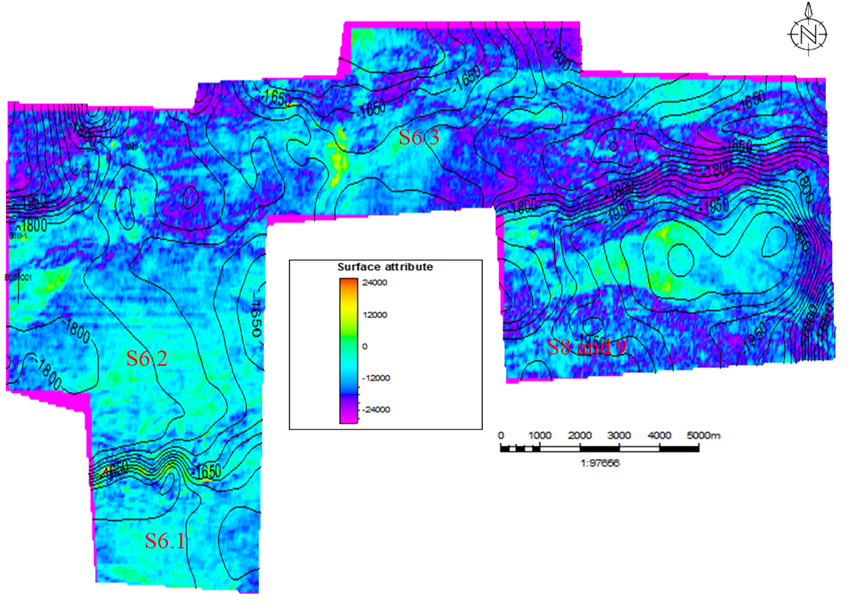
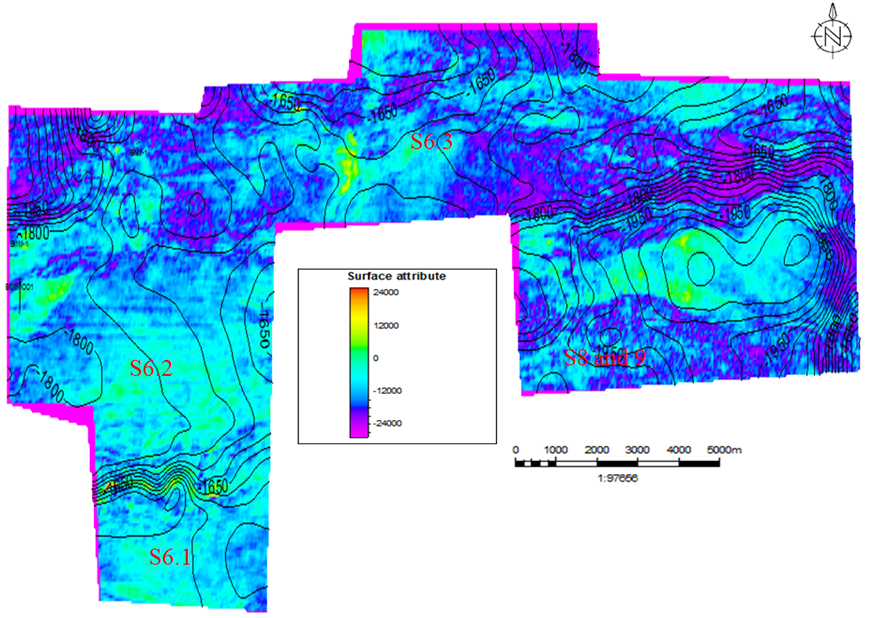
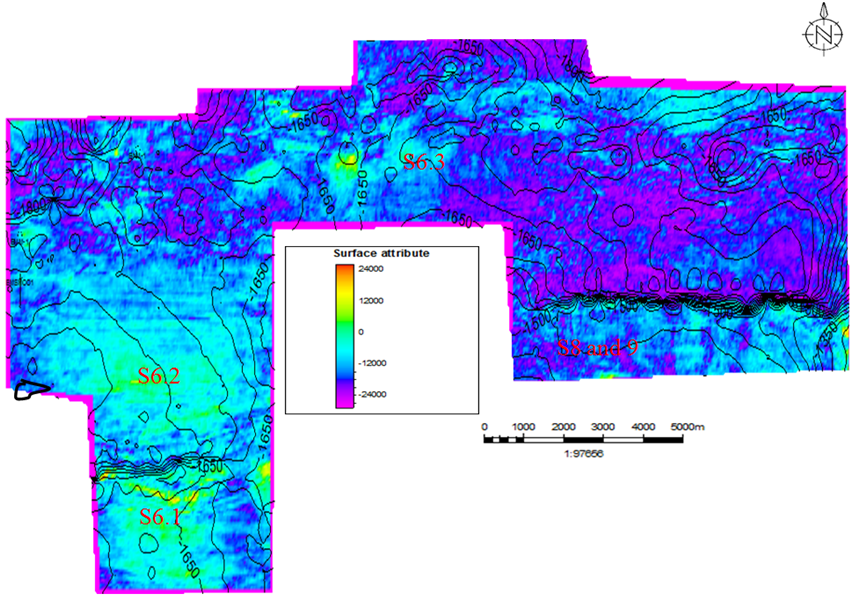
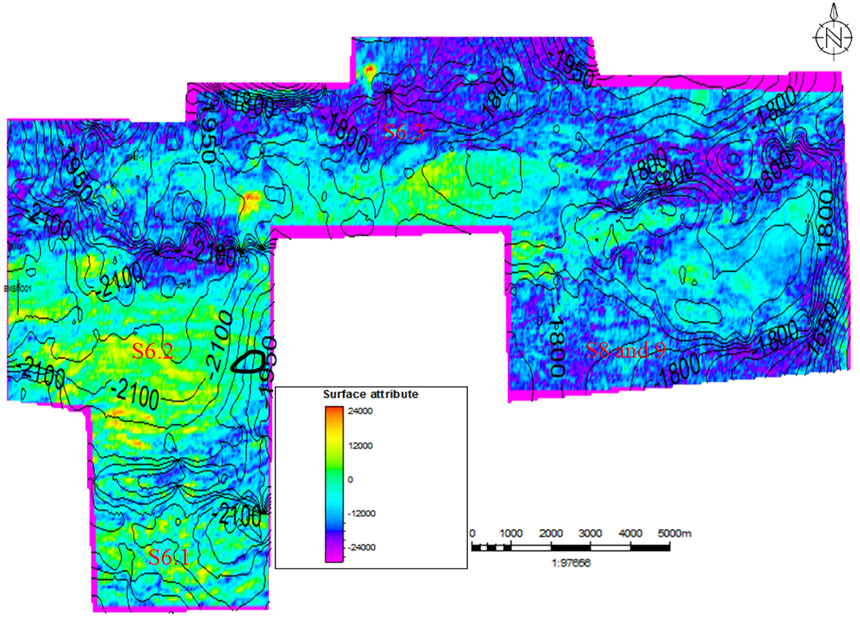
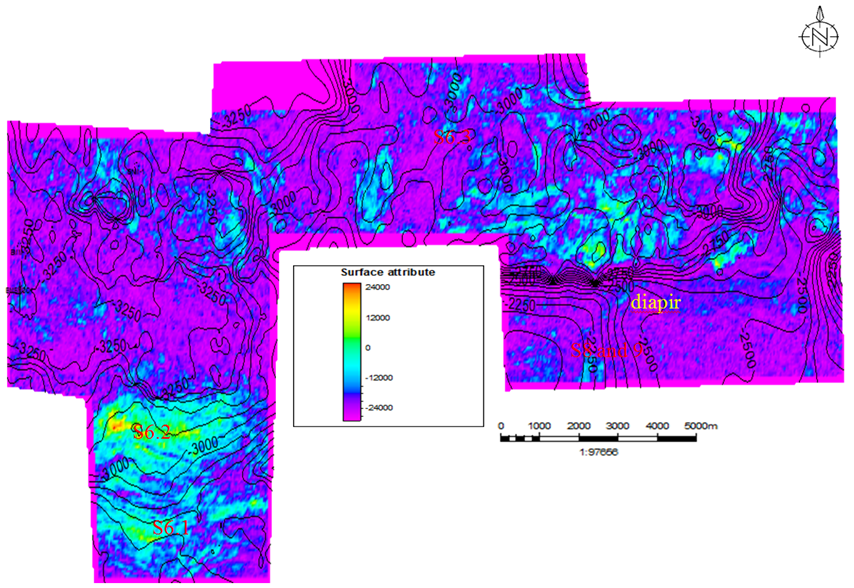
The amplitudes, spectral decomposition and similarity attributes extracted from the main horizons S6.1, S6.2, S6.3, S.8 and S.9 levels (Figure 8 to Figure 12) show anomalies. Some can be attributed to the presence of gas, which should be visible at such shallow levels, and some are reflecting reservoir distribution. Although attributes can indicate reservoir qualities and hydrocarbon fill, it can also be caused by the varying densities of the overlying shales and interference patterns by changing thickness in the package. Oil fill is not expected to give a sufficient seismic contrast as the oil is quite heavy; however the presence of gas is expected to give a good contrast as the depth of the reservoirs is very shallow. The results are provided together with isochore maps below. For N-Field prospect, S6 objectives appear to be just above the top of under compacted shale and a few S6 levels show bright amplitudes coherent with structural contours. It was a case for S6.1 and S6.2 reservoir layers, worked out as amplitude supported objective. S6.1 and S6.2: Strong amplitude anomaly over the prospect area, interpreted as DHI. Both levels were found with good reservoir properties, S6.1 is thicker (15 m) and oil bearing whereas S6.2 is thinner (10 m) with conclusive hydrocarbon fluid interpretation defined to be gas bearing. S6.3: Amplitude extracted along horizon interferes with layer (9 m) with 9 m gas column and a water gas contact. The maximum amplitude map shows a reduced anomaly around the proposed well location, limited eastward by NNE-SSW fault S8 and S9 objectives are sitting deeper within higher pressure sediments and therefore, at this level, seismic amplitude anomalies are more likely related to petrophysical variation within shale.


The estimation of the gross rock volume and area of the reservoirs shows that Reservoir S6.2 has the largest volume (Table 2). Reservoir S6.3 has a very small volume and area compared to the other reservoirs.
At the S6 levels, the only sands encountered by a well are the S6.1 (oil-bearing, well), S6.2 (Gas bearing, well) and S6.3. For the deeper levels (S.8 and S.9 level), some very distinctive areas were found during the attribute analysis (see Figure 11). Since the outlines of the anomaly respect the contours of the map, these could be a relation to a hydrocarbon contact. The A3 well drilled the S6.3 down-dip and well outside the anomalous area. The attribute maps show clearly up-dip hydrocarbon potential for the S6.3 sand. The anomaly is very strong, indicating a high risk for gas. The area in the direct surrounding of the diapir shows extensive faulting and fracturing, which increases the noise-level in the seismic. Interpretation is therefore difficult in this area and introduces uncertainties. Besides, the faults and fractures, diapir can act as flow barriers and therefore complicate amplitude variations.
As seen on the amplitude maps of S.8 and S.9 levels (Figure 11 and Figure 12), there are clear anomalies visible to the south east. These anomalies might indicate presence of hydrocarbons. Unfortunately, the amplitudes could also mean water-bearing sands.
The integration of several subsurface information to generate prospect map of the N-Field offshore Rio Del Rey Basin in Cameroon has proved successful in identifying the likely reasons for production challenges presented as decrease in oil production with increasing water output. This study has analysed and integrated well logs, 3D seismic volume, to generate information that would assist better
Several frequency-related, energy and similarity attributes were tested on the data in order to get more insight into structure, relative thickness and sedimentological differences and details of the sedimentology. Frequency gave very satisfying results concerning the presence and extension of faults. The use of Energy and amplitude resulted in maps showing significant anomalies that could be related to reservoir characteristics and/or hydrocarbon presence. However, it should be kept in mind that the analysis does not allow a predictive tool for areas with favorable S6 development to be identified
The author acknowledges the Pan African University (PAU) Through African Union and African Development Bank for financial support. The authors thank SNH (National Hydrocarbons Cooperation in Cameroon) who kindly provided the data set used in this study and granted permission to publish this article.
| [1] | Doust, H., and E. Omatsola, 1990. Niger delta: in J. D. Edwards and P.A. Santogrossi, eds., Divergent/passive margin basins: AAPG Memoir 48, p. 239-248. | ||
| In article | View Article | ||
| [2] | Koneshloo, M., Aryana, S. A., & Hu, X. (2018). The impact of geological uncertainty on primary production from a fluvial reservoir. Petroleum Science, 15(2), 270-288. | ||
| In article | View Article | ||
| [3] | Asquith G, Krygowski D. (2004). Basic well log analysis. AAPG methods in exploration series, vol. 28. American Association of Petroleum Geologists, Tulsa, p 244. | ||
| In article | View Article | ||
| [4] | Hilchie DW. (1990). Wireline: a history of the well logging and perforation business in the oil fields. D. W. Hilchie Inc., Boulder, pp 25-86. | ||
| In article | |||
| [5] | Coughlin, R.M., Bement, W.O. and Maloney, W.V. (1993). Petroleum Geology of the Deltaic Sequence, Rio Del Rey Basin, Offshore Cameroon. AAPG International Conference and Exhibition, The Hague, 17-20 October 1993. | ||
| In article | View Article | ||
| [6] | SNH (2015). Blocks on offer in the Rio Del Rey basin, DKC and Mamfe basin, 1-16. | ||
| In article | |||
| [7] | Corredor, F., Shaw, J. H., & Bilotti, F. (2005). Structural styles in the deep-water fold and thrust belts of the Niger Delta. Aapg Bulletin, 89(6), 753-780. | ||
| In article | View Article | ||
| [8] | Haack, R.C., Sundararaman, P., Diedjomahor, J.O., Xiao, H., Gant, N.J., May, E.D., Kelsch, K., (2000). Niger Delta petroleum systems. Nigeria, in M. R. Mello and B. J. Katz, eds., Petroleum systems of South Atlantic margins: Am. Assoc. Petrol. Geol. Memoir, 73: 213-231. | ||
| In article | View Article | ||
| [9] | LE Dlux A, Mba E. Montaneir P. (1996). Synthise geologigue et petroliere de concession Ekundu et ouest Boa – Bakassi. | ||
| In article | |||
| [10] | Tuttle LW, Charpentier RR, Brownfeld ME. (1999). The Niger Delta Petroleum System: Niger Delta province, Nigeria, Cameroon and Equatorial Guinea Africa, USGS, Open-fle Report 99-50-H. | ||
| In article | View Article | ||
| [11] | Villemin J, Tarreserence P. (1990). Sedimentary basins of Carbon Geology and Oil systems. American Association of Petroleum Geologists Memoir, Tulsa, pp 117-199. | ||
| In article | |||
| [12] | Brownfeld ME, Charpentier RR (2006). Geology and total petroleum systems of the West Central province (7203) West Africa. U.S. Geological Survey, Bulletin 2207-c, p 57. | ||
| In article | |||
| [13] | SNH, (2010). Republic of Cameroon, third liscencing round: The Rio Del Rey Basin. | ||
| In article | |||
| [14] | Marsden D (1989). I. Layer cake depth conversion. Geophys Lead Edge 8: 10-14. | ||
| In article | View Article | ||
| [15] | Amigun JO, Bakare NO. (2013). Reservoir evaluation of “Danna” field Niger Delta using petrophysical analysis and 3-D seismic interpretation. Pet Coal 2(55): 119-127. | ||
| In article | |||
Published with license by Science and Education Publishing, Copyright © 2021 Lionel Takem Nkwanyang, Olugbenga Ajayi Ehinola, Gilbert Mbzigha Chongwain and Samuel Etame Makoube
 This work is licensed under a Creative Commons Attribution 4.0 International License. To view a copy of this license, visit
http://creativecommons.org/licenses/by/4.0/
This work is licensed under a Creative Commons Attribution 4.0 International License. To view a copy of this license, visit
http://creativecommons.org/licenses/by/4.0/
| [1] | Doust, H., and E. Omatsola, 1990. Niger delta: in J. D. Edwards and P.A. Santogrossi, eds., Divergent/passive margin basins: AAPG Memoir 48, p. 239-248. | ||
| In article | View Article | ||
| [2] | Koneshloo, M., Aryana, S. A., & Hu, X. (2018). The impact of geological uncertainty on primary production from a fluvial reservoir. Petroleum Science, 15(2), 270-288. | ||
| In article | View Article | ||
| [3] | Asquith G, Krygowski D. (2004). Basic well log analysis. AAPG methods in exploration series, vol. 28. American Association of Petroleum Geologists, Tulsa, p 244. | ||
| In article | View Article | ||
| [4] | Hilchie DW. (1990). Wireline: a history of the well logging and perforation business in the oil fields. D. W. Hilchie Inc., Boulder, pp 25-86. | ||
| In article | |||
| [5] | Coughlin, R.M., Bement, W.O. and Maloney, W.V. (1993). Petroleum Geology of the Deltaic Sequence, Rio Del Rey Basin, Offshore Cameroon. AAPG International Conference and Exhibition, The Hague, 17-20 October 1993. | ||
| In article | View Article | ||
| [6] | SNH (2015). Blocks on offer in the Rio Del Rey basin, DKC and Mamfe basin, 1-16. | ||
| In article | |||
| [7] | Corredor, F., Shaw, J. H., & Bilotti, F. (2005). Structural styles in the deep-water fold and thrust belts of the Niger Delta. Aapg Bulletin, 89(6), 753-780. | ||
| In article | View Article | ||
| [8] | Haack, R.C., Sundararaman, P., Diedjomahor, J.O., Xiao, H., Gant, N.J., May, E.D., Kelsch, K., (2000). Niger Delta petroleum systems. Nigeria, in M. R. Mello and B. J. Katz, eds., Petroleum systems of South Atlantic margins: Am. Assoc. Petrol. Geol. Memoir, 73: 213-231. | ||
| In article | View Article | ||
| [9] | LE Dlux A, Mba E. Montaneir P. (1996). Synthise geologigue et petroliere de concession Ekundu et ouest Boa – Bakassi. | ||
| In article | |||
| [10] | Tuttle LW, Charpentier RR, Brownfeld ME. (1999). The Niger Delta Petroleum System: Niger Delta province, Nigeria, Cameroon and Equatorial Guinea Africa, USGS, Open-fle Report 99-50-H. | ||
| In article | View Article | ||
| [11] | Villemin J, Tarreserence P. (1990). Sedimentary basins of Carbon Geology and Oil systems. American Association of Petroleum Geologists Memoir, Tulsa, pp 117-199. | ||
| In article | |||
| [12] | Brownfeld ME, Charpentier RR (2006). Geology and total petroleum systems of the West Central province (7203) West Africa. U.S. Geological Survey, Bulletin 2207-c, p 57. | ||
| In article | |||
| [13] | SNH, (2010). Republic of Cameroon, third liscencing round: The Rio Del Rey Basin. | ||
| In article | |||
| [14] | Marsden D (1989). I. Layer cake depth conversion. Geophys Lead Edge 8: 10-14. | ||
| In article | View Article | ||
| [15] | Amigun JO, Bakare NO. (2013). Reservoir evaluation of “Danna” field Niger Delta using petrophysical analysis and 3-D seismic interpretation. Pet Coal 2(55): 119-127. | ||
| In article | |||