The vulnerability of coaster regions to flooding due to extreme sea level rise and storm surge has become notable since the late 20th century to date this 21st century. This vulnerability can be attributed among other things to the global rising sea level due to anthropogenic climate change. A platform is needed to integrate the necessary data to mitigate the impact of flooding and aid plans intended to safeguard these vulnerable regions. Geographic Information Systems (GIS) technique has given that stage by which different bits of past, present, and future information can be incorporated to get spatial-based data, from which areas in danger of unavoidable flood peril can be recognised. This study utilised GIS techniques to develop a spatial flood model of rising sea level scenarios. The expected rising sea level data (RCP 4.5 scenario), LiDAR Digital Elevation Model (DEM), estimated 2011 UK census, and the building & height alpha data were used to estimate the approximate number of buildings that might be exposed to inundation. Also, an estimated number of people that could be affected and land area were obtained. The outcome shows that for 3.11mOD extreme rising sea level value, 1074-unit houses, 2.79km2 (6.91%) of the land area were inundated with an estimated population of about 2,000 people. Whereas for the 3.59mOD rising sea level value, 14,500-unit houses, covering 4.63km2 (11.5%) of land were immersed, with an estimated population of about 71,500 people. The result also shows, among other places in the city, that an estimated 5,900-unit building and 33,931 people will be impacted in the south, Southsea, and Portsea areas. In comparison, about 5,000 structures and 17,500 people will be affected on the eastern side of Portsea Island. These areas were distinguished as regions possibly in danger of coaster flooding because of storm surges and extremely rising sea levels.
There is scientific consensus that the climate is changing, and the extreme climatic events brought on by global warming will inevitably occur 1, 2.
Global warming is a tendency to the warmer condition of the planet. Until the period of rapid industrialisation, it has been a steady normal phenomenon experienced for a 20,000-year extensive stretch. However, the warming trend has rapidly increased since post-industrialisation and is now deemed a threat to Earth 3, 4.
Associated with the occurrence of extreme global climate change are challenges peculiar to various locations (described by either spatial coordinates or spatial grid references, the direction, and distance connecting the locations). Places (areas represented by boundaries, margins, and spatial boundaries) and environments (characterised by the occurrence of both humans and nature and the impact of these activities that can be quantified and observed) are part of these challenges. Thus, extreme global climate change is a geographic problem 5. Environmental degradations attributable to increased drought, desertification, dry summer, and frequent heat wave are typical challenges faced in some regions. Contrarily, the wet and coastal regions face high precipitation, forcing the influx of people to these locations. As a result of this, more people become vulnerable to flooding, storm surge, typhoon, and loss of wetlands/low-land communities caused primarily by extreme climate change 4, 6.
Careful records like temperature, rainfall, sea level data, glacial recession, atmospheric conditions, climate change, and extreme climate hazards have been collected and documented by humankind for ages 7. Analysis and evaluation of these data would invariably help in answering questions about recent environmental challenges and predict future ecological degradation and conditions.
We, therefore, need a platform that can transform these historical spatial and climate observations into useful information. Retrievability of data, and adequate data pre-processing and processing, are also required to develop reliable models for analysis and evaluation of the environment 8. These are cardinal to understanding the world's dynamic climate and provide a framework for better decision-making to salvage the environment from further degradation and enhance adaptive measures to anthropogenic climate change 8, 9. This study demonstrates the significance of GIS and remote sensing as a tool to aid mitigation plans and decision-making in the face of extreme climate change.
1.1. Geographic Information Systems (GIS)Geographic Information Systems is a collection of tools for gathering, recovering, converting, and showing spatial data from everyday life for a specific purpose 8, 10. Furthermore, Earth surface data, remote sensing, and global positioning system (GPS) are among the technology that makes GIS a key concept for its effective use 11. GIS uses computer systems and software that come in a variety of forms for great applications. The emphasis on using spatial dimensions when transforming data into information helps us understand geographic phenomena. Therefore, it is a link between curiosity-based science and practical problem-solving 12, 13.
The benefits of utilising GIS technology include the use of remote sensing techniques when collecting data on environmental and climate change, like the freely available space-based data from satellites, high-resolution Light Detection, and Ranging (LiDAR) at low altitudes and aerial images. These are important for the widespread extension of local measurements to cover a wider area or region, and remote sensing data is spatially related to the location. Satellite images provide consistent data trends like rising sea levels and storm surges, flood wave travel times, and records of previously flooded sites. When analysed with GIS tools and compared to ground records, a precise map of the flood hotspot regions can be created 9, 14.
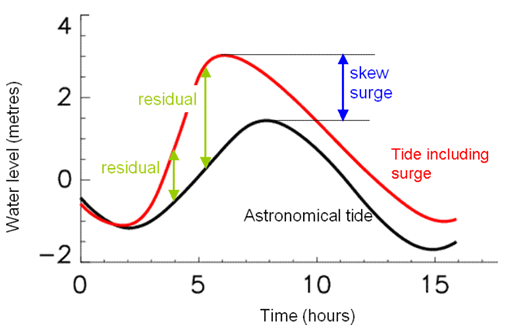
1.2. Challenges of Storm Surge and Flooding in Coaster RegionsStorm surges are brief, above-normal tide level rises in sea level. They happen as a result of low air pressure and the force that strong winds exert on the sea's surface and are hypothetically most harmful when they arise during high tide 15. We can measure the value of storm surge by evaluating the differences between normal/astrological and observed storm tides (Figure 1).
Storm surge events depend on driven meteorology, wave action, and the direction of the wind 17. Hence it is more accurate to forecast the occurrence of individual storms a few days ahead. But, using the Return period for the storm, a forecast of 25 - 50 years and above can be done. The Return period is the possible number on the average that will exceed a given height or the average between a surge height being exceeded 15.
On the other hand, Flooding occurs when water flows into dry places that are not intended for such inundation. According to reports, flooding is a natural catastrophe that impacts most people at once and occurs the most frequently 18.
If storm surge is the source and the cause of the floods, the degree of these effects is greater, and it may result in loss of life and property, environmental damage, and hardship in the economy that may last for years 19, 20, 21.

To manage the challenges of extreme climate change, it is important to consider all sources of flooding, including groundwater flooding, to ensure that flooding concerns are of the utmost in planning decisions to lower flood risk in every feasible way. It may be challenging to pinpoint a specific source of flood during a flooding situation 22.
Therefore, for extensive land and urban development within coaster communities, it is important to take into account how to identify or classify sites based on their susceptibility to flooding. The projected period of a coastal flood might probably impact the location and at what severe sea level rise value such region will be inundated. Questions on the likely number of properties, land, and population that could be affected in the event of flooding, as well as an effective mitigation strategy to be adopted to limit the impact of the hazardous event, must be considered. This may be accomplished by creating a comprehensive system that is not prone to unscientific manipulation, such as paper mapping, but rather uses better processing efficiency, less expensive, and geographically precise tools accessible in GIS 13, 21. Spatiotemporal modelling in GIS may be used to build maps and a spatial model of probable future flood scenarios for frequent assessment of sensitive regions by combining remote sensing data with severe sea level rise values of various return periods and other data 23, 24. These will improve flood mitigation strategy decisions.
The risk of flooding and storm surge is substantial in Portsmouth city, England, as in many other cities located along the coast. In addition to better educating the authorities so that suitable mitigation actions can be put in place, GIS-based vulnerability assessments of floods and storm surges will also help to build strategies for guaranteeing the environment's long-term sustainability 25. Proper planning and information management provide a solid and effective foundation for future generations.
For this study, the vulnerability of Portsmouth was assessed using the GIS procedure. The city is situated on Portsea Island on England's south coast, covering an area of around 40.25 km2, is surrounded by water, and has a very low land area. The city has a dense population. A major portion of Portsea Island's backshore is reclaimed land, some of which is currently utilised for urban development and the city's infrastructures 26, 27. The flood map of areas prone to be inundated from coastal flooding was made, and the likely size of land and the building points that the inundation could impact were also made based on the projected change in climate, Medium (A1B) emission scenario of Intergovernmental Panel on Climate Change (IPCC). Furthermore, in addition to the LiDAR DEM data of the city, present-day structures like the flood defence barriers and drainage system were considered when executing the spatial flood model.
The ocean's mean surface height between low and high tides is known as the Sea level 28. In the UK, tides are expressed in meters relative to Chart Datum (mCD), whereas sea level with respect to land is calculated in meters relative to Ordnance Datum (mOD) at Newlyn 29. The Chat Datum is the lowest astronomical tide. In contrast, the Ordnance Datum is the Ordnance Survey vertical datum determined by the height above average sea level based on a known datum point having its initial point at Newlyn (Cornwall) and Terrestrial Reference Frame observed by spirit levelling between 200 fundamental benchmarks (FBMs) across Britain. Below the Chat datum, the tide will often not fall since it is the water level from which navigational charts are measured 16. Portsmouth City's Chart Datum is negative 2.73m below Ordnance Datum Newlyn. The relationship between mOD and mCD when calculating the sea level to land height is expressed below.
 |
Where the Relative value changes for different locations in the UK, the Relative value for Portsmouth is -2.73m 28.
The flood modelling analysis used data that was provided through the release of the Environment Agency's Coastal Boundary Data project at several gauge points along the English coastlines in 2011 and was updated in 2019 (Table 1). The projected extreme mean sea level rise values were according to the IPCC Representative Concentration Pathway (RCP) 4.5 scenario for a Return period of 100 years at Newlyn, UK.
LiDAR Data: From the Channel Coast Observatory's resource, a LiDAR DEM was acquired. The data was obtained in grid (raster) format with 5 x 5 m cells, 0.1 m vertical precision, and centre-of-pixel calculations.
Master Map and Building Heights Attribute: Master-Map Topography layer of the UK is the detailed topographic data of the physical environment, including structures, roads, railways, rivers and lakes, and fields, represented by a point, lines, areas, or text and was obtained from Ordnance Survey (OS). The Building Heights Attributes (BHA) contain height attributes of each building, walls, and Flood defence (incorporated for sea level rise until 2050) in the OS Master-Map Topography Layer. They were downloaded on a scale of 1:1250 GML and CSV format, 5km x 5km tile size, respectively.
Population Census: The census data is the 2011 Lower Super Output area and boundary of usual residents staying for 12 months and above or having a permanent UK address. Postcodes serve as the focal point and building block of the Lower Super Output area and border 30.
SEEDED-FLOOD: The 'Seeded flood' is an Arc Map tool compiled from Python script specifically for the spatial-temporal flood model of the extremely rising sea level scenarios due to storm surges. The "Seeded Flood tool" was developed such that it can be used for any location. It however requires Raster data (DEM), the location (XY) and the value of the sea level rise.
Extracting Portsmouth OS Master Map, Building height Attributes, and LiDAR data: We pulled the section within the Portsmouth city boundary area from the Master Map topographic of the UK. This was then joined to the building height attributes data to have the building and other physical layouts with height attributes and the census data.
Spatial-Temporal Model (STM): The technique is founded on the dimensions of the environmental dynamics—x, y, and z—and time (t). A time-driven inundation model computes the state of the land-covered regions in a square grid, which indicates a corresponding location's characteristic (inundated or not inundated) by advancing the simulation by set time intervals and sea-level values 23.
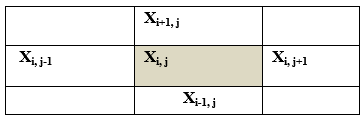
A cell at (Xi, j) will be inundated if the cell covered type is not a sea, but the covered type of one of the surrounding cells is a sea or flooded, and the elevation value of the cell (Xi, j) is equal or less than the adjacent cell (Figure 1). Each cell's status is retained at the beginning. If this condition is met at any point in the model, the state of the cell (Xi, j) (space) will change throughout time.
The rising sea level values were a key variable producing changes in the elevation and grid cell cover variable in the spatial modelling of flooded areas with the LiDAR DEM grid cell data. Physical variables such as connectedness and closeness to the coastline or inundated cells and elevation were critical considerations in determining the flow direction between neighbouring grid cells. This formed the basis for the ArcGIS tool "SEEDED-FLOOD" used in the modelling.
For this analysis, the initial value at sea level from the DEM is zero, and the location was set at 462115, 98129 southwest of Portsmouth. The extreme sea level rise data for the return periods were entered into the SEEDED-FLOOD tool, this produces the respective inundation scenarios with attributes that contain both lands and flood areas (flood layer). The maps of each flooded area were after that made.

To assess the areas vulnerable to flooding (buildings and land), the result of each inundated model (flood layers) was overlaid with the Portsmouth Master map and the Building/height layer. The number of features that fell within these locations was estimated to be the sum of vulnerable buildings and structures. Together with it was also the estimated number of people per building that would be impacted within each flood model.
Likewise, to determine the apparent inundated land size within the city, each flood layer was overlayed with Portsmouth-master-map and building/height layer, and locations that intersect with each other in the two layers were calculated by geometry to obtain the flooded area.
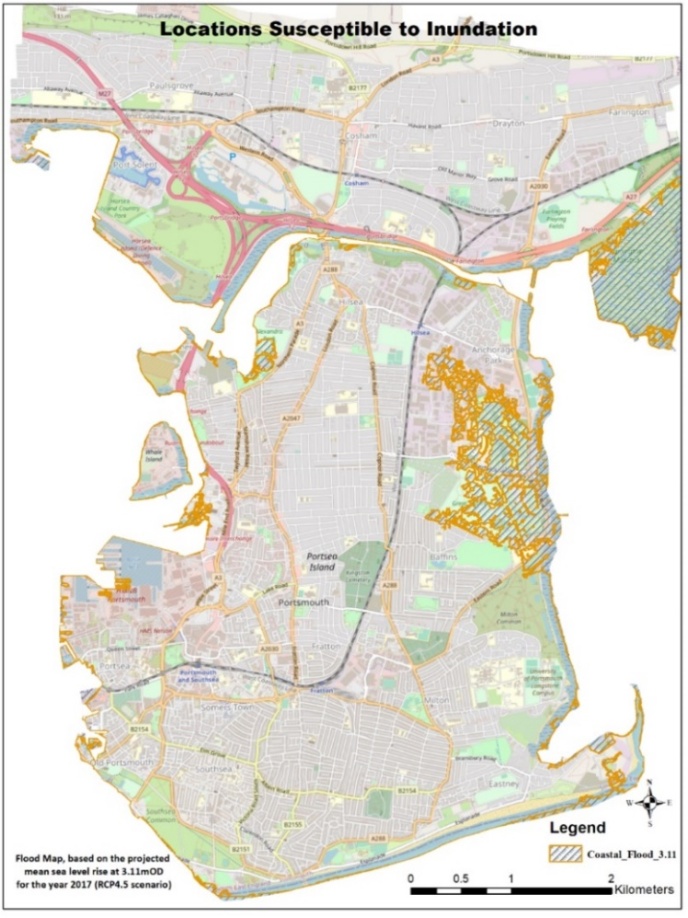
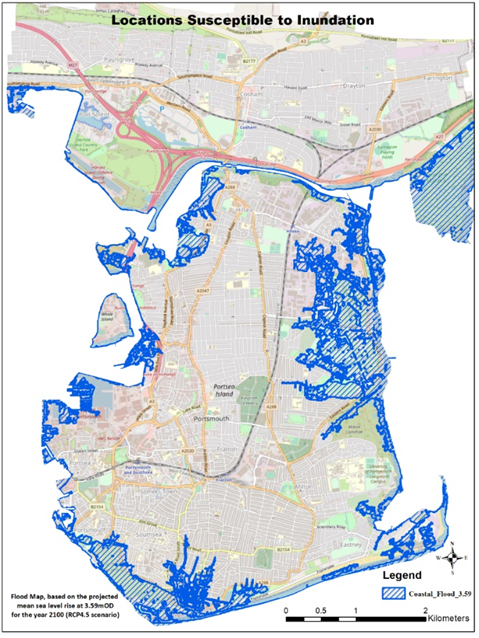
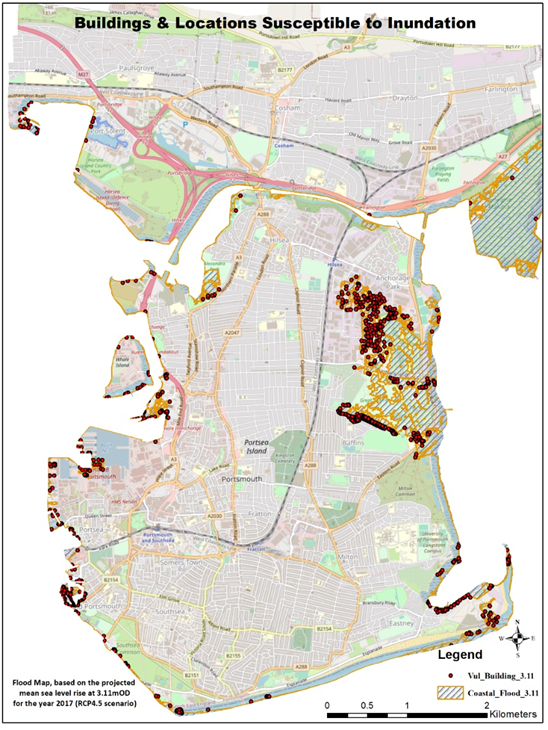
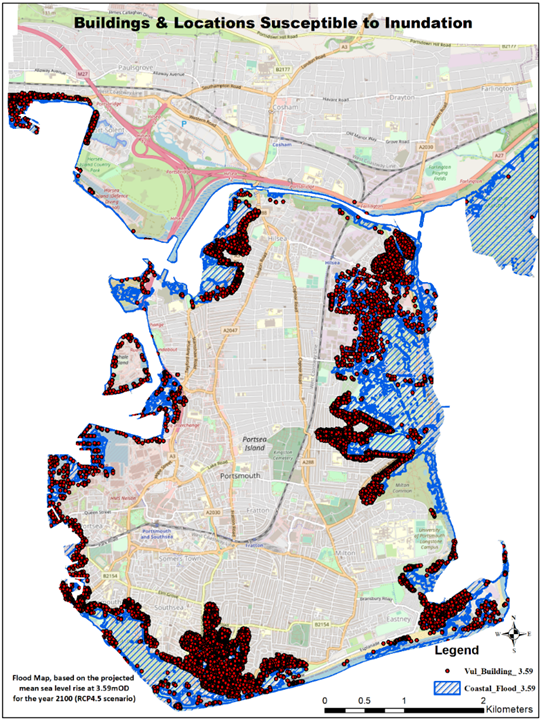
Figures illustrating the outcome of the analysis for 3.11mOD and 3.59mOD projection scenarios of extreme sea level rise for 2017 and 2100, respectively, as well as the map showing submerged regions are shown in Figure 3 and Figure 4. With a Street view raster map as a base map for each outcome, a familiar view of the flooded locations is better identified.
3.1. Interpretation:The flood maps display the areas submerged under the different extreme sea-level rise modelling scenarios. In the first modelled scenario, the existence of flood defence along the city's southern border greatly decreased flooding from the 3.11mOD sea rise flood scenario (Figure 3a). The Portsmouth Climate Action Board (2021) stated that this flood defence wall was created to resist anticipated flooding in 2050 prediction. Nevertheless, the flood swamped the eastern portion of the city (Figure 3a), which has a modest flood protection wall. The deluge continued inward, inundating the Great Sultan, the Portsmouth emergency centre, and a portion of Voyager Park in the city's northeastern outskirts.
Furthermore, according to the 3.33mOD scenario model (Figure 3b), more of Portsmouth Southsea is inundated, including portions of Victoria Street and Herbert Road and regions farther to the south, north, and east of the city. More places were submerged due to the flood defences being unable to keep up with the sea level increase.


The maps presented in Figures 4a-b represent the locations flooded (land) and the buildings (both residential and commercial) susceptible to inundation. The centroid, a point, serves as a representation of every construction. As a result, the structures that will be impacted were found using a 25 m flood buffer. In addition, the summary of the number of vulnerable buildings and the percentage of land is shown in Table 2.
The vulnerability assessment's findings show that only the northern and central portions of the city are shielded from the risk of flooding since they are not located near the source of the danger (Coast).
With the flood rising beyond the southwest flood defence, several properties in the south, eastern and south-eastern and many parts of the city are exposed to the hazard.
From the table, the sea level is the projected extreme sea level rise (mOD), the year projected, the Population is the projected number of people that might be impacted, land area is the area and percentage of land susceptible to flooding, and the building is the number of structures that could be impacted by the flood.
The vulnerability assessment's findings show that only the northern and central portions of the city are shielded from the risk of flooding since they are not located near the hazard's source (Coast). Several homes in the south and eastern portion of the city and sizeable areas of these parts are susceptible and exposed to the threat because of the flood rising beyond the flood barrier.
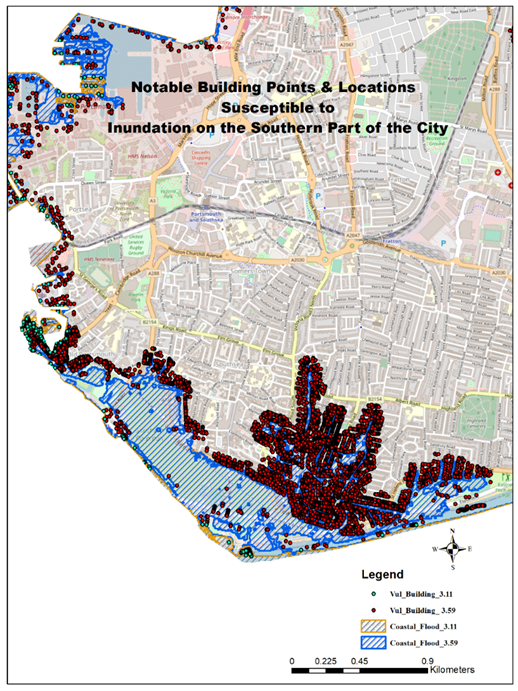
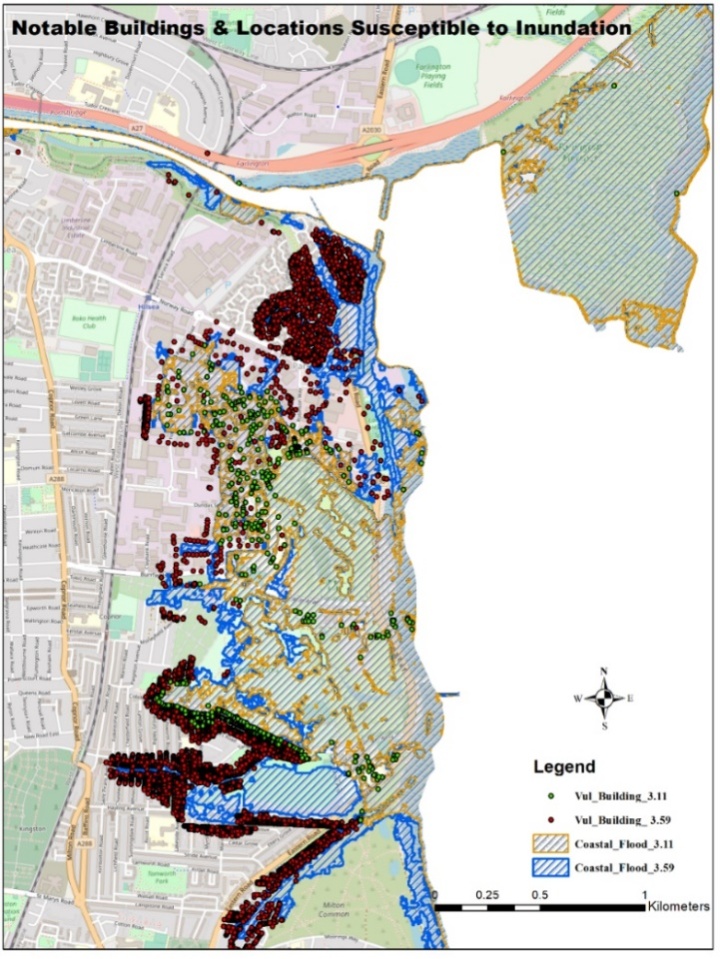
In all, 650 to 14,500 buildings are at risk, and 6.91% to 11.5% of the land within the built environment are vulnerable to flood hazard due to the expected extreme sea level rise from 3.11mOD to 3.59mOD. Additionally, an estimated population of 71,500 people is susceptible to flooding by the 3.59mOD based on the estimated 2011 census data. Among other vulnerable locations, the result shows that an estimated 5,900-unit building and 33,931 people will be impacted in the south, Southsea, and Portsea areas. In contrast, on the eastern side of Portsea Island, about 5,000 units of buildings and 17,500 people will be impacted (Figure 5a-b).
An environment's vulnerability is assessed using three variables: exposure, sensitivity, and adaptive capability.
Exposure: The city of Portsmouth is vulnerable to flooding, particularly with increasing sea levels. Though the Portsdown Hills in the city's northern section shelter it from the northerly winds, a covering from the Isle of Wight on the southwest side also protects it from the strong westerly winds. However, the seafront remains vulnerable to storm surges from the Solent Sea on the southeastern side.


With the imminent rising sea level due to extreme climate change, the city's exposure level, notably from the south and the eastern part, increased, thereby making many homes, businesses, green spaces, and biodiversity, among others, vulnerable and at risk of flooding (Figure 4a-b).
Adaptive capacity and Sensitivity: The city is highly sensitive to the possibility of flooding, and as a result, numerous adaptive measures, such as flood defence barriers, have been put in place to withstand flood increases. Due to the predicted sea level rise, a significant portion of the shoreline has yet to achieve a good safe level against flood risk using the current adaptive strategy 22, 31 and as seen in the results (Figure 5a-b). This implies that the city should explore the additional building of defensive structures in the east and southeast, as well as increasing the degree of protection in the city's southwest.

There are globally recognised environments inside and around Portsmouth that provide a natural habitat for many species of wildlife and plants. Portsmouth Harbour on the west and Longstone Harbour on the east (Figure 5b) have been designated as Special Areas of Conservation (SAC) for diverse wild animals, vegetation, and Special Protection Areas (SPA) for migratory bird species. They are termed Sites of Special Scientific Interest (SSSI) under UK legislation to safeguard the country's top wildlife and geological sites. The Farlington Marshes, located northeast of the island, is also designated as an SSSI. Eastney, Milton Common, Great Salterns, and Hilsea Lines (Figure 5b), which are local wildlife sites, are also recognised for their informal heathland, wetland, and woodland habitats 32. According to the results of the investigation of flood modelling, many of these habitats would be impacted and maybe gone. Consequently, the diverse organism in this niche will experience a considerable environmental impact 33.
Likewise, there could be a significant land-use/land-cover change; the flooding may cause the loss of part of the open land utilised as sports and recreation areas along the city's shore. This change could also affect the residential buildings that could become unhabitable due to inundation.

Long-term flood protection investment: It is now essential for everyone to participate in flood risk management and mitigation to have sound development plans. With the limited resources, the municipal government has, expanding the flood defence with a rugged design plan over the vulnerable regions may not be viable in the long run. Hence, innovative, inclusive financial strategies are required; the city government, in partnership with the environmental agency (UK), private sector, and community support group, will have a plan and policy to maintain the coastline. An example is the Alverstoke and Forton construction of the Scheme. This policy will encourage private entities to make long-term investments in the flood protection plan 34, 35.
Another innovative financial strategy could be a partnership and developing more sporting activities, promoting tourism activities around the shoreline and the preserved habitat to generate funding to protect the city against flooding.
Improved Structural Design: A successful flood mitigation strategy that lowers the costs of flood damage is the flood-proofing of individual structures in flood-prone locations 36. Building structural design can incorporate safeguards like constructing flood barriers or anti-backflow valves, as well as elevating the ground flow, among other things 37. Other architectural designs and adaptive construction instances are "green infrastructures" flexible for the changing climate. Also employed for residences in New Orleans' Ninth Ward was the construction of a stilt building design, which allows the area below to be utilised for vehicle parking. At the same time, inhabitants and property remain safe above 26. Installation of heating and electrical facilities on upper levels and water barriers for buildings utilised in Germany are recent initiatives that have decreased the cost of flood damage by up to 50%. 37. Furthermore, flood level buffers may be determined using GIS technologies, and the results can be utilised to influence the selection of suitable design and construction materials.
Community Engagement: The importance of communication and flood danger awareness cannot be overstated. The community needs to be involved by raising knowledge about the risks of living in flood-prone areas, the past flood plains and future predictions of coastal flooding due to high sea level rise. Educating people on the value of self-defence and how to do it is also essential. It is also crucial to involve the community in the rules and decision-making processes related to flood control 38.
The city council uses media platforms like the Coaster Partners page and the Environmental Agency website to communicate the proposed flood defence plan. Yet, there is an opportunity for improvement by building a flood and storm sensor that supports online and mobile open-source GIS apps that can be linked to a social media platform to facilitate the faster exchange of information between residents and authorities before a flood threat 36. This platform will serve as the citizen observatory, providing communities and people with an ecosystem of information for debate, monitoring, and action on situations, locations, and events 39, 40.
The fact that the GIS application is location-based and additional GIS specialised extensions (Network and 3D analytic tools) may be utilised to give real-time analysis of the information being handed over, particularly in emergency operations, is one advantage of this strategy.
While such initiatives will result in much knowledge, citizens' full potential will be realised when their opinions and concerns are noted, shared with the appropriate authorities, and reciprocated cooperatively. The GIS platform for the citizens' observatories will make this feasible 39.
The challenge of protecting the environment, preserving natural ecosystems, making the city a safe place for everybody to live, and securing the future in the face of the threat posed by anthropogenic climate change in Portsmouth and other low-lying coastal towns throughout the world is monumental. However, this effort is doable with the assistance of numerous governmental organisations, all relevant parties, individuals, and scholars.
Most significantly, GIS methods provide a variety of approaches for flood control, from modelling to real-world flood management applications. GIS tools offer a better way of generating and understanding the regions at risk of coastal flood hazards. They will also enable effective flood mitigation decisions by combining spatial information with climate, landscape, and socioeconomic data.
As used in this study, with GIS tools and procedures, buildings and land areas (this includes the natural habitat for various plant and animal species) potentially at risk of coastal flooding in Portsmouth city due to probable severe sea level rise were identified. The likely number of the population exposed was also computed. The outcome is a testament to the importance of GIS as a useful means that will enhance the continuous effort towards protecting the people in Portsmouth city and its environs against flood hazards and other low-land cities exposed to flooding.
A review of this research work is recommended. The continuous increase in greenhouse gas emissions implies that adverse climatic change is inevitable. Hence the sea level rise remains unpredictable and could rise beyond the current projection used in this study.
Moreover, the evaluation might involve an investigation of the economic impact of possible flood damage to flood-prone locations and the cost of adaptive measures and implementation, particularly to the built environment and natural ecosystems. Also, the population affected by future flooding could be included based on the most recent census date.
Future studies should also look at the effects of other sources of flooding, like excessive precipitation, the connection between this and coastal flooding, and the impact these factors have on population growth in Portsmouth.
5.1. LimitationsLimitations in estimating the number of likely affected buildings
This study does not put into consideration the categories of buildings estimated, either residential or commercial. The idea is to have an estimated number of structures that could be affected.
Limitations on the affected population
Without considering non-residential constructions, the estimated 2011 Output Area population census was allocated equally across each building within each Output Area. The goal is to have an estimate of each area's population in the event of flooding.
Limitation in focus
This study's scope solely covers inundation from coastal flooding caused by extreme sea level rise calculated based on the skew surge technique and its impact on the community, land area, and built environment. All other consequences, such as flash floods caused by severe precipitation, groundwater flooding, and flooding caused by an overflowing reservoir, are not taken into account.
Additionally, this study did not consider the social and financial cost of the potential damage sustained in flood-prone regions.
The sea level rise values were based on the medium emission scenario of representative concentration pathways (RCP 4.5) and did not consider present-day uncertainty.
The authors want to thank everyone who helped make this project a success, Paul Carter and Martin Schaefer of the University of Portsmouth, for their technical assistance, and Babatunji Oyinloye of Afe Babalola University for his editorial input.
| [1] | Intergovernmental Panel on Climate Change (IPCC), "The Physical Science Basis, Working Group I Contribution to the Sixth Assessment Report," IPCC, Switzerland, 2021. | ||
| In article | |||
| [2] | A. B. A. Slangen, J. A. Church, C. Agosta, X. Fettweis, B. Marzeion and K. Richter, "Anthropogenic forcing dominates global mean sea-level rise since 1970," Nature Climate Change, vol. 6, no. 7, pp. 701-705, 2016. | ||
| In article | View Article | ||
| [3] | S. J. Purkis and V. Klemas, "Remote Sensing and Global Environmental Change," Wiley-Blackwell, 2011. | ||
| In article | View Article PubMed | ||
| [4] | M. Dobson, "From Ice Cores to Tree Rings; In Sharon, L.S., McGlothlin, K.L. (Ed) (2002): Global Climate Change.," Rowman & Littlefield, 2002. | ||
| In article | |||
| [5] | Intergovernmental Panel on Climate Change (IPCC), "Climate Change 2007: Impacts, Adaptation and Vulnerability. Contribution of Working Group II to the Fourth Assessment," Cambridge University Press, Cambridge, UK, 2007. | ||
| In article | |||
| [6] | A. J. Bloom, Global Climate Change: Convergence of Disciplines, Sunderland: Sinauer Associates, 2010. | ||
| In article | |||
| [7] | Byravan, S. and Chella Rajan, S., "Sea Level Rise And Climate Change Exiles: A Possible Solution," Bulletin of the Atomic Scientists, vol. 71(2), pp. 21-28, 2015. | ||
| In article | View Article | ||
| [8] | J. Rosen, "The Science of Climate Change Explained: Facts, Evidence and Proof: Definitive answers to the big questions," The Newyork Times, Online, 2021. | ||
| In article | |||
| [9] | M. D. Michael F. Worboys, GIS A Computing Perspective,, 2nd, Ed., online: CRC Press, 2016. | ||
| In article | |||
| [10] | Burrough, P.A., Principles of Geographical Information Systems for Land Resources Assessment, Oxford: Clarendon Press, 1986. | ||
| In article | View Article | ||
| [11] | M. Goodchild, What is Geographic Information Science? NCGIA Core Curriculum in GIScience; In Heywood, I., Cornelius, S., Carver, S. (2011): An Introduction to Geographical Information Systems (4th ed.) p. 19, England: Pearson Education Limited., 1997. | ||
| In article | |||
| [12] | R. A. d. B. Otto Huisman, Principle of Geographic Information Systems, Enschede, The Netherlands: ITC, 2009. | ||
| In article | |||
| [13] | A. Longley, M. Goodchild, D. Maguire and W. Rhind, Geographic Information Science and Science (2nd ed.), England: Wiley, 2005. | ||
| In article | |||
| [14] | M. A. Ali, D. Solomatine and, D. G. Baldassarre, "Assessing the impact of different sources of topographic data on 1-D hydraulic modelling of floods," Hydrology and Earth System Sciences, vol. 19, pp. 631-643, 2015. | ||
| In article | View Article | ||
| [15] | J. Lowe and J. Gregory, "The effects of climate change on storm surges around the United Kingdom.," Philosophical Transactions of the Royal Society, p. 1313–1328., 2005. | ||
| In article | View Article PubMed | ||
| [16] | Environment Agency, "Exploratory sea level projections for the UK to 2300," Environment Agency, Bristol, 2019. | ||
| In article | |||
| [17] | P. Reed, "Types of Floods and Floodplains.," Federal Emergency Management Agency, Emergency Management Institute, pp. 1-18, 2011. | ||
| In article | |||
| [18] | F. Vos, J. Rodriguez, R. Below and D. Guha-Sapir, Annual Disaster Statistical Review: The numbers and trends 2009, Brussels: Centre for Research on the Epidemiology of Disaster (CRED), 2010. | ||
| In article | |||
| [19] | J. Lamond, Flood Hazards: Impacts and Responses for the Built Environment. Boca Raton: CRC Press., CRC Press, 2012. | ||
| In article | View Article | ||
| [20] | A. K. Jha, R. Bloch and J. Lamond, "Cities and Flooding: A Guide to Integrated Urban Flood Risk Management for the 21st Century.," World Bank Publications., Herndon, VA, USA: 2012. | ||
| In article | View Article | ||
| [21] | J. Houghton, Global Warming (4th ed.). UK: Cambridge Press., UK: Cambridge Press, 2009. | ||
| In article | |||
| [22] | Portsmouth city council (PCC), "Local Flood Risk Management Strategy. Technical Report," Portsmouth city council, 2015. | ||
| In article | |||
| [23] | O. Sahin and S. Mohamed, "Coastal Vulnerability to Sea-Level Rise: A Spatial-Temporal Assessment Framework," Natural Hazards, pp. 395-414, 2014. | ||
| In article | View Article | ||
| [24] | Eastern Solent Coastal Partnership (ESCP), "Flood Risk Assessments," Eastern Solent Coastal Partnership, Portsmouth, 2021. | ||
| In article | |||
| [25] | P. Cowell and Q. Zeng, "Integrating Uncertainty Theories with GIS for Modelling Coastal Hazards of Climate Change," Marine Geodesy, p. 5–18, 2003. | ||
| In article | View Article | ||
| [26] | Institution of Civil Engineers (ICE) and Building Futures (BF), "Green Infracture," 09 01 2022. [Online]. Available: www.buildingfutures.org.uk/what-are-green-buildings. [Accessed 12 09 2022]. | ||
| In article | |||
| [27] | J. Sadden, Portsmouth: A Century of Change., Stroud: History Press Ltd, 2009. | ||
| In article | |||
| [28] | National Tidal and Sea Level Facility (NTSLF), "Chart Datum and Ordnance Datum; Differences at Selected UK and Irish Ports," 2021. [Online]. Available: www.ntslf.org/tides/datum. [Accessed 10 01 2022]. | ||
| In article | |||
| [29] | Ordnance Survey, "A Guide to Coordinate Systems in Great Britain: An Introduction to Mapping Coordinate Systems and the Use of GPS Datasets With Ordnance Survey Mapping," Ordnance Survey, pp. 1-43, 2019. | ||
| In article | |||
| [30] | Office for National Statistics, "Office for National Statistics, 2011 Census: Aggregate data (England and Wales) [computer file].," 10 Feb 2014. [Online]. Available: http://infuse.mimas.ac.uk. [Accessed February 2022]. | ||
| In article | |||
| [31] | Portsmouth Climate Action Board, PCAB, "Portsmouth Climate Change Risks," Portsmouth Climate Action Board, Portsmouth, 2021. | ||
| In article | |||
| [32] | Portsmouth City Council (PCC), "Local Flood Risk Management Strategy. Technical Report. Retrieved, from," Portsmouth City gov, Portsmouth, 2015. | ||
| In article | |||
| [33] | W. A. Houston and R. L. Black, "Effect of a Major Flood on Breeding and Habitat of the Crimson Finch (Neochmia Phaeton) A Riparian Specialist," River Research & Applications, vol. 30(5), pp. 609-616, 2014. | ||
| In article | View Article | ||
| [34] | D. Osberghaus, "The determinants of private flood mitigation measures in Germany-Evidence from a nationwide survey," Ecological Economics, vol. 110, pp. 36-50, 2015. | ||
| In article | View Article | ||
| [35] | Coaster Partners, "Coastal Defence Improvements in Gosport," Portsmouth Council, online, 2022. | ||
| In article | |||
| [36] | Coaster Partners, "Protecting Yourself Against Flooding," Coaster Partners, 2021. | ||
| In article | |||
| [37] | J. K. Poussin, W. Wouter Botzen and J. C. Aerts, "Effectiveness of Flood Damage Mitigation Measures: Empirical Evidence from French Flood Disasters," Global Environmental Change, pp. 3174-84, 2015. | ||
| In article | View Article | ||
| [38] | W. Uta, M. Rusca, E. Jaap and L. Vitavesca, "Participation in flood risk management and the potential of citizen observatories: A governance analysis," Environmental Science & Policy, vol. 48, pp. 225-236, 2015. | ||
| In article | View Article | ||
| [39] | V. Lanfranchi, N. Ireson and U. When, "Citizens' Observatories for Situation Awareness in Flooding.," Proceedings of the 11th International ISCRAM Conference University Park, Pennsylvania, USA, 2014. | ||
| In article | |||
| [40] | F. Ciravegna, H. Huwald, V. Lanfranchi and U. Wehn de Montalvo, "Citizen observatories: The WeSenseIt Vision.," in Inspire Conference, Florence, 2013. | ||
| In article | |||
Published with license by Science and Education Publishing, Copyright © 2023 Sanmi O. Odeyemi, Dominic Fontana, Eberechi Ichi, Ene S. Ajonye and Ossai Alu
 This work is licensed under a Creative Commons Attribution 4.0 International License. To view a copy of this license, visit
http://creativecommons.org/licenses/by/4.0/
This work is licensed under a Creative Commons Attribution 4.0 International License. To view a copy of this license, visit
http://creativecommons.org/licenses/by/4.0/
| [1] | Intergovernmental Panel on Climate Change (IPCC), "The Physical Science Basis, Working Group I Contribution to the Sixth Assessment Report," IPCC, Switzerland, 2021. | ||
| In article | |||
| [2] | A. B. A. Slangen, J. A. Church, C. Agosta, X. Fettweis, B. Marzeion and K. Richter, "Anthropogenic forcing dominates global mean sea-level rise since 1970," Nature Climate Change, vol. 6, no. 7, pp. 701-705, 2016. | ||
| In article | View Article | ||
| [3] | S. J. Purkis and V. Klemas, "Remote Sensing and Global Environmental Change," Wiley-Blackwell, 2011. | ||
| In article | View Article PubMed | ||
| [4] | M. Dobson, "From Ice Cores to Tree Rings; In Sharon, L.S., McGlothlin, K.L. (Ed) (2002): Global Climate Change.," Rowman & Littlefield, 2002. | ||
| In article | |||
| [5] | Intergovernmental Panel on Climate Change (IPCC), "Climate Change 2007: Impacts, Adaptation and Vulnerability. Contribution of Working Group II to the Fourth Assessment," Cambridge University Press, Cambridge, UK, 2007. | ||
| In article | |||
| [6] | A. J. Bloom, Global Climate Change: Convergence of Disciplines, Sunderland: Sinauer Associates, 2010. | ||
| In article | |||
| [7] | Byravan, S. and Chella Rajan, S., "Sea Level Rise And Climate Change Exiles: A Possible Solution," Bulletin of the Atomic Scientists, vol. 71(2), pp. 21-28, 2015. | ||
| In article | View Article | ||
| [8] | J. Rosen, "The Science of Climate Change Explained: Facts, Evidence and Proof: Definitive answers to the big questions," The Newyork Times, Online, 2021. | ||
| In article | |||
| [9] | M. D. Michael F. Worboys, GIS A Computing Perspective,, 2nd, Ed., online: CRC Press, 2016. | ||
| In article | |||
| [10] | Burrough, P.A., Principles of Geographical Information Systems for Land Resources Assessment, Oxford: Clarendon Press, 1986. | ||
| In article | View Article | ||
| [11] | M. Goodchild, What is Geographic Information Science? NCGIA Core Curriculum in GIScience; In Heywood, I., Cornelius, S., Carver, S. (2011): An Introduction to Geographical Information Systems (4th ed.) p. 19, England: Pearson Education Limited., 1997. | ||
| In article | |||
| [12] | R. A. d. B. Otto Huisman, Principle of Geographic Information Systems, Enschede, The Netherlands: ITC, 2009. | ||
| In article | |||
| [13] | A. Longley, M. Goodchild, D. Maguire and W. Rhind, Geographic Information Science and Science (2nd ed.), England: Wiley, 2005. | ||
| In article | |||
| [14] | M. A. Ali, D. Solomatine and, D. G. Baldassarre, "Assessing the impact of different sources of topographic data on 1-D hydraulic modelling of floods," Hydrology and Earth System Sciences, vol. 19, pp. 631-643, 2015. | ||
| In article | View Article | ||
| [15] | J. Lowe and J. Gregory, "The effects of climate change on storm surges around the United Kingdom.," Philosophical Transactions of the Royal Society, p. 1313–1328., 2005. | ||
| In article | View Article PubMed | ||
| [16] | Environment Agency, "Exploratory sea level projections for the UK to 2300," Environment Agency, Bristol, 2019. | ||
| In article | |||
| [17] | P. Reed, "Types of Floods and Floodplains.," Federal Emergency Management Agency, Emergency Management Institute, pp. 1-18, 2011. | ||
| In article | |||
| [18] | F. Vos, J. Rodriguez, R. Below and D. Guha-Sapir, Annual Disaster Statistical Review: The numbers and trends 2009, Brussels: Centre for Research on the Epidemiology of Disaster (CRED), 2010. | ||
| In article | |||
| [19] | J. Lamond, Flood Hazards: Impacts and Responses for the Built Environment. Boca Raton: CRC Press., CRC Press, 2012. | ||
| In article | View Article | ||
| [20] | A. K. Jha, R. Bloch and J. Lamond, "Cities and Flooding: A Guide to Integrated Urban Flood Risk Management for the 21st Century.," World Bank Publications., Herndon, VA, USA: 2012. | ||
| In article | View Article | ||
| [21] | J. Houghton, Global Warming (4th ed.). UK: Cambridge Press., UK: Cambridge Press, 2009. | ||
| In article | |||
| [22] | Portsmouth city council (PCC), "Local Flood Risk Management Strategy. Technical Report," Portsmouth city council, 2015. | ||
| In article | |||
| [23] | O. Sahin and S. Mohamed, "Coastal Vulnerability to Sea-Level Rise: A Spatial-Temporal Assessment Framework," Natural Hazards, pp. 395-414, 2014. | ||
| In article | View Article | ||
| [24] | Eastern Solent Coastal Partnership (ESCP), "Flood Risk Assessments," Eastern Solent Coastal Partnership, Portsmouth, 2021. | ||
| In article | |||
| [25] | P. Cowell and Q. Zeng, "Integrating Uncertainty Theories with GIS for Modelling Coastal Hazards of Climate Change," Marine Geodesy, p. 5–18, 2003. | ||
| In article | View Article | ||
| [26] | Institution of Civil Engineers (ICE) and Building Futures (BF), "Green Infracture," 09 01 2022. [Online]. Available: www.buildingfutures.org.uk/what-are-green-buildings. [Accessed 12 09 2022]. | ||
| In article | |||
| [27] | J. Sadden, Portsmouth: A Century of Change., Stroud: History Press Ltd, 2009. | ||
| In article | |||
| [28] | National Tidal and Sea Level Facility (NTSLF), "Chart Datum and Ordnance Datum; Differences at Selected UK and Irish Ports," 2021. [Online]. Available: www.ntslf.org/tides/datum. [Accessed 10 01 2022]. | ||
| In article | |||
| [29] | Ordnance Survey, "A Guide to Coordinate Systems in Great Britain: An Introduction to Mapping Coordinate Systems and the Use of GPS Datasets With Ordnance Survey Mapping," Ordnance Survey, pp. 1-43, 2019. | ||
| In article | |||
| [30] | Office for National Statistics, "Office for National Statistics, 2011 Census: Aggregate data (England and Wales) [computer file].," 10 Feb 2014. [Online]. Available: http://infuse.mimas.ac.uk. [Accessed February 2022]. | ||
| In article | |||
| [31] | Portsmouth Climate Action Board, PCAB, "Portsmouth Climate Change Risks," Portsmouth Climate Action Board, Portsmouth, 2021. | ||
| In article | |||
| [32] | Portsmouth City Council (PCC), "Local Flood Risk Management Strategy. Technical Report. Retrieved, from," Portsmouth City gov, Portsmouth, 2015. | ||
| In article | |||
| [33] | W. A. Houston and R. L. Black, "Effect of a Major Flood on Breeding and Habitat of the Crimson Finch (Neochmia Phaeton) A Riparian Specialist," River Research & Applications, vol. 30(5), pp. 609-616, 2014. | ||
| In article | View Article | ||
| [34] | D. Osberghaus, "The determinants of private flood mitigation measures in Germany-Evidence from a nationwide survey," Ecological Economics, vol. 110, pp. 36-50, 2015. | ||
| In article | View Article | ||
| [35] | Coaster Partners, "Coastal Defence Improvements in Gosport," Portsmouth Council, online, 2022. | ||
| In article | |||
| [36] | Coaster Partners, "Protecting Yourself Against Flooding," Coaster Partners, 2021. | ||
| In article | |||
| [37] | J. K. Poussin, W. Wouter Botzen and J. C. Aerts, "Effectiveness of Flood Damage Mitigation Measures: Empirical Evidence from French Flood Disasters," Global Environmental Change, pp. 3174-84, 2015. | ||
| In article | View Article | ||
| [38] | W. Uta, M. Rusca, E. Jaap and L. Vitavesca, "Participation in flood risk management and the potential of citizen observatories: A governance analysis," Environmental Science & Policy, vol. 48, pp. 225-236, 2015. | ||
| In article | View Article | ||
| [39] | V. Lanfranchi, N. Ireson and U. When, "Citizens' Observatories for Situation Awareness in Flooding.," Proceedings of the 11th International ISCRAM Conference University Park, Pennsylvania, USA, 2014. | ||
| In article | |||
| [40] | F. Ciravegna, H. Huwald, V. Lanfranchi and U. Wehn de Montalvo, "Citizen observatories: The WeSenseIt Vision.," in Inspire Conference, Florence, 2013. | ||
| In article | |||