The clam Galatea schwabi is a bivalve found in the lower Sanaga, and exploited by local people for its meat and shell. This research aimed to determine the proximate and heavy metals (Cd, Pb and Hg) composition contained in fresh and smoked clam meat by standard analytical methods. Fresh clam meat was collected from the fishing area and smoked from Yakalak and Malimba Districts. The results showed a significant difference in the water, protein, lipid, and mineral content of smoked clams in Yakalak and Malimba District, except for the ash content which was similar in the different areas studied. The clam harvested in the lower Sanaga, regardless of its commercialized form is rich in proteins with 27,31 ± 0,27% in fresh, for the smoked clams 59,85 ± 0,24% in Yakalak, 34,66 ± 0,13% in Malimba District, and minerals Ca, Mg and Na. The concentration of heavy metals Pb and Cd in fresh and smoked G. schwabi meat is above the WHO recommended tolerance limits, while Hg is below the same standard. The highest concentrations of heavy metals were observed in smoked clams from Malimba District. Although that G. schwabi clam constitutes an alternative source of nutrients for human and animal, the high concentration of heavy metals, show that the resource is subject to the effects of anthropic activity, and consuming it would be a risk for consumers.
Bivalves such as oysters, clams, and mussels have been cultivated for centuries. They are a rich source for human food and an associated economic value for local communities 1. Total aquaculture and fisheries production of bivalves was 17.7 million tons in 2020 2, and clams occupy an important place among these bivalves. The analysis of the chemical composition of the shellfish meat has shown interesting nutritional values and the possibility of using this meat in preventive nutrition 3. However, these animals that live buried in the mud feed by absorbing heavy metals who is a consequence of the consumption of contaminated food by the bivalves 4, or the organic matter and some inorganic materials from the nearby water source through filtration 5. Bioaccumulation of these heavy metals is not directly or solely from the sediment, but from other sources such as suspended living or dead particles and dissolved metals in the sediment 6. The poisoning effects of heavy metals are due to their interference with the normal body biochemistry in the normal metabolic processes 7. Three metal contaminants are most sought after in fishery products, namely lead, mercury and cadmium, because they have no role in life processes and are known to be toxic at relatively low doses to humans and organisms 8. Human exposure to these metals after consumption is associated with health problems such as kidney and bone damage, lung cancer, effects on neurodevelopment and neurobehavior in fetuses, infants, and children, and elevated blood pressure in adults 9.
In Cameroon, the main areas where clams are found are located in the watersheds of the Sanaga and Wouri rivers 10, 11. Little research has been conducted on the exploitation of freshwater clam meat in Cameroon; and those exploited in the Sanaga River basin belong to a single species recently named Galatea schwabi by Kondakov et al. 12. An estimated production of more than 800 tons per year has been exploited along the Sanaga Delta for meat and shell by local fishermen in the Mouanko Sub-division 13. The strong presence of the resource has led the populations to commercialize clams in various forms, notably fresh, smoked or cooked. Due to the perishable nature of clam, processing methods are used to stabilize the food from a sanitary point of view, increase shelf life, enhance the value of less noble or less sought after cuts, diversify supply, and preserve the product. Salting, cooking, drying, smoking and fermentation are the most frequency used processes 14. The present study aims to evaluate not only the proximate composition, but also the bioaccumulation of heavy metals contained in fresh and smoked Galatea schwabi clam meat exploited by local people.
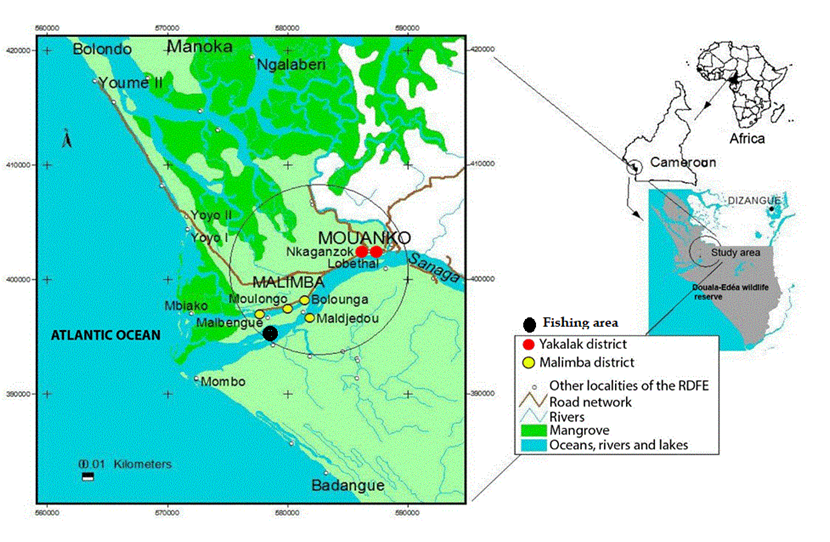
This study was conducted in the Mouanko Sub-division, Department of Sanaga Maritime, in the Littoral Region of Cameroon. The geographical coordinates of the study area are between 3°14’ & 3°50’ North latitude, and 9°34' & 10°03' East longitude. The sites located as enclaves or peripheral to Douala-Edea national park. The surveyed in Yakalak District were made up of the villages Lolbethal and Nkangansok; and those of Malimba District were Moulongo, Bolounga, Malbengue and Maldjebou, and the fishing area downstream of the Sanaga River near the village of Bôngo following the coordinates 03°34'02.2'' N, 009°42'20.8'' E (Figure 1). The area is with Sanaga estuary closer to the giant mangrove forests of Mbiako 15. River Sanaga is the longest of Cameroon river sweeping over 1/3 of country surface taking its rise from the Mandara Mountains of Bamenda Chain of Mountains. The study area has an equatorial-type climate with four seasons with Guinean variance: a long dry season (mid-November to mid-April), a short rainy season (mid-April to mid-June); a short dry season (mid-June to mid-August) and a long rainy season (mid-August to mid-November). The rainiest month is October with an average annual rainfall that varies between 3000-4000mm, and the least rainy is January. Moreover, yearly average temperature between 25 and 30°C 16.


Samples of G. schwabi clams were collected between February and May 2022 in the study area. Smoked clam samples were collected in Yakalak and Malimba District, the shell and fresh clams were collected in the fishing area. For smoking, the processors boil for 15 to 30 minutes fresh clams in cylindrical drums, then separated after cooling the flesh of the shell. The meat thus obtained is spread out on the racks for traditional heat smoking between 55 and 86°C for 12 to 72 hours with the “Banda” smoker. Woods from forests or mangroves are used for combustion 13. To represent each District, 15 units were randomly sampled from the smokers the products treated for less than a week.
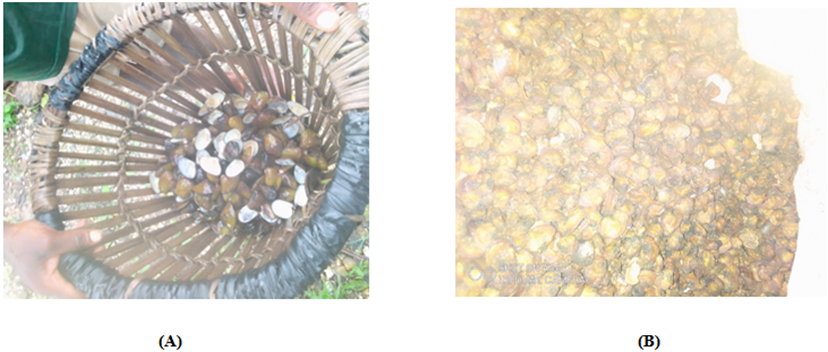
The fresh samples (Figure 2A) collected with shell were stored in a sterile cooler at a temperature near to 0°C, and the smoke (Figure 2B) were put into plastic bags that had been labeled according to each District from randomly selected processors before being transported to the laboratory for analysis. The choice of collection sites was based on the availability of the resource and the accessibility of the various smoking camps.
2.2. Proximate AnalysisThe water content of fresh and smoked Galatea schwabi clam meat was determined according to the method described by AOAC 17. Samples were dried in an air oven at 105°C for about 10 hours until constant weights were obtained, then cooled in a desiccator before reweighed. The water content was taken to be the differential between fresh and dry weights.
The ash content was determined by the procedure described by the AOAC 17. In fact, dried samples obtained in the process of water content determination were heated in the muffle furnace at 550°C for several hours. After incineration and cooling in a desiccator, the percentage of ash was calculated by subtracting the weight of ash from the initial weight.
The presence of the mineral content Ca, Na and Mg of the ash was determined by using air-acetylene flame atomic absorption spectrophotometer, Perkin-Elmer HGA 700 brand Model analyst according to the method described by the AOAC 17.
Crude protein content of smoked and fresh clam was analyzed by the Kjeldahl’s method 18. In fact, the samples went through the three digestion, distillation and titration using a conversion factor of 6.25 to convert total nitrogen to crude protein. The percentage of protein in the samples was calculated thereafter.
Lipids content was determined by weighing 10g of each sample wrapped in a filter paper in a Soxhlet apparatus using hexane. This was done each for 6 hours. After this, the extracted materials left after the solvent had evaporated were weighed, and the lipids content was calculated according to the procedure described by 17.
2.3. Heavy Metals AnalysisHeavy Metals Analysis were determined by weighing 1g of oven-dried samples and made into fine powder for digestion. The samples were digested with concentrated nitric and hydrochloric acid in the ratio 3:1, and the mixture was placed on a water bath until the color changes. The resulting solution was cooled, filtered into a 100ml standard flask and made to mark with distilled water 19. The heavy metals (mercury, cadmium and lead) were determined using flame furnace Atomic Absorption Spectrometry, Perkin Elmer HGA 700 brand. Each sample set has its own blank, while correction or adjustment was made through reference to blank. For mercury (Hg), the assay was carried out by measuring the absorbance with a UV visible spectrophotometer at 420nm of each of the standards on the calibration curve and of the samples. In the course of the experiment, glassware was washed with acid and distilled water twice. All reagents were of analytical grade. Certified reference material was checked to ensure of the analytical procedure.
2.4. Statistical AnalysisThe obtained data were entered into an Excel sheet, coded, and then exported to StatView v5.0 software for statistical analyses. Qualitative data were presented in tables and graphs. Pearson's Chi-square test of independence and Fisher's exact probability were used to make comparisons between variables (bivariate statistics). Data were tested for compliance with the Cochrane rule before statistical testing. Associations meeting the Cochrane rule were tested by Pearson's Chi-square test of independence and, where appropriate, Fisher's exact probability test. The threshold for statistical significance was set at p-value < 0.05.
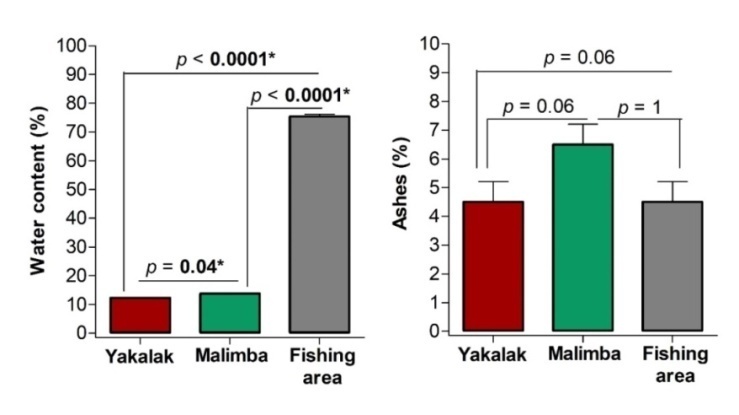
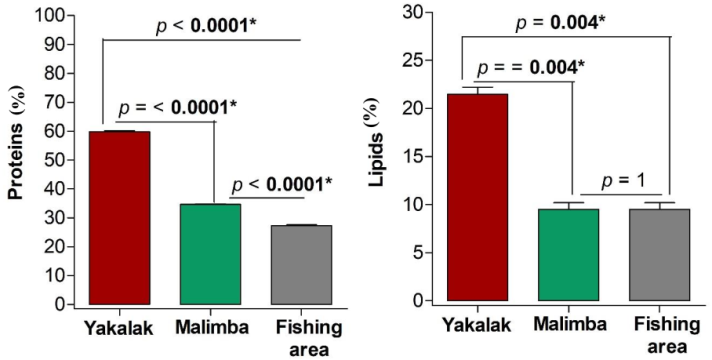
The percentage proximate composition of the fresh and smoked meat of the G. schwabi clam collected in the fishing area and the Malimba and Yakalak District revealed the content of water, ash, protein, lipids and minerals as presented in Figure 3, Figure 4 and Table 1.

The values obtained of water and ash content expressed as percentage of dry matter of fresh flesh of G. schwabi was 75.23% and 6.50% respectively. It was also observed that there was a statistically significant difference (p < 0.05) between the water content of smoked clams from the two Districts. The values obtained were 13.84 ± 0.80% in Yakalak District, and 15.68 ± 4.20% for Malimba District. As for ash content, no significant difference was observed with values obtained of 4.50 ± 0.71% and 6.50 ± 0.70% respectively.
Figure 4 presents the protein and lipid contents in fresh and smoked G. schwabi clam meat from the fishing and smoking area in each District. The protein content found on fresh clam meat was 27.31 ± 0.27%, and lipid 9.50 ± 0.71%. However, after smoking, protein and lipids increased significantly, and there was a significant difference (p < 0.05) between smoked clams from the two Districts. The smoked clams collected in Yakalak District had the highest protein (59.85 ± 0.24%) and lipid (9.50 ± 0.71%) contents. Those in Malimba District were 34.66 ± 0.13% and 9.50 ± 0.71% respectively. However, no significant difference (p > 0.05) was observed between the lipid content of the fresh clam and that smoked in Malimba District.

The analysis carried out the determination of the mineral content of clam meat from the different collection areas. The values obtained in Na, Mg and Ca expressed as a percentage of dry matter are presented in Table 1. The recorded Ca contents showed the highest values in fresh and smoked clam meat, and an increase in Mg content after smoking. In return, the Na content varied significantly between the areas studied. There was a significant difference (p < 0.05) between the different minerals sought and the sampling area. With respect to these minerals Na, Mg and Ca, the clams smoked in Yakalak District showed better results than those in Malimba District.
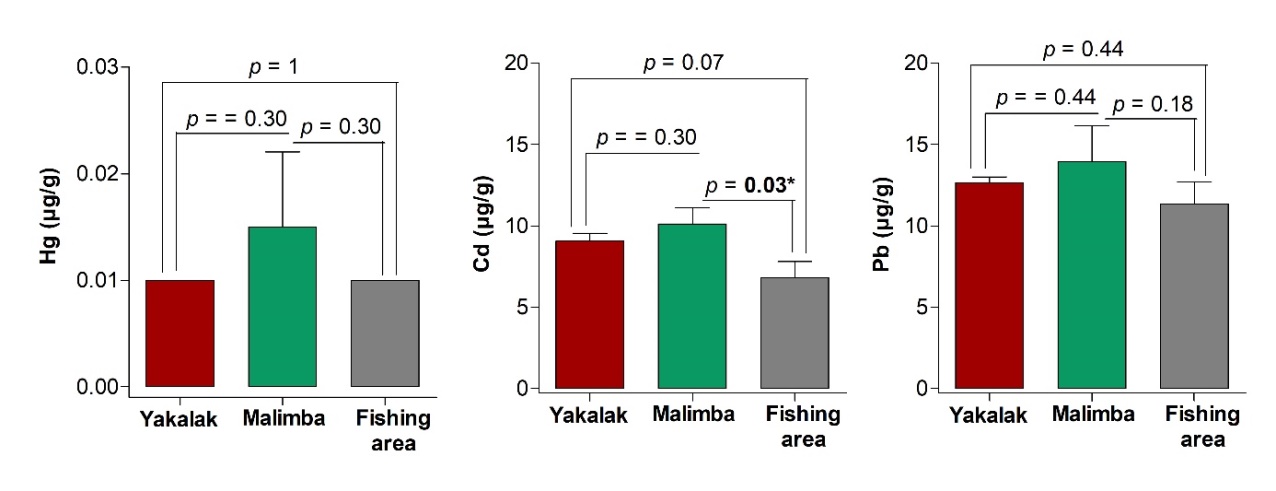
The concentration of heavy metals determined on smoked and fresh flesh of Galatea schwabi collected from the smoking and fishing areas are recorded in Figure 5.
The level of mercury (Hg) obtained for each sample (smoked and fresh) is lower than the value indicated by the usual WHO standard, which is 0.50 µg/g. No significant difference (p > 0.05) was observed between the different collection areas. Therefore, lead (Pb) and cadmium (Cd) levels increased after smoking from 11.35 µg/g to 12.65 µg/g in Yakalak District and 15.00 µg/g in Malimba. Cadmium levels increased from 6.80 µg/g to 9.05 µg/g in Yakalak District and 10.95 µg/g in Malimba District. These results obtained are higher than the same standard, which is 1.50 µg/g and 1.00 µg/g respectively on a fresh weight basis. For smoked products, no significant difference (p > 0.05) was obtained between the heavy metals Cd and Pb from the two Districts. However, there was a significant difference (p < 0.05) in Cd concentration between smoked meat from Malimba District and that from the fishing area.

The nutritional attributes of animal-source foods are evaluated on the basis of their nutrient composition (proteins, lipids, carbohydrates, vitamins, minerals) and their ability to cover humans nutritional needs 14. The proximate composition of the clam can increase or decrease due to the state in which it is found (processed or fresh) and also tells us about the ecosystemic situation of the environment. The results on the water, lipids and proteins content of smoked clam meat collected in Malimba and Yakalak District indicated significant differences, except for the ash and heavy metal content.
Water content is one of the main factors limiting the growth of microbial cells and regulating the level of food spoilage. It is a primary factor responsible for safeguarding the food matrix, stabilizing the food supply, budding of various types of shelf-stable products, stability of foods, and assessment of microbial species present in foods 20. Water content also influences other chemical compounds in the food. The results of water, lipid and protein content obtained on fresh G. schwabi flesh are comparable to those of other authors. An important caveat to bivalve production is the health benefit of low fat, protein meat, and mineral content 1. The concentrations of these different nutrients vary from species to species. Plana et al. 21 obtained 78% water, 25 to 27 mg/g lipid and 86 to 92% proteins on the flesh of young clams Ruditapes philipinarum. Ogidi et al. 5 obtained similar values on the flesh of Mercenaria mercenaria collected in the community of Ekowé in Nigeria. The different values were obtained by Bityutskaya et al. 3 in the fresh meat of Anadara kagoshimensis, Donax trunculus and Chamelea gallina clams collected from the Sea of Azov in Russia. This difference could be explained by the fact that some aquatic organisms such as bivalves show significant seasonal variations in chemical composition. They can also vary from one species and from one individual to another depending on age, diet, sex, area and sampling period. It has also been shown that water content may depend on the portion collected. The work of Chouba et al. 22 reported a mean value of 28% water content in the visceral mass of Venerupis decussata clams. The part of the sample taken would also be a significant factor influencing the water content of the product analyzed. The latter also showed that protein contents ranging from 48% to 58%, and total lipid contents ranging from 3 to 5% on clam meat vary according to the collection areas. This difference could be attributed on the one hand to the method used for the determination of proteins and the extraction of clam oils. On the other hand, the increase in protein and lipid content is observed in situations of dehydration of the product. The significant decrease in water content during the treatments would have led to an increase in the protein and lipid content of the product. These phenomena of dehydration who depends on the conditions of the smoking method, concentrate the dry mater and those of nutrients contents 23.
The significantly lower water content of smoked clams is caused by smoking techniques that would be applied in the same way in both Districts. Smoking is the preferred method of shore dwellers since it extends the shelf life of large quantities of harvested clams. According to Rifna et al. 20 the use of heat, natural drying, forced drying, freezing, crystallization and osmotic concentrations are the basic techniques applied to reduce the water content of food. Trisyani et al. 24 obtained lower water content in dried clam meat of Solen sp. in Indonesia. The results obtained are also comparable to similar studies conducted on smoked fish 25, 26, 27. But, the smoking time of fish products is not long enough to reduce moisture to the recommended level of 10% or less 28. The moisture contents obtained in the studied District are higher than this standard, and this would be explained on the one hand by the different treatments applied such as de-roasting and sun drying which are two treatments that favor the reduction of water following the coagulation of proteins before the actual smoking. According to Assogba et al. 29 water losses during cooking are often related to the denaturation of muscle proteins after the death of the animal. On the other hand, storage conditions could have an influence on the dehydration of the smoked product. In the case of this study, the smoked products are spread out on shelves in the kitchens that continue to dry the clams thanks to the heat produced by the wood fire. This measure is taken by the local residents to avoid the appearance of insects and mold on the smoked products during storage. The water content would therefore correlate with the ash content of the products. The ash content of G. schwabi is between 4.50 and 6.50%, which would indicate that the clam would contain many minerals regardless of its form (fresh or smoked). The loss of water in the food would obviously lead to an increase in ash content. Trisyani et al. 24 obtained 12.28% on fresh meat, and 3.99% on dried meat of Solen sp. These values are still high compared to those of Bityutskaya et al. 3 who obtained ash contents below 2.00%.
Minerals are inorganic nutrients, which generally require small amounts ranging from less than 1 to 2500 mg per day depending on the mineral 30. They are known to play an important role in maintaining various biochemical activities in the body. Analysis of Na, Mg and Ca minerals from G. schwabi from the lower Sanaga, showed that regardless of its form (fresh or smoked) or the area sampled, calcium has the highest values than the others. This could be explained by the fact that G. schwabi clam is a bivalve that lives buried on the sediment, and filters organic or inorganic particles from detritus suspended in the water to feed. Calcium plays an important role in human and animal nutrition, as it contributes to the normal development and maintenance of bones and teeth, the clothing of the blood, the nervous irritability of the blood, the normal action of the heart, muscle activity and the activation of enzymes 5. Furthermore, the roles of potassium, magnesium and calcium have been demonstrated in the prevention and treatment of hypertension 31. Our results are comparable to the work done on clam meat from the Sea of Azov 3 and those of Yelengwe Ndjamou et al 32 done on smoking and fresh clam meat from the lower Sanaga. Similar observations were obtained on the meat of the clam Venerupis decussata from different regions of the Tunisian coastline 22 and Mercenaria mercenaria from the Ekowe community in Nigeria 5. The low Na content of G. schwabi smoked in Malimba District awakens that it is an excellent food for people with heart conditions such as high blood pressure. During the pre-treatment process, there would be a significant leakage of soluble mineral salts into the cooking liquid during the detoxification. Although the smoking process is applied in the same way in both Districts, the boiling time during the de-broiling phase would be the element that marks the difference between the values obtained. The cooking processes carried out under certain temperature and pressure conditions can lead either to the production of substances harmful to humans or to the loss of certain important nutrients.
Three metallics contaminants, toxic to humans, notably lead (Pb), cadmium (Cd) and mercury (Hg), are considered from the point of view of their pathway in the environment, in particular their access to the consumer through food of marine origin 8. Although in low concentrations, they accumulate in the flesh of bivalves 33. The mercury value of clam reported here (less than 0.02µg/g) was lower than what reported by Fauziah et al. 34 who reported an average value of 0.35 µg/g for meat clam Batissa violacea from the Teunom river in Indonesia. In fact, mercury is introduced into the environment through cosmetic products as well as manufacturing processes like making of sodium hydroxide. It is toxic and has no known function in human biochemistry and physiology. Inorganic forms of mercury cause spontaneous abortion, congenital malformation, gingivitis, stomatitis, neurological disorders 7. The level of Pb and Cd obtained in the flesh of G. schwabi in the Yakalak District varied according to the sampling area and the type of product analyzed (fresh or smoked). The results observed are comparable to those on clams 4, 5, 6, 32, and on processed fish meat and crab 23, 35. However, the work done by Chouba et al. 22 in Tunisia does not corroborate with the results obtained in the present study. They reported low concentrations of Pb and Cd in the visceral mass of the clam Venerupis decussata depending on the sampling stations. Meteigner et Pierriere-Rumebe 36 obtained similar results when assessing the chemical quality of areas producing burrowing shellfish in the Arcachon basin. Assessment of the toxicity of these two heavy metals (Cd and Pb) in Asian clam Corbicula fluminea was done by Ai Yin Sow et al. 37. The high concentration of Pb and Cd in the clam G. schwabi from the lower Sanaga is not surprising and could be explained on the one hand by the mode of nutrition and the state of the living environment of the clam, and on the other hand by the method used for the treatment (smoking). Regarding its mode of nutrition and its living environment, many works have shown that clams feed by filtration accumulating different particles, pollutants and microorganisms and their mode of contamination in water 36, 38. In accordance with what has been observed, the clams of the Lower Sanaga are mollusks living buried in the sand. The surrounding environment would therefore be a factor that could promote the increase of heavy metals Cd and Pb in clam meat through water pollution due to anthropogenic activities. Water pollutants that are either physical or chemical have various origins among which: phytosanitary products, nitrates and phosphates (eutrophication), Polychlorinated Biphenyls (PCBs), by hydrocarbons (oil spill), by bacteria (fecal coliforms), by acid mine drainage, by heavy metals (cadmium, lead, etc.) 39. It should be noted that industrial development located upstream of the clam fishing area (metal company, hydroelectric dams), and the discharge of their effluents into the water, could lead to an increase in the level of these two heavy metals in fresh and smoked clam meat in Mouanko. According to Clemens and Feng 40, Cd, Pb, and Hg are all highly toxic to both plants and humans in their ionic forms. These elements can damage different cellular structures and a variety of tissues and organs. Low-dose exposure far below the thresholds for acute toxicity can cause disease because of long-term bioaccumulation in the human body.
In conclusion, analysis of the proximate composition of G. schwabi meat clam of the Lower Sanaga, indicated the presence of nutrients protein, lipid, mineral, and could serve as a source of nutrients for the maintenance of healthy body. The heavy metal content of fresh and smoked clam was analyzed to ensure that it was safe for consumption. The concentration of Pb and Cd is high compared to the limit proposed by the WHO standard. However, the heavy metals analyzed raise questions among local residents about the pollution of the ecological environment of the G. schwabi clam in the Lower Sanaga. The presence of Cd, Hg and Pb in the fresh and smoked tissues of clam implies that human activities that release these heavy metals into the environment should be put in check.
The data used to support the findings of this study are available from the corresponding author upon request.
The authors declare that there are no conflicts of interest relating to this article.
The authors express their sincere gratitude to the entire Cameroon Wildlife Conservation Society (CWCS) team for the facilities in the field. We would also like to the National Veterinary Laboratory of Douala, and the Faculty of Agronomy and Agricultural Sciences of Dschang, for the preparation of the samples and their analysis. Jaime Aníbal had the support of national funds through Fundação para a Ciência e Tecnologia (FCT), under the project LA/P/0069/2020 granted to the Associate Laboratory ARNET and UID/00350/2020 CIMA.
This research work, design and analysis were carried out by all the authors. The manuscript was put together by AOA. The final version was read and approved by all authors. All authors read and approved the final manuscript.
This study was funded by the authors.
| [1] | A. C. Smaal, Ferreira, G. Joao, J. Jon Grant, K. Petersen, and Øivind Strand, “Goods and Services of Marine Bivalves,” Springer Nature, Switzerland, 2019. | ||
| In article | View Article | ||
| [2] | FAO, “The state of world fisheries and aquaculture 2022. Towards blue transformation,” Rome, Italy, 2022. | ||
| In article | |||
| [3] | O. E. Bityutskaya, L. V. Donchenko, and K. I. Moshenec, “Analysis of technical and chemical characteristics as well as the nutritional value of clams from the Sea of Azov,” IOP Conf. Ser.: Earth Environ. Sci., vol. 640, no 3, pp. 1-6, 2021. | ||
| In article | View Article | ||
| [4] | E. I. Nnamonu, G. E. Odo, O. Ajuzie Ifeanyi, and C. D. Nwani, “Proximate composition and bioaccumulation of heavy metals in edible Achatina spp in some rural agro-settlements, south-east Nigeria,” The Journal of Basic and Applied Zoology, pp. 1-8, 2021. | ||
| In article | View Article | ||
| [5] | O. I. Ogidi, E. C. Eruom, A. M. Onimisi, and R. Amugeh, “Assessment of Nutritional Properties and Heavy Metal Composition of African Giant Land Snails (Archachatina marginata) and Clams (Mercenaria mercenaria) from Ekowe Community,” European Journal of Nutrition & Food Safety, vol. 12, no. 6, pp. 99-108, 2020. | ||
| In article | View Article | ||
| [6] | D. Adjei-Boateng, K. A. Obirikorang, and S. Amisah, “Bioaccumulation of Heavy Metals in the Tissue of the Clam Galatea paradoxa and Sediments from the Volta Estuary, Ghana,” Int. J. Environ. Res., vol. 4, no. 3, pp. 533-540, 2010. | ||
| In article | |||
| [7] | J. O. Duruibe, M. O. C Ogwuegbu, and J. N. Egwurugwu, “Heavy metal pollution and human biotoxic effects,” International Journal of Physical Sciences, vol. 2, no. 5, pp. 112-118, 2007. | ||
| In article | |||
| [8] | Y. Thibaud, “Le plomb, le cadmium et le mercure dans les produits de la mer,” Ifremer - Centre de Nantes, pp. 1-25, 1987. | ||
| In article | |||
| [9] | WHO, “Health risks of heavy metals from long-range transboundary air pollution,” World Health Organisation, Regionale Office for Europe, 2007. | ||
| In article | |||
| [10] | M. Tomedi Tabi, “Bassin versant du Nkam-Wouri : Prototype de la biodiversité des zones humides du Cameroun,” L’harmattan, 2017. | ||
| In article | |||
| [11] | G. Essome Bang, G. N. Ajonina, A. R. Bitja Nyom, F. Besack, C. M. Manga Essome, B. L. F. Fouegap, and M. Tomedi-Tabi Eyango, “Study of the composition and determinism of the microalgal content in the stomach of clams (Bivalvia: veneridae) of the Nkam-Wouri river basin in Cameroon,” International Journal of Fauna and Biological Studies, vol. 7, no. 3, pp. 105-113, 2020. | ||
| In article | |||
| [12] | A. V. Kondakov, E. S. Konopleva, A. J. Adesanya, Y. V. Bespalaya, J. J. Braun, M. Y. Gofarov, A. A. Lyubas, A. A. Tomilova, I. V. Vikhrev, O. S. Pokrovsky, and I. N. Bolotov, “The global freshwater bivalve checklist’s extension: Fresh water occurrences and phylogenetic position of Galatea clams from West Africa (Venerida: Donacidae),” Ecologica Montenegrina, vol. 35, pp. 144-158, 2020. | ||
| In article | View Article | ||
| [13] | P. Ajonina, G. N. Ajonina, E. Jin, F. Mekongo, I. Ayissi, and L. Usongo, “Gender roles and economics of exploitation, processing and marketing of bivalves and impacts on forest resources in the Sanaga Delta Region of Douala Edea Wildlife Reserve. Cameroon,” International Journal of Sustainaible Development World Ecology, vol. 12, pp. 161-172, 2005. | ||
| In article | View Article | ||
| [14] | S. Prache, C. Adamiec, T. Astruc, E. Baéza, P. É. Bouillot, A. Clinquart, C. Feidt, E. Fourat, J. Gautron, A. Girard, L. Guillier, E. Kesse-Guyot, B. Lebret, F. Lefèvre, S. Le Perchec, B. Martin, P. S. Mirade, F. Pierre, M. Raulet, D. Rémond, P. Sans, I. Souchon, C. Donnars, V. Santé-Lhoutellier, “La qualité des aliments d’origine animale : enseignements d’une expertise scientifique collective,” INRAE Prod. Anim., vol. 36, no. 1, p. 1-17, 2023. | ||
| In article | View Article | ||
| [15] | G. N. Ajonina, “Cameroon Mangroves: Current Status, Uses, Cgallenges, and Management Perspectives. In: Das, S. C., Pullaiah, Ashton, E. C. (eds) Mangroves,” Biodiversity, Livehoods and Conservation. Springer, Singapore, 2022. | ||
| In article | View Article | ||
| [16] | A. Dikoume, G. Ajonina, M. Tomedi, “Diversity of phytoplankton for nutritional selectivity by Galatea paradoxa (Born 1780) of lower Sanaga delta, Cameroon,” International Journal of Fisheries and Aquatic Research, vol. 2, no. 6, pp. 34-.42, 2017. | ||
| In article | |||
| [17] | AOAC, Official methods of analysis, 15th edition, Washington DC, USA, 1990. | ||
| In article | |||
| [18] | AOAC, “Official Methods of Analysis of the Association of the Official Analytical Chemists,” 17th edition, AOAC International, Washington, DC, USA, 2000. | ||
| In article | |||
| [19] | .J. M., E. Pauwels, Van Ranst, M. Verloo, et A. Mvondo-Ze, “Manuel de laboratoire de pédologie: Méthodes d’analyses des sols et de plantes, équipements, gestion des stocks de verrerie et de produits chimiques,” Publications Agricoles, Bruxelles, vol. 28, 1992. | ||
| In article | |||
| [20] | E. J. Rifna, M. Dwivedi, and O. P. Chauhan, “Role of Water Activity in Food Preservation,” Food Chemistry. Springer, Singapore, pp. 39-64, 2022. | ||
| In article | View Article | ||
| [21] | S. Plana, G. Sinquin, P. Maes, C. Paillard, and M. Le Pennec, “Variations in biochemical composition of juvenile Ruditapes philippinarum infected by a Vibrio sp.,” Dis aquat Org, vol. 24, pp. 205-213, 1996. | ||
| In article | View Article | ||
| [22] | L. Chouba, K. H. Telahigue, I. Rabeh, C. H. Tissaoui, and T. Hajji, “Evaluation de la qualité biochimique et chimique de la masse viscérale de la palourde Venerupis decussata provenant de différentes régions du littoral tunisien’’ Bull. Inst. Natn. Scien. Tech. Mer de Salammbô, Vol. 47, pp. 87-96, 2020. http://hdl.handle.net/1834/41599. | ||
| In article | |||
| [23] | C. A. Kumolu-Johnson, N. F. Aladetohun, and P. E. Ndimele, “The effects of smoking on the nutritional qualities and shelf-life of Clarias gariepinus (Burchell, 1822),” African Journal of Biotechnology, vol. 9, no. 1, pp. 073-076, 2010. http://www.academicjournals.org/AJB. | ||
| In article | |||
| [24] | N. Trisyani, and L. Y. Yusan, “Proximate analysis and amino acid profile in fresh meat, meat meal, and shell meal of bamboo clam Solen sp. from Kwanyar Coast, Bangkalan-Madura, Indonesia,” AACL Bioflux, vol. 13, no. 5, pp. 2921- 2927, 2020. | ||
| In article | |||
| [25] | U. Y. Monney, V. Diaby, Y. A. Ake, I. Sanogo, A. F. Yapo, and J. A. Djama, “Evaluation de la teneur en cadmium, plomb et mercure avant et après fumage chez trois espèces de poisson à forte consommation dans la zone d’Abidjan, côte d’ivoire, ” Rev. Ivoir. Sci. Technol., vol. 36, pp. 253-266, 2020. | ||
| In article | |||
| [26] | Fronthea Swastawati, Putut Har Riyadi, Retno Ayu Kurniasih, Aninditya Artina Setiaputri, and Defita Faridlotus Sholihah, “The Chemical Composition, Microbiology and Micronutrients Changes of Fresh Barracuda Fish and Smoked Barracuda Fish using Different Smoking Methods,” Proceeding on The International Halal Science and Technology Conference. vol. 1, no. 1, pp. 68-78, 2021. | ||
| In article | View Article | ||
| [27] | M. Sayuti, I. B. Hismayasari, A. S. Abadi, and Ernawati Saidin, “Chemical composition and hedonic test of asar fish (smoked Katsuwonus pelamis) from Sorong, West Papua, Indonesia,” AACL Bioflux, vol. 14, no. 5, pp. 2751-2760, 2021. | ||
| In article | |||
| [28] | M. K. Kabahenda, P. Omony, and S. M. C. Hüsken, “Manutention après capture des produits halieutiques de faible valeur et menaces pour la qualité nutritionnelle: une étude des pratiques dans la région du Lac Victoria. Programme régional pour les pêches et le VIH/SIDA en Afrique: investir dans des solutions durables,” Rapport de projet du WorldFish Center, 2009. | ||
| In article | |||
| [29] | H. M. Assogba Mahussi, S. Ahounou, G. Bonou Assouan, F. A. Salifou, M. Dahouda, A. Chikou, S. Farougou, I. Youssao Abdou Karim, “Qualité de la chair des poissons : Facteurs de Variations et Impacts des Procédés de Transformation et de Conservation,” International journal of progressive Sciences and Technologies, pp. 2509-0119, 2018. http://ijpsat.ijsht-journal.org. | ||
| In article | |||
| [30] | K. O. Soetan, C. O. Olaiya, and O. E. Oyewole, “The importance of mineral elements for humans, domestic animals and plants,” African Journal of Food Science, vol. 4, no. 5 pp. 200-222, 2010. | ||
| In article | |||
| [31] | C. Houston Mark, and J. Harper Karen, “Potassium, Magnesium, and Calcium: Their Role in Both the Cause and Treatment of Hypertension,” 2008. | ||
| In article | View Article | ||
| [32] | T. C. Yelengwe Ndjamou, S. R. Tchabong, J. Djopnang Djiembie, Y. Etchutakang Nchong, G. Essome Bang, N. Ajonina Gordon, M. Epoh Ndi and F. Tchoumbougnang, “Determination of the minerals of Galatea schwabi Clench, 1929 clam from the lower Sanaga Cameroon,” International Journal of Fisheries and Aquatic Studies, vol. 11, no 3, pp. 88-93, 2023. | ||
| In article | View Article | ||
| [33] | F. A. Colakoglu, H. B. Ormanci, İ. E. Kunili, and S. Colakoglu, “Chemical and Microbiological Quality of the Chamelea gallina from the Southern Coast of the Marmara Sea in Turkey,” Kafkas Univ Vet Fak Derg. Vol. 16, pp. 153-158, 2010. | ||
| In article | |||
| [34] | F. Fauziah, A. Abdullah, S. Supriatno, F. Firdus, M. Nasir, S. Mellisa, and A. S. Batubara, “Heavy metal contamination of Hg and Pb in water, sediment and Violet Batissa (Batissa violacea Lamark, 1818) meat in Teunom River, Aceh Jaya Regency, Indonesia,” Depik Jurnal Ilmu-Ilmu Perairan, Pesisir dan Perikanan, vol. 10, no. 3, pp. 238-242, 2021. | ||
| In article | View Article | ||
| [35] | I. Opeyemi Ayanda , G. Adewumi Dedeke, Ukinebo Imuentiyan Ekhator, and M. Kufreabasi Etiebet, “Proximate Composition and Heavy Metal Analysis of Three Aquatic Foods in Makoko River, Lagos, Nigeria,” Journal of Food Quality, 2018. | ||
| In article | View Article | ||
| [36] | C. Meteigner, et M. Pirriere-Rumebe, “Evaluation de la qualité des zones de production conchylicole. Département de la Gironde. Période 2020-2022, ” Ifremer, vol. 23, no. 003, 2022. | ||
| In article | |||
| [37] | Ai Yin Sow, Koh Han Dee, Seong Wei Lee, and A. L. Aweng Eh Rak, “An Assessment of Heavy Metals Toxicity in Asian Clam, Corbicula fluminea, from Mekong River, Pa Sak River, and Lopburi River, Thailand,” The Scientific World Journal., 2019. | ||
| In article | View Article | ||
| [38] | A. Mallet, E. Mayrand, M. Ouellette, and V. Mallet, “Contamination bactérienne chez des bivalves cultivés dans le Havre de Shippagan (Shippagan, Nouveau-Brunswick),” Rapp. Tech. Can. Sci. Halieut. Aquat. Vol. 7, pp. 1- 27, 2009. | ||
| In article | |||
| [39] | S. Madhav, A. Ahamad, A. K. Singh, J. Kushawaha, J. S. Chauhan, S. Sharma, P. Singh, “Water pollutants: Sources and Impact on the Environment and Human Health,”, Springer Nature, Singapore, pp. 43-62, 2020. | ||
| In article | View Article | ||
| [40] | S. Clemens, and M. J. Feng, “Toxic heavy metal and metalloid accumulation in crop plants and foods,” Annu. Rev. Plant Biol., vol. 67, pp. 489–512, 2016. | ||
| In article | View Article | ||
Published with license by Science and Education Publishing, Copyright © 2023 Théophile Collins Yelengwe Ndjamou, Gabel Essome Bang, Jaime Anibal, Loick Pradel Kojom Foko, Gordon Nwutih Ajonina, Minette Tomedi Eyango and François Tchoumbougnang
 This work is licensed under a Creative Commons Attribution 4.0 International License. To view a copy of this license, visit
http://creativecommons.org/licenses/by/4.0/
This work is licensed under a Creative Commons Attribution 4.0 International License. To view a copy of this license, visit
http://creativecommons.org/licenses/by/4.0/
| [1] | A. C. Smaal, Ferreira, G. Joao, J. Jon Grant, K. Petersen, and Øivind Strand, “Goods and Services of Marine Bivalves,” Springer Nature, Switzerland, 2019. | ||
| In article | View Article | ||
| [2] | FAO, “The state of world fisheries and aquaculture 2022. Towards blue transformation,” Rome, Italy, 2022. | ||
| In article | |||
| [3] | O. E. Bityutskaya, L. V. Donchenko, and K. I. Moshenec, “Analysis of technical and chemical characteristics as well as the nutritional value of clams from the Sea of Azov,” IOP Conf. Ser.: Earth Environ. Sci., vol. 640, no 3, pp. 1-6, 2021. | ||
| In article | View Article | ||
| [4] | E. I. Nnamonu, G. E. Odo, O. Ajuzie Ifeanyi, and C. D. Nwani, “Proximate composition and bioaccumulation of heavy metals in edible Achatina spp in some rural agro-settlements, south-east Nigeria,” The Journal of Basic and Applied Zoology, pp. 1-8, 2021. | ||
| In article | View Article | ||
| [5] | O. I. Ogidi, E. C. Eruom, A. M. Onimisi, and R. Amugeh, “Assessment of Nutritional Properties and Heavy Metal Composition of African Giant Land Snails (Archachatina marginata) and Clams (Mercenaria mercenaria) from Ekowe Community,” European Journal of Nutrition & Food Safety, vol. 12, no. 6, pp. 99-108, 2020. | ||
| In article | View Article | ||
| [6] | D. Adjei-Boateng, K. A. Obirikorang, and S. Amisah, “Bioaccumulation of Heavy Metals in the Tissue of the Clam Galatea paradoxa and Sediments from the Volta Estuary, Ghana,” Int. J. Environ. Res., vol. 4, no. 3, pp. 533-540, 2010. | ||
| In article | |||
| [7] | J. O. Duruibe, M. O. C Ogwuegbu, and J. N. Egwurugwu, “Heavy metal pollution and human biotoxic effects,” International Journal of Physical Sciences, vol. 2, no. 5, pp. 112-118, 2007. | ||
| In article | |||
| [8] | Y. Thibaud, “Le plomb, le cadmium et le mercure dans les produits de la mer,” Ifremer - Centre de Nantes, pp. 1-25, 1987. | ||
| In article | |||
| [9] | WHO, “Health risks of heavy metals from long-range transboundary air pollution,” World Health Organisation, Regionale Office for Europe, 2007. | ||
| In article | |||
| [10] | M. Tomedi Tabi, “Bassin versant du Nkam-Wouri : Prototype de la biodiversité des zones humides du Cameroun,” L’harmattan, 2017. | ||
| In article | |||
| [11] | G. Essome Bang, G. N. Ajonina, A. R. Bitja Nyom, F. Besack, C. M. Manga Essome, B. L. F. Fouegap, and M. Tomedi-Tabi Eyango, “Study of the composition and determinism of the microalgal content in the stomach of clams (Bivalvia: veneridae) of the Nkam-Wouri river basin in Cameroon,” International Journal of Fauna and Biological Studies, vol. 7, no. 3, pp. 105-113, 2020. | ||
| In article | |||
| [12] | A. V. Kondakov, E. S. Konopleva, A. J. Adesanya, Y. V. Bespalaya, J. J. Braun, M. Y. Gofarov, A. A. Lyubas, A. A. Tomilova, I. V. Vikhrev, O. S. Pokrovsky, and I. N. Bolotov, “The global freshwater bivalve checklist’s extension: Fresh water occurrences and phylogenetic position of Galatea clams from West Africa (Venerida: Donacidae),” Ecologica Montenegrina, vol. 35, pp. 144-158, 2020. | ||
| In article | View Article | ||
| [13] | P. Ajonina, G. N. Ajonina, E. Jin, F. Mekongo, I. Ayissi, and L. Usongo, “Gender roles and economics of exploitation, processing and marketing of bivalves and impacts on forest resources in the Sanaga Delta Region of Douala Edea Wildlife Reserve. Cameroon,” International Journal of Sustainaible Development World Ecology, vol. 12, pp. 161-172, 2005. | ||
| In article | View Article | ||
| [14] | S. Prache, C. Adamiec, T. Astruc, E. Baéza, P. É. Bouillot, A. Clinquart, C. Feidt, E. Fourat, J. Gautron, A. Girard, L. Guillier, E. Kesse-Guyot, B. Lebret, F. Lefèvre, S. Le Perchec, B. Martin, P. S. Mirade, F. Pierre, M. Raulet, D. Rémond, P. Sans, I. Souchon, C. Donnars, V. Santé-Lhoutellier, “La qualité des aliments d’origine animale : enseignements d’une expertise scientifique collective,” INRAE Prod. Anim., vol. 36, no. 1, p. 1-17, 2023. | ||
| In article | View Article | ||
| [15] | G. N. Ajonina, “Cameroon Mangroves: Current Status, Uses, Cgallenges, and Management Perspectives. In: Das, S. C., Pullaiah, Ashton, E. C. (eds) Mangroves,” Biodiversity, Livehoods and Conservation. Springer, Singapore, 2022. | ||
| In article | View Article | ||
| [16] | A. Dikoume, G. Ajonina, M. Tomedi, “Diversity of phytoplankton for nutritional selectivity by Galatea paradoxa (Born 1780) of lower Sanaga delta, Cameroon,” International Journal of Fisheries and Aquatic Research, vol. 2, no. 6, pp. 34-.42, 2017. | ||
| In article | |||
| [17] | AOAC, Official methods of analysis, 15th edition, Washington DC, USA, 1990. | ||
| In article | |||
| [18] | AOAC, “Official Methods of Analysis of the Association of the Official Analytical Chemists,” 17th edition, AOAC International, Washington, DC, USA, 2000. | ||
| In article | |||
| [19] | .J. M., E. Pauwels, Van Ranst, M. Verloo, et A. Mvondo-Ze, “Manuel de laboratoire de pédologie: Méthodes d’analyses des sols et de plantes, équipements, gestion des stocks de verrerie et de produits chimiques,” Publications Agricoles, Bruxelles, vol. 28, 1992. | ||
| In article | |||
| [20] | E. J. Rifna, M. Dwivedi, and O. P. Chauhan, “Role of Water Activity in Food Preservation,” Food Chemistry. Springer, Singapore, pp. 39-64, 2022. | ||
| In article | View Article | ||
| [21] | S. Plana, G. Sinquin, P. Maes, C. Paillard, and M. Le Pennec, “Variations in biochemical composition of juvenile Ruditapes philippinarum infected by a Vibrio sp.,” Dis aquat Org, vol. 24, pp. 205-213, 1996. | ||
| In article | View Article | ||
| [22] | L. Chouba, K. H. Telahigue, I. Rabeh, C. H. Tissaoui, and T. Hajji, “Evaluation de la qualité biochimique et chimique de la masse viscérale de la palourde Venerupis decussata provenant de différentes régions du littoral tunisien’’ Bull. Inst. Natn. Scien. Tech. Mer de Salammbô, Vol. 47, pp. 87-96, 2020. http://hdl.handle.net/1834/41599. | ||
| In article | |||
| [23] | C. A. Kumolu-Johnson, N. F. Aladetohun, and P. E. Ndimele, “The effects of smoking on the nutritional qualities and shelf-life of Clarias gariepinus (Burchell, 1822),” African Journal of Biotechnology, vol. 9, no. 1, pp. 073-076, 2010. http://www.academicjournals.org/AJB. | ||
| In article | |||
| [24] | N. Trisyani, and L. Y. Yusan, “Proximate analysis and amino acid profile in fresh meat, meat meal, and shell meal of bamboo clam Solen sp. from Kwanyar Coast, Bangkalan-Madura, Indonesia,” AACL Bioflux, vol. 13, no. 5, pp. 2921- 2927, 2020. | ||
| In article | |||
| [25] | U. Y. Monney, V. Diaby, Y. A. Ake, I. Sanogo, A. F. Yapo, and J. A. Djama, “Evaluation de la teneur en cadmium, plomb et mercure avant et après fumage chez trois espèces de poisson à forte consommation dans la zone d’Abidjan, côte d’ivoire, ” Rev. Ivoir. Sci. Technol., vol. 36, pp. 253-266, 2020. | ||
| In article | |||
| [26] | Fronthea Swastawati, Putut Har Riyadi, Retno Ayu Kurniasih, Aninditya Artina Setiaputri, and Defita Faridlotus Sholihah, “The Chemical Composition, Microbiology and Micronutrients Changes of Fresh Barracuda Fish and Smoked Barracuda Fish using Different Smoking Methods,” Proceeding on The International Halal Science and Technology Conference. vol. 1, no. 1, pp. 68-78, 2021. | ||
| In article | View Article | ||
| [27] | M. Sayuti, I. B. Hismayasari, A. S. Abadi, and Ernawati Saidin, “Chemical composition and hedonic test of asar fish (smoked Katsuwonus pelamis) from Sorong, West Papua, Indonesia,” AACL Bioflux, vol. 14, no. 5, pp. 2751-2760, 2021. | ||
| In article | |||
| [28] | M. K. Kabahenda, P. Omony, and S. M. C. Hüsken, “Manutention après capture des produits halieutiques de faible valeur et menaces pour la qualité nutritionnelle: une étude des pratiques dans la région du Lac Victoria. Programme régional pour les pêches et le VIH/SIDA en Afrique: investir dans des solutions durables,” Rapport de projet du WorldFish Center, 2009. | ||
| In article | |||
| [29] | H. M. Assogba Mahussi, S. Ahounou, G. Bonou Assouan, F. A. Salifou, M. Dahouda, A. Chikou, S. Farougou, I. Youssao Abdou Karim, “Qualité de la chair des poissons : Facteurs de Variations et Impacts des Procédés de Transformation et de Conservation,” International journal of progressive Sciences and Technologies, pp. 2509-0119, 2018. http://ijpsat.ijsht-journal.org. | ||
| In article | |||
| [30] | K. O. Soetan, C. O. Olaiya, and O. E. Oyewole, “The importance of mineral elements for humans, domestic animals and plants,” African Journal of Food Science, vol. 4, no. 5 pp. 200-222, 2010. | ||
| In article | |||
| [31] | C. Houston Mark, and J. Harper Karen, “Potassium, Magnesium, and Calcium: Their Role in Both the Cause and Treatment of Hypertension,” 2008. | ||
| In article | View Article | ||
| [32] | T. C. Yelengwe Ndjamou, S. R. Tchabong, J. Djopnang Djiembie, Y. Etchutakang Nchong, G. Essome Bang, N. Ajonina Gordon, M. Epoh Ndi and F. Tchoumbougnang, “Determination of the minerals of Galatea schwabi Clench, 1929 clam from the lower Sanaga Cameroon,” International Journal of Fisheries and Aquatic Studies, vol. 11, no 3, pp. 88-93, 2023. | ||
| In article | View Article | ||
| [33] | F. A. Colakoglu, H. B. Ormanci, İ. E. Kunili, and S. Colakoglu, “Chemical and Microbiological Quality of the Chamelea gallina from the Southern Coast of the Marmara Sea in Turkey,” Kafkas Univ Vet Fak Derg. Vol. 16, pp. 153-158, 2010. | ||
| In article | |||
| [34] | F. Fauziah, A. Abdullah, S. Supriatno, F. Firdus, M. Nasir, S. Mellisa, and A. S. Batubara, “Heavy metal contamination of Hg and Pb in water, sediment and Violet Batissa (Batissa violacea Lamark, 1818) meat in Teunom River, Aceh Jaya Regency, Indonesia,” Depik Jurnal Ilmu-Ilmu Perairan, Pesisir dan Perikanan, vol. 10, no. 3, pp. 238-242, 2021. | ||
| In article | View Article | ||
| [35] | I. Opeyemi Ayanda , G. Adewumi Dedeke, Ukinebo Imuentiyan Ekhator, and M. Kufreabasi Etiebet, “Proximate Composition and Heavy Metal Analysis of Three Aquatic Foods in Makoko River, Lagos, Nigeria,” Journal of Food Quality, 2018. | ||
| In article | View Article | ||
| [36] | C. Meteigner, et M. Pirriere-Rumebe, “Evaluation de la qualité des zones de production conchylicole. Département de la Gironde. Période 2020-2022, ” Ifremer, vol. 23, no. 003, 2022. | ||
| In article | |||
| [37] | Ai Yin Sow, Koh Han Dee, Seong Wei Lee, and A. L. Aweng Eh Rak, “An Assessment of Heavy Metals Toxicity in Asian Clam, Corbicula fluminea, from Mekong River, Pa Sak River, and Lopburi River, Thailand,” The Scientific World Journal., 2019. | ||
| In article | View Article | ||
| [38] | A. Mallet, E. Mayrand, M. Ouellette, and V. Mallet, “Contamination bactérienne chez des bivalves cultivés dans le Havre de Shippagan (Shippagan, Nouveau-Brunswick),” Rapp. Tech. Can. Sci. Halieut. Aquat. Vol. 7, pp. 1- 27, 2009. | ||
| In article | |||
| [39] | S. Madhav, A. Ahamad, A. K. Singh, J. Kushawaha, J. S. Chauhan, S. Sharma, P. Singh, “Water pollutants: Sources and Impact on the Environment and Human Health,”, Springer Nature, Singapore, pp. 43-62, 2020. | ||
| In article | View Article | ||
| [40] | S. Clemens, and M. J. Feng, “Toxic heavy metal and metalloid accumulation in crop plants and foods,” Annu. Rev. Plant Biol., vol. 67, pp. 489–512, 2016. | ||
| In article | View Article | ||