A conjunction of different constraints (natural, anthropogenic, socioeconomic, demographic, etc.), most of which are interrelated, shapes the challenges of food availability and accessibility in the Sahel. This paper aims to explore ways of coping with these constraints and meeting the challenges. The article refers to the present configuration of both short-term and structural responses to Sahelian food insecurity. In short-term emergency action, if significant advances have been made, some recurrent shortfalls reduce its effectiveness. Regarding structural development challenges, the overall picture is a mixed one, with efforts underway on different lines but a mitigated balance of progress for now. Despite an overall trend of agricultural production growth, food deficits have continued to occur in some recent bad weather years. In parallel, chronic food insecurity, associated with poverty, is deep-rooted even after favourable harvests. A multifaceted strategy (inclusive agriculture development, social protection, demography) becomes indispensable. Such a strategy should involve more linkages and synergies between food emergency responses, resilience support to the most vulnerable and development actions.
After considering the various factors driving food insecurity in five Sahelian countries (Mauritania, Mali, Burkina Faso, Niger, and Chad){1}, this article will explore some directions to reverse this adverse situation. It will first examine the progress and shortcomings of current responses to such insecurity, both in the face of short-term emergencies and at a more structural level. Against this background, the objective of this article is to discuss the initiatives and policies advocated by different actors in order to make these responses more effective.
To serve the above purpose, the paper draws on the literature from academics and from actors working to promote food security and development in the Sahel. The author's observations from his professional stay in one of the countries examined are also used. Relevant data from different international or regional sources, notably FAOSTAT (Food and Agriculture Organisation Statistics Division) and RPCA (Réseau de prévention des crises alimentaires), are also an important input of the present paper.
The complexity of sustainably reversing the current food situation in the Sahel must be acknowledged; the process could only be gradual. In the countries considered, disadvantaged natural and agricultural conditions, exacerbated by climate change, are interacting with social and economic constraints (high poverty, rapid population growth). More recently, violent conflicts have created serious threats to food security in some Sahelian territories. The interaction between these different constraints has tended to generate a feeling of the inevitability of food crises in the Sahel. Despite decades of attempts to eradicate hunger, recurrent food insecurity remains a crucial human problem in that region.
The repetition of emergency efforts to address food crises in developing regions has induced increased reflections on approaches and methods to better deal with such crises (for the Sahel, see 1). While saving lives, those urgent efforts have been considered not well adapted to chronically insecure people who need differential support to recover their livelihoods. The link between relief and development, initially raised regarding conflict-related emergencies 2, has been extended to food crises by the incorporation of resilience approaches 3. Conceptual and operational ways to enhance the resilience of vulnerable Sahelian people have been largely developed by researchers 4, international agencies 5 and NGOs 6. Nevertheless, the often-proclaimed resilience support strategies, combining relief with the productive redress of vulnerable households, have translated relatively little into practice.
The compound nature of food insecurity means that its alleviation must go beyond simply increasing agricultural production. A wider and more coherent policy framework, also including environmental, socioeconomic, and demographic goals, is needed 7. Issues such as rural poverty and vulnerability constraints, food accessibility and market prices, climate change or population dynamics must be integrated into that framework 8. However, this integrated strategic approach does not contest the key potential contribution of agricultural development to food security. Options for that development in the Sahel have been widely studied from the past century (see, for instance 9 to more recent years 10.
Shortly after the A. Sen’s entitlement thesis, the nexus between food insecurity and poverty was assumed by development institutions such as the World Bank 11 or the FAO 12. Several authors have developed the analysis of such a nexus, specifically in the sub-Saharan context 13. The "poverty trap" premise 14, which is quite illustrative of the Sahelian people's chronic vulnerability, has been widely discussed 15. The key place of anti-poverty social protection (safety nets) to increase food security has been substantiated for developing regions in general 16, for sub-Saharan Africa 17 and for the Sahel 18.
Climatic changes during recent past periods have been observed in the Sahel 19 and their hypothetical nexus with conflicts has been pondered 20. Some studies have been devoted to the predictable influence of future climatic changes on the evolution of Sahelian crop yields 21, as well as on potential counteracting and adaptation initiatives 22. Concerning demographic issues, the impact of upwards population trends on livelihood vulnerability and food insecurity has been exposed 23. The combined adverse effect of population growth and climate change on future food security in the Sahel has also been the subject of research 24.
There is a broad consensus on the identification and conjunction of food system drivers 7. In the case of Sahel, current and future food security is determined by a combination of interrelated factors. Some of them are biophysical constraints (weather, land aridity, water scarcity…) or relate to gradual environmental change{2}. Other factors are of a more endogenic and societal nature: demographic trends, socioeconomic drivers (rural poverty, food prices, etc.), and institutional and political settings. The latter can include formal or customary rules on access to natural resources, public policies and capacities, the propensity to conflict or the quality of governance. The junction of adverse trends in some of those multiple drivers aggravates the risks for the Sahelian populations.
Rural land use is restricted by Sahelian natural conditions. Only 25-35% of the territory of the five countries examined has pastoral or cultivation use, although this often happens on the land of deficient quality. Livestock activities have traditionally been concentrated in the aridest areas, with north-south transhumant movements in search of seasonal pastures. Crop production (cereals in particular) and fodder availability are subject to high natural risks (poor/irregular rain, locust pests, etc.). When these risks materialise, they can seriously affect the livelihoods of rural communities, reduce the national food supply, and increase prices. It is above all the poorest families, with precarious access to land{3}, who bear the brunt of poor harvests, as their capability to produce or buy cereals is exiguous.
Many vulnerable families have seen their meagre productive resources disappear after recurrent crises, thus becoming market dependent. When prices rise, notably during the lean season, their very low purchasing power makes them unable to acquire cereals. These are situations of structural or chronic food insecurity{4}, closely associated with poverty, in which families are persistently at risk.
A large part of local cereal production (millet, sorghum, maize, fonio) is reliant on the annual rainfall regime. Despite some irrigation development (see 4.1.1), rain-fed agriculture remains the predominant provider of food and the origin of potential cyclical food deficits. Some of these deficits, together with fodder shortages, have occurred during the current century (cropping/marketing seasons 2004/05, 2009/10, 2011/12, 2021/22), with major negative consequences for the food and nutrition status of a significant part of the population. During these crises, the prevalence of acute (global) child malnutrition at the national level has approached or exceeded emergency levels (15% according to the World Health Organisation/WHO) in countries such as Niger, Mauritania, and Chad.
International trade can partially offset those cyclical deficits, but only on relatively expensive cereals such as rice or wheat, which are mostly consumed in urban centres{5}. Formal or informal cross-border trade is of some importance in normal times, especially coarse cereal imports by Niger or Chad from Nigeria. Nevertheless, the above cyclical deficits, conjugated with rising cereal prices, can occur simultaneously in various countries of the region, which restricts the available supplies. In addition, intraregional trade is still subject to several obstacles (frequent cereal export bans, high transaction costs, bribes along roadblocks, etc.), despite free-trade ECOWAS agreements 10.
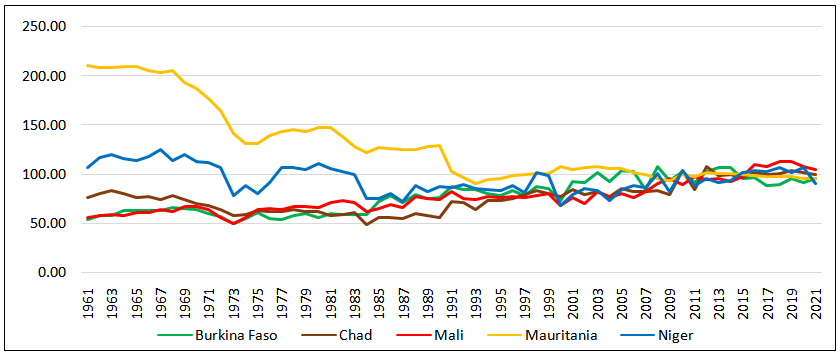
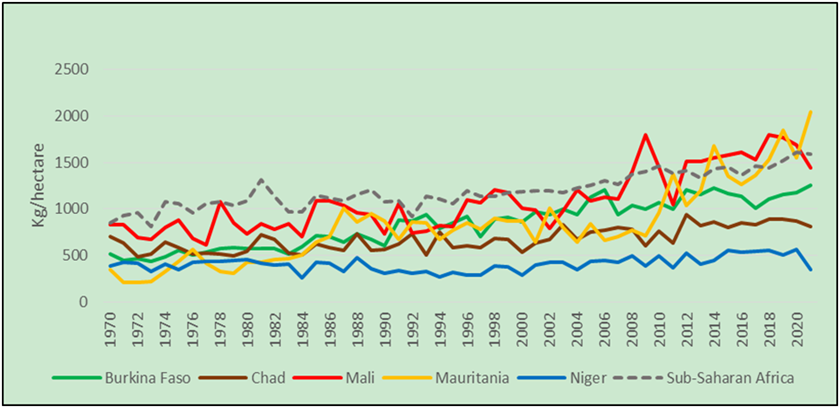
If the cereal annual balance is unstable because of the fluctuating supply from one year to the next, it is also affected on the demand side by rapid population growth. In fact, despite some annual deficits originating from natural contingencies, increases in agricultural production have tended to follow the demographic upsurge (see Figure 1). Nonetheless, this correspondence could be increasingly difficult to ensure in the longer term. Production expansion has been more the result of an extension of cultivated areas than higher yields. Although cereal yields have improved (Figure 2), they are still significantly lower than those of other developing regions (South Asia, North Africa, etc.). Yields have also been below the sub-Saharan average, except recently in Mali and Mauritania. A particularly unfavourable situation is that of Niger, where yields are almost stagnant.


The problem with the extensive productive model practised to date is the growing scarcity of additional cultivable land (the "closing of land frontier"). Farmers, compelled by demographic trends, have expanded cultivation to marginally less-fertile soils, increasing labour on smaller plots{6} 19. This expansion has often involved encroachment on traditional grazing or transhumant areas, fuelling conflicts between farmers and shepherds. Pressure on resources (land, water…) can also be exercised by unsustainable practices by producers: reduction or abandonment of fallow periods, overgrazing, overexploited boreholes, etc{7}. Together with other reasons (lack of technical means), these practices hamper their productivity.

The referred anthropogenic factors interact with climatic natural drivers (dryness, wind, or hydric erosion, salinisation, etc.) and, at least in some zones, with debated desertification{8}. In the Sahelian areas, where these coupled natural-human processes are most advanced, low yields/poor harvests aggravate the poverty of their population. Even in good harvest years at the country level, the surplus of cereals observed at the national level coexists with local deficits and food insecurity in some communities. In such circumstances, the economic access restrictions for vulnerable people (low purchasing power), or those of a logistic/marketing nature (transport difficulties, private traders' interest), may prevent intranational commercial redistribution of cereals.
Food insecurity caused by the abovementioned structural reasons (less productive areas, households' poverty) has been aggravated recently by a new factor: growing civil insecurity. Jihadist terrorist attacks in some territories hinder the cultivation or marketing of cereals, restrict grazing activities and induce large displacements of people. The most affected areas are those surrounding Lake Chad (belonging to Nigeria, Chad, Niger, and Cameroon){9} and the region of the Liptako-Gourma/3 Borders (shared by Mali, Burkina Faso and Niger). Furthermore, the presence and influence of the Jihadist organisations have intensified, especially in Mali and Burkina Faso, the traditional intercommunity conflicts due to disputes over resources. Jihadist groups can exacerbate these conflicts and capitalise on people's feelings of neglect and injustice towards the state, other communities or within the community itself{10}.
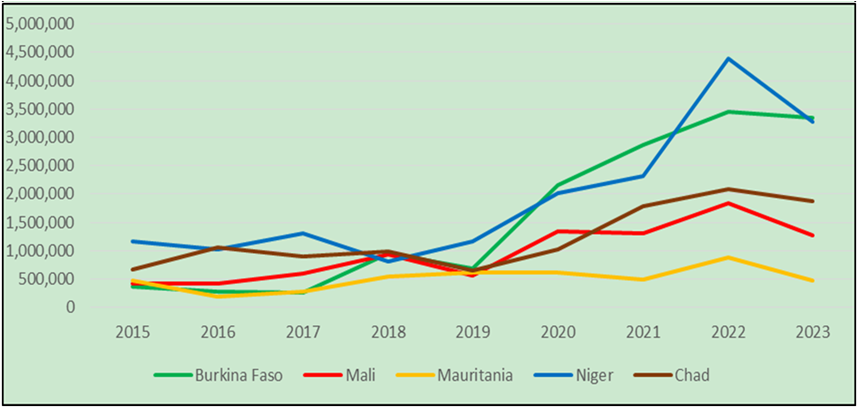
A combination of drivers (chronic production failures in some areas, terrorist conflicts, price increases) has recently exacerbated food shortages. Despite some relatively good annual harvests at national level, the number of people facing severe food insecurity during the lean season (soudure{11}) has increased in the five Sahelian countries studied (Figure 3). Erratic pluviometry led to important cereal deficits in several territories in 2021, particularly in Niger. This had serious implications for the food situation in 2022. Despite better harvests in 2022, rising food prices and civil insecurity continue to affect access to food for a significant part of the population. According to CILSS projections 28, the number of severely food insecure people in the five countries could exceed 10.2 million during the 2023 soudure.
The first to react to the risks of food shortages are the people affected by them. They must cope with these risks, balancing competing needs and scarce resources to ensure their subsistence, trying at the same time to preserve their essential livelihoods. This can involve a dilemma between the response to short-term urgent needs and the prevention of future vulnerability.
Coping strategies by food-insecure households are strongly influenced by their exogenous and endogenous context 31. The exogenous factor is, of course, the intensity of the natural shocks (drought, pest, flooding…) generating the production shortages. Other multiple variables may also be considered exogenous: the area's agro-ecological characteristics, the civil security risks, the proximity to markets and labour opportunities, the quality of transport infrastructure, and the available resources at the community level (cereal banks). Endogenous factors are the own attributes of the concerned households. Among them: their socioeconomic conditions (income sources, owned assets, indebtedness…), their demographic structure (size{12}, age, gender composition, education level…), their status and social links with other community members, their acquired experience from previous crises… This set of exogenous and endogenous factors works against chronic food-insecure families, especially if they are in remote or ecologically degraded areas. Their coping strategies risk being less effective or having negative consequences for their already meagre livelihoods.
A wide range of coping actions by households is undertaken, mainly in the times preceding or during the lean season. An initial reaction is to reduce the number of meals or have recourse to alternative food (forest fruits, wild plants, immature grains, etc.). In some cases, they may be fortunate enough to cultivate irrigated off-season crops. They can also try to obtain some income from selling wood or harvest residues (straw), from off-farm activities (artisanal, petty trade…) or from casual labour in other people's fields. These income-generating options may, however, be limited if production shortages are extensive in the area or community. Although intracommunity solidarity ties are often strong, their exercise will depend on the degree to which hardship is widespread or not. If existing and accessible in the area, community reserves (cereal banks) may have a palliative function.
To survive, households can be forced to adopt negative coping practices that increase their vulnerability. Among them, the consumption of their seed stock, the disposal of small livestock or other productive assets, the sale, or mortgage of their land, etc. As explained later, outside assistance should be timely to minimise these negative reactions.
Another widespread response to climatic shocks and production shortages has been migration to urban centres or to neighbouring countries in the South (Ivory Coast, Nigeria, Ghana…). As a first effect, this reduces food pressure in the areas of origin. The temporary migratory movement has traditionally occurred during the dry season when both land work and family provisions decrease. However, rural hardship and demographic pressures have stimulated permanent internal or international migration to other Western African countries, Northern Africa, or Europe. Remittances from migrants can bring benefits to the communities of origin, reducing food insecurity and increasing the productive assets of the recipient families. However, migration can also involve changes in the household structure and labour forces that, in some cases, can affect their productivity 33.
3.2. Short-term Responses from National and External Actors: Some New Thoughts and Improved InstrumentsSuccessive past crises in the Sahel and other regions have led to the revision of approaches and instruments to address food insecurity 1. For the past two or three decades, changes have occurred at the level of conceptual thoughts, as well as the level of the operational frameworks to prevent/respond to the crisis.
The persistent food insecurity for many families has cast doubt on a relief conceived only as a short-term remedy. To ensure a more sustainable prospect for those families, short-term interventions should have a long-lasting impact, anticipating future shocks. This has meant the incorporation of "resilience" targets into food assistance 3, although this concept has been interpreted in a heterogeneous manner 34. Building resilience can be reasonably understood as a way to restore/enhance the livelihood capacity of households that are vulnerable to food or other shocks 35. The question is to translate this approach into practice (see 3.3). Another issue that has received growing conceptual and methodological attention is related to the strategies to right targeting assisted beneficiaries.
Changes have also occurred at the macro-operational level. The in-kind aid sent in the past, often from agricultural surpluses of the respective areas of origin (United States, Europe, Japan, etc.), has become increasingly important. International food aid (bilateral or multilateral) now tends to be financial, including support for governments to build up national food stocks. To the extent possible, these stocks come from the purchase of local or regional cereal production. Another key channel of international assistance is the funding of programmes of organisations such as WFP or NGOs, whose interventions have become increasingly important.
Another development has been the growing assumption of the regional dimension of food security. This has led to the involvement not only of a specialised institution such as CILSS but also of the regional integration body (ECOWAS). Shared information and diagnostic mechanisms (early warning systems) have been developed at regional/national levels; intercountry cooperation initiatives such as the RPCA (Réseau de Prévention des Crises Alimentaires au Sahel et en Afrique de l'Ouest) have been reinforced. Although still modest, some steps have been recently taken to build up a regional food reserve; some minimal coordination criteria between national stocks have also been adopted.
Basically, the capacities and instruments now available in the Western Africa region, to which the Sahelian countries belong, are as follows:
- Information and warning mechanisms with national/regional coverage, ranging from meteorological and phytosanitary monitoring to crop results data, national or subnational shortages or market and price trends;
- Reserve stocks at the community (cereal banks), national and regional levels, seeking greater integration and complementarity between these three levels;
- National response plans (NRPs) under the responsibility of the respective governments, defining and implementing annually the relevant actions for the successive phases of risk; among these varied actions: food or cash for work, reduced price sales from public stocks or their free distribution during the soudure, provision of animal feed to herders, etc.
Pursuing complementary to these national plans, an expanding line of assistance by humanitarian organisations (WFP, NGOs…) takes the form of cash transfers. They are very relevant if the beneficiaries can buy cereals or other foodstuffs on local markets. Apart from being quicker and simpler to mobilise, such transfers can favour sales by local producers. In other situations, in-kind food distribution may be made from stocks managed by the mentioned organisations.
Humanitarians are also very active in the fight against child malnutrition. While operating now throughout the year, actions against child malnutrition are more intense during the lean period, when the highest levels of undernutrition are reached. They can be preventive, such as "blanket feeding", which consists of the distribution of food supplements to specific groups (under 5 children, pregnant or lactating women, etc.). When acute malnutrition is evident, other actions have a curative purpose by attending to children in outpatient recovery centres located in the health facilities. In the case of severe malnutrition, children are generally admitted to the Intensive Nutritional Recovery Centres (CRENIs, Centres de récupération et d'éducation nutrionnelle). This type of assistance requires close collaboration between humanitarian organisations and local health services{13}.
3.3. Crisis Response EffectivenessThe effectiveness of food security actions is determined by several organisational features, including the quality of the available information, the degree of coordination between actors or the timeliness of the response. Other key factors are of a more methodological or practical nature: the accurate targeting of the most vulnerable groups or the adjusted modes of assistance. These conditions are particularly important when the assisted people's hardships are structural (loss of productive capacity). In addition, the scope of the response is also logically dependent on the financial and physical resources available. In this regard, the picture is not very encouraging; according to data from the RPCA, the financial execution rates of the NRPs averaged 54% in 2017, 69% in 2018, 55% in 2019, 66% in 2020 and 57% in 2021. The level of national stocks is often insufficient.
Some review reports, including those from the regional food security network (RPCA), have critically examined the effectiveness of annual national plans (NRPs). Overall, the better anticipation of responses, the diversified and more articulated actions, and the building-up of a certain volume of public stocks are indisputable advances. The relevance of information and forecasts at regional/national levels is also considered rather acceptable 36. The difficulties stem above from other features. International humanitarian organisations have their channels of financing and operational implementation, even if they are formally integrated into national plans. Nonetheless, it has often been found that this integration is not sufficiently effective in the context of a lack of adequate leadership by the countries themselves 37. The dilemma between respecting national sovereignty and the urgency of the response continues to arise. The outcome is the limited complementarity and synergy between national and humanitarian actors{14}. In addition, the links between the national decision-making levels and the local operational levels are sometimes unsatisfactory 38. Coordination of efforts, including at regional and international levels, "has still a lot of room for improvement" 39.
Another drawback is the delays in starting up the actions or in the sequence they follow. Lack of resources or organisational readiness can still provoke these delays 37, even if they are now relatively less harmful than they were in some past crises. Major time lags can have irreversible effects on vulnerable families by not preventing their negative coping strategies.
The conditions and methods of selecting the most food-insecure communities and families to receive aid constitute another critical issue. This targeted exercise remains an enormous challenge for NRPs. Little harmonisation of this complex exercise between different actors has been noted. Hasty and recurrent practices to select recipient areas or communities have been observed, sometimes influenced by sociopolitical considerations. Furthermore, targeting processes are generally not adapted to pastoral communities 40. The consequence can be an unbalanced distribution of aid between communities or within a community, neglecting population groups at the highest risk. Another problem can be the suspicious perception or limited acceptance of the targeting results by the assisted community 41. To achieve a more proper and harmonised selection of needy people, the so-called Registre social unifié is being developed in the Sahelian countries. Such an information system can be useful to identify chronically vulnerable households, and potential beneficiaries of anti-poverty social programmes (see 4.2). However, it may be less adapted for people affected by unexpected transitory food shocks.

The assistance delivery modalities also matter greatly. When hardship is due to structural causes, remaining throughout the year, it cannot be remediable by short-term food aid during the lean season; differential resilience support is needed. These situations would require a combination of food relief with basic productive support (inputs, assets), including some coaching/training. This initial support should be extended under a more development-oriented framework. The same can be done through social protection schemes (safety nets) if adequate linkages are established between them, the initial relief, and rural productive initiatives. For the most dispossessed people, including women and youth, access to land may be a necessary condition.
Such resilience support modalities require methods that are difficult to follow under emergency pressures and scarcity of means 42. Initiatives of this kind operate in the Sahelian countries but are still limited in scale{15} 36. Much-proclaimed resilience strategies have been little translated into real action 6. They can need additional resources (material and human) that are not easily available under the NRP's short-term frame. Nonetheless, they can be cost-effective in the medium term by helping households cope with new shocks, thus mitigating the need for recurrent emergency interventions.
In addition to the issues mentioned, there are other specific problems in conflict-affected territories. In them, abandoned lands, disrupted transhumant movements, perturbed supply markets and the presence of refugees/displaced people increase food deficits and may exhaust the resilience capacity of their dwellers 43. Assistance in these areas is constrained by restrictions on transport and personal movements imposed by security bodies, with which coordination is not very effective 44. It has been found that NRPs do not have a strategy adapted to these special situations 36, for which there is a tendency to shift the initiative to the humanitarian sector 40. Humanitarian organisations are trying to meet the challenge of maintaining their presence and protective contribution in these conflict areas. Nevertheless, in addition to the restrictions mentioned above, they encounter other obstacles, including assaults on their staff or the looting of their properties.
It is obvious that greater and more stable agricultural production, to the extent that it is ecologically feasible, would improve food security in the Sahel. This would mean fewer and less severe cyclical crises. However, mere productive expansion cannot solve the global food problems in the region. Agricultural policies are designed for producers with a minimum of means, and the most vulnerable sectors of the rural population do not have them. In addition, the adverse effect of strong population growth on food availability and access cannot be ignored.
As widely agreed upon at the international level 7, a multisectoral integrated approach is emerging as the way forward to address the scourge of hunger and promote sustainable resilience (for the Sahel, see 18). The core of this strategy should articulate inclusive and climate-adapted agricultural development with anti-poverty social protection and with the best possible management of demographic dynamics. All those large policy goals will, of course, require strong commitments and efforts from national governments and cooperating partners. Progress in these directions would mean moving gradually away from the current scenario in which annual food emergencies absorb many resources{16}. These resources could be accordingly reallocated to development needs, following the so-called "twin-track" process (relief efforts increasingly integrated with long-term development purposes).
4.1. Agricultural DevelopmentSeveral constraints must be overcome to achieve future sustainable agricultural progress. This would involve reducing rain dependency (developing irrigation), increasing yields in dry lands, and preserving and enhancing livestock/pastoral potential in balance with cropping interests.
Irrigation has been a logical priority for the Sahelian countries since their independence. Several investments were made years ago to create broad infrastructures with full control of the water pumped from adjacent rivers (Niger, Senegal). Rice was the most common product in these infrastructures. Nonetheless, with a relative exception in the case of Mali, this large-irrigated model has raised serious managerial, economic and social difficulties; among them, deficient maintenance, low productive performance, lack of ownership and real involvement by producers 45. The impact of these vast irrigated perimeters on poverty and food security has been considered limited 46.
Gradually, increased focus has been placed on initiatives to develop small-scale irrigation according to different schemes (collective or private, surface or groundwater). They are generally based on light techniques: wells and shallow forage on aquifers that are renewed each season, river weirs, small pumping for permanent watercourses, etc. Under some conditions (well-targeted areas, inexpensive investing, affordable technologies), these modalities can provide economic and environmental returns 47. As reported by field studies, they can improve the living standards (consumption and assets) of poor households 48.
Moreover, traditional ways of retaining/using water from the rainy season (lowland and shrinking crops, small ponds, water dispersal dikes, hillside reservoirs, etc.) have been improved and spread. Water-saving technologies (drip irrigation) are being disseminated.
By 2020, FAO-Aquastat recorded a total of 602,000 ha. equipped for irrigation in the five studied countries, out of which only 359,000 ha. were actually irrigated. According to a report for a regional irrigation plan [(Initiative pour l'irrigation au Sahel/2iS, 50), there is global potential to irrigate two or three times more surfaces than the current ones. Nevertheless, this would require not only considerable funding but also strengthened public capacities to manage such a significant scale of investment and new irrigation schemes.
The extension of irrigated areas would make it possible to increase the production of several agri-foods, including rice, which has a growing weight in the regional diet. Rice production in West Africa has increased over the last 50 years at an average annual rate of 4.6%, and rice yields doubled during that period, although they are still far below those of the rest of the world. Except for Mali, the rice self-sufficiency ratio is still low; the other countries must import significant volumes of that cereal.
By reducing fertility and yields, land degradation has strong social consequences, increasing poverty and further compromising food security in areas where it is most advanced. Degraded grazing lands also reduce livestock productivity and pastoral livelihoods. Climatic changes can aggravate these unfavourable consequences{17}.
Sustainable land management (SLM) has been gaining importance since the severe food crises in the 1970s and 1980s. Successful SLM experiences have been developed in the Sahel, improving the environmental and productive conditions of specific areas. Due to its important coverage and impact, the FMNR programme (Farm Managed Natural Regeneration) in the southern territories of Niger has been specially studied and mentioned 51; it concerns more than 5 million hectares and 1.25 million households. Actions with the same agroforestry purpose have been carried out in other countries (Central Plateau in Burkina Faso, Seno Plains in Mali, etc.). Many studies on soil and water conservation efforts in those countries have confirmed that they increase agricultural productivity and improve food security (see, for instance, the meta-analysis on Burkina Faso experiences in 52).
The techniques, modalities, and practices of SLM are well known and sufficiently experienced in the Sahel{18}. Their cost-effectiveness is well demonstrated 51. However, they have not been scaled up for wider adoption due to several constraints, including the lack of sufficient institutional coherence and financial resources 22. National agri-environmental policies contain SLM and climate adaptation budget lines, but their real scope remains limited.
An opportunity to reinforce and extend SLM actions in the region could come from the Great Green Wall (GGV) massive initiative. This macro project (a band 7,500 km long and 15 km wide) includes the Sahelian countries of West Africa and those of the Horn of Africa (Sudan, South Sudan, Eritrea, Ethiopia, and Djibouti). Launched in 2007, its implementation and funding are lagging; recent international pledges have been made to enhance them 56.
After heavy animal losses during the past century's severe droughts, more favourable rainfall conditions have allowed the rebuilding of herds and even a large increase in livestock numbers. This quantitative growth has been particularly high in the small ruminant segment (sheep/goats). For many families who have few resources, the possession of small flocks ensures some economic security, a "four-legged savings" to defend themselves in difficult periods. The resulting increase in stocking density and grazing pressure, especially from cattle transhumant herds, has raised divergent views about their impact on the Sahelian environment (see, e.g., 57, 58). Animal mobility is a livelihood strategy for pastoralists. The transhumance of their animals becomes indispensable due to the irregular availability of fodder and water in space and time in the Sahel. However, there is a frequent risk of colliding with agricultural activities when livestock must move during the dry season to less arid southern areas. Conversely, crops are often spread to grazing areas or transhumant corridors, hindering pastoral activities{19}. There are rules, both at the national (rural or pastoral codes) and regional levels (ECOWAS transhumant certificate), that intend to protect and regulate transhumant rights and land uses. However, the poor respect and supervision of these rules, the rising resource scarcity, and some underlying interethnic contentions lead to strong conflicts (see section 2).
Apart from involving violence and human losses, those conflicts disturb the normal course of productive activities by farmers and pastoralists. Their treatment and gradual resolution, trying to achieve ways of coexistence, if possible, of mutual interest, is among the conditions for agricultural/livestock development. One first requirement would be to adapt, where necessary, and to more effectively implement the existing rules for access to resources and transhumant movements. This would imply a clear stipulation of the rights and responsibilities of farmers and pastoralists, according to their respective calendars, along with mutually agreed enforcement procedures. It would also be necessary to strengthen the mediation and supervision capacities at the local level.
Together with those institutional changes, livestock enhancement would require better conditions at the level of production (animal health, feed supply, improved pasture management, pastoral wells, etc.) and marketing (live animal markets, slaughterhouses, etc.). Animal breeders often claim to be discriminated against in terms of public assistance (see 4.1.4). Livestock policies should give special attention to small herd owners, whose low monetary income depends mostly on the sale of the animals they have been able to raise. Such support would have the dual merit of developing small-scale livestock production and combating rural poverty.
Under the continental CAADAP or the regional ECOWAP frameworks, the Sahelian countries have adopted agricultural policies and investment plans in all the fields mentioned thus far{20}. Expanding irrigation, improving rain-fed crop productivity, counteracting soil degradation and enhancing livestock production are key goals of these national policies. However, the practical translation of such policy goals is not consistent enough, especially in terms of resource allocation. Under the severe budget constraints endured by the countries examined, agriculture does not seem to be a high priority; other pressing needs, including recent security needs, are depleting their public budget margins 59. It is worth mentioning some issues about their relative levels of agricultural expenditure, composition, preferences, and efficiency.
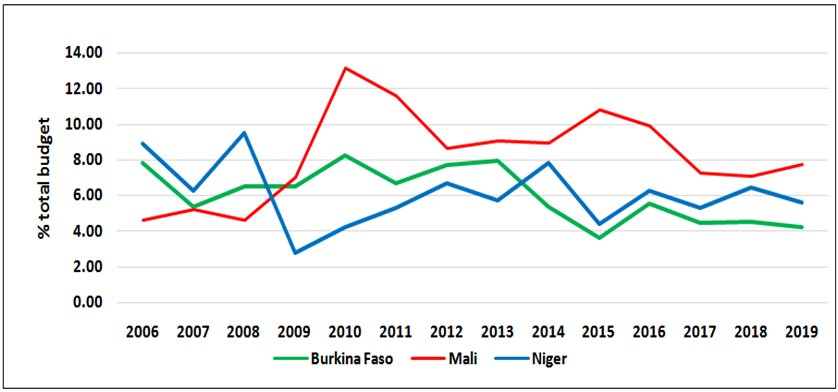
• Figure 5 shows, for countries for which more disaggregated data are available, agricultural expenditure as a percentage of total national budget expenditure over the period 2006-2019. Except for a few years in Mali, these percentages were below the level (10%) deemed necessary to boost African agriculture (African Union Maputo Declaration, 2003). Donor funding remains substantial in these countries (40% or more of the total agriculture expenditure). Nonetheless, there has been little integration/coordination between the programmes of the different external agencies, a key problem that the Sahel Alliance (see footnote 1) is trying to address.
• Spending is concentrated in some agriculture subsectors (rice, cotton, maize…) and in some investment or support lines (irrigation, input subsidies…) of predominant interest to the same subsectors. This seems to be explained by short-term economic or commercial reasons (e.g., the importance of cotton as a foreign exchange provider or the growing role of rice in urban consumption). However, this choice may involve underspending in other crucial productive areas, such as rain-fed cereals or livestock raising, which engage most farmers{21}. Expenditure on R&D and extension services is also too low{22}.

• For the examined group of five countries, except for Mauritania, the technical efficiency scores of public agriculture expenditure are estimated to be among the lowest in sub-Saharan Africa 60.
• The costly subsidy for inputs, particularly fertilisers, has been a hotly debated policy issue in countries such as Mali, Burkina Faso, and Niger. The socio-productive impact of these subsidies has been estimated to be advantageous in some cases 61. However, their management and allocation modalities have been generally criticised: inadequate targeting of beneficiaries, focus on medium- and large-scale farmers, inefficient logistics, eviction of private operators, etc. 62. Subsidies can also have negative consequences for crop diversification 63. To avoid such distortions, reforms towards so-called "smart subsidies" are being conducted in most of the Sahelian countries considered.
• Another sensitive issue is related to seed policies, which are also subsidised. According to some views, the problem here is the overdependence on transnational firms supplying sophisticated and expensive selected seeds. This entails the marginalisation of the potential development of local farmer seeds 64. This issue gained considerable public relevance with the temporary authorisation of the distribution of GMO seeds for cotton in Burkina Faso{23}.
4.2. Social ProtectionTo ensure social protection along with food subsistence for the most vulnerable households, different initiatives are operating in the Sahel. The most visible ones are the cash or productive input transfer programmes that have been emerging since approximately one decade ago. They can provide resilience assistance, in which the objective of immediate relief is combined with productive support (individual or collective) to families/communities (see 3.3). Implemented by local or international NGOs, mainly during the lean season, these activities are largely managed or funded by external agencies (WFP, FAO, ECHO-EU, USAID…). Under a more continuous safety net approach, other initiatives, notably the so-called "filets sociaux", are making small cash transfers over the year; in some cases, they also promote the productive inclusion of their beneficiaries. These programmes have been developed with World Bank support. They operate in each of the five countries examined in this article, although their financial dimension and social coverage are varied.
The resilience-building performance of these two different modalities has been discussed. It is argued that regular and predictable transfers throughout the year contribute to smoothing the income and consumption of assisted families and even promote their productive investment 65. Furthermore, they can also intervene in the crucial 2nd quarter of the year when the new season cultivation work may start; in the same period, negative coping strategies by the most food-vulnerable are likely to emerge. According to these views, this kind of help is more effective than support focused on the lean period that might arrive too late 66. Nevertheless, other views consider that, particularly in the case of cyclical chocks, specific interventions during the critical lean period are very relevant. This is the period when the worst consequences of such chocks are felt and when chronically vulnerable people are left more deprived. It is an opportune moment to initiate resilience building that can then be continued through regular transfers or additional productive support 67. Coordination and articulation between the two types of assistance is in any case essential, as well as refining the most appropriate targeting methods for each of them{24}.
The challenges of adapting cash transfer practices to local contexts must also be carefully considered. It has been remarked that the "filets sociaux" follow models that are foreign to local customs and rules, which affects a genuine consent by communities 68. A misunderstood separation between beneficiaries and nonbeneficiaries could disrupt social cohesion within a community 69.
The coverage of the "filets sociaux" has remained modest in the Sahelian countries; it has ranged from 0.4% of the national population in Chad to 1.6% in Niger and Burkina Faso 70. In Niger, 6.5% of the population under the poverty line and 10.9% of those living in chronic poverty were receiving this kind of transfer in 2017. Spending on social safety nets in the region (an average of 0.8% of GDP 70) has been rated as too low 71. Apart from their serious financial constraints, governments seem not to recognise the key food security role of these antipoverty instruments{25}; they may expect that, in one way or another, foreign aid maintains the bulk of funding. Reallocating national budget funds to social protection from inefficient spending (including subsidies) has been suggested 72.
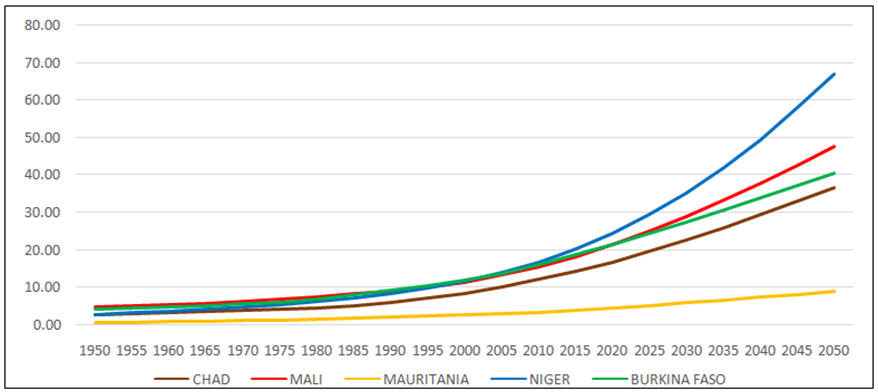
4.3. Slowing Population GrowthThe rate of demographic growth in the Sahelian countries is higher than in any other region of Africa and the world. They lag other developing countries in their demographic transition. According to UN Population Division projections, their population could double or triple the current figures by 2050 (Figure 6).
The relationship between population growth and food insecurity or declared famines has been the subject of contradictory approaches under anti-Malthusian (Boserupian){26} or neo-Malthusian assumptions. Beyond these controversies, it is widely assumed in the case of the Sahel that upwards population trends have an impact on livelihood vulnerability and food insecurity (see, e.g., 18, 23). Several field studies in Sahelian countries have examined these adverse outcomes in terms of both food availability 73 and accessibility 74. The size of households and their dependency ratio{27} influence their food security 75.
The impact of population growth on food balances could be much more pronounced in the future. Recent projections for 2050, combining this impact with that from climate change, indicate foreseeable drops in available agricultural production per capita 24; other studies predict potential serious increases in nutritional deficits 76. Demographics are seen as the driving force behind these possible trends ahead of climate change. Options to avoid or reduce those trends would be to increase the agricultural yields, to expand food imports and migration and, obviously, to contain demographic growth. There can be meaningful increases in agricultural yields with adapted techniques and modes of production, as already discussed in 4.1.2. However, a degree of uncertainty remains about the quantitative results that can be obtained 21. Some smallholders may not be fit to adapt yield-increasing technologies 79. Huge food imports will be inhibited by both economic (foreign exchange constraint) and social reasons (low people's purchasing power){28}. Migration trends will depend on the economic evolution of other better-off countries in the region, as well as on restrictive policies of European and other advanced countries. Last, the potentially most effective option, the gradual deceleration of population growth, poses other challenges.
In fact, demographic management has been part of the national policies adopted in the Sahel region for the last 30 years. Nonetheless, its weak effective implementation through family planning has had little impact. More recently, under a regional initiative (the Ouagadougou Partnership), more precise national plans to extend family planning services have been launched.
The above plans were drawn up with external assistance and are being largely financed by international aid. Their cost is relatively limited and could be gradually co-financed by national budgets if there were genuine ownership of them. However, the effective commitment from governments has thus far been inadequate 80, as it is influenced by a strong procreative popular culture rooted in tradition and religion. Other factors are of socioeconomic nature: poor rural couples tend to perceive many children as "old-age insurance" 81. Together, these various factors feed a widespread social mentality against the reduction of fertility, which transcends to the political sphere. When some governments have proposed fertility-related measures, such as the schooling of girls or the legal age of marriage, they have been strongly opposed by Islamic conservative forces.
Apart from devoting more domestic resources, a sound political strategy of information and persuasion, seeking basic civil support, could start changing the situation. The experience of many other developing countries, including Muslim-majority ones, may well inform this strategy. Within it, the deployment of human resources (social public agents, religious leaders, civil society advocates, etc.) and media campaigns would occupy a key place.

A conjunction of different adverse drivers (natural, anthropogenic, socioeconomic, demographic, among others), most of them interrelated, shape the challenges of food availability and accessibility in the Sahel. To address these varied challenges, a multifaceted strategy becomes necessary. Efforts in that direction are being made, but their scope and results are still insufficient. While cyclical supply deficits have continued to occur in recent years, chronic food insecurity, linked to poverty, is deep-rooted in many families even after good harvests. The lack of means of these families entails that they can neither produce enough food themselves nor buy it at the market; their situation worsens when prices rise during the lean season.
Cyclical rises could be better approached by mobilising enough volume of public reserve stocks (national, regional) and promoting cereal banking at the level of communities. Improving the effectiveness of the response plans (funding, promptitude, coordination, accurate targeting…) would also be crucial. Another way to compensate for a national cereal deficit is through commercial imports, particularly from neighbouring countries with an available supply of coarse grains. This would, however, require greater respect for regional ECOWAS free trade agreements and fewer cross-border obstacles.
A durable reduction of cyclical deficits, of their frequency and severity, will depend on accrued and more stable agriculture production: extending irrigation, increasing rain-fed yields and securing/upgrading livestock activities. These rather obvious development lines have been underway for some time, but there is still significant room for improvement. More resources are certainly needed, but a more balanced and efficient allocation of those made available, both from domestic and donor sources, is also needed. Regarding the latter, compliance with the Sahel Alliance's commitments would be essential. Apart from more cost-effective means and coherent policies, other challenges are institutional. They are related to reforms adapting and enforcing rules on the shared use of natural resources to prevent and settle conflicts between farmers and pastoralists. Likewise, initiatives facilitating access to land for dispossessed people, particularly women and youth, are very convenient.
Regarding chronically food insecure people, who having lost much or all of their productive capacity after successive (cyclical) crises, a more specific response approach is suitable. Food relief assistance must be accompanied by livelihood support. The most vulnerable households must be helped to start recovering their assets and to resume some productive activities (cropping, animal rearing or off-farm work). This initial push must be prolonged for some time to ensure enough restoration of livelihoods to participate in the common development endeavour. This graduated support may also be done through social protection programmes (safety nets) if associated with productive initiatives and conveniently adapted to the local contexts. This is the process that has been called "from protection to production".
It is predicted that climate change may condition agricultural development in the Sahel to some extent. Even if productive development takes place, it could be offset (in terms of per capita production) if high rates of population growth persist. As a further component of the referred multifaceted strategy, a sound policy of family planning and demographic containment will be indispensable. Successful plans of this nature in many other developing countries could serve as a reference. In those plans, as well as in the above safety net programmes, more national leadership and financial participation would be congruent with their crucial national importance.
Although not dealt with in this article, another key condition for improved food security in the Sahel is the security stabilisation of its territories suffering current violent conflicts. This can require, in addition to security strategies and improvement of people's living conditions, advances in internal civil cohesion and governance in those territories and in their respective countries.
No funds, grants, or other support was received.
The author has no conflicts of interest to declare that are relevant to the content of this article.
{1} The five countries are members of the regional integration organisation ECOWAS (Economic Community of West African States) and of the specialised regional body CILSS (Comité Permanent Inter-Etats de Lutte contre la Sécheresse dans le Sahel). With a commitment to strengthen donor coordination, a Sahel Alliance was launched in 2017 to promote, amplify and accelerate aid to this region. The Alliance, one of whose main axes is agriculture and food security, has been joined by all the main Western donors, the World Bank, the African Development Bank, and UNDP.
{2} Signs of climate change have been well observed in the Sahelian region, with night temperatures 2°C higher than they were 60 years ago during the warmest period of the year, together with irregular and extreme pluviometry events 19.
{3} As in other sub-Saharan countries, land tenure/use in the Sahelian regimes mix modern state standards (some of them existing since colonial times) with customary rules and practices. This juxtaposition, as well as the lack of supervision of standards, leads to situations of confusion, uncertainty, or arbitrariness in land access rights. One problem thus generated is that of frequent conflicts in areas where agricultural and pastoral activities converge. Another consequence of this normative context, influenced by Islamic traditional laws, is the near exclusion of women from land tenure; only 8.4% of the land was owned by women in 2010/11 in Burkina Faso, and 3.1% in Mali 25.
{4} Although chronic food insecurity may have peculiarities in different contexts, a reference table categorising it into 4 levels of severity, according to different indicators, has been set up by the multi-partner international initiative IPC (Integrated Food Security Phase Classification). In Niger, for example, it has been estimated that 14% of the population was at the most severe level 4 of chronic insecurity in 2018 26.
{5} In March 2023, rice prices on local markets in the countries studied were 60-100% higher than those for coarse grains (millet, sorghum) 27.
{6} From 1971 to 2018, arable land (hectares) per person was halved in Chad and reduced by up to a third in Niger (FAOSTAT).
{7} The mentioned unfavourable practices, driven by subsistence needs, are one side of the coin. At the same time, remarkable efforts by rural communities are underway to offset land degradation and restore the ecosystem (see 4.1.2). Together with climatic factors, there are both positive and negative human contributions to the state of soils and vegetation.
{8} There has been a debate about the reality of Sahelian desertification, with researchers referring to a reverse trend of "regreening", based on remote sensing data. This trend appears to be a more complex one; it may have a temporal and spatial dimension. After the period of intense droughts of the last century (the 1970s-80s), the last decades have seen recovered rainfall levels, although with erratic annual changes. Nevertheless, such recent levels are lower than those observed in previous periods (the 1950s-60s), which raises the question of the period to be taken as default to assess the ecosystem change. Moreover, some areas of the region (in particular, the Middle Niger Basin) did not show any vegetation recovery; in other areas, the vegetation recovery hasn't led to an increase in the soil water holding capacity 29.
{9} In the northeast region of Nigeria and around Lake Chad are acting the two factions of Boko Haram, one of them associated with the Islamic State (ISWA, Islamic State in West Africa). In the Liptako-Gourma region, the most powerful organisations are the État islamique dans le Grand Sahara (EIGS, also associated with the IS) and the Groupe de soutien à l'islam et aux musulmanes (GSIM) that has links with Al Qaeda.
{10} A link between climate change and violent conflicts in the Sahel has been suggested. However, what is now generally considered is that rather than a cause-effect relationship, environmental changes can contribute to creating societal circumstances that are conducive to conflicts, including those related to land use 20. Scarcity and competition over resources, or dispossession of them, under scenarios of social and political marginalisation, have played a significant role in fueling disputes, in some cases motivating local people to join (or create) terrorist groups. This incitement has been specially examined regarding the most deprived lineages of the Fulani pastoral communities who contest the unequal access rights to agro-pastoral resources 30.
{11} The "soudure" is the riskiest period between the depletion of the previous year's reserves (this can occur from the first months of the following year) and the next harvest (around September/October, after the rainy season). People in severe food insecurity are those placed in the 3-5 worst situations (crisis, emergency, and famine) out of the five considered in the Cadre harmonisé. This tool for analysis and identification of food risks in the CILSS area has been adapted to the international IPC (Integrated Food Security Phase Classification).
{12} The propensity of large families to food vulnerability has been observed by regular surveys in the Sahelian countries, as well as by some global sub-Saharan studies 32.
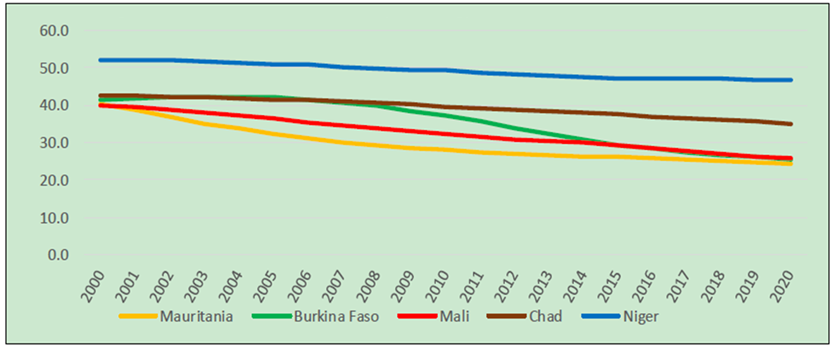
{13} The increased effort against child malnutrition, together with other actions improving somewhat the family life conditions (health, clean water, hygiene...) seems to have been relatively effective in some countries. As shown in Figure 4, stunting prevalence indicators have been dropping in Mauritania, Mali, and Burkina Faso for the last 20 years. The reduction has been less significant in Chad and Niger, where the stunting prevalence remains extremely high. Nevertheless, the challenge to meet SDG 2030 on stunting (target 2.2.1) is posed for all these countries.
{14} Coordination gaps have also arisen between the different humanitarian actors. The institution of Food Security Clusters in each of the countries, as well as the extension of operational consortia or inter-consortia of NGOs, intend to reduce those gaps.
{15} Usually, the resilience support initiatives combine food and nutrition relief with the provision of inputs/assets (seeds, fertilisers, feed, small animals, etc.) or cash to acquire them, together with some technical advice. In this way, beneficiaries can reactivate or diversify their farming production. In other cases, the assistance can promote off-farm activities for complementary income. An additional option is to support collective works to improve farming or grazing conditions of the communities (soil restoration, water harvesting, forestry, etc.); the WFP Food for Assets Programme 5 is adopting this option. Humanitarian organisations in the Sahel are already distinguishing their food assistance beneficiaries from those also receiving resilient livelihood support.
{16} The total international food and humanitarian aid between 2012 and 2016 to the 5 countries examined (around MUSD 4,000) was almost double the amount allocated to their agricultural and livestock sectors during the same period 49.
{17} The various climate change prediction models for the Sahel give different results. Nonetheless, there is relative convergence on two important aspects: temperature increases could be higher than in other regions of the world and rainfall trends would diverge according to geographical location; less rainfall in the Western part of the Sahel and more in the Central part. It has been estimated that the combined future effect of these two factors would lead to a significant drop in cereal yields. They can decrease by an average of 12% between 1961-1990 and 2031-2060, although this drop would be more pronounced in the Western part of the Sahel 53. The negative impact of these trends on small farmers food self-sufficiency could be particularly acute [54].
{18} There is a wide range of techniques to preserve and improve the productivity of rain-fed crops in arid Sahelian conditions. Some of them have traditionally been used in the region (like the zaï: digging tiny planting pits to break the surface crust during the dry season, filling them with organic manure). Among the methods practised, there are various forms of protection against water or wind erosion (stone bunds, half-moons, fixation of dunes …), reforestation, natural land regeneration, early and more resistant seed varieties, intercropping, etc. Other techniques intend greater rainwater control (retention, dispersion, infiltration into the subsoil...), as already explained in 4.1.1 22. It has been argued that agroecological intensification (with low external inputs) seems to be the most viable option to increase production for many Sahelian farmers 55.
{19} The traditional symbiotic complementarity between farmers and shepherds, both for production (manure for the former, harvest residues for the latter) and for consumption (exchange of milk or meat for cereals), has become less relevant. Many farmers have been acquiring livestock with which they practice the abovementioned complementarity on their farms; more and more pastoralists are becoming agro-pastoralists. The growing presence of herds in cultivated areas at certain times of the year, and even the semi-sedentarisation of shepherds in those areas, may run counter cropping interests. Access to water can also be a source of disputes, sometimes between different pastoralist communities. Conflicts over resources may even arise between different social strata of the same community, as in the case of the Fulani communities of Central Mali and Northern Burkina Faso. Dissensions opposing impoverished pastoralists of these communities, mainly youth, to the traditional dominant elite (owners of large numbers of livestock) have become deepest (see footnote 10).
{20} CAADAP (Comprehensive Africa Agriculture Development Programme under NEPAD); ECOWAP (Economic Community of West Africa Agricultural Policy).
{21} Budget (executed) allocations to the ministries responsible for livestock in Burkina Faso, Mali, and Niger range from 10 to 20% of total agricultural spending, (World Bank-BOOST), while the relative contribution of livestock to agricultural GDP varies between 30 and 40% in these three countries.
{22} A report by FAO 60 on agriculture spending in some sub-Saharan countries, provides data on the composition of such spending in Mali and Burkina. During the period 2015-2018, their respective budget allocation shares were: irrigation infrastructure: 26.5% and 7.5%; variable input subsidies, including for fertilisers and seeds: 35.5% and 28.2%; R&D and extension services: 11.5% in both countries; land management, forest, and environment: 4% and 8%.
{23} An agreement in 2008 with the American multinational Monsanto allowed the distribution of GMO seeds to cotton farmers in Burkina Faso. After nonperforming productive and commercial results, the agreement was revoked in 2015.
{24} The first level of targeting is geographic through the Cadre Harmonisé. At the level of final beneficiary households, the most common targeting methods are the Proxy Means Test, used in the programmes promoted by the World Bank, and the Household Economy Analysis, used by other actors and many NGOs (Escot, 2018). Some harmonisation is expected to be reached through the ongoing development of a single common database on people qualified for social protection (Registre social unifié, see 3.3).
{25} A study of 15 West-African countries has found that a 1% increase in social protection coverage may increase the level of food security by 2,1% 77.
{26} The Danish economist E. Boserup 78 considered that population pressure is a general condition for agricultural progress.
{27} The 2021 national age dependency ratio (proportion of dependents per 100 working-age population) was 87.4% in Burkina Faso, 99.7% in Chad, 99.3% in Mali and 105.4% in Niger. All these ratios are above the average level of sub-Saharan countries (82.9%) and of the least developed countries (76.2%); the ratio in Mauritania was 82,7% (World Bank, World Development Indicators/WDI).
{28} Poor Sahelian households mainly consume coarse grains (millet, sorghum, and local maize). It can be difficult to offset deficits with imports because these grains are not available on international markets and the grains available (rice and wheat) are more expensive (Dury et al., 2019).
| [1] | Michiels D., J. Egg & R. Blein (2012). La répétition des crises alimentaires et nutritionnelles au Niger : la rénovation urgente des politiques de sécurité alimentaire. Cahiers Agricultures, 21(5), 302-310. | ||
| In article | View Article | ||
| [2] | Ross, J., S. Maxwell & M. Buchanan-Smith (1994). Linking relief and development, IDS Discussion Paper 344, Brighton. | ||
| In article | |||
| [3] | FAO (2013). Resilient Livelihoods – Disaster Risk Reduction for Food and Nutrition Security. | ||
| In article | |||
| [4] | Frankenberger, T. et al. (2012). Enhancing Resilience to Food Security Shocks in Africa, Discussion Paper, Tango International. | ||
| In article | |||
| [5] | WFP/World Food Programme (2018). Scaling up for resilient individuals, communities and systems in the Sahel (Operational Reference Note). | ||
| In article | |||
| [6] | Mathieu, A. (2018). NGO position paper: Oxfam International, Save the Children, Action Contre La Faim, December 2018. | ||
| In article | |||
| [7] | Dury, S., P. Bendjebbar, E. Hainzelin, T. Giordano & N. Bricas (eds.) (2019). Food Systems at risk: new trends and challenges. Rome, Montpellier, Brussels, FAO, CIRAD and European Commission. | ||
| In article | View Article | ||
| [8] | Ashley, J. M. (2016). Food security in the developing world. Academic Press. | ||
| In article | |||
| [9] | Bosc P.-M., V. Dollé, P. Garin & J.-M.Yung (1992-96). Le développement agricole au Sahel, CIRAD, Montpellier. | ||
| In article | |||
| [10] | Hollinger, F. & J. M. Staatz (2015). Agricultural Growth in West Africa: Market and Policy Drivers, FAO-African Development Bank. | ||
| In article | |||
| [11] | World Bank (1986). Poverty and hunger: issues and options for food security in developing countries. | ||
| In article | |||
| [12] | FAO (1996). Déclaration de Rome sur la sécurité alimentaire mondiale. Sommet mondial de l’alimentation, 13-17 novembre 1996, Rome. | ||
| In article | |||
| [13] | Devereux, S. & S. Maxwell (2001). Food security in sub-Saharan Africa, Practical Action Publishing, Rugby (UK). | ||
| In article | View Article | ||
| [14] | Dasgupta, P. (1997). Nutritional Status, the Capacity for Work, and Poverty Traps, Journal of Econometrics 77.1, 5-37. | ||
| In article | View Article | ||
| [15] | Banerjee, A. & E. Duflo (2011). Poor Economics: A radical rethinking of the way to fight global poverty. Public Affairs: New York. | ||
| In article | |||
| [16] | Alderman, H. & T.S. Haque (2006). Countercyclical safety nets for the poor and vulnerable, Food Policy Vol. 31 (4), 372-383. | ||
| In article | View Article | ||
| [17] | Devereux, S. (2016). Social protection for enhanced food security in sub-Saharan Africa, Food Policy, vol. 60, 52-62. | ||
| In article | View Article | ||
| [18] | Gubbels, P. (2011). Escaping the hunger cycle: Pathways to resilience in the Sahel, Groundswell International. | ||
| In article | |||
| [19] | Sultan, B., R. Lalou, M.A. Sanni, A. Oumarou & M.A. Soumaré (2017). In: Sultan et al., Rural societies in the face of climatic and environmental changes in West Africa, Conclusion, 417-425, Marseille: IRD Éditions. | ||
| In article | View Article | ||
| [20] | Benjaminsen, A., K. Alinon, B. Halvard Buhaug & J.Tove Buseth (2012). Does climate change drive land-use conflicts in the Sahel? Journal of Peace Research vol 49, issue 1. | ||
| In article | View Article | ||
| [21] | Sultan, B. & M. Gaetani (2016). Agriculture in West Africa in the Twenty-First Century: Climate Change and Impacts Scenarios, and Potential for Adaptation, Frontiers in Plant Science, vol. 7: 1262. | ||
| In article | View Article PubMed | ||
| [22] | Maisharou, A., P.W. Chirwa, M. Larwanou, F. Babalola & C. Ofoegbu (2015). Sustainable land management practices in the Sahel: review of practices, techniques and technologies for land restoration and strategy for up-scaling, International Forestry Review, vol.17 (S3), 1-19. | ||
| In article | View Article | ||
| [23] | Morris, M., R. Cervigni & K. Brooks (2016). The Road Ahead: Toward a Shared Dryland Development Agenda, In: Cervigni, R. & M. Morris (eds.), Confronting Drought in Africa’s Drylands: Opportunities for Enhancing Resilience, chapter 13, Africa Development Forum AFD-World Bank series. | ||
| In article | View Article | ||
| [24] | Defrance, D., B. Sultan, M.Castets, A. M. Famien & C.Baron (2020). Impact of Climate Change in West Africa on Cereal Production Per Capita in 2050, Sustainability, 12, 7585. | ||
| In article | View Article | ||
| [25] | FAO (2011). The State of Food and Agriculture 2010-11. | ||
| In article | |||
| [26] | FEWSNET/Famine Early Warning Systems Network (2019). Évaluation de l’insécurité alimentaire chronique au Niger. | ||
| In article | |||
| [27] | FEWSNET/Famine Early Warning Systems Network (2023). Afrique de l'Ouest Bulletin Mensuel des Prix avril 2023. | ||
| In article | |||
| [28] | CILSS-RPCA (2023). Situation alimentaire et nutritionnelle Mars-mai 2023, http://www.food-security.net/en/ressources/. | ||
| In article | |||
| [29] | Descroix, L., F. Guichard, M. Grippa, L.A. Lambert, G. Panthou, L. Gal, C. Dardel, G. Quantin, L. Kergoat, Y. Bouaïta et al. (2018). Evolution of surface hydrology in the Sahelo-Sudanian stripe: An updated synthesis. Water, MDPI 10 (6), 478. | ||
| In article | View Article | ||
| [30] | Bouju, J. (2020). La rébellion peule et la « guerre pour la terre »: Le gouvernement par la violence des ressources agropastorales (Centre-Mali, Nord-Burkina Faso). Revue internationale des études du développement, 243, 67-88. | ||
| In article | View Article | ||
| [31] | Adams, A. M., J. Cekan & R. Sauerborn (1998). Towards a Conceptual Framework of Household Coping: Reflections from Rural West Africa, Africa: Journal of the International African Institute, vol. 68 (2), 263-283. | ||
| In article | View Article | ||
| [32] | Drammeh W., N.A. Hamid & A.J. Rohana (2019). Determinants of Household Food Insecurity and Its Association with Child Malnutrition in Sub-Saharan Africa: A Review of the Literature. Curr. Res. Nutr. Food Sci. 2019, 7(3). | ||
| In article | View Article | ||
| [33] | FAO-IFAD-IOM-WFP (2018). The Linkages between Migration, Agriculture, Food Security and Rural Development, Rome. | ||
| In article | |||
| [34] | Ansah, I.G.K., C. Gardebroek & R. Ihle (2019). Resilience and household food security: a review of concepts, methodological approaches, and empirical evidence. Food Security. (2019) 11: 1187-1203. | ||
| In article | View Article | ||
| [35] | Vonthron, S, S. Dury, A. Fallot, A. Alpha & F. Bousquet (2016). L’intégration des concepts de résilience dans le domaine de la sécurité alimentaire: regards croisés, Cahiers Agricultures. 25: 64001. | ||
| In article | View Article | ||
| [36] | CILSS-RPCA (2018b). Analyse de la performance et de l’efficacité de la réponse aux crises alimentaires et nutritionnelles. Rapport de synthèse régional. | ||
| In article | |||
| [37] | CILSS-RPCA (2018a). Deuxième évaluation externe de la Charte PREGEC. | ||
| In article | |||
| [38] | Moussa, M.S. & S. Lawali (2016). Acteurs et stratégies d’acteurs dans la gestion des crises alimentaires au Niger : Quelle régulation dans les collectivités rurales décentralisées ? Revue du CAMES, 006, 35-53. | ||
| In article | |||
| [39] | CILSS-RPCA (2020). Bilan de la mise en œuvre des plans nationaux de réponses et actions de riposte face à la pandémie de la Covid-19. | ||
| In article | |||
| [40] | Leturque, H., T. Le Cotty, A. Tassiou & B. Sambo (2019). Evaluation des effets des operations 2018 mises en œuvre par le Dispositif national de prevention et de gestion des crises alimentaires, IRAM, Montpellier - Paris. | ||
| In article | |||
| [41] | Escot, F. (2018). Le ciblage dans les systèmes de protection sociale : étude comparative sur deux méthodes « HEA » et une méthode « PMT » de ciblage pour des programmes de transferts monétaires dans le cercle de Gao, Mali, 2016-17, MISELI, Bamako. | ||
| In article | |||
| [42] | Janin, P. & A. Roy (2016). La « résilience pour la sécurité alimentaire » au Burkina Faso: entre dires, labellisation et (re-)positionnements d’acteurs, Journées du développement ATM 2016. | ||
| In article | |||
| [43] | Agwu, G. A. (2022). The Boko Haram Conflict and Food Insecurity: Does Resilience Capacity Matter ?, Journal of African Economies, 2022. | ||
| In article | View Article | ||
| [44] | Murphy, K. (2020). Security Fragmentation Hinders Humanitarian Response in the Sahel. Center for Strategic and International Studies (CSIS). | ||
| In article | |||
| [45] | Barbier B, H. Ouedraogo, Y. Dembélé, H. Yacouba, B. Barry & J.Y. Jamin (2011). L'agriculture irriguée dans le Sahel ouest-africain, Cahiers Agricultures 20 (1-2), 24-33. | ||
| In article | View Article | ||
| [46] | Tapsoba, A., F. Gérard & W. Daré (2010). Grands périmètres irrigués et résilience des paysans au Sahel. Le cas de Bagré au Burkina Faso, Mondes en développement 2010/3 (151), 51-66. | ||
| In article | View Article | ||
| [47] | Nazoumou Y, G. Favreau, M.M. Adamou & I. Maïnassara (2016). La petite irrigation par les eaux souterraines, une solution durable contre la pauvreté et les crises alimentaires au Niger? Cahiers Agricultures 25: 15003. | ||
| In article | View Article | ||
| [48] | Dillon, A. (2011). The Effect of Irrigation on Poverty Reduction, Asset Accumulation, and Informal Insurance: Evidence from Northern Mali, World Development, vol. 39 (12), 2165-2175. | ||
| In article | View Article | ||
| [49] | Barret, D. & A. Kéré (2018). Analyse de l'aide accordée aux pays du Sahel. Rapport Chaire Sahel FERDI, Ouagadougou. | ||
| In article | |||
| [50] | Initiative pour l’irrigation au Sahel/2iS (2017). Cadre Stratégique pour l’Eau Agricole au Sahel. | ||
| In article | |||
| [51] | Reij, C., G. Tappan & M. Smale (2009). Agroenvironmental Transformation in the Sahel Another Kind of “Green Revolution”, IFPRI Discussion Paper 00914. | ||
| In article | |||
| [52] | Nyamekye, C., M. Thiel, S. Schönbrodt-Stitt, B. J.-B. Zoungrana & L. K. Amekudzi (2018). Soil and Water Conservation in Burkina Faso, West Africa, Sustainability, MDPI, 10, 3182, | ||
| In article | View Article | ||
| [53] | Sultan, B., K. Guan, M. Kouressy, M. Biasutti, C. Piani, G. L. Hammer, G. McLean & D. B. Lobell (2014). Robust features of future climate change impacts on sorghum yields in West Africa, Environmental Research Letters vol. 9 (10). | ||
| In article | View Article | ||
| [54] | Traore, B., K. Descheemaeker, M. T. Van Wijk, M. Corbeels, I. Supit & K. E. Giller (2017). Modelling cereal crops to assess future climate risk for family food self-sufficiency in Southern Mali, Field Crops Research, vol. 201, 133-145. | ||
| In article | View Article | ||
| [55] | Mentz-Lagrange, S. & P. Gubbels (2019). Agroecology as the foundation of resilience in the Sahel, Groundswell International. | ||
| In article | |||
| [56] | UNCCD (2020). The Great Green Wall Implementation Status and Way Ahead to 2030: One Planet Summit 11/01/2021, Action commitments for Biodiversity, https://www.oneplanetsummit.fr/en/press-corner-158. | ||
| In article | |||
| [57] | Wittig, R., K. König, M. Schmidt & J.A. Szarzynski (2007). Study of climate change and anthropogenic impacts in West Africa. Environ Sci Pollut Res Int. 2007 14(3): 182-9. | ||
| In article | View Article PubMed | ||
| [58] | Assouma, M. H., P. Hiernaux, P. Lecomte, A. Ickowicz, M. Bernoux & J.Vayssières (2019). Contrasted seasonal balances in a Sahelian pastoral ecosystem result in a neutral annual carbon balance. Journal of Arid Environments 162, 62-73. | ||
| In article | View Article | ||
| [59] | Chaire Sahel FERDI (2021). Étude sur les dépenses de sécurité et leurs effets d'éviction sur le financement des dépenses de développement dans les pays du G5 Sahel, Ouagadougou. | ||
| In article | |||
| [60] | Pernechele, V., F. Fontes, R. Baborska, J. Nkuingoua, X. Pan & C. Tuyishime (2021). Public expenditure on food and agriculture in sub-Saharan Africa: trends, challenges and priorities. Rome, FAO. | ||
| In article | |||
| [61] | Oumarou Dan Baki, A. & A.S. Yacouba (2018). Effet de la subvention d’engrais sur le rendement du riz au Niger: Analyse par le modèle d’Heckman à deux étapes, Journal of Applied Biosciences 124, 12489-12496. | ||
| In article | View Article | ||
| [62] | Maître d’Hôtel, E. & I. Porgo (2018). Quelles actions politiques pour renforcer l’accès des producteurs agricoles à des engrais chimiques à prix réduits au Burkina Faso? MAFAP-FAO. | ||
| In article | |||
| [63] | Theriault,V. & M. Smale (2021). The unintended consequences of the fertilizer subsidy on crop species diversity in Mali, Food Policy, vol. 102, 102121. | ||
| In article | View Article | ||
| [64] | Brac de la Perrière, R. A. (2017). Etude critique du cadre juridique et des dispositifs politiques sur les semences au Niger, SWISSAID/Alternative Espaces citoyens. | ||
| In article | |||
| [65] | Stoeffler, Q., B. Mills & P. Premand (2020). Poor Households’ Productive Investments of Cash Transfers: Quasi-experimental Evidence from Niger, Journal of African Economies, vol. 29, issue 1, 63-89. | ||
| In article | View Article | ||
| [66] | Annan, F. & A. Sanoh (2018). Social Protection in Niger: What Have Shocks and Time Got to Say? Policy Research Working Paper 8455 World Bank. | ||
| In article | View Article | ||
| [67] | WFP/World Food Programme (2019). Niger: Amélioration des systèmes de protection sociale pour la sécurité alimentaire et la nutrition | ||
| In article | |||
| [68] | Olivier de Sardan, J.-P. & O. Hamani (2018). Cash Transfers in Rural Niger. Social Targeting as a Conflict of Norms, In: J.-P. Olivier de Sardan & E. Piccoli (eds.), Cash Transfers in Context: An Anthropological Perspective, 300-322, Berghahn Books, Oxford. | ||
| In article | View Article | ||
| [69] | Della Guardia, A., M. Lake & P. Schnitzer (2022). Selective inclusion in cash transfer programs: Unintended consequences for social cohesion, World Development, vol. 157, 105922. | ||
| In article | View Article PubMed | ||
| [70] | Beegle, K., A. Coudouel & E. Monsalve (eds.). (2018). Social safety nets in Africa: How to achieve their full potential? Appendix F and G, World Bank, Washington, DC. | ||
| In article | |||
| [71] | SWAC/OECD (2020). Social safety net spending remains too low. https:// www.oecd.org/swac/maps, 05/2020 Maps & Facts. | ||
| In article | |||
| [72] | Vandeninden, F., R. Grun & A. Semlali (2019). The Way Forward for Social Safety Nets in Burkina Faso. World Bank, Washington, DC. | ||
| In article | View Article | ||
| [73] | Harouna, N., S. Abou-Soufianou & Y. Boubacar (2019). Insécurité Alimentaire des Ménages Agricoles et Stratégies de Résilience au Sahel:Cas de la Vallée de Goulbi, Niger, European Scientific Journal, 15(18), 96-112. | ||
| In article | View Article | ||
| [74] | Grimm, M., C. Wetta & A. Nikiema (2016). Burkina Faso: Shipping Around the Malthusian Trap, In: Ch. Arndt et al., Growth and Poverty in Sub-Saharan Africa, chap. 8, Oxford University Press. | ||
| In article | View Article | ||
| [75] | Ouédraogo, D., M. Kaboré & B. Kienou (2007). Insécurité alimentaire, vulnérabilité et pauvreté en milieu rural au Burkina : une approche en termes de consommation d'énergie, Mondes en Développement vol.35 (n°140), 65-83. | ||
| In article | View Article | ||
| [76] | Hall, C., T. P. Dawson, J. I. Macdiarmid, R.B. Matthews & P. Smith (2017) The impact of population growth and climate change on food security in Africa: looking ahead to 2050, International Journal of Agricultural Sustainability, 15(2), 124-135. | ||
| In article | View Article | ||
| [77] | Osabohien, R. et al. (2021). Social protection and food security nexus in the Global South: empirical evidence from West Africa, Contemporary Social Science. | ||
| In article | View Article | ||
| [78] | Boserup, E. (1965). The Conditions of Agricultural Growth: The Economics of Agrarian Change under Population Pressure. Chicago: Aldine publishing. | ||
| In article | |||
| [79] | Gassner et al (2019). Poverty eradication and food security through agriculture in Africa: Rethinking objectives and entry points Outlook on Agriculture. 48(4): 309-315. | ||
| In article | View Article PubMed | ||
| [80] | CILSS-RPCA (2016). Les enjeux alimentaires face aux défis démographiques, urbains, migratoires et sécuritaires. Maps and Facts nº 2/Novembre 2016. | ||
| In article | |||
| [81] | Sounaye, A., A. Diarra & I.Younoussi (2017). Genre et Population. Étude socio-anthropologique sur les déterminants des politiques de population au Niger, Etudes et travaux LASDEL 123, Niamey. | ||
| In article | |||
Published with license by Science and Education Publishing, Copyright © 2023 Rafael Aguirre-Unceta
 This work is licensed under a Creative Commons Attribution 4.0 International License. To view a copy of this license, visit
http://creativecommons.org/licenses/by/4.0/
This work is licensed under a Creative Commons Attribution 4.0 International License. To view a copy of this license, visit
http://creativecommons.org/licenses/by/4.0/
| [1] | Michiels D., J. Egg & R. Blein (2012). La répétition des crises alimentaires et nutritionnelles au Niger : la rénovation urgente des politiques de sécurité alimentaire. Cahiers Agricultures, 21(5), 302-310. | ||
| In article | View Article | ||
| [2] | Ross, J., S. Maxwell & M. Buchanan-Smith (1994). Linking relief and development, IDS Discussion Paper 344, Brighton. | ||
| In article | |||
| [3] | FAO (2013). Resilient Livelihoods – Disaster Risk Reduction for Food and Nutrition Security. | ||
| In article | |||
| [4] | Frankenberger, T. et al. (2012). Enhancing Resilience to Food Security Shocks in Africa, Discussion Paper, Tango International. | ||
| In article | |||
| [5] | WFP/World Food Programme (2018). Scaling up for resilient individuals, communities and systems in the Sahel (Operational Reference Note). | ||
| In article | |||
| [6] | Mathieu, A. (2018). NGO position paper: Oxfam International, Save the Children, Action Contre La Faim, December 2018. | ||
| In article | |||
| [7] | Dury, S., P. Bendjebbar, E. Hainzelin, T. Giordano & N. Bricas (eds.) (2019). Food Systems at risk: new trends and challenges. Rome, Montpellier, Brussels, FAO, CIRAD and European Commission. | ||
| In article | View Article | ||
| [8] | Ashley, J. M. (2016). Food security in the developing world. Academic Press. | ||
| In article | |||
| [9] | Bosc P.-M., V. Dollé, P. Garin & J.-M.Yung (1992-96). Le développement agricole au Sahel, CIRAD, Montpellier. | ||
| In article | |||
| [10] | Hollinger, F. & J. M. Staatz (2015). Agricultural Growth in West Africa: Market and Policy Drivers, FAO-African Development Bank. | ||
| In article | |||
| [11] | World Bank (1986). Poverty and hunger: issues and options for food security in developing countries. | ||
| In article | |||
| [12] | FAO (1996). Déclaration de Rome sur la sécurité alimentaire mondiale. Sommet mondial de l’alimentation, 13-17 novembre 1996, Rome. | ||
| In article | |||
| [13] | Devereux, S. & S. Maxwell (2001). Food security in sub-Saharan Africa, Practical Action Publishing, Rugby (UK). | ||
| In article | View Article | ||
| [14] | Dasgupta, P. (1997). Nutritional Status, the Capacity for Work, and Poverty Traps, Journal of Econometrics 77.1, 5-37. | ||
| In article | View Article | ||
| [15] | Banerjee, A. & E. Duflo (2011). Poor Economics: A radical rethinking of the way to fight global poverty. Public Affairs: New York. | ||
| In article | |||
| [16] | Alderman, H. & T.S. Haque (2006). Countercyclical safety nets for the poor and vulnerable, Food Policy Vol. 31 (4), 372-383. | ||
| In article | View Article | ||
| [17] | Devereux, S. (2016). Social protection for enhanced food security in sub-Saharan Africa, Food Policy, vol. 60, 52-62. | ||
| In article | View Article | ||
| [18] | Gubbels, P. (2011). Escaping the hunger cycle: Pathways to resilience in the Sahel, Groundswell International. | ||
| In article | |||
| [19] | Sultan, B., R. Lalou, M.A. Sanni, A. Oumarou & M.A. Soumaré (2017). In: Sultan et al., Rural societies in the face of climatic and environmental changes in West Africa, Conclusion, 417-425, Marseille: IRD Éditions. | ||
| In article | View Article | ||
| [20] | Benjaminsen, A., K. Alinon, B. Halvard Buhaug & J.Tove Buseth (2012). Does climate change drive land-use conflicts in the Sahel? Journal of Peace Research vol 49, issue 1. | ||
| In article | View Article | ||
| [21] | Sultan, B. & M. Gaetani (2016). Agriculture in West Africa in the Twenty-First Century: Climate Change and Impacts Scenarios, and Potential for Adaptation, Frontiers in Plant Science, vol. 7: 1262. | ||
| In article | View Article PubMed | ||
| [22] | Maisharou, A., P.W. Chirwa, M. Larwanou, F. Babalola & C. Ofoegbu (2015). Sustainable land management practices in the Sahel: review of practices, techniques and technologies for land restoration and strategy for up-scaling, International Forestry Review, vol.17 (S3), 1-19. | ||
| In article | View Article | ||
| [23] | Morris, M., R. Cervigni & K. Brooks (2016). The Road Ahead: Toward a Shared Dryland Development Agenda, In: Cervigni, R. & M. Morris (eds.), Confronting Drought in Africa’s Drylands: Opportunities for Enhancing Resilience, chapter 13, Africa Development Forum AFD-World Bank series. | ||
| In article | View Article | ||
| [24] | Defrance, D., B. Sultan, M.Castets, A. M. Famien & C.Baron (2020). Impact of Climate Change in West Africa on Cereal Production Per Capita in 2050, Sustainability, 12, 7585. | ||
| In article | View Article | ||
| [25] | FAO (2011). The State of Food and Agriculture 2010-11. | ||
| In article | |||
| [26] | FEWSNET/Famine Early Warning Systems Network (2019). Évaluation de l’insécurité alimentaire chronique au Niger. | ||
| In article | |||
| [27] | FEWSNET/Famine Early Warning Systems Network (2023). Afrique de l'Ouest Bulletin Mensuel des Prix avril 2023. | ||
| In article | |||
| [28] | CILSS-RPCA (2023). Situation alimentaire et nutritionnelle Mars-mai 2023, http://www.food-security.net/en/ressources/. | ||
| In article | |||
| [29] | Descroix, L., F. Guichard, M. Grippa, L.A. Lambert, G. Panthou, L. Gal, C. Dardel, G. Quantin, L. Kergoat, Y. Bouaïta et al. (2018). Evolution of surface hydrology in the Sahelo-Sudanian stripe: An updated synthesis. Water, MDPI 10 (6), 478. | ||
| In article | View Article | ||
| [30] | Bouju, J. (2020). La rébellion peule et la « guerre pour la terre »: Le gouvernement par la violence des ressources agropastorales (Centre-Mali, Nord-Burkina Faso). Revue internationale des études du développement, 243, 67-88. | ||
| In article | View Article | ||
| [31] | Adams, A. M., J. Cekan & R. Sauerborn (1998). Towards a Conceptual Framework of Household Coping: Reflections from Rural West Africa, Africa: Journal of the International African Institute, vol. 68 (2), 263-283. | ||
| In article | View Article | ||
| [32] | Drammeh W., N.A. Hamid & A.J. Rohana (2019). Determinants of Household Food Insecurity and Its Association with Child Malnutrition in Sub-Saharan Africa: A Review of the Literature. Curr. Res. Nutr. Food Sci. 2019, 7(3). | ||
| In article | View Article | ||
| [33] | FAO-IFAD-IOM-WFP (2018). The Linkages between Migration, Agriculture, Food Security and Rural Development, Rome. | ||
| In article | |||
| [34] | Ansah, I.G.K., C. Gardebroek & R. Ihle (2019). Resilience and household food security: a review of concepts, methodological approaches, and empirical evidence. Food Security. (2019) 11: 1187-1203. | ||
| In article | View Article | ||
| [35] | Vonthron, S, S. Dury, A. Fallot, A. Alpha & F. Bousquet (2016). L’intégration des concepts de résilience dans le domaine de la sécurité alimentaire: regards croisés, Cahiers Agricultures. 25: 64001. | ||
| In article | View Article | ||
| [36] | CILSS-RPCA (2018b). Analyse de la performance et de l’efficacité de la réponse aux crises alimentaires et nutritionnelles. Rapport de synthèse régional. | ||
| In article | |||
| [37] | CILSS-RPCA (2018a). Deuxième évaluation externe de la Charte PREGEC. | ||
| In article | |||
| [38] | Moussa, M.S. & S. Lawali (2016). Acteurs et stratégies d’acteurs dans la gestion des crises alimentaires au Niger : Quelle régulation dans les collectivités rurales décentralisées ? Revue du CAMES, 006, 35-53. | ||
| In article | |||
| [39] | CILSS-RPCA (2020). Bilan de la mise en œuvre des plans nationaux de réponses et actions de riposte face à la pandémie de la Covid-19. | ||
| In article | |||
| [40] | Leturque, H., T. Le Cotty, A. Tassiou & B. Sambo (2019). Evaluation des effets des operations 2018 mises en œuvre par le Dispositif national de prevention et de gestion des crises alimentaires, IRAM, Montpellier - Paris. | ||
| In article | |||
| [41] | Escot, F. (2018). Le ciblage dans les systèmes de protection sociale : étude comparative sur deux méthodes « HEA » et une méthode « PMT » de ciblage pour des programmes de transferts monétaires dans le cercle de Gao, Mali, 2016-17, MISELI, Bamako. | ||
| In article | |||
| [42] | Janin, P. & A. Roy (2016). La « résilience pour la sécurité alimentaire » au Burkina Faso: entre dires, labellisation et (re-)positionnements d’acteurs, Journées du développement ATM 2016. | ||
| In article | |||
| [43] | Agwu, G. A. (2022). The Boko Haram Conflict and Food Insecurity: Does Resilience Capacity Matter ?, Journal of African Economies, 2022. | ||
| In article | View Article | ||
| [44] | Murphy, K. (2020). Security Fragmentation Hinders Humanitarian Response in the Sahel. Center for Strategic and International Studies (CSIS). | ||
| In article | |||
| [45] | Barbier B, H. Ouedraogo, Y. Dembélé, H. Yacouba, B. Barry & J.Y. Jamin (2011). L'agriculture irriguée dans le Sahel ouest-africain, Cahiers Agricultures 20 (1-2), 24-33. | ||
| In article | View Article | ||
| [46] | Tapsoba, A., F. Gérard & W. Daré (2010). Grands périmètres irrigués et résilience des paysans au Sahel. Le cas de Bagré au Burkina Faso, Mondes en développement 2010/3 (151), 51-66. | ||
| In article | View Article | ||
| [47] | Nazoumou Y, G. Favreau, M.M. Adamou & I. Maïnassara (2016). La petite irrigation par les eaux souterraines, une solution durable contre la pauvreté et les crises alimentaires au Niger? Cahiers Agricultures 25: 15003. | ||
| In article | View Article | ||
| [48] | Dillon, A. (2011). The Effect of Irrigation on Poverty Reduction, Asset Accumulation, and Informal Insurance: Evidence from Northern Mali, World Development, vol. 39 (12), 2165-2175. | ||
| In article | View Article | ||
| [49] | Barret, D. & A. Kéré (2018). Analyse de l'aide accordée aux pays du Sahel. Rapport Chaire Sahel FERDI, Ouagadougou. | ||
| In article | |||
| [50] | Initiative pour l’irrigation au Sahel/2iS (2017). Cadre Stratégique pour l’Eau Agricole au Sahel. | ||
| In article | |||
| [51] | Reij, C., G. Tappan & M. Smale (2009). Agroenvironmental Transformation in the Sahel Another Kind of “Green Revolution”, IFPRI Discussion Paper 00914. | ||
| In article | |||
| [52] | Nyamekye, C., M. Thiel, S. Schönbrodt-Stitt, B. J.-B. Zoungrana & L. K. Amekudzi (2018). Soil and Water Conservation in Burkina Faso, West Africa, Sustainability, MDPI, 10, 3182, | ||
| In article | View Article | ||
| [53] | Sultan, B., K. Guan, M. Kouressy, M. Biasutti, C. Piani, G. L. Hammer, G. McLean & D. B. Lobell (2014). Robust features of future climate change impacts on sorghum yields in West Africa, Environmental Research Letters vol. 9 (10). | ||
| In article | View Article | ||
| [54] | Traore, B., K. Descheemaeker, M. T. Van Wijk, M. Corbeels, I. Supit & K. E. Giller (2017). Modelling cereal crops to assess future climate risk for family food self-sufficiency in Southern Mali, Field Crops Research, vol. 201, 133-145. | ||
| In article | View Article | ||
| [55] | Mentz-Lagrange, S. & P. Gubbels (2019). Agroecology as the foundation of resilience in the Sahel, Groundswell International. | ||
| In article | |||
| [56] | UNCCD (2020). The Great Green Wall Implementation Status and Way Ahead to 2030: One Planet Summit 11/01/2021, Action commitments for Biodiversity, https://www.oneplanetsummit.fr/en/press-corner-158. | ||
| In article | |||
| [57] | Wittig, R., K. König, M. Schmidt & J.A. Szarzynski (2007). Study of climate change and anthropogenic impacts in West Africa. Environ Sci Pollut Res Int. 2007 14(3): 182-9. | ||
| In article | View Article PubMed | ||
| [58] | Assouma, M. H., P. Hiernaux, P. Lecomte, A. Ickowicz, M. Bernoux & J.Vayssières (2019). Contrasted seasonal balances in a Sahelian pastoral ecosystem result in a neutral annual carbon balance. Journal of Arid Environments 162, 62-73. | ||
| In article | View Article | ||
| [59] | Chaire Sahel FERDI (2021). Étude sur les dépenses de sécurité et leurs effets d'éviction sur le financement des dépenses de développement dans les pays du G5 Sahel, Ouagadougou. | ||
| In article | |||
| [60] | Pernechele, V., F. Fontes, R. Baborska, J. Nkuingoua, X. Pan & C. Tuyishime (2021). Public expenditure on food and agriculture in sub-Saharan Africa: trends, challenges and priorities. Rome, FAO. | ||
| In article | |||
| [61] | Oumarou Dan Baki, A. & A.S. Yacouba (2018). Effet de la subvention d’engrais sur le rendement du riz au Niger: Analyse par le modèle d’Heckman à deux étapes, Journal of Applied Biosciences 124, 12489-12496. | ||
| In article | View Article | ||
| [62] | Maître d’Hôtel, E. & I. Porgo (2018). Quelles actions politiques pour renforcer l’accès des producteurs agricoles à des engrais chimiques à prix réduits au Burkina Faso? MAFAP-FAO. | ||
| In article | |||
| [63] | Theriault,V. & M. Smale (2021). The unintended consequences of the fertilizer subsidy on crop species diversity in Mali, Food Policy, vol. 102, 102121. | ||
| In article | View Article | ||
| [64] | Brac de la Perrière, R. A. (2017). Etude critique du cadre juridique et des dispositifs politiques sur les semences au Niger, SWISSAID/Alternative Espaces citoyens. | ||
| In article | |||
| [65] | Stoeffler, Q., B. Mills & P. Premand (2020). Poor Households’ Productive Investments of Cash Transfers: Quasi-experimental Evidence from Niger, Journal of African Economies, vol. 29, issue 1, 63-89. | ||
| In article | View Article | ||
| [66] | Annan, F. & A. Sanoh (2018). Social Protection in Niger: What Have Shocks and Time Got to Say? Policy Research Working Paper 8455 World Bank. | ||
| In article | View Article | ||
| [67] | WFP/World Food Programme (2019). Niger: Amélioration des systèmes de protection sociale pour la sécurité alimentaire et la nutrition | ||
| In article | |||
| [68] | Olivier de Sardan, J.-P. & O. Hamani (2018). Cash Transfers in Rural Niger. Social Targeting as a Conflict of Norms, In: J.-P. Olivier de Sardan & E. Piccoli (eds.), Cash Transfers in Context: An Anthropological Perspective, 300-322, Berghahn Books, Oxford. | ||
| In article | View Article | ||
| [69] | Della Guardia, A., M. Lake & P. Schnitzer (2022). Selective inclusion in cash transfer programs: Unintended consequences for social cohesion, World Development, vol. 157, 105922. | ||
| In article | View Article PubMed | ||
| [70] | Beegle, K., A. Coudouel & E. Monsalve (eds.). (2018). Social safety nets in Africa: How to achieve their full potential? Appendix F and G, World Bank, Washington, DC. | ||
| In article | |||
| [71] | SWAC/OECD (2020). Social safety net spending remains too low. https:// www.oecd.org/swac/maps, 05/2020 Maps & Facts. | ||
| In article | |||
| [72] | Vandeninden, F., R. Grun & A. Semlali (2019). The Way Forward for Social Safety Nets in Burkina Faso. World Bank, Washington, DC. | ||
| In article | View Article | ||
| [73] | Harouna, N., S. Abou-Soufianou & Y. Boubacar (2019). Insécurité Alimentaire des Ménages Agricoles et Stratégies de Résilience au Sahel:Cas de la Vallée de Goulbi, Niger, European Scientific Journal, 15(18), 96-112. | ||
| In article | View Article | ||
| [74] | Grimm, M., C. Wetta & A. Nikiema (2016). Burkina Faso: Shipping Around the Malthusian Trap, In: Ch. Arndt et al., Growth and Poverty in Sub-Saharan Africa, chap. 8, Oxford University Press. | ||
| In article | View Article | ||
| [75] | Ouédraogo, D., M. Kaboré & B. Kienou (2007). Insécurité alimentaire, vulnérabilité et pauvreté en milieu rural au Burkina : une approche en termes de consommation d'énergie, Mondes en Développement vol.35 (n°140), 65-83. | ||
| In article | View Article | ||
| [76] | Hall, C., T. P. Dawson, J. I. Macdiarmid, R.B. Matthews & P. Smith (2017) The impact of population growth and climate change on food security in Africa: looking ahead to 2050, International Journal of Agricultural Sustainability, 15(2), 124-135. | ||
| In article | View Article | ||
| [77] | Osabohien, R. et al. (2021). Social protection and food security nexus in the Global South: empirical evidence from West Africa, Contemporary Social Science. | ||
| In article | View Article | ||
| [78] | Boserup, E. (1965). The Conditions of Agricultural Growth: The Economics of Agrarian Change under Population Pressure. Chicago: Aldine publishing. | ||
| In article | |||
| [79] | Gassner et al (2019). Poverty eradication and food security through agriculture in Africa: Rethinking objectives and entry points Outlook on Agriculture. 48(4): 309-315. | ||
| In article | View Article PubMed | ||
| [80] | CILSS-RPCA (2016). Les enjeux alimentaires face aux défis démographiques, urbains, migratoires et sécuritaires. Maps and Facts nº 2/Novembre 2016. | ||
| In article | |||
| [81] | Sounaye, A., A. Diarra & I.Younoussi (2017). Genre et Population. Étude socio-anthropologique sur les déterminants des politiques de population au Niger, Etudes et travaux LASDEL 123, Niamey. | ||
| In article | |||