Temulawak (Curcuma xanthorrhiza Roxb.), traditionally known as a medicinal plant which is effective in reducing blood lipid levels. In this study we made a nata de coco product fortified with temulawak juice called nata de cocolawak. The purpose of this study was to determine the effect of supplementation of nata de cocolawak on total serum cholesterol, LDL-cholesterol, HDL-cholesterol, triglyceride-cholesterol, and serum pancreatic lipase levels. Respondents in this study were healthy adult women who were divided into 2 groups, there are group 1 consuming nata de coco products and group 2 consuming nata de cocolawak products. Each product was given as much as 100 grams consumed 3 times a day for 30 days. Nata de cocolawak products contain ascorbic acid, catechins, rutin, quercetin, alkaloids, and curcumin. Supplementation of nata de cocolawak products can significantly reduce serum total cholesterol, LDL-cholesterol, and serum pancreatic lipase levels (p <0.05) and significantly increase HDL-cholesterol levels (p < 0.05) compared to baseline data. While it is not significantly (p>0.05) increase triglyceride-cholesterol levels. In this study, we can prove that regular consumption of nata de cocolawak products can affect blood lipid profile.
Cardiovascular disease due to atherosclerosis and thrombosis is the leading cause of death in the world. The main clinical entities of the disease are chronic heart disease, ischemic stroke, and peripheral arterial disease. The cause of the disease is multifactorial, where some of it can be modified. One risk factor that can be modified is dyslipidemia 1, 2, 3. Dyslipidemia is a condition of increased levels of lipids in the serum which include increased triglyceride levels, total serum cholesterol levels, LDL, and decreased HDL.
Management of dyslipidemia can be done through pharmacological and non-pharmacological therapy. Changes in a healthy lifestyle are one of types of non-pharmacological therapy. Non-pharmacological efforts to improve dyslipidemia conditions include reducing saturated fat intake, increasing fiber intake, reducing carbohydrate and alcohol intake, increasing daily physical activity, reducing excess weight, and stopping smoking.
Diets of water-soluble fiber such as peas, vegetables, fruits, and cereals have a hypolipidemic effect 4. Diets of 5-10 grams of fiber per day can reduce LDL cholesterol by 5% 5, 6. The recommended diet for water-soluble fiber to reduce LDL cholesterol is 5-15 grams/day 7. Nata de coco is one of the foods that are rich in fiber with maximum crude fiber of 450mg/g product 8. Fortification of temulawak (Curcuma xanthorrhiza Roxb.) rhizome extract on nata de coco products can synergize the effect of nata de coco in reducing blood lipid profile. Temulawak (Curcuma xanthorrhiza Roxb.) contains curcumin compounds which are known to have hypolipidemic effects. The hypolipidemic effect of curcumin is thought to be influenced by its antioxidant activity 9.
Based on the results of previous studies, fiber content in the nata de cocolawak product was measured at 211mg/g and contained total curcumin of 129.355 ± 0.032mg/100g products 10. One of the activities to decrease blood lipid was influenced by the activity of antioxidant compounds. Some sources of natural antioxidants are ascorbic acid, phenolic compounds, and flavonoid compounds. Based on its feasibility as a food, nata de cocolawak products also meet Indonesian National Standards for nata de coco products 10. This study aims to look at the effect of consumption of nata de cocolawak on decreasing blood lipid profiles.
The materials used in this study, nata de coco and nata de cocolawak, was made by home industry in Palembang city, South Sumatera, Indonesia. All chemicals used in this study was pro analytical standard.
2.1. Determination of Phytochemical ContentNata de cocolawak and nata de coco was subjected to phytochemical estimation of parameters such as ascorbic acid 11, catechins content 12, rutin content 13, quercetin 14, and total alkaloids 15.
The quantitative ascorbic acid level of the samples was measured using HPLC-PDA at quality testing service laboratory, Indonesian University. Mobile phase composition was tested with methanol/phosphate buffer with tetrabutylammonium (95:5 and 70:30, v/v) in C8 column (λ=254nm); and 0.2% metaphosphoric acid in water solution, 0.2% metasphoric acid/methanol (95:5 and 90:10, v/v), 0.2% metaphosphoric acid/acetonitrile (95:5 and 90:10, v/v) and 0.2% metaphosphoric acid/methanol/acetonitrile (90:5:5, v/v/v) in C8 column (λ=254nm).
The column used was Superspher RP-18 (250x4.6mm) while the mobile phase (pH 2.6) consisted of 1,5g ascorbic acid dissolved in 500 mL of acetic acid (99.8%) and mixed well. Routine degassing of the mobile phase was carried out by passing it through a 0,45µm membrane filter. The mobile phase was pumped isocratically at a flow rate of 0.7mL/min at 20°C. The injection volume was 50µL.
Approximately 250 mg of samples were weighed precisely and dissolved separately in 50mL mobile phase. The mixtures were centrifuged at 3000 rpm for 5 min at room temperature (20°C). The supernatants were collected and aliquots of the samples were diluted to 0.2mg/mL.
The samples were extracted using ethyl acetate. The extract was read spectrophotometrially at maximum absorbance 279nm. The standard calibration curve (10-50 µL/mL) was plotted using catechins standard.
The quantitative rutin level of the samples were measured using AlCl3 colorimetric method. The samples were extracted using 70% ethanol. Briefly, 200 µL of sample, 1.5mL of 70% of ethanol, 100 µL of 10% AlCl3 and 100 µL of 1M CH3COONa were homogenized with ethanol until volume reaches 5mL in a volumetric flask. The solution was incubated for 30 minutes. Each solution was read spectrophotometrically at maximum absorbance 420nm. The standard calibration curve of rutin (5, 10, 15, 20, and 25 µL/mL) was plotted.
The quercetin level of the samples were evaluated using AlCl3 colorimetric method. The samples were extracted using 96% ethanol. Briefly, 200µL of sample, 1.5mL of 95% of ethanol, 100µL of 10% AlCl3 and 100µL of 1M CH3COONa were homogenized with ethanol until volume reaches 5mL in a volumetric flask. The solution was incubated for half an hour. Each solution was read spectrophotometrically at maximum absorbance 434nm. The standard calibration curve of quercetin (10-50 µL/mL) was plotted.
Preparation of solutions. Bromcresol green (BCG) solution was prepared by heating 69.8mg BCG with 3mL of 2N NaOH and 5 mL distilled water until completely dissolved and the solution was diluted to 1000 mL with distilled water. Phosphate buffer solution (pH 4.7) was prepared by adjusting the pH of 2M sodium phosphate (71.6 g Na2HPO4 in 1 L distilled water) to 4.7 with 0.2M citric acid (42.02g citric acid in 1 L distilled water). Atropine standard solution was made by dissolving 1 mg pure atropine in 10 mL distilled water.
The samples were extracted with methanol then heated until dry. A part of this residue was dissolved in 2 N HCl and then filtered. One mL of this solution was transferred to a separatory funnel and wash with 10 mL chloroform (3 times). The pH of this solution was adjusted to neutral with 0,1 N NaOH. Then 5 mL of BCG solution and 5 mL of phosphate buffer were added to this solution. The mixture was shaken and the complex formed was extracted with 4 mL chloroform by vigorous shaking. The chloroform phase was collected and diluted with chloroform until 10 mL in a volumetric flask. The solutions were read at maximum absorbance 416 nm spectrophotometrically. The standard calibration curve (10, 15, 20, 25, and 30 %v/v) was plotted using atropine standard.
2.2. Experimental StudyDesign of this experimtental study was randomize controlled trial. Respondents were randomly selected with 36 healthy women, divided into placebo and nata de cocolawak groups. Respondents were woman, adults (17-40 years), and healthy. Respondents consumed 100g of nata de coco for placebo and 100g of nata de cocolawak for treatment groups three times a day for 30 days. All groups respondents were given same nutritional intake during the experiment. This clinical experimental study was registered in Health Research Review Committee Mohammad Hoesin Central General Hospital and Faculty of Medicine Sriwijaya University with number 062/kepkrsmhfkunsri/2019. Examination of blood samples was carried out before and after the treatment. Blood sampling was carried out through a 3 mL median cubital vein. Before taking blood samples, all equipment is cleaned first with 70% alcohol. The blood taken was put in a clean and dry venoject® tube, then centrifuged at 4000 rpm for 20 minutes. The separated serum was sent immediately for biochemical analysis.
2.3. Lipid and Serum Pancreatic Level ExaminationTotal serum cholesterol, triglyceride-cholesterol, HDL-cholesterol, LDL-cholesterol, and serum pancreatic lipase levels were measured by commercially available kits in spectrophotometer at Sriwijaya University Clinic.
2.4. Sensory EvaluationThe sensory evaluation of nata de cocolawak and nata de coco was performed following the method described by reference 16 with slight modification. The sensory analysis of nata de cocolawak and nata de coco performed using 36 respondents consisted of the women adult population. The panelists were asked to evaluate each sample for taste, aroma, texture, color, and overall acceptability. A 5-point hedonic scale was used where 1-dislike very much, 2-dislike, 3-neither like nor dislike, 4-like, and 5-like very much. The panelists were instructed to rate the attributes indicating their degree of liking or disliking by putting a number as provided in the hedonic scale according to their preference 17.
2.5. Statistical AnalysisAll data were shown as mean ± SEM for at least three replications for each prepared sample. The IBM SPSS® ver.25 for windows was used to determine the significant differences of comparisons data. Results with p-value less than 0.05 were considered as statistically significant.
Prevention of hyperlipidemia condition can be through a healthy lifestyle, such as by consume of functional foods. Functional foods are foods that are specifically designed and utilize certain bioactive compounds that have a role in preventing certain diseases. Temulawak has been studied as having anti hyperlipidemia activity 9, 18. Temulawak product development in the form of dessert nata de cocolawak is intended to improve acceptability.
Several bioactive compounds have been investigated to have antihyperlipidemic effects. The majority of these bioactive compounds have antioxidant effects. Some compounds that have antioxidant activity are ascorbic acid, flavonoids, alkaloids, and phenolic derivatives such as catechins and curcumin. Table 1 shows the levels of several phytochemical compounds in nata de coco and nata de cocolawak products.
Table 1 shows that the fortification of temulawak extract in nata de coco products has higher levels of phytochemical compounds. Ascorbic acid, as an antioxidant, can influences the lipid profile. In cholesterol metabolism, ascorbic acid plays a role in increasing the rate of cholesterol removed in the form of bile acids and also increasing HDL-cholesterol levels 19. Catechin reported reducing circulating total cholesterol and LDL-cholesterol concentration on serum lipid postmenopausal women 20. Rutin was identified to be antioxidant compound that reduces serum total cholesterol and LDL-cholesterol on in vitro study 21, 22. Quercetin reported can decrease in cholesterol, triglycerides and LDL value with parallel increase in HDL on clinical study 23. In vitro studies investigated the anti-hyperlipidemia effect of the alkaloid rich extract some medicinal plants 24, 25. Curcumin reported had properties to lowered oxidative damage by neutralizing free radical species when they attack the lipid membrane 26. This antioxidative activity of curcumin provides protection against lifestyle-related disorders, such as hyperlipidemia 27.
Table 2 shows the effect of nata de cocolawak product on serum lipid profiles of respondents. The lipid serum in nata de cocolawak supplementation decreased significantly (p<0.05) both total serum cholesterol and LDL-cholesterol levels when compared with baseline levels. Nata de cocolawak supplementation had no significant (p>0.05) increase of triglyceride serum level. Supplementation of nata de cocolawak product also increased significantly (p<0.05) HDL-cholesterol levels when compared with baseline levels. The respondents who were received nata de coco supplementation have significantly (p<0.05) lower triglyceride level, and higher HDL-cholesterol level compares with baseline. Though, they have no significant (p>0.05) effect on other lipid serum parameters.
Statistical analysis of lipid serum levels after treatment in both nata de coco and nata de cocolawak grups are exhibit in Table 3. Independent t-test was use to examine the mean of lipid serum levels. The p-value of lipid serum levels shows no significant (p>0.05) difference between groups.
The phytochemical compound that is contained in the nata de coco dan nata de cocolawak product affect the serum lipid profile. Besides that, the raw material, coconut water in products also has activity to affect serum lipid profile. Nata de coco and nata de cocolawak was made from coconut water. Coconut water has been reported rich in vitamins, amino acids, enzymes and minerals. Coconut water contains ascorbic acid 2.2-3.7mg/100mL has been reported scavenges DPPH, ABTS, and superoxide radicals 28. Ascorbic acid as antioxidant compound in coconut water can reduces lipid peroxidation 29 and inhibit the formation of hydroxyl radical species 30.
Fortification temulawak (Curcuma xanthorrhiza Roxb.) extract in nata de coco intended to increase bioactivity of the product. Traditionally, temulawak (Curcuma xanthorrhiza Roxb.) had been used as blood purifier 31. Many studies had been prove that temulawak (Curcuma xanthorrhiza Roxb.) have antihyper-cholesterolemic effect in vivo or in vitro studies 32, 33, 34, 35, 36.
Curcumin as active compound was reported to modulate 3- hydroxy -3- methylglutaryl - coenzime A (HMG-CoA) reductase activity 35. HMG-CoA reductase is enzyme that lead to decrease in the level of serum cholesterol, triglycerides, and free fatty acid. Curcumin also reported stimulate hepatic cholesterol-7α-hydorxylase enzyme, an enzyme that regulates cholesterol catabolism 36.
In previous study, nata de cocolawak contains 58.25mg/Kg of calcium and 25.73 mg/Kg of zinc 10. The reference 37 reported that a low calcium intake was related to increase total serum cholesterol and LDL-cholesterol concentration significantly. Zinc supplementation also reduced total cholesterol, LDL-cholesterol, and triglycerides significantly 38.
Pancreatic lipase enzyme is a key enzyme related to dietary fats absorption 39. Among various lipase, pancreatic lipase performs the hydrolysis of 50-70% of total dietary fats to fatty acids and monoglycerides 40. The reduction of fat absorption through pancreatic lipase inhibition is known to benefit the regulation of dyslipidemia 41.
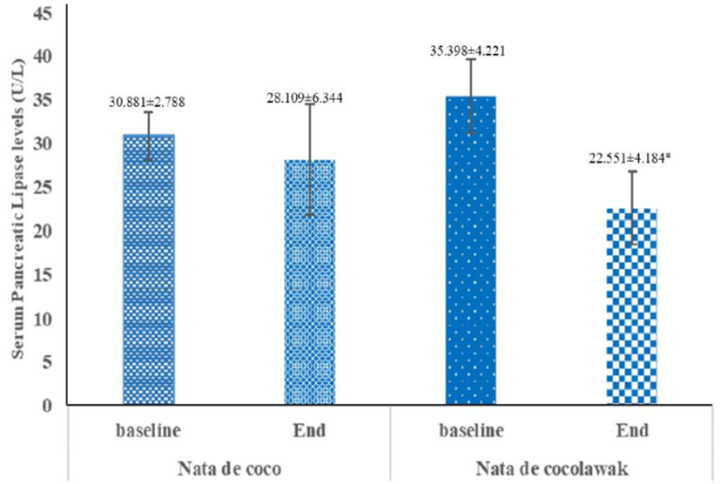
In our current study, the obtained results in Figure 1 show that nata de cocolawak supplementation reduced the level of serum pancreatic lipase significantly (p<0.05) compared to its baseline. Whereas, nata de coco supplementation not significantly (p>0.05) reduced the level of pancreatic lipase compared to its baseline. Many in vitro studies reported that curcumin 42 and Curcuma xanthorrhiza Roxb. 43, tannins, flavonoids, and alkaloids are active inhibitors of pancreatic lipase 44, 45, 46.

Fortification temulawak juice on nata de coco product may affect the organoleptic of product. The sensory scores of nata de coco and nata de cocolawak products are shown in Table 4. The result shows that there was significantly (p<0.05) difference color in nata de coco and nata de cocolawak products. Nata de coco products were white, while nata de cocolawak products were yellow. This yellow color comes from the content of curcumin in nata de cocolawak products. The sensory score of texture, aroma, taste, and overall acceptability are no significantly difference (p>0.05). This sensory score results might indicate that fortification temulawak extract on nata de coco product might not play any sensory role.
Nata de cocolawak product contains ascorbic acid, catechin, rutin, quercetin, alkaloids, and curcumin. Supplementation of nata de cocolawak to healthy women significantly reduced total serum-cholesterol, LDL-cholesterol, and serum pancreatic lipase levels compared to its baseline. It is also significantly increased HDL-cholesterol levels compared to its baseline. Based on these results, nata de cocolawak supplementation potential to be used as adjunct therapy for dyslipidemia condition.
The authors declare no conflict of interest.
The authors would like to express their gratitude toward Sriwijaya University Clinic for facilitating clinical biochemical analysis during this study.
| [1] | Hokanson J.E., Austin M.A., “Plasma triglyceride level is a risk factor for cardiovascular disease independent of high-density lipoprotein cholesterol level: a metaanalysis of population-based prospective studies”, J Cardiovasc Risk, 3. 213-219. 1996. | ||
| In article | View Article | ||
| [2] | Karthikeyan G., Teo K.K., Islam S., McQueen M.J., Pais P., Wang X., Sato H., Lang C.C., Sitthi-Amorn C., Pandey M.R., Kazmi K., Sanderson J.E., Yusuf S., “Lipid Profile, Plasma Apolipoproteins, and Risk of a First Myocardial Infarction Among Asians: An Analysis From the INTERHEART Study”, J Am Coll Cardiol, 53. 244-253. 2009. | ||
| In article | View Article PubMed | ||
| [3] | Nugroho, A.E., Malik, A., Pramono, S., “Total Phenolic and Flavonoid Contents, and In Vitro Antihypertension Activity of Purified Extract of Indonesian Cashew Leaves (Anacardium occidentale L.)”, International Food Research Journal, 20(1). 299-305. 2013. | ||
| In article | |||
| [4] | Brown L., Rosner B., Willet W., Sacks S.M., “Cholesterol-lowering effects of dietary fiber: a meta-analysis”, Am J Clin Nutr, 69. 30-42. 1999. | ||
| In article | View Article PubMed | ||
| [5] | U.S. Department of Health and Human Services. Food and Drug Administration, Food labeling: health claims; soluble fiber from certain foods and coronary heart disease: proposed rule, Federal Register, 1997, 62.28234-45. | ||
| In article | |||
| [6] | U.S. Department of Health and Human Services. Food and Drug Administration, Food labeling: health claims; soluble fiber from certain foods and coronary heart disease: final rule, Federal Register, 1998, 63.8103-8121. | ||
| In article | |||
| [7] | Rideout T.C, Harding S.V., Jones P.J., Fan M.Z., “Guar gum and similar soluble fibers in the regulation of cholesterol metabolism: current understandings and future research priorities”, Vasc Health Risk Manag, 4.1023-1033. 2008. | ||
| In article | View Article PubMed PubMed | ||
| [8] | National Standardization Department, Indonesian National Standard for nata in packaging. SNI 01-4317-1996. | ||
| In article | |||
| [9] | Zingg, J.M., Hasan, S.T., Meydani, M., “Review Article: Molecular Mechanism of Hypolipidemic Effect of Curcumin”, BioFactors, 39(1). 101-121. 2013. | ||
| In article | View Article PubMed | ||
| [10] | Solihah, I., Miksusanti, Novita, R.P., Ramadhan, S.Y., “Determination of quality parameters in nata de cocolawak as hepatoprotector functional food”, J.Phys: Conf.Ser, 1282. 012067. 2019. | ||
| In article | View Article | ||
| [11] | Mitic S.S., Kostic D.A., Naskovic-Dokic D.C., Mitic, M.N., “Rapid and Reliable HPLC method for the determination of Vitamin C in Pharmaceutical samples”, Trop. J. Pharmaceutical Res., 10(1). 105-111. 2011. | ||
| In article | View Article | ||
| [12] | Ibrahim, Y.A., Musa., A., Yakasai, I.A., “Spectrophotometric method for determination of catechins in green tea and herbal formulations”, Nigerian Journal of Pharmaceutical Sciences, 6 (1). 25-30. 2017. | ||
| In article | |||
| [13] | Xu, H., Li, Y., Tang, H.W., Liu, C.M., Wu., Q.S., “Determination of rutin with UV-Vis spectrophotometric and laser-induced flourimetric detection using a non-scanning spectrometer”, Analytical Letters, 43. 893-904. 2010. | ||
| In article | View Article | ||
| [14] | Shiyan, S., Hertiani, T., Martien, R., Nugroho, A.K. “Optimization of a novel kinetic-assisted infundation for rich-egg and polyphenols of white tea (Camellia sinensis) using central composite design”, Int.J of Applied Pharmaceutics. 10(6). 259-268. 2018. | ||
| In article | View Article | ||
| [15] | Shamsa, F., Monsef, H., Ghamooshi, R. & Verdian-rizi, M., “Spectrophotometric determinaton of total alkaloid in Peganum harmala L. using bromocresol green”, Res J Phytochem, 1(2). 79 − 82. 2007. | ||
| In article | View Article | ||
| [16] | Larmond, E. Laboratory methods for sensory evaluation of food (Publication No. 1637), Ottawa: Research Branch, Canada Department of Agriculture. 19-63. 1977. | ||
| In article | |||
| [17] | Rahim A., Kadir S., Jusman J., Zulkipli Z., Hambali T.N.A., “Physical, chemical and sensory characteristics of bread with different concentrations of acetylated arenga starches”, Int. Food Res. Journal. 26(3). 841-848. 2019. | ||
| In article | |||
| [18] | Wientarsih, I., Chakeredza, S., Meulen, U.t., “Influence of curcuma (Curcuma xanthorrhiza Roxb.) on lipid metabolism in rabbits”, J.Sci Food Agric, 82. 1875-1880. 2002. | ||
| In article | View Article | ||
| [19] | McRae MP. “Vitamin C supplementation lowers serum low-density lipoprotein cholesterol and triglycerides: a meta-analysis of 13 randomized controlled trials”, Journal of Chiropractic Medicine; 7. 48-58. 2008. | ||
| In article | View Article PubMed PubMed | ||
| [20] | Samavat, H., Newman, A.R., Wang, R., Yuan, J.M., Wu, A.H., Kurzer, M.S., “Effect of green tea catechin extract on serum lipids in postmenopausal women: a randomized, placebo-controlled clinical trial”, Am J Clin Nutr, 104. 1671-82. 2016. | ||
| In article | View Article PubMed PubMed | ||
| [21] | Katsube T, Imawaka N, Kawano Y, Yamazaki Y, Shiwaku K,Yamane Y., “Antioxidant flavonol glycosides in mulberry (Morus alba L.) leaves isolated based on LDL antioxidant activity”, Food Chem, 97. 25-31. 2006. | ||
| In article | View Article | ||
| [22] | Ziaee, A., Zamansoltani, F., Nassiri-Asl, M., Abbasi, E., “Effect of Rutin on Lipid Profile in Hypercholesterolaemic Rats”, Basic & Clinical Pharmacology & Toxicology, 104. 253-258. 2008. | ||
| In article | View Article PubMed | ||
| [23] | Talirevic, E. and Sehovic, J., “Quercetin in the treatment of dyslipidemia”, MED ARH, 66(2). 87-88. 2012. | ||
| In article | View Article PubMed | ||
| [24] | He, K., Kou, S., Zou, Z., Hu, Y., Feng, M., Han, B., Li, X., Ye, X., “Hypolipidemic effects of alkaloid from rhizome Coptidis in diet-induced hyperlipidemic Hamsters”, Planta Med, 82. 690-697. 2015. | ||
| In article | View Article PubMed | ||
| [25] | Zhang, X., Jin, Y., Wu, Y., Zhang, C., Jin, D., Zheng, Q., Li, Y., “Anti-hyperglicemic and anti-hyperlipidemia effect of the alkaloid-rich extract from barks of Litsea glutinosa in ob/ob mice”, Scientific Reports, 8. 12646. 2018. | ||
| In article | View Article PubMed PubMed | ||
| [26] | Chattopadhyay I., Biswas K., Bandyopadhyay U., Banerjee R.K., “Turmeric and curcumin: biological actions and medicinal applications”, Current Science, 87. 44-53. 2004. | ||
| In article | |||
| [27] | Manikandan P., Sumitra M., Aishwarya S., Manohar B.M., Lokanadam B., Puvanakrishnan R. “Curcumin modulates free radical quenching in myocardial ischaemia in rats”, International Journal of Biochemistry and Cell Biology, 6. 1967-1980. 2004. | ||
| In article | View Article PubMed | ||
| [28] | Mantena, S.K., Jagadish, Badduri S.R., Siripurapu K.B., Unnikrishnan, M.K., “In vitro evaluation of antioxidant properties of Cocos nucifera Linn.water”, Nahrung, 47(2).126-131. 2003 | ||
| In article | View Article PubMed | ||
| [29] | Halliwell, B., Gutteridge, J.M.C., Biochem. J. 1-14. 1984 | ||
| In article | |||
| [30] | Krishnankutty, S., in: Thampan, P.K., Markose, V.T., Pankajakshan, A.S., Edachal, M., Nandakumar, T.B., (Eds), Processing and marketing of coconuts in India, Coconut Development Board, Ministry of Agriculture, Government of India, Kochi, 70-76. 1987 | ||
| In article | |||
| [31] | Elliot, S., Brimacombe, J., “The Medicinal Plants of Gunung Leuser National Park, Indonesia”, Ethnopharmacol. 19(3). 285-317. 1987. | ||
| In article | View Article | ||
| [32] | Mauren, FM., Yanti, Lay, BW., “Efficacy of oral curcuminoid fraction from Curcuma xanthorrhiza and curcuminoid cider in high-cholesterol fed rats”, Pharmacognosy Res. 8(3). 153-159. 2016. | ||
| In article | View Article PubMed PubMed | ||
| [33] | Bertges LC., Souza JB., Cardoso VA, “Hyperlipidemia induced by triton WR1339 (Tyloxapol) in wistar rats”, Braz J Med Sci Health. 1. 32-34. 2011. | ||
| In article | |||
| [34] | Ramirez-Tortosa MC., Mesa MD., Aguilera MC., Quiles JL., Baro L., Ramirez-Tortosa Cl., et al, “Oral administration of a turmeric extract inhibits LDL oxidation and has hypocholesterolemic effects in rabbits with experimental atherosclerosis”, 147. 371-378. 1999. | ||
| In article | View Article | ||
| [35] | Murugan P., Pari L, “Effect of tetrahydrocurcumin on lipid peroxidation and lipids in streptozotocin-nicotinamide-induced diabetic rats”, Basic Clin Pharmacol Toxicol. 99. 122-127. 2006. | ||
| In article | View Article PubMed | ||
| [36] | Babu PS., Srinivasan K, “Hypolipidemic action of curcumin, the active principle of turmeric (Curcuma longa) in streptozotocin induced diabetic rats”, Mol Cell Biochem. 166. 169-175. 1997. | ||
| In article | |||
| [37] | Jacqmain M, Doucet E, Despres JP, Bouchard C, Tremblay A., “Calcium intake, body composition, and lipoprotein-lipid concentrations in adults”, Am J Clin Nutr, 77. 1448-52. 2003. | ||
| In article | View Article PubMed | ||
| [38] | Ranasinghe, P., Wathurapatha W.S., Ishara, M.H., Jayawardana, R., Galappatthy P., Katulanda, P., Constantine, G.R., “Effect of Zinc supplementation on serum lipids: a systematic review and -meta-analysis”, Nutrition & Metabolism, 12(26). 1-16 2015. | ||
| In article | View Article PubMed PubMed | ||
| [39] | Veeramachaneni, G.K., Raj, K. K., Chalasani, L. M., Annamraju, S. K., B. Js, and Talluri, V. “Shape based virtual screening and molecular docking towards designing novel pancreatic lipase inhibitors,” Bioinformation, 11(12). 535-542. 2015. | ||
| In article | View Article PubMed PubMed | ||
| [40] | Birari, R. B. and Bhutani, K. K. “Pancreatic lipase inhibitors from natural sources: unexplored potential,” Drug Discovery Today, 12 (19-20). 879-889. 2007. | ||
| In article | View Article PubMed | ||
| [41] | Ahn, J.H., Liu, Q., Lee, C. et al., “A new pancreatic lipase inhibitor from Broussonetia kanzinoki,” Bioorganic and Medicinal Chemistry Letters, 22(8). 2760-2763. 2012. | ||
| In article | View Article PubMed | ||
| [42] | Kim, T.H., Kim, J.K., Ito, H., Jo., C., “Enhancement of pancreatic lipase inhibitory activity of curcumin by radiolytic transformation”, Bioorganic and Medicinal Chemistry Letters, 21. 1512-1514. 2011. | ||
| In article | View Article PubMed | ||
| [43] | Ado, M.A., Abas, F., Mohammed A.S., Ghazali, M., “Anti-and pro-Lipase activity of selected medicinal, herbal, and aquatic plants, and structure elucidation of an anti-lipase compound”, Molecules, 18. 14651-69. 2013. | ||
| In article | View Article PubMed PubMed | ||
| [44] | Thomas, S.; Patil, D.A.; Patil, A.G.; Chandra, N. “Pharmacognostic evaluation and physicochemical analysis of Averrhoa carambola L. fruit”, J. Herbal Med. Toxicol, 2. 51-54. 2008. | ||
| In article | |||
| [45] | Liu, H., Di, Y., Yang, J., Teng, F., Lu, Y., Ni, W., Chen, C., Hao, X., “Three novel 3,4-seco-podocarpane trinorditerpenoids from Aleurites moluccana”, Tetrahedron Lett, 49. 5150-5151. 2008. | ||
| In article | View Article | ||
| [46] | Mackeen, M.M., Ali, A.M., Abdullah, M.A., Nasir, R.M., Mat, N.B., Razak, A.R., Kawazu, K., “Antinematodal activity of some Malaysian plant extracts against the pine wood nematode, Bursaphelenchus xylophilus”, Pestic. Sci. 51. 165-170. 1997. | ||
| In article | View Article | ||
Published with license by Science and Education Publishing, Copyright © 2019 Indah Solihah, Rennie Puspa Novita, Ina Suci Pratiwi and Miksusanti
 This work is licensed under a Creative Commons Attribution 4.0 International License. To view a copy of this license, visit
http://creativecommons.org/licenses/by/4.0/
This work is licensed under a Creative Commons Attribution 4.0 International License. To view a copy of this license, visit
http://creativecommons.org/licenses/by/4.0/
| [1] | Hokanson J.E., Austin M.A., “Plasma triglyceride level is a risk factor for cardiovascular disease independent of high-density lipoprotein cholesterol level: a metaanalysis of population-based prospective studies”, J Cardiovasc Risk, 3. 213-219. 1996. | ||
| In article | View Article | ||
| [2] | Karthikeyan G., Teo K.K., Islam S., McQueen M.J., Pais P., Wang X., Sato H., Lang C.C., Sitthi-Amorn C., Pandey M.R., Kazmi K., Sanderson J.E., Yusuf S., “Lipid Profile, Plasma Apolipoproteins, and Risk of a First Myocardial Infarction Among Asians: An Analysis From the INTERHEART Study”, J Am Coll Cardiol, 53. 244-253. 2009. | ||
| In article | View Article PubMed | ||
| [3] | Nugroho, A.E., Malik, A., Pramono, S., “Total Phenolic and Flavonoid Contents, and In Vitro Antihypertension Activity of Purified Extract of Indonesian Cashew Leaves (Anacardium occidentale L.)”, International Food Research Journal, 20(1). 299-305. 2013. | ||
| In article | |||
| [4] | Brown L., Rosner B., Willet W., Sacks S.M., “Cholesterol-lowering effects of dietary fiber: a meta-analysis”, Am J Clin Nutr, 69. 30-42. 1999. | ||
| In article | View Article PubMed | ||
| [5] | U.S. Department of Health and Human Services. Food and Drug Administration, Food labeling: health claims; soluble fiber from certain foods and coronary heart disease: proposed rule, Federal Register, 1997, 62.28234-45. | ||
| In article | |||
| [6] | U.S. Department of Health and Human Services. Food and Drug Administration, Food labeling: health claims; soluble fiber from certain foods and coronary heart disease: final rule, Federal Register, 1998, 63.8103-8121. | ||
| In article | |||
| [7] | Rideout T.C, Harding S.V., Jones P.J., Fan M.Z., “Guar gum and similar soluble fibers in the regulation of cholesterol metabolism: current understandings and future research priorities”, Vasc Health Risk Manag, 4.1023-1033. 2008. | ||
| In article | View Article PubMed PubMed | ||
| [8] | National Standardization Department, Indonesian National Standard for nata in packaging. SNI 01-4317-1996. | ||
| In article | |||
| [9] | Zingg, J.M., Hasan, S.T., Meydani, M., “Review Article: Molecular Mechanism of Hypolipidemic Effect of Curcumin”, BioFactors, 39(1). 101-121. 2013. | ||
| In article | View Article PubMed | ||
| [10] | Solihah, I., Miksusanti, Novita, R.P., Ramadhan, S.Y., “Determination of quality parameters in nata de cocolawak as hepatoprotector functional food”, J.Phys: Conf.Ser, 1282. 012067. 2019. | ||
| In article | View Article | ||
| [11] | Mitic S.S., Kostic D.A., Naskovic-Dokic D.C., Mitic, M.N., “Rapid and Reliable HPLC method for the determination of Vitamin C in Pharmaceutical samples”, Trop. J. Pharmaceutical Res., 10(1). 105-111. 2011. | ||
| In article | View Article | ||
| [12] | Ibrahim, Y.A., Musa., A., Yakasai, I.A., “Spectrophotometric method for determination of catechins in green tea and herbal formulations”, Nigerian Journal of Pharmaceutical Sciences, 6 (1). 25-30. 2017. | ||
| In article | |||
| [13] | Xu, H., Li, Y., Tang, H.W., Liu, C.M., Wu., Q.S., “Determination of rutin with UV-Vis spectrophotometric and laser-induced flourimetric detection using a non-scanning spectrometer”, Analytical Letters, 43. 893-904. 2010. | ||
| In article | View Article | ||
| [14] | Shiyan, S., Hertiani, T., Martien, R., Nugroho, A.K. “Optimization of a novel kinetic-assisted infundation for rich-egg and polyphenols of white tea (Camellia sinensis) using central composite design”, Int.J of Applied Pharmaceutics. 10(6). 259-268. 2018. | ||
| In article | View Article | ||
| [15] | Shamsa, F., Monsef, H., Ghamooshi, R. & Verdian-rizi, M., “Spectrophotometric determinaton of total alkaloid in Peganum harmala L. using bromocresol green”, Res J Phytochem, 1(2). 79 − 82. 2007. | ||
| In article | View Article | ||
| [16] | Larmond, E. Laboratory methods for sensory evaluation of food (Publication No. 1637), Ottawa: Research Branch, Canada Department of Agriculture. 19-63. 1977. | ||
| In article | |||
| [17] | Rahim A., Kadir S., Jusman J., Zulkipli Z., Hambali T.N.A., “Physical, chemical and sensory characteristics of bread with different concentrations of acetylated arenga starches”, Int. Food Res. Journal. 26(3). 841-848. 2019. | ||
| In article | |||
| [18] | Wientarsih, I., Chakeredza, S., Meulen, U.t., “Influence of curcuma (Curcuma xanthorrhiza Roxb.) on lipid metabolism in rabbits”, J.Sci Food Agric, 82. 1875-1880. 2002. | ||
| In article | View Article | ||
| [19] | McRae MP. “Vitamin C supplementation lowers serum low-density lipoprotein cholesterol and triglycerides: a meta-analysis of 13 randomized controlled trials”, Journal of Chiropractic Medicine; 7. 48-58. 2008. | ||
| In article | View Article PubMed PubMed | ||
| [20] | Samavat, H., Newman, A.R., Wang, R., Yuan, J.M., Wu, A.H., Kurzer, M.S., “Effect of green tea catechin extract on serum lipids in postmenopausal women: a randomized, placebo-controlled clinical trial”, Am J Clin Nutr, 104. 1671-82. 2016. | ||
| In article | View Article PubMed PubMed | ||
| [21] | Katsube T, Imawaka N, Kawano Y, Yamazaki Y, Shiwaku K,Yamane Y., “Antioxidant flavonol glycosides in mulberry (Morus alba L.) leaves isolated based on LDL antioxidant activity”, Food Chem, 97. 25-31. 2006. | ||
| In article | View Article | ||
| [22] | Ziaee, A., Zamansoltani, F., Nassiri-Asl, M., Abbasi, E., “Effect of Rutin on Lipid Profile in Hypercholesterolaemic Rats”, Basic & Clinical Pharmacology & Toxicology, 104. 253-258. 2008. | ||
| In article | View Article PubMed | ||
| [23] | Talirevic, E. and Sehovic, J., “Quercetin in the treatment of dyslipidemia”, MED ARH, 66(2). 87-88. 2012. | ||
| In article | View Article PubMed | ||
| [24] | He, K., Kou, S., Zou, Z., Hu, Y., Feng, M., Han, B., Li, X., Ye, X., “Hypolipidemic effects of alkaloid from rhizome Coptidis in diet-induced hyperlipidemic Hamsters”, Planta Med, 82. 690-697. 2015. | ||
| In article | View Article PubMed | ||
| [25] | Zhang, X., Jin, Y., Wu, Y., Zhang, C., Jin, D., Zheng, Q., Li, Y., “Anti-hyperglicemic and anti-hyperlipidemia effect of the alkaloid-rich extract from barks of Litsea glutinosa in ob/ob mice”, Scientific Reports, 8. 12646. 2018. | ||
| In article | View Article PubMed PubMed | ||
| [26] | Chattopadhyay I., Biswas K., Bandyopadhyay U., Banerjee R.K., “Turmeric and curcumin: biological actions and medicinal applications”, Current Science, 87. 44-53. 2004. | ||
| In article | |||
| [27] | Manikandan P., Sumitra M., Aishwarya S., Manohar B.M., Lokanadam B., Puvanakrishnan R. “Curcumin modulates free radical quenching in myocardial ischaemia in rats”, International Journal of Biochemistry and Cell Biology, 6. 1967-1980. 2004. | ||
| In article | View Article PubMed | ||
| [28] | Mantena, S.K., Jagadish, Badduri S.R., Siripurapu K.B., Unnikrishnan, M.K., “In vitro evaluation of antioxidant properties of Cocos nucifera Linn.water”, Nahrung, 47(2).126-131. 2003 | ||
| In article | View Article PubMed | ||
| [29] | Halliwell, B., Gutteridge, J.M.C., Biochem. J. 1-14. 1984 | ||
| In article | |||
| [30] | Krishnankutty, S., in: Thampan, P.K., Markose, V.T., Pankajakshan, A.S., Edachal, M., Nandakumar, T.B., (Eds), Processing and marketing of coconuts in India, Coconut Development Board, Ministry of Agriculture, Government of India, Kochi, 70-76. 1987 | ||
| In article | |||
| [31] | Elliot, S., Brimacombe, J., “The Medicinal Plants of Gunung Leuser National Park, Indonesia”, Ethnopharmacol. 19(3). 285-317. 1987. | ||
| In article | View Article | ||
| [32] | Mauren, FM., Yanti, Lay, BW., “Efficacy of oral curcuminoid fraction from Curcuma xanthorrhiza and curcuminoid cider in high-cholesterol fed rats”, Pharmacognosy Res. 8(3). 153-159. 2016. | ||
| In article | View Article PubMed PubMed | ||
| [33] | Bertges LC., Souza JB., Cardoso VA, “Hyperlipidemia induced by triton WR1339 (Tyloxapol) in wistar rats”, Braz J Med Sci Health. 1. 32-34. 2011. | ||
| In article | |||
| [34] | Ramirez-Tortosa MC., Mesa MD., Aguilera MC., Quiles JL., Baro L., Ramirez-Tortosa Cl., et al, “Oral administration of a turmeric extract inhibits LDL oxidation and has hypocholesterolemic effects in rabbits with experimental atherosclerosis”, 147. 371-378. 1999. | ||
| In article | View Article | ||
| [35] | Murugan P., Pari L, “Effect of tetrahydrocurcumin on lipid peroxidation and lipids in streptozotocin-nicotinamide-induced diabetic rats”, Basic Clin Pharmacol Toxicol. 99. 122-127. 2006. | ||
| In article | View Article PubMed | ||
| [36] | Babu PS., Srinivasan K, “Hypolipidemic action of curcumin, the active principle of turmeric (Curcuma longa) in streptozotocin induced diabetic rats”, Mol Cell Biochem. 166. 169-175. 1997. | ||
| In article | |||
| [37] | Jacqmain M, Doucet E, Despres JP, Bouchard C, Tremblay A., “Calcium intake, body composition, and lipoprotein-lipid concentrations in adults”, Am J Clin Nutr, 77. 1448-52. 2003. | ||
| In article | View Article PubMed | ||
| [38] | Ranasinghe, P., Wathurapatha W.S., Ishara, M.H., Jayawardana, R., Galappatthy P., Katulanda, P., Constantine, G.R., “Effect of Zinc supplementation on serum lipids: a systematic review and -meta-analysis”, Nutrition & Metabolism, 12(26). 1-16 2015. | ||
| In article | View Article PubMed PubMed | ||
| [39] | Veeramachaneni, G.K., Raj, K. K., Chalasani, L. M., Annamraju, S. K., B. Js, and Talluri, V. “Shape based virtual screening and molecular docking towards designing novel pancreatic lipase inhibitors,” Bioinformation, 11(12). 535-542. 2015. | ||
| In article | View Article PubMed PubMed | ||
| [40] | Birari, R. B. and Bhutani, K. K. “Pancreatic lipase inhibitors from natural sources: unexplored potential,” Drug Discovery Today, 12 (19-20). 879-889. 2007. | ||
| In article | View Article PubMed | ||
| [41] | Ahn, J.H., Liu, Q., Lee, C. et al., “A new pancreatic lipase inhibitor from Broussonetia kanzinoki,” Bioorganic and Medicinal Chemistry Letters, 22(8). 2760-2763. 2012. | ||
| In article | View Article PubMed | ||
| [42] | Kim, T.H., Kim, J.K., Ito, H., Jo., C., “Enhancement of pancreatic lipase inhibitory activity of curcumin by radiolytic transformation”, Bioorganic and Medicinal Chemistry Letters, 21. 1512-1514. 2011. | ||
| In article | View Article PubMed | ||
| [43] | Ado, M.A., Abas, F., Mohammed A.S., Ghazali, M., “Anti-and pro-Lipase activity of selected medicinal, herbal, and aquatic plants, and structure elucidation of an anti-lipase compound”, Molecules, 18. 14651-69. 2013. | ||
| In article | View Article PubMed PubMed | ||
| [44] | Thomas, S.; Patil, D.A.; Patil, A.G.; Chandra, N. “Pharmacognostic evaluation and physicochemical analysis of Averrhoa carambola L. fruit”, J. Herbal Med. Toxicol, 2. 51-54. 2008. | ||
| In article | |||
| [45] | Liu, H., Di, Y., Yang, J., Teng, F., Lu, Y., Ni, W., Chen, C., Hao, X., “Three novel 3,4-seco-podocarpane trinorditerpenoids from Aleurites moluccana”, Tetrahedron Lett, 49. 5150-5151. 2008. | ||
| In article | View Article | ||
| [46] | Mackeen, M.M., Ali, A.M., Abdullah, M.A., Nasir, R.M., Mat, N.B., Razak, A.R., Kawazu, K., “Antinematodal activity of some Malaysian plant extracts against the pine wood nematode, Bursaphelenchus xylophilus”, Pestic. Sci. 51. 165-170. 1997. | ||
| In article | View Article | ||


 (*The significant difference between baseline (p-value = 0.040) is examined using t-test.))