sciepub.com
 Quick Submission

The Defensive Role of Antioxidants Astaxanthin against Oxidative Damage in Diabetic Rats Injected with Streptozotocin
Mohammed Said Moosa Al-Bulish1, 2, Changhu Xue1, Mostafa I. Waly2, Jie Xu1, Yuming Wang1, Qing-Juan Tang1,
1College of Food Science and Engineering, Ocean University of China, Qingdao City, Shandong Province, P.R.China
2Food Science and Nutrition Department, College of Agricultural and Marine Sciences, Sultan Qaboos University, Oman
Abstract
Background: Astaxanthin (ASTA) is a carotenoid which has anti-tumor, anti-diabetic, anti-inflammatory and cardio protective properties and is also a powerful antioxidant. Objective: Consumption of antioxidant-rich foods reduces cellular oxidative stress related health problems. This study aims to assess the antioxidant properties of ASTA, against hydrogen peroxide induced oxidative stress and antioxidant potential properties of ASTA in diabetic rats. Materials and Methods: Streptozotocin (STZ) drug was used as a diabetogenic agent in a single intraperitoneal injection dose of 60 mg/kg body weight of male Sprague-Dawley rats. Diabetic and non-diabetic rats were fed chow diet plus oral feeding contained ASTA. After 12 weeks, following STZ injection, all animals were overnight fasted and then sacrificed; pancreas tissues were homogenized for antioxidant measurements and histopathological examination was done. Results: A significant change in lipid and protein contents of pancreatic tissue was observed, however, this change was reversed after treatment with ASTA. Conclusion: the results of this in-vivo study demonstrated that astaxanthin has a protective effect against STZ-induced hyperglycemia and pancreatic cell injury.
Keywords: Astaxanthin, Diabetes, Oxidative stress, arotenoid streptozotocin
Copyright © 2017 Science and Education Publishing. All Rights Reserved.Cite this article:
- Mohammed Said Moosa Al-Bulish, Changhu Xue, Mostafa I. Waly, Jie Xu, Yuming Wang, Qing-Juan Tang. The Defensive Role of Antioxidants Astaxanthin against Oxidative Damage in Diabetic Rats Injected with Streptozotocin. Journal of Food and Nutrition Research. Vol. 5, No. 3, 2017, pp 191-196. http://pubs.sciepub.com/jfnr/5/3/9
- Al-Bulish, Mohammed Said Moosa, et al. "The Defensive Role of Antioxidants Astaxanthin against Oxidative Damage in Diabetic Rats Injected with Streptozotocin." Journal of Food and Nutrition Research 5.3 (2017): 191-196.
- Al-Bulish, M. S. M. , Xue, C. , Waly, M. I. , Xu, J. , Wang, Y. , & Tang, Q. (2017). The Defensive Role of Antioxidants Astaxanthin against Oxidative Damage in Diabetic Rats Injected with Streptozotocin. Journal of Food and Nutrition Research, 5(3), 191-196.
- Al-Bulish, Mohammed Said Moosa, Changhu Xue, Mostafa I. Waly, Jie Xu, Yuming Wang, and Qing-Juan Tang. "The Defensive Role of Antioxidants Astaxanthin against Oxidative Damage in Diabetic Rats Injected with Streptozotocin." Journal of Food and Nutrition Research 5, no. 3 (2017): 191-196.
| Import into BibTeX | Import into EndNote | Import into RefMan | Import into RefWorks |
At a glance: Figures
1. Introduction
Diabetes Mellitus is the most perilous consequences of human civilization. It involves the body’s production or utilization of insulin, and is identified as either Type 1 or Type 2. Type 1diabetes also known as childhood diabetes Characterized by beta cell destruction leading to absolute insulin deficiency. Type 2 (adult onset) diabetes results from the inability of the body to effectively utilize insulin which leaves it unable to break down the glucose in the blood stream [1].
An excess of glucose concentration in the blood stream, is termed as hyperglycemia, is usually associated with long term damage, dysfunction or even failure of various organs, especially the eyes, kidneys, nerves, heart and blood vessels [2, 3]. It is estimated that 347 million people have Type 2 diabetes, with 1.5 million deaths in 2012 directly attributable to the disease [4, 5]. Type 2 diabetes accounts for 90% of global diabetes cases [6], with an estimated 175 million of these cases being undiagnosed [7].
Astaxanthine is a pinkish-orange carotenoid, widely and naturally distributed in various plants, microorganisms and marine organisms, including crustaceans such as shrimps and crabs; and fish such as salmon and sea bream. When these aquatic plants and algae are eaten by shrimps and crustaceans, the pigment imparts its reddish hue to their shells. Astaxanthin, has a unique structure, and works in unique ways. Most other antioxidants are depleted after they've transferred their free electrons. But astaxanthin has a massive surplus, allowing it to remains "active" for long enough i.e. at least more than most of the other antioxidants. It donates electrons to neutralize free radicals, and then rejects the excess energy primarily as heat. But the astaxanthin remains intact — there are no chemical reactions to break it down, which is what occurs in most other antioxidants.
Astaxanthin can protect pancreatic β-cells against glucose toxicity. It was also revealed to be a good immunological agent in the recovery of lymphocyte dysfunctions associated with diabetic rats [8]. A combination of astaxanthin with α-tocopherol ameliorated oxidative stress in streptozotocin-diabetes rats [9]. It can also inhibit glycation and glycated proteins induced cytotoxicity in human umbilical vein endothelial cells by preventing lipid/protein oxidation [10]. Improved insulin sensitivity in both spontaneously hypertensive corpulent rats and mice on high fat plus high fructose diets were observed after feeding with astaxanthin [11, 12, 13]. Astaxanthene has been proved as immunity enhancer and a potent antioxidant. Naito et al, suggested that the administration of astaxanthin might be a novel approach for the prevention of diabetes nephropathy due to reduced oxidative stress on the kidneys and renal cell damage [14, 15]. The urinary albumin level in astaxanthin treated diabetic mice was significantly lower than the control group [16].
This study is to assess the antioxidant properties of Astaxanthin, against hydrogen peroxide induced oxidative stress and antioxidant potential properties of Astaxanthin in diabetic rats injected with streptozotocin.
2. Material and Methods
2.1. ReagentsChemicals and Supplies: All chemicals and supplies were purchased from Sigma Chemical Co (St Louis, MI, USA). Astaxanthin purchased from Changsha Huakang biotechnology development Co. Ltd (Hunan, China).
2.2.1. Animals
Forty adult Sprague-Dawley rats, which were approximately 8 weeks old with a body weight of 200±20 grams were obtained from the Animal House Facility, Sultan Qaboos University, Oman. All the forty rats were kept in polypropylene cages (32 x 24 x 16 cm), exposed to 12:12 hours light-dark cycles, maintained at a room temperature of 23 ± 1°C, relative humidity 60%, and provided with free access to food and water. The protocol used in this study was approved by the Animal Ethics Committee at the Sultan Qaboos University and was in accordance with the international laws and policies [17].
2.2.2. Experimental Design
The rats were randomly divided into five groups (n=8 per group) as follows: (i) non-diabetic rats C; (ii) non-diabetic rats treated with astaxanthin ASTA; (iii) diabetic rats CD; (iv) diabetic rats treated with 5%astaxanthin ASTA5%; (v) diabetic rats treated with 10% astaxanthin ASTA10%. The control groups that received oral feeding ASTA of 2 ml extract/kg of body weight 2 days in a week. The normal control (C) and diabetic control (CD) rats were treated with the same volume of saline with the same time. Diabetes was induced in each rat in the diabetic group by a single intraperitoneal injection of streptozotocin (STZS0130, Sigma, St Louis, MO, USA) dissolved in 0.1 M citrate buffer (pH 4.5) at 60 mg/kg, while the normal control rats received a single intraperitoneal injection of 0.1M citrate buffer solution. After 72 hrs of the STZ injection, only rats with a blood glucose level over 15 mmol/lwere considered to be diabetic and included in this study. The blood glucose levels were measured from the tail vein, using a portable glucose meter (One Touch II; Johnson & Johnson, Milpitas, CA, USA), for such process, the distal part of the tail was gently snipped; the first blood drop was discarded and the second was absorbed by a test strip inserted in the glucose meter. Blood glucose levels were measured twice/week at 8:00am. Body weight of rats was taken once per week using an electronic balance (catalogue number 321-62150, Shimadzu Scientific Instruments, Columbia, USA).
The treatments started off from first week of STZ injection. At the end of the 12 weeks treatment, the animals were sacrificed by decapitation after being anesthetized with a lethal dose of a cocktail containing ketamine (1 mg), xylazine (5 mg), and acepromazine (0.2 mg). The whole pancreas tissue from each rat was removed and used for: (I) Homogenization (~50 mg in 5 ml of 100 mM potassium phosphate buffer, pH 7.2) by a glass-Teflon Homogenizer with an ice-cold jacket and centrifuged at a speed of 4,000g for 20 minutes at 4°C. The resulting supernatant was used for biochemical antioxidant markers and protein content measurements; (II) Histopathologicalexamination.
2.2. Protein ContentProtein content of pancreas tissue homogenates was assayed by the method of Lowry et al. (1951) using bovine serum albumin as standard and protein content was expressed as mg/ml of sample.
2.3. Biochemical Measurement of AntioxidantsThe biochemical parameters (total antioxidant capacity, TAC; hydrogen peroxide, H2O2 and lipid peroxidation malondialdehde, MDA) were measured according to the manufacturer’s instructions (BioVision Incorporated, Milpitas, CA USA) in each kit: GSH by assay kit K251, TAC by assay kit K274, H₂O₂ by assay kit K265, and MDA by assay kit K739. All parameters were assayed in 96 well plates and measured using Biochrom EZ Read 400 Microplate Reader (Biochrom Ltd, England).
2.4. Histopathological ExaminationPancreatic tissues were collected in 70% Ethanol solution and processed by the paraffin technique. The organ was washed, dehydrated in ascending grades of alcohol, cleared in xylene and embedded in hard paraffin wax. Serial sections of 5μm were cut using a microtome (Microm, HM, 325, Thermo Scientific, UK), mounted on glass slides, and allow drying. Sections were deparafinized in xylene and hydrated to water through descending series of alcohol. Staining was performed using hematoxylin and counterstained by 0.5 aqueous eosin and all stained sections were qualitatively evaluated using a photo microscope, magnification x400, equipped with a digital camera (Olympus DP70, Japan).
2.5. Statistical AnalysisStatistical analysis was performed using GraphPad Prism (version 5.03; GraphPad Software Inc. San Diego, CA). The results are expressed as mean ± standard deviation (SD). The statistical analysis was performed by using one way analysis of variance (ANOVA) followed by Tukey's test and Student's t-test for means comparisons, and a P-value of less than 0.05 is considered significant.
3. Results
3.1. Blood Glucose Level, Weight and Growth of RatsAll non-diabetic, G2, G4 and G5 supplemented rats grew at a similar rate and the average weight gain was 6g per week reaching (325±6.729g) at the end of the experiment. Meanwhile, in diabetic rats, there was a time-dependent loss of weight between the initial body weight (200±20 grams) and the final body weight (100±10 grams) at the end of the experiment. A remarkable observation was that the G2 and G5 supplementation in diabetic rats caused a recovery in the final body weight reaching (325±6 grams for G2 and 311±7 grams for G5) at the end of the experiment.
A remarkable observation was that the ASTA supplementation in diabetic rats caused a recovery in the final body weight reaching (330±20 grams) at the end of the experiment. The daily consumption of water and food in non-diabetic rats were noted and observed, respectively, and the same pattern was observed for ASTA supplemented groups, indicating in general that they had no interactive effects of the differences between the initial and final body weights. In diabetic rats, the daily consumption of water and food was increased and there was less in body weight and no much improvement. But, in the ASTA supplementation in diabetic rats caused a reduction of water and food consumption and recover in final body weight.





The blood glucose level was significantly elevated in STZ induced diabetic rats (18.295±1.276mmol/l) as compared to non-diabetic group (4.166±0.212mmol/l), meanwhile oral administration of astaxanthin has significantly reverted the STZ-induced hyperglycemia back to basal levels. A total of four deaths occurred in diabetic group and three in 5% diabetic group.





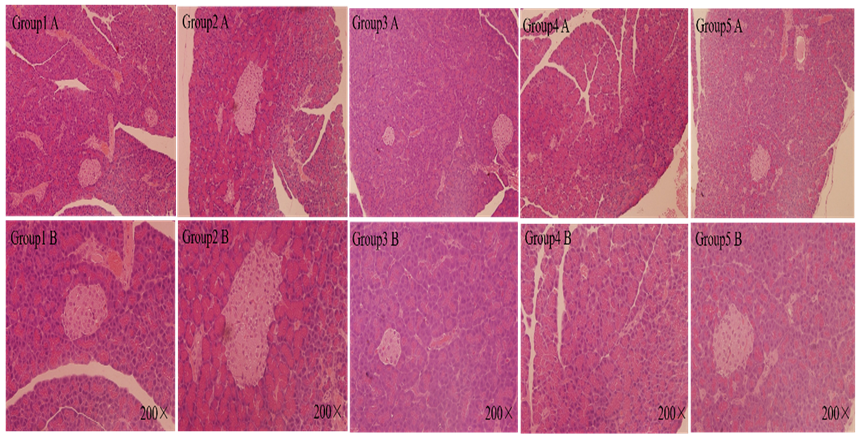
The histopathological differences of pancreatic sections for the different experimental groups were compared with the photomicrograph of the pancreas sections in non-diabetic rats, which showed typical features of normal pancreatic tissue, consisting of acini, duct and normal cell population in the islets of Langerhans (Group1). No inflammation, fibrosis, atypical cells or malignancy was seen (Group1). In contrast, the diabetic rat sections showed alterations such as demonstration of reduction in the number and size of islets of Langerhans (Group2). Sections of pancreatic tissue, consisting of acini, ducts and islets of Langerhans with minimal enlargement of cells and no apoptosis, necrosis, atypical cells or malignancy are noted with other non-diabetic groups treated with astaxanthin (Group4and Group5). Interestingly, pancreatic tissues in diabetic rats that were supplemented with astaxanthin (Group4 and Group5) showed no necrosis, with a mild reduction in the size and number of the islets, and the islet architecture is more organized and less disrupted as compared with that of the diabetic group (Group2). Accordingly, the astaxanthin treatment was able to regenerate pancreatic β-cells islets of Langerhans.
As in Figure 1; Group 1B, Pancreatic tissue shows acini, ducts and islets of Langerhans. No evidence of necrosis, atypical cells or malignancy is noted. In Group 2B, Figure 1; Pancreatic tissue shows islets of Langerhans with increased cellularity. The cells showed cytoplasmic vacuolation but no inflammation or necrosis noted. In Group3B, Figure 1; Pancreatic tissue shows enlargement of islets of Langerhans with increased cellularity. Congested blood vessels within the islets are noted. Dilated vessels between acini are also seen with no inflammation or necrosis. In Group 4B, Figure 1; Pancreatic tissue shows islets of Langerhans reduced in size and cells show degenerative changes with large vacuoles. Mild lymphocytic inflammation involving the islets is noted while no necrosis is noted. In Group 5B, Figure 1; Pancreatic tissue shows some islets of Langerhans with reduction in size. The cells show cytoplasmic degenerative changes. A few islets were enlarged with increased cellularity. Mild lymphocytic inflammation and no necrosis are seen.

 Download as
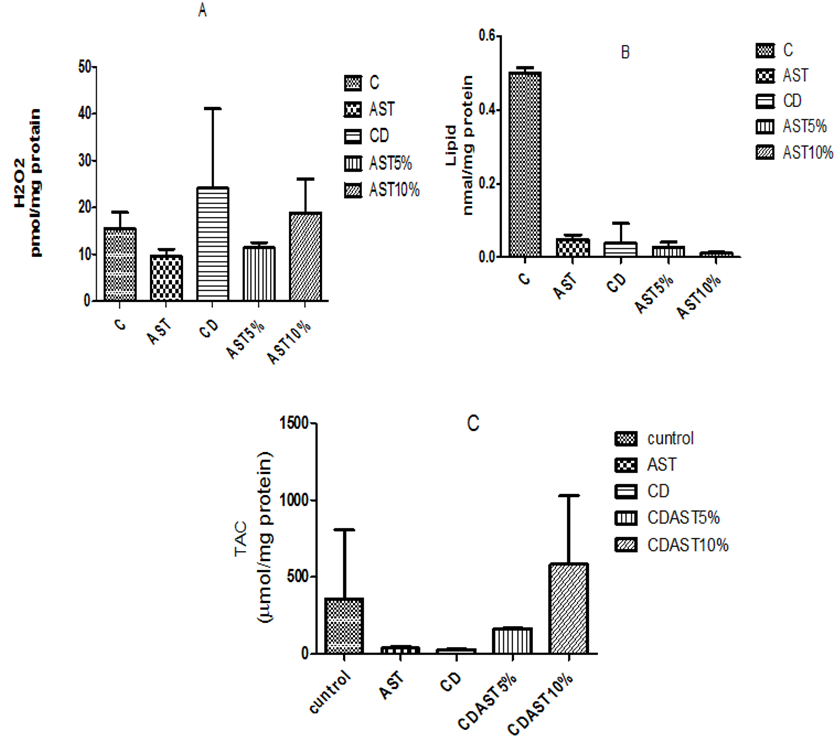
Administration of ASTA caused replenishment for the depleted glutathione in the diabetic group. By contrast, oxidative stress indices (total antioxidant capacity, H2O2 and lipid peroxidation) were significantly increased in the diabetic group compared to no-diabetic group.
The antioxidant potential properties of astaxanthin in pancreatic tissues of the diabetic rats showed significant results, H2O2 concentration is significantly elevated in diabetic group when compared to non-diabetic group. Results showed that diabetic groups treated with ASTA have significantly lowered H2O2 as compared to the observed elevated levels of H2O2 in diabetic rats.The lipid peroxidation (MDA) contents in the pancreatic homogenate of diabetic group are elevated when compared to non-diabetic group. Treatment of diabetic rats with ASTA caused significant reduction in the elevated MDA level .A similar trend was observed for total antioxidant capacity (TAC) in the diabetic rats where they showed a decreased level of TAC as compared to non-diabetic group and Diabetic rats supplemented with ASTA showed higher TAC values as compared to diabetic group and this improvement was significantly different.
 Download as
4. Discussion
The present study strongly suggests beneficial effects of ASTA supplementation for immune competence, based on the redox balance in plasma (significant increase in GSH-dependent reducing power), non-activated neutrophils (increased glutathione-recycling enzymes GPxand GR) and PMA-activated neutrophils (lower O2-, H2O2 eneration, reduced membrane oxidation, but a higher phagocytic activity) of Wistarrats. Oxidative stress results from increased production of reactive oxygen species (ROS) plays a key role in the pathogenesis of diabetic complication [18, 19].
Diabetes mellitus is a metabolic disorder characterized by hyperglycemia and insufficient secretion or action of endogenous insulin [20] predisposing to an increase of micro- and macrovascular complications [21]. Numerous researches reported that oxidative stress is a contributor to the development and progression of diabetes and its cardiovascular complications [22]. Several mechanisms can contribute to the increased oxidative stress in the diabetic patients, especially the chronic exposure to hyperglycemia. Accumulated evidence points out that hyperglycemia can lead to an elevated reactive oxygen (ROS) and nitrogen species (RNS) production of the mitochondrial respiratory system [23] glucose autoxidation [24], activation of the polyol pathway [25] formation of advanced glycation end-products (AGEs) [26], antioxidant enzyme inactivation [27] and imbalance of glutathione redox status [20]. Hyperglycemia can promote an important oxidative imbalance, favoring the production of free radicals and reduce of antioxidant defenses. At high concentrations, ROS and NS can lead to damage of the major components of the cellular structure, including nucleic acids, proteins, amino acids and lipids [28]. Such oxidative modifications in diabetes condition would affect several cell functions, metabolism and gene expression, which can cause other pathological conditions [29].
Diabetes mellitus is a global disorder that is manifested by elevated levels of blood glucose as a result of defective insulin production or action, and oxidative stress is a common factor in the etiology of diabetes [30]. TZ-induced diabetic model in animals is being increasingly utilized because of its similarity to human diabetes, as it is selectively destroyed β- pancreatic cells, insulin-producing pancreatic endocrine cells, and hence provoked experimental diabetes mellitus [31]. The cytotoxic action of STZ is related to the production of reactive oxygen species (ROS) causing oxidative damage that ends with ß-cell destruction through the induction of apoptosis and suppression of insulin biosynthesis mellitus [31]. The present study discussed the antioxidant and hypoglycemic effects of the ASTA in STZ-induced diabetic rats. In the current study, diabetic rats exhibited significantly elevated blood glucose, and oral administration of ASTA reversed the elevated glucose level in diabetic group near to basal level of the non-diabetic group. The findings of this study revealed that oral administration of ASTA has protective effect against the STZ-induced oxidative stress in pancreatic tissue as evidenced by the decrease in pancreatic MDA and H2O2 levels concomitant with a significant increase in GSH and TAC. Oxidative stress plays a significant role in the pathogenesis and the complications of diabetes, and GSH as an intracellular antioxidant is crucial for the detoxification of ROS and lipid hydroperoxide mellitus [32].
The observed depletion of GSH content in the tissues of diabetic rats and its normalization with ASTA suggested. Its potent antioxidant properties and we hypothesized that ASTA as a functional food supplement. IT decreases oxidative stress in-vivo due to both of improved antioxidant activities and decreased peroxidation processes. Therefore, ASTA might help positively in glycemic control and probably improving cellular redox potential of risk groups. The histopathological examination in this study reported that STZ produced an incomplete destruction of β- pancreatic cells even though rats became permanently diabetic. The regeneration of β-pancreatic cells is reported in our study following treatment of diabetic rats with ASTA. This novel findings suggested that the hypoglycemic activity of the ASTA might be attributed to the regeneration of β- pancreatic cells in STZ – indced diabetic rats. Hence enhancing insulin sensitivity and activation of glucose uptake by peripheral tissue. Another mechanism that was suggested is that ASTA via its antioxidant properties prevents the death of β- pancreatic cells, allowing healing of partially destroyed cells under the effect of STZ as an oxidizing agent mellitus [33].
5. Conclusion
ASTA and other carotenoids are considered to be beneficial in the prevention of a variety of major diseases, including cardiovascular disease, cancer and diabetes [34]. We found that the hydrogen peroxide significantly modify the neutrophils in STZ induced diabetic rats. However, treatment of rats with ASTA during 30 days, at a dose of 20mg/kg of body weight was not effective in preventing increased ROS production, but was able to prevent the increasing oxidative stress biomarkers.
Acknowledgements
The authors deeply extend their appreciation to the Sultan Qaboos University, Department of Food Science and Nutrition, College of Agricultural and Marine Sciences and to, Mohamed A. Al-Kindi and Halima K. Al-Issaei from Pathology Department, College of Medicine and Health Sciencesans to Nasneen Althaf1, Sultan N.M. Al-Maskari, Bader R.S Al-Ruqaishi from Small Animal House, College Of Medicine and Health Sciences. This work was supported by the National Natural Science Foundation of China (grant number 31330060, 31571864).
References
| [1] | World Health Organization. Library Cataloguing-in-Publication Data World health statistics 2014: ISBN 978 92 4 156471 7(NLM classification: WA 900.1), Geneva 2014. | ||
 In article In article | |||
| [2] | Grundy S.M., Brewer H.B., Jr., Cleeman J.I., Smith S.C., Jr., Lenfant C. Definition of metabolic syndrome: report of the National Heart, Lung, and Blood Institute/American Heart Association conference on scientific issues related to definition. Circulation. 2004:09:43:38. | ||
| In article | |||
| [3] | Global Atlas on Cardiovascular Disease Prevention and Control. Mendis S, Puska P, Norrving B editors. World Health Organization, Geneva 2011. | ||
| In article | |||
| [4] | National, regional, and global trends in fasting plasma glucose and diabetes prevalence since ystematic analysis of health examination surveys and epidemiological studies with 370 country-years and 2·7 million participants.Danaei G, Finucane MM, Lu Y, Singh GM, Cowan MJ, Paciorek CJ, Lin JK, Farzadfar F, Khang YH, Stevens GA, Rao M, Ali MK, Riley LM, Robinson CA, Ezzati 2001:jul 2:378(9785)3. 1-40. | ||
| In article | |||
| [5] | Mathers, S., Eisenstadt, N., Sylva, K., Soukakou, E., & Ereky-stevens, K. Sound Foundations: a review of the research evidence on quality of early childhood education and care for children under three – Implications for policy and practice 2014. | ||
| In article | |||
| [6] | Definition, diagnosis and classification of diabetes mellitus and its complications : report of a WHO consultation. Part1, Diagnosis and classification of diabetes mellitus World Health Organization. Dept. of Noncommunicable Disease Surveillance 19999 World Health Organization1999WHO/NCD/NCS/99.259. | ||
| In article | |||
| [7] | Aguirre A, Sancho-Martinez I, Izpisua Belmonte JC. Reprogramming toward heart regeneration: stem cells and beyond. Cell Stem Cell. 2013:12: 275-284. | ||
| In article | View Article PubMed | ||
| [8] | R. Otton, D.P. Marin, A.P. Bolin, C. Santos Rde, T.G. Polotow, S.C. Sampaio, M.P. de Barros Astaxanthin ameliorates the redox imbalance in lymphocytes of experimental diabetic rats .Biol. Interact., 186 2010:pp. 306: 315. | ||
| In article | |||
| [9] | Nakano M, Orimo N, Katagiri N, Tsubata M, Takahashi J, Van Chuyen N: Inhibitory effect of astaxanthin combined with fla-vangenol on oxidative stress biomarkers in streptozotocin-in-duced diabetic rats. Int J Vitam Nutr Res 2008;78:175-182. | ||
| In article | View Article PubMed | ||
| [10] | Nishigaki I, Rajendran P, Venugopal R, Ekambaram G et al. Cytoprotective role of astaxanthin against glycated protein/iron chelate-induced toxicity in human umbilical vein endothelial cells. Phytother. Res. 2010; 24: 54-59 | ||
| In article | View Article PubMed | ||
| [11] | Hussein, G.Takako Nakagawa, Hirozo Goto, Yutaka Shimada, Astaxanthin ameliorates features of metabolic syndrome in SHR/NDmcr-cpLife Sci. 80: 522-529, 2007. | ||
| In article | |||
| [12] | Saravanan Bhuvaneswari, Elumalai Arunkumar, Periyasamy Viswanathan, Carani Venkatraman Anuradha Astaxanthin restricts weight gain, promotes insulin sensitivity and curtails fatty liver disease in mice fed a obesity-promoting diet, Process Biochem. 45: 1406-1414, 2010. | ||
| In article | View Article | ||
| [13] | Bhuvaneswari, S, Carani Venkatraman Anuradha Astaxanthin prevents loss of insulin signaling and improves glucose metabolism in liver of insulin resistant mice Can. J. Physiol. Pharmacol. 90: 1544-1552, 2012. | ||
| In article | View Article PubMed | ||
| [14] | Naito, Yuji, Uchiyama, Kazuhiko, Aoi, Wataru, Hasegawa, Goji, Nakamura, Naoto, Yoshida, Norimasa, Maoka, Takashi, Takahashi, Jiro, Yoshikawa, Toshikazu Prevention of diabetic nephropathy by treatment with astaxanthin in diabetic db/db mice.BioFactors, vol. 20, no. 1, pp. 49-59, 2004. | ||
| In article | View Article PubMed | ||
| [15] | Jinu Kim, Young Mi Seok, Kyong-Jin Jung, Kwon Moo Park .Reactive oxygen species/oxidative stress contributes to progression of kidney fibrosis following transient ischemic injury in mice ,2009 Vol. 297 no. 2, F461-F470. | ||
| In article | |||
| [16] | Kazuhiko Uchiyama, Yuji Naito, Goji Hasegawa, Naoto Nakamura, Jiro Takahashi, and Toshikazu Yoshikawa,Astaxanthin protects β-cells against glucose toxicity in diabetic db/db mice Vol. 7 , Iss. 5,2002 | ||
| In article | |||
| [17] | McPherson C: Regulation of animal care and research? NIH’s opinion. J AnimSci1980, 51(2):492-496. | ||
| In article | View Article PubMed | ||
| [18] | Lowry OH, Rosebrough NJ, Farr AL, Randall RJ. Protein measurement with the folin phenol reagent. J BiolChem 1951; 193(1): 265-275. | ||
| In article | PubMed | ||
| [19] | Baynes JW. Role of oxidative stress in development of complications in diabetes. Diabetes 1991; 40: 405-12. | ||
| In article | View Article PubMed | ||
| [20] | Giugliano D, Cerielic A, Paoliss G, 1996. Oxidative stress and diabetic vascular complication.diabetes care 19: 257-267. | ||
| In article | |||
| [21] | Maritim AC, Sanders RA, Watkins III JB. Diabetes, oxidative stress, and antioxidants: a review. J BiochemMolToxicol 2003; 17: 24-38. | ||
| In article | View Article | ||
| [22] | Schalkwijk CG, Stehouwer CD. Vascular complications in diabetes mellitus: the role of endothelial dysfunction. ClinSci 2005; 109: 143-59. | ||
| In article | View Article PubMed | ||
| [23] | Davi G, Falco A, Patrono C. Lipid peroxidation in diabetes mellitus. Antioxid Redox Signal 2005; 7: 256-68. | ||
| In article | View Article PubMed | ||
| [24] | Nishikawa T, Araki E. Impact of mitochondrial ROS production in the pathogenesis of diabetes mellitus and its complications. Antioxid Redox Signal 2007; 9: 343-53. | ||
| In article | View Article PubMed | ||
| [25] | Yorek MA. The role of oxidative stress in diabetic vascular and neural disease. Free Radic Res 2003; 37: 471-80. | ||
| In article | View Article PubMed | ||
| [26] | Cameron NE, Cotter MA, Hohman TC. Interactions between essential fatty acid, prostanoid, polyol pathway and nitric oxide mechanisms in the neurovascular deficit of diabetic rats. Diabetologia 1996; 39: 172-82. | ||
| In article | View Article PubMed | ||
| [27] | Monnier VM. Intervention against the Maillard reaction in vivo. Arch Biochem Biophys 2003; 419: 1-15. | ||
| In article | View Article PubMed | ||
| [28] | Kaneto H, Fujii J, Suzuki K, Kasai H, Kawamori R, Kamada T, et al. DNAcleavage induced byglycation of Cu, Zn-superoxide dismutase. Biochem J 1994; 304(Pt 1): 219-25. | ||
| In article | View Article PubMed | ||
| [29] | Valko M, Leibfritz D, Moncol J, Cronin MT, Mazur M, Telser J. Free radicals and antioxidants in normal physiological functions and human disease. Int J Biochem Cell Biol 2007; 39: 44-84. | ||
| In article | View Article PubMed | ||
| [30] | Young IS, Woodside JV. Antioxidants in health and disease. J ClinPathol 2001; 54: 176-86. | ||
| In article | View Article PubMed | ||
| [31] | Waly MI, Ali A, Essa MM, Al-Shuaibi Y, Al-Farsi YM. The global burden of type 2 diabetes: a review. International Journal of Biological and Medical Research 2010; 1(4): 326-329. | ||
| In article | |||
| [32] | Brenna O, Qvigstad G, Brenna E, Waldum HL. Cytotoxicity of streptozotocin on neuroendocrine cells of the pancreas and the gut. Dig Dis Sci 2003; 48(5):906-910. | ||
| In article | View Article PubMed | ||
| [33] | Haghani K, Bakhtiyari S, DoostMohammadpour J. Alterations in plasma glucose and cardiac antioxidant enzymes activity in streptozotocin-induced diabetic rats: Effects of Trigonellafoenum-graecumextract and swimming training. Can J Diabetes. 2016. | ||
| In article | View Article PubMed | ||
| [34] | Krinsky NI, Johnson EJ. Carotenoid actions and their relation to health and disease.Mol Aspects Med 2005; 26: 459-516. | ||
| In article | View Article PubMed | ||
 CiteULike
 Mendeley
 StumbleUpon
 Delicious
 Facebook
 Twitter
 LinkedIn
 Non-diabetic group, (2) Diabetic group, (3) Non-diabetic rats treated with extracted astaxanthin, (4) Diabetic rats treated with extracted 5% astaxanthin, (5) diabetic rats treated with 10% astaxanthin. B group is the enlargement 200 time of A group.)
 hydrogen peroxide, H2O2. (B) lipid peroxidation. (C) total antioxidant capacity. (a P-value of less than 0.05 is considered significant))