Introduction: Maternal dietary pattern is one of the most important birth outcomes determinants. We aimed to evaluate association of dietary patterns with risk of small-for-gestational age (SGA) and large-for-gestational age (LGA) newborns for weight, height, and head circumferences (HC). Methods: The Yazd Birth Cohort (YBC) includes 1666 mother-child pairs which their dietary intakes were obtained food frequency questionnaire (FFQ) at 4-12 weeks of gestation. By using principal component analysis (PCA), we derived two dietary patterns: fruit/vegetables and western pattern. Multinominal regression model was used for analyses. Results: Of 1666 newborns, 263 SGA and 71 LGA for weight, 115 SGA and 182 LGA for height and 86 SGA and 279 LGA for HC, were born. Lower scores of western pattern are associated with lower risk of LGA newborns (OR: 0.34; 95% CI: 0.15-0.78) and higher risk of SGA newborns (OR: 1.53; 95% CI: 1.01-2.32) for weight and also higher risk of LGA infants (OR: 1.67; 95% CI: 1.36-2.71) for height. While, lower adherence to fruit/vegetable is associated with higher risk of LGA infants (OR: 1.69; 95% CI: 1.02-2.8) for height too. Conclusion: Western pattern in early pregnancy may have higher risk of LGA and lower risk of SGA infants for weight.
An estimated 32.4 million live births in middle- and low-income countries are small for gestational age (SGA) (below the 10th percentile of the birth weight curve); in fact, 27% of all children born are small for gestational age 1. On the other hand, previous studies have shown an increasing trend of obesity and gestational diabetes mellitus (GDM) which causes a higher prevalence of macrosomia and large-for-gestational-age (LGA) (above the 90th percentile of the birth weight curve) newborns in developing countries 2. Whereas abnormalities in weight of newborns at birth may predict a higher risk of mortality, morbidity, and defective growth 3, 4, 5, 6, in 2009 Institute of Medicine (IOM) reported weight gain during pregnancy (inadequate or excessive gain) affect long term maternal and offspring health, such as maternal postpartum weight retention, adiposity in childhood 7 and coronary heart disease (CHD) 8.
Adequate intake of certain micro-nutrients during pregnancy, such as iron, folic acid, and vitamin D, is crucial for proper fetal growth and development 9, 10, 11. As mothers follow different diets and any diet includes thousands of minerals, vitamins, and substances with complex combinations, these are likely to be interactive or synergistic 12. Rather than single or a few nutrients or foods, maternal dietary pattern provides in depth understanding of the whole diet and in addition, it is an important modifiable risk factor that could be a applicable method to reduce non communicable diseases in offspring 13.
Many studies have evaluated a priori dietary patterns, e.g., the Healthy Eating Index (HEI) 14 and Mediterranean dietary patterns 15, 16. These studies illustrate that adherence to these patterns in pregnancy were associated with a lower risk of preterm newborns. In addition, in a systematic review and meta-analysis, healthy dietary patterns were associated with a lower risk of SGA and low birth weight (LBW; under 2500 gr) 17. In Japan, wheat products dietary pattern, including bread, confectionaries, and soft drink increased the risk of SGA for weight and head circumferences but not for height 18 while, others found no such association 19. Earlier studies have also shown that high-quality diet in the first trimester of pregnancy is positively associated with birth size including birth weight and birth length 20.
Dietary patterns are strongly associated with population’s culture and cooking recipes in a particular manner. Therefore, concept of “healthy” and “unhealthy” differs, making comparison between populations difficult. Hence, comparison among different populations and attribute results from one study to another is challenging. In addition to population differences, inconsistent finding in studies may be due to the use of different outcome definitions because there is no international consensus on growth standard and SGA and LGA definition. However, because the definite relationship between early maternal dietary pattern and birth weight in developing countries (Iran) are not fully known, we decided to evaluate the relationship between SGA and LGA for weight, height, and head circumferences at birth and mothers' major dietary patterns.
Yazd birth cohort is a prospective, population-based pregnancy cohort which is a part of a bigger project (PERSIAN birth cohort) 21. Briefly, this study was conducted in five cities of Iran on the association between pregnancy and post-pregnancy outcomes and environmental exposure, socioeconomic status, and diet from June 2016 and it still goes on. Sample size calculated 15,000 mother-offspring pair (n=3,000 for each city), sufficient to study the events as rare as those with incidence of less than 0.4% in the study population, which is acceptable for most of the outcomes studied in this cohort. The first phase of data collection was conducted on pregnant women in Yazd. Ethics approval was obtained [IR.SSU.SPH.REC.1399.201] from School of Public Health, Shahid Sadoughi University of Medical Sciences.
We enrolled pregnant women regardless of pregnancy time within the first trimester, gravida number, parity or use of fertility treatment and also who signed the informed consent form, planned to give birth in hospitals in which the cohort study was being undertaken, had Iranian nationality, and did not plan to change their city of residence for five years. Pregnancies ended in both natural vaginal deliveries or cesarean section were included in the study. The pregnant women were recruited by two catchment processes 1: when they referred to hospital outpatient clinics or when our experts phoned them by using mother and child databank from the National Health Service. 2: distribution of invitation advertisements in the city. A total of 3,110 pregnant women were enrolled in the YBC at the first invitation and completed the demographic baseline questionnaire and the validated FFQ 22 in face-to-face interview. After recruitment (baseline questionnaire), protocol of study includes three time follow up: first trimester (13th-15th weeks), second trimester (24th-27th weeks) and third trimester (one week before estimated delivery date).
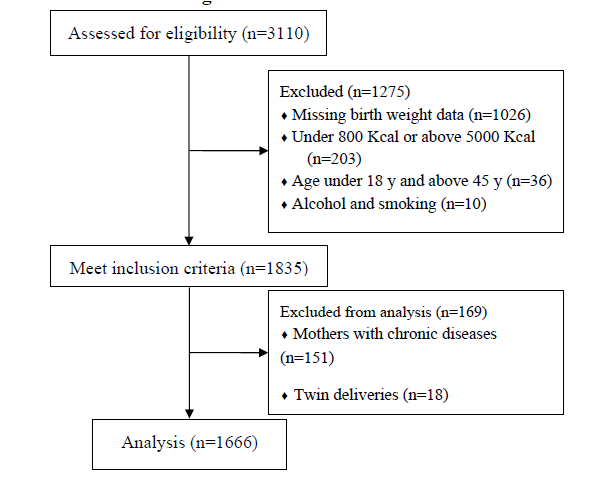
At the time of analysis, the dietary patterns of 1,666 pregnant women who have given birth to a healthy baby were extracted. The missing values of birth weight were because of miscarriage, immigration, lack of corporation with the researchers, or the birth of the child in other hospitals (1,026 attrition). After excluding women with daily calorie intakes of under 800 Kcal and above 5000 Kcal (n=203) 23, 1,881 women remained. Thirty-six pregnant women who were older than 45 or younger than 18 years were eliminated. Also, 10 pregnant women were removed because of smoking and alcohol abuse during pregnancy. Pregnant women suffering from diabetes (except GDM), cancers, fibromyalgia, chlamydia, arthritis rheumatoid, systematic lupus erythematosus, autoimmune diseases, syphilis, gonorrhea, toxoplasmosis, epilepsy, and multiple sclerosis (MS) (n=151) were also eliminated from the analysis. Finally, 18 mothers who had twins were removed from the data, and the analysis was performed on 1,666 women. (Figure 1)

Dietary information was obtained from a 88-item semiquantitative FFQ which the validity and reliability of the FFQ had been previously evaluated 24. The psychometric properties of this FFQ were investigated and confirmed by Sharifi among pregnant female in Iran. In the study of Sharifi et al., Pearson correlation coefficients between test and retest for foods was r=0.845. The Kaiser-Meyer-Oilskin measure of sampling adequacy was 0.584, P values for the Bartlett test of sphericity were all less than 0.001. This questionnaire was filled out by pregnant women one time in the first trimester of pregnancy (4-15 weeks of pregnancy). Mothers were asked to fill out the questionnaire by themselves regarding their usual intake during the past year. This FFQ asked the participants about the consumption frequency of standard units commonly used by Iranians for each food item (on a daily, weekly, monthly, or yearly basis). After completing FFQ, each food item was calculated for daily intake and then, we converted the FFQ information into gram using household measurements. Energy intake and the amounts of other nutrients were computed by Nutritionist 4 (N4) designed for Iranian foods. All the items in FFQ were divided into 34 groups based on similar characteristics and culinary use (Supplemental Table 1, online supplementary material). Then, to reduce the basic error in dietary intake assessments (energy effects), we computed the energy-adjusted gr for each group 25. By using principal component analysis (PCA) with the Varimax rotation, dietary patterns were extracted. The breakpoint of the scree plot depicted two major factors (dietary patterns) that could be extracted. The factor loading for each food group showed the correlation of that food group with the dietary patterns; we considered the factor loading of 0.2 or higher than 0.2 (Table 1).
The mothers' gestational age was estimated during the first interview by calculating the first day of the last menstrual period. Information on birth outcomes was extracted from the mentioned hospitals which measured weight (g), height (cm), and head circumference (cm) immediately after birth. SGA, Appropriate-for-Gestational Age (AGA), and LGA were categorized based on the birth week in the Fenton growth chart 26. SGA was defined for weight, height, and head circumference as measurements below the 10th percentile on the sex- and age-specific Fenton growth chart. LGA was defined as newborns whose anthropometric measurements were above the 90th percentile curves, and normal newborns were placed in the AGA category 27.
2.4. CovariatesPotential confounding covariates were asked during interviews from previously reported determinants of fetal growth 28, 29. We treated maternal age, Body Mass Index (BMI), and height (which were measured at first trimester) as continuous variables. BMI calculated by dividing the early pregnancy maternal body weight (kg) by the square of body height (m2) (BMI = kg/m2). The International Physical Activity Questionnaire (IPAQ) was used for physical activity measurements 30. The scores of IPAQ are divided into three levels. Based on the IPAQ guideline, physical activity is classified as follows: at least 600 MET-minutes/week: low, 600-3000 MET-minutes/week: moderate, and above 3000 MET-minutes/week: high physical activity. The consumption of folic acid supplements and other multivitamin supplements that contain folic acid was asked during the first and second interviews (yes or no). During the first interview, the use of oral contraceptive pills (OCP) in the four months before pregnancy was reported by the mothers. Morning sickness during pregnancy was divided into three levels (no nausea, nausea, and acute vomiting for a long time) and analyzed as dichotomous data (yes/no). In the third and fourth interviews, the mothers self-reported GDM based on screening on the 20-24th week as an overall protocol in Iran. Financial level was reported in three levels: very poor, poor, and favorable. Another important covariate for analysis was the gravida number which was classified into nulliparous mothers or mothers with more than 1 gravidity. Education was divided into three levels of illiterate, low literacy, and university (Table 2). Weight gain (kg) during pregnancy was obtained by subtracting the weight before birth from the first weight of the mothers and after that it was converted to ounces (oz). Mothers according to gestational weight gain guidelines, divided into three categories: below, within and above. Pregnancy BMI was categorized into four groups and a specific weight gain range is defined for each group: underweight <18.5 (28-40 oz); normal 18.5–24.9 (25-35 oz); 25-29.9 (15-25); overweight, ≥30 (11-20 oz). Some of other important micro and macro nutrients provided in Table 3.
The distribution of maternal characteristics in the quartile of dietary patterns was analysis by the chi-square test for categorical measurements, an analysis of variance (ANOVA) for comparing the means of normal quantitative measurements, and the Kruskal-Wallis test for nonnormal quantitative measurements. Means of dietary variables that were adjusted for age and energy used to compare them across quartiles in patterns were calculated by an analysis of covariance (ANCOVA) with Bonferroni’s correction. To remove confounding effect of energy, we adjusted the gram of food groups by using linear regression (residual method) 31, and the residual amounts in each group were added to a constant number to eliminate minus numbers. PCA was performed on residual amounts to extract dietary patterns with the Varimax rotation. We also evaluated Bartlett's test of sphericity and Kaiser–Meyer–Olkin (KMO) measure to sampling adequacy. As determining the number factors to be retained, the three selection criteria that are typically used include 1) retaining factors with an eigenvalue greater than one, 2) the scree plot, and 3) the interpretable variance percentage. The dietary pattern score for each participant was calculated by summing the standardized frequency of food groups weighted by their factor loadings. The scores of each pattern were categorized into quartiles and last quartile consider as the reference. The response variable was divided into three groups (SGA, AGA, and LGA); so we used multinomial logistic regression and AGA was considered as reference 32. All data analyses were performed in SPSS 21.0 (IBM Corporation).
A total of 1,666 pregnant women were selected for this study. There were 261 (15.8%) SGA and 71(4.1%) LGA newborn for weight, 115 (6.9%) SGA and 182 (10.9%) LGA newborn for height and 86 (5.2%) SGA and 279 (16.7%) LGA newborn for head circumference in this study.
3.1. Dietary PatternsFourteen components had the eigenvalue above 1 but, there was a clear break after second factor (Supplemental Figure 1, online supplementary material). Based on breaking point and interpretability, we decided to retain two factors 33. Two distinct dietary patterns with as well as factor loading above 0.2 34, were retained. These patterns explained 12.8% of the variance of total intakes. The first pattern included higher factor loading for fruits and vegetables such as leafy vegetables, fruits, dried fruits, dates, cruciferous vegetables, fruit juice, olives, tomatoes, nuts, and fish as the only animal source. Refined grains had only negative factor loading in the fruits/vegetables pattern. The second pattern (Western pattern) included processed meat, chips/puffs, soft drinks, pickles, hydrogenated fat, legumes, tea, salt, soybean protein, canned fish, sugar, sweet desserts, poultry, and potatoes. Dairy and whole grains in the Western pattern had negative scores (Table 1). The Kaiser-Meyer-Olkin statistic was 0.43 and Bartlett's test of sphericity means that the data is sufficient for the PCA (P-value < 0.0001).
3.2. Association of Dietary Patterns with Maternal CharacteristicsAs shown in Table 2, in the fruits/vegetables across pattern quartiles, means of age, weight, and BMI decreased which is opposite to the Western pattern in which age and weight decreased in higher quartiles and BMI was not different across quartiles. In education level, more adherence to fruits/vegetables pattern is associated to lower number of illiterate and low-literacy pregnant women and higher number of university-educated mothers. In contrast, illiterate and low-literacy pregnant women have higher adherence to western pattern and university-educated women have lower adherence to western dietary pattern. No significant difference was observed in the frequency of GDM in the quartiles of two patterns.
The financial level was stratified into three levels; in low and medium levels, the number of mothers decreased by increasing the quartiles of the fruits/vegetables pattern, while the number of high-income families in quartile 4 was higher than the first quartile. On the other hand, since the adherence to western dietary pattern increased also, frequency of pregnant women in low- and medium-financial levels increased. In addition, the number of women in the high financial level decreased when quartiles increased. The frequency of nulliparous mothers declined in higher adherence to the Western dietary pattern, while in the fruits/vegetables pattern, there was no significant difference.
Furthermore, pregnant women with higher scores of the fruits/vegetables pattern had higher folic acid supplement consumption and vice versa, i.e., pregnant women with higher scores of the Western dietary pattern, consumed less folic acid supplement. There was no significant association between the number of pregnant women in physical activity levels and quartiles of dietary patterns. Additionally, mothers who had more adherence to the fruits/vegetables dietary pattern had less acute vomiting for a long time, and mothers in higher quartiles of this pattern had a lower risk of nausea. Although there is no association among gestational weight gain categories (below, Whitin and above) across quartiles of western dietary pattern, mothers in the higher quartiles of fruit/vegetable dietary pattern are more likely to be in the above category of gestational weight gain categories.
3.3. Association of Dietary Patterns and Birth OutcomesA total of 263 SGA and 71 LGA newborns for weight were born among 1,666 newborns. There was no significant association between quartiles of dietary patterns and SGA and LGA in the crude model of multinominal regression for weight. After adjusting for morning sickness, education level, acid folic, physical activity, age, BMI, OCP usage, nulliparous, financial level, GDM, height, energy intake, and weight gain during pregnancy in the Western pattern, the second quartile compared to the reference showed a higher risk for SGA newborns (OR: 1.53; 95% CI: 1.01-2.32). Again, in the Western dietary pattern in the adjusted model, less adherence to the pattern reduced the risk of LGA in quartiles 1 compared to quartile 4 (OR: 0.34; 95% CI: 0.15-0.78) (Table 4).
There was another significant association in the third quartile compared to the fourth quartile of western pattern in LGA newborns for height that showed lower adherence to western pattern increased risk of LGA infants (OR: 0.1.67; 95% CI: 1.36-2.71). Also, in fruit/vegetables pattern lower adherence to pattern was significantly associated with higher risk of LGA newborns (OR: 1.69; 95% CI: 1.02-2.8). For crude and adjusted models in head circumference, there was no significant association between head circumference and dietary patterns.
We found two major dietary patterns in this study using the PCA. Lower adherence to the Western pattern was associated with a higher risk of SGA and a lower risk of LGA in newborns for weight. Also, western dietary pattern has a negative association with LGA infants for height. On the other hand, the fruit/vegetables pattern that was an almost healthy pattern, is negatively associated with LGA newborns for height.
Many developing countries are experiencing a nutrition transition which decreases poverty and increases the prevalence of overweight and obesity 35. Getting pregnant with overweight and obesity may result in higher risks of SGA and LGA newborns 36. Furthermore, a global estimate of SGA in 2012 in low- and middle-income countries reported that 19.3% of total live births were SGA, which means that 1 out of every 5 newborns was SGA 37. Other risk factors for SGA and LGA infants have been identified, included weight, body mass index (BMI), gravida number, history of delivery, gestational age at delivery and dietary pattern 38, 39, 40.
The maternal dietary pattern in early pregnancy and its relationship with birth size has received attention in recent researches. Thompson et al. in New Zealand assessed dietary patterns in early pregnancy and found that higher scores of the traditional pattern (including apples/pears, citrus fruit, kiwifruit/feijoas, bananas, green vegetables, root vegetables, peas/maize, dairy food/yogurt, and water), which was similar to our fruit/vegetables pattern, could likely reduce the delivery of SGA newborns, which is in contrast with our finding 41. In Thompson et al. study, women filled out the FFQ shortly after delivery which causes a change in reporting compared to the pregnancy period. Similarly, Garay et al. identified two patterns named Western and health-conscious, the latter was characterized by salad/vegetables, dried fruits, fruits, supplements, meat alternatives, fish, and cheese/yogurt. None of the patterns and LGA showed any association, and just a negative relationship was observed only between the health-conscious pattern and SGA compared with AGA 42. However, the sample size was small (n=303) and adjustment was limited in this study. Again, in the ProcriAr cohort study in Sao Paulo, Brazil (n=299), which just analyzed SGA infants, an unhealthy pattern that contained snacks, sandwiches, sweets, and soft drinks was reported to possibly increase the risk of SGA 43.
Mother and child cohort study in Norway (MoBa) was conducted on 65,904 pregnant women and their dietary patterns 39. Four patterns were found in this study: Western, prudent, traditional, and mixed, and every pattern was compared to the Western diet. Similar to our results, the prudent pattern (including fruits and vegetables) compared to the Western diet increased SGA and decreased LGA. Women in the higher quartile of western dietary pattern consumed more energy dense foods and their food quality characterized by highest amount of total fat, added sugar, trans fatty acids as well as the lowest amount of dietary fiber, all of which may be association with higher risk of LGA. Lower amount of fiber and higher added sugar in diet are correlated to higher postprandial plasma glucose after meals 44 and increased maternal glucose is associated with overgrowth newborn, even in non-diabetic pregnant women 45.
The role of diet during pregnancy on fetal growth is undeniable 46. Most previous studies that have measured the relationship between fetal growth and maternal diet have been conducted in Western countries 47, 48, 49, 50. An Iranian prospective observational study, was performed on major dietary patterns in early pregnancy and birth weight and length. Among three major patterns (healthy, western and traditional patterns), just western pattern showed negative association with weight of newborns 51. Because the neonates born at various gestational weeks and the sex-differences for anthropometric measurements, usage of SGA and LGA in studies is more appropriate. On the other hand, considering the high nutritional value of fruits and vegetables another finding of this study can be also the importance of the dietary variety and balance. Dietary variety and balance are items to measure food quality that were studied in a study in Spain 20. Diet quality in this study was inversely associated with small-for-age birth. Further studies are needed to assess the quality of diet in our population.
Although the effects of maternal genetics 52 which covers about 38-80% birth weight and height variance cannot be ignored 53, 54, many mechanisms can demonstrate how dietary factors in early pregnancy play a pivotal role on birth anthropometric characters 55. One of our findings is that lower consumption of foods in Western dietary pattern is associated with a higher risk of SGA newborns for weight and higher risk of LGA for height. Even though this pattern is somehow unhealthy, some foods with high-biological-value proteins exist in this pattern. one study in China clearly illustrated the association between important animal and plant sources of protein separately with LBW, SGA, and intrauterine growth retardation (IUGR) 56. This study showed that a higher intake of total and animal protein can reduce the risk of SGA, LBW, and IUGR, while plant protein did not. Additionally, in a longitudinal study in Spain, protein was introduced as the most effective macronutrient in the preconception period and during pregnancy on birth weight, independently of the mother's age, smoking, newborn's sex, pregnancy length, BMI, physical activity, and total calorie intake 57. So western dietary pattern may have conflicting effect on SGA/LGA due to its higher content of protein.
Additionally, maternal nutrition can affect morphology and transporter expression of the placenta as the most important transmitter of macro- and micro-nutrients and other crucial substances between mother and fetus 58. Although studies show malnutrition impairs the development and function of the placenta which causes lower transfer of nutrients and possibly lead to impairment of fetal growth 59, maternal overnutrition as seen in western dietary pattern caused lower blood level of adiponectin (ADP) and also caused higher blood level of leptin, insulin, insulin-like growth factor-1 (IGF-1) and interleukin 6 (IL-6) which all of them promote anabolism 60. These changes in hormones and cytokines in response to nutrition up-regulate placental transport of nutrients such as amino acids 61.
In another study, path analysis performed on birth weight and 4 different dietary patterns extracted by PCA: FDP (high intake of fruit, dairy products, poultry and coarse grain), VBP (high intake of vegetables, beans, nuts, fungi, algae and pork), FS (high intakes of fish, seafood, dietary supplements, coarse grains and soup) and TE (high intakes of potatoes and eggs) with mediated role of cytokines. VBP and FDP patterns negatively related to IL-6 and TE has positively related to ADP. IL-6 and ADP showed significant negative and positive associations with birth weight, respectively 62.
The current study had a prospective design and many coefficients were measured via a questionnaire. The inclusion criteria were not too rigid, and thus, a wide range of age and women with different socioeconomic status participated. Birth outcomes were less affected by reports because at the time of filling out the questionnaire, pregnancy outcome complications did not exist. In our study, alcohol and cigarettes use were removed from the analysis due to their confounding effects.
Still, there were some limitations in this study. As the study was observational, a causal interpretation was not possible. Although we had precision in the known risk factors, other confounders may have remained. The FFQ recall bias is another limitation, whereby people's memories often do not report the exact intake, or mothers may change their diets in late pregnancy; furthermore, the FFQ cannot report the whole diet because the dish composition is different in every family, and the ingredients should be guessed by researchers. Finally, residual confounding linked with both birth weight and dietary patterns cannot be removed, although we adjusted for several factors in the statistical analysis.
Even though we found no association between the fruits/vegetables pattern and weight abnormalities (SGA and LGA), higher adherence to the Western pattern was associated with a lower risk of SGA and a higher risk of LGA for weight. This finding implied that the Western pattern may reduce the risk of SGA even it has unhealthy components Future well-designed controlled trials would be applicable and corroborate the beneficial effects of dietary patterns on pregnancy outcomes.
We greatly appreciate all the families who participate in the study, all trained personnel such as nurses, midwives, computer and laboratory technicians, physicians, managers and interviewers and all other ones who help us directly or indirectly. No personal or financial conflict of interest was declared by the authors.
| [1] | Lee AC, Katz J, Blencowe H, Cousens S, Kozuki N, Vogel JP, et al. National and regional estimates of term and preterm babies born small for gestational age in 138 low-income and middle-income countries in 2010. The Lancet Global Health. 2013; 1(1): e26-e36. | ||
| In article | View Article PubMed | ||
| [2] | Koyanagi A, Zhang J, Dagvadorj A, Hirayama F, Shibuya K, Souza JP, et al. Macrosomia in 23 developing countries: an analysis of a multicountry, facility-based, cross-sectional survey. Lancet. 2013; 381(9865): 476-83. | ||
| In article | View Article PubMed | ||
| [3] | Blencowe H, Cousens S, Oestergaard MZ, Chou D, Moller A-B, Narwal R, et al. National, regional, and worldwide estimates of preterm birth rates in the year 2010 with time trends since 1990 for selected countries: a systematic analysis and implications. The lancet. 2012; 379(9832): 2162-72. | ||
| In article | View Article PubMed | ||
| [4] | Whincup PH, Kaye SJ, Owen CG, Huxley R, Cook DG, Anazawa S, et al. Birth weight and risk of type 2 diabetes: a systematic review. Jama. 2008; 300(24): 2886-97. | ||
| In article | View Article PubMed | ||
| [5] | White SL, Perkovic V, Cass A, Chang CL, Poulter NR, Spector T, et al. Is low birth weight an antecedent of CKD in later life? A systematic review of observational studies. American Journal of Kidney Diseases. 2009; 54(2): 248-61. | ||
| In article | View Article PubMed | ||
| [6] | Richards M, Hardy R, Kuh D, Wadsworth ME. Birthweight, postnatal growth and cognitive function in a national UK birth cohort. International Journal of Epidemiology. 2002; 31(2): 342-8. | ||
| In article | View Article PubMed | ||
| [7] | Zilko CEM, Rehkopf D, Abrams B. Association of maternal gestational weight gain with short-and long-term maternal and child health outcomes. American journal of obstetrics and gynecology. 2010; 202(6): 574. e1-. e8. | ||
| In article | View Article PubMed | ||
| [8] | Wang SF, Shu L, Sheng J, Mu M, Wang S, Tao XY, et al. Birth weight and risk of coronary heart disease in adults: a meta-analysis of prospective cohort studies. J Dev Orig Health Dis. 2014; 5(6): 408-19. | ||
| In article | View Article PubMed | ||
| [9] | Long H, Yi J-M, Hu P-L, Li Z-B, Qiu W-Y, Wang F, et al. Benefits of iron supplementation for low birth weight infants: a systematic review. BMC pediatrics. 2012; 12(1): 1-11. | ||
| In article | View Article PubMed | ||
| [10] | Chen Y-H, Fu L, Hao J-H, Yu Z, Zhu P, Wang H, et al. Maternal vitamin D deficiency during pregnancy elevates the risks of small for gestational age and low birth weight infants in Chinese population. The Journal of Clinical Endocrinology & Metabolism. 2015; 100(5): 1912-9. | ||
| In article | View Article PubMed | ||
| [11] | Obeid R, Holzgreve W, Pietrzik K. Folate supplementation for prevention of congenital heart defects and low birth weight: an update. Cardiovascular diagnosis and therapy. 2019; 9(Suppl 2): S424. | ||
| In article | View Article PubMed | ||
| [12] | Hu FB. Dietary pattern analysis: a new direction in nutritional epidemiology. Current opinion in lipidology. 2002; 13(1): 3-9. | ||
| In article | View Article PubMed | ||
| [13] | Chen X, Zhao D, Mao X, Xia Y, Baker PN, Zhang H. Maternal dietary patterns and pregnancy outcome. Nutrients. 2016; 8(6): 351. | ||
| In article | View Article PubMed | ||
| [14] | Chia A-R, Tint M-T, Han CY, Chen L-W, Colega M, Aris IM, et al. Adherence to a healthy eating index for pregnant women is associated with lower neonatal adiposity in a multiethnic Asian cohort: the Growing Up in Singapore Towards healthy Outcomes (GUSTO) Study. The American journal of clinical nutrition. 2018; 107(1): 71-9. | ||
| In article | View Article PubMed | ||
| [15] | Saunders L, Guldner L, Costet N, Kadhel P, Rouget F, Monfort C, et al. Effect of a M editerranean Diet during Pregnancy on Fetal Growth and Preterm Delivery: Results From a F rench Caribbean Mother–Child Cohort Study (TIMOUN). Paediatric and perinatal epidemiology. 2014; 28(3): 235-44. | ||
| In article | View Article PubMed | ||
| [16] | Chatzi L, Mendez M, Garcia R, Roumeliotaki T, Ibarluzea J, Tardón A, et al. Mediterranean diet adherence during pregnancy and fetal growth: INMA (Spain) and RHEA (Greece) mother–child cohort studies. British Journal of Nutrition. 2012; 107(1): 135-45. | ||
| In article | View Article PubMed | ||
| [17] | Chia A-R, Chen L-W, Lai JS, Wong CH, Neelakantan N, van Dam RM, et al. Maternal dietary patterns and birth outcomes: a systematic review and meta-analysis. Advances in Nutrition. 2019; 10(4): 685-95. | ||
| In article | View Article PubMed | ||
| [18] | Okubo H, Miyake Y, Sasaki S, Tanaka K, Murakami K, Hirota Y, et al. Maternal dietary patterns in pregnancy and fetal growth in Japan: the Osaka Maternal and Child Health Study. British journal of Nutrition. 2012; 107(10): 1526-33. | ||
| In article | View Article PubMed | ||
| [19] | Poon AK, Yeung E, Boghossian N, Albert PS, Zhang C. Maternal Dietary Patterns during Third Trimester in Association with Birthweight Characteristics and Early Infant Growth. Scientifica (Cairo). 2013; 2013: 786409. | ||
| In article | View Article PubMed | ||
| [20] | Rodríguez-Bernal CL, Rebagliato M, Iniguez C, Vioque J, Navarrete-Munoz EM, Murcia M, et al. Diet quality in early pregnancy and its effects on fetal growth outcomes: the Infancia y Medio Ambiente (Childhood and Environment) Mother and Child Cohort Study in Spain. The American journal of clinical nutrition. 2010; 91(6): 1659-66. | ||
| In article | View Article PubMed | ||
| [21] | Zare Sakhvidi MJ, Danaei N, Dadvand P, Mehrparvar AH, Heidari-Beni M, Nouripour S, et al. The prospective epidemiological research studies in IrAN (PERSIAN) birth cohort protocol: Rationale, design and methodology. Longitudinal and Life Course Studies. 2021; 12(2): 241-62. | ||
| In article | View Article | ||
| [22] | Sharifi SF, Javadi M, Barikani A. Reliability and validity of short food frequency questionnaire among pregnant females. Biotechnology and health sciences. 2016; 3(2). | ||
| In article | View Article | ||
| [23] | Fransen HP, May AM, Stricker MD, Boer JM, Hennig C, Rosseel Y, et al. A posteriori dietary patterns: how many patterns to retain? J Nutr. 2014; 144(8): 1274-82. | ||
| In article | View Article PubMed | ||
| [24] | Dehghan-Banadaki S, Hosseinzadeh M, Madadizadeh F, Mozaffari-Khosravi H. Empirically derived dietary patterns and postpartum depression symptoms in a large sample of Iranian women. BMC psychiatry. 2023; 23(1): 1-11. | ||
| In article | View Article PubMed | ||
| [25] | McCullough LE, Byrd DA. Total Energy Intake: Implications for Epidemiologic Analyses. American Journal of Epidemiology. 2022. | ||
| In article | View Article PubMed | ||
| [26] | Fenton TR, Kim JH. A systematic review and meta-analysis to revise the Fenton growth chart for preterm infants. BMC pediatrics. 2013; 13(1): 1-13. | ||
| In article | View Article PubMed | ||
| [27] | Mikolajczyk RT, Zhang J, Betran AP, Souza JP, Mori R, Gülmezoglu AM, et al. A global reference for fetal-weight and birthweight percentiles. The Lancet. 2011; 377(9780): 1855-61. | ||
| In article | View Article PubMed | ||
| [28] | McCowan L, Horgan RP. Risk factors for small for gestational age infants. Best practice & research clinical obstetrics & gynaecology. 2009; 23(6): 779-93. | ||
| In article | View Article PubMed | ||
| [29] | Nohr EA, Vaeth M, Baker JL, Sørensen TI, Olsen J, Rasmussen KM. Pregnancy outcomes related to gestational weight gain in women defined by their body mass index, parity, height, and smoking status. The American journal of clinical nutrition. 2009; 90(5): 1288-94. | ||
| In article | View Article PubMed | ||
| [30] | Craig CL, Marshall AL, Sjöström M, Bauman AE, Booth ML, Ainsworth BE, et al. International physical activity questionnaire: 12-country reliability and validity. Medicine & science in sports & exercise. 2003; 35(8): 1381-95. | ||
| In article | View Article PubMed | ||
| [31] | Willett W, Stampfer MJ. Total energy intake: implications for epidemiologic analyses. American journal of epidemiology. 1986; 124(1): 17-27. | ||
| In article | View Article PubMed | ||
| [32] | Agresti A. Categorical data analysis: John Wiley & Sons; 2012. | ||
| In article | View Article | ||
| [33] | Batis C, Mendez MA, Gordon-Larsen P, Sotres-Alvarez D, Adair L, Popkin B. Using both principal component analysis and reduced rank regression to study dietary patterns and diabetes in Chinese adults. Public health nutrition. 2016; 19(2): 195-203. | ||
| In article | View Article PubMed | ||
| [34] | Silvera SAN, Mayne ST, Risch HA, Gammon MD, Vaughan T, Chow W-H, et al. Principal component analysis of dietary and lifestyle patterns in relation to risk of subtypes of esophageal and gastric cancer. Annals of epidemiology. 2011; 21(7): 543-50. | ||
| In article | View Article PubMed | ||
| [35] | Conde WL, Monteiro CA. Nutrition transition and double burden of undernutrition and excess of weight in Brazil. Am J Clin Nutr. 2014; 100(6): 1617s-22s. | ||
| In article | View Article PubMed | ||
| [36] | Chen YH, Li L, Chen W, Liu ZB, Ma L, Gao XX, et al. Pre-pregnancy underweight and obesity are positively associated with small-for-gestational-age infants in a Chinese population. Sci Rep. 2019; 9(1): 15544. | ||
| In article | View Article PubMed | ||
| [37] | Lee AC, Kozuki N, Cousens S, Stevens GA, Blencowe H, Silveira MF, et al. Estimates of burden and consequences of infants born small for gestational age in low and middle income countries with INTERGROWTH-21(st) standard: analysis of CHERG datasets. Bmj. 2017; 358: j3677. | ||
| In article | |||
| [38] | McCowan LM, Roberts CT, Dekker GA, Taylor RS, Chan EH, Kenny LC, et al. Risk factors for small-for-gestational-age infants by customised birthweight centiles: data from an international prospective cohort study. Bjog. 2010; 117(13): 1599-607. | ||
| In article | View Article PubMed | ||
| [39] | Englund-Ögge L, Brantsæter AL, Juodakis J, Haugen M, Meltzer HM, Jacobsson B, et al. Associations between maternal dietary patterns and infant birth weight, small and large for gestational age in the Norwegian Mother and Child Cohort Study. European journal of clinical nutrition. 2019; 73(9): 1270-82. | ||
| In article | View Article PubMed | ||
| [40] | Shin D, Song WO. Prepregnancy body mass index is an independent risk factor for gestational hypertension, gestational diabetes, preterm labor, and small-and large-for-gestational-age infants. The Journal of Maternal-Fetal & Neonatal Medicine. 2015; 28(14): 1679-86. | ||
| In article | View Article PubMed | ||
| [41] | Thompson JM, Wall C, Becroft DM, Robinson E, Wild CJ, Mitchell EA. Maternal dietary patterns in pregnancy and the association with small-for-gestational-age infants. Br J Nutr. 2010; 103(11): 1665-73. | ||
| In article | View Article PubMed | ||
| [42] | Garay SM, Savory KA, Sumption L, Penketh R, Janssen AB, John RM. The Grown in Wales Study: Examining dietary patterns, custom birthweight centiles and the risk of delivering a small-for-gestational age (SGA) infant. PLoS One. 2019; 14(3): e0213412. | ||
| In article | View Article PubMed | ||
| [43] | Teixeira JA, Hoffman DJ, Castro TG, Saldiva S, Francisco RPV, Vieira SE, et al. Pre-pregnancy dietary pattern is associated with newborn size: results from ProcriAr study. Br J Nutr. 2021; 126(6): 903-12. | ||
| In article | View Article PubMed | ||
| [44] | Silva FM, Kramer CK, Crispim D, Azevedo MJ. A high–glycemic index, low-fiber breakfast affects the postprandial plasma glucose, insulin, and ghrelin responses of patients with type 2 diabetes in a randomized clinical trial. The Journal of nutrition. 2015; 145(4): 736-41. | ||
| In article | View Article PubMed | ||
| [45] | Group HSCR. Hyperglycemia and Adverse Pregnancy Outcome (HAPO) Study: associations with neonatal anthropometrics. Diabetes. 2009; 58(2): 453-9. | ||
| In article | View Article PubMed | ||
| [46] | Nnam N. Improving maternal nutrition for better pregnancy outcomes. Proceedings of the Nutrition Society. 2015; 74(4): 454-9. | ||
| In article | View Article PubMed | ||
| [47] | Knudsen V, Orozova-Bekkevold I, Mikkelsen TB, Wolff S, Olsen S. Major dietary patterns in pregnancy and fetal growth. European journal of clinical nutrition. 2008; 62(4): 463-70. | ||
| In article | View Article PubMed | ||
| [48] | Northstone K, Ness A, Emmett P, Rogers I. Adjusting for energy intake in dietary pattern investigations using principal components analysis. European journal of clinical nutrition. 2008; 62(7): 931-8. | ||
| In article | View Article PubMed | ||
| [49] | Coelho NdLP, Cunha DB, Esteves APP, Lacerda EMdA, Theme MM. Dietary patterns in pregnancy and birth weight. Revista de saude publica. 2015; 49: 1-10. | ||
| In article | View Article PubMed | ||
| [50] | Colón-Ramos U, Racette SB, Ganiban J, Nguyen TG, Kocak M, Carroll KN, et al. Association between dietary patterns during pregnancy and birth size measures in a diverse population in Southern US. Nutrients. 2015; 7(2): 1318-32. | ||
| In article | View Article PubMed | ||
| [51] | Hajianfar H, Esmaillzadeh A, Feizi A, Shahshahan Z, Azadbakht L. Major maternal dietary patterns during early pregnancy and their association with neonatal anthropometric measurement. BioMed research international. 2018; 2018. | ||
| In article | View Article PubMed | ||
| [52] | Warrington NM, Beaumont RN, Horikoshi M, Day FR, Helgeland Ø, Laurin C, et al. Maternal and fetal genetic effects on birth weight and their relevance to cardio-metabolic risk factors. Nature genetics. 2019; 51(5): 804-14. | ||
| In article | View Article PubMed | ||
| [53] | Magnus P, Berg K, Bjerkedal T, Nance W. Parental determinants of birth weight. Clinical genetics. 1984; 26(5): 397-405. | ||
| In article | View Article PubMed | ||
| [54] | Magnus P. Causes of variation in birth weight: a study of offspring of twins. Clinical genetics. 1984; 25(1): 15-24. | ||
| In article | View Article PubMed | ||
| [55] | Belkacemi L, Nelson DM, Desai M, Ross MG. Maternal undernutrition influences placental-fetal development. Biology of reproduction. 2010; 83(3): 325-31. | ||
| In article | View Article PubMed | ||
| [56] | Yang J, Chang Q, Tian X, Zhang B, Zeng L, Yan H, et al. Dietary protein intake during pregnancy and birth weight among Chinese pregnant women with low intake of protein. Nutr Metab (Lond). 2022; 19(1): 43. | ||
| In article | View Article PubMed | ||
| [57] | Cuco G, Arija V, Iranzo R, Vila J, Prieto M, Fernandez-Ballart J. Association of maternal protein intake before conception and throughout pregnancy with birth weight. Acta obstetricia et gynecologica Scandinavica. 2006; 85(4): 413-21. | ||
| In article | View Article PubMed | ||
| [58] | Connor KL, Kibschull M, Matysiak-Zablocki E, Nguyen TT-TN, Matthews SG, Lye SJ, et al. Maternal malnutrition impacts placental morphology and transport. An origin for poor offspring growth and vulnerability to disease. bioRxiv. 2019: 727404. | ||
| In article | View Article | ||
| [59] | Henriksen T, Clausen T. The fetal origins hypothesis: placental insufficiency and inheritance versus maternal malnutrition in well-nourished populations. Acta obstetricia et gynecologica Scandinavica. 2002; 81(2): 112-4. | ||
| In article | View Article PubMed | ||
| [60] | Gaccioli F, Lager S, Powell T, Jansson T. Placental transport in response to altered maternal nutrition. Journal of developmental origins of health and disease. 2013;4(2):101-15. | ||
| In article | View Article PubMed | ||
| [61] | Jones HN, Jansson T, Powell TL. Full-length adiponectin attenuates insulin signaling and inhibits insulin-stimulated amino acid transport in human primary trophoblast cells. Diabetes. 2010; 59(5): 1161-70. | ||
| In article | View Article PubMed | ||
| [62] | Ma L, Lu Q, Ouyang J, Huang J, Huang S, Jiao C, et al. How are maternal dietary patterns and maternal/fetal cytokines associated with birth weight? A path analysis. British Journal of Nutrition. 2019; 121(10): 1178-87. | ||
| In article | View Article PubMed | ||
Published with license by Science and Education Publishing, Copyright © 2024 Shahab-Aldin Akbarian, Amin Salehi-Abargouei, Sara Jambarsang, Habib Nikukar and Azadeh Nadjarzadeh
 This work is licensed under a Creative Commons Attribution 4.0 International License. To view a copy of this license, visit
http://creativecommons.org/licenses/by/4.0/
This work is licensed under a Creative Commons Attribution 4.0 International License. To view a copy of this license, visit
http://creativecommons.org/licenses/by/4.0/
| [1] | Lee AC, Katz J, Blencowe H, Cousens S, Kozuki N, Vogel JP, et al. National and regional estimates of term and preterm babies born small for gestational age in 138 low-income and middle-income countries in 2010. The Lancet Global Health. 2013; 1(1): e26-e36. | ||
| In article | View Article PubMed | ||
| [2] | Koyanagi A, Zhang J, Dagvadorj A, Hirayama F, Shibuya K, Souza JP, et al. Macrosomia in 23 developing countries: an analysis of a multicountry, facility-based, cross-sectional survey. Lancet. 2013; 381(9865): 476-83. | ||
| In article | View Article PubMed | ||
| [3] | Blencowe H, Cousens S, Oestergaard MZ, Chou D, Moller A-B, Narwal R, et al. National, regional, and worldwide estimates of preterm birth rates in the year 2010 with time trends since 1990 for selected countries: a systematic analysis and implications. The lancet. 2012; 379(9832): 2162-72. | ||
| In article | View Article PubMed | ||
| [4] | Whincup PH, Kaye SJ, Owen CG, Huxley R, Cook DG, Anazawa S, et al. Birth weight and risk of type 2 diabetes: a systematic review. Jama. 2008; 300(24): 2886-97. | ||
| In article | View Article PubMed | ||
| [5] | White SL, Perkovic V, Cass A, Chang CL, Poulter NR, Spector T, et al. Is low birth weight an antecedent of CKD in later life? A systematic review of observational studies. American Journal of Kidney Diseases. 2009; 54(2): 248-61. | ||
| In article | View Article PubMed | ||
| [6] | Richards M, Hardy R, Kuh D, Wadsworth ME. Birthweight, postnatal growth and cognitive function in a national UK birth cohort. International Journal of Epidemiology. 2002; 31(2): 342-8. | ||
| In article | View Article PubMed | ||
| [7] | Zilko CEM, Rehkopf D, Abrams B. Association of maternal gestational weight gain with short-and long-term maternal and child health outcomes. American journal of obstetrics and gynecology. 2010; 202(6): 574. e1-. e8. | ||
| In article | View Article PubMed | ||
| [8] | Wang SF, Shu L, Sheng J, Mu M, Wang S, Tao XY, et al. Birth weight and risk of coronary heart disease in adults: a meta-analysis of prospective cohort studies. J Dev Orig Health Dis. 2014; 5(6): 408-19. | ||
| In article | View Article PubMed | ||
| [9] | Long H, Yi J-M, Hu P-L, Li Z-B, Qiu W-Y, Wang F, et al. Benefits of iron supplementation for low birth weight infants: a systematic review. BMC pediatrics. 2012; 12(1): 1-11. | ||
| In article | View Article PubMed | ||
| [10] | Chen Y-H, Fu L, Hao J-H, Yu Z, Zhu P, Wang H, et al. Maternal vitamin D deficiency during pregnancy elevates the risks of small for gestational age and low birth weight infants in Chinese population. The Journal of Clinical Endocrinology & Metabolism. 2015; 100(5): 1912-9. | ||
| In article | View Article PubMed | ||
| [11] | Obeid R, Holzgreve W, Pietrzik K. Folate supplementation for prevention of congenital heart defects and low birth weight: an update. Cardiovascular diagnosis and therapy. 2019; 9(Suppl 2): S424. | ||
| In article | View Article PubMed | ||
| [12] | Hu FB. Dietary pattern analysis: a new direction in nutritional epidemiology. Current opinion in lipidology. 2002; 13(1): 3-9. | ||
| In article | View Article PubMed | ||
| [13] | Chen X, Zhao D, Mao X, Xia Y, Baker PN, Zhang H. Maternal dietary patterns and pregnancy outcome. Nutrients. 2016; 8(6): 351. | ||
| In article | View Article PubMed | ||
| [14] | Chia A-R, Tint M-T, Han CY, Chen L-W, Colega M, Aris IM, et al. Adherence to a healthy eating index for pregnant women is associated with lower neonatal adiposity in a multiethnic Asian cohort: the Growing Up in Singapore Towards healthy Outcomes (GUSTO) Study. The American journal of clinical nutrition. 2018; 107(1): 71-9. | ||
| In article | View Article PubMed | ||
| [15] | Saunders L, Guldner L, Costet N, Kadhel P, Rouget F, Monfort C, et al. Effect of a M editerranean Diet during Pregnancy on Fetal Growth and Preterm Delivery: Results From a F rench Caribbean Mother–Child Cohort Study (TIMOUN). Paediatric and perinatal epidemiology. 2014; 28(3): 235-44. | ||
| In article | View Article PubMed | ||
| [16] | Chatzi L, Mendez M, Garcia R, Roumeliotaki T, Ibarluzea J, Tardón A, et al. Mediterranean diet adherence during pregnancy and fetal growth: INMA (Spain) and RHEA (Greece) mother–child cohort studies. British Journal of Nutrition. 2012; 107(1): 135-45. | ||
| In article | View Article PubMed | ||
| [17] | Chia A-R, Chen L-W, Lai JS, Wong CH, Neelakantan N, van Dam RM, et al. Maternal dietary patterns and birth outcomes: a systematic review and meta-analysis. Advances in Nutrition. 2019; 10(4): 685-95. | ||
| In article | View Article PubMed | ||
| [18] | Okubo H, Miyake Y, Sasaki S, Tanaka K, Murakami K, Hirota Y, et al. Maternal dietary patterns in pregnancy and fetal growth in Japan: the Osaka Maternal and Child Health Study. British journal of Nutrition. 2012; 107(10): 1526-33. | ||
| In article | View Article PubMed | ||
| [19] | Poon AK, Yeung E, Boghossian N, Albert PS, Zhang C. Maternal Dietary Patterns during Third Trimester in Association with Birthweight Characteristics and Early Infant Growth. Scientifica (Cairo). 2013; 2013: 786409. | ||
| In article | View Article PubMed | ||
| [20] | Rodríguez-Bernal CL, Rebagliato M, Iniguez C, Vioque J, Navarrete-Munoz EM, Murcia M, et al. Diet quality in early pregnancy and its effects on fetal growth outcomes: the Infancia y Medio Ambiente (Childhood and Environment) Mother and Child Cohort Study in Spain. The American journal of clinical nutrition. 2010; 91(6): 1659-66. | ||
| In article | View Article PubMed | ||
| [21] | Zare Sakhvidi MJ, Danaei N, Dadvand P, Mehrparvar AH, Heidari-Beni M, Nouripour S, et al. The prospective epidemiological research studies in IrAN (PERSIAN) birth cohort protocol: Rationale, design and methodology. Longitudinal and Life Course Studies. 2021; 12(2): 241-62. | ||
| In article | View Article | ||
| [22] | Sharifi SF, Javadi M, Barikani A. Reliability and validity of short food frequency questionnaire among pregnant females. Biotechnology and health sciences. 2016; 3(2). | ||
| In article | View Article | ||
| [23] | Fransen HP, May AM, Stricker MD, Boer JM, Hennig C, Rosseel Y, et al. A posteriori dietary patterns: how many patterns to retain? J Nutr. 2014; 144(8): 1274-82. | ||
| In article | View Article PubMed | ||
| [24] | Dehghan-Banadaki S, Hosseinzadeh M, Madadizadeh F, Mozaffari-Khosravi H. Empirically derived dietary patterns and postpartum depression symptoms in a large sample of Iranian women. BMC psychiatry. 2023; 23(1): 1-11. | ||
| In article | View Article PubMed | ||
| [25] | McCullough LE, Byrd DA. Total Energy Intake: Implications for Epidemiologic Analyses. American Journal of Epidemiology. 2022. | ||
| In article | View Article PubMed | ||
| [26] | Fenton TR, Kim JH. A systematic review and meta-analysis to revise the Fenton growth chart for preterm infants. BMC pediatrics. 2013; 13(1): 1-13. | ||
| In article | View Article PubMed | ||
| [27] | Mikolajczyk RT, Zhang J, Betran AP, Souza JP, Mori R, Gülmezoglu AM, et al. A global reference for fetal-weight and birthweight percentiles. The Lancet. 2011; 377(9780): 1855-61. | ||
| In article | View Article PubMed | ||
| [28] | McCowan L, Horgan RP. Risk factors for small for gestational age infants. Best practice & research clinical obstetrics & gynaecology. 2009; 23(6): 779-93. | ||
| In article | View Article PubMed | ||
| [29] | Nohr EA, Vaeth M, Baker JL, Sørensen TI, Olsen J, Rasmussen KM. Pregnancy outcomes related to gestational weight gain in women defined by their body mass index, parity, height, and smoking status. The American journal of clinical nutrition. 2009; 90(5): 1288-94. | ||
| In article | View Article PubMed | ||
| [30] | Craig CL, Marshall AL, Sjöström M, Bauman AE, Booth ML, Ainsworth BE, et al. International physical activity questionnaire: 12-country reliability and validity. Medicine & science in sports & exercise. 2003; 35(8): 1381-95. | ||
| In article | View Article PubMed | ||
| [31] | Willett W, Stampfer MJ. Total energy intake: implications for epidemiologic analyses. American journal of epidemiology. 1986; 124(1): 17-27. | ||
| In article | View Article PubMed | ||
| [32] | Agresti A. Categorical data analysis: John Wiley & Sons; 2012. | ||
| In article | View Article | ||
| [33] | Batis C, Mendez MA, Gordon-Larsen P, Sotres-Alvarez D, Adair L, Popkin B. Using both principal component analysis and reduced rank regression to study dietary patterns and diabetes in Chinese adults. Public health nutrition. 2016; 19(2): 195-203. | ||
| In article | View Article PubMed | ||
| [34] | Silvera SAN, Mayne ST, Risch HA, Gammon MD, Vaughan T, Chow W-H, et al. Principal component analysis of dietary and lifestyle patterns in relation to risk of subtypes of esophageal and gastric cancer. Annals of epidemiology. 2011; 21(7): 543-50. | ||
| In article | View Article PubMed | ||
| [35] | Conde WL, Monteiro CA. Nutrition transition and double burden of undernutrition and excess of weight in Brazil. Am J Clin Nutr. 2014; 100(6): 1617s-22s. | ||
| In article | View Article PubMed | ||
| [36] | Chen YH, Li L, Chen W, Liu ZB, Ma L, Gao XX, et al. Pre-pregnancy underweight and obesity are positively associated with small-for-gestational-age infants in a Chinese population. Sci Rep. 2019; 9(1): 15544. | ||
| In article | View Article PubMed | ||
| [37] | Lee AC, Kozuki N, Cousens S, Stevens GA, Blencowe H, Silveira MF, et al. Estimates of burden and consequences of infants born small for gestational age in low and middle income countries with INTERGROWTH-21(st) standard: analysis of CHERG datasets. Bmj. 2017; 358: j3677. | ||
| In article | |||
| [38] | McCowan LM, Roberts CT, Dekker GA, Taylor RS, Chan EH, Kenny LC, et al. Risk factors for small-for-gestational-age infants by customised birthweight centiles: data from an international prospective cohort study. Bjog. 2010; 117(13): 1599-607. | ||
| In article | View Article PubMed | ||
| [39] | Englund-Ögge L, Brantsæter AL, Juodakis J, Haugen M, Meltzer HM, Jacobsson B, et al. Associations between maternal dietary patterns and infant birth weight, small and large for gestational age in the Norwegian Mother and Child Cohort Study. European journal of clinical nutrition. 2019; 73(9): 1270-82. | ||
| In article | View Article PubMed | ||
| [40] | Shin D, Song WO. Prepregnancy body mass index is an independent risk factor for gestational hypertension, gestational diabetes, preterm labor, and small-and large-for-gestational-age infants. The Journal of Maternal-Fetal & Neonatal Medicine. 2015; 28(14): 1679-86. | ||
| In article | View Article PubMed | ||
| [41] | Thompson JM, Wall C, Becroft DM, Robinson E, Wild CJ, Mitchell EA. Maternal dietary patterns in pregnancy and the association with small-for-gestational-age infants. Br J Nutr. 2010; 103(11): 1665-73. | ||
| In article | View Article PubMed | ||
| [42] | Garay SM, Savory KA, Sumption L, Penketh R, Janssen AB, John RM. The Grown in Wales Study: Examining dietary patterns, custom birthweight centiles and the risk of delivering a small-for-gestational age (SGA) infant. PLoS One. 2019; 14(3): e0213412. | ||
| In article | View Article PubMed | ||
| [43] | Teixeira JA, Hoffman DJ, Castro TG, Saldiva S, Francisco RPV, Vieira SE, et al. Pre-pregnancy dietary pattern is associated with newborn size: results from ProcriAr study. Br J Nutr. 2021; 126(6): 903-12. | ||
| In article | View Article PubMed | ||
| [44] | Silva FM, Kramer CK, Crispim D, Azevedo MJ. A high–glycemic index, low-fiber breakfast affects the postprandial plasma glucose, insulin, and ghrelin responses of patients with type 2 diabetes in a randomized clinical trial. The Journal of nutrition. 2015; 145(4): 736-41. | ||
| In article | View Article PubMed | ||
| [45] | Group HSCR. Hyperglycemia and Adverse Pregnancy Outcome (HAPO) Study: associations with neonatal anthropometrics. Diabetes. 2009; 58(2): 453-9. | ||
| In article | View Article PubMed | ||
| [46] | Nnam N. Improving maternal nutrition for better pregnancy outcomes. Proceedings of the Nutrition Society. 2015; 74(4): 454-9. | ||
| In article | View Article PubMed | ||
| [47] | Knudsen V, Orozova-Bekkevold I, Mikkelsen TB, Wolff S, Olsen S. Major dietary patterns in pregnancy and fetal growth. European journal of clinical nutrition. 2008; 62(4): 463-70. | ||
| In article | View Article PubMed | ||
| [48] | Northstone K, Ness A, Emmett P, Rogers I. Adjusting for energy intake in dietary pattern investigations using principal components analysis. European journal of clinical nutrition. 2008; 62(7): 931-8. | ||
| In article | View Article PubMed | ||
| [49] | Coelho NdLP, Cunha DB, Esteves APP, Lacerda EMdA, Theme MM. Dietary patterns in pregnancy and birth weight. Revista de saude publica. 2015; 49: 1-10. | ||
| In article | View Article PubMed | ||
| [50] | Colón-Ramos U, Racette SB, Ganiban J, Nguyen TG, Kocak M, Carroll KN, et al. Association between dietary patterns during pregnancy and birth size measures in a diverse population in Southern US. Nutrients. 2015; 7(2): 1318-32. | ||
| In article | View Article PubMed | ||
| [51] | Hajianfar H, Esmaillzadeh A, Feizi A, Shahshahan Z, Azadbakht L. Major maternal dietary patterns during early pregnancy and their association with neonatal anthropometric measurement. BioMed research international. 2018; 2018. | ||
| In article | View Article PubMed | ||
| [52] | Warrington NM, Beaumont RN, Horikoshi M, Day FR, Helgeland Ø, Laurin C, et al. Maternal and fetal genetic effects on birth weight and their relevance to cardio-metabolic risk factors. Nature genetics. 2019; 51(5): 804-14. | ||
| In article | View Article PubMed | ||
| [53] | Magnus P, Berg K, Bjerkedal T, Nance W. Parental determinants of birth weight. Clinical genetics. 1984; 26(5): 397-405. | ||
| In article | View Article PubMed | ||
| [54] | Magnus P. Causes of variation in birth weight: a study of offspring of twins. Clinical genetics. 1984; 25(1): 15-24. | ||
| In article | View Article PubMed | ||
| [55] | Belkacemi L, Nelson DM, Desai M, Ross MG. Maternal undernutrition influences placental-fetal development. Biology of reproduction. 2010; 83(3): 325-31. | ||
| In article | View Article PubMed | ||
| [56] | Yang J, Chang Q, Tian X, Zhang B, Zeng L, Yan H, et al. Dietary protein intake during pregnancy and birth weight among Chinese pregnant women with low intake of protein. Nutr Metab (Lond). 2022; 19(1): 43. | ||
| In article | View Article PubMed | ||
| [57] | Cuco G, Arija V, Iranzo R, Vila J, Prieto M, Fernandez-Ballart J. Association of maternal protein intake before conception and throughout pregnancy with birth weight. Acta obstetricia et gynecologica Scandinavica. 2006; 85(4): 413-21. | ||
| In article | View Article PubMed | ||
| [58] | Connor KL, Kibschull M, Matysiak-Zablocki E, Nguyen TT-TN, Matthews SG, Lye SJ, et al. Maternal malnutrition impacts placental morphology and transport. An origin for poor offspring growth and vulnerability to disease. bioRxiv. 2019: 727404. | ||
| In article | View Article | ||
| [59] | Henriksen T, Clausen T. The fetal origins hypothesis: placental insufficiency and inheritance versus maternal malnutrition in well-nourished populations. Acta obstetricia et gynecologica Scandinavica. 2002; 81(2): 112-4. | ||
| In article | View Article PubMed | ||
| [60] | Gaccioli F, Lager S, Powell T, Jansson T. Placental transport in response to altered maternal nutrition. Journal of developmental origins of health and disease. 2013;4(2):101-15. | ||
| In article | View Article PubMed | ||
| [61] | Jones HN, Jansson T, Powell TL. Full-length adiponectin attenuates insulin signaling and inhibits insulin-stimulated amino acid transport in human primary trophoblast cells. Diabetes. 2010; 59(5): 1161-70. | ||
| In article | View Article PubMed | ||
| [62] | Ma L, Lu Q, Ouyang J, Huang J, Huang S, Jiao C, et al. How are maternal dietary patterns and maternal/fetal cytokines associated with birth weight? A path analysis. British Journal of Nutrition. 2019; 121(10): 1178-87. | ||
| In article | View Article PubMed | ||