Acer truncatum Bunge seed oil (ASO) is rich in unsaturated fatty acids, which are recognized for their bioactive and beneficial affects on human health. We performed fatty acid profile analysis, physical and chemical detection to reveal the composition and quality of ASO in this study. We further evaluated the anti-alcohol effect of ASO, and combination with Pueraria Lobata (PL) and soybean milk (SM), in temulence rat model via animal behavioral test, including locomotor activity test, motor coordination test and step-down test. The results showed that ASO in this study was eligible and stable according to certain tests in standard, and rich in unsaturated fatty acids mainly in type of glycerolipids, and the content of nervonic acid up to 8%. We originally confirmed the content of flavonoid in ASO with content of 3.51%. ASO supplementation brought significant improvement in movement coordination, and the combination of PL and SM further enhanced the learning and memory capacity in rats. However, the combination of ASO and PL resulted adversely in motor coordination test and step-down test. In conclusion, ASO has anti-alcohol effects, which can mainly attribute to the fatty acid constituent. The pathway of ASO in anti-alcohol needs further exploration and an appreciative formula of ASO combining another ingredient is worthy development.
Fatty acids are essential nutrients for growth and normal physiological function of the human body 1. Acer truncatum Bunge is a widespread and prominent species in the hard-wood forests of north to west China 2, of which the seed oil is considered of high value in the fatty acid composition as well as the natural nervonic acid. As a novel edible oil, the content of unsaturated FAs in ASO is up to 92%, and it was certified as a new food resource by the Ministry of Health of China 3. Furthermore, ASO is the main plant resource for mass production of nervonic acid. Our previous research has proven that ASO can effectively improve the capacity of learning and memory in rats, which can mainly contribute to nervonic acid 4. Umemoto et al. have demonstrated that nervonic acid-treatment significantly increases cell viability, which implies nervonic acid has the ability to enhance the ROS removal mechanism 5.
Alcohol is important in the social community 6, however excessive consumption can be associated with several adverse symptoms, such as dizziness, nausea, emesis and liver injury. Given the fact that alcohol impacts numerous neuropharmacological functions, including intoxication, sedating, anxiolytic, reinforcing, and addictive qualities, the effects of alcohol on the brain are considered particularly significant than other various organ systems to the consumer 7.
Pueraria Lobata (PL) was first recorded in Shen Nong's Materia Medica and has been listed as a special anti-alcoholic herbal medicine in traditional Chinese medicine since ancient times 8. There is a diverse anti-alcohol product containing PL 8. Several studies have found puerarin, a natural ingredient extracted from PL, to be effective in preventing both acute alcoholism 9 and chronic alcoholism 10. Soybean is a traditional Chinese food that is rich in protein and vegetable oil 11. A study reported that soybean peptides can markedly dispel the effect of alcohol, which may be attributable to the antioxidation, and improve the structural changes of liver tissue in mice with alcoholic liver injury, reduce the content of triacylglycerol in damaged liver tissue, and alleviate the degree of steatosis in liver tissue 12. Zeng et al. reported that garlic oil dramatically prevented acute alcohol induced hepatic steatosis, which should be attributed to the antioxidant activities 13. However, there are few studies on the effect of bioactive fatty acids on anti-alcohol. Therefore, the current study performed fatty acid profile analysis, physical and chemical detection to reveal the composition and quality of ASO, and further evaluated the anti-alcohol effect of ASO as well as combine it with PL and soybean milk (SM), to find the most effective formula.
We purchased high-performance liquid chromatography (HPLC)-grade acetonitrile (ACN) and methanol from Thermo Fisher Scientific Co., Ltd. ASO is purchased from Baofeng Biotechnology (Beijing) Co., Ltd. Soybean milk (SM) powder was bought from Yonho Food (CHINA) Co., Ltd. Radix puerariae (RP) powder was purchased from Bozhou Bocao Chinese Herbal Medicine Sales Co., Ltd. The alcohol (Fenjiu, 52%, 52:100, v/v) was purchased from Shanxi Xinghua Village Fenjiu Group.
2.2. Fatty Acids and Quality Detection of ASOThe detections of fatty acids composition and quality of ASO were performed upon the methods in National standard of China. The fatty acids detection was based on the, method GB 5009.168-2016, sense evaluation, GB 2716-2018, moisture, GB 5009.3-2016, heating test, GB 5531-2018, acidity, GB 5009.229-2016, peroxide, GB 5009.227-2016, solvent residue, GB 5009.262-2016.
Take an oil sample into a flask and mix with 100 mg pyrogallic acid, several zeolites, and 2 mL 95% ethanol. Then add 10 mL 8.3M hydrochloric acid solution and hydrolyzed in 70 - 80°C water bath for 40 min. Oscillate the flask every 10 minutes to mix the particles attached to the surface of flask into the solution. Once the hydrolysis is complete, remove the flask and cool to room temperature.
Add 10mL of 95% ethanol and mix thoroughly, then transfer the mixture to a separator funnel, rinse the flask and stopper with a 50mL mixture of diethyl ether and petroleum ether, then merge the rinsed solution into the separator funnel and cap. Shake for 5 min and let stand for 10 min. Collect the ether layer extract into a 250mL flask. The hydrolysate is extracted three times following the procedure described above. Finally, the separator funnel is rinsed with a mixture of diethyl ether and petroleum ether and collected into a flask. Dry the mixture in a revolving evaporator, the residue being the fat extract.
Add 2mL of 2% sodium hydroxide methanol solution to the fat extract and water bath at 85°C for 30min. Subsequently add 3 mL of 14% boron trifluoride methanol solution and water bath for 30min. Cool the mixture to room temperature, add 1mL n-hexane and shake 2min. The mixture is then stood for 1 hour to stratify. Take 100μL supernatant and volume it with n-hexane to 1 mL, Filter the mixture by passing through the 0.45μm membrane and test on gas chromatography (Agilent 7890A, Santa Clara, CA, USA).
The prepared sample is chromatographic separated by HP-88 column (100m*0.25mm*0.20μm, Agilent, Santa Clara, CA, USA). Let N2 be the loading gas, with a flow rate of 1.0 mL/min. The temperature of the sample injector is 250°C, FID detector, 280°C. The temperature programming: initial at 100°C for 13 min, temperature rise with 10°C/min to 180°C and maintain for 6min, then rise with 1.5°C/min to 192°C and maintain for 6min, finally rise with 3.5°C/min to 240°C and maintain for 4min. The type and content of fatty acids in the sample were corrected and calculated according to the standards.
Observe the sample under natural light and describe the color and status. The sample shall be with eligible color and status, without visible matter.
Heat the sample by water bath to 50°C, stir it quickly with a glass rod and smell it. Taste the sample after oral cleaning. The sample shall have an eligible odor and taste, without burnt, rancidity or other peculiar smell.
Place the sample in the oven at 101-105°C and dried to constant weight. Calculate the weight loss of the sample as a percentage of the total sample weight. The final result is represented as water weight (g)/100g sample.
 | (1) |
m1: weight of sample (g)
m2: weight of sample after dried (g)
Take 50mL of the sample into a 100mL beaker and observe the color. Heat the sample to 280°C within 16-18min, then cool it to room temperature. Watch for precipitation or color changes. The darker the sample color, the more precipitates are formed and the worse the quality.
Take a 20g sample and mix it with 100mL ether and 4 drops of phenolphthalein indicator. Titrate the mixture with 0.1M potassium hydroxide solution until acid-base equilibrium is reached. The acid mass of the sample was calculated based on the volume of potassium hydroxide consumed and its corresponding concentration and molar mass. The final result is expressed as acid mass (mg)/sample mass (g).
 | (2) |
V: volume of consumed potassium hydroxide (mL)
m: weight of sample (g)
Take 2g sample into 250mL iodine bottle, gently mix with 30mL trichloromethane-acetic acid mixture (trichloromethane volume/acetic acid volume = 2/3). Accurately add 1.00mL of saturated potassium iodide solution and gently mix for 0.5min, then place in the dark for 3min. Add 100mL of distilled water to the well-mixed cocktail and immediately add a standard solution of 0.002M sodium thiosulfate, titrated to precipitate iodine to a pale-yellow color, then add 1mL of 1% starch indicator, continue titration and shake vigorously until the solution turns blue to colorless. Keep track of the volume of sodium thiosulfate consumed. The peroxide value is expressed in terms of the mass fraction of peroxide equivalent to iodine:
 | (3) |
V: volume of consumed sodium thiosulfate (mL)
m: weight of sample (g)
Take 5g sample into a 20mL headspace injection bottle, and headspace gas chromatography was used to detect residual solvent content in the upper gas phase after residual solvent in sample diffusing to the dynamic equilibrium between gas phase and liquid phase.
2.3. Animals and TreatmentA total of 24 male Sprague-Dawley (SD) rats (180-200 g) aged 7-8 weeks, were procured were placed in a room with a temperature of 22°C and humidity of 45%, with cycled day and night time periods for 12 hours (lighting time 8:00-20:00), and were allowed access to food and water ad libitum. The rats fasted for 12 hours before the experiment with provision for drinking water. The experiment was carried out in strict accordance with the guidelines in the Guide for the Care and Use of Laboratory Animals as well as ethical standards for experimental animals, the approval number is P2021038.
The rats were placed in the three apparatus one day in advance for acclimation training, including locomotor activity test, motor coordination test and step-down test, as well as recorded the autonomous activities in the ordinary status. Next day during formal experiment, the rats were pre-administrated with 5 mL saline, ASO, ASO plus PL powder, or ASO plus PL and SM powder as control, ASO, ASO+PL and ASO+PL+SM, respectively. After 30 min all the rats were administrated 0.2ml/g alcohol (52%, v/v) by gavage. Subsequently the rats were placed in the behavior tests instruments to record the data.
The formula of the anti-alcohol product: Per 1g PL powder mixed to 3mL ASO, or per 1g PL powder plus 1g SM powder mixed to 3mL ASO.
The rat was placed in the center of the locomotor activity recorder (YLS-1C, Jinan Yiyan Technology Development Co., LTD, Jinan, China). We observed the activity of rat for 10 min in the instrument and recorded the time of autonomous activities in the last 5 min. The rats in each group were tested alternately to avoid the influence of time difference on the autonomous activities of rats.
The rat was placed on the sloping panel and trained to crawl freely. We observed the rat for 10 min on the panel and recorded the number of falls in the last 3 min. Rats with more than 20 falls were excluded. On the day of formal experiment, the rat was placed on the plate 5 min after treatment with alcohol.
The rat was placed in the step-down recorder (YLS-3TB, Jinan Yiyan Technology Development Co., LTD, Jinan, China) apparatus for 5 min to adapt to the environment and then subjected to an electric shock of 36V for 5 min so it would jump to the platform to avoid the shock. An error response, which reflect the memory retention, was recognized once both feet of rat touched the copper grid at the same time and received an electric shock. Rats with more than 20 errors were excluded. On the day of the formal experiment, the rats were placed in the apparatus 5 min after alcohol administration, and observations were recorded.
2.4. Sample Preparation for Metabolomics AnalysisWe extracted the lipid from ASO with isopropanol as per previous method 14. Mixed 200μL ASO with 600μL isopropanol at a temperature of 4°C, vortexed vigorously for 1 minute, and incubated at room temperature for 10 minutes. Later, the mixture was stored overnight at -20°C. Samples were centrifuged at 14000 rpm for 20 minutes, and the supernatant was transferred into a new centrifuge tube and diluted to 1:10 with IPA/ACN/H2O (2.5:1:1, v: v: v). Before LC/MS analysis, the sample was stored at -80°C.
2.5. LC-QTOF AnalysisThe oil sample was analyzed by ACQUITY UPLC (Waters Instruments, Inc., Rochester, MN) and XEVO-G2XS quadrupole time-of-flight (QTOF) mass spectrometry (Waters Instruments, Inc., Rochester, MN) with ESI. Lipid separation was performed on an Acquity UPLC charged surface hybrid C18 column (2.1×100 mm, 1.7 μm, Waters Instruments, Inc., Rochester, MN), and the gradient mobile phase was composed of 10 mM ammonium formate and 0.1% formic acid acetonitrile/aqueous solution (A, 60:40, v/v)) and 10 mM ammonium formate and 0.1% formic acid isopropanol/acetonitrile solution (B, 90:10, v/v). A 20-minute accelerated elution curve was employed as described below: the mobile phase was altered by linear gradient at a flow rate of 0.4 mL/min. The column was initially eluted with 40% B, 0-2 min 43% B, 2-2.1 min 50% B, 2.1-12 min 54% B, 12-12.1 min 70% B, 12.1-18 min 99% B, 18-18.1 min 40% B, 18.1-20 min 40% B.
The injection volume was 1μL. The lipids in both positive and negative modes were detected by a Xevo-G2XS QTOF mass spectrometer, which was operated in MSE mode from m/z 50–1200, and the collection time was 0.2 s. The source temperature was 120°C. The desolvation temperature was 550°C, the gas flow rate was 1000 L/h, and nitrogen was used as the flowing gas. The capillary voltage was 2.0kV (+)/1.5kV (-), and the cone voltage was 20V. Leucine encephalin (molecular weight = 555.62×200 pg/μL, 1:1 acetonitrile: water) was used as the locking mass for accurate mass determination and corrected with 0.5 mm sodium formate solution.
2.6. Data Pre-processing and AnalysisBased on the fatty acids profile of ASO, we calculated the following indices related to the nutritional quality 15:
1. Atherogenic index:
 | (4) |
2. Thrombogenic index:
 | (5) |
3. Hypocholesterolemic/hypercholesterolemic ratio:
 | (6) |
The original tandem mass spectrometry datasets were generated on the Waters XEVO-G2XS QTOF instrument and processed by the commercial software Progenesis QI 2.0 (Waters, Inc., Rochester, MN), including raw data import, selection of possible adducts, peak set alignment, peak detection, deconvolution, dataset filtering, noise reduction, compound identification and normalization. To identify and evaluate significant lipid features between groups, the original data first underwent LOESS regression for normalization and then employed R software version 3.6.3 for univariate and multivariate analyses, pathway analysis, and permutation ANOVA. One-way ANOVA permutation and unpaired Student’s t-test were conducted to evaluate the significance of differences among groups, and the Kruskal–Wallis test was used for one-way analysis of variance.
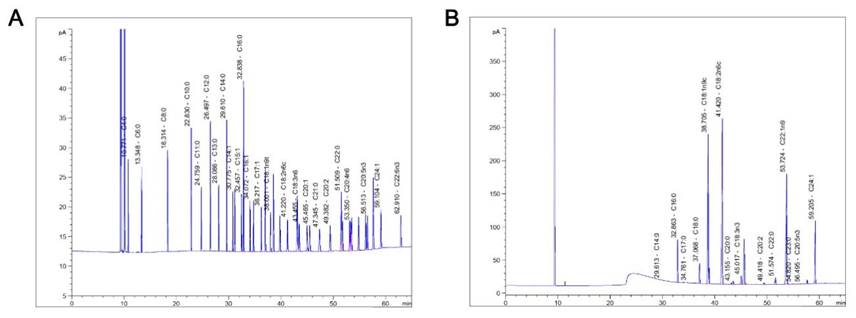
We performed GC/MS as well as LC-MS/MS analysis of the fatty acids and type in ASO. The composition of the fatty acid was determined by gas chromatography (Figure 1), and the result showed the main fatty acids and the content in the table below: linoleic acid (C18:2ω-6, 28.2%), oleic acid (C18:1ω-9, 21.8%), erucic acid (C22:1ω-9, 20.0%), cis,cis-11-eicosenoic acid (C20:1ω-9, 8.6%), nervonic acid (C24:1ω-9, 8.0%), palmitic acid (C16:0, 3.6%) and others (detailed in Table 1).

Based on the fatty acid profile in ASO, we calculated the indices of nutritional quality, which can indicate for predicting the possible risk for developing cardiovascular diseases 15 (Table 2).
We determined the lipid composition and vitamins in ASO shown as the detailed results in Table 3. The values quality indices were all at relatively low level, including sense evaluation, heating test, insoluble impurities, acidity, peroxide and moisture and volatile matter, cold test, which represented ASO in this study is eligible under the standard of China. We confirmed vitamin E content of 71.96 mg/kg in ASO.
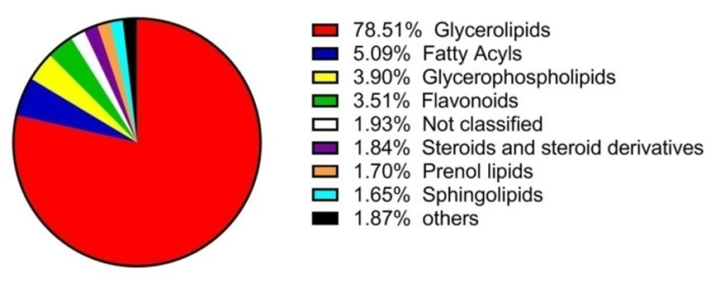
To explore the structural form of fatty acids in ASO, we applied LC-QTOF-MS/MS to perform non-targeted lipidomic detection of the oil sample. The compound was identified based on the HMDB database (https://hmdb.ca/) and according to the precise retention time, m/z and fragment information as well as other information, generalized the compounds according to the lipid type, HMDB number and corresponding class and sub-class. The integrated lipid proportion were: glyceride 78.51%, fatty acyl 5.09%, glycerophospholipid 3.90%, flavonoids 3.51%, etc. (Figure 2)

We investigated the types of lipids in glycerolipides and concluded that: triglyceride (TG), 59.30%, diacylglycerol (DG), 27.91%, monoacylglycerol, 0.14%, and others, 12.65%.
3.3. The Anti-alcohol Effect of ASO Alone or Plus Traditional Natural IngredientsAlcohol produces diverse effects in the brain, such as excitement, emotional instability, faltering, dizziness, drowsiness, etc. Therefore, we investigated the behavior test of locomotor activity, motor coordination, learning and memory ability of rats before and after temulence. To evaluate the anti-alcohol effect of ASO, we pre-administrated ASO to rats via gavage. The data of each rat was the value of experiment calibrated against that of previous training day, which served as a background.
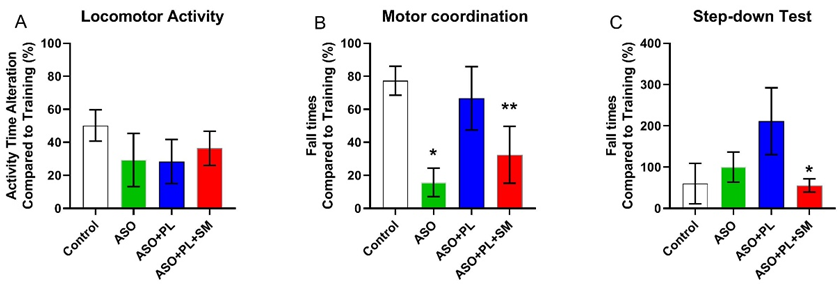
In the locomotor activity test, we recorded the number of times the animals were active before and after alcohol intake. Under the correction of the activity times of the rats in the normal state on the previous day, the activity times of all animals decreased after alcohol treatment. The number of activities of the rats in the control group decreased to 50.20% compared to normal status, and the activities of the rats in ASO group tended to be lower than that in the control group, but there was no statistical difference (Figure 3A).
The motor coordination was to observe the effect of coordination of rats after alcohol administration, we recorded the times of fall when the rats crawled on the slope. After training one day before the experiment, the falls of rats declined in both groups. The falls of rats with ASO pre-protection showed significantly lower than that of control group, which demonstrated that ASO can effectively improve animal movement coordination ability from alcohol induced faltering (Figure 3B).
To explore the effect of ASO on learning and memory ability under the affect of alcohol, we adopted step-down test for analysis. The error rate of rats in the control group decreased after training, however, rats in the ASO group represented higher error rates, but there was no significant difference between the two groups.
In order to further explore the anti-alcohol effect of ASO plus certain traditional natural ingredients, we adopted PL and SM for detecting animal behavioral tests. In the locomotor activity test, the rats in pre-protection groups exhibited lower activities compared to control group, but there was no significant difference (Figure 3A). In the motor coordination test, the rats treated with ASO added with PL and SM notably decreased the time of fall from the slope, whereas rats treated with PL in addition to ASO showed no alteration compared to control group (Figure 3B). In the step-down test, the error rates of rats treated with ASO added with PL and SM markedly decreased compared to that of control group. However, the error rates increased without significance in rats treated with ASO and PL (Figure 3C).

ASO is considered valuable due to its fatty acid composition, especially nervonic acid, the characteristic ingredient. Therefore, we detected ASO fatty acid profile and further analysis the lipid types. The result showed that the fatty acids composition was similar to the earlier report 4, with slightly higher content of NA (8.0%, Figure 1 and Table 1). The lipid type of ASO was analyzed via lipidomics, which revealed that the dominant lipid type in ASO is glycerolipids, with a content of 78.51% (Figure 2). Further analysis discovered the main components in glycerolipids as TG and DG, comprising 59.30% and 27.92%, respectively. We detected flavonoids and vitamin E (α-tocopherol) in ASO, which has been reported previously 16. We originally confirmed the flavonoids with 3.51% in ASO. Evidence showed that flavonoids is capable of scavenging free radicals, regulating lipoproteins, anti-oxidative properties, scavenging free radicals, and hence applied on certain treatments of diseases such as anti-cancer, cardiovascular diseases, Alzheimer’s disease and etc. 17 The content of vitamin E in this study was much lower than the previous report (1252.3mg/kg) 16, which may cause by different origin or extraction method etc. Although it is not the main ingredient in ASO, vitamin E not only act as positive role in human health, but also increase the stability of oil and avoid rancidity during storage 16.
Alcohol consumption is recognized as a leading risk factor for premature mortality and the burden of disease worldwide in recent years 20. Alcohol is considered a very hazardous cytotoxic substance that can harm the organism both acutely and chronically. The more dangerous of alcohol is causing addiction. However, alcohol is of great significance to the social life of human society 21, as a result, restraining humans from alcohol is impractical. Hence, it is necessary to develop certain products against or to alleviate the adverse consequences brought by alcohol. Our pre-experiments established a proper dose by observing the rats treated with 52% alcohol (alcohol/water = 52:100, V/V). The standard is that the righting reflex of temulence rats disappears and is stable or sluggish for a certain period and then recovered (data not shown). We administered the dose of 0.02 ml/g alcohol via gavage to rats and compared it to the animals in the normal status on the behavior change.
The results of rats pre-treated with ASO showed an effective improvement in motor coordination at the status of temulence (Figure 3B). Alcohol-induced damage to the organism derives from its direct effect, which manifests mainly in changes to biological membranes and influences their fluidity 22. Furthermore, alcohol oxidation in vivo leads to reactive oxygen species formation and changes in human antioxidant protection systems, subsequently causing the development of oxidative stress, which could evoke certain adverse effects and even disease in the human body, especially cardiovascular disease 23. Topiwala et al 24. declared via a longitudinal cohort study that alcohol consumption, even at moderate levels, can be associated with adverse brain outcomes including hippocampal atrophy and cognitive decline. So far, there has been little effort on the anti-alcohol effect of oil and lipids, although these are vital for the brain, which possessed 50% lipids to constitute the dry weight, and mainly utilizes acylated lipids to generate phospholipids for cell membranes 25. Dietary TG is emulsified by bile acids within the intestinal lumen after being hydrolyzed primarily by pancreatic lipase, which produces sn-2-monoacylglycerols, free fatty acids, and releasing DG via the catalyzation of TG hydrolysis 18, 19. Recently, Xue et al 26. reported that dietary supplementation of ASO during the recovery phase of cuprizone-induced demyelination alleviated schizophrenic-like behavior and promoted remyelination in mice, which could be attributed to the DG-type lipids in ASO. Nervonic acid, as well as arachidonic acid and docosahexaenoic acid (DHA), are the most important fatty acids in the nervous system 27. Our previous study 4 proved that ASO can effectively improve the capacity of learning and memory in rats, which correlated to the biomarkers with NA chain accumulated and subsequently conversed in serum and brain. Simultaneously, the alleviating-temulence effect of NA may also contribute to its anti-oxidant function 5.
Our further exploration of ASO combined with traditional natural ingredients obtained inverse results. Surprisingly, as an anti-alcoholic herbal medicine in China, PL addition counteracted the effect of ASO in motor coordination (Figure 3B), and even led to a worse manifestation in the step-down test (Figure 3C). Nevertheless, further addition of SM reverted the effect of ASO alone (Figure 3B). Additionally, the rats pre-treated with the formula of three ingredients, presented a significant decrease in the error times in the step-down test (Figure 3C), which represented a superior learning and memory ability. The anti-alcohol function of PL can be attributed to the anti-oxidative effect 9, 10, however, combined with ASO showed a trend of counteracting the effect. Upon our hypothesis, the reason may be due to the experimental error which can caused by individual difference among the rats. On the other hand, we cannot exclude the possibility of the fact that there may exist an antagonism effect between ASO and PL. As a form of isoflavonoid compound, puerarin is one of the main active ingredients of PL 28. Certain research indicated that puerarin can block lipid uptake and metabolism 28, 29. Therefore, in this study, the addition of PL may affect the function of ASO and lead a counteraction effect. When the third ingredient, SM, was added, the antagonism effect seemed to be quenched, and moreover the learning and memory ability of rats was enhanced. Soybean is rich in high-quality proteins and peptides which possess antioxidant activity and benefit for human health 30, 31, and soybean milk is a better nutritional supplement than milk as major source of protein for patients with inflammation 31, 32. There has not been much research on anti-alcohol effect of soybean or SM, but limited reports indicate that the function of soybean peptides may also be based on the anti-oxidant effect 12. Several reports employed lipids as nanocarriers for oral peptide delivery and thus augmented the bioactivity in vivo 33. In this study, the SM powder and ASO were simply mixed, though there might have formed a nanostructure of lipid-peptides, which may enhance both SM and ASO. Based on these results, it is worthwhile to develop a formula for anti-alcohol, and simultaneously the antagonism effect should be considered.
We evaluated ASO for fatty acid composition, physical and chemical characters, and other bioactive ingredients such as vitamin E and flavonoids. Through the investigation of the ingredients of ASO, we found a higher concentration of nervonic acid, as well as lipids in the main form of TG and DG, which are beneficial for brain damage repair and can be associated with antioxidant function. In animal experiments, we discovered that ASO has an anti-alcohol effect, effectively alleviating the problem of decreased coordination and gait instability in rats after temulence. In addition, we paired ASO with PL and SM, and found that ASO and PL may have antagonistic effects, whereas the combination of the three ingredients can restore the effect of ASO and enhance the performance of temulence rats in learning and memory ability. Therefore, the formula with ASO products for anti-alcohol is worth developing, and the metabolic pathways of the anti-alcohol effect of ASO also need further exploration.
This work was supported by Bao Feng Biotech (Beijing) Co., Ltd research project: Research on the drug effect of Nervous Acid Extracts, [grant numbers NO: BFYF2022YW01].
The detection of fatty acids composition and quality of ASO was performed at Qingdao Sci-tech Innovation Quality Testing Co., Ltd., China.
The animal experiment was procured by Beijing Vital River Laboratory Animal Technology Co., Ltd., and approved by the Ethics Committee of Vital River Laboratory.
The authors have no competing interests.
| [1] | A. A. Spector and H. Y. Kim, “Discovery of essential fatty acids,” J Lipid Res, 56(1). 11-21. Jan. 2015. | ||
| In article | View Article PubMed | ||
| [2] | L. Li, W. J. Manning, L. Tong and X. Wang, “Chronic drought stress reduced but not protected Shantung maple (Acer truncatum Bunge) from adverse effects of ozone (O3) on growth and physiology in the suburb of Beijing, China,” Environ Pollut, 201(34-41. Jun. 2015. | ||
| In article | View Article PubMed | ||
| [3] | Wang, XY, Fan, JS, SY, Sun and RC, “A new resource of nervonic acid from purpleblow maple (Acer truncatum) seed oil,” FOREST PROD J, 2006,56(11-12)(-). 147-150. 2006. | ||
| In article | |||
| [4] | W. Song, K. Zhang, T. Xue, J. Han, F. Peng, C. Ding, F. Lin, J. Li, F. T. A. Sze, J. Gan and X. Chen, “Cognitive improvement effect of nervonic acid and essential fatty acids on rats ingesting Acer truncatum Bunge seed oil revealed by lipidomics approach,” Food Funct, 13(5). 2475-2490. Feb 11. 2022. | ||
| In article | View Article PubMed | ||
| [5] | H. Umemoto, S. Yasugi, S. Tsuda, M. Yoda, T. Ishiguro, N. Kaba and T. Itoh, “Protective Effect of Nervonic Acid Against 6-Hydroxydopamine-Induced Oxidative Stress in PC-12 Cells,” J Oleo Sci, 70(1). 95-102. 2021. | ||
| In article | View Article PubMed | ||
| [6] | K. J. Mukamal, “A safe level of alcohol consumption: the right answer demands the right question,” J Intern Med, 288(5). 550-559. Nov. 2020. | ||
| In article | View Article PubMed | ||
| [7] | S. M. Paul, “Alcohol-sensitive GABA receptors and alcohol antagonists,” Proc Natl Acad Sci U S A, 103(22). 8307-8. May 30. 2006. | ||
| In article | View Article PubMed | ||
| [8] | Y. Guan, P. Xu, Q. Shen, E. Jiang, L. Chen, W. Zhu, W. Wu and Z. Zang, “Research Progress in Anti-alcoholic Effect of Puerariae Lobatae Radix,” Chinese Journal of Experimental Traditional Medical Formulae, 27(2). 8. 2021. | ||
| In article | |||
| [9] | M. Zhao, Y. Q. Du, L. Yuan and N. N. Wang, “Protective effect of puerarin on acute alcoholic liver injury,” Am J Chin Med, 38(2). 241-9. 2010. | ||
| In article | View Article PubMed | ||
| [10] | S. Q. Cui, Q. Wang, Y. Zheng, B. Xiao, H. W. Sun, X. L. Gu, Y. C. Zhang, C. H. Fu, P. X. Dong and X. M. Wang, “Puerarin protects against damage to spatial learning and memory ability in mice with chronic alcohol poisoning,” Braz J Med Biol Res, 48(6). 515-22. Jun. 2015. | ||
| In article | View Article PubMed | ||
| [11] | A. Sugiyama, Y. Ueda, H. Takase and K. Yazaki, “Do soybeans select specific species of Bradyrhizobium during growth?,” Commun Integr Biol, 8(1). e992734. Jan-Feb. 2015. | ||
| In article | View Article PubMed | ||
| [12] | Y. Zhou, Y. Chen, Q. Wang, M. T. Cai and X. L. Guo, “[Study on anti-alcohol mechanism of soybean peptide],” Zhong Yao Cai, 37(6). 1033-6. Jun. 2014. | ||
| In article | |||
| [13] | T. Zeng, F. F. Guo, C. L. Zhang, S. Zhao, D. D. Dou, X. C. Gao and K. Q. Xie, “The anti-fatty liver effects of garlic oil on acute ethanol-exposed mice,” Chem Biol Interact, 176(2-3). 234-42. Nov 25. 2008. | ||
| In article | View Article PubMed | ||
| [14] | M. H. Sarafian, M. Gaudin, M. R. Lewis, F. P. Martin, E. Holmes, J. K. Nicholson and M. E. Dumas, “Objective set of criteria for optimization of sample preparation procedures for ultra-high throughput untargeted blood plasma lipid profiling by ultra performance liquid chromatography-mass spectrometry,” Anal Chem, 86(12). 5766-74. Jun 17. 2014. | ||
| In article | View Article PubMed | ||
| [15] | G. Marcelino, P. A. Hiane, A. Pott, W. F. de Oliveira Filiu, A. R. L. Caires, F. S. Michels, M. R. M. Junior, N. M. S. Santos, A. A. Nunes, L. C. S. Oliveira, M. R. Cortes, I. R. Maldonade, L. F. Cavalheiro, C. E. D. Nazario, L. F. Santana, C. Di Pietro Fernandes, F. J. Negrao, M. B. Tatara, B. B. de Faria, M. A. Asato, K. de Cassia Freitas, D. Bogo, V. A. do Nascimento and R. de Cassia Avellaneda Guimaraes, “Characterization of Buriti (Mauritia flexuosa) Pulp Oil and the Effect of Its Supplementation in an In Vivo Experimental Model,” Nutrients, 14(12). Jun 19. 2022. | ||
| In article | View Article PubMed | ||
| [16] | S. Zhou, Y. Zhou and W. Yan, “Research Progress on New Food Raw Materials for Seven Seed Oils,” Science and Technology of Food Industry, 43(21). 11. 2022. | ||
| In article | View Article | ||
| [17] | K. Wen, X. Fang, J. Yang, Y. Yao, K. S. Nandakumar, M. L. Salem and K. Cheng, “Recent Research on Flavonoids and their Biomedical Applications,” Curr Med Chem, 28(5). 1042-1066. 2021. | ||
| In article | View Article PubMed | ||
| [18] | M. Armand, P. Borel, B. Pasquier, C. Dubois, M. Senft, M. Andre, J. Peyrot, J. Salducci and D. Lairon, “Physicochemical characteristics of emulsions during fat digestion in human stomach and duodenum,” Am J Physiol, 271(1 Pt 1). G172-83. Jul. 1996. | ||
| In article | View Article PubMed | ||
| [19] | M. E. Lowe, “The triglyceride lipases of the pancreas,” J Lipid Res, 43(12). 2007-16. Dec. 2002. | ||
| In article | View Article PubMed | ||
| [20] | I. Sohi, A. Franklin, B. Chrystoja, A. Wettlaufer, J. Rehm and K. Shield, “The Global Impact of Alcohol Consumption on Premature Mortality and Health in 2016,” Nutrients, 13(9). Sep 9. 2021. | ||
| In article | View Article PubMed | ||
| [21] | P. Anderson, “The Impact of Alcoholic Beverages on Human Health,” Nutrients, 13(12). Dec 10. 2021. | ||
| In article | View Article PubMed | ||
| [22] | T. Zima, “Alcohol Abuse,” EJIFCC, 29(4). 285-289. Dec. 2018. | ||
| In article | |||
| [23] | A. Y. Sun, M. Ingelman-Sundberg, E. Neve, H. Matsumoto, Y. Nishitani, Y. Minowa, Y. Fukui, S. M. Bailey, V. B. Patel, C. C. Cunningham, T. Zima, L. Fialova, L. Mikulikova, P. Popov, I. Malbohan, M. Janebova, K. Nespor and G. Y. Sun, “Ethanol and oxidative stress,” Alcohol Clin Exp Res, 25(5 Suppl ISBRA). 237S-243S. May. 2001. | ||
| In article | View Article | ||
| [24] | A. Topiwala, C. L. Allan, V. Valkanova, E. Zsoldos, N. Filippini, C. Sexton, A. Mahmood, P. Fooks, A. Singh-Manoux, C. E. Mackay, M. Kivimaki and K. P. Ebmeier, “Moderate alcohol consumption as risk factor for adverse brain outcomes and cognitive decline: longitudinal cohort study,” BMJ, 357(j2353. Jun 6. 2017. | ||
| In article | View Article PubMed | ||
| [25] | J. A. Hamilton, C. J. Hillard, A. A. Spector and P. A. Watkins, “Brain uptake and utilization of fatty acids, lipids and lipoproteins: application to neurological disorders,” J Mol Neurosci, 33(1). 2-11. Sep. 2007. | ||
| In article | View Article PubMed | ||
| [26] | Y. Xue, X. Zhu, W. Yan, Z. Zhang, E. Cui, Y. Wu, C. Li, J. Pan, Q. Yan, X. Chai and S. Zhao, “Dietary Supplementation With Acer truncatum Oil Promotes Remyelination in a Mouse Model of Multiple Sclerosis,” Front Neurosci, 16(860280. 2022. | ||
| In article | View Article PubMed | ||
| [27] | G. P. Amminger, M. R. Schafer, C. M. Klier, J. M. Slavik, I. Holzer, M. Holub, S. Goldstone, T. J. Whitford, P. D. McGorry and M. Berk, “Decreased nervonic acid levels in erythrocyte membranes predict psychosis in help-seeking ultra-high-risk individuals,” Mol Psychiatry, 17(12). 1150-2. Dec. 2012. | ||
| In article | View Article PubMed | ||
| [28] | Y. X. Zhou, H. Zhang and C. Peng, “Puerarin: a review of pharmacological effects,” Phytother Res, 28(7). 961-75. Jul. 2014. | ||
| In article | View Article PubMed | ||
| [29] | L. Yang, D. Yao, H. Yang, Y. Wei, Y. Peng, Y. Ding and L. Shu, “Puerarin Protects Pancreatic beta-Cells in Obese Diabetic Mice via Activation of GLP-1R Signaling,” Mol Endocrinol, 30(3). 361-71. Mar. 2016. | ||
| In article | View Article PubMed | ||
| [30] | L. Azadbakht, M. Kimiagar, Y. Mehrabi, A. Esmaillzadeh, F. B. Hu and W. C. Willett, “Dietary soya intake alters plasma antioxidant status and lipid peroxidation in postmenopausal women with the metabolic syndrome,” Br J Nutr, 98(4). 807-13. Oct. 2007. | ||
| In article | View Article | ||
| [31] | S. T. Baghbadorani, M. R. Ehsani, M. Mirlohi, H. Ezzatpanah, L. Azadbakht and M. Babashahi, “Antioxidant Capability of Ultra-high Temperature Milk and Ultra-high Temperature Soy Milk and their Fermented Products Determined by Four Distinct Spectrophotometric Methods,” Adv Biomed Res, 6(62. 2017. | ||
| In article | View Article PubMed | ||
| [32] | S. Reinwald, S. R. Akabas and C. M. Weaver, “Whole versus the piecemeal approach to evaluating soy,” J Nutr, 140(12). 2335S-2343S. Dec. 2010. | ||
| In article | View Article PubMed | ||
| [33] | Z. Niu, I. Conejos-Sanchez, B. T. Griffin, C. M. O'Driscoll and M. J. Alonso, “Lipid-based nanocarriers for oral peptide delivery,” Adv Drug Deliv Rev, 106(Pt B). 337-354. Nov 15. 2016. | ||
| In article | View Article PubMed | ||
Published with license by Science and Education Publishing, Copyright © 2023 Ke Zhang, Jiarui Han, Tingting Chang, Wangting Song, Xianyang Chen and Baoming Ji
 This work is licensed under a Creative Commons Attribution 4.0 International License. To view a copy of this license, visit
http://creativecommons.org/licenses/by/4.0/
This work is licensed under a Creative Commons Attribution 4.0 International License. To view a copy of this license, visit
http://creativecommons.org/licenses/by/4.0/
| [1] | A. A. Spector and H. Y. Kim, “Discovery of essential fatty acids,” J Lipid Res, 56(1). 11-21. Jan. 2015. | ||
| In article | View Article PubMed | ||
| [2] | L. Li, W. J. Manning, L. Tong and X. Wang, “Chronic drought stress reduced but not protected Shantung maple (Acer truncatum Bunge) from adverse effects of ozone (O3) on growth and physiology in the suburb of Beijing, China,” Environ Pollut, 201(34-41. Jun. 2015. | ||
| In article | View Article PubMed | ||
| [3] | Wang, XY, Fan, JS, SY, Sun and RC, “A new resource of nervonic acid from purpleblow maple (Acer truncatum) seed oil,” FOREST PROD J, 2006,56(11-12)(-). 147-150. 2006. | ||
| In article | |||
| [4] | W. Song, K. Zhang, T. Xue, J. Han, F. Peng, C. Ding, F. Lin, J. Li, F. T. A. Sze, J. Gan and X. Chen, “Cognitive improvement effect of nervonic acid and essential fatty acids on rats ingesting Acer truncatum Bunge seed oil revealed by lipidomics approach,” Food Funct, 13(5). 2475-2490. Feb 11. 2022. | ||
| In article | View Article PubMed | ||
| [5] | H. Umemoto, S. Yasugi, S. Tsuda, M. Yoda, T. Ishiguro, N. Kaba and T. Itoh, “Protective Effect of Nervonic Acid Against 6-Hydroxydopamine-Induced Oxidative Stress in PC-12 Cells,” J Oleo Sci, 70(1). 95-102. 2021. | ||
| In article | View Article PubMed | ||
| [6] | K. J. Mukamal, “A safe level of alcohol consumption: the right answer demands the right question,” J Intern Med, 288(5). 550-559. Nov. 2020. | ||
| In article | View Article PubMed | ||
| [7] | S. M. Paul, “Alcohol-sensitive GABA receptors and alcohol antagonists,” Proc Natl Acad Sci U S A, 103(22). 8307-8. May 30. 2006. | ||
| In article | View Article PubMed | ||
| [8] | Y. Guan, P. Xu, Q. Shen, E. Jiang, L. Chen, W. Zhu, W. Wu and Z. Zang, “Research Progress in Anti-alcoholic Effect of Puerariae Lobatae Radix,” Chinese Journal of Experimental Traditional Medical Formulae, 27(2). 8. 2021. | ||
| In article | |||
| [9] | M. Zhao, Y. Q. Du, L. Yuan and N. N. Wang, “Protective effect of puerarin on acute alcoholic liver injury,” Am J Chin Med, 38(2). 241-9. 2010. | ||
| In article | View Article PubMed | ||
| [10] | S. Q. Cui, Q. Wang, Y. Zheng, B. Xiao, H. W. Sun, X. L. Gu, Y. C. Zhang, C. H. Fu, P. X. Dong and X. M. Wang, “Puerarin protects against damage to spatial learning and memory ability in mice with chronic alcohol poisoning,” Braz J Med Biol Res, 48(6). 515-22. Jun. 2015. | ||
| In article | View Article PubMed | ||
| [11] | A. Sugiyama, Y. Ueda, H. Takase and K. Yazaki, “Do soybeans select specific species of Bradyrhizobium during growth?,” Commun Integr Biol, 8(1). e992734. Jan-Feb. 2015. | ||
| In article | View Article PubMed | ||
| [12] | Y. Zhou, Y. Chen, Q. Wang, M. T. Cai and X. L. Guo, “[Study on anti-alcohol mechanism of soybean peptide],” Zhong Yao Cai, 37(6). 1033-6. Jun. 2014. | ||
| In article | |||
| [13] | T. Zeng, F. F. Guo, C. L. Zhang, S. Zhao, D. D. Dou, X. C. Gao and K. Q. Xie, “The anti-fatty liver effects of garlic oil on acute ethanol-exposed mice,” Chem Biol Interact, 176(2-3). 234-42. Nov 25. 2008. | ||
| In article | View Article PubMed | ||
| [14] | M. H. Sarafian, M. Gaudin, M. R. Lewis, F. P. Martin, E. Holmes, J. K. Nicholson and M. E. Dumas, “Objective set of criteria for optimization of sample preparation procedures for ultra-high throughput untargeted blood plasma lipid profiling by ultra performance liquid chromatography-mass spectrometry,” Anal Chem, 86(12). 5766-74. Jun 17. 2014. | ||
| In article | View Article PubMed | ||
| [15] | G. Marcelino, P. A. Hiane, A. Pott, W. F. de Oliveira Filiu, A. R. L. Caires, F. S. Michels, M. R. M. Junior, N. M. S. Santos, A. A. Nunes, L. C. S. Oliveira, M. R. Cortes, I. R. Maldonade, L. F. Cavalheiro, C. E. D. Nazario, L. F. Santana, C. Di Pietro Fernandes, F. J. Negrao, M. B. Tatara, B. B. de Faria, M. A. Asato, K. de Cassia Freitas, D. Bogo, V. A. do Nascimento and R. de Cassia Avellaneda Guimaraes, “Characterization of Buriti (Mauritia flexuosa) Pulp Oil and the Effect of Its Supplementation in an In Vivo Experimental Model,” Nutrients, 14(12). Jun 19. 2022. | ||
| In article | View Article PubMed | ||
| [16] | S. Zhou, Y. Zhou and W. Yan, “Research Progress on New Food Raw Materials for Seven Seed Oils,” Science and Technology of Food Industry, 43(21). 11. 2022. | ||
| In article | View Article | ||
| [17] | K. Wen, X. Fang, J. Yang, Y. Yao, K. S. Nandakumar, M. L. Salem and K. Cheng, “Recent Research on Flavonoids and their Biomedical Applications,” Curr Med Chem, 28(5). 1042-1066. 2021. | ||
| In article | View Article PubMed | ||
| [18] | M. Armand, P. Borel, B. Pasquier, C. Dubois, M. Senft, M. Andre, J. Peyrot, J. Salducci and D. Lairon, “Physicochemical characteristics of emulsions during fat digestion in human stomach and duodenum,” Am J Physiol, 271(1 Pt 1). G172-83. Jul. 1996. | ||
| In article | View Article PubMed | ||
| [19] | M. E. Lowe, “The triglyceride lipases of the pancreas,” J Lipid Res, 43(12). 2007-16. Dec. 2002. | ||
| In article | View Article PubMed | ||
| [20] | I. Sohi, A. Franklin, B. Chrystoja, A. Wettlaufer, J. Rehm and K. Shield, “The Global Impact of Alcohol Consumption on Premature Mortality and Health in 2016,” Nutrients, 13(9). Sep 9. 2021. | ||
| In article | View Article PubMed | ||
| [21] | P. Anderson, “The Impact of Alcoholic Beverages on Human Health,” Nutrients, 13(12). Dec 10. 2021. | ||
| In article | View Article PubMed | ||
| [22] | T. Zima, “Alcohol Abuse,” EJIFCC, 29(4). 285-289. Dec. 2018. | ||
| In article | |||
| [23] | A. Y. Sun, M. Ingelman-Sundberg, E. Neve, H. Matsumoto, Y. Nishitani, Y. Minowa, Y. Fukui, S. M. Bailey, V. B. Patel, C. C. Cunningham, T. Zima, L. Fialova, L. Mikulikova, P. Popov, I. Malbohan, M. Janebova, K. Nespor and G. Y. Sun, “Ethanol and oxidative stress,” Alcohol Clin Exp Res, 25(5 Suppl ISBRA). 237S-243S. May. 2001. | ||
| In article | View Article | ||
| [24] | A. Topiwala, C. L. Allan, V. Valkanova, E. Zsoldos, N. Filippini, C. Sexton, A. Mahmood, P. Fooks, A. Singh-Manoux, C. E. Mackay, M. Kivimaki and K. P. Ebmeier, “Moderate alcohol consumption as risk factor for adverse brain outcomes and cognitive decline: longitudinal cohort study,” BMJ, 357(j2353. Jun 6. 2017. | ||
| In article | View Article PubMed | ||
| [25] | J. A. Hamilton, C. J. Hillard, A. A. Spector and P. A. Watkins, “Brain uptake and utilization of fatty acids, lipids and lipoproteins: application to neurological disorders,” J Mol Neurosci, 33(1). 2-11. Sep. 2007. | ||
| In article | View Article PubMed | ||
| [26] | Y. Xue, X. Zhu, W. Yan, Z. Zhang, E. Cui, Y. Wu, C. Li, J. Pan, Q. Yan, X. Chai and S. Zhao, “Dietary Supplementation With Acer truncatum Oil Promotes Remyelination in a Mouse Model of Multiple Sclerosis,” Front Neurosci, 16(860280. 2022. | ||
| In article | View Article PubMed | ||
| [27] | G. P. Amminger, M. R. Schafer, C. M. Klier, J. M. Slavik, I. Holzer, M. Holub, S. Goldstone, T. J. Whitford, P. D. McGorry and M. Berk, “Decreased nervonic acid levels in erythrocyte membranes predict psychosis in help-seeking ultra-high-risk individuals,” Mol Psychiatry, 17(12). 1150-2. Dec. 2012. | ||
| In article | View Article PubMed | ||
| [28] | Y. X. Zhou, H. Zhang and C. Peng, “Puerarin: a review of pharmacological effects,” Phytother Res, 28(7). 961-75. Jul. 2014. | ||
| In article | View Article PubMed | ||
| [29] | L. Yang, D. Yao, H. Yang, Y. Wei, Y. Peng, Y. Ding and L. Shu, “Puerarin Protects Pancreatic beta-Cells in Obese Diabetic Mice via Activation of GLP-1R Signaling,” Mol Endocrinol, 30(3). 361-71. Mar. 2016. | ||
| In article | View Article PubMed | ||
| [30] | L. Azadbakht, M. Kimiagar, Y. Mehrabi, A. Esmaillzadeh, F. B. Hu and W. C. Willett, “Dietary soya intake alters plasma antioxidant status and lipid peroxidation in postmenopausal women with the metabolic syndrome,” Br J Nutr, 98(4). 807-13. Oct. 2007. | ||
| In article | View Article | ||
| [31] | S. T. Baghbadorani, M. R. Ehsani, M. Mirlohi, H. Ezzatpanah, L. Azadbakht and M. Babashahi, “Antioxidant Capability of Ultra-high Temperature Milk and Ultra-high Temperature Soy Milk and their Fermented Products Determined by Four Distinct Spectrophotometric Methods,” Adv Biomed Res, 6(62. 2017. | ||
| In article | View Article PubMed | ||
| [32] | S. Reinwald, S. R. Akabas and C. M. Weaver, “Whole versus the piecemeal approach to evaluating soy,” J Nutr, 140(12). 2335S-2343S. Dec. 2010. | ||
| In article | View Article PubMed | ||
| [33] | Z. Niu, I. Conejos-Sanchez, B. T. Griffin, C. M. O'Driscoll and M. J. Alonso, “Lipid-based nanocarriers for oral peptide delivery,” Adv Drug Deliv Rev, 106(Pt B). 337-354. Nov 15. 2016. | ||
| In article | View Article PubMed | ||