Astragali radix (AR) is a famous traditional Chinese medicine in China. Different AR producing areas and different extraction methods will affect the internal quality of AR. To ensure the internal quality of AR sold in the market and explore the influence of its source and extraction method on the quality of AR, we proposed a method combining fingerprint and stoichiometry to identify AR. UPLC fingerprints of AR methanol extract (AME) and AR water extract (AWE) were established, and common peaks were found. Qualitative and quantitative analyses were carried out using stoichiometric methods, such as similarity analysis (SA), principal component analysis (PCA), and orthogonal partial least squares (OPLS-DA). The chemical composition of AME and AWE was analyzed by UPLC-Q-TOF/MS. In addition, five compounds of AR were quantitatively determined, which provided accurate and useful data for quality evaluation.
Astragali radix (AR) is the dry root of the leguminous plant Astragalus membranaceus (Fisch.) Bge. var. Mongholicus (Bge.) Hsiao or A.membranaceus (Fisch.) Bge 1. It has high health care and medicinal value, and it is also the homologous substance of medicine and food 2. Studies have shown that the main components of astragalus membranaceus are flavonoids 3, triterpenoids 4, 5, and alkaloids 6, which have many pharmacological activities, such as immunomodulatory, antioxidant, anti-inflammatory, antidiabetic, and antiviral activities 7, 8, 9, 10. AR, as one of the commonly used Chinese medicinal materials in China, has a long medicinal history, extensive clinical application, and large market consumption.
Traditional Chinese medicine decoction is the earliest and most widely used dosage form in China. With the quickening of the pace of modern life, to better adapt to the fast pace of modern life, traditional medical workers developed Chinese medicine formula granules 11. Traditional decoction is water decocted, but methanol extract is often further processed as liquid medicine when preparing formula granules. The number, type, and content of chemical components in the extracts with different solvents were obviously different, indicating that the extraction solvent greatly influenced the chemical components of plant extracts 12. Studies have shown that the 70% ethanol ultrasonic extraction method is more effective than water extraction and enzymatic hydrolysis for extracting natural compounds from Angelica sinensis 13. Therefore, it is necessary to study the differences in chemical components in different extraction methods and AR quality control from different sources.
A fingerprint is a powerful means to evaluate the quality of traditional Chinese medicine (TCM), identify the authenticity, distinguish the origin of species, and ensure the consistency and stability of its components. But the chemical composition of Traditional Chinese medicine is very complex, so it is difficult to determine the correlation between the fingerprints obtained by instrumental analysis. Using Principal Component Analysis (PCA), a statistical analysis of samples can identify specific differences between graphs. The contents of the four main active triterpenoids in Alismatis rhizoma were determined by HPLC, and 20 batches of samples from different sources were distinguished and classified by PCA 14. Ultrahigh performance liquid chromatography chromatographic quadrupole time of flight mass spectrometry (UPLC-Q-TOF-MS) has the advantages of high speed, resolution, and accuracy 15, which can be used for qualitative analysis of complex TCM components 16. In recent years, UPLC-Q-TOF-MS has rapidly become an important research method in the field of TCM component analysis 17.
In this study, the fingerprints of different extracts were established, and SA, PCA and OPLS-DA methods were used for quantitative labeling screening of Astragali radix from different sources. UPLC-Q-TOF /MS was used to study the chemical constituents of Chinese herbal medicines, which provided the basis for quality evaluation of Chinese herbal medicines. In summary, a new method was established to explore the influence of the extraction process, climate environment, soil conditions, and other factors on AR quality.
A total of 20 batches of licorice were collected from Xinjiang, Gansu, and Inner Mongolia and were divided into three groups: S1–S5 from Xinjiang, S6–S10 from Gansu, and S11–S13 from Inner Mongolia. The Calycosin 7-O-glucoside (LOT number: R11O9F71937), Calycosin (LOT number: A03GB156838), Methylnissolin-3-O-glucoside (LOT number: P21N9F75533), Ononin (LOT number: M02A11S120167), and Isomucronulatol (LOT number: Y28M10H84303) were purchased from Shanghai yuanye Bio-Technology Co.
2.2. Preparation of Sample SolutionsThe medicinal herbs of AR were dried and crushed. We sieved the powder through a 40-mesh sieve. After precision weighing (1 g), 50 ml of methanol was added to the dried and crushed herb, followed by ultrasonic extraction for 1 h. The supernatant was centrifuged, and the solution was stored in the injection vial through a filter membrane with a diameter of 0.22 mm to obtain the methanol extracts of AR. Next, we weighed out 50 g of AR powder, decocted in 1000 ml of boiling water for 2 h, strain, and repeated once. The water extract of AR with the concentration of 0.025 g/mL was prepared by combining two water decoctions, filtration, concentration, and dilution, with pure water. The prepared alcohol extract and water extract were tested by UPLC-Q-TOF/MS.
2.3. UPLC-Q-TOF/MS AnalysisChromatographic analysis of the AME and the AWE were performed in the Agilent UPLC-Q-TOF/MS system. Chromatographic separation was carried on a Waters CORTECS C18 column (4.6 × 50 mm, 2.7 µm) held at 30°C. To shorten the analysis time while maintaining satisfactory separation, the optimal mobile phase was composed of acetonitrile (A) and 0.1% aqueous formic acid (B) operating under a gradient elution program as follows: 0–5 min, 82–77% B; 5–7 min, 77–70% B; 7–10 min, 70–65% B; 10–12 min, 65–60% B; 12–13 min 60–55% B; and 13–15 min 55–40% B. The flow rate was 0.4 mL/min, the injection volume was 2 µL, and the chromatogram detector was set at 260 nm. The mass spectrometry detector was equipped with an electrospray ionization (ESI) source. The ESI source was operated in both negative and positive polarities. The optimal MS parameters were as follows: the capillary temperature was set at 270°C and the vaporization temperature at 300°C. The sheath gas flows were set at 35 µL/min, the auxiliary gas flows were set at 5 µL/min. The analyses were conducted in full scan mode, and the Q-TOF acquisition rate was 0.1 s, with a mass range between 100 and 1500 m/z.
2.4. Data ProcessingThe chromatographic fingerprints were evaluated by chemometrics, including Similarity Evaluation System for Chromatographic Fingerprint of Traditional Chinese Medicine (version 2004A, National Committee of Pharmacopoeia, China), principal component analysis (PCA), and orthogonal partial least squares discriminant analysis (OPLS-DA) was performed by SIMCA 13.0 software. The post-acquisition mass spectrometry data are processed by Qualitative Analysis 10.0 (Agilent).
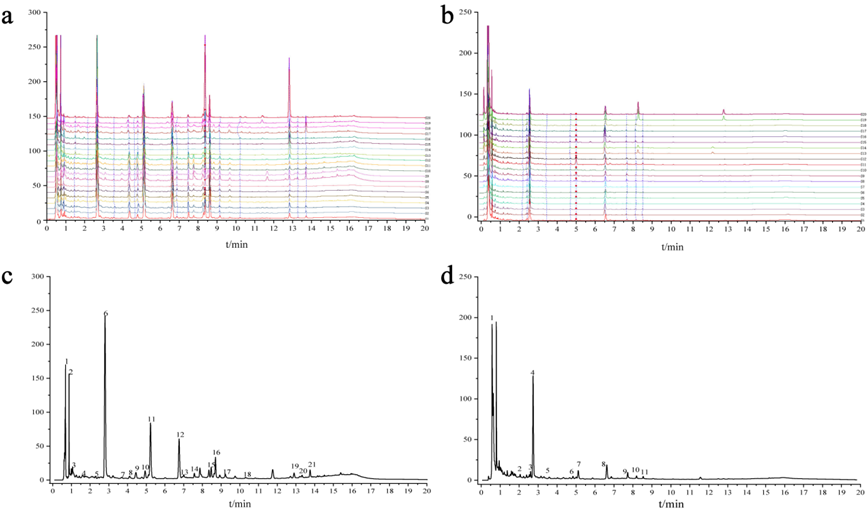
Twenty batches of AR from different producing areas were determined by UPLC with different extraction methods, as shown in Figure 1a and 1b. Fingerprints of alcohol extraction and water extraction were established, and standardized treatment was carried out using the similarity evaluation system of fingerprint of traditional Chinese medicine chromatography (2004A edition). According to fingerprint analysis, 21 common peaks were identified from 20 batches of methanol extract samples of AR (Figure 1c). Eleven common peaks were delineated from the water extract sample (Figure 1d), showing a high degree of separation. For reference chromatogram.

Supplemental Table S1 and S2 show the correlation analysis of 20 ethanol and water extraction samples batches, respectively. The results of AME showed that the similarity of the samples from the Shanxi region was greater than 0.974, the similarity of the samples from the Gansu region was greater than 0.914, and the similarity of the samples from Inner Mongolia was greater than 0.814, except for the two samples which were 0.565 and 0.703. The AWE results showed that the similarity values of all samples from Shanxi were greater than 0.973, the similarity values of all samples from Gansu were greater than 0.831 except sample S17, and the similarity values AR from Inner Mongolia were greater than 0.969 except sample S19 and S20.
Table S1 shows that the correlation between S6 and S5, S6 and S7, S10 and S9, S10 and S11, S10 and S12 is higher than other sample sources. The correlation between S13 and S8, S13 and S9, S16 and S8, and S16 and S9 were lower than other samples. The contents of characteristic peaks 6, 7, 8, and 11 in S6 and S10 were significantly higher than those in other samples, while the contents of characteristic peaks 5, 6, 7, 10, and 14 in S13 and S16 were significantly lower than those in other samples. The results in Table S2 show that the correlation between S4 and S2, S4 and S17, S4 and S13, S15 and S16, and S15 and S1 is higher than the similarity of other sample sources. The correlations between S20 and S7, S20 and S9, S18 and S19, and S18 and S10 samples were lower than other samples. It was found that the content of characteristic peaks 4, 8, and 11 in S15 was significantly higher than that in other samples, while the content of characteristic peaks 2, 3, 5, and 7 in S20 was significantly lower than that in other samples.
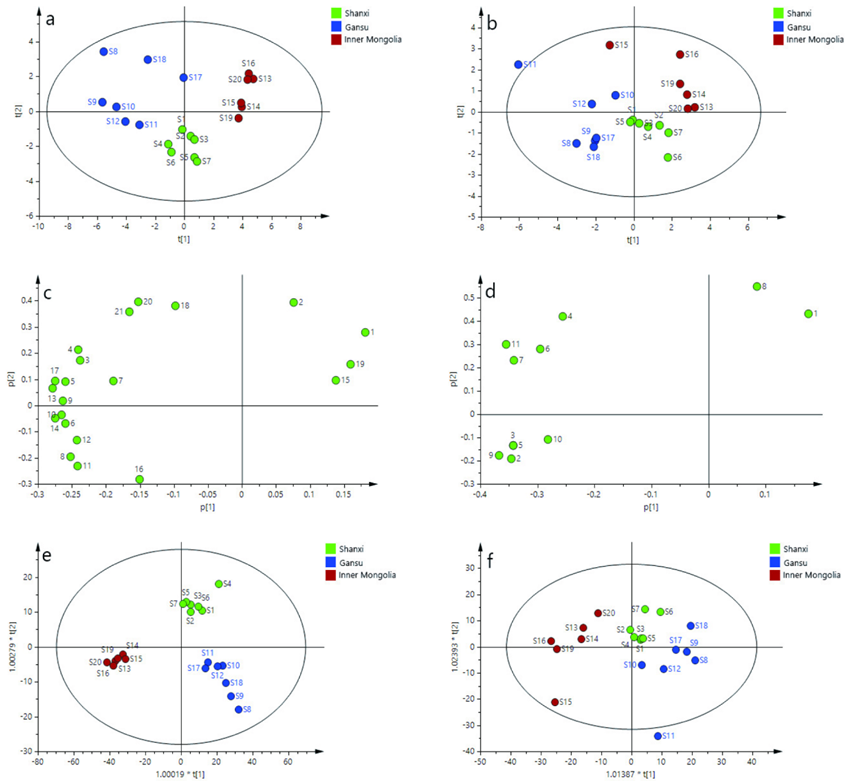
3.3. The Score Plot of the PCA AnalysisAccording to the PCA score chart of AME (Figure 2a), PC1 and PC2 accounted for 56.8% and 16.7% of the total variation of the original observations, respectively. In the PCA score diagram of AWE (Figure 2b), PC1 and PC2 accounted for 53.7% and 19.7% of the total change in the original observations, respectively. We found that AR from three different regions was clearly distinguished through two PCA score charts. The results showed that the regional differences had a certain influence on the quality of AR.
3.4. The Loadings Plot of PCA AnalysisFigure 2c and 2d are PCA loading diagrams of AR. In the load analysis, the further away the sample is from the origin, the greater the weight of the variable. As can be seen from the AME (Figure 2b), peaks 2, 4, 16, 21, and 20 had the greatest influence on the quality of geographical difference. Similarly, it can be seen from the load diagram of AWE (Figure 2e) that peaks 1, 4, 8, and 11 have a great influence on the quality of geographical difference. The loading plot shows the multivariate variables that influence the differences between the samples. It can be seen that these common peaks affect the quality of AR.
3.5. OPLS-DA AnalysisFigure 2e and 2f are the score plot of the OPLS-DA. The results show that the established AME model R2X = 0.808. For the AWE model, R2X = 0.729 and Q2 are all greater than 0.5. It shows that the model data is in good condition and has the good predictive ability. The samples were divided into three groups according to the origin. OPLS-DA model analysis showed that the samples of each group could be significantly distinguished under methanol extraction and water extraction conditions, indicating that there were significant differences between different producing areas of AR.

The differential compounds were screened according to the VIP value of each index component in the model. Within the confidence interval of 0.95, the compounds with VIP > 1.0 were selected as the differential compounds to further analyze the overall difference of the data of abbreviations and the predicted values of the order of importance of variable weights (VIP) were obtained, as shown in Table 1. The effects of methanol extract were the peaks 16, 2, 20, 4, 5, 21, 19, and 11. The VIP influence of water extract was in the order of peaks 8, 1, 5, 2, and 11 (Table 2).
The most important clue for TOF-MS characterization is the high-resolution molecular ion peak. Combined with the isotope model, the molecular formula of the compound can be inferred. Finally, various methods (MS/MS fragmentation information, retention index, UV absorption, and literature retrieval) were used to qualitatively identify the inferred compounds. In this study, the water and alcohol extracts of AR were qualitatively identified by using TOF-MS to obtain accurate relative molecular weight information of excimer ion peak, isotopic distribution, and secondary fragments information obtained by MS/MS, combined with retention time. The unknown compounds were identified from fingerprint and similarity analysis (21 characteristic peaks of alcohol extraction and 11 characteristic peaks of water extraction).
Through OPLS-DA combined with UPLC-Q-TOF/MS analysis, it was found that the Koparin, Feruloyl C1-glucuronide, Isomucronulatol, Sucrose, Biochanin A 7-O-beta-d-glucoside-6''-O-malonate, and Choline were differential genes of AME. The Choline, Methylnissolin-3-O-glucoside and 2, 5-Dimethoxycinnamic acid were differential genes of AWE.
3.7. Quantitative Analysis and Methodological VerificationThe reference substance under item 2.1 was accurately weighed, and the methanol was put into a 10 mL volumetric flask to obtain the mixed reference substance solution. Mixed reference solutions 1, 1.5, 2, 2.5, and 3 mL were accurately absorbed and placed in a 5 mL volumetric flask. UPLC determination was performed according to the chromatographic conditions in item 2.3. The linear regression equation was established, and the results are shown in Table S3. The R2 values were greater than 0.999, indicating a good linear relationship.
We prepared the test solution and analyzed the precision, repeatability, and stability by UPLC. We recorded the peak area and calculated the RSD value. The results are shown in Supplemental Table S4. RSD of precision repeatability and stability were lower than 5%, indicating that the instrument precision met the requirements and the sample was stable.
3.8. Quantitative ResearchContents of characteristic compounds under different extraction methods were determined, as shown in Supplemental Tables S5 and S6. In AME, the CalyCosin-7-O-beta-D-Glucoside contents of samples 1–7 were between 0.0863% and 0.0928%; the contents of samples 8–12 and 17–18 were between 0.0696% and 1.387%, and the contents of samples 13–16 and 19–20 were between 0.0581% and 0.0781%. In AWE, the calyCosin-7-O-beta-D-glucoside content of samples 1–7 was between 0.0570% and 0.0674%, and the contents of samples 8–12 and 17-18 were between 0.0559% and 0.0846%. The contents of samples 13–16 and 19–20 ranged from0.0572% to 0.0839%. The content of each sample in the table is different. However, there are significant differences in different regions. This shows that different growing environments and different extraction conditions would affect the content of medicinal materials.
AR is a common Chinese medicine in traditional decoction and modern granule 18, 19, 20. Unlike traditional dosage forms, methanol is used as an extraction solvent for further preparation. Therefore, the chemical composition of AR is significantly different when extracted with different solvents. AME and AWE were analyzed by UPLC, and a fingerprint was established to find 21 common peaks of AME and 11 common peaks of AWE. The results show that the composition and quantity of AR extracted by different methods differed. Studies have shown that aroma profiles recorded by GC-MS showed that the resulting odor profile varies widely in different preparation methods, Capsicum Annuum L. 21. Similarity analysis results showed significant differences between AR from different sources and different extraction processes. For example, the low similarity among the different origins may be due to the differences in the chemical composition of R. rugosa caused by different ecological environments 22. Therefore, different origins and extraction methods will affect the quality of AR.
PCA, OPLS-DA, and other stoichiometric methods showed that samples from the same area clustered together, and there were significant differences among different areas. This result is confirmed by UPLC and similarity analysis. The results in Figure 2b showed a large difference between samples S11 and S15 in the water extract. Combined with peak area analysis, the peak area of all common peaks in sample S11 was larger than that of the other five batches of Gansu samples, and the peak area of five common peaks in sample S15 was larger than that of other Inner Mongolia samples. Zizhou astragalus is famous for its good quality 23, and most of the ancient origin of AR is in Gansu Province. The growth environment of the S11 sample is similar to that of Zizhou astragalus, so the quality of S11 is better. The S15 samples cultivated in Inner Mongolia are sandy soil suitable for the growth of Astragali radix, which is the main reason for the high quality 24.
In this study, AR with different extraction methods was analyzed by UPLC and fingerprint was established. The differences in the chemical composition of AR from different producing areas and different extraction methods were analyzed by UPLC-Q-TOF/MS. The fingerprint was combined with a similarity evaluation system, PCA, OPLS-DA, and other stoichiometric methods to distinguish and screen characteristic peaks of AR from different producing areas, and then quantitative analysis was conducted. We found that AR from different sources (Shanxi, Inner Mongolia, Gansu) gather together separately. The composition and content of AME and AWE were also significantly different. The results showed that different growing environments and different extraction methods had a significant influence on the inner quality of AR. Fingerprint and stoichiometry were used to confirm the results more comprehensively. The combination of fingerprint and stoichiometry can explain more effectively the influence of different growing environment and extraction process on the quality of medicinal materials.
This study was financed in part by the Natural Science Foundation of Hebei Province of China (grant 19276414D); and Hebei Province University Students' Science and Technology Innovation Ability Cultivation Project (grant 2021H011608).
The authors declare that they have no conflicts of interest.
| [1] | Pharmacopoeia of the People's Republic of China (Part One) [M]. China Medical Science and Technology Press, Beijing, 2020. | ||
| In article | |||
| [2] | Tian, Y., Ding, Y. P., Shao, B. P., Yang, J. and Wu, J. G, “Interaction between homologous functional food Astragali radix and intestinal flora,” China Journal of Chinese Materia Medica, 11:2486-2492, 2020. | ||
| In article | |||
| [3] | Ibrahim, L. F., Marzouk, M. M., Hussein, S. R., Kawashty, S. A., Mahmoud, K. and Saleh, N. A. M, “Flavonoid constituents and biological screening of Astragalus bombycinus Boiss,” Natural Product Research, 27(4-5): 386-393. 2013. | ||
| In article | View Article PubMed | ||
| [4] | Jan, S., Abbaskhan, A., Musharraf, S.G., Sattar, S. A., Resayes, S. I., Al-Othman, Z. A., Al-Majid, A. M. and Choudhary, M. I, “Three new cycloartane triterpenoids from Astragalus bicuspis,” Planta Med, 77: 1829-1834. 2011. | ||
| In article | View Article PubMed | ||
| [5] | Kim, G. S., Kim, S. Y., Hong, Y., Lee, S. E., Lee J. H., Lee, M. H., Lee, K. H., Choi, J., Noh, H. J. and Lee, D. Y, “Anti-inflammatory cycloartane-type saponins of Astragalus membranaceus,” Molecules, 18(4): 3725-3732. 2013. | ||
| In article | View Article PubMed | ||
| [6] | Daniel, C., Dale, R.G., Martinez, A., Carlos, A. R. and James, A. P, “Screening for swainsonine among South American Astragalus species,” Toxicon, 139: 54-57. 2017. | ||
| In article | View Article PubMed | ||
| [7] | Yang, L. P., Shen, J. G., Xu, W. C., Li, J. and Jiang, J. Q, “Secondary metabolites of the genus Astragalus: structure and biological-activity update,” Chem Biodivers, 10: 1004-1054. 2013. | ||
| In article | View Article | ||
| [8] | Fu, J., Wang, Z. H., Huang, L. F., Zheng, S. H., Wang, D. M., Chen, S. L., Zhang H.T., and Yang, S. H, “Review of the botanical characteristics, phytochemistry, and pharmacology of Astragalus membranaceus (Huangqi),” Phytotherapy Research, 28(9): 1275-1283. 2014. | ||
| In article | View Article PubMed | ||
| [9] | Guo, Z. Z., Lou, Y. M., Kong, M. Y., Luo, Q., Liu, Z.Q. and Wu, J. J, “A systematic review of phytochemistry, pharmacology and pharmacokinetics on Astragali radix: implications for Astragali Radix as a personalized medicine,” International Journal of Molecular Sciences, 20:1463. 2019. | ||
| In article | View Article PubMed | ||
| [10] | Su, H. F., Shaker, S., Kuang, Y., Zhang, M., Ye, M. and Qiao, X, “Phytochemistry and cardiovascular protective effects of Huang-Qi (Astragali radix),” Medicinal Research Reviews, 41(4), 1999-2038. 2021. | ||
| In article | View Article PubMed | ||
| [11] | Zhou, J.L, “Historic review and future prospect of TCM formula granules,” Modern Chinese Medicine, 18: 1093-1096. 2016. | ||
| In article | |||
| [12] | Han, Y. Y. and Liao, C. S, “Effects of different extraction solvents on the chemical composition of Epilobium angustifolium L,” Journal of Anhui Agricultural Sciences, 19:151-156. 2021. | ||
| In article | |||
| [13] | Liu, F. X., Liu, L. L. and Zhang, S. Z, “Comparative study on the content of active components of Astragalius membranaceus from different regions in Gansu Province,” Journal of Traditional Chinese Veterinary Medicine, 5:50-52. 2021. | ||
| In article | |||
| [14] | Zhang, Y. W., Qing, L., Lv, C. X., Liu, X. J., Chen, X. H.and Bi, K. S, “Simultaneous determination of four active components in Alisma orientale (Sam.) Juz. by HPLC-DAD using a single reference standard,” Journal of Pharmaceutical Analysis, 2:85-92. 2015. | ||
| In article | View Article PubMed | ||
| [15] | Zhong, Z., Huang, Y. K., Huang, Q. D., Zheng, S. L., Huang, Z. X., Deng, W. M. and Li, T.W, “Serum metabolic profiling analysis of gout patients based on UPLC-Q-TOF/MS,” Clinica Chimica Acta, 515:52-60. 2021. | ||
| In article | View Article PubMed | ||
| [16] | Wang, Z. Y., Xiong, H., Duan, L. Y., Wang, C. F., Du, Y. L., Hong, X., Zha H. H. and Pan, H. F, “UPLC-Q-TOF-MS-based metabolomics study of hawthorn leaves in different geographical regions,” Anal Methods, 2021. | ||
| In article | View Article PubMed | ||
| [17] | Nie, J., Xiao, L., Zheng, L. M., Du, Z. F., Liu, D., Zhou, J. W., Xiang, J., Hou, J. J., Wang, X, G. and Fang, J. B, “An integration of UPLC-DAD/ESI-Q-TOF MS, GC-MS, and PCA analysis for quality evaluation and identification of cultivars of Chrysanthemi Flos (Juhua),” Phytomedicine, 59;152803. 2019. | ||
| In article | View Article PubMed | ||
| [18] | Wang, Y. H., Li, Y. Y., Zhang, H., Zhu, L. L., Zhong, J., Zeng, J. K. and Ma, Y. M, “Pharmacokinetics-based comprehensive strategy to identify multiple effective components in Huangqi decoction against liver fibrosis, ” Phytomedicine, 84:153513. 2021. | ||
| In article | View Article PubMed | ||
| [19] | Liu, W. W., Shi, L. Q., Wan, Q., Wu, Y. S., Huang, D., Ou, J. Y. and Gao, J. D, “Huangqi Guizhi Wuwu Decoction attenuates Podocyte cytoskeletal protein damage in IgA nephropathy rats by regulating the AT1R/Nephrin/c-Abl pathway,” Biomedicine & Pharmacotherapy, 142:111907. 2021. | ||
| In article | View Article PubMed | ||
| [20] | Cheng, Y., Liu, P., Hou, T. L., Maerbiya, M., Reyangguli, A. and Aini, A, “Mechanisms of huangqi decoction granules on hepatitis B cirrhosis patients based on RNA-sequencing,” Chinese Journal of Integrative Medicine, 7:507-514. 2019. | ||
| In article | View Article PubMed | ||
| [21] | Csóka, M. and Amtmann, M, “Comparing different extraction methods for the investigation of red pepper (L.) volatiles,” Journal of Essential Oil Research, 2:1858983. 2021. | ||
| In article | View Article | ||
| [22] | Nijat, D., Lu, C. F., Lu, J. J., Abdulla, R., Hasan, A., Aidarhan, N. and Aisa, H. A, “Spectrum-effect relationship between UPLC fingerprints and antidiabetic and antioxidant activities of Rosa rugose,” J Chromatogr B Analyt Technol Biomed Life Sci, 1179:122843. 2021. | ||
| In article | View Article PubMed | ||
| [23] | Chen, X. S. and Wu, Y. N, “Textual research on white river, black river, red river, and Yizhou ancient producing place of Astragali radix,” Chinese Traditional and Herbal Drugs, 3:732-738. 2018. | ||
| In article | |||
| [24] | Li, Z. Y., Zhu, S. D., Liu, L. B., Yang, M., Zhang, L., Zhang, C. H.and Li, M. H, “Research on the ecological suitability division of astragalus membranaceus (Fisch.) Bge. var. mongholicus (Bge.) P. K. Hsiao in Inner Mongolia,” Journal of Agricultural Science and Technology, 2:170-176. 2021. | ||
| In article | |||
Published with license by Science and Education Publishing, Copyright © 2022 Meng Wu, Xizhen Cheng, Yuling Zhang, Mingdong Si, Yuguang Zheng, Huigai Sun and Donglai Ma
 This work is licensed under a Creative Commons Attribution 4.0 International License. To view a copy of this license, visit
http://creativecommons.org/licenses/by/4.0/
This work is licensed under a Creative Commons Attribution 4.0 International License. To view a copy of this license, visit
http://creativecommons.org/licenses/by/4.0/
| [1] | Pharmacopoeia of the People's Republic of China (Part One) [M]. China Medical Science and Technology Press, Beijing, 2020. | ||
| In article | |||
| [2] | Tian, Y., Ding, Y. P., Shao, B. P., Yang, J. and Wu, J. G, “Interaction between homologous functional food Astragali radix and intestinal flora,” China Journal of Chinese Materia Medica, 11:2486-2492, 2020. | ||
| In article | |||
| [3] | Ibrahim, L. F., Marzouk, M. M., Hussein, S. R., Kawashty, S. A., Mahmoud, K. and Saleh, N. A. M, “Flavonoid constituents and biological screening of Astragalus bombycinus Boiss,” Natural Product Research, 27(4-5): 386-393. 2013. | ||
| In article | View Article PubMed | ||
| [4] | Jan, S., Abbaskhan, A., Musharraf, S.G., Sattar, S. A., Resayes, S. I., Al-Othman, Z. A., Al-Majid, A. M. and Choudhary, M. I, “Three new cycloartane triterpenoids from Astragalus bicuspis,” Planta Med, 77: 1829-1834. 2011. | ||
| In article | View Article PubMed | ||
| [5] | Kim, G. S., Kim, S. Y., Hong, Y., Lee, S. E., Lee J. H., Lee, M. H., Lee, K. H., Choi, J., Noh, H. J. and Lee, D. Y, “Anti-inflammatory cycloartane-type saponins of Astragalus membranaceus,” Molecules, 18(4): 3725-3732. 2013. | ||
| In article | View Article PubMed | ||
| [6] | Daniel, C., Dale, R.G., Martinez, A., Carlos, A. R. and James, A. P, “Screening for swainsonine among South American Astragalus species,” Toxicon, 139: 54-57. 2017. | ||
| In article | View Article PubMed | ||
| [7] | Yang, L. P., Shen, J. G., Xu, W. C., Li, J. and Jiang, J. Q, “Secondary metabolites of the genus Astragalus: structure and biological-activity update,” Chem Biodivers, 10: 1004-1054. 2013. | ||
| In article | View Article | ||
| [8] | Fu, J., Wang, Z. H., Huang, L. F., Zheng, S. H., Wang, D. M., Chen, S. L., Zhang H.T., and Yang, S. H, “Review of the botanical characteristics, phytochemistry, and pharmacology of Astragalus membranaceus (Huangqi),” Phytotherapy Research, 28(9): 1275-1283. 2014. | ||
| In article | View Article PubMed | ||
| [9] | Guo, Z. Z., Lou, Y. M., Kong, M. Y., Luo, Q., Liu, Z.Q. and Wu, J. J, “A systematic review of phytochemistry, pharmacology and pharmacokinetics on Astragali radix: implications for Astragali Radix as a personalized medicine,” International Journal of Molecular Sciences, 20:1463. 2019. | ||
| In article | View Article PubMed | ||
| [10] | Su, H. F., Shaker, S., Kuang, Y., Zhang, M., Ye, M. and Qiao, X, “Phytochemistry and cardiovascular protective effects of Huang-Qi (Astragali radix),” Medicinal Research Reviews, 41(4), 1999-2038. 2021. | ||
| In article | View Article PubMed | ||
| [11] | Zhou, J.L, “Historic review and future prospect of TCM formula granules,” Modern Chinese Medicine, 18: 1093-1096. 2016. | ||
| In article | |||
| [12] | Han, Y. Y. and Liao, C. S, “Effects of different extraction solvents on the chemical composition of Epilobium angustifolium L,” Journal of Anhui Agricultural Sciences, 19:151-156. 2021. | ||
| In article | |||
| [13] | Liu, F. X., Liu, L. L. and Zhang, S. Z, “Comparative study on the content of active components of Astragalius membranaceus from different regions in Gansu Province,” Journal of Traditional Chinese Veterinary Medicine, 5:50-52. 2021. | ||
| In article | |||
| [14] | Zhang, Y. W., Qing, L., Lv, C. X., Liu, X. J., Chen, X. H.and Bi, K. S, “Simultaneous determination of four active components in Alisma orientale (Sam.) Juz. by HPLC-DAD using a single reference standard,” Journal of Pharmaceutical Analysis, 2:85-92. 2015. | ||
| In article | View Article PubMed | ||
| [15] | Zhong, Z., Huang, Y. K., Huang, Q. D., Zheng, S. L., Huang, Z. X., Deng, W. M. and Li, T.W, “Serum metabolic profiling analysis of gout patients based on UPLC-Q-TOF/MS,” Clinica Chimica Acta, 515:52-60. 2021. | ||
| In article | View Article PubMed | ||
| [16] | Wang, Z. Y., Xiong, H., Duan, L. Y., Wang, C. F., Du, Y. L., Hong, X., Zha H. H. and Pan, H. F, “UPLC-Q-TOF-MS-based metabolomics study of hawthorn leaves in different geographical regions,” Anal Methods, 2021. | ||
| In article | View Article PubMed | ||
| [17] | Nie, J., Xiao, L., Zheng, L. M., Du, Z. F., Liu, D., Zhou, J. W., Xiang, J., Hou, J. J., Wang, X, G. and Fang, J. B, “An integration of UPLC-DAD/ESI-Q-TOF MS, GC-MS, and PCA analysis for quality evaluation and identification of cultivars of Chrysanthemi Flos (Juhua),” Phytomedicine, 59;152803. 2019. | ||
| In article | View Article PubMed | ||
| [18] | Wang, Y. H., Li, Y. Y., Zhang, H., Zhu, L. L., Zhong, J., Zeng, J. K. and Ma, Y. M, “Pharmacokinetics-based comprehensive strategy to identify multiple effective components in Huangqi decoction against liver fibrosis, ” Phytomedicine, 84:153513. 2021. | ||
| In article | View Article PubMed | ||
| [19] | Liu, W. W., Shi, L. Q., Wan, Q., Wu, Y. S., Huang, D., Ou, J. Y. and Gao, J. D, “Huangqi Guizhi Wuwu Decoction attenuates Podocyte cytoskeletal protein damage in IgA nephropathy rats by regulating the AT1R/Nephrin/c-Abl pathway,” Biomedicine & Pharmacotherapy, 142:111907. 2021. | ||
| In article | View Article PubMed | ||
| [20] | Cheng, Y., Liu, P., Hou, T. L., Maerbiya, M., Reyangguli, A. and Aini, A, “Mechanisms of huangqi decoction granules on hepatitis B cirrhosis patients based on RNA-sequencing,” Chinese Journal of Integrative Medicine, 7:507-514. 2019. | ||
| In article | View Article PubMed | ||
| [21] | Csóka, M. and Amtmann, M, “Comparing different extraction methods for the investigation of red pepper (L.) volatiles,” Journal of Essential Oil Research, 2:1858983. 2021. | ||
| In article | View Article | ||
| [22] | Nijat, D., Lu, C. F., Lu, J. J., Abdulla, R., Hasan, A., Aidarhan, N. and Aisa, H. A, “Spectrum-effect relationship between UPLC fingerprints and antidiabetic and antioxidant activities of Rosa rugose,” J Chromatogr B Analyt Technol Biomed Life Sci, 1179:122843. 2021. | ||
| In article | View Article PubMed | ||
| [23] | Chen, X. S. and Wu, Y. N, “Textual research on white river, black river, red river, and Yizhou ancient producing place of Astragali radix,” Chinese Traditional and Herbal Drugs, 3:732-738. 2018. | ||
| In article | |||
| [24] | Li, Z. Y., Zhu, S. D., Liu, L. B., Yang, M., Zhang, L., Zhang, C. H.and Li, M. H, “Research on the ecological suitability division of astragalus membranaceus (Fisch.) Bge. var. mongholicus (Bge.) P. K. Hsiao in Inner Mongolia,” Journal of Agricultural Science and Technology, 2:170-176. 2021. | ||
| In article | |||