Cape gooseberry is a wild plant whose fruits and leaves have been widely used in traditional medicine due to its multiple beneficial health properties, which can be improved using elicitors during cultivation. The aim of this study was to evaluate the foliar application of chitosan (0, 10, 25 and 50 mg/L), hydrogen peroxide (0, 50, 100 and 150 µM) and sodium nitroprusside (0, 50, 100 and 150 µM) on cape gooseberry plants and its effect on the metabolite content, antioxidant capacity and digestive enzyme inhibitory activity of leaves. Results showed that foliar application of chitosan at 25 and 50 mg/L or sodium nitroprusside 100 and 150 µM during cultivation of cape gooseberry significantly improved the phenolic compounds, flavonoids, proline, and total chlorophyll contents of methanolic extracts of leaves, enhancing its antioxidant capacity, as well as α-amylase and α-glucosidase inhibitory activities, without affecting the growth of the plants, whereas hydrogen peroxide 150 µM improved the flavonoid content and pancreatic lipase inhibitory activity, however, this treatment decreased the proline content of leaves. Therefore, elicitors as chitosan and sodium nitroprusside, applied at low concentrations during growth of plants, could be considered as a tool to improve the nutraceutical potential of cape gooseberry leaves.
Plants have been considered as a rich source of therapeutic compounds that help in the treatment and prevention of several diseases. The use of herbal medicines has been increasing in the last years 1. Cape gooseberry is a plant of great interest for agriculture, is cultivated in many countries, such as Colombia, India, South Africa, Australia, Great Britain, among others, it belongs to the Solanaceae family and produces a round and small fruit, enclosed within a persistent calyx that covers the berry. Fruits, leaves and calyces of cape gooseberry have been important ingredients in the culinary traditions in Mesoamerica, fruits are consumed fresh or cooked, whereas leaves and calyces have been used in traditional medicine since ancient times. Recently, these plants have been of great interest for farmers and consumers due to its high nutraceutical value. Fruits extracts have shown preventive effects against certain carcinogens, besides antioxidant and anti-hepatotoxic activities, as well as anti-inflammatory and anti-diabetic effects 2. These effects have been associated to its high content of bioactive compounds, such as phenolic acids, flavonoids, carotenoids and withanolides 3. Furthermore, 4β-Hydroxywithanolide extracted from Physalis peruviana leaves acts as chemotherapeutic agent against lung cancer through DNA damage, apoptosis and G2/M arrest 4. Additionally, aqueous and ethanolic extracts of P. peruviana leaves showed protective effects against CCl4-induced hepatotoxicity 5, leaf extracts have also presented antiproliferative, antifibrotic, antidiabetic, and antibacterial activities, related to its profile of flavonoids, glycowithanolydes, free withanolides and alkaloids 6.
The bioactive compounds composition of plants foods differs depending on genetics, physiological and environmental factors. Some specific treatments, including exogenous elicitor application, which can be used during cultivation of plants to increase their metabolite production and to improve its commercial value for fresh consumption as enriched food or raw material for pharmaceutical products 7.
Elicitors are compounds that induce physiological changes in plants, which respond to these stimuli by activating a series of mechanisms, similar to the defense responses occurring after pathogen infections or environmental stress that modifies the plant metabolism and improves the synthesis of bioactive compounds. Elicitors are classified as biotic or abiotic compounds, as well some plant hormones that are also considered as elicitors 8. It has been shown that chitosan elicitation increases the synthesis of phenolic compounds and anthocyanins in grapevine plants 9, likewise, exogenous application of hydrogen peroxide at low concentrations, improves the antioxidant activity of sweet bell peppers 10. Furthermore, sodium nitroprusside induces the accumulation of total phenolic compounds, flavonoids, and increases the antioxidant capacity of Scrophularia kakudensis 11.
To our knowledge, no previous studies have documented the influence of chitosan, hydrogen peroxide or sodium nitroprusside on the nutraceutical properties of Physalis peruviana leaves. Thus, the current study aims to elucidate the effect of these elicitors on the yield, bioactive compounds content, antioxidant capacity and digestive enzyme inhibition activity on cape gooseberry plants.
Cape gooseberry seeds (Physalis peruviana L) were purchased from Saflax® (Münster, Germany). Seeds were sowed in a 124 cavities polystyrene tray, using vermiculite and peat moss as substrate, then were placed in a germination chamber (25°C, 75% RH) until germination. Fifty days after germination, seedlings were transplanted into pots with a diameter of 60 cm, in a greenhouse located in Culiacan, Sinaloa, México (longitude of 107°23′16″ O; latitude, 24°47′25″ N; altitude, 95 m), at 25 C and 80% RH with irrigation every 3 days and fertilization every 9 days using a solution containing calcium nitrate (1.12 g/pot), magnesium sulfate (0.50 g/pot), potassium nitrate (0.36 g/pot), monobasic potassium phosphate (0.30 g/pot), iron chelate (0.07 g/pot) and manganese sulfate (0.01 g/pot). The experiment was carried out using a completely randomized block design with three replicates, each replicate consisted of 7 plants. 60 days after transplant, plants were randomly treated with the solutions of elicitors, which were dissolved in distilled water (Chitosan: 0, 10, 25 and 50 mg/L; H2O2: 0, 50, 100 and 150 µM; SNP: 0, 50, 100 and 150 µM). These solutions were sprayed at dew point (approximately 200 ml per plant) every 7 days and the leaves were collected for analysis at day 81 after planting.
The growth response of the plants to elicitor treatment was determined by measuring the increase in shoot length (longitudinal growth) and weight of leaves, which were dried at 45 C for 24 h using a convection oven (Fisher Scientific, 650D, USA) followed by milling in a herb grinder (Krups GX4100, México) to a particle size of 0.7--1.0 mm.
2.2. Chlorophyll and Proline DeterminationTotal chlorophyll determination in cape gooseberry leaves was carried out as described previously 12. Results were expressed in mg g−1 dry weight (DW). Free proline was evaluated by a colorimetric determination, based in the reaction between ninhydrin and amino acids 13, using L-Proline as standard and results were expressed as mg of L-Proline g-1 dry matter.
2.3. Total Phenolic and Flavonoid ContentsTo evaluate the content of total phenolic compounds, plant extracts were obtained according to previously reported methods 14. Dried cape gooseberry leaves were incubated in methanol-water (80:20 v/v) for 16 h at room temperature. Afterwards, samples were centrifuged at 13,700 g for 20 min, and the supernatant was stored at -20 °C. Once the extracts were obtained, the total content of phenolic compounds was evaluated by a colorimetric method in both extracts 15. Results were expressed as equivalent of gallic acid per g of dry sample (GAE/gDW). The total flavonoid content (TFC) was evaluated on the same extracts by the aluminum chloride colorimetric method 16 and the results were expressed as mg of catechin equivalents per g of dry leaves (CatEq/gDW).
2.4. Antioxidant Capacity Assays2,2'-azino-bis(3-ethylbenzothiazoline-6-sulphonic acid) (ABTS) assay, was carried out following the procedure previously reported by Arnao et al. 17; a calibration curve (y=-0.0017+1.7; R2=0.9966) was prepared using Trolox as standard and the results were expressed as means (mg of Trolox equivalents g-1 dry leaves). For 2,2-Diphenyl-1-picrylhydrazyl (DPPH) assay, was followed the method of Brand-Williams, Cuvelier and Berset 18; calibration curve (y=0.0012x+1.3685; R2=0.9992) was prepared using Trolox as standard and the results are expressed as means (mg of Trolox equivalents g-1 dry leaves).
2.5. Digestive Enzyme Inhibition Activityα-Amylase, α-glucosidase, and pancreatic lipase inhibitory activities were evaluated in the polyphenolic extract according to the methods described by Kandra et al. 19, Apostolidis, Kwon and Shetty 20, and Sosnowska et al. 21 respectively.
2.6. Statistical AnalysisData were analyzed using the software JMP ver. 10.0.0 (Copyright © 2012 SAS Institute Inc.) by analysis of variance (ANOVA) and Tukey´s test was performed at a significance level of P<0.05 at 95 % confidence limit to establish the significant difference between the mean parameters for the two treatments and the control.
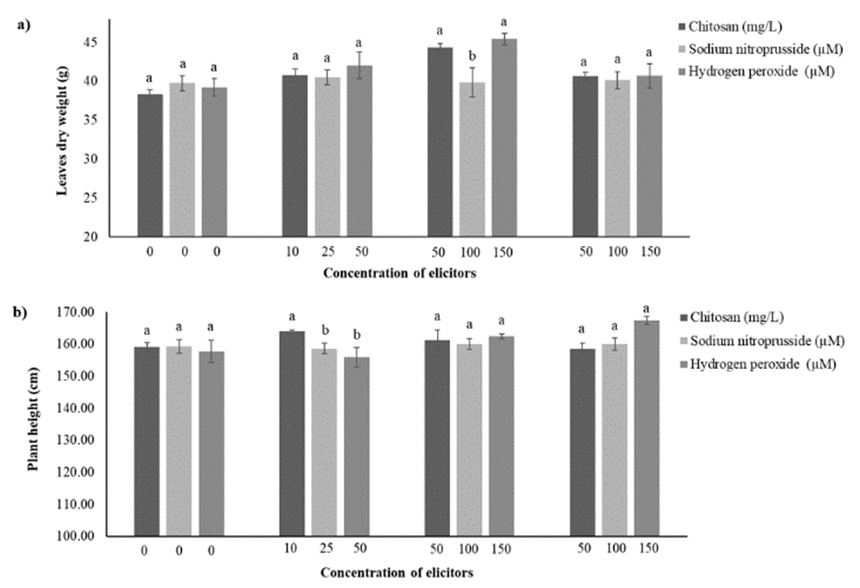
Figure 1 shows the effect of the application of the elicitors on the dry weight of leaves and the plants height. It was observed that the application of chitosan (50 mg/L) increased the dry weight of the leaves by 25%, as compared to control plants, whereas treatment with 10 mg/L of chitosan slightly improved by 15% the plant height. Regarding sodium nitroprusside, no significant changes were observed neither in the weight of the leaves nor in the height of the plant. On the other hand, hydrogen peroxide 100 and 150 µM increased by about 10-12% the weight of the leaves.

Table 1 shows the total phenolic and flavonoids content of cape gooseberry plants treated with different concentration of elicitors. It is observed that chitosan at concentration of 25 and 50 mg/L significantly increased the content of phenolic compounds (28-52%) and flavonoids (70-100%).
Regarding, plants treated with sodium nitroprusside, all the tested concentration increased the phenolic compounds and flavonoid content in cape gooseberry leaves, showing the greatest effect the treatment with sodium nitroprusside 150 µM, which increased the total phenolic compounds and flavonoids by about 1.7 and 2.2-fold respectively as compared to the control. Hydrogen peroxide treatment did not show significant effects on the content of total phenolic compounds in cape gooseberry leaves, whereas concentration 150 µM increased by a 47% the content of flavonoids.
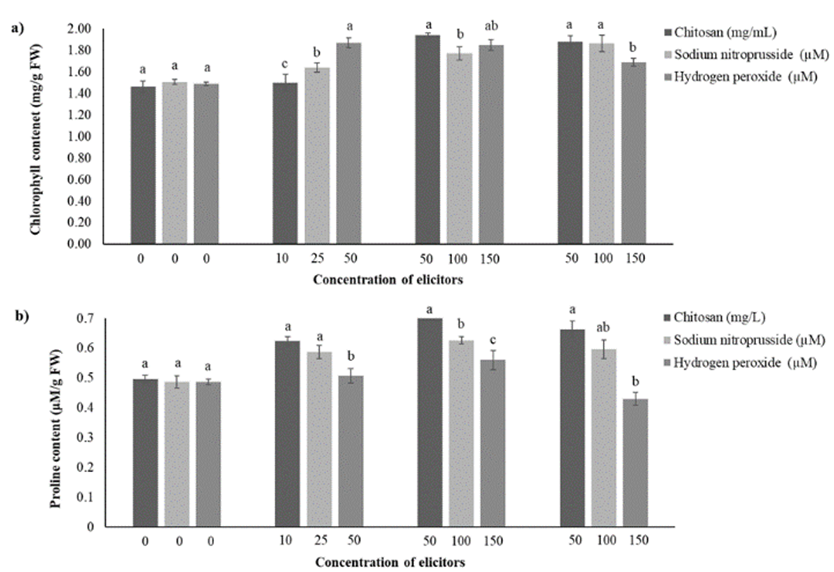
Figure 2 show the total chlorophyll content in cape gooseberry leaves treated with different concentrations of elicitors. It was observed that application of chitosan at 25 and 50 mg/L increased the chlorophyll content of leaves by a 30-32%, whereas the treatment with sodium nitroprusside 50 mM induces an increase of 24% of chlorophyll content in comparison to the control plants. Furthermore, hydrogen peroxide 50 and 100 mM increased the chlorophyll content by a 25 and 24% respectively.

On the other hand, we evaluate the proline levels in cape gooseberry plants treated with elicitors. Proline is an amino acid essential for primary metabolism, which has been related to a higher antioxidant capacity in edible plants 22. Figure 2 indicate that application of chitosan at 25 and 50 mg/L showed the highest effect on the proline content of cape gooseberry leaves, increasing its amount by a 46 and 34%, respectively. All the concentrations of sodium nitroprusside tested also induced increases by about 38-46% in the proline content of the plants, whereas hydrogen peroxide 100 µM slightly increased (16%) the proline concentration as compared to the control.
3.4. Antioxidant CapacityTable 2 shows the capacity of elicited cape gooseberry plants, to inhibit the formation of ABTS and DPPH radicals. Results indicated that chitosan applications at 25 and 50 mg/L improved the antioxidant capacity of plants. The greatest effect was shown by the treatment 50 mg/L of chitosan, which produced increases of 2.2 and 2-fold for the inhibition of DPPH and ABTS radicals, respectively. On the other hand, sodium nitroprusside 150 µM induced increases of 1.5 and 1.6-fold for the DPPH and ABTS methods, respectively. Regarding hydrogen peroxide, concentration 50 µM slightly increased the antioxidant capacity of cape gooseberry plants.
Table 3 shows the ability of elicited cape gooseberry plants, to inhibit the activity of α-amylase, α-glucosidase, and pancreatic lipase in vitro. Results are expressed as Half-maximal inhibitory concentration (IC50), which indicates how much plant material is needed to inhibit the activity of these enzymes, therefore, low values of IC50 shows a high inhibition activity and, consequently, a greater antidiabetic potential. Results showed that chitosan at concentrations of 25 and 50 mg/L decreased the IC50 values for the inhibition of α-amylase in a 47 and 52% respectively as compared to the control plants. Regarding, α-glucosidase, treatments with foliar chitosan at 25 and 50 mg/L also showed the greatest effects, decreasing the IC50 values in a 41 and 35% respectively, which indicates a higher capacity to inhibit the activity of this enzyme. About pancreatic lipase, the treatments that showed the greatest effects on the inhibition of this enzyme activity, were chitosan and hydrogen peroxide at concentrations of 25 mg/L and hydrogen peroxide 100 µM, respectively.
Chitosan has been proven to improve plant growth by inducing stress tolerance in various plant species. Ghasemi et al. 23 demonstrated that exogenous application of chitosan (0.4 g/L) on two species of basil (Ocimum ciliatum and Ocimum basilicum) stressed by drought, significantly enhanced dry weight, height, number of branches and leaf area in both species of basil under stressed or non-stressed conditions as compared to control plants. Furthermore, Phothi and Theerakarunwong 24 found that chitosan treatment by soaking seeds during 21 days and spraying plants with a solution of chitosan (0.05% w/v) significantly reduced the harmful effects of ozone stress in rice plants, increasing the numbers of tiller, leaf area, chlorophyll, photosynthesis and biomass as compared to the control group.
The protective effect of chitosan against stress in plants and the stimulating effect on plant growth may be associated to an increase in the uptake of water and essential nutrients by modifying cell osmotic pressure, and decreasing the accumulation of free radicals (ROS) through the increase of antioxidant secondary metabolites and enzyme activities 25. On the other hand, some researchers reported that the exogenous application of chitosan increased the activity of some key enzymes of nitrogen metabolism, such as glutamine synthetase, nitrate reductase, and protease, which enhance the transportation of nitrogen in the leaves, improving the growth and development of plants. It was also demonstrated that chitosan induce the activation of signaling pathway related to auxin biosynthesis, which increase the synthesis of some plant hormones such as gibberellins and enhance growth and development of plants 25.
Regarding hydrogen peroxide elicitation, there are various studies about its effects on plant growth. Nurnaeimah et al. 26 found that foliar application of hydrogen peroxide 30 mM during cultivation of mistletoe fig (Ficus deltoidei), significantly increased the plant height and leaf area, which was associated to a higher chlorophyll content of leaves. On the other hand Orabi et al. 27 found that spraying hydrogen peroxide 1.0 or 2.0 mM on canola plants increased dry matter of shoots and root.
Previous studies have shown that exogenous application of hydrogen peroxide induced the growth of the root system in wheat plants, also, this elicitor applied in low doses can increase weight and length of this plant 28. In addition, it has been shown that an early and vigorous root growth in plants is the major factor for higher nitrogen uptake, which induce a greater development of the plant 29. Furthermore, it has been demonstrated that hydrogen peroxide mediates several physiological and developmental processes in plants, changes in H2O2 levels impact on the activity of metabolic and antioxidant enzymes related to the plant development 30.
Phenolic compounds, including flavonoids, are important plant metabolites that exhibit redox properties responsible for antioxidant activity and several health beneficial properties 31. Mandal and Gupta 32 reported that chitosan improved the concentration of cell wall-bound phenolic compounds in eggplants, moreover, Silva et al. 9 showed that exogenous application of chitosan improved the antioxidant capacity of grapevine plants, which was associated to its content of phenolic compounds. Previous studies reported the effect of chitosan on the phenylpropanoid pathway, indicating that the exogenous application of this compound increases the activity of key enzymes such as phenylalanine ammonia-lyase (PAL) and tyrosine ammonia-lyase, related to the synthesis of secondary metabolites. Furthermore, chitosan stimulates other defense responses, including the synthesis of H2O2, which also act as a signal to accelerate the transcription of some genes related to the phenolic compounds production 33.
On the other hand, it has been reported that sodium nitroprusside significantly increases the total phenolic and flavonoids contents in cell suspension cultures of Scrophularia (Scrophularia kakudensis Franch) 11. According to previous reports, sodium nitroprusside is a nitric oxide donor, which is considered to play an important role in plant defense by enhancing the secondary metabolites synthesis. Therefore, this chemical elicitor has been widely employed to stimulate the production of isoflavonoid, phytosterols, terpenes, phenylpropanoids and other secondary metabolites in plants 34.
Chlorophyll is a natural pigment widely distributed in the leaves and other parts of plants that plays an important role on the photosynthesis process. In addition, chlorophyll has multiple beneficial properties for health, nowadays has been used as remedy and diagnostics in the field of medicine, mainly as antioxidant and photosensitizer for cancer therapy 35.
Gerami et al. 36 found that Application of 0.4 g/L of chitosan to Stevia rebaudiana under salt stress conditions, increased it content of chlorophyll a. On the other hand, it has also been reported that the exogenous application of sodium nitroprusside has a positive effect on the total chlorophyll content in sunflower plants under conditions of abiotic stress induced by NaCl, which was associated with a greater photosynthesis rate and an increase in the yield of plants 37. Furthermore, Nurnaeimah et al. 26 found that treatment with hydrogen peroxide 30 mM increases the total chlorophyll content and net photosynthesis in Ficus deltoidei, which was associated to an enhanced growth of plants. This could be associated to the increased stomatal opening caused by H2O2 and the accumulation of photosynthetic pigments. Hydrogen peroxide is synthesized through several routes in the plant cells, including the electron transport during photosynthesis and plays an important role as a signal molecule, mediating several physiological processes such as photosynthesis, stomatal movement, photorespiration, the cell cycle, senescence, among others 30.
Peykani and Sepehr 38 reported that exogenous application of chitosan at low concentration on wheat (Triticum aestivum L.) and maize (Zea maize L.) seedlings under salt stress conditions significantly increased it proline content. Moreover, Hayat et al. 39 found that application of sodium nitroprusside 10-5 M for 8 hours to in tomato plants under salinity stress improves its proline content in about 66%, as compared to untreated plants. This effect may be associated to the ability of chitosan to trigger signaling pathways, influencing metabolism to improve the plant resistance against several biotic or abiotic stress conditions. Proline plays an important role in metabolism, as stabilizer cell membrane and in the synthesis of proteins and antioxidant compounds 40.
The antioxidant capacity of edible plants has generated a lot of interest in the last decades, since antioxidant foods are believed to exhibit protective properties against several diseases 41.
The effect of the application of elicitors on the antioxidant capacity of cape gooseberry leaves has not been previously reported, however, it has been shown that many stress situations can generate increased foliar antioxidant activity in plants. Miranda et al. 42 reported that saline stress induced by NaCl significantly enhanced the free radical scavenging activity of cape gooseberry leaves. Furthermore, Roveda-Hoyos and Moreno-Fonseca 43 found that phosphorus deficiency in cape gooseberry seedlings induce an antioxidant response in plants. It has been demonstrated that the antioxidant response level of plants depends on the stress duration and intensity, type and concentration of elicitor, plant species, development stage, and metabolic state 42. The antioxidant capacity of cape gooseberry leaves is attributed to their bioactive compounds content, mostly phenolics, due to the ability of these metabolites to scavenge free radicals 41. Previous studies have shown that the main phenolic compounds in Physalis peruviana leaves are rutin, rosmarinic, protocatechuic, synaptic, ferulic acids among others. These compounds have shown high antioxidant properties on different leafy vegetables, indicating their significant dietary and nutritional value 44.
It has been shown that some secondary metabolites in plants can modulate the activity of digestive enzymes involved in carbohydrate and lipids digestion, such as α-amylase, α-glucosidase and pancreatic lipase, leading to a reduced release of glucose and triglycerides after a meal, which can help reduce some complications of chronic degenerative diseases such as diabetes and obesity 45. Several secondary metabolites in cape gooseberry have been associated to health benefits. It has been reported that the inhibitory activity for α-glucosidase in cape gooseberry fruits, is associated to its sucrose esters content, pyrrolidine alkaloids and flavonoids 46, 47. On the other hand, Fokunang et al. 48 showed that the hypoglycemic activity in cape gooseberry fruits is related to its content of alkaloids, terpenoids, polyphenols and flavonoids. Kinasih et al 49 showed that quercetin, myrecetin and kaempferol are the main phenolic compounds in cape gooseberry and related these compounds to the antidiabetic effects of the fruit. On the other hand, the presence of fisalin, citric acid and vitamin C, in ethanolic extracts of cape gooseberry are considered as antidiabetic active principles, since they inhibit the activity of the glycogen-phosphorylase enzyme that catalyzes the glycogenolysis process 50.
The results obtained in this study demonstrated that cape gooseberry leaves exhibit interesting antioxidant properties and capacity to inhibit the activity of α-amylase, α-glucosidase, and pancreatic lipase in vitro. Furthermore, foliar application of chitosan and sodium nitroprusside during cultivation improve the phenolic compounds, proline, and total chlorophyll contents of goldenberry leaves, enhancing its antioxidant capacity and digestive enzyme inhibitory activities. Therefore, elicitors as chitosan and sodium nitroprusside, applied at low concentrations during growth of plants, could be considered as a tool to improve the health beneficial properties of cape gooseberry leaves.
Authors declare that they do not have any conflict of interest.
| [1] | Mgbeahuruike, E. E. Yrjönen, T. Vuorela, H. and Holm, Y. “Bioactive compounds from medicinal plants: Focus on Piper species,” S. Afr. J. Bot, 112. 54-69. 2017. | ||
| In article | View Article | ||
| [2] | Akhtar, N. Chaudhari, S. K. Arshad, S. Fatima, H. Amjad, M. S. and Saboon, “Biological Activities and Nutritional Value of Physalis peruviana L. BT - Natural Bio-active Compounds: Volume 1: Production and Applications,” M. S. Akhtar, M. K. Swamy, and U. R. Sinniah, Eds. Singapore: Springer Singapore, 2019, 587-598. | ||
| In article | View Article | ||
| [3] | Ramadan, M. F. “Bioactive phytochemicals, nutritional value, and functional properties of cape gooseberry (Physalis peruviana): An overview,” Food Res. Int., 44(7) 1830-1836. 2011. | ||
| In article | View Article | ||
| [4] | Yen, C. Y., Chiu, C. C., Chang, F. R., Chen, J. Y., Hwang, C. C., Hseu, Y. C., Yang, H. L., Lee, A. Y., Tsai, M. T., Guo, Z. L., Cheng, Y. S., Liu, Y. C., Lan, Y. H., Chang, Y. C., Ko, Y. C., Chang, H. W. and Wu, Y. C. “4β-Hydroxywithanolide E from Physalis peruviana (golden berry) inhibits growth of human lung cancer cells through DNA damage, apoptosis and G2/M arrest” BMC Cancer, 10(1). 46. 2010. | ||
| In article | View Article PubMed | ||
| [5] | Ramadan, M. F. “Bioactive Phytochemicals of Cape Gooseberry (Physalis peruviana L.) BT - Bioactive Compounds in Underutilized Fruits and Nuts,” H. N. Murthy and V. A. Bapat, Eds. Cham: Springer International Publishing, 2020, 75-90. | ||
| In article | View Article | ||
| [6] | Nocetti, D., Núñez, H., Puente, L., Espinosa, A. and Romero, F. “Composition and biological effects of goldenberry byproducts: an overview.,” J. Sci. Food Agric., 100(12). 4335-4346. 2020. | ||
| In article | View Article PubMed | ||
| [7] | Baenas, N., García-Viguera, C. and D. A. Moreno, “Elicitation: a tool for enriching the bioactive composition of foods,” Molecules, 19(9). 13541-13563. 2014. | ||
| In article | View Article PubMed | ||
| [8] | Ruiz-García Y. and E. Gómez-Plaza, “Elicitors: A Tool for Improving Fruit Phenolic Content,” Agriculture, 3(1). 2013. | ||
| In article | View Article | ||
| [9] | Silva, V., Singh, R. K., Gomes, N., Soares, B. G., Silva, A., Falco, V., Capita, R., Alonso-Calleja, C., Pereira, J. E., Amaral, J. S., Igrejas, G. and Poeta, P., “Comparative Insight upon Chitosan Solution and Chitosan Nanoparticles Application on the Phenolic Content, Antioxidant and Antimicrobial Activities of Individual Grape Components of Sousão Variety.,” Antioxidants (Basel, Switzerland), 9(2). 2020. | ||
| In article | View Article PubMed | ||
| [10] | Garcia-Mier, L., Jimenez-Garcia, S. N., Guevara-González, R. G., Feregrino-Perez, A. A., Contreras-Medina, L. M. and Torres-Pacheco, I. “Elicitor Mixtures Significantly Increase Bioactive Compounds, Antioxidant Activity, and Quality Parameters in Sweet Bell Pepper,” J. Chem., 269296. 2015. | ||
| In article | View Article | ||
| [11] | Manivannan, A. Soundararajan, P. Park, Y. G. and Jeong, B. R. “Chemical Elicitor-Induced Modulation of Antioxidant Metabolism and Enhancement of Secondary Metabolite Accumulation in Cell Suspension Cultures of Scrophularia kakudensis Franch,” Int. J. Mol. Sci., 17(3). 399. 2016. | ||
| In article | View Article PubMed | ||
| [12] | Gogoi, M. and Basumatary, M. “Estimation of the chlorophyll concentration in seven Citrus species of Kokrajhar district, BTAD, Assam, India,” Trop. Plant Res., 5(1). 83-87. 2018. | ||
| In article | View Article | ||
| [13] | Bates, L. S., Waldren, R. P. and Teare, I. D. “Rapid determination of free proline for water-stress studies,” Plant Soil, 39(1). 205-207. 1973. | ||
| In article | View Article | ||
| [14] | Nguyen, P. M. and Niemeyer, E. D. “Effects of nitrogen fertilization on the phenolic composition and antioxidant properties of basil (Ocimum basilicum L.).,” J. Agric. Food Chem., 56(18). 8685-8691. 2008. | ||
| In article | View Article PubMed | ||
| [15] | Singleton, V. L. Orthofer, R. and Lamuela-Raventós, E., “Analysis of total phenols and other oxidation substrates and antioxidants by means of folin-ciocalteu reagent,” in Oxidants and Antioxidants Part A, vol. 299, Academic Press, 1999, pp. 152-178. | ||
| In article | View Article | ||
| [16] | Chandra, S., Khan, S., Avula, B., Lata, H., Yang, M. H., Elsohly, M. A. and Khan, I. A. “Assessment of Total Phenolic and Flavonoid Content, Antioxidant Properties, and Yield of Aeroponically and Conventionally Grown Leafy Vegetables and Fruit Crops: A Comparative Study,” Evid. Based Complement. Alternat. Med., 253875. 2014. | ||
| In article | View Article PubMed | ||
| [17] | Arnao, M. B., Cano, A., Alcolea, J. F. and Acosta, M. “Estimation of free radical-quenching activity of leaf pigment extracts.,” Phytochem. Anal., 12(2). 138-143. 2001. | ||
| In article | View Article PubMed | ||
| [18] | Brand-Williams, W., Cuvelier, M. E. and Berset, C. “Use of a free radical method to evaluate antioxidant activity,” LWT - Food Sci. Technol., 28(1). 25-30. 1995. | ||
| In article | View Article | ||
| [19] | Kandra, L., Gyémánt, G., Zajácz, A. and Batta, G. “Inhibitory effects of tannin on human salivary alpha-amylase.,” Biochem. Biophys. Res. Commun., 319(4). 1265-1271. 2004. | ||
| In article | View Article PubMed | ||
| [20] | Apostolidis, E., Kwon, Y. I. and Shetty, K. “Inhibitory potential of herb, fruit, and fungal-enriched cheese against key enzymes linked to type 2 diabetes and hypertension,” Innov. Food Sci. Emerg. Technol., 8(1). 46-54. 2007. | ||
| In article | View Article | ||
| [21] | Sosnowska, D., Podsędek, A., Kucharska, A. Z., Redzynia, M., Opęchowska, M. and Koziołkiewicz, M. “Comparison of in vitro anti-lipase and antioxidant activities, and composition of commercial chokeberry juices,” Eur. Food Res. Technol., 242(4). 505-515. 2016. | ||
| In article | View Article | ||
| [22] | Karagözler, A. A., Erdağ, B. Emek, Y. Ç. and Uygun, D. A. “Antioxidant activity and proline content of leaf extracts from Dorystoechas hastata,” Food Chem., 111(2). 400-407. 2008. | ||
| In article | View Article PubMed | ||
| [23] | Ghasemi P. A., Malekpoor, F., Salimi, A. and Golparvar, A. “Exogenous application of chitosan on biochemical and physiological characteristics, phenolic content and antioxidant activity of two species of basil (Ocimum ciliatum and Ocimum basilicum) under reduced irrigation,” Sci. Hortic. (Amsterdam)., 217. 114-122. 2017. | ||
| In article | View Article | ||
| [24] | Phothi, R. and Theerakarunwong, C. “Effect of chitosan on physiology, photosynthesis and biomass of rice (Oryza sativa L.) under elevated ozone,” Aust. J. Crop Sci., 11. 624-630. 2017. | ||
| In article | View Article | ||
| [25] | Malerba M. and Cerana, R. “Chitosan Effects on Plant Systems,” Int. J. Mol. Sci., 17(7). 996. 2016. | ||
| In article | View Article PubMed | ||
| [26] | Nurnaeimah, N., Mat, N., Suryati Mohd, K., Badaluddin, N. A., Yusoff, N., Sajili, M. H., Mahmud, K., Mohd Adnan, A. F., Khandaker, M. M., “The Effects of Hydrogen Peroxide on Plant Growth, Mineral Accumulation, as Well as Biological and Chemical Properties of Ficus deltoidea,” Agronomy, 10(4). 1-19. 2020. | ||
| In article | View Article | ||
| [27] | Orabi, S. A., Hussein, M. M., Safi-naz, S. and Sharara, F. A. “Influence of hydrogen peroxide on growth, yield and biochemical constituents of canola plants grown under different irrigation intervals”, 7(3). 407-418. 2018. | ||
| In article | |||
| [28] | Hameed, A., Farooq, S., Iqbal, N. and Arshad, R., “Influence of exogenous application of hydrogen peroxide on root and seedling growth on wheat (Triticum aestivum L.),” International Journal of Agriculture and Biology, 2. 366-369. 2004. | ||
| In article | |||
| [29] | Liao, M., Fillery, I. R. P. and Palta, J. A. “Early vigorous growth is a major factor influencing nitrogen uptake in wheat.,” Funct. Plant Biol., 31(2). 121-129. 2004. | ||
| In article | View Article PubMed | ||
| [30] | Niu L. and Liao, W., “Hydrogen Peroxide Signaling in Plant Development and Abiotic Responses: Crosstalk with Nitric Oxide and Calcium.,” Front. Plant Sci., 7. 230. 2016. | ||
| In article | View Article | ||
| [31] | Aryal, S. Baniya, M. K. Danekhu, K. Kunwar, P. Gurung, R. and Koirala, N. “Total Phenolic Content, Flavonoid Content and Antioxidant Potential of Wild Vegetables from Western Nepal,” Plants (Basel, Switzerland), 8(4). 96. 2019. | ||
| In article | View Article PubMed | ||
| [32] | Mandal S. and Gupta, C. K. “Inducing cell wall-bound phenolic compounds by elicitors in eggplant (Solanum melongena),” Appl. Biochem. Microbiol., 52(6). 650-656. 2016. | ||
| In article | View Article | ||
| [33] | Yin, H., Du, Y. and Dong, Z. “Chitin Oligosaccharide and Chitosan Oligosaccharide: Two Similar but Different Plant Elicitors,” Front. Plant Sci., 7. 522. 2016. | ||
| In article | View Article | ||
| [34] | Wang J. W. and Wu, J. Y. “Involvement of nitric oxide in elicitor-induced defense responses and secondary metabolism of Taxus chinensis cells,” Nitric Oxide, 11(4). 298-306. 2004. | ||
| In article | View Article PubMed | ||
| [35] | Mishra, V., Bacheti, R. K. and Husen, A. “Medicinal Uses of Chlorophyll: a critical overview,” 2012. | ||
| In article | |||
| [36] | Gerami, M., Majidian, P., Ghorbanpour, A. and Alipour, Z. “Stevia rebaudiana Bertoni responses to salt stress and chitosan elicitor,” Physiol. Mol. Biol. Plants, 26(5). 965-974. 2020. | ||
| In article | View Article PubMed | ||
| [37] | Ramadan, A. A., Abd E. M. and Sadak, M. S. “Comparative study for the effect of arginine and sodium nitroprusside on sunflower plants grown under salinity stress conditions,” Bull. Natl. Res. Cent., 43(1). 118. 2019. | ||
| In article | View Article | ||
| [38] | Peykani, L. S. and Sepehr, M. F. “Effect of chitosan on antioxidant enzyme activity, proline, and malondialdehyde content in Triticum aestivum L. and Zea maize L. under salt stress condition,” Iran. J. Plant Physiol., 9(1). 2661-2670. 2019. | ||
| In article | |||
| [39] | Hayat, S., Yadav, S., Wani, A. S., Irfan, M., Alyemini, M. N. and Ahmad, A. “Impact of sodium nitroprusside on nitrate reductase, proline content, and antioxidant system in tomato under salinity stress,” Hortic. Environ. Biotechnol., 53(5). 362-367. 2012. | ||
| In article | View Article | ||
| [40] | Salimi, A., Ardebili, Z. O. and Salehibakhsh, M. “Potential benefits of foliar application of chitosan and Zinc in tomato,” Iran. J. Plant Physiol., 9(2). 2703-2708. 2019. | ||
| In article | |||
| [41] | Xu, D. P., Li, Y., Meng, X., Zhou, T., Zhou, Y., Zheng, J., Zhang, J. J. and Li, H. B., “Natural Antioxidants in Foods and Medicinal Plants: Extraction, Assessment and Resources,” Int. J. Mol. Sci., 18(1). 96. 2017. | ||
| In article | View Article PubMed | ||
| [42] | Miranda, D., Fischer, G., Mewis, I., Rohn, S. and Ulrichs, C., “Salinity effects on proline accumulation and total antioxidant activity in leaves of the cape gooseberry (Physalis peruviana L.),” J. Appl. Bot. Food Qual., 87. 67-73. 2014. | ||
| In article | |||
| [43] | Roveda-Hoyos, G. and Moreno-Fonseca, L., “Physiological and antioxidant responses of cape gooseberry (Physalis peruviana L.) seedlings to phosphorus deficiency ,” Agron. Colomb., 37. 3-11. 2019. | ||
| In article | View Article | ||
| [44] | Khanam, U. K. S., Oba, S., Yanase, E. and Murakami, Y., “Phenolic acids, flavonoids and total antioxidant capacity of selected leafy vegetables,” J. Funct. Foods, 4(4). 979-987. 2012. | ||
| In article | View Article | ||
| [45] | Shakoor, H. Abdelfattah, F. Albadi, K. Adib, M. Kizhakkayil, J. and Platat, C. “Inhibition of Digestive Enzyme and Stimulation of Human Liver Cells (HepG2) Glucose Uptake by Date Seeds Extract,” Evid.-based Complement. Altern. Med., 4290702. 2020. | ||
| In article | View Article PubMed | ||
| [46] | Bernal, C. A., Castellanos, L., Aragón, D. M., Martínez-Matamoros, D., Jiménez, C., Baena, Y., Ramos, F. A., “Peruvioses A to F, sucrose esters from the exudate of Physalis peruviana fruit as α-amylase inhibitors,” Carbohydr. Res., 461. 4-10. 2018. | ||
| In article | View Article PubMed | ||
| [47] | Nasser, S. A. and Youssef, F. S., “Medicinal Plants with Potential Antidiabetic Activity and their Assessment,” Med. Aromat. Plants, 03(01). 1-12. 2014. | ||
| In article | View Article | ||
| [48] | Fokunang, C. N., Mushagalusa, F. K., Tembe-Fokunang, E., Ngoupayo, J., Ngameni, B., Njinkio, L. N., Kadima, J. N., Kechia, F. A., Atogho-Tiedeu, B., Mbacham, W. F. and Ngadjui, B. T., “Phytochemical and zootechnical studies of Physalis peruviana L. leaves exposured to streptozotocin-induced diabetic rats,” J. Pharmacogn. Phyther., 9(8).123-130. 2017. | ||
| In article | View Article | ||
| [49] | Kinasih, L. S., Djamiatun, K. and Al-Baarri, A. N. “Golden Berry (Physalis peruviana) Juice for Reduction of Blood Glucose and Amelioration of Insulin Resistance in Diabetic Rats,” J. Gizi dan Pangan., 15(28). 37-44. 2020. | ||
| In article | View Article | ||
| [50] | Erman, F. Kirecci, O. A. Ozsahin, A. D. Erman, O. Kaya, T. and Yilmaz, O. “Effects of Physalis peruviana and Lupinus albus on malondialdehyde, glutathione, cholesterol, vitamins and fatty acid levels in kidney and liver tissues of diabetic rats,” Prog. Nutr., 20(1-S). 218-230. | ||
| In article | |||
Published with license by Science and Education Publishing, Copyright © 2022 Humberto Ramos-Sotelo, Pedro Alberto Rojas-Rojas, Heidi Melania Medina Montenegro and Marely Graciela Figueroa-Pérez
 This work is licensed under a Creative Commons Attribution 4.0 International License. To view a copy of this license, visit
http://creativecommons.org/licenses/by/4.0/
This work is licensed under a Creative Commons Attribution 4.0 International License. To view a copy of this license, visit
http://creativecommons.org/licenses/by/4.0/
| [1] | Mgbeahuruike, E. E. Yrjönen, T. Vuorela, H. and Holm, Y. “Bioactive compounds from medicinal plants: Focus on Piper species,” S. Afr. J. Bot, 112. 54-69. 2017. | ||
| In article | View Article | ||
| [2] | Akhtar, N. Chaudhari, S. K. Arshad, S. Fatima, H. Amjad, M. S. and Saboon, “Biological Activities and Nutritional Value of Physalis peruviana L. BT - Natural Bio-active Compounds: Volume 1: Production and Applications,” M. S. Akhtar, M. K. Swamy, and U. R. Sinniah, Eds. Singapore: Springer Singapore, 2019, 587-598. | ||
| In article | View Article | ||
| [3] | Ramadan, M. F. “Bioactive phytochemicals, nutritional value, and functional properties of cape gooseberry (Physalis peruviana): An overview,” Food Res. Int., 44(7) 1830-1836. 2011. | ||
| In article | View Article | ||
| [4] | Yen, C. Y., Chiu, C. C., Chang, F. R., Chen, J. Y., Hwang, C. C., Hseu, Y. C., Yang, H. L., Lee, A. Y., Tsai, M. T., Guo, Z. L., Cheng, Y. S., Liu, Y. C., Lan, Y. H., Chang, Y. C., Ko, Y. C., Chang, H. W. and Wu, Y. C. “4β-Hydroxywithanolide E from Physalis peruviana (golden berry) inhibits growth of human lung cancer cells through DNA damage, apoptosis and G2/M arrest” BMC Cancer, 10(1). 46. 2010. | ||
| In article | View Article PubMed | ||
| [5] | Ramadan, M. F. “Bioactive Phytochemicals of Cape Gooseberry (Physalis peruviana L.) BT - Bioactive Compounds in Underutilized Fruits and Nuts,” H. N. Murthy and V. A. Bapat, Eds. Cham: Springer International Publishing, 2020, 75-90. | ||
| In article | View Article | ||
| [6] | Nocetti, D., Núñez, H., Puente, L., Espinosa, A. and Romero, F. “Composition and biological effects of goldenberry byproducts: an overview.,” J. Sci. Food Agric., 100(12). 4335-4346. 2020. | ||
| In article | View Article PubMed | ||
| [7] | Baenas, N., García-Viguera, C. and D. A. Moreno, “Elicitation: a tool for enriching the bioactive composition of foods,” Molecules, 19(9). 13541-13563. 2014. | ||
| In article | View Article PubMed | ||
| [8] | Ruiz-García Y. and E. Gómez-Plaza, “Elicitors: A Tool for Improving Fruit Phenolic Content,” Agriculture, 3(1). 2013. | ||
| In article | View Article | ||
| [9] | Silva, V., Singh, R. K., Gomes, N., Soares, B. G., Silva, A., Falco, V., Capita, R., Alonso-Calleja, C., Pereira, J. E., Amaral, J. S., Igrejas, G. and Poeta, P., “Comparative Insight upon Chitosan Solution and Chitosan Nanoparticles Application on the Phenolic Content, Antioxidant and Antimicrobial Activities of Individual Grape Components of Sousão Variety.,” Antioxidants (Basel, Switzerland), 9(2). 2020. | ||
| In article | View Article PubMed | ||
| [10] | Garcia-Mier, L., Jimenez-Garcia, S. N., Guevara-González, R. G., Feregrino-Perez, A. A., Contreras-Medina, L. M. and Torres-Pacheco, I. “Elicitor Mixtures Significantly Increase Bioactive Compounds, Antioxidant Activity, and Quality Parameters in Sweet Bell Pepper,” J. Chem., 269296. 2015. | ||
| In article | View Article | ||
| [11] | Manivannan, A. Soundararajan, P. Park, Y. G. and Jeong, B. R. “Chemical Elicitor-Induced Modulation of Antioxidant Metabolism and Enhancement of Secondary Metabolite Accumulation in Cell Suspension Cultures of Scrophularia kakudensis Franch,” Int. J. Mol. Sci., 17(3). 399. 2016. | ||
| In article | View Article PubMed | ||
| [12] | Gogoi, M. and Basumatary, M. “Estimation of the chlorophyll concentration in seven Citrus species of Kokrajhar district, BTAD, Assam, India,” Trop. Plant Res., 5(1). 83-87. 2018. | ||
| In article | View Article | ||
| [13] | Bates, L. S., Waldren, R. P. and Teare, I. D. “Rapid determination of free proline for water-stress studies,” Plant Soil, 39(1). 205-207. 1973. | ||
| In article | View Article | ||
| [14] | Nguyen, P. M. and Niemeyer, E. D. “Effects of nitrogen fertilization on the phenolic composition and antioxidant properties of basil (Ocimum basilicum L.).,” J. Agric. Food Chem., 56(18). 8685-8691. 2008. | ||
| In article | View Article PubMed | ||
| [15] | Singleton, V. L. Orthofer, R. and Lamuela-Raventós, E., “Analysis of total phenols and other oxidation substrates and antioxidants by means of folin-ciocalteu reagent,” in Oxidants and Antioxidants Part A, vol. 299, Academic Press, 1999, pp. 152-178. | ||
| In article | View Article | ||
| [16] | Chandra, S., Khan, S., Avula, B., Lata, H., Yang, M. H., Elsohly, M. A. and Khan, I. A. “Assessment of Total Phenolic and Flavonoid Content, Antioxidant Properties, and Yield of Aeroponically and Conventionally Grown Leafy Vegetables and Fruit Crops: A Comparative Study,” Evid. Based Complement. Alternat. Med., 253875. 2014. | ||
| In article | View Article PubMed | ||
| [17] | Arnao, M. B., Cano, A., Alcolea, J. F. and Acosta, M. “Estimation of free radical-quenching activity of leaf pigment extracts.,” Phytochem. Anal., 12(2). 138-143. 2001. | ||
| In article | View Article PubMed | ||
| [18] | Brand-Williams, W., Cuvelier, M. E. and Berset, C. “Use of a free radical method to evaluate antioxidant activity,” LWT - Food Sci. Technol., 28(1). 25-30. 1995. | ||
| In article | View Article | ||
| [19] | Kandra, L., Gyémánt, G., Zajácz, A. and Batta, G. “Inhibitory effects of tannin on human salivary alpha-amylase.,” Biochem. Biophys. Res. Commun., 319(4). 1265-1271. 2004. | ||
| In article | View Article PubMed | ||
| [20] | Apostolidis, E., Kwon, Y. I. and Shetty, K. “Inhibitory potential of herb, fruit, and fungal-enriched cheese against key enzymes linked to type 2 diabetes and hypertension,” Innov. Food Sci. Emerg. Technol., 8(1). 46-54. 2007. | ||
| In article | View Article | ||
| [21] | Sosnowska, D., Podsędek, A., Kucharska, A. Z., Redzynia, M., Opęchowska, M. and Koziołkiewicz, M. “Comparison of in vitro anti-lipase and antioxidant activities, and composition of commercial chokeberry juices,” Eur. Food Res. Technol., 242(4). 505-515. 2016. | ||
| In article | View Article | ||
| [22] | Karagözler, A. A., Erdağ, B. Emek, Y. Ç. and Uygun, D. A. “Antioxidant activity and proline content of leaf extracts from Dorystoechas hastata,” Food Chem., 111(2). 400-407. 2008. | ||
| In article | View Article PubMed | ||
| [23] | Ghasemi P. A., Malekpoor, F., Salimi, A. and Golparvar, A. “Exogenous application of chitosan on biochemical and physiological characteristics, phenolic content and antioxidant activity of two species of basil (Ocimum ciliatum and Ocimum basilicum) under reduced irrigation,” Sci. Hortic. (Amsterdam)., 217. 114-122. 2017. | ||
| In article | View Article | ||
| [24] | Phothi, R. and Theerakarunwong, C. “Effect of chitosan on physiology, photosynthesis and biomass of rice (Oryza sativa L.) under elevated ozone,” Aust. J. Crop Sci., 11. 624-630. 2017. | ||
| In article | View Article | ||
| [25] | Malerba M. and Cerana, R. “Chitosan Effects on Plant Systems,” Int. J. Mol. Sci., 17(7). 996. 2016. | ||
| In article | View Article PubMed | ||
| [26] | Nurnaeimah, N., Mat, N., Suryati Mohd, K., Badaluddin, N. A., Yusoff, N., Sajili, M. H., Mahmud, K., Mohd Adnan, A. F., Khandaker, M. M., “The Effects of Hydrogen Peroxide on Plant Growth, Mineral Accumulation, as Well as Biological and Chemical Properties of Ficus deltoidea,” Agronomy, 10(4). 1-19. 2020. | ||
| In article | View Article | ||
| [27] | Orabi, S. A., Hussein, M. M., Safi-naz, S. and Sharara, F. A. “Influence of hydrogen peroxide on growth, yield and biochemical constituents of canola plants grown under different irrigation intervals”, 7(3). 407-418. 2018. | ||
| In article | |||
| [28] | Hameed, A., Farooq, S., Iqbal, N. and Arshad, R., “Influence of exogenous application of hydrogen peroxide on root and seedling growth on wheat (Triticum aestivum L.),” International Journal of Agriculture and Biology, 2. 366-369. 2004. | ||
| In article | |||
| [29] | Liao, M., Fillery, I. R. P. and Palta, J. A. “Early vigorous growth is a major factor influencing nitrogen uptake in wheat.,” Funct. Plant Biol., 31(2). 121-129. 2004. | ||
| In article | View Article PubMed | ||
| [30] | Niu L. and Liao, W., “Hydrogen Peroxide Signaling in Plant Development and Abiotic Responses: Crosstalk with Nitric Oxide and Calcium.,” Front. Plant Sci., 7. 230. 2016. | ||
| In article | View Article | ||
| [31] | Aryal, S. Baniya, M. K. Danekhu, K. Kunwar, P. Gurung, R. and Koirala, N. “Total Phenolic Content, Flavonoid Content and Antioxidant Potential of Wild Vegetables from Western Nepal,” Plants (Basel, Switzerland), 8(4). 96. 2019. | ||
| In article | View Article PubMed | ||
| [32] | Mandal S. and Gupta, C. K. “Inducing cell wall-bound phenolic compounds by elicitors in eggplant (Solanum melongena),” Appl. Biochem. Microbiol., 52(6). 650-656. 2016. | ||
| In article | View Article | ||
| [33] | Yin, H., Du, Y. and Dong, Z. “Chitin Oligosaccharide and Chitosan Oligosaccharide: Two Similar but Different Plant Elicitors,” Front. Plant Sci., 7. 522. 2016. | ||
| In article | View Article | ||
| [34] | Wang J. W. and Wu, J. Y. “Involvement of nitric oxide in elicitor-induced defense responses and secondary metabolism of Taxus chinensis cells,” Nitric Oxide, 11(4). 298-306. 2004. | ||
| In article | View Article PubMed | ||
| [35] | Mishra, V., Bacheti, R. K. and Husen, A. “Medicinal Uses of Chlorophyll: a critical overview,” 2012. | ||
| In article | |||
| [36] | Gerami, M., Majidian, P., Ghorbanpour, A. and Alipour, Z. “Stevia rebaudiana Bertoni responses to salt stress and chitosan elicitor,” Physiol. Mol. Biol. Plants, 26(5). 965-974. 2020. | ||
| In article | View Article PubMed | ||
| [37] | Ramadan, A. A., Abd E. M. and Sadak, M. S. “Comparative study for the effect of arginine and sodium nitroprusside on sunflower plants grown under salinity stress conditions,” Bull. Natl. Res. Cent., 43(1). 118. 2019. | ||
| In article | View Article | ||
| [38] | Peykani, L. S. and Sepehr, M. F. “Effect of chitosan on antioxidant enzyme activity, proline, and malondialdehyde content in Triticum aestivum L. and Zea maize L. under salt stress condition,” Iran. J. Plant Physiol., 9(1). 2661-2670. 2019. | ||
| In article | |||
| [39] | Hayat, S., Yadav, S., Wani, A. S., Irfan, M., Alyemini, M. N. and Ahmad, A. “Impact of sodium nitroprusside on nitrate reductase, proline content, and antioxidant system in tomato under salinity stress,” Hortic. Environ. Biotechnol., 53(5). 362-367. 2012. | ||
| In article | View Article | ||
| [40] | Salimi, A., Ardebili, Z. O. and Salehibakhsh, M. “Potential benefits of foliar application of chitosan and Zinc in tomato,” Iran. J. Plant Physiol., 9(2). 2703-2708. 2019. | ||
| In article | |||
| [41] | Xu, D. P., Li, Y., Meng, X., Zhou, T., Zhou, Y., Zheng, J., Zhang, J. J. and Li, H. B., “Natural Antioxidants in Foods and Medicinal Plants: Extraction, Assessment and Resources,” Int. J. Mol. Sci., 18(1). 96. 2017. | ||
| In article | View Article PubMed | ||
| [42] | Miranda, D., Fischer, G., Mewis, I., Rohn, S. and Ulrichs, C., “Salinity effects on proline accumulation and total antioxidant activity in leaves of the cape gooseberry (Physalis peruviana L.),” J. Appl. Bot. Food Qual., 87. 67-73. 2014. | ||
| In article | |||
| [43] | Roveda-Hoyos, G. and Moreno-Fonseca, L., “Physiological and antioxidant responses of cape gooseberry (Physalis peruviana L.) seedlings to phosphorus deficiency ,” Agron. Colomb., 37. 3-11. 2019. | ||
| In article | View Article | ||
| [44] | Khanam, U. K. S., Oba, S., Yanase, E. and Murakami, Y., “Phenolic acids, flavonoids and total antioxidant capacity of selected leafy vegetables,” J. Funct. Foods, 4(4). 979-987. 2012. | ||
| In article | View Article | ||
| [45] | Shakoor, H. Abdelfattah, F. Albadi, K. Adib, M. Kizhakkayil, J. and Platat, C. “Inhibition of Digestive Enzyme and Stimulation of Human Liver Cells (HepG2) Glucose Uptake by Date Seeds Extract,” Evid.-based Complement. Altern. Med., 4290702. 2020. | ||
| In article | View Article PubMed | ||
| [46] | Bernal, C. A., Castellanos, L., Aragón, D. M., Martínez-Matamoros, D., Jiménez, C., Baena, Y., Ramos, F. A., “Peruvioses A to F, sucrose esters from the exudate of Physalis peruviana fruit as α-amylase inhibitors,” Carbohydr. Res., 461. 4-10. 2018. | ||
| In article | View Article PubMed | ||
| [47] | Nasser, S. A. and Youssef, F. S., “Medicinal Plants with Potential Antidiabetic Activity and their Assessment,” Med. Aromat. Plants, 03(01). 1-12. 2014. | ||
| In article | View Article | ||
| [48] | Fokunang, C. N., Mushagalusa, F. K., Tembe-Fokunang, E., Ngoupayo, J., Ngameni, B., Njinkio, L. N., Kadima, J. N., Kechia, F. A., Atogho-Tiedeu, B., Mbacham, W. F. and Ngadjui, B. T., “Phytochemical and zootechnical studies of Physalis peruviana L. leaves exposured to streptozotocin-induced diabetic rats,” J. Pharmacogn. Phyther., 9(8).123-130. 2017. | ||
| In article | View Article | ||
| [49] | Kinasih, L. S., Djamiatun, K. and Al-Baarri, A. N. “Golden Berry (Physalis peruviana) Juice for Reduction of Blood Glucose and Amelioration of Insulin Resistance in Diabetic Rats,” J. Gizi dan Pangan., 15(28). 37-44. 2020. | ||
| In article | View Article | ||
| [50] | Erman, F. Kirecci, O. A. Ozsahin, A. D. Erman, O. Kaya, T. and Yilmaz, O. “Effects of Physalis peruviana and Lupinus albus on malondialdehyde, glutathione, cholesterol, vitamins and fatty acid levels in kidney and liver tissues of diabetic rats,” Prog. Nutr., 20(1-S). 218-230. | ||
| In article | |||