A recent economic and political history has extensively shown that high growth alone does not necessarily lead to better social outcomes. Quality of growth has, therefore, become a popular lemma over the past few years. Most countries are now concentrating on how to improve the quality of growth rather than the quantity. This study, therefore, aimed at assessing the impact of innovation on the quality of economic growth in China, using Research and Development Expenditure as an indicator for innovation, and Human Development Index as an indicator for quality of economic growth. A time series data covering a period from 2000 to 2019, and the Ordinary Least Square method of estimation were used in the regression analysis. The results of the study provide evidence that research and development expenditure is a vital factor for ensuring quality of economic growth. The findings of the study is very essential for policymakers in China, as China in its 14th Five-Year plan, intends to increase its spending on research and development to enhance innovation activities. This provides adequate evidence for the government of China, as well as other emerging economies, that as a country increases its investment in research and development, it stands a better chance for enhancing its quality of growth, and also achieving its Sustainable Development Goals. The study also adds new empirical evidence to the existing literature on innovation and economic growth.
Recently, several researchers and policymakers have been paying attention to innovation and its impact on human capital and the economy as a whole 1, 2, 3. Innovation is seen to improve human capital, thereby increasing productivity and consequently enhancing economic growth 4. In the quest for innovativeness, most policymakers and countries have resorted to investment in Research and Development (R&D). Since human capital is held to be a vital factor to innovativeness, investing in R&D would invigorate the human capital, making it more productive.
Innovation affect an economy in diverse ways such as global competitiveness 5, 6, infrastructural development 7, 8, 9, quality of life 10, 11, 12, employment 13, 14, 15, 16, and the financial system 17, 18 of the country.
A recent economic and political history has extensively shown that high growth alone does not necessarily lead to better social outcomes. Quality of growth has, therefore, become a popular lemma over the past few years. Most countries are now concentrating on how to improve the quality of growth rather than the quantity. Among these countries is China. According to China’s 14th Five-Year Plan (2021-2025) Report, China is shifting its principal growth drivers towards innovation and prioritizing quality of growth over quantity of growth 19. China, therefore, intends to increase its R&D spending in order to enhance innovativeness.
This paper, therefore, assessed the impact of increase in R&D expenditure on the quality of growth in China. The research findings showed that the increase in china’s spending on R&D is directly proportional to the economic growth quality. As China keeps allocating a percentage of its GDP to investment in R&D, it should expect nothing but a better and sustained economic future.
This study is quite useful as the empirical results provide adequate evidence that investment in R&D is a good driver of a countries innovativeness, hence enhancement of quality of economic growth. Policymakers and governments can rely on this evidence in making good innovative policies for their countries, especially for developing or emerging economies. Most studies on innovation are limited to growth quantity which ignores the social benefits. This study bridges this gap, and adds to the existing knowledge of literature on economic growth and innovation.
The rest of the paper is structured as follows. The literature review deals with related studies on the subject of study and empirical reviews. The next sections deal with data and methodology, and empirical results. The last section provides conclusion to the study.
This section provides a brief discussion about the various institutions of study which include innovation, economic growth and human development index.
Innovation is a concept that is quite difficult to be defined. Despite its difficulty in definition, economists have been able to break it down into three forms which include decreasing costs, quality enhancements, and increasing the variety of goods and services, and its production methods. This definition involves finding new ways of doing things and coming up with new ideas and products and services to meet either the standard of the market or make a difference in the marketplace. It is a concept that has a huge influence on conditions of living of people and also the society as a whole. Innovation may come in the form of technology or social. However, most often, innovation is limited to technology. Technological innovation deals with stock and the knowledge flow underlying science. Technological innovation entails scientific research and the stage of R&D which includes new inventions, registration of patent, prototyping, and consequently leads to either change or making of new products and services to be followed by market entry, marketing and commercialization 20.
Since 2015 China has been identified as innovation-driven economy 21. China is one of the countries in Asia that is fast growing in terms of innovation. China boosts of innovative products like high-speed trains, e-commerce, mobile payments, and drones. The country began with imitation and finally arrived at innovation 22, 23.

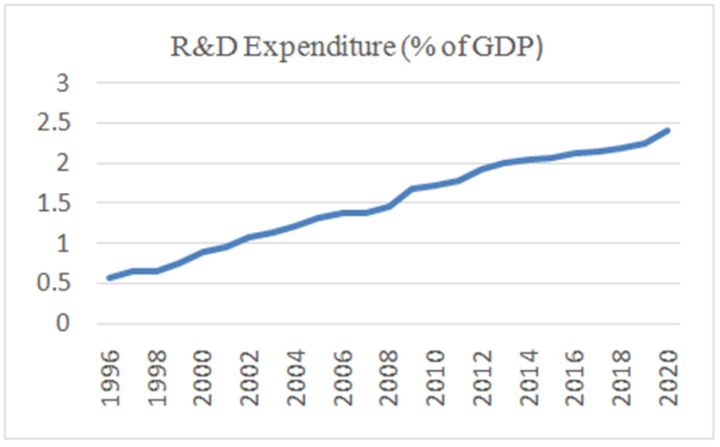
With a strong ambition to become the leading innovative country by 2035 19, China has prioritized R&D, spending a percentage of its GDP on encouraging and reducing the cost of R&D activities. Since 1996, China has been increasing its rate of spending on R&D from a 0.56% to 2.4% in 2020. According to the country’s 14th Five-Year Plan (2021-2025), China will continue to increase its percentage of GDP spending on R&D yearly by more than 7% 19. The country intends to make technology as its core focus 24. For a country to be successful at its cutting edge sectors it should have a strong scientific base 25.
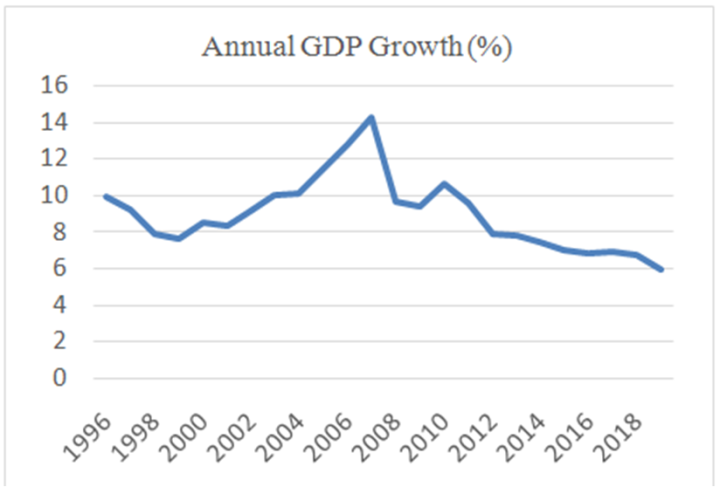
2.2. China’s Economic Growth TrendThe economy of China had experienced poverty, stagnant growth, and inefficiencies for some number of years until the country began to undergo reforms and trade liberalization. Since 1979, China has been identified to be one of the fastest growing economies in the world with an annual GDP growth of 6.75% in 2018 and 5.95% in 2019. China is currently, in terms of purchasing power parity, seen globally to be the largest economy which has a large market for merchandize goods, foreign exchange reserves, and manufacturing.

Despite the maturity in economic growth, China’s real GDP growth began to fall after a rise in 2007. In 2007, China recorded a real GDP growth of 14.23%. Since then, the country has been experiencing significant fall in growth from 9.65% in 2008, 5.95% in 2019, and about 2.3% in 2020. However, according to a forecast from International Monetary Fund (IMF), the real GDP growth rate of China is expected to increase to 8.44% in 2021 but after begin to fall from 5.57% in 2022 to 4.86% in 2026 26. According to the Chinese government, the slower rate of growth of the economy is not really a problem as the country is currently considering embracing a new growth model that depends on innovation strategies in order to drive better growth. Moreover, China is no more pay attention to the quantity of growth but the quality of growth. AS such, the country plans to strengthen its domestic economic and social development 27.
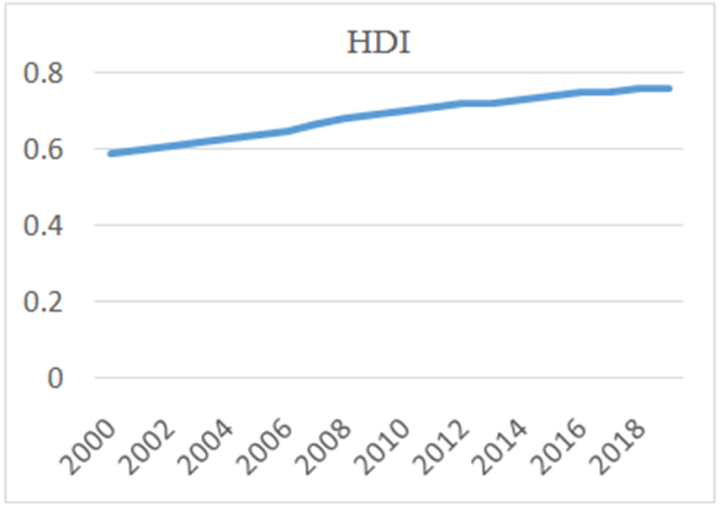
The decision by Chinese government considering quality of growth is because political and economic history has shown that growing in terms of quantity does not bring about enhanced social outcomes. Many countries, especially developing economies have been experiencing increase in economic growth, yet the level of poverty, unemployment, and inequality are high. Hence, in order to ensure that economic growth comes with achievement of social goals, countries are now considering quality of growth. The concept of quality of growth, however, is quite difficult defining since it meaning differs country by country. In measuring quality of growth, Human Development Index (HDI) which was developed by the United Nations (UN), has been proven to be a better indicator 28. The HDI comprises of life expectancy index, education index, and the income index which is based on Gross National Income per Capita. Since 2000, China has been experiencing increase in the HDI, from 0.59 in 2000 to 0.76 in 2019. According to the 2019 report on global HDI by United Nations Development Program, China is ranked 85th position.

Literature postulates that innovative activities, directly and indirectly aid economic growth through other macroeconomic factors 29, 30. On the other hand, other studies have shown innovation does not contribute to economic growth 31, 32.
Pece, et al. 29 examined how innovation is able to influence long-term economic growth among CEE countries. Number of patents, R&D expenditures, and number of trademarks were used as proxy for innovation. The results from the multiple regression analysis indicated that a positive relationship exist between innovation and economic growth. Similarly, Maradana, et al. 30 analyzed the long-run relationship between innovation and per capita economic growth, using 19 European countries. Six innovative indicators, including patents for residents, patents for non-residents, expenditure on R&D, researchers in R&D, high-technology exports, and scientific and technical journal articles, were used. The results from the Granger causality test showed that there is a positive relationship between innovation and per capita economic growth. However, there were variations in the results from country to country, due to differences in the type of innovative indicators.
Bilbao-Osorio and Rodríguez-Pose 33 analyzed the impact of innovation on economic growth in peripheral regions of Europe. Their study sort to achieve two objectives; the effect of R&D investment of the private, public, and higher education sectors on economic growth, and how innovation and innovation growth influence the economic growth. The results indicated a positive relationship between investment in R&D as a whole, and investment in peripheral regions of the EU, and economic growth.
Bayarçelik and Taşel 34 studied the link between innovation and economic growth of Turkey. Bayarçelik and Taşel 34 used the number of researchers in R&D, R&D expenditures, and patents as indicators for innovation. For economic growth, GDP was used as a proxy. The findings indicated that R&D expenditure and the number of researchers in R&D are significant and positively related with economic growth.
Technological growth is responsible for long-run economic growth 35. In 36, digital technology usage was found to be substantial to economic growth for 39 African countries. In countries that have access to better education, the use of internet contributes to economic growth 37. This means that education facilitates a positive relationship between technology and economic growth. Technological innovation is, therefore, a key factor to economic growth and the development of human capital. The long-term record of success of most developed countries like USA, Germany 38, Singapore 39, and Iceland are attributed to technological innovation.
On the other hand, Gumus and Celikay 31 found a weak relationship between R&D and economic growth among developing countries. 40 also investigated the relationship between R&D and economic growth using 30 developing countries. R &D indicators like government expenditures on research in GDP, the number of researchers in each one million population, and scientific output of the countries were used. The findings indicated that there is no significant positive impact of R&D on economic growth of the countries under the study. Similarly, Burcu and Ayşe 41 analyzed the relationship between R&D and economic growth for 15 OECD countries. The findings showed that R&D positively affect economic growth. However, a negative relationship was found for countries like Germany, Netherland, Spain, and England.
Moreover, Kokko, et al. 42 examined the relationship between R & D spending and economic growth among EU countries and other regions. A negative relationship between R&D and economic growth was found among the 15 EU countries. A similar result was also found in 32. An investigation was done on how technological innovation affect economic growth in 25 developing countries. Using R&D expenditure and number of researchers in R&D, Pala 32 found a negative impact of R&D on economic growth in countries like China, Iran, Panama, Serbia, Egypt, and Uzbekistan. Also, a negative effect of number of researchers in R&D and economic growth was found among countries like Mexico, Tunisia, Iran, and Uzbekistan.
In this literature, several studies have been conducted on innovation and economic growth. However, these studies focused on quantity of growth, using GDP or GDPPC as a measure of growth. This current study goes beyond the economic impact by including the social benefits of innovation on the adopted country.
This study used the time series data to examine the impact of innovation on the quality of economic growth in China. The Ordinary Least Square method of estimation was used for the regression analysis. R & D expenditure used as a measure of innovation whereas human development index was used to measure the quality of economic growth. The table below presents the definition of the variables and their sources.
Before the regression analysis, a test was conducted to check whether multicollinearity exist amongst the variables of study. Using Variance Inflation Factor, the test shows no multicollinearity in the variables. Test results are presented in Table 2.
The Table 3 shows the results of the regression analysis between R & D expenditure and HDI.
Table 3 provides the results of the OLS regression analysis of the impact of R & D on quality of economic growth. From the results, RDEXP has a probability value of 0.0000 which indicates a highly significant value with a positive coefficient value of 0.1332. This means that a percentage increase in R&D expenditure will lead to 13.32 percent increase or improvement in growth quality.
Considering the results of the empirical analysis, it is evidenced that R & D expenditure which is used as an indicator of innovation is a vital factor that drives quality of growth. The amount of spending on research and development is directly proportional to quality of growth. The results of this study is in line with the findings of 43. The findings of this study also affirms the notion that investing in R&D aids in achieving both social and economic goals in the country. This means that countries that set aside a proportion of their GDP for R&D, stand the chance of better economic and social outcomes.
Based on the findings, it is of good essence for countries, especially developing economies which seek to improve their economies to begin to prioritize innovation as a driver for spurring quality growth. More policies such as tax incentives, direct grants for R&D, protecting of intellectual property, and creating cooperative research for government universities and private institutions, could be undertaken to enhance innovation which would consequently empower economic growth.
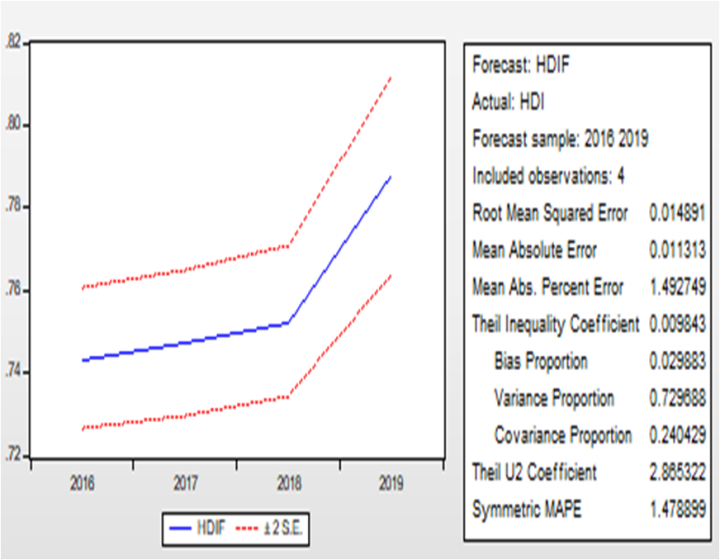
4.2. Further AnalysisA forecasting analysis was done to check the accuracy of the model. Before the forecasting, serial correlation was checked and from the results in Table 4, the Breusch-Godfrey Serial Correlation shows a Chi-Square probability of 0.2154 which is an indication of absence of serial correlation in the data.
Out of the data period, 2000 to 2015 was used to estimate the regression line, whilst data from 2016 to 2019 was used for forecasting. Using Root Mean Squared Error (0.011313) and Theil Inequality Coefficient (0.009843) for evaluating the forecast, the results show that the model is accurate and has no errors. As such, it is good for making future predictions.
The main aim of this study is to examine the relationship between innovation and quality of economic growth. The study used a time series data covering a period from 2000 to 2019. Using R&D expenditure as an indicator for innovation, and human development index, the results of the OLS estimator revealed that increase in research and development expenditure propels increase in quality of economic growth. Also, using the period 2000 to 2015 as a regression line, and period from 2016 to 2019 for a forecast, the results of the Root Mean Squared Error and Theil Inequality Coefficient provide evidence that the model makes correct predictions. As countries continue to invest in research and development, they create avenue for quality growth and also achieving their Sustainable Development Goals. Innovation is, therefore, seen to incite quality of economic growth.
| [1] | E. Cammeraat, L. Samek, and M. Squicciarini, “The role of innovation and human capital for the productivity of industries,” 2021. | ||
| In article | |||
| [2] | C. Diebolt and R. Hippe, “The long-run impact of human capital on innovation and economic development in the regions of Europe,” Applied Economics, vol. 51, no. 5, pp. 542-563, 2019/01/26 2019. | ||
| In article | View Article | ||
| [3] | J. V. Reenen, Innovation and Human Capital Policy (Innovation and Public Policy). University of Chicago Press, 2020. | ||
| In article | View Article PubMed | ||
| [4] | M. Alawamleh, L. Bani Ismail, D. Aqeel, and K. J. Alawamleh, “The bilateral relationship between human capital investment and innovation in Jordan,” Journal of Innovation and Entrepreneurship, vol. 8, no. 1, p. 6, 2019/01/25 2019. | ||
| In article | View Article | ||
| [5] | D. D. Dereli, “Innovation Management in Global Competition and Competitive Advantage,” Procedia - Social and Behavioral Sciences, vol. 195, pp. 1365-1370, 2015/07/03/ 2015. | ||
| In article | View Article | ||
| [6] | D. V. Gibson and H. Naquin, “Investing in innovation to enable global competitiveness: The case of Portugal,” Technological Forecasting and Social Change, vol. 78, no. 8, pp. 1299-1309, 2011/10/01/ 2011. | ||
| In article | View Article | ||
| [7] | K. Yang, W. Wang, and W. Xiong, “Promoting the sustainable development of infrastructure projects through responsible innovation: An evolutionary game analysis,” Utilities Policy, vol. 70, p. 101196, 2021/06/01/ 2021. | ||
| In article | View Article | ||
| [8] | N. Gil, M. Miozzo, and S. Massini, “The innovation potential of new infrastructure development: An empirical study of Heathrow airport's T5 project,” Research Policy, vol. 41, no. 2, pp. 452-466, 2012/03/01/ 2012. | ||
| In article | View Article | ||
| [9] | J. Wilkes-Allemann and A. Ludvig, “The role of social innovation in negotiations about recreational infrastructure in forests – A mountain-bike case study in Switzerland,” Forest Policy and Economics, vol. 100, pp. 227-235, 2019/03/01/ 2019. | ||
| In article | View Article | ||
| [10] | R. Puertas, L. Marti, and J. M. Guaita-Martinez, “Innovation, lifestyle, policy and socioeconomic factors: An analysis of European quality of life,” Technological Forecasting and Social Change, vol. 160, p. 120209, 2020/11/01/ 2020. | ||
| In article | View Article | ||
| [11] | T. R. Hornick, “Surgical Innovations: Impact on the Quality of Life of the Older Patient,” Clinics in Geriatric Medicine, vol. 22, no. 3, pp. 499-513, 2006/08/01/ 2006. | ||
| In article | View Article PubMed | ||
| [12] | B. Matarazzo and J. Teghem, “O.R. for innovation and quality of life,” European Journal of Operational Research, vol. 139, no. 2, pp. 191-192, 2002/06/01/ 2002. | ||
| In article | View Article | ||
| [13] | C. Zhu, Z. Qiu, and F. Liu, “Does innovation stimulate employment? Evidence from China,” Economic Modelling, vol. 94, pp. 1007-1017, 2021/01/01/ 2021. | ||
| In article | View Article | ||
| [14] | S. Lachenmaier and H. Rottmann, “Effects of innovation on employment: A dynamic panel analysis,” International Journal of Industrial Organization, vol. 29, no. 2, pp. 210-220, 2011/03/01/ 2011. | ||
| In article | View Article | ||
| [15] | F. Bogliacino and M. Pianta, “Innovation and Employment: a Reinvestigation using Revised Pavitt classes,” Research Policy, vol. 39, no. 6, pp. 799-809, 2010/07/01/ 2010. | ||
| In article | View Article | ||
| [16] | M. Vivarelli, “Innovation and Employment,” in International Encyclopedia of the Social & Behavioral Sciences (Second Edition), J. D. Wright, Ed. Oxford: Elsevier, 2015, pp. 152-159. | ||
| In article | View Article | ||
| [17] | M. Al Mamun, K. Sohag, M. Shahbaz, and S. Hammoudeh, “Financial markets, innovations and cleaner energy production in OECD countries,” Energy Economics, vol. 72, pp. 236-254, 2018/05/01/ 2018. | ||
| In article | View Article | ||
| [18] | A. Marszk and E. Lechman, “Reshaping financial systems: The role of ICT in the diffusion of financial innovations – Recent evidence from European countries,” Technological Forecasting and Social Change, vol. 167, p. 120683, 2021/06/01/ 2021. | ||
| In article | View Article | ||
| [19] | B. Cooper, “China's 14th Five-Year Plan (2021-2025) Report,” 2021, Available: https://www.hkstrategies.com/en/chinas-14th-five-year-plan-2021-2025-report/. | ||
| In article | |||
| [20] | S. Alijani and R. Wintjes, “Interplay between Technological and Social Innovation,” SIMPACT Working Paper, vol. 2017, no. 3, 2017. | ||
| In article | |||
| [21] | X. Zhao, “Innovation Ecosystem in China,” 2021, Available: https://www.linkedin.com/pulse/innovation-ecosystem-china-xinjin-zhao. | ||
| In article | |||
| [22] | M. König, Z. M. Song, K. Storesletten, and F. Zilibotti, “From Imitation to Innovation: Where Is all that Chinese R & D Going?,” National Bureau of Economic Research Working Paper Series, vol. No. 27404, 2020. | ||
| In article | View Article | ||
| [23] | W. Dobson and A. E. Safarian, “The transition from imitation to innovation: An enquiry into China's evolving institutions and firm capabilities.,” Journal of Asian Economics, vol. 19, no. 4, pp. 301-311, 2008. | ||
| In article | View Article | ||
| [24] | A. Kaja and S. Huang, “China's 14th Five-Year Plan (2021-2025): Spotlight on Semiconductors,” in Global Policy Watch vol. 2021, ed: Lexology, 2021. | ||
| In article | |||
| [25] | Q. Xie and R. B. Freeman, “Bigger Than You Thought: China’s Contribution to Scientific Publications and Its Impact on the Global Economy,” China & World Economy, vol. 27, no. 1, pp. 1-27, 2019. | ||
| In article | View Article | ||
| [26] | C. Textor, “Growth rate of real gross domestic product (GDP) in China from 2010 to 2020 with forecasts until 2026,” Statista2021, Available: https://www.statista.com/statistics/263616/gross-domestic-product-gdp-growth-rate-in-china/. | ||
| In article | |||
| [27] | N. Grünberg and V. Brussee, “China’s 14th Five-Year Plan – strengthening the domestic base to become a superpower,” in “Mercator Institutes for China Studies,” 2021, Available: https://merics.org/en/short-analysis/. | ||
| In article | |||
| [28] | H. Lashmar, “SDGs: delivering change,” in “The Human Development Index-a better indicator for success,” United Nations Association 2018, Available: https://www.sustainablegoals.org.uk/human-development-index-better-indicator-success/. | ||
| In article | |||
| [29] | A. M. Pece, O. E. O. Simona, and F. Salisteanu, “Innovation and Economic Growth: An Empirical Analysis for CEE Countries,” Procedia Economics and Finance, vol. 26, pp. 461-467, 2015/01/01/ 2015. | ||
| In article | View Article | ||
| [30] | R. P. Maradana, R. P. Pradhan, S. Dash, K. Gaurav, M. Jayakumar, and D. Chatterjee, “Does innovation promote economic growth? Evidence from European countries,” Journal of Innovation and Entrepreneurship, vol. 6, no. 1, p. 1, 2017/01/10 2017. | ||
| In article | View Article | ||
| [31] | E. Gumus and F. Celikay, “R&D Expenditure and Economic Growth: New Empirical Evidence,” Margin: The Journal of Applied Economic Research, vol. 9, no. 3, pp. 205-217, 2015/08/01 2015. | ||
| In article | View Article | ||
| [32] | A. Pala, “Innovation and Economic Growth in Developing Countries: Empirical Implication of Swamy's Random Coefficient Model (RCM),” Procedia Computer Science, vol. 158, pp. 1122-1130, 2019/01/01/ 2019. | ||
| In article | View Article | ||
| [33] | B. Bilbao-Osorio and A. Rodríguez-Pose, “From R&D to Innovation and Economic Growth in the EU,” Growth and Change, vol. 35, no. 4, pp. 434-455, 2004. | ||
| In article | View Article | ||
| [34] | E. B. Bayarçelik and F. Taşel, “Research and Development: Source of Economic Growth,” Procedia - Social and Behavioral Sciences, vol. 58, pp. 744-753, 2012/10/12/ 2012. | ||
| In article | View Article | ||
| [35] | B. Verspagen, Innovation and Economic Growth (The Oxford Handbook of Innovation). Oxford Handbook of Innovation, 2009. | ||
| In article | |||
| [36] | E. M. Solomon and A. van Klyton, “The impact of digital technology usage on economic growth in Africa,” Utilities Policy, vol. 67, p. 101104, 2020/12/01/ 2020. | ||
| In article | View Article PubMed | ||
| [37] | F. Donou-Adonsou, “Technology, education, and economic growth in Sub-Saharan Africa,” Telecommunications Policy, vol. 43, no. 4, pp. 353-360, 2019/05/01/ 2019. | ||
| In article | View Article | ||
| [38] | W. Naudé and P. Nagler, “Technological Innovation and Inclusive Growth in Germany,” in “IZA Discussion Papers,” 2017, Available: https://ideas.repec.org/cgi-bin/refs.cgi. | ||
| In article | |||
| [39] | K.-S. Tan and S.-Y. Phang, “From Efficiency-Driven to Innovation-Driven Economic Growth: Perspectives from Singapore.,” in “Policy Research Working Paper,” World Bank, Wshington, DC, World Bank2005, vol. No.3569. | ||
| In article | View Article | ||
| [40] | J. S. Ahmad and M. A. Seyede, “R&D and Economic Growth: New Evidence from Some Developing Countries.,” Australian Journal of Basic and Applied Sciences, vol. 3, no. 4, pp. 3464-3469, 2009. | ||
| In article | |||
| [41] | Ö. Burcu and A. Ayşe, “The Relationship between Research and Development Expenditures and Economic Growth: Panel Data Analysis,” Maliye Dergisi, no. 166, pp. 39-55, 2014. | ||
| In article | |||
| [42] | A. Kokko, P. G. Tingvall, and J. Videnord, ““The growth effects of R&D spending in the EU: A meta-analysis”,” Economics, Open-Assessment E-Journal, vol. 9, no. 40, pp. 1-26, 2015. | ||
| In article | View Article | ||
| [43] | O. Özçatalbaş, in Human Development and Research-Development-Extension Relationships: IntechOpens, 2017, p. 17. | ||
| In article | View Article | ||
Published with license by Science and Education Publishing, Copyright © 2021 Gigamon Joseph Prah
 This work is licensed under a Creative Commons Attribution 4.0 International License. To view a copy of this license, visit
http://creativecommons.org/licenses/by/4.0/
This work is licensed under a Creative Commons Attribution 4.0 International License. To view a copy of this license, visit
http://creativecommons.org/licenses/by/4.0/
| [1] | E. Cammeraat, L. Samek, and M. Squicciarini, “The role of innovation and human capital for the productivity of industries,” 2021. | ||
| In article | |||
| [2] | C. Diebolt and R. Hippe, “The long-run impact of human capital on innovation and economic development in the regions of Europe,” Applied Economics, vol. 51, no. 5, pp. 542-563, 2019/01/26 2019. | ||
| In article | View Article | ||
| [3] | J. V. Reenen, Innovation and Human Capital Policy (Innovation and Public Policy). University of Chicago Press, 2020. | ||
| In article | View Article PubMed | ||
| [4] | M. Alawamleh, L. Bani Ismail, D. Aqeel, and K. J. Alawamleh, “The bilateral relationship between human capital investment and innovation in Jordan,” Journal of Innovation and Entrepreneurship, vol. 8, no. 1, p. 6, 2019/01/25 2019. | ||
| In article | View Article | ||
| [5] | D. D. Dereli, “Innovation Management in Global Competition and Competitive Advantage,” Procedia - Social and Behavioral Sciences, vol. 195, pp. 1365-1370, 2015/07/03/ 2015. | ||
| In article | View Article | ||
| [6] | D. V. Gibson and H. Naquin, “Investing in innovation to enable global competitiveness: The case of Portugal,” Technological Forecasting and Social Change, vol. 78, no. 8, pp. 1299-1309, 2011/10/01/ 2011. | ||
| In article | View Article | ||
| [7] | K. Yang, W. Wang, and W. Xiong, “Promoting the sustainable development of infrastructure projects through responsible innovation: An evolutionary game analysis,” Utilities Policy, vol. 70, p. 101196, 2021/06/01/ 2021. | ||
| In article | View Article | ||
| [8] | N. Gil, M. Miozzo, and S. Massini, “The innovation potential of new infrastructure development: An empirical study of Heathrow airport's T5 project,” Research Policy, vol. 41, no. 2, pp. 452-466, 2012/03/01/ 2012. | ||
| In article | View Article | ||
| [9] | J. Wilkes-Allemann and A. Ludvig, “The role of social innovation in negotiations about recreational infrastructure in forests – A mountain-bike case study in Switzerland,” Forest Policy and Economics, vol. 100, pp. 227-235, 2019/03/01/ 2019. | ||
| In article | View Article | ||
| [10] | R. Puertas, L. Marti, and J. M. Guaita-Martinez, “Innovation, lifestyle, policy and socioeconomic factors: An analysis of European quality of life,” Technological Forecasting and Social Change, vol. 160, p. 120209, 2020/11/01/ 2020. | ||
| In article | View Article | ||
| [11] | T. R. Hornick, “Surgical Innovations: Impact on the Quality of Life of the Older Patient,” Clinics in Geriatric Medicine, vol. 22, no. 3, pp. 499-513, 2006/08/01/ 2006. | ||
| In article | View Article PubMed | ||
| [12] | B. Matarazzo and J. Teghem, “O.R. for innovation and quality of life,” European Journal of Operational Research, vol. 139, no. 2, pp. 191-192, 2002/06/01/ 2002. | ||
| In article | View Article | ||
| [13] | C. Zhu, Z. Qiu, and F. Liu, “Does innovation stimulate employment? Evidence from China,” Economic Modelling, vol. 94, pp. 1007-1017, 2021/01/01/ 2021. | ||
| In article | View Article | ||
| [14] | S. Lachenmaier and H. Rottmann, “Effects of innovation on employment: A dynamic panel analysis,” International Journal of Industrial Organization, vol. 29, no. 2, pp. 210-220, 2011/03/01/ 2011. | ||
| In article | View Article | ||
| [15] | F. Bogliacino and M. Pianta, “Innovation and Employment: a Reinvestigation using Revised Pavitt classes,” Research Policy, vol. 39, no. 6, pp. 799-809, 2010/07/01/ 2010. | ||
| In article | View Article | ||
| [16] | M. Vivarelli, “Innovation and Employment,” in International Encyclopedia of the Social & Behavioral Sciences (Second Edition), J. D. Wright, Ed. Oxford: Elsevier, 2015, pp. 152-159. | ||
| In article | View Article | ||
| [17] | M. Al Mamun, K. Sohag, M. Shahbaz, and S. Hammoudeh, “Financial markets, innovations and cleaner energy production in OECD countries,” Energy Economics, vol. 72, pp. 236-254, 2018/05/01/ 2018. | ||
| In article | View Article | ||
| [18] | A. Marszk and E. Lechman, “Reshaping financial systems: The role of ICT in the diffusion of financial innovations – Recent evidence from European countries,” Technological Forecasting and Social Change, vol. 167, p. 120683, 2021/06/01/ 2021. | ||
| In article | View Article | ||
| [19] | B. Cooper, “China's 14th Five-Year Plan (2021-2025) Report,” 2021, Available: https://www.hkstrategies.com/en/chinas-14th-five-year-plan-2021-2025-report/. | ||
| In article | |||
| [20] | S. Alijani and R. Wintjes, “Interplay between Technological and Social Innovation,” SIMPACT Working Paper, vol. 2017, no. 3, 2017. | ||
| In article | |||
| [21] | X. Zhao, “Innovation Ecosystem in China,” 2021, Available: https://www.linkedin.com/pulse/innovation-ecosystem-china-xinjin-zhao. | ||
| In article | |||
| [22] | M. König, Z. M. Song, K. Storesletten, and F. Zilibotti, “From Imitation to Innovation: Where Is all that Chinese R & D Going?,” National Bureau of Economic Research Working Paper Series, vol. No. 27404, 2020. | ||
| In article | View Article | ||
| [23] | W. Dobson and A. E. Safarian, “The transition from imitation to innovation: An enquiry into China's evolving institutions and firm capabilities.,” Journal of Asian Economics, vol. 19, no. 4, pp. 301-311, 2008. | ||
| In article | View Article | ||
| [24] | A. Kaja and S. Huang, “China's 14th Five-Year Plan (2021-2025): Spotlight on Semiconductors,” in Global Policy Watch vol. 2021, ed: Lexology, 2021. | ||
| In article | |||
| [25] | Q. Xie and R. B. Freeman, “Bigger Than You Thought: China’s Contribution to Scientific Publications and Its Impact on the Global Economy,” China & World Economy, vol. 27, no. 1, pp. 1-27, 2019. | ||
| In article | View Article | ||
| [26] | C. Textor, “Growth rate of real gross domestic product (GDP) in China from 2010 to 2020 with forecasts until 2026,” Statista2021, Available: https://www.statista.com/statistics/263616/gross-domestic-product-gdp-growth-rate-in-china/. | ||
| In article | |||
| [27] | N. Grünberg and V. Brussee, “China’s 14th Five-Year Plan – strengthening the domestic base to become a superpower,” in “Mercator Institutes for China Studies,” 2021, Available: https://merics.org/en/short-analysis/. | ||
| In article | |||
| [28] | H. Lashmar, “SDGs: delivering change,” in “The Human Development Index-a better indicator for success,” United Nations Association 2018, Available: https://www.sustainablegoals.org.uk/human-development-index-better-indicator-success/. | ||
| In article | |||
| [29] | A. M. Pece, O. E. O. Simona, and F. Salisteanu, “Innovation and Economic Growth: An Empirical Analysis for CEE Countries,” Procedia Economics and Finance, vol. 26, pp. 461-467, 2015/01/01/ 2015. | ||
| In article | View Article | ||
| [30] | R. P. Maradana, R. P. Pradhan, S. Dash, K. Gaurav, M. Jayakumar, and D. Chatterjee, “Does innovation promote economic growth? Evidence from European countries,” Journal of Innovation and Entrepreneurship, vol. 6, no. 1, p. 1, 2017/01/10 2017. | ||
| In article | View Article | ||
| [31] | E. Gumus and F. Celikay, “R&D Expenditure and Economic Growth: New Empirical Evidence,” Margin: The Journal of Applied Economic Research, vol. 9, no. 3, pp. 205-217, 2015/08/01 2015. | ||
| In article | View Article | ||
| [32] | A. Pala, “Innovation and Economic Growth in Developing Countries: Empirical Implication of Swamy's Random Coefficient Model (RCM),” Procedia Computer Science, vol. 158, pp. 1122-1130, 2019/01/01/ 2019. | ||
| In article | View Article | ||
| [33] | B. Bilbao-Osorio and A. Rodríguez-Pose, “From R&D to Innovation and Economic Growth in the EU,” Growth and Change, vol. 35, no. 4, pp. 434-455, 2004. | ||
| In article | View Article | ||
| [34] | E. B. Bayarçelik and F. Taşel, “Research and Development: Source of Economic Growth,” Procedia - Social and Behavioral Sciences, vol. 58, pp. 744-753, 2012/10/12/ 2012. | ||
| In article | View Article | ||
| [35] | B. Verspagen, Innovation and Economic Growth (The Oxford Handbook of Innovation). Oxford Handbook of Innovation, 2009. | ||
| In article | |||
| [36] | E. M. Solomon and A. van Klyton, “The impact of digital technology usage on economic growth in Africa,” Utilities Policy, vol. 67, p. 101104, 2020/12/01/ 2020. | ||
| In article | View Article PubMed | ||
| [37] | F. Donou-Adonsou, “Technology, education, and economic growth in Sub-Saharan Africa,” Telecommunications Policy, vol. 43, no. 4, pp. 353-360, 2019/05/01/ 2019. | ||
| In article | View Article | ||
| [38] | W. Naudé and P. Nagler, “Technological Innovation and Inclusive Growth in Germany,” in “IZA Discussion Papers,” 2017, Available: https://ideas.repec.org/cgi-bin/refs.cgi. | ||
| In article | |||
| [39] | K.-S. Tan and S.-Y. Phang, “From Efficiency-Driven to Innovation-Driven Economic Growth: Perspectives from Singapore.,” in “Policy Research Working Paper,” World Bank, Wshington, DC, World Bank2005, vol. No.3569. | ||
| In article | View Article | ||
| [40] | J. S. Ahmad and M. A. Seyede, “R&D and Economic Growth: New Evidence from Some Developing Countries.,” Australian Journal of Basic and Applied Sciences, vol. 3, no. 4, pp. 3464-3469, 2009. | ||
| In article | |||
| [41] | Ö. Burcu and A. Ayşe, “The Relationship between Research and Development Expenditures and Economic Growth: Panel Data Analysis,” Maliye Dergisi, no. 166, pp. 39-55, 2014. | ||
| In article | |||
| [42] | A. Kokko, P. G. Tingvall, and J. Videnord, ““The growth effects of R&D spending in the EU: A meta-analysis”,” Economics, Open-Assessment E-Journal, vol. 9, no. 40, pp. 1-26, 2015. | ||
| In article | View Article | ||
| [43] | O. Özçatalbaş, in Human Development and Research-Development-Extension Relationships: IntechOpens, 2017, p. 17. | ||
| In article | View Article | ||