This study was prompted by the desire to assess the relationship among partnering, trust and organizational efficiency in selected construction firms in North-East, Nigeria. It sought to:(i) ascertain the nature of the effect of partnering on organizational productivity in selected construction firms in North East, Nigeria; (ii) ascertain the extent of the relationship between partnering and trust in the selected construction firms in North East, Nigeria. The population of the study was 1662 staff of the selected construction firms in North East Nigeria. The sample size of 553 was obtained using freund and William formula. Proportionate Stratified sampling technique was used to select respondents in each of the construction industry. Data were collected using content validated questionnaire. The reliability was test using a test retest method and Cronbach’s alpha was adopted, giving a coefficient of 0.94, indicating a high degree of items consistency. It was found that Partnering had a positive effect on organizational productivity in selected construction firms in North East, Nigeria (r = 0.772, p < 0.05); Partnering had a significant positive relationship with trust in selected construction firms in North East, Nigeria. (r = 0.948, p < 0.05). Based on the findings the study concluded that trust is simply indispensable for long term strategic relationships like partnering; however, successful partnering in contracting firms has certain pre-requisites that must be fulfilled before implementing the concept. Based on the conclusion, the study recommends that Management should continually and continuously design effective partnering that will achieve organizational productivity. This will ensure that these organisations are equipped with the requisite rules and regulation of Agreement. Trust should be targeted to ensure that it is focused on achieving organizational profitability; The Partnering Agreement of construction firms should be focused to enhance organizational market share and appropriate partnering that suit the uniqueness of the organization should be adopted, to ensure that growth is achieved.
The origin of partnering, as a construction management concept, is relatively recent, dating from themid-1980s. This is not to say that partnering did not exist prior to that period and indeed many would subscribe to the view that partnering between contractors and private clients is as old as construction itself. The study focuses on formal partnering, where there is evidence of an explicit arrangement between the parties. According to the National Economic Development Council 1, true partnership in the formal sense only became established in the mid-1980s, the first being that between Shell and Partners in 1984. The most frequently cited partnering arrangement of the 1980s is the Du Pont/Fluor Daniel relationship for the Cape Fear plant project. The partnering agreement between Du Pont and Fluor Daniel was made in 1986 and was a formalization of a relationship which had existed since the 1970s. Other notable partnering relationships during this era were Union Carbide/Bechtel Proctor and Gamble/Kellogge and Shell Oil/Parsons.
Since the publication of the Lathan 2 report, partnering has been increasingly used as a procurement method. Partnering enables the industry to understand more clearly its clients’ needs and objectives including improved efficiency and cost-effectiveness, increased innovation, opportunities and the continuous improvement of quality products and services.
The construction industry has been plagued by issues of trust for long and has been characterized as having “too little trust” which hurts both client and industry 3. In this regard, Munns 3 correctly referred to lack of trust in projects as condemning indictment, it is because of issues such as this that led Klemetti 4 to opine that a “culture of conflict and inefficiency… dogs Britain’s biggest industry”.
Such concerns have given rise to a number of government reports, such as the Klemetti 4, other reports and House of Commons reports 5.
Partnering is an umbrella term applied to a series of strategies that involve producing collaborations between different types of actors which extend beyond the sector based division between government, market and civil society. An allied concept to trust is that of partnering which is a commitment between the clients and contractors to avoid issues but cooperate with each other in order to achieve their common business objectives. Projects are dynamic by nature and therefore, the use of fixed or predetermined agreements in the initial stages lead to problems such as time delays, cost overruns, trivial claims and dissatisfaction of the parties 6.
Munns 3 contends that the importance of trust in a society can be judged from the fact that in the absence of trust, every individual will have to do his work himself. Relating this analogy to projects, he argues that complete absence of trust in the industry will lead to a situation where clients will do their work themselves, rather than give to other players in the industry. This analogy is meant to clarify that in extreme cases, lack of trust may lead to multiple problems in projects. Similarly, Luhmann 7, emphasizes that trust is important for increasing cooperation between parties to overcome risk and engage in corrective actions in environments characterized by uncertainty. These arguments could easily be applied to projects as well, since projects involve risk and interdependence, therefore, trust between the clients and contractor is extremely important.
The concept of partnering has been reviewed by many researchers, and most of the definitions seem to have more similarities than differences amongst them. Like some researchers 8, 9 define partnering in terms of notional benefits on offer to the individuals participating in the process. The major focus of these benefits is on the development of long term relationship and mutual trust among the organizations. To this extent, it seems that it is a concept or a notion of applying abstract ideas to the construction industry for the sake of achieving efficiency and mutual satisfaction.
However, a rising number of small contractors are facing delays in payments, shrinking contracts as well as difficulty in getting loans due to tough operating environments in the construction organizations. Additionally, some face insufficient financing, material price escalation, lack of high skilled work force, lack of performance and time management, and lack of productivity among others. Since there are huge numbers of small contractors in Nigeria, it should be questioned, why they do not practice partnering or merging amongst themselves. Through partnering, these hitherto small firms can produce more benefits compared to just running small contractor firms solely on their own. In a partnering relationship, the role of a contractor is different from that in a traditional project. There would be much competition among the small contractors themselves. It is believed that some of the small contractors come from the same family, for example, a father, mother, brother and sister, are all registered as small contractors. The question is, why not just merge to form a family consortium which is much better compared to forming separate construction firms.
Confronted with these myriads of issues, small contractors are in a great need to practice the concept of partnering to enable them determine their goals to educate all parties of each other’s goals and to mold them into common goals and mission. It is the molding of these common divergent goals into one cohesive team and purpose which leads to a successful project
1.1. Statement of the ProblemMost recently, going into partnership has become more and more communal and is today reflected in a range of policy areas. In spite of recent developments taking place in the discipline of Project Management in general and contracting in particular, some projects are still failing. With the increase in complexity of construction systems and processes, there is a growing need to bring together advances from different realms of constructing research. Despite developments taking place in the discipline of Project Management in general and contracting in particular, some projects are still failing. With the increase in complexity of construction systems and processes, there is a growing need to bring together advances from different realms of constructing research. This trend is motivated by many reasons. Projects are more complex and tolerances tighter, constructors need to focus on multiple aspects of the construction process to achieve this required level of quality and response times are decreasing from design to project. It is no longer adequate for construction firms to focus on particular aspects of their process for development. Rather, they need to use a holistic approach for process improvement. This is especially the case as cost and time requirements for contract parts are getting progressively stringent. Learning contracting techniques are standard in most contracting practices these days and inefficiencies in the contracting process are being addressed by process and system improvement. Supply chains are getting more complex as well, and it is critical to improve the fractional value added time while making parts.
Confronted with these encounters, the construction industry is in a great need to practice the concepts of partnering to enable them to determine their goals, educate all parties of each other’s goals and to move them into common goals and mission. Though, there are studies on partnering, trust and organizational efficiency, specific investigation that integrates the factor base between partnering and trust is taken in the context of organizational efficiency in construction industry. Hence, this study is to ascertain the practice of partnering; trust and organizational efficiency, and identifies the problems and effects of these myriad of issues among construction industry. It is pertinent to address this gap by conceptualizing an integrated framework for assessing partnering, trust and organizational efficiency within the context of construction industry.
1.2. Objectives of the Studyi. Ascertain the effect of partnering on organizational productivity in selected construction firms in North-East, Nigeria.
ii. Ascertain the extent of the relationship between partnering and trust on cost effectiveness in selected construction firms in North-East, Nigeria
1.3. Research Questionsi. What is the effect of partnering on organizational productivity in selected construction firms in North-East, Nigeria?
ii. To what extent is the relationship between partnering and trust on cost effectiveness in selected construction organizations in North-East, Nigeria?
1.4. Research Hypothesesi. Partnering has a positive effect on organizational productivity in selected construction firms in North-East, Nigeria.
ii. Partnering and Trust have a significant positive relationship with cost effectiveness in selected construction firms in North-East, Nigeria.
Partnering
The concept of partnering originated in the United States of America (USA) and has gained popularity and worked well in various other countries 10. According to Das and Keng 11, partnering “is a relationship between two or more companies or organisations formed with the express intent of improving performance in the delivery of projects.” The term partnering is often confused with “partnership”. Partnership is defined as “an arrangement involving two or more persons who have agreed to undertake a business venture as co-owners, with the intent to make a profit”.
The National Economic Development Council 1 provides a working definition of partnering as a long term commitment between two or more organizations for the purpose of achieving specific business objectives by maximizing the effectiveness of each of the participants. Partnering is a process for improving relationships among those involved to the benefits of all.
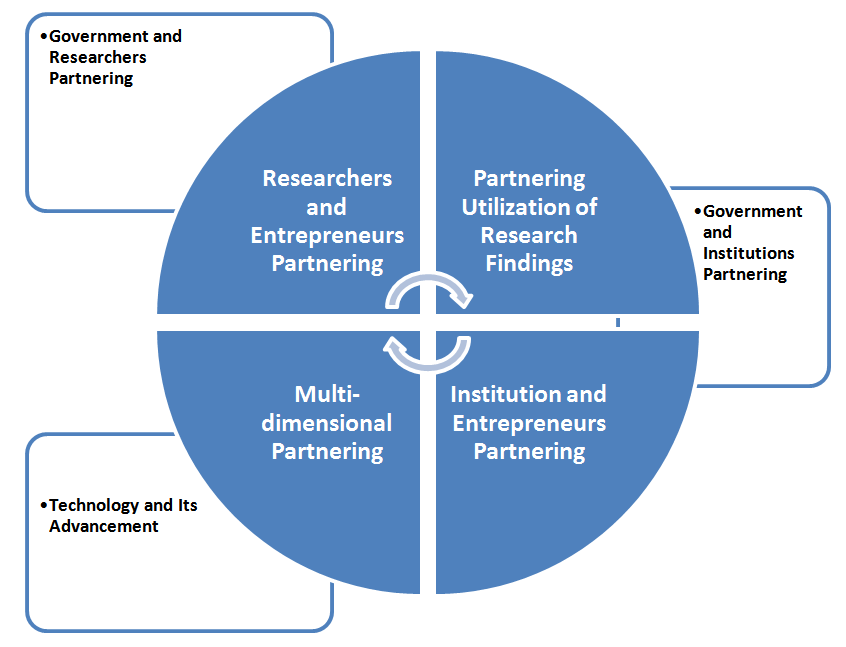
Technology is changing the way we live, work, play and learns. Successful partnerships between construction organizations can provide the technology and innovations necessary to provide a flexible learning framework to meet the needs of today’s lifelong learners. Fostering collaborative and innovative partnerships will enable higher organization to transform in this high speed information age. Construction organizations have extensively used partnering or joint ventures (JVs) as a means of transforming hostile, adversarial owner-contractor relationships into more collaborative teams 8.
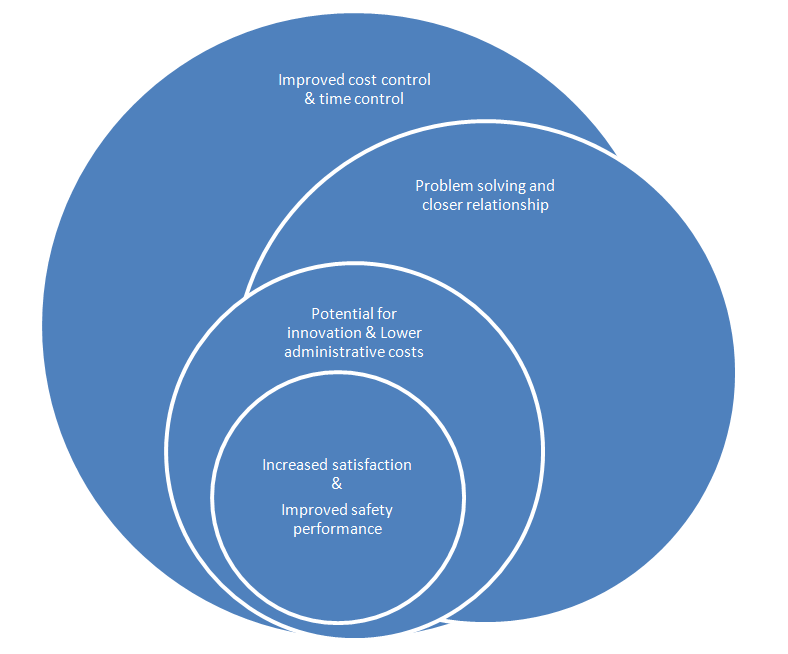
Partnering is also receiving a positive response in the construction industry because it understands the necessity of subcontracting and the difficulties of joining the historical division. Larson 8 states that, partnering benefits all parties involved, including the contractors, subcontractors, the owner and the management, as well as on-site employees. More generally, partnering brings with it benefits in various forms, and to several parties. The advantages over traditional approaches identified by Bresnen and Marshall 12 include increased productivity, reduced costs, reduced project duration, improved product quality and improved client satisfaction.


Categories of Partnering
There are two different categories of partnering and within each category there are varieties.
1. Strategic Partnering: This is sometimes referred to as multi-project partnering or less frequently as second level partnering. Strategic partnering takes place when two or more firms use partnering on a long-term basis to undertake more than one construction project.
2. Project Partnering: This is sometimes called single project partnering or first-level partnering project. Partnering occurs when two or more firms come together in a partnering arrangement for a single project. Because partnering has to do with long term relationships, it follows that more gains and benefits are likely to be achieved from the longer term strategic partnering as opposed to the shorter duration project partnering arrangements. However, project partnering can be a stepping stone to strategic partnering.
The Participants – the first issue to be addressed in any form of partnering is: who should participate in the partnering arrangement? If the partnering concept is introduced at the outset of the project, this will have a bearing on the procurement method adopted which in turn will have a bearing on the composition of the project participants. In order to gain the maximum benefits of partnering, the general trend is to use a design and build form of procurement. The advantage of this approach is that it allows all the key stakeholders to be involved in a partnership arrangement from the outset of the project.
Partnering is not however, the exclusive domain of design and building as it can be used in a traditionally procured project where the lowest bid contractor is brought on board at the tender acceptance stage. In this situation the contractor is excluded from the design stage. Thus during the preconstruction phase the partnering arrangements can only take place between the client and the design consultants, the contractor being brought into the partnering relationship at the downstream stage of tender acceptance.
The selection of members of the partnering team is clearly of paramount importance in a concept which is all about trust and mutual support. The partnering team must be capable of carrying out its responsibilities throughout the project. If any one of the team members is not capable of carrying out its duties, any attempt at partnering will fail. Therefore, the task of selecting partners is not an easy one. For instance, as indicated by Gambetta 13 ideally, you can select contractors or owners who have established a successful track record of partnering on previous contracts. By interviewing contractors an owner can discern interest and/or expertise. However, it is possible for a contractor to progress from being an interested party to a partnering participant. This profession states clearly in the New South Wales Contractor Accreditation Scheme which identifies five categories of partnering. These categories are reflected in the table below:
The decision to partner is a very essential one because of the reliance which one partner must inevitably place on the other(s). It follows that a decision to partner should be taken at the highest possible level in an organization. It is inconceivable that partnering could be carried out without commitment at the very highest levels within both organization.
Although great trauma is made by all commentators of the need for high-level commitment and there is also a need for interval partnering to take place within an organization prior to a commitment by senior management to enter into a partnering agreement. Therefore, internal partnering means preparing your organization and reviewing internal procedures and documentation. It also involves educating and informing staff on partnering. The result of this process should be a united organization that is prepared to work closely with another organization.
2.2. Partnering ProcessThe process which is adopted for project partnering will depend on the circumstance of each situation, if the project participants have previously been involved in similar partnering arrangements, many of the bridges will already have been made, whereas if this is a first-off occasion for the participants then the process will have previously been involved in similar partnering arrangements, bridges will already have been made, whereas if this is a first-off occasion for the participants then the process will have to be developed with particular care and sensitivity. The partnering process is divided into three categories: the pre-project stage, the implementation stage and the completion or feedback stage.
Pre-project stage: The Pre-project stage begins with the decision of whether or not to partner. In other words, the readiness to use partnering will be a condition of prequalification for government tenders. The decisions and initiative to partner comes from the client, design team or contractor; it is a potentially high-risk decision and as such cannot be taken lightly. It is not an automatic assumption that partnering is always the best option. For instance, partnering should be best avoided in some situations. Ideally, there should be a synergistic relationship between the parties with each party bringing complementary efforts to the partnering table.
Implementation stage: At the conclusion of the initial partnering workshop on implementation plan, there will be established a time table for a series of follow-up workshops. The frequency and the duration of these workshops will depend on individual circumstances. The initial workshop is geared towards changing a traditional adversarial culture to a team-spirited win-win environment.
Completion Stage: The completion stage of the project partnering process would normally be centered round a final workshop session. Usually this final workshop will incorporate a lunch or dinner during which senior management will take the opportunity to make mention of specific contributions and highlights the characteristics of the completed project. Although this social event is an occasion for emotional release and for self-congratulation, the final workshop is not simply to do with social niceties. It is an opportunity to undertake some serious work in order to learn from.
2.3. Requirements for PartneringAccording to Rics 14 for partnering to yield good results there are some preconditions that must be satisfied. These are that the culture and structure of an organization should be flexible and willing to trust the contracting parties. Organizations that are rigid and have no intentions to trust the other party confront failure in partnerships and therefore, require a radical change initiative in culture and structure.
Chen and Chen 15 opine that the requirements for successful partnerships in addition to cultural and structural changes are:
• A clear communication strategy for resolving the conflicts that may arise over the period of a project must be resolved in a timely manner before they become real issue to the project
• The parties to the contract should be willing to share resources as and when required.
• Equitable allocation of risk and responsibilities as submitted by Rahman and Kumaraswamy 16.
• Monitoring of the partnering process on a regular intervals, commitment to win-win attitude is critical to the success of partnerships 17.
2.4. Partnering and Trust in OrganizationTrust has been a frequently cited determinant of group performance 18. In prior research, the argument for a main effect of trust on performance is relatively straightforward. Put simply, trust increases the ability of group members to work together. Since work groups require that individuals work together, trust is expected to increase the performance of the group, both in terms of effectiveness and efficiency. Effectiveness is expected to be positively related to trust, as the latter may improve cooperation and the motivation to work jointly 19 that in turn may improve the group’s execution of its task. Efficiency is expected to increase, as trust reduces the need for controls (e.g., rules and monitoring) and increases the ability to confront performance problems; both of these factors facilitate the maximal utilization of the group’s resources 19.
On troubled projects, it is worthwhile to bring in independent, professional partnering facilitators to aid in the planning and conducting of the partnering workshop activities. Facilitators can be rapidly located
by an internet search of “partnering facilitators”. Before the workshop, the facilitator, as a neutral person, will interview the stakeholders, identify the issues and draft a workshop agenda for review with the project manager(s). During the workshop, the skilled neutral facilitator will conduct the meeting to help the team develop understandings and team actions to address project issues, clarify project goals and its mission, record them in the form of a partnering charter and establish guidelines of interaction that stress open communication and rapid issue resolution. On large or complex projects, facilitators often continue to support the project managers. As a neutral party, they continue to assess the partnering effectiveness and to help the team in follow-up partnering workshops to make their project the best that it can be.
In general, different forms of relational contracting exist that encompass partnering alliancing, public-private partnership, joint venture, and other collaborative working arrangements 16, 20. Partnering in construction can be generally classified as project partnering and strategic partnering in terms of the number of projects for which the relationships are established (Cheng et al., 2001).
Various perspectives of trust and risk provided in the literature can broadly be grouped into the following three streams:
1. Characteristics based trust / characteristics based risk which deals with trust or risk characteristics such as reliability, credibility, commitment, benevolence, goodwill, affect, emotions etc 10, 21, 22.
2. Rational Trust / rational risk which deals with the rational choice of trust or risk such as economics, dynamic capabilities and technology adoption 22.
3. Institutional Trust / institutional risk protection, which induces trust between partners by reducing the risk level through legal frame works, commercial law, control system, agreements and contracts etc 21.
In the process of conceptualizing trust, researchers have identified a number of antecedents of trust - including personal characteristics 23, situational factors 24, institutional arrangements suggest that trust can be of three types-deterrence-based, knowledge-based, and identification-based. Ring and Vandeven 10 proposes that trust is of two types, one being fragile and the other resilient. Whereas fragile trust is more calculative, resilient trust is based on a perception of goodwill. Desgupta 25 emphasized the point that trust is either cognition-based or affect-based. Cognition is calculative and affect is about emotions and goodwill.
Several different definitions of trust are found in organizational behaviour literature but they are referring to similar, intangible characteristics of human behaviors. Three descriptions of trust are:
i. The belief in the integrity, character and ability of a leader.
ii. Reciprocal faith in one’s intentions and behaviors.
iii.A confident reliance on the integrity, honesty, or justice of another.
Integrity, character, ability, faith, reliability, honesty and justice are virtues to live up to in the modern work place. Yet, it is these high standards that create a culture of organizational trust. The term organizational trust can be used in several ways. One form of trust is best described as inter-organizational trust, or the trust between two organizations, organizational trust may be better described as intra-organizational trust, a term that can be used in different ways. Some researchers focus on the relationship between workers and their immediate superiors, while others look at the relationship between workers and those running the organization. The role of interpersonal trust within work group and work teams can also be seen as an aspect of organizational trust.
What is trust, and how do we establish it within and between organizations? We can begin by describing trust in terms of what it is intended to accomplish, namely, to get people to collaborate. Trust, it has been argued, is one of the essential conditions necessary for happiness 22. Establishing a climate of trust within an organization, however, is difficult since it must be built up over time, and may be influenced by a variety of factors.
Dasgupta 25 identifies seven factors that he felt were necessary to ensure trust: honesty, candor, competence, diligence, loyalty, fairness, and discipline. Others, in describing values essential to interpersonal relationships, add factors such as caring and pursuit of excellence 26.
Many scholars contend that trust is rather difficult to produce intentionally. For example, Coleman suggests that as a rational account of human behavior, trust can only be produced in informal, small, closed and homogeneous communities which are able to enforce normative sanctions 27.
It is unclear how to create trust within communities, especially in diverse or heterogeneous societies. Still, many researchers continue to search for conditions that may help to facilitate trust and thereby allow efforts to create it deliberately.
Trust may be classified as basic, simple, blind and authentic. The characteristics as described by Solomon and Flores include:
(i) Basic Trust: Is the ability and willingness to meet people without inordinate suspicion, and the ability to take comfort ability and deal with strangers along the willingness to enter into intimate relationships. Basic trust provides the basics for one’s entire personality and demeanor toward the world.
(ii) Simple Trust: Is the utter absence of suspicion, it demands on reflection, on conscious choice, no scrutiny and no justification. It may come about because no reason has ever arises to question the other trustworthiness, but it may also be that the one who trust is simply naïve.
(iii) Blind trust: Has been exposed to violation and betrayal but refuses to believe it has occurred. Blind trust denies the possibility that anything could shake or betray the trust.
(iv) Authentic trust: Is fully self-aware, cognizant of its own conditions and limitations, open to new and even unimagined possibilities, based on choice and responsibility rather than the mechanical operations of predictability, reliance and rigid rule following. Authentic trust is well aware of the risk and willing to confront distrust and overcome it.
(v) Literature has identified four different types of trust for example, 26 identifies production trust, point to opportunistic trust and identifies cooperative trust. Trust is simply indispensable for interpersonal 18 and commercial relationships. Trust is vital whenever risk, uncertainty, or interdependence exist.
The focal issue of this research has been the effect of individual characteristics on the establishment of trust. Characteristics that have received significant attention in the literature are: Competence, Dependability, Commitment, Reliability, Belief, Fairness, Benevolence, Honesty, Credibility andWillingness to take risk.
The institutional control systems such as commercial laws, local legislation, trade organizations and partner’s agreements, contracts, legal frame works are analyzed based on the strength of the institutional systems. Rachhman and Kumaraswamy 16 argue that an effective long-term strategy for dealing with supply risk requires consistent monitoring and auditing of a supplier’s processes to check that they conform to the required standards. Luhmann 28 suggests that the existence of legal norms is one of the most effective remedies to confine the risk. Giddens 29 argues that since social actors themselves are assumed to produce and to reproduce the institutional order in which they live they are in principle also free to change its structures. Also according to Giddens, they cannot avoid permanently orienting their behavior towards existing institutional arrangements unless they accept that their actions are arbitrary and meaningless to others.
Organizations with high levels of cultural trust tend to produce high-quality products and services and less cost because they can recruit and retain highly motivated employees. These employees are more likely to enjoy their work, take time to do their jobs correctly; make their own decisions; take risks; innovate; embrace the organizations vision, mission, and values, and display organizational citizenship behaviour.
Another benefit of organizational trust is demonstrated in the area of organizational justice. Distributive justice: The perceived fairness of outcome within the organization.
Procedural justice: The perceived fairness in the process of reaching decisions about disturbing outcomes. Interactional justice: The perceived fairness of interpersonal interactions and treatment in the organization. Similarly, the importance of trust is often acknowledged but seldom examined. Similarly, scholars tend to mention trust, to allude to it as a fundamental ingredient or lubricant, an unavoidable dimension of social interaction, only to move on to deal with less intractable matters. Luhmann 28 contends that trust has never been a topic of mainstream sociology. Dasgupta 25 states that, “it is not easy to model the link between personal, groups and institutional trust. However, the link needs to be studied if we are to understand the ideal of social capital”.
Kamaruzaman 30 distinguish between what they call “disappointment of trust” and “breach of trust”. Disappointment of trust is less serious fractures in relationships that are due to unintentional errors or that are no one’s fault. Breaches of trust are more serious fractures due to perceptions of fraudulent acts, lies, reneging, incompetence, indifference, cynicism, lack of caring, insincerity and the break of contracts.
According to Davis and Seah 31, trust is needed because relationships between people working together often involve interdependencies; people therefore are required to trust others in a number of ways for attaining their personal and organizational objectives. Before embarking upon the discussion on trust in manufacture organizations, it would be appropriate to first provide brief introduction to the sequence: These sequences are (i) the perception of context; (ii) the decision of trust and (iii) actions.
Trust is a Pre-Condition of Social Capital
Jehn and Shah 32 define social capital at the organizational scale as “a resource reflecting the character of social relations within the organization, realized through members’ level of collective goal orientation and shared trust”. Organizational trust is the employee’s confidence that the organization will perform an action that is beneficial to him 13. Much organizational trust is the same kind of trust that exists between individuals based on reputation and experience, but it is more than simply individual trust. Jones 33 states that, organizational trust consists of “lateral trust”-- trust relations among peers who share a similar work situation and “vertical trust” relationships between individuals and their immediate supervisors, subordinates, and top management.
Trust is a Product of Social Capital
Trust-based connections that characterize social capital lead to the development of increased trust as people work with one another over time, so trust is also a product or benefit of social capital. Employment practices in organizations with high social capital may enjoy longer job tenure and more reciprocal labour-management relations that lower transaction costs and bring about higher-performance work practices (Heitzberg, 1966).
2.5. Theoretical FrameworkThe commitment-trust theory of relationship marketing says that two fundamental factors, trust and commitment, must exist for a relationship to be successful. Relationship marketing involves forming bonds with customers by meeting their needs and commitments. Rather than chasing short-term profits, businesses following the principles of relationship marketing forge long-lasting bonds with their customers. As a result, customers trust these businesses, and the mutual loyalty helps both parties fulfill their needs.
Even though many trust commitment work have been tested and supported, exiting researches contain little information on the relationship of KMV theory and cooperative intention in the maritime transportation of international trade supply chain. Two components of trust (cognition based and affect based trust) and three components of commitment (normative, effective, and continuance commitment) are extracted from related theories. In the work, the authors conduct an empirical test to support KMV theory and extend further to study the inter-organizational relationship. Specially, the authors find out that organizations in different culture and variety of line vessels (i.e. tramp vessel or liner vessels) have numerous relationships between socio-psychological trust and commitments which contribute significantly to their cooperative intention. The study indicates the existence of variables moderating the relationship between cognition-/affect based trust and continuance commitment.
Some of the sources of risk, studied are: price fluctuations, available capacity, manufacturing yield, supplier quality, internal organization, and competitor’s action, and information delay, political environment, customs regulations. Jacobson and Choi 34 suggest that there are two main types of supply chain risk to which partners can be exposed: technological risk and over-reliance on single partner. Denzin and Lincoln 35 maintain that risk is about choice; the action we dare to take. According to the Transitional Cost Economics (TCE) Theory of Williamson (1979) a part of the business cost is associated with managing the buyer and supplier relationship. For example, some of the costs of a relationship to a supplier could be the investment in machinery or technology in order to supply the buyer. These costs could be very high and could expose the supplier to considerable risk should the customer choose to go elsewhere. From the customer’s point of view, this type of situation might make it difficult and costly to find and switch to another supplier. In the former situation, the transaction costs for the customer might be lower whilst in the latter they might be higher. Here, the partners are exposed to economic risk. With increasing size of the partner’s organizations, the other partners need to build their dynamic capabilities to respond to the partner’s requirement or risk the relationship. Similarly, a long term trust worthy relationship between partners may turn risky under high uncertainty or risk conditions, firms may need to either develop some additional assurances from various risk perspectives or use formal governance mechanisms such as contracts or legal agreements to reduce the risk.
This study is a survey design. The total population was 1662 consisting of management staff and contractors. The management staff are top management 250 staff middle management staff 410, lower management staff 533, while contractors are 469 from the available registered and surviving construction firms in North-East, Nigeria and the elements considered were the staff that had knowledge of partnering and trust in the organization. A sample size of 553 using Freund and Williams as cited in Agbadudu 36 was used.
 |
where Z is the z score for a two tailed test,
p is the proportion of the returned questionnaire
q is a proportion of unreturned questionnaire,
To generate the p and q for the sample size formula, a pilot study was conducted. The outcome indicated that out of the hundred (100) copies distributed, ninety (90) which is p = (0.9) was returned positive, while ten (10) which is q = (0.1) was not returned. With 95% level of confidence, this implies that the level of significance is 5%. At two tailed test, the value of Z is 1.96. Besides, the value of the allowable error which is 5% (0.05) is split into two such that we have 0.025.
 |
e is the error term = 0.025.
for z = 1.96 and p = .9 and q = .1, e = 0.025
 |
 |
The questionnaire with questions that are structured to solicit Likert scale responses in the form of Strongly Agree, Agree, Undecided, Disagree and Strongly Disagree. Cronbach alpha coefficient of reliability was used to determine consistency of the instrument. The reliability result is 0.94.
 |
Data were presented in frequency tables and the corresponding values expressed in percentages. Equally, Hypotheses were tested using linear Regressions. Mean scores and standard deviations were computed for the data collected on the effects of partnering on organisational productivity, relationship between partnering and trust, relationship between trust and organisational profitability, mediating effect in the relationship between partnering and organisational market shares, the relationship between partnering and growth and the differences in perception of trust among the shareholders. The qualitative data SA, A, U, D, SD were codified into quantitative data by scaling them as follows: SA: 5, A: 4, U: 3, D: 2, and SD: 1.
In order to specify the models for the regression for hypothesis one to two of this study, equations (i) to (ii) are transformed to suit the various hypotheses as follows;
Model Specification
For Hypothesis one which states that Partnering has a positive effect on organizational productivity in selected construction firms in North-East, Nigeria, it is represented as:
 | (1) |
where:
P= Partnering
OP =Organizational Productivity
a = Constant of the equation
bi = Coefficient of the independent variable
µ = Error Term
For Hypothesis two which states that Partnering and Trust have a significant positive relationship with cost effectiveness in selected construction firms in North-East, Nigeria, it is represented as:
 | (2) |
where:
PT= Partnering and Trust
CE= Cost Effectiveness
a= Constant of the equation
bi = Coefficient of the independent variable
µ= Error Term
To ascertain the nature of the effect of partnering on organizational productivity of selected construction firms in North-East, Nigeria.
The perception of the respondents on the nature of the effect of partnering on organizational productivity of selected construction firms in North-East, Nigeria is presented in Table 2.
The responses in Table 2. reveal that 182 (35.3%) respondents strongly agree that partnering has a positive effect on organizational productivity in the selected construction firms in North-East, Nigeria. 203 (39.4%) respondents agree that it has positive effects, 17 (3.3%) respondents were undecided, 74 (14.4%) respondents did not agree and 39 (7.6%) respondents strongly did not agree. With a mean response score of 3.81 + 1.27, the respondents are of the opinion that partnering has a positive effect on organizational productivity in selected construction firms in North-East, Nigeria. It is the opinion of the respondent’s that partnering does not have a negative effect on organizational productivity in selected construction firms in North-East, Nigeria. This is predicated upon the mean response of 2.18 ± 1.32 and the responses of 47 (9.1%) respondents that strongly agreed 61 (11.8%) respondents that agreed, 37 (7.2%) respondents that were undecided, 165 (32%) respondents that disagreed and 205 (39.8%) respondents that strongly disagreed that partnering has a negative effect on organizational productivity in selected construction firms in North-East, Nigeria.
116 (22.5%) respondents and 248 (48.2%) respondents strongly agreed and agreed respectively that Partnering has no effect on organizational productivity of the selected construction firms in North-East, Nigeria. 37 (7.2%) respondents were undecided as to whether Partnering has no effect on organizational productivity of the selected construction firms in North-East, Nigeria or not. 92 (17.9%) respondents and 32 (6.2%) respondents disagreed and strongly disagreed that Partnering has no effect on organizational productivity of the selected construction firms in North-East, Nigeria. With a mean score of 3.63 ± 1.19, the general view of the respondents is that Partnering has no effect on organizational productivity of the selected construction firms in North-East, Nigeria. The mean response of 2.24 ± 0.96 and the responses of 62 (12%) respondents strongly agreeing, 11 (2.1%) respondents disagreeing, 61 (11.8%) respondents being undecided, 96 (18.6%) respondents disagreeing and 285 (55.3%) respondents strongly disagreeing, it is the determination of the respondents that there is a relationship between partnering and organizational productivity in the selected construction firms.
Relationship among Partnering, Trust and Cost Effectiveness in selected construction firms in north-East, Nigeria.
The view of the respondents on whether there is a relationship between Partnering and Trust in selected construction firms in North-East, Nigeria.is presented in Table 3.
As presented in Table 3, 146 (28.3%) respondents strongly agreed that Partnering has a significant relationship with trust and cost effectiveness in selected construction firms in North-East, Nigeria.260 (50.5%) respondents agreed with this. However, 33 (6.4%) respondents were undecided, 46 (8.9%) respondents disagreed and 30 (5.8%) respondents strongly disagreed with this. With a mean response score of 3.87 ± 1.10, it is the determination of the respondents that Partnering has a significant positive relationship with trust and cost effectiveness in the selected construction firms in North-East, Nigeria. Having a mean response score of 1.99 ± 0.99 and the responses of 23 (4.5%) respondents, 20 (3.9%) respondents, 54 (10.5%) respondents, 252 (48.9%) respondents and 166 (32.2%) respondents who strongly agreed, agreed, were undecided, disagreed and strongly disagreed respectively, the respondents disagree that Partnering has a significant negative relationship with trust and cost effectiveness in the selected construction firms in North-East, Nigeria.
While, 113 (21.9%) respondents and 240 (46.6%) respondents strongly agreed and agreed respectively that there is no relationship among partnering, trust and cost effectiveness in the selected construction firms in North-East, Nigeria. 59 (11.5%) respondents were undecided about it, while 63 (12.2%) respondents and 40 (7.8%) respondent disagree and strongly disagree with this. Having a mean response score of 3.63 ± 1.18, it is the determination of the respondents that there is no relationship among partnering, trust and cost effectiveness in the selected construction firms.With a mean response of 2.09 ± 0.92 and 6 (1.2%) respondents who strongly agreed, 31 (6%) respondents who agreed, 116 (22.5%) respondents who were undecided, 214 (41.6%) respondents who disagreed and 148 (28.7%) respondents who strongly disagreed, the respondents are not of the view that there is no significant relationship among partnering and trust and cost effectiveness in the selected construction firms in North-East, Nigeria.
Test of Hypothesis One
Partnering has a positive effect on organizational productivity in selected construction firms in North-East, Nigeria
In testing this hypothesis, the data presented in Table 4 was tested using the regression analysis. The results are presented below.
The result of the regression analysis summarized in Table 4 shows that the model for the relationship between Organizational Productivity (OP) and Partnering (P):
 |
This reveals that partnering have positive effect on organizational productivity in the construction industry. Furthermore, as t-value > 1.96 (t-critical) and p-value < 0.05, this effect is significant. The model fit is a predictive models that shows that without the influence of P, the value of OP will be 5.206.
Also, the regression coefficient (r) of 0.772 indicates a strong relationship between the independent variable (organizational productivity) and the dependent variable (partnering). The coefficient of determination (r2) of 0.595 reveals that 59.5% of the variation observed the dependent variable is caused by the independent variable. Having a regression sum of square of 378.561 > the residual sum of squares of 257.330, this variation is not due to chance. The F-value and corresponding significance value of 754.682 (0.000) shows that these results are significant. The constant value of 5.206 shows that without the influence of P, the value of OP will be 5.206.Based on this, the results indicate partnering has a positive effect on organizational productivity in selected construction firms in North-East, Nigeria.
Test of Hypothesis Two
Partnering and trust has a significant positive relationship with cost effectiveness in selected construction firms in North-East, Nigeria.
In testing this hypothesis, the data presented in Table 5. was tested using the regression analysis. The results are presented below.
The result of the regression analysis summarized in Table 5 shows that the model for the relationship among partnering (P) and trust (T) and cost effectiveness:
 |
This reveals that partnering have positive impact on trusting selected construction firms. Furthermore, as t-value > 1.96 (t-critical) and p-value < 0.05, this impact is significant. The model fit is a predictive model that can predict the level and cost effectiveness given a particular level of partnering and trust.
Also, the regression coefficient (r) of 0.948 indicates a strong relationship between the independent variable (partnering and trust) and the dependent variable (cost effectiveness). The coefficient of determination (r2) of 0.898 reveals that 89.8% of the variation observed the dependent variable is caused by the independent variable. Having a regression sum of square of 403.543 > the residual sum of squares of 45.725, this variation is not due to chance. The F-value and corresponding significance value of 4527.414 (0.000) shows that these results are significant.
Based on this, the results indicate that partnering and trust has a significant positive relationship with cost effectiveness in selected construction firms in North-East, Nigeria.
Effect of Partnering on Organizational Productivity of selected Construction firms in North-East, Nigeria.
Every organization, especially construction firms, aims at ensuring survival and sustainability. The findings of this study revealed that partnering had a positive effect on organizational productivity in selected construction firms in North-East, Nigeria. This finding is in line with the findings of Onajaete and Ukpere 9 that did a study on partnering for small and medium contractors in Malaysia, employed a survey design using questionnaire as the technique. His study revealed that partnering can be used in review situations that demands productivity within a short period, well-equipped plants and materials, enough capital and experience. Work productivity can be raised if the class of contractors is fully committed to partnering.
Relationship among partnering, trust and cost effectiveness in the selected construction firms in North-East, Nigeria.
This study portrayed this point succinctly, when it revealed that partnering has a significant positive relationship with trust in selected construction firms in North-East, Nigeria. Colquitt, Scott and Lepine 37 conducted a study on Critical Factors Affecting Trust in Construction Partnering in UK. The study found that the relationship between trust and partnering is not always linear suggesting that apart from 'trust' other elements are required to achieve success in partnering.
This study focused on the relationship between partnering, trust and organizational efficiency in selected construction firms in North-East, Nigeria. It aimed at assessing relationship among partnering, trust and organizational efficiency with a view to ascertain the nature of the effect of partnering on organizational productivity, ascertaining the extent of the relationship among partnering, trust and cost effectiveness, determine the nature of the relationship between trust and organizational profitability, identify the extent to which trust has a mediating effect in the relationship between partnering and organizations market shares, determine the extent of the relationship between partnering and growth, establish the extent of differences in perception of trust among the shareholders. It is evident from the ongoing study that most of the researchers and experts endorse that trust and partnering has a significant role to play in the success of contracting within construction projects. The relationship between trust and contract is obscure in a way that sometimes trust seems to precede contracts while at other instances contract precedes trust. This study shows that trust is simply indispensable for long term strategic relationships like partnering; however, successful partnering in contracting has certain pre-requisites that must be fulfilled before implementing the concept.
i. Management should continually design effective partnering that will achieve organizational productivity;
ii. Trust and Partnering should be of paramount importance in construction firm in North-East Nigeria. This will ensure that these organisations are equipped with the requisite rules and regulation of Agreement.
iii. Trust should be targeted to ensure that it is focused on achieving organizational profitability;
The authors will like to acknowledge the Vice Chancellors, Deans of Faculty, University research team Organisations used and SCiep for giving life to this body of knowledge.
| [1] | National Economic Development Council (1991). Partnering Contract without Conflict. London: NEDC, HMSO. | ||
| In article | |||
| [2] | Lathan, M. (1994).Constructing the Team. Final Report of the Government/Industry Review of Procurement and Contractual Arrangements in the UK Construction Industry. London. HMSO. | ||
| In article | View Article | ||
| [3] | Munns, A. K. (1995). “Potential Influence of Trust on the Successful Completion of a Project”. International Journal of Project Management, 13(1), 19-24. | ||
| In article | View Article | ||
| [4] | Klemetti A (2006). Risk Management in Construction Project Networks Helsinki: University of Technology. | ||
| In article | View Article | ||
| [5] | House, C. O. (2007). Construction Matters: Government Responses to the Committee’s Ninth Report of Session 2007 – 2008 in: Committee B.A.E (ed.) London: House of Common. | ||
| In article | |||
| [6] | Brien, A. (1998). “Professional Ethics and the Culture of Trust”, Journal of Business Management Ethics, 17,391-40. | ||
| In article | View Article | ||
| [7] | Luhmann, N. (1979), “Trust and Power”, John Wiley & Sons. | ||
| In article | View Article | ||
| [8] | Larson, E. (1997). Partnering on Construction Projects: A Study of the Relationship between Partnering Activities and Project Success IEEE “Transport Engineering Management. 44(2), 188-95. | ||
| In article | View Article | ||
| [9] | Onojaefe, D. & Ukpere, W. I (2009). “Partnership and the e-commerce Initiatives of Organizations: Three Possible Culprits. Academy of Management Journal, 17, 205-215. | ||
| In article | |||
| [10] | Ring, P. S., & Vandeven, A. H. (1994). “Developmental Processes of Cooperative Inter-organizational Relationships”. Academic Management Review., 19(1), 90-118. | ||
| In article | View Article | ||
| [11] | Das, T. K., & Teng, B.S. (2001). “A Risk Perception Model of Alliance Structuring”, Journal of International Management, 71, 1-29. | ||
| In article | View Article | ||
| [12] | Bresnen, M. & Marshall, N. (2002). “The Engineering or Evolution of Cooperation? A Tale of Two Partnering Projects”. International Journal Project Management, 20(7), 497-505. | ||
| In article | View Article | ||
| [13] | Gambetta, D. (1988). Trust: Making and Breaking Cooperative Relations. Oxford: Blackwell. | ||
| In article | View Article | ||
| [14] | Rics (1998) Partnering Experience Explored Conference Paper 2 (10). | ||
| In article | |||
| [15] | Chen, W.T., & Chen, T.T. (2007). “Critical Success Factors for Construction Partnering in Taiwan” International Journal of Project Management, 25(5), 475-484. | ||
| In article | View Article | ||
| [16] | Rahman, M. M & Kumaraswamy, M. M. (2004). “Contracting Relationship Trends and Transitions” Journal of Management. Engineering. 20(4), 117. | ||
| In article | View Article | ||
| [17] | Bennett, J., & Jayes, S. (1998). The seven pillars of partnering: Guide to Second Generation Partnering, London: Thomas Telford. | ||
| In article | View Article | ||
| [18] | Golembiewski, R., & McConkie, M. (1988). The Centrality of Interpersonal Trust in Group Process. In C. L. Cooper (Ed.), Theories of group process. New York: Wiley. | ||
| In article | |||
| [19] | Larson, C., & Lafasto, F. (1989). Teamwork. Newbury Park, CA: Sage. | ||
| In article | |||
| [20] | Chan, A.P., Chan, D.W., Fan, L.C., Lam, P.T., & Yeung J.F.Y (2008). “Achieving Partnering Success through an Incentive Agreement; Lessons Learned from an Underground Railway Extension Project in Hong King” Journal of Management, 24(3), 128-137. | ||
| In article | View Article | ||
| [21] | Barney, J., & Hansen, M. (1994). Trustworthiness as a source of competitive advantage, Strategic Management Journal, 15, 175-190. | ||
| In article | View Article | ||
| [22] | Beauchamp, T. L., & Bowie, N. E. (1979). Ethical theory and business. Englewood Cliffs, NJ: Prentice Hall. | ||
| In article | View Article | ||
| [23] | Dess, G., & Shaw, J. (2001). “Voluntary turnover, social capital, and organizational performance”, The Academy of Management Review, 26(3), 446-457. | ||
| In article | View Article | ||
| [24] | Dilorenzoraiss, J. & Mathisen, R. E. (1996). “Marketing Higher Education: Model of Marketing Intensive Programme as tool for Recruitment and Retention of Undergraduate Major”. Journal of marketing for higher education, 7(1), 71-84. | ||
| In article | View Article | ||
| [25] | Dasgupta, P. (1988). “Trust as a commodity'', in Gambetta, D.G. (Ed.), Trust, Basil Blackwell, New York, NY, 49-72. | ||
| In article | View Article | ||
| [26] | Barry, V. (1979). Moral issues in business. Belmont, CA: Wadsworth Publishing Company. | ||
| In article | |||
| [27] | Grant, D.B. (2005). “The transaction relationship Dichotomy in Logistics and supply Chain Management” Supply Chain Forum An International Journal, 6(2 ), 38-48. | ||
| In article | View Article | ||
| [28] | Luhmann, N. (1988). Familiarity, Confidence and Trust: Problems and Alternative, Making and Breaking Cooperative Relations, Oxford: Blackwell. | ||
| In article | View Article | ||
| [29] | Giddens, A. (1984), “The constitution of society”. Cambridge: Polity. | ||
| In article | |||
| [30] | Kamaruzaman, J. (2008). Risk Management Assessment for Partnering Projects in the Malaysian Construction Industry. Journal of Politics and Law, 1(1). | ||
| In article | View Article | ||
| [31] | Davis, L. & Seah C. (2006). “Partnering and Contracts – Dichotomy of Cultures.” In Executive Summaries for the Practitioner, 6(2), 1-8. | ||
| In article | |||
| [32] | Jehn, K., & Shah, P. (1997). Interpersonal Relationships and Task Performance: An Examination of Mediating Processes in Friendship and Acquaintance Groups. Journal of Personality and Social Psychology, 72, 775-790. | ||
| In article | View Article | ||
| [33] | Jones, D. (2000). “Project Alliances.” Proceedings of the Conference on ‘Whose Risk? Managing Risk in Construction - Who Pays?’, Thomson Press Hong Kong Ltd. Hong Kong. | ||
| In article | |||
| [34] | Jacobson, C., & Choi, S. O. (2008). “Success Factors: Public Works and Public – Private Partnerships”. International Journal of Public Sector Management. 21 (b): 637-657. | ||
| In article | View Article | ||
| [35] | Denzin, N. K., & Lincoln, Y. S (1998). Collecting and Interpreting Qualitative Material, Thomson Oaks, C. A: Sage. | ||
| In article | PubMed | ||
| [36] | Agbadudu, A. B. (2004). Statistics for basic business and the social sciences. Benin City: Uri. Publishing Limited. | ||
| In article | |||
| [37] | Colquitt, J. A., Scott, B. A., & Lepine, J. A (2007). “Trust, Trustworthiness and Trust propensity: A metal Analytic Test of their unique relationships with Risk Taking and job performance”, Journal of Applied Psychology, 92, 909-922. | ||
| In article | View Article PubMed | ||
| [38] | Jeffries, F.L., & Reed, R. (2000). “Trust and Adoption in Relational Contracting”. Academic Management Review. 25, 873-882. | ||
| In article | |||
| [39] | Lyons, B., & Mehta, J. (1997). Contracts, Opportunism and Trust: Self-interest and Social Orientation Cambridge. Journal of Economics. 21(2), 239-257. | ||
| In article | View Article | ||
| [40] | Rahman, M. M, N., Friedman, L. & Ruff, R. (1996). Getting Partnering Right: How Market Leaders are creating long –team Competitive Advantage. McGraw-Hill, New York. | ||
| In article | |||
| [41] | Rahman, M.M., & Kumaraswamy, M. M. (2002b). Culture Change Initiatives: Needs for the Hong Kong Construction Industry Re-engineering. Construction: Enab. Motive. Excellence, 52-63. | ||
| In article | View Article | ||
Published with license by Science and Education Publishing, Copyright © 2017 E. Sambo, E.U. Obijuru, A.A. Kifordu and N.O. Emelike
 This work is licensed under a Creative Commons Attribution 4.0 International License. To view a copy of this license, visit
http://creativecommons.org/licenses/by/4.0/
This work is licensed under a Creative Commons Attribution 4.0 International License. To view a copy of this license, visit
http://creativecommons.org/licenses/by/4.0/
| [1] | National Economic Development Council (1991). Partnering Contract without Conflict. London: NEDC, HMSO. | ||
| In article | |||
| [2] | Lathan, M. (1994).Constructing the Team. Final Report of the Government/Industry Review of Procurement and Contractual Arrangements in the UK Construction Industry. London. HMSO. | ||
| In article | View Article | ||
| [3] | Munns, A. K. (1995). “Potential Influence of Trust on the Successful Completion of a Project”. International Journal of Project Management, 13(1), 19-24. | ||
| In article | View Article | ||
| [4] | Klemetti A (2006). Risk Management in Construction Project Networks Helsinki: University of Technology. | ||
| In article | View Article | ||
| [5] | House, C. O. (2007). Construction Matters: Government Responses to the Committee’s Ninth Report of Session 2007 – 2008 in: Committee B.A.E (ed.) London: House of Common. | ||
| In article | |||
| [6] | Brien, A. (1998). “Professional Ethics and the Culture of Trust”, Journal of Business Management Ethics, 17,391-40. | ||
| In article | View Article | ||
| [7] | Luhmann, N. (1979), “Trust and Power”, John Wiley & Sons. | ||
| In article | View Article | ||
| [8] | Larson, E. (1997). Partnering on Construction Projects: A Study of the Relationship between Partnering Activities and Project Success IEEE “Transport Engineering Management. 44(2), 188-95. | ||
| In article | View Article | ||
| [9] | Onojaefe, D. & Ukpere, W. I (2009). “Partnership and the e-commerce Initiatives of Organizations: Three Possible Culprits. Academy of Management Journal, 17, 205-215. | ||
| In article | |||
| [10] | Ring, P. S., & Vandeven, A. H. (1994). “Developmental Processes of Cooperative Inter-organizational Relationships”. Academic Management Review., 19(1), 90-118. | ||
| In article | View Article | ||
| [11] | Das, T. K., & Teng, B.S. (2001). “A Risk Perception Model of Alliance Structuring”, Journal of International Management, 71, 1-29. | ||
| In article | View Article | ||
| [12] | Bresnen, M. & Marshall, N. (2002). “The Engineering or Evolution of Cooperation? A Tale of Two Partnering Projects”. International Journal Project Management, 20(7), 497-505. | ||
| In article | View Article | ||
| [13] | Gambetta, D. (1988). Trust: Making and Breaking Cooperative Relations. Oxford: Blackwell. | ||
| In article | View Article | ||
| [14] | Rics (1998) Partnering Experience Explored Conference Paper 2 (10). | ||
| In article | |||
| [15] | Chen, W.T., & Chen, T.T. (2007). “Critical Success Factors for Construction Partnering in Taiwan” International Journal of Project Management, 25(5), 475-484. | ||
| In article | View Article | ||
| [16] | Rahman, M. M & Kumaraswamy, M. M. (2004). “Contracting Relationship Trends and Transitions” Journal of Management. Engineering. 20(4), 117. | ||
| In article | View Article | ||
| [17] | Bennett, J., & Jayes, S. (1998). The seven pillars of partnering: Guide to Second Generation Partnering, London: Thomas Telford. | ||
| In article | View Article | ||
| [18] | Golembiewski, R., & McConkie, M. (1988). The Centrality of Interpersonal Trust in Group Process. In C. L. Cooper (Ed.), Theories of group process. New York: Wiley. | ||
| In article | |||
| [19] | Larson, C., & Lafasto, F. (1989). Teamwork. Newbury Park, CA: Sage. | ||
| In article | |||
| [20] | Chan, A.P., Chan, D.W., Fan, L.C., Lam, P.T., & Yeung J.F.Y (2008). “Achieving Partnering Success through an Incentive Agreement; Lessons Learned from an Underground Railway Extension Project in Hong King” Journal of Management, 24(3), 128-137. | ||
| In article | View Article | ||
| [21] | Barney, J., & Hansen, M. (1994). Trustworthiness as a source of competitive advantage, Strategic Management Journal, 15, 175-190. | ||
| In article | View Article | ||
| [22] | Beauchamp, T. L., & Bowie, N. E. (1979). Ethical theory and business. Englewood Cliffs, NJ: Prentice Hall. | ||
| In article | View Article | ||
| [23] | Dess, G., & Shaw, J. (2001). “Voluntary turnover, social capital, and organizational performance”, The Academy of Management Review, 26(3), 446-457. | ||
| In article | View Article | ||
| [24] | Dilorenzoraiss, J. & Mathisen, R. E. (1996). “Marketing Higher Education: Model of Marketing Intensive Programme as tool for Recruitment and Retention of Undergraduate Major”. Journal of marketing for higher education, 7(1), 71-84. | ||
| In article | View Article | ||
| [25] | Dasgupta, P. (1988). “Trust as a commodity'', in Gambetta, D.G. (Ed.), Trust, Basil Blackwell, New York, NY, 49-72. | ||
| In article | View Article | ||
| [26] | Barry, V. (1979). Moral issues in business. Belmont, CA: Wadsworth Publishing Company. | ||
| In article | |||
| [27] | Grant, D.B. (2005). “The transaction relationship Dichotomy in Logistics and supply Chain Management” Supply Chain Forum An International Journal, 6(2 ), 38-48. | ||
| In article | View Article | ||
| [28] | Luhmann, N. (1988). Familiarity, Confidence and Trust: Problems and Alternative, Making and Breaking Cooperative Relations, Oxford: Blackwell. | ||
| In article | View Article | ||
| [29] | Giddens, A. (1984), “The constitution of society”. Cambridge: Polity. | ||
| In article | |||
| [30] | Kamaruzaman, J. (2008). Risk Management Assessment for Partnering Projects in the Malaysian Construction Industry. Journal of Politics and Law, 1(1). | ||
| In article | View Article | ||
| [31] | Davis, L. & Seah C. (2006). “Partnering and Contracts – Dichotomy of Cultures.” In Executive Summaries for the Practitioner, 6(2), 1-8. | ||
| In article | |||
| [32] | Jehn, K., & Shah, P. (1997). Interpersonal Relationships and Task Performance: An Examination of Mediating Processes in Friendship and Acquaintance Groups. Journal of Personality and Social Psychology, 72, 775-790. | ||
| In article | View Article | ||
| [33] | Jones, D. (2000). “Project Alliances.” Proceedings of the Conference on ‘Whose Risk? Managing Risk in Construction - Who Pays?’, Thomson Press Hong Kong Ltd. Hong Kong. | ||
| In article | |||
| [34] | Jacobson, C., & Choi, S. O. (2008). “Success Factors: Public Works and Public – Private Partnerships”. International Journal of Public Sector Management. 21 (b): 637-657. | ||
| In article | View Article | ||
| [35] | Denzin, N. K., & Lincoln, Y. S (1998). Collecting and Interpreting Qualitative Material, Thomson Oaks, C. A: Sage. | ||
| In article | PubMed | ||
| [36] | Agbadudu, A. B. (2004). Statistics for basic business and the social sciences. Benin City: Uri. Publishing Limited. | ||
| In article | |||
| [37] | Colquitt, J. A., Scott, B. A., & Lepine, J. A (2007). “Trust, Trustworthiness and Trust propensity: A metal Analytic Test of their unique relationships with Risk Taking and job performance”, Journal of Applied Psychology, 92, 909-922. | ||
| In article | View Article PubMed | ||
| [38] | Jeffries, F.L., & Reed, R. (2000). “Trust and Adoption in Relational Contracting”. Academic Management Review. 25, 873-882. | ||
| In article | |||
| [39] | Lyons, B., & Mehta, J. (1997). Contracts, Opportunism and Trust: Self-interest and Social Orientation Cambridge. Journal of Economics. 21(2), 239-257. | ||
| In article | View Article | ||
| [40] | Rahman, M. M, N., Friedman, L. & Ruff, R. (1996). Getting Partnering Right: How Market Leaders are creating long –team Competitive Advantage. McGraw-Hill, New York. | ||
| In article | |||
| [41] | Rahman, M.M., & Kumaraswamy, M. M. (2002b). Culture Change Initiatives: Needs for the Hong Kong Construction Industry Re-engineering. Construction: Enab. Motive. Excellence, 52-63. | ||
| In article | View Article | ||