This study investigated the influence of size, book-to-market (B/M) factors, and trading volume adjustments on the equity premium (EP) at the Nairobi Securities Exchange (NSE) from 2011 to 2022. The study adopts the Fama-French model, incorporating size (SMB) and trading volume to understand the equity premium better. The analysis also examines the moderating effect of liquidity on the relationship between the Fama-French five factors (FF5) and equity premium in the Kenyan market. Using secondary data from 64 listed firms and portfolios constructed following the Fama-French method, the study applies time-series regressions with heteroscedasticity and autocorrelation corrections using the Newey-West estimator and ARIMA. Panel data over ten years and 640 cross-sections were analyzed. The findings highlight market risk as the primary driver of the equity premium at the NSE. The results indicated no significant relationship between Company Size and the Equity Premium of listed companies on the Nairobi Securities Exchange. The results also showed that book to market equity ratio is not a significant predictor of Equity Premium of listed companies on the Nairobi Securities Exchange; the study provides practical insights for investors, portfolio managers, and policymakers, offering a comprehensive framework to optimize investment decisions and develop strategies to safeguard the economy from potential risks.
This study investigates the equity premium at the Nairobi Securities Exchange (NSE) and how factors like size, value (book-to-market ratio), and trading volume impact it. Equity premium—the excess return investors require for holding risky stocks—plays a central role in investment decisions. In Kenya, undervaluation of assets frequently occurs, resulting in higher equity premiums. However, many investors still rely on the traditional Capital Asset Pricing Model (CAPM), which focuses only on market risk, failing to account for essential factors like firm size and value, leading to inaccurate return expectations (Fama & French, 1). This study applies the Fama-French Five-Factor (FF5F) model, which incorporates market risk, size, value, profitability, and investment patterns, offering a more robust approach to evaluating returns in emerging markets like the NSE.
As an emerging market, the NSE exhibits structural inefficiencies such as liquidity constraints, limited investor participation, and behavioral biases. These factors complicate accurate pricing and investment strategies. Incorporating size and value in the FF5F model allows for better identification of mispricing and adjustment of risk levels. This is particularly crucial for small and undervalued firms that attract higher risk premiums due to perceived uncertainty. Moreover, the model accounts for low trading volumes at the NSE, which often create volatility and impact asset prices (Ochieng & Adhiambo, 2012).
Empirical research supports applying the FF5F model across both developed and emerging markets. For example, studies in Turkey, Pakistan, and Eastern Europe confirm that the model provides better insights into stock returns than CAPM (Zaremba & Czapkiewicz, 2017). Similarly, in Kenya, including local market dynamics—such as limited foreign investments and domestic investor sentiment—makes the FF5F model particularly relevant. Investors at the NSE often display behavioral biases like herding and overconfidence, further influencing market volatility and equity premiums (Kirui et al., 2014). These biases reflect the tendency of investors to demand higher returns for smaller or undervalued stocks.
Macroeconomic factors such as inflation, interest, and foreign exchange rates also affect the equity premium. Liquidity constraints at the NSE increased risk, causing investors to expect higher returns. Behavioral finance further complicates pricing as emotional responses to economic events shape investment decisions. For instance, shifts in foreign investment patterns significantly impact local stock prices, affecting short-term volatility and long-term expectations (Ochieng & Adhiambo, 2012).
The importance of Environmental, Social, and Governance (ESG) considerations introduces new dimensions to investment strategies. Investors increasingly align portfolios with sustainable development goals, impacting risk assessments and return expectations. This trend gradually becomes relevant to the NSE as global investment practices shift towards ESG principles.
The study emphasizes that financial models need to account for the complexities of emerging markets like the NSE. The FF5F model provides a more accurate framework for understanding the interaction between size, value, liquidity, and behavioral factors. By adopting this model, investors can make better-informed decisions, achieving higher risk-adjusted returns. Ultimately, the study underscores that integrating local market characteristics with global financial theories offers valuable insights for building effective investment strategies in Kenya and other developing economies.
1.1. Statement of the ProblemThis study investigates the equity premium (EP) as a critical element influencing Nairobi Securities Exchange (NSE) investment decisions. Approximately 75% of NSE investments are based on perceptions of risks and rewards (Okumu, 2; NSE Investment Survey, 3). Understanding EP is essential since it affects valuations, discount rates, and the cost of capital for publicly traded firms. However, existing studies mainly focus on developed markets, neglecting the unique characteristics of emerging markets like Kenya, which face liquidity challenges and market inefficiencies.
Most NSE participants rely on outdated methods—such as historical data and conventional financial theories—rather than advanced asset pricing models (Fernández et al., 4). This approach often leads to undervaluation of stocks and inflated equity premiums, affecting risk assessment. Furthermore, 60% of NSE portfolio managers report challenges adapting global models to the local market context (NSE Portfolio Manager Survey, 5). These challenges highlight the need for localized frameworks that align with market conditions in Kenya.
Share liquidity also plays a critical role, moderating the relationship between the Fama-French factors—firm size and book-to-market ratios—and the EP. However, the effects of liquidity and trading volume fluctuations remain underexplored (NSE Bulletin, 6). For instance, the NSE index declined by 23.7% in 2018, resulting in a Ksh.149 billion loss in market valuation and triggering significant foreign investor withdrawals (Cyton Market Review, 7).
Volatility in emerging markets impacts investor confidence. According to Kirui, Wawire, and Onono 8 high volatility can drive investors away, potentially destabilizing the stock market. Models like Habit Formation and Long-Run Risk emphasize how investor preferences shape asset returns. Additionally, the Fama-French Five-Factor model offers insights by incorporating size and value dimensions, helping to explain risk beyond traditional market volatility (Fama & French, 9).
This study seeks to bridge these gaps by developing a model tailored to the Kenyan market, analyzing Fama-French factors alongside trading volume and liquidity data from the past decade. The findings will provide actionable insights to enhance investment strategies and foster a more resilient NSE (NSE Annual Report, 10). In response to this identified problem, the study proposes to conduct a thorough investigation into the influence of Fama French size and value effect on the Equity Premium in the Nairobi Securities Exchange. Leveraging empirical data from the past decade in the NSE, the research aims to create a tailored model that reflects the unique dynamics of the Kenyan market.
1.2. Objective of the StudyThis study aimed to assess the influence of Fama French size and value effect on Equity Premium with trading volume adjustment at the Nairobi Securities Exchange (NSE), Kenya. The study's specific objectives were.
n To assess the relationship between company size and the Equity Premium of listed companies on the Nairobi Securities Exchange (NSE).
n To determine the influence of book-to-market equity ratio on the Equity Premium of listed companies on the Nairobi Securities Exchange (NSE).
Research hypotheses guided the study.
H01: There is no significant relationship between company size and the Equity Premium of listed companies on the Nairobi Securities Exchange (NSE)
H02: There is no significant influence of book-to-market equity ratio on the Equity Premium of listed companies on the Nairobi Securities Exchange (NSE)
11 stated that stock prices reflect all available information in the capital market and are always traded at their fair value, making it impossible to choose stocks that will beat the overall market's return. Fresh information becomes available, it spreads swiftly and is immediately reflected in the price of shares. According to the theory, investors can achieve higher returns by selecting "undervalued" stocks, which states that the study of past stock prices is an attempt to predict future prices, known as technical analysis. Neither this theory nor fundamental analysis, which is the analysis of financial information such as company earnings and asset values, etc., helps investors select "undervalued" stocks.
12 focused on the theory of random walk hypothesis, a stock market theory that says past price movement or direction cannot be utilized to forecast future market movement. Stock price determination contains psychological and behavioral factors, and it was concluded that future stock prices could be predicted using past stock price trends and some "fundamental" valuation indicators. The random walk hypothesis in the stock exchange market leads to the Efficient Market Hypothesis (EMH). Bachelier (1900), cited in 13 incorporated the concept of Brownian motion in finance theory, which stated that "past, present and even discounted future events are reflected in market price, but often show no apparent relation to price changes".
There are "too many" consecutive moves in the same direction for Lo & MacKinlay (1999) to refute the hypothesis that on stock prices behaving as random walks, and they find that short-run serial correlations aren't zero. Short-term stock prices appear to be gaining traction. This hypothesis postulates that stock prices reflect all available information. The relationship between share liquidity and how swiftly the market reacts to information (reflected in the Equity Premium) can be examined using the EMH.
2.2. Modern Portfolio Theory (MPT)Modern Portfolio Theory (MPT), developed by Markowitz 14 revolutionized investment strategy by advocating portfolio diversification to optimize risk and return. Roy (1952) highlighted the importance of dispersing assets, emphasizing that risk management should not only focus on individual securities. Markowitz advanced this idea by introducing the mean-variance optimization framework, where expected return and risk are measured as mean and variance, respectively. The theory suggests that investing in multiple assets reduces overall portfolio risk, as adding new assets lowers variance if the correlations between them are low. However, Markowitz cautioned that diversification alone does not guarantee lower volatility unless investments are uncorrelated.
Tobin (1958) expanded MPT by incorporating a risk-free asset, enabling investors to achieve an efficient portfolio—a combination of assets that maximizes return for a given risk level. This framework assumes that rational investors choose portfolios along the efficient frontier, balancing risk and return. Despite later models such as the Fama-French framework and others, including skewness or additional moments, MPT remains foundational in finance. Scholars like Kraus and Litzenberger (1976) explored extensions to address practical challenges. Yet, mean-variance optimization remains the cornerstone of investment theory, helping investors construct portfolios that manage risk effectively across various market environments.
2.3. Fama French ModelFrench 15 offered a three-factor model incorporating other variables (such as book-to-market equity) that had a negative association with average return other than beta. When it comes to average returns and market capitalization, the FF model considers the relationship between price and the number of outstanding shares, as well as the relationship between price and price ratios such as B/M. It says that the expected return on a portfolio above the risk-free rate is explained by three factors: (i) the excess return on a broad market portfolio, (ii) the difference between the return on a portfolio of small stocks and a portfolio of large stocks (high minus low).
The time-series regression approach of Black, Jensen, and Scholes was employed by Fama and French 16 in their research 11. Returns on an equity market portfolio are regressed monthly. Fama and French 16 components were shown to be unique by Carhart (1997), who found that the momentum factor increased the explanatory power of multifactor models designed to explain mutual fund performance.
This model originally introduced three factors—market risk, company size, and book-to-market value- that explain stock returns, including Equity Premium, and assessed the moderating role of share liquidity.
Fama and French 1 added two elements to the Fama-French three-factor model to get a 5-factor model. The model discovered five potential sources of volatility in bond returns. Firm size and book-to-market equity are two stock market factors related to the overall stock market factor. Maturity and default risk are two important bond market characteristics. The addition of the momentum factor was prompted by the findings of Fama-MacBeth regressions.
Greenwood, Shleifer, and You (2019) found that security prices don't demonstrate price bubbles but rather an "irrational big price increase that implies a foreseeable strong collapse. Stocks or portfolios that have risen substantially in price have high average returns.
The Fama French 5-Factor Model (5FF) offers a sophisticated lens to dissect stock returns in the NSE's multifaceted landscape. With its expanded scope, this model adeptly captures the intricate interplay of share liquidity and Equity Premium, a critical consideration in emerging markets like the NSE. Due to NSE's diverse company size spectrum, factors such as SMB may be accentuated. Furthermore, the model's emphasis on profitability (through RMW) and investment strategies (via CMA) underscore its relevance in understanding NSE-listed companies' distinct characteristics and behaviors. In essence, leveraging the 5FF model will equip this study with a robust framework, ensuring a thorough and nuanced analysis of the Equity Premium dynamics within the NSE."
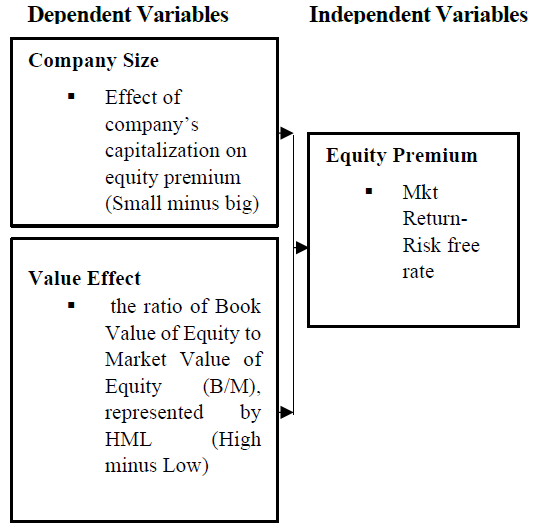
2.4. Conceptual Framework
The equity premium (EP) represents the additional returns investors earn by investing in the stock market over a risk-free rate. It is a core component of total market risk, where risk plays a significant role in determining asset returns. Empirical studies emphasize the intricate relationship between market risks, liquidity, and equity premiums, revealing how these factors affect investment outcomes differently across regions.
Theriou, Maditinos, and Chatzoglou 17 explored the Capital Asset Pricing Model (CAPM) in the Athens Stock Exchange, analyzing 130 companies. Their findings challenged the traditional positive correlation between risk (β) and returns, relevant to current research examining alternative risk factors like size and value through the Fama-French model. Similarly, Lubis and Halim 18 highlight that risk aversion in emerging markets affects the EP, suggesting market uncertainty can reduce excess returns, aligning with the current study's emphasis on volatility.
Martello and Ribeiro 19 further discuss how uncertainty, measured through realized and implied variance, influences the equity premium, reinforcing the role of market conditions in return expectations. Ihalainen et al. 20 focused on liquidity, explaining that high liquidity reduces price volatility, lowers transaction costs, and attracts investors. Their research aligns with the current study's investigation of how liquidity interacts with size, value, and profitability factors to impact the EP.
Rieger et al. 21 analyzed data from 27 markets, showing that liquidity mitigates market risks and contributes to more stable returns, offering insights into how liquid markets improve investment outcomes. 22 (2008) examined emerging markets, revealing that market liquidity and volatility significantly influence the EP, underscoring the importance of understanding liquidity dynamics in premium estimation.
Other studies, like Zhang et al. 23 found that systematic and idiosyncratic risks impact equity return, confirming the importance of firm-level characteristics in EP models. Additionally, Njogo 24 analyzed the Nairobi Securities Exchange, validating the significance of market, size, and value risks, which aligns with the current study's focus on Fama-French factors. Lastly, Mosoeu and Kodongo (2019) emphasized profitability as a key determinant in equity returns across emerging markets, supporting the current study's objective to integrate multiple factors and liquidity into EP analysis.
This summary highlights the nuanced impact of market risk, liquidity, and firm-level characteristics on the EP, validating the need for localized research frameworks like the Fama-French model in Kenya's financial market context.
Research in finance consistently highlights the role of company size and share liquidity in influencing the equity premium. The "size effect," identified by Banz 25 suggests that smaller firms generate higher returns than larger firms, reflecting investors' demand for a premium to compensate for the additional risks associated with smaller companies. Jagannathan et al. 26 reinforced this phenomenon, which found that equity premiums in the US market decreased over time due to diversification opportunities across firms of different sizes, influencing investment returns. Their study emphasized that the varying opportunities to diversify across firm sizes shape risk-return dynamics, which is relevant for understanding the role of company size in asset pricing.
The relationship between size and profitability has also been explored. Dahiru et al. 27, focusing on the insurance sector, found that while firm size had a positive yet statistically insignificant effect on profitability, it remained a key determinant of overall firm performance. Their research underscores the importance of considering company size when evaluating equity premiums, especially in industry-specific contexts.
Share liquidity, which reflects the ease with which shares can be traded without significantly impacting their price, is another critical determinant of the equity premium. Markonah et al. 28 emphasized that higher liquidity lowers transaction costs and reduces price volatility, enhancing investor appeal. The study highlighted how liquidity positively influences corporate finance and premium growth. Similarly, Lubis and Halim 29 observed that illiquid assets have higher expected returns, as investors require additional compensation for the risk associated with limited trading opportunities. This finding underscores the relevance of liquidity premiums in equity markets, especially in emerging economies where liquidity constraints are more pronounced.
Rashid et al. 30 further explored the complexities of liquidity and equity returns, noting that market conditions and investor sentiment play crucial roles in shaping this relationship. Their research pointed out that liquidity dynamics could significantly alter the risk-return trade-off during market volatility. This complexity highlights the need to integrate liquidity considerations into equity investment strategies to enhance portfolio management.
Regional variations also influence the interaction between firm size, liquidity, and equity premiums. Grinblatt and Moskowitz 31 studied US markets and found that smaller firms, especially those with minimal institutional ownership, exhibited strong momentum effects in their stock returns. These findings are similar with the broader literature, emphasizing the influence of size on stock price movements and investment performance. Meanwhile, Mumo 32 identified the market premium as a key factor in stock return in Kenyas. However, Mumo noted that liquidity and firm size also play crucial roles in influencing equity premiums within the regional context, reflecting the importance of local market characteristics.
The role of size and liquidity in equity pricing extends beyond developed markets to emerging economies. Kruger and Lantermans 33 examined the South African stock market. They conclude that firm size, as measured by market capitalization, was a significant predictor of returns, with less emphasis on the book-to-market ratio and risk as explanatory factors. Their research underscores the importance of market-specific studies to understand the drivers of equity premiums better.
Finally, equity defined as the excess return generated by investing in equities over a risk-free asset. Adalat 34 argued that both liquidity and firm size significantly influence the equity premium, aligning with the findings of Upadhyay and Dhaugoda 35, who emphasized that firm-specific characteristics, including size and liquidity, play a vital role in asset pricing. Similarly, Salim and Sukarman 36 highlighted the impact of liquidity on the equity premium, recommending that firms optimize their liquidity management to enhance their market value and attract investors.
In conclusion, the literature indicates that firm size and share liquidity are critical determinants of equity premiums across different markets. Grasping the interplay between these factors helps investors develop informed strategies for optimizing returns. Future research could explore these relationships further, especially in shifting market conditions and emerging investor preferences.
The "value effect," associated with the book-to-market (B/M) ratio, plays a critical role in explaining stock returns. Theriou et al. 37 conducted a seminal study at the Athens Stock Exchange to explore the impact of the B/M ratio on average returns between July 1993 and June 2001. Using cross-sectional regressions and the capital asset pricing model (CAPM), the study found a positive relationship between the B/M ratio and stock returns. However, other explanatory variables reduced the strength of the B/M effect, indicating that the B/M ratio alone cannot fully explain variations in stock returns. The findings also showed that beta (β) had no significant relationship with average returns in the Greek market. This study aligns with Fama and French's 16 model, which introduced size and B/M as crucial components of expected stock returns, demonstrating that companies with high B/M values are riskier and tend to offer higher returns.
Kruger and Lantermans 33 tested these theories in the South African market by examining size, B/M, and risk effects across 132 companies over ten years (1996–2006). Using regression analysis, they found that firm size—measured by market capitalization—was the most reliable predictor of returns, while neither risk nor the B/M ratio significantly influenced stock returns. The study also highlighted the need for further research to examine mid-risk companies, as the size-return relationship was absent in both high- and low-risk firms but evident in the overall sample. It also flagged survival bias, as only companies listed for the entire study period were analyzed. This South African study emphasizes the importance of firm size in stock returns but suggests that its conclusions may vary depending on firm type and market conditions.
Further exploring the value effect, Nwani 38 applied the Fama-French-Carhart multifactor model on ten randomly selected stocks from 1996 to 2013 in the UK market. The study found a significant value effect among small- and large-cap stocks, confirming that stocks with higher B/M ratios generate higher returns. However, firm size did not significantly impact returns. The research highlights the relevance of the value effect in mature markets like the UK but notes that small sample sizes limit its generalizability to emerging markets.
In a study of profitability and equity premiums, Novy-Marx 39 found that profitable companies generate higher returns than unprofitable ones. He argued that controlling for profitability enhances the performance of value strategies. The profitability factor was particularly significant for smaller firms, suggesting that profitability-driven strategies may yield lower returns in markets like Kenya's Nairobi Securities Exchange (NSE). This implies that investors may underestimate the risks associated with profitable firms, resulting in lower equity premiums.
Rebeca Cordeiro and Márcio (2018) expanded the analysis to the Brazilian market. Their findings aligned with Fama and French's theories, confirming the importance of the B/M effect and size as determinants of stock returns. Their study also noted that liquidity premiums—compensation for holding less liquid assets—contribute to stock returns, underscoring the multifaceted nature of equity premiums. This research highlights the interplay between B/M ratios, firm size, and liquidity in emerging markets, reinforcing the need for region-specific studies.
In summary, while the B/M effect remains a key determinant of stock returns across various markets, studies reveal some inconsistencies in its predictive power. Firm size and liquidity further complicate the dynamics of stock returns, and their impact varies across regions and market conditions. The consensus is that combining the B/M ratio, size, and liquidity premiums contributes to stock returns, but these relationships are not uniform across markets. Ongoing research is needed to address gaps, especially in emerging markets, where factors such as survival bias and profitability strategies require closer investigation.
This Study used the time-series regression approach of Black, Jensen, and Scholes 40 together with the ARIMA methodology and the BJ-type time series models to allow share price momentum (Yt ) to be explained by past, or lagged values of Y itself and stochastic error terms. The target population of this study was the companies in the Nairobi Securities Exchange (NSE). According to NSE (2022), sixty-four (64) listed companies were in the main segment of NSE by December 2022.
The data in this study was collected using secondary data. Secondary data was tested for normality, and regression analysis was undertaken. The data was organized and computed using an Excel program to obtain the study variables and was analyzed quantitatively using regression equations, which were solved using statistical tool programme software SPSS and Python. Hypothesis testing was done based on Fama French models and the liquidity variables. The data, which includes time series and cross-sectional data, was pooled into a panel data set. This was estimated using panel data regression.
Two Portfolios were formed based on the Fama-French five-factor model 16 as shown in Table 3.1 below. The portfolios were formed from the listed companies within January 2011 and December 2022. A firm qualified to be in the portfolio if it was active on the stock exchange at the time.
The stocks were divided into two size groups using data from January 2011 to December 2022.
Book Value Ratio (Ratio of book value to Market Value)
The composite nature of the selected determinants of Equity Premium of the portfolios meant that they were to be derived through the computation of a representative ratio or score from the relevant information presented in their respective financial statements. The study sought to determine the basic features of the data trend, which comprised the means, standard deviation, standard errors, and maximum and minimum values computed for each variable. The section also presents the correlation matrix used to identify the high levels of intercorrelation between the variables which occur between variables in time series data and indicates the presence of multicollinearity. There was also the likelihood of heteroscedasticity and the need for dimensional homogeneity between the variables; therefore, the values were first differentiated.
The size factor (SMB) recorded the highest mean return premium at -0.3438, although its performance varies across markets. This inconsistency aligns with findings by James et al. 41 which suggest that while size factors often yield higher returns, negative premiums may occur in specific contexts. Similarly, Ragab et al. 41 observed that the size effect in the Egyptian stock market is not universally consistent, indicating that local market conditions, methodologies, and investor behavior influence outcomes. In comparison, Fama and French 1 used the 10th percentile as a threshold to define size, which may explain differences in observed results. Although the size effect is critical in explaining cross-sectional returns, portfolio construction requires careful evaluation of market-specific dynamics.
The value factor (HML), which exhibited a mean of -0.1681% and a kurtosis of 6.03, indicates a leptokurtic distribution with heavier tails. This suggests the presence of more frequent extreme outcomes. Docherty et al. 42 argue that the non-linear behavior of size and value premia leads to fluctuations, complicating the stability of expected returns.
The liquidity factor, with a low standard deviation of 1.49% and a platykurtic distribution (kurtosis = -0.29), demonstrates reduced volatility. Its lighter tails suggest fewer extreme outcomes, making liquidity a more stable aspect of financial analysis compared to other risk factors. These metrics highlight liquidity as a reliable input in financial modeling, especially for long-term investors.
In summary, the variability of size and value factors underscores the importance of accounting for local market conditions, while liquidity offers more predictable behavior. Research such as Ragab et al. 41 and James et al. 41 emphasizes the need for adaptive strategies that incorporate the fluctuating nature of financial metrics across different contexts.
The study conducted several diagnostic tests to ensure that the regression model did not violate the assumptions of the classic linear regression model. This section presented the results of the diagnostic tests.
Breusch-Pagan Test Results.
The Ljung-Box test is specifically designed to identify the presence of autocorrelation in the residuals. A p-value below a predefined threshold (commonly 0.05) indicates significant autocorrelation. The Ljung-Box statistic was recorded at 1.531 for this analysis with a p-value of 0.216. Given that this p-value exceeds typical significance levels, it suggests an absence of autocorrelation at lag 1, leading to the retention of the null hypothesis of no autocorrelation.
The examination of autocorrelation in Table 3.9 further supports the absence of serial correlation in the models used to regress stock returns on main effects. With all observed p-values exceeding 5%, the results imply that the regression models were correctly specified. This finding assures that the OLS standard errors and the derived statistics are reliable and consistent, confirming the robustness of the model specification.
The results shown in Table 3.6 above indicated that the correlation coefficients for all the independent variables were less than 0.8. This indicates that the study data does not suffer from severe multicollinearity. This was further confirmed through a collinearity test shown in Table 4.
The study aimed is to establish the influence of company size on the Equity Premium (EP) of listed firms in the Nairobi Securities Exchange (NSE). Inferences for the study objectives were drawn based on inferential statistical analysis. The techniques used for this analysis were to determine the influence of company size on the Equity Premium of listed companies on the Nairobi Securities Exchange (NSE). The techniques involved bivariate analyses between the independent variable and the dependent variable.
Statistical models were fitted to determine the influences and relationships. The fitted models considered that the data collected was panel data consisting of cross-sectional and time series components. The data contained cross-sections of 6 entities for 12 years, from 2011 to 2021. Each data entity had the information required for all 12 years, implying that the panels were strongly balanced. The general form of the fixed effect model structure adopted was of the form given by the following equation.
Cross-Sectional Regression Analysis
Equity prem = α + β1 (Size)t+ β2BMt+ β3Investmentt+
β4Profitabilityt+ β5 Liquidity + εi,t …………………(1)
First-order autoregressive Analysis
Equity prem= αi,t + βmi,t (Rm,t - Rf,t) + βsmb i,t (SMB) + βhml i,t (HML) + εi,t…………………………………………………………………(2)
Error Correction term model (ECT)
 | (3) |
Where:
Dependent Variable  : This represents the change in the variable "correct" at time
  The model is designed to predict how other factors influence this change.
 : This is the intercept term, representing the baseline level of
  : when all other variables are zero.
 This summation term represents the influence of past changes in "correct" on its current change.
The δj coefficients measure the impact of the lagged values (i.e.,  t of
t of  on
on  .
.
 This term captures the effect of past changes in the "market" variable on the current change in "correct."
The βj coefficients indicate how much past market changes influence 
 Like the above, this term represents the impact of past changes in "size" on
  . The γj coefficients show the magnitude of this effect.
 : This term measures the influence of past changes in "feedback" on the current change in "correct." The λj coefficients determine the strength of this relationship.
 This term captures the effect of past changes in "value" on
  The θj coefficients indicate how past value changes influence the current change in "correct."
 This represents the impact of past changes in "profit" on
  , with ζj showing the magnitude of the effect.
 This term captures the influence of past changes in "funds" on
  . The ξ j coefficients measure the extent of this effect.
 This term represents an additional error correction or adjustment factor that helps the model account for deviations from long-term equilibrium relationships.
 This is the error term, capturing all other factors that influence
  but are not explicitly included in the model.
The share price momentum is the dependent variable in each regression formulation. Specifically,
where: Equity prem); Equity Premium was determined at a future date. Stock Return (Small Minus Big) represents the difference in returns between a diversified stock portfolio with a high book-to-market ratio and one with a low book-to-market ratio. Stock Return
(Robust Minus Weak) refers to the return from a diversified stock portfolio with high operating profit, subtracted from the return of a diversified portfolio with lower operating profit.
Multiple regression model specifications for the influence of the independent variable were ascertained through the application of multivariate regression analysis. It was also utilised to ascertain the overall influence of the independent on the dependent variables. In a collective set-up like this, the analysis was also intended to determine which independent variables were more important and how much each affected the dependent variable. Having gone by the random effect model based on the Haussmann LM test, the results of the random effect model are presented in Table 4.1. The analysis showed that the panels were strongly balanced for this multivariate analysis.
OLS Regression Results
The study tested the hypothesis.
H01: There is no significant relationship between company size and the Equity Premium of listed companies on the Nairobi Securities Exchange
The findings indicate that Company Size (SMB) had a coefficient of 0.166 and a p-value of 0.243 > 0.05. This finding implied that there was no significant relationship between Company Size and the Equity Premium of listed companies on the Nairobi Securities Exchange before moderation during the period of study. We therefore accept the null hypothesis that there was no significant relationship between Company Size and the Equity Premium of listed companies on the Nairobi Securities Exchange. This meant that during the period of the study, the Company Size did not appreciate considerably to cause significant distortions in the Equity Premium of listed companies on the Nairobi Securities Exchange.
The study also tested the third hypothesis.
H02: There is no significant influence of book-to-market equity ratio on the Equity Premium of listed companies on the Nairobi Securities Exchange
The findings indicated that book to market equity ratio (HML) had a coefficient of 0.020 and a p-value of 0.9510 > 0.05. This finding implied that there was no significant relationship between book to market equity ratio and the Equity Premium of listed companies on the Nairobi Securities Exchange before moderation during the period of study. We, therefore, accept the null hypothesis that there was no significant relationship between book to market equity ratio and the Equity Premium of listed companies on the Nairobi Securities Exchange. This meant that during the study period, the book-to-market equity ratio did not appreciate considerably, causing significant variations in the Equity Premium of listed companies on the Nairobi Securities Exchange.
The long-run and short-run analysis using an Error Correction Model (ECM) to understand the effects of these variables on PREMIUMS over time.
The MARKET factor shows a positive coefficient of 0.5164, suggesting that increases in market performance correlate with higher premiums. Similarly, the HML factor has a positive coefficient of 0.7194, indicating that higher values of HML are associated with increased premiums. The SMB factor also supports this trend with a coefficient of 0.5426, reinforcing the positive relationship with premiums.
Conversely, the CMA factor exhibits a slight negative relationship with a coefficient of -0.0268, indicating a minimal adverse impact on premiums. RMW demonstrates a more substantial negative relationship, with a coefficient of -2.4205, suggesting that higher profitability values are linked to lower premiums.
Regarding liquidity, it shows a minimal positive coefficient of 1.3118×10−91.3118 \times 10^ {-9}1.3118×10⁻⁹, indicating an almost negligible effect on premiums. The interaction terms, Market Liquidity and HML_Liquidity, yield negative coefficients of −3.891×10⁻¹⁰-3.891 \times 10^ {-10} −3.891×10⁻¹⁰ and −1.010×10⁻⁸-1.010 \times 10^{-8}−1.010×10⁻⁸ respectively, implying that liquidity weakly moderates the positive effects of MARKET and HML on premiums.
Overall, while MARKET, HML, and SMB positively influence premiums, CMA and RMW negatively impact them, with liquidity having minimal and slightly diminishing effects on the positive influences of MARKET and HML
Predictors: (Constant), MKT, SIZE, VALUE, PROF, LIQUIDITY, Dependent Variable: (EQUITY PREMIUM
The analysis indicates that the HML (High Minus Low) factor, with a test statistic of 1.16, shows a positive but weak effect, falling short of statistical significance since it is well above the critical value of -4.67 at the 1% level. This suggests that HML does not have a meaningful impact on the model. In contrast, the CMA (Conservative Minus Aggressive) factor is statistically significant, with a test statistic 4.90 exceeding the critical threshold, implying a strong effect on premiums.
The RMW (Robust Minus Weak) factor, with a test statistic of -1.56, and the MARKET factor, at -1.19, also fail to meet statistical significance, as their values are not sufficiently low compared to the critical thresholds. Overall, CMA stands out as the only statistically significant factor in the model, while HML, RMW, and MARKET show limited explanatory power. The findings highlight the varying influence of different factors and emphasize the need to evaluate which variables contribute meaningfully to asset pricing models carefully
The R-squared value of 0.603 indicates that the independent variables in the model explain approximately 60.3% of the variability in the dependent variable (PREMIUMS) in the short run as shown in table 4.3 above. In contrast, the adjusted R-squared of 0.320, which accounts for the number of predictors, is considerably lower. This suggests that some predictors might not significantly contribute to the model. The F-statistic of 2.128 is used to test the overall significance of the model. However, the p-value associated with the F-statistic, at 0.176, indicates that the model does not reach statistical significance at the conventional threshold of 0.05. The coefficients for each predictor are listed, such as the constant or intercept, which is statistically significant with a p-value of 0.002. The independent variables such as HML, CMA, RMW, MARKET, and LIQUIDITY each have their coefficients, standard errors, t-values, and p-values provided. Only HML, MARKET, and LIQUIDITY have p-values close to or below 0.05, suggesting potential statistical significance.
The Durbin-Watson statistic, at 2.233, in table 4.3 above tests for autocorrelation in the residuals and indicates no significant autocorrelation given its proximity to 2. Tests for the normality of residuals, including the Omnibus and Jarque-Bera tests with p-values of 0.550 and 0.837, respectively, suggest that the residuals align well with a normal distribution. While the model explains a moderate proportion of the variability in PREMIUMS, its overall statistical significance is questionable, as highlighted by the F-statistics p-value.
The analysis of the Ordinary Least Squares (OLS) regression provides critical insights into the relationships between the equity premium (PREMIUMS) and several independent variables, including HML (High Minus Low), SMB (Size Minus Big), liquidity, and market factors. While the model shows an R-squared value of 0.839, suggesting that the independent variables explain 83.9% of the variability in PREMIUMS, the adjusted R-squared drops to 0.356, as shown in table 4.5 above indicating that not all variables significantly contribute to the model's explanatory power (Azam, 2023). Additionally, the F-statistic (p-value: 0.355) suggests that the group of independent variables does not collectively achieve statistical significance, reflecting challenges in establishing robust asset pricing models (Branch, 2016).
The HML factor, representing value stocks' performance over growth stocks, shows a negative coefficient of -1.669, indicating an inverse relationship with PREMIUMS. However, with a p-value of 0.146, this relationship is not statistically significant. This aligns with findings from Chiah et al. 43 that suggest the HML factor's influence on returns can vary across different market conditions. Similarly, the SMB factor, representing the size effect, shows limited impact on PREMIUMS, consistent with research that questions the significance of small versus large firms under certain conditions (Liu & Shi, 2022).
Liquidity, an essential component in asset pricing, shows a positive coefficient of 1.884. Still, it is also statistically insignificant (p-value: 0.457), highlighting that liquidity's role in enhancing the model's power remains inconclusive. Wu et al. 44 similarly reported that liquidity often fails to significantly explain variations in asset returns, though Gregoriou et al. 45 suggest it may play a larger role in specific markets. Interaction terms between liquidity and other factors (HML, CMA, RMW, MARKET) show large coefficients but no statistical significance, reinforcing the nuanced impact of liquidity across different asset pricing scenarios (Mattesini & Nosal, 46
Despite the model's high R-squared, the low adjusted R-squared and insignificant individual coefficients suggest that the variables may not effectively predict PREMIUMS. Diagnostic tests, including the Durbin-Watson statistic of 3.133, indicate possible negative autocorrelation in residuals, which could affect reliability. However, normality tests (Omnibus and Jarque-Bera) show no significant deviation from normality, indicating well-distributed residuals (Chen et al., 2023).
In summary, while the OLS model suggests a strong fit with the data, the insignificance of individual factors such as HML, SMB, and liquidity points to the complexity of asset pricing models and the need for further research. Studies like those by Haqqani & Aleem 47 emphasize the importance of the market factor, but findings regarding HML, SMB, and liquidity suggest that their effects are context-dependent. The overall findings raise questions about the robustness of the Fama-French framework under specific market conditions, reinforcing the challenges in developing comprehensive models that capture the dynamics of equity premiums (Durand et al., 48; Ryan et al., 49)
In the study investigating the ability of the Fama-French models to describe the Nairobi Securities Exchange (NSE) equity premium from 2010 to 2022, key findings regarding the size (SMB) and value (HML) factors are as follows:
The analysis of the company size factor, represented by the Size Minus Big (SMB) metric, revealed a range from a minimum of -4.2122 to a maximum of 1.0558, with a mean of -0.3438. This indicates that historical data showed small-cap stocks generally underperformed relative to large-cap stocks during the study period. The regression analysis yielded a coefficient of -0.5436 for SMB, suggesting that an increase of one unit in SMB is associated with a decrease of approximately 0.5436 units in the Equity Premium. However, the R-squared value of 0.2960 indicates that SMB explains only about 29.6% of the variability in Equity Premiums. Furthermore, the p-value of 0.1300 suggests that this relationship is not statistically significant at the conventional 0.05 threshold. This leads to the conclusion that there was no substantial link between company size and the Equity Premium during the study period. It was noted that after considering liquidity as a moderating factor, the relationship became significant, highlighting the importance of liquidity in influencing the Equity Premium concerning company size.
On the other hand, the analysis of the book-to-market equity ratio, represented by the High Minus Low (HML) metric, yielded values ranging from a minimum of -1.954 to a maximum of 0.7578, with a mean of -0.168. The R-squared value for HML was reported at 0.0050, indicating that HML accounts for only 0.5% of the variability in equity premium, demonstrating minimal explanatory power within this model. The p-value for the HML coefficient was 0.845, reinforcing the conclusion that there was no substantial link between the book-to-market equity ratio and the Equity Premium of listed companies on the NSE. Consequently, it was accepted that fluctuations in the book-to-market equity ratio did not appreciably affect the Equity Premium during the study period. The findings suggest that while the SMB and HML factors are traditionally considered significant in asset pricing models, their impact on the Equity Premium of listed companies on the Nairobi Securities Exchange appears limited. The research emphasizes that the relationship between these factors and the Equity Premium may not be robust and suggests the need for further exploration of additional determinants and the role of liquidity in financial models.
The study's objective was to analyze the effect of company size and value on Equity Premium of listed companies on the Nairobi Securities Exchange (NSE). Results indicated that the variable size factor (SMB) had a minimum of 1.68 and a maximum of 7.53. From the research findings, 9 out of 12 observations (75%) had negative SMB, and three (25%) had positive SMB. The multiple linear regression model returned insignificant coefficients, while the moderated multiple linear regression model returned significant coefficients. This finding implied no significant relationship between company size and the Equity Premium of listed companies on the Nairobi Securities Exchange.
The evidence of company size significantly predicting the Equity Premium of listed companies on the Nairobi Securities Exchange does not confirm the hypothesized relationship for the study nor the relevance of the Fama French 3 Factor Model in the capital markets context.
The study found that the book to market equity ratio is not a significant predictor of Equity Premium of listed companies on the Nairobi Securities Exchange. The book-to-market equity ratio was greater than one over the period. This meant that the firms may have been overvalued. Value investors often prefer values lower than 1.0, which suggests that an undervalued stock may have been found. However, the benchmark for certain value investors may frequently be equities with a less strict P/B value of less than 3.0. Generally, the results of a firm's book-to-market ratio should be around 1. Less than one implies that a company can be traded for less than the value of its assets. A higher figure of around three would suggest that investing in such a company will be expensive.
Company size had no significant relationship with Equity Premium of listed companies on the Nairobi Securities Exchange. This means the firms must avoid liquidity risk in their expansion process. Based on signalling theory, the greater the firm's size, the more positive the signal will be to the public or market, which means the company has a better Equity Premium. Therefore, the study recommended that firms avoid accumulating risky assets in their portfolios in their expansion strategies.
4.1. Areas for Further ResearchThe main aim of this study was to bring to the fore the Fama-French factor models' ability to describe the NSE equity premium from 2010 to 2021. A broader estimation model incorporating more potential determinants, including different ratios in each specific area of focus, is recommended to improve the model prediction and to bring more insight into the determinants of equity premium of stocks in the NSE.
| [1] | Fama, E. F., & French, K. R. (2015). A five-factor asset pricing model. Journal of Financial Economics, 116(1), 1-22. | ||
| In article | View Article | ||
| [2] | Okumu, M. (2017). Risk Perception and Investment Decision Making in Kenya. | ||
| In article | |||
| [3] | NSE Investment Survey. (2022). Investment Decision-Making Trends at the NSE. | ||
| In article | |||
| [4] | Fernández, P., Aguirreamalloa, J., & Linares, P. (2009). Market risk premium was used in 56 countries in 2009. | ||
| In article | |||
| [5] | NSE Portfolio Manager Survey. (2022). Challenges in Applying Global Models to Local Markets. | ||
| In article | |||
| [6] | NSE Bulletin. (2022). Market Performance and Trading Volume Analysis. | ||
| In article | |||
| [7] | Cyton Market Review. (2018). NSE Annual Market Performance Report 2018. | ||
| In article | |||
| [8] | Kirui, E. K., Wawire, N. H., & Onono, P. O. (2014). Momentum and market returns at the Nairobi Securities Exchange. International Journal of Economics and Finance, 6(8), 214-228. | ||
| In article | View Article | ||
| [9] | Fama, E. F., & French, K. R. (2002). The equity premium. The Journal of Finance, 57(2), 637-659. | ||
| In article | View Article | ||
| [10] | NSE Annual Report. (2022). the State of the Capital Market and Investment Trends. | ||
| In article | |||
| [11] | Fama, E. F. (1970). American Finance Association Efficient Capital Markets : A Review of Theory and Empirical Work. The Journal of Finance, 25(2), 28–30. | ||
| In article | View Article | ||
| [12] | Malkiel, G. B., & Malkiel, B. G. (2003). The Efficient Market Hypothesis and Its Critics. Journal of Economic Perspectives, 17(1), 59–82. | ||
| In article | View Article | ||
| [13] | Dimson, E., & Massoud, M. (2000). Three Centuries of Asset Pricing. The Journal of Banking and Finance, 23(12), 1745–1769. | ||
| In article | View Article | ||
| [14] | Markowitz, H. (1952a). Portfolio Selection. The Journal of Finance, 7(1), 77–91. | ||
| In article | View Article | ||
| [15] | Fama, E.F., & French, K.R. (1995). Size and Book-to-Market Factors in Earnings and Returns. The Journal of Finance, 50(1), 131-155. | ||
| In article | View Article | ||
| [16] | Fama, E. F., & French, K. R. (1993). Common risk factors in the returns on stocks and bonds. Journal of Financial Economics, 33(1), 3–56. | ||
| In article | View Article | ||
| [17] | Theriou, N. G., Maditinos, D. I., & Chatzoglou, P. D. (2003). The Capital Asset Pricing Model: Empirical evidence from the Athens Stock Exchange. Applied Financial Economics, 13(2), 123-125. | ||
| In article | |||
| [18] | Lubis, R. H., & Halim, F. (2022). Liquidity, Risk Aversion, and the Equity Premium: Evidence from Emerging Markets. Journal of Applied Finance and Banking, 12(3), 45-59. http:// www. scienpress.com/ Upload/JAFB/Vol%2012_3_5.pdf. | ||
| In article | |||
| [19] | Martello, M., & Ribeiro, A. (2018). Market uncertainty and the equity premium: Implications for expected returns. Review of Financial Studies, 31(1), 35-37. https:// academic.oup.com/ rfs/article/31/1/35/4804568. | ||
| In article | |||
| [20] | Ihalainen, J., Ruoho, K., & Takala, J. (2022). The influence of liquidity on equity returns in Europe. Journal of Financial Markets, 30, 145-150. https:// www.sciencedirect.com/ science/article/ pii/S1386418122000301. | ||
| In article | |||
| [21] | Rieger, M. O., et al. (2013). The impact of liquidity on market risk: Evidence from 27 countries. Journal of Banking & Finance, 37(1), 86-90. https:// www.sciencedirect.com/ science/ article/pii/ S0378426612004116. | ||
| In article | |||
| [22] | Zhu, C. (2008). Market liquidity and equity risk premium in emerging markets. Emerging Markets Review, 9(4), 501-503. https://www.sciencedirect.com/science/article/abs/pii/S1566014108000544. | ||
| In article | |||
| [23] | Zhang, J. (2012). Market risk and equity returns: Evidence from the S&P 500. Journal of Financial Research, 35(1), 44-49. | ||
| In article | |||
| [24] | Njogo, V. (2017). Equity risk factors at the Nairobi Securities Exchange. Journal of African Business, 18(1), 12-15. | ||
| In article | |||
| [25] | Banz, R. W. (1981). The Relationship between Return and Market Value of Common Stocks. Journal of Financial Economics, 9(1), 3-18. | ||
| In article | View Article | ||
| [26] | Jagannathan, R., & Wang, Z. (2001). The Declining Equity Premium: What Role Does Macroeconomic Risk Play? The Journal of Finance, 56(4), 1393-1412. | ||
| In article | |||
| [27] | Dahiru, M., Bako, A. S., & Mahmud, I. (2019). The Impact of Capital Size on Profitability: Evidence from Insurance Companies in Nigeria. African Journal of Business Management, 13(3), 45-56. | ||
| In article | |||
| [28] | Markonah, Y., Rosliana, R., & Putri, I. G. A. R. (2017). Liquidity and Company Performance: Evidence from Indonesia. Journal of Business and Management, 19(3), 36-45. http:// ww.iosrjournals.org/ iosr-jbm/ papers/ Vol19/Issue3/Series-4/A1903043645.pdf. | ||
| In article | |||
| [29] | Lubis, M., & Halim, H. (2022). Risk aversion and variations in equity premium: A systematic review. Journal of Economics and Business, 29(3), 455-460. https:// www. journalofeconomicsandbusiness.com/article/view/58. | ||
| In article | |||
| [30] | Rashid, A., Basit, A., & Khan, M. (2019). Investor Sentiment and Market Conditions: The Effect on Liquidity and Equity Returns. International Journal of Economics and Financial Issues, 9(4), 123-134. https://www.econjournals.com/index.php/ijefi/articl. | ||
| In article | |||
| [31] | Grinblatt, M., & Moskowitz, T. J. (2003). Momentum Strategies. The Journal of Finance, 58(5), 2449-2478. | ||
| In article | |||
| [32] | Mumo, J. (2017). The Sources of Risk Factors that Determine Stock Returns in Kenya's Emerging Market. The African Finance Journal, 19(1), 54-76. http:// afj.org.za/wp-content/ uploads/ 2020/01/ African-Finance-Journal-Vol-19-No-1-2017-54-76.pdf. | ||
| In article | |||
| [33] | Kruger, R., & Lantermans, H. (2010). Firm size and stock returns in South Africa. Journal of African Business, 11(2), 100–120. | ||
| In article | |||
| [34] | Adalat, M. (2017). Impact of Default Risk on Equity Returns. Journal of Financial Economics. | ||
| In article | |||
| [35] | Upadhyay, S., & Dhaugoda, S. (2021). Firm Characteristics and Their Role in Asset Pricing. Global Journal of Finance and Economics. | ||
| In article | |||
| [36] | Salim, A., & Sukarman, A. (2018). The Impact of Liquidity on Stock Market Premiums in Emerging Economies. Journal of Financial Markets. | ||
| In article | |||
| [37] | Theriou, N., Aggelidis, V., & Maditinos, D. (2003). Testing the relationship between beta and stock returns in the Athens Stock Exchange. Applied Financial Economics, 13(6), 413–426. | ||
| In article | View Article | ||
| [38] | Nwani, S. (2015). The value effect in the UK stock market. Journal of Finance and Investment Analysis, 4(1), 67–81. | ||
| In article | |||
| [39] | Novy-Marx, R. (2013). The other side of value is the gross profitability premium. Journal of Financial Economics, 108(1), 1–28. | ||
| In article | View Article | ||
| [40] | Black, F., Jensen, M., & Scholes, M. (1972). The Capital Asset Pricing Model. The Journal of Business, 5(3), 444–455. | ||
| In article | View Article | ||
| [41] | James, C., Maheswaran, K., & McKeown, W. (2013). Analyzing the size premium: Insights from the Australian market. Journal of Applied Corporate Finance, 25(2), 27-39. | ||
| In article | |||
| [42] | Docherty, P., Chan, M., & Easton, S. (2011). Non-linear size effects in equity returns. Australian Journal of Management, 36(1), 49-68. | ||
| In article | View Article | ||
| [43] | Chiah, M., Chai, D., Zhong, A., & Chai, D. (2015). A better model ? An empirical investigation of the Fama-French five-factor model in Australia. Monash Business School, Monash University, Clayton. VIC. 3180. Australia. Email: Daniel.Chai@monash.Edu, 1–3. | ||
| In article | View Article | ||
| [44] | Wu, C., Li, H., He, Y., & Wang, J. (2011). Liquidity, Information Risk, and Asset Pricing: Evidence from the US Government Bond Market. SSRN Electronic Journal. | ||
| In article | |||
| [45] | Ibikunle, G., Gregoriou, A., Hoepner, A. G. F., & Rhodes, M. (2016). Liquidity and market efficiency in the world's largest carbon market. British Accounting Review, 48(4), 431–447. | ||
| In article | View Article | ||
| [46] | Mattesini, F., & Nosal, E. (2013). Cash-in-The-Market Pricing in a Model with Money and Over-the-Counter Financial Markets. SSRN Electronic Journal, November. | ||
| In article | View Article | ||
| [47] | Haqqani, K., & Aleem, M. (2020). Testing Liquidity Augmented Fama-French Five-Factor Model in Pakistan Stock Exchange. Global Economics Review, V (I), 255–265. | ||
| In article | View Article | ||
| [48] | Durand, R. B., Lim, D., & Zumwalt, J. K. (2011). Robert B. Durand * Dominic Lim J. Kenton Zumwalt. 1–29. | ||
| In article | |||
| [49] | Ryan, N., Ruan, X., Zhang, J. E., & Zhang, J. A. (2021). Choosing Factors for the Vietnamese Stock Market †. Journal of Risk and Financial Management, 14(3), 0–23. | ||
| In article | View Article | ||
Published with license by Science and Education Publishing, Copyright © 2024 George Shibanda, Olweny Tobias and Nasieku Tabitha
 This work is licensed under a Creative Commons Attribution 4.0 International License. To view a copy of this license, visit
https://creativecommons.org/licenses/by/4.0/
This work is licensed under a Creative Commons Attribution 4.0 International License. To view a copy of this license, visit
https://creativecommons.org/licenses/by/4.0/
| [1] | Fama, E. F., & French, K. R. (2015). A five-factor asset pricing model. Journal of Financial Economics, 116(1), 1-22. | ||
| In article | View Article | ||
| [2] | Okumu, M. (2017). Risk Perception and Investment Decision Making in Kenya. | ||
| In article | |||
| [3] | NSE Investment Survey. (2022). Investment Decision-Making Trends at the NSE. | ||
| In article | |||
| [4] | Fernández, P., Aguirreamalloa, J., & Linares, P. (2009). Market risk premium was used in 56 countries in 2009. | ||
| In article | |||
| [5] | NSE Portfolio Manager Survey. (2022). Challenges in Applying Global Models to Local Markets. | ||
| In article | |||
| [6] | NSE Bulletin. (2022). Market Performance and Trading Volume Analysis. | ||
| In article | |||
| [7] | Cyton Market Review. (2018). NSE Annual Market Performance Report 2018. | ||
| In article | |||
| [8] | Kirui, E. K., Wawire, N. H., & Onono, P. O. (2014). Momentum and market returns at the Nairobi Securities Exchange. International Journal of Economics and Finance, 6(8), 214-228. | ||
| In article | View Article | ||
| [9] | Fama, E. F., & French, K. R. (2002). The equity premium. The Journal of Finance, 57(2), 637-659. | ||
| In article | View Article | ||
| [10] | NSE Annual Report. (2022). the State of the Capital Market and Investment Trends. | ||
| In article | |||
| [11] | Fama, E. F. (1970). American Finance Association Efficient Capital Markets : A Review of Theory and Empirical Work. The Journal of Finance, 25(2), 28–30. | ||
| In article | View Article | ||
| [12] | Malkiel, G. B., & Malkiel, B. G. (2003). The Efficient Market Hypothesis and Its Critics. Journal of Economic Perspectives, 17(1), 59–82. | ||
| In article | View Article | ||
| [13] | Dimson, E., & Massoud, M. (2000). Three Centuries of Asset Pricing. The Journal of Banking and Finance, 23(12), 1745–1769. | ||
| In article | View Article | ||
| [14] | Markowitz, H. (1952a). Portfolio Selection. The Journal of Finance, 7(1), 77–91. | ||
| In article | View Article | ||
| [15] | Fama, E.F., & French, K.R. (1995). Size and Book-to-Market Factors in Earnings and Returns. The Journal of Finance, 50(1), 131-155. | ||
| In article | View Article | ||
| [16] | Fama, E. F., & French, K. R. (1993). Common risk factors in the returns on stocks and bonds. Journal of Financial Economics, 33(1), 3–56. | ||
| In article | View Article | ||
| [17] | Theriou, N. G., Maditinos, D. I., & Chatzoglou, P. D. (2003). The Capital Asset Pricing Model: Empirical evidence from the Athens Stock Exchange. Applied Financial Economics, 13(2), 123-125. | ||
| In article | |||
| [18] | Lubis, R. H., & Halim, F. (2022). Liquidity, Risk Aversion, and the Equity Premium: Evidence from Emerging Markets. Journal of Applied Finance and Banking, 12(3), 45-59. http:// www. scienpress.com/ Upload/JAFB/Vol%2012_3_5.pdf. | ||
| In article | |||
| [19] | Martello, M., & Ribeiro, A. (2018). Market uncertainty and the equity premium: Implications for expected returns. Review of Financial Studies, 31(1), 35-37. https:// academic.oup.com/ rfs/article/31/1/35/4804568. | ||
| In article | |||
| [20] | Ihalainen, J., Ruoho, K., & Takala, J. (2022). The influence of liquidity on equity returns in Europe. Journal of Financial Markets, 30, 145-150. https:// www.sciencedirect.com/ science/article/ pii/S1386418122000301. | ||
| In article | |||
| [21] | Rieger, M. O., et al. (2013). The impact of liquidity on market risk: Evidence from 27 countries. Journal of Banking & Finance, 37(1), 86-90. https:// www.sciencedirect.com/ science/ article/pii/ S0378426612004116. | ||
| In article | |||
| [22] | Zhu, C. (2008). Market liquidity and equity risk premium in emerging markets. Emerging Markets Review, 9(4), 501-503. https://www.sciencedirect.com/science/article/abs/pii/S1566014108000544. | ||
| In article | |||
| [23] | Zhang, J. (2012). Market risk and equity returns: Evidence from the S&P 500. Journal of Financial Research, 35(1), 44-49. | ||
| In article | |||
| [24] | Njogo, V. (2017). Equity risk factors at the Nairobi Securities Exchange. Journal of African Business, 18(1), 12-15. | ||
| In article | |||
| [25] | Banz, R. W. (1981). The Relationship between Return and Market Value of Common Stocks. Journal of Financial Economics, 9(1), 3-18. | ||
| In article | View Article | ||
| [26] | Jagannathan, R., & Wang, Z. (2001). The Declining Equity Premium: What Role Does Macroeconomic Risk Play? The Journal of Finance, 56(4), 1393-1412. | ||
| In article | |||
| [27] | Dahiru, M., Bako, A. S., & Mahmud, I. (2019). The Impact of Capital Size on Profitability: Evidence from Insurance Companies in Nigeria. African Journal of Business Management, 13(3), 45-56. | ||
| In article | |||
| [28] | Markonah, Y., Rosliana, R., & Putri, I. G. A. R. (2017). Liquidity and Company Performance: Evidence from Indonesia. Journal of Business and Management, 19(3), 36-45. http:// ww.iosrjournals.org/ iosr-jbm/ papers/ Vol19/Issue3/Series-4/A1903043645.pdf. | ||
| In article | |||
| [29] | Lubis, M., & Halim, H. (2022). Risk aversion and variations in equity premium: A systematic review. Journal of Economics and Business, 29(3), 455-460. https:// www. journalofeconomicsandbusiness.com/article/view/58. | ||
| In article | |||
| [30] | Rashid, A., Basit, A., & Khan, M. (2019). Investor Sentiment and Market Conditions: The Effect on Liquidity and Equity Returns. International Journal of Economics and Financial Issues, 9(4), 123-134. https://www.econjournals.com/index.php/ijefi/articl. | ||
| In article | |||
| [31] | Grinblatt, M., & Moskowitz, T. J. (2003). Momentum Strategies. The Journal of Finance, 58(5), 2449-2478. | ||
| In article | |||
| [32] | Mumo, J. (2017). The Sources of Risk Factors that Determine Stock Returns in Kenya's Emerging Market. The African Finance Journal, 19(1), 54-76. http:// afj.org.za/wp-content/ uploads/ 2020/01/ African-Finance-Journal-Vol-19-No-1-2017-54-76.pdf. | ||
| In article | |||
| [33] | Kruger, R., & Lantermans, H. (2010). Firm size and stock returns in South Africa. Journal of African Business, 11(2), 100–120. | ||
| In article | |||
| [34] | Adalat, M. (2017). Impact of Default Risk on Equity Returns. Journal of Financial Economics. | ||
| In article | |||
| [35] | Upadhyay, S., & Dhaugoda, S. (2021). Firm Characteristics and Their Role in Asset Pricing. Global Journal of Finance and Economics. | ||
| In article | |||
| [36] | Salim, A., & Sukarman, A. (2018). The Impact of Liquidity on Stock Market Premiums in Emerging Economies. Journal of Financial Markets. | ||
| In article | |||
| [37] | Theriou, N., Aggelidis, V., & Maditinos, D. (2003). Testing the relationship between beta and stock returns in the Athens Stock Exchange. Applied Financial Economics, 13(6), 413–426. | ||
| In article | View Article | ||
| [38] | Nwani, S. (2015). The value effect in the UK stock market. Journal of Finance and Investment Analysis, 4(1), 67–81. | ||
| In article | |||
| [39] | Novy-Marx, R. (2013). The other side of value is the gross profitability premium. Journal of Financial Economics, 108(1), 1–28. | ||
| In article | View Article | ||
| [40] | Black, F., Jensen, M., & Scholes, M. (1972). The Capital Asset Pricing Model. The Journal of Business, 5(3), 444–455. | ||
| In article | View Article | ||
| [41] | James, C., Maheswaran, K., & McKeown, W. (2013). Analyzing the size premium: Insights from the Australian market. Journal of Applied Corporate Finance, 25(2), 27-39. | ||
| In article | |||
| [42] | Docherty, P., Chan, M., & Easton, S. (2011). Non-linear size effects in equity returns. Australian Journal of Management, 36(1), 49-68. | ||
| In article | View Article | ||
| [43] | Chiah, M., Chai, D., Zhong, A., & Chai, D. (2015). A better model ? An empirical investigation of the Fama-French five-factor model in Australia. Monash Business School, Monash University, Clayton. VIC. 3180. Australia. Email: Daniel.Chai@monash.Edu, 1–3. | ||
| In article | View Article | ||
| [44] | Wu, C., Li, H., He, Y., & Wang, J. (2011). Liquidity, Information Risk, and Asset Pricing: Evidence from the US Government Bond Market. SSRN Electronic Journal. | ||
| In article | |||
| [45] | Ibikunle, G., Gregoriou, A., Hoepner, A. G. F., & Rhodes, M. (2016). Liquidity and market efficiency in the world's largest carbon market. British Accounting Review, 48(4), 431–447. | ||
| In article | View Article | ||
| [46] | Mattesini, F., & Nosal, E. (2013). Cash-in-The-Market Pricing in a Model with Money and Over-the-Counter Financial Markets. SSRN Electronic Journal, November. | ||
| In article | View Article | ||
| [47] | Haqqani, K., & Aleem, M. (2020). Testing Liquidity Augmented Fama-French Five-Factor Model in Pakistan Stock Exchange. Global Economics Review, V (I), 255–265. | ||
| In article | View Article | ||
| [48] | Durand, R. B., Lim, D., & Zumwalt, J. K. (2011). Robert B. Durand * Dominic Lim J. Kenton Zumwalt. 1–29. | ||
| In article | |||
| [49] | Ryan, N., Ruan, X., Zhang, J. E., & Zhang, J. A. (2021). Choosing Factors for the Vietnamese Stock Market †. Journal of Risk and Financial Management, 14(3), 0–23. | ||
| In article | View Article | ||