Iron extraction generates waste that can impact the chemical quality of water. The aim of this work is to test the effectiveness of potash from different ashes obtained from several plants to remove ferrous ions from groundwater in the canton of Bangeli. Thus, three ashes were obtained respectively from corn cobs, nere wood and soybean stalks. The dry matter taken from porcelain crucibles was calcined at 550°C in an oven for 6 hours. The results showed that ash from corn cobs has a more ferrous ion removal effect. Indeed from a concentration of 2.5 g / L of this ash is obtained a reduction of 95% of the concentration of ferrous ions of treated water after 6 hours of reaction. There is also an increase in the levels of certain minerals such as potassium and sodium in water treated with ash from corn cobs.
Iron is part of the natural composition of many rocks. Along with manganese, it is one of the most abundant metallic elements in nature 1. Iron in water is found in three forms: ferrous iron (Fe2+), ferric iron (Fe3+) and complexed iron (with organic or mineral matter) 2. Iron is an essential element for the proper functioning of the body: it is involved in the formation of hemoglobin, a protein responsible for transporting oxygen in the blood. On average, the body needs about 10 mg of iron per day. It is an essential element in human and animal nutrition 3. The World Health Organization since 2017 recommends a maximum value of 0.3 mg of iron per liter of water. Beyond this norm, iron can not only be harmful to health, but could also cause brownish or reddish discoloration of water and leave stains on laundry 4. Excessive iron intake in humans can lead to poor regulation of its absorption by the intestine (hemochromatosis) and even cause liver cancerization. The ubiquity of iron in the waters is due to its abundance in the earth's crust. There is also a spread due to corrosion of ferrous materials. The presence of iron in natural springs is due to the decomposition of iron-composed rocks and materials; also, acidic water from mine drainage, leaching water from controlled landfills, sewage effluents and discharges from industrial sectors that treat iron 4, 5. In the prefecture of Bassar, about 385 km northwest of Lomé and particularly in the canton of Bangeli, the population uses water from boreholes and ponds for the supply of drinking water. Most of these waters have iron levels ranging from 3.62 ± 1.85 mg/L to 6.47 ± 0.91 mg/L 6. These values exceed the WHO guideline value for iron content in drinking water (0.3 mg/L is the maximum permissible value in 2017). However, no treatment is planned to improve the quality of these waters and this situation could induce haemochromatosis and liver cancer problems in consumers of these waters. These waters therefore require treatment by iron removal before consumption.
There are several methods for treating water polluted with metal cations 3. The most used are: chemical oxidation by oxidants of varying strength (chlorine, potassium permanganate, oxygen, ozone) and biological processes involving microorganisms 4; ion exchange, electrolysis, membrane processes and adsorption 7 or even activated carbon. Unfortunately, although these processes give good yields are not used in rural areas because of their high cost and the toxicity of the products used. The majority of peasant populations have low incomes and also lack adequate training for the use of these chemicals in the canton of Bangeli.
In this context, we have developed a method of removing iron from groundwater by oxidation with potash from the ashes of local materials in the canton of Bangeli coupled with simple aeration. The choice of this method is based on the cost and accessibility of these local materials.
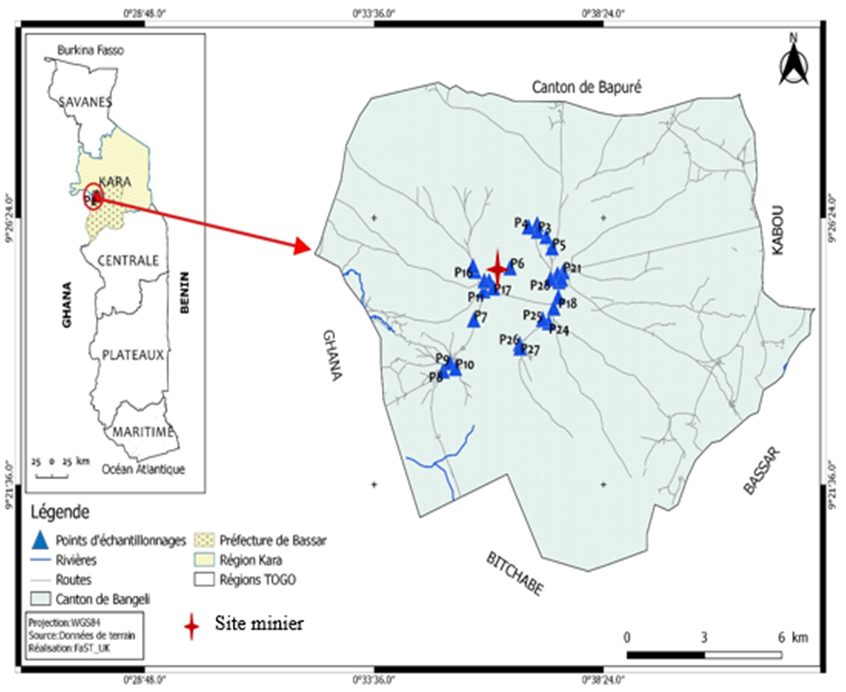
Bassar Prefecture is located in northwestern Togo precisely southwest of the Kara region. It covers an area of 3620 km2. Bangeli is a commune Bassar 2 (former canton of Bangeli) in Bassar prefecture and located about 36 km west of the city of Bassar (Figure 1). It is located between 09° 42 min 19 ́ north latitude and 0° 62 min 43 ́ east longitude. This municipality is home to rich deposits of iron ore in the form of hematites that allowed a vast iron production industry to develop there from the beginning of the Iron Age 8. The Bangeli iron mine is operated by MM Mining SA on the basis of an investment agreement of 7 August 2006 with the Togolese State. Mining activities could cover an area of about 3708 km² in the Buem structural unit and about 11621 km² in the Atakora structural unit. The reserve is estimated at 500 million tons and is located at a depth of about 10 to 30 meters from the ground surface. Iron ore is mainly concentrated over a length of 50 km at the Bangeli hill with iron proportions varying between 35 and 55% 9. The region enjoys a tropical Guinean climate with two seasons: a dry season dominated by the northern trade winds (the harmattan) which lasts from October to April and a rainy season dominated by the southern trade winds (the monsoon) which lasts from April to October. Annual thermal averages range from 26.4°C to 28.3°C and average annual precipitation varies between 1000 and 1800 mm.

To determine the general quality in relation to iron, a sampling campaign was carried out. Water samples were taken with polyethylene bottles from twenty-nine (29) boreholes in the township in April 2021 and packaged at 4°C in a cooler containing 10.
2.3. Field ParametersParameters such as pH, electrical conductivity and temperature were determined in situ. The determination of conductivity is carried out by means of a conductivity meter coupled to a thermometer brand ELMETRON type CC - 411. The pH is determined using a Sartorius pH meter. Total iron was determined in the laboratory using a GENESYS 10S UV-VIS brand molecular absorption spectrophotometer using the 1,10-orthophenantroline method 11.
2.4. Ash QualityTo determine ash quality, samples underwent mineralization by nitric acid etching. It is carried out in a closed environment and hot (150°C). For 1g of sample, 4 mL of nitric acid and 10 mL of hydrogen peroxide (H2O2) at 9% are required 12. The analyses of iron and major ions (Ca2+, Mg2+, Na+ and K+) on mineralization, raw water and treated water are carried out using an iCE 3000 SERIES THERMO FISCHER flame+ atomic absorption spectrophotometer (AAS) after acidification and filtration on a 0.45 μm filter.
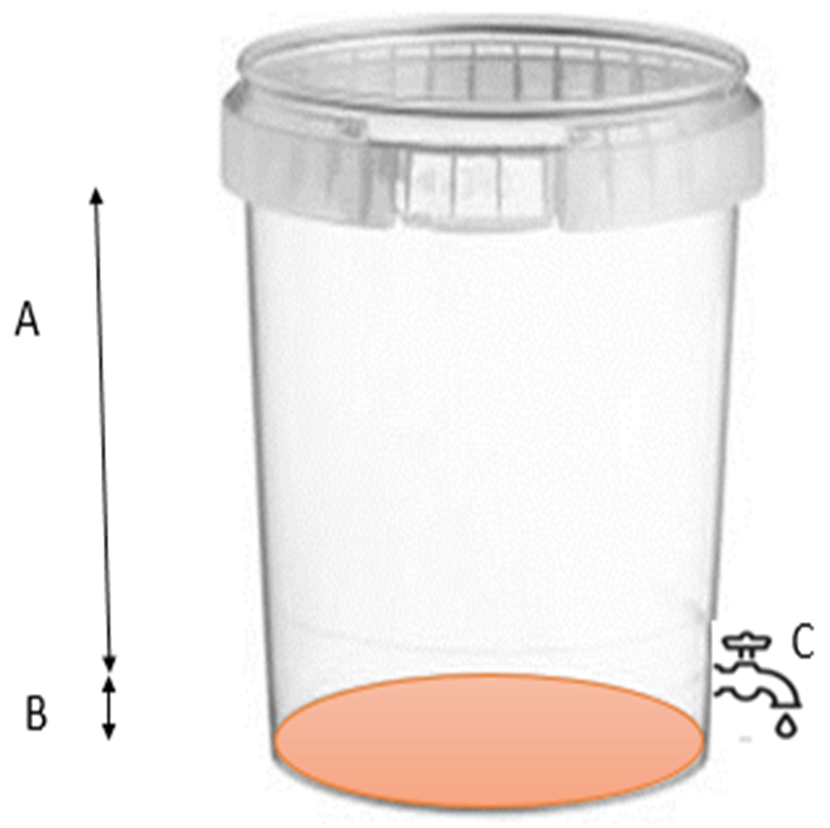
2.5. Experimental Set-UpA technique for removing iron by potash from ash from corn cobs, soybeans and nere coupled with aeration (Figure 2). This technology is a simple iron removal system designed for households, it is similar to the one used for the hand wash device. The system consists of a precipitation unit and a tap to separate drinking water from sedimenting flocs. Potash resulting from ash converts soluble iron salts into insoluble goethite (FeOOH) or ferrihydrite 7, 13, 14. The equations of reactions are written:
 | (1) |
 | (2) |

The iron-rich groundwater is mixed with the potashes of the various ashes respectively by shaking with a rod for about 1 min. The device is kept open so that the water remains in contact with the air to promote oxidation. A tap separates the treated water and flocs. Once the water is separated from these flocs, the deposit of the system which is groundwater from Bangeli washed if necessary is emptied and treatment resumes (Figure 2).
Laboratory tests were first conducted on synthetic waters with iron concentrations of 3 mg/L and 12 mg/L. For the practical phase, a groundwater sample of 5.5 mg/L concentration was used for the iron removal test (sample with a higher total iron concentration during the campaign).
Potash is obtained by dissolving 3 g of each ash in 1 L of distilled water for the experimental phase and with drinking water for the practical phase. Data processing is carried out by Excel 2016 and OriginPro 2021.
The results of the determination of the concentration of metal ions, namely: K+, Na+, Ca2+, Mg2+ and Fe2+ in ash are given in Table 1.
Compared to the results of Table 1, we see on the first hand that calcium and potassium are the major elements in all samples 210.62 ± 2 g/kg; 165.12 ± 2 g/kg and 219.92 ± 2 g/kg for calcium and 146.85 ± 2 g/kg; 162.35 ± 2 g/kg; 126.72 ± 2 g/kg for potassium in soybean stalks, corn cob and nere wood respectively. Iron is the weakest element in these ashes; The values are respectively in the same order: 0.011 ± 0.001 g/kg; 0.014 ± 0.001 g/kg and 0.006 ± 0.001 g/kg. On the other hand, sodium levels are very low compared to those of potassium (Table 1).
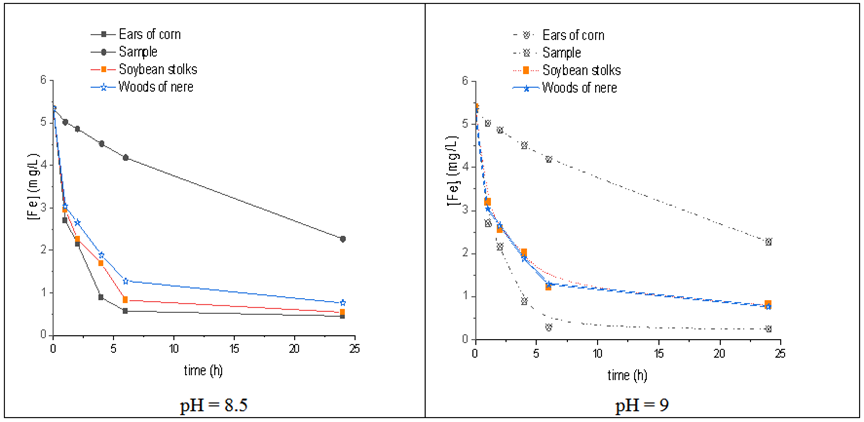
The iron content and pH of water after iron oxidation and precipitation are shown in Figure 3. The WHO guideline value for total iron is 0.3 mg/L and for pH is in the range 6.5 to 9 15. As shown in Figure 3, the decrease of iron concentration changes with pH. Indeed, the higher the pH, the more important will be the removal of iron regardless of the type of potash used. Removal is optimal for pH = 9 and is better for potash obtained from corn cob ash but lower than potash from cornwood ash and soybean stalks; these results are consistent with those of 4, 16, 17. Indeed, these authors have shown that the elimination of metal ions in solution increases with pH.

According to Figure 3, the iron content of the water decreases with the settling time. The elimination of iron is maximum after a settling time of 6 hours. Beyond 6 hours, the concentration of iron remains almost constant. From that moment, the iron content decreased from 5.5 mg/L to 0.26 mg/L with a pH = 9 for potash obtained from the ashes of corn cobs. So after 6 hours of precipitation, the total iron concentration in our water is below the drinking limit. This gradual decrease in iron content in water is explained by the formation of iron hydroxide precipitates. Water treated with potash from corn cobs ash meets WHO guidelines for total iron. But for the other ash used, even after 24 hours, the iron concentration is still above the WHO guideline value. The low removal of iron by potash obtained from the ashes of nere wood and soybean stalks means that the reduction in iron concentration would not only be related to the potash introduced but rather to the oxidation by oxygen of the air. Indeed, the work of 4, 7 have shown that oxygen in the air can oxidize dissolved iron and precipitate it. But this oxidation is better in basic medium; this explains the small reduction in iron content in the raw sample. For further analysis, we will consider the ash of the corn cobs as the best for iron removal and pH = 9 as the optimal pH for better removal. The pH of the different prepared potashes is shown in Figure 4.
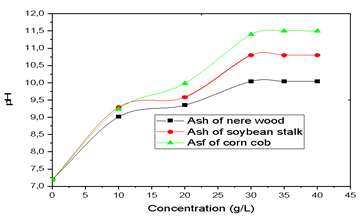
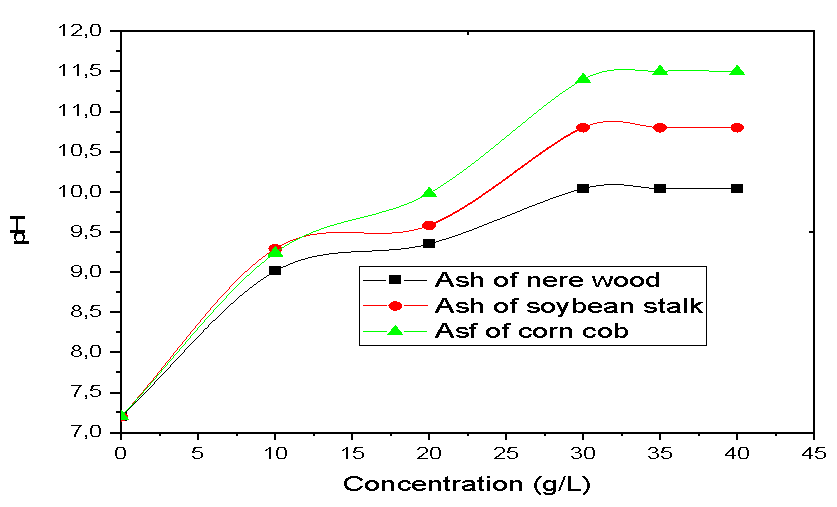
The Figure 4 shows that for the same mass of ash from different materials in the same volume of water, the pH value varies. The pH is higher for ash obtained from corn cobs; followed respectively by the ash of the soybean stems and finally the wood of the nere. It can be seen that from a certain concentration of ash of the materials used, the pH no longer evolves. A saturation concentration has been reached. The pH limit for prepared potash is 11.4 for ash obtained from corn cobs; 10.8 for ash from soybean stalks and 10.4 for ash obtained from wood from nere. Analyses performed on raw and treated water are shown in Table 2.
The Table 2 presents the mineral content of the treated water according to the types of ash used for treatment. Analysis of the results in Table 2 shows that water treatment from potash from this ash increases the sodium (Na+) and potassium (K+) ion content in the water. Values increased from 20.86 ± 0.3 m g/L to 21.42 ± 0.3 mg/L on average for sodium and from 3.23 ± 0.5 mg/L to 345.28 ± 0.5 mg/L for potassium. The increase in potassium is explained by the fact that it is the most important ion in the ashes; moreover, it appears as a spectator ion in the oxidation reaction of ferrous ions. However, this treatment results in a decrease in calcium (from 38.81 ± 0.3 mg/L to 1.36 ± 0.3 mg/L ) and magnesium (from 17.67 ± 0.3 mg/L to 10.91 ± 0.4 mg/L); the same applies to total iron content (5.50 ± 0.1 mg/L to 0.28 ± 0.1 mg/L) and total hardness (TH). Calcium and magnesium ions would therefore have an affinity for hydroxide ions, thus causing their precipitation; this would explain the decrease in the levels of these ions in the treated water. There is also an increase in the conductivity of the treated water (from 1095 ± 2 μS/cm to 2003 ± 2 μS/cm in water treated with potash from corn cob ash). This increase would be related to the increase in potassium ions. On the other hand, according to a survey conducted in the commune, the ash of nere is much more used by the indigenous populations of Bangeli for the production of the base (soda) in cooking; this preference would be related to the presence of potassium ions in lower quantities compared to other ashes. We also note the availability of corn cobs in the commune of Bangeli in quantity and in all seasons because this commune is an agricultural area; we therefore propose this biomass as the best suited for the removal of iron from groundwater.
The decrease in the iron content in the raw water without the addition of the prepared potash is explained by aerobic oxidation of iron; indeed, the ferrous ion in the presence of oxygen in the air gradually oxidizes to iron oxide II which also precipitates. These results are in agreement with those of other researchers such as 18. These researchers have shown that in the presence of oxygen in the air, ferrous ions oxidize to give iron oxide precipitates. This oxidation is better at basic pH 7, 19.
The technology for removing iron present in solution from groundwater developed by this study is a suitable method in rural areas. Corn cobs are the best biomass to remove iron to the acceptable value. With a concentration of 2.5 g/L, ash from this biomass was able to reduce the iron concentration from 5.5 mg/L to 0.28 mg/L; however, the pH of the treated water meets the WHO guideline value. During this work, we have seen that there is an increase in potassium and sodium ions. On the other hand, there has been a decrease in calcium and magnesium ions. This technique has advantages such as simplicity in its application, low cost, increase of elements like sodium and potassium. We plan to reduce the potassium content in our future work because the value obtained exceeds the WHO guideline for potassium.
The authors thank Kara University, the Faculty of Science and Technology as well as the Laboratory of Organic Chemistry and Environmental Science for the training, the support and the accompaniment.
| [1] | J. Margat, “Exploitations et utilisations des eaux souterraines dans le monde”, Coédition UNESCO BRGM 52p, 2008. | ||
| In article | |||
| [2] | Olivier Atteia (2005), Chimie et pollutions des eaux souterraines, Editions TEC et DOC, 398 p. | ||
| In article | |||
| [3] | Andrès Y., F.-B. Catherine, C. GÉRENTE, et P. LE CLOIREC, “Elimination des ions métalliques et des métalloïdes dans l’eau”, 2007. | ||
| In article | View Article | ||
| [4] | Ruiti M., “Elimination du fer par procédés d’oxydation et d’adsorption sur charbon de pin d’alep [Elimination of iron by processes of oxidation and by adsorption on coal of pine]”, Int. J. Innov. Appl. Stud., vol. 10, p. 694700, févr. 2015. | ||
| In article | |||
| [5] | Hamiroune N., “Etude comparative de la capacité d’élimination des métaux lourds dissouts dans l’eau par les poudres de coquilles d’oeufs et de Kaolin.”, PhD Thesis, univercité de jijel, 2013. | ||
| In article | |||
| [6] | Akpaki O., B. Ouadja, G. Baba (2019). “Impact of mining and agricultural activities on water chemical quality of the volta basin in togo over 2015 – 2017”, Modern and Traditional Methods of Water Resource Management in Africa; May 5-6 2019-Durban, South Africa; Cuvillier Verlag Göttingen, 85-95. | ||
| In article | |||
| [7] | Das B.et al., “Removal of iron from groundwater by ash: A systematic study of a traditional method”, J. Hazard. Mater., vol. 141, no 3, p. 834841, mars 2007. | ||
| In article | View Article PubMed | ||
| [8] | de Barros P. L., L. Iles, L. D. Frame, et D. Killick, “The Early Iron Metallurgy of Bassar, Togo: furnaces, metallurgical remains and iron objects”, Azania Archaeol. Res. Afr., vol. 55, no 1, p. 343, 2020. | ||
| In article | View Article | ||
| [9] | Tchanadema M., M. AYAH, T. KODOM, P. NAMBO, L. M. BAWA, et G. DJANEYE-BOUNDJOU, “Risks of chemical pollution on the environment by solid mine waste at the semi-industrial iron mining site in Bandjeli, Togo”, 2021. | ||
| In article | |||
| [10] | Jean Rodier 2009. Water Analysis Document, 9th edition. Dunod Paris, 1959 | ||
| In article | |||
| [11] | Jeffery G.H., J. Basset, J. Mendham, R.C. Denney, Vogel's Textbook of Quantitative Chemical Analysis, fifth ed., Longman Scientific & Technical, New York, 1989, p. 691. | ||
| In article | |||
| [12] | Ecole des Mines de Saint-Etienne, 2008. Spectrometric methods of analysis and characterization: Atomic Absorption Spectrometry Axis “Process Engineering “, Spin Center, 43p. | ||
| In article | |||
| [13] | Houben G. J., “Iron oxide incrustations in wells. Part 1: genesis, mineralogy and geochemistry”, Appl. Geochem., vol. 18, no 6, p. 927-939, 2003. | ||
| In article | View Article | ||
| [14] | Komnitsas K., Bartzas, G., & Paspaliaris, I. (2004). Efficiency of limestone and red mud barriers: Laboratory column studies. Minerals engineering, 17(2), 183-194. | ||
| In article | View Article | ||
| [15] | “Normes de l’OMS sur l’eau potable”. https://www.lenntech.fr/applications/potable/normes/normes-oms-eau-potable.htm (consulté le 2 septembre 2021). | ||
| In article | |||
| [16] | Iqbal J., Y. Nazzal, F. Howari, C. Xavier, et A. Yousef, “Hydrochemical processes determining the groundwater quality for irrigation use in an arid environment: The case of Liwa Aquifer, Abu Dhabi, United Arab Emirates”, Groundw. Sustain. Dev., vol. 7, p. 212219, 2018. | ||
| In article | View Article | ||
| [17] | CHARLES P., “Elimination catalytique du fer et du manganèse pour la production d’eau potable”, Etude Financ. Par Agence Eau Seine Normandie Rapp. Final SUEZ Environ. Octobre, 2008. | ||
| In article | |||
| [18] | Lanciné G. D., K. Bamory, L. Raymond, S. Jean-Luc, B. Christelle, et B. Jean, “Coagulation-Flocculation treatment of a tropical surface water with alum for dissolved organic matter (DOM) removal: Influence of alum dose and pH adjustment”, J Int Env. Appl Sci, vol. 3, no 4, p. 247-257, 2008. | ||
| In article | |||
| [19] | Bordoloi S., S. K. Nath, S. Gogoi, et R. K. Dutta, “Arsenic and iron removal from groundwater by oxidation-coagulation at optimized pH: Laboratory and field studies”, J. Hazard. Mater., vol. 260, p. 618626, 2013. | ||
| In article | View Article PubMed | ||
Published with license by Science and Education Publishing, Copyright © 2023 Bouwèdèo Toi Bissang, Ogouvidé Akpaki and Gnon Baba
 This work is licensed under a Creative Commons Attribution 4.0 International License. To view a copy of this license, visit
http://creativecommons.org/licenses/by/4.0/
This work is licensed under a Creative Commons Attribution 4.0 International License. To view a copy of this license, visit
http://creativecommons.org/licenses/by/4.0/
| [1] | J. Margat, “Exploitations et utilisations des eaux souterraines dans le monde”, Coédition UNESCO BRGM 52p, 2008. | ||
| In article | |||
| [2] | Olivier Atteia (2005), Chimie et pollutions des eaux souterraines, Editions TEC et DOC, 398 p. | ||
| In article | |||
| [3] | Andrès Y., F.-B. Catherine, C. GÉRENTE, et P. LE CLOIREC, “Elimination des ions métalliques et des métalloïdes dans l’eau”, 2007. | ||
| In article | View Article | ||
| [4] | Ruiti M., “Elimination du fer par procédés d’oxydation et d’adsorption sur charbon de pin d’alep [Elimination of iron by processes of oxidation and by adsorption on coal of pine]”, Int. J. Innov. Appl. Stud., vol. 10, p. 694700, févr. 2015. | ||
| In article | |||
| [5] | Hamiroune N., “Etude comparative de la capacité d’élimination des métaux lourds dissouts dans l’eau par les poudres de coquilles d’oeufs et de Kaolin.”, PhD Thesis, univercité de jijel, 2013. | ||
| In article | |||
| [6] | Akpaki O., B. Ouadja, G. Baba (2019). “Impact of mining and agricultural activities on water chemical quality of the volta basin in togo over 2015 – 2017”, Modern and Traditional Methods of Water Resource Management in Africa; May 5-6 2019-Durban, South Africa; Cuvillier Verlag Göttingen, 85-95. | ||
| In article | |||
| [7] | Das B.et al., “Removal of iron from groundwater by ash: A systematic study of a traditional method”, J. Hazard. Mater., vol. 141, no 3, p. 834841, mars 2007. | ||
| In article | View Article PubMed | ||
| [8] | de Barros P. L., L. Iles, L. D. Frame, et D. Killick, “The Early Iron Metallurgy of Bassar, Togo: furnaces, metallurgical remains and iron objects”, Azania Archaeol. Res. Afr., vol. 55, no 1, p. 343, 2020. | ||
| In article | View Article | ||
| [9] | Tchanadema M., M. AYAH, T. KODOM, P. NAMBO, L. M. BAWA, et G. DJANEYE-BOUNDJOU, “Risks of chemical pollution on the environment by solid mine waste at the semi-industrial iron mining site in Bandjeli, Togo”, 2021. | ||
| In article | |||
| [10] | Jean Rodier 2009. Water Analysis Document, 9th edition. Dunod Paris, 1959 | ||
| In article | |||
| [11] | Jeffery G.H., J. Basset, J. Mendham, R.C. Denney, Vogel's Textbook of Quantitative Chemical Analysis, fifth ed., Longman Scientific & Technical, New York, 1989, p. 691. | ||
| In article | |||
| [12] | Ecole des Mines de Saint-Etienne, 2008. Spectrometric methods of analysis and characterization: Atomic Absorption Spectrometry Axis “Process Engineering “, Spin Center, 43p. | ||
| In article | |||
| [13] | Houben G. J., “Iron oxide incrustations in wells. Part 1: genesis, mineralogy and geochemistry”, Appl. Geochem., vol. 18, no 6, p. 927-939, 2003. | ||
| In article | View Article | ||
| [14] | Komnitsas K., Bartzas, G., & Paspaliaris, I. (2004). Efficiency of limestone and red mud barriers: Laboratory column studies. Minerals engineering, 17(2), 183-194. | ||
| In article | View Article | ||
| [15] | “Normes de l’OMS sur l’eau potable”. https://www.lenntech.fr/applications/potable/normes/normes-oms-eau-potable.htm (consulté le 2 septembre 2021). | ||
| In article | |||
| [16] | Iqbal J., Y. Nazzal, F. Howari, C. Xavier, et A. Yousef, “Hydrochemical processes determining the groundwater quality for irrigation use in an arid environment: The case of Liwa Aquifer, Abu Dhabi, United Arab Emirates”, Groundw. Sustain. Dev., vol. 7, p. 212219, 2018. | ||
| In article | View Article | ||
| [17] | CHARLES P., “Elimination catalytique du fer et du manganèse pour la production d’eau potable”, Etude Financ. Par Agence Eau Seine Normandie Rapp. Final SUEZ Environ. Octobre, 2008. | ||
| In article | |||
| [18] | Lanciné G. D., K. Bamory, L. Raymond, S. Jean-Luc, B. Christelle, et B. Jean, “Coagulation-Flocculation treatment of a tropical surface water with alum for dissolved organic matter (DOM) removal: Influence of alum dose and pH adjustment”, J Int Env. Appl Sci, vol. 3, no 4, p. 247-257, 2008. | ||
| In article | |||
| [19] | Bordoloi S., S. K. Nath, S. Gogoi, et R. K. Dutta, “Arsenic and iron removal from groundwater by oxidation-coagulation at optimized pH: Laboratory and field studies”, J. Hazard. Mater., vol. 260, p. 618626, 2013. | ||
| In article | View Article PubMed | ||